Bull Logic, Bear Result

I recently heard an interesting interview with author Paul Kingsnorth. Some years ago Kingsnorth was a prominent advocate for the environment.. He ceased his activism, though has kept most of his beliefs about the environmental and sociological issues western civilization faces. Kingsnorth also recently converted to Orthodox Christianity, which–while not the same as moving to Texas and becoming a Baptist–still puts him at odds with aspects of many environmental movements (for a few at least, Christianity is the cause of our environmental degradation with its teaching about man’s dominion over creation).

Again–Kingsnorth agrees that many problems exist. But he has come to believe that

  • Some of the solutions many advocate are in fact part of the problem. Technological advances will not save us–be those advances in carbon reduction, green energy, etc. To look to “Science” and “Progress” for help is to look to what got us in this mess in the first place. For example, electric cars are no doubt better for the environment than gasoline engines, but one still has to do a lot mining to get the materials for the batteries of those cars.
  • Activism spends too much time telling people what to do (which naturally provokes resistance) and not enough showing them how to do it.

More importantly, he added that

  • People may want to change, but our choices actually have very little “choice” in them. The whole concept of the “market” has helped create many of our environmental problems. But–all of our “stories” we tell ourselves involve the market. We market ourselves, and our causes, on social media and elsewhere. We seek to maximize ourselves just as we seek to get the best deal on a mattress.
  • So, in the end–change seems impossible within current framework.*

Kingsnorth has now dedicated himself to trying to create a different framework for himself and others through rediscovering old stories and crafting new ones, something he has done with his novels, The Wake, Beast, and Alexandria. Of course, I hope I have represented his views fairly–I encourage you to listen to him yourself.

Hearing Kingsnorth made me curious to try and explore the question of the market, and this led me to Harvey Cox’s The Market as God. I tend toward conservatism (whatever that means), so I thought it important to check out a more liberal voice on the question. A few aspects of Cox’s analysis raised my ire. He critiques aspects of the Christian tradition, which I’m fine with as far as it goes. Certain aspects of Christian tradition should come in for critique.** But heaven forbid that Cox put other religions under the same lens. For many on the left, what is “other” always stands superior to what is one’s own. But Cox showed nuance and thoughtfulness in other areas that helped me read on (such as his correct refusal to name Adam Smith as the patron of self-interest and unbridled capitalism). He picks some low-hanging fruit, but also explores deeper questions about where we find ourselves.

Most analyses of capitalism focus too much on surface questions, i.e., how much utility does the market have for society? Cox moves through this territory quickly. First, people will inevitably create markets. And, markets obviously accomplish many functions that benefit society. Cox acknowledges the persuasive power of arguments within the Christian tradition on behalf of the Market. Michael Novak, a conservative Catholic, argues that

  • God made man in His image, which gives mankind the capacity to create things of value
  • Societies should be constructed so that this God-given aspect of man can flourish
  • Thus, whatever impedes this creative faculty in man, be it burdensome regulation, crony capitalism, and so forth, should be removed.

Novak understands the problems of unbridled capitalism combined with a competitive spirit. He also traces the effects of markets on those in poverty. Increasing opportunities for all means increasing them for the poor. Novak need not say that capitalism works perfectly to rightly argue that, while it likely will increase economic inequality, it will also raise the standard of living for all. Capitalism will not raise everyone out of poverty, but it will raise some, which is always better than none. Critics of capitalism have to acknowledge the benefits it brings.

But what I like about Cox’s book is that he is not concerned to argue about the relative pro’s and con’s of capitalism. This debate has gone on ad nauseam in many other places. He wonders not what good the Market brings (it obviously brings many benefits) but what kind of a person a Market society creates.

To start, if the Market served as a deity it would need holy days, or “feasts.” And so we have Black Friday, Prime Day, the Christmas buying season, and so on. A religion needs precepts, articles of faith. Cox mentions the idea of “trickle-down” theories, and given his background, could have leaned on this hard. But I give him credit that he went deeper to foundational ideas, not just politically divisive ones on the surface. Cox sees that every religion needs a topography, a uniform landscape where people can enter at any place. A Baptist should be able to walk into more or less any Baptist church and feel comfortable to an extent at least. The Market seeks efficiency and maximizes opportunity. For Cox, Market “faith” means much more than trickle-down theories. The Market teaches us fundamentally that we must choose, but within a set of defined parameters. Cox writes,

The Market calls not just for a monochrome outer topography. It needs an internal predictability as well. It needs people open to conversion. The Market mentality within us must match the Market that surrounds us or else the vital connection will misfire. . . . because profit derives from the mass production of countless blouses, cars, and wristwatches, a certain uniformity of taste must be generated. The problem is that human beings are not the same . . . So the Market God needs to transform people what what they once were into people prepared to receive and act on its message. . . . They have to be reconfigured to want the same thing, with manageable variations in packaging, color, and flavor.

Perhaps this explains why the Market tends to take over territory that in its inception at least, had nothing to do with Market incentives. One immediately thinks of the Super Bowl, which many now watch for the commercials. The game itself is practically secondary for many viewers. Cox briefly traces the path of Mother’s Day, Valentine’s Day, and of course, even Christmas itself, and how the Market inexorably wormed its way into how we “observe” such days. President’s Day, Memorial Day, and so on, have at least been partially transformed simply into long weekends with inevitable sales and opportunities to buy. This presence of the Market, akin to “omnipresence,” shows the deep power of Market ideology.

In light of this, liberals and progressives might face temptation to chortle on the moral high ground. But hold the phone . . . progressives gladly support the idea of corporations and organizations supporting their causes. In fact, I would argue that liberals/progressives do a much better job branding and yes, “marketing” their ideas to the culture. How else did they win the culture wars? Those on the left believe firmly that their choices define them. Their bodies are buyers in the domain of sexuality much more than conservatives. They would cry “foul” just as much as a free-market capitalist if government or culture at large restricted their freedom of choice, their freedom to “create” themselves in the market of ideas, and causes.

This is Kingsnorth’s insight. Nearly all of our discourse on the right and the left takes place within the framework of choice, opportunity and allowing us to maximize our ability to choose.

Cox holds back from saying that the Market rules all, but admits it comes close. He floats the possibility that faith in the Market god may have peaked around 2015-16. He cites data showing that Black Friday shopping has declined in recent years. This he attributes not to people shopping less, but to stores following the lead of market rationale of providing more opportunities to shoppers, thus the new trend of stores opening on Thanksgiving evening. The logic here works, of course–the Market loves more opportunities and openings–but that same logic also works against itself. Cox cites interviews with Black Friday pre-dawn shoppers. Many told reporters that they were not there for the deals so much as the spectacle, or the ritual, of Black Friday. If they got a cheap tv, great, but they came for the Black Friday experience. Without that experience, why come?

Cox wrote his book before peak Amazon and advent of Prime Day, which, following the logic of the Market, has expanded into multiple days. Nothing testifies to the Market in all its glory like Amazon. One can buy almost anything from almost anywhere, all without “wasting time” driving too and from different stories (full disclosure–I bought The Market as God used on Amazon for the amazing low price of $3.49, I think). But the problem is the same as the ones retailers face with Black Friday. The Market seeks to expand choice and possibility. Amazon, the current apotheosis of Market ideology, has followed this creed better than anyone else. But spread the butter too thin and you won’t notice it at all. Amazon has no embodied communal rituals, and religions cannot survive without them.

In the medieval period most markets existed within the vicinity of the great cathedrals. Some see in this a co-opting of religion, or an unholy partnership between religion and the market. Some foolish folk even go so far as to see profit as the driving force behind the building of cathedrals themselves. Cox pleasantly surprised me by seeing it differently. The point of the medievals locating markets near churches only partially had anything to do with the fact that churches existed in the center of towns. Rather, markets only really work when they know their place in a proper hierarchy, which is under the shadow of the Cross.

DM

*Kingsnorth has no issue with markets per se, but their omnipotence. I would not say that Kingsnorth is a pessimist outright, yet it seems that the main thrust of his recent writing focuses on preparing us for death, and hopefully, new life afterwards. No civilization lasts forever, and most succumb to their own internal logic reaching the end of the line. For example . . . most emissions and environmental problems come from China, and perhaps India. How can we stop this? Europe, Russia, and the U.S. went through the same process of industrialization and urban centralization in the late 19th-early 20th century. Doesn’t “fairness” indicate that they should get their turn as well? If not–would we fight a war to stop them? Aside from the monumental human cost, war would involve much more destruction to the environment than the current situation. We are stuck. If we stop, we will lose to China and others, and if we continue, we will all lose together. At least, this is one possible outcome.

**Cox has read Max Weber much more closely than I, and, unwittingly or no, he indirectly confirms some of Weber’s key ideas. It is eerily remarkable how many ‘founding fathers’ of the Market came from some kind of Calvinistic background. A connection must exist that I have yet to fully grasp.

The Year 0

I have never been much for math but the concept of the ‘0’ has always intrigued me, perhaps because of its philosophical nature. How can one count or measure something that by definition has nothing to count or measure? The ancient Greeks, obsessed as they were with perfection, never came to terms with it. The Romans–ever practical by nature–used numbers for recording, bartering, etc. only, so they seemed to have no need for it, or never thought of it. Or perhaps, they feared and consciously avoided the 0, dimly perceiving its immense metaphysical weight.

In ancient cultures, from India, Egypt, China, and Meso-America, the ‘0’ had a differing but overall overlapping meaning. A ‘zero’ is the “space between” what we can measure. A zero dwells where reason cannot. As a practical example, the Roman Ptolemy apparently used a ‘0’ to measure the time of solar eclipses, when it was day, but not day, as one might interpret it. In China, a 0 functioned in writing as a “full stop.” One hits the reset button with the 0. More poetically, we might say that in calendars, a 0 functions as a beginning outside of time. The 0 creates time, or certainly at least, the meaning of time. Something has stopped, something else will begin, a new demarcation.

Over the last several years, we have seen the rise of BCE (Before Common Era) and CE (Common Era) to mark our passage through time. This shift has happened without anyone in particular decreeing it so, an interesting fact in itself. I came across a description of this change here from a reputable encyclopedic website, where they make two basic claims:

  • That the change from BC/AD to BCE/CE has “nothing to do with removing Christ from the calendar and everything to do with historical accuracy, and
  • That calendars should be concerned only with scientific accuracy.

Regarding the second point, Robert Cargill writes,

According to the Gospel of Matthew, Jesus was born during the reign of Herod the Great. According to multiple ancient sources, Herod died in 4 BCE. If the Gospel of Matthew is historically accurate, this would mean that Jesus of Nazareth was born on or before 4 BCE—meaning Jesus was born 4 BC (4 years Before Christ)! If we add to these 4 years the fact that Herod the Great did not die immediately after the birth of Jesus, but, according to Matthew, ordered the death of all children two years of age and younger in an attempt to kill Jesus, we can add an additional two years to the birth of Jesus, making his birth approximately 6 BCE. If we also add the missing year zero, it is most likely that, according to the Gospel of Matthew, Jesus was born around 7 BCE!A

Thus, the BC/AD system is fundamentally flawed in that it misrepresents the birth of Jesus by approximately 7 years. This means that Jesus’ ministry did not begin around the year 30, but instead around the year 23. Likewise, Pentecost and the origin of the Christian Church should not be dated to “33 AD,” but to about 26 CE.

An even greater problem still exists with the BC/AD system: the year of Jesus’ birth differs depending on which Gospel one reads. While the Gospel of Matthew states in chapter 2:1 that Jesus was born during the reign of Herod the Great, the Gospel of Luke states in chapter 2:1-2 that Jesus was born during the first census of the rule of Quirinius, governor of Syria. According to ancient sources, the date of this census is about 6 CE. Thus, the Bible is internally inconsistent regarding the year of Jesus’ birth. (2)

The article explains that the phrase “Common Era” (instead of A.D.) should not be viewed as a bow to political correctness, for scholars in the 17th-19th century used the term when communicating with non-Christians. The article notes that,

Non-Christian scholars, especially, embraced the new designations because they could now communicate more easily with the Christian community. Jewish and Islamic, Hindu and Buddhist, scholars could retain their calendar but refer to events using the Gregorian Calendar as BCE and CE without compromising their own beliefs about the divinity of Jesus of Nazareth. Since the BCE/CE designations corresponded to the Christian BC/AD, Christians could correspond back just as clearly. Throughout the 18th and 19th century, “common era” was used frequently with a respectful nod to Christianity in phrases such as “the common era of Christ” or “the common era of the Incarnation” until, by the late 20th century, it again reverted to simply “common era”.

All in all, the article’s author Josh Mark tells everyone to calm down. The Gregorian calendar is not really accurate, and the new designations make communication easier across cultures.

But I disagree. This change, now adopted across western-speak, portends a great deal. To make this case we first need to understand something of the nature of time itself.

As to the question, “What is time?” many things could be said. In his book The Ethics of Time John Pateleimon Manoussakis makes the observation that time should be primarily thought of as “movement.” We might assume this an obvious given, but some ancient philosophers thought movement essentially impossible. Zeno’s paradox suggests the impossibility of movement. Parmenides concurs, writing that Being

is simple, immovable, and without end. Nor was it ever, nor will it ever be; for now it is, all at once, one and continuous . . .

Heraclitus seems to promote movement, but his concept of flux remains so completely continuous, that we can truly said to go nowhere at all because we lack a solid reference point from which to measure. Without this, we cannot truly know if we have moved at all.

Anaxagoras broke this mold by claiming that Parmenides reached his conclusion by the movement of thinking, the movement of the “nous,” I.e., the “soul” or “heart” of a man (the word has various translations). This movement of our inmost being need not take us away from, but rather towards our perfection. To the question, “How does something become what is best for it?” Anaxagoras answered, “By being moved.” Plato tells us that Socrates joined in with Anaxagoras’ approach, and Manoussakis summarizes Socrates’ thoughts thusly:

If then one wishes to know the cause of each thing, why it comes to be or perishes or exists, one had to find what was the best way for it, the best way for it to be, or to be acted upon, or to act.

St. Maximus the Confessor, likely quite familiar with Greek philosophy, saw as one of its problematic manifestations this fundamental disbelief in movement through the idea of “eternal return.” Anaxagoras and Socrates broke free from its clutches to an extent, but lacked a definitive goal. For St. Maximus,

rest is not simply the cessation of motion, but its intensification, so with the human will whose willful self-surrender to God’s will finds its fulfillment, a fulfillment that will never know any satiety.

The Ethics of Time, p. 90

We can heartily agree with Anaxagoras, Plato/Socrates, and St. Maximus, but only if we know where we begin and where we should go. We can only discern “movement” with a fixed point of reference. With this in mind we can tackle the two main claims above.

Sure, the move to ‘BCE’ has some precedent, but it also obviously means to alter the Christian reference point. I have no love for the French revolutionaries, but at least they perfectly understood the meaning of time. When they wanted to change society, they changed the calendar, declaring the French Revolution itself as their ‘0’. To say that some in the 17th century used the term “Common Era” fails to answer the question. The question should be–what is meant by the change? Anyone who knows anything about the history of the west knows that a movement away from a strictly Christian conception of the world began in the 17th century. Scientists like Kepler wished to set aside a Christian way of speaking so that they could engage in where their treasure truly lay–scientific research and discovery.

Secondly, no calendar can have scientific accuracy as its main concern. Every philosopher and mathematician of repute acknowledges that the ‘0’ of any system has to lay outside the system itself. Every pre-modern dating system puts their ‘0’ outside of time, or at least on the margins of time and eternity. But one cannot use the tools of the system to measure outside of the system. Every calendar, then, is at root a religious enterprise, and not strictly scientific.

So too the switch to BCE/CE involves religion more than science.

We have yet to receive an explanation as to what this new reference point means by “common” (as in “Common Era”). I can think of two possibilities:

  • It is the first salvo of a move to reorient time in another direction. Obviously, “Common” is without meaning but we will replace “Common” with what we really mean when we have got rid of Christian conceptions of time. Or,
  • The meaning of time is that it really has no meaning. There is no real past for us to be concerned about–i.e., many made arguments in favor of gay marriage by simply stating, “Hey, it’s 2015.” In other words, “We live now and this is what we want to do, so . . . your objection is . . . ?”

This second view basically assumes that what matters is getting along and not thinking about such things like a ‘0’ or the meaning of time. Best to live our lives, watch what we want on Netflix, and buy what we want on Amazon.

All well and good . . . people have fought and killed each other over the concept of ‘0’ and the meaning of time, and people with the 2nd view are not likely to do this.

But we can’t live this way for long. We have to have a point of reference.

On a podcast that serves as the impetus for this post, the host and his guest made the observation that in many non-western countries, very few people know their birthdays. This perplexes many Americans–they can’t quite conceive of such a world. They obviously have the technical capacity to know this information, but it has no importance for them. When asked, “When were you born?” they get the quizzical response, “When my mother gave birth to me.” Their concept of themselves and their place in the world has no need of such precise information.

The fact that we have a hard time imagining our world without this information (think of how often we use our birthday as a means of identifying ourselves to companies, etc.) means that we may have found our own personal ‘0’ for our lives. Perhaps this explains why no one has put up much fuss over how we perceive the past. Our shared sense of things need not matter if we surmise the world began with us.*

Dave

*Evidence that birthday party celebrations may be what we truly have in common:

The Marriage of Handwriting and Architecture

It did not take me long to get miffed by Steven Greenblatt’s The Swerve.  Almost right away  he commits two cardinal sins in my book when discussing the Medieval period.
  • He brings up all the worst aspects of the Medieval period without any of its virtues, and
  • He asserts that the discovery of Lucretius’s On the Nature of Things is one of the main causes for the “swerve” from the Medieval to the Modern world.  He does not assert this absolutely, but hedging all on one manuscript still seemed too reductionistic to me.

But Greenblat’s charm and narrative style kept me going.  In the end, I didn’t read the whole thing and skimmed some sections, but one thing in particular struck me forcefully — how handwriting can be a reflection of the personality of a society.

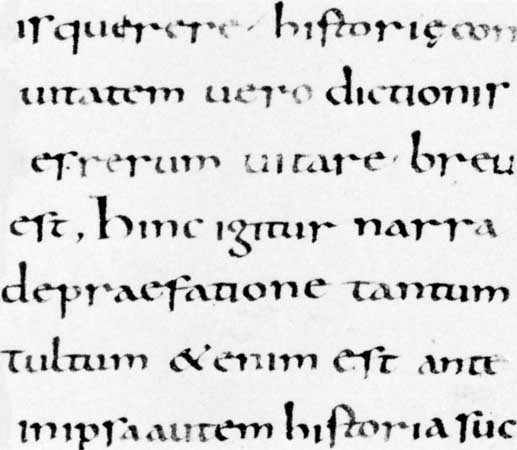
‘Gothic’ script dominated the ‘Gothic’ era, and it can be contrasted with the Carolingian script revived by many Renaissance scribes:

Petrarch complained that Gothic script, “had been designed for something other than reading,” and he was not whining, but speaking the truth.

Gothic Script

The height and cramped fashion of letters makes it difficult to read, and may subconsciously have been designed to be “seen and not heard.”  When we remember that very few could read, and that books were meant to educate visually just as much as textually, the Gothic “font” makes more sense.

Gothic Manuscript

Here are examples of the Carolingian script fashionable during the Renaissance:

Perhaps pro-Renaissance scholars do not exaggerate the real shift that took place as far as education is concerned.  Perhaps this shift in handwriting style helped pave the way for the printing press itself.

If the “font’s” a society uses reflect something of its larger worldview, we would expect to see this expressed in other aspects of their culture.  Gothic architecture mirrors gothic script in uncanny script in uncanny ways, with the “bunched up” nature of its space.

Flying Buttresses

True, the high ceilings of these cathedrals did give a sense of space, but it was space that meant to overpower you, a weight and bulk of a different kind.  The stained glass windows again reveal the same thing as the buttresses — the “cramming” full of space with color.

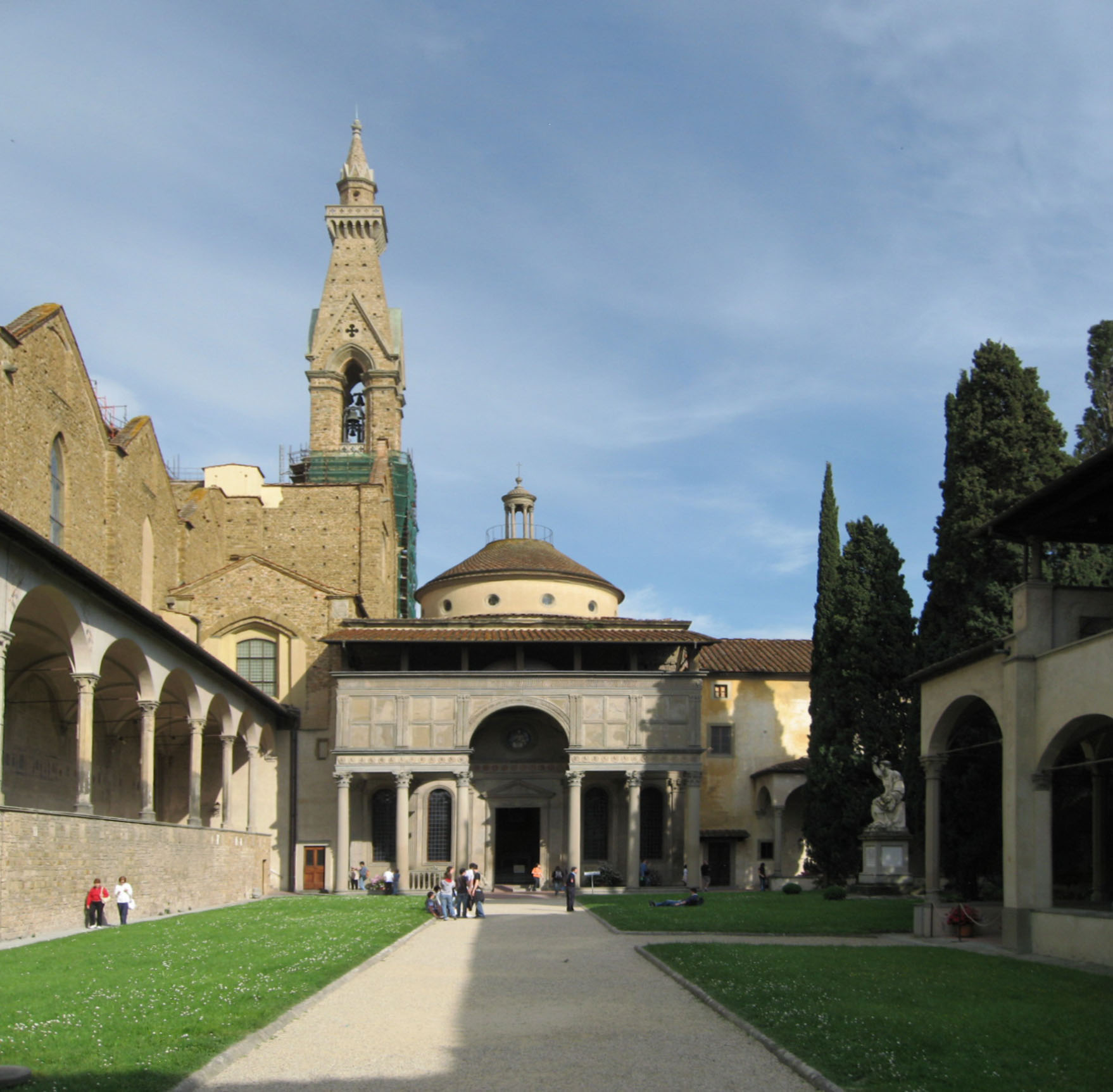
In the Renaissance we see something else entirely, a more “human” scale in architecture, and a greater sense of space.

The Pazzi Chapel

Michelangelo, the Medici Chapel

So apparently, handwriting can be an expression of a culture’s personality just as architecture can, which should not have surprised me.

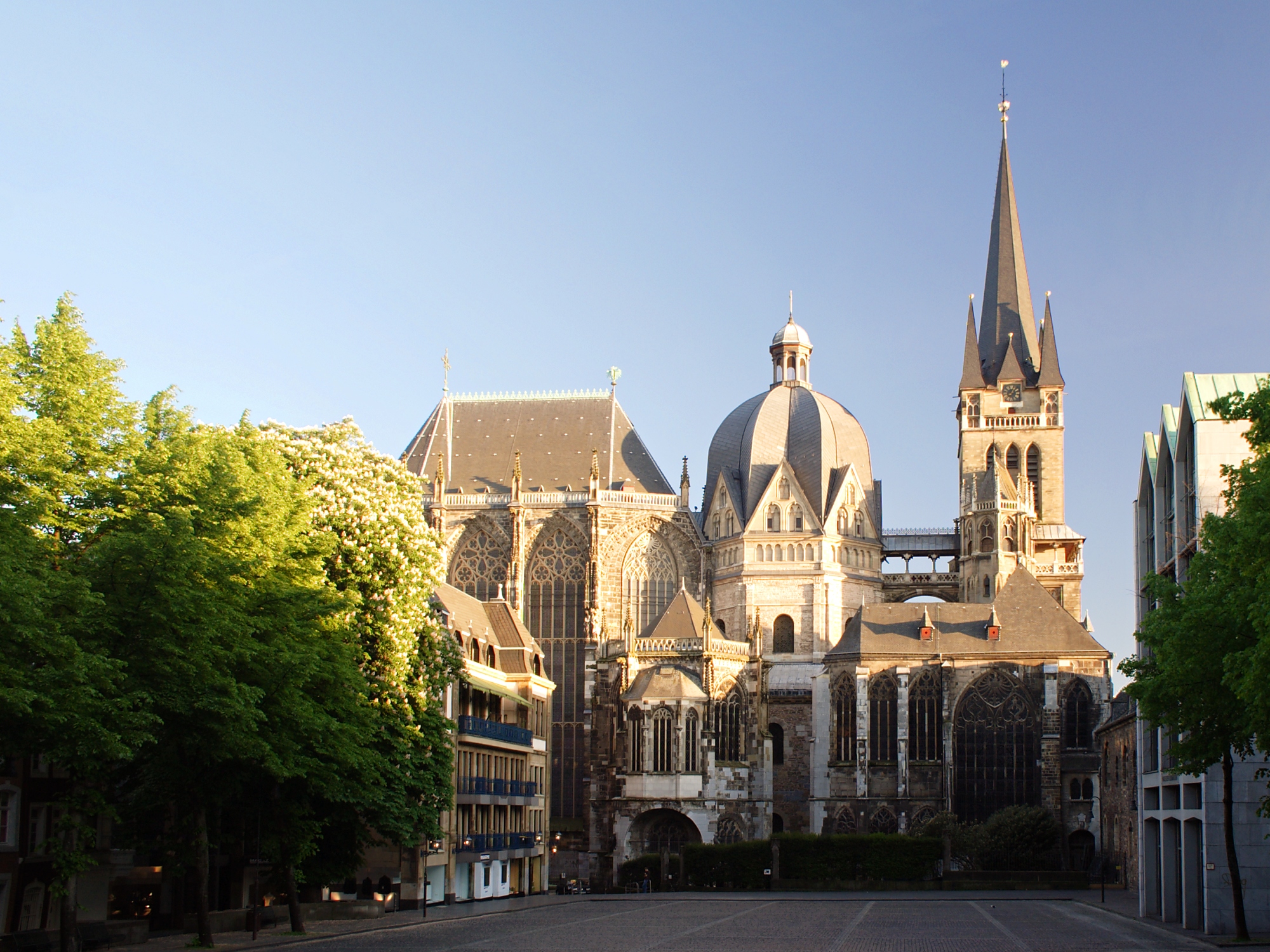
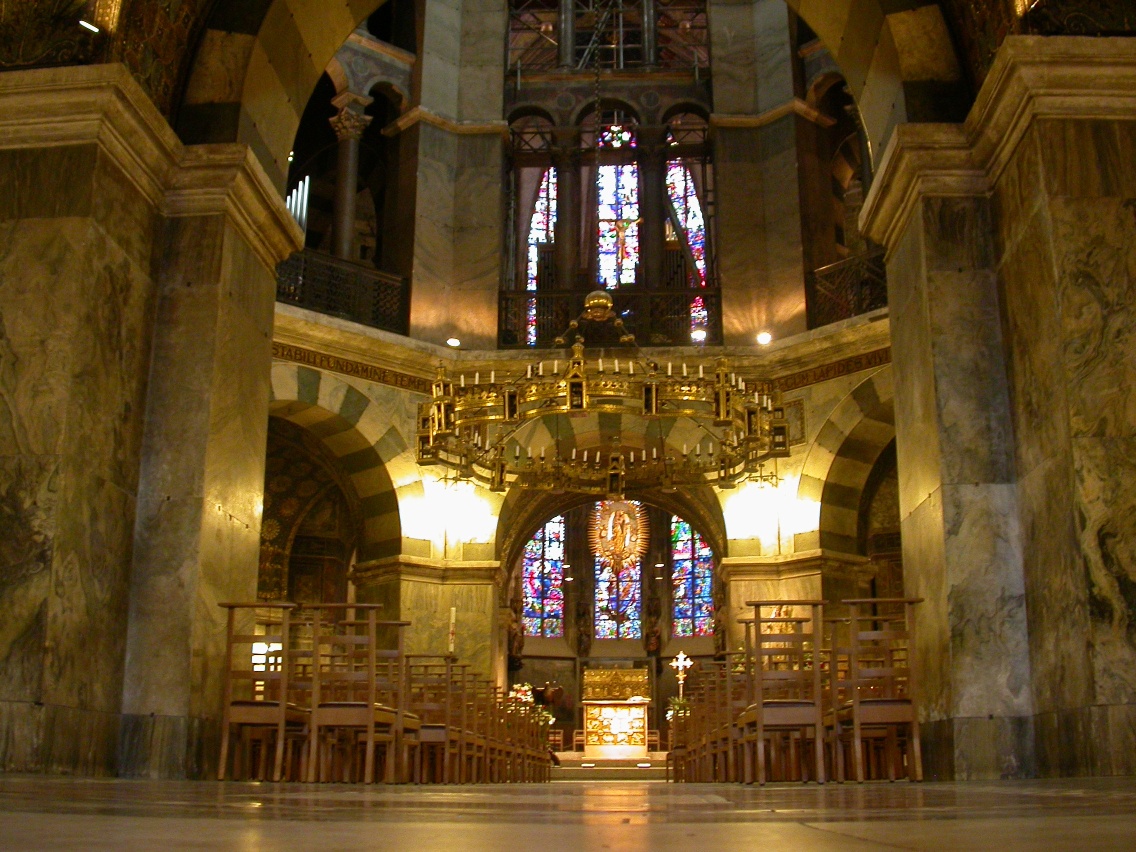
When I realized that the Renaissance basically just revived Carolingian script, this gave new significance to the Carolingian Renaissance itself under Charlemagne six centuries earlier.  Those that invented the style and not merely copied it should get greater credit.  Some scholars dismiss the “Carolingian Renaissance,” as small potatoes, but the script they used showed an interest in reading, which sheds new light on the work of Nottker and Einhard.  So, what about architecture under Charlemagne — will it show that same sense of space?  Naturally we must consider Aachen Cathedral, the central building of Charlemagne’s realm:

Aachen Cathedral, Exterior

Aachener_dom_oktagon

Well, it appears that we have a mixed verdict.  It is part Gothic, part Byzantine, and part something all its own.  Will I allow this to overthrow my theory of seeing links between handwriting and architecture? Perish the thought!  I can always say that Charlemagne’s time had so much going on that they had no time to be particularly self-aware of these choices, in contrast to both the Gothic and Renaissance periods.

Does America’s utter lack of defining architectural identity have anything to do with our confusion about teaching handwriting?

Blessings,

Dave

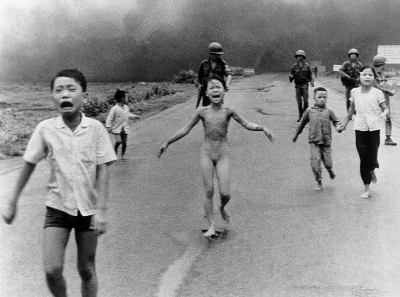
11th Grade: “The bombs in Vietnam explode at Home”

Greetings,

This week we continued our look at the Vietnam War, but also focused on the Civil Rights movement.

Vietnam has many controversial aspects, including the way we fought the war.  I think our massive bombing campaigns attracted Johnson for political reasons.  He campaigned in ’64 on a “I don’t want to want to get too involved in Vietnam,” platform and won easily. Bombing allowed us to do something while committing relatively few men and risking relatively few lives compared to other options.  At the same time, our bombing could send the message to the North that we meant business.

But our military actions have a meaning to them that extends far beyond their direct military impact.  Bombing proved disastrous in a number of ways:

  • Bombing, while low-risk, comes with great expense.  As Martin Luther King said, “The bombs in Vietnam explode at home.  They destroy the chance for us to create a decent America.”
  • In jungle terrain, bombing had little to no effect on enemy movements or their ability to fight
  • Bombing makes us look like a bully.  Here we are, the most advanced society on earth, dropping explosives from a safe distance upon a peasant society.  Human nature loves an underdog, and perhaps Americans especially loves them.  Our tactics made the North Vietnamese look like the team a neutral observer would root for (we need to think in similar ways about our use of drones today — how are drone strikes interpreted by the global population?)
  • Finally, one could argue that bombing sent a message not of the strength of our resolve, but of our lack of it.  We know that Johnson wished desperately that the war in Vietnam would “go away.”  Bombing brought little domestic fall-out initially, because it would mean relatively few casualties for us. Ho Chi Minh could easily have interpreted bombing as Johnson’s way of trying to avoid the hard questions Vietnam brought.  It appears that they did just that.

We lost the battle for public opinion in the war by around 1967.

General Westmoreland’s tactics of “Search and Destroy” proved strategically ineffective in the long run.  We like to think of our armed forces as tool for good.  We understand that that might mean violence, but most of don’t want to think of our military primarily being used to kill others.  Westmoreland did not focus on protection, but on “body counts.”  How many of the enemy did we kill?  This does not have the same ring, as “How many innocent lives did we protect?” though obviously that could involve killing the enemy.

The North Vietnamese certainly committed atrocities — more of them than we did and with greater scope.  They usually treated civilians much worse than us, sometimes intentionally using them as human shields.  Their atrocities did  not get equal media attention.  But I suspect that even if such atrocities had been well-reported, it may not have made much difference.  We expected others, the “them,” to be the bad guys.  Nothing in our national psyche or identity prepared us not to like what we saw in the mirror.  One sees this self-delusion in those that said, “The only thing that can defeat America is America,” which asserts that we can attain omnipotence if only we will it.

De Tocqueville and many others have commented that when democratic armies have the support of the population they become very difficult to stop.  Democratic armies naturally seek to draw strength from the people.  But when they cannot do this, their effectiveness gets diminished.  This is something that democratic societies must bear in mind in a way that dictatorships, for example, do not.  In Vietnam, I believe that most historians would agree that we did not fashion a “way of war” that lent itself to gaining the support of the people.  The North Vietnamese realized our predicament long before we did.  Le Duan Thoc, a North Vietnamese strategist, commented fairly early in the war,

[We can win no matter what the United States does.]  They will fight far from home and will be regarded as an old style colonial invader, in a climate to which they are not accustomed, against indigenous forces backed by China and the Soviets.  If they invade the North they will face 17 million of us, and potentially hundreds of millions from China.   If they use nuclear weapons the Soviets will retaliate.  The more they risk, the more they alienate the international community and erode support domestically – the more too they are vulnerable to a crisis in other parts of the world.   The enemy is in a weak position.

Some argue that, in fact, we could never have won in Vietnam.  Eventually we would go home, and they would remain.  Others counter with the argument that, had we fought in a way that focused on security for the South rather than killing the enemy, we could have won over public opinion and given the South Vietnamese government a chance to work.  We in fact began to try this strategy in 1969 when General Abrams replaced Westmoreland, but by then America had given up the fight in our hearts and minds.  Of course, some believe we could have won if we had fought differently, either with more bombing in Cambodia and Laos, or with a different style of fighting (perhaps fewer men and more covert operations).

We also looked this week at how the Civil Rights movement transformed over time.  The enormous moral force of those that demonstrated for equal treatment overwhelmed opposition.  Television brought the issue to the forefront of American homes across the country, much as the Fugitive Slave Law of 1850 moved the slavery question from the abstract to the real for many Americans.  The movement peaked in 1965 with the Voting Rights Act.

But then something happened.  Violence erupted in many cities across America over the next two years, beginning with the Watts riots in Los Angeles.  Student protests spiked sharply.  The fringe “Hippy” movement went into the mainstream.  How did this happen?  At the moment when it seemed that America had become more of the kind of country it was supposed to be, why did so many subsequently turn to violence?

This paradoxical question will occupy us next week.  What I suggest for now is that King’s words above may not have  been merely metaphorical.

Many thanks,

Dave

Standardization is Decline, Easy as ABC

A few years ago I wrote another post under this same theme about restaurant regulation in the EU, based off a particular quote from Arnold Toynbee, which reads,

In a previous part of this study we have seen that in the process of growth the several growing civilizations become differentiated from one another.  We shall now find that, conversely, the qualitative effect of the standardization process is decline.

This idea that “standardization is decline” is exactly the sort of pithy phrase that drew the ire of many of Toynbee’s critics.  In his work Toynbee attempted to create universal general laws of history based on his premise of the uniformity of human nature.  Toynbee’s writing could sometimes degenerate into ideas that seem so general as to be almost meaningless.*  On the subject of standardization, we easily see that surely not every instance of standardization brings decline and limits freedom.  Standard traffic laws, for example, make driving much easier and much safer.  Toynbee’s critics have a point.

But some of Toynbee’s critics seem afraid to say anything without caveating it a million different ways, and this too is another form of saying nothing at all.  Toynbee’s assertion about standardization is of course is not true in every respect, but is it generally true?

I like historians like Toynbee who try and say things, and no one I’ve come across tries to “say things” like Ivan Illich.  Toynbee threw down a magnificent challenge to the prevailing view of history (in his day) that more machines, more territory, more democracy, more everything meant progress for civilization.

But he did not know Ivan Illich, who allows almost no assumption of the modern world to go unexamined.  Toynbee poked at some of our pretty important cows.  Illich often aims for the most sacred.  In Medical Nemesis he challenges the assumption that people today are healthier than they were in the pre-industrial era.  In ABC, he (with co-author Barry Sanders) attacks the idea that universal literacy brings unquestioned benefits to civilization.  In fact, he argues the quest for rote literacy will end with meaninglessness and possibly, tyranny.

Illich begins the book by referencing a quote of the historian Herodotus, who wrote 1000 years after the death of Polycrates. He commented that the tyrant of Samos,

was the first to set out to control the sea, apart from Minos of Knossos and others who might have done so as well.  Certainly Polycrates was the first of those whom we call the human race.

Illich comments that,

Herodotus did not deny the existence of Minos, but for him Minos was not a human being in the literal sense.  . . . [Herodotus] believed in gods and myths, but excluded him from the domain of events that could be described historically.  He did not see it as his job to decipher a core of objective historical fact.  He cheerfully [placed] historical truth alongside different kinds of truth.

This may seem an odd place to begin a book about language.

Later Greek and Roman historians attempted to explain the minotaur and Minos not as myth but as exaggerated historical reality.  So, the sacrifice to the minotaur must really have been a sacrifice of perhaps money or troops to some cruel despot.  Herodotus will have none of this, and neither will Illich.  Those that seek to explain away myths attempt a kind of standardization of truth.  This standardization inevitably involves a reduction, a narrowing, of the meaning of truth, language, and human experience.  I think this explains why he begins with this quote from Herodotus.

Historians misread prehistory when they assume, Illich contends, that language is spoken in a wordless world.  Of course words can exist without exactly defined meanings that last beyond the context in which they were spoken.  But many often assume that this means we have barbarism because without an established language, we cannot have “education” in the sense that we mean it.  Speech remains different from language.  Lest we think that Illich is nuts, we should consider the impact of early forms of standardization:

  • In ancient Egypt, scribes with a unified written language could keep records, and could thus hold people accountable to pay taxes, work on the pyramids, etc.
  • In ancient China, too, the power of scribes over language gave them enormous power within the halls of power.
  • Illich argues that medieval oaths used to be distinctly personal.  Those that swore would clasp their shoulder, their hands, their thigh, and so on.  Towards the end of the Middle Ages, with the rise of Roman, classical concepts of law came the fact that one’s signature stood as the seal of an oath.  By “clear” we should think, opaque, or lacking substance because it lacks context.  This impersonality can give way to tyranny.
  • Henry II attempt at reforming English law (and thus, it would inevitably seem, unifying language as well) was done to increase his power by making it easier to govern and control the population.  Does not much of modern law do the same thing?
  • Isidore of Seville once wrote (ca. 1180) that letters “indicate figures speaking with sounds,” and admitted that until a herald spoke the words, they had no authority, because they had no meaning.  The modern age allows those in power to multiply their authority merely through the distribution of lifeless pieces of paper.
  • One of the first advocates for a universal language and literacy, Elio Nebrija, made his argument just after Columbus set sail.  He bases his argument on hopes of creating a “unified and sovereign body of such shape and inner cohesion that centuries would not serve to undo it.”  He frankly admits that the diversity of tongues presents a real problem for the crown.

Regarding Nebrija, Illich makes the thunderous point that he sought a universal language not to increase people’s reading but to limit it.  “They waste their time on fancy novels and stories full of lies,” he writes to the king.  A universal tongue promulgated from on high would put a stop to that.

We might be surprised to note that Queen Isabella (who does not always get good treatment in the history books) rejected Nebrija’s proposal, believing that, “every subject of her many kingdoms was so made by nature that he would reach dominion over his own tongue on his own.”  Royal power, by the design of the cosmos, should not reach into local speech.  Leave grammar to the scribes.

We live in a world of disembodied texts.  The text can be analyzed, pored over, dissected in such a way as to kill it.  As the texts lack a body, the text remains dead and inert.

But just as we assume that meaning comes when a text is analyzed rather than heard, so too we have created the idea of the self merely to analyze the self.  Ancient people, up through the medieval period, do not possess a “self” in the modern sense.  We see this in their literature.  No stratified layers exist in an Odysseus, Aeneas, or Roland.  No “self” exists apart from their actions.  So too in the modern era the self lacks meaning unless the self is examined.  So we turn ourselves inside out just as turn over the texts that transmit meaning.   But who is more alive, Roland, Aeneas, and Alexander Nevsky, or the man on the psychologists couch?

We might think, maybe the drive for universal literacy back then meant squelching freedom but now surely it is a path to freedom.  After all, we tout education as the pathway to independence, options in life, and so on.  Illich will not let us off the hook.  Education according to whom?  Universal literacy, again, can only be achieved through universal language.  And universal language implies a standardized education.  So to prove we are educated we need the right piece of paper, paper only the government can grant.**

Back to square one again.

So the passion for universal literacy ends in the death of meaning, and the death of the self.  In his final chapter Illich examines the newspeak of 1984 and sees it as the logical conclusion of universal literacy.  Words will mean what the standard-bearers of words say they mean, and this in turn will define the nature of truth and experience itself.

ABC is a short book and easy to read.  But in another way, reading Illich can be very demanding.  He asks you not just to rethink everything, but to actually give up most everything you thought you knew.  Agree or not, this makes him an important writer for our standardized and bureaucratic age.


Dave

*Obviously this post is not about Toynbee, but as much as I admire him and as much as I have learned from him, Toynbee’s latent and terribly damaging gnosticism (which comes from his failure to understand the Incarnation and the Resurrection) did at times lead him into a kind of a airy vagueness that greatly limits his persuasive power.

**I suppose to get Illich’s full argument on this score we would need to read his Deschooling Society.

12th Grade History/Civics: “To be, or not to be. . .”

Greetings,

This week we continued with the Cold War in earnest and took a look at a few key issues and events:

England and America could see the Cold War coming as W.W. II ended.  The unfortunate Eastern European nations of Poland, Hungary, Rumania, and Bulgaria exchanged one conqueror for another.  Soviet dictatorship may not have been as bad as Nazi occupation, but that is hardly saying much.

Atomic weapons quickly became prominent, although not necessarily because we wanted it that way.  Free societies maintain themselves traditionally through a volunteer military, except in emergencies.  With the war over hundreds of thousands of soldiers looked forward to returning home and resuming normal civilian life.

But the Soviets did not disband their army.  They kept it active and occupied much of Eastern Europe.  How could we respond?  We could either:

  • Keep the draft going and maintain our military at W.W. II levels, which might also mean continuing the war-time command economy.

Or

  • Use atomic weapons as a kind of equalizer against the sheer volume of Soviet troops.

The latter option appealed to us for many reasons, but of course created other problems.  If the Soviets eventually got “the bomb,” how then do we maintain our advantage?  Do we make more atomic weapons?  Or do we make them more powerful?  The arms race was on, and one consequence of this was the proliferation of weapons able not to just win wars but wipe out civilization as we know it.

Another problem with nuclear weapons revolves around what exact purpose they serve.  Are they weapons?  This seems obvious on its face.  Of course they are weapons.  But can something be a weapon if you would never actually use it?  No — then it’s just a very expensive and very dangerous showpiece.  But could nuclear weapons actually be used?  For once used, Pandora’s box opens.  Could a nuclear war have a winner?

So, did nuclear weapons in reality function much like status symbols, reflecting the image of power rather than actually having power?  But then again, if everyone thinks they are just status symbols, they pose no threat.  And clearly, these weapons posed a huge threat.  We could not contemplate the consequences of using them, and we felt that we needed to have them ready to use at a moment’s notice. These were some of the terrible dilemmas the Cold War gave us.  The confusion between image and reality bore itself out in this Civil Defense video many elementary school children saw in the early 1950’s:

The idea that we may not have known exactly what we had on our hands gets reinforced from the Castle Bravo disaster in 1954.

At its core, the Cold War presented us with the dilemma of how to win a war without actually fighting the other side.  How could you win a boxing match if neither opponent could touch each other?  Much of our strategy revolved around the following premesis:

  • Communism can only survive as a parasite.  It cannot internally sustain itself, so the only way it can live is by feeding off of others.  Thus, it is imperative to deny them access to new territory, for each new piece of territory will artificially extend their life-span.
  • Since fighting the Soviet Union directly would have exceedingly dire consequences, we have took for non-traditional, or “asymmetrical” ways to fight.  Economic advantage, and our political image, among other things, would play key roles in this conflict.

The Korean War often gets ignored, sandwiched between World War II and Vietnam.  I myself usually breeze over it, but every so often the conflict makes itself very relevant.  The issues involved deal with many of problems discussed above.  Commentators could argue that we

  • Won the war, because after the invasion of the North we pushed the North out of South Korea.
  • Lost the war, because we failed to destroy North Korean forces, largely due to the intervention of China, and got pushed back out of North Korea
  • Tied, because the status quo was restored, but nothing more.

While we could not go through the entirety of the history of the war, the impact of our involvement would have large, though subtle ripple effects in our own society.

  • The Korean War was unquestionably a war, yet the Senate never declared war.  Obviously this was not the first time that we had used troops and not declared war formally, but the scale of the conflict and commitment exceeded previous undeclared wars.
  • After the Korean War we began to maintain a continuously large standing army, a break from the past.
  • The war also raised questions about executive power and the role of Congress.  As foreign policy came to dominate, the power of presidency inevitably increased, but for the most part, these questions have no resolution as of now.

A brief aside, every political commentator of which I am aware from the classical era down to the early modern age (Aristotle, our own founders, etc.) argued that a large standing army posed a dire threat to liberty.  That is, no militarized state could maintain political freedom indefinitely.  Whether they were wrong, or our exception proves the rule, or perhaps our political system has indeed suffered because of this is a point of great debate.

Many of these questions came to a head in October 1962 in the Cuban Missile Crisis, where under a cloak of deceit, the Soviets started building missile silos to house nuclear warheads capable of reaching at least 1/3 of the U.S. mainland.  We could either . . .

  • Ignore the problem.  Perhaps it would not be worth it to get them out, or perhaps we did not have the political will to stop them from installing them.  As parents we sometimes ignore things that we would rather not deal with at the moment.  We then file the incident away to be used later if we need to.
  • Acknowledge the presence of the silos/missiles, but do nothing about it, which would make us look terribly weak.
  • Insist that the missiles not be installed and prepare to take action to prevent it.  Easy to say, but hard to do, because it begs the question of how far we would go.  Would it be worth W.W. III to prevent it?  Would it be worth a global nuclear holocaust?  Maybe we would not actually launch nukes, but do we then bluff and claim we would?  Would that escalate or diffuse the crisis?

Records indicate that initially most favored an air strike against the silos.  Most agreed that we had a good chance of eliminating the silos via bombing, with minimal casualties.  But it would involve a military attack on one of Russia’s allies, and we could not be sure how they would respond.  Would they then take West Berlin?  What would we do then?

Perhaps these questions led Kennedy to decide on a naval quarantine which would prevent the installation of the missiles, and also give the two sides time to talk.  It forced the Soviets to back down or be the first to take aggressive action.

But none of this attempts to see the crisis from the Soviet perspective.  If the U.S. had concerns about missiles 90 miles from our shores, what about the fact that we had missiles 90 miles from the Soviet Union in Turkey?  What about the Bay of Pigs?  One could easily argue that the missiles in Cuba served peace, if you believed that strategic parity gave the best guarantee of avoiding conflict.

In the end the Soviets agreed to remove the missiles if we pledged never to invade Cuba and removed ours from Turkey, which we agreed to do, albeit secretly.  Many felt that we had won, and many praise Kennedy for his handling of the crisis.

But as time passed, we learned more about just how close we came to disaster.  In the documentary The Fog of War, Defense Secretary Robert McNamara discussed his meetings with Castro in 1992 below.

If these revelations are true, the air-strike we nearly decided upon would have led to disaster.  When one understands the possibilities inherent when human fallibility combines with enormous destructive power, we can only thank God that nuclear war did not happen in 1962.

Next week we move on to Vietnam.

Blessings,

Dave

Breathe In, Breathe Out

I have very fond feelings for Will Durant. His multi-volume series The Story of Civilization was an absolute lifeline for me in my early years of teaching, and reading those volumes propelled me to some wonderful primary sources. His insights were not as profound as those of his contemporary AJ Toynbee, but he wrote with a more whimsical touch.

In Durant’s The Lessons of History (co-authored by his wife Ariel) he includes an essay on the question of whether or not progress is real. In grand Thomistic fashion Durant begins by proposing a negative answer. Philosophy will never eclipse Plato, literature will not move beyond Shakespeare. Science heals but also has created new forms of death and accelerated our means to destroy each other.

But Durant then pivots, and affirms that we have progressed–not in happiness (we will always find ways to be unhappy)–but in command over the environment. Famine and other natural disasters no longer decimate millions each year, and Durant asks,

“Are we ready to scuttle the science that has so diminished superstition, obscurantism, and religious intolerance, or the technology that has spread food, home ownership, comfort, education, and leisure beyond any precedent?”

He continues and admires the expansion of education, stating that

“If education is the transmission of civilization, we are unquestionably progressing … our finest contemporary achievement is our unprecedented expenditure of wealth and toil in the provision of higher education for all … we have raised the average level of knowledge beyond any age in history.”

It is a fine argument, and as always, wonderfully written.

In 1845 Thomas Macaulay wrote eloquently in favor of the Progress narrative:

It is now the fashion to place the golden age of England in times when noblemen were destitute of comforts the want of which would be intolerable to a modern footman, when farmers and shopkeepers breakfasted on loaves the very sight of which would raise a riot in a modern workhouse, when to have a clean shirt once a week was a privilege reserved for the higher class of gentry, when men died faster in the purest country air than they now die in the most pestilential lanes of our towns, and when men died faster in the lanes of our towns than they now die on the coast of Guiana.

We too shall, in our turn, be outstripped, and in our turn be envied. It may well be, in the twentieth century, that the peasant of Dorsetshire may think himself miserably paid with twenty shillings a week; that the carpenter at Greenwich may receive ten shillings a day; that labouring men may be as little used to dine without meat as they now are to eat rye bread; that sanitary police and medical discoveries may have added several more years to the average length of human life; that numerous comforts and luxuries which are now unknown, or confined to a few, may be within the reach of every diligent and thrifty working man

But even Macaulay, amidst his rhapsody, at least gives a quick nod to the counter argument:

And yet it may then be the mode to assert that the increase of wealth and the progress of science have benefited the few at the expense of the many, and to talk of the reign of Queen Victoria as the time when England was truly merry England, when all classes were bound together by brotherly sympathy, when the rich did not grind the faces of the poor, and when the poor did not envy the splendour of the rich.

Most ancient historians claim that things have gotten worse, that we progress from golden ages, to silver, to bronze and iron, a descent from heaven to earth. A middle position exists that I want to explore, one that questions the main arguments of the progress and decline narratives–though obviously certain kinds of progress and decline happen–and instead focus on the idea that “there is nothing new under the sun,” and be guided by St. Gregory of Nyssa’s treatise, On the Making of Man.*

Consider what follows speculative . . .

Humanity may progress in certain ways, and decline in others, but will always be limited by the circumstances of his creation. We are meant both to reflect God to world and to mediate the world to God. As such we have elements both of movement and stability in our nature. St. Gregory writes,

It may be, by a providential dispensation, so that the property of nature which constitutes its immutability and immobility might not, when viewed in any created object, cause the creature to be accounted as God; for that which may happen to move or change would cease to admit the conception of the Godhead.

Hence the earth is stable without being immutable, while the heavens, on the contrary, as it has no mutability, so has not stability either, that the Divine power, by weaving change in the stable nature and motion with that which is not subject to change, might by the interchange of attributes, at once join them both closely to each other, and make them alien from the conception of Deity.

That is, God makes us in such a way so that we can neither have the presumption to be God, but also see that we are more than the beasts. We have this duality within us, meant to exist in harmony.

St. Gregory makes many such connections between the rhythms and operations of nature and our own flourishing as human beings made by God. He comments that many creatures are larger, stronger, and faster than us, yet we have dominion over them–a seeming puzzle. He answers this disarmingly by stating that if we were to be the largest, fastest, and strongest of the creatures we would surely look rather funny–misshapen and unbalanced, “wild looking.” But as he stresses our dominion over creation, he does so again by establishing our connection with it.

. . . moreover, he would have neglected his rule over the other creatures if he had no need of the co-operation of his subjects.

St. Gregory establishes (so it seems to me) an irrevocable connection between God, man, and nature, writing elsewhere that,

The creation of man is related as coming last, as of one who took up into himself every single form of life, both that of plants and that which is seen in brutes.

So, although we are all always in a state of flux, we have stable elements, just as creation itself is both stable and fluid. We never step into the same river twice, and yet it is still the same river. And while some may see hints of evolutionary ideas in St. Gregory’s above comment, I think that he would say that creation reflects man more so than man reflects creation.

Given this, we can ask in regards to the question of progress–can creation “progress?” Certainly dirty water can become clean, but we might call this a “return” more than an “advance.”

We should think similarly in terms of human progress.

What I mean is that what we often call progress may be simply a reflection of how we breathe. We inhale, that is:

  • We draw things into ourselves
  • We concentrate our being, we focus, or in other words,
  • We centralize our being

And we exhale, meaning

  • We disperse things from our being
  • We separate the good and bad, the proper and improper
  • We get looser physically and mentally, we de-centralize**

We shouldn’t call inhalation or exhalation progress, but we often do. So, for example, many heralded the changes we made in the area of national intelligence in the wake of 9/11. We centralized our intelligence gathering–we inhaled. Surely this was correct? But in the wake of our intelligence failure after Pearl Harbor we determined that we needed to exhale and de-centralize intelligence agencies so we could have multiple views to consider. Both seemed like exactly the right thing to do given their respective contexts, and maybe both were correct actions to take, but neither can be termed “progress,” though it may feel like it at the time. What we might instead be doing is returning to a proper balance, or recalibrating temporarily.

Of course we usually want avoid dramatic inhalation and exhalation, which we only do as humans exerting ourselves or trying to de-escalate an emotional situation. We cannot continue for long in such a state.

We can take the state of education, so lauded by Durant, among others. Democratic education “inhales” a great deal by taking in everyone it can. But this has led to a kind of hyper-concentration in education, which can only lead to more centralization and standardization. So, naturally we see the rise of importance in standardized tests, which have the effect of getting teachers to “teach to the test.” In what sense has education truly improved in the last 100 years? What we can say for sure is that it has done some things at the expense of others.

Democracies possibly overvalue the “fluid” elements of our created selves, and trust in the free flow of people, goods, and information. The New York Times recently announced, for example, that it would “open up” its process of how it endorses presidential candidates and make it more transparent. Surely transparency means progress in any democracy? But as Alex Tabbarok pointed out, this will likely make all of the candidates far less candid than they might have otherwise been when talking with the Times. Certain stances they might have explained as a kind of horse-trading off the record they would never reveal in a more public forum. When the scale tips too far in the “fluid” direction, the natural reaction brings us to excessive solidity. “Progress,” so called, seems impossible in either direction, and that by design. The structure of creation, our bodies, etc. makes utopias impossible.

Perhaps the most striking form of progress surely is the application of science to food production and the eradication of disease. We live healthier and longer than in the past. Infant mortality has decreased dramatically. Unquestionably, the argument goes, this is progress that all can champion without qualification.

This certainly strongly challenges my argument–and most every argument has its limits. Still, perhaps these significant improvements do have a hidden cost of separation from the very creation that nurtures us and with whom our identity is inextricably linked. Here, I will admit, however, that it is hard to argue against progress of this kind.

Maybe . . . certain kinds of progress are possible.

But I think the larger point still remains, one that we do well to consider as we head towards another election cycle. Some may feel that Trump has lurched us too far in one direction, so that the solution is go hard in the opposite direction. This will exhaust us quickly. Rather, as St. Gregory taught us, we need to be a nation that takes calm and measured breaths.

Dave

*I should state at the outset that I do not find St. Gregory an easy read, and I make no certain claim to interpreting him correctly, though hopefully I have at least applied his words in the right spirit.

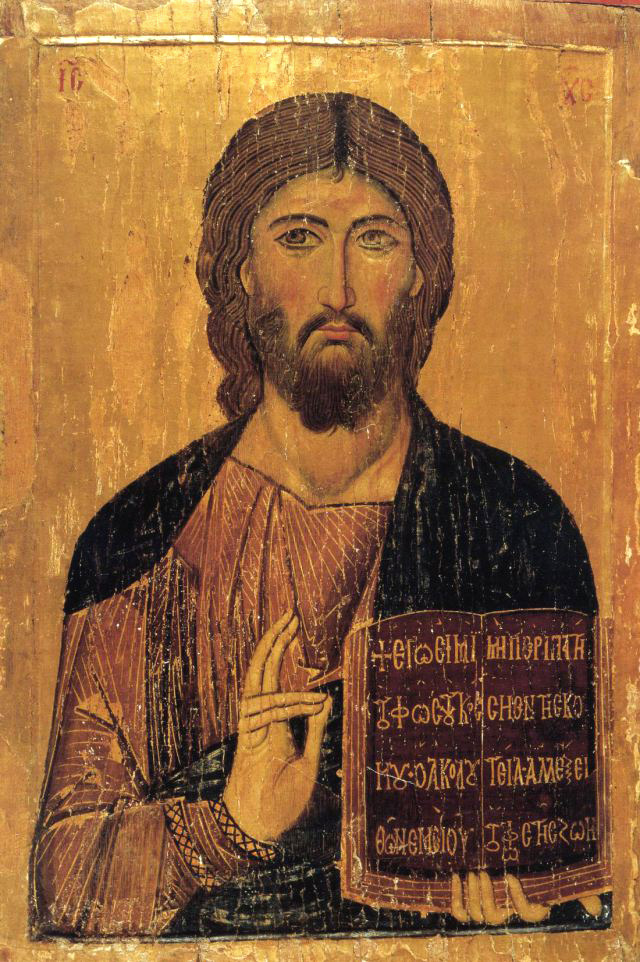
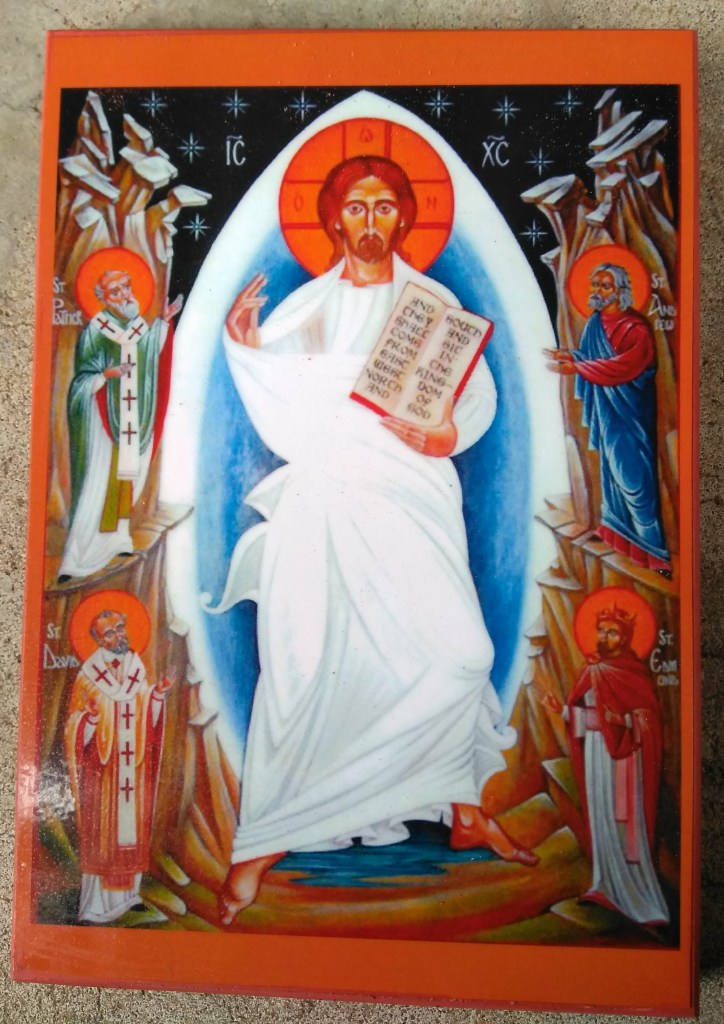
**This process of gathering in and pushing out is reflected in almost every icon of Christ, as He blesses with His right hand (drawing in) and separates with his left (in the form of a scroll, the Book of Life, which makes distinctions between people, etc.), further testimony to this pattern at the very Head of Humanity itself.

In the Byzantine icon below, the blessing/”drawing in” motif is more explicit, as His right hand almost seems to draw one towards Him:

A more modern icon, “Christ of the Isles” (Celtic style), that abides by the traditional pattern . . .

11th/12th Grade: Ending the War Justly(?)

Greetings,

This week we wrapped up World War II by focusing on two key issues: our use of the atomic bomb, and the Nuremberg Trials.

We discussed before how war in general can have a terrible kind of osmosis for the combatants.  So in W.W. I the Germans first used chemical warfare and all cried foul, but soon the Allies followed suit.  All were outraged when the Germans bombed London, but as the war went on the British and Americans killed far more civilians with their bombings than the Axis powers.  Herman Goering called the conflict, “the great racial war,” and Americans as well as the British adopted some similar attitudes to their enemies as the Axis powers did to us.  This proved especially towards our Japanese opponents.  This picture, for example, of a young woman admiring the skull of a dead Japanese soldier her boyfriend sent her, appeared prominently in Life Magazine.  

A few issues regarding the bombings need discussed:

1. Is it the primary job of the commanding officer primarily to abide by a a Christian ethic of human life even if it puts his troops at relative disadvantage, or do we want him to instead seek to have his men accomplish their mission with as few casualties as possible?  What about the President?  It is worth noting that Air Force General Curtis LeMay, who led many of the bombing runs that killed hundreds of thousands of Japanese, thought that he would be tried as a war criminal should the Allies lose the war.

The divide here may be seen this way. . .

  • On the one hand, you have the view that “war is hell,” and exists essentially outside normal ethical standards.  Killing someone, for example, is never the “kind” thing to do.  The main goal, therefore, is to end war as soon as possible, and then resume “normal” life.
  • On the other, you have the view that war is not primarily about victory, but about our sanctification as individuals and as a nation.  If fighting “morally” means we suffer, so be it.  Just as individuals should never do wrong to benefit themselves, so nations should not either.

Granted, this divide may be altogether too simplistic. but it touches on another issue.  What are nations?  When a nations acts should it be held to the same standards as individuals, or are nations in fact artificial, impersonal creations that therefore are not subject to the same standards as individuals?

These questions have no easy answers.

2. Should the ethics of war depend in part on the nature of conflict itself? For example, conflicts in the past involved armies of aristocratic warriors, and rarely involved the general population.  In the 20th century however, war between whole nations became the standard.  If nations fight, can the whole nation, civilian or otherwise, become the target?  I hope the students will consider some difficult questions.  Is there a difference between bombing cities from the sky, and going from house to house shooting those inside?  Can you target areas if civilians are likely to be unintended collateral damage?

Our decision to use the atomic bomb had many factors involved:

  • We wanted to avoid a mainland invasion of Japan, which would likely have cost us at least 100,000 casualties, with some estimates being much higher.
  • We wanted to end the war before the Soviets could get involved and take Japan for themselves.
  • While we could have bombed Hiroshima conventionally with a comparable destructive impact, the atomic weapon had much greater potential for psychologically impacting them.

Our use of the two atomic weapons, “Fat Man,” and “Little Boy” did have the desired effect.  Japan did surrender without us needing to invade.  But nearly all Japanese that died in these attacks were civilians.  For the first time in my teaching career, almost all of the students thought that the decision to use the bomb could not be justified.

Germany’s surrender left us with a variety of post-war dilemmas.  The magnitude of the evil perpetrated in the Holocaust numbs the mind.  Never before in history had such a thing happened on such a scale.

But what should we do with Nazi leaders that surrendered?  Should they be released into civilian life again, as if nothing happened?  Or should they be shot out of hand?  Neither option seems to satisfy.  Putting them on trial had many advantages to it.  We would give them legal counsel.  They would have a fair chance to prove their innocence or at least mitigate their guilt.  This was the “civilized” option.

But that too posed problems.  What right did we have to put Germans on trial?  They were not American citizens and had broken no American laws.  To what kind of law can we hold them accountable?  We can argue for international law, but the Germans had withdrawn from international agreements and oversight before the war began.  Thus, they were not accountable directly to international laws they never pledged to obey.  What legal procedures should even govern the trial?

Furthermore, how could the trials be fair if all the judges were Allies?  Should the Germans have the right to a trial of their peers?  But would that eliminate the possibility of guilty verdicts?  Could the trials be fair if the Soviets participated in the prosecutions?  But how could we exclude them, considering that the Soviet Union suffered far, far more casualties than the U.S. and England combined?

The trials raise many perplexing legal questions, but also difficult moral ones.  How far should the “I was just following orders defense,” be allowed to go?  How far down the chain of command should we prosecute?

Eichmann served in the S.S. and played a role in the Holocaust.  He ended up escaping from Germany, and was captured by Israeli’s 15 years after the end of the war and put on trial.  Many remarked on how ordinary a man Eichmann was.  Hannah Arendt’s famous phrase “the banality of evil” fit him perfectly.

Many thanks,

Dave

The White Stag

In medieval legend and folklore, the White Stag appeared to beckon knights to adventure. At times they served as harbingers of change, or perhaps represented an important yet ultimately elusive quest. Perhaps one would not call the appearance of the White Stag an unqualified blessing, but it laid a call upon people they could not ignore.

Ideally, a historian chooses to hunt the White Stag of a grand unified theory of all things. But few choose to do this. Some fail nobly, but helpfully, like Toynbee. Some fail badly and with destructive consequences, like Marx. But–failure seems to be part of the equation of aiming so high. Still, one should make the attempt, for even the failures can serve as signposts along the way.

Should the historian stay shy of the hunt, their next job involves jolting people out of the present and making other times and places strange in some way. Of course a uniformity of human nature exists–history as a discipline could not exist without this. But in making other times “strange” the historian performs the service of helping others realize that our world is not the only one that has ever existed. Our values, mores, and habits may not represent the pinnacle of human achievement. Our beliefs and practices today may actually be “the wrong side of history.” I do not say that the historian should invite skeptical cynicism. Rather–they should help dislodge people from their own societies at least a bit so that they might seek another Kingdom.

I credit Philippe Erlanger for noticing things others miss in his The Age of Courts and Kings: Mannerans and Morals 1558-1715. He sees the distinctions, not just between past and present, but even unusual elements within the societies he examines. He avoids the lazy habits many fall into of using the past merely to confirm our current beliefs.

For example . . .

  • Most moderns who look at 16th century Spain focus on the prevalence of religious persecution there. But he notes that–contemporaneous with the “narrow” religiosity of Philip II–education exploded. Dozens of colleges and universities opened up, forming a golden age of sorts of Spanish culture.

He points out that this educational expansion involved a lot more than people studying theology:

There were some 30 Spanish universities: the one at Salamanca had no less than 7800 pupils; at Alcala 2000 students studied medicine. In the scientific field the results were remarkable. In metallurgy, mining, astronomy, and ophthalmology, Spain was in the vanguard of progress.

  • He puts on full display what we at least would call the ridiculous fopperies of the French aristocracy of the early 17th century. We get plenty of exposure to the sumptuous dress and other extravagances of court life. But he also shows us that many of these dandies (actually called “minions” to denote their service to the king) died young. They possessed great courage. He writes,

And yet the Minions (or Mignons, as they were called), were avid duelists, prodigal with their blood, fighting with a laugh or a leer of contempt. Nearly all of them gave their lives for the King before they were 30, and their heroic end should have spared them the ignominious meaning which history attached to the once common title of His Majesty’s Minions [the word meant ‘servant’–common in use at the time].

Good for Erlanger. Most just notice the obvious things–the crazy dress, the religious persecution–the things that would offend modern sensibilities. Most do not take a second look. I am grateful for Erlanger taking these second looks and discovering the other side of the coin.

What almost shocks me is that, noticing such things, he didn’t stop and ponder their meaning.

For example, everything about our society tells us that religious fundamentalism and an expansion of education-especially scientific education–shouldn’t mix. The 19th-early 20th century American experience with some fundamentalist Christians bears this out. But this example from Spain should make us wonder–maybe our modern experience is the exception to the general rule? The Puritans, for example, could justifiably fall into the “religious dogmatism” category but stressed education enormously, founding Harvard University seven years after coming to the continent. Christians in late antiquity through the high Middle Ages would not necessarily fit the “religiously dogmatic” bill in the same way as 17th century Puritans. Neither did this period display a joyous and progressive exchange of ideas with other faiths. But any student of the medieval era knows that the Church provided the only means of education during this era, and that various advances in science and architecture took place in this time.

And what of the silly aristocrats and their silly dress? Everything about our democratic mind tells us that such people should be wastes of space, with their lives consumed by the trivial. And yet, as Erlanger indicates, many of these same dandies displayed high courage and most spent their lives before the age of 30. Again–an aberration, or so it seems at least.

But maybe . . . ages of intense religious belief are periods of great conviction, and perhaps this conviction gives one confidence to explore various disciplines. We see the confidence of the Athenians in the 5th century B.C. give rise to many advances in science, as one example.

And maybe . . . the grand style of the Mignons simply served as an accompaniment to their grandeur of spirit. Maybe their detachment from normal life led then to great and heroic action. Maybe the stagnation of spirit we feel today mirrors our bland fashion sense.

I say, “maybe” in earnest–these are just suggestions. But Erlanger has to wonder, has to at least spur us on to wonder, and in this he fails, though the book has real virtues.

Among his other observations, two stand out to me:

  • In England in the 17th century, fathers were prohibited from caring for their illegitimate children for too long in their own house. They could provide for them, certainly, but could not keep them at home for too long. And,
  • In various places a prohibition existed against the excess selling of goods–not prohibited goods, mind you, but perfectly legal goods.

Odd laws and practices tangential to the prevalent culture exist everywhere. But in general I think that disparate mores have a common root of belief or perception. We should attempt to tie these items together, despite their strange appearance to the modern mentality.

The words “open” and “closed” will likely produce subtle but important reactions for most of us. We probably have a positive reaction towards “open” and a negative one towards “closed.” In general, modern western societies build on the preference towards openness–open communication, open sourcing, open markets, much more open and fluid sexual practices, more open immigration, and so on. We want to be “open minded,” and not its opposite.*

But “open” and “closed” are descriptive, not moral categories. Surely, for example, we can’t possibly be open to everything–many things would harm or even kill us. We should not be open to every idea or possibility, every food, or every possible person living in our house. We want to be “closed” to bad things, open to good things. How we define good and bad will differ, obviously, and whether we lean towards “open” or “closed.”

Let us filter the observations above through this grid.

With the laws about illegitimacy, we see a more “closed” approach to the family unit. Laws against “excessive” harboring of illegitimates protected the identity of the family centered on marriage and “common blood.” Thus, the extended family could have more weight in such a culture. The idea, for example, that an aristocrat’s body servant would be “part of the family,” is a modern conceit.

We see this same principle at work with the prohibition of selling “excessive” goods.** A preference towards “closed” leads to a desire to limit the general fluidity of things. Flooding the market one week could lead to drying it up the next, perhaps. I suppose also–a society with an aristocracy needs to strongly rely on tradition. Relying on tradition requires stability. One might counter that economic fluidity would not endanger political stability. This rings false–we know very well how economics, politics, and culture interrelate. Seen in this light such seemingly aberrant data points Erlanger notes actually make sense.

Erlanger includes enough nuggets to make us gawk, but we can’t stay there. We have to wonder, and follow the trail where it leads.

Dave

*This centuries long preference for “open” resides in our cultural DNA, and this makes turning back the fluid concepts of sexuality and gender prevalent in our culture very difficult. One needs a strongreference point outside of our culture in order to try and swim in the other direction. Appealing to our traditions, the Constitution, and so on will have zero impact.

**Perhaps this is not so strange to us, as we have similar practices with farmers today.

The Psychology of Encounters

As an author A.J. Toynbee could be controversial and intimidating.  His grand theories of the scope of history naturally had adherents and skeptics.  Toynbee repeated himself numerous times over the scope of his 12 volume magnum opus.  At times too, Toynbee’s “insights” seem like little more than average common sense, such as his observation that geography must present a challenge to encourage the development of a civilization.

But sometimes his insights, even if not earth-shattering, are nonetheless important to contemplate, and show their worth because of their applicability in different circumstances.  I have always thought that the book The World and the West a great entry point for those interested in Toynbee’s work.  My favorite chapter (the book is a collection of speeches given on a theme) is “The Psychology of Encounters” (available here for those interested).

His main point deals with how cultures interact with one another.  One of his arguments entails showing how when a culture gets transplanted into “non-native” soil, it may not “take” in the way it did so where originally planted.  He uses the rise of nationalism from the mid 19th-early 20th centuries.  The idea of nationalism grew up slowly and organically in England and France, and perhaps to a lesser extent in Russia.  But the exportation of this idea to other areas could have unintended and dangerous consequences.  I quote at length,

We can see why the same institution has had these strikingly different effects in these two different social environments. The institution of ‘national states’ has been comparatively harmless in western Europe for the same reason that accounts for its having originated there; and that is because, in western Europe, it corresponds to the local relation between the distribution of languages and the alignment of political frontiers. In western Europe, people speaking the same language happen, in most cases, to be huddled together in a single continuous and compact block of territory with a fairly well defined boundary separating it from the similarly compact domains of other languages; and, in a region where, as here, the languages are thus distributed in the pattern of a patchwork quilt, the language map provides a convenient basis for the political map, and ‘national states’ are therefore natural products of the social milieu. Most of the domains of the historic states of Western Europe do, in fact, coincide approximately with homogeneous patches of the language map; and this coincidence has come about, for the most part, undesignedly. The west European peoples have not been acutely conscious of the process by which their political containers have been moulded on linguistic lasts; and, accordingly, the spirit of nationalism has been, on the whole, easy-going in its west European homeland. In west European national states, linguistic minorities who have found themselves on the wrong side of a political frontier have in most cases shown loyalty, and been treated with consideration, because their coexistence with the majority speaking ‘the national language’ as fellow-citizens of the same commonwealth has been a historical fact which has therefore been taken for granted by everyone.

But now consider what has happened when this west European institution of ‘national states’, which in its birthplace has been a natural product of the local linguistic map, has been radiated abroad into regions in which the local language map is On a quite different pattern. When we look at a language map, not just of Western Europe, but of the world, we see that the local west European pattern, in which the languages are distributed in fairly clear-cut, compact, and homogeneous blocks, is something rather peculiar and exceptional. In the vastly larger area stretching south-eastward from Danzig and Trieste to Calcutta and Singapore, the pattern of the language map is not like a patchwork quilt; it is like a shot-silk robe. In eastern Europe, south-west Asia, India, and Malaya the speakers of different languages are not neatly sorted out from one another, as they are in western Europe; they are geographically intermingled in alternate houses on the same streets of the same towns and villages; and, in this different, and more normal, social setting, the language map—in which the threads of different colours are interwoven with each other—provides a convenient basis, not for the drawing of frontiers between states, but for the allocation of occupations and trades among individuals.

I thought of Toynbee’s insight when reading Ivan Morris’ excellent The Nobility of Failure.  In his book Morris examines the idea of the Japanese hero through mythology, folklore, and history.  By comparing various stories over two millennia a consistent picture emerges.

  • The hero must be sincerely dedicated and have a purity of devotion.
  • Japanese heroes often dedicate themselves to hopeless, or nearly hopeless causes.  The fact that the cause is relatively hopeless demonstrates his purity and sincerity.  That is, the cause itself is not particularly important — rather, the character of the hero takes center stage.
  • The Japanese hero invariably ends his life in a noble death, one that he himself controls and determines.  This death validates the purity of his cause.  We might assume that the method was always sepiku, the ritual disembowlment.  Not so, Morris explains.  Originally, ritual suicide was performed by slicing the carotid artery on the neck.  Sepiku probably became part of the samurai tradition because it is a much more painful form of death, one that allows for a greater demonstration of suffering and courage.

The last chapter naturally deals with the kamikaze attacks at the end of W.W. II.  Previous to W. W. II heroic status could only be attained by the aristocratic class & samurai class.  But Toynbee’s theory of the unpredictability of cultural transference applies in this case.  This transference on a cultural level can have the same kind of unpredictable detrimental effect as it can on the ecological level.  Think of the kudzu plant, which serves a good purpose in Japan’s unusual geography.  Transplant it to the southeastern U.S., however, and it will take over entire forests. Beginning in the mid-19th century Japan got exposed to western ideology, including obviously the idea of equality.  But what equality meant for Japan in this case became a horrifying kind of parody — now everyone can kill themselves and attain heroic status.

Hence the kamikaze pilots.  As Morris points out, the Japanese did not carry out these attacks primarily because they believed it would lead to victory.  No one really believed in victory by the end of 1944.  Such attacks, however, would certainly lead to the pilots achieving hero status in Japan.  They mimicked almost exactly the form and pattern laid down in Japan’s past.

Below I include various excerpts from Morris’ book.  Another quote from Toynbee illustrates the tragedy of Japan in W.W. II.

Since our discovery of the trick of splitting the atom, we have learned to our cost that the particles composing an atom of some inoffensive element cease to be innocuous and become dangerously corrosive so soon as they have been split off from the orderly society of particles of which an atom is constituted, and have been sent flying by themselves on independent careers of their own.

Excerpts from The Nobility of Failure

Testimonies of Kamikaze Pilots, 1944-45

If only we might fall

Like cherry blossoms in the Spring —

So pure and radiant!

  • Haiku by a kamikaze pilot in the ‘Seven Lives’ Unit, died Feb. 22, 1945, age 22. Kamikaze planes were called “Oka” bombs.  “Oka” is the Japanese word for “Cherry Blossom.”

“The purity of youth will issue in the divine wind.” [i.e., the “shimpu,” or “kamikaze.”]

  • Admiral Onishi, the probable originator of the “kamikaze” attacks.   He said to his officers, “Even if we are defeated, the noble spirit of the kamikaze attack corp will keep our homeland from ruin.  Without this spirit, ruin would surely follow defeat.  [The pilots] are already gods, without earthly desires.”

Beckoned to a chair, the young man [Lt. Seki] sat down facing us.  Commander Tamai patted him on the shoulder.  “Seki, Admiral Onishi himself has visited the 201st air group to present a plan of the greatest importance to Japan.  The plan is to crash-dive our Zero fighters, loaded with 250 kilogram bombs, into the ships of the enemy.  You are being considered to lead such an attack.  How do you feel about it?

There were tears in Tamai’s eyes as he spoke.

For a moment there was no answer.  Seki sat motionless, eyes closed, in deep thought.  Then calmly, raising his head, he said, “You absolutely must let me do it.”  There was not the slightest falter in his voice.

  • Lt. Seki was the first to lead a kamikaze squadron, and he successfully sank an escort carrier.

When it was clear that they understood my message [about forming a kamikaze squadron], I turned and said, “Anyone who wishes to volunteer for today’s sortie will raise his hand.”

The words were hardly spoken before every man raised his hand.  Several of them left their seats and pressed up against me, pleading, “Send me!  Please send me!”

I wheeled about and shouted, “Everyone wants to go.  Don’t be so selfish!”

[As the planes moved to the runway for takeoff] Lt. Nakano raised himself in the cockpit and shouted, “Commander Nakajima!”

Fearing that I had done something wrong I rushed over.  His face was wreathed in smiles as he called, “Thank you Commander!  Thank you very much for choosing me!”  I flagged him on with a vigorous wave of my arm, and other pilots shouted the same thing.  “Thank you!” they shouted.  I pretended not to hear these words, but they tore at my heart.

  • Official log of Capt. Nakajima

It is of no avail to express it now, but  in my 23 years of life I have worked out my own philosophy.  It leaves a bad taste in my mouth when I think of the deceits of the wily politicians upon the innocent population.  But I am willing to take orders from the high-command . . . because I believe in the beautiful polity of Japan.  

The Japanese way of life is indeed beautiful, and I am proud of it, as I am of Japanese history and mythology, which reflect the purity of our ancestors and our past.   And the living embodiment of all wonderful things in our past is the Imperial Family which, too, is the crystallization of the splendour and beauty of Japan and its people.  It is an honor to give my life for such beautiful and lofty things.

  • Last letter of Lt. Yamaguchi Teruo

Dear Parents:

Please congratulate me.  I have been given a splendid opportunity to die.  This destiny of our homeland hinges on the decisive battle in the seas to the south where I shall fall like a blossom from a radiant cherry tree.

How I appreciate this chance to die like a man!  . . . Thank you, my parents, for the years during which you have cared for me and inspired me.  I hope that in some small way this deed will repay you for what you have done.

  • From the last letter of Lt. Matsuo Isao

Never think of winning!

Thoughts of victory will only bring defeat.

When we lose, let us press forward, ever forward!

  • A popular kamikaze song

Cease your optimism,

Open your eyes,

People of Japan!

Japan is bound to be defeated.

It is then that we Japanese

Muse infuse into this land

A new life

A new road to restoration

Will be ours* to carve.

  • Last poem of a kamikaze pilot.  The “ours*” refers to the kamikaze pilots, whose death will plant the seeds of “new life.”

If by some strange chance, Japan should suddenly win this war, it would be a fatal misfortune for the future of the nation.  It will be better for our nation and people if they are tempered through real ordeals, which will serve to strengthen.

  • Sub. Lt. Okabe [?]

Listen carefully!  Imagine you have nothing in your hand but a pebble, and you need to take down a tree.  What is the best method?  To throw the pebble, or to take the pebble in your hand and strike it against the tree yourself?

  • Lt. Nagatsuka, last message to his parents.

Probably the most fearsome of all scenes took place on Saipan in 1944.  When organized military resistance became impossible soldiers  — some 3000 of them — armed with nothing but sticks came charging at the American concentrated machine-gun fire.   They were mowed down to the last man.   A particularly macabre note was provided by wounded Japanese soldiers who limped forward, bandages and all, to the slaughter.

Subsequently, entire units of Japanese soldiers knelt down in rows to be decapitated by their commanders, who then in turn committed ritual suicide.  Hundreds of others shot themselves in the head or, more commonly, exploded themselves with hand grenades.  As the marines advanced through the island they witnessed one mass suicide after another, culminating in the last terrible scene when Japanese civilians, including large numbers of women with children in their arms, hurled themselves off cliffs or rushed out into the sea to drown rather than risk capture.  

  • From Ivan Morris’ The Nobility of Failure

Traditional Strengths

About a month ago Jordan Peterson returned to the public eye after a long period of dealing with his own personal and family medical issues. Controversy followed him in his earlier rise to prominence, and sure enough, controversy picked up where it left off with his first major interview in years with the Sunday Times. It appears that the published interview, and the unpublished edited transcript, show that the Times performed something of a hit piece. Given the mainstream media’s general dislike of Peterson (I also am critical of certain aspects of his message, and appreciative of others), some called into question why he would give the interview at all. One could easily assume that it came from weakness–a desire to correct the “embarrassment” of his departure from the public eye and subsequent issues with medication. Others questioned why he would, even with the best of motives, open himself up to the “jackals” of leftist media.

Peterson acknowledged the issues and explained some of his motivation on his website, writing,

So, what would a wise man do?

Learn my lesson, and avoid the press at all cost? But I don’t know how to distinguish that from turning my tail and hiding, and I think that would be worse for me, even in my currently compromised state, than continuing to engage as I have.

Only choose to make myself available to outlets that will produce positive coverage? First, how do I know which outlets are trustworthy. I could only talk to people with whom I have become friendly, such as David Rubin and Joe Rogan. But I don’t think it’s right to stay inside what risks becoming a mere echo chamber.

Was it a mistake for me to conduct the now-infamous Channel Four interview with Cathy Newman? Or the almost equally-viewed GQ interview with Helen Lewis? Both of those were markedly hostile. Were they failures, or successes? I don’t think it is unreasonable to note that they are markedly of our time, and perhaps indicate something important–whatever that might be–about our time. Both have garnered some 25 million views. There’s something of broad public interest about the tension that characterizes both conversations….

GQ, motivated by the success (?) of the Helen Lewis interview, plans to produce a profile on me in the near future. I have been asked to make myself available for an interview. Should I do it? I haven’t decided. If it goes badly, will I only have myself to blame? Should I therefore avoid it?

I hope to be judicious in my decisions about when and where to speak. I hope that I can stick to the truth when I do so, and believe that there is no better defense (and, indeed, no better offense) than that? Do I trust myself to tell the truth? Will my ego invariably get in the way? Has that already happened?

As the man says: You pays your money and you takes your chances.

I have no idea if Peterson should continue to give such interviews. But his “staying the course” I feel shows at least some strength. He gave such interviews before, which people interpreted in different ways. He can continue to give such interviews, with likely the same result–people will continue to disagree about him, perhaps even sharply so. But if he chooses the path of more mainstream interviews I will not condemn him. The temptation invariably will tend, however, towards seeing that choice as a weakness–as a love of attention, as an attempt to cover over his illness, etc. We love to break down narratives and deconstruct.

Within the Pseudepigrapha there exists a delightful story called “Joseph and Aseneth,” which details the marriage between the biblical Joseph and the daughter of the priest of On (Gen. 41:45). Essentially, Aseneth has great beauty and is much desired throughout the land of Egypt, but refuses to consider marriage to the great Joseph. Joseph, for his part, wants nothing to do with someone devoted to idols. But Aseneth repents, forsakes her gods, and marries Joseph, all the while preventing a clash between Joseph’s brothers and the Pharoah’s eldest son.

What struck me in particular the means whereby the editor (someone named C. Burchard) of the text framed the story. First, we have the insinuation that the story is designed to cover over an embarrassment–“How could Joseph–the model of chastity, piety, and statesmanship, marry a foreign Hamitic girl, daughter of an idolatrous priest?”* Rather–should we not see the story in terms of the triumph of the whole biblical narrative? If we read the Old Testament from Christ backwards, we should expect to see marriages to foreigners as a foreshadowing of Christ “wooing” the Gentiles into the Kingdom of God.

Second, despite the clear statement that, “The book is an author’s work, not a folk tale which has no progenitor,” the editor seeks here and there for textual origins of the story. I apologize, for I have little stomach for the minutiae of scholars on such questions, though I admit the minutiae has its place at times. I feel, however, that often we make things too complicated. He sees the origin of the story’s framework in various kinds of Greek literature, writing, “More helpful is hellenistic romance [most agree that the story was originally written in Greek], especially the erotic variety as represented by the Great Five, “Chariton’s ‘Chaereas and Calirrrhoe,’ Xenophon of Ephesus . . . [etc.]” I confess I have no idea who these authors are, but again–might we not be trying too hard for the sake of trying too hard? Isn’t there plenty of “origin” within the Old Testament itself, i.e., the Song of Songs, Hosea and Gomer, or the Book of Ruth for such romantic tales?

Though I lack all of the technical knowledge possessed by the editor, and therefore perhaps should not judge–yet–what bothers me is

  • The idea that tales such as “Joseph and Aseneth” present themselves to cover gaps, to explain away embarrassments, etc. rather than expand/magnify the existing tradition.
  • The idea that traditions are inherently weak, that they must constantly fill from the outside in

Essentially, the problem I encounter at times (though perhaps I judge the editor C. Burchard too harshly) involves focusing so much on the bark of one tree that no one sees the forest.^

Rachel Hallote’s Death, Burial, and Afterlife in the Biblical World suffers from a similar problem. Her main thesis involves showing that the burial practices she uncovered show that the Israelites borrowed heavily from pagan practices in other peoples, and therefore failed to follow Mosaic law in their attitude towards the dead. Well, given the many denuniciations found in the prophets and elsewhere, the fact that Israel broke various commandments should not surprise us. We do not need an archaeologist to tell us this, though some of the burial details could illumine how they broke biblical law and whom they might have borrowed from. But, hearkening back to my earlier point, many scholars see themselves in the role of breaking down traditions by finding smoking guns in the historical record. When they do so, they sometimes miss the forest, as I think Rachel Hallote has in her book.

Hallote’s central point revolves around her observations that, while the Mosaic Law seems to mandate a definitive break between the living and dead, and that Israelite burial practices show a much more fluid relationship between them. Her main observations include:

  • Evidence of family members buried in agricultural fields, and not strictly formal graves. While at first glance this may seem disrespectful, Hallote and others speculate that the dead were to function as sentinels, in a sense, of fields laying fallow. Israel practiced this, as did other Middle Bronze Age cultures.
  • Iron and Bronze age burials of family members also took place under houses, indicating a continued relationship with the departed. The members buried under houses might be those still thought in need of care in some way, such as children or the elderly–not those in between, who might be buried in fields.
  • A strong suggestion that alternate forms of burial, such as placing a body under a stone mound, likely indicated that such a person was to receive no offerings, prayers, etc. It was a way of marking that person as ‘cursed’ in some way (i.e., Josh. 8:29, 10:27).

I see her chapter “The Cult of the Dead in Ancient Israel ” as central to her thesis. She cites various proscriptions about not participating in “sacrifices” to the dead, common among the Canaanites. She then goes on to point out that various Old Testament texts show that Israelites participated in such practices, such as Ps. 106:28. Certain particular archaeological finds certainly can illumine these texts for us. But she puts all of her eggs into the archaeology basket–everything similar from the Israelites and the Canaanites regarding their dead for her must mean an unbiblical syncretism. She cites a variety of passages from 1 Samuel to show that Israelites conducted yearly worship service families for their dead (1 Sm. 1:21, 2:19, 20:6, 20:29), which apparently the Canaanites also held. Yet no condemnation exists that I am aware of for such services (one of the references involves the soon to be crowned David and the family of Jesse).

Where Hallote sees embarrassment, I see strength. Some time ago my wife knew a lady that attended a particular church with a distinct fundamentalist leaning. Our friends’ skirts were inevitably the length of her shins. Obviously, skirts too short would be immodest. But at that time, long flowing skirts were very much in fashion. Thus, to avoid “worldliness” one had to wear modest skirts that out of fashion–to wear something modest but “fashionable” would not cut it. Should shin length skirts shoot up in popularity, her church would switch to those of a longer length. When one tacks so much to the world around them, “strength” is not the word most would use. Ideally one has such confidence in their way of life, that the world around them fades as a reference point. So in Deut. 26:13-14, Hallote sees evidence of Mosaic law making a concession to existing practices that Israelite leaders cannot control, rather than establishing a clear delineation between having a relationship with the dead and offering them sacrifices. She sees weakness where she should see strength.

So, not every Canaanite practice is “wrong,” just as not every fashion choice the “world” makes Christians need to avoid. A further distinction Hallote misses shows the limits of what archaeology can prove. To praise the dead is not worship. To remember the dead is not worship. To pray for them is not to worship them (i.e, 2 Macc. 12). To ask them to pray for us is not worshiping them. To offer sacrifices to them–that is worship, and that the Law and the Prophets condemns.

Archaeology deals with “facts,” with observational, physical data. So when Hallote observes practices that allow for a narrowly “physical” meaning, that is what she puts forth. So the Israelites used spices for the dead because of the smell of decomposition in the hot weather. Or, they buried people under trees to provide a kind of fertilization. To her credit, when such a narrow interpretation would lead into absurdity, she backs off (as in the above cited examples about burials in fields, for example). But why not apply that same symbolic understanding to all of what she sees? Surely, a trees at least have a great deal of rich layers of meaning attached to them. Surely death itself is a great mystery and only the barest minority of us deals with it in a strictly physical manner.

Archaeology can give wonderful insights into particular matters, and the strengths of Hallote’s work share in the strengths of that field. But trees can never show you the forest.

Dave

*After writing this, upon reflection and a re-read, I may have read the editor’s intro to the story (C. Burchard, found in Charlesworth’s collection of the Pseudepigrapha, p. 177 ff.) too critically. A week later I am not as confident in my interpretation above–the idea of the editor that the story meant to cover an embarrassment. I still think it likely given the tone and content of the intro, but I may be over-sensitive. If anyone else reads it for themselves and wants to offer a correction, my ears are open. Of course, this initial reading of the Burchard’s intro formed the basis of this haphazard post, so naturally I cannot question my initial reading too substantially.

**The story may be of Christian or Jewish origin. Either way, there is the fascinating renaming of Aseneth to “City of Refuge.” If the story is of Jewish origin, it shows that Marian typology, i.e., Mary as the “City of God” has its roots within Jewish tradition. If the story is of Christian origin, it shows us how to read back into stories “types of Mary” just as we can read back “types of Christ.”

^I find it perfectly natural that western scholars should seek to deconstruct traditions, for they would naturally view traditions as weak. Modern western civilization is built on a rejection of tradition. It is in our cultural DNA to assume that traditions are weak because we naturally assume a kind of unreality about them. Thus, it seems we must continually find underdogs to keep our culture moving at all.

“Social Theories of the Middle Ages”

There is the idea touted by some that “a thing can be known only by its opposite.” Perhaps this idea has more cache in today’s parlance due to the rise of eastern philosophies in the west. However attractive the idea sounds on the most important questions it doesn’t hold up.  The Devil does indeed need God, but God has no need of the Devil.  Adam and Eve had every chance of knowing God perfectly before the presence of sin — of course sin prevents us from knowing God as we ought.

Still, on lesser questions the aphorism has its usefulness, including in History.  We rarely can see the nose on our face, and so it’s hard to understand one’s own society just by looking at one’s own society.  Instead we need perspective, and history can provide this.  Of course we should not look at history merely as a vehicle for understanding our own time.  Rather we can say that good history both opens up new worlds to us and sheds light on our own.  Such is the accomplishment of Bede Jarrett’s Social Theories of the Middle Ages.  His chosen title fails to inspire, and at times his writing follows his title and gets bogged down and technical.  But all in all Jarrett succeeds in his stated aim of fairly portraying a world strangely familiar to us and yet not so familiar.

Jarrett divides his examination by category, and so we have chapters on Law, Education, Women, and son on.  Right away in his first chapter on “Law” we see differences between us and them. Before thinking about particular laws the medievals thought in terms of their proper “ends” or to use the Greek term, the “telos” of a particular law.  No law made sense unless put in a larger theological context.  In order to know this context we need to know not just our ends as human beings in general, but also our origins.  So any medieval theory of law must first start by talking about creation, natural law, sin, and so on.  Then they move on to questions about salvation, and the role of law as an aid to that process.  Having done this, now we can move on to actual laws.  So while the medievals often focused on the big picture, they had a rigid categorical exactness about their thinking.

This had two seemingly different kinds of consequences.  One is that specific laws might matter much less than the theory behind the laws, and so law itself disappears in the shuffle.  We see this in one medieval Welsh code of “law” where a woman could be remitted for a particular offense if she paid a fine of “a penny as wide as her behind.”  In other words, we need not worry about law at all.  On the other hand, medieval thinkers consistently mentioned that law “must adhere to the bones of the people” — it had to fit a time and context (again we see the medieval exactitude at work) to have real validity.

I said these attitudes presented only a seeming difference.  What held them together, I think, is that for them laws had validity only because of our temporal earthly existence.  When “History” serves its purpose we shall have no need of law at all.  To understand the place of law one must first understand the temporary nature of the state itself.  One then, can play with law, either to fit a particular occasion, or in the case of the Welsh, for our particular amusement.  It is this sense of distance from law the medievals had that differentiates our society and theirs.  Anyone who has been ticketed in a “Mandatory Headlight Use Area” though the sun shines brightly, or been caught in a speed trap on a road with a speed limit well below the road’s design, has felt the absolute nature of law in the modern west.  We treat the law thusly because we do not do as the medievals did — we have no “higher end ” in view, only the power of the consent of governed at our disposal.

But I should not give the impression that Jarrett romanticizes the Middle Ages, though I think he certainly is fond of them.  He wades into the controversy surrounding how to translate the Latin word “servus,” and has no qualms about rendering it as a “slave.”  He denies that slavery disappeared during the middle ages (though it did decrease significantly from Roman times) because a certain class of people had no legal freedoms.  In this he departs from the fiery Regine Pernoud, who called it the height of ignominious irresponsibility to render “servus,” as “slave.”*  The strict categorical methodology they used spilled over into their society at large at times to an unhealthy degree.

The modern perspective on such a social arrangement might incline towards tolerance — some might excuse it as a necessary stage to better things down the road (much as some might excuse the condition of the urban lower-class at the beginning of the industrial era).  They might be less willing to excuse the medieval view of women, at least at first glance.  Here Jarrett urges caution, for most often those that wrote were monks, because they had the best educations.  And monastic writing about women would have its own particular concerns apart from the larger community.  One gets a more robust picture of medieval women in the Canterbury Tales, for example.  Jarrett points out that,

  • Women who entered convents could receive a very similar kind of education as men.  That the education of men and women would be equal in any sense might have been a historical first.
  • “Their intelligence is more keen and more quick than that of a man.”  So said Franco Sanchetti, with general agreement from others.
  • Women had some opportunity to make a vital contribution to Christian culture at large, witness Christiana de Pisan.
  • Women had an honored place as nuturers and civilizers of men.
  • No era that gave such veneration to the Blessed Virgin Mary could be said to truly denigrate women.

But Jarrett also points out that women often got blamed for the Fall of mankind in general.  And many saw women as quicker to do evil than men — Sanchetti, quoted above, admired feminine intelligence but thought they used this intelligence to work more evil than men.

As Jarrett often does, he turns to Aquinas to help provide balance between these two seeming poles.  “The image of God in man in its principal signification — namely, the intellectual nature — is found both in man and in woman . . . .  But in a secondary sense the image of God is found in man and not in woman: for man is the beginning and end of woman, as God is the beginning and end of all things.  So when the Apostle had said that man is the image and glory of God but woman is the glory of man (I Cor. 11:7), he adds this reason, ‘for man is not of woman, but woman of man; and man was not created for women, but women for men.'”  Again in Aquinas, as we see so often, the “telos” of things guided their thinking.

We moderns cringe at this, but the best medievals would not have seen secondary status (if we wish to call it that) as denigrating.  We tend to measure worth in accomplishments or opportunities to live as we wish.  The medievals found glory in living out one’s assigned role in the grand cosmic dance that led to salvation.  So St. Francis (a man who understood chivalry perfectly) in his glorious “Canticle of the Sun” (see below) exults in the feminine aspects of creation because the feminine exults in meekness, which leads to humility.  And without humility no one can receive salvation.  From the medieval perspective (here I speculate) Jesus does not say, “The poor will always be with you,” because of the inevitability of sin, or the intractable problems of just political and economic systems.  Rather, some must play the role of “poverty” so that others will have the chance of exercising charity, and thereby become more like God.

This leads to what might most interest our economically minded/obsessed age, the medieval attitude towards money and property (there is an extended chapter on the medieval attitude towards war as well, but that gets covered in large measure here for any who have interest).  We experience confusion in the modern world about such things because we have no proper sense of the “telos” of money.  Jesus gives us many warnings about money’s destructive power, and yet we need money to live.  Money therefore has a proper place in the scheme of things, but money must be subordinated to its proper “end.”  So we should have enough to provide for our family.  We should seek also to have enough to practice charity.  Such is the proper, though temporary “end” of money.  Some would probably argue that a few might have a lot more money than this, but why?  To better reflect the image of God to creation, in this case, that of munificence or “kingly joy.”  By custom, though not law, the wealthy were expected to royally “fete” the poor under their charge on the most prominent of feast days (indeed, the mingling of rich and poor would have been much more common then than now).^

Property ownership as well came with this same tension.  Since God truly owned all things, in what sense could we own anything?  Medieval concepts of ownership absented themselves from our modern absolute legal concepts.  Rather, medievals “had use” of certain things, and then only on a contingent basis.  So the king had power provided he upheld his oath.  Nobles could receive grants of land from the king provided they served him faithfully.  None owned anything absolutely. The right to use something depended on whether or not you used it faithfully, according to the telos of the thing used.  Jarrett points out that absolute concepts of ownership came to the modern west with a revival of classical ideas in the Renaissance.  For the Romans, Rome was the telos of all things, so Roman ownership of property or people could be absolute. They had nothing beyond themselves from which they could take their pulse.  Aesthetically too, the contingent complexities of the medievals created stained glass.  The clear simplicities of the Renaissance smashed many of these windows and replaced them with clear panes just as the clear, classical concepts of Roman law began to replace the complex labyrinth that was the medieval synthesis.

In the early 20th century a group of thinkers led by men like G.K. Chesterton and Hillaire Belloc attempted to revive medieval economic concepts for the modern world.  They failed to make much headway, and most of their admirers attribute this failure to a lack of a defined system or program adapted for the modern world.  I have a different idea as to their lack of success.

Many might admire medieval views on property and wealth, but they arose within a defined context.  Specifically, the medieval focus on contextualizing everything in light of its place in the scheme of salvation gave them a framework in which to place wealth and property.  We have rejected the context of medieval views on things, and without that context, we have no agreed upon telos for money and property as the medievals had.  Our society values maximizing freedom and opportunity for the individual, and so the more wealth, the more opportunities to extend the self into places yet unknown.  Again, the medievals valued stability much more than change, innovation, and the need for “forward momentum.”  Without the medieval theological and psychological context, medieval ideas about economics would be dead on arrival.  We often wish to have our cake and eat it as well, but societies can not be put together in such a hodge-podge fashion.  We must choose the telos we pursue.

Dave

*Solving this riddle depends largely on how one defines “slave.”  Medieval peasants at the very bottom of the social ladder were slaves in the sense that they had very very few freedoms they could exercise on their own.  Unlike the slaves of most other cultures, however, even those at the very bottom had certain engrained legal protections in law and from the Church.  Also medieval “slaves” were almost entirely bound to the soil, which meant certain periods of long hours, and certain extended periods of relative inactivity.  And they also would have been exempt from work on numerous medieval feast and saint days in the Church calendar.

^In his The Court Society, Norbert Elias mentions a few aristocratic Spanish families who bankrupted themselves by projects, gifts, and feasts for those in their charge, and gained glory thereby.  Their family had in a sense, fulfilled its place in society by demonstrating such largesse.

— Regarding the “Canticle of the Sun” . . .

I partially agree with those that regard St. Thomas and St. Francis as the best fulfillment of medieval society.  St. Thomas’ massive Summa Theologica stands as perhaps the greatest extended theological treatise in the history of the Church.  But St. Francis possibly had a greater degree of sanctity.  And in one fell swoop of poetic insight, St. Francis both perfectly expressed the medieval vision and revealed timeless truths.

Most high, all powerful, all good Lord!
All praise is Yours, all glory, all honor, and all blessing.

To You, alone, Most High, do they belong.
No mortal lips are worthy to pronounce Your name.

Be praised, my Lord, through all Your creatures,
especially through my lord Brother Sun,
who brings the day; and You give light through him.
And he is beautiful and radiant in all his splendor!
Of You, Most High, he bears the likeness.

Be praised, my Lord, through Sister Moon and the stars;
in the heavens You have made them bright, precious and beautiful.

Be praised, my Lord, through Brothers Wind and Air,
and clouds and storms, and all the weather,
through which You give Your creatures sustenance.

Be praised, my Lord, through Sister Water;
she is very useful, and humble, and precious, and pure.

Be praised, my Lord, through Brother Fire,
through whom You brighten the night.
He is beautiful and cheerful, and powerful and strong.

Be praised, my Lord, through our sister Mother Earth,
who feeds us and rules us,
and produces various fruits with colored flowers and herbs.

Be praised, my Lord, through those who forgive for love of You;
through those who endure sickness and trial.

Happy those who endure in peace,
for by You, Most High, they will be crowned.

Be praised, my Lord, through our sister Bodily Death,
from whose embrace no living person can escape.
Woe to those who die in mortal sin!
Happy those she finds doing Your most holy will.
The second death can do no harm to them.

Praise and bless my Lord, and give thanks,
and serve Him with great humility.

“A Land of Great Sinners, a Land of Great Saints”

If you can imagine a young, somewhat effete French aristocrat taking a trip to Russia to observe and perhaps even be instructed by their ways, then you can probably imagine the reaction of a colleague of mine who saw me reading the book.  He commented, “A French aristocrat observing Russians?  The poor man will be bound to say something like,’Oh, I can’t even!'”

Indeed, the Marquis von Custine found himself most unimpressed with the Russians and made that absolutely clear in his memoir of 1839, Empire of the Czar.

I feel for the Marquis.  His father perished in the French Revolution.  His mother survived only through good fortune.  He saw the rise of Napoleon and the attendant uncertainty following his fall.  Scarred by democracy and revolution, he came to Russia in hopes of finding an elixir to the political ills of the west.  Expecting so much, and indeed, too much, the crushing disappointment and disillusionment he expressed should not surprise us.

Obviously one can find much to critique about Russia.  The fact that Custine doesn’t like Russia should not bother the historian.  But Custine’s dislike is visceral and almost hysterical in nature.  Nearly everything disgusts him.  The lay of the land fills his soul with ennui, the architecture of the cities leave him cold.  The expressions of the people leave him perplexed and alienated.   It is not so much that he observes a kind of brutality, but that even the brutality seems lifeless.  He searches for explanations and finds none.  Those he encounters defend the situation by saying something like, “The soul of Russia is not veiled over or explained by any sort of doctrines,” which only enrage him all the more.  Inevitably he returns to his main theme, that Russia has no spontaneity, that all everywhere has a military bearing all the time, that no one ever laughs except on cue, and so on.  He lets himself go a bit and admits for a paragraph or two to admiring the Peterhof palace (pictured below), for example.  But then he inevitably returns to his theme–i.e., “yes it is grand and magnificent, but no one is happy here, one must force every gesture,” and so on.  His main lesson for all French parents boils down to, “If your children complain about France, send them to Russia.  They will return full of love for their native land.”

At roughly the same time as the Marquis went to Russia, Alexis de Tocqueville (another French aristocrat) came to America to observe democracy in action.  Tocqueville created an acknowledged masterpiece, in turn praising, critiquing, and giving deadpan analysis of nascent democratic practice.  Custine’s work strays nowhere near this.  Granted, sometimes he entertains his readers more than Tocqueville did.  His fits of astonishment and disgust provide a kind of comedy.

Though the book has obvious flaws, the Marquis provides something different than most historians.  He offers not analysis but a kind of poetry.  He offers to capture Russia in a painting rather than in prose.  He seeks to provide an interpretation even above seeking an understanding.

I don’t entirely fault him for this.  In fact I think we need more writers like him.  At least Custine dares greatly.

If one is an Orthodox Christian, as I am, one need not absolutely love Russia, but, one must at least come to know the Russians and appreciate them in some way. Their history bears witness to a great wisdom born from a great suffering.  The list of “new martyrs” under Communism is immeasurably long.  Their novelists write with an unmatched power to move the soul, as do their filmmakers.  I think it no coincidence that many of the greatest spiritual witnesses of the last century have been Russians.

e42ffcb52cedfde1d492e00694456e00

Icon of the “New Martyrs” under Soviet rule.

And yet the blunt brutality witnessed by Custine (not so much in specific acts but in demeanor and habits) shows up often in Russia’s history. The horrors of Stalin had much to do with ideology and the particular leaders in place.  But we must admit too that the gulags, murders, and martyrs could not have happened just anywhere.  I once heard an American Orthodox priest sigh and say, “Ah, Russia, a land of great sinners, a land of great saints,” and he said this with a mixture of admiration, frustration, and bewilderment.  Though he has visited Russia on a few occasions spanning multiple years, he too did not understand.

But, though he did not understand, still, he saw the different sides.  So while I don’t blame Custine for his poetic attempt at understanding, it fails–not because he is negative–but because he blinds himself to Russia’s virtues.  If everyone really existed at the level of misery he describes their civilization would have collapsed some time ago.  And yet, they not only keep going, they have found a way to maintain their identity in the face of several disasters dating back centuries, from the Mongol invasions, to the “Time of Troubles,” through Napoleon, World War II, and the like.  Clearly Russia has something that Custine failed to see.

But–I heartily approve of the nature of his project and the way he attempted to understand Russia.  Historians do their job well when they can hone in on something specific and use it to explain the whole.  They need the flair of an artist.  As one historian comments,

My answer is an hypothesis, and it can take form both simple and complex. Most simply: history was—and still is— becoming elusive as well as ever more uncomfortable. Poets and novelists are people whose vocation it is to see and say as much as possible the whole of things rather than their division into categories; they are sensitive to a wholeness they believe to be really there and really prepotent over appearances even if it can be grasped only by synoptic and symbolic vision attending to minute particulars.

When one tries to specify a little more this elusiveness of history, the same hypothesis takes a more complicated, more problematic, maybe even a more dubious form. This form has to do with the amazing growth of the scientific way of viewing the world, and with the corresponding growth of the technological way of changing the world that went along with it. Most plainly, the poets have never been happy under the reign of Newtonian mechanics and Kantian criticism. Their distrust of, their protests against, the consequences entailed upon life and thought by this physics and this philosophy form a major strand in the movement known as Romanticism, which indeed may not be over yet. For it was the effect of Newton to remove mind from the cosmos except as a passive recording instrument, and the effect of the dominance of Kant’s philosophy to remove from remaining mind any access whatever to ultimate reality. Whereas poetic thought can proceed beyond the minimal affirmation of parlor verse only upon the supposition that the world is equally and simultaneously perceivable as real and as transpicuous, or sacramental, and that no percept is ever divorced entirely from concept.

The best historians will not necessarily need gobs of data.  For some writers, data and not conclusions or interpretation form their main concern.  While obviously saying nothing against facts, historians should know how to find the right part that illumines the whole.

I’ll make my own attempt to sum up all things Russian–the banning of Jehovah’s Witnesses, their religious revival, Putin swimming in icy lakes, and the like, via a story from the Russian Book of the Year for 2012 entitled Everyday Saints, which mainly tells stories about the monks in the one monastery the Soviets could not close.  The author relates an encounter between a group of monks and some drunken hooligans, which I paraphrase here.

The monks walked along a country road and came upon a few louts.  The foolish and loud youths threw mud and insults at them, calling them idlers, fools, black beetles, and other such names.

Still, the monks walked with heads bowed.

Then, “Getting no response, the idiots then took to blaspheming the Son of God and His Most Holy Mother in the foulest and most unnatural of ways.”

They stopped walking.  Their heads came up.

The priest at the head of the line stated, “I am a priest, and so may not answer.  Father Vassily is infirm, and Father Tikhon will look after him.  But Brother Alexander . . . he may answer.”

It turns out that Brother Alexander studied martial for years before entering the monastery.  He let out a ferocious yell and proceed to do some serious damage, easily taking all on at once, and leaving each man bloodied and a few with broken teeth behind him.

After checking to see that no one needed to go the hospital, the monks then continued on their way.


Dave


11th/12th Grade: Fascist Culture and Architecture

Greetings,

In our look at Germany this week I wanted us to consider why German society and Nazi ideology developed as it did. One area we focused on was the idea of humiliation.  Germany felt humiliated after W.W. I, and many of us understand the anger and desperation that come with humiliation.  The whole tenor of Nazi society seemed to have this desperate edge to it.  We might think, for example, that for the Nazi’s to have the kind of control it did over the populace it must have been a state with police everywhere.  In fact, the Gestapo usually had very few actual people in a given place, but thousands of denunciations to pore over from average Germans kept them quite busy.  Those denounced were usually turned in by neighbors, not “found out” by the Gestapo.  The common theme in these denunciations was that these “enemies of the state” just didn’t seem to fit in.  They were “asocial.”  They had unusual friends or habits.  They posed a threat to the German sense of German unity.

I wonder if this reveals a deep sense of insecurity in the German people, and the need to therefore overcompensate.

For example, let’s imagine that you are a big fan of band X.  You love the band, they changed your life, and so on.  Many share the same feelings, and you form an intense bond with other fans of the band.  If you believed that people who did not share your beliefs about the band needed sent to a concentration camp, we would not declare that you were entirely secure about your beliefs.  Your attitude would more likely reveal that you simply could not tolerate dissent, perhaps because you did not want reminded of the possibility that all you have bet everything on was a lie.  Or it may not even need to be a “lie” — perhaps you would not want reminded that the band should not occupy such a cult-like status in your own head.

We see this sense of intimidating overcompensation in different aspects of Nazi society.

Fascist architecture has this dynamic:

This first image, from Italy, has an almost comic look.  Mussolini tried to revive the glories of ancient Rome.  The arch was one of ancient Rome’s great achievements, so let’s build a tall building of one arch on top of another!  Rather than show the dynamism of fascism, it instead showed only its sterility.

A few German examples below, however, reveal something else.  Everything revolves around size,  intimidation, and a repellant worship of force.

When their soldiers went on parade, they couldn’t just march normally.  The “goose-step” march heightened the intensity, but in fact only made them more robotic and less human.

Hitler’s private residence reflects all of these concepts.  Naturally, it had to be on top of a mountain, and Hitler insisted that his bay window be the largest known bay window in existence.  Here are Allied troops standing in that window well after its destruction: 

Throughout Hitler’s Germany we see this sense of exaggeration and distortion beyond the common.

Unfortunately the fascist style found adherents in other countries, including the U.S.A.,  as this grade school pledge from the late 1930’s make clear:

Thankfully we dropped the the “Bellamy Salute” (as it was known) in early 1942.

In the end what we see in Japan, Italy, the Soviet Union, and even in the U.S. to a lesser extent, is the idea that the state is God.  Idols succeed because they seem to offer a great deal to us.  Money, for example, puts power, security, and pleasure within reach.  After the Industrial Revolution, with its attendant changes in demographics and communication technology, the state had tremendous power to organize any people’s collective potential.  Again, America was not immune as the case “Minersville v. Gobitis” demonstrates, though again, we showed more sanity than others by overturning that ruling a few years later in “West Virginia v. Barnette.”

We should not think that barbarism is a mere relic of the distant past.  The worship of the state is little more than the worship of the tribe by the tribe.  Those that worship the individual do most of their damage to themselves and their immediate circle.  Concentrated idol worship by collectives has the potential to wreak far more havoc.

Next week we begin the actual fighting of World War II.

Blessings,

Dave Mathwin

Imagined Communities

Today there is much talk surrounding the idea of the lack of communal identification in America.  We have red states, and blue states, and we bowl alone.  Our kids don’t go outside to play with other neighborhood kids.  We have much to lament.

On the other hand, this social/cultural shift (for our purposes here we’ll assume it’s true) has given us some distance from the whole concept of a “nation.”  Paul Graham has a marvelous post entitled “The Re-fragmentation” in which he discusses the darker side of everyone huddled together around the center.  One could argue that the prime era of nationalism produced an eerie cultural conformity on a scale perhaps not seen since ancient times.

It is this spirit that Benedict Anderson writes Imagined Communities.  The book attempts to tackle how it is that communities71hPv-gXglL called “nations” formed.  At times I thought he drifted into a bit of esotericism, but I found other insights of his incisive and quite helpful.  The first of these insights is in the title itself.  Nations require imagination.  We can understand that those within an immediate geographic proximity could be a community.  We can surmise that those of like-minded belief could find a way to become a community.  But how might I be connected with someone in Oregon with whom I may not share either belief, geography, experience, or culture?  It requires a certain leap of the imagination.

Anderson cites two texts from the fathers of Filipino nationalism to demonstrate how this idea of a national community could be formed.  The first is from Jose Rizal:

Towards the end of October, Don Santiago de los Santos, popularly known as Capitan Tiago, was giving a dinner party.  Although, contrary to his usual practice, he announced it only that afternoon, it was already the subject of every conversation in Binondo, in other quarters of the city, and even in the city of Intramuros.  In those days Capitan Tiago had the reputation of a lavish host.  It was known that his house, like his country, closed his doors to nothing — except to commerce or any new or daring idea.

So the news coursed like an electric shock through the community of parasites, spongers, and gatecrashers, whom God, in His infinite goodness, created, and so tenderly multiplies in Manila.  Some hunted polish for their boots, others looked for collar buttons and cravats.  But one and all were occupied with the problem of how to greet their host with the familiarity required to create the appearance of long-standing friendship, or if need be, to excuse themselves for not having arrived earlier .
The dinner was being given on a house on Anloague Street.  Since we cannot recall the street number, we shall describe it such a way that it may be recognized — that is, if earthquakes have not yet destroyed it.  We do not believe that its owner will have had it torn down, since such work is usually left to God or Nature, which besides, holds many contracts with our Government.  

The second from Marko Kartikromo

It was 7 o’clock Saturday evening; young people in Semarang never at home Saturday night.  On this night, however, no one was about.  Because the heavy day-long rain had made the roads wet and very slippery, all had stayed at home.  

For the workers in shops and offices Saturday morning was a time of anticipation–anticipating their leisure and the fun of walking around the city in the evening, but on this night they were to be disappointed–because of the lethargy created by the bad weather.  The main roads usually crammed with all sorts of traffic, the footpaths usually teeming with people, all were deserted.  Now and then the crack of horse cab’s whip could be heard spurring a horse on its way.

Samerang was deserted.  The light from the gas lamps shone on the shining asphalt road.

A young man was seated on a long rattan lounge reading a newspaper.  He was totally engrossed.  His occasional anger and smiles showed his deep interest in the stories.  He turned the pages of the newspaper, thinking that he might find something to make him feel less miserable.  Suddenly he came upon an article entitled:

PROSPERITY

A destitute vagrant became ill on the side of the road and died of exposure

The report moved the young man.  He could just conjure up the the suffering of the poor soul as he lay dying on the side of the road.  One moment he felt an explosive anger well-up inside.  Another moment he felt pity, and yet again he felt anger at the social system which made some men poor and others rich.

If we contrast these texts with two other famous opening passages (The Iliad, and Pride and Prejudice) we may begin to see why the above texts could be described as “nationalistic.”

Sing, O goddess, the anger of Achilles son of Peleus, that brought countless ills upon the Achaeans. Many a brave soul did it send hurrying down to Hades, and many a hero did it yield a prey to dogs and vultures, for so were the counsels of Jove fulfilled from the day on which the son of Atreus, king of men, and great Achilles, first fell out with one another.

And which of the gods was it that set them on to quarrel? It was the son of Jove and Leto; for he was angry with the king and sent a pestilence upon the host to plague the people, because the son of Atreus had dishonoured Chryses his priest. Now Chryses had come to the ships of the Achaeans to free his daughter, and had brought with him a great ransom: moreover he bore in his hand the sceptre of Apollo wreathed with a suppliant’s wreath and he besought the Achaeans, but most of all the two sons of Atreus, who were their chiefs.

“Sons of Atreus,” he cried, “and all other Achaeans, may the gods who dwell in Olympus grant you to sack the city of Priam, and to reach your homes in safety; but free my daughter, and accept a ransom for her, in reverence to Apollo, son of Jove.”

On this the rest of the Achaeans with one voice were for respecting the priest and taking the ransom that he offered; but not so Agamemnon, who spoke fiercely to him and sent him roughly away. “Old man,” said he, “let me not find you tarrying about our ships, nor yet coming hereafter. Your sceptre of the god and your wreath shall profit you nothing. I will not free her. She shall grow old in my house at Argos far from her own home, busying herself with her loom and visiting my couch; so go, and do not provoke me or it shall be the worse for you.”

The old man feared him and obeyed. Not a word he spoke, but went by the shore of the sounding sea and prayed apart to King Apollo whom lovely Leto had borne. “Hear me,” he cried, “O god of the silver bow, that protects Chryse and holy Cilla and rulest Tenedos with thy might, hear me oh thou of Sminthe. If I have ever decked your temple with garlands, or burned your thigh-bones in fat of bulls or goats, grant my prayer, and let your arrows avenge these my tears upon the Danaans.”

Thus did he pray, and Apollo heard his prayer. He came down furious from the summits of Olympus, with his bow and his quiver upon his shoulder, and the arrows rattled on his back with the rage that trembled within him. He sat himself down away from the ships with a face as dark as night, and his silver bow rang death as he shot his arrow in the midst of them. First he smote their mules and their hounds, but presently he aimed his shafts at the people themselves, and all day long the pyres of the dead were burning.

******

It is a truth universally acknowledged, that a single man in possession of a good fortune, must be in want of a wife.

However little known the feelings or views of such a man may be on his first entering a neighbourhood, this truth is so well fixed in the minds of the surrounding families, that he is considered the rightful property of some one or other of their daughters.

“My dear Mr. Bennet,” said his lady to him one day, “have you heard that Netherfield Park is let at last?”

Mr. Bennet replied that he had not.

“But it is,” returned she; “for Mrs. Long has just been here, and she told me all about it.”

Mr. Bennet made no answer.

“Do you not want to know who has taken it?” cried his wife impatiently.

You want to tell me, and I have no objection to hearing it.”

This was invitation enough.

“Why, my dear, you must know, Mrs. Long says that Netherfield is taken by a young man of large fortune from the north of England; that he came down on Monday in a chaise and four to see the place, and was so much delighted with it, that he agreed with Mr. Morris immediately; that he is to take possession before Michaelmas, and some of his servants are to be in the house by the end of next week.”

If we consider the idea that nations are primarily imagined communities we can examine the texts.

The first two texts . . .

  • Conjure up a sense of belonging to a particular place.  The reader may not know the locations described in experience but can imagine being there.
  • Establish a connection between the large groups of people in the story, despite the fact that these people do not know each other — note that in the second text the man feels a connection to the vagrant though they had never met.
  • Presuppose an almost jocular familiarity with the the concept of a “nation.”

But neither The Illiad or Pride and Prejudice do any of these things.  The reader gets dropped into a world that is not theirs, and neither author shows much concern to make it so.  The reader observes the story, but does not participate in the story.  If we consider Austen one of the primary literary voices of her day, we can surmise that the transition to considering “nations” as communities is quite recent.  C.S. Lewis commented that the world of Austen and Homer had much more in common with each other, despite their 2500 year separation, than his world and Austen’s, despite the mere 150 year time difference.^

Too many causes exist for this momentous shift to consider them here.  Anderson focuses on a couple, however, worth considering.

As mentioned above, one can have a sense of community based on physical proximity.  Anderson’s brilliance is to focus on the idea of “imagination” creating this sense of community.  We must always realize, then, in the essential unreality of nationhood, a subject to which we will return.  But Anderson also shows the concrete foundation for the myth of nationality.

Ideologically the idea of equality had to arise before the idea of nationality had a chance.  But the idea of equality needed fertile soil, and Anderson names “print-capitalism” as one primary ingredient.  With the Enlightenment came the idea of rational standardization of measurement (of distance, time, weight, etc.) and language.

The printed book, kept a permanent form, capable of infinite reproduction, temporally and spatially.  It was no longer subject to the ‘unconsciously modernizing’ habits of monastic scribes.  Thus, while 12th century French differed markedly from that written by Villon in the 15th, the rate of change slowed markedly by the in the 16th.  ‘By the end of the 17th century languages in Europe had generally assumed their modern forms.’

Capitalism too played its part.  “In the Middle Ages,” commented Umberto Eco, “one did not ‘make money.’  You either had money or you didn’t.”  Today we hear a great deal about the inequalities of capitalism.  But capitalism helped produced a society in which the vast majority of people can share in common experiences though common consumption.*  The mass production made possible by political unification helped create mass consumption, and so one hand washes the other.  Capitalism and print media together created the newspaper, which formed the ‘daily liturgy’ of the national community.

So to what extent can we say that “nations” have value?  One student of mine refused to take the bait and argued bluntly (but effectively) that “they seem to be doing pretty well so far.”  Ross Douthat writes,

The nation-state is real, and (thus far) irreplaceable. Yes, the world of nations is full of arbitrary borders, invented traditions, and convenient mythologies layered atop histories of plunder and pillage. And yes, not every government or polity constitutes a nation (see Iraq, or Belgium, or half of Africa). But as guarantors of public order and personal liberty, as sources of meaning and memory and solidarity, as engines of common purpose in the service of the common good, successful nation-states offer something that few of the transnational institutions or organizations bestriding our globalized world have been able to supply. (The arguable exception of Roman Catholicism is, I fear, only arguable these days.) So amid trends that tend to weaken, balkanize or dissolve nation-states, it should not be assumed that a glorious alternative awaits us if we hurry that dissolution to its end.

I agree that the effectiveness of nations vis a vis other forms of organization is at least arguable.**  I agree with Douthat that the premature burial of  “nations” before their time, with nothing ready to replace it, would be silly at best.  But . . . Anderson’s work reminds us that we live in purely imagined communities.  They exist not in reality, but for expediency, a product of contingent historical circumstances.

The question remains — will their imaginary existence, like that of the zero, prove so valuable that they will last far into the future?  We can see the challenge posed to them already by the internet, globalization, and political polarization.  We shall see how strong our imaginations can be in the next generation or two.

Dave

*I do not suggest that defining ourselves through consumption is a good thing in itself, merely that consumerism has had this particular impact.

**In brief, we might say that the birth of nations was bloody (ca. 1800-1871), with the next generation settling into a relative peace.  But the first half of the 20th century was catastrophically destructive, with a moderately peaceful era to follow.  For whatever it’s worth, the possibly waning age of “nations” — ca. 1970’s – present, has been a period of steadily decreasing world violence.

^M.I. Finley makes an interesting connection between the two eras in his classic, The World of Odysseus.  Finley looks at Achilles’ comment in Hades and draws an unexpected conclusion.  Achilles seems to state that he would rather be a “thes” on earth than king in Hades.  Most translations assume that “thes” means “slave,” but Finley argues that the best translation would mean something like, “unattached free small landholder.”  This, and not slavery, was the worst fate Achilles could imagine.

This reminds me of a part in the Gwyenth Paltrow Emma movie where Emma disdains the independent farmer.  “He has no society, no information.”  We get another confirmation of the role capitalism and the concept of “equality” played in the creation of nations.