10th Grade: Authority and the Stuart Kings

Greetings to all,

This week we continued our story in England.  With the death of Elizabeth, the male Tudor line ended, but the line could continue through Henry’s niece Mary, known as Mary Queen of Scots.  She had been executed for treason by Elizabeth, but now ironically, it was her son James that was called upon to take the reigns of power in England.

James I defense of absolute monarchy raises a dilemma occasioned by  the Reformation.  Protestants often accused Catholics of being ‘authoritarian.’  “Look,” they might say, “you have to obey bishops, popes, councils, and the like. Man has no chance to have an individual, personal relationship to God.”  Thus, according to this argument, Catholicism and democratic government could never go hand in hand.  Catholicism is inherently authoritarian.

Catholics would likely respond that Protestantism has the “authoritarian” problem.  By reducing everything to “Scripture alone” and forgoing reason, tradition, etc. we put ourselves at the mercy of whoever has the authority to give the “right” interpretation of Scripture.  With no buffer between man and the state in an independent church, the state would naturally grab up all the power.

As for Catholicism and democracy, what about the local village elections in the Middle Ages, or the Italian city-state republics of the 15th century?  Democracy has its roots in Catholicism, not Protestantism.

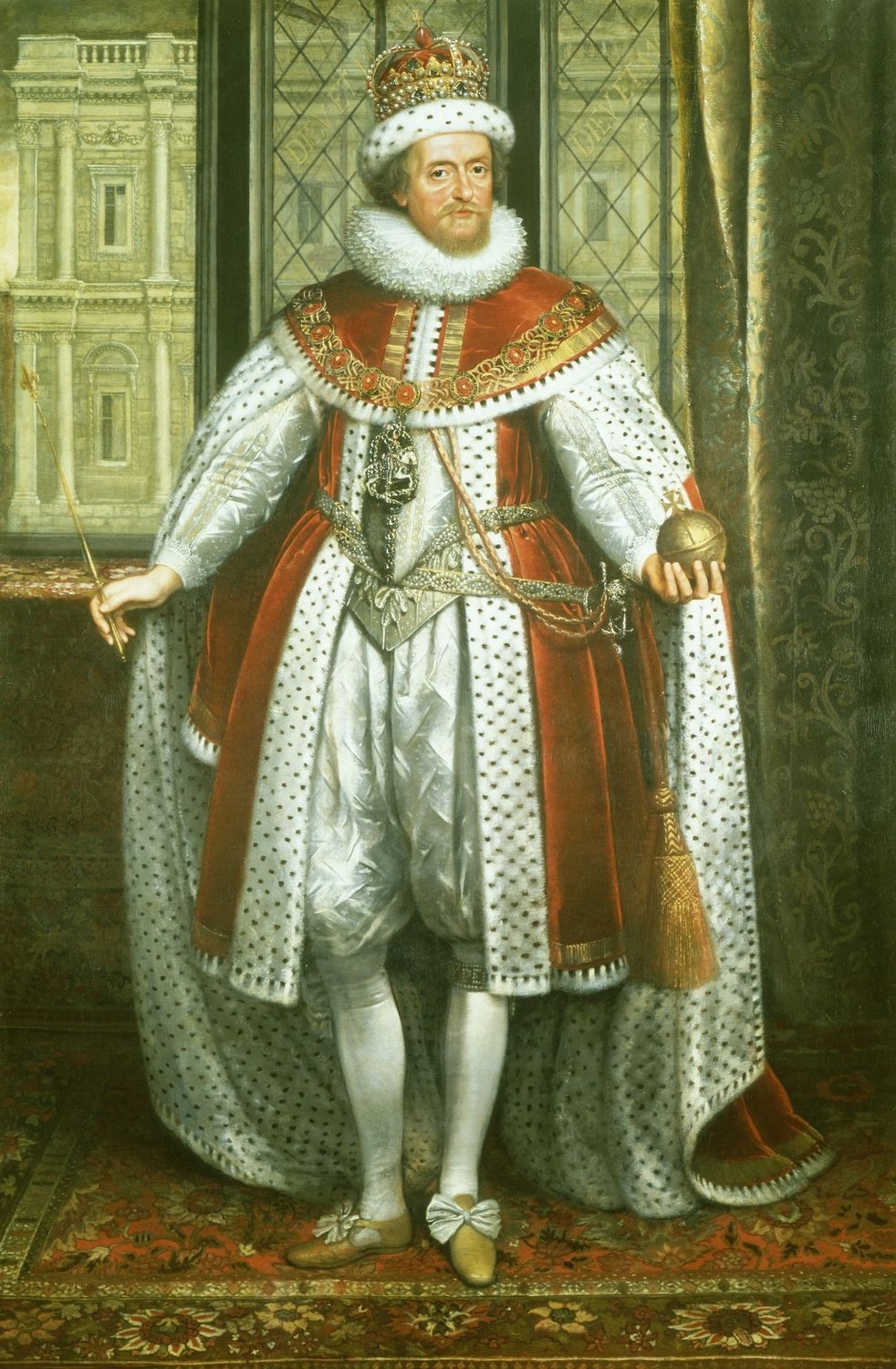
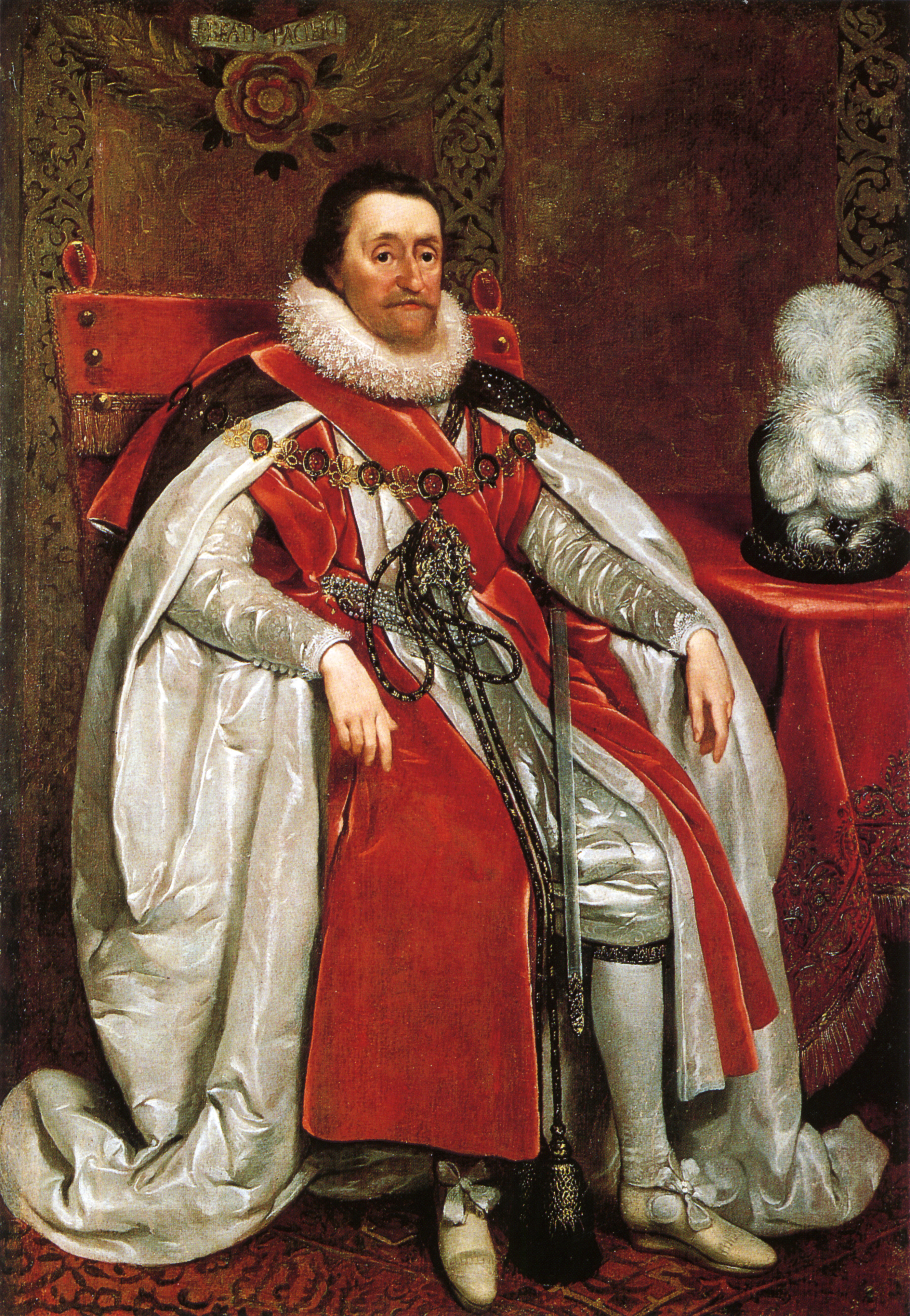
Both sides of this debate are a bit of a caricature, but absolute monarchy arose first within Protestantism, beginning with Henry VIII and extending down to James I.  In class we discussed when absolutism can gain acceptance by the people.  It takes certain historical circumstances, generally, for that sort of thing to fly.  One needs a time of great transition or crisis for people to accept this kind of authority.  In the aftermath of the Wars of the Roses, Henry VIII had the license to reign autocratically.  In the aftermath of “Bloody” Mary and the Spanish Armada, perhaps his daughter Elizabeth did as well.  By the time of James I, however, this license may have expired.  But James exercised his absolute rule generally to bring moderation.  His portraits reveal an ease with himself and his surroundings,  He is comfortable in power, and makes others comfortable thereby.

James_I_of_England_404446 James_I_of_England_by_Daniel_Mytens

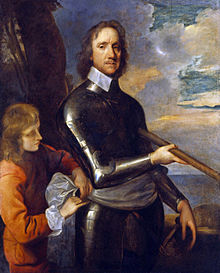
His son Charles, however, inherited his father’s ideas about absolute rule, but without the political sense  and personality of his father.  One look at his most famous portrait shows a man of unease and intensity, someone who might “upset the apple cart.”

His actions and those of others would bring about a clash that would shape the question of power and rights in England and perhaps western Europe, for decades to come.

From our vantage point monarchy seems quaint and outdated.  But we must realize that democratic movements are the relative newcomer on the historical stage.  It behooves us then, to consider the arguments for monarchical government.

Most such arguments that I encountered focus on some the technical aspects of kingly rule.  Monarchy is faster, more efficient,  and more unifying than democracies, and so on.   I think these arguments, whatever their merits, miss the major point of monarchies from a Christian perspective.  We should consider whether or not certain forms of government, and not just how they function, can aid or detract from our spiritual lives.

We begin by recognizing that the physical world is inextricably bound up with our spiritual lives.  Of course creation itself reflects God, but it goes beyond that.  Certain physical states may be more “spiritual” than others at certain times.  Thus, kneeling to pray put our bodies in a submissive posture, which can aid our prayers.  Or we stand to praise God, rather than recline on a couch during worship.   God gave humanity the special privilege of being created in His image, and we in turn should “image” God to the rest of creation as well as to each other.

In this line of thought, our form of government should image God’s governance of His creation.  Having a king, then, (regardless of whether the king acts well or poorly) gives us a physical reminder that we serve a heavenly king.  Serving a king (whether or not we agree with him) trains and prepares us to serve the King of Kings.

Thus, king’s should at times be dressed regally to reflect the splendor and majesty of kingly rule.  Also, a king should lead in service, modeling himself after how Jesus exercised His kingship (St. Louis IX of France and Emperor Michael II of Byzantium are notable examples of this).  Either way, it is the office of kingship that teaches us about God’s Kingship over creation. It has nothing to do with the person itself, who got the job merely by accident of birth.  And that’s the point (in part): some have the job of lawyer, or shoemaker, and some have the job of pantomiming the kingship of God.  Democracy, in contrast, gives us not just a poor but even detrimental spiritual example (the argument goes), because it essentially states, “What you want, you get.”  Democracy then, can encourage the worst of our spiritual impulses.

When we get to the democratic movements that sweep America and France we will make the case for a different form of government.  For now, I want students to understand the logic and motivation behind the actions and attitudes like James and Charles.

As some of you may know, the title of this site is drawn from the historian Kenneth Clarke, one of my favorites.  Last week we looked at parts of the ‘Protest and Communication” episode of his epic “Civilisation” series.  I include the entire episode below if you are interested, but even if you had time to see just the first few minutes, that alone reveals how much insight art can give into an era.

Chaos Theory

In the wake of 9/11 Patrick Deneen wrote an essay entitled “Patriotic Vision: At Home in a World made Strange,” in which he lamented the dichotomy he saw in public opinion. On the one hand, you had an entirely uncritical belief among many of the righteousness of the United States. Politicians needed to wear a small flag on their jacket lapels, (couldn’t happen now), and waved through sweeping legislation (the “Patriot Act”) that dramatically increased the surveillance powers of the government. On the other . . . you had many in academia, perhaps especially among our elite institutions, that could barely contain their smugness with pronouncements that America had gotten what it deserved for its overbearing foreign policy. Deneen published this essay in early 2002, and this split would only grow in the run-up to the Iraq War. Remember “America Fries?”

Two seems to be a natural number for democracies to fall into, and perhaps somewhat natural in general for any society. We have night and day, sun and moon, major and minor keys, and so on. But “two” has always been something of a dangerous number, symbolically speaking. The either/or paths “2” creates bring inevitable division among extremes. Still, if we think of myths and creation accounts as, among other things, poetic interpretations of the world, we note that “2,” while obviously prevalent in creation, does not have the final say.

Between day and night, and night and day, lies twilight and dawn, the grey area linking them both. We have Adam and Eve, but they are supposed to “be fruitful and multiply,” i.e., not stay just the two of them. We have six days of creation and the seventh day–a breathing space of sorts within the normal cycle of the week. In Revelation the angel tells the Apostle John to measure the inner court of the temple of God, but to leave the outer court unmeasured (Rev. 11:1-2), i.e., we need to loosen our intellectual hold on at least parts of reality. St. John’s gives us grand cosmic visions, but the Old Testament has this need for an unmeasured, in-between space, displayed even in the most prosaic of ways. The Israelites had to leave the fringe of their fields unharvested, and to leave the edges of their garments loose (Duet. 24, Num. 15).

It is on this fringe, the in-between spaces, where fruitful interaction and new creation can happen.

Certainly Deneen’s essay has resonance with us today. But he did not seek merely to lament the situation that existed in 2002, nor do I seek only to bemoan the world today. Rather, Deneen pointed to the classical world for a possible solution to the dilemma of “2”–the Greek vocation of the “theorist.”

One form of education seeks to construct by rote a particular view of the world. In regard to our own history some proclaim that the founders were all wise and good men–and only wise and good–our wars are always just, etc. Without cultivating any possibility of error, no repentance can happen and growth a forlorn hope. Such infants can never eat meat. As Aristotle noted, the perfect citizen would rarely be a good man. He could never grow into virtue.

The other education aims only at deconstruction–our founders were all misogynists, slave owners, etc. Of course this deconstruction supposes the need to construct something else in its place. Nothing can exist based on a universal negative. But often, having despised their birthright, deconstructionists have no idea what or where to build, and can feed only on dreams, or worse–themselves, and thereby “starve for feeding”(Coriolanus, Act 4.2). We need another approach.

Enter “one who sees,” which is a translation from the Greek word “theorist.” Certain elected officials within most classical Greek city-states had the title of “theoroi.” To quote Deneen,

To “theorize” was to take part in a sacred journey to visit the “other,” to “see” events such as religious or athletic festivals, and to return to their home city to give an account . . . the theorist would then attempt to comprehend, assess, compare, and then, in the idiom of his own city, explain what he had seen. The encounter would inevitably raise questions about the customs and practices of the theorists own city. . . . Might their be a best way of organizing the city that is not our way?

. . . The activity of “seeing” other ways of foreign life comprised half of the theorist’s duty. The other half . . . was the “giving an account” of what the theorist had seen. A “theorist” would betray his office if he were, so to speak, “go native” while abroad. . . . Even if a theorist were persuaded that that foreign practices were superior to those of his own city, the primacy of the theorist’s allegiance to his own city demanded careful and prudent explanation . . .

The “theorist” then, was not chosen only for his ability to “see” and apprehend with sensitivity the new and unusual but equally for the abiding customs of his own way of life. . . . it was by means of deep familiarity and love for that cultural inheritance that the theorist was able to move fellow citizens to renewed devotion to those practices . . . or to subtle questioning of dubious customs . . .

Conserving America: Essays on Present Discontents, pp. 18-20

It is through this lens that Deneen suggests we should see Socrates. He self-consciously went on a “sacred journey” of philosophy and saw himself as a “gadfly” to Athens, but also someone who would never consider disobedience to the laws of his city.*

Deneen examines Rene Descartes as possibly the first example of a modern “theorist.” As a French Catholic fighting other Catholics in the brutal 30 Years War, Descartes had a unique opportunity for serious soul-searching. As Deneen points out, however, he operated purely with his mind and imagination, and not with his heart. He “begins with radical suspicion of all that preceded him in act or thought, and especially all that is the result of the common endeavors of a community or people” (23). Descartes prefers to think by himself in a foreign land, but cares not even for the foreign locale. Time and place matter not to him. “A thinker like Descartes would be content to think anywhere on earth” (24). Descartes loved to sit in bed and think–all well and good. But what person, or place, or custom, did he love?

The abstract method Descartes employed led him to question everything . . . except himself (“I think, therefore, I am”). The mind, powered by egotism and unfettered from the body, became a weapon to remake nations and nature itself for civilizations that followed his wake. But to be free from one’s time and place is also to be estranged from it. We tend to lash out at strangers, even if the stranger is our very selves.

Those younger than me may groan–but nevertheless–a line runs straight from Descartes’ abstractions to the internet and social media, or, the “cloud.” The internet has perfected the art of taking you away from where you reside and placing you nowhere in particular. I suppose with very simple and direct messages, social media works well, i.e., “Look, my son graduated from high school,” or, “I love my new haircut.” But anything involving complexity requires context, and context requires “full body” communication–not just the mind. Misunderstandings become almost the norm if we ignore this, which brings chaos. Our connections to one another disappear. To compensate for the interpersonal gap (which we perhaps feel but may not be fully aware of), we use manipulation as a method to bridge the chasm. Christians are guilty of this just as others are, i.e., “Jesus is the Light of the World–If you love God you will share with all your Friends!” Marshall McLuhan was right–the medium often dictates the message.

In difficult times we face two temptations. One is to bury our vision into the dark and tangled soil. There we meet the demons of blood and earth. The early 20th century saw this nightmare made real. The other involves a flight into escapist utopian fantasy with our heads in the sky. Devils lay there as well (i.e. the “prince of the powers of the air”–Eph. 2:2**). Both soil and clouds exist for a reason, however. Both have their place. We need to see what lies below and above at the same time, with Christ in the center, holding all things together.

*We can note that in The Republic he places his ideal, or perhaps, imaginary, city outside of Athens (I tend to think of The Republic as a thought experiment and not a description of Plato’s “real” beliefs–others disagree). Deneen also notes that the great Athenian dramatists played the role of “theorists,” and they, like Plato, often set their events outside of Athens.

**Perhaps we should think of Paul’s words in a strictly spatial manner, but I am fairly sure that we should interpret his words metaphorically (the two are not mutually exclusive–both meanings are in play). That is, the “air” shifts to and fro–it has no boundaries, no direction–its shiftiness resembles the snake, who speaks with a forked tongue, etc.

A Religious War that was about . . . Religion

Most modern westerners have a hard time with the notion of a religious war.  After 9/11 many commentators scrambled to find other alternatives to the notion that the conflict had religious differences at its core.  We talked about the relative poverty of the Mideast as the cause, though many leaders of terror groups come from wealthy backgrounds.  We argued that they simply fail to understand us, even though many terrorists lived (and currently live) in western countries and got fully exposed to our culture and way of life.

Quite simply, it may be the case that most of us in the west can no longer understand faith as a motive for much of anything, seeing no purpose for religion aside from something purely private and “spiritual.”

Many scholars of the wars that convulsed Europe in the wake of the Reformation take the same approach.  Whatever the religious differences between the sides, many point to rising tides of nationalism, economic concerns, class strife, and so on, to explain the crises. While all these issues have their place, they are almost always not the cause, but the fruit of underlying religious differences.

For example, let us take the rise of nationalist feeling in late 15th and early 16th centuries.  Such ideas arose no doubt as an outgrowth of the revival of classical culture.  Classical culture meant a revival of the city-state ethos, which worked directly against the medieval notion of Christendom.  Certainly, the weakness of church leadership in the 15th century did little to stem this tide.  But nationalism came from a revival of classical culture, a new life for an old religion buried 12 centuries prior.

Mack Holt’s The French Wars of Religion, 1562-1629 impressed me immediately by his simple declaration that yes, the French wars of religion really were about religion.  If we only realized that sanity comes at such a simple price.

From John Wycliffe on down, reformers often focused their attacks on the Mass and the doctrine of the real presence of Christ in the eucharistic feast.  The same happened in France, with the first major Protestant salvo coming with with the “Affair of the Placards” in 1534.  Various pamphlets distributed throughout Paris read thusly:

By this mass the poor people are like ewes or miserable sheep, kept and maintained by these priests, then eaten, gnawed, and devoured.  Is there anyone who would not say and think that this is larceny and debauchery?  

By this mass they have seized, destroyed, and swallowed up everything.  They have disinherited kings, princes, nobles, merchants, and everything else alive.  Because of this, the priests live without any duty to anyone or anything, even the need to study.  What more do you want?  Do not be amazed then, that they defend it with such force.

They kill, burn, and destroy all who oppose them.  For now, all they have left is force.  Truth is lacking in them, but it menaces them, follows them, and chases them, and in the end, truth will find them out.  By it they shall be destroyed, Amen. Amen.  Amen.

For many Protestants, issues such as the eucharist began and ended in the theologically intellectual realm.  Strongly influenced by Renaissance humanists, they believed that truth came via textual analysis and debate.  Their arguments centered on interpretation of Scripture.  Holt gives a clear yet subtle analysis with this incident.  He points out that for Catholics the issue went far beyond abstract theological interpretation.  Obviously they had a theological position.  But for Frenchmen at least at this time, the celebration of the mass formed crucial social bonds between its participants.  The Church placed strong emphasis on not communing unless one had peace with your neighbors.  So in the end, attacking the mass meant attacking the linchpin of social cohesion in France.  It was the mass, and not any particular laws, political, or social organization that made France “France.”  To change the theology of the mass would be akin to dramatically altering our Constitution.

Critics of religious wars today might often wonder why they couldn’t all just get along.  Holt again parries and shows us the coronation oath all French kings took, which reads:

I shall protect the canonical privilege, due law, and justice, and I shall exercise defense of each bishop and of each church committed unto him, as much as I am able, with God’s help, just as a king properly ought to do in his kingdom.

To this Christian populace entrusted and subject to me, I promise in the name of Christ:

First, that by our authority the whole Christian populace shall preserve at all times true peace for the  Church of God.

Also, that in good faith to all men I shall be diligent to expel from my land all heretics designated by the Church

I affirm by oath all this said above.

Faced with the “Affair of the Placards,” any French king could either abjure his oath or try and fulfill it.  We can legitimately question some of the approaches used, but should not fault the French king for trying.  He had no other choice, at least initially.

Things got out of hand quickly.  The untimely death of certain French kings left a power vacuum filled at different times with different factions.  Huguenots often converted from the merchant class.  They had money and lived in towns that could easily be fortified against attackers.  It would have taken a dynamic king with a budget in the black to defeat them if it came to fighting.  France had neither.  Eventually, commoners took up the cause themselves, and then things got really ugly, even allowing for the possibility of exaggeration in some accounts.

Catholics and Protestants both committed atrocities for various reasons.  Catholics seem to have perpetrated more than their fair share of terrible deeds.  Holt shows us, however, how the issues that divided them went far below the skin.  Each side fought for a certain theology, and in so doing, fought for different versions of the meaning and purpose of France.

I find understanding the differences between the Protestant and Catholic versions of France tricky, but my best guess would be

  • Catholic France had an agricultural bent, while Protestantism favored merchants.
  • Protestants defined community via intellectual and doctrinal agreement.  Catholics found community in common visible practices and common observance of the liturgical calendar.
  • Protestants stressed the written word, Catholics looked to a more embodied “word” in their mass, liturgy, architecture, sacraments, and so on.

Whatever the overlap between Catholics and Protestants, these religious differences would produce different cultures.  We can imagine a Huguenot triumph perhaps resembling the Dutch Republic, where Protestants triumphed with a similar theology as the Huguenots–though Huguenots never had the numbers to actually take over France as they did the Netherlands.

For various reasons the monarchy never could root out Protestants.  An uneasy peace developed which allowed for toleration and Protestants to have a firm minority presence in France.  Some might say this proves that France could still be France with the two faiths co-existing.

Maybe.  But France could no longer have the same basis of political and social order if the celebration of the mass no longer held the country together.  The role of the king would have to change, his person would inevitably become less sacred, his job more administrative.  In time the brilliant but enigmatic Richelieu stated that, “People are immortal, and so must live by the law of God.  States are mortal, and thus are subject to the law of what works.”  Possibly the emphasis on the text for Huguenots led to a decidedly different, more disembodied intellectual climate, and perhaps this helped lead to the universal dream of a rational Enlightenment.

“A house divided against itself cannot stand.”  In the event that you find your house divided, you will therefore need to find a new place to live.  In our own Civil War, one side triumphed decisively enough to force their opponents to live with them.  In this case, the minority never succumbed to the majority, and so it seems that they both had to find a different house to live in.

Holt’s book reminded me of the quote from Adam Wayne, a character in G.K. Chesterton’s The Napoleon of Notting Hill.  Wayne commented that,

There were never any just wars but the religious wars.  There were never any humane wars, but the religious wars.  For these men fought for something they claimed at least, to be the happiness of a man, the virtue  of a man.  A Crusader at least thought that Islam hurt the soul of every man, king, or tinker that it could capture.

Beauty in the Eyes of the Beholders

When a crazy theory comes around, some reject it out of hand, or desperately hope that it is not true. I understand this–I myself very much hope, for example that intelligent alien life does not exist–and theories that they do in fact exist are not wildly crazy. Their presence would destabilize our view of the cosmos and our place in it far too much. When it comes to history, some reject any different theory as inherently destabilizing. Some adopt the Bill Hader approach, and seem to only want to make others squirm. For me–new theories generally appeal because I find them fun. In a world where every traditional narrative now has a target on its back, even flat-earth theories have made a comeback. Alas, it seems quite certain that we inhabit a spherical world, but wouldn’t it be fun if it was indeed flat? What a hilarious and tremendous flip of the script that would be.*

In 1946, at the tail end of the crisis that in hindsight dramatically weakened western civilization, William Ivins wrote Art and Geometry: A Study in Space Intuitions. This admittedly boring title concealed a powerful punch in the form of a sustained attack on the veneration of Greek sculpture so prevalent in the west at that time, or at least prevalent until 1914. Ivins admits the foolish impossibility of judging some art as superior to other art, but then proceeds to do just that (this was the right call–obviously we have the faculty to judge such things–we do it all the time–but should do so carefully). Greek sculpture, in fact, had little real vitality, little real understanding of geometry and its relationship to the body. Here we have what seems like a crazy idea, and what’s more, Ivins enjoys himself, writing with confidence and panache.

As his book involves geometry along with sculpture, one of his main criticisms involves the Greek’s apparent lack of spatial relatedness, of their inability to put their figures in relation to other people or things. He writes:

I have happened on no evidence to show that any Greek ever sat down and drew a view, or a group of figures, or a congeries of objects, such as his tables and chairs, as they appeared relatively to each other in their shapes and sizes, and positions from a single point of view.

And,

The celebrated battle friezes from the temple at Bassae or Phigaleia . . . were removed and sold before any record was made of their respective positions. They were taken to London, where for 100 years intelligent men of all nations labored to discover the order in which they had been originally set up. . . . Then at last, a brilliant young American solved the problem . . . Reasoning that the slabs must have been held to the wall by dowels, he went to the still standing temple and compared the dowel holes in the slabs to that of the temple walls. He solved the problem, in the most literal sense of the word, without ever having to look at the faces of the sculptures themselves [which gave no clue to the solution].

Ivins also lays into the Greeks for their persistent abstraction and the resulting aloofness of nearly all their subjects.

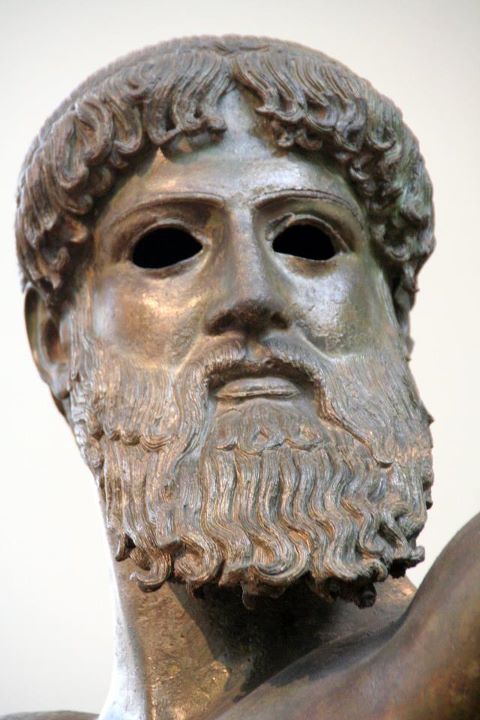
The extremely small number of Greek portrait heads is significant. . . . They are what we call “idealized” or “ennobled” portraits, i.e., abstractions with only the faintest personal character and psychological value–really no more than “composite group photographs.”

Compare any Greek figure to the quietly seated Pythagoras of the Cathedral at Chartes. He is only making an erasure in his manuscript, but his personality and the intentness and tensions of his mind and body probably cannot be equaled in all of Greek sculpture. It is as perfect a demonstration of the nonsense of the Aristotelian definition of fine art as an be imagined.

To illustrate his point, first the Pythagoras from Chartes**

And Greek sculpture

He continues his argument by linking the limitations of Greek art to their geometric theory. Whatever the greatness of Euclid and his successors, they had significant limitations. Ivins writes,

Basically the Greeks thought about their geometry in terms of an unexpressed chalk line or yard stick which they held in their two hands. . . . The way Euclid proved his basic theorem (I.4) that two triangles, having two sides and the angle between them equal, are equal to each other–was by picking one triangle up and superimposing it upon the other. . . . Euclid’s geometry was based on the tactile-muscular intuitions . . . neither Euclid or his successors had any notion of infinity.

And,

The story of Peithon and Serenus, two geometers of the 4th century AD, affords a striking example of how the Greeks missed out. [It goes] as follows:

“In the propositions (29-33) from this point to the end of the book Serenus deals with what is really an optical problem. Peithon, not being satisfied with Euclid’s treatment of parallels, thought to define them by means of an illustration, observing that parallels are such lines as are shown on a wall or roof by the shadow of a pillar with light behind it. This definition was generally ridiculed; and his friend Serenus seeks to rehabilitate Peithon by showing his statement as mathematically sound. He proves with regard to the cylinder that if any number of rays outside the cylinder are drawn touching it on all sides, all the rays pass through the parallelogram–Prop. 29–and if they are produced farther to meet any other plane parallel to that of the parallelogram the point in which they meet will lie on two parallel lines. He adds that the lines will not seem parallel.

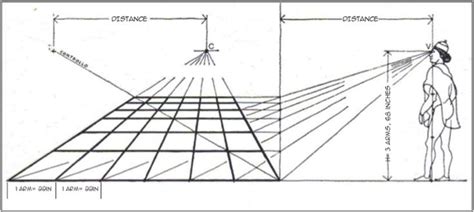
Ivins then charts the problems with not challenging assumptions, and so on, until the era of the Renaissance. The Renaissance obviously borrowed from the classical world and the classical ideal of beauty and proportion. But in Ivins’ judgment improvements in geometric theory beginning in the early 15th century greatly improved the art of the time. This book stretched my very weak mathematical knowledge throughout, especially so as geometric theory got more complex. For Ivins, the key leap came from the renowned Alberti:

It has been said that Alberti’s greatest discovery was that the picture plane was a section of the cone of vision, but really it was something in addition to that. Up to his time the problem had been thought of as a simple two-term beholder-object relation that was really insoluble. His great contribution, though doubtless he was not aware of it, was that in fact he discarded the simple two term relation and discovered other relations sufficient to permit a solution–in other words he discovered that form and position were functions of each other, and thus were relative and not absolute . . .

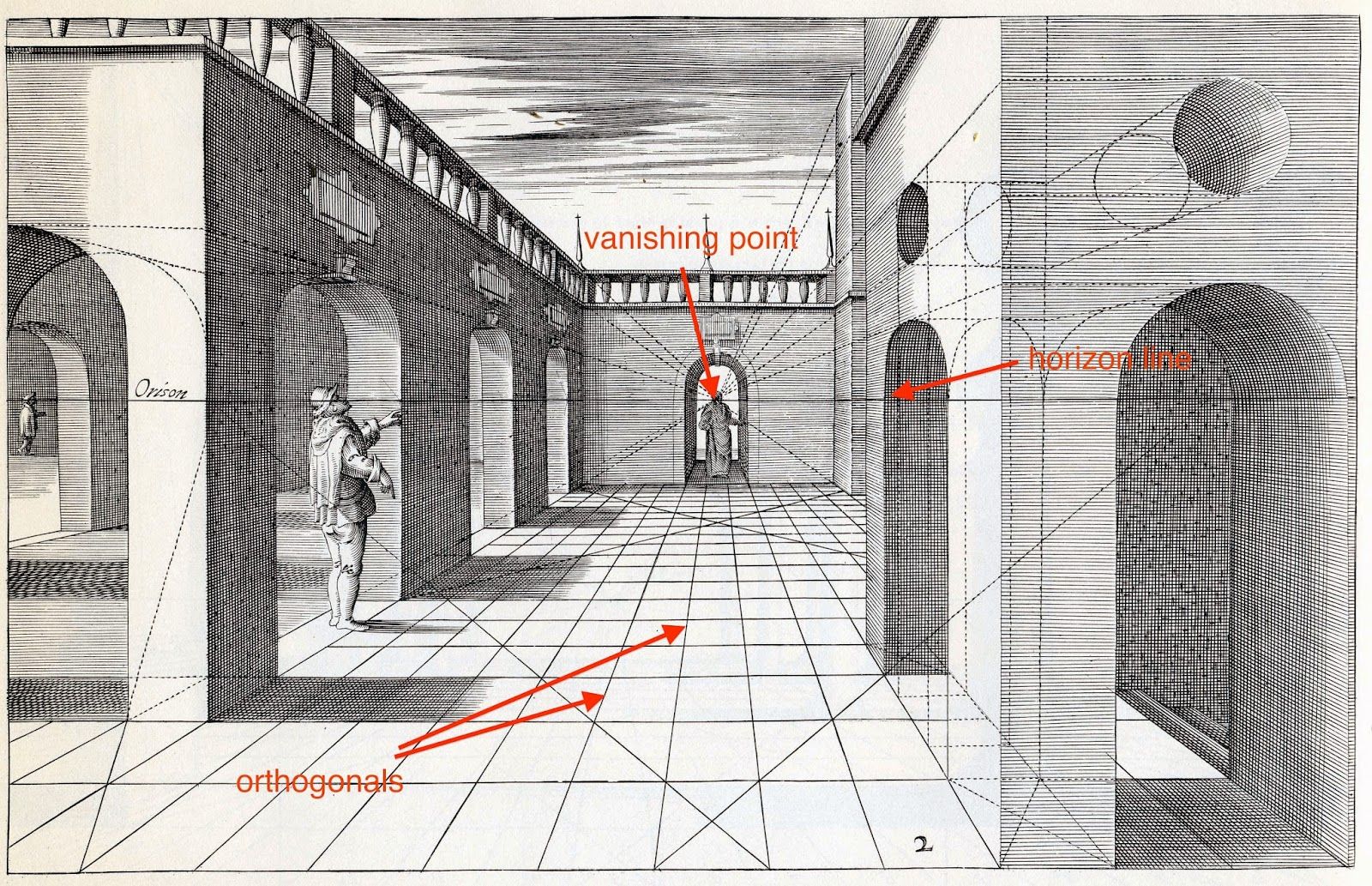
Alberti’s Linear Perspective Model

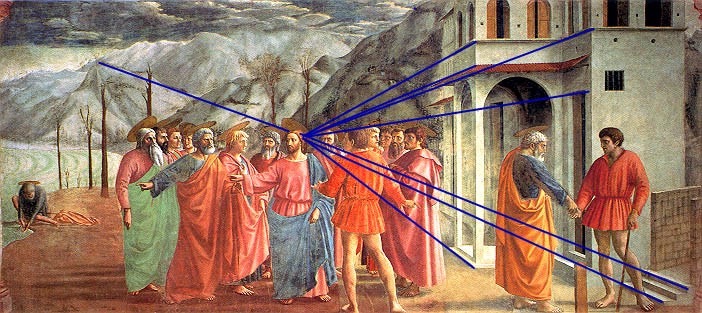
Advances in geometric theory set the stage for a dramatic shift in art, with several Renaissance painters making full use of perspective.

Ivins comments,

Looked at in retrospect it seems almost incredible that the Greeks should not have discovered these things, which today seem intuitive in their simplicity and obviousness. The probable reason for this failure is that they were so obsessed by measuring and working out the relations between measurments in each of the separate conics that they were never able to see the descriptive qualities that ran through a whole series of conics.

I confess that I could not understand much of what Ivins said related to geometry, but I found his applications of geometry to art clear, and made obvious by any number of examples.

Ivins continues in his conclusion,

There is much talk of how much we owe the ancient Greek ideas, but most of this talk seems to be based on some vestigial legend of a “Golden Age,” which in this case extended for several hundred years, in a definite historical time with its origin in a definite historical place [i.e. Athens]. In general people who talk this way show little acquaintance to what we owe other peoples, and to what we owe ourselves.

Indeed the end of W.W. II ended in many respects the dream of a unified and confident western culture. Ivins’ reevaluation of the greek inheritance in geometry presaged an entire rethinking of western civilization itself. Seventy-odd years after Ivins, the west has yet to fully deal with its identity crisis.

I admire Ivins for his pluck, and I agree that there is something “off” about Greek art. Their sculptures invariably do reveal a problematic detachment, and possibly, even a kind of brutality in their subjects. But a common theme running through many of a scientific bent is that pauses in scientific knowledge, or moments when the world seems “stuck” in a particular mode of thinking, can invariably get reduced to some cruel twist of fate, or some power structure holding things back, or some basic lack of imagination due to a historical accident, or some other such “linear” explanation solved by restarting the stuck timeline.

In this area I depart with Ivins. If an idea persists, I say we should look for the reason for its persistence. We should assume that people are smart, and not hoodwinked or trapped for centuries on end.^ Judging the superiority of one kind of art over another quickly gets problematic. Still, I believe that the persistence of certain styles/ideas is evidence not of some trick of fate or conspiracy, but instead points to the idea having legs–it must have a point of connection with reality that people intuitively recognize.

Whatever we might think of the classical style, it dominated the ancient Mediterranean world for 800 years, give or take. I agree with Ivins that its revival ca. 1700-1900 AD was problematic and unfortunate in certain ways. But still–we should not attribute the dominance of this style merely to the power of the Greeks and Romans, and its revival merely to the power of England and France. They, and those around them, must have found something intuitively “right” about the classical approach.

In certain ways the Renaissance artists had more skill and worked with more developed geometric ideas. We can commend them for this. But . . . the Renaissance artistic style lasted perhaps 100 years at most, and failed to spread much beyond southern Europe. If we use the criteria of “long-term reception by ‘the people'” then we have to conclude that using advanced ideas of perspective did not make for “better” art. Ivins may overrate the place of perspective in important cultural creations.

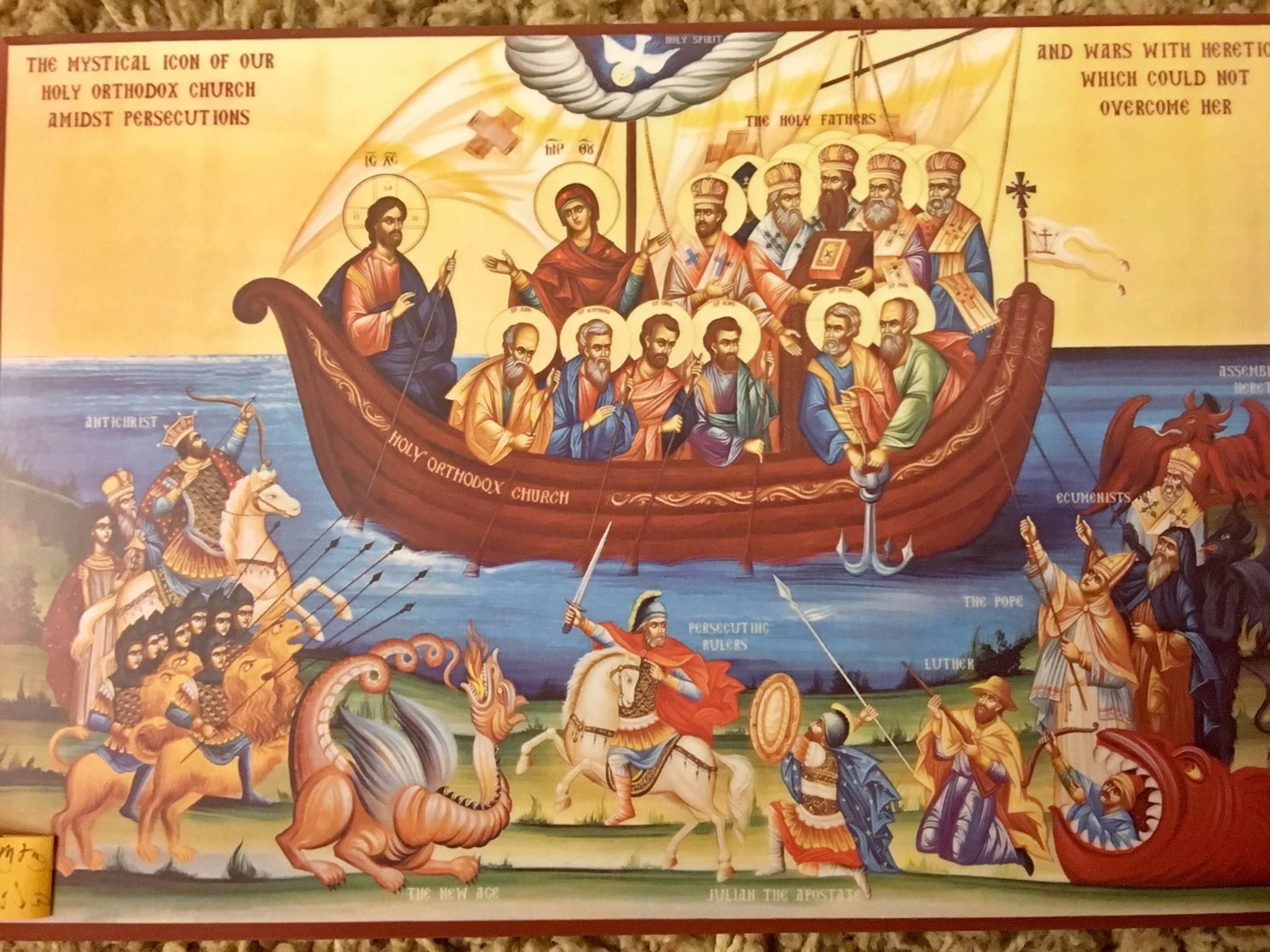
There exists another example of an artistic style that consciously abandons certain principles of perspective that has lasted longer than the classical model–around 1500+ years–and still continues today, that being . . . Christian iconography.

We cannot attribute the persistence of this style to power (sometimes the Church had “power” and sometimes not), nor the limitations of geometric knowledge (the style began before Alberti and others revolutionized geometry, but continued long after). Though different cultures developed their own iconographic style, and though certain changes have taken place within iconography over time, no one has ever fully integrated perspective into icons. At times icons seem to deliberately reject perspective.

I am no student of iconography and will say little about the theology behind these choices, except that the power of art may reside in its ability not to accurately reflect the world as we see it, but to show us the spiritual tension we feel between we what we see, and what we “know.” We feel, not in our gut, but in our bones, that we live between two worlds, between the physical and the spiritual, between heaven and earth. Nearly all of human history testifies to our desire to somehow unite these two elements of our knowledge and experience. History shows us that most of the time we fail badly in our attempts.

Icons reveal part of the reason why we misfire so often. Our nearly exclusive focus on how people and objects relate to one another in space has made us look only at linear explanations for reality that cannot satisfy. Certainly advances in geometric knowledge did not cause this problem, but our exclusive focus on this aspect of reality (the linear/spatial) has brought about a new view of reality. Our perception is warped. We also need a way to see how we relate to each other in time, as well as space, and this, icons seek to display.

I love Ivins’ panache and willingness to go a little crazy. But maybe the truth doesn’t always extend forward, maybe sometimes it bends back around in a circle.

Dave

*Yes, some crazy ideas are really crazy . . . but perhaps there is a part of you that would want to have a conversation with this guy . . . ?

**His choice of Pythagoras to make his point is interesting–obviously this sculpture would have been regarded as a minor part of the whole edifice–and yet still something definite of his personality shines through.

^Though Ivins rightly points out the west’s immoderate attachment to the Greeks (something not really present, btw, during the Middle Ages), especially in the Victorian era, he failed to reckon what might happen when we gave up the idea of any kind of cultural center at all.

9th/10th Grade: The Big Armada that Couldn’t

Greetings to all,

This week we continued our look at Elizabeth’s reign in England, and began our special focus on the Spanish Armada of 1588.  This crucial naval battle was the high water mark of the Hapsburg Empire.  With hindsight, we can see that Spain’s defeat here sent them spiraling into a decline for the next few centuries.  Traditionally, the conflict between England and Spain is viewed through the following lens:

1. Spain was the big dominant empire, with all the advantages that brings, led by an intolerant king bent only on increasing his power.

2. England was the ‘Little Island that Could’ — the huge underdog that through scrap and pluck defeated the big bully.

I think this analysis is flawed for a number of reasons:

  • Did Spain have a legitimate strategic reason to attack England?  The English had been raiding the Spanish coastline, as well as Spanish ships in the Atlantic, for years.  England’s support of the Dutch’s rebellion against the Spanish would have made communication and supply very difficult for the Spanish.  None of this is to say that Spain had a good plan, or that you have to root for Spain — but it is important to understand what might have motivated the Spanish in the first place.
  • England’s ‘privateering’ could in one sense be called ‘state-sponsored piracy,’ and what the Spanish might have called, ‘State-Sponsored Terrorism’ (though the Spanish, with the conditions of their mines and their treatment of the natives across the Atlantic, cannot claim moral high ground either).  The English knew they could not beat Spain in the purely conventional sense.  But they also knew they did not need to.  If they could hit them here and there unpredictably, the Spanish would be forced to expend a great deal of resources to cover themselves everywhere.  Maybe Spain could be slowly weakened not by destroying them from without, but putting too much strain on them from within.
 We can see Spain in the mirror when we look at our current situation.  In some ways, we are the Spain of today, one of the few nations with a truly global reach of power and presence.  Al Queda and other like minded groups are in some ways in the position of England.  What happened on 9/11 was devastating in the sense of shock and loss of life.  The ripple effects, both financial (new government agencies, extra security measures, wars, etc.) and psychological continue to this day.  They don’t have to hit us everywhere all the time to hurt us.  To help identify with Phillip further I  asked the students to consider the following hypothetical possibility:
  • You are president, and your Secretary of Defense comes to you with a plan.  If the U.S. acts quickly, he has an idea, that if successful, could end the War on Terror and bring peace to the Mid East for the next 50 years.  The plan is realistic and achievable
  • However, the plan requires a large commitment of our available forces
  • The plan has about a 50% chance of success
  • If the plan fails, perhaps as much as 1/3 of our forces might be wiped out.

Would you approve of the plan and take the risk?  Most students said they would.  Though if it failed, history would likely paint you as an ignorant fool who had blind faith, just as Phillip tended to get portrayed until the latter 20th century.

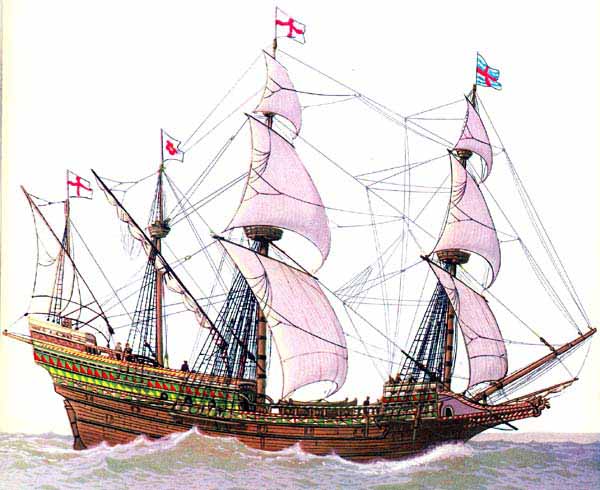
3. What were the strategic burdens the Spanish faced?  They had more ships, but their ship were bigger, slower, and of course, needed to carry a lot of men and supplies (for the invasion).  Spanish ships had, at best, 5% of their weight as weaponry, while the average English ship had about 14% of its weight as weapons.  Who is the real underdog?

Below is the image of the newly designed English “race” ship:

And here we have the a typical Spanish ship of the time:

Of course, these differences in their respective ships are not the product of coincidence, but of the overall culture of Spain and England.  Spain and England had many similarities, with neither monarch presenting us with either the image of a saint or sinner.  Spain fought Protestants, but Elizabeth persecuted Catholics.   We must careful to find good and bad guys too quickly.

I do think we can say with confidence that England was a more ‘open’ society.  Next week we will examine the relative advantages more open societies have over their more ‘closed society’ counterparts.  England was not necessarily more tolerant than Spain.  They persecuted Catholics with the same zeal as Spain persecuted Protestants.   But England had more social mobility.  For example, in England non-nobles like Francis Drake could have enormous influence.  In Spain, Philip II appointed the Duke of Medina Sedona as the top commander of the Armada, chiefly I think because he was the highest ranking nobleman available.  He did this in spite of the fact that the Duke had rarely even been at sea, let alone commanded ships at sea.  The Duke protested to the king to no avail.  For Philip, the nature of things dictated that the highest ranking nobleman command the fleet.

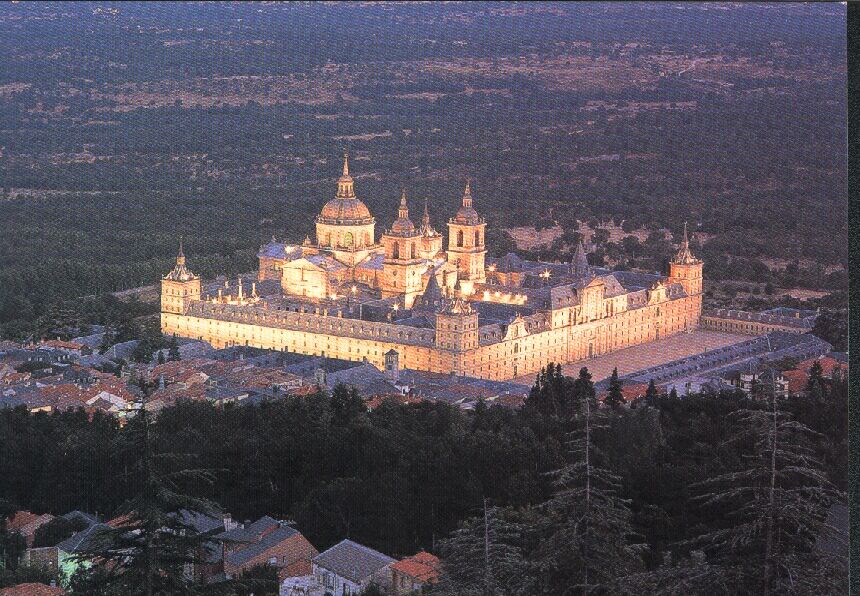
Philip II may not have been tyrannical, but he did close himself off from his people.  He never communicated in person – it was all done through official letters.  While he communicated frequently with people, it was not in a manner that would generate a free flow of ideas.   He issued pronouncements, and did not invite dialogue.  Take a look at his palace in this image here, which shows his physical as well as psychological isolation:

In any contest, there are many factors at work, including what we might call luck.  But we should not be surprised to see connections between winning and losing armies, and the respective contexts from which they are born.
As a total aside, here is a painting of Philip II, not afraid to show a little leg!  Elizabethan fashion remains a mystery to me.  When I asked what fashion accessory future generations will scratch their heads at, a few students said, “Ties.”  I say, “Stiletto heels.”
Blessings,

Dave Mathwin

11th/12th Grade: Bad Music Begets Bad Government

This week we continued in our reading of Plato’s Republic.  In class we have simply been reading and discussing excerpts from this great philosophical treatise, and I have enjoyed seeing the students react and respond to this text, strange as it will seem to our modern eyes.

The Republic has political implications, but the dialog begins with a discussion about justice.  The participants realize that to see justice more clearly, they had to talk about something larger than justice in individuals.  “If we look at justice in the state we will see justice more clearly,” they suppose, “for the state has a much greater size than any one individual.”  But justice itself becomes a vehicle for larger questions of truth.  Thus, the dialog always has immediate application for individual lives even as we consider their political implications.  Plato writes The Republic, I think, not so much to create a better state but to hopefully make better people, who will then make a better state.

The dialog starts early on discussing the origins of the state.  No matter their talents, everybody at one point realizes that they need others even to meet basic needs.  We then divide up tasks to accomplish them more efficiently.  Providing for our basic needs is relatively natural and easy, but then we begin to want “luxuries,” which Plato terms anything more than what we need for a decent, ordinary life.  This desire for luxury corrupts the soul and creates problems in the state itself, because now the state will have to provide for something beyond the “natural,” and at times the only way to do this involves taking from others.  Hence, war and the attendant expansion of the state come into being.

How to avoid this?  Some see the state as a mere conduit of whatever the people desire.  The government’s job, in this view, is to actualize our choices.  Plato feels differently, and like many Greeks believed that the state should help us live the good life, which might sometimes mean giving us what we might even dislike–just like parents helping their kids healthy by feeding them vegetables.  In Plato’s famous analogy of the cave he imagines humanity bound in chains underground.  All they can see are their shadows cast on the cave walls made by the fire behind them.  They believe the shadows are reality, and the fire true light.  But eventually some break free and walk out of the cave to see true light and true reality.  Their discovery brings pain — we shrink from the sun’s light, and the reality we discover will be so much different than what we imagined.  When these people go back to the cave, few if any believe them, and nearly all prefer to live in the shadows.

Plato asks us to understand that just because we fail to immediately appreciate the truth might even point to the truth of what he argues.

Plato may surprise his modern readers at least with going from war as a result of greed to a discussion of music and the arts.  But political problems for Plato begin with disordered souls, and Plato believes that little has more power to shape the soul than music.  Plato relates a common anecdote of the time of Sparta banning certain kinds of music altogether.  Perhaps even Plato thought the Spartans too severe, but he agrees with the fundamental idea that musical change brings  political changes.

Many moderns think of music as a matter of personal taste and personal enjoyment.  We listen to the music we like, and imagine ourselves having control over the music.  Plato asks us to think more carefully about the music we hear, and wants us to admit that “gets under our skin” in ways we might not even notice.  Upon reflection some of us might testify to the power of music.  It can move us even when we might not want to be moved.

Understanding Plato’s doctrine of the soul helps explain his views here.  Some think of the soul as encompassing the merely moral part of us.  Plato went further.  For him the soul was the “heart” of man in the Hebraic sense, encompassing everything about someone.  Our moral acts do define, mold, and shape us, but we are more than our moral acts.  So for Plato, a beautiful soul would be one that not only loved truth, but also had it itself shaped by beautiful things.  Separating truth from beauty never occurred to Plato.

So if we want to concern ourselves with “doing right” we need first to provide the necessary surroundings, the necessary training, for our souls.  Plato admits that this means certain music can stay, and other forms must go in the ideal state.  The state has a vested interest in the arts because the arts shape the soul.  Badly formed souls will create badly formed governments.  He writes,

Philosophy, [said Socrates], tempered with music, who comes and takes her abode in a man, . . . is the only saviour of his virtue throughout life.

Justice for Plato means having all things in their proper place, or giving each thing its proper due.  This leads to Plato’s prescription that only music that emphasizes balance and proportion should be allowed.  If we want harmony in the state we must have proper training of the soul, and that means the right harmonies in our music.  The rhythm must not over-excite, nor should it be too “soft.”  Curiously for the students, Plato seemed to link rhythm with the idea of grace.  He writes,

But there is no difficulty in seeing that grace or the absence of grace is an effect of good or bad rhythm.

and,

Then beauty of style and harmony and grace and good rhythm depend on simplicity, — I mean the true simplicity of a rightly and nobly ordered mind and character, not that other simplicity which is only an euphemism for folly?

What can Plato mean here?

When we see the word “grace” we immediately put it in a distinctly Christian context.  The Greek word for grace is “charis,” which had different connotations.  The basic meaning had roots in something like “power” or “movement” — hence a “charismatic” man has the ability to “move” people.  The Greeks also used the word in the context of the social graces, which can have the sense of proper “movement” in society.  But Plato, I think, has something more in mind besides mere politeness.  If we think of a gracious hostess, for example, we think of how she controls, or “moves” a social event.  She will possess a certain rhythm of movement and speech.  She’ll have impeccable timing, she’ll neither be overbearing nor invisible, akin to a symphony conductor.  Thus, for Plato, if we immerse ourselves in proper rhythm and harmony, we will train our souls towards “graciousness.”^

Plato has another motive for his seeming harshness about music.  Problems in the state arise from the people’s desire for luxury.  This desire is almost inevitable given human nature, but Plato believes the state can curb it (thereby saving everyone lots of trouble) by proper training of the souls of the young.  If we purge the person of luxurious taste in music, or the desire for too much variety in music, we can form the soul to desire less.* This can get into a “chicken or the egg” argument.  Does music reflect or shape the culture?  Well, we can say  perhaps that it performs both functions, but which primarily?  Here, I at least agree with Plato (and Francis Schaeffer, Kenneth Clark, and others) who feel that in general, artists work ahead of culture and do more to shape it than reflect it.

If all this seems hopelessly idealistic, I think Plato would respond by saying that,

  • You have to aim for something to hit anything, and
  • My point here is not to create the perfect state so much as it is to use the state to better see Justice and apply that understanding to how we live our lives.

Next week we will look at Plato’s ideas of how different souls create different forms of government.

*************

*Many in the modern world make the argument that classical music makes one smarter.  Plato did not focus so much on classical music (it didn’t exist) or increased intelligence.  Rather, the right music would help form the right kind of soul, not the right kind of brain.

^Since the New Testament writes use “charis” to denote grace in the Christian sense, we may wonder whether or not a certain “rhythm” exists in God’s grace — a certain pattern, timing, or tempo, perhaps?

Trade Off

One of the great strengths of one of my former bosses involved his ability to see that the pie never extended unto forever. Everything one did in the classroom came with costs and benefits. Whenever trying something new, consider what that meant one would conversely not do, and judge the consequences. We see little of this thinking on either side of the political aisle today. When looking at issues, one should consider not just the benefits it would bring, but also consider which costs and drawbacks one can live with most reasonably.

The words “free trade” are a major coup for laissez-faire capitalists. Even those against such practices have to stand against something “free.” One can understand what the term means in one sense–that no barriers should exist between those who want to exchange something. But, the term obscures the fact that no trade is “free.” In every trade, one gives up something, and the term “free-trade” might not clue us into this fact.

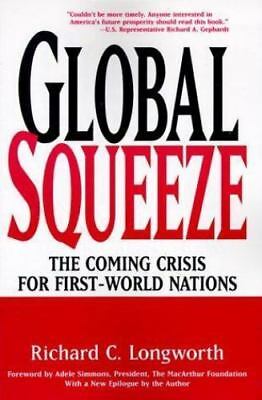
In his book, Global Squeeze author Richard Longworth argues that the global “free trading” market which opened up in the post-Cold War era hurt us much more than it helped. We have exchanged much more than we thought in the bargain. This in itself is nothing remarkable–many books have argued likewise. What drew me to the book initially was that

  • He predicted many of our economic and resulting political concerns today (such as the rise of ethno-nationalism, populism, etc.) way back in 1998, when virtually everyone else saw only one side of the new globalism. At the same time,
  • I felt that this was not just a lucky guess, because he clearly understood the nature of trade-off’s even in “free trade,” and most of all,
  • He asked questions that no other economics book I’ve read asked, such as, “What is an economy for?”

That question we rarely ask. We want a “good” economy, but we have no clear idea what a “good” economy means. While I have no impression that Longworth has a conscious understanding of the patterns and symbolic structure of reality, his book helped me see economics within this frame. So, with apologies to all who find where I begin a bit odd . . .

Theologian Dumitru Staniloae wrote concerning St. Maximos the Confessor

Some of the Fathers of the Church have said that man is a microcosm, a world which sums up in itself the larger world. Saint Maximus the Confessor remarked that the more correct way would be to consider man as a macrocosm because he is called to comprehend the whole world within himself, as one capable of comprehending it without losing himself, for he is distinct from the world. Therefore man effects a unity greater than the world exterior to himself whereas, on the contrary, the world as cosmos, as nature, cannot contain man fully within itself without losing him, that is, without losing in this way the most important reality, that part which more than all others gives reality its meaning. The idea that man is called to become ‘the world writ large’ has a more precise expression, however, in the term macroanthropos. 

The term conveys the fact that in the strict sense the world is called to be humanised entirely, that is, to bear the entire stamp of the human, to become panhuman, making real through that stamp a need that is implicit in the world’s own meaning, to become in its entirety a humanised cosmos in a way that the human being is not called to become nor can ever fully become, even at the farthest limit of his attachment to the world where he is completely identified with it, a cosmosised man. The destiny of the cosmos is found in man not man’s destiny in the cosmos. This is shown, not only by the fact that the cosmos is the object of human consciousness and knowledge and not the reverse, but also by the fact that the entire cosmos serves human existence in a practical way.

Taking this view of man and the cosmos as my premise, I argue that we should interpret our experience of the world and derive meaning through the lens of what it means to be human, a composite being of body, soul, and spirit. This does not mean that all truth is relative or subjective–far from it. Rather, it is a perspective that recognizes that, “The sabbath was made for man, and not man for the sabbath” (Mk. 2:27). God creates the world through the Logos, who is Christ (John 1). Ultimately then, Christ is not the image of Adam so much as Adam is the image of Christ, mysteriously “slain before the foundation of the world” (Rev. 13:8).

So for things to have intelligibility and proper functionality, they should scale to human experience (I realize that I am about to take a massive leap from this premise which I have not done a lot to prove, but . . . :)*

We have to trade things to live, in a sense, both in our bodies individually and in the body social. We have to take in food, water, and so on. We are not autonomous or self-sufficient. Longworth agrees, giving us examples of cultures that have no trade that end up drab, and lifeless. One might think of the ancient Spartans, and the more contemporary Soviet Union. But we can’t just take in anything from anywhere, for any reason–“trade” is not an inherent good, but a contingent one. If we trade too much, even of a good thing, it will be bad for us. One can drown even by drinking excessive amounts of water–too much water brings a flood. In addition, for reality to make sense to us, ideally at least, we should have some connection to those we trade with. Personal contact and personal relationships help let us know if we have a fair trade or not, one that pleases both sides.**

In sum, for an economy to work as it should, it should benefit all sides involved, and benefit them in a way that preserves meaning and coherence. Nations should trade, just as people should trade oxygen for carbon dioxide.

While Longworth does not engage in these kinds of symbolic connections, they do form the unspoken background to his foundational question of, “Whom is an economy meant to serve?”

We come into the world and into a family, if not sociologically, at least biologically. A family economy, then, primarily should serve the family. But it gets tricky, because no family should only concern itself with itself. When this happens, one gets The Godfather saga. Christian teaching pushes outwards towards those on the fringe socially and economically, but we need balance. A mom or dad who devoted too much of their energies to those outside the family would erode the very foundation of their well intentioned actions. Here, C.S. Lewis’ great principle of “First and Second Things” directly applies, which runs something like,

Put first things first and we get second things thrown in: put second things first & we lose both first and second things. We never get, say, even the sensual pleasure of food at its best when we are being greedy.^

Many have discussed the lack of connection we have to what we purchase. We have divorced the thing we buy from who made it, where it was made, and so on. Many have spoken of a “meaning crisis” in our culture and surely the fact that what we trade for and consume has no “context” for us contributes to this dislocation. However, Longworth doesn’t address this, and altering this societal condition remains impossible for almost everyone. We can focus then, on what we can fix, at least on a national level.

Longworth points out in multiple ways how our globalized economy violates the “First and Second Things,” principle. The “nature” of capital seeks out the most efficient way of doing business, so naturally labor would migrate out of the country. We anticipated this in part economically, but not at all sociologically. Longworth mentions that many African-American families (to take one example) rose to the middle class in part through blue-collar jobs in inner-cities. These jobs offered stability and helped build distinct local neighborhoods. As these jobs left, these communities eroded (something seen by Jane Jacobs way back in the 1960’s–this is not NAFTA’s fault alone). Just as we can see the distortions of Marxism as a reaction to the distortions of industrialism, so too we can see racial identity politics as the current distortion to try and correct for the distortions of the market. We can bring it back to the family concept. If your plumber brother really needed work, but you had a 20% discount coupon for some other guy you didn’t know, and hired him instead of your brother, you could expect family difficulties.

As Longworth points out, the medieval peasant always had work, but rarely had prospects for growth. Now, we have the opposite problem of the possibility of growth for all, but no promise of work.

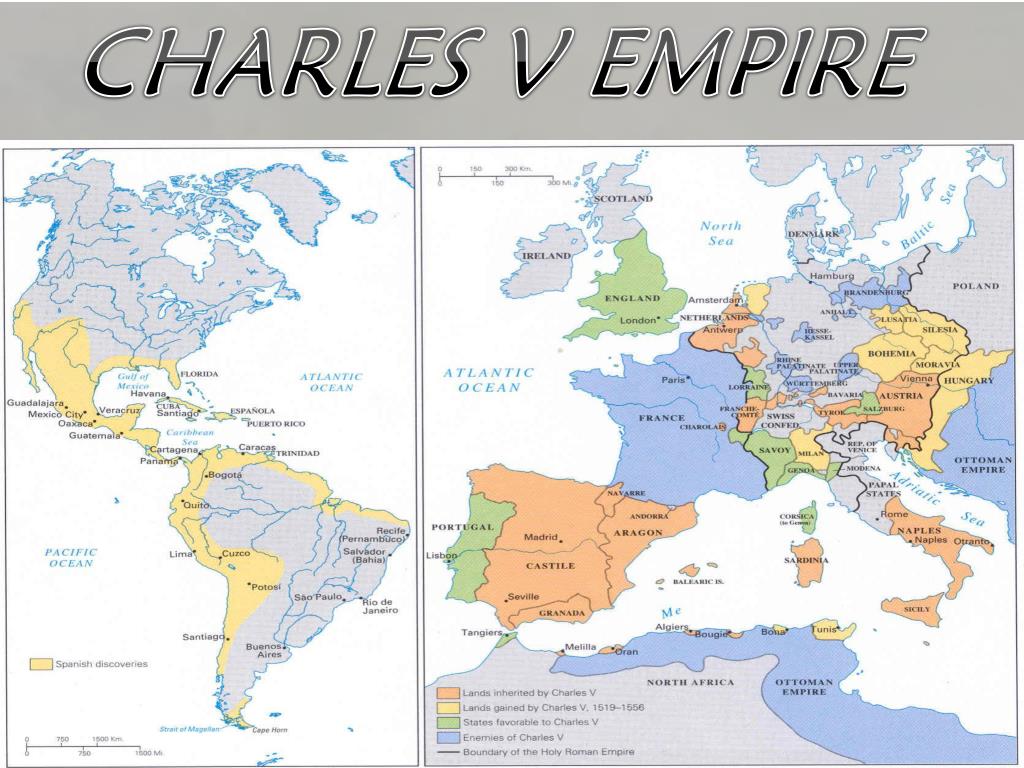
Many today fear the presence of national populism, but here too Longworth had prescience. When we exhale deeply we will inhale in a like manner. One can look at the Hapsburg dominions of the mid 16th century . . .

and compare it with modern European global trading connections

The discontinuities lack coherence on both examples. The Hapsburg holdings don’t make sense, and most students recognize this immediately at some level. They then rarely root for them in any of their various wars. Starting around the mid 17th century, we saw the beginnings of concentration of identity into national states, partly as a reaction to the wars involving the Habsburg dominions. The trade map above concerns Europe primarily, but the principle applies to other regions. Start neglecting meaning and coherence in the family, and look for the kids to try and recover that meaning in ways the parents might not like–look no further than the relationship between the EU and Hungary.

Our modern free trade policies evolved for various reasons in the wake of W.W. II. Free-trade could legitimately serve (perhaps) as a means to combat communism in part because the vast majority of major players shared many in things in common:

  • Common cultures and religions
  • Similar pools of labor and technological access
  • A common political goal

Japan participated in this as well, which posed problems for the U.S. in particular. Japan had different cultural and political goals, which led to more protection of its labor force and different economic practices. However, Japan’s labor pool was small enough not to erode and distort the system. With the entrance of China and India, however, things changed dramatically. Economist Richard Koo commented in the early 1990’s

The free trade system has lasted this long only because China and India are not in it. The U.S started this system after the war and other countries joined in. Japan is not a full member even yet–Japan is certainly not a free-trader. But if the problem is just Japan, it’s tolerable. But if China plays the game as Japan has done, the system will not last without safeguards. With the 3rd world entering–there is no end to the potential problem.

Trade in finance may prove an even bigger problem than trade of goods, and again, Longworth showed remarkable foresight here. Bartering goods has a direct coherence to it. You give me your apples, I give you my wheat. But bartering is cumbersome, so we go to money. But in the early stages at least, one could exert a degree of control over money and give it a degree of coherence in a local context–i.e., the money that “works” in a given place is the money with the king’s head on it. That too, limits us, so we went to a more universal, though still concrete, “gold standard” to determine the value of money and limit its movement at least partially. Then Nixon abandoned the Bretton-Woods arrangement and broke from the gold standard, which pushed money into an even further abstraction. Non-national currencies in the cloud are the inevitable conclusion to this process, a process which–however many it benefits materially–pushes us further away from meaning and coherence in our exchanges with each other. I am not one to often quote Keynes approvingly, but he understood–perhaps subconsciously–the necessary symbolic balance of trade, stating,

I sympathize therefore, with those who would minimize, rather than maximize economic entanglement between nations. Ideas, knowledge, art, hospitality, travel–these are things which of their nature should be international. But let goods be homespun whenever reasonably possible. Above all, let finance be primarily national.

But nations cannot control the flow of money because they cannot control trade. Merely trying to control currency movement by the elite, therefore will not work and only hurt the “everybody else” in the economy.

The bigger question, however, of “Can we stop this?” relates strongly to the question, “Do we want to stop it?” Here it gets difficult for all of us. Longworth rightly says that technology is not the problem. The internet obviously has the ability to “actualize” many of the trends Longworth saw developing, but the shift had begun decades before the internet entered society. For Longworth, the root lies in trade, but I say, let’s go one deeper–what in our cultural leads us to practice trade as we do?

Democracies foster a sense of individualism, which maximizes opportunities for the self vis a vis the group. Democracies tend towards dynamism, which bodes ill for stability. For example, a recent study shows that

…democratic rule and high state capacity combined produce higher levels of income inequality over time. This relationship operates through the positive effect of high-capacity democratic context on foreign direct investment and financial development. By making use of a novel measure of state capacity based on cumulative census administration, we find empirical support for these claims using fixed-effects panel regressions with the data from 126 industrial and developing countries between 1970 and 2013.

Aye, there’s the rub. To change how trade works, we may have to change more than just trade.^^

Dave

*Suggesting any kind of absolute relativism is the last thing I mean to do, but unfortunately I fear I may not be explaining it well. By ‘human experience’ I don’t mean anything at all that humans might experience. We experience many things that are obviously wrong and bad for us. I mean then, something akin to a union of Heaven and Earth that is supremely Christ Himself, then the Virgin Mary, the saints, and so on down the line. Of course man himself was meant to function as a union of Heaven and Earth originally in creation. One can see this in the very structure of our bodies. Some animals soar above the earth, some slither under it (fish). Most every animal has all of its appendages on the ground, whereas we have two on the ground, with our intellect–our ‘heavenly’ aspect on the commanding heights above us. Our heart unites the two.

**For those that used to trade baseball cards, think of those times when you might see when you drove too hard a bargain for the “Mutton Chop Yaz” in the face of your friend. Unless you were Comic Book Guy, hopefully you adjusted the cost so that you prioritized your relationship and avoided taking advantage of him.

^In seminary many years ago I heard several cautionary tales along the lines of:

  • Young, energetic pastor and young family come to the church
  • Young pastor becomes popular and receives lots of affirmation from church. He throws himself into his work at church–glory and acclaim can be like a drug.
  • But because of this, he spends less time at home, where things are inevitably more mundane. His wife eventually grows resentful and distant.
  • Wife leaves husband, which makes it impossible for him to keep his job at church. Thus, he loses both the “first thing” (family, in this case), and the “second thing” (job) all at once.

^^Supposing the accuracy of the study, one can react in the following ways:

  • Inequalities in wealth are such a bad thing that if democracy contributes to it we should overthrow it.
  • Inequalities in wealth are not good, but perhaps it is one of the costs we must endure to have the greater good of democracy.
  • Inequalities in wealth are not always bad–and in fact can sometimes become a positive good. The wealthy (individuals or companies) can dramatically advance society in important ways, etc. We cannot avoid hierarchy.

As to #1–I would wonder what we would replace it with. Certainly most modern replacement ideas involve a revival of Marxism which we should reject out of hand. The other two make more sense to me, but I am still not satisfied. I feel that if a solution to the problem exists, it exists outside the system itself, and this would mean letting go of some aspects of our modern world as it relates to culture, politics, etc.

9th/10th Grade: Gnawing Insecurity

Greetings,

This week we looked at the English Reformation, beginning with Henry VIII, and culminating with Elizabeth I.  Wherever the Reformation took root, it did so for slightly different reasons and took different forms.  Some say that the English Reformation was driven more by personality and nationality than theology, and there may be truth to this.  In time, Anglicanism would develop a distinct theological voice, but in the beginning the marriages of the monarch determined much of the course of events.

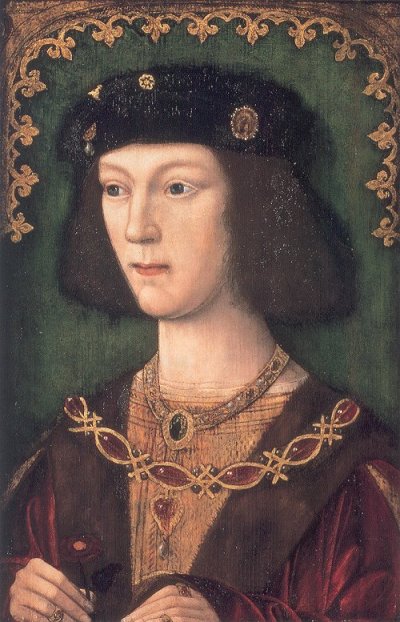
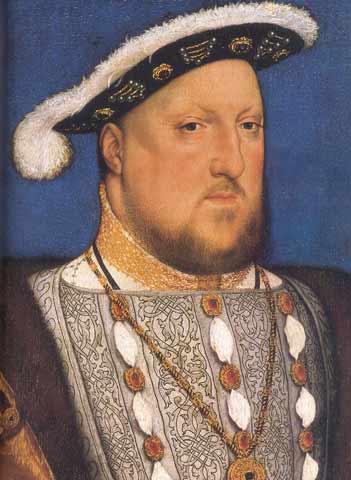
When we think of Henry VIII we often think of a domineering and abusive man, perhaps too much in love with his own power.  This may capture much of the truth of who Henry was, but he did not necessarily begin that way.  He had great intelligence.  He spoke fluently in perhaps three different languages.  He was an accomplished musician and dancer.  He wrote a legitimate and scholarly work on the sacraments.   He had a love for crowds and spectacle, and England adored him in the early years.

When we see him as a young man . . .

we may wonder how eventually he became this man. . .

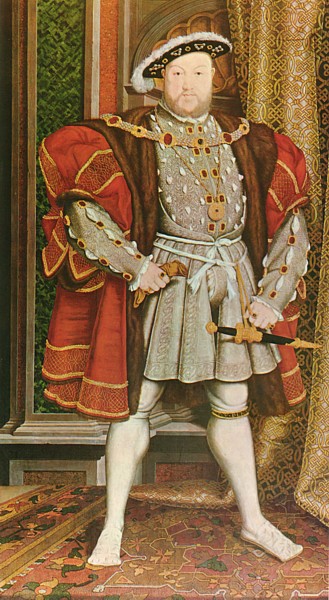
But I think both pictures share something in common.  We often think of Henry as all confidence and show, like this. . .

But I wonder if this last picture shows Henry “protesting too much.”  The first two pictures to me show a lurking insecurity.  The man in the first two pictures is not at ease with himself or his place in the world.  Perhaps I go too far in psychological speculation, but the image above with him jutting out his chest seems to reinforce this idea of insecurity.  If we see Henry this way, his near obsession for a son begins to make sense to us.  Strong as Henry wanted to appear, his theological views depended greatly on those who he surrounded himself at a given moment in time.  Perhaps this is why many assert that Henry’s last wife, the evangelical Catherine Parr (here below giving her best “Excuse me, will you please keep your children quiet — this is a library!” look) may have been his most important.  She tutored Henry’s son Edward, and had the strength of will to get her vision of Anglicanism imprinted on England.  To outlive Henry (the only of his wives to do so) she must have been a strong woman!

Six years after his death, his oldest daughter Mary assumed the throne.  History knows her as “Bloody Mary,” because of her persecution of Protestants.  In many ways she deserved this epithet, but we must try and sympathize with her.  Henry unjustly divorced and banished her mother Catherine of Aragon.  She had little contact with Protestants, and plenty of time to nurse a grudge, to plan to right the wrongs of the past.  We might understand better if we we realize that she thought that Henry had “ruined the country,” and God placed her in authority to bring England back to a godly foundation.  We can imagine becoming president where your predecessor had done everything against your most deepest convictions.  You would want to set things aright.

To this psychological motivation we should add that neither Henry or Mary’s mother lived very long.  What if she felt that she had precious little time to accomplish her goals before her death?  As the saying goes, “Beware of an old man (or woman) in a hurry.”  In this image to the right we see the same gnawing insecurity her father could not hide.  Like Henry she knew she needed a son if her attempt at reform would last, but as an older woman nearly past childbearing years, she had little hope of a suitor actually appearing.  We can lament the tragic nature of her life without condoning her actions.

After Mary’s death the stage was set for her half-sister Elizabeth to have a glorious reign.  Yet she too had reason to fear.  The pope had declared Henry’s marriage to Anne illegitimate, which meant that Elizabeth herself had no right to rule.  After Elizabeth, the closest to the throne was her cousin Mary Queen of Scots, niece of Henry VIII.  She stayed Catholic, and so remained the focus of Catholic plots to unseat Elizabeth.

Matters got more complicated when Mary fled to England for refuge after some accused her of murder. Personal letter between the two reveal a long friendship between them, but almost immediately after her arrival in England, Elizabeth imprisoned her.  Eventually one of Elizabeth’s spies uncovers evidence of Mary implicating herself  in a plot to overthrow Elizabeth.  The trial is a foregone conclusion — she’s guilty of treason.

We know that Elizabeth agonized over the options about what to do with her friend and cousin.  Many  believed that England and Elizabeth could never be safe as long as Mary lived.  Now that Mary had committed treason, Elizabeth had every right to deal with the problem once and for all.  Elizabeth had a few options:

  • She could execute her
  • She could keep Mary imprisoned, knowing that plots could still arise
  • She could exile Mary, but in exile she could still raise an army and return
  • She could ignore it altogether and hope it would not happen again.  But what head of state can ignore treason?

Neither option appealed to Elizabeth.  Sometimes we don’t have good choices, only a series of bad ones.

Some students wondered astutely if Elizabeth could escape all these choices by marrying herself.  If she had kids, her place on the throne, and the future of Protestantism, would be much more secure.  As to why she never did marry, my theory is the Tudor love of power.  If she married, she would still be queen, but someone else would be king.  This image below shows Elizabeth, like her father, perfectly comfortable in the role of outsized, grand monarch.

Next, the Spanish Armada.

Many thanks,

Dave

Seeing what you Mean

This was originally written in 2018 . . . .

*****************************

It seems that we occupy a strange place in our national life.  We have more political divisions even though we have much less actual discretionary spending in the federal budget than in the past.  President’s Trump and Obama function/ed largely as symbols for their supporters and detractors.  Many do not care much to look at their particular actions, rather, an action becomes bad or good because of who did it.  We have a hard time seeing past the ad hominem.

But this should not surprise us.  Perhaps it is our very lack of flexibility in the budget that heightens the symbolic role of the president.  I suspect also that especially since the end of the Cold War, and probably since Vietnam, America has searched for a new identity, and forming an identity requires strong symbols.  And, while I think that we would struggle in our political life currently in any case because of this, as (bad) luck would have it, our last two presidents have been near opposites in terms of their personalities and style.  Some argue that Obama was the far more “rational” president, but even if that were true, Obama’s supporters had a strong emotional, gut-level attachment to him, akin to Trump’s current supporters.  In any case, we will miss what is really happening if we focus only on the policies, or the outward appearance of things (though to be sure, we could use some dispassionate focus on what presidents are actually doing in addition to their symbolic perception).

What is a president, exactly?

Childish interpretations of kingship in earlier eras tend to argue along the lines of, “Kings dressed up in all their finery because they were greedy, cruel, and didn’t care about the people.”  Much better interpretations see monarchs as an extension of the people themselves in some way.  The people would not want them to dress in a dowdy fashion, for that would reflect poorly on them too.  So, for example, many Frenchman took great pride in the fact that Louis XIV could eat 2-3x more than a normal man with no apparent ill effects.  But I have struggled with even some of these more sympathetic approaches.  I still feel that they leave something out.

Alice Hunt’s The Drama of Coronation brings out many nuances and subtleties of English coronation rites.  She demonstrates a great ability to let the texts breathe and speak for themselves.  Her analysis strikes me as fair and careful, and her comments attempt to illumine what for 21st-century moderns is a great mystery.  She traces the coronations of five English monarchs in attempt to answer the question:

What is a king (or queen), exactly?

We will miss the mark widely if we think only in terms of having an executive function in government.  One problem that faces historians with this question is that we have very few records of medieval coronation rites.  This in itself gives us a clue that coronation ceremonies had a primarily religious function.  In the older Byzantine rite, we see that the public, and even catechumens, had to leave the service during the canon of the mass.  In the western rite of St. Gregory the Great, the confession of sin has communicants proclaim, “I will not speak of thy mysteries to thine enemies.”  Hunt suggests that at least beginning with Pepin the Short, coronations took place in a sacramental and liturgical sphere, which would have meant “private” in at least some ways.

But we have many records or eyewitnesses of England’s 16th-century coronations.  The crowning of Henry VIII would not have been unusual, but each subsequent coronation had its own unique elements that perhaps called for a more public justification, aside from the turbulent historical circumstances:

  • Anne Boleyn was crowned.  The fact that a new queen would be publicly crowned while the king still reigned was entirely novel.
  • The coronations of Mary and Elizabeth as “queens regnant” had not happened before
  • Edward VI coronation involved that of a boy king amidst stark religious changes

As mentioned, Hunt handles the sources marvelously.  My only quibble is one that I have with many (it seems) English historians, which involves their failure to raise their eyes above the various perspectives and declare something definite.  I am all for intellectual humility, but sometimes it takes more humility to take a risk of being wrong than to say nothing at all.

The first issue Hunt tackles involves historians who try and argue for something along the lines of “exploitation of ceremonies” to achieve power.  She cites some historians of the Wars of the Roses that accuse the Yorkist faction of attempting just this to achieve power.  Hunt dismisses this perspective quickly.  Along with David Kertzer and others, she argues that ceremonies don’t exploit as much as they create legitimate rule.  This may sound silly to some modern ears if they think only of ancient robes and mitres.  But if we imagine a disputed presidential election in the U.S., and one candidate had the Chief Justice of the Supreme Court administer the oath of office, we would not say that he “exploited ceremony.”  Rather, the ceremony–at least in part–made him president.  He could not be president without the ceremony, nor would we say the ceremony meant nothing more than empty ritual.

Henry VIII gives us a good place to begin as the last great coronation before the Reformation.  Here we reside in the realm, so we imagine, of absolute divine right before the advent of more popular Reformation polities.  But just as the Roman emperors opposed themselves to the aristocratic senate and ruled in the name of the people, so too did Henry and other European kings.  Kingship had an element of “popularity” about it, in the strict sense of the Latin meaning of “populares.”  Hunt quotes from the Liber Regalis:

Here followers a device for the manner and order of Coronation of the most excellent and Christian prince Henry VIII, rightful and undoubted inheritor of the Crown of England and of France with all appurtenances, which is only by the whole assed and consent of every of the three estates of his realm.

Henry’s legitimacy is real, rooted not just in Heaven but on Earth.  Thus, the “physicality” of his rule has a reflection in his person, and required the physical objects of rulers past, especially the chalice of St. Edward, among other things.  These various objects had a hierarchy of value, and who carried them and where people processed gave rather than reflected status.  Contra the modern assumption of the homogenization of space and time, the king stood somewhere between heaven and earth.  Heaven of course was not earth, but the two met in various times and places in the medieval view.  Church buildings themselves were a touchstone, and the designs of the buildings manifested this.*  Clergy were consecrated, set apart, so they could receive the ultimate intersection between heaven and earth–the holy eucharist.  The City of God was not the City of Man, but they sought to model earthly order on heavenly order, or reality itself.  Thus, officiating clergy elevated the king at a certain point in the coronation, just as they would elevate the bread and wine.  The ceremony made the connection of “consecration” immediately obvious to all.

Many assume that Henry’s Reformation might make such “catholic” ceremonies obsolete, but in fact Henry seems to have gone “all out” in Anne’s coronation ceremony.  To start, he held a separate coronation service for her, which may have had no precedent.  Second, the ceremony took place on Whitsunday (Pentecost), the second most holy day in the church calendar.  Third, Henry absented himself from being seen directly during the ceremony itself, which gave him more “god-like” status, the unseen yet present “earthly god” bidding Anne receive the crown.  Finally, Henry wanted for Anne to wear Katherine’s crown during the ceremony. Yet here even Henry met a roadblock he could not overcome, as the man in charge of the crown would not give it up.  The ambassador of Venice relates,

Accordingly, the king wrathfully sent to the one who has charge  of the queen’s [i.e. Katherine] crown, Master Sadocho by name, a great man in that island, requiring the crown for the coronation.  Master Sadocho replied he could not give it up because of the oath he had taken to the said queen, that he would guard that crown faithfully. The king then went to see him and expressed his desire.  At this, Master Sadocho, who is a man of ripe age, took off his cap and flung it to the ground without saying a word.  When the king saw this he asked what moved him to do such a thing as this, to which Master Sadocho replied that rather than give him the crown he would suffer his head to lie where his cap did.  . . . As he is a  great personage who also has a son also of great worth and numerous followers, the king took no further steps, but had another crown made for the coronation of the new queen, who has been pregnant for five months.

Obviously, symbols had real meaning for those outside of the king and clergy.

In all these things Henry to me seems to overreach, realizing the precarious nature of his enterprise.  He had founded a new church, divorced/annulled his marriage with Katherine, and married someone already pregnant.  He gave Anne all the symbolism he could.  Prayers said during the coronation directly assumed that the child Anne carried was a boy.  Alas for Anne, perhaps the connection between symbolism and reality could only go so far.

The real shift took place with Edward VI.  Here we had a combination of 1) No Henry to go all out to get his way, 2) More evangelical reformers in charge in the Church of England, 3) A boy king who had no real say in what went on.  The crucial distinction came when Bishop Cranmer stated that, “the oil [for consecration], if added, is but a ceremony,” and not strictly necessary.  Nothing really happens at the coronation that could not happen elsewhere.  Heredity, the system, and his oath made Edward king, and nothing more.  Certainly the ceremony had to have the Church presiding–or so it seemed obvious at the time–but the Church no longer had to “do” anything important.

One might argue that this shifted politics wholly into the realm of the secular, and so made kingship defendant on the right exercise of power.  This made kings potentially just as politically vulnerable as any president, but in a more precarious position, as Charles I and Louis XVI discovered.

As a culture, we clearly crave symbolic archetypes more than in the past.  We see this in the consistent popularity of super-hero movies, and the somewhat polarizing popularity of Jordan Peterson.  We see it in recent political commentary, as a handful of mostly normal people believed that Obama was the anti-Christ in 2008, or that Bush and Trump were/are Nazis. We see it in our woeful neglect of Congress–perhaps there are just too many of them to affix any meaningful archetypes.  It may be that we are forced into this symbolic realm by the incomprehensibility of our laws. However we got here, this unsettling political moment gives our culture some interesting opportunities to understand our symbols and to recover an older view of reality.

Today we tend to assume that if something is a symbol it is not really real, but only a signifier for the real.  Hence, we know what a male sign for the bathroom means, even though of course no one in the bathroom looks like the symbol.  Symbol and reality live in different worlds, in different planes of meaning.  But the older meaning of “symbol” meant the bringing together of reality to create “real” meaning.  St. Maximos the Confessor writes,

…for he who starting from the spiritual world sees appear the visible world or else who sees appear symbolically the contour of spiritual things freeing themselves from visible things… that one does not consider anything of what is visible as impure, because he does not find any irreconcilable contradiction with the ideas of things.

To quote Jonathan Pageau, “a symbol is a meeting place of two worlds, the meeting of the will of God with His creation.”  Pageau goes on to say that the most real things are that way because precisely because they are symbols.  Reality “really happens” when heaven and earth unite, when they “symbol together.”^

I can’t say for sure if this older view of reality will help us understand exactly what a president is, but I think it will help.  The more self-aware we can be of what we are doing, the more hope we have.   Then, maybe we can go back to the lemonade on the porch days of debating the finer points of Social Security reform.

Dave

*Pageau talks mostly of church designs in the eastern Roman empire, though his point applies in the west, though with different applications.

**I am indebted to Pageau’s article here: https://www.orthodoxartsjournal.org/the-recovery-of-symbolism/

^This is exactly what St. Luke tells us the Virgin Mary did in Lk. 2:19 when she “gathered” or (as the Greek states) “symballoussa” all of what had happened to her.

“I See Satan Fall like Lightning”

This was originally published in 2014, then again in 2015 after Girard’s death.  I post it again in light of some discussions this past week in government class.

And now, the post . . .

**************************************

I’ve said before that for the most part, I can’t stand the modern British historian, or at least, a certain kind of British historian. This is the type that Toynbee rebelled against and patiently denounced for years.  This model calls for exacting discipline to attempt to focus only on the “what” and never the “why.”  They see their jobs as using a microscope to discover the most amount of facts possible, but never think to lift up their heads. Leave that to the metaphysicians.  Historians should tell you what happened and keep their noses clean of any other venture.

This approach has flaws from top to bottom.  First of all, it’s dreadfully boring, and second, it’s a lie. We simply can’t avoid metaphysics — we will always worship and point to something, though they seek to drive ourselves and others away from such a fate.

The Abbot Suger of the Abbey St. Denis once declared, “The English are destined by moral and natural law to be subjected to the French, and not contrariwise.”  Leave it to the French to say crazy things!  And with historians anyway, I agree.  French historians to the rescue!   They have their share of great ones, from Einhard to Tocqueville, Fernand Braudel, Marc Bloch,  Regine Pernoud, and so on.  Historians should not forget that they too are made in the image of God, and that history has no meaning or purpose without us seeking to “sub-create” and give meaning and purpose to the world around us.*

Rene Girard fits into this mold with his great I See Satan Fall like Lightning, a brief, but dense and thought provoking book that challenges how we read the gospels, mythology, and all of human history.  A magnificent premise, and he delivers (mostly) — all in 200 pages.

To understand Girard’s argument, we first need to understand two main lines of thought regarding civilization.  The first and overwhelmingly dominant view sees civilization as a great blessing in human affairs. Civilization allows for creativity and cooperation.  It fosters a rule of law that prevents a cycle of violence from overwhelming all.  Civilizations give the stability that, paradoxically, gives us space and time to challenge existing ideas and move forward.

The distinct minority believes that civilization can do no better than aspire to a lesser evil than barbarism.  It at times descends below barbarism because it enacts great cruelties under the comforting cloak of “civilization.” At least the abject barbarian harbors no such illusions.  The very organizing principle of civilization concentrates the worst human impulses to impose their will on others and count themselves innocent in the process.  Before we dismiss this uncomfortable thought, we should note that in Genesis 4 the “arts of civilization” are attributed to Cain and his lineage, with violence as the hallmark of their work.  God confuses language at the Tower of Babel because collectivized human potential is simply too dangerous.  In his The City of God Augustine seems at least sympathetic to this view, as his memorable anecdote regarding Alexander the Great makes clear:

Justice being taken away, then, what are kingdoms but great robberies? For what are robberies themselves, but little kingdoms? The band itself is made up of men; it is ruled by the authority of a prince, it is knit together by the pact of the confederacy; the booty is divided by the law agreed on. If, by the admittance of abandoned men, this evil increases to such a degree that it holds places, fixes abodes, takes possession of cities, and subdues peoples, it assumes the more plainly the name of a kingdom, because the reality is now manifestly conferred on it, not by the removal of covetousness, but by the addition of impunity. Indeed, that was an apt and true reply which was given to Alexander the Great by a pirate who had been seized. For when that king had asked the man what he meant by keeping hostile possession of the sea, he answered with bold pride, What you mean by seizing the whole earth; but because I do it with a petty ship, I am called a robber, while you who does it with a great fleet are styled emperor.

I used to associate this negative view of civilization exclusively with French post-modernists like Foucoult (not that I’ve actually read them 🙂 and therefore dismissed it.  But, there it is, in Genesis 4, in St. Augustine, and likely other places I’m not aware of.  So, when Girard asks us to accept this view, he does so with connection to the Biblical tradition and some aspects of historical theology (Girard accepts the necessity of government and order of some kind but never fleshes out just how he wants it to function).

With this groundwork we can proceed to his argument.

Scripture tells us that Satan is “the Prince of this world,” but in what sense is this case, and how does he maintain his power?  Where he wields influence, he sows discord internally in the hearts and minds of individuals and in society in general.  Hence, the more influence he has, the more dissension, and thus, two things might happen:

  • He risks losing control of his kingdom, as no kingdom can withstand such division for very long.
  • The chaos might incline people to seek something beyond this world for comfort, which might mean that people meet God.

How to maintain control in such a situation?  Girard believes that mythology and Scripture both point to the same answer: Satan rules via a ritual murder rooted in what he calls “mimetic desire.”  The war of “all against all” fostered by Satanic selfishness must be stopped or he risks losing all.  Mimetic desire heightens and gets transformed into the war of “all against one.”  The people’s twin desires for violence and harmony merge in an unjust sacrifice.  This restores order because we have find the enemy collectively, and find that the enemy is not us — it’s he, or she, or possibly they — but never “us.”  Satan’s triumph consists of

  • His control restored
  • His control rooted in violence
  • A moral blindness on our parts
  • A reaffirmation of our faith in the ruling authorities to bring about order

“Mimetic desire” has a simple meaning: we seek to imitate the desires of others, and by doing so take them into ourselves, into the community.  Girard speaks at some length about the 10th commandment which prohibits coveting. While this prohibition is not unique to the Old Testament, it places greater emphasis on the problem of desire than other cultures. Desire in itself is good, but Satan, the “ape of God” gives us his desires, desires for power, for more.  Once these desires spread they turn into a contagion, or a plague that infects people everywhere (Girard believes that many ancient stories that talk of a “plague” may not refer to something strictly biological).  Once begun, resistance is nearly futile.

To understand this we might think of two armies opposing one another.  Neither wants to fight, but both fear that the other might want to fight, so both show up armed.  Once the first shot is fired, be it accidental or otherwise, all “must” participate. All will fire their weapons, and you would not necessarily blame a soldier for doing so.  It just “happened,” and with no one to blame, there can be no justice — another victory for Satan.

He references Peter’s denial of Jesus just before his trial.  Often our interpretations focus on the psychological aspects of Peter’s personality — his impulsiveness, and so on.  Girard won’t let us off the hook so easily.  Such psychological interpretations distance ourselves too comfortably.  In reality, Peter fell prey to the desires of the crowd in ways that ensnare most everyone.  Peter is everyman, in this case, and perhaps its more telling that he extracts himself from that situation.

Pilate too succumbs, in a way typical of politicians everywhere.  Pilate needs order — his cannot afford that Justice be his primary concern.  To maintain order he has no other choice but to give in.  Girard would argue, I think, that this is nothing less than the bargain all rulers must make from time to time.  Politics, then, get revealed as more than a “dirty business,” but one with indelible roots in the City of Man.

Many ancient stories show forth the nature of mimetic violence, but the Cross itself stands as the example par excellence. The people in general have no hostility to Jesus, but once they become aware that the religious authorities are divided, and the Romans start to weigh in, the plague of mimetic desire settles in.  They turn on Jesus, and believe that His death will solve their problems.  It looks like a repeat of other events and another victory for Satan.  But this victim not only possessed legal innocence, He actually had true and complete innocence.  Now Satan’s methodology gets fully exposed, for “truly this was the Son of God.”  His resurrection and ascension vindicate Jesus and establishes His lordship and His reign over a kingdom of innocent victims.**  This “exposure” has its hints in the Old Testament at least in the Book of Job.  His troubles must be deserved in some way, so say Job’s friends.  If he follows his wife’s advice to “curse God and die,” he will bring peace to the community by vindicating their perception of the world.  He resists, and God vindicates him in the end.

Girard argues that Jesus does not give commands so much as introduce a new principle, that of imitation.  He counters our mimetic desires not by squashing them, but by redirection.  Jesus asks that we imitate Him, as He imitates the Father.  The epistles carry this forward.  Paul tells us to imitate him, as he imitates Christ, who imitates the Father.  Well, Jesus did give commands, but his commands about love in John, at least, invoke this pattern of imitation.  “A new commandment I give to you, that you love one another, even as I have loved you, that you also love one another” (John 13:34).  What makes this commandment new is not the injunction to love each other, but perhaps the principle on which it is based.

So far I buy Girard entirely.  His link of mimetic desire with the crucifixion, and his analysis of the nature and extent of Satan’s influence I find profound.  He started to lose me a bit when talking about how so many myths follow this pattern of mass confusion, scapegoat, death, and then, deification of the victim — or barring deification of the person killed, then of the process itself.  I.e., because it restored order, it must be from God/the gods.  I could think of a few myths, but I’m not sure how many follow this pattern (though I have a weak knowledge of mythology and could easily simply be ignorant).

When speaking of the founding of certain civilizations, however, he seems once again right on target.  In Egypt and Babylon the violence occurs between the gods.  Girard suggests that some stories may have actually occurred, and then the victims like Osiris and Tiamat became gods.  But in Rome at least, the violence takes place between the twins Romulus and Remus, an instructive case study for Girard’s thesis.  The twins set out to found a kingdom but cannot agree on which spot the gods blessed.  But the brothers cannot co-exist peacefully.  Their rivalry heightens until Romulus kills Remus and assumes kingship of Rome.  Livy, at least, passes no judgment on any party.  This is the way it “had to be.” No state could have two heads at the helm–one had to be sacrificed for order to commence. The Aeneid also has a similar perspective on the founding of Aeneas’ line. Violence just “happened.”  Such was the founding of Rome, and in later stories Romulus is deified as a personification of the Roman people.  Not that everything about Rome would be evil, but the foundational principle of “sacred violence” to establish civic order has no business with the gospel.

This story is instructive for Girard, but not entirely.  The deification of the aggressor fits squarely within Girard’s framework. But what of those that deify or exalt the victim?  Many myths fall into this category, Persephone, Psyche, Hercules, and so on.  These myths seem to prepare the way for Christ, who fulfills the stories in the flesh made real before our eyes.  Girard sees mythology in general rooted entirely in “City of Man,” but I cannot share this view.

At the end of it all, however, we have a great and thought-provoking book.  We should have more like them even if it means more French influence in our lives.  Below is a brief interview excerpt with him.

Dave

POPE BENDICT IS RIGHT: CHRISTIANITY IS SUPERIOR

Rene Girard, a prominent Roman Catholic conservative and author of the seminal book “Violence and the Sacred,” is an emeritus professor of anthropology at Stanford University. His more recent books include “Things Hidden Since the Foundation of the World” and “I See Satan Fall Like Lightning.” This interview was conducted by Global Viewpoint editor Nathan Gardels earlier this year. It is particularly relevant in shining some light on the controversial comments by Pope Benedict on violence and Islam in Germany last week.

By Rene Girard

Global Viewpoint: When Pope Benedict (then Cardinal Ratzinger) said a few years ago that Christianity was a superior religion, he caused controversy. In 1990, in the encyclical “Redemptoris Missio,” Pope John Paul II said the same thing.

It should not be surprising that believers would affirm their faith as the true one. Perhaps it is a mark of the very relativist dominance Pope Benedict condemns that this is somehow controversial?

Girard: Why would you be a Christian if you didn’t believe in Christ? Paradoxically, we have become so ethnocentric in our relativism that we feel it is only OK for others — not us — to think their religion is superior! We are the only ones with no centrism.

GV: Is Christianity superior to other religions?

Girard: Yes. All of my work has been an effort to show that Christianity is superior and not just another mythology. In mythology, a furious mob mobilizes against scapegoats held responsible for some huge crisis. The sacrifice of the guilty victim through collective violence ends the crisis and founds a new order ordained by the divine. Violence and scapegoating are always present in the mythological definition of the divine itself.

It is true that the structure of the Gospels is similar to that of mythology, in which a crisis is resolved through a single victim who unites everybody against him, thus reconciling the community. As the Greeks thought, the shock of death of the victim brings about a catharsis that reconciles. It extinguishes the appetite for violence. For the Greeks, the tragic death of the hero enabled ordinary people to go back to their peaceful lives.

However, in this case, the victim is innocent and the victimizers are guilty. Collective violence against the scapegoat as a sacred, founding act is revealed as a lie. Christ redeems the victimizers through enduring his suffering, imploring God to “forgive them for they know not what they do.” He refuses to plead to God to avenge his victimhood with reciprocal violence. Rather, he turns the other cheek.

The victory of the Cross is a victory of love against the scapegoating cycle of violence. It punctures the idea that hatred is a sacred duty.

The Gospels do everything that the (Old Testament) Bible had done before, rehabilitating a victimized prophet, a wrongly accused victim. But they also universalize this rehabilitation. They show that, since the foundation of the world, the victims of all Passion-like murders have been victims of the same mob contagion as Jesus. The Gospels make this revelation complete because they give to the biblical denunciation of idolatry a concrete demonstration of how false gods and their violent cultural systems are generated.

This is the truth missing from mythology, the truth that subverts the violent system of this world. This revelation of collective violence as a lie is the earmark of Christianity. This is what is unique about Christianity. And this uniqueness is true.

*Ok, I overstated the case.  The British have many great historians, Henry of Huntington, Toynbee, and recently Niall Ferguson (British Isles), and countless others who all attempt to have the humility stick out their neck, say something intelligible, and make people think.

**In an intriguing aside, Girard points out that Christianity helped establish concern for victims for the first time in history, a great victory for Justice and the human heart.  But Satan has learned to pervert this as well.  Now our “victimization” culture has left off concern for justice, and instead has become a quest for power over others.  I.e., “because ‘x’ happened to me, now you must do ‘y.'”  We see this happen in the ancient world also, perhaps most notably with Julius Caesar’s murder and its relationship to the founding of the Roman Empire with Octavian/Augustus.  Girard writes,

The Antichrist boasts of bringing to human beings the peace and tolerance Christianity promised but failed to deliver.  Actually, what the radicalization of contemporary victomology produces is a return to all sorts of pagan practices: abortion, euthanasia, sexual undifferentiation, Roman circus games without the victims, etc.

Historical Philosophy in Renaissance France

Like many of you I have spent some time wondering where we are as a civilization and how we got here.

It might seem like a book about French historians of the 16th century might have very little to do with this question.  But bear with me!–George Huppert’s book The Idea of Perfect History: Historical Erudition and Historical Philosophy in Renaissance France might indeed have something to do with where we find ourselves.

Though perhaps getting there via this informative but slightly dry tome may require more patience from readers than usual!

Huppert makes that point that the writing of history changed dramatically during the period he examines, but to understand this we need to briefly glimpse the history of “History,” for the study of history as we know it came into being comparatively recently.

In the ancient world various kings had their escapades recorded for posterity.  A text of the Egyptian pharaoh Thutmose III, for example, has him slaying 1000 lions with a single arrow and other such things.  We can wonder, did Thutmose expect others to believe him?  Did he believe it himself?  More likely, he had no wish to record exactly what happened but inhabited another way of thinking and another form of writing.  Herodotus records a combination of personal observations, investigations, and poetic constructions.  He saw no need to differentiate.  Apparently, he didn’t think it mattered.  He saw no need to concern himself exclusively with what “actually happened.”  Even Thucydides–who had a much more scientific bent and witnessed many of the events he records–surely invents certain speeches to craft an artful narrative.

The medieval period formed the immediate context for many of Huppert’s subjects.  Many wrote first-hand accounts of kings or crusades during this period.  What they knew and saw they described.  But when going beyond this, they no problem filling in gaps with some educated guesswork, and like the ancients, saw no need to be clear about the difference.  Others went further.  In his History of the Kings of Britain Geoffrey of Monmouth includes a lengthy section on King Arthur.  Here Geoffrey is on at least semi-historical footing.  King Arthur, or someone like him, may have existed.  But Geoffrey includes a section detailing Arthur’s denunciation by the senate of Rome, and his combat against a rag-tag army which included “Kings from the Orient,” which certainly never happened.  Moreover, Geoffrey and his readers must have known this never happened.

We also see in many medieval histories the desire to connect one’s own particular history with a grander narrative.  One can do this with myth directly, but others did this “mythically.”  Vergil has the origins of Rome come from Troy, and Geoffrey has the English, in turn, come from Rome/Troy.  French historians have the Franks come from Troy as well.*  Again, the desire to connect poetically/narratively with the grand story of civilization trumps that of what “actually happened.”  They did this quite self-consciously.

Nicole Gilles’ Annals of France (ca. 1525) gives us a late example of this.  He begins with Creation itself and then recounts some aspects of Biblical history.  He moves quickly to the history of France’s kings, but here he includes many legends and miracles.  The giants he describes, as well as the kings, have an ancestry. It just so happens in the Annals that the Franks were founded by a man named Francio, . . . also from Troy. Even the giant Feragut, slain by Roland, descends from Goliath.  Perhaps Roland and Francio did not exist, but certainly Charlemagne did.  But he has Charlemagne do things that few would really think actually happened, such as undertake a crusade to Jerusalem.  His book was a wild success, which surely frustrated many of the France’s emerging humanist scholars.  Those scholars might have taken solace had they known that the Annals were the last of its kind.

We see the shift evidenced by the comments of two humanist scholars in the mid 16th century.  Claude Fauchet wrote that medieval historians had, “failed in the chief responsibility of the historian, that is, to tell the truth.” And Lancelot Popeliniere declared that “no man of honor ever practiced [history in France], since the profession had always been in the hands of clerics,” whose limitations and biases prevented them from giving an objective appraisal of events.

These statements contain within them a revolution of thought, but they both beg questions: What does it mean for a historian to tell the truth?  And who is objective?

Their passion for “what really happened” involved the following:

  • Making history a science that concerned itself with the affairs of men, not so much the intervention of God, which cannot be measured or predicted.
  • Broadening the scope of history beyond national or religious concerns, and focusing on the history of all, and
  • Getting the best texts, and staying faithful to the best texts, would get us to the truth.  Truth comes from texts, not so much from tradition.

The astute observer no doubt notices a strong correlation between this last goal and the emerging Protestant Reformation.  Indeed, some of this new breed of historians had much sympathy with the French Protestants, and we can say more on this later.  But regardless of religious affiliation, all three goals also added up to a rejection of the idea that history involved a kind of devolution, a falling away from grace.  Rather, for these French humanists, just as we could improve the study of history and cleanse from the muck of the errors of the past, so too could our whole society move forward and progress.**

Huppert details the writing of several French historians of the 16th century who followed these axioms.  The details here ran a bit dry for me, but the overall effect was the same.  When one combines the work of these scholars in the 16th century with the Scientific Revolution of the 17th century, the work of history changed dramatically, and we should evaluate the fallout for good or ill.

The passion for precision and the value of the text have done a great deal to improve history in a variety of ways that seem axiomatic to mention.  We have more access to more information, we have more texts in translation, and almost certainly, a better idea for “what really happened,” than previously.  The late Renaissance humanists foreshadowed the Enlightenment, which gave us a variety of other secondary blessings, especially related to advancements in science that comes with breaking things down into component parts.

But we have lost a great deal in the exchange, and the exchange may not have worth it.

First, I stress that while we have a “better idea” for what really happened in the past, we still don’t really know.  We still have to guess and be comfortable with guessing.  Having more texts will not solve the problem of interpreting the texts.  But all this says is that the French humanists had a bit too much optimism, hardly a dreadful fault.  But this optimism has had certain consequences.

Their methods assert that we can get outside traditions and into a place of pure perspective and rationality.  We know that we cannot do this.  Their reliance on texts exacerbates this.  A text, divorced from tradition, can have an almost infinite amount of interpretations.  Note how the reliance on “sola Scriptura” has doomed Protestants into constant splintering and thousands of factions, each claiming to base their ideas on the “text” of the Bible.  In the end, different traditions of interpretation do in fact form, with Reformed Study Bibles, Scofield Reference Bibles, and so on.

We must also deal with Geoffrey of Monmouth and Nicole Gilles and ask if they write history. We may say that the discipline of History involves many things, but we must first ask what it involves primarily.  Is it primarily an art or science?  If we had to choose would we rather have eyewitness testimonies to tell us what happened in Guernica, or Picasso’s painting?

If we side with Picasso we will begin to understand medieval historians.

For History to have any real significance, it must have meaning.  Meaning requires interpretation, and interpretation requires poetry, something beyond mere facts.  We might surmise that in having Arthur deal with Rome, Geoffrey sought to display his view of Arthur as the inheritor of the mantle of Christendom after the fall of Rome–the literary equivalent to an interpretative painting of him, or perhaps an “icon” of Arthur (a great example of how truth can be communicated in image can be found here). The same could be said of Gilles’ “depiction” of Charlemagne.

We do not critique paintings by saying things such as, “He didn’t look exactly like that, so that’s not painting.”  But humanistic rationalism treated the text as having more truth than the image.  This is why they treated medieval historians unfairly.  They failed to see how truth claims could be communicated in the text artistically (and entertainingly as well, as anyone who has read Geoffrey of Monmouth can attest).^  I have no problem calling Geoffrey and Gilles historians, albeit historians of a different type.  They told the “truth,” (if their interpretations were accurate), but in a different way.  They had their biases, but so do you and I.

One can point to many reasons why we experience our current political situation.  Some of them do indeed have a connection to the historians of Renaissance France.  The founders (not the early colonists) drank deeply from the same Enlightenment-oriented spirit of our aforementioned historians.  They too focused heavily on texts, and indeed, we base our life together not on shared traditions, but the texts of the Declaration and Constitution, and this has certain consequences.

The postmoderns rightly tell us that texts can have an almost uncountable number of interpretations.  The search for the “absolute” interpretation of the text will get us nowhere.  So, both those who drive pickups with big American flags, and those who drink latte’s and protest the national anthem can claim to live out what it means to be an American (i.e., “protest is the most American thing one can do,” and so on).  On the one hand, Trump takes an ax to many traditions of how a president should act.  But on the other hand, he “connects with the common man,” and isn’t America all about the common man and freedom from tradition?

Hence, we see our dilemma.

But postmoderns fail us because not every interpretation has the same validity.  We have to have a way of distinguishing and separating the good from the bad.  With only texts and no traditions at our disposal, however, we will have a hard time reigning in the various interpretations.  Other ways of seeing and apprehending the “truths” of history can provide checks, balances, and possibly, a return to sanity.  In his introduction to Fr. Maximos Constas’ The Art of Seeing Bishop Maxim asks

For example, if you have a photograph of Christ and an icon painting of Christ, which is more truthful?  Certainly, if you have a naturalistic approach, you would say, “the photograph.”  But if you say [the icon] you point to unconventional and eschatological truth.  . . . .Therefore, there is truth in art that does not correspond to the mind of reality.

Dave

*I find it interesting that everyone wanted to come from Troy and not Greece.  Troy lost.  Many say that the Europeans wanted to come from Troy to connect themselves with Rome.  I can’t deny this might have something to do with it, but I think it goes beyond that.  Hector, for example, became a Christian name, while Odysseus and Achilles did not.  I’m sure there is more here to explore.

**The idea that history means speaking of such devolution is hardly the property of medievals alone.  Most every ancient society had myths of golden ages in the past we should attempt to emulate, whether these ages be mythical, quasi-mythical, or presented as historical (as perhaps Livy does in his work).  What looks benign to us in the French scholars really represented a radical shift from the past.

I consider the idea of devolution in history here.

^I think this attitude towards texts and the reduction of the idea of truth to “what actually happened” contributed greatly to the Galileo controversy and the subsequent tension between science and religion. In my limited reading of the situation, no such tension existed before this time.


Renaissance and Reformation, Act 2 (?)

I published this originally in 2016 a few weeks after Trump’s election.  In re-reading it, I would change very little of my original thoughts.  I am still not sure of what to make of Trump’s presidency and what it might mean for our future, and I still am not sure what criteria to use to evaluate his presidency.

Without further comment, the original post . . .

**************************

Like many I awoke Wednesday, November 9 to a big surprise.  Like many I wonder in what sense business as usual (more or less) will be the order of the day as Trump begins to actually govern, or whether or not we will see a significant pivot in our national life.  Time will tell (full disclosure, I supported neither candidate and hoped for a 3rd party revolution that never materialized).

I confess there is much I fail to understand about the election.  I have no strong opinions as to why Trump won.   I will attempt to focus on a broader historical perspective and will not deal with issues specific to the campaign, whatever their importance might have been.  I will not seek to take sides so much as to explain.

Consider what follows speculative . . .

Like many I search for historical parallels to our situation.  Many months ago I suggested Andrew Jackson, or perhaps Rome’s Marius, as a historical counterpart to Trump.  A few months ago Tyler Cowen suggested that, based on a book he had read, our world might resemble that of the Reformation.  I filed that away and thought little of it–until November 9.  All six of Cowen’s observations have merit, but two immediately jumped out at me:

1. Many of the structures in places are perceived as failing, even though in absolute terms they are not obviously doing worse than previous times.

2. There is a rise in nationalist sentiment and a semi-cosmopolitan ethic is starting to lose influence.

In his Civilisation series Kenneth Clark displayed an obvious affection for Erasmus of Rotterdam (1466-1536).  Who can blame him?  Erasmus had a great intellect and a good sense of humor, especially about himself.  Erasmus had no particular attachments anywhere and so he cultivated friends all over Europe.  He represented what some might see as the apotheosis of the medieval vision–a cosmopolitan, universal man of Christendom.

Such status did not prevent Erasmus from engaging in polemical criticism.  From what I hear, his Praise of Folly (I have not read it) mercilessly lambasts much of society at that time, in and out of the Church.  And yet, Clark points out that Erasmus could not accept challenges to authority from the common man.  In a personal letter he wrote with horror at the fact that hardly anyone in a town he visited doffed their caps to him–to him–a respectable pillar of Society.  We can almost hear him say, “I’m the one who gets to criticize society.  Not you!  You don’t know what you’re doing, whereas I (obviously) do!”*

Erasmus could criticize aspects of society but would never think of criticizing Society itself and the conventions that held it together.  He lived in an urbane, intelligent, tolerant world of reason, progress, proportion, and the like.  But the temper of times overwhelmed him.  Europe’s darling in 1511 found himself playing the role of “Mr. Irrelevant” soon after the Reformation began in 1517.

Even Clarke, I think, sees the problem with Erasmus.  No one doubted his character, but they questioned his conviction. Erasmus wore too much on his sleeve and not enough (at least to observers) in his heart.  His glib dance throughout Europe made many wonder what he actually believed.

Many assume the that the medieval period practiced more than its fair share of intolerance.  Scholar and historian Regine Pernoud points out, however, that the latter Renaissance had many more persecutions of heretics and witches than any period in the Middle Ages.  She offers no direct reasons for this, but we can speculate.  By 1200 A.D. Europe had attained a significant measure of stability, but not yet a great deal of movement.  The elite of society had “real” jobs and connections to the common man.  The “people” did not live as well as the aristocracy, but they lived with the elite in the same communities and moved in the same circles.  The sea had yet to tempt medieval society, which limited physical mobility and perhaps added to the stability.

By the mid 13th century Thomas Aquinas begins to dabble in the powers of reason and Aristotle.  The Black Plague disrupted the settled social arrangements (among other things).  The 15th century saw plenty of change with the beginnings of exploration and the printing press.  The papal court practiced pagan Greek city-state thinking more so than the service of God.  Now too, elites like Erasmus moved in entirely different circles than “the people.”  With the revival of classical culture came the revival of classical pagan religion, and the rise of occult practices.  It adds up to too much change too quickly.  The Reformation happened not just because of Luther, but in part because Europe had several different people rise up simultaneously willing to challenge an out of touch status quo many no longer cared anything for.  Rightly or wrongly, many felt that elite Renaissance culture had gone too far.**  As Pernoud points out, the reaction against this outwardly benign march of “progress” began before the Reformation in the late Renaissance.

In another post, again from a few months ago, Cowen suggests the possibility that too much immigration may result in a backlash against immigration (we should note that Cowen favors increased immigration as a matter of ideology, but might be pragmatic as a matter of policy–I don’t know). If the pace of change moves too fast, people react against it even if the change itself benefits them overall (most data shows the increased benefits of increased immigration). Rapid change often creates psychological problems of dislocation.

Others with different ideological perspectives seem to agree with him.  Slavoj Zizek argues (warning to those who follow the link: Zizek uses profanity rather “liberally” in places:) that on European immigration issue, allowing for more democracy would significantly restrict immigration policies in multiple countries.  Right now more inclusive policies must come from the state and not from the people.^  Ezra Klein had an interesting exchange with Tyler Cowen recently where they discussed the subject of diversity.

COWEN: …Now Putman, let me ask you about Putnam, and how Putnam relates to Donald Trump. As you know, Robert Putnam at Harvard, he has some work showing that when ethnic diversity goes up that there’s less trust, less cooperation, less social capital.

If you think of yourself in the role of an editor, so you have an American society, diversity has gone up, and a lot of people have reacted to this I would say rather badly — and I think you would agree with me they’ve reacted rather badly — but there’s still a way in which the issue could be framed that while diversity is actually a problem, we can’t handle diversity.

Putnam almost says as such, and do you think there’s currently a language in the media where you have readers who are themselves diverse, where it’s possible not to just be blaming the bigots, but to actually present the positive view, “Look, people are imperfect. A society can only handle so much diversity, and we need to learn this.” What’s your take on that?

KLEIN: I strongly agree. We do not have a language for demographic anxiety that is not a language that is about racism. And we need one. I really believe this, and I believe it’s been a problem, particularly this year. It is clear, the evidence is clear. Donald Trump is not about “economic anxiety.”

Might Trump have a doppelgänger of sorts (not religiously, not even close!) in Martin Luther?  In Luther, we see, among other things, someone with an authoritarian nationalist streak, one who could not stand the polite pagan-infused niceness of elite Europe, one who had no trouble calling fire and brimstone down upon a variety of people, and one who dabbled in opportunism from time to time.

One possible explanation for Trump might lie in the reaction against some of the sweeping changes that have come into the consciousness of America, such as

  • The “trigger warning” and “snowflake” phenomena across many college campuses
  • The Supreme Court case legalizing homosexual marriage across the land (overturning a variety of state laws in the process).
  • The extreme pressure directed against those who refuse to cater, provide flowers, etc. for homosexual weddings
  • The debate over transgender bathrooms, the reaction against the NC law, etc.

None of these changes directly effect the well-being of very many at all, but they do impact how one sees the their place in the world.  Without considering who is right or wrong in these actions, might the western cosmopolitan set across the U.S. and Europe have flown too close to the sun too quickly?

I listen to classical music on a very low level, when I actually listen to it. I can usually tell if it’s Beethoven, Bach, or Mozart, but that’s about it.   One day I decided to get cultured and tried to listen to a Mahler symphony.  My reaction?

In Absolutely on Music, Japanese author Haruki Murakami recorded a series of interviews with the famous conductor Seiji Ozawa.  In one interview Murakami asks,

Just listening to the third movement of [Mahler’s] First Symphony, it seems clear to me that his music is filled with many different elements, all given more or less equal value, used without logical connection, and sometimes in conflict with one another: traditional German music, Jewish music, Bohemian folk songs, musical caricatures, comic subcultural elements, serious philosophical propositions, Christian dogma, Asian worldview–a huge variety of stuff, no single one at the center of things . . . .  Isn’t there something particularly universal or cosmopolitan about Mahler’s music?

To my admittedly very limited experience of attempting to listen to Mahler, Murakami could have just as easily asked, “Isn’t there something meaningless and incomprehensible about Mahler’s music?  After 1/2 hour of attempting to “elevate” my cultural understanding, I would have begged someone to play me a Sousa march to at least bring my brain back into focus.

Cowen’s final thought on how this world might resemble that of the Reformation . . .

The world may nonetheless end up much better off, but the ride to get there will be rocky indeed.

Dave

*A possible parallel to this exists today.  A variety of high-profile fashion designers have said that they will not provide gowns for Melania Trump.  Bruce Springsteen canceled a concert in North Carolina over his objections to their transgender laws.  The great jazz pianist Ethan Iverson called for a boycott of Steinway pianos because the owner of Steinway supported Trump in some vague fashion (in 2012 Iverson urged a boycott of a particular jazz musician for his support of Romney.  Were Iverson a politician, this would be extremely dangerous territory, i.e., punishing someone not for their actions but for their particular beliefs). All of them were perfectly within their rights to do so.  Many applauded them putting moral convictions over profit or convenience.

Can progressives not extend the same rights to those who wish not to cater homosexual weddings?  It appears that some do not wish to extend the same right of protest.  Stephanie Slade at Reason magazine wrote,

The problem is not that Theallet was willing to dress Michelle Obama and isn’t willing to dress Melania Trump (which is, like it or not, a form of discrimination). The problem is just how many people don’t seem to think that same freedom should be extended to bakery owners, photographers, and other wedding vendors who object to same-sex marriage on religious grounds.

As Theallet put it, “we consider our voice an expression of our artistic and philosophical ideals.” I suspect Barronelle Stutzman, the white-haired grandmother who owns Arlene’s Flowers, feels the same way about her craft. But instead of assuming a live-and-let-live attitude on the matter, Washington state has systematically worked to destroy Stutzman’s business unless she agrees to take part in a celebration to which she is morally opposed.

**Whatever authoritarian streak the Middle Ages might have had, the Renaissance had it too, but it came not from the people, but from the elite makers of taste.  In many cathedrals the colorful stained glass (made by a variety of local artisans) got smashed out and replaced with clear glass to better fit wth their ideas of classical purity and decorum.

Pernoud argued with some force that the culture of the Middle Ages was “populist,” which the culture of the Renaissance was “elitist.”

^We can see the Brexit vote as a symptom of this same phenomena.  Europe’s pundits all seemingly declared that Britain would vote to stay in the European Union.  Part of me wonders whether or not the vote to leave had more to do with “sticking it to the cosmopolitan man” (which certainly includes most pundits) than any particular economic or social issue.

9th/10th Grade: The Reformation Roller Coaster

Greetings,

This week we looked at how the Reformation began to spread beyond Luther and his theology.  We looked at a couple of key ideas and themes:

1. Erasmus was a notable scholar.  He wrote many powerful critiques of the Catholic hierarchy.  He believed in going “back to the sources,” and translated the New Testament into Greek.  He initially admired Luther, but felt that a) Luther went too far, and b) Breaking with the Church would cause more harm than good.  Erasmus’ life should make us consider whether or not the cost of the Reformation outweighed its benefits.

2. Mainstream reformers like Luther, Calvin, and Zwingli believed that while the Church needed reform, society as it stood should be preserved.  Others of a more radical bent believed that both Church and society needed drastic overhauls.  They borrowed heavily from Luther’s “priesthood of all believers” theology and established their own views of faith, revelation, and the culture around them.  They went much further than Luther ever intended.  The logic of their ideas ran something like. . .

  • All believers have equal access to God, and have an equal chance of understanding His Word
  • Therefore, we have no need of any kind of hierarchical leadership in the Church
  • Those with the Spirit of God have more wisdom than those who do not.  Therefore, we have no real need of local governments.
  • To achieve real holiness of life, and real holiness in society, the godly must separate themselves from the ungodly.

Luther and others were aghast when they saw how others interpreted their ideas.  When Luther wrote pamphlets urging the nobility to crush the radicals without mercy, some felt that Luther had become a ‘Protestant Pope.’

Our look at the ‘Radical Reformation’ forced us to consider the Church’s relationship to society.  Calvin’s followers wanted to blend civic and religious duties almost until there was no distinction.  In other words, Church and Society in their view should blend seamlessly together.  Radical Reformers wanted the kept entirely separate.  I hope the students understood that our ideas of how the Church should function impact how we think Christians should interact with society.

Of course, Luther never envisioned that he was starting “The Reformation.”  He believed that the Church needed reformed, and that under his guidance, the Church had more or less done so.  In his mind, after the reforms he helped initiate, it was time to stop “The Reformation.”  But Luther had unwittingly opened the floodgates.  The genie was out of the lamp, roaming free across Europe.

We discussed that while Protestantism solved many problems, it created others:

1. There are thousands and thousands of Protestant denominations worldwide.  What did this mean for society in the 16th century?  What does this mean for us today? Is this a problem?  If so, can Protestantism solve it, or is it part of its very nature?

2. In the 16th century, Catholics persecuted Protestants (and vice versa), but Protestants also persecuted each other, largely over disagreements over what is ‘essential’ to the faith.  How do we know what an essential of the faith is?  Can Protestants reach unity on this question today?  Why could they not do so in the 16th century?  As we discussed in class, few disagree about what Scripture says.  We disagree about what it means.  Why did the social, political, and religious climate of this time lead to so much violence?

The peasant revolts, the political shifts, and the multitude of opinions that emerged from this period should make us ask — “What was the Reformation exactly?”  For our first formal discussion of the year we got different perspectives on this question.  Whatever our answer, we must see that the Reformation involved much more than a change of church doctrine.  In fact, the Reformation shows us that changes in the Church will get reflected in society at large.

We continued to examine the Reformation in England, and its consequences for the rest of Europe. On Thursday we looked at Henry VIII early life and reign.  I include here four pictures of him at various points in his life.   No matter the period — I don’t trust those eyes!

Last Thursday I had the students look at a variety of maps in an effort to look at the Reformation from a purely geographical perspective.  In other words, did geography do anything to shape the course of the Reformation? Are there any patterns for us to observe?  The maps are here, which include the topography that the students had to match up with the religious divisions.

European Topography:

Some of them noted how mountains walled off certain religious groups.  Some theorized that different countries of like religious beliefs usually were close enough to be trading partners.  Religious groups in more rugged terrain (Spanish Catholics, French and Scottish Protestants) tended to have a bit more militancy to them than others did.  The possible link with rugged terrain and more intense religious expression may go beyond Europe.  Most of radical Islam, for example, does not come from Indonesia (the most populous Moslem country) but from the deserts of the Mid-East.  Looking at events from different angles hopefully can give us a more full complete picture of an era.

Many thanks,

Dave Mathwin

9th/10th Grade: Looking back from the Reformation

Greetings to all,

This will be the first of what should be weekly updates about what we are doing in class.  My goal is to have these updates to you no later than Sunday afternoon, so if you do not receive one by Monday, do let me know.  My purpose is to let you have a glimpse of the classroom so you can keep abreast of what we are learning and discussing.  I hope you will join in the conversation with us as we move through the year.

We spent part of the first week reviewing and setting the context for the Reformation.  For the new students, this meant entering a story somewhere in the middle, which can always be difficult.  For some of the returning students, summer has understandably flushed some of their brains.  Any student who feels shaky on the medieval and Renaissance period may want to look here and here, or perhaps other places in the “9th Grade” category in the archives here at astickinthemud.

As I mentioned at orientation, this class primarily involves understanding what it means to transition from the pre-modern to the modern world.  We tend to use “modern” as a synonym for “good,” and indeed, students may feel that the changes from 1500-1850 represent a substantial improvement for mankind.  However, others may just as legitimately feel that we lost a great deal of our Christian heritage as a result of this transition.  Understanding both sides of this debate is one of the key goals of this class, regardless of where students stand on this transition.

The transition can be best understood I think in the following ways:

  • The pre-modern world believed that time and space had a meaning of its own apart from our own actions, whereas the modern world, in the words of scholar Charles Taylor, believes in the homogeneity of time and space.

For example, some churches today have spaces that they use for basketball on one day, picnics on another day, and worship on Sundays.  The meaning of the space depends on the meaning the people give it.  The space has no “meaning” in itself.

The pre-modern world believed in sacred time (Lent, Paschaltide, Advent, etc.) and sacred space.  No one would every think of playing basketball inside Chartes Cathedral.  The space has a meaning apart from us, inherent in the nature of the space itself.

  • The modern world puts a lot more emphasis on the individual than the pre-modern world, which had a more communal and historically oriented approach to meaning.

For example, many in the modern world feel comfortable with the idea than anyone can interpret the scriptures, which empowers the laity to read for themselves.  On the flip side, however, the modern world has a harder time deciding which interpretation is correct.  The pre-modern world had little concept of the individual and derived meaning and understanding from the past more so than the present.

No Church historian, whether Protestant or Catholic, believes that things in the Church in 1500 A.D. were fine.  Many wanted reform in the Church and believed it was desperately needed.   Among scholars and contemporaries, disagreements come in the following areas:

1. When did the problems in the Church begin?  Some say that it began with the popes of the 15th century.  Some say it began with the Great Schism of 1378.  Some argue that it can be traced to the Avignon Papacy, or to the papal decree ‘Unam Sanctum.’  Some go as far back as the Investiture Controversy of 1077.  Some reformers would want to go back further still, and argued that the problems began with Constantine in the 4th century A.D. How people answered this question influenced what they believe was the root problem the church faced.

2. What  indeed was the root problem the Church faced?  Was it a question of the ethics of the Church hierarchy? Was the issue mainly theological?  Or was it the Church’s long involvement with politics?  Or perhaps, all three?  Each choice represented a new fork in the road, one that would involve different choices and divergent paths.  For example, if you believed the Church’s problems to be recent, you likely would focus on the Church’s moral lapses.  The further back one found the so-called “root” of the problem, the more theological and institutional the criticisms, the more radical the operation required to correct the abuses.

Another issue was not only how far reform should go, but, cut free from Church hierarchy, what criteria should they use to make theological decisions?  What authority should tradition be granted?  Is it just “What the Bible means to me?”  If it is more than that, what is it?  Reformers at the time did not always agree on this question, and the results of their disagreement would do much to shape events throughout Europe.

Despite its fairly innocuous beginning when Martin Luther nailed the 95 Theses to the church door in Wittenburg, the Reformation would snowball into a revolution.  Martin Luther had all of the necessary qualities that revolutionaries need.  He possessed great courage and great belief in his convictions.  He had charisma and keen intelligence.  The same qualities that make for good revolutionaries, however, do not make for good diplomats.  This type needs patience, flexibility, and the ability to see many points of view.  Historically speaking, very, very few have been good at both.*  This too will have a significant impact on Protestantism in particular, and the history of Europe in general.  Below I include some quotes from Martin Luther (and others) that illustrate Luther’s keen insights, sense of humor, temper, and stubbornness.

Next week we will see how the Reformation spreads throughout northern Europe, and the different guises reform takes.  If we believe that religion forms the heart of any civilization, the religious upheaval in Europe in 16th century will have significant ripple effects into all areas of life.  We shall examine some of these things next week.

Many thanks,

Dave Mathwin

*The only two I can think of are Nelson Mandela and George Washington.  Can anyone else think of others?

Reformation Quotes:

I think his [95 Theses] will please all, except a few regarding Purgatory who make their money thereby.  I perceive that the monarchy of the Roman high priest is the plague of Christendom, yet I hardly know if it is expedient to touch this open sore. — Erasmus in 1518

Most blessed Father, I offer myself prostrate at the feet of your Holiness, with all that I am and have. . . .I will acknowledge your voice as the voice of Christ, residing and speaking in you.  — Martin Luther to Pope Leo, 1518

Dearest brother in Christ, your epistle, showing the keeness of your mind and breathing a Christian spirit, was most pleasant to me.  Christ gave you his spirit, for His glory and the world’s good. [My advice] is that quiet argument may do more than wholesale condemnation.  Keep cool.  Do not get angry. — Erasmus 1519, in a letter to Luther

Luther’s books are everywhere and in every language.  No one would believe the influence he now has on men. — Erasmus, 1521

Unless I am convicted by the testimony of Sacred Scripture or by evident reason . . . I cannot and I will not recant anything, for to go against my conscience is neither right nor safe.  God help me. — Martin Luther at the Diet of Worms, 1521

If we strike thieves with the gallows, robbers with the sword, heretics with fire, why do we not much more attack these masters of perdition, these cardinals, these popes, and this sink of Roman Sodom . . . and wash our hands in their blood? —  Martin Luther, 1520

It would be better if every bishop were murdered, every foundation of every cloister rooted out, then one soul destroyed, let alone that all souls should be lost due to their trumpery and idolatry. – Martin Luther, 1521

Begone, unclean swine!  Touch not the altars with your desecrated hands!  The cup is full.  See ye not that the breath of liberty is stirring?  – John Hutten, German priest speaking to the Roman bishops

The common man is learning to think, and contempt of princes is gathering among the multitude.  Men will not suffer your tyranny much longer. — Luther to the German princes

You lords, let down your stubborness and oppression, and give the poor air to breathe.  The peasants, for their part, should let themselves be instructed, and [withdraw some of their demands]. – Luther to German Nobility

Forward!  Forward while the fire is hot!  Let your swords be ever warm with blood. . . . The godless have no right to live except as they are permitted to do so by the elect.  – Thomas Munster, to his peasant army, 1524

In my former book, I did not venture to judge the peasants, since they had offered to be set right and instructed, [but they did not listen].  Any man against whom sedition can be proved is outside the law of God, so that the first who can slay him does right and well.  Therefore let everyone who can smite, slay, and stab.  There is nothing more devilish than a rebel. – Luther, ‘Against the Robbing and Murderous Horde Of Peasants.’ – 1525

He who will not hear God’s Word when it is spoken with kindness must hear the headsman when he comes with his axe. . . . Of mercy I will give no heed but to God’s will in His word.  If He will have wrath and not mercy, what are you to do with mercy?  Did not Saul sin by showing mercy upon Malek? — Luther, ‘An Open Letter concerning the Hard Book Against the Peasants.

Why should we pity men more than God does? – Philip Melancthon on the destruction of the Anabaptists

Anyone who is aware of [Anabaptist] teaching and preaching must give names to the magistrate, in order that the offender may be taken and punished.  Those aware of such breeches of this order and do not give information, shall be punished by loss of life or property. – Edict of Saxony, 1528

Quotes from Luther on Various Topics:

All the articles of our Christian faith are in the presence of reason sheerly impossible, absurd and false.  Reason is the greatest enemy faith has.  She is the Devil’s greatest whore.

The Bible teaches us to feel, hope, grasp, and comprehend faith, hope, and charity far otherwise than mere human reason can.

The human will is a beast of burden.  If God mounts it, it goes where He wills, and if Satan, it goes where he wills.  Nor can it choose the rider.

Christianity is nothing but a continual exercise in feeling that though you sin, you have no sin.  It is enough to know that the Lamb bears the sins of the world, whether we commit a thousand fornications a day or as many murders.

Man is as unfree as a block of wood, a lump of clay, a pillar of salt.

I do not admit that my doctrine can be judged by anyone.  He who does not receive my doctrine cannot be saved.

Seek out the society of your boon companions, drink, play talk bawdy, amuse yourself.  One must sometimes commit a great sin out of hate for the Devil, so as not to give you the chance to feel scrupulous over mere nothings.

Sin powerfully.  God can only forgive a hearty sinner.

I eat like a Bohemian and drink like a German.  Thanks be to God.

I seek and accept joy where I can find it.  We now know, thank God, that we can be happy with a good conscience.

Our loving God wills that we eat, drink, and be merry.

Dances are instituted that courtesy may contracted between young men and girls.  I myself would attend them sometimes, but the youth would whirl less giddily if I did.

I would not give up my humble musical gift for anything, however great.  Next to theology, there is no art that can be compared to music, for it alone, after theology, gives us rest and joy of heart.

Christians need not altogether shun plays because there is sometimes coarseness and adulteries therein; for such reasons they would have to give up the Bible too.

If God can forgive me for having crucified Him . . . He can also bear with me for occasionally taking a good drink to honor Him.

My enemies examine all that I do.  If I break wind in Wittenberg they smell it in Rome.

Punish if you must, but let the sugar plum go with the rod.

Take women from their housewifery and they are good for nothing.  But there she can do more with the children with one finger than a man with two fists.

My Lord Katie (his pet name for his wife Katharine).

I wish you peace and grace in Christ, and send you my infirm love.  Dear Katie, I was weak on the road to Eisleben, but that was my own fault. . . . now, thank God I am so well that I am sore tempted by fair women and care not how gallant I am.  God bless you.

I never work better than when I am inspired by anger.

Luther the Anti-Semite?

 I would not have the Gospel defended by violence or murder.  Since belief and unbelief is a matter of everyone’s conscience . . . the secular power should be content to attend to its own affairs and constrain no one by force.

Since our fools, the popes, bishops, sophists and monks, those donkeys have dealt poorly with the Jews.  Indeed, had I been a Jew and seen such idiots, I would rather be a hog than a Christian.  I would advise everybody to deal kindly with the Jews.

And let whosoever can throw brimstone and pitch upon [the Jews]; if one could hurl hellfire so much the better. . . .And this must be done, so that our Lord will see that we are indeed Christians.  Let them be driven like mad dogs out of the land.

Opinions of Luther

Luther is the ‘Morning Star’ of Wittenberg. – Mutantius, contemporary of Luther

Luther has all the fury of a maniac. – Mutantius, spoken about a year after the previous comment

If we judge greatness by influence – which is the least subjective test we can use – we may rank Luther with Copernicus, Voltaire, and Darwin as the most powerful personalities in the modern world. – Will Durant

Chronicling and Creating History

Being a history teacher, I sometimes come across articles and studies detailing various forms of bias in history textbooks. Most of the time this bias leans in a liberal direction, but I have also seen Christian texts that are just as bad in the opposite direction. Two wrongs do not make a right. History textbooks are notoriously wretched things in any form, one of the worst examples of design by committee. You can solve the problem partially by removing textbooks altogether and simply rely on primary sources in the classroom, as I do. But of course bias still remains in which texts I select, how I present them, and so on.

The answer to “bias” is not to remove it, which would be impossible in any case, but to recognize that we have bias and to use it rightly. As to what “right” bias might be, well . . .

When we read ancient and medieval historians we can see this crafting of narrative openly. The authors seek to make a point about their universe. Herodotus shapes the story of the Persian Wars around the idea on heeding the limits of nature, be they physical or moral limits. Polybius looks for universal laws of the rise and fall of nations and explicitly applies that paradigm to Rome. Plutarch dug and found moral lessons in his parallel lives, and so on.

Father Patrick Henry Reardon made a point I had not considered before in his excellent commentary on the Books of Chronicles. The Books of 1 & 2 Chronicles covers the same era as parts of 2 Samuel–2 Kings, written some centuries prior. Father Patrick made the point that the author of Chronicles selected his material and his emphasis differently, a perfectly obvious point. What really got me thinking was his assertion that,

This spiritual exegesis of the sacred Scriptures, however, always takes place in history and pertains to the movement of history. . . . Understanding of the Bible must not be abstracted from the historical movement of the Bible itself. Its continuous line, which records history, is recorded within history, and gives form and shape to future history (emphasis mine).

I had never considered this idea that the narrative focus of Scripture would necessarily shape the way people acted in the future, and thus create history. But why else would the author (which the rabbinical tradition believed was Ezra, but Reardon thinks probably not) write at all? For he wrote not just to record events but to try and convince people of the centrality of Davidic Kingship and Temple worship, intending that the Jewish people would cling to these truths and be blessed accordingly. He wanted to shape history through his narrative.

We can take Thucydides as an example. Many see his brilliant work on the Peloponnesian War as a pioneering work of political realism. He almost entirely avoids standard historical tropes involving the gods, myth, heroes, etc. I don’t think Thucydides necessarily reflected the general mindset of the Athenians of his day,* but his philosophical concerns certainly shaped many in the future. It is no coincidence, for example, that Thomas Hobbes translated Thucydides. Thucydides also had a great influence on George Marshall’s thinking about the Cold War. It seems that Thucydides truly did both chronicle and create history.

Accepting this premise gives me great pause. I entirely abhor the “safe space” culture of many campuses, the shouting down of speakers, and so on. But–might they have a point? Their contention that words have power to mold and shape not just thoughts but future actions, seems born out by Reardon’s analysis and history itself. They would have us believe that all we are left with are words and action, in short–power. And if power is all that exists, then we should fight to have it used in service of our narrative (I suppose they could not even call their narratives “good” things if all we have is power).

We cannot live in a world of abstract facts as the modern age would have liked–that world never existed. We have our biases, and words and narratives have more power than we might have thought.** But I am convinced that neither are we left with the wasteland modern campus radicals would leave us. They promise liberation from oppressive structures (or something like that), but the real result is a narrowing of human thought and experience, and a demand to toe the party line without thinking.

Language theorists could likely comment on this question far better than I. But I offer that, as a start at least, we need to rethink the meaning of boundaries itself. We naturally think that boundaries restrict freedom, but not always. G.K. Chesterton had a wonderfully helpful analogy, in which he asked us to imagine children at a playground perched on a cliff. With the security of a fence keeping them from disaster, they will happily roam about the whole area. Remove the fence, and watch them huddle in the middle, fearful of falling to their doom. He writes in his famous work, Orthodoxy that,

. . .the more I considered Christianity, the more I found that while it had established a rule and order, the chief aim of that order was to give room for good things to run wild.

In the Book of Chronicles, the author devotes a great deal of space to Israel’s construction of the temple. David passed on to Solomon a whole host of specific instructions. We might initially recoil at the specificity, the restrictions on freedom of thought and design! And yet, the second half of Chronicles details what happens when Israel is deprived of temple worship, and Judah deviates from it and squanders their inheritance—corruption, war, division–all such things as restrict our freedom. We can glean further insight into this focus when we realize that the Temple functioned as an archetypal pattern–a meeting place of heaven and earth, just as mankind himself is a microcosm of heaven and earth (we are both earthly, physical beings, like the beasts, and ‘heavenly’ spiritual beings, like the angels).

When we write history, then, we will know when have hit upon the proper bias, the proper orientation, when that bias leads to an enhancement of the human person. A concentration, yes, but a concentrated vitality. St. Augustine understood our dilemma. The Roman idea of freedom meant freedom from others determining your actions–the more options, the better. The Christian sees dissipation in such a idea. Rather, God means for us to share in His life. This involves a conformity, to be sure, but one that makes us far more than we are by nature, not less. Pressing home his point, he writes in the City of God that,

Nay rather, it will be more truly free, when set free from the delight of sinning to enjoy the steadfast delight of not sinning.  . . . This new freedom will be the more powerful just because it will not have the power to sin; and this, not by its unaided natural ability, but by the gift of God has received from him the inability to sin . . .   It surely cannot be said that God Himself has not freedom, because he is unable to sin?

Such can be the healing power of the right “bias.”

Dave

*The Athenians must have cared about religion enough to put Socrates to death for impiety in 399 B.C. Those dying of the plague during the war went to the Parthenon (dedicated to Athena) to die. But I do not say either that Thucydides was a complete outlier. There is a noticeable difference, for example, between the plays of Aeschylus written a generation before Thucydides, and Euripides, his contemporary.

**Understanding this might give us further insight into God creating in Genesis 1 through speech..