What Happens when Germans Go Nuts?

They make a rational, thoroughly scientific, argument for the existence of Atlantis, located in the Atlantic (right where Plato said it was) destroyed cataclysmically somewhere around 9000 B.C. (apologies to one of my favorite ad campaigns).

I have written before about the likelihood of advanced civilizations that existed long before their so-called beginning around 4000 B.C.  But it is so much easier to propound vague ideas then to make a concrete case for a specific civilization, let alone one for which we (seemingly) have no evidence for except Plato’s account in one of his dialogues.  And then you realize that one of the more credible arguments for the existence of Atlantis was written by Otto Muck . . . who invented the U-boat schnorkel for the Germans in W.W. II.  Yes, he came over to the U.S. like many other former German scientists after the war, but still, it does not help the case that he worked for the Nazis.

But first, Muck reminds us that Plato discussed Atlantis in two dialogues, not one, the Timaeus and Critias.  Plato has Socrates relate many myths throughout his work, but he speaks of Atlantis in strictly factual terms.  Like many others, I suppose, I had never actually read the full account of Atlantis in the dialogues and Muck makes a good point.  Plato, at least, seems to believe in the historicity of Atlantis, or certainly, Critias does, and he gives a lengthy description filling at least 15 pages of its size, location, topography, plants, and the like.  Critias talked about how the Greeks first learned of Atlantis from the Egyptians, still considered quite wise by the Greeks even in Plato’s day, via the great legislator Solon–Athens’ George Washington.  Plato invests a lot of heavy-hitters in his account of Atlantis.

It makes perfect sense to me to believe in a cataclysmic flood, as it is spoken of in every major religion of the ancient world.  I expect to find, along with Graham Hancock and others, the existence of civilizations that long predate the fertile crescent of 4000 B.C.  I delight in Jon Anthony West’s interpretation of Egypt’s history, for example, and find it persuasive.  But I cracked the cover of Muck’s book skeptically.  I don’t approach questions like this even primarily scientifically, let alone entirely so.  Still, with Atlantis, even I needed something to hold onto besides stories.  With other sites, you have megalithic architecture, for example.  For Atlantis, I need more than Plato’s account.

I give Muck credit.  He understands skepticism as a scientist and confronts head-on, piece by piece, in methodical fashion.  Some of what Muck wrote I found very intriguing, and other stuff, not so much.

To begin, Muck asks where the Atlantic ocean got its name.  Well, obviously from the Atlantis story, but this means very, very little.  Slightly more intriguing is Muck’s examination of the very similar phonetics between the god Atlas (apparently spelled out ‘Atlants’), who stood at the middle of the world upholding it, and the name “Atlantis” and its topography, which Plato tells us had a large mountain.  Well . . . ok, but . . . ?

He moves on.

If we look closely at Plato’s description of the topography he tells of a huge variety of plants and food that one could find there.  It seems almost fantastical. We assume the variety couldn’t really exist, given the size and location Plato mentions.  But if we consider the gulf stream moving across the Atlantic, then match it with the mountains described by Plato as well as the location, it matches.  You would have warm air from the south-east, with a large mountain in the center impacting the Arctic air, and the variety described by Plato is possible.  What makes this more intriguing is that Plato probably did not have the biological and topographical knowledge to make this up.
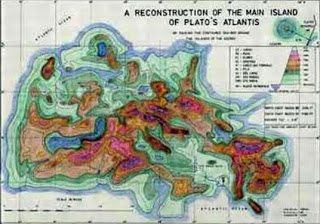
More interesting is the Gulf Stream itself.  If you compare latitudes for northwestern Europe and its overseas counterpart, you know that Europe is a lot warmer than the upper reaches of North America.  The Gulf Stream makes this possible.  But we also know that thousands of years ago Europe was much colder.  Then, around the time of Atlantis’ supposed destruction, it started to warm up.  What if the Gulf Stream did not always flow across to Europe, but instead was diverted by a continent in the middle of the ocean?  That could account for the temperature difference at first, and the shift after.

Perhaps the most bizarre, yet intriguing, argument Muck makes involves the habits of eels.

Apparently, a breed of eels exists that spawns in the Sargasso Sea (located just to the east of Atlantis on the map above).  For the longest time scientists could never understand why these eels undertook a long and dangerous migration across the Atlantic.  The females find European rivers, the males sit and wait in the ocean while the female eels fix their hair.  Ok, ok . . . observers discovered that the females can only come to sexual maturity in fresh water, hence their need for rivers.  But why travel east across the Atlantic.  It makes much more sense, from an evolutionary perspective and every other perspective, to go west from the Sargasoo.  The existence of Atlantis, however, would explain this.  For who knows how long the eels would go east for only a short distance from the Sargasso to the rivers of Atlantis.  The destruction of Atlantis did not alter their genetic memory.  They still swim east, and no doubt suppose that when they hit the coast of Europe they are back in Atlantis, more or less.

Plato considered Atlantis a bridge of sorts between land on either side of the ocean, and Muck explores some of the connections between the Americas and the world of Plato’s day.  He considers possible racial connections, considering that the typical look of the Basque people would fit well for a possible Atlantean type, since that “look” could fit in the western parts of Europe, north Africa, and Meso-America–the old sphere of Atlantean influence.  Muck makes you think hard throughout his work, but I think this the most ridiculous of Muck’s arguments.  Maybe I am just squeamish when an ex-Nazi helper-guy talks about race, but it seems that if the Atlantis story is true, 10,000 years of post-Atlantis destruction intermarriage would dilute the racial stock.

Perhaps more interesting are the ancient pyramids built by the Egyptians and Meso-Americans.  Muck seems to argue that both cultures acted as preservers of some kind of Atlantean legacy even thousands later in the post-apocalyptic reboot of civilization.  Perhaps the pyramid shape was meant to recall Atlas and Atlantis’ great mountain. This is more convincing than the racial argument, but I still think it fairly weak.  Both cultures built their structures thousands of years apart, and it seems they had different purposes in mind.  Muck’s earlier arguments about climate, topography, and the gulf stream stand on much more solid footing.  His analysis about the mapping of the ocean floor of the Atlantic indicates the possibility of an Atlantean like form still lying on the ocean floor.

As for the cataclysmic end, Muck has an answer for that as well.  Plato’s description has Atlantis lying right around the mid-Atlantic ridge, a potentially volcanic region.  The diagram below right shows the ridge shows the newest ocean floor crust in red:

Muck believes that a very large asteroid struck earth right around 9000 B.C., which matches remarkably with the chronology offered by Plato’s account.  Here is one of a variety of articles on the subject, with impact dates ranging between 10,000 to 13,000 years ago.  Some argue that this asteroid or comet struck the polar ice caps.  Muck argues that it struck somewhere around the mid-Atlantic ridge.  If Atlantis existed, and if a very large asteroid struck near the mid-atlantic ridge, you could easily have had a gigantically massive subterranean volcanic eruption that literally could have had Atlantis sink into the sea in a single night.

Muck doesn’t need the asteroid to hit the mid-Atlantic ridge necessarily.  If it did strike the polar ice-caps, it would have caused the destruction of Atlantis in a global deluge not overnight, but within a week or so at the most.

I have left out a great deal of technical information Muck includes, and must content myself with a general summary.

Muck knows he cannot absolutely prove his case one way or another.

I am a big fan of Jonathan Haidt’s work with Heterodox Academy, which encourages more ideological diversity on campus.  Haidt readily acknowledges his liberal beliefs–he has never voted Republican–but even he agrees that the situation has gotten dangerously imbalanced in many departments across many campuses.  He has discovered some interesting links, not surprisingly, between religious belief, psychological temperament, and political affiliations.  You can take various fun tests at his link here.

Just as political leanings often come from moral and religious beliefs, I think what one thinks of Muck’s book will depend on a variety of factors that go a bit deeper than the evidence itself.

If you look to disagree with Muck, most likely . . .

  • You are a committed ‘gradualist’ in all things geological
  • You are strictly scientific in deciding about the past and would hardly value Plato’s account as evidence of any kind.
  • You probably hesitate in part because you don’t want to be associated with various new age crazy people who believe in the existence of Atlantis for all the wrong reasons.
  • You need “hard” evidence like clay tablets, pots with markings, the stuff that archaeologists would find, before you would acquiesece to Muck

If you look to agree with Muck, most likely . . .

  • You are a contrarian by temperment
  • You weigh lots of different kinds of evidence much more equally than those committed to a particular field
  • You think it would be “cool” if Atlantis once existed (an attitude most abhorred by the strict scientific type, who would see this feeling as meaning absolutely nothing.  I think they are right, but only about 90% right in their approbation of this attitude).
  • You admit the possibility of great catastrophe’s altering the fabric of human history as well as geology.

I fall in the latter category, but hope that I have been fair to the former.  Again,some parts of Muck’s book I found nearly persuasive, and others not so much.

To illustrate some of the above differences, we can examine Jon Anthony West’s work in Egyptology.  He got famous/infamous for suggesting that erosion patterns on the Sphinx suggested that it was much older than was commonly believed, and was likely built by a civilization that predated Egypt perhaps by a thousands of years.  Dr. Robert Schoch, who earned his Ph.D in geology at Yale, analyzed the Sphinx and agreed with him.  You can see the video–narrated by Charlton Heston!:)–here.

When Schoch presented his findings at a conference, Egyptologists present could say little about the actual data he presented.  But one retorted, “Well, you say that the Sphinx was built thousands of years before, but if another civilization built it, where is the evidence?  Where are their tools?  Where is their writing?”  Schoch could only stare back rather dumbfounded. Hadn’t he just presented evidence in the form of the Sphinx?  Perhaps they did not accept the fact of the Sphinx itself as evidence because it did not fit into their preconceived notions of what constitutes evidence, which has to be in the form of writing, pottery, etc.  Of course, if a highly developed civilization did exist somewhere around 10,000 B.C., it would have suffered catastrophic collapse as a result of the asteroids that struck Earth around that time.  If they did have a written language and if they made pottery, it would have been washed away almost immediately.

We see how these different areas of belief work together.

So I say, let the Germans go nuts.  Let them make far-fetched claims.  It beats some other avenues they have taken in the past . . .

https://www.youtube.com/watch?v=l5EdrrN5xWI

Magicians of the Gods

I consider myself a mild agnostic on certain things about the ancient past.

I have no firm commitments about the age of the Earth.  I also have no commitment to the development of life on a macroevolutionary scale, thus I have no need for a very old earth.  As much as I understand the science, it looks like the earth (or at least the universe) has a very, very long history.  But I am intrigued by some young-earth arguments on the periphery out of curiosity.  Among other things, a lot of ‘old-earth’ arguments don’t take into account a cataclysmic worldwide flood.  If such an event happened, geological dating would need recalibrating.

When it comes to the book of Genesis, my commitments get deeper.  I am open to both literal and ‘mythopoetic’ interpretations of the early chapters of Genesis.  We can also combine them and probably both methods have their place.  But certain messages seem absolutely clear, among them:

  • That humanity fell from a state of grace, innocence, peace, etc. into a type of chaos
  • That our sin fundamentally altered the nature of human existence
  • That the change in humanity was physical as well as spiritual.  One may not believe that the lifespans given in Genesis are literal.  But the pattern is clear.  Adam and the earliest humans lived much longer than those at the end of the book.  By the end of Genesis we see that something about humanity has changed drastically.
  • The formation of civilizations happens very quickly.  It is almost the default mechanism of humanity.  Cain builds cities right away.  After the flood we have the Tower of Babel, and so on.

This reading of Genesis informs my reading of ancient history.

There is a version of early pre-history, common in most textbooks, that runs like so:

  • The earliest humans were basically ignorant and violent hunter-gatherers that lived in small groups.
  • At some point the climate changes or the herds thin out.  Food resources dwindle, forcing them to cooperate with larger groups to survive.
  • Because now you have to stick close to water, you get rooted to a particular spot.  You can’t just follow the herds.
  • So, you invent agriculture.  When you have really good harvests, you have a surplus.
  • This surplus gives the group leisure.  With this leisure they build more tools.  Eventually they build governments and laws.
  • As society expands governments have a harder time holding everything together.  So, they either invent religious practices or codify them in some way for the masses, which finishes the development of civilization.

This view is called “gradualism” or “evolutionary gradualism” or something like that.

I entirely disagree with this view.  The book of Genesis certainly at bare minimum strongly hints at something much more akin to devolution, and myths from other cultures hint at the same thing.

Enter Graham Hancock.

I don’t know exactly what to make of him.  The fact that he is an amateur bothers me not at all.  Those very familiar with this blog know of my love for Arnold Toynbee, and one of his main causes involved championing the amateur historian.  He makes no claims to fully understand some of the science he cites but relies on others with special degrees.  You can’t fault him for this.

He also has a restless curiosity about the ancient world that I love.  He willingly dives into unusual theories with a seemingly open mind.  His understanding of Christianity is deeply flawed.  But . . . his argument against the evolutionary development of religion could have come from any Christian.  Many evolutionary theorists acknowledge the social utility and advantage of religious belief.  But, he argues, there would be no obvious evolutionary advantage to saying, “We must take time and effort away from survival, making weapons, improving our shelter, etc. to build a large structure for a god that, fundamentally, we are making up.  In the evolutionary model it makes no sense that anyone would think of this and that others would somehow agree. Or, you would have to believe that the intelligent people that planned and built these temples were tremendously deluded, and furthermore, that this delusion occurred in every culture.  To crown it, if all we have is matter in motion, how would anyone think of something beyond matter in the first place?

Magicians of the Gods has some flaws.  It bounces around too much for my taste, and in some sections of the book the arguments change.  One review stated that,

Speaking as someone who found [Hancock’s earlier book] Fingerprints of the Gods to be entertaining and engaging, even when it was wrong, I can say that Magicians of the Gods is not a good book by either the standards of entertainment or science. It is Hancock at his worst: angry, petulant, and slipshod. Hancock assumes readers have already read and remembered all of his previous books going back decades, and his new book fails to stand on its own either as an argument or as a piece of literature. It is an update and an appendix masquerading as a revelation. This much is evident from the amount of material Hancock asks readers to return to Fingerprints to consult, and the number of references—bad, secondary ones—he copies wholesale from the earlier book, or cites directly to himself in that book.

Alas, I agree with some of these criticisms.  But I think some of them miss the overall point Hancock attempts to make.

When evaluating Hancock v. the Scientific Establishment, we should consider the following:

  • Arguments in the book involve interpretations of archaeology and geology, two branches of science that are relatively young, both of which have to make conclusions based on a variety of circumstantial evidence.  Science usually comes down hard on circumstantial evidence, and “proof” is hard to come by in these disciplines.  But some that attack Hancock do so when he suggests or speculates, and then blame him for not having “proof.”
  • Hancock is right to say that the Scientific Establishment is too conservative.  But, this is probably a good thing that Science is this way.  This is how Science operates.
  • Hancock cites a variety of specialists and laments that the “Establishment” pays them little heed.  I think that some of these “fringe” scientists may truly be on to something that the conservatism of the academy wants to ignore.  But . . . some of them may be ignored by the academy because they are doing bad science.  How does the layman decide when degreed specialists radically disagree?  We may need a paradigm outside of science to judge.  In any case, Hancock too often assumes that scientists with alternative ideas get rejected only for reasons that have nothing to do with science.
  • Some reviews give Hancock a hard time for referencing earlier books of his. This can be annoying, but . . . on a few occasions Hancock references his earlier books to disagree with or modify his earlier conclusions.  In the 20 years since he wrote Fingerprints of the Gods he has “pulled back” from some earlier assertions in light of some new evidence.  This seems at least something like a scientific cast of mind, but his critics seem not to have noticed this.  Should he be criticized for changing his views?
  • His book cover and title might help him sell copies, but it looks too gimmicky, and is guaranteed to draw the suspicion of “Science.”

I wish he made his central point clearer throughout and summed it up forcefully at the end of the book.  But we can glean the main thrust of his argument.

First . . .

Emerging evidence exists that a major comet, or series of comets, struck Earth some 12,000 years ago.  While this may not yet have the full weight of the scientific establishment behind it, many regard it as an entirely legitimate proposition.  It is not a fringe idea.

Many in turn believe that this comet struck to polar ice-caps, causing a flood of literally biblical proportions.  Those who believe in the Biblical flood need not ascribe this as the cause, but perhaps it could have been.  Of course many other ancient cultures have stories involving a cataclysmic flood.

Well, all this may be interesting, but this had little to do with the history  of civilization (so the argument goes) because civilization did not emerge until sometime around 4000 B.C., well after the possible/likely? meteor impact flood.

This brings us to Hancock’s second assertion, that civilization is much older than we think.

The discovery of Gobeki-Tepe some 25 years ago began to revolutionize our understanding of the ancient world.

No one disputes that the site dates to thousands of years before the so-called beginnings of human civilization.  The stone work is precise and impressive.  Recent radar penetrations indicate that even bigger, likely more impressive stone work lies beneath the site.

Here we come to a fork in the road.

  • We can rethink our assumption of early hunter-gatherers.  We can assume that they were far more advanced than we originally thought.  We can assume that they could organize in large groups and they possessed a high level of development and skill, including that of agriculture.  But then, would they be hunter-gatherers if they acted this way?
  • Or, we can assume that mingled with hunter-gatherers might have been the holdovers of a previous advanced civilization, perhaps one mostly wiped out by a global cataclysm.  These are the “magicians of the gods” Hancock postulates–those that emerged from the mass extinctions caused by global flooding, who perhaps took refuge with hunter-gatherers.  Perhaps they had a trade of sorts in mind: 1) You teach us survival skills, and 2) We teach you how to build, plant, and organize.

Option 2 might seem crazy.  It would probably mean reversing our gradual, evolutionary view of the development of civilization at least in the last 10,000 years.  But we have seen something like this already–an undisputed example of it after the fall of Rome.  All agree that in almost every respect, Roman civilization of 100 A.D. stood far above early medieval civilization of 800 A.D.

But Gobekli Tepe is not the only example of something like this.  Archaeologists observe other sites where earlier architecture seems far more advanced than later architecture.  Take, for example, the Sascayhuaman site in Peru, not far from where the Incas developed.  This wall, for example,

almost certainly predate the Incas by thousands of years.  The Incas later certainly could build things, but not in the same way, as the picture below attests (and it looks like they tried to copy the older design in some respects).

At Gobekli-Tepe, the recently deceased project head Klaus Schmidt commented regarding the parts of the site still underground that, “The truly monumental structures are in the older layers; in the younger layers [i.e., those visible to us at the moment] they get smaller and there is a significant decline in quality.”

Some similar possibilities of much older and possibly more advanced civilizations exist in Indonesia and other sites around the world. For example some believe that the Sphinx was built thousands of years before the pyramids.  There is some water erosion evidence that could support this theory.  There is also this intriguing ancient alignment with the Sphinx and the Leo constellation:

If true, this could mean that the Egyptians built the Pyramids where they did because they knew the site was already sacred from a previous era, or even possibly, a previous civilization.

With this before us, at bare minimum, we can strongly argue that the standard gradual and uniform process of the development of civilization should be in serious doubt.  If we accept this, then two other possibilities follow:

  1. Some civilizations went through periods of great advancement* and then fell into a period of steep decline, after which they never quite recovered their former glory.  A massive flood certainly could have triggered this decline.
  2. Another possibility is that we may be dealing with different civilizations altogether.  Hancock ascribes to this view.  For him, sites like Gobeckli Tepe served as a time capsule of sorts, a clue, or a deposit of knowledge for others to use in case of another disaster.  This may raise an eyebrow or two, but one of the mysterious aspects of Gobeckli-Tepe that all agree on is that they deliberately buried the site and left it. Who does this?  Why? Perhaps they wanted this site preserved so that it could be used in case of another emergency to restart civilization.  If this is true, there is much we do not understand at all about this site.

Those that want a tightly knit argument heavily supported by the scientific community will be disappointed by Magicians of the Gods.  But for those that want a springboard for rethinking the standard timeline of the ancient world, the book does very nicely.

Dave

*Michael Shurmer of Skeptic magazine argued against Hancock, saying that, “If they were so advanced, where is the writing?  Where are the tools?”  But why must writing be a pre-requisite for advancement?  Or if you believe writing is a hallmark of advancement, what if this previous civilization was more advanced in many other ways? And if they built buildings, isn’t it obvious that they used tools, even if we can’t find them?  If they built them without tools, wouldn’t they be really smart?

Maybe no tools exist at the site because they didn’t live near the site, for whatever reason.  But where they lived has nothing to do with how advanced they seem to have been.  Like Hancock, I’m not sure what else we need other than Gobekli Tepe to prove the point.


Democracy and the Feminine

This was originally written in March 2019 . . .

*****************

Any observer of our political and media cycles knows that we have a problem. Unfortunately, for as much as we talk about various problems, we seem no closer to solving them. We do not understand the roots of the problem, or what the problem even is. We have no common platform on which to stand to start to discuss it meaningfully. Here I do not wish to discuss red-state/blue-state divides, inequality, immigration, or any such thing. They all have importance. But we must go deeper into basic symbolic language to see what these issues mean in our context. Without this, we will continue to spin our wheels

Many who care not for President Trump seem mystified that he can violate a variety of established presidential norms and have more or less the same approval rating. Those with other political perspectives felt similarly about President Obama. To their great frustration, neither a terrible Iran deal, or the labryinth of the financially unsustainable health care bill–his two main initiatives–had any effect on his supporters. Neither president inspires(d) middle-ground opinions, and I believe that we can explain this only by understanding that neither one of them functions(ed) as traditional politicians, but rather as heavily symbolic figures. People identify with them primarily not through their policies or even their personal actions, but by what they represent.

If true, this may forebode difficult times ahead, for it shows that we disagree on fundamental things, and that whatever we say about the marginal tax-rate may only serve as a smokescreen for what we really mean beneath our words. We will fight hard for our narratives. This should impel us not just to understand the symbolic nature of our politicians, but also the “location” of democracy within traditional symbolic archetypes.* I will primarily reference biblical models and explanations, but I readily acknowledge that other civilizations use many of the same understandings.

Much confusion exists as to the meaning of masculinity today. We can start correcting this by understanding that all of us, men and women, are “feminine” in relation to God. That is, the masculine is the originator, the beginning and the end, the initiator. The “masculine” is steady, solid, not in flux. We might expect the feminine to have a merely passive role, and true, we see the feminine as “becoming,” rather than “being.” It is God who seeks us out, hunts us down (think of Francis Thompson’s great “The Hound of Heaven”). But, the feminine plays a strong supporting role.

We can see this even in the modern penchant for guys to call cars and boats “she.” The feminine gives the masculine a context for action, a space to develop. Cars and boats both create a womb of sorts, and (most) every mythological male hero needs a ship. Indeed, we are all born from water, just as God drew creation itself out of water in Genesis 1. And because water involves flux, so too the feminine can give flexibility to the straight and “narrow” nature of the masculine.

I confess that I find it rather silly that some feminists find the modern west toxically patriarchal. If we understand male and female archetypes, one immediately sees that modern democracy may be the most Feminine form of government in human history. We embrace change, possibility, and the new. We allow for individual expression and variation–all archetypal feminine strengths. While the west’s history with immigration has been somewhat erratic, overall we have welcomed far more foreign people’s than other cultures. We should expect this in democracies, for women are usually the best and most gracious hosts. They are generally better at managing social dynamics than men.

In human history, myth, and folklore the masculine tyrannizes much more often than the feminine. St. Francis’ marvelous Canticle of the Sun praises “Brother Fire” for being bright and strong, but fire so easily gets out of hand, flaring up at any time and place. Heat burns, but we quickly can remove ourselves from it (hopefully). So too, St. Francis honors “Sister Water” as being humble, clear, and pure. But Scripture, myth, and folklore all attest that, when feminine tyrants do happen to arise–though they are rare–they are the most dangerous.

One might see this in Medusa, Medea, and Jezebel. In Babylonian myth, the goddess of the sea, Tiamat, oversteps her bounds and inspires the other gods to rebel against her, with Marduk gaining the victory. Not surprisingly, the feminine aspects of Babylonian thought lingered on in their culture ever after, with the goddesss Ishtar reigning over most aspects of everyday life.** True to their feminine nature, Babylon was probably the most cosmopolitan and open city in the ancient world, but so open, however, that Scripture refers to the city in the book of Revelation as the archetypal harlot to the world.

In his magisterial Democracy in America, Tocqueville says much in praise of what he observed. But he devotes some time to discussing “What Sort of Tyranny Democracies Have to Fear.” Though he does not use Male/Female categories of thought explicitly, one can see them when he contrasts two types of abuse of power. “Masculine” forms of government such as monarchy or aristocracy go wrong in obvious ways. They rage, they lash out. But such tyrants usually care nothing for what you think. They are too direct for such subtlety. Tocqueville points out that the more masculine forms of tyranny may imprison the body, but they leave the mind free.

In contrast, democratic/feminine tyranny may be more rare, but will have greater power over individuals indirectly. They care not so much for the body but the soul. They don’t want you to empty the dishwasher, so much as they want you to want to empty the dishwasher. They want love, not obedience.^ They come for your soul and care little for the body, weakening one from the inside out.

Still, those that lament the feminization or infantilization of our culture have to acknowledge that, as already stated, democracy itself borrows much more heavily from feminine archetypes. It has no hierarchy for us to consult.^^ But, even if one wanted to establish a more “masculine” form of government like monarchy to counteract this, such an endeavor would be foolish and impossible. It seems, then, that we have an impasse between masculine and feminine visions.

I suggest, however, that the Church gives us a path forward, showing us how the feminine plays a crucial role in establishing, or reestablishing, a new sense of order. I will take just a few examples, but many more exist.

Postmodern thinkers like Jacques Derrida talk of the need for “radical hospitality,” a radical openness to the “other,” a dramatic extension of the feminine archetype. Such openness obviously invites chaos and self-obliteration. But, look again . . . perhaps we should not be surprised, then, that when Joshua sends spies to the Promised Land it is a woman (Rahab), and a prostitute who practices “radical hospitality,” that shelters them (my thanks, once again, to Jonathan Pageau for this example). So too Mary Magdalene, another loose woman, devotes herself completely to Christ before His disciples. Rahab’s openness to the new allows her to see that her civilization must be destroyed–by men of war. She becomes a hero of the faith (Heb. 11:31). But we must not also forget that she joins with Israel, and has her head shaved as a sign of her submission to the new order, and her devotion to God the Father.

The Virgin Mary gives us an even more constructive example. Tradition tells us that she was raised as a servant in the Temple, the very center of life for the people of God. Germanos of Constantinople marveled in the 8th century that

Do [we] not see a girl born as a result of a promise, and she at the age of three, being taken within the inner veil as an umblemished gift to live there without interruption, also being carried in procession by the wealthy among the people? . . . What then will this child become (Lk. 1:66). But as for us, the peculiar people of God . . . let us approach the [Virgin Mary] and approach the divine mysteries! . . . Let us see how the prophet admits her by his own hand and brings her into inaccessible places, having been in no way displeased, and without having said to her parents, “I am not undertaking this most novel practice and leading a girl into the holy of holies to dwell there without interruption, where I have been instructed to enter only once a year.” The prophet uttered no such thing; instead he knew in advance what would come to pass, since he was a prophet.

Mary Cunningham, translator for the above text, notes that

The high priest was only allowed to enter the holy of holies, the most sacred part of the building, shielded by a veil, representing the boundary of the created order and the realm of divinity. The preacher emphasizes here the extraordinary exception that was made in admitting the Virgin Mary to this sacred space and allowing her to live there throughout her childhood.

We might say that Rahab serves as a precursor to Mary–both women expressed an openness to God that made salvation–entering the Promised Land–possible. We might say that it is convenient that God could only become Man through a woman, but it makes “sense” mythically and archetypally just as it does biologically. And in her Magnificat, Mary alludes that this “openness” will not destroy order but in fact reaffirm it. Her “radical hospitality” becomes not a tyranny of chaos, but instead, wondrous devotion to the new kingdom ruled by her Son.

When “I AM” is both Alpha and Omega (Rev. 21:6) the hierarchy can be inverted and reaffirmed at the same time. This forms the solution to our current political and social difficulty. On the one hand, the “Masculine” must acknowledge that the possibilities inherent in the “Feminine” might bring about our “salvation” (using that term in an earthly and limited sense). But even in a democracy, the “Feminine” must acknowledge that the openness they bring best serves the reaffirmation of order, and not its destruction.

Dave

*All of what comes after this point assumes the following:

  • That gender/sex differences are real, rooted in creation, and not mere social constructs (though some degree of variation may occur over time and space as to how these differences manifest themselves).
  • That certain mythological constructs/ideas are also not mere human constructs–however universal they may be–but go deeper, and express “real reality.”

**True to the potential of excessive openness in the feminine, Ishtar reigned over love, marriage, war, and . . . prostitution.

^We see this in some of the worst democratic tyrannies, such as the French Revolution. In a near parody of the “impossible female,” one could get imprisoned in Paris ca. 1793-94 for either being too excessive in one’s love of liberty, or conversely, not excited enough about liberty. So too in Stalinist Russia (for communism is a western form of government), you could be shot for not keeping up with the intricacies of party dogma.

Today the idea of safe spaces, of the regulation of language so no one gets feelings hurt, etc., conjures up the image of a smothering mother–in contrast to the typical bad dad who is absent or physically abusive.

^^Perhaps not surprisingly, the first great western democracy had Athena, goddess of wisdom, for their patron deity. Scripture also calls Wisdom “she,” for wisdom is often subtle and contextual, not always straightforward and direct.


The Metal Mountain

Originally published in 2021 . . .

***********

I am guessing that many of you have seen this video, of the dancing robots, from Boston Dynamics:

Most of the comments either say that this is the greatest or worst thing ever. I asked a science teacher friend of mine for his reaction. He said, “Really cool and impressive, but . . . also terrifying.” I had a similar, but flipped, reaction. I find the video viscerally horrible, and I had the strong urge to reach through the screen and smash the robots with baseball bats. But I have to admit–it is pretty cool.

“Both-And” trumps “Either-Or” in this instance, and so far my friend and I agree. But we can’t both be right in our emphasis.

In the pseudepigraphal Book of Enoch*, an apocalyptic text associated with Second Temple Judaism, we read of a “metal mountain” in chapter 52.

And after those days, in that place where I had seen all the visions of that which is secret, for I had been carried off by a whirlwind, and they had brought me to the west. There my eyes saw the secrets of Heaven; everything that will occur on Earth: a mountain of iron, and a mountain of copper, and a mountain of silver, and a mountain of gold, and a mountain of soft metal, and a mountain of lead.

And I asked the Angel who went with me, saying: “What are these things which I have seen in secret?”

And he said to me: “All these things which you have seen serve the authority of His Messiah, so that he may be strong and powerful on the Earth.” And that Angel of Peace answered me, saying: “Wait a little and you will see, and everything which is secret, which the Lord of Spirits has established, will be revealed to you.

And these mountains, that you have seen; the mountain of iron, and the mountain of copper, and the mountain of silver, and the mountain of gold, and the mountain of soft metal, and the mountain of lead. All these in front of the Chosen One will be like wax before fire, and like the water that comes down from above onto these mountains they will be weak under his feet. And it will come to pass in those days, that neither by gold, nor by silver, will men save themselves; they will be unable to save themselves, or to flee.

And there will be neither iron for war nor material for a breastplate; bronze will be no use, and tin will be of no use and will count for nothing, and lead will not be wanted. All these will be wiped out and destroyed from the face of the earth when the Chosen One appears in front of the Lord of Spirits.”

I am no scholar of such literature, but I believe a connection exists with the meaning of robots for us now and our current political situation–why both are full of wonder and terror all at once.

I begin my case in what seem will think a strange place . . .

We all remember the excitement of dating our spouse, or even dating in general. At the root of this excitement lies the mystery of possibility. A dating relationship has a great deal of “potential energy,” to use a scientific term. But we must convert this potential into actual energy, or the “potential” is dead and meaningless. We see the same relationship with money. If I receive an Amazon gift card, it is always fun browsing and imagining what I might purchase. Sometimes the actual purchase fails to live up to the fun of ‘window shopping.’ But if I never actually converted potential reality (the gift card) into lived reality (the book I would read), then the gift card is “dead,” lacking any purpose or telos.**

It is no coincidence that money–which represents a multiplicity of possible reality, traditionally comes from the earth in the form of precious metals. We can see the “mountain of metal” in Enoch symbolically as a mass of possibility attempting to reach up to heaven, akin to the Tower of Babel.

Whatever status we accord the Book of Enoch, this interpretation should not surprise anyone reading the early chapters of Genesis. Here we see that it is Cain and his descendants that cultivate the earth for its potential. They develop the earth for tools, cities, and weapons. This technological development leads to violence and disaster, the unleashed chaos of the Flood. When we understand that the paradise was located on a mountain (cf. Ez. 28), we understand the Fall as a coming down from “heaven” to “earth,” a physical as well as spiritual descent.^ After murdering his brother, Cain descends further into the earth in the development of various technologies. He becomes enamored with potentiality, and his descendants develop it for violent ends. We usually see new technologies creating disruption. While it might be a chicken-egg situation, I think the pattern in Genesis points to

  • First, chaos, then
  • Technological development

Might the 1960’s show forth this pattern? We had large scale social upheaval starting around 1959, then the space-race/moon landing.

The metal mountain–a mountain full of “dead” metal, can also be contrasted with the paradisal mountain bursting with life in Gen. 1-2. No one expects to see a mountain lush with life, but this is the kind of paradox that suffuses the Christian faith. Perhaps the metal mountain can be seen as a kind of anti-paradise. Most every culture has some kind of sacred mountain, as mountains represent a union of heaven and earth.^ The metal mountain, then, would represent a bastardization of this reality, an “earth only” mountain.

This is not to say that all cities, shovels, trumpets, and swords are evil in themselves, any more than the Tree of the Knowledge of Good and Evil was evil. But Adam and Eve were not ready for such a gift, not ready for the power such knowledge would convey. Acquiring this knowledge before its appointed time severed them from God, each other, and themselves. The theme of dangerous and thus forbidden knowledge has a reflection in other mythologies, most familiarly for us in the story of Prometheus who brought the tools of civilization to humanity.

So, yes, I fear the robots, not because they are evil but because I don’t think we can possibly handle such things rightly in our current moment. But I must acknowledge the romance of the “potential” the robots convey, just as I love to receive Amazon gift cards.

We can understand our current political situation with the same symbolic framework.

There are those on both the right and the left that want nothing to do with the mundane realities of “married” political life. Some on the left looted Portland for weeks, and others occupied Seattle. Some on the right did something similar with the Capitol. Both sides have elements within them that want to transcend politics, that want a divorce from the constitutional order. They are enamored with the possibilities of a brand-new trophy wife. Those on the left envision a utopia of equality from below. Those on the right envision a strong Caesar from above to lead them to glory and defend them from all evil. Both imagine a perfect marriage to Brad Pitt or Emma Stone is theirs for the taking. Again–we cannot deny the intoxicating nature of “potential.” Gold has always exercised this spell.

Many have remarked how social media, which exponentially increases the potential power of language, has exacerbated this problem. This makes perfect sense when we see language as the manifestation of potential from the earth, much like gold or silver coins.

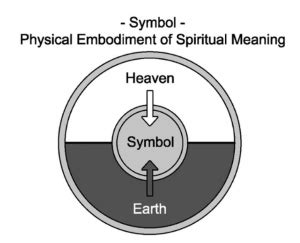
In his The Language of Creation Matthieu Pageau develops this idea convincingly, and what follows here merely seeks to condense his description. If we think of letters as random marks condensed into form, we can see that this process of incarnating ideas in language essentially boils down to turning potential into reality, the same as turning a hunk of iron into a sword. First, the basic union of Heaven and Earth pattern illustrated by Pageau as developed in Scripture:

We should note well that “symbol” here means not an ephemeral representation of something real, but instead an embodiment of meaning, something more real than a mere fact.

Forgive the crude nature of the drawing below which attempts to illustrate the principle as it applies to language (also stolen from Pageau):

The internet adds even more potential to the reach of the human mind, and it is both terrifying and glorious.

The current political climate mostly reflects this terrifying aspect of the internet. Imagine our body politic as the guy in a marriage who constantly gets different women paraded before him, an endless array of options and perspectives. He might eventually grow tired of his wife, with so much intriguing “potential” before his eyes. Many elites and institutions have lost trust, and this accelerates the problem. But these untested political realities are the elusive fantasy girlfriend that you never have to live real life with.

Exposing ourselves to robots during such a chaotic time (in fact such things are more likely to appear during chaotic times–just like Cain’s tool-making was directly preceded by his wandering) may greatly exacerbate the “meaning crisis.” We should not storm the Capitol, ransack Portland, or mess around with dancing robots.

But . . . as much as we should hedge and protect our current political symbols and institutions, our political life is akin to, but not the same as, our sacramental married life. The unformed potential is not evil, but how we use it might be. No good can come to a husband witnessing a parade of super-models, but our political life needs more “give” than a marriage to stay fresh and alert. A political system needs to occasionally integrate new ideas. But the only thing one can do during a flood is batten down the hatches. Twitter, Facebook, Youtube–who can doubt they bring a “flood” of “biblical proportions?”

As usual, Genesis gives us the pattern from which to operate. We have the paradisal mountain with four rivers flowing through it. The mountain encases the dynamism of the rivers–“change” safely residing within solidity. Without this solidity, even small challenges to existing order will pose an existential threat. Maybe conservatives will have to tone down market dynamism. Maybe liberals will have de-escalate the speed of social change. Maybe that works, but we’ll need to turn our keys at the same time.

Dave

*The Book of Enoch is not regarded as canonical Scripture for any Christian group except the Ethiopian Orthodox. But, it was a book held in great respect by the early Church. The Apostle Jude quotes it in his epistle. We may say that it was part of the vernacular, perhaps, of the early Christians.

**It is in translating the “potential” into reality that determines a good or bad marriage. The husband/wife run the risk of things growing “dead” through the lack of potential. This can lead to affairs, or more benignly to the buying of sports cars. This is one reason (among others) why couples should have children–to have new “potential” come into reality. After a couple completes the child-rearing stage, which for many can last into their 50’s, they enter a new transformative phase of “death to glory.” The couple can no longer generate new “potential life,” and their hair grows gray. But even their gray hair manifests glory–“white light” streaming from their heads.

^The importance of mountains becomes obvious in Scripture once we get clued into this pattern, i.e., Mt. Sinai, Mt. Zion, Mt. Carmel, Mt. Tabor, the Sermon on the Mount, Christ crucified on the ‘Hill of the Skull,’ and so on.

8th Grade: Egypt’s Desert Formation

Greetings to all,

I hope you have had a good week, and I hope too that you will enjoy the weekend before us.

This week we began our unit on Egypt, and first considered the influence of geography on the formation of their civilization.  I wanted to ask the following of the students:

1. What is the central feature of Egyptian geography, and why might this promote civilization?

2. What about Egyptian geography might influence it towards strong centralized government?

3. How might Egyptian geography have influenced their religion?

I do not believe geography exercises an absolute authority over humankind.  We are always left with choice & responsibility for those choices.  Having said that, we should not neglect the impact our surroundings may have upon us.  I do also stress to the students that the heart of any civilization is not its surroundings, resources, etc., but what it worships.  What a civilization worships is, in its turn, often reflected in its architecture.  With that in mind, I anticipate us taking a hard look at the pyramids next week.

When we think about Geography and its connections to Egypt, we noted the following:
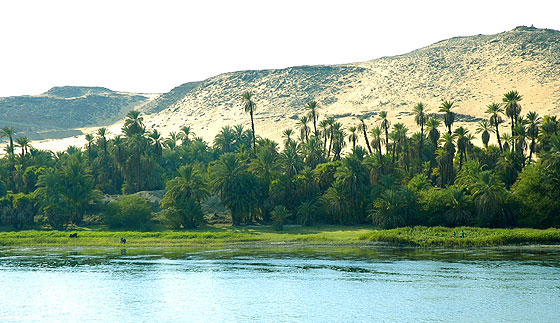
1. The extremes of Egyptian geography: Only somewhere between 5-10% of their land was arable, but that land was some of the best farmland in the ancient world due to the yearly Nile floods.  Lush farm land backed right up against barren desert (as seen in the picture below).  This geographical tension probably produced psychological tension.  We see in Egypt, for example, the duality between the worship of almost any life whatsoever, and the reign of death just beyond.  The pictures of the Nile river valley below illustrate this stark contrast.
Nile River Valley
This tension had to be resolved in either a positive or negative way.  As time went by, death gained the upper hand.  Here is an early Egyptian poem that reflects this.  Some of these sentiments may ring true from a Christian perspective, and some lines resemble aspects of Biblical Wisdom literature. I think, however, that the overall imbalance towards death as an escape from the “claustrophobia” of life rather than a source of redemption is evident.
Egypt and Death: An Early Poem
To whom can I speak today?
One’s fellows are evil;
The friends of today do not love.
To whom can I speak today?
The gentle man has perished,
But the violent man has access to all.
To whom can I speak today?
No one remembers the past;
No one at this time does good in return for good.
Death stands before me today
Like the recovery of a sick man,
Like going outside after being confined.
Death stands before me today
Like the fragrance of myrrh,
Like sitting under the shade on a breezy day.
Death stands before me today
As a man longs to see his house,
After he has spent many years in captivity.
The Nile River valley had to serve as the center of Egyptian civilization, and in turn, we note that the Egyptians had an unusual inward focus.  They did not interact with many other peoples in the ancient near east.  Some geographies push people out of their settings, but we might imagine the Nile river as a giant vacuum, sucking everyone towards it.
  • The extremes may have led to Egypt’s focus on ‘Ma’at,’ or keeping things in balance. When one lives in between stark images of life and death constantly, it should not surprise us to see an inordinate focus on the concept of “balance.”  Keeping the order of things (ma’at) was the central job of the pharaoh, and of course this is a semi-divine task.  No problem per se for the Egyptians, as in their mind  the pharaoh’s were divine, or perhaps semi-divine, themselves.  When we look at the Exodus in a little bit we should keep in mind that among other things, God exposes Pharaoh’s complete inability to maintain “ma’at.”  God uses the plagues as a means to free His people, but also a message to the Egyptians to come join the Israelites.  Pharaoh’s inability to maintain harmony and balance gets decisively exposed.
  • The relative sameness and flatness of Egypt contributed to the political centralization of Egypt.  Egyptian society could not exist without fair and equitable distribution of the Nile floodwaters, and this would have required executive oversight.  But it may also have psychologically contributed to the eventual rigidity of thought that eventually overtook Egypt from about 1800 B.C. onward.

With this emphasis on Ma’at we get confronted with a very different way of thinking, and a very different set of priorities.  A president who wanted to look successful in his memoirs would probably highlight the great changes he brought to America.  In Egypt, Pharaoh’s “memoirs” focused on how they kept things exactly the same, in just the proper proportion (for those interested one can read this post on Ma’at and Pharaoh Userkaf).

Next week we began our look at Thutmose III and the Battle of Meggido.  We will continue that next week as well examine the Book of the Dead and the monotheistic Pharaoh Ikhneton.

Blessings,

Dave

Words in Play

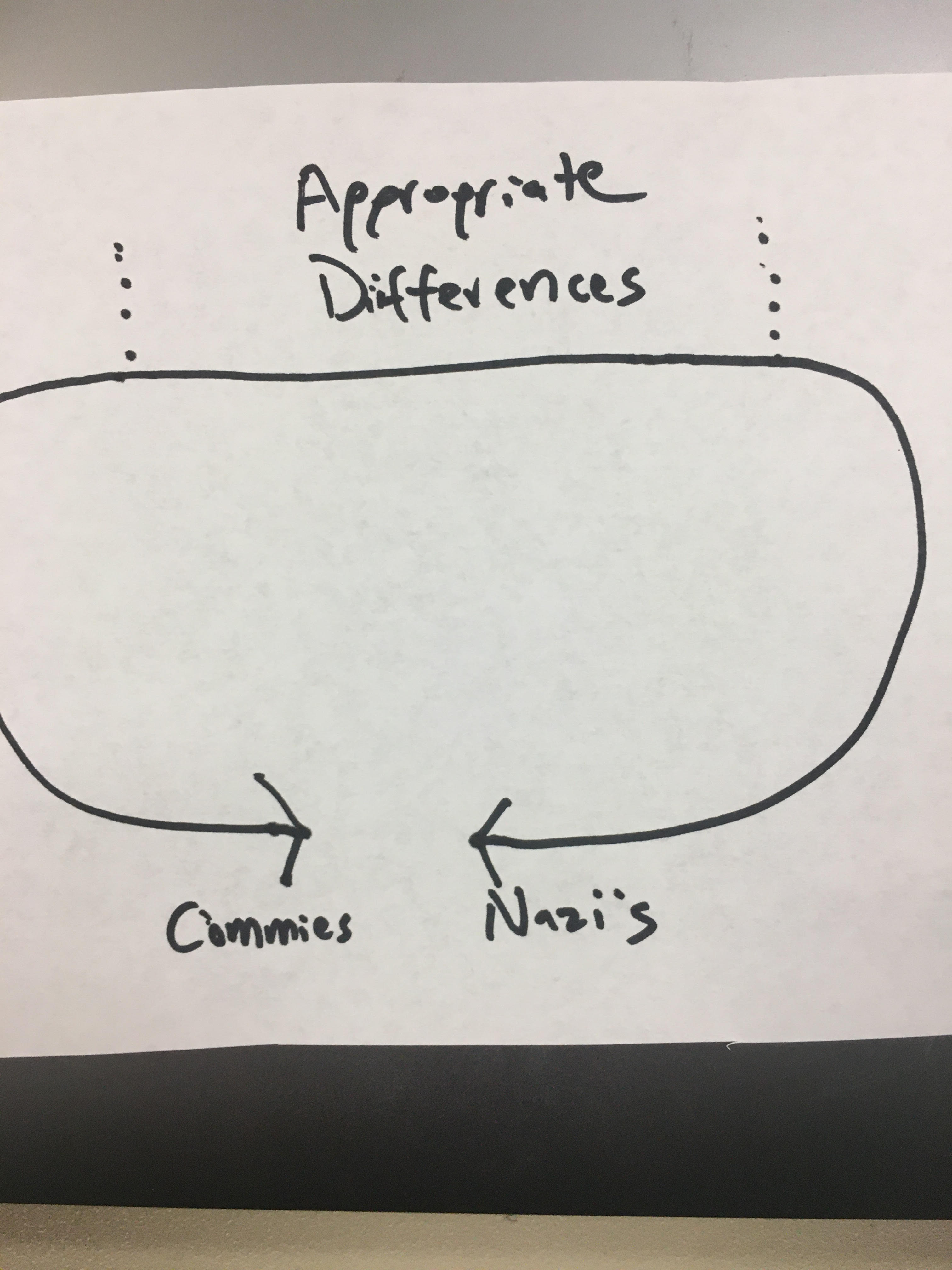
Lots of pendulum swings happen in the history of thought, but these pendulum swings sometimes resemble more the bending of a line towards the form of a circle instead of opposite points on a line horizontally. In other words, when certain positions get to their extremes, they start to resemble what they claim to oppose. Reality, when warped, curves back on itself.

For example, one could argue that the age of imperialism in Europe came from the conviction that a) We are better than you, and b) We are different than you. This is a caricature, but we can let it stand for our purposes. In turn, this attitude called forth the work of Joseph Cambell, who argued in his religious analysis that actually, nothing has any difference from anything else. Narcissus, Christ, Osiris, and so on all participate in the same reality and are basically the same god. On the surface this looks like the opposite end of the imperialist impulse, but as imperialism grew, the mingling of cultures grew, and the differences between the cultures start to blur. For example, we have Rudyard Kipling as one of imperialism’s strongest advocates, but much of his writing shows a fascination not with English culture, but with that of India and Afghanistan.

So . . . McBain was entirely correct to conflate the Commies and the Nazi’s.

Plato and Aristotle give us the foundation to western philosophy. Many first notice their differences, and certainly they parted ways in key areas. Plato emphasized the unity of things via the world of the forms. He sought to draw everything up into the eternal, i.e., when we come to know and understand something, we are in fact remembering something we used to know.* Aristotle differed from his teacher and focused on particulars. We know him best through his extensive categorizations. He separates that we might see things more clearly. It seems they occupy opposite points on a line, with opposite strengths and weaknesses. But in certain ways they share the same strengths and faults. Aristotle critiqued Plato’s overgeneralizing of concepts, but he himself seemed to overgeneralize everything in the mythical/spiritual realm, consigning it all to irrelevancy. Like Plato, he criticized aspects of Athenian religion but could not see the particular threads of truth within it. In turn, Plato’s focus on finding the eternal kernel of truth led him to define concepts so finely that in the Laches a general does not know what courage is due to his faulty definition. They both over-generalized at times, they both hyper-categorized other times.

Avoiding this warping effect might involve taking Aristotle’s “advice:” If you drill a hole all the way through the earth and fall down from the North Pole, stop and hover at the halfway point. The key to healthy societies as well as healthy thought comes from fusing “Heaven” and “Earth,” and not by camping out at either locale.

I never knew that Plato’s dialogue Cratylus even existed until a few weeks ago. Here he focuses entirely on the role of language, and names in particular. The issue has relevance especially in times of societal breakdown. Without a common cultural framework, language loses its power as a conveyor of meaning and a means of discourse, i.e., we no longer have an agreed upon meaning for important words such as “male and female,” “racism,” “love,” and so on.

The dialogue begins with one extreme tentatively suggested by Hermogenes, who argues that, “whatever anyone agrees to call a particular thing is its name.” Socrates teases out the implication of such a position, which means that something can have infinite names, “And however many names someone says there are for each thing, it will really have that number at whatever time he says it?” Hermogenes reluctantly agrees.

Of course this won’t do, and Socrates leads Hermogenes out of this thicket. The problem of meaning has a link to the problem of virtue. If we can give names to anything we wish and have that in fact be its name, then we in effect, become the arbiters of reality itself. For, “some statements are true, while others are false,” and “it is possible to say things that are and that are not in a statement.” We are not God and cannot make reality come into being by merely declaring it so. Otherwise good and evil have no real existence outside of our own minds, and so we can call nothing truly good or evil at all. Meaning and coherence break down. The question of language is much more than academic.

So words and their meaning cannot come into being from below. The “bottom of the mountain,” so to speak, has too much individuation and division to provide a platform for societies. As our examples above show (i.e., Kipling, etc.), this extreme individuation shakes hands with extreme unity, for it cannot properly divide anything at all according to its nature. So in the end, with this view, everything mashes up together.

Socrates and Hermogenes then seek to go up to the “top of the mountain” to attempt to find the origin of names. Names function as a means of instruction, as a means of “divid[ing] things according to their natures. As Socrates comments,

So just as a shuttle is a tool for dividing warp and woof, a name is a tool for giving instruction, that is to say, for dividing being.**

Just as not all can use the loom, so Socrates asks, “Do you think every man is a rule-setter, or only those who possess the craft?” Hermogenes concedes that one must have the craft. Control of language cannot belong to the individual alone, but nor to “every man.” One must have “the craft.”

So Cratylus is right in saying that things have natural names, and that not everyone is a craftsman of names, but only someone who looks the natural name of a thing and is able to put its form into letters and symbols.

Undoubtedly language shapes our perception of reality, and possibly more than that, for in Genesis God’s speech creates reality as we know it. The names He gives fixes the distinctions between things, and Adam’s naming of animals gives humanity a cooperative role in the creative process.

The theological dilemma of, “Is something good because God declares it to be good, or does God declare something good because it is good already,” has a mirror in the dilemma about language.^ No one person can simply declare a word to be a word and have it fixed for all time. Socrates struggles with finding the absolute in each word. He had penetrating insights regarding the essence of truth, but stumbled in its application. The same hold true in Cratylus. The dialogue continues on a long excursion where Socrates seeks the unity of the principle embodied in names, and their particular Greek phonetics. Some of these endeavors succeed more than others. But in the end, Socrates must face reality–other cultures have different phonetical constructions for words embodying the same principles.

Socrates: Here is what I suspect. I think that the Greeks, especially those who live abroad, have adopted many names from foreign tongues.

Hermogenes: What of it?

Socrates: Well, if someone were trying to discover whether the names had been reasonably given, and he treated them as belonging to the Greek language rather than the one they were really from, then he would be in a quandary.

Hermogenes: He very probably would.

Socrates: . . . Consequently, though one might say something about these names, one mustn’t push them too far.

This realization leads Socrates nearer the truth, that language, like truth itself, involves a union of the masculine principle of declaration from those “who know,” from above, and the fluidity of things on earth. Socrates comments,

Perhaps you didn’t that [the names] are given on the assumption that the they name are moving, flowing, and coming into being. . . . Wisdom (phronesis) is the understanding of motion (phoras noesis) and flow. Or it might be interpreted as taking delight in motion. . . . Wisdom signifies the grasping of this motion.

For the rest of the dialogue Socrates struggles to find a way to unite the masculine and feminine aspects of language, but can’t quite get there. Still, he makes the crucial realization of the need for the seed from above, the plant from below, or the pattern and its manifestation must go together. For Adam in the Garden (Genesis 2) his names correctly manifested this, for at that time he had perfect communion with the Father above and the (Mother) Earth below. But since the sin entered the world, we essentially fail in proper manifestation of language, which furthers confusion of meaning.

But though we fall short, we still have the image of God within us, and can use Socrates’ insight to evaluate how we use words and their relationship to truth. There exists, for example, a certain method of Bible study among Christians that involves

  • Finding out the Hebrew/Greek meaning of a particular word
  • Grabbing a concordance to see where that word gets used in different parts of the Bible, and then
  • Using the meaning in one context to determine its meaning everywhere in Scripture.

This ignores the fluid aspects of language, and the central importance of context over strict phonetics. We all know that the word “radical” can be a math term in one context, an outdated term from the 80’s in another, an adjective for a political ideology, and so on.

Many of our current cultural debates, however, center around ignoring the fixed aspects of language. We can all acknowledge that the meaning of “male” and “female,” for example, have certain contextual fluidities determined in part by culture. Some men may be more effeminate, some women more masculine, than others of the same sex. But surely being either male or female cannot mean anything we wish it to mean. Biology certainly gives us constraints on the meaning of sex. The very fact that we call some men more masculine than other men shows that we have a defined concept of masculinity we cannot escape even if we wanted to. Indeed, some of those who wish to introduce more fluidity to the concept of sex/gender also decry “toxic masculinity” more than others.

It seems that we must see language, along with the reality language describes/creates, existing in a hierarchy. At the top we have God, who in Christian theology can only be defined as Father, Son, and Holy Spirit, one God in three persons. Then at the bottom we have words like “green,” a collection of phonetic sounds that can refer to a color, a newbie on the job, a person with sea-sickness, and so on. Yet while these phonetic sounds can take on meanings essentially unrelated to each other, they each manifest connections to a particular idea. More fluidity in language exists at the bottom of the mountain, but . . . not chaos. Then somewhere in the middle of reality, we have words such as “male and female,” which have more defined limits, along with a degree of contextual meaning.

Though the Cratylus fails to stick the landing on a unified theory of language, Socrates rightly intuits that correct naming is a “beautiful work.” We recognize beauty when we recognize a pattern, a pattern of the marriage of heaven and earth, of unity and diversity.^^ When this reality gets warped both the language absolutist and the language relativist both destroy the beauty of language and its meaning. Contrary to some, language is not a tool of power, but of meaning. When weaponized we lose beauty, wisdom, and also power. For in reality, power cannot truly exist without its connection to Heaven.

Dave

*I should state now that I am a rank amateur in my knowledge of Plato and Aristotle. My critique is not meant to deny their rightful place in the history of philosophy.

**Here we see more evidence of Andrew Kern’s suggestion that weaving and wisdom are interrelated in the ancient world, thus, the Luddites rebellion against mechanical looms had little to do with economics and much more to do with maintaining meaning and coherence in society.

^This dilemma is really no dilemma at all to those who understand Christian theology. The Church has always said that the answer to the above dilemma involves splitting the horns–things are “good” because God made them, and are stamped with God’s being and character.

^^I will attempt an explanation of my meaning by thinking about a spectacular sunset. We look up, and see light from above-that’s purity/Heaven. The light then transforms, becomes more fluid/diverse as it interacts with matter, the stuff of Earth. This combination produces the beauty we are drawn to.

While only God is eternal and infinite, this union of Heaven and Earth will continue into eternity. In His resurrection Christ continues to have a physical body. And when He returns, He will descend, and we will rise to “meet Him in the air.”

Seeing is not Believing

Imagine a large group attending a traditional bull fight in Spain, replete with the attendant pageantry. You would all witness the same actions, and the same events. But, interpretations of the events and their ultimate meaning would likely differ widely, and thus, what what one “sees” would diverge strongly as well. A possible smattering of interpretations might include

  • Some would find the event barbaric, shameful, and cruel–a terrible relic of some pre-modern past.
  • Some, a la Hemingway, would see an exhilarating, if not slightly problematic, affirmation of masculinity
  • Some would not go any deeper than pure entertainment–they would see a spectacle and be glad they had that chance.
  • Some would see a noble re-presentation of the sacrifice of Christ, and his traveling the Via Dolorosa, the path of sorrow.

This last suggestion no doubt strikes many moderns, Christians included, as absurd. And yet, the Catholic faithful called the passing of the bull through the cape the “Veronica Pass,” after the story of a young woman named Veronica (translation–“true image”–think veracity, verdict, and ‘icon’) who offered Christ her veil to wipe his face as he carried the cross. Some say that Christ accepted the offer, and an image of His face remained imprinted on the veil, the “icon made without hands.”

Some might accuse Christians here of very conveniently glomming on to something pagan like a bullfight, to make sure that Christians 1) could still have fun, 2) or still have a dark side, 3) or to appease a paganism that they could not expunge. A variety of pre-Christian cultures made extensive use of bulls and bull imagery, as did other pagan European cultures the church encountered as it grew throughout Europe. Certainly in general Christianity incorporated and transformed certain pagan customs from different cultures. But all in all, the practice likely has most of its roots in a vision of the prophet Ezekiel. In chapter 1 of his prophesy, within a larger vision of a wheel of fire, Ezekiel sees something else:

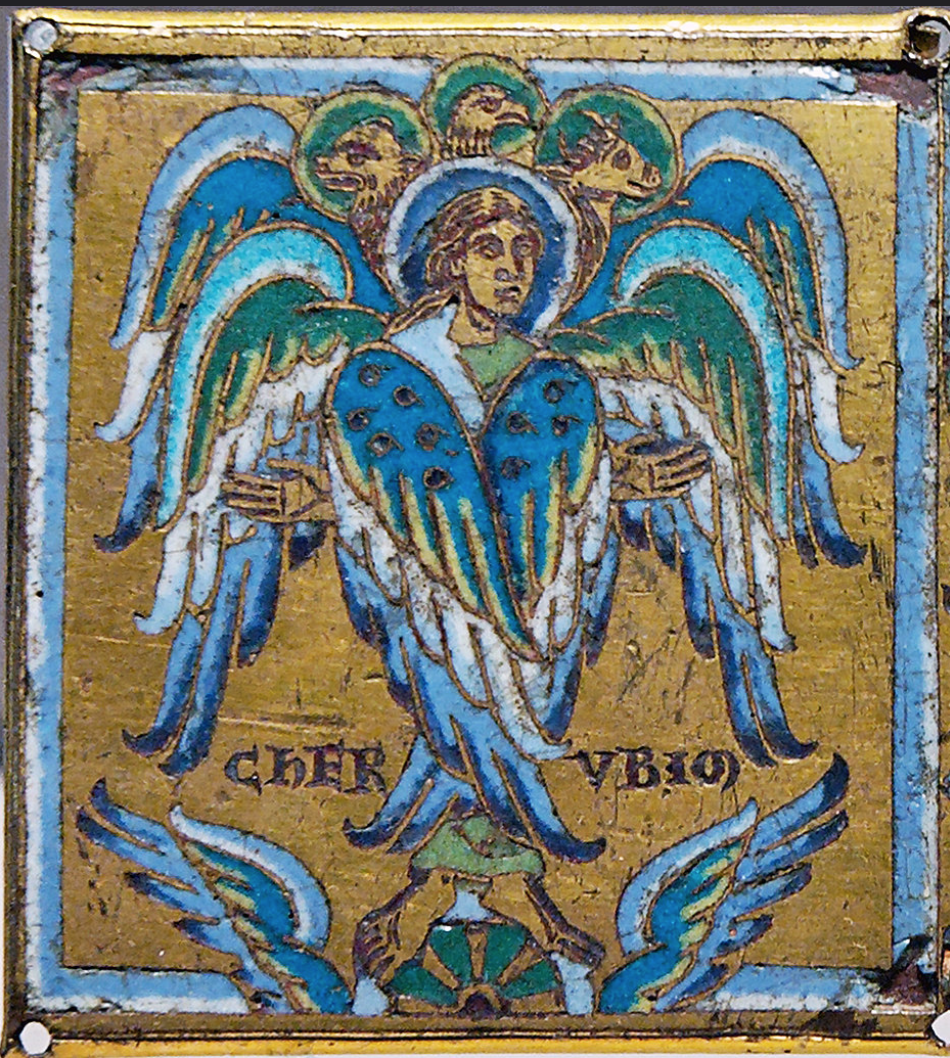
there was as it were the likeness of four living creatures. This was their appearance, and the likeness of man upon them. Each had four faces, and each had four wings. . . . This was the likeness of their faces: the face of a man, the face of a lion on the right side of the foursome, the face of an ox on the left, and the face of an eagle

Ezekiel 1:5-6, 10

Traditionally, according to St. Gregory the Great (late 6th century AD) and other commentators* from the early church

  • Matthew and his gospel is identified with the man, for he begins with a geneology
  • Mark is the lion, the “voice crying in the wilderness” (Mk. 1:1)
  • Luke is the ox, who begins with a sacrifice (Lk. 1:8)
  • John is the eagle, “who stretched towards the very substance of God” (St. Gregory, Jn. 1:1)–it is John who is regarded as the Theologian par excellence, hence his association with what is high above.

Ezekiel also mentions the essential unity of the four creatures as well, just as the four evangelists have an essential harmony, which leant early commentators to ultimately see each creature as a partial image of Christ.

Along with other cultures we also today associate the bull with virility and the source of life. This association naturally leads one to the idea of a supreme sacrifice, the outpouring of the fullness of life. In the Old Testament, the sacrifice of a bull was the highest sacrifice one could offer, the fullest outward expression of devotion (Ps. 51:19, etc.). In this light, linking the bullfight with Christ’s death makes much more sense, but nothing in what we physically saw would lead us to that conclusion. We would need the proper interpretive framework to “see” this in what we saw.

Historically speaking, the way we see now has very little to do with how most people have seen in the past. The difference probably boils down to the idea of symbols. One author writes,

The simplest way of defining this difference [between the old world and the modern] is to recall the changed meaning and function of the word “symbol.” For us the symbol is an in am image that invests physical reality with poetic meaning. For medieval man, the physical world as we understand it has no reality except as a symbol. But even the term “symbol” is misleading. For us the symbol is the creation of poetic fancy; for medieval man what we would call symbol is the only objectively valid definition of reality. We find it necessary to suppress the symbolic instinct if we seek to understand the world as it is rather than as it seems. Medieval man conceived the symbolic instinct as the only reliable guide to to such an understanding. Maximus the Confessor . . . actually defines what he calls “symbolic vision” as the ability to apprehend within the objects of sense perception the invisible reality of the intelligible that lays beyond them.

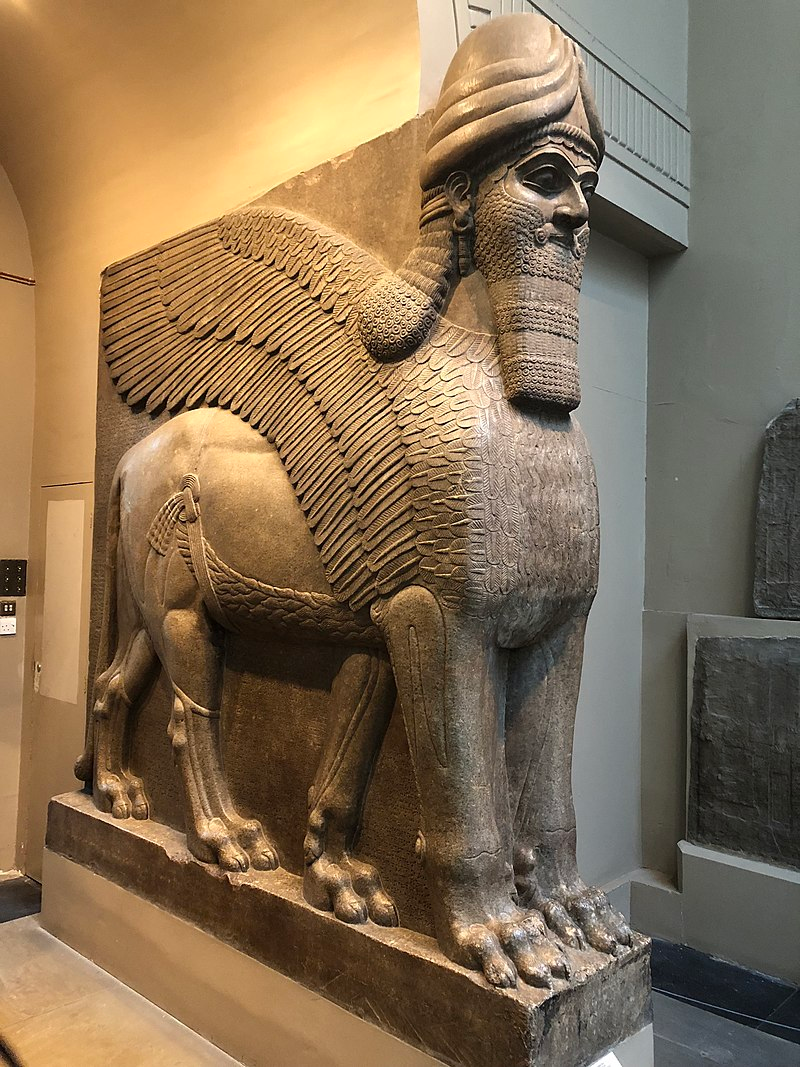
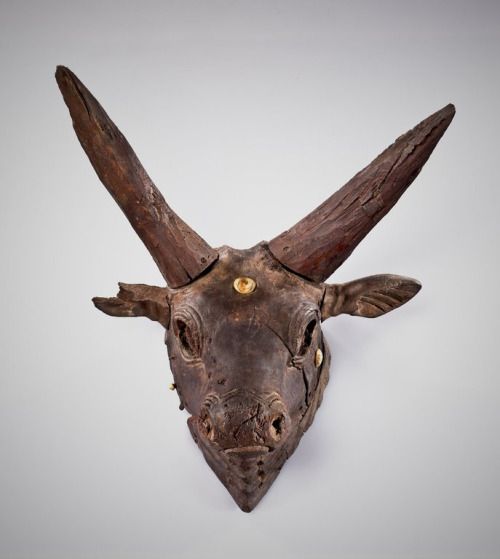
But still some might object that realm of symbol has far too much subjectivity to rely on these associations and intuitions. After all, bull imagery has a variety of pagan associations. One need only think of Assyria, one of the more cruel empires, and their winged bulls, or Egypt and their Apis bull.

However ambiguous some of these association might be (is the Assyrian depiction meant to be somewhat demonic or angelic?), we have no doubt when we look at images of Bel/Baal and the bull horn attendant imagery, or even the golden calf.

Noting this ambiguity, the materialist will assert that this proves the arbitrary nature of language and our symbols, that nothing has any meaning in itself. But this position in fact makes a grand metaphysical claim about reality, that it is univocal, that if it speaks it must speak with one voice only. But our experience tells us this is false. Meaning has multiple layers.

Mircea Eliade continues,

It is therefore the image as such, as the whole bundle of meanings, that is true, and not any one of its meanings, nor one alone of its many frames of reference. To translate an image into a concrete terminology by restricting it to any one of these frames of reference is to do worse than multilate it–it is to annihilate, to annul it as an instrument of cognition.” — Eliade, Images and Symbols, 13

We can see that the New Testament is well aware of the tension inherent in symbols. Christ is the “Lion of Judah,” but Peter also compares a lion to Satan, a merciless prowler (1 Pet. 5:8). We shouldn’t say that Peter rejects one form of symbolism for another, however. Both are possible at the same time. Our experience of objects manifests a reality that does not belong strictly to the physical, observable world. The “real” world is full of grace, yet fallen, and our symbols naturally reflect this as well.

We can go further. As I mentioned above, I think the bull image has Christian roots, for I count the Old Testament as part of the Christian tradition. But suppose I throw this out and say that any associations with a bull/ox and Christ has purely pagan roots. Well, the very act of taking something fallen, baptizing it, “cleaning it up,” and re-presenting it to God anew–this has everything to do with our role as image-bearers of God and stewards of creation.** Through repentance, we hopefully do this with ourselves every day. This is, in part, what it means to grow the Kingdom of God.

Ultimately, however, one cannot “prove” any of this in a strictly rational way. I propose, however, that we can see the superiority of the symbolic way of thinking by examining what happens when we assume a more materialistic approach.

We can start with our very selves. I have participated in discussions where a strict materialist argued that all things beyond neurons, chemicals, synapses, etc. were simply fabrications of evolution. Whatever he could not measure he discarded. Yet, this meant that everything he valued, his friends, his choices, even food he liked, would ultimately mean nothing. Thankfully, he agreed that things like love, friendship, etc. were important, just not real. Without this thin anchor, actual existence in the world for him would not be possible. To believe that chemicals are “real” and friendship is not puts one quite near the wind, as they say.

We can scale up a bit to a family. If you think in a purely materialistic manner, one could easily argue that the concept of a family is only social convention. “Names” are certain phonetic sounds, “families” just a group of people whose DNA has more in common with each other than with other people. “Marriage” gets reduced to a convenient, or not so convenient, voluntary arrangement. Marriages only really work, however, when the people involved believe that what they cannot see or measure about their relationship has a greater reality than themselves as individuals. Participating in this greater intangible reality makes the lesser reality possible.

We can only live through symbols. Our experience of objects involves the manifestation of something other, a reality that transcends our world while including it at the same time.

But we must use caution with these symbols. We can take the corporate identity of a political party, for example. Political parties can serve good ends. They bring people together across geographical space. They help aggregate ideas and should, in theory at least, filter out extremism. They can give a sense of identity. But if one makes that identity supreme, it becomes a demon instead of an angel. The person loses agency to the party–whatever the party says, they think. Like rooting for a sports team, the key is the color of the laundry, not the particular ideology. Initially being a Republican/Democrat likely bestowed a sense of belonging and purpose. Now–you are food. You exist to vote and feed the machine. The same can happen with a family. The “higher reality” of the family can give one guidance and meaning beyond our own individual existence. But if we make family the highest reality, it too will eat us. This happens in gangs, organized crime, and so on–Michael Corleone’s Godfather tragedy.

The bull can and should scale up to Christ, but if we miss the mark, or stop too short, we end up with the devil.

Dave

*St. Bruno d’ Asti, St. Yves of Chartes, among others. Perhaps we might see further symbolism in that the three synoptic gospels have more similarity in their “earthiness,” but John’s gospel departs significantly in emphasis, thus his association with the heavenly eagle(?).

**This is why the obvious fact that the church refashioned certain pagan festivals and images for Christian use is not anything to apologize for, but something to celebrate. It is part of the triumph of the Church.

8th Grade: “Bueller. . . Bueller. . .”

Greetings to all,

Are we sure that History matters?

This was the question I posed to the students the first day of school.

A few students pointed out that we should study History to learn from the mistakes and copy the successes of the past.  This is the answer most frequently given to the question, “Why History?”

But why should we accept it?  What on earth could anyone who has been dead for thousands of years, living in a completely different part of the world, have to teach us today?   “Perhaps,” I suggested to the students, “I am wasting your time, serving as part of a vast conspiracy of the old to occupy and distract the young.”  Is this what school really means?  Is the study of history merely an exercise in the “vain repetitions of the heathen?”

It’s fun to play devil’s advocate, but in the end we provided two key reasons why History does matter.

“Begin at the beginning,” said the King in Alice in Wonderland.  The study of history rests on a few key Christian assumptions:

  • We assume that what happens to people depends in part on choices they make, and these choices must in some sense be “free” choices.  If we have no ability to choose then whatever success of failure we experience has nothing to do with anything we can call “ourselves” at all, but merely instinct, environment, and so on.
  • We must believe that genuine communication across time and space can occur.  Believing this, in turn, rests on the belief that much more unites us as humans than divides us.  Otherwise, either communication would be impossible (because we would not understand one another), or meaningless (if our differences would be so extreme the experience of others would have no relevance for us).

Such things may seem so commonplace that they do not need to be defended, but in fact, those who buy into certain postmodern assumptions about identity and language would likely not agree with the above propositions.

In Genesis we read that God made mankind in His own image.  I am not capable of exhausting the richness of what this means for humanity, but we established a couple key concepts in class:

  • In Genesis 1 we see God bringing order out of the void.  He could have created everything in an instant, but He chose six days/periods of time (whichever you prefer), each with a clear progression and pattern.  In Genesis 1 we see God separating night from day, dry land from sea, and so on.  He then separates mankind from the rest of His creation.  So too, we can find order and patterns in our surroundings.  History need not be “one thing after another” with no distinctions or meaning.
  • God acts with will and intentionality, and so too we act from more than mere instinct.  If we had no ability to choose and act with purpose, History would have no meaning because we could not learn from it or apply what we learned without it.

God gives all people who have ever the lived the gift of His image, and this is the good side of the coin regarding humanity.  But in Genesis 3 sin enters the picture, with terrible consequences.

  • Adam and Eve attempt to alienate themselves from the very Source of Life itself and hide from God.  While mankind retains the stamp of God’s image, I think it no coincidence that Genesis 5:3 mentions that Seth was born in Adam’s image.
  • Adam and Eve turn away from each other, refusing responsibility for their sin
  • Humanity experiences alienation from creation as a whole.

History rightly examines many facets of various civilizations, and the collapse of various people groups  have political, economic, cultural, and geographic explanations.  But sin lies at the root of all misery, and since we are all sinners, all of us share responsibility for whatever is wrong in the world.  “All have sinned and fall short of the glory of God.”

Both the image of God and the fall of man mean that there is far more that unites, rather than divides, every person who has ever lived.   Even an Egyptian god-king from thousands of years ago and our next door neighbor still share these same characteristics.  Our differences remain skin deep.  Rod Dreher (a Christian) recently interviewed Louis Betty, a scholar of the work of the modern French author Michael Houllebecq.  Neither Betty or Houllebecq profess any allegiance to Christianity, and may not profess a religious faith of any kind. But Betty’s observation about the belief of the image of God in man are revealing.  He commented,

More concretely, you don’t get white supremacy if you believe that every human being has a soul fashioned in God’s image. Neither do you get far-left racial and ethnic identitarianism. Both are symptoms of a metaphysical deficit. It’s very easy to start dividing people up into tribal categories; after all, humans vary massively in just about every imaginable quality. It’s really something of a miracle that we ever came up with a notion of common humanity at all! We have the Judeo-Christian heritage to thank for this in the West. This is something secular people ought to consider before making glib criticisms of traditional religion.

The full article is here for any who are interested.

We see the confluence of the image of God and the Fall in every life and in every civilization.  We all seek order and coherence.  We all seek to create distinctions (just as in Genesis 1) in our lives, giving precedence to some things over others, and so on.  In this way we image the God who made us.  Yet we also see that we often choose to embrace death to create our personal/civilizational kingdoms.  We will hate others to make the kind of order we wish for our own lives.  Nations may literally kill and destroy others to achieve the peace they desire.

1 Corinthians 15:56 states that, “the sting of death is sin.”  This order might surprise us–we might expect it to be reversed.  Adam sinned and brought death to himself and his descendants.  In many ways, it is our fear of death, of the diminution of the self, that leads us into sin, as 1 Corinthians states.  We cut each other off in traffic, grab the last cookie, and declare war to obtain resources in order to preserve and extend our earthly lives.  We obtain life only through surrender to death, i.e., “He who wishes to save his life must lose it” (Luke 9:24).

Other areas of Scripture show the importance of History.  Much of the Old Testament simply records events without editorial comment.  We can read of various kings of Israel, for example, and the Biblical authors do not always insert, “And God thought ‘x’ about the king.”  No doubt God means for us to figure it out on our own from the context, and from what we already know from reason, observation, experience, and other parts of Scripture.  If History is important to God in Scripture, we can conclude that History itself serves as a kind of revelation, a revelation that will teach us much about ourselves, and God Himself indirectly.

Apart from a Christian context, History, however interesting, would have no real meaning for us beyond mere entertainment.  We will keep returning to these foundational truths, for History makes no sense without them. I told the students that this class may have started in an unexpected way for them, but we cannot understand History without understanding mankind, and we cannot understand mankind without understanding who God is. Next week, we will attempt to understand what makes a “civilization,” and how civilizations function.

Blessings,

Dave Mathwin