For our next unit, we will examine short stories and literature that deal with the question of technology and its impact on humanity. In thinking about “impact,” we will think about how technology changes society, but more importantly, about how technology changes how we conceive of the meaning of our humanity. I know that this will be a challenging unit, but I hope that the students will enjoy it.
We are used to thinking of technology as neutral. Something is invented, such as a hammer, and the hammer is neither good nor bad. Rather, we can do a good thing with the hammer (build a house) or a bad thing (hit someone on the head with it). But we, the human being, remain independent from the hammer. We give meaning, form, and function to the hammer. The communication, or interaction, is, in this view, all a one-way street.
There are elements of truth to this idea, but it is an incomplete view of our interaction with the tools we create, whether those tools be a hammer, a dishwasher, or a computer. As we interact with the hammer, there is a sense in which the hammer is interacting with us and changing us thereby.
This happens even with our most simple tools, such as a hammer or shovel. We can forget the psychological impact and just focus on the phyical changes that we undergo when weilding these tools. Someone who spent their days hammering and shoveling would experience a change in their body, as certain muscles would grow where before they were possibly weak. The hammer and shovel would change our body, and this is obvious. The fact that we have the slogan, “If all you have is a hammer, every problem looks like a nail,” indicates that we perceive that something psychological happens between us and the hammer in our interactions, even if we do not directly perceive it.
There is a Chinese anecdote which runs as follows:
As Tzu-Gung traveled through the region he saw an old man working in his vegetable garden. He had dug an irrigation ditch. The man would descend into his well, fetch a vessel of water in his hands and pour it out into the ditch. Then he would repeat the process as much as necessary. While his efforts were significant the results seemed meager in comparison.
Tzu-Gung said, “There is a way whereby you can irrigate a hundred ditches in one day with little effort. Would you like to hear it?” [He then proceeded to explain the pulley-system with a larger bucket and grooves running out to the ditches].
Then anger rose up in the man’s face. “I have heard my teacher say that whoever uses a machine does all his work like a machine. He who does his work like a machine grows a heart like a machine, and he who carries the heart of a machine loses his simplicity. He who has lost his simplicity becomes unsure in the strivings of his soul–and so we lose all honest sense. It is not that I do not know of such things: I am ashamed to use them.
Very few of us would be willing to go in all the way with the Old Man in this story. But it is important we understand the trade-offs involved in our use of technology. What technology gives is usually quite obvious and useful. What it takes away is just as much a part of the story, though it is less obvious.
I would summarize the relationship of technology to humanity thusly:
Every increase in power creates an increase in vulnerability.
For example, a match creates fire much more quickly than sparks from two pieces of flint, or rubbing two sticks together. A match gives us power over the element of fire. However, having matches means we have lost the skill of creating fire in the traditional way. If our box of matches gets wet, we would be incapable of making fire. We now must devote extra energy to keeping the matches dry, men from previous eras had no such concerns.
Or imagine a person who wants to travel from New York to Los Angeles.
Walking would take the longest amount of time, but the physical act of walking risks only a twisted ankle
Running would take less time, but increase the possible injury risk to a broken ankle or leg
Riding a bike would take even less time, but a crash on a bike could badly injure parts of our whole body
Riding a car would reduce the trip from weeks to days, but if we make a mistake driving, or something big goes wrong with the car, we could be badly injured or killed.
A plan would make the trip in hours instead of days, but even a mild mechanical problem with the plane would mean death as the almost certain result.
We can also think of how much power comes from our invention of electricity. Among other things, electricity allows us to be vastly more productive than civilizations of earlier eras. We can make many more things much more quickly. But, if the electrcial grid went dark, what we could produce would drop to near zero. We have become completely dependant on electricity for most things that sustain our civilization. Our electrical grid is perhaps our greatest vulnerability.
The ancients were well aware of this trade off. Plato includes an anecodote in his “Phaedrus” dialogue that may have been from Egypt involving the invention of writing.
At the Egyptian city of Naucratis, there was a famous old god, whose name was Theuth; the bird which is called the Ibis is sacred to him, and he was the inventor of many arts, such as arithmetic and calculation and geometry and astronomy and draughts and dice, but his great discovery was the use of letters. Now in those days the god Thamus was the king of the whole country of Egypt; and he dwelt in that great city of Upper Egypt which the Hellenes call Egyptian Thebes, and the god himself is called by them Ammon. To him came Theuth and showed his inventions, desiring that the other Egyptians might be allowed to have the benefit of them; he enumerated them, and Thamus enquired about their several uses, and praised some of them and censured others, as he approved or disapproved of them. It would take a long time to repeat all that Thamus said to Theuth in praise or blame of the various arts. But when they came to letters, “This,” said Theuth, “will make the Egyptians wiser and give them better memories; it is a specific both for the memory and for the wit. “
Thamus replied: “O most ingenious Theuth, the parent or inventor of an art is not always the best judge of the utility or inutility of his own inventions to the users of them. And in this instance, you who are the father of letters, from a paternal love of your own children have been led to attribute to them a quality which they cannot have; for this discovery of yours will create forgetfulness in the learners’ souls, because they will not use their memories; they will trust to the external written characters and not remember of themselves. The specific which you have discovered is an aid not to memory, but to reminiscence, and you give your disciples not truth, but only the semblance of truth; they will be hearers of many things and will have learned nothing; they will appear to be omniscient and will generally know nothing; they will be tiresome company, having the show of wisdom without the reality.”
Some may argue that there is nothing inevitable in this trade off. Hypothetically, we did not have to abandon riding horses to drive cars, or abandon working with flint as we used matches. Hypothetically, we could have maintained modes of production that did not need electricity in tandem with the development of the power grid. Possibly, this is true, but I cannot recall an instance where this actually happened in history. In general, it seems we have to accept the trade-off, all or nothing, for good or ill. Technology seems to “require” this of us. Often the tail wags the dog with technology (think of how much of our society has been oriented around the car), and this seems to be the rule and not the exception, at least since the Industrial Revolution.
The costs of technological advances are usually hidden, which clouds our discernment about adopting such ideas or not. We see what it gives, and not what it takes away. This is the main theme of our introductory story, The Monkey’s Paw.
In the Socratic dialogue “Cratylus” Socrates and his friend Hermogenes attempt to discover if language has any real meaning. We know that words can take on or lose meaning depending on context and time. But can the word “door” actually mean something absolute. Can language convey more than our momentary cultural attribution of particular sounds.
Socrates wants to find the origin of names and words, and believes that words, if they are to have any meaning at all, must have a connection to ultimate reality. He comments,
So just as a shuttle is a tool for dividing warp and woof, a name is a tool for giving instruction, that is to say, for dividing being.
“Giving Instruction” can be interpreted as giving us wisdom. Words must be a clue to reality, and how we use words must convey something about how we perceive meaning in the world. Language then, cannot belong onlyto an individual, but neither is it a purely democratic medium. We don’t get to vote on the meaning of words. Rather, language is a cultural possession, a trust, and a storehouse of meaning.
So Cratylus is right in saying that things have natural names, and that not everyone is a craftsman of names, but only someone who looks the natural name of a thing and is able to put its form into letters and symbols.
But Socrates also understands that language has a fluid aspect to it, and no one time, place, or word, can fully grasp ultimate wisdom and pure being.
Perhaps you didn’t that [the names] are given on the assumption that the they name are moving, flowing, and coming into being. . . . Wisdom (phronesis) is the understanding of motion (phoras noesis) and flow. Or it might be interpreted as taking delight in motion. . . . Wisdom signifies the grasping of this motion.
In other words,language and meaning can bend, but not break. Understanding this difference is one of the keys to any healthy life and culture.
I open this post with this blurb about language because as Macbeth transpires, the title character and Lady Macbeth lost their hold on the nature of reality. Both of them can no longer trust their perception. Is a dagger really in front of Macbeth or not? Has the ghost of Banquo really appeared to him or not? Does Lady Macbeth actually have blood on her hands or not? Both of them lose their ability to perceive the world around them, and this only adds to the confusion of their internal moral compass. For them, the meaning of words, the meaning of sight, and the meaning of life itself, all disappear.
One of Macbeth’s most famous soliloquies in the play reads,
Tomorrow, and tomorrow, and tomorrow Creeps in this petty pace from day to day To the last syllable of recorded time; And all our yesterdays have lighted fools The way to dusty death. Out, out, brief candle! Life’s but a walking shadow, a poor player That struts and frets his hour upon the stage And then is heard no more. It is a tale Told by an idiot, full of sound and fury Signifying nothing.
Some see this as evidence of Shakespeare’s pessimism or even nihilism, but we must remember that this speech is given by the villain of the play at the very end of his moral decline. At this point in the story, Macbeth has completely abandoned the moral and social ties that bind him to his fellow man and to creation. As a result, he can make no sense of his experience of the world. Other characters around him affirm the possibility of creating a sensible state once again, but not Macbeth. He does not wish to die but confirms that he has no particular reason to live. He is trapped in a world without meaning of his own making.
One common theme in Shakespeare’s work is the confusion and decay that happens when the normal structure of society gets upended. Shakespeare belonged to a world where the basic order of society was regarded as divinely given, or at least partly divinely ordained. Modern democracies do not share this belief, seeing the social hiearchy as continually fluid, Some believe that all hiearchy should be continually dismantled and the social oder continually refreshed. But even if we do not share the convictions of Shakespeare and his contemporaries, we can observe the effects of a social order that lacks clear delineation.
Our lives are governed mostly by routine. Some find this stifling. I believe (along with Edmund Burke and others) that routine actually liberates. When we need to think and rethink all of our actions and decisions, it brings paralysis, not freedom. Shared routines allow us to easily perceive meaning in the actions of others. Routines also free us up to think and ponder, for example, the meaning of a Shakespeare play. We would not have this freedom if we had to overly scrutinize the meaning of our wardrobe, to give just one example. We would be stuck wondering if a polo shirt or t-shirt would be more appropriate to do the day’s tasks.
Without routine and established order, we would exist in a world where we could not perceive meaning. All standard social cues would be abandoned. Communication with those outside your social and ideological circle would be impossible. Macbeth and Lady Macbeth both confuse the meaning of words during their descent into madness and death, especially around the meaning of the words “man” and “woman.”
The “good news” in this situation is that nature itself cannot abide this situation for very long. Meaningful order and hiearchy must reassert itself. This is what Macbeth briefly experiences before his death, when “Birnham Wood” comes to fight with him.
Macbeth’s simple plot hides an important message for us, not just about morality, but about the structure of society as a whole, and what role language plays in the construction of society.
This week in Civics we explored the 1990’s, not so much in the specific events, but the cultural trends that shaped that decade.
Having lived through the 90’s as a young man, I remember them as good times. I enjoyed much of what the culture offered, such as grunge music and the chance to wear untucked flannel shirts. And yet, the 90’s pose a curious problem. Having definitively won the Cold War, we should have been happy and celebratory as a nation. And yet, the 80’s, a time of uncertainty and the fear of nuclear war, appear as the decade of optimism. In the 1990’s, we appear wracked by self-doubt, angst, and a loss of confidence. The popular image of the time is that of the disaffected slacker.
Logic dictates this should not have been the case. After all, throughout most of the 90’s we had
Economic Growth
Former Enemies in Europe becoming fast friends (i.e., Poland, Romania, etc.)
New, exciting technologies such as the internet (the legacy of the internet is debatable, at the time everyone thought it would be great).
A more peaceful world
The expansion of trade and the modern advent of globalization (today the legacy of this is hotly debated, at the time it seemed a slam-dunk to most).
And yet, it was during this time that our culture began to fragment in weird and unexpected ways. I have some theories as to why this might have happened, but first, let us note the sharp difference between the late 80’s and the early 90’s.
In terms of fashion, the 80’s were defined by bright colors, and bold choices. Things were bright and big.
Whatever one might think of such choices, they certainly come from a place of confidence (perhaps too much of it :).
In the early 90’s things shift dramatically to a look now known as “heroin chic.”
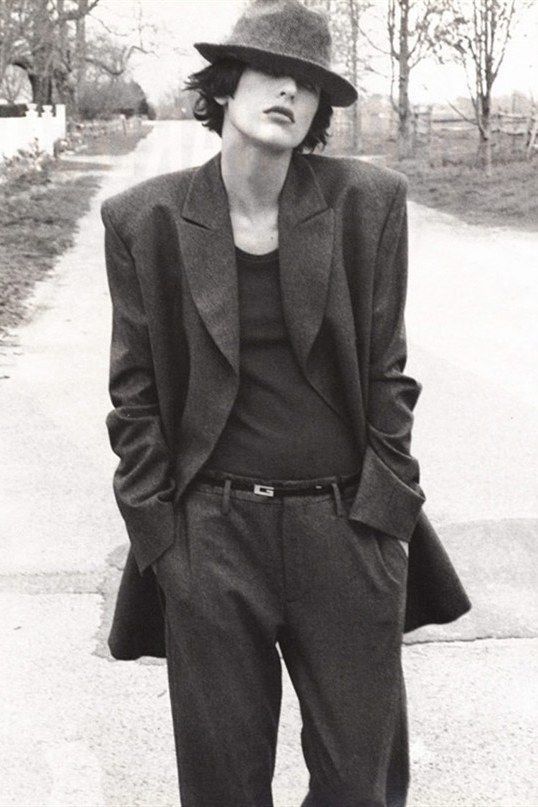
We are used to the issue of confusion between male and female and the blurring of lines between them. This has it roots in the 90’s as well, as these fashion shoots indicate:
A theme in 90’s fashion is the empahsis is not on the accentuation of the human form, but its dimunition (perhaps especially for women). Now that it is the 90’s, we are not supposed to have colors, or happiness. We are supposed to feel bad about things. But exactly what we are to feel bad about . . . we’re not sure.
Any perusal through the popular music of the 1980’s reveals an era loaded with upbeat songs with big, bright production values. Even the “bad boys” generally were not angry or sad, but celebrating partying, doing bad things, etc.–think Van Halen and AC/DC. These bands were agressive in their sound, but optimistic in their tone, i.e., it was time to have a good time.
Coincidentally or no, almost exactly as the Soviet Union completed its collapse, Nirvana released its album Nevermind (which already hints at Gen X disengagement) and its most popular song, “Smells like Teen Spirit.” Some of it’s lyrics read
Load up on guns, bring your friends
It’s fun to lose and to pretend
She’s over-bored, and self-assured
Oh no, I know a dirty word
Hello, hello, hello, how low?
Hello, hello, hello, how low?
Hello, hello, hello, how low?
Hello, hello, hello
With the lights out, it’s less dangerous
Here we are now, entertain us
I feel stupid and contagious
Here we are now, entertain us.
This song, and others by Nirvana, ask us to engage with apathy, disillusionment, chaos, without really pinpointing the problem, exactly. Other famous grunge bands such as Pearl Jam, Alice in Chains, and Soundgarden would follow suit. They sang about emptiness, apocalypse, and other such topics (think of Soundgarden’s Black Hole Sun” or Stone Temple Pilot’s “Trippin’ on a Hole in a Paper Heart”). Like the fashion of the early 90’s there seemed to be a desire to destroy what was generically considered “human,” at least in the 1980’s. We no longer believed in what we were, or who we were.
True, by the mid-late 90’s, these cultural trends would shift again somewhat. Grunge and the fashion style of “heroin chic” would fall out of fashion. But the stage was set for significant transition in other modes of life. The old norms that guided society were starting to fade away. Thirty years later, we are still looking for new norms to hold us together.
We are getting used to political polarization, and many of us reading this have essentially grown up with it. I did not. The 1980’s still experienced a reasonable amount of cooperation and consensus building. That changed with the election of 1992, when the winning candidate, Bill Clinton, failed to get a majority of the popular vote in a three person race. In his candidacy, Clinton broke with typical norms governing how politicians should act, appearing on the Arsenio Hall show and playing saxophone along with the house band. Republicans followed suit, and were early in the political talk-radio space, which had more aggressive and angry messaging. The center was losing its grip, but we did not see this at the time.
Again, all of this should be strike us a curious. Most cultures experience something of a golden age in the aftermath of significant military victory, such as Athens after the Persian Wars, or England after the defeat of the Spanish Armada, or the Dutch after their own defeat of Spain. This did not happen with us. We should have been confident and exuberant. But this pattern did not materialize for us as it had in the past.
Perhaps not coincidentally, the advent of the 1990’s saw the publishing of what would become a very influential book in China, Wang Huning’s America against America. Huning had visited America for several months in the late 1980’s and wrote about his observations. Huning went on to serve as a top advisor to three Chinese premiers and still holds a top position in the government today. Many see Huning’s book as having a strong impact on the development of China and their view on the United States.
Huning saw culture, tradition, and shared values all eroding in America. This is a fairly common critique of democracies in general, and so nothing particularly new. Huning had good things to say about America that many other foreign observers might share. There are a few observations he made, however, that seem prescient and influential over the next three decades.
The title of the book is taken from the Chinese term yíhuò [疑惑] meaning “puzzle” or “doubt.”America had effectively turned itself into a yíhuò [疑惑] which has made Americans equally puzzled by their own system. For Huning, America was trapped in a puzzle. It was in a battle against itself.
As one online commentator notes, “One of his observations in particular would be very influential for China’s new path forward: the power of technology. The use of electronic payments like the credit card shocked him, as did the emergence of computers. But he also understood that this technological process would eventually remake the very people it was supposed to serve. Sometimes it is not the people who master technology, but the technology that masters the people. If you want to overwhelm the Americans, you must do one thing: surpass them in science and technology.”
Huning saw most Americans as fundamentally disconnected from each other, and wrote that, “Lonliness is a major burden on the political system.” If true, perhaps grunge music was not such an anomaly at all, but a logical consequence of this unconscious feeling.
One can certainly argue that Huning took some of his observations too far. His fear of social fracturing, combined with his adoration of technology, has led to institutions like China’s dystopian social credit system. But his observations in themselves may have merit.
The legacy of the 1990’s is complicated, but it is where the seeds were planted for many of our modern problems.
As we move into Book Three of the Argonautica we get introduced to Medea, which sets up the central dramatic problem of the epic.
Greek literature followed Greek religion and delved into the nature of human choice, Fate, and the gods. Actions between men and the gods are often countered and then countermanned again. The gods push and pull against each other and mankind mirrors their actions. The line between what humans can control and what they must submit to from the gods is always blurry, and so it is in our story.
Jason was set on a quest by his uncle to retrieve the Golden Fleece, an ancient gift representing kingly power. Jason claims the throne belongs to him, so it is somewhat natural that he should need some emblem of royal dignity to accompany him. He was set on this quest to fail, however, as his uncle intended. The owner of the fleece, Aeetes, will never relinquish it. Jason has so far shown he lacks the brawn to overpower anyone. He has shown cunning and diplomacy in spurts, but that will not be enough to defeat Aetes in his own backyard.
At this point, Hera, backed by Athena, enters the story. She is a fan of Jason, as Jason one time did Hera a good turn when she was disguised as an old woman. More to the point, she hates Jason’s uncle Peleus, who regularly ignored her altars. She wants Jason to have the fleece, and decides to use Aeetes’ daughter Medea to help him get it. Medea is shot by Eros/Cupid, and falls irrevocably in love with Jason. This is tragic largely because Medea will be torn between her “love” for Jason and for her duty to her family and city. For her, helping Jason would be akin to treason. If she gains Jason, she will lose everything else.
Her choice of Medea is not random. Medea is a priestess of Hecate, and Hecate was the goddess of witchcraft, liminal borders, and magic.
Hecate was also the goddess of crossroads, which is reflected in the three directional statue of Hecate above. And this is appropriate as well, for Medea’s decision whether or not to help Jason will put her life on an irrevocable path. She will risk everything for Jason, but Jason may not be worth that risk.
The Argonautica is more slippery than previous Greek epics. The Iliad is rife with tragedy but has a tragic granduer. The Odyssey gives us a flawed hero but also justice and catharsis at its conclusion. The Odyssey also gives us a wise and virtuous heroine in Penelope.
Here in the Argonautica we have neither a bold hero or a virtuous heroine. Medea is sympathetic, but she is no Penelope. In many ways the story wants to see her action as selfish, though today many would not view it so. We are much more individualistic than the ancient Greeks. Medea’s actions cut her off from everyone and everything–except Jason. If Jason cannot successfully integrate her into his world, she will have no world at all. The Greeks thought that acting virtuously required a social context. For Aristotle, to be without a defined community made it impossible to realize one’s full humanity. Medea’s choices put her in danger of essentially becoming a non-person.
The postscript for Jason and Medea is a bitter one. Medea flees with Jason, and Jason agrees to marry her out of sympathy, gratitude, and in part, to keep her safe. But from the start their relationship was off balance. Medea was much more drawn to Jason than Jason to Medea, and Medea had to give up a great deal more than Jason.
Still, Jason had to give up something as well. He was the son of a king, and to marry a king’s daughter would certainly not be beneath him. But, he married Medea without her family’s consent (her father wanted Jason dead) and so his marriage would likely bring conflict to his own land even if he made it back safely. To marry without the family blessing of either side put their relationship at risk from the word ‘go.’
There is an interesting vignette in Medea’s story not in The Argonautica but in other versions of the story. On their way home, Medea has an encounter with Queen Arete, who can be compared to Penelope in terms of virtue and the best of feminine wisdom. Medea asks Arete for advice, and Arete tells her to leave her history of magic, spells, and sorcery behind, especially when it comes to her relationship with Jason. In the end, Medea will not follow this advice. In a classic instance of particularly Greek irony, her use of magic to keep Jason attached to her only ends up driving her away. Jason and Medea eventually have children (the number varies according to the source), but in the end, Jason divorces Medea. To make sure that Jason will have no heirs and no legacy, Medea murders his new bride and her own children as well.
The original readers knew all of this lore, and all of adds extra weight to Medea’s choice to help Jason and his crew escape. Medea chose wrongly, but the tragedy of Greek literature is that choosing rightly still would have meant the deaths of Jason and his crew at the hands of Aetes, and the failure of his quest. If the quest failed, well, we have no story. Hera and Jason sacrifice Medea for their own ends, and Medea destroys her family (and even later murders her brother) to achieve her own ends as well.
Earlier this week we had fun discussing what elements a good relationship needs, such as family support, mutual attraction, similar backgrounds, and so forth. The class did not always agree about where to rank these elements in their order of importance, but it became obvious that Jason and Medea had very little to build on and much working against them. In their favor, we can note their mutual attraction for one another, and the fact that both came from royal families. Against them, we can list:
Neither had the blessing of their families
Their “relationship” was formed very quickly in a very intense situation
Jason owed far more to Medea than Medea owed to Jason.
Conversely, after her betrayal Medea depended entirely on Jason for her protection and status. She uses this at times to guilt Jason into marrying her.
They had very different experiences growing up
Medea’s service to Hecate made Jason suspicious of her, while at the same time, her powers were needed at crucial moments to save Jason and the crew.
They forced enormous stress from the very start of their attraction for one another.
It is easy to see that Jason and Medea had little chance for a successful future together.
In the end, everyone may or may not be playing everyone else, and this quest does not give us the catharsis that we hope for. This is what makes The Argonautica a late-civilization epic, and why we can compare Jason’s character to the context of Machiavelli’s The Prince, which we are also reading this year.
One of the advantages of reading ancient texts is that they expose us to an unfamiliar world with an unfamiliar way of thinking. But for us to appreciate this we sometimes need to look behind some of the archaic or strange phrases we encounter to help the story make sense. After we get a sense of the story’s meaning, we can then consider its application for us today.
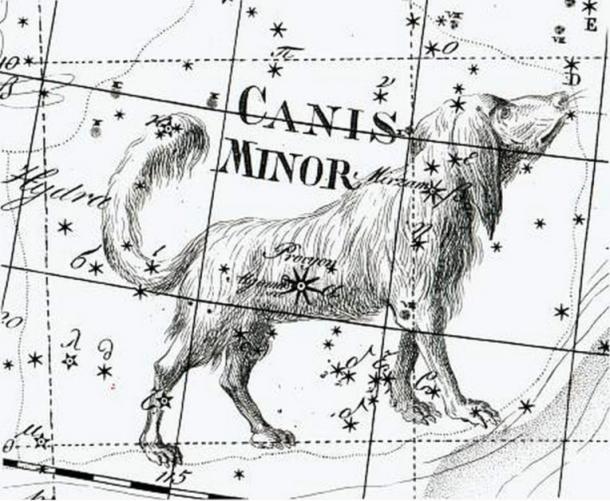
At a few different points in the story the narrator compares Jason’s attractiveness to the star Sirius. This star appeared close to the sun betweeen July 3-August 11, the so called “dog days” of summer. The Sirius star is the brightest sun in the constellation Canis Major (hence the term “dog days”). Some surmise that the ancients believed that the closeness of this bright star added to the heat of the sun, intensifying all things about what summer brings.
We can perhaps easily understand why human beauty would be linked with that of a star. The brightness of Sirius stands out above all other stars in the sky, just as when we notice that special someone across the room, all others fade from view. But in comparing Jason to Sirius in particular, Apollonius gave a foreshadowing hint that his audience in AD 300 would have understood immediately in a way we do not.
The ancient Greeks valued temperance and finding a mean between extremes. Cold and heat both bring good things, but the extremes of both are destructive. Excessive heat brings destruction to crops and to the soul. We know that on hot days, for example, crime increases. Our tendency towards anger and lethargy increases with extreme heat.
Romantic feelings are also associated with heat, but it is Spring, not Summer, that we associate with romance. Summer brings excess, and this foreshadows the destructive relationship Jason will end up having with Medea. The brightness of Sirius is a foreboding brightness. Too much light can harm just as much, or perhaps even more, as too much darkness.
But there is a flip side to the dog associations Apollonius foists upon Jason, and this subtlety helps makes The Argonautica literature worthy of our attention
Dogs had a dual place in ancient and traditional socieities (something we have touched on regarding Roland in this post). To recap briefly, dogs are, on the one hand,
Linked with false prophets and unrestrained appetite
but on the other,
Associated with obedience, humility and protection.
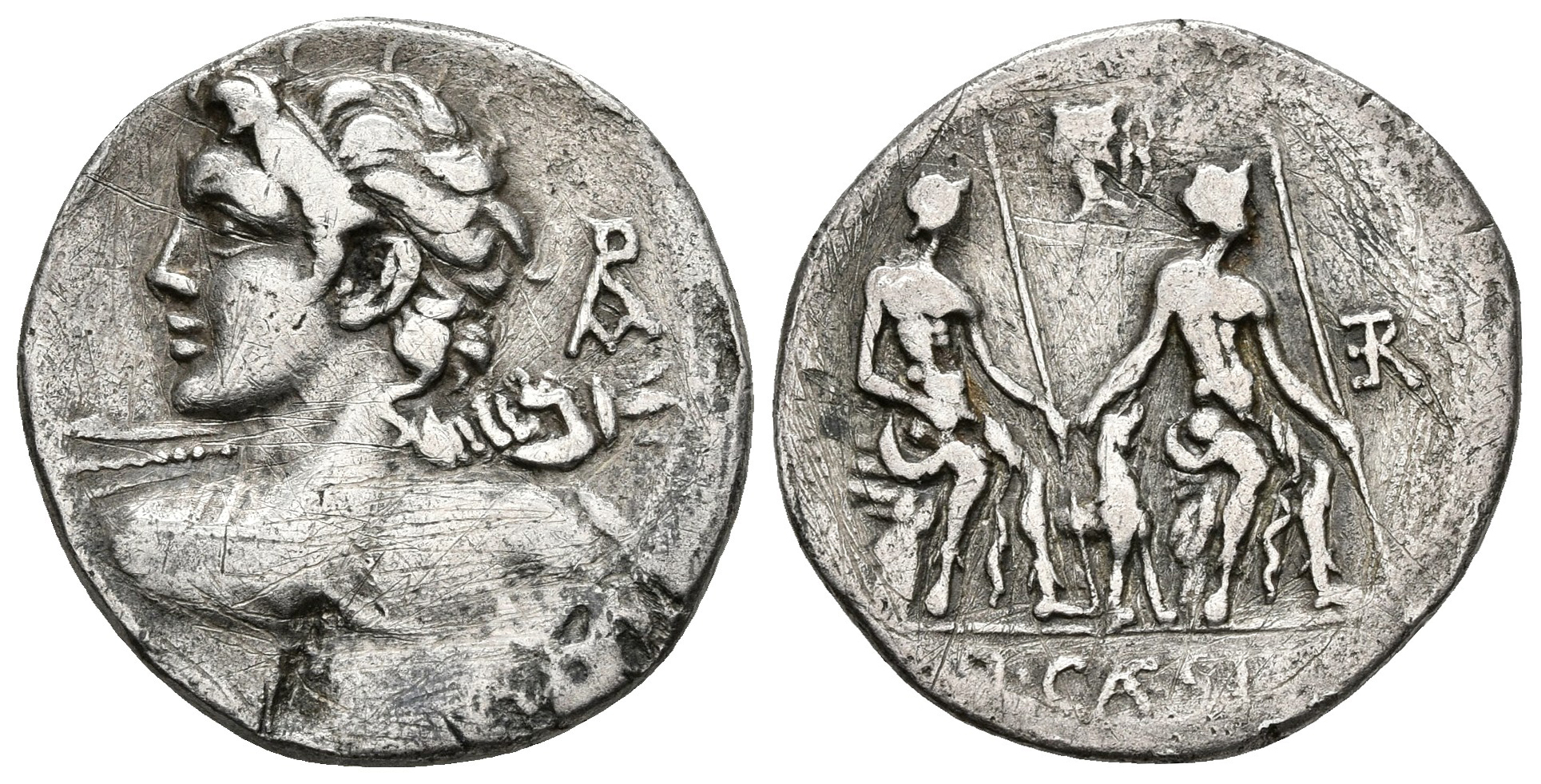
As noted previously, Jason does not exercise typical heroic leadership. He is not an unstoppable warrior like Achilles. He does not lead from the front like Roland, or possess the single-minded brilliance of Captain Nemo. Jason does show great concern for his men. He is a guardian, of sorts, for his crew, and this fits with how dogs were viewed in the Roman empire. We see here two Lares on a coin, and you can see the dog form:
Here is a later image, where they take a more distinctly human form:
So this connects positively to Jason’s leadership, and Apollonius includes this imagery to let you know of Jason’s strengths.
But dogs in the ancient world were never quite fully domestic creatures as we are used to today. They guarded borders, but would not have been brought inside the home. But Jason is the son of a king, and he should be king himself, were it not for his usurping uncle. Throughout the story, however, Jason rarely seems comfortable as a leader. He hangs back, he worries, he has insecurities. Initially his crew thought Hercules should lead. In one instance, he decides to leave an island at night because of a fair wind, but everyone knows that we have bad associations with night because of the confusion it can bring. Sure enough, Jason ends up leaving Hercules behind by mistake, and turning a ship around in the ancient world to row against the wind is basically impossible. In another instance, friendly hosts mistake Jason and his crew for invaders (again, this happens at night), and Jason accidentally kills the host king. When it comes time to box the brutish Amycus to allow them to leave his island peacefully, it is not Jason that steps forward, but another crew member.
Those who know the full story of Jason (which we will discuss at the conclusion of the Argonautica) understand that Jason will continually feel trapped and pressed by circumstances, and not able to transcend them. He never attains the greatness associated with other Greek heroes.
All this is wrapped up in Apollonius’ references to him as Sirius, the dog star, which many in the ancient world feared to see.
This week we looked at a debate about immigration to highlight a crucial skill Aristotle wishes to teach us, a skill democracies are prone to lack. As we saw last week, advocates of different political ideologies or platforms tend to absolutize the values their position highlights, while forgetting that their position inevitably fails to cover every conceivable value. We are finite creatures, and our values are finite, in the sense that every gain/advance will come at a cost. We have to leave something behind.
This is experientially true. If you want to get married and have a family, you have to sacrifice the fun of dating and meeting other people. If you have children, you have to leave behind the life of doing what you like and disposable income. You can certainly argue that married life with a family is a better choice than a life of perpetual dating. But worst of all would be the person who tried to have both at once. The married person who also wanted to date other people would wreak a great deal of havoc. The perpetual dater might simply provoke raised eyebrows.
Theologically this rings true as well, i.e., “Except a seed fall to the ground and die, it remains only a single seed; but if it dies, it produces much fruit” (John 12:24). If we are to have life, either spiritually or physically, we must have death, whether that be physical death (the food we eat) or the death of a way of life (giving up a life of dating for marriage).
When faced with a controversial and thorny political issue such as immigration, I wanted the students to use Aristotle’s template to do the following:
See the strengths of each side of the argument
Understand the costs/what you have to sacrifice to achieve your aim
Discern that the debate was not about good values vs. bad values, but involved deciding which kinds of values to prioritize over other values.
The debate we viewed can be seen here:
Both speakers made good arguments, but I wanted the students to see the key underlying assumptions each side brought to the debate. How we view those key assumptions will likely determine what side we favor.
Not everyone loves argument by analogies, but I think analogies have a lot of power to distill key principles of an argument.
The “Pro” side of the debate (Prof. Kaplan) argues that people should be able to travel freely to seek out the best life for themselves they possibly can. He uses the analogy of a house and guest in the following manner:
Kaplan declares that he is not arguing that whomever wishes should be able to come to his house if he does not want them in his house.
If he wants someone to come in his house, and that someone wants to come, he should be allowed to come to Kaplan’s house. True, his neighbor might disapprove, but what business is it of theirs anyway?
He asserts that the “Con” side of the debate essentially argues that people should not have the freedom to extend invitations to people to come over to their house, and that those invited should not have the freedom to accept. This is absurd.
The “Con” side of the debate (Prof. Wellman) also uses the illustration of a house, but with a different emphasis from Kaplan:
He asks us to imagine that he leaves his house and goes to a conference for a week. When he returns, he asks his wife what she did while he was gone. She replied that she played cards with friends, got her hair done, and volunteered. Wellman implies that it would be absurd for him to object to such activities.
But, his wife then adds, I also decided to adopt a child from a foreign country. Here he is–meet your new son! Wellman declares that he would have every right to object to this action. His wife’s “freedom of association” has dramatically impacted his own freedom of association without his consent.
There are some deeper foundations to the arguments from both sides.
Kaplan, a libertarian, seems to believe in two key principles. The first is that the individual is the primary unit of society, and so our laws should be oriented around maximizing individual freedom. Secondly, libertarians tend to believe that maximizing economic freedom (which includes the free movement of labor) is a primary way to boost freedom overall. Economic growth is a moral issue, for greater economic growth means a better life for more people, especially those on the border between the lower and middle classes. So, in his analogy of the house, the homeowner is an employer and the guest is a potential worker.
I am not sure of the philosophical background of Wellman, but he argues that the group (though perhaps not necessarily the family, a la Aristotle) is the primary political decision making unit. Decisions that involve altering the makeup of a household/political community should be made by the community as a whole (or their representatives). In his “house” analogy he envisions a family rather than an employer.
Both analogies are persuasive, and both have their limits. Kaplan’s analogy doesn’t work as well when the guest wants to blast heavy metal music out of his window, which would obviously adversely affect the community. Wellman’s analogy makes perfect sense when comparing adoption to citizenship. But what if his wife just invited a friend over for coffee (maybe similar to a temporary work visa)? Hypothetically Wellman might still object to associating with his wife’s friend, but in that case our sympathies go to his wife. We would expect Wellman to bear up with the “incovenience” of the temporary association.
Deciding between these two positions boils down to the key divide between seeing the group/family or the individual as the primary political unit of society. Kaplan is suspicious of governments exercising authority over the individual, and Wellman much less so.
Hopefully, the students will see how their beliefs about these key “fork in the road” questions influence their position on immigration, whatever that might be.
As the story continues and the characters spend more time in the Nautilus, students noted that many of the chapters contain boring lists of different plants and fish they see under the waves. This may surprise those who remember certain iconic moments in the story, such as the attack of the squid and the Nautilus’ attacks of other ships. But many chapters do contain lists of fish and other technical details of undersea life and life at sea.
These portions of the story do not resonate with me very much, and I have sympathy with the student’s reactions. But such portions of the story also give us an opportunity to gain insights into the mind of the author and the times in which he wrote.
We can first note that the story was originally published in installments in a bi-monthly periodical. It is possible that Verne includes such detail merely to lengthen his story and get paid more for publishing more. But the story was a smash hit when it debuted in 1870, and we should surmise that while financial gain may have played a part in this narrative choice, it cannot entirely explain it.
When we get incrongruity between our time and the past, this gives us an opportunity to notice how cultures change over time and what that reveals not just about them, but us as well.
Verne published his book at a time when people generally had
Faith that the future would be better than the past, and
Trust that science, and the increase of knowledge that science would bring, would be the main cause of that progress.
Captain Nemo is a bit of a superior type, and frequently in the story we see him correcting various views held by the enlightened and gentlemanly Prof. Arronax. Nemo’s travels and knowledge give him “the truth” about various historical and especially naval events. The reading public likely heavily bought into the common cutural narrative about the connections between knowledge, power, and progress. The facts obtained by the Professor about the nature of undersea life would likely have been viewed in 1870 not as random data points but priceless treasures that could help mankind advance.
The fact that these sections of the book fall on deaf ears in our day says much about us as well. The 20th century revealed that the power that comes with science has revealed itself as a double-edged sword. The knowledge that can heal us can just as easily be used to destroy us. The cataclysmic conflicts of WW I and WW II taught us this, as did Hiroshima and Nagasaki.
But we also no longer trust science as a discipline. Our trust in institutions in general has eroded, which has led to many over the last several years calling into question various things that science was supposed to have settled for us. On the other side of the 20th century, science has lost its charm and its persuasive hold on the culture at large.
One might say that Verne wrote at the “high noon” of the West’s trust in science. At the beginning, trust in science might have needed explained. At the end of an era, science would need defended. Here, in our story, the trust placed in science by all characters is implicit. They are fish who do not know they swim in water.
The embedding of the story in a sea of facts perhaps helps us focus more intently on the main character of the story, the mysterious Captain Nemo.
The other main characters are somewhat stock. They do not change and the character is easily defined.
The Professor wants to learn and discover new things
Conseil (the Professor’s servant) wants to obey his master and classify the Professor’s observations
Ned wants to hunt and eat. At different times in the story, he also wants his freedom.
Captain Nemo is more complex, but Verne also wrote his most famous character after a type, the “Byronic Hero,” named after Lord Byron. Byronic heroes have the following characteristics:
They are socially isolated by their own choice
They have suffered some great, unkown tragedy that has marked them for life
They are intelligent and arrogant
They are highly emotional, and given to violent outbursts of temper
He has significant personality flaws and knows it, making him a “tortured soul.”
The story makes no attempt to explain Captain Nemo’s origin. We can reasonably surmise it involves the death of his family, but otherwise we have only scattered hints. Verne did well to leave Nemo as a sketch instead of a finished portrait. It is the mystery of Nemo, and the questions we have about his actions, that make the story compelling. It says something of our age at least, and perhaps of humanity in general, that we prefer mystery to fact.
When you teach the same classes year after year as I have, one starts to realize that what seems like great material one year seems to fall flat in another. Many reasons exist for this, some of them obvious, such as whether or not you taught the lesson on a Tuesday or a Friday, or at the beginning or the end of the day. Sometimes more mysterious factors present themselves, such as whether or not you have a critical mass of students interested in the topic.
Thankfully, some things work even if you teach it last period on the day before Christmas vacation, such as Assyrian tortures with 8th grade boys, and the Kennedy-Nixon debates. I am always impressed how students, with very little context or introduction, immediately pick up that “somethin’ ain’t right” with Nixon–setting aside the infamous sweat on his lower lip.
What Nixon gets wrong has nothing to do with what he says. Students note, too, that the debate, while it suffers somewhat from the medium of television, has some actual substance to it from both candidates. The problem lies deeper, in the “atmosphere” around Nixon.
At times I think that Marshal McCluhan, for all his brilliance, sees everything as a nail, armed as he is with his significant insight into how the “medium is the message.” But his comments about this seminal debate in 1960 led me to following him down a rabbit hole of sorts, and wondering if our current cultural angst has its roots in transformation of our media landscape.
In a famous interview McCluhan describes the differences between what he calls “hot” and “cool” mediums, saying,
Basically, a hot medium excludes and a cool medium includes. Hot media are high in completion, and low in audience participation. Cool media are high in participation. A Hot medium extends a single sense with high definition . . . A photography for example, is “hot” whereas a rough sketch cartoon is “cool.” Radio is a hot medium because it sharply and intensely provides a great amount of high definition auditory information that leaves little or nothing to be filled in by the audience. A lecture is hot, a seminar is cool.
He continues by suggesting that television is not even a strictly visual medium. Its low definition (here we must remember that McCluhan is speaking around 1968. He might think differently about today’s “high definition” tv’s) means that we the audience have to be “drawn in.” Those who come across “hot” rather than “cool” will put off their audience. He continues
Kennedy was the first tv president . . . . TV is an inherently cool medium, and Kennedy had a compatible coolness and indifference to power, bred of personal wealth, which allowed him to adapt fully to tv. [Without this] any candidate will electrocute himself on television–as Richard Nixon did in his disastrous debates with Kennedy. Nixon was essentially hot, he presents a high-definition, sharply defined image . . . that contributed to his reputation as a phony. . . . He didn’t project the cool aura of disinterest and objectivity that Kennedy emanated so effortlessly and engagingly.
McCluhan’s analysis explains why those who listened to the debate on the radio gave the edge to Nixon. It has nothing per se to do with the content of their messages, but the medium itself.* Nixon’s earnest and direct manner worked much better on radio. McCluhan makes clear in the interview that the process of our interaction with this new media would transform western society–a society built upon the printing press.
I think McCluhan overstates his case a bit, but his analysis of media and culture have a great deal of explanatory power. I will try to present him as best as I can, starting with a long excerpt from the interview (slightly edited for clarity by myself–the ‘M’ is McCluhan):
M: Oral cultures act and react simultaneously, whereas the capacity to act without reacting, without involvement, is the special gift of literate man. Another basic characteristic of [pre-modern] man is that he lived in a world of acoustic space, which gave him a radically different concept of space-time relationships.
Q: Was phonetic literacy alone responsible for this shift in values from tribal ‘involvement’ to civilized detachment?
M: Yes. Any culture is an order of sensory preferences, and in the tribal world, the senses of touch, taste, smell, and hearing were more developed. Into this world, the phonetic alphabet fell like a bombshell . . . literacy put the eye above all else. Linear, visual values replaced an integral communal interplay. The writing of the Egyptians, Chinese, and Mayan were an extension of multiple senses–they gave pictorial expression to reality and used many signs to cover a wide range of data. The achievement of phonics demands the separation of both sight and sound from their semantic and dramatic meanings in order to render speech visually.
As knowledge is extended in alphabetic form, it is localized and fragmented into specialities, creating divisions of function, classes, nations. The rich interplay of the senses is sacrificed.
Q: But aren’t their corresponding gains in insight to compensate for the loss of tribal values?
M: Literacy . . . creates people who are less complex and diverse. . . . But he is also given a tremendous advantage over non-literate man, who is hamstrung by cultural pluralism–values that make the African as easy a prey for the European colonialist as the barbarian was for the Greeks and Romans. Only alphabetic cultures ever succeeded in mastering connected linear sequences as a means of social organization.
Q: Isn’t the thrust of your argument then, that the introduction of the phonetic alphabet was not progress, but a psychic and social disaster?
M: It was both. . . . the old Greek myth has Cadmus, who brought the alphabet to man, sowing dragons teeth that sprang up from the earth as armed men. The age of print, which held sway from 1500-1900, had its obituary tapped out by the telegraph, the first of the new electric media, and further obsequies were registered by the perception of curved space and non-Euclidean mathematics in the early years of the century, which revived [pre-modern] man’s discontinuous space-time concepts–and which even Spengler dimly perceived as the death-knell of Western literate values. The development of tv, film, and the computer have driven further nails into the coffin. It is tv that is primarily responsible for ending the visual supremacy that characterized all mechanical technology.
Q: But isn’t TV primarily a visual medium?
M: No, quite the opposite. . . . The TV image is a mosaic mesh not only of horizontal lines but of millions of tiny dots, of which the viewer is only able to pick out 50 or 60 from which he shapes the image; thus he is constantly bringing himself into involvement with the screen and acting out a creative dialog with the iconoscope, which tattoos its message directly onto our skins. Each viewer is thus an unconscious pointilist painter, like Seurat.
Q: How is tv reshaping our political institutions?
M: For one thing, it is creating an entirely new type of national leader, a man who is much more a tribal chieftain than a politician.
In his The Medium is the Message McCluhan quotes a poem of Yeats,
Locke sank into a swoon;
The garden died;
God took the spinning jenny
Out of his side
McCluhan sees the man’s interaction with media thusly:
Pre-literate man was essentially oral. He lived in an sensory integrated world, and an “immediate” world. He lived in a world he could cohere into a totality of experience. His sense of space-time, how he got his information, etc. came within an embodied context.
True–a few unusual people might have been merchants who traveled a lot, whose sense of time and space might have been somewhat different, but these people were rare, on the fringe of society.
The printing press both mechanized information and intensified how we received it, “assuring the eye a position of total dominance in man’s sensorium. . . . The schism between thought and action was institutionalized, and fragmented man, first sundered by the alphabet, was at last diced into bite-sized tidbits.”
Commenting on the poem above, McCluhan writes, “Yeats presents Locke, the philosopher of linear and mechanical association, as hypnotized by his own image, but the “garden” of unified consciousness had ended.”
“Literate Man,” as McCluhan names western man from 1500-1900, valued highly the detachment cultivated by textual interaction. Indeed–we have to detach ourselves to a degree to read at all. We see the values of literate man producing “detached” scientific exploration and experimentation, promoting distance, toleration, and a political transformation away from the directly personal monarchies to impersonal democratic republics. Perhaps we can say that such values peaked in the late 18th century. We begin to see with 19th century Romanticism a yearning for a more holistic way of life. McCluhan’s focus stays on media, with
The invention of the telegraph for McCluhan was the beginning of the end of “Literate Man,” a point he admits to borrowing from the enigmatic Oswald Spengler. The telegraph both began the process of altering our perception of time and space, and made information more direct and immediate, a feature of pre-literate experience.
The radio followed suit quickly, then tv, etc. We saw cultural conflict and disintegration in the 1960’s because television accelerated the process of a cultural transference away from literate man. Our educational system offered all of the values of literate man, a complete mismatch with the desire for holistic integration our interaction with modern media produces.**
Had McCluhan lived to see the internet (some say he clearly predicted it), he would likely say that such instantly available means of breaking down time and space might very well put the nails in the coffin of Literate Man and cause a deep cultural division. Indeed, McCluhan’s analysis can shed light on the division between Gen X–the last generation not raised with the internet–and Millennials, etc. Many under 30 today care little for the Literate Man values that helped found our country, i.e., rational debate, give and take, etc. They want a more integrated communal experience.^
Our current political struggle, then, pits not Republicans against Democrats–who knows what it means to be a Republican or Democrat anyway now?–but against literate/printing press man values of privacy, debate, and individualism vs. the tribal/internet man values of community and integrated life. We see this conflict running through different aspects of our society, such as in journalism. The old journalistic ethic taught that the reporter should cultivate distance and a degree of objectivity. The new school of reporting seeks engagement, communal change, etc.
McCluhan admitted that early in his career he saw the decline of “Literate Man” as a moral catastrophe, but by the late 1960’s he committed himself to trying to observe (ironically, perhaps, a quintessential Literate Man pose) and not attach value judgments to his preferences. But with an additional 50 years of perspective on the influence of new media, I think we should venture some conclusions about its impact.
I agree that no absolute moral difference exists between Printing Press Man and Integrated/Tribal Man. McCluhan’s focus on the telegraph makes one realize that the technological/cultural changes many of us think are 15-20 years in the making are really 150 years old. McCluhan points out rightly that the advent of the printing press, industrialization, etc. into traditional societies was at least in part “a psychic and social disaster.” But he put less attention on the switch back the other way–it too will be experienced as a “disaster” by Literate Man for society to go back to Integrated Man.
I agree too that something mysterious exists with our relationship to media, which includes not just radio and the internet, but all of the ways in which we seek to extend our being, including our clothes. A meshing of man and media leads to a switch in perception and how we act. For example, our reaction to COVID had just as much to do with the media we use as it did with the disease itself. I am not saying that COVID is just the flu, but it is not the Black Plague either. Without online shopping, Zoom, etc. we would never have taken the measures we did with COVID. Some will say, “Thank goodness we had Zoom so we did not have to go into work, and more lives were saved.” Others, like myself, see something not so much sinister as deeply skewed. The media we use focuses our attention, and our view of the world is “made” from where we direct our attention. COVID and the internet worked symbiotically to form our decisions.
McCluhan rightly points out the many advantages of pre-modern societies. He saw us recapturing some of those values as our media landscape transformed. I wouldn’t mind a return of some pre-modern values. But contrary to McCluhan (if I understand him rightly), we don’t see these values returning. Or rather, we see them returning, but in a distorted way. No question, visiting a waterfall would be an “integrative” experience–sight, smell, touch, etc.–in ways that seeing the waterfall online would not. The continual availability of a fragmented online experience has not given us a holistic society but one where, according to some accounts, one in four young adults take some form of anti-depressant. McCluhan might say that this is exactly what we should expect when we ask kids to spend 7 hours a day in a detached, “Literate” environment when the media they use calls them to an entirely different way of life. I would perhaps argue that what we see now is a combination of
Literate Man reaching the end of its days
No good Integrated Man alternative available.
One can argue that there was an “Anti-Nature” strand in the history of Literate Man, with its extreme focus on linear thought and the eye. But so far, the new Integrated Man all in all shows no signs of actually wanting to create a holistic society. For example,
Many of the same environmentalists who want us to be closer to nature also tell us not to have children. But few other things are more “natural” than men and women getting married and having children. How can one speak of integration of our experience while excluding humanity from that experience?
Many advocates of an extreme individual fluidty/”rights” with their bodies (abortion, sexual differences, etc.) also are quite rigid about certain other areas around race, speech, etc.
Most all of us use the internet not as a tool of integration but escape. Television, in some ways at least, brought people together, i.e., we all watched “I Love Lucy,” “The Cosby Show,” and the Super Bowl.
Richard Rohlin noted that one can define conservatism simply as love of one’s parents. By that he meant our biological parents, but also our spiritual fathers, our culture, our past. We need not believe that our parents are perfect, or even particularly “good.” We love ourselves and hopefully know that we have deep flaws that need work, but we cannot build or change anything by starting with a void, a negative. America’s problem, as it relates to McCluhan, can be boiled down to
Conservatives should embrace tradition, but American “Conservatives” hearken back to a tradition of individually oriented, linear, and “cool” world. This is perhaps one reason why appeals to the past in American politics never quite seem to work, and only seem to further individualism.
Modern progressives seem to seek a more communal and holistic vision of society, which has the earmarks of “Tradition.” However, progressives tend to reject the past outright as evil. They seek the impossibility of a traditional society constructed out of revolutionary ideology.
If neither vision can succeed, then our solution has to lie beyond adaptation or understanding of our new media. McCluhan shows us where we are better than most, but he can’t say where we need to go.
Dave
*McCluhan commented about Lyndon Johnson in a spot-on analysis . . . “[Johnson] botched [tv] in the same way that Nixon did in 1960. He was too intense, too obsessed with making his audience love and revere him as father and teacher. Johnson became a stereotype–even a parody–of himself, and earned the same reputation as a phony that plagued Nixon for so long. The people wouldn’t have cared about Kennedy lying to them on tv, but they couldn’t stomach Johnson even when he told them the truth.”
He also noted how Nixon rehabilitated his image by changing his tv demeanor, starting with his appearance on the Jack Parr show in 1963. “In the recent [1968] election,” he comments, “it was Nixon who was cool and Humphrey who was hot.” Correctly, he noticed in 1968 that this was a mask for Nixon. His presidency would prove this the case. If there is anything one can say about Nixon–he was not someone who “invited people in.”
**We see the maddening apotheosis of literate man in the form of the ultra-scholar who only seeks to point out facts, and never wants to commit to a conclusion, never wants to integrate his knowledge into anything cohesive or final. As for McCluhan’s point about “immediacy” and “participation,” think of the impact of television on the Civil Rights movement in the 1960’s. Everyone could see the images, the marches, and participate to a degree in the “cultural moment.”
^Note the stereotype of the detached, unengaged Gen X’er, with slacker anti-heroes, i.e., The Breakfast Club and Bill and Ted’s Excellent Adventure, etc. — very different movies, but with the same overall theme. Today’s heroes tend to be about “family”–think Amazon’s series The Expanse and the Fast and Furious franchise.
WIth this blog I hope to keep you updated on some aspects of our class. I will not convey everything about our week, but hope to give you insight into some of the main points of focus and discussion. I hope you find this helpful.
Our summer reading was Hemingway’s Old Man and the Sea, his most famous and best beloved story. The plot is simple, perhaps almost aburdly simple. A poor, elderly fisherman named Santiago journeys out on his skiff. He hooks and fights a huge marlin for three days. He eventually lands the fish, but then has the problem of getting it back to shore intact. As he rows back to shore, sharks come and eat the fish, leaving him with nothing but its skeleton when he lands. But Santiago remains content. He is a fisherman and has done what a fisherman should do. He knows who he is.
Hemingway’s story has several important themes, such as man vs. nature, and the essence of human life, dignity, and identity. But at the heart of the story is a paradox, rooted both in Hemingway’s style of writing, and in his development (or lack thereof) of his main character, Santiago.
First, his style of writing . . .
Many credit Hemingway, along with Mark Twain, of pioneering a distinctively American style of writing. He uses simple sentences and simple words, at times writing in a somewhat offhand, stream of consciousness. He rarely if ever introduces large metaphysical or theological questions. What you see is what you get. In this way, Hemingway’s writing mimics the plain, open approach of the common man. Many famous commentators, such as Alexis de Tocqueville, see Americans as primarily doers, not thinkers. Hemingway doesn’t argue, but rather leans into this conception of American identity.
Hemingway may not have invented his particular style, but he pioneered a concept of writing called Iceberg Theory. His approach allows the reader only to see the surface of the characters–what one can observe in “real life.” Most authors give the reader insight into the character’s thoughts and inner life. Hemingway rarely grants this insight. For the most part, the reader gets to observe the characters but is limited to seeing their actions and words. In this way, Hemingway presents his readers with something more realistic. In real life when we observe others we would not have omniscent access to their thoughts and motivations. Hemingway writes in the same. Of course his characters have deep seated motivations just like any person, but they remain below the surface. We have to guess as to what lies beneath.
Herein lies the paradox of Heminway’s style, which is both transparent and opaque all at once.
On the one hand,
Hemingway’s writing reflects everyday reality that all experience all the time. His writing is “common” and “relatable” in this sense.
His plots and his characters are open books, making them, in a certain sense at least, easily understandable to anyone.
On the other hand,
While we can easily discern the plot of the story, without access to the character’s inner life we have no easy way to determine why anything happens. This is no coincidence, as Hemingway seemed much more interested in the “what” than the “why.” “Why” questions are burdensome and hinder one from living fully.
This in turn, means that an author lauded for his humble and transparent prose can write stories that confuse his readers. Many of the students, for example, perfectly understood the plot but had “no idea what happened.” With this comment, they meant that they had no idea what the story meant, or how they might apply it to their lives.
We can push further, and see how Hemingway mirrors the paradox of American individualism and society as a whole. Many foreign visitors to America are surprised by the frank openness of most Americans they encounter. Frew other countries are as immediately transparent with those outside of their community as are Americans. But Americans are also much less communal than people in most other countries. Our suburbs, technology, and habits isolate us from one another. Both of these observations can be true at once.
The character of Santiago perfectly melds with Hemingway’s style of writing. Santiago constantly reminds himself throughout the story to stop thinking, and focus on the moment in front of him. He is a beloved figure in his village. But at the same time, he lives alone, with no family and no direct connections to the village around him. He has one friend, but in keeping with the “Hemingway paradox,” this friend is a much younger boy. The boy loves Santiago, but of course, cannot really relate to him or connect with him.
This coming Monday, the students will discuss some aspects of this paradox in our first formal discussion.







 A Stick in the Mud