8th Grade Literature: The Dog Days

One of the advantages of reading ancient texts is that they expose us to an unfamiliar world with an unfamiliar way of thinking. But for us to appreciate this we sometimes need to look behind some of the archaic or strange phrases we encounter to help the story make sense. After we get a sense of the story’s meaning, we can then consider its application for us today.

At a few different points in the story the narrator compares Jason’s attractiveness to the star Sirius. This star appeared close to the sun betweeen July 3-August 11, the so called “dog days” of summer. The Sirius star is the brightest sun in the constellation Canis Major (hence the term “dog days”). Some surmise that the ancients believed that the closeness of this bright star added to the heat of the sun, intensifying all things about what summer brings.

We can perhaps easily understand why human beauty would be linked with that of a star. The brightness of Sirius stands out above all other stars in the sky, just as when we notice that special someone across the room, all others fade from view. But in comparing Jason to Sirius in particular, Apollonius gave a foreshadowing hint that his audience in AD 300 would have understood immediately in a way we do not.

The ancient Greeks valued temperance and finding a mean between extremes. Cold and heat both bring good things, but the extremes of both are destructive. Excessive heat brings destruction to crops and to the soul. We know that on hot days, for example, crime increases. Our tendency towards anger and lethargy increases with extreme heat.

Romantic feelings are also associated with heat, but it is Spring, not Summer, that we associate with romance. Summer brings excess, and this foreshadows the destructive relationship Jason will end up having with Medea. The brightness of Sirius is a foreboding brightness. Too much light can harm just as much, or perhaps even more, as too much darkness.

But there is a flip side to the dog associations Apollonius foists upon Jason, and this subtlety helps makes The Argonautica literature worthy of our attention

Dogs had a dual place in ancient and traditional socieities (something we have touched on regarding Roland in this post). To recap briefly, dogs are, on the one hand,

  • Linked with false prophets and unrestrained appetite

but on the other,

  • Associated with obedience, humility and protection.

As noted previously, Jason does not exercise typical heroic leadership. He is not an unstoppable warrior like Achilles. He does not lead from the front like Roland, or possess the single-minded brilliance of Captain Nemo. Jason does show great concern for his men. He is a guardian, of sorts, for his crew, and this fits with how dogs were viewed in the Roman empire. We see here two Lares on a coin, and you can see the dog form:
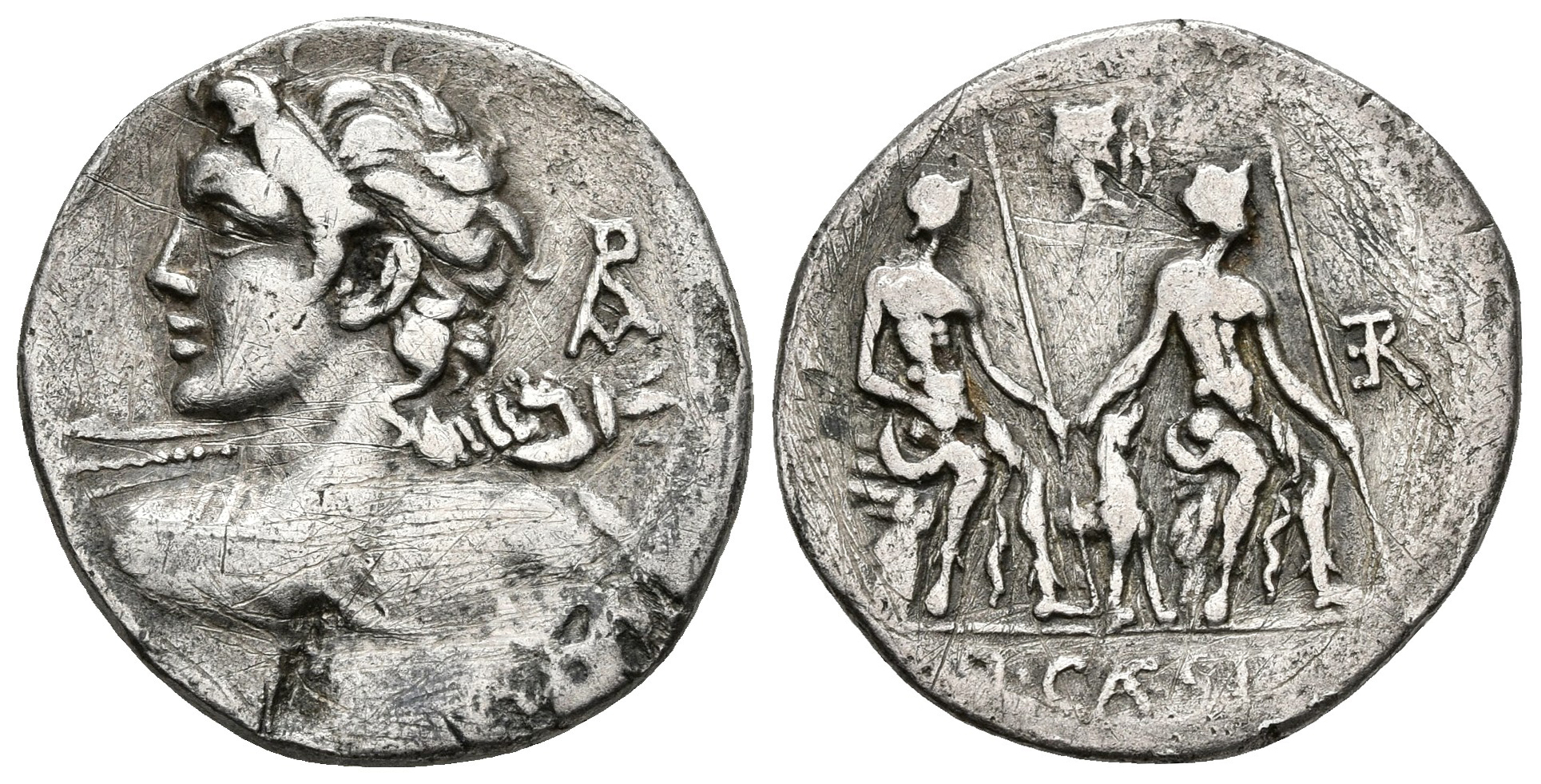
Here is a later image, where they take a more distinctly human form:

So this connects positively to Jason’s leadership, and Apollonius includes this imagery to let you know of Jason’s strengths.

But dogs in the ancient world were never quite fully domestic creatures as we are used to today. They guarded borders, but would not have been brought inside the home. But Jason is the son of a king, and he should be king himself, were it not for his usurping uncle. Throughout the story, however, Jason rarely seems comfortable as a leader. He hangs back, he worries, he has insecurities. Initially his crew thought Hercules should lead. In one instance, he decides to leave an island at night because of a fair wind, but everyone knows that we have bad associations with night because of the confusion it can bring. Sure enough, Jason ends up leaving Hercules behind by mistake, and turning a ship around in the ancient world to row against the wind is basically impossible. In another instance, friendly hosts mistake Jason and his crew for invaders (again, this happens at night), and Jason accidentally kills the host king. When it comes time to box the brutish Amycus to allow them to leave his island peacefully, it is not Jason that steps forward, but another crew member.

Those who know the full story of Jason (which we will discuss at the conclusion of the Argonautica) understand that Jason will continually feel trapped and pressed by circumstances, and not able to transcend them. He never attains the greatness associated with other Greek heroes.

All this is wrapped up in Apollonius’ references to him as Sirius, the dog star, which many in the ancient world feared to see.

8th Grade Literature: The Joy of Battle

This week we continued with The Song of Roland and delved into the topic of the violence in the story.

Those familiar with this story will note partial similarities to Homer’s The Iliad, and perhaps these similarities were intended by the author. Both stories have extended battle scenes with vivid descriptions of the violence, with limbs cracked, armor pierced, heads split, and so on. Both stories have their authors and their characters exulting in the carnage. Here is just one example:

Gradonies was bold and brave, a strong intrepid fighter. Now he finds himself faced with Roland. And though he has never seen him before, he recognizes him by his proud face, noble body, his regard for bearing, and he is filled uncontrollable dread. He tries to escape but fails, for the Count strikes him with such force that the blow splits the helmet, nose piece and all, cleaves through his nose, and his mouth, and his teeth, and his whole body and the coat of linked chain mail encasing it, the gilded saddle, both sides of the silver saddle tree, and deep into the horse’s back. He kills them both. Nothing could have saved them.

And another, this one involving not just a ‘regular’ soldier, but a high ranking clergyman, the Archbishop Turpin:

Nothing can turn [the Archbishop] aside: he charges against Abisme and strikes him on the shield studded with amethysts and blazing rubies, which a devil in Val Metas had given to the Emir Galafres, who in turn presented it to Abisme. Turpin strikes him; he does not spare him; and after one blow I don’t think the shield was worth a farthing. He chops through the body from one side to the other and kicks the corpse onto the bare ground.

The French say: “That was a noble stroke! The cross will not suffer while the Archbishop is there to protect it.”

We might expect such similar language from Homer’s tale of pagan Greece, but The Song of Roland fashions itself squarely within a Christian worldview, and means to communicate a Christian message. We might understand as Christians the need for violence at times. But violence is necessary only when something is wrong in the world. Some might assume that if we must fight, we should conflicted about it and have a heavy heart about our task. Above all, we certainly should not revel in it.

Whatever you may think about this sentiment (and it is one shared by many moderns, Christian or otherwise), it certainly was not one shared by the author, and we should consider why.

I remember years ago my next door neighbor had her grandson living with her on the weekends for a few months. He was in training to be a police officer. When I asked where he hoped to be assigned, she replied, “He wants to be right in the thick of it in downtown Baltimore. He wants to be where the action is.” Naturally this attitude worried his grandmother, but she said most of his academy friends felt the same way.

Some of you may know that one of my sons recently graduated from his training to be a firefighter, and is now working regular shifts at a local station. His first week was slow. Sure, a few interesting things happened on some other shifts, but his shift had it easy. This meant some downtime at the station, and some light days. You might think that a job where not much happened might be appealing, but my son was frustrated. In his view, he didn’t become a firefighter to play cards. He wanted action.

One can have two perspectives on this:

  1. These are the wrong attitudes to have. If one wants “action” as a police officer or firefighter, then one “wants” crime and property destruction to occur. The world would be better without crime or fires or medical emergencies. We do have to deal with them, but we should not be “excited” to deal with such things.
  2. Since crime and fire do exist, we need to have people trained to deal with them. If we need to deal with them, wouldn’t it be better to enjoy the work? Is fighting crime or fire something one can do to the glory of God? If so, they should ideally find joy in the task. Probably, the cop who enjoyed the job is more likely to be better at it than someone who hated it.

One might think that Roland as a character belongs to the past, but not necessarily. He is a type, although one we don’t see much of anymore. In CS Lewis’ autobiography Surprised by Joy he recounts his experiences meeting different kinds of soldiers in the trenches of WW I. He writes,

Perhaps the best of all us was Wallie. Wallie was a farmer, a Roman Catholic, a passionate soldier (the only man I ever met who really longed for fighting) and gullible to the [highest degree]. The technique was to criticize the Yeomanry. Poor Wallie knew that it was the bravest, the most efficient, the hardest and cleanest corps that ever sat on horses. He knew all that inside, having learned it from an uncle in the Yeomanry when he was a child. But he could not get [his words] out. He stammered, and contradicted himself, and always came at last to his trump card: “I wish my Uncle Ben were here to talk to you. He’d tell you.” Mortals must not judge but I doubt whether any man who fought in France who was more likely to go straight to Heaven if he were killed. I would have been better employed cleaning his boots than laughing at him. I may add that I did not enjoy the short amount of time I spent in the company he commanded. Wallie had a genuine passion for killing Germans and a complete disregard of his own or anyone else’s safety. He was always striking out bright ideas at which the hair of us subalterns would stand on end. Luckily, he could be easily dissuaded by any plausible argument that occurred to us. Such was his valor and his innocence that he never suspected us of any but a military motive.

Charlemagne’s battle cry is “Mountjoy!” and his sword is named “Joy” (as translated from the French), so we know his approach. Some might assume that Charlemagne was a war-mongering sadist, but the story will not allow for this interpretation. Among other things, there are the last lines in the book, which read,

The King has gone to bed in his vaulted bedroom. God sends St. Gabriel to visit him, and he says, “Charles summon all of the hosts of your Empire and enter the land of Bire by force of arms, and rescue King Vivien, for the pagans have laid seige to him in the city of Imphe, and the Christians there are pleading and crying out for you.”

The Emperor does not wish to go.

“Oh God,” says the King, “my life is a burden!” And the tears run from his eyes and he rends his white beard.

We should not read this as Charles contradicting himself or his life’s work. Rather, a faithful reading of The Song of Roland causes us to examine our own life critically, just as Charlemagne had to do with his.