The Marriage of Handwriting and Architecture

It did not take me long to get miffed by Steven Greenblatt’s The Swerve.  Almost right away  he commits two cardinal sins in my book when discussing the Medieval period.
  • He brings up all the worst aspects of the Medieval period without any of its virtues, and
  • He asserts that the discovery of Lucretius’s On the Nature of Things is one of the main causes for the “swerve” from the Medieval to the Modern world.  He does not assert this absolutely, but hedging all on one manuscript still seemed too reductionistic to me.

But Greenblat’s charm and narrative style kept me going.  In the end, I didn’t read the whole thing and skimmed some sections, but one thing in particular struck me forcefully — how handwriting can be a reflection of the personality of a society.

‘Gothic’ script dominated the ‘Gothic’ era, and it can be contrasted with the Carolingian script revived by many Renaissance scribes:

Petrarch complained that Gothic script, “had been designed for something other than reading,” and he was not whining, but speaking the truth.

Gothic Script

The height and cramped fashion of letters makes it difficult to read, and may subconsciously have been designed to be “seen and not heard.”  When we remember that very few could read, and that books were meant to educate visually just as much as textually, the Gothic “font” makes more sense.

Gothic Manuscript

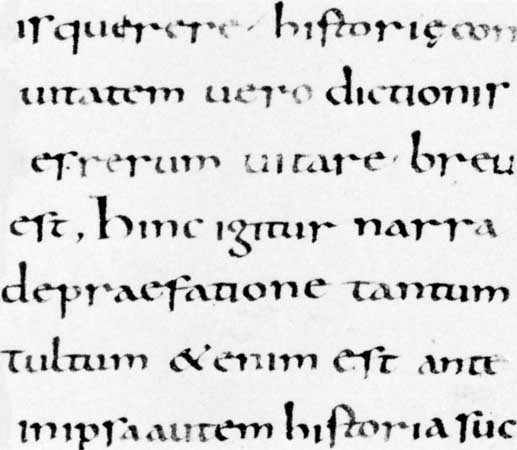
Here are examples of the Carolingian script fashionable during the Renaissance:

Perhaps pro-Renaissance scholars do not exaggerate the real shift that took place as far as education is concerned.  Perhaps this shift in handwriting style helped pave the way for the printing press itself.

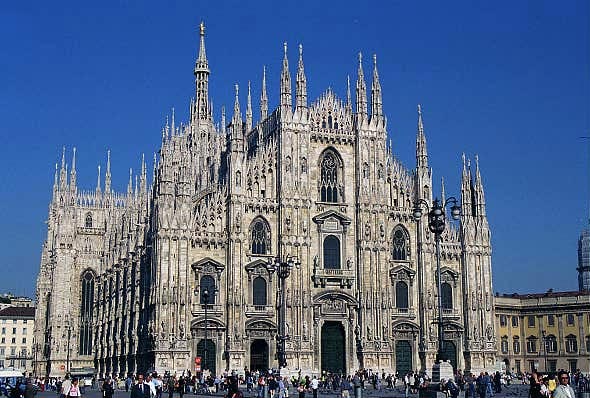
If the “font’s” a society uses reflect something of its larger worldview, we would expect to see this expressed in other aspects of their culture.  Gothic architecture mirrors gothic script in uncanny script in uncanny ways, with the “bunched up” nature of its space.

Flying Buttresses

True, the high ceilings of these cathedrals did give a sense of space, but it was space that meant to overpower you, a weight and bulk of a different kind.  The stained glass windows again reveal the same thing as the buttresses — the “cramming” full of space with color.

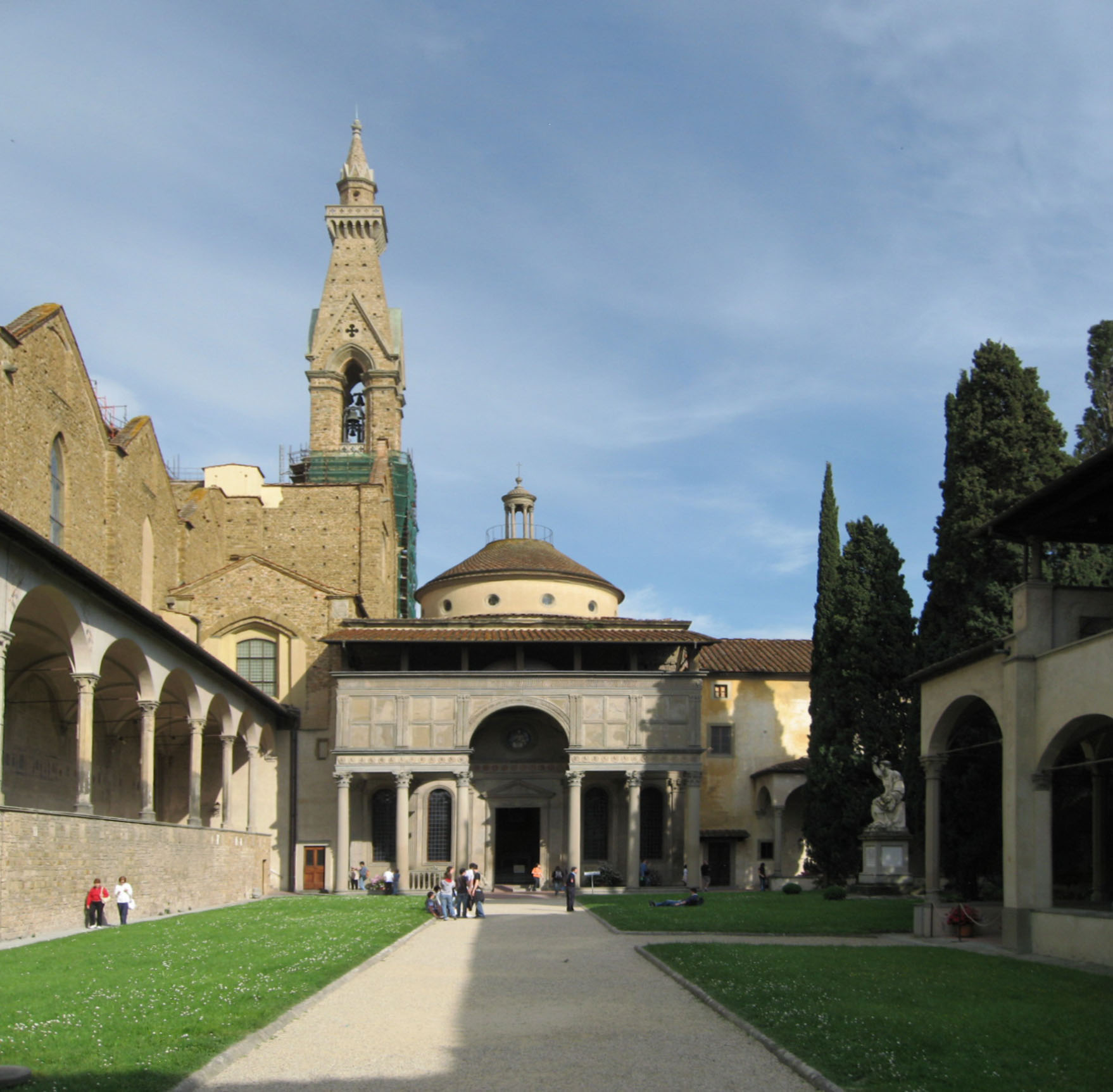
In the Renaissance we see something else entirely, a more “human” scale in architecture, and a greater sense of space.

The Pazzi Chapel

Michelangelo, the Medici Chapel

So apparently, handwriting can be an expression of a culture’s personality just as architecture can, which should not have surprised me.

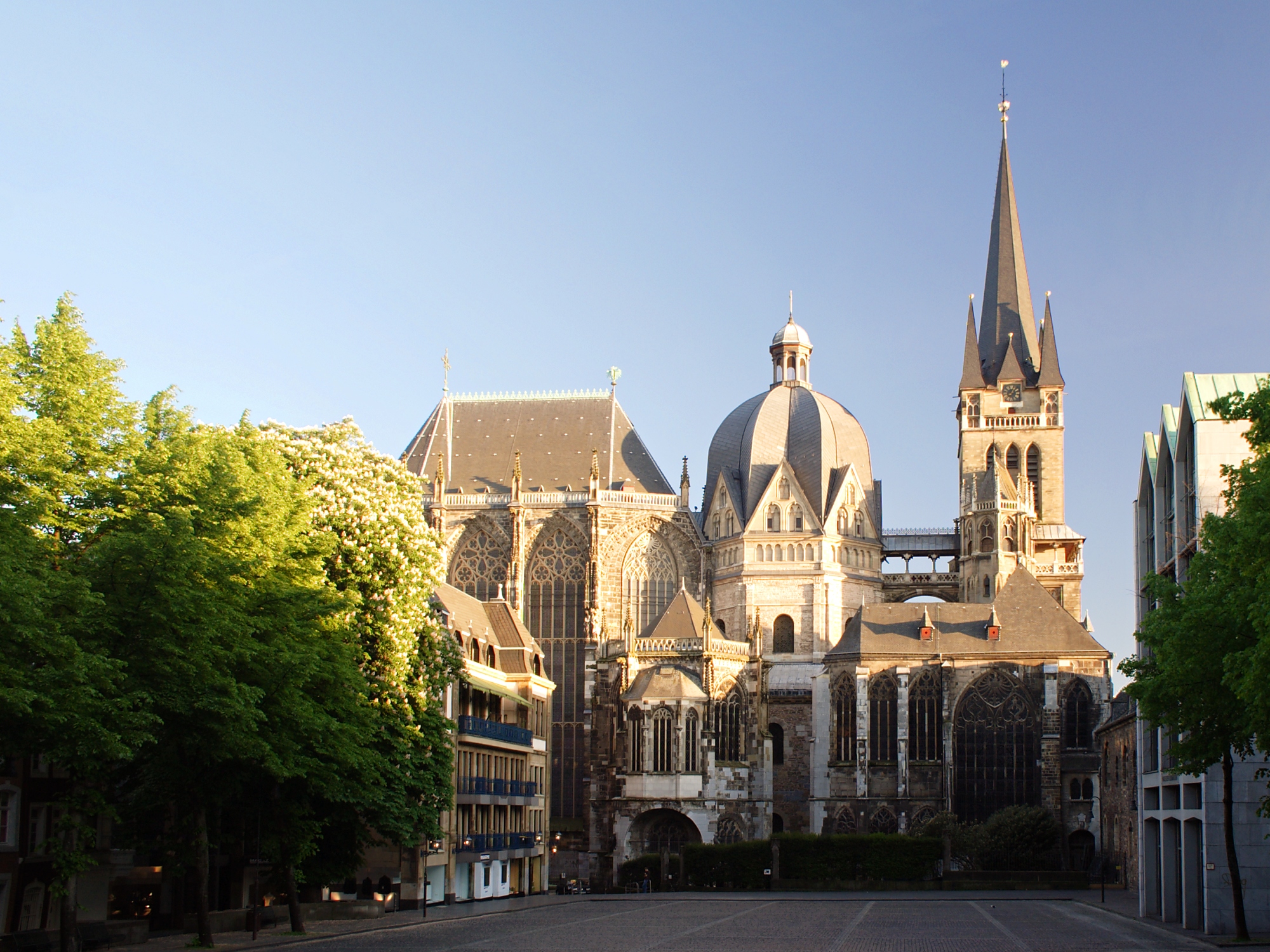
When I realized that the Renaissance basically just revived Carolingian script, this gave new significance to the Carolingian Renaissance itself under Charlemagne six centuries earlier.  Those that invented the style and not merely copied it should get greater credit.  Some scholars dismiss the “Carolingian Renaissance,” as small potatoes, but the script they used showed an interest in reading, which sheds new light on the work of Nottker and Einhard.  So, what about architecture under Charlemagne — will it show that same sense of space?  Naturally we must consider Aachen Cathedral, the central building of Charlemagne’s realm:

Aachen Cathedral, Exterior

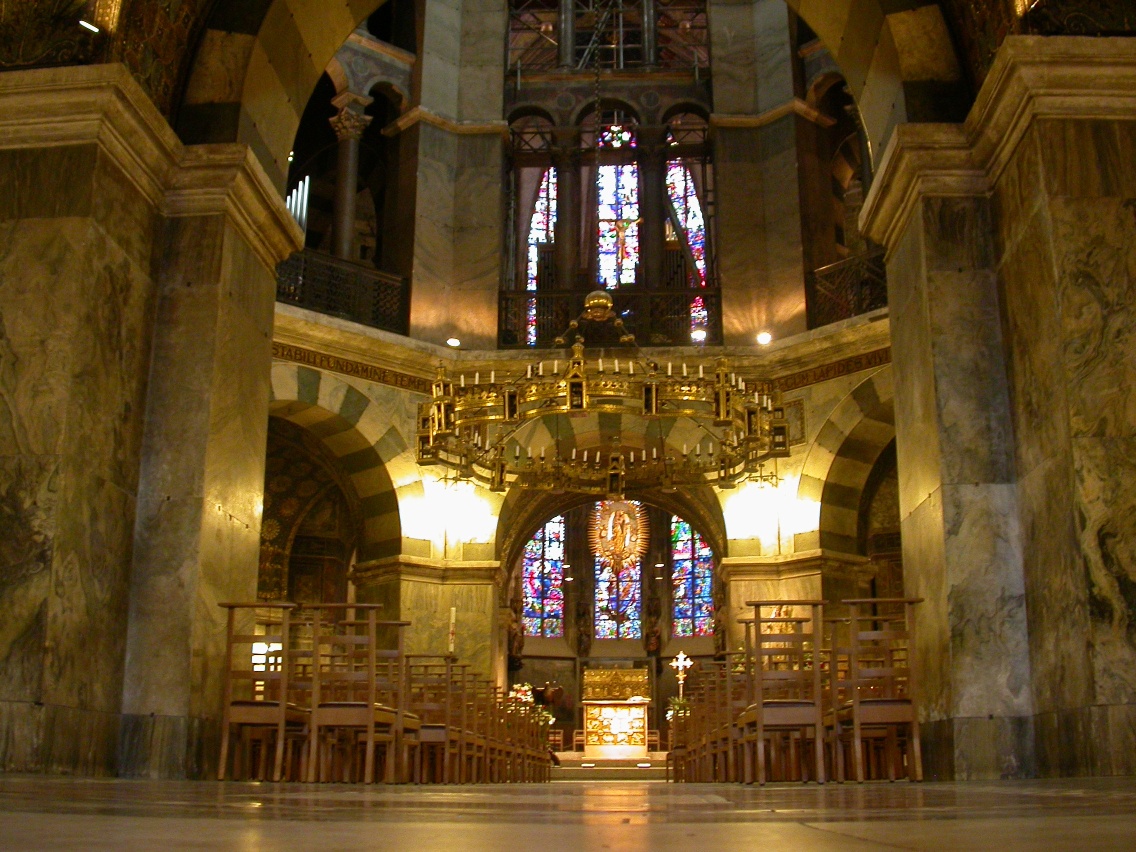
Aachener_dom_oktagon

Well, it appears that we have a mixed verdict.  It is part Gothic, part Byzantine, and part something all its own.  Will I allow this to overthrow my theory of seeing links between handwriting and architecture? Perish the thought!  I can always say that Charlemagne’s time had so much going on that they had no time to be particularly self-aware of these choices, in contrast to both the Gothic and Renaissance periods.

Does America’s utter lack of defining architectural identity have anything to do with our confusion about teaching handwriting?

Blessings,

Dave

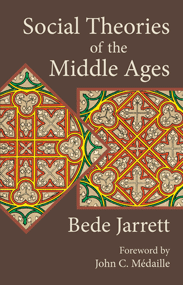
“Social Theories of the Middle Ages”

There is the idea touted by some that “a thing can be known only by its opposite.” Perhaps this idea has more cache in today’s parlance due to the rise of eastern philosophies in the west. However attractive the idea sounds on the most important questions it doesn’t hold up.  The Devil does indeed need God, but God has no need of the Devil.  Adam and Eve had every chance of knowing God perfectly before the presence of sin — of course sin prevents us from knowing God as we ought.

Still, on lesser questions the aphorism has its usefulness, including in History.  We rarely can see the nose on our face, and so it’s hard to understand one’s own society just by looking at one’s own society.  Instead we need perspective, and history can provide this.  Of course we should not look at history merely as a vehicle for understanding our own time.  Rather we can say that good history both opens up new worlds to us and sheds light on our own.  Such is the accomplishment of Bede Jarrett’s Social Theories of the Middle Ages.  His chosen title fails to inspire, and at times his writing follows his title and gets bogged down and technical.  But all in all Jarrett succeeds in his stated aim of fairly portraying a world strangely familiar to us and yet not so familiar.

Jarrett divides his examination by category, and so we have chapters on Law, Education, Women, and son on.  Right away in his first chapter on “Law” we see differences between us and them. Before thinking about particular laws the medievals thought in terms of their proper “ends” or to use the Greek term, the “telos” of a particular law.  No law made sense unless put in a larger theological context.  In order to know this context we need to know not just our ends as human beings in general, but also our origins.  So any medieval theory of law must first start by talking about creation, natural law, sin, and so on.  Then they move on to questions about salvation, and the role of law as an aid to that process.  Having done this, now we can move on to actual laws.  So while the medievals often focused on the big picture, they had a rigid categorical exactness about their thinking.

This had two seemingly different kinds of consequences.  One is that specific laws might matter much less than the theory behind the laws, and so law itself disappears in the shuffle.  We see this in one medieval Welsh code of “law” where a woman could be remitted for a particular offense if she paid a fine of “a penny as wide as her behind.”  In other words, we need not worry about law at all.  On the other hand, medieval thinkers consistently mentioned that law “must adhere to the bones of the people” — it had to fit a time and context (again we see the medieval exactitude at work) to have real validity.

I said these attitudes presented only a seeming difference.  What held them together, I think, is that for them laws had validity only because of our temporal earthly existence.  When “History” serves its purpose we shall have no need of law at all.  To understand the place of law one must first understand the temporary nature of the state itself.  One then, can play with law, either to fit a particular occasion, or in the case of the Welsh, for our particular amusement.  It is this sense of distance from law the medievals had that differentiates our society and theirs.  Anyone who has been ticketed in a “Mandatory Headlight Use Area” though the sun shines brightly, or been caught in a speed trap on a road with a speed limit well below the road’s design, has felt the absolute nature of law in the modern west.  We treat the law thusly because we do not do as the medievals did — we have no “higher end ” in view, only the power of the consent of governed at our disposal.

But I should not give the impression that Jarrett romanticizes the Middle Ages, though I think he certainly is fond of them.  He wades into the controversy surrounding how to translate the Latin word “servus,” and has no qualms about rendering it as a “slave.”  He denies that slavery disappeared during the middle ages (though it did decrease significantly from Roman times) because a certain class of people had no legal freedoms.  In this he departs from the fiery Regine Pernoud, who called it the height of ignominious irresponsibility to render “servus,” as “slave.”*  The strict categorical methodology they used spilled over into their society at large at times to an unhealthy degree.

The modern perspective on such a social arrangement might incline towards tolerance — some might excuse it as a necessary stage to better things down the road (much as some might excuse the condition of the urban lower-class at the beginning of the industrial era).  They might be less willing to excuse the medieval view of women, at least at first glance.  Here Jarrett urges caution, for most often those that wrote were monks, because they had the best educations.  And monastic writing about women would have its own particular concerns apart from the larger community.  One gets a more robust picture of medieval women in the Canterbury Tales, for example.  Jarrett points out that,

  • Women who entered convents could receive a very similar kind of education as men.  That the education of men and women would be equal in any sense might have been a historical first.
  • “Their intelligence is more keen and more quick than that of a man.”  So said Franco Sanchetti, with general agreement from others.
  • Women had some opportunity to make a vital contribution to Christian culture at large, witness Christiana de Pisan.
  • Women had an honored place as nuturers and civilizers of men.
  • No era that gave such veneration to the Blessed Virgin Mary could be said to truly denigrate women.

But Jarrett also points out that women often got blamed for the Fall of mankind in general.  And many saw women as quicker to do evil than men — Sanchetti, quoted above, admired feminine intelligence but thought they used this intelligence to work more evil than men.

As Jarrett often does, he turns to Aquinas to help provide balance between these two seeming poles.  “The image of God in man in its principal signification — namely, the intellectual nature — is found both in man and in woman . . . .  But in a secondary sense the image of God is found in man and not in woman: for man is the beginning and end of woman, as God is the beginning and end of all things.  So when the Apostle had said that man is the image and glory of God but woman is the glory of man (I Cor. 11:7), he adds this reason, ‘for man is not of woman, but woman of man; and man was not created for women, but women for men.'”  Again in Aquinas, as we see so often, the “telos” of things guided their thinking.

We moderns cringe at this, but the best medievals would not have seen secondary status (if we wish to call it that) as denigrating.  We tend to measure worth in accomplishments or opportunities to live as we wish.  The medievals found glory in living out one’s assigned role in the grand cosmic dance that led to salvation.  So St. Francis (a man who understood chivalry perfectly) in his glorious “Canticle of the Sun” (see below) exults in the feminine aspects of creation because the feminine exults in meekness, which leads to humility.  And without humility no one can receive salvation.  From the medieval perspective (here I speculate) Jesus does not say, “The poor will always be with you,” because of the inevitability of sin, or the intractable problems of just political and economic systems.  Rather, some must play the role of “poverty” so that others will have the chance of exercising charity, and thereby become more like God.

This leads to what might most interest our economically minded/obsessed age, the medieval attitude towards money and property (there is an extended chapter on the medieval attitude towards war as well, but that gets covered in large measure here for any who have interest).  We experience confusion in the modern world about such things because we have no proper sense of the “telos” of money.  Jesus gives us many warnings about money’s destructive power, and yet we need money to live.  Money therefore has a proper place in the scheme of things, but money must be subordinated to its proper “end.”  So we should have enough to provide for our family.  We should seek also to have enough to practice charity.  Such is the proper, though temporary “end” of money.  Some would probably argue that a few might have a lot more money than this, but why?  To better reflect the image of God to creation, in this case, that of munificence or “kingly joy.”  By custom, though not law, the wealthy were expected to royally “fete” the poor under their charge on the most prominent of feast days (indeed, the mingling of rich and poor would have been much more common then than now).^

Property ownership as well came with this same tension.  Since God truly owned all things, in what sense could we own anything?  Medieval concepts of ownership absented themselves from our modern absolute legal concepts.  Rather, medievals “had use” of certain things, and then only on a contingent basis.  So the king had power provided he upheld his oath.  Nobles could receive grants of land from the king provided they served him faithfully.  None owned anything absolutely. The right to use something depended on whether or not you used it faithfully, according to the telos of the thing used.  Jarrett points out that absolute concepts of ownership came to the modern west with a revival of classical ideas in the Renaissance.  For the Romans, Rome was the telos of all things, so Roman ownership of property or people could be absolute. They had nothing beyond themselves from which they could take their pulse.  Aesthetically too, the contingent complexities of the medievals created stained glass.  The clear simplicities of the Renaissance smashed many of these windows and replaced them with clear panes just as the clear, classical concepts of Roman law began to replace the complex labyrinth that was the medieval synthesis.

In the early 20th century a group of thinkers led by men like G.K. Chesterton and Hillaire Belloc attempted to revive medieval economic concepts for the modern world.  They failed to make much headway, and most of their admirers attribute this failure to a lack of a defined system or program adapted for the modern world.  I have a different idea as to their lack of success.

Many might admire medieval views on property and wealth, but they arose within a defined context.  Specifically, the medieval focus on contextualizing everything in light of its place in the scheme of salvation gave them a framework in which to place wealth and property.  We have rejected the context of medieval views on things, and without that context, we have no agreed upon telos for money and property as the medievals had.  Our society values maximizing freedom and opportunity for the individual, and so the more wealth, the more opportunities to extend the self into places yet unknown.  Again, the medievals valued stability much more than change, innovation, and the need for “forward momentum.”  Without the medieval theological and psychological context, medieval ideas about economics would be dead on arrival.  We often wish to have our cake and eat it as well, but societies can not be put together in such a hodge-podge fashion.  We must choose the telos we pursue.

Dave

*Solving this riddle depends largely on how one defines “slave.”  Medieval peasants at the very bottom of the social ladder were slaves in the sense that they had very very few freedoms they could exercise on their own.  Unlike the slaves of most other cultures, however, even those at the very bottom had certain engrained legal protections in law and from the Church.  Also medieval “slaves” were almost entirely bound to the soil, which meant certain periods of long hours, and certain extended periods of relative inactivity.  And they also would have been exempt from work on numerous medieval feast and saint days in the Church calendar.

^In his The Court Society, Norbert Elias mentions a few aristocratic Spanish families who bankrupted themselves by projects, gifts, and feasts for those in their charge, and gained glory thereby.  Their family had in a sense, fulfilled its place in society by demonstrating such largesse.

— Regarding the “Canticle of the Sun” . . .

I partially agree with those that regard St. Thomas and St. Francis as the best fulfillment of medieval society.  St. Thomas’ massive Summa Theologica stands as perhaps the greatest extended theological treatise in the history of the Church.  But St. Francis possibly had a greater degree of sanctity.  And in one fell swoop of poetic insight, St. Francis both perfectly expressed the medieval vision and revealed timeless truths.

Most high, all powerful, all good Lord!
All praise is Yours, all glory, all honor, and all blessing.

To You, alone, Most High, do they belong.
No mortal lips are worthy to pronounce Your name.

Be praised, my Lord, through all Your creatures,
especially through my lord Brother Sun,
who brings the day; and You give light through him.
And he is beautiful and radiant in all his splendor!
Of You, Most High, he bears the likeness.

Be praised, my Lord, through Sister Moon and the stars;
in the heavens You have made them bright, precious and beautiful.

Be praised, my Lord, through Brothers Wind and Air,
and clouds and storms, and all the weather,
through which You give Your creatures sustenance.

Be praised, my Lord, through Sister Water;
she is very useful, and humble, and precious, and pure.

Be praised, my Lord, through Brother Fire,
through whom You brighten the night.
He is beautiful and cheerful, and powerful and strong.

Be praised, my Lord, through our sister Mother Earth,
who feeds us and rules us,
and produces various fruits with colored flowers and herbs.

Be praised, my Lord, through those who forgive for love of You;
through those who endure sickness and trial.

Happy those who endure in peace,
for by You, Most High, they will be crowned.

Be praised, my Lord, through our sister Bodily Death,
from whose embrace no living person can escape.
Woe to those who die in mortal sin!
Happy those she finds doing Your most holy will.
The second death can do no harm to them.

Praise and bless my Lord, and give thanks,
and serve Him with great humility.

A Pattern Language

Many years ago I witnessed a debate between the Christian William Lane Craig, an atheist, and a Buddhist. Naturally I “rooted” for Craig, but also hoped for an interesting discussion. The atheist cut a poor figure. Craig possesses an enormous intellect and made quick and brutal work of the scientific materialist. In so doing, however, he neglected the Buddhist, who had a much more interesting argument, Though I disagreed with the Buddhist, I wished Craig had stopped shooting fish in the barrel and paid more attention to him. The Buddhist basically argued that values certainly exist in the world, contra the strict materialist. But he thought Christians too interested in the explanation for the values in the world–why not simply live in light of them? Craig never dealt with this enigmatic assertion.

Everyone should read Christopher Alexander’s A Pattern Language, or at least glance through it as I did. 🙂 On its surface the book is about architecture, and he provides much directly for the professional builder. What makes the book remarkable, however, is how easily Alexander connects architecture to everyday life, and orients it not around outsized auteur individual creation, but making spaces for people to live communally and “normally.” To do so, one must tap into the “patterns” in everyday living. Though I know very, very little about Asian religious philosophy, I sensed something of the Buddhist or Taoist in Alexander. He felt no need to justify these patterns or explain their meaning. As far as I could tell he called mainly upon the intuition of our experience in presenting his ideas. Many have written about the increasing privatization of our culture, and no doubt this reflects itself in the buildings we create. Alexander injects a comforting warmth into our sterile sense of the meaning of a building, something quite needed given the state of modern architecture.

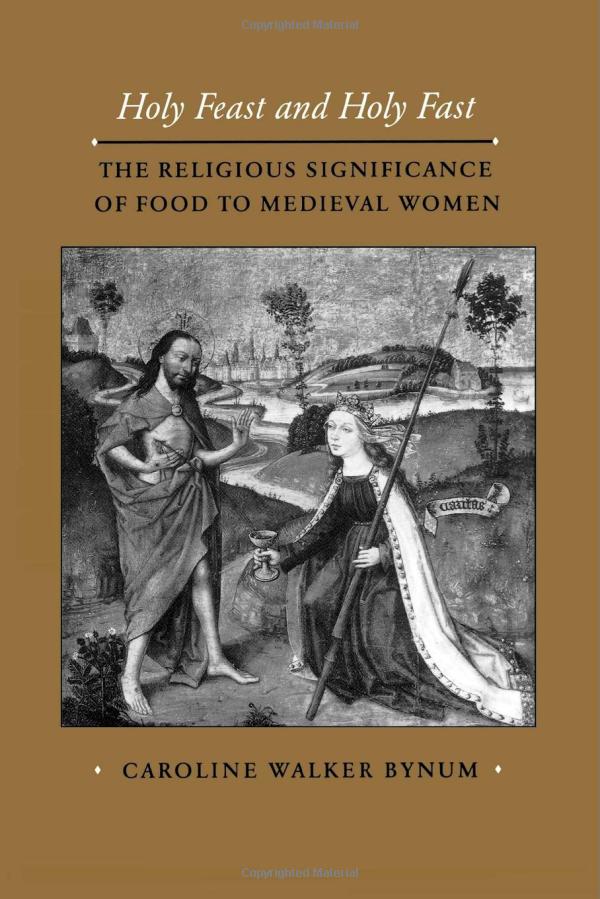
I agree that values present themselves in the world as real entities. I disagree that the origin of these values is a red herring–I think that it matters very much. But I agree again that the experience of such values matters much more than debating or discussing them. To understand the reality of symbols we have to enact them, to incarnate them, in our daily lives. The argument over when we started living in our modern linear, factual. and personalized way has a different contenders–some say the Reformation, the Scientific Revolution, the Enlightenment, or the Industrial Revolution. Caroline Walker Bynum’s Holy Feast and Holy Fast: The Religious Significance of Food for Medieval Women work hints that this process began in the late Middle Ages-early Renaissance, though answering this question was not the intent of her work.

Bynum won me over immediately in her introduction. She makes it clear that we have to understand medievals on their own terms. She quotes John Tauler of the 14th century, who writes,

St. Bernard compared this Sacrament [the eucharist] with the human processes of eating when he used the similes of chewing, swallowing, assimilation, and digestion. To some this will seem crude, but let such refined persons be aware of pride, which comes from the devil; a humble spirit will not take offense at simple things.

The words form an introduction to the subject of her book, and indeed–unlike Henry Charles Lea–Bynum knows that to understand medieval ideas of food (or almost anything) means understanding the eucharist first and foremost. The words also bracket ones whole approach to any part of the past–humility usually triumphs over judgment.*

The humble everyday nature of food is a great place to start understanding the nature of things.

The remarkable Alexander Schemmen began his classic For the Life of the World with these words:

“Man is what he eats.”  With this statement the German materialistic philosopher Feurbach thought he had put to an end all “idealistic” speculations about human nature.  In fact, he was expressing, without knowing it, the most religious idea of man.  For long before the same definition of man was given in Genesis.  The biblical story of creation man is presented, first of all, as a hungry being, and the whole world as his food.  . . . Man must eat in order to live; he must take into the world his body and transform into himself.  He is indeed that which he eats, and the whole world is presented as one banquet table for man.  It is the image of life at its creation and at its fulfillment at the end of time . . . “that you eat and drink at my table in my Kingdom” (Lk. 22:30).

We remember too, that just as, “the whole world is one banquet table” so too, the first sin involved breaking the fast. How and when we eat matters as to how we understand the world.**

Individually, food involves taking the life of something else and making it part of ones own life. Even a stalk of wheat or an apple must be plucked from its source of life and ‘die’ so that we may live. So eating mirrors Christ’s life, death, and resurrection. I talked in a recent post about adopting a theopomorphic view of our experience with the concept of bodies, and we should understanding eating as part of our joining our life to Christ’s life. He offered himself as food for us (John 6:56).

In addition, eating joins us to creation’s pattern. The earth receives water and bears fruit. The earth receives death and decay–think compost or manure–and turns it into life. The church in the early west established “ember” days of fasting to mirror changes in seasons, and the longest fasts of the church year (Advent and Lent) occur during times of year when the ground lies essentially inactive.

Establishing this pattern, Bynum then leads into understanding medieval women and their relationship to food. Creation has always been associated with the feminine, i.e., “Mother Earth.” We know too the trope of the mother who “sacrifices herself,” who will eat less, eat last, or . . . not eat at all. She “dies” so that she can provide.

Bynum frames the context of medieval female religious experience through this lens. Bynum looks at the fasting and eucharistic devotion of certain medieval women, including a long discourse on the whether or not such women suffered from anorexia that is tedious in a scholarly way, but fair and sympathetic nonetheless.

But this intense personal piety as it related to food has a problematic endgame. Connecting fasting and feasting to the patterns in creation meant that communities could experience it together in the same way, with the same meaning. The physicality of things makes itself obvious to all, from the saint, to the scholar, to the ploughman. By separating the practice from “normal” rhythms, the experience became intensely personal, and less communal. This is not to say absolutely that no variance can exist in a community, and the late medievals never normalized the experience of these unusual women. But a decisive shift happened. Fasting meant no longer primarily a communal experience linked with the pattern of the life of Christ and creation, but a vehicle for personal, and possibly idiosyncratic, devotion.

From here dominos start to fall. Without the connection to creation, the common language of food might disappear. In time, one could fast from Netflix or shopping instead of certain foods. Maybe such things have their place for individuals, but the reduction of fasting to individual experience and individual authority robs us of meaning and identity (something Mary Douglas pointed out in her excellent work).

This same radical personalization and consequent loss of meaning have done similar work in the realm of sexuality. In ye olden days marriages happened not primarily because people were “in love,” but rather as a vehicle whereby people could participate in what it means to be human and the drama of salvation. If we think of our humanity and the humanity of Christ as one–before the foundation of the world–we see this clearly especially as it relates to women who get married:

  • The woman is led to the altar by her father
  • She “dies” at the altar–Miss Jane Smith is no more
  • She is “reborn”–meet Mrs. Jane Johnson
  • After marriage comes the “fruit” of the marriage, say hello to little baby Jack Johnson

The meaning of sexuality comes from this mirroring of Christ’s life, death, resurrection and ascension. And here we see why we need “Heaven,” and “Earth,” man, and woman, for our sexuality to make any sense at all. We have divorced this aspect of our being from all such patterns, and made it purely personal inside the chaotic variability of our minds. It appears the end of this rope has come, when some experts tell us that not only is the created order not a model for sexuality, but our very bodies should be discarded to achieve our purely personal goals.

Many today focus on our political confusion, and we should lament this. But these political issues have far deeper roots which we cannot see. Not only do we not see a pattern, we don’t expect to see a pattern. We won’t be able to solve these problems until we start looking.

Dave

*Another aspect of her writing that I appreciated . . . She delineated in the introduction chapters geared more towards layman like myself, and those written more with the professional scholar in mind. I personally have no taste for the hemming and hawing of scholar-speak, but I understand it has its place. It was kind of her to let me know what to avoid and where to focus my attention.

**This may seem a crazy assertion, but if we think of our lived experience we begin to understand. Let’s take drinking alcohol as an example. We instinctively recognize that someone who drinks scotch at 10 am has a problem, but if they did so at 10 pm, no problem. But why? What is the difference between drinking in the morning or at night?

Life is full of “inhaling” and “exhaling.” At night we begin to “exhale,” we reach the “fringe” of our being for the day. As we move through the “fringe” of the day we begin to approach the “chaos” of the unconscious. It intuitively makes sense, then, for us to match drinking something that relaxes us, that moves us toward the “fringe” of our being, at night rather than during the day. If we move towards the “fringe” in the morning when we should be “inhaling”–focusing and getting active–we create personal and societal dissonance. Our distinctions are not arbitrary.

Likewise, we understand that drinking socially is better than drinking alone. A person who drinks too much socially we might perceive as having a minor problem. A person who drinks too much alone we perceive as being in grave danger. But why? The pattern tells us, and again, we understand not so much logically but in our lived experience. Social groups exist for people to blend and mix together. Alcohol can bring us to the fringe of our being, we can “extend” the self in some respects through alcohol. Hence, “Can I buy you a drink?” can be a means of introduction in ways that, “Can I buy you some carrots?” would not. Someone who drank too much alone would extend themselves and connect with no one–it would be an intentionally fruitless action, in which we rightly recognize despair and nihilism.

God’s Legs

Translation will always be a tricky business, but two rules of thumb remain: 1) Make it readable for modern audiences, without 2) Losing the flavor of the original. Nigel Bryant’s The History of William Marshal hits this mark admirably. He translates the original poem into prose, but preserves the period’s idiomatic way of speaking. I confess a great fondness for medieval diction which perhaps runs in literature from Beowulf through Shakespeare. Part of this comes simply from seeing new phrases that inject life into staid platitudes. So, one can smile at the fact that they use the word “nanny-goat” in place of “chicken” for a coward. But more to the point–the medievals combined high-flown sentiment with an earthy directness that we lack today.

A few examples . . .

  • “Sir Thomas Coulances added his two ounces of salt. Making sauces was all he was good for. In sum, five got involved in this mustard” [i.e., they ‘stirred up trouble’].
  • “The Marshall grabbed a stick and gave him such a whack across the brow that the rogue had made his last blink with that eye–it went flying from his head. Well, they do say, ‘an appropriate feast day for such a saint'” [said ironically–the ‘rogue’ in question had stolen a horse. Normally the feast day of a saint would occur on the day of his martyrdom/death, though in this case the Marshall actually prevented the thief’s death by hanging and let him go–missing an eye].

And my favorite:

  • Sir Richard foolishly inserted himself–he should never have goaded the ass [i.e., he should have “let sleeping dogs lie”–“ass” here refers to a donkey and not the grumpy personage].

My admiration for Bryant increased as I read the introduction. The History of William Marshall author remains unknown but may have been his son. Some treat the book as pure literature and leave aside any historical value, thinking it an “obvious panegyric” to Marshall and not to be trusted. Bryant affirms the historical value of the work, pointing out that most of the books’s audience knew the famous man in England and France. Perhaps it contains exaggerations in places but its basic foundation remains, like stories you might tell about a relative at Thanksgiving dinner. Change the tale too much and you get called out.

Primary sources, if one willingly dives in, can give great insight into how those at the time viewed the world. In other medieval or Elizabethan texts one readily comes across such phrases as “God’s eyes!” or “God’s blood!” as vows or mark’s of irritation and (righteous?) anger, i.e., “By God’s blood I’ll do no such thing,” or, “God’s eyes, I’ll have him out!” upon hearing that some dastardly earl has seized a castle of the king. Never before have I seen the phrase “God’s legs!” as it used in The History of William Marshall, though the author uses it in a similar manner as the above phrases. Seeing this new idiom helped me think about this whole phenomena anew. What could they have meant by such expressions? We do have phrases for “stirring up trouble,” for example, but not anything like “God’s teeth!”

An easy explanation might sound like

  • This shows the “top-heavy” nature of medieval society. Sure, you have some brilliant theologians and marvelous architecture, but the bulk of the masses were ignorant of such things and descended into blasphemous superstition at the drop of a hat.

This view, however, violates one of my cardinal rules: we should never assume the ignorance of others in the past. People might be wrong about things, but that doesn’t mean they lack good reasons for being wrong. A better explanation might sound like,

  • These phrases show the “low” of the “high” and “low” dichotomy in the medieval period, ably expounded by brilliant commentators such as the author of the blog “astickinthemud.com.” Phrases such as “God’s legs!” simply give evidence that this tension could not always be maintained coherently–i.e., sometimes the “low” went a bit too low.

Still, I don’t buy it. Numerous examples exist of the “high” and “low” existing in the same person throughout the medieval period, such as Boccaccio, Chaucer, Dante, Marguerite of Navarre, etc. So, we should entertain the idea that such phrases do not betray the medieval synthesis but rather give witness to it.*

Does God have a body?

In one very important sense obviously of course He does. In the incarnation Christ assumed the fullness of human nature. He did not simply “appear” as a man, He was a fully human man with a real human body. Christ remains both God and glorified Man. And being Man, this means that He has arms, legs, etc. just as we do, or if you prefer–just as we will in the resurrection.

In another sense God has no body. All orthodox theologians tell us that He is “simple” and not composed of parts. Having arms, legs, etc. seems to imply parts to God. But we must be careful with the meaning of “parts.” Divine simplicity at its root might mean something along the lines of, “God is not divided from Himself,” or perhaps that no separation exists between God and His attributes. The “justice” or “mercy” of God is simply God Himself. But I am no theologian and will leave off the exact meaning of “divine simplicity.”

Even before the Incarnation it seems that God has a “body.” He walks in the Garden, He has “eyes” (Ps. 119:18, etc.), and a “right hand” (Is. 41:10, etc.). “Ahh,” we say, “but that is anthropomorphic language.” Well, maybe not.**

We assume that the Bible speaks of God as having arms, eyes, etc. as a concession to our understanding and language. God obviously has no physical body of flesh and bone. In this sense certainly God is bodiless as are the angels. Orthodox testimony unanimously speaks to the immaterial nature of God, and the “simplicity” of God. God has no parts:

Far removed is the Father of all from those things which operate among men, the affections and passions. He is simple, not composed of parts, without structure, altogether like and equal to himself alone. He is all mind, all spirit, all thought, all intelligence, all reason.

St. Irenaeus, Against Heresies, 2.13.3

God, however, being without parts, is Father of the Son without division and without being acted upon. For neither is there an effluence from that which is incorporeal, nor is there anything flowering into him from without, as in the case of men. Being simple in nature, he is the Father of one only Son.

St. Athanasius, Letter on the Council of Nicea, 11

These are just two examples. Nothing in what follows is meant to contradict this in any way. But we should understand that God the Father begets a Son (eternally), and that our begetting is a shadow of His begetting, and not vice-versa. We are made in His image, not vice-versa. God’s eyes do not see like our eyes, our eyes see, however dimly, like His. But of course, God does not have squishy white things just below His forehead, rods, cones, and so on.

Perhaps, then, we can understand that the concept of “body” should not be understood in an anthropocentric way. We have, unfortunately, significantly bought into anthropocentric thought when it comes to the ancient and medieval world. The Greeks thought Zeus threw thunderbolts because they did not know about electricity, or Poseidon caused earthquakes because they had no knowledge of tectonic plates. We really should give the Greeks–and others in the past–more credit than that. So with bodies–maybe we should not think of bodies as an assemblage of physically moving parts, but as a “nexus of potentiality,” to quote Father Stephen de Young. God’s being contains all true potential. He sees but needs no organ called “eyes” to do so. He moves but has no need of physical legs to make that happen. We lack the “simplicity” of God and so we need bones, tissue, etc. to enact such impulses as the desire to move or perceive.

It seems to me that the medievals nearly always tended to think in a top-down manner. One sees this in their bestiary’s, where it is not so much the physical lion that is seen, but a kingly symbol. Their desire to know particulars of the lion were not as strong as their desire to “scale up” the lion and integrate with God’s existence. Perhaps they thought similarly about the body itself. In the 3rd century AD Origen wrote,

The apostle Paul teaches us that the invisible things of God may be known through the visible, and that which is not seen may be known by what is seen. The Earth contains patterns of the heavenly, so that we may rise from lower to higher things.

As a certain likeness of these, the Creator has given us a likeness of creatures on earth, by which the differences might be gathered and perceived. And perhaps just as God made man in His own image and likeness, so also did He make remaining creatures after certain other heavenly images as a likeness. And perhaps every single thing on earth has something of an image or likeness to heavenly things, to such a degree that even the grain of mustard, which is the smallest of seeds, may have something of an image and likeness in heaven.

Perhaps this can explain medieval explications such as “God’s legs!” I say perhaps–it may be that I read too much into this and have strayed too near the wind. But I will stretch things a bit and declare that rather than see such statements as departures from the piety of the age, we should see them as part of their intertwined view of the world that saw all categories of being flowing down from Heaven to Earth.

Dave

*I leave off the question of whether or not acclamations of this sort violate Christ’s words in Matthew 5 about oaths, etc. My answer is “no” or at least “not necessarily” but I give no defense for that here.

**In what follows I am enormously indebted to the 1/15/21 episode of the “Lord of Spirits” podcast from Ancient Faith Radio.

If you like it, why don’t you marry it?

Many of us I’m sure remember this elementary school taunt. Often you would be unknowingly baited in some way, i.e., “What do you think of Cheetos?” and then declare that you thoughts Cheetos were pretty great. The “Then why don’t you marry it?!” response is of course colossally dumb, but I admit that it often had its intended unsettling effect on me. Be careful of declaring that you liked something! I believe C.S. Lewis pointed out in The Four Loves that loving anything at all, even a plant or a sunset, opens oneself up to pain and loss.

Historians of a traditional mindset such as myself often express admiration for the past. We may even pine for a return of the past in some way, and this naturally opens us up to the old school taunt: if you like knights and cathedrals and gilds so much, why don’t you marry medieval society? It is easy to “date” any civilization and pick out just the things you like. But all of what you like, about medieval civilization, for example, also came with a near total lack of indoor plumbing, and no mouth wash either. You have to accept everything, and if you are not willing to do so, one’s admiration is stupid fancy at best, dangerous idealism at worst.

This charge has some of the same flaws as the old schoolyard taunt. The past surely can offer some salutary guidance even if reliving it remains obviously impossible. Aren’t we allowed to like things? But I acknowledge that one must not selectively pick, choose, and romanticize. One must “marry” the civilizations we study.

Books on the Middle Ages almost always fall into one of three camps:

  • Look at how dumb, superstitious, and oppressive they were. Aren’t you glad you didn’t live then?*
  • Look at how smart, chivalrous, beautiful they were. Don’t you wish you lived then?
  • Look at this culture. I examine it thoroughly, and discover that they did things, upon which I pronounce no judgments whatsoever.

Of the three, most fall into the first two, but I like the last the least. The first two types of authors at least strike me as human beings with something to say. Henry Charles Lea’s The Ordeal, written in an era when the progressive ascent of democratic modernism seemed the only future, falls into the first camp. He examines the medieval practice of trial by various ordeals to illuminate the progress we have made since then. He comes not to praise, but bury.

We can admire much about this book. It is not an uninformed screed, nor is it a hit-piece on the Middle Ages itself, for he mentions that trial by ordeal happened in many other ancient cultures. He has a lot of primary source texts and reports things with some air of detachment. If his overall point is clear, as I said earlier, at least he has a point. Like Chesterton, Lewis, and other of my literary heroes, I like the Middle Ages but need to contend with the fact that they did have trials by ordeal, and do I really want to substitute a jury for a hot piece of iron?

In what follows, then, I hope to fall into neither of the three aforementioned camps.

I appreciated that Lea took time to show that other cultures also used trial by ordeal, such as Hindu and Islamic civilizations, as well as many ancient cultures. Lea also used a lot of primary sources–indeed most of his book involves simply recounting the sources and commenting on them briefly. I also admired the fact that he included a section on the eucharist as an ordeal, for every other treatment I have seen ignores this aspect of medieval life, focusing on the more sensational ordeals by fire, water, and so on. Lea buries his treatment of this towards the back, but I feel this is where one should start if we want to have some understanding of the practices of ordeal in general.

If the central aspect of medieval life was the church, then the pearl within the oyster was the eucharist, where the faithful feed upon God Himself. Certainly I make no attempt here to develop any theology of the eucharist. But we may gain more insight if we pan out further to the last judgment. Many today have the idea that God’s final judgment involves Him declaring some fit and others unfit, and then banishing the unfit. Rather, the picture the early church gives us is that God’s love (and the presence of God is the love of God) both saves and condemns. God’s showers His love upon all, but His love is so strong that it resembles a refining fire. For some made strong, made holy, the love of God warms and comforts. For others who reject the love of God, God’s love leads to their further destruction, for the hate the love of God, and it burns them. As St. Isaac the Syrian stated,

. . .those who find themselves in Gehenna will be chastised with the scourge of love. It is not right to say that sinners in hell are deprived of the love of God . . . But love acts in two different ways, as suffering in the reproved, and as joy in the blessed.

An icon of the Last Judgment shows forth this same idea:

Salvation in a Christian context means that one is not so much declared righteous but made righteous through the grace of God–made able to receive the love of God as blessing and not as curse (I acknowledge that both terms have their place, however, in discussing the meaning of salvation).

So too communion, when even thought about for a moment, takes on monumental proportions. As Fr. Schmemman stated in his classic For the Life of the World, Fuerbach’s “you are what you eat,” quip, meant as a materialistic taunt, actually expresses a profound religious truth. To eat anything means to take the life of the fruit, meat, etc. into oneself. So too, in the eucharist God offers us the chance to take His life into our own. But this free gift does not come cheap. Scripture warns us about taking communion unworthily. We must realize that the presence of God can heal and transform or destroy us. As one prayer from perhaps the 8th century states,

Though I am hindered by so many and such great evils, I now add to them by approaching holy mysteries so heavenly and divine that even the angels desire to understand them. . . . Because of my unworthiness, I fear that, rather than receive divine enlightenment and a share of grace, I will be condemned . . . What am I to do? By partaking of the awesome mysteries, I subject myself to these and greater punishments. By abstaining from them, I shall fall into greater evils . . .

Lea’s work has many merits, but his leaving this background out of the discussion can lead one to a more superstitious understanding of the practice then is warranted. As an example we can take the ordeal of boiling water. Before the ordeal the water would be prayed over by a priest:

O creature of water, I adjure thee by the living God, by the holy God, who in the beginning separated thee from the dry land; I adjure thee by the living God who led thee from the fountain of Paradise, and in four rivers commanded thee to encompass the world; I adjure thee by Him who in Cana of Galilee by His will changed thee to wine, who trod on thee with His holy feet . . . water which washes away the dust and sins of the world, I adjure thee . . . to make manifest and bring to light all truth . . .

This prayer, quite similar to the prayers said for baptism, ask that God make the water a revealer of truth in the same way that water is used to fashion the world. That is–water must serve truth, which is a manifestation of God Himself, who is Truth.** The 3rd century bishop St. Gregory the Wonderworker stated, “The Lord, Who has come upon the Jordan River, through its streams transmitted sanctification to all streams (of water),” with Christ imparting to all water, “a sign of heavenly streams” of grace.”

For the early medievals, the same held true for the ordeal of fire/the hot iron. Prayers recalled how fire revealed much in Scripture–Fire found Sodom guilty but Shadrach, Meshach, and Abednego innocent, and the burning bush of Horeb reveals God Himself. Again, I don’t think we should see the verdict’s rendered by the fire ordeal as merely forensic. The fire, the water (and other types of ordeals) manifest God to men. Some by their holiness and innocence are able to stand, some by their sin cannot. Lea writes with a seemingly exclusive legal bent, and so misses the theological import.

Lea stated that, “The History of Jurisprudence is the History of Civilization.” The sentiment has nobility but is misplaced. One must go deeper at least to culture, and preferably to religion, to see its influence on jurisprudence. This too means that he overemphasizes looking at the technical matters of the law and misses some important caveats to the use of ordeals, two of which are worth noting.

First–Lea gives the impression that the medievals used ordeals willy-nilly at the drop of a hat. Rather, I believe they used ordeals usually as a last resort when they exhausted other means of determining the truth of the matter. Perhaps it is easier for modern, depersonalized society to let matters such as hung-juries or mistrials stand. For those in a pre-modern, more personal and local context, having a unresolved verdict on a matter of great importance might put an unbearable strain on the community.

Second–Lea misses something of the “objectivity” of the ordeal. With no such measure justice might tend toward the “justice” of the strong and powerful. It was not always the case that ordeals vindicated the weak against the strong, but it seems to me that it happened much more often than Lea cared to admit or notice.^

Lea’s anti-religious cards come into full display with certain choice vocabulary words like “superstition,” and “fetish.” Indeed, when the Catholic church issued a general condemnation of ordeals in 1215, Lea does not see the triumph of a more reasonable religion, but a political power play. So Lea blames the church for fostering and encouraging ordeals (including a quip about how they preferred the ordeal of fire, no doubt for its impressive aesthetic qualities), then fails to credit them for dramatically curtailing the practice.

By now the reader may assume that in seeking to explain ordeals more fully and expressing guarded appreciation, I now should “marry” them. I object to such a burden placed on the historian. A practice may have been less onerous than some suppose, but that wouldn’t mean that the practice has no issues. No Church today (with the exception of the snake-handler cult), indeed no churchman I am aware of for basically the last 500 years has recommended the practice. I don’t feel the need to do so either.

Historians usually come in absolutist or relativist garb. The absolutist would say that, “If ordeals are wrong now, it was wrong then. The stories of people emerging unscathed from ordeals are either lies, exaggerations, or works of the devil, for no good can come from such an unjust practice.” A relativist might tell us that we should not judge the past–and indeed cannot judge anyone ever for anything. The historian should work for “understanding” and should avoid “judgment.”

One should use from both perspectives to a degree, but embracing either one in its totality leads to incoherence. Will Durant posed a generous means of interpreting people and cultures from the past. If a man shares the vices of the past, that was unfortunate, but does he have virtues that cut against the grain of his society? How does a culture compare relatively to other cultures of its time? I find the medievals did not so badly on the relative scale, but on the absolute scale, I would not want to bring them back.

I have the feeling that Lea would dismiss all of the accounts of God working through the ordeals as fabrications and propaganda. I will not so glibly dismiss numerous testimonies, and so that leaves me the position of believing that God used an imperfect and “arbitrary” means to achieve His ends. But this is hardly a problem–He has done this since the beginning of time.

The Catholic Church’s Fourth Lateran Council of 1215, which attempted to ban trial by ordeal, gave as one reason the fact that ordeals “tested God.” That is, God pledges Himself to act in certain ways in the sacraments of the Church, but we cannot take this pledge and extrapolate it to any sticky situation we face. We have not the power to call God down and demand He reveal Himself when we are stuck. As C.S. Lewis famously noted regarding Aslan–“He is not a tame Lion.” It may be, then, that the story of trial by ordeal involves not so much the folly of men, but the humility of God, who accommodated Himself to our weakness patiently for a time.

Dave

*It is interesting that no one really writes about the ancient Babylonians, Chinese, Mayans, etc. in the way that we write about the Middle Ages.

**To his credit Lea cites several instances from saints lives of people putting their arms in boiling cauldrons, either to test obedience or another point of dispute, and emerging unscathed.

^As an example, see Eric Jager’s book The Last Duel, which chronicled the plight of a woman who accused another prominent nobleman of raping her. The issue could not be definitively resolved at trial, and her husband agreed to fight the accused to the death to determine the verdict. He won, and the accused was pronounced guilty.

We should pause for a moment and flip the script, putting jury trials under a touch of scrutiny. One can read online a plethora of articles about the fairness of juries, the random nature of verdicts, and so forth. Again, I would not suggest replacing jury trials with medieval ordeals, but for someone like Lea, who believed that ordeals were entirely arbitrary, modern evidence about juries does not give us as much separation from the past as we might wish. And yet, we too have to invest the jury trial with a kind of sacredness if we are to have any kind of society at all.

Most of the Time, the World is Flat

Our struggle with economic equality has many roots.  For starters, we have the dual affirmation of the values of liberty and equality, something Tocqueville noted as perhaps the key tension in modern democracies.  Modern democracies also elevate the status of the individual choice much more highly than traditional societies.   This honoring of the individual adds fuel to the free market, which ultimately seeks to commodify our choices.  We will likely see laws supporting “traditional” morality, such as those against gambling and certain kinds of drug use, get removed from the books.   I read with dismay this article, which indicates that Washington state now allows one to commodify the womb.

The multiplication of choices in the market dovetails with additional freedoms for the individual, and of course we generally want and desire such freedoms.  But we cannot have such freedoms and have economic equality at the same time.

The roots of this trend towards an absolute market of things, and even using oneself as an economic object, has origins that predate modern democracies.  To have an unending market of things we need to first have control over things, and to establish control the thing must be emptied of its own significance that we might fill it.  In his A Secular Age, Charles Taylor observes that it is the homogenization of time and space that makes the modern era (ca. 18th century-today) possible, for it allows us to give our own meanings to our experiences.  We can add that our perception of things as mere objects contributes to this trend.

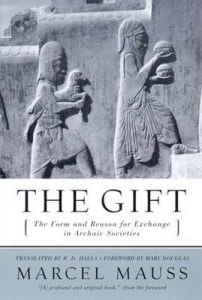
Marcel Mauss’ book The Gift: Forms and Functions of Exchange in Archaic Societies poses many questions, such as, “Do books with absurdly boring titles, written by French sociologists, have an inverse or complimentary relationship with the inevitable nerdiness and pomposity of those that read such books?”  Sure, having this book in front of you at your local Starbucks will likely make you look like a prig, but for those willing to assume the risk, Mauss has some interesting nuggets to reveal about the economies of the ancient world.

The societies Mauss surveys have an economy, but not ones we might expect.  Some minor differences exist between the societies he examines across time and space, but in the main we can say that:

  • One can never truly own a thing, because the thing (be it a gold coin, a chair, a paddle) has an identity all its own.  It is its “own” (ha!) thing before it ever was “your” thing.
  • One should not keep anything for too long.  To do so would risk courting vengeance of a sort from thing itself (some societies had a more magical view of this, some abstracted it a bit more), which “longs” to go to someone else.  Our stuff wants to roam wild and free.
  • One could potentially amass even a great surplus of things, but in end, everyone needed to give things to others and keep the cycle of exchange moving.* This was not mere self-emptying or even generosity per se, because all acknowledged that receiving a gift came with reciprocal responsibilities and burdens.**  Failure to reciprocate courted disaster.

Of course these societies had a hierarchy, determined by birth or honorific achievements, or something else, but material wealth got passed around with much more fluidity in the ancient world than today.  We may admire this, but quite frankly, we could never replicate it.  For starters, we no longer see the world of things as full of meaning.  As Taylor observed, in a world of homogeneity only we ourselves can transmit this meaning to things.  Again, the concept of magic enters in with some of the early societies, but Mauss delineates between magic and some form of “embodied meaning.”  I did not find him terribly clear on this point, but it is a hard concept to describe (and for me to understand).  Something has to do with the idea that in the societies Mauss describes one more directly experiences the world.  This too is hard to describe, but I would venture that

  • Today we assume that a thing has no meaning in itself.  So its meaning must be mediated or transmitted by layers of society and the self.
  • Whereas “back then,” our experience of the world and the meaning of the world were one and the same.

We might catch a glimpse of this difference by looking a a different issue.

About four years ago Jonathan Pageau wrote a series of articles about ancient cosmology, and gave his first post the intriguing title, “Most of the Time the World is Flat.”  Pageau obviously does not mean to imply that the Earth is not really round, and of course the earth does not change its shape. Rather, he postulates a significant disconnect between what we believe the world/cosmos to actually be like and our everyday experience of it.  Science has not given us, and perhaps cannot give us, a workable, experiential model of the world.  So we live divided, having to import a meaning to our experience that has no solid reality behind it.  He writes,

I would like to propose something that might seem provocative at first, but will hopefully help people see the world with different eyes. There is a growing image on the recent horizon of human experience, it is an image of a family or a group of friends all next to each other at a table or in some other intimate setting, yet all interacting with tablets, ipods and smartphones as if the people around them didn’t exist. I would like to propose that this image, this reality is the final result of Galileo’s cosmological model. Some of you might think I am exaggerating, so I will need to explain.

The Copernican/Galilean worldview, that is the heliocentric worldview and its further development into our modern cosmology of galaxies and nebulas and black holes has two important aspects. It is an artificial vision and it is an alienating vision. It is artificial in the strictest sense of “art” or “techne”. It is a technical vision because we cannot experience this vision without technology, without telescopes and other apparatuses. Because technology is a supplementary thing, a garment of skin, something which we add to our natures in order to physically bolster them toward the material world, it therefore also leads further into the material world itself. (emphasis mine).

. . . modern cosmology is not only artificial, but it is alienating, it moves Man away from himself. Once Man accepted that what he saw through his telescopes and microscopes is more real than his natural experience, he made inevitable the artificial world, he made inevitable as its end the plastic, synthetic, genetically modified, photoshopped, pornographic, social-networked reality we live in. When at the very core of vision, the shape of your cosmos leads you to believe that technology provides a perception which is more true, more real than your experience, more real than walking out of your house and looking at the sky, then the telescope and the microscope will soon be side by side with the camera, the screen and the accelerated time and space of the car window. The metal and glass frame will swallow us and human beings will lose themselves for their incapacity to fully inhabit the world.

Pageau knows that his desired task of reorienting our perspective will likely fail, with a gulf too broad for us to comprehend.  Still, I encourage you to read the whole article here and try for yourself.

It is the strict materialization of our things that creates the gulf between us and our things, which then means we cannot access the economies of the past.

If we wish to regain access to this world, we need a different conception of reality itself.  We should take care and not romanticize this version of society.  Mauss points out that violence existed in these societies–though probably not because of stark material inequality.  The societies he describes sometimes had huge surpluses, which they then sometimes consumed in spectacular fashion.  On the other hand, rarely did these societies have much of the technological innovation that we would appreciate.  But, if we wish to access this way of life, we need to stop treating the inanimate things we create and consume as mere means to an end.  Indeed, we often treat others as a means to an end as part of our contribution to a fallen world.  Unfortunately, as the new surrogacy law in Washington state reveals, we are now so completely alienated even from our selves that we will cannibalize our own bodies as a means to an end for ourselves–a bifurcation that puts us far from the world Mauss describes.

“Man is what he eats.”  Alexander Schemmann began his classic For the Life of the World quoting this epigram of Fuerbach.  One might assume that an Orthodox priest would disagree with this radically materialist statement, but Schemmann turns the quote on its head and argues that with this quote Fuerbach, “expressed the most religious idea of man.”  Mere matter does not exist, at least in the way we usually think.  Perhaps the place to begin is with the eucharist, for it is here that symbol and reality fuse together most profoundly, and it is here that the world’s transformation begins anew.

Dave

*This reminds a bit of the modern economic idea that money must circulate through society like blood must circulate through the body.  Was this Ricardo’s idea originally?

**Norbert Elias talks about aristocrats even as late as the 17th century in Spain who were expected to beggar themselves once every 10-15 years or so by hosting grand feasts for entire villages.  After which, the cycle would begin again.  This hosting/feasting was a crucial basis of their authority.

A Flip of the Script

A few days ago I came across the trailer for a mini-series on Amazon called Redbad, a harbinger of Europe’s (and perhaps ours as well) cultural moment. The movie involves the advancement of Christianity into a pagan land. The story proceeds from the pagans’ perspective. A few things immediately stand out:

  • The cross is associated not with sacrificial love, but with a ‘dark god’ who presumably loves punishment, an enormous ‘flip’ of its symbolic meaning for the last two millennia.
  • The series depicts Christians as intolerant bigots, the pagans as allowing something akin to freedom of conscience.
  • The Christians are usually filmed amidst darkness and smoke. Scenes with pagans alone seem to give them brighter light.

A few comments . . .

  • I would not say that Charlemagne allowed for freedom of conscience, but the idea that the pagans did . . . well–no one practiced this in the 8th century.
  • Charlemagne’s reign had plenty of messiness. But ‘messiness’ reigned in the West politically more or less since the time of Roman emperor Septimus Severus ca. 200 A.D. What historians should look for, as Will Durant suggested, was not how particular people shared in the vices of their time, but whether or not they swam against the current in any way with their virtues. With this standard, the cultural impact of the “Carolingian Renaissance” gleams brightly. As Kenneth Clark stated, paraphrasing Ruskin, “Great nations write their autobiographies in three manuscripts: the book of their words, the book of their deeds, and the book of their art.” If we think, like Clark, that the last is the most trustworthy, Charlemagne’s reign comes off rather well.

A few examples:

  • The invention of a beautiful script (the Carolingian).
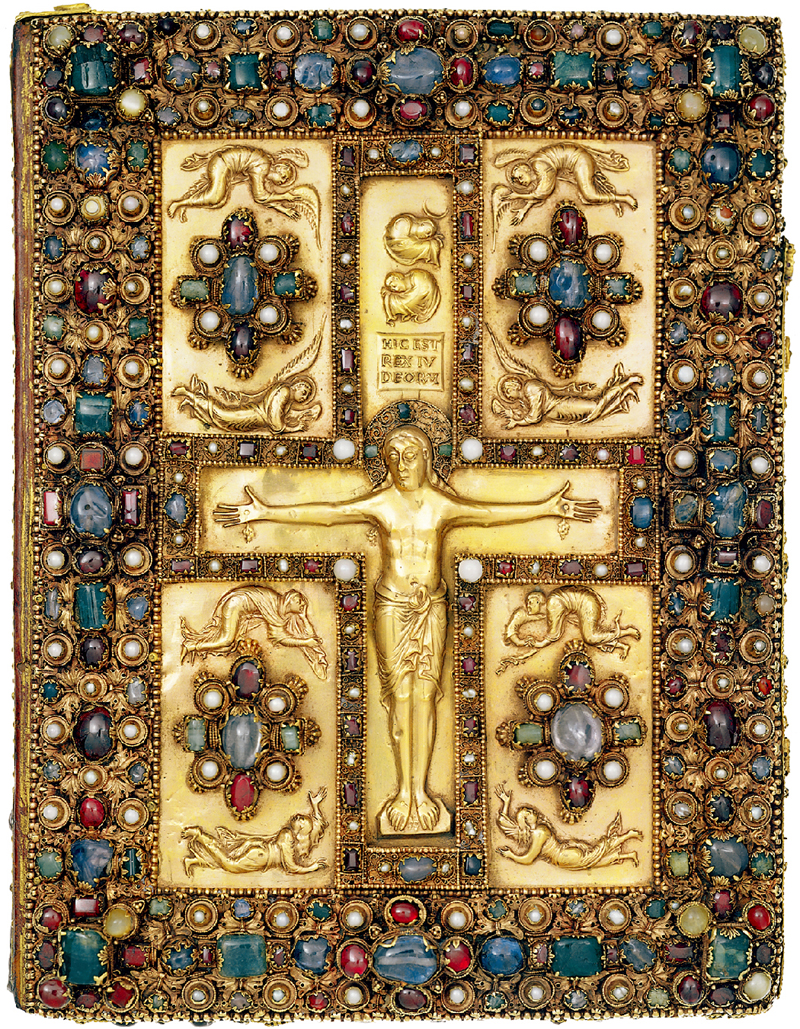
  • The creation of books, and the elevation of books as highly prized articles (studding the cover with jewels couldn’t make their value more obvious to their contemporaries).
  • Architectural innovations. Charlemagne put of the building talent of his empire not into palaces and castles, but the church at Aachen:

None of these things belong to pagan achievement.

One should not criticize Redbad for ‘historical inaccuracy’ per se. The medium of film works differently and tells stories differently. “Accuracy” is not my real concern. The mythos surrounding Charlemagne in the centuries after his death lacked “accuracy” in the strict sense of the word, just as any reporting or retelling of any event lacks “accuracy.” We edit and shape all the time, this is how our brain works as well as our souls. The problem with Redbad comes from the replacement of the standard Christian mythos entirely, and inventing another out of whole cloth, a perverse parody of creation ‘ex nihilo.’ As we see from the “book of their art,” the mythos surrounding Charlemagne has basis in fact.

Per Fexneld

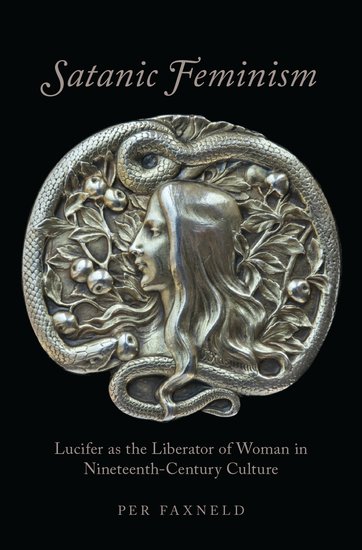
When seeing a book titled, Satanic Feminism: Lucifer as the Liberator of Women in the 19th Century, one should proceed with caution. The book could be written by a crazy feminist, or a crazy anti-feminist. The book could hardly be a book at all, and instead a mere rant. But this book stands as a work of scholarship, carefully (mostly too carefully) written with extensive bibliography and footnotes. The author, Per Fexneld, teaches at the University of Stockholm and seems an ordinary professorial sort, with perhaps a small chip on his shoulder. Digging a bit further, you see that he intends not necessarily to praise or condemn with what he finds, but merely to put the facts before the dear reader. I will usually at least pick up books with bold titles like these, merely out of curiosity and admiration for the sense of dash the writer displays.*

I kept reading the book because Fexneld faithfully executes his task of providing copious information, albeit at arms length from the material. But his perspective seems trustworthy because of this distance. He clearly has no love for Christianity and has much sympathy with women of the 19th century. He never identifies as a “Satanist” himself but seems to value, or at least understand, the role the idea of Satan plays in transgressing norms for the sake of liberation as it relates to feminism.

A few things I did not like:

  • As an Orthodox Christian, naturally I would be sensitive as to how Fexneld uses ancient Christian sources. I found to my chagrin that when discussing them, he uses secondary sources rather than direct quotes from the primary texts. I sense that these secondary sources shaped his opinions of the early fathers, not reading the primary texts directly. Despite this, he treats early Christian commentators mostly with fairness, but he could have done much better than this for what aims to be a serious scholarly study. My sense is that he cherrypicked what early Christian witnesses said about women, and to his credit, he partially admits this at least one point.
  • Fexneld takes his place among the many (mostly European? it seems to me) “historians” that don’t write history at all, but reference books. He has good information, but writes with such obviously posed dry detachment that his style could light a fire on a wet day. Where are the Abbot Suger’s, the Thomas Carlyle’s? Alas, gone are the poet historians from the world.
  • The “reference book” feel means that he tries hard not let the reader in on how one should interpret his information. Should we denounce the “satanic” feminists? Should we praise them? Or should we merely observe and think nothing about these feminists, besides concluding that a=a?

But in the end I have to confess that he created an effective and interesting reference book. My frustration above stems from the fact that he has talent that he holds back through fear or misperceptions regarding his chosen profession. If you want to do research, well and good. If you want to write, at least make an attempt at poetry that seeks meaning and synthesis.

To the thrust of his work, then . . .

With copious notes and numerous examples, Fexneld amply shows a “Satanic” strain that ran through many early feminists. He distinguishes full blown “Satanists” (of which there were a few) from those that merely used Satanic tropes (the majority of his examples). With different particular manifestations, these women

  • Built upon Romantic ideas from Byron and Shelley that recast Satan as a tragic hero of the Biblical narrative. He attempted to bring knowledge and liberation, and so on.
  • Recast Eve as the mankind’s savior, of sorts, a figure akin to Prometheus. She boldly went where Adam refused to go and paid the price, but she gave mankind knowledge and self-awareness.
  • Thus, for these women, feminism represented a real social and theological revolution, not just icing on a semi-Christian foundation. They wanted an overthrow of the Christian narrative and the patriarchy which it established. To do so, it simultaneously exalted Eve, Satan, and the fall itself.

The multitude of examples is the strength of the book, but Fexneld throws them together in ‘one after another’ fashion. Worse, one cannot sense if any one example or group of examples accurately embodies or represents the whole. He very carefully hedges many of his statements. This caution has its place in parts, but not for the whole. When writing a book like this you have to actually say something. To mitigate this, the breadth of his treatment touches on

  • The rise of the occult in the period
  • The focus from the pre-Raphaelites on feminine figures from classical cultures, “strange” women, and even Lillith, Adam’s first wife in certain Jewish texts.
  • How popular literature and art veered into occult themes with the thinnest Christian veneer, with significant attacks on “Christian patriarchy” hidden below the surface.
  • The popularity of certain occult female writers like Mary McClane and Sylvia Townsend
  • The connection of feminist social inversion to sexual inversion (lesbianism).
  • The rise of women depicted as Satan (in a positive sense) or at least, womanly figures depicted as Satan.
  • The publication of The Woman’s Bible which inverted the basic biblical narrative, praising Eve, etc.

. . . and other things. One gets the sense of a tidal wave of either direct, or mostly indirect, Satanism flooding the feminist movement from 1880-1920. But the central question–was 1st wave feminism driven primarily by “Satanism” or not? I have the feeling Fexneld would recoil at the thought of the volumes of his research intended to answer that question one way or the other. No doubt he would see such a commitment as a grave faux pas.

Let us deal with this crucial question which Fexneld leaves untouched.

First, the feminist movement obviously challenged and successfully upended certain elements of society. Certainly Satan, among other things, sought to upend the order God established in creation. So perhaps feminist women found themselves naturally drawn to satanic symbols or Satan himself. But, not all orders should stay in place. Scripture has numerous examples of the established order needing “flipped” or inverted to attain proper wholeness again. David, the youngest son of Jesse and a shepherd, will overthrow Saul, the “demonic” king who consulted with witches. Herod, for example, rightly feared that Christ would give him a run for his money.

So, second . . . was the feminist movement a proper or improper inversion? I don’t think we should answer this question based on the rote numbers of “satanic” vs. non-satanic feminists. I think the question has its roots in the nature of the inversion. If the inversion was proper, then we can relegate the trends Fexneld observes to the fringe. If improper, then we can say that even the “good” feminists participated in something wrong.

This is a very tricky question, and I can see why Fexneld failed to tackle it. But how can we truly avoid it? I’m sure that Fexneld has an answer for this conundrum somewhere in his own mind, or at least I hope he has answered it. I cannot claim to know enough to answer it definitively. I will try a pass at it, however–why not?

I begin with the obvious statement that calling upon Satan in reality or in tropes, for any cause, will ultimately destroy you, just as the flood and chaos will destroy anyone.

Not surprisingly, the feminist movements occurred within democratic societies. One can see democracy itself as a kind of inversion against traditional monarchy, replacing a “top down” political order with one from the “bottom up.” Just like Saturn eating his children in a fruitless attempt to stop the slippery slope of revolution, so too the feminist movement seems like an inevitable byproduct of democracy itself–the revolt of “Earth” against “Heaven.” Feminist detractors could not prevent this ‘revolt’ even as they might praise and affirm a democratic way of life.

Were Victorian era women “oppressed” in some sense of the word? If we look at women’s fashion as a piece of evidence, we see that–whether or not women created/embraced these fashions, their movement, the way for them to show themselves to the world, was certainly restricted–especially if we accept Fexneld’s “proto-feminists” from the mid-19th century starting the modern feminist movement. This may shed light on their overall place in society. But the place of women in Victorian society is something which I know too little about to comment on.

I suspect that the “oppression” of women lacked the severity that some claimed, but disconnects from equality are hard to bear within a democracy. I withhold sympathy from many of Fexneld’s female examples, but would extend it to more moderate feminists.

The age old problem of revolutions has always been, however, where and when do they stop?

Obviously, I oppose the rebellion against Christianity that at least some feminists then and now espouse, on historical as well as religious grounds. I trust my religious objections are obvious. As to the historical, we can briefly consider Regine Pernoud’s Women in the Days of Cathedrals, which shows us an era where

  • The earliest medieval treatise on education was written by a woman
  • We see the invention of romantic love (at least as an accepted part of general society)
  • Women regularly practiced medicine
  • Women in monastic orders could get more or less the same education men in the church received

In short, the status of women at the height of medievalism–a patriarchal society in most respects–far surpassed that of any pagan society. Pernoud suggests, however, that the Renaissance and subsequent ages introduced more Roman and classical pagan concepts of property and ownership. Possibly this did have an impact on women’s status in the Renaissance and future centuries.

Of course, one cannot construct a society entirely of “Heaven” anymore than entirely out of “Earth.” Mankind itself is both “heavenly” and “earthly,” (just as mankind is not just men or just women) made from the dust of the earth and the spirit from above. Strikingly, many of the cathedrals in the “Age of Cathedrals” reference by Pernoud were dedicated to the Virgin Mary, including Chartes, Notre Dame, Burgos, and Cologne, just to name a few. Here, I am convinced, lies the heart of the matter Fexneld misses entirely. Yes, Christianity is obviously patriarchal. We pray to our Father in Heaven. But Christians made the “Woman” (John 2:24, 19:26) the representative of Creation itself. On the one hand, Mary flips the hierarchy. As a young girl, she resided in the Holy of Holies–unheard of within Judaism. This seems a radical inversion. But it is her assent to God “flips” everything– she sets what was askew right again, the harm of Eve healed.** But what Mary put back in place is not a revolutionary society but a the right hierarchy, the reign of the true king–the subject of her Magnificat.

A blessed Advent to all.

*Some of Fexneld’s other work includes a published article: “Bleed for the Devil: Self-injury as Transgressive Practice in Contemporary Satanism, and the Re-enchantment of Late Modernity.” Clearly he has Satan on the brain. As an aside, should I ever become President my first executive order would ban all titles that that have something short and arresting to start, and then ruin it with a long and boring subtitle.

**Many of the fathers from St. Justin Martyr (ca. AD 150) onward develop the Eve-Mary parallel. Both are approached by an angel, and both assent to the angel, but it is Mary who in questioning Gabriel shows wisdom–Eve should have questioned the serpent. Eve’s pride humbles her, whereas Mary’s humility exalts her to the highest place.

9th/10th Grade: Matter and Spirit in the Dark Ages

Greetings,

After our Rome unit we transition out of Roman civilization into the medieval world.  This transition will involve rebuilding civilization along a whole new foundation with a different view of reality and consequently, society.  Early next week we will examine the question of the relationship between the physical and spiritual reality, and to what extent (if any) they can be separated.

Can a physical thing be a spiritual thing at the same time?  Or vice-versa?

The modern west tends to view reality in binary form.  We have a spiritual world and a physical world and for the most part the two live separately and do not mingle.  But the medievals would answer the above question affirmatively, and for them the divide between the physical and spiritual had much less rigid separation.

As an entry point into their mindset, we might think of mankind itself.  We are physical and spiritual beings.  Our bodies and souls have a mutual relationship.  We cannot separate them, just as we cannot extract the sugar from the eggs in a cake mix once we mix them together.  We exist as physical and spiritual beings simultaneously.

Medieval people applied this concept to many other areas of theology and life in general.  The elements in the eucharist can be both the body and blood of Christ and bread and wine at the same time.  Certain physical places were holy and important to see on pilgrimages, which were spiritual journeys often undertaken barefoot.  God’s presence hallowed certain physical objects, and God used them in various ways.  The medievals called them relics, and some Biblical examples of this might be Moses’ staff, the cloaks of Elijah and Jesus, and Paul’s handkerchief (Acts 19:12).  The saints don’t reside “out there” so much as they dwell in the here and now as a cloud of witnesses.  The presence of God and the saints link Heaven and Earth and we should (according to early Church doctrine and practice) ask the saints to intercede for us in prayer, just as we ask those on Earth to pray for us.

These theological ideas did not stay purely in the spiritual life of Christians, but impacted the values and shape of society in unique ways.  As we might expect these theological ideas took some time to trickle down into society itself, but eventually we will see their impact when we examine feudalism.

This week we also looked at the chaos in Europe after Rome’s fall.  As the only transnational organized group, the Church inevitably ended up bearing the brunt of the load in bringing about the return of civilization.  At first glance, the proliferation of monasteries has little to do with the recovery of civilization.  But monasteries performed at least 3 crucial functions to aid civilization:

1. Geographical Stability

As this map indicates,

the 5th and 6th centuries saw a great deal of chaos.  Semi-nomadic barbarian tribes wandered and fought as they went.  At bare minimum, civilization needs a defined location upon which to build.  Monasteries provided that, not only be dedicating themselves to prayer, but also to agriculture.  Farmers have to stay put and establish roots to successfully grow crops.

2. Refugees

With barbarians on the move many lost their homes and families.  Monasteries often served as places of refuge to care for, or possibly even educate, thousands of unfortunates.

3. Manuscripts

Many of you, like me, grew up in a time when parents said something akin to, “If we ever have a fire the house, the first and only thing to grab is the photo album.”  As a kid, this never made sense to me.  How about grabbing the tv?  But my parents had the right idea.  Part of our identity means having a connection to the past and those around us.  We don’t just exist as individuals in the ‘now,’ we know who we are based at least in part on our connection to others.

Monks copied many manuscripts such as the Bible and Church fathers, but also other Latin texts from Rome’s past.  We owe a great deal of our ancient Latin literature today to monks from the 6th-10th centuries preserving and copying them.  These books, I think, helped enhance their collective cultural memories.  It helped them connect to a past, reminding them that not all was lost.

The prevalence of monasteries raises the question of what exactly civilizations build upon.  Many critics of the Church accused Christians of “dropping out” by going to monasteries.  This withdrawal showed a heart that did not care.

In his monumental work, The City of God, St. Augustine asks his audience what exactly makes civilization work (among other topics).  It is not, he argues, a good economy, a powerful military, or even a workable political system.  What makes civilization tick is an established pattern of interacting with others both within and without one’s borders.  These interactions get formed from our values, and our values come from what we worship.

Perhaps monasteries can be viewed as a civilizational act of faith, akin to tithing.  They declare that we put our roots in the worship of God, in prayer and in praise, and not in our economy, our military, etc.  Only after recognizing the source of all things can things be properly enjoyed and properly used.  Rome, like nearly every other civilization, mistakenly believed that enough power, enough effort, enough careful application of resources, could hold things together.  They put the cart before the horse.

G.L. Cheesman: “The Auxilia of the Roman Imperial Army”

The author knows he is writing about something arcane and of little general interest. He does little to spruce up the writing — he at times seems to wallow in the details, perhaps getting a secret laugh out of boring his readers. My eyes glazed over more than once.

The book is thorough, but still brief enough for someone with just enough interest to glean some tidbits. I am far, far from having any comprehensive knowledge about Rome, but I wanted to read this to test a theory. Gibbon puts the fall of Rome essentially beginning after Marcus Aurelius. Others, like Toynbee put it far earlier. I tend to see it happening sometime after the 2nd and before the 3rd Punic War, and I wanted to see what Cheesman analysis of the Roman army had to contribute to this debate.

Early on Cheesman makes some interesting observations, namely that the imperial army was more versatile and specialized than any army of the Republic. This probably has do with the fact that they encountered different cultures and fighting styles as they expanded. They added cavalry (one may recall the serious weakness of the Roman cavalry when they faced Hannibal), usually getting them from far flung conquered provinces.  But no one would think that the Imperial armies were superior to say, those under Scipio Africanus ca. 210 BC. In other words, increasing complexity and specialization may not have been a sign of strength, but subtle weakness.  The increased specialization shows they had too many burdens in too many places around the globe to maintain a coherent fighting force with a fixed identity.

Also, Cheesman points out that many of the recruited ‘auxilia’ (auxiliary troops attached to the legions, recruited from conquered provinces) often rebelled against their new masters when stationed near their home territory. This could be fixed by shipping them elsewhere, but this created awkward burdens and costs involving transport.  Surely it also lessened the effectiveness of these auxiliaries, as they had to fight far from familiar territory.

The fact that Rome faced so many rebellions within its ranks tells me that Rome lost its mojo long before Marcus Aurelius, contra Gibbon. These rebellions came despite the fact that some emperors fast-tracked the path to rights and citizenship for many auxiliary regiments. They were being more ‘progressive’ in a sense, but it made no difference — things were not working as they used to for Rome. One need only recall the general solidity of their alliance system during the much greater stress of the 2nd Punic War to see this happening.

With more knowledge of Imperial Rome, more patience, and more military background I might have gleaned more from this work.  Still, one always likes their theories backed by neutral observers! So, my gratitude to G.L. Cheesman for his somewhat tedious, partially sleep inducing, yet still occasionally quite insightful book.

Dave

To the Victor go Some of the Spoils

Many often declare that since, “To the victor go the spoils,” so too, that, “Victors write the history books.”  This pithy phrase assumes that historical narratives boil down to power, a concession to postmodern theory that I am loathe to make.  Aside from the debate over the theory, however, history itself will not confirm the statement.  Several examples exist to prove this point:

  • The Athenians exiled Thucydides but we read of the war that helped bring about his exile almost exclusively through him.
  • Athenian Democracy “won” by executing Socrates, but subsequent generations of readers learned Athenian democracy primarily through Plato’s eyes.
  • The triumph of the “imperial” system over the Republic in Rome became a fact of life after Augustus, but we think of that triumph foremost through the writings of Tacitus, a significant critic of most of the emperors.
  • The North won the American Civil War, but the Confederacy had a variety of champions shortly after the war and a variety of sympathizers today,

and so on.

As Tocqueville noted, mere physical force can control the body but often has the opposite impact on the soul.  The examples above demonstrate also that, contra the mundane postmodernist, shaping how we see the world has much more to do with our imagination that rote political force.

Jaroslav Pelikan’s The Excellent Empire disappointed me overall.  He is likely one of the few who could have possibly made a history of Christian doctrine an exciting read, and he did just that in his four volume work The Christian Tradition.  In The Excellent Empire he flashes his ability to deftly dance from text to text, but seems to get trapped into the detached tone of his main subject, Edward Gibbon, whose The Decline and Fall of the Roman Empire forms the backdrop of this book.

I give Gibbon much credit for his labors, his erudition, and for having a defined point of view.  Alas, he writes like a know-it-all, and I cannot buy into how he frames his narrative.  Pelikan seems to accept Gibbon’s perspective (or–is just playing a scholarly game, or am I too dense to notice something else?), and discusses how GIbbon’s perspective relates to Christian thoughts at the time from Sts. Jerome and Augustine, as well as a touch of Salvian and Orosius.

Gibbon’s work is an interesting examination of who gets the last laugh.

Roman contemporary critics of Christians viewed them as a drain on the Roman state, and in many ways enemies of the Roman state.  Jerome saw the collapse of Rome in the most starkly apocalyptic terms, and in the most anguished.  He compared Rome’s end to various passages from Revelation.  He saw Rome as ripe for judgement.  Yet, he grieved over their fall, seeing their end as the end of all things as he knew them.  Augustine took a more cerebral approach, which gained him some more penetrating insights.  He conceived of a Rome built upon shaky foundations from the start.  In one brilliant passage from Book 3 of The City of God he writes,

First, then, why was Troy or Ilium, the cradle of the Roman people (for I must not overlook nor disguise what I touched upon in the first book(2)), conquered, taken and destroyed by the Greeks, though it esteemed and worshipped the same gods as they? Priam, some answer, paid the penalty of the perjury of his father Laomedon.(3) Then it is true that Laomedon hired Apollo and Neptune as his workmen. For the story goes that he promised them wages, and then broke his bargain. I wonder that famous diviner Apollo toiled at so huge a work, and never suspected Laomedon was going to cheat him of his pay. And Neptune too, his uncle, brother of Jupiter, king of the sea, it really was not seemly that he should be ignorant of what was to happen. For he is introduced by Homer(4) (who lived and wrote before the building of Rome) as predicting something great of the posterity of AEneas, who in fact founded Rome. And as Homer says, Neptune also rescued AEneas in a cloud from the wrath of Achilles, though (according to Virgil (1))

“All his will was to destroy
His own creation, perjured Troy.”

Gods, then, so great as Apollo and Neptune, in ignorance of the cheat that was to defraud them of their wages, built the walls of Troy for nothing but thanks and thankless people.(2) There may be some doubt whether it is not a worse crime to believe such persons to be gods, than to cheat such gods. Even Homer himself did not give full credence to the story for while he represents Neptune, indeed, as hostile to the Trojans, he introduces Apollo as their champion, though the story implies that both were offended by that fraud. If, therefore, they believe their fables, let them blush to worship such gods; if they discredit the fables, let no more be said of the “Trojan perjury;” or let them explain how the gods hated Trojan, but loved Roman perjury. For how did the conspiracy of Catiline, even in so large and corrupt a city, find so abundant a supply of men whose hands and tongues found them a living by perjury and civic broils? What else but perjury corrupted the judgments pronounced by so many of the senators? What else corrupted the people’s votes and decisions of all causes tried before them? For it seems that the ancient practice of taking oaths has been preserved even in the midst of the greatest corruption, not for the sake of restraining wickedness by religious fear, but to complete the tale of crimes by adding that of perjury.

Such analysis gave medieval Europe a whole new foundation of political and religious ideology on which to proceed.

Rome attacked Christians for not giving themselves fully to the well-being of the state.  For the Romans, this might have taken the form of not giving due sacrifices to the emperor, or not joining the army.  Gibbon pointed out as well that the best men in the Church gave themselves to the Church, and not Rome.  Imagine a Rome where Athanasius, Jerome, Augustine, Ambrose, etc.–with all of their energy and intelligence–served as provincial governors instead of bishops.

Jerome and Augustine responded variously with how Rome had doomed itself to destruction via its sins, or how Christians were in fact the best citizens of Rome.  Their analysis won the day.  Monastics, for example, appear on the surface at least, to not contribute anything to the well-being of civilization.  But monastics would be honored in the west for the next 1000 years.  Their presence made no sense to either the Romans or to Gibbon.  The “social triumph of the church,” as Pelikan calls it, gave the Church the power of interpreting Rome’s history.  But I gathered that Pelikan thought Augustine and Jerome thieves, to a certain extent.*  Perhaps for Pelikan, Gibbon restored Rome’s vision of itself back to the stream of history.

Augustine and Jerome appeared to be the victors in the 5th century A.D. and beyond, as the Church had a strong hand on shaping the next millennium.  But historical spoils can be slippery things.  In an irony that perhaps not even Gibbon might have foreseen, today’s Christians, having abandoned much of the otherworldliness of the Church of the 5th century, may find more congeniality with Gibbon’s interpretation as opposed to Augustine’s.  What modern mega-church leader, for example, would tell anyone to become a monk?  We have our eyes set on this world and have no concept of how to patttern ourselves after the heavenly realms.  Some may applaud this.  But without the worldview of Augustine and Jerome we may find ourselves wishing, along with Gibbon, that St. Augustine had served as proconsul of Alexandria.

DM

*I could be totally wrong here.  Part of the difficulty I had with this book was I felt that I was reading a different Pelikan than the one I encountered in The Christian Tradition.  I had assumed that The Excellent Empire was written before this series, because its tone seemed more distant to me, less committed to the idea of truth than The Christian Tradition.  I knew that Pelikan had converted to Orthodox Christianity in 1998.  But I had somehow thought (how I thought this I’m not sure) that The Christian Tradition was written during/after his conversion, when in reality the early volumes stretch back to 1973, and the last volume predates his official reception into the Church by eight years.

This could mean that

  • I have misread Pelikan entirely in The Excellent Empire
  • Pelikan is deft at hiding his particular point of view from the reader and is simply examining certain points of view in a more detached way.
  • He does admire Gibbon (which is understandable) and agrees with Gibbon that Christians really did bring down Rome from the inside out.  This stance is not Augustine’s or Jerome’s, but it is certainly not an anti-Christian idea in itself.  Nebuchadnezzar’s first dream may hint at this (Daniel 2).  Perhaps I am too ingrained in my distaste for Gibbon’s pompous Enlightenment attitude to see that, despite this weakness, he may have been right after all about the Church’s relationship to Rome.


Malleus Maleficarum

Heinrich Kramer and James Sprenger’s Malleus Maleficarum (translation–possibly, “The Hammer for Devils/Witches/, i.e., “Malefactors”) ranks way up there among the more strange historical documents I have read. Published in 1484, this tome tells one all about witches and other sundry works of the devil. It deals with the reality of the supernatural quite openly and frankly, and in this way strikes us as “pre-modern.” And yet, the “hammer” the title alludes to appears to strike hardest through the use of the farthest reaches of the logic parsing of the scholastic method. Those familiar with the Summa Theologica (dating more than two centuries prior to the Malleus) can testify to Thomas Aquinas’ clarity and brevity, even if he relies possibly too much on Aristotelian logic. Aquinas leaves a certain amount of space and room to breathe in his work. It is that mystical fringe that exists in Aquinas’ best writing that gives it its staying power.

Not so Kramer and Sprenger. Though grudgingly–I have to admire their ability to go on for pages on end, giving all counterarguments incredible deference and losing the reader in a labyrinth, before finally turning the battleship slowly round towards their correct conclusion. I firmly believe that Christians should take the supernatural seriously–much more so than many do today. However, one must wonder of the efficacy of extended discussion on “Whether Witches may work some Prestidigitatory Illusion so that the Male Organ appears to be Entirely Removed from the Body”–which is only Question IX of Part One, of the First Part, or what final precautions should be observed in the trial of a witch in the eleventh action of the second examination (3rd Part, 2nd Head, q. 16).

At least one does get the sense that Kramer and Sprenger enjoy their work. Here is a very mild excerpt . . .

If it be accordance with the Catholic faith to maintain that in order to bring about some effect of magic, the devil must intimately cooperate with some witch, or whether, one without the other, that is to say, the devil without the witch, or conversely, could produce the same effect.

And the first argument is this, that the Devil can bring about an effect of magic without the help of any witch.  So St. Augustine holds . . . and we learn from Holy Scripture of the disasters which fell upon Job, . . . which the Devil himself was able to bring about, with God’s permission.  What a superior power has within itself to do, it may do without reference to a lesser power.

So too, an inferior power may work within its “sphere” to produce effects without reference to a power greater than itself.  For Blessed Albertus Magnus says in his treatise De Pasionibus Aeris that rotten sage, if used according to certain specifications and thrown into running water, will arouse fearful tempests and storms.  

Moreover it may be said that the devil makes use of the witch not because he has any need of her agency, but because he seeks the damnation of the witch.  We may refer to what Aristotle says in the 3rd book of his Ethics, where Evil is a voluntary act . . . 

But an opposite opinion holds, that the Devil, being unlike man, cannot readily do harm to man without the effect of material agency, such as the instrumentality of witches. For every act, some kind of contact must be established.  And many hold this to be proven by the text of St. Paul to the Galatians, where the gloss on the text who have singular, and fiery eyes, who by a mere look can harm others.  And Avicenna [Abn Ibn Sina] also bears this out, in Naturalism book 3, “Very often the soul may have an impact on the body of another, for such is the influence of the eyes.”  And the same opinion by Ali Ghaza in the fifth book of his Physics  . . .   St. Thomas too speaks of this in the Summa, part I, q. 117, whereupon he states that the influence of the soul may be concentrated in the eyes. 

Without any mental powers insensible bodies may produce effects, and so a living man, if he pass near the corpse of a murdered man, is often seized with fear though unaware of the dead body.  Moreover, it would seem that most extraordinary and miraculous events come to passby thte workings of the power of nature, and St. Gregory points out in his Second Dialogue. The saints perform miracles, sometimes by prayer, sometimes by their power alone.  St. Peter prayed and Tabitha was restored to life.  By rebuking Ananias and Saphira who told a lie, he slew them without any prayer.  Therefore a man by his mental influence can change the condition of another material body.*  

Can any doubt that a man with courage will warm his body, and a man with fear will cool and enfeeble his body?

St. Isidore in Etymologies calls witches guilty of greater sin, for they stir up and confound the elements with the aid of the Devil, and bring about terrible storms and tempests.  And Vincent of Beauvais, quoting many learned authorities in his Speculum Historiale, says that he who first practiced magical arts was Zoroaster, in the line of Ham, son of Noah, and according to St. Augustine in the City of God, Ham laughed aloud when he was born, showing that he would give service to the Devil.

When comparing Aquinas and these authors, I reminded of analogy used I believe by both Toynbee and C.S. Lewis–that bacon and eggs smells so much better when hungry at 9 am, as opposed to when satiated later in the day. Even in the text above, though I largely agree with the conclusion, the method conjures up the smell of bacon and eggs after one has eaten. The scholastic method has run its course.

That late-medievals thought seriously about witches should surprise no one. But to many moderns, the breadth of discussion, the familiarity with many texts both within and without the Christian tradition, will surprise many. When we disagree fundamentally with others, we assume that they do not have actual reasons for their belief. We assume their ignorance, selfishness, or some other such flaw. About 150 years later, an Ambrosian monk named Francesco Guazzo published a companion volume, the Compendium Maleficarum. In Book I, Chapter III he writes,

Any man who maintained that all effects of magic were true, or who believed that they were all illusions, would be a radish rather than a man.

This spirit of balance characterizes the work, which a modern must acknowledge even if one believed that witches and demons did not exist.

Of course the Devil works in various ways, both through physical and spiritual/mental means. I have no thoughts on the exact nature of the Devil’s work regarding COVID-19. What we can say in general is that the Devil always seeks to sow confusion, doubt, and fear. He is the accuser, the divider of the brethren. Just as he seeks to divide us from God, so too he brings death–a literal decomposition of soul from body, and of the various connections in our physical form. He seeks to “decompose” meaning as well, and we have certainly seen this in our society the last few months.

The uncertain nature of the disease relates strongly to this decomposition of meaning. But I feel sure that others factors must be at play, and I wonder at the manifestation of this confusion as it relates to masks. Some people, given their circumstances, probably should wear masks, but I am curious about the vast majority of us who have options and feel the tension between wearing/not wearing them. What motivates our choices, and why do those choices often divide along political lines? Liberals want more mask wearing, conservatives seem to wear them less–although the terms “liberal” and “conservative” lack a defined meeting. We should approach the subject with the method of the Malleus in mind, aware that not everyone who believes in wearing masks is a coward or out to control everyone, and those who eschew masks may not always be selfish jerks, or ignorant of “Science.”

I am sure that something else is going on, but not sure exactly what. Consider what follows speculative, and certainly incomplete . . .

Perhaps the most obvious connection might relate to debates over the last few years around free speech. Progressives want to limit certain kinds of speech in certain places to protect the “vulnerable” minority. Conservatives push against this. So progressives stress protection from the disease, even if this protection should extend far beyond those directly at risk. Conservatives who favor a more rough and tumble approach to speech might then favor the same approach to the disease. We should be tough, have thick skins, and so on.

Perhaps this might go some way to explaining the difference with mask attitudes now. But just 50 years ago, liberals championed free speech, not conservatives. And–liberals tend to prefer longer shut-downs of the economy, even though the shut-down obviously hurts the poor far more than the rich. Restrictions on the economy–favored more by progressives–also will hurt illegal immigrants–another progressive issue.** It makes sense that conservatives want order, sanctity, protection, and liberals would want freedom, and the knocking down of boundaries. But part of the confusion the world experiences lies in the lack of coherent meaning in our political designations.

With rates of abuse, depression, suicide, time on screens, opioid and alcohol use, etc. all going way up during the quarantine, we must realize that the temptation to go a bit nuts will significantly increase. And when our visible structures of decision-making and common institutions fail us–as they largely have during our various recent crises, we will revert to archetypal symbolic modes of being. When the visible symbols of unity fails us, we will retreat inward even subconsciously to find meaning and direction.

These subconscious symbolic actions make themselves perhaps most evident with masks. I have no solid thoughts here as to why they have caused such disagreement among good people. I think we have to go beyond politics (i.e., does the government have the right to order this or not?). And–let us borrow from the Malleus and assume that the Devil would like nothing better than to tear us apart. And to borrow again from Sprenger and Kraemer–no doubt both sides have good arguments that could fill many pages. I shudder to think how many the two of them could find to apply to the mask argument.^

When we think of masks, we should think of the use of veils, for masks function much like a veil. Veils have very little role in our society today. Even in weddings, very few brides today would consider wearing a veil. But most ancient societies used veils (or something like them) in many religious settings, and certainly for weddings. In the ancient world veils would be used to cordon off portions of a temple, for example. You would use veils as means of

  • Protecting the people from the power/holiness of what lay behind the veil, or
  • Protecting what was special/holy from intrusion by the people.

We live in a society that builds on a foundation of “openness”–trade with others, traveling from place to place with few barriers, free speech, etc. and so the notion of veils initially strikes us as odd. This “open” view of life is certainly part of existence. We cannot sustain our own lives. Whenever we eat anything, we take the life of something else into our bodies and incorporate into our own lives–this holds true for plants just as it does for pigs and cows. We do not generate life for ourselves. We must be filled from outside ourselves and ultimately, “In Him we live and move and have our being” (Acts 17:28).

But . . . we must be “closed” to some things in order to survive. We cannot play in traffic, swim with sharks, or take candy from strangers. And other things are so powerful that we can only have a little bit of at a time lest it destroy us, like whiskey, for example. In ancient Israel the high priest went into the Holy of Holies only once a year, alone, with a rope tied around his leg to remove him in case he died from the experience.

As to veils for brides, both of the above purposes could fit. On the one hand, the bride is the most precious “item” of the day, and she is meant for her husband only. Thus she should not be “revealed” until the ceremony is completed. So too, to veil the bride is to honor her beauty and to protect us from it. This may not make sense historically or scientifically, but certainly it does mythologically–recall “the face that launched 1000 ships,” or Lucy’s desire in The Dawn Treader to say a spell that would make her “beautiful beyond the lot of mortals,” and have men and nations fight over her. In the medieval Marian office of “None” (the ninth hour) the antiphon before the psalms hearkens to the power of the beauty of the feminine:

Thou art fair and comely, O daughter of Jerusalem, terrible as an army set in array.

Song of Solomon 6:4

To wear masks in public places may be entirely appropriate and necessary, but we should understand what it means. It means, in certain respects, that we cannot act as a community of trust that mutually shares life together. And this is not necessarily our fault, as the insidious nature of the virus means that one can have it and spread it without any knowledge. But neither is it a trifling thing. To “veil” ourselves means that we set ourselves apart from society. One cannot have a conversation with a mask on–one cannot really share life with another with a mask on. It is terribly ironic that we have to “come together” in such polarized times to essentially isolate ourselves socially from each other. As Jean-Claude Larchet writes,

Through our body we reach out and communicate with others–by exchanging glances, smiles, handshakes, and so on.  It is through our body that others gain their first impressions of us–our character, or our mood at the time.  Our body both reveals and hides us from others . . . 

I believe this accounts for much of the confusion about masks. Larchet rightly suggests that even small physical gestures of communication that we normally make at the grocery store become impossible with masks. Circumstances ask us to hold an impossible tension in our minds and we can’t quite do it. Telling the difference won’t always be easy.

In such times we may want to reach out and look for solutions and healing in what is distant from us–in our political leadership. These days we will not find it there, and likely were never meant to. We should return to our immediate center–our churches, families, and friends–a Malleus Malleficarum for our times

Dave

*I think Jonathan Pageau makes some good points here about the validity of the so-called “Evil Eye,” tradition, derided by some materialists.

**I have heard some suggest that those out of work should get checks from the rich/the government, and so what’s the problem? This strikes me as not ‘progressive’ in any sense. What about the ‘dignity of labor’ so hallowed by the Marxist tradition? I find the ‘just give them a check and they should be happy’ mentality degrading and paternalistic. Perhaps it is necessary–but don’t dismiss the cost to the soul.

^A brief parody of Kraemer and Sprenger (with all references entirely made up)

There are many who say that we should not wear masks in public. For has not Aristotle said in his Physic that, “to one is one thing, and another, like unto it, has the same properties” (B.V-8.12). So we see that all things “come unto all other things” (Averroes, De Civitate, Q. 12, p.4, S.4), so then it follows naturally that we follow The Almagest and declare that we maintain the motion of the “heavenly spheres,” which in this case means, our bodies. For Ptolemy has said much that many of the wise would hardly dare to gainsay.

And should not our bodies be compared to the heavenly spheres? For Plotinus has called us all a microcosm of the worthy cosmos, as have many holy men, though others have not agreed (Quintus, et al, Deus Mirabilius, Book II, p. 8). And is not the face the “bearer of all things” (Isocrates, Etymologies Part II, 6.7.8)? We bear with one another, then, for how else shall we live if we bear not with another, as Ulfin stated in Amor Arondus Ibid (Bk. II, p. 5)?

But others deny it, stating along with Avicenna that, “As things move, so they are distinct, for not all motion is equal (Figures, Book V.3-1).” Now if motion is not equal, than it means that motion must be set in a hierarchy, and to appear contrarian is not in the habit of the scholar, who seeks to have “all put in its proper place (Fabius, Magnus Opus, Bk. 1.3).” . . .

If Civilization is Worth Doing, it’s Worth Doing Badly

Historian Arnold Toynbee takes the long view–the very long view, on the fall of Rome.  We think of Rome as a grand empire, but Toynbee reminds us both in his book Hellenism, and in Hannibal’s Legacy, that Rome originally organized itself very much like other Greek city-states.  The early Roman Republic was essentially a polis.  As they grew in size, the political dynamics changed until little to nothing remained of its more democratic past.  But if we think of Rome as a “Republic” first and foremost, we should place the decline of Rome somewhere in the transition between the 3rd-2nd cenutry B.C. at the absolute latest.*

Toynbee takes this approach because he sees civilizations operating in a spiritual sense.  He focuses on the beliefs, the internal coherence, the relationships between different groups in society, and so on.  He has long sections in volumes five and six of his multi-volume A Study of History on the “schism in the soul” present in declining civilizations, which might strike one with a more materialist bent as rather absurd.

Niall Ferguson takes a different approach, and I believe that I see common themes in his books, Civilization, Colossus, and Empire.  Ferguson sees civilization running on various physical platforms, such as the quality of roads, a good sewer system, and a good way of gathering and using tax revenue.**  He eschewed the idea of slow, steady decline–or at least one that we could observe in any meaningful way.  For him, the system works until suddenly it doesn’t, and no one can really predict when it will stop working. This explains why no one saw the collapse of the Soviet Union coming, or various stock-market crashes.  The collapses, when they come, will therefore come out of the blue suddenly.

Joseph Tainter’s The Collapse of Complex Socieities is a short, dense, book about a difficult subject. Tainter does a good job with his argument, which I admit even I though I disagree with some of his basic premises.

His argument boils down to a few key points:

  • Major civilizations tend to experience an early period of rapid growth through the ‘low hanging fruit’ of available territory, resources, etc.
  • This growth inevitably leads to specialization, stratification, and complexity which initially serves growth–though this “low-hanging fruit” won’t last forever.
  • The civilization plateau’s and the structure established to help it grow becomes an inextricable  part of society just at the moment that it is no longer really needed.
  • When the ‘low hanging fruit’ disappears, further expansion (be it territorial, trade-oriented) becomes less and less profitable, and eventually starts to work against the civilization.
  • Finally, the complex structure gets too unwieldy, a ball and chain, as the state has to spend more and more to get less and less. But now we depend on the structure.   It has become too big to fail, but like a house of cards, easy to knock over.

Tainter supports his theory well from civilizations across time, and uses very obvious info, like territory, and some other more unusual information, like crop yields, colonial administrations, and so on. No doubt there are many lessons for economists here.

But, while his book is valuable, it has big holes.

In his quest for absolute objectivity, he rejects all value-judgment theories of collapse. If you can’t measure it, it’s not useful. We can never be sure exactly a civilization really believes, and even if we could, it is not an objective field of study, so has nothing to contribute to the study of collapse. After a brief summary of  the work of people like Gibbon, Toynbee, Spengler, and others he dismisses them with a wave of his hand. But as C.S. Lewis once pointed out, very few people are actually German economists. Any study of history must involve people, which will involve more than graphs on paper.

This over-emphasizing of economics shows up in what is actually a thought-provoking idea. What happens after collapse, he argues, may actually be beneficial to society, because it removes a great deal of inefficiency that the old system labored under. Collapse, might be the cleansing forest fires of history, events to almost welcome.

This sounds good on paper, but no actual human being who lived through collapses would have agreed with him. Imagine living in Western Europe ca. 550 AD and thinking, “Boy, I sure am glad for the fall of Rome. Of course, our ramshackle village could be overrun, destroyed, and our people pillaged who knows when by some Goth, Ostrogoth, Visigoth, Vandal, Hun, or some other kind of Goth I have forgotten about. But I’ll take that any day over the economic inefficiency of the late Roman Empire.”

To augment Chesterton’s oft-quoted phrase (If a thing is worth doing, it’s worth doing badly,” “If civilization is worth doing, it’s worth doing badly.”

Dave


*I love and admire Toynbee for many reasons.  But in some places he puts the decline of Rome at 431 B.C. (!), the same year as the outbreak of the Pelopponesian War in Greece.  He does this mostly because he sees much more similarity than difference between Greece and Rome.  One can make that argument, and he does so decently in his Recollections, but to carry it so far as to say that Rome began declining when Athens hit the wall goes way too far.

**In some ways the difference between Toynbee and Ferguson boils down, as (almost) always, to the differences between Plato and Aristotle.  Both are great–I prefer Toynbee and Plato.

Epilogue

I almost always find Toynbee stimulating, and I include some of his collected thoughts on the fall of Rome . . .

It is indeed, one of the tragic ironies that the idealists that arise within the ruling class should tread the same path of social migration as the wastrels.  The Graachi worked far greater havoc through a nobility [in the late Republic] to which someone like Commodus could never aspire. Commodus did far less damage by his own social truancy [i.e., pretending to be Hercules, fighting in the arena, etc.], by engaging in a vulgarity that represents a spiritual malaise, to which the Graachi would never fall.  

By their ‘downward migration’ towards the plebs, the Graachi incurred the wrath of their fellows, who punished them severely for abandoning their class privilege.  Commodus is uneventfully swallowed by the slough in which he delighted to wallow, whereas the Graachi released a kind of demonic energy into the masses of Rome.

*********

Seneca writes ca. A.D. 60 concerning the social function of the Emperor in one of his treatises. . .


“He is the bond that holds the Commonwealth together, he is the breath of life is breathed by his subjects, who in themselves would be nothing but a burden and a prey if they were left to their own devices through the removal of a presence which is the soul of the Empire.


Their king is safe?  One mind informs them all;

Lost?  They break faith straightway.

*********

If this calamity, written about by Vergil in his Georgics (IV, 212-13), which he imagines overtaking the bees, would overtake us, the people would be safe so long as it does not snap the reins, or–if they refuse to be bridled again.  Should this happen–then the texture of this mighty empire would be rent and its present tidiness would fly apart into a hundred shreds. Rome will cease to rule the moment they cease to render obedience.”

A foretaste of the fulfillment of the prophecy that Seneca made to the Emperor Nero was inflicted on the Roman world in A.D. 68-69 as an immediate result of Nero’s tyranny; but the first time round this calamity acted as a stimulus, for after the chaos Rome got Vespasian as emperor and relative calm.  Though Domitian (d. A.D. 96) tried his utmost to revive the chaos by claiming deity for himself, the tide was turned by a series of beneficial philosopher emperors who succeeded one another from Nerva (A.D. 96) through Marcus Aurelius (d. A.D. 180).

It was only after Marcus that the new “time of troubles” set in, and even then foolishness of Commodus managed to right itself after the civil wars of Severus, who repeated Vespasian’s work, though with a rougher and less skilled hand.  It was only after the death of Alexander Severus (A.D. 235) that the storm broke with shattering and uncontrollable violence.

*********

And finally, some of his thoughts on the drawn out length of Roman decline:

In the downward course of a civilization there is truth in the saying of the philosopher Heraclitus: “War is the father of all things.”  The sinister concentration of the resources of a civilization upon the business of fratricidal warfare may generate a military prowess that will place their neighbors at their mercy, may create a military technique that may grant them a far reaching technical mastery over the merely “Material World.”   

Since it is common to reckon success primarily by power and wealth, the opening chapters in the decline of a civilization will be hailed as times of blessing and growth, and this misconception can persist even for centuries.  Sooner or later, however, disillusionment is bound to follow, for a society that is hopelessly divided against itself is almost certain to try and double down on military might, for that is what seemed to work initially.

For example, we see the money-power and man-power won for Greek society by Alexander the Great, and these same vast resources used to intensify the civil wars between Alexander’s successors.  This same power swept into Roman hands through the meteoric rise in Rome’s land and wealth ca. 241-146 B.C. was just as quickly spent in the various civil wars that wracked Rome before the rise of Augustus and the Pax Romana.  For Spain, the treasure gained in the new world and the free labor of the essentially enslaved native populations was the food for their wars in Europe during the late 16th and early 17th centuries–the same wars that brought them into second-rate power status in Europe.

Thus the increasing command over the environment gained is apt to bestow upon a society a disintegration that puts a greater driving power into the suicidally demented society’s chosen work of self-destruction; and that story turns out to be a simple illustration of the theme that, “The wages of sin is death” (Rom. 6:23).  And again, the empires of industrialized Europe in the late 19th century gained the material resources to nearly destroy European civilization in our great Western civil war of 1914-18.

[Toynbee goes on to argue at length that Augustan synthesis bought Rome time, and brought Rome increased prosperity, nevertheless, it was an “Indian Summer” that lasted about 175 years that did nothing to fix Rome’s basic issues or  prevent the coming winter.]


Renaissances and Ghosts: “Contacts Between Civilizations in Time”

This is not a book unto itself, but merely one-third of Volume 9 of his multi-volume A Study of History series, subtitled, “Contacts Between Civilizations in Time.” However, it can stand apart from the other sections, and it is so dense and at times so insightful it deserves its own treatment.

Naturally when one mentions “The Renaissance,” in the West, we think of the Italian Renaissance of the 15th century, but this, Toynbee states, serves us poorly for three main reasons:

1. There have been many “renaissances” throughout history and to call the one we know “The Renaissance” narrows our vision and prevents us from seeing patterns throughout time and place.

2. When we think of The Renaissance we think mostly about its art, but the classical style came from a broader classical culture.  One thing inevitably spills over into another.

3. Finally, what a “renaissance” really involves  is not so much a resurrection of an idea in the sense of new life, but an act of necromancy designed to bring back to life a dead past.  Think Frankenstein instead of a “new heavens and new earth.”  After all, we cannot bring back the dead, but we can contact a dead past’s “ghost.”  It is this concept of a Renaissance as an act of necromancy that gives this part of the book its unifying theme and key spiritual insight. With that in mind. . .

Toynbee begins with the Italian Renaissance, with which most of us are familiar.  Imagine yourself in Florence, ca. 1400 A.D.  Let’s suppose that you discover the artistic classical style and you begin to replace the prevailing gothic way of seeing the world.  Soon you find yourself, however, noticing the classical political ideology can lend credence to your fight for more independence for  parochial communities (i.e. Venice, Florence, etc.) in one fell swoop.  The city-state system experiences a revival in Italy, which leads to a different role for the Church.  In time, the nation-state is born.  So, “one thing leads to another.”  We cannot expect that we can revive just the artistic style without the accompanying framework.

But if you want the blessings, you get the curses.  The parochial nation-state idea nearly destroyed Europe from 1914-1945, just as it destroyed Greece from 431-338 B.C.  As Toynbee indicates, there is a reason for the death of a previous civilization, and “if you latch onto a decayed society’s social ethos, you will likely suffer their fate.”

This leads naturally into his “necromancy” template.  He makes a few points,

1. Necromancy is by definition an act of desperation (i.e., Saul and the witch at Endor, the rise of spiritualism and seances in England during World War I).  The desperate act may be warranted/worth the cost, or it may be a reaction in the wrong direction.

2. Necromancy reveals not only desperation but a lack of confidence.  Necromancy signals an abdication in our ability to create something new and the passive acceptance to what others already did for you.  Regine Pernoud made similar points in Those Terrible Middle Ages.  But there may be more to it; a renaissance may reflect something deeply lacking in the era in which it happens.

3. When civilizations connect with each other in living “space,” the interaction between the two has potential for equality and mutual exchange, but not with ghosts.  While in Hades, the ghost has no power.  You live; it does not.  But call up the ghost and you discover, like Hamlet, that the ghost has all the power.  You have no influence over the dead, who cannot hear you.  All you can do is listen to them.  Again — you have abdicated something of yourself by reviving the ghost.  “Renaissances are bound to be insulated experiences,” Toynbee commented.  You are now in his power.  The US helped support the revival of the ghost of 19th century Sudanese Wahabi’ism in Afghanistan in the 1980’s, and that did not work out so well for us.

But maybe drastic times call for drastic measures.  Take Charlemagne, for example, who along with Pope Leo III revived the ghost of the Roman Empire.   Was it worth it?  Many historians credit Charlemagne with reviving civilization itself in Europe for the first time in three centuries.  Perhaps inventing a new model would have been preferred, but how much do we blame them given the chaotic times?

Still, even if we agree with Pope Leo and Charlemagne, we must count the cost.  Empires mean conquest; conquest means death, centralization, and other attendant evils.  You can’t have Charlemagne be the “Holy Roman Emperor” without bringing back the filth attendant to the glory.

4. The effect of the ghostly presence will depend in part on geography.  Reviving a direct family member works differently than a distant cousin.  So in Italy the effect of the reviving the classical ghost would be like bringing back the stern father, while in the north the response would have more latitude, and probably, more creativity.

Of course the closer the relation, the greater power the ghost has.

We will also have a difficult time getting the ghost to leave.  In Europe the classical artistic style faded within a century, but in architecture it remained centuries longer, and politically longer still, into the 20th century.

However necessary they may be, renaissances remain unpredictable and dangerous.   Approach at your peril.

Just as renaissances are messy and unpredictable, so too evaluating them remains difficult.  Toynbee cuts through the grey in his typically incisive way, saying,

“Renaissances must be judged by their hindrance or help to the soul with the sin of idolatry.”

Here Toynbee shows his great insight that all human affairs have a theological dimension.  A renaissance may help pry us from a lifeless and destructive present, or it may make us greater slaves to an even more lifeless past and put us, “Out of the frying pan and into the fire.”

Dave

I enjoyed this analysis on the dangers of calling up ghosts in the music industry.

9th Grade: Bodies in Art

When discussing the Renaissance, one must discuss its art, and one cannot escape a key feature of Renaissance art: nudity.  Next week we will be looking at Renaissance art in more depth, and we (as individuals) have to answer this question before we can evaluate its relation to a Christian worldview.

We started by discussing the idea of the purpose of art.  How do we know when art is good, and when it is not?  I am no art critic, and am not the person to offer a complete answer to that question. But I suggested that good art, among other things, reveals truth to us, be it truth about God, mankind, ourselves, or the world He made.  We agreed also that there nothing is true for any reason other than that, ultimately, God exists.  This led to other questions.

  • If non-Christians can arrive at some truths because these truths reside in the world God made, (1+1=2, we should practice generosity, etc.) can non-Christians reveal truth in the art they create?
  • If they can reveal truth, can we say that non-Christians can paint “Christian” art?  Would this mean that any art that reveals truth can be considered Christian?

Most students reached no definite conclusions on these questions, but I hope they enjoyed considering them.

We understand that creation reveals something of the Creator, but we may not often consider that the body itself is also a form of revelation.  In fact, the body may reveal more about God than other aspects of creation because we are made in His image (though of course this should be taken in an exclusively, or even primarily physical sense).

We began the discussion with looking at the three things that make movies objectionable: violence, language, and sexuality.  Of these three, what bothers us most?  The students and I all agreed that sexuality was most problematic, but why?  Answers do not come easily to this question, we “feel” it more than we can explain it.  But we gave it shot and concluded that . . .

  • Violence bothers us less because we understand it is not real.  No one really gets shot, blown up, or what have you.  The unreality of at least much of movie violence creates a comfortable distance for the audience.
  • Language may be offensive, but we understand that some people do talk in those ways, and in some places anyway, that language has  a public context.  When see it the context of a movie (a public forum), we don’t notice a disconnect.
  • Sexuality/nudity often involves situations where it is inappropriate, but even when shown in a proper husband/wife context, we instinctively understand that the movie makes something public that should be private.  Movie violence “keeps its distance” but with sexuality the movie moves right in close — too close. We understand that movies are not real, but there remains an undeniable reality to the displays of nudity we see in movies.  Unlike violence, the people really are nude, or really are kissing, etc. someone.  Besides, even if within the movie the situation involves a husband/wife, they are not husband/wife in reality.  Even if they were–why should we see it?

Having said this, none of the students objected to the concept of nudity in art per se, and again we should ask why most object to it in movies but not in art.  What is the difference?

Students agreed that since God made the body and seeks to redeem and glorify the body, the physical world itself becomes worthy of awe and reverence.  The Incarnation testifies to the same truth.  But while they agreed that nudity per se could be appropriate, we would not want to see the painting of our next door neighbor in the nude.  With this observation, we came back to the idea of the need to have a separation from direct reality.  Nudity can allow us to contemplate the reality of the body in the abstract, but we do not want to contemplate the nudity of our neighbors.

We took the conversation to a different level when we asked, “Could Jesus be portrayed nude?”  After all, Jesus was and is fully Man as well as fully God.  Some portrayals of the crucifixion have him nearly nude.  Could one show Him nude in a more glorified context?  How do we react to this painting, called “The Resurrection,” done by Ed Knippers?

The Resurrection

His artist statement is here, for those interested.

The first time many see his art, they react uncomfortably.  Is this because we are uncomfortable with physicality, with bodies in general, our own humanity?  Or, does the art cross a line, for here we deal not with an abstract body, but a particular one?

I enjoyed hearing the students discuss these difficult, but important questions.

Many thanks,

Dave M

9th Grade: Machiavelli’s Bombshell

Greetings,

This we week we wrapped up some aspects of Renaissance exploration by thinking about why exactly Europe experienced such a huge burst of exploration activity in the mid-late 15th century.

Most of us might tend to think that the key to the increased activity was the advent of new technology.  That is, Europeans discovered new tools that would help them sail the seas, and so now they could make the attempts to find new lands that lack of technology made previously impossible.

In his book Pathfinders, historian Felipe-Fernandez Armesto discounts this notion.  Very few technological advances took place in the decades leading up to the great expansion of exploration.  One thing did change significantly, however, and that was their desire to explore.  Quite simply, they wanted to go, whereas before they did not. Exploration resulted from a belief that mankind should take great risks to find out more about the world.  While they made some technological advances as a result of their sailing, things continued more or less as they had been from 1450 until the discovery of how to measure longitude in late 18th century.  Belief, not technology, spurred on exploration.

What happened?  The Renaissance shifted the emphasis from orienting one’s life from “top to bottom,” as the Medievals viewed life and thought, to a more “side to side” perspective that focused on the knowable, observable, and measurable.  Whether this shift indicated that the Renaissance tried to “improve upon God’s handiwork of creation,” as the great Umberto Eco stated, or that, “the people of the Renaissance had a renewed sense of humanity’s responsibility and stewardship of creation,” as the great art appreciator Sister Wendy postulated, is a question I want the students to consider.

So, what building cathedrals was to medievals, exploration was to the Renaissance.  Both capture the spirit of the times, and show the values of each time and place.  A good question for us to consider is, “What values does our society pursue?”  Do cultures need to dream, to risk, to reach beyond themselves to function well?

We then went on to discuss the controversial political philosopher Nicolo Machiavelli.  To help set the groundwork for understanding him, I asked the students a few questions:

1. Martin Luther supposedly said, “I would rather be ruled by a wise Turk than a foolish Christian” (though many now believe that Luther never said this exactly, though he said other things like it).  If we agree with Luther, this assumes that what we want from political governance differs from what we want from our spiritual leaders.  If we followed Machiavelli, for example, we would not put moral character or spiritual guidance at the top of our list for qualities we look for in political leadership.  Consider these two alternatives for president

  • A solid Christian in belief and morals, but possessing little political experience, imagination, or intelligence,

or

  • A shrewd, intelligent, and experienced leader with respect from the international community, but who does not consider himself a Christian.

“See,” Machiavelli might argue, “Contrary to your instincts, religion is not most important in politics.”  Machiavelli encourages rulers not to be hostile to religion, but believes that politics operates independently from it.

2. Can politics have a redemptive effect on humanity?  St. Augustine argued that politics, as it dealt with the ordering of earthly relationships, could not by definition help lead one to God.  Other theologians disagree with Augustine, but if you agree with him, then one opens the door for politics to have different rules than “normal” life.  For example, we have no problem admitting that trying to bluff in poker is not a sin, however much one tries to deceive others in the game.  Poker is not “normal” life.  When we play poker, we enter into an agreed upon alternate reality.

Politics functioned in a similar kind of alternate reality, according to Machiavelli.  There are times when we expect our leaders to lie or disseminate false information, especially about military operations.  Most of us would not only expect it, we might even admire the tactic should it prove successful and give our country a greater measure of safety.  Whether we agree or not, if we understand these questions we can understand where Machiavelli came from with some of his ideas.

In a famous phrase intended as jibe against Plato, Machiavelli urges us not to seek out “imagined republics.”  Like the Renaissance in general he sought guidance from what he saw in front of him, a consummate political realist.  For example. . .

1. It would be best if you (the ruler) were perfect.  But you’re not, so you will have faults and vices.  First, seek to turn your faults to your advantage if you can.  If you lack consistency of character, perhaps this could mean that your enemies will fear your unpredictability. Failing that, make sure you avoid vices that will directly effect your ability to rule.  Much better for you to run around with women, for example, than to steal from the public till.  God can forgive all sin, people will probably forgive the former, but not the latter.  Above all, power is your guiding star.  Do what you needed to do to maintain and keep power, for without that, nothing else matters (from a political perspective).

2. Should a ruler prefer to be loved or feared?  Again, ideally the answer is, “both.”  But very few can achieve this.  Since nearly all of us must choose one or the other, Machiavelli writes,

Because this is to be asserted in general of men, that they are ungrateful, fickle, false, cowardly, covetous, and as long as you succeed they are yours entirely; they will offer you their blood, property, life and children, as is said above, when the need is far distant; but when it approaches they turn against you. And that prince who, relying entirely on their promises, has neglected other precautions, is ruined; because friendships that are obtained by payments, and not by greatness or nobility of mind, may indeed be earned, but they are not secured, and in time of need cannot be relied upon; and men have less scruple in offending one who is beloved than one who is feared, for love is preserved by the link of obligation which, owing to the baseness of men, is broken at every opportunity for their advantage; but fear preserves you by a dread of punishment which never fails.

Some of you may remember the controversy Surgeon General C. Everett Koop created when he allowed for contraceptive education in public schools.  He stood against abortion and as a Christian privately supported abstinence, but as a public servant he believed in that if teens did have sex, they should use contraceptives, as it would protect them from disease and reduce teen pregnancy and abortions.  Some Christians applauded this stance. Others believed that Koop did not just take sin into account with his policy, he gave it the victory.  One can level the same charge against Machiavelli.  Koop and Machiavelli both, though in different ways and to different degrees, touch on the dilemma between public service and personal belief and practice.

Few Christians would want to go as far as Machiavelli did, yet many would probably find themselves agreeing with some of his assumptions.  Drawing the line appropriately will require great wisdom, and the students did a great job discussing some of these tough questions this past week.

Many thanks,

Dave M