Myths and Realities

Carl Bridenbaugh’s Myths and Realities has a bold title.  One supposes that he will seek to reshape everything about the colonial south.  He doesn’t.  If we view the colonial south as a society of aristocratic-minded men with large social networks, with a mass of underclass and slaves lurking just beneath the surface–well, Bridenbaugh sees the same thing.

But the book shines an unusual and unexpected light on certain aspects of society that surprised me.  What he lacks in flash and dash Bridenbaugh makes up for in clear, concise prose.  Though he grew up in Philadelphia (and taught at Harvard), he writes with the nonchalance of our picture of a southern gentlemen.  It works.

Before I write more I should say that Bridenbaugh deals very little with slavery in this volume.  At certain times he acknowledges its obvious impact and the problems it caused.  Among a few other things, he briefly seeks to dismantle the myth of the contented rural slave.* Here he focuses, however, on those that shaped the overall culture, which means focusing on whites.  Those interested in a much more in-depth look at slavery, at least in Chesapeake society, may wish to go here.  Though Bridenbaugh focuses on a variety of issues, his thoughts on education and cultural formation interested me the most.

Myths are not lies per se, and ancient myths reveal many truths.  In part, myths serve as a kind of synthesis of accumulated data.  Myths might not reveal the whole complete truth but can illumine the important core truths.

I am not anti-myth, any more than I am anti-folklore.  Indeed, these are not things one can really be “against”–they just are.

But . . . while myths can reveal truths, at times they can also obscure them, at least partially.

In Classical-Christian education circles, the narrative (or “myth,” if you prefer) at times runs something like this:

  • America’s founding fathers were an assemblage of great men who gave us a remarkable political system that is the envy of many around the world.
  • The men would not have had the impact they did or been who they were without their educations, which in general were “classical” educations, involving the extensive reading of the classics.
  • Pre-Revolutionary America was largely a Christian society, and Christianity obviously shaped this education along with the classics.
  • Therefore . . . we should all receive this kind of education to help improve our selves and our country.

There are many truths in the above statements, but is it “True”?

Yes, many of our founders were remarkable and interesting men.  Many of them had classical educations.  But they represented a very small sliver of the population and we should wonder whether or not their experience can be transferred to the broader public. Bridenbaugh shows that

  • Formative elite culture and education had little to do with literacy and
  • Little to do with religion, or at least the church

Those that eventually revolted against the British (below the Mason-Dixon line at least) do not quite fit the assumed narrative some have about our past education.  But if the vast bulk of the populace lacked a classical education, what kind of education did they have?

Most settlers might have been literate, but they likely did very little reading.  A few notables had impressive libraries, like Thomas Jefferson, James Madison, and a few others.  Most other families had a Bible, The Pilgrim’s Progress, practical farming manuals, and little else.  They had nothing against book-learning per se.  Part of the reason surely was that books cost a great deal.

But there were other reasons.  Frankly, we hear no great laments about the lack of books in colonial America.  Those that did write books wrote for a small coterie that would have little application beyond their communities.  The lack of books meant they found their education elsewhere, and it seems they liked it that way.

All this made me think about the nature of education, but please consider the following thoughts speculative . . .

Residents in both the mid-atlantic and southern colonies loved visiting, events, and conversation.  Bridenbaugh states that they were all, “Eminently endowed with the art of talking.”  Dancing had great importance for youngsters, but not just because dancing allowed one to demonstrate aristocratic status. Such an interpretation gives far too much credit to Marx. They genuinely believed that learning the social graces and physical movements improved character.  We might suppose that this characater formation had strictly moral applications.  But again, this society had a political consciousness high enough to revolt from the British.  So either we assume that

  • The education of even the upper classes had no real historical content.  Then, this means that the American Revolution was not really a popular revolt, but one led primarily by the top crust of societal elites, something akin to Rome’s republican rebellion against their kings, or
  • Such an education (in visiting, talking, dancing, etc.) really did give one a distinct set of values that had public and political content.

We should not dismiss the first option out of hand (though the American Revolution, like most any revolution, was too messy to categorize absolutely in any direction).  George Washington, for example, had  a great fondness for Addison’s play about Cato the Younger, one of the pre-eminent plays of the Enlightenment.  Our Constitution very obviosuly borrows from the structures and ethos of the Roman Republic.  The Roman aristocracy led the rebellion and formed a government that favored their class.  And, we might note that the colonial rebellion started amongst the more egalitarian (and probably more literate) New England colonies.

But I do think the second option more likely.  This means we might have to change our view of what consititutes a good education, and helps us get beyond our current model, so heavily influenced by the Industrial Revolution.  Bridenbaugh writes that this upbringing did produce “a responsible aristocracy, though not a cultured one.”  And of course, one can get “historical content” in many ways apart from books.

The western emphasis on literacy predates the Reformation.  The Reformation on the whole certainly stressed it, but they inherited this from the Catholic church.  The Church preserved the ancient manuscripts.  Up until quite recently, one had to go to the Church to receive an education.

This might lead us to further speculation . . . if the education in the mid-atlantic and southern regions lacked a strong literate foundation, what might have been the state of the church?  Indeed, Bridenbaugh cites a variety of examples showing the rather deplorable state of the dominant Anglican church in the south.  Among other things, churches could not lead colonial culture because they failed to transcend it.  The majority of churches seemed to provide little in the way of spiritual guidance, training, or education.

This in turn leads us to question the role of the Church in the American Revolution.  To what extent did it have either a firm Christian foundation, or merely a polite Christian veneer that covered an Enlightenment foundation?

As I mentioned earlier, consider this mostly speculative.  But I credit Bridenbaugh with gently encouraging such thoughts.

Dave


*Population figures seem to indicate that in rural areas blacks outnumbered whites, who feared rebellion constantly, which does not support the ‘contented’ myth.
 

10th Grade: Reality comes to Roost

Greetings,

This week we set up the class for what will be our look at the fall of Napoleon early next week.

Napoleon loved speed.

I don’t know if he could have stopped moving if he wanted to.  Motion seemed ingrained into his being.  At this time, anyone in France who ate dinner in less than an hour would be considered a barbarian.  Most took about two hours to eat.  Napoleon routinely ate in less than 15 minutes, and his favorite dish–fried potatoes and onions–was in fact a dish he frequently had while on military campaigns.

On the battlefield, in politics, he practiced what he preached: he who acts quickly and decisively wins.  He had little patience for anything that would not move quickly.  This worked well for him in France on one level — it allowed to constantly outmaneuver his political opponents.  It certainly worked for him on the battlefield, and it translated, by 1810, into a considerable empire.

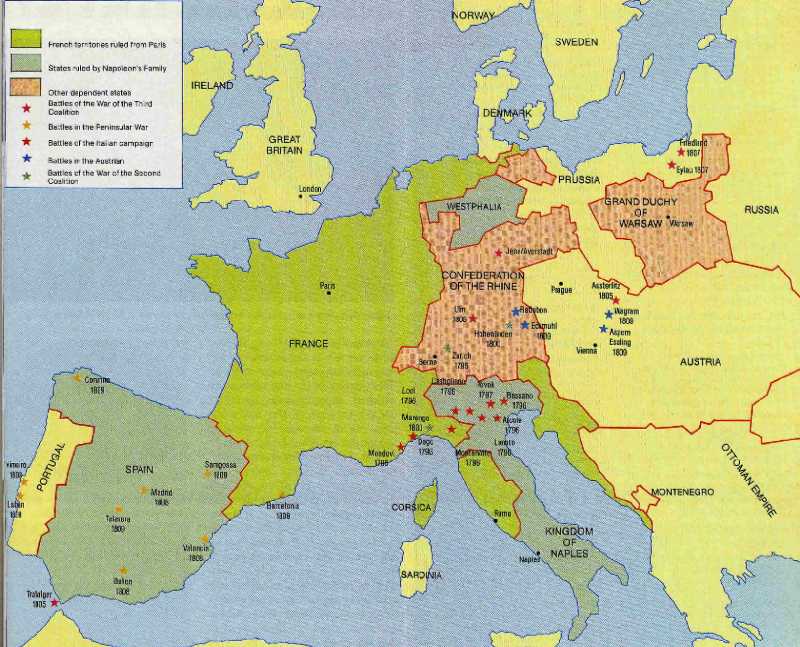
But his need for speed did not translate well in foreign policy.  He often used family members, for example, to rule large territories in his name.  This would be much quicker than patiently learning local cultures, courting local opinion, and adapting to it.   What he gained in time he paid for in many ways.  His policy was short-sighted for a number of reasons:

  • Napoleon claimed to bring the blessings of the French Revolution where he conquered.  Why then, did he think that conquered territories would accept a foreign ruler when he had exported the nationalism of the Revolution to their domains?
  • As puppets of Napoleon, his family would take orders from Napoleon, not from the people they ruled. How then, could these puppet rulers hope to hold the loyalty of the people to Napoleon?  How long until the people rebelled?

This in fact happened in Spain, a country Napoleon drastically underestimated.  To him Spain represented ignorance, sloth, military futility.  He dealt with them in his typical quick and summary fashion, but when he removed the Spanish royal family and installed his brother as king the people erupted in rebellion.  Spain became a nightmare of guerrilla war, for which Napoleon’s temperment had zero liking.  Goya captured the mood of the Spanish in his famous work, “The Third of May:”

Eventually the Spanish campaign pinned down 250,000 French troops.  But the presence of so many French in Spain alerted Portugal, who called upon England for help.  In both Portugal and Spain British general Sir Arthur Wellesley got invaluable experience fighting the French — experience he put to good use in Napoleon’s final battle at Waterloo, when he was then known as the Duke of Wellington.

But when people think of Napoleon’s missteps, they think of his invasion of Russia.

Why did he do it?

In many ways he felt he must because Russia had violated a treaty they signed with him and had traded with England.  If he let that go, then he would look weak, which would induce others to revolt as well.   Here Napoleon had, however, made his own bed.  He put tremendous stress on using his image to maintain his power.  He put his family members in charge of other nations, and so naturally did not have the loyalty of those he controlled.  So, he was right — his image was all he had left to maintain his power, and without it, it might collapse.  When Napoleon talked about the fact that losing one battle might end his reign he may not have been whining or exaggerating.  It may have been the truth, for even one defeat would shatter the image he had constructed for himself.

To invade Napoleon amassed a huge force that historians put between 475,000-600,000 men.  He wanted to use this army to quickly smash Russian forces and compel Czar Alexander I to surrender.  But Napoleon’s  usual keen strategic insight deserted  him here.  Who would fight an army that large?  Naturally, the Russians retreated inland, forcing Napoleon to follow and stringing out his supply lines.

What is victory?  Napoleon learned the hard way that victory comes not just by winning battles or capturing cities.  Victory does not come when you say it has.  It takes two to tango.  Victory only comes when your opponent, not you, thinks that he is defeated.  Battles, cities, crops — they meant nothing to the Russians.  But time did, and they used time to retreat inland and wait for winter.  They slashed and burned what they could — even the city of Moscow itself — and left Napoleon with nothing.

The Frenchman Joseph Minard made two classic visual aids, the first for Hannibal’s invasion of Rome, the other for Napoleon’s invasion of Russia.  Both tell the story of time, cold, and loss.

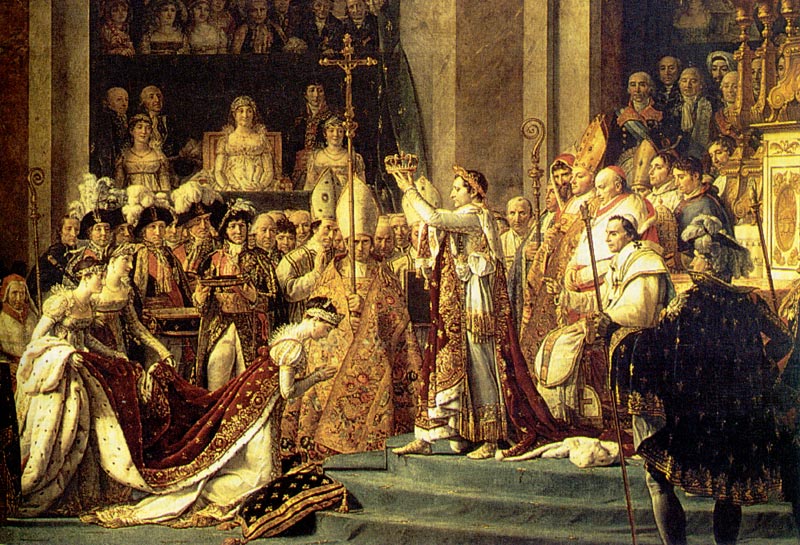
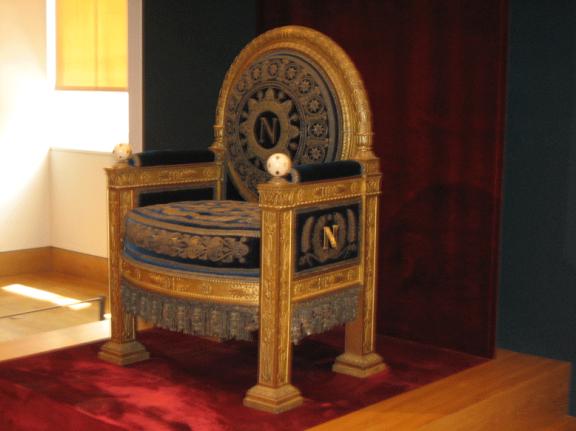
I think that Napoleon faced huge challenges when he assumed power in France.  He dealt with a country that had nearly destroyed itself during the Revolution, and felt that it needed security and stability above all else.  But he insisted on bringing that security by himself.  He never shared credit or delegated effectively.  He even took it upon himself to put the crown of France on his own head.

To establish his power, he fudged election results and removed certain civil liberties.  On occasion he imprisoned or even executed those who spoke out against him.  His image had to be preserved after all.  In the end, he complained that his friends deserted him just when he needed them the most.  He told the truth in the sense that after his failure in Russia, many did turn on him.   But his capacity for self-delusion may have been at work again.  He didn’t seem to be the type to make friends in the first place.

Many thanks,

Dave

Are you Bored?

This was one of my favorite scenes from The Great Muppet Caper:

I recently polled some of my students and gave them choice between a) Boredom, and b) A mild amount of physical pain, almost all of them chose the latter.  This might surprise us until we ask ourselves the same question.  Boredom can be excruciating, and physical pain would at least give us something on which to focus our attention.

In the poem “Waiting for the Barbarians,” C.P. Cavafy describes the hustle and bustle of a city in late Rome preparing for barbarians to menace them.  In the end, however, the barbarians for an unknown reason depart, leaving the people more confounded than relieved.  Cavafy concludes the with,

And now, what’s going to happen to us without barbarians?
They were, those people, a kind of solution.

Cavafy wrote this work originally in 1898, though it was not published until 1904.  He speaks with a macabre prescience, for one can detect a latent nihilism in Europe at this time.  Many in Europe welcomed the arrival of war in 1914 though today historians endlessly debate the cause of the war, which seems elusive.  What exactly were they fighting for?  Perhaps the answer is more mundane.  Perhaps they preferred pain to boredom.

William Lee’s book, Blackbeard: A Reappraisal of his life and Times, raises some similar questions.  His book gives some interesting detail and good stories of the notorious pirate.  Lee attempted to write with precision and has an impressive bibliography of original colonial sources.  But what stood out to me most was that Lee could not quite help himself but admire the man.  Of course many in Blackbeard’s own day felt likewise.  I blame Lee for this, but not too much.  We have always had a hard time knowing what to do both physically and psychologically with men like William Thatch/Teach/something else (a.k.a., “Blackbeard”).  Pirates remind us of our tenuous relationship with civilization itself.  St. Augustine’s City of God  and his anecdote about Alexander the Great bring this home:

Justice being taken away, then, what are kingdoms but great robberies? For what are robberies themselves, but little kingdoms? The band itself is made up of men; it is ruled by the authority of a prince, it is knit together by the pact of the confederacy; the booty is divided by the law agreed on. If, by the admittance of abandoned men, this evil increases to such a degree that it holds places, fixes abodes, takes possession of cities, and subdues peoples, it assumes the more plainly the name of a kingdom, because the reality is now manifestly conferred on it, not by the removal of covetousness, but by the addition of impunity. Indeed, that was an apt and true reply which was given to Alexander the Great by a pirate who had been seized. For when that king had asked the man what he meant by keeping hostile possession of the sea, he answered with bold pride, What you mean by seizing the whole earth; but because I do it with a petty ship, I am called a robber, while you who does it with a great fleet are styled emperor.

As mentioned, Lee can’t quite help himself.  Blackbeard obviously had a certain dash and strong leadership skills.  We can admire his bloodless appropriation of supplies and medicine from the city of Charleston.  When we compare life in the colonial south and the life of pirates, we find that the pirates ran their organizations far more democratically than many of the colonies.  Ethnicity and religion counted neither for or against you on a pirate vessel, only achievement.  Add to that, officers could be subject to votes of “no confidence” from the crew at almost any time, and indeed some captains found themselves removed in this way. We can even find ourselves winking at some of his vices, i.e., he couldn’t stop “marrying” various women in the various ports he frequented.  Lee also points out that many of the stories of Blackbeard’s cruelty surely exaggerated for effect.

Blackbeard’s eventual death also raises questions on the rule of law and the nature of civilizations.  Pirates essentially made the claim that, “the sea is my kingdom, the land is your kingdom.  Who has the right to deny us?”  What right, indeed, can anyone claim to control or rule anything? If we believe that might does not make right, does consent?  There seems no ultimate reason why it should.

Blackbeard enjoyed hiding out near North and South Carolina waters for a few reasons.  First, the Outer Banks area posed many hazards for bigger ships with deeper draughts.  These same shallower waters and hidden inlets provided ready-made hiding places for pirates.  Secondly, these colonies had less organization and money, and thus posed less of a possible military threat to Blackbeard.  But eventually Governor Spotswood of Virginia had enough, and sent a fleet south secretly to do battle with Blackbeard and kill him.  Their success raised legal questions about jurisdiction and the legality of force.  Such questions soon quieted down, however.  After all, Blackbeard was a dangerous nuisance, and Virginia had taken care of him. Just as in the case of the pirates, nothing speaks quite like success.

They had many reasons for looking the other way with Virginia’s encroachment. Blackbeard clearly possessed a streak of violence and random cruelty.  He himself admitted to randomly shooting his 1st mate in the leg because, “Otherwise no one will talk about me from henceforth.”  In other words, he had to keep up his reputation.  No one disputes that he marooned most of his crew on one occasion in order to maximize his profits from a particular voyage.  He remained a violent, unpredictable man even with Lee’s generous treatment (which I suppose goes to Lee’s credit).  Of course everyone in Blackbeard’s own day knew this, and yet they had a hard time knowing what to do, despising, fearing, admiring, and possibly even envying him in equal parts.

In his Terror and Consent, Philip Bobbitt has an excellent treatment of the history of terrorism to begin the book.  He talks about the golden age of piracy and describes that it survived so long mostly because they piggy-backed off of the prevailing political ideology of the time.  In the age of absolute kings, monarchs had no real territorial limits on their claims to rule. States in that era defined power not by contiguous territory but by the extension of one’s person.  After both the Peace of Westphalia (1648) and the Treaty of Utrecht (1713), western states redefined power in terms of physically occupied territory.  The earlier understanding fit the pirates perfectly–the sea has no boundaries, and the pirates could extend their power with their personal presence, just like any other king.  Especially after Utrecht, this logic no longer applied and European governments had a much easier time now defining them out of existence and executing combined military action.

Bobbitt’s brilliant analysis sheds important light on the problem of piracy, but for all its insight, I don’t think it fully explains the problem.

As much as modern democracies may hate to admit it, consent-based societies have a problem when it comes to authority.  We base our civilization on the idea that we consent to it via a social contract of sorts, when in fact we do no such thing.  Most of us did not choose to live here, we were simply born here.  And all of us, from time to time, may disagree with particular laws or whole movements of society.  We lack a good rationale as to why we should go along with the crowd when we have a deep disagreement, other than perhaps, “this is better than the alternative–agreeing to disagree makes things easier and more profitable for you in the long run.”  But piracy found a fairly easy way to profit far more by not agreeing to disagree.  I find it curious that the golden age of piracy began just as social contract/government by consent idea started to emerge, and as mentioned above, most pirates ran their organizations more democratically than any other colony or country.

Of course piracy is not only a byproduct of the idea of consent.  Piracy existed long before such ideas.  My suggestion here is that the idea of the social contract may have created fertile ground for its resurgence.  And this leads to perhaps the root reason for most pirates throughout time.  Many have pointed out that those who are often most attracted to violence are not so much the poor, but the bored, and we can recall the fishwives of Paris in 1790 as an example of this, or the myriad of failed artists at loose ends in Weimar Germany that later comprised the bulk of Nazi party leadership.  It may not be coincidence that the Roman gladiatorial games expanded dramatically at a time when Rome had no more wars to fight, either abroad or at home.  Under the emperors they couldn’t even argue about politics anymore.  Boredom, our failure to dwell with ourselves, perhaps even one could say, our aversion to ourselves, may lead us to take out our frustration on others.

Dave

When the holy Abba Anthony dwelled in the desert, he was beset by boredom, and attacked by many sinful thoughts.  He said to God, “Lord, I want to be saved, but these thoughts will not leave me alone.  What shall I do in my affliction?  How shall I be saved?

A short while afterwards, Anthony saw a man like himself, sitting at his work, then getting up again to pray, then sitting back down again to plait a rope, then getting up again to pray.  It was an angel of the Lord sent to correct him.  “Do this and you will be saved.”

At these words Anthony was filled with joy and courage.  He did this, and was saved.

– From The Sayings of the Desert Fathers.


The “Pursuit of Happiness”

I remember an interview long ago that William Buckley did with journalist and social critic Malcolm Muggeridge.  The interview touched on the idea of happiness, and Muggeridge commented that the words, “the pursuit of happiness” in the Declaration of Independence had done terrible harm to America and the west in general.  Whatever the original meaning and purpose of the phrase, Muggeridge believed that the Declaration teaches its readers that happiness can be effectively hunted down, caught, and then enjoyed.  He stated,

There is something ridiculous and even quite indecent in an individual claiming to be happy. Still more a people or a nation making such a claim. The pursuit of happiness… is without any question the most fatuous which could possibly be undertaken. This lamentable phrase ”the pursuit of happiness” is responsible for a good part of the ills and miseries of the modern world.

The truth is that a lost empire, lost power and lost wealth provide perfect circumstances for living happily and contentedly in our enchanted island.

I can say that I never knew what joy was like until I gave up pursuing happiness, or cared to live until I chose to die. For these two discoveries I am beholden to Jesus.

In reality, Muggeridge argued the very act of pursuing happiness will in fact ensure that we will never achieve happiness at all.  Instead, happiness comes unbidden.  It is a gift.  We immerse ourselves in particular person, thought, book, or what have you, and suddenly we realize, “I’m happy.”  Adherence to the Declaration’s view of happiness would lead us down a path of restlessness, materialism, cynicism, or flight into fanciful and frightful utopia’s.

I could not find the original clip of this on Youtube.  The clip below deals with an entirely different question, but it’s still worth watching.   Whether  your agree with Muggeridge or not (and he makes another controversial assertion), we must all agree that Muggeridge possessed the greatest English accent of all time.

I thought of Muggeridge on happiness when reading a brief post from David Derrick about individuals or nations that seek to “leave their mark upon history.”  In it he quotes Toynbee, who mentions that since Austria and Bavaria parted company centuries ago, the two have pursued different paths.  Austria looked to do “great things,” and they did achieve a kind of greatness with the city of Vienna.  But they also involved themselves in numerous wars that they often lost.  They got crushed by Napoleon in the 19th century, then by Russia and the allies in W.W. I.  Toynbee’s thoughts in the post above date from 1934.  In the few years that followed Austria continued to try and “leave its mark” by joining up with Nazi Germany, and of course that too ended very badly.  I have some friends who visited Austria years ago, and they saw this same attitude of “we’re special” at work in those they met (though in the modern context it had the manifestation of strong hostility to foreigners and immigration).  This approach has not helped them find their place in the world.  It appears that pursuing a place in “History” might be as futile as pursuing happiness.

What of Bavaria?  How did they do in the great trial of German history between 1933-45?  I know nothing about the history of Bavaria, but after a little research (read: I looked on a Wikipedia page), I note the following;

  • During the tumultuous period of the Weimar Republic, Bavaria avoided radicalism and voted for the mainstream conservative “Bavarian People’s Party.”
  • Hitler was fond of Bavaria, and the Nazi’s held many of their rallies in the Bavarian city of Nuremberg.
  • The White Rose, the heroic student resistance movement to Nazism, had its origins in Bavaria.

Before examining these points, we should note that no country, just as no person, should be judged only by their sins, no matter how bad those sins may be.  Still, defenders of Bavaria’s relaxed approach to their own history need to examine this period.  Points two and three stand out most sharply.  As to Nuremberg, Hitler may have held rallies there simply because he was known to be fond of Bavaria.  On the other hand, Bavaria may have been a stronghold of Nazi power.  The White Rose may have originated in part due to a strong underground of resistance in Bavaria, or it may have arose for entirely other reasons.  Without further knowledge (and I have none), we might say these two factors cancel each other out.

I think the first category may hold the most weight.  In the Weimar years Germany swayed to a fro between extreme ideas and stark resistance to the Versailles Settlement.  Both Nazi’s and Communists, for example, sought to “leave their mark” upon history.  The fact that the German people went with the Nazi’s shows their general bent towards radicalism.  The “Bavarian People’s Party” in contrast, wanted to bypass all of the immediate debates and return to traditional concepts of governance.  They contemplated separation from the rest of Germany to achieve this, not unlike the “Bloodless Revolution” in England in 1688.  Perhaps they understood the secret that Muggeridge knew, that seeking “History” can hold just as much danger as seeking happiness.

10th Grade: There’s More than One Way to Skin a Cat

Greetings,

As we reflected on the Scientific Revolution as a whole, we saw how people’s view of their experience in the world changed.  Newton and others gave us a universe of order and balance — a somewhat reductionistic world of cause and effect.  One could argue that a subtle shift occurred between the Reformation/Counter-Reformation era of the ‘inner’ man, the world of faith, etc., and a new focus on what can been seen and measured.

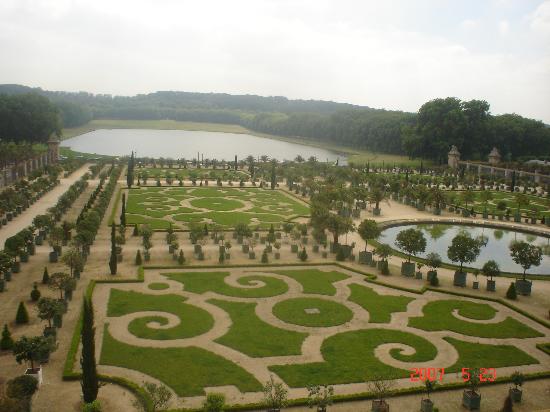
The reign of Louis XIV in some ways embodied these new principles.  Symmetry and order were key concepts of his reign, and they both were abundantly evident in the architecture of his royal residence in Versailles.  Many may tend to think of absolute monarchies existing in the Medieval period, but this is far from the case.  The era of absolutism might be dated between 1600-1750, and the Reformation certainly may have impacted this.  With the political power of the Church as a separate entity broken, that power would have to land somewhere.  For many, the most convenient and obvious place for that power to reside was in the person of the king.  And, if a neat house, for example, reflects to our eye a well-run house, than the order and symmetry in the architecture surely reflected back on Louis himself.

Hall of Mirrors

and
Gardens at Versailles
Louis himself put great stress on managing his own image, as this picture shows
Louis XIV

Perhaps most striking aspect of Louis’s reign, however, was how he controlled  the nobility.  Like many nations France’s nobles had a tumultuous relationship with the crown, with a variety of wars and compromises as the result.  Louis changed the dynamic by changing methods.  He created an elaborate system of ritual and custom. Violating these rules of ‘polite’ society meant ostracism, which meant loss of influence.  What the nobles apparently did not notice, however, was that under Louis’s system they had no influence.  Louis had them immersed in a bizarre system of etiquette.  Things like discussing politics or deep questions of life were not against the law, but frowned upon.  It was ‘not done.’  Thus, their lives became almost ridiculously trivial and inconsequential, with literally hours taken up in deciding who could sit where, who should stand for who, and so on.  Ask your children if you are interested about some of the specifics of this etiquette involving door knocking and chair sitting, among other things. The French Revolution would reveal some of the consequences of this development.

To control others, Louis did not use force.  Instead he dazzled, charmed, and confused the nobility.  To function all states need to establish some kind of order and control.  Louis, of course, had bigger fish to fry.  He did not want the status quo so much as he wanted a political revolution, a more centralized state.  To accomplish this most might have resorted to force, a “1984” style of authoritarian rule.  Louis was not known for his book learning but he must have had a keen “street-smarts,” for he chose a different path, the “Brave New World” path to control.  This path controls others not directly, but indirectly.  It creates a scenario whereby you, the individual, gladly give up some measure of political liberty to gain something you think is better.  Those who have seen the movie Matchstick Men might recall the line where the main character Roy defends himself by saying,

I’m not a criminal.  I’m a con-man.  [The difference being], I don’t take people’s money–people give me their money.

There’ more than one way to skin a cat.

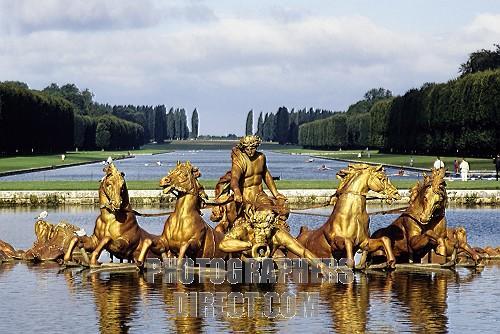
We can say that Versailles was many things.  It was a social hot-spot.  It was a place of elegance and beauty, or at least, a certain idea of beauty.  But it was also a piece of political propaganda.  Louis was known as the ‘Sun King,’ and this statue of Apollo on his chariot dragging the sun up stood in a prominent place:

pd2047369

Louis masterfully tried to have image morph into reality.  Apollo, for example not only had the power to move the sun, he also was the god of music and culture.  In using Apollo, Louis claimed not just preeminence of power but also of taste, a place the French have enjoyed for centuries since.  Yet, for my money, while I would readily call Versailles impressive, I don’t think I would call it beautiful.  Louis wanted to subtly scream “Authority!” which did, I think, create a chilling effect.

Next week we will look more deeply into the policies and practices of Louis’ France.  In this update I have painted perhaps too black a picture of Louis.  He was certainly far from an overtly evil or cruel man.  He had many endearing qualities.  But the changes he began did have significant consequences.

Blessings,

Dave

10th Grade: The Dutch Have Their 15 Minutes

Greetings,

This week we looked at the golden age of Dutch culture from around 1630-75, and how that related to the painting of Rembrandt.  I can think of three instances where a naval based culture defeats a large empire, and then subsequently experienced a ‘golden age.’

1. Athens defeats Persia ca. 480 BC, which leads to Periclean Athens (Aeschylus, Euripides, etc.)
2. England defeats Spain in 1588, which leads to Elizabethan England (Shakespeare, Philip Sydney, etc.)
3. The Dutch defeat Spain ca. 1600, which brings about the Dutch Republic (Rembrandt)

I don’t know if this is coincidence or not.  Can anyone think of other examples?  We discussed before what needs to happen to create a ‘golden age’ in a culture, but I don’t know if having a solid navy needs to be part of that. Might we suggest that navies give people a broader perspective of the world, which allows for broader minds to create culture?  Or, do navies lead to trade, which brings economic prosperity, which also seems to be an ingredient?   I am not sure.

The Dutch defeat of Spain had military and economic causes.  The Spanish had seemingly inexhaustible silver mines in the new world, but the Dutch had something new and more powerful: a stock market.  Initially all of us might take the silver mine over the stock market, but why did the stock market beat the silver mine?  We discussed this in class, with the caveat that I am not an economist:

  • A silver mine would make one feel rich, but what does one do with the wealth?  If everyone wins the lottery, no one in fact would win, because inflation would skyrocket as prices would inevitably rise.  Loads of silver are in the end a wasting asset.  In fact, prices rose some 400%  in Spain over a period of a century.
  • Besides this, how the money is used makes a difference.  If it is used in a consumptive way, no new wealth is created.  If you buy a series of fancy dinners, well and good, but the money is in your belly.  If money was invested or used to create, it could create ‘new’ money, like a perpetual motion machine.
  • Of course, having money create new wealth requires a society where innovation is possible, a society that allows for creativity and risk.  When studying the Spanish Armada we saw how Spain lagged behind other European nations by maintaining a traditional social structure.
  • Currency can be anything that has value.  If you buy $10 worth of stock, the certificate = $10.  But if the value of the company goes up, the value of what you own does as well.  That $10 certificate can become $30 over time. You just made $20 — new wealth appears almost by magic.  But this new wealth would ideally, at least, be tied toward actual production which would benefit society.  So, ideally again, the value is not simply ‘on paper’ but has some tie to reality.  Stock market bubbles burst when value becomes artificial, supported merely by belief or false delusion, and we discussed the first stock market boom/bust with the tulip craze.

The Dutch also invent the idea of the corporation.  Though today many view the corporation as  the epitome of entities estranged from “the people,”  their original invention had a lot to do with the broad Republic created by the Dutch.  The corporation not only allowed resources to be maximized and risks minimized, it allowed for the ordinary Joe to have a shot at wealth and status.  No longer would money be in the hands of the aristocracy, or those granted a royal monopoly.  It is a bit ironic to see what has happened to the image of corporations recently, but perhaps some of it is just.  Perhaps corporations have grown so large as to become essentially faceless and detached from a human and understandable context.  This, I think, is the root of some of modern unease some feel towards corporations today, but in the beginning the corporations was the ‘underdog,’ the People vs. the Established Powers.  Still, I long for the day when a corporation is not the bad guy in a recently released movie.

On a related note, we had a good discussion about the morality of stock markets, and whether or not it is just for someone from the market.  Should someone profit without work?  Or is investing in company a kind of ‘work’ that benefits society?  I’m happy to say that the students did very well with these heady concepts.

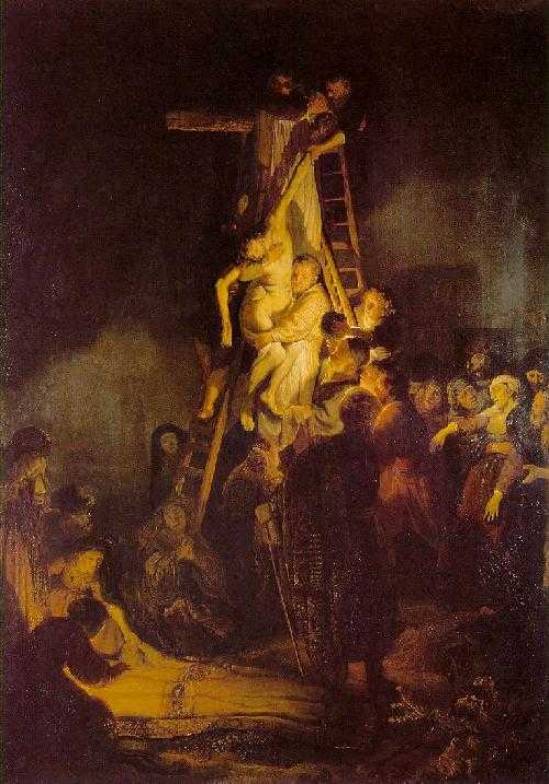
A few weeks ago we  looked at the  art of Rembrandt, the great Dutch master, and compared him to Carravaggio, contemporaries of each other.  The Reformation emphasis of the sanctity of the everyday, of humanity itself, shines through in Rembrandt’s work.  His portraits get inside people’s skin, bringing dignity and meaning to each individual.

Rembrandt painted many religious works, and his up and down life may have helped him not pull any punches with himself.  In this famous work, many believe that Rembrandt puts himself in the work (bottom right), associating himself with those that killed Christ.

Though Carravaggio was a Catholic, his emphasis on everyday people amidst the drama of salvation shows the influence of the Reformation (and perhaps a resurgence of the Medieval mindset against the Renaissance) as well.  He excelled in painting sinners.  In my favorite work of his, “The Calling of St. Matthew,” all of his genius gets poured to Matthew’s surprised, yet hopeful eyes.

Carravaggio’s possessed a wild and unruly streak, one that led to him killing a man in a duel in a dispute over a woman.  In perhaps his most dramatic work (and one of his last), he uses his own head as the model for Goliath.

How can one choose between two great masters?  Yet the differences in their work reveal differences in their personalities and their respective cultures, something I wanted the students to consider.

Blessings,

Dave Mathwin

Flotsam from “The Palace of Reason”

Like most great artists, Johann Sebastian Bach created his immortal works amidst uncertain times and an unusual amount of philosophical and cultural upheaval.  One could sense a perceptible shift away from theology as “queen of the sciences” towards the dominance of abstract reason and scientific methodology.  James Gaines chronicles one particular episode in Bach’s life representative of this shift in his Evening in the Palace of Reason.  Bach, the great Baroque composer, received an invitation to visit Frederick the Great of Prussia, the great Enlightment monarch.  Their brief meeting led to Bach composing “A Musical Offering,” considered by some to be his greatest instrumental work, and a definitive statement of his theological and musical convictions.

Gaines’ book is serviceable, if unremarkable.  It certainly is more accessible than other works on Bach I’ve attempted.  On the other hand, Gaines’ background is in magazine editing, so as one might expect, the books lacks expertise and depth. Life presents us with many such trade-offs.

Reading the work did spur on a few thoughts and questions in my mind . . .

To best understand Bach and the shift in the sciences taking place during his life, Gaines briefly describes the cosmological beliefs Bach inherited from his contemporaries.  Gaines has a difficult job with this material.  On the one hand, his book seeks a more conventional and conversational tone and such information bogs down modern readers in a mass of unfamiliar material.  But Gaines needs to cover the material to properly understand Bach. Unfortunately Gaines gives a dismissive rendering of the information, interspersed with parenthetical comments such as, “This will be over soon,” and “There will not a quiz on the forgoing.”  Gaines seems to find the pre-modern scientific beliefs absurd and embarrassing, despite his frank admission that such beliefs had a direct connection to music of the period. As one contemporary of Bach commented, “. . . an individual is both inwardly and outwardly, spiritually and physically, a divinely created harmonic being,” (emphasis mine) reflecting the divine harmony of the cosmos itself.

Some regard Bach as perhaps the greatest composer Western civilization has produced. Everyone agrees that at bare minimum he’s one of the all-time greats.  Is it possible then, that such great music could come from theological and scientific foundations (in Bach’s day these two naturally went together) utterly removed from the truth? Bad trees produce bad fruit, but the scientific tree of the Baroque era gave us something else entirely (for an extended look at the transition between Galileo and the past, please enjoy my friend Bill Carey’s post here).

Asking this question leads one into the deep waters of the nature of scientific truth, waters too deep for me. The real problem, I think, is that the modern view of truth (in science or elsewhere, but perhaps especially in science) has very little to do with poetry. Or to take a different approach, the scientific tree of the baroque period produced fantastic music, but less than able surgeons. Can science do both equally at once?  This is a question science must answer.

With the transition to the Enlightenment, Bach’s music and convictions fell out of favor. People no longer sought complex harmony, they wanted more “pleasing” — and easier — melodies.  The purpose of music and art shifted from lifting us up to the divine to meeting our needs here and now.  This was not merely a matter of taste. These different ideas about music arose from a shift in cosmology and theology.

When we think of the solar system, we probably think in a horizontal rather than vertical fashion.  We also likely think of each planet “doing it’s own thing” floating around in space.  Space between planets is empty and cold. In the medieval conception of the universe the planets descended hierarchically, with the movement between the planets forming a glorious celestial harmony — the “music of the spheres” — which in turn reflected the eternal “perichoresis” (the Greek word used by early church fathers meaning “circle dance”) of the Trinity.

Whichever we prefer, we should note that modern and medieval choices in regard to the cosmos are theological and poetic in nature, not strictly scientific.

This theological and poetic shift impacted musical opinions of Bach’s later years.  His critics believed that emphasizing harmony (as Bach did) made the music too difficult.  What’s more, harmony itself was “artificial” and “unnatural.”  Music should instead focus on singable, “natural” melodies, which we can “perform” as individuals.

Baroque harmony and counterpoint, then, came from a theological perspective that emphasized the importance of the trinitarian community, and scientific perspective that emphasized the “community” of planets.  So we might only think of harmony as “artificial” if we believe that either

  • The spheres have no music, or
  • If they did, it would be irrelevant as it would not be part of our daily experience.

Of course the medievals believed both that the spheres make music, and that their motion had an impact, however indirect, on our lives.  Thus, celestial harmony for them occupied a very real place in creation and could hardly be called artificial.

So once again we see the intersection of science, poetry and theology in musical theory, and we see the stark difference the Enlightenment brought to many aspects of our life and thought.  The legion of trickle-down effects on poetry, music, church architecture and like are everywhere present.


Dave

Ages of Refinement

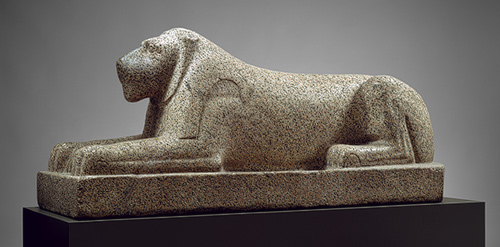
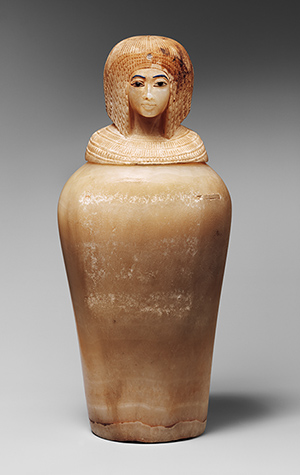
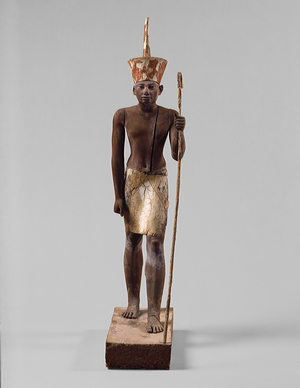
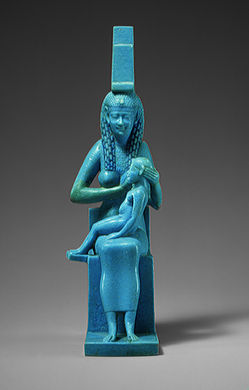
I admit that the museum’s in D.C. are generally all great, even though despite living within striking distance I rarely visit them.  Recently, however, I got a chance to visit Manhattan and the Metropolitan Museum of Art — an experience on a whole different level.  One couldn’t possibly see everything, but I spent some time in their extensive Egyptian wing and a thought struck me.

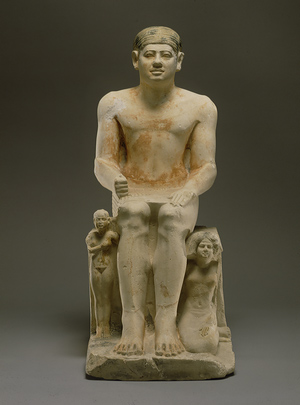
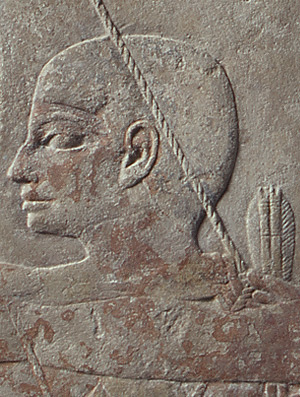
The museum laid out the pieces chronologically, not topically, and this gives one a chance to see the development of Egyptian style and technique over millennia.  Now, very little changed over time — as a culture Egypt had a very strong identity and they did not necessarily value originality — but I had a flight of fancy that subtle differences emerge upon close inspection.

Below is some work from Egypt’s “Old Kingdom” ca. 2500 B.C.

Old

Old Kingdom

Old Kingdom

Next, examples from their “Middle Kingdom” ca. 1400 B.C.

Middle Kingdom

Middle Kingdom


And finally, work from the “Late Kingdom” ca. 700 B.C.

Late Kingdom

Late Kingdom

Egypt Late Kingdom

No civilization lives out its time as a perfect bell-curve of steady rise, peak, and smooth decline.  Ebbs and flows interject themselves.  But we can safely say that Egypt as a “power” was on the rise early, perhaps peaked during the reign of Thutmose III in the Middle Kingdom period, and certainly continually waned after around 1100 B.C. and into the Late Kingdom.

But the artistic quality does not follow this bell curve.  In general their art evidences a steady increase at least in technical skill down through the Late Kingdom well past their political decline.  One could argue, however, that we see the most latent spiritual power in their earliest art.  The somewhat stoic solidity of their craft in the Old Kingdom seems to be bursting with energy just waiting to get released. Might we say then, that the increase in technical skill not only does not mirror an increase in the overall health of their civilization, it might even be evidence for their decline?

We see something similar in the history of Rome.  Here, for example is a bust of the hero of the 2nd Punic War, Scipio Africanus ca. 200 B.C.

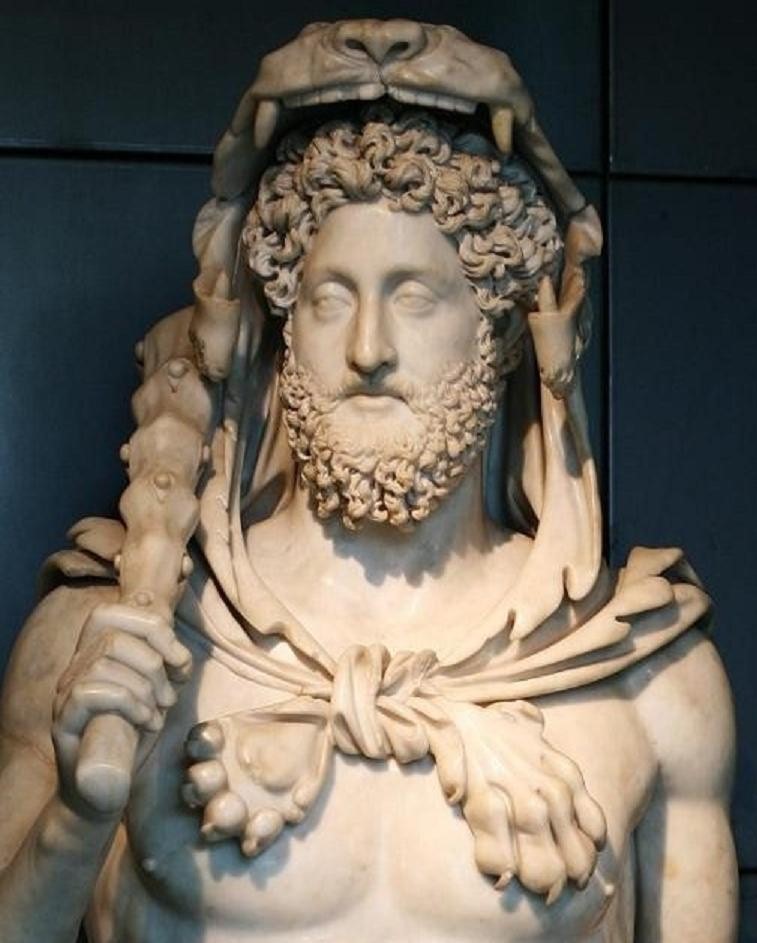
Fast-forward about 400 years and we find ourselves in the reign of the Emperor Commodus.  At this point Rome controlled more territory than at any point in its history, but no one would suggest that Rome stood taller and healthier in 180 A.D. than at 200 B.C.  And yet,

once again we see that technical skill in the arts has increased, and again we can draw similar conclusions about this increase as we can in Egypt.  Rome has declined, but technical skill has gone up.* We can also see a great deal more “spiritual” strength in Scipio than we can in Commodus, again similar to Egypt.

All this should be taken in the spirit of this blog as a whole.  I am a rank amateur making a guess. But if my guess be correct, why might it be so?

We can understand why a civilization might lack technical refinement in its earlier stages.  It has little to do with intelligence, I’m sure, and perhaps more to do with not having developed a clear style or sense of themselves.  But if the early stages show some of the clumsiness of youth, it also displays some of the (irrational) confidence of adolescence as well.

For convenience I label the later stages — like those that produce the Commodus bust — as ages of “refinement.”  I don’t think that “refinement” means an inward turn — inward turns of a civilization can bring great spiritual insights (this post here discusses this possibility in Byzantine civilization), and I don’t think either the Egyptian or Roman art shows that.  Rather, the refinement in the above art appears excessively “outward” to me, a decoration, perhaps even a covering over, of an inward reality.  In the case of Commodus, for example, his desire to show himself, a Roman emperor, in the guise of the Greek Hercules, bodes ill for himself and Rome. “Refinement” then represents a stage occupied not with deeper spiritual things but with “protesting too much.”

We can see this in Rococo art, for example, and the resulting storm that followed.  One can see the French Revolution of 1789 as the fall of one type of European Civilization.  It’s nice to celebrate simple happiness — nothing wrong with that.  But for my money Rococo (mid-late 1700’s) goes too far . . .

Schloss Ludwigsburg

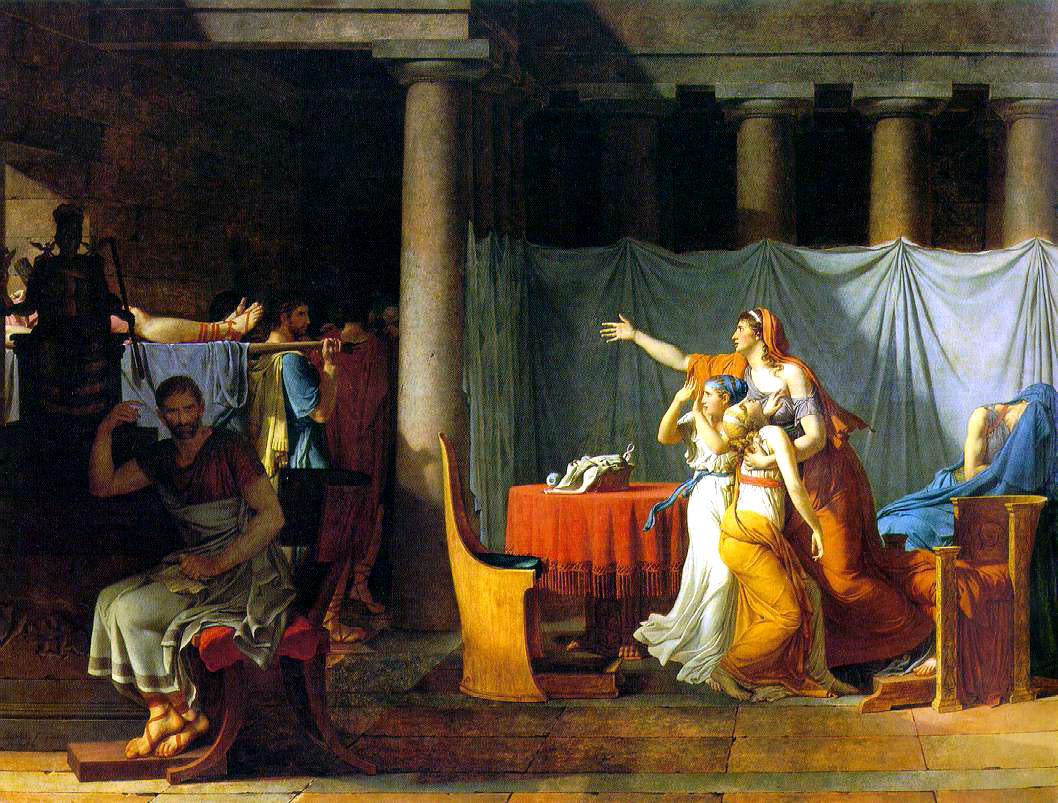
The monstrous retribution that fell upon that civilization both in terms of the French Revolution specifically, and the Napoleonic Wars generally, has its harbinger with the drastic change in art represented by Jacques-Louis David.  All sense of “refinement” gets sacrificed to stark reality, in this case, the consul Brutus receiving back the bodies of his sons he ordered executed for treason to the Republic.

Returning to Egypt, while the architectural and sculptural achievements of the era of the late kingdom Pharaoh Ramses II impress in terms of scale, we do not see the same spiritual depth as in Akhenaton a century before him,

Ramses II

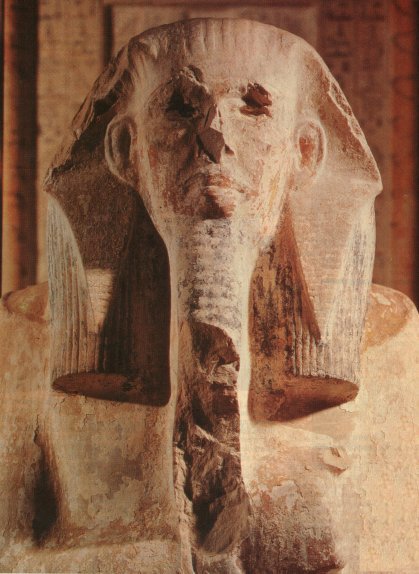
or the stark humanity of the much earlier Pharaoh Djoser (perhaps akin in style to bust of Scipio above, which might place their respective civilizations in the same spiritual framework).

Djoser - statue en calcaire

If this is a good/correct guess for these civilizations, we can ask whether or not it appears to be a law of civilizations generally, but   We may wonder too where our civilization fits in this suggested interpretative framework.  I think it obvious that many of our cultural creations do not evince the clumsy confidence of adolescence.  I’m tempted to say that we focus on ways to multiply purely external pleasure, which might put us in an “Age of Refinement.”  But if I say these things I will be following the pattern of every ancient historian in my, “Kids these days,” attitude, as well as most men generally past 40.  I don’t know if I’m quite ready to embrace that just yet.


*There may be another parallel between Rome and Egypt — we might say that Thutmose III (ca. 1450 B.C.) and Marcus Aurelius (ca. 160 A.D.) represent similar places in the respective histories of Egypt and Rome.  Both perhaps represent an “Indian Summer,” — a brief but ultimately failed rally against the tide.

Hillaire Belloc’s “Waterloo”

Usually I like Hillaire Belloc, and this book was no exception.  Still, Belloc needs approached with caution.  His marvelous intelligence and delight in iconoclasm sometimes led him astray.  Thankfully, this short book, while not spectacular, highlights hints of Belloc at his best.

His best observations center on the political aspects of the struggle, and not the battle itself.  He asks two pertinent questions:

1. How significant was the Battle of Waterloo?

Sir Edward Creasy ranked Waterloo as one of the 15 most decisive battles in the history of the world.  Others wouldn’t go that far, but argue that a victory for Napoleon at Waterloo would have established him securely in France and perhaps led to a fatal fissure in the alliance against him.

Belloc disagreed.  Had Napoleon won, he would still have had to face many more armies, who could ultimately outnumber him by a factor of five.  England, Austria, Prussia, and Russia had staked their entire identity on stopping him and would not be deterred by one loss, just as they did not back down despite many defeats from 1801-1809.  However romantic Napoleon’s comeback seems, it had no chance.  Napoleon sealed his fate in Russia, not Belgium.  Two can play the iconoclasm game, so I’ll and suggest that maybe Napoleon sealed his fate in Spain in 1808-9.  His ruthless policy of repression there destroyed his image and came back to bite him terribly.

Belloc probably has a better argument, one that today, further removed from Napoleon, is not even particularly controversial.

2. Did Napoleon Lose the Battle, but Win the War?

The other major European powers lined up against Napoleon and France.  They feared all that the French Revolution represented, partly out of fear for the social disruption it brought, partly out of self-interest.  Napoleon had little to recommend him as an individual.  As a symbol and lawgiver, he brought death to the old feudal era whose political institutions no longer had mass appeal.  This other heads of state instinctively knew and feared.  They opposed him.

Napoleon’s favored target was the well-ordered, precisely drilled Enlightenment style armies of balance and proportion.  He knew just what made them tic and how to exploit their weaknesses.  His conquests destroyed the armies of the old order, but his impatience and pride led him to establish puppet regimes that could never gain the loyalty of those he ruled.  Thus, in destroying the armies of Europe he created the same kind of national identity that fueled his own rise to power.  This new national identity created new armies, mirror images of Napoleon’s own.

Belloc asserts that the Napoleonic struggle went on for too long after the creation of these new armies for the kings of Europe to avoid the consequences of creating these new armies.  By 1848, many countries had, via revolutions of their own, adopted many provisions of Napoleonic law.

Who had the last laugh?

Belloc has a similar to point to Toynbee, who explored similar ripple effects in his  magisterial work on Hannibal and the 2nd Punic War.  Was the 2nd Punic War really just a battle, and not the war itself?  Was the same true for the years 1797-1815 in Europe?

10th Grade: The World Turned Upside Down

Greetings,
This week we discussed the preamble to the Declaration of  Independence.  While the particular grievances have come and gone,  Jefferson’s preamble is deservedly remembered.  In 1765 the colonists  talked of ‘English liberties,’ and protested on that basis.  In the  Declaration, however, we see the concept of universal human rights  enunciated.  The colonists were not fighting to be English, but in a sense to be more human.  While Jefferson was a deist and not a  Christian, he is clear to point out that these rights are universal because they originate in the fact that we are created by God.  In  class we discussed how these ideals have shaped our nation.
Many in the world, rightly or wrongly, accuse us of meddling, not minding  our own business, and so on.  Whether this charge is just or not can be debated.  What we can trace back to the Declaration, however,  is that we seek in some measure to spread our ideals not because they’re ours, but because we believed that they belonged to  all.  Are we right about this crucial assertion?  Clearly the words of the Declaration not only reflected, but also molded and shaped our self perception as a nation.
Again, this does not mean that we have always done this, or done it well, or at the right times, places, and so on.
We wrapped up the fighting of the war this week as well, and focused on the crucial battles of Saratoga and Yorktown.  To help cement the impact of these battles we did a card game activity, where the rules and structure of the game give an advantage to the ‘favorite.’  However, I hoped that the students would discern that the underdog had certain advantages as well:
– They could afford to play more recklessly, since they had less to lose
– If they got lucky or could bluff their way to 1 big success, they could simply fold (i.e. retreat in orderly fashion) and wait until the end of the game — until time ran out.
Many of you may have seen an action movie where the lone hero has to fight his way into a compound, boat, or some other such structure.  Despite being outnumbered, miraculously he kills the bad guys and escapes.  Along with Hollywood escapism at work, our hero does have one advantage.  Every person he sees on the boat he knows immediately is a bad guy.  He can shoot first, ask questions later.  Because the bad guys are so numerous, chances are nearly every person the bad guys see in the shadows is on their side.  They hesitate and give the hero the advantage, showing how their numbers work against them at least in some ways.
I could easily stretch this analogy too far, but British failures at Saratoga and Yorktown show the great difficulty the British faced winning the war.  How could they solve the problems that created the war in the first place through violence?  The situation between England and their colonies from 1764-1775 craved a political response that the British proved unable to provide.  Victory through violence therefore required an absolutely crushing military defeat, and this mean they would have to take chances to achieve it.  Both times they did this, it backfired mightily upon them.  To add to their problems, Americans could afford to take chances occasionally because their victories would mean so much more than British ones.  England’s  political bungling in the decade prior to the war prepared the way for their defeat.  I touch on some of these issues in this post on whether or not generalship can be “clutch” or not here.
Next week we will begin our unit on the Constitution and our mock Supreme Court Activity.  Many thanks for all your support,
Dave Mathwin
Here is the song supposedly played by the British at their Yorktown surrender:

A Word on Methodology and the Purpose of History

On the first day of school in 8th grade Ancient History (which is the first time I will have taught any of the students in that class), I begin class with the premise that I am wasting their time.

History, after all, (I argue) has no real bearing on your life.  We study some names and dates from the past, a few battles here and there.  Sometimes it might have entertainment value but will never really impact you in any way.  Whatever Cyrus the Great did, be it good or bad, won’t impact on you today.  The past has no present.

Depending on their personality and previous experience students either get very excited or troubled by the prospect that we can blow off the year.  Yes, eventually we get around to reasons why hopefully I will not waste their time, but we should not sweep the arguments against History under the rug too quickly.  Before we bother with History in the first place, we should know what we are doing and why.

Some students respond by stating that history offers us lessons.  When people do bad things, we can learn to avoid them, when they do good we can emulate them.

This is a very common answer, with some truth in it, but I refuse the premise on which it’s based.  Reducing history to didactic lessons runs akin to telling people that Christianity is about adhering to a superior morality.  Whatever truth lies in that statement, Christianity really is not about “morality” at all, or at least, the moral component makes no sense without a much larger context.

In the same way, History does not begin and end with proverbs and moral lessons.  It should be about encounter.  It should be about transformation.

History is often and easily abused.  One common form of abuse is using History as a vehicle for proving a pet theory, something all of us can be guilty of at times. Such an approach is both dangerous and uncharitable.  Uncharitable, because History has no room to speak for itself when we insist it conform to us.  We stop listening and lose the possibility of empathy and understanding.  Dangerous, because manipulating the past puts us in a position of great power.  We erect a wall between ourselves (the “good,” or those with knowledge and understanding) and others, those who “should know better.”  If we do this, we cannot learn, cannot be challenged, and cannot grow.

Finitude will always limit our experience, but we need confronted with “the other” to get shaken out of our narrow field of vision.  Historians can often make the mistake of viewing the past in terms of the present, but this robs the power of the past to really do its work.  Seeing through different eyes pushes us beyond ourselves.  In writing about great books, C.S. Lewis said,

. . . in reading great literature I become a thousand men and yet remain myself. Like the night sky in the Greek poem, I see with a myriad eyes, but it is still I who see. Here, as in worship, in love, in moral action, and in knowing, I transcend myself; and am never more myself than when I do.

This is how History (like all our endeavors) should prepare us for the Beatific Vision.  The “otherness” of different cultures and people can by grace train our hearts for the “otherness” of God’s Kingdom.  Other times and places should also make us humble and charitable.  Hindsight is a great luxury, but we must avoid “finger-wagging.”  We must honor the past by viewing it as they saw it, not as we see it now.  We too act in a fallen context without omniscience.  Those in the past lived under the same constraints.  What kind of decisions would we make in their place?

Bringing it to the present, how do we act morally and justly with the information we have?  How do we make decisions in a fallen world?   We must take responsibility for these decisions, and the difficulties we face should make us rely on God’s grace and wisdom.  Our own sin should make us slow to judge those in the past that struggled with many of the same things as ourselves.  Are we so sure that we would do better?  When we, with proper conviction, call out the past for its mistakes we likely will need the humility to call ourselves and our own society to account.

I am not interested so much in changing the opinion of any student about, say, Napoleon or the Industrial Revolution.  But I am very much interested in 1) Each student coming to a greater understanding of their view of the world, and the extent to which that view can be supported by Christian belief, ethics, etc., and 2) Each student more fully understanding the implications of their decisions in the short and long term for themselves and others.

Mark Twain once said that history does not repeat itself, but it does rhyme.  As we see connections and patterns, we learn more about humanity.  But humanity does not exist in a vacuum.  As in all disciplines, the study of History involves an attempt to understand Reality, imbued with God’s presence.  As Francis Schaeffer said, “He is there and He is not Silent.”