Meandering Thoughts on Equality

For the past several years now we have seen a fair amount of thought on the idea of economic inequality. Some see it as a serious problem, others perhaps as a temporary byproduct of the switch from a production economy to one rooted in service.  I suppose a very few might celebrate the possibilities free market economies in the fact of inequality.

I had a chance to think about this a bit recently, and attempt to bring some historical perspective.

It is hard to imagine this issue being resolved more successfully than the Athenians under Solon, ca. 590-570 B.C.  There were the aristocrats and the commoners, with law and wealth heavily sided in favor of the aristocratic class (the ‘Code of Draco’).  Debt spiraled out of control, society was coming apart.
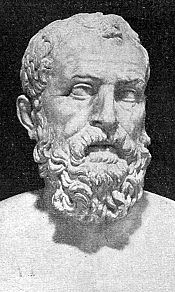
Enter Solon.  He was given full powers to resolve this crisis. He did not need to curry votes or constituents. He was not an aristocrat, but he was rich.  He could appeal to both sides and be trusted by both sides.  He believed that Athens needed its rich citizens, as we might expect.  More crucially, he knew how to motivate reform by appealing to the aristocratic ‘need’ for glory, or arete.  One can’t just dismiss this, as it was part of the Greek mindset for centuries.

He made paying high taxes a sign of arete. You could pay your high taxes not in terms of a fixed percentage, but in terms of

  • Pay for this religious festival, and we’ll say loud and long that you paid for it
  • Build a trireme and pay the crew, but you get to command the ship
  • Build this bridge and we’ll name it after you
  • Etc.  You get the idea.

By some accounts aristocrats paid a percentage 12x higher than the poor, but they got ‘arete’ for those taxes, and they had a direct hand in how they were spent.  

He did other things, like expanding the merchant fleet and encouraging trade, which put a lot of people to work.  This sounds easy but must have been politically difficult, given the role of farming in almost every ancient civilization.

He canceled all debts, but he refused to redistribute property.  

In the end

  • Athens had a stronger middle class
  • Athens had relative social stability
  • Many believe that this helped lead to the cultural/political explosion in their ‘golden age’ a century later.  They  create modern science, literature, democracy, etc.)

Alas, many things about Solon are not replicable for us.  For one thing, change did not come from a democratic process.  He was a ‘tyrant’ (a technical description and not a bad word).  C.S. Lewis commented a few times that to get good results for democracies often you have to achieve them in non-democratic ways.  We are locked into our one democratic tradition, and have not nearly the flexibility the Athenians had.

I love his taxes idea, but we just too big and bureaucratic to copy it.  Could we do something like it–give the rich the privilege of naming how they contribute if they willingly contribute more, and giving them public recognition for this (i.e. naming a bridge after them, getting their name on a fighter jet’s wings, I don’t know)?

The idea of a ‘bridge-builder’ politician we can do, and have done successfully before.  But we lack the civic-mindedness of the Athenians.  For better or worse we are more individualistic.  The ancient world would find our attitude towards the state unfathomable.  

Unfathomable, yes, but their conception of rule, society, etc. was far more personal, far more uniform, and far more religious than ours.  Ancient Persia could be an exception.  The Roman Republic could also serve as an exception.  They did integration and pluralism quite well until they ventured beyond Italy and the Alps and into the Mediterranean.  It proved too much for them to swallow. Most Italians had similar cultures.  But in North Africa, Spain, etc., . . . they were different, and no one wanted to try integrating them into the Republic, and no one thought of not ruling over them in some way.  This is another factor, I’m sure, in the collapse of the Republic.  It may be that societies with higher ethnic diversity have a harder time with equality.  If so, this makes America’s relative equality all the more impressive.*

The trade-offs are huge.  You can get more civic buy-in, in theory, in America, but you would probably have to sacrifice some sense of personal rights, and you would definitely have to ditch pluralism and relatively open immigration.  The first is highly unlikely, the second probably impossible.  Even if we could do those things, it is debatable that we should.

Anyway, we can’t dismiss the rugged individualism out of our national DNA, nor should we want to. Solon could not dismiss arete.  But . . . he found a way to work with it.  

Can we create low-skilled jobs from the digital revolution and keep them in America?  If we did so, would it make things worse for workers in Asia?  Would we want the flag-waving and possible economic confrontations that would come from a more nationalistic America?  Would the world be safer?  I don’t know the answers to these questions.

We are such a big nation (like almost every other one) that our problems become abstract and impersonal.  In Athens more or less everyone knew everyone in some way.  Dealing with inequality has much more meaning when we have a personal connection to the problem.

Rome faced a similar problem ca. 150 B.C. that Athens faced in 600 B.C.  They never found a way out, and the Republic collapsed.  All agree this period has many complexities, and historians hotly debate why the collapse happened, but I think most agree that

  • Both sides used violence to settle issues
  • Both sides tended to view politics as a zero-sum game, very much an ‘us vs. them.’  They destroyed each other with a century of intermittent civil war.

The French Revolution, the Russian Revolution, the revolutions in China, SE Asia, Cuba, and even arguably the American Revolution created far worse tyrannies than those they replaced (this is a stretch in the U.S.– the British weren’t tyrants, and neither were the victors, but the victors did exile many loyalists, slavery expanded, Indians fared far worse than under the British, etc.).  The Roman civil wars over the political questions of the day gave them the emperors.  

We need a political genius of sorts, who can find a synthesis between liberty and equality, between civic responsibility and rugged individualism. He/she would need to be trusted by the common man in Iowa and in Silicon Valley.  He/she would have to, perhaps, give huge tax breaks to corporations who did not outsource jobs–a pro-nationalist low taxes weird hybrid.  If we find him (and I don’t see him/her around), he would not have nearly the power Solon had, at least by the letter of the law.  

None of these mostly unoriginal thoughts get to the unspoken root issue.  Why is inequality a problem in the first place?  By “problem” I don’t mean whether or not inequality exists, but whether or not people perceive it as an issue worthy of much attention.

We might think that inequality is problem in every society but, not so.  For example, monastics renounce property and have all things in common.  We say that communism has never worked, but it works in monastic societies, though of course on a small scale and with everyone present strongly and voluntarily committed to that idea.

Other societies experience inequality, but seem not to think much of it. Neither Homer, Plato, Augustine, Chaucer, Shakespeare, or Austen ever made it a burning issue.  But we do see the issue move right to the front of political thinking just after Austen in the mid-19th century.**  We see it in Marx as well as Dickens, and thereafter inequality could be a rallying cry for political revolution.

Surely the Industrial Revolution has something to do with this, for it created a society where, having mastered the elements of nature, one could quickly have great material success.  The first two generations of factory workers at least likely lived at lower standard of living than previously.  Vast gaps between classes opened up.

Vast gaps existed in ancient Egypt as well between the pharaoh and the peasants, for example, but these gaps made sense to their society historically and theologically.  In a society where “all men are created equal” inequality hits with much greater force.

Marx thought that in the first 50 years or so of Industrialism some of these “non-sensical” gaps would certainly destroy the capitalistic state.  Marx had many things wrong.  But on this, I can’t blame him for his guess.  Why did the capitalist state survive?  Marx, the great materialist, had ironically underestimated our materialism as a society.  Its reasonable to assume that the social gaps created by the industrial revolution, coupled with our ideology of equality, would end the industrial-capitalist society.

The “cause” of the problem of inequality perhaps lies in solving this riddle.  It seems that the poor want what the rich have. Both rich and poor want the same thing, and the values of western society tell them they should have the same thing.  I don’t mean to say that inequality is not a problem or no such problem of economic injustice exists, or that the poor should rest content with the rich as mortal gods on earth.  I am not advocating a revival of ancient Egypt.  I merely point out that our society as a whole has surrendered to the materialist impulse which makes easing the problem that much harder.

Of course this parallels the rise of the issue in the mid-19th century just as social Darwinism, textual biblical criticism, and other de-mythologizers of life gained pride of place.  All that we left ourselves had to do with the here and now, i.e. applied science to increase our standard of living, and our various abstractions to make these things real.

All this to say, dealing with crippling inequality in society will involve a spiritual solution.  The monastics show us that it is possible.

Dave

*If this is true, we are faced with choosing between the competing goods of liberty and equality.  Would we prefer economic peace between our citizens or freedom of movement for all?

**Others I’m sure would disagree, but I don’t see the French Revolution being driven primarily by inequality.

A Flip of the Script

A few days ago I came across the trailer for a mini-series on Amazon called Redbad, a harbinger of Europe’s (and perhaps ours as well) cultural moment. The movie involves the advancement of Christianity into a pagan land. The story proceeds from the pagans’ perspective. A few things immediately stand out:

  • The cross is associated not with sacrificial love, but with a ‘dark god’ who presumably loves punishment, an enormous ‘flip’ of its symbolic meaning for the last two millennia.
  • The series depicts Christians as intolerant bigots, the pagans as allowing something akin to freedom of conscience.
  • The Christians are usually filmed amidst darkness and smoke. Scenes with pagans alone seem to give them brighter light.

A few comments . . .

  • I would not say that Charlemagne allowed for freedom of conscience, but the idea that the pagans did . . . well–no one practiced this in the 8th century.
  • Charlemagne’s reign had plenty of messiness. But ‘messiness’ reigned in the West politically more or less since the time of Roman emperor Septimus Severus ca. 200 A.D. What historians should look for, as Will Durant suggested, was not how particular people shared in the vices of their time, but whether or not they swam against the current in any way with their virtues. With this standard, the cultural impact of the “Carolingian Renaissance” gleams brightly. As Kenneth Clark stated, paraphrasing Ruskin, “Great nations write their autobiographies in three manuscripts: the book of their words, the book of their deeds, and the book of their art.” If we think, like Clark, that the last is the most trustworthy, Charlemagne’s reign comes off rather well.

A few examples:

  • The invention of a beautiful script (the Carolingian).
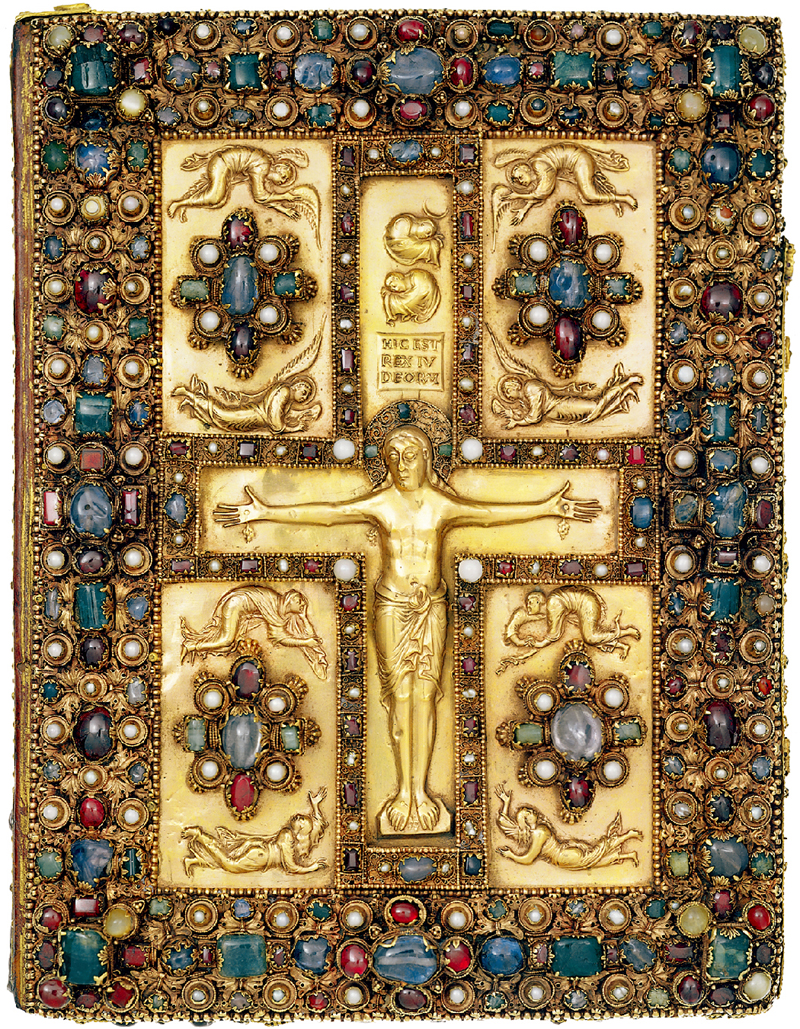
  • The creation of books, and the elevation of books as highly prized articles (studding the cover with jewels couldn’t make their value more obvious to their contemporaries).
  • Architectural innovations. Charlemagne put of the building talent of his empire not into palaces and castles, but the church at Aachen:

None of these things belong to pagan achievement.

One should not criticize Redbad for ‘historical inaccuracy’ per se. The medium of film works differently and tells stories differently. “Accuracy” is not my real concern. The mythos surrounding Charlemagne in the centuries after his death lacked “accuracy” in the strict sense of the word, just as any reporting or retelling of any event lacks “accuracy.” We edit and shape all the time, this is how our brain works as well as our souls. The problem with Redbad comes from the replacement of the standard Christian mythos entirely, and inventing another out of whole cloth, a perverse parody of creation ‘ex nihilo.’ As we see from the “book of their art,” the mythos surrounding Charlemagne has basis in fact.

Per Fexneld

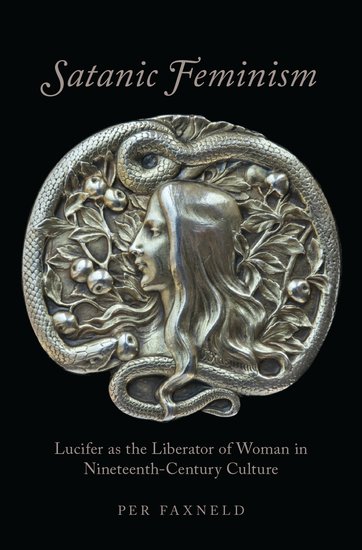
When seeing a book titled, Satanic Feminism: Lucifer as the Liberator of Women in the 19th Century, one should proceed with caution. The book could be written by a crazy feminist, or a crazy anti-feminist. The book could hardly be a book at all, and instead a mere rant. But this book stands as a work of scholarship, carefully (mostly too carefully) written with extensive bibliography and footnotes. The author, Per Fexneld, teaches at the University of Stockholm and seems an ordinary professorial sort, with perhaps a small chip on his shoulder. Digging a bit further, you see that he intends not necessarily to praise or condemn with what he finds, but merely to put the facts before the dear reader. I will usually at least pick up books with bold titles like these, merely out of curiosity and admiration for the sense of dash the writer displays.*

I kept reading the book because Fexneld faithfully executes his task of providing copious information, albeit at arms length from the material. But his perspective seems trustworthy because of this distance. He clearly has no love for Christianity and has much sympathy with women of the 19th century. He never identifies as a “Satanist” himself but seems to value, or at least understand, the role the idea of Satan plays in transgressing norms for the sake of liberation as it relates to feminism.

A few things I did not like:

  • As an Orthodox Christian, naturally I would be sensitive as to how Fexneld uses ancient Christian sources. I found to my chagrin that when discussing them, he uses secondary sources rather than direct quotes from the primary texts. I sense that these secondary sources shaped his opinions of the early fathers, not reading the primary texts directly. Despite this, he treats early Christian commentators mostly with fairness, but he could have done much better than this for what aims to be a serious scholarly study. My sense is that he cherrypicked what early Christian witnesses said about women, and to his credit, he partially admits this at least one point.
  • Fexneld takes his place among the many (mostly European? it seems to me) “historians” that don’t write history at all, but reference books. He has good information, but writes with such obviously posed dry detachment that his style could light a fire on a wet day. Where are the Abbot Suger’s, the Thomas Carlyle’s? Alas, gone are the poet historians from the world.
  • The “reference book” feel means that he tries hard not let the reader in on how one should interpret his information. Should we denounce the “satanic” feminists? Should we praise them? Or should we merely observe and think nothing about these feminists, besides concluding that a=a?

But in the end I have to confess that he created an effective and interesting reference book. My frustration above stems from the fact that he has talent that he holds back through fear or misperceptions regarding his chosen profession. If you want to do research, well and good. If you want to write, at least make an attempt at poetry that seeks meaning and synthesis.

To the thrust of his work, then . . .

With copious notes and numerous examples, Fexneld amply shows a “Satanic” strain that ran through many early feminists. He distinguishes full blown “Satanists” (of which there were a few) from those that merely used Satanic tropes (the majority of his examples). With different particular manifestations, these women

  • Built upon Romantic ideas from Byron and Shelley that recast Satan as a tragic hero of the Biblical narrative. He attempted to bring knowledge and liberation, and so on.
  • Recast Eve as the mankind’s savior, of sorts, a figure akin to Prometheus. She boldly went where Adam refused to go and paid the price, but she gave mankind knowledge and self-awareness.
  • Thus, for these women, feminism represented a real social and theological revolution, not just icing on a semi-Christian foundation. They wanted an overthrow of the Christian narrative and the patriarchy which it established. To do so, it simultaneously exalted Eve, Satan, and the fall itself.

The multitude of examples is the strength of the book, but Fexneld throws them together in ‘one after another’ fashion. Worse, one cannot sense if any one example or group of examples accurately embodies or represents the whole. He very carefully hedges many of his statements. This caution has its place in parts, but not for the whole. When writing a book like this you have to actually say something. To mitigate this, the breadth of his treatment touches on

  • The rise of the occult in the period
  • The focus from the pre-Raphaelites on feminine figures from classical cultures, “strange” women, and even Lillith, Adam’s first wife in certain Jewish texts.
  • How popular literature and art veered into occult themes with the thinnest Christian veneer, with significant attacks on “Christian patriarchy” hidden below the surface.
  • The popularity of certain occult female writers like Mary McClane and Sylvia Townsend
  • The connection of feminist social inversion to sexual inversion (lesbianism).
  • The rise of women depicted as Satan (in a positive sense) or at least, womanly figures depicted as Satan.
  • The publication of The Woman’s Bible which inverted the basic biblical narrative, praising Eve, etc.

. . . and other things. One gets the sense of a tidal wave of either direct, or mostly indirect, Satanism flooding the feminist movement from 1880-1920. But the central question–was 1st wave feminism driven primarily by “Satanism” or not? I have the feeling Fexneld would recoil at the thought of the volumes of his research intended to answer that question one way or the other. No doubt he would see such a commitment as a grave faux pas.

Let us deal with this crucial question which Fexneld leaves untouched.

First, the feminist movement obviously challenged and successfully upended certain elements of society. Certainly Satan, among other things, sought to upend the order God established in creation. So perhaps feminist women found themselves naturally drawn to satanic symbols or Satan himself. But, not all orders should stay in place. Scripture has numerous examples of the established order needing “flipped” or inverted to attain proper wholeness again. David, the youngest son of Jesse and a shepherd, will overthrow Saul, the “demonic” king who consulted with witches. Herod, for example, rightly feared that Christ would give him a run for his money.

So, second . . . was the feminist movement a proper or improper inversion? I don’t think we should answer this question based on the rote numbers of “satanic” vs. non-satanic feminists. I think the question has its roots in the nature of the inversion. If the inversion was proper, then we can relegate the trends Fexneld observes to the fringe. If improper, then we can say that even the “good” feminists participated in something wrong.

This is a very tricky question, and I can see why Fexneld failed to tackle it. But how can we truly avoid it? I’m sure that Fexneld has an answer for this conundrum somewhere in his own mind, or at least I hope he has answered it. I cannot claim to know enough to answer it definitively. I will try a pass at it, however–why not?

I begin with the obvious statement that calling upon Satan in reality or in tropes, for any cause, will ultimately destroy you, just as the flood and chaos will destroy anyone.

Not surprisingly, the feminist movements occurred within democratic societies. One can see democracy itself as a kind of inversion against traditional monarchy, replacing a “top down” political order with one from the “bottom up.” Just like Saturn eating his children in a fruitless attempt to stop the slippery slope of revolution, so too the feminist movement seems like an inevitable byproduct of democracy itself–the revolt of “Earth” against “Heaven.” Feminist detractors could not prevent this ‘revolt’ even as they might praise and affirm a democratic way of life.

Were Victorian era women “oppressed” in some sense of the word? If we look at women’s fashion as a piece of evidence, we see that–whether or not women created/embraced these fashions, their movement, the way for them to show themselves to the world, was certainly restricted–especially if we accept Fexneld’s “proto-feminists” from the mid-19th century starting the modern feminist movement. This may shed light on their overall place in society. But the place of women in Victorian society is something which I know too little about to comment on.

I suspect that the “oppression” of women lacked the severity that some claimed, but disconnects from equality are hard to bear within a democracy. I withhold sympathy from many of Fexneld’s female examples, but would extend it to more moderate feminists.

The age old problem of revolutions has always been, however, where and when do they stop?

Obviously, I oppose the rebellion against Christianity that at least some feminists then and now espouse, on historical as well as religious grounds. I trust my religious objections are obvious. As to the historical, we can briefly consider Regine Pernoud’s Women in the Days of Cathedrals, which shows us an era where

  • The earliest medieval treatise on education was written by a woman
  • We see the invention of romantic love (at least as an accepted part of general society)
  • Women regularly practiced medicine
  • Women in monastic orders could get more or less the same education men in the church received

In short, the status of women at the height of medievalism–a patriarchal society in most respects–far surpassed that of any pagan society. Pernoud suggests, however, that the Renaissance and subsequent ages introduced more Roman and classical pagan concepts of property and ownership. Possibly this did have an impact on women’s status in the Renaissance and future centuries.

Of course, one cannot construct a society entirely of “Heaven” anymore than entirely out of “Earth.” Mankind itself is both “heavenly” and “earthly,” (just as mankind is not just men or just women) made from the dust of the earth and the spirit from above. Strikingly, many of the cathedrals in the “Age of Cathedrals” reference by Pernoud were dedicated to the Virgin Mary, including Chartes, Notre Dame, Burgos, and Cologne, just to name a few. Here, I am convinced, lies the heart of the matter Fexneld misses entirely. Yes, Christianity is obviously patriarchal. We pray to our Father in Heaven. But Christians made the “Woman” (John 2:24, 19:26) the representative of Creation itself. On the one hand, Mary flips the hierarchy. As a young girl, she resided in the Holy of Holies–unheard of within Judaism. This seems a radical inversion. But it is her assent to God “flips” everything– she sets what was askew right again, the harm of Eve healed.** But what Mary put back in place is not a revolutionary society but a the right hierarchy, the reign of the true king–the subject of her Magnificat.

A blessed Advent to all.

*Some of Fexneld’s other work includes a published article: “Bleed for the Devil: Self-injury as Transgressive Practice in Contemporary Satanism, and the Re-enchantment of Late Modernity.” Clearly he has Satan on the brain. As an aside, should I ever become President my first executive order would ban all titles that that have something short and arresting to start, and then ruin it with a long and boring subtitle.

**Many of the fathers from St. Justin Martyr (ca. AD 150) onward develop the Eve-Mary parallel. Both are approached by an angel, and both assent to the angel, but it is Mary who in questioning Gabriel shows wisdom–Eve should have questioned the serpent. Eve’s pride humbles her, whereas Mary’s humility exalts her to the highest place.

The Prophet or the Madman

A good education should prepare one to see many sides of an issue and to see the complex nature of problems. Solutions, should they exist, come from seeing the good in things and building upon that, along with balance, patience, and so on.

It seems to me that about 95% of problems or questions should get handled in this fashion.

But the remaining 5% probably require none of the aforementioned qualities, but instead call for a prophet.  Some problems have such deep and destructive roots in society that only radical solutions suffice, and coming to these conclusions require a complete change of perspective not unlike repentance.  In such cases balance and moderation hurt more than help.

The problem with prophets is that they usually sound crazy.  They are entirely “unreasonable” and see nothing among us to build on.  They abhor compromise.  No doubt this explains why most of Israel’s prophets were dismissed as lunatics or dangerous subversives.

The fact that not all prophets deserve the title of “Prophet” adds to the dilemma.  God mandated harsh punishments for false prophets, who unnecessarily rile up/provide false comfort in addition to the far worse consequence of giving us the wrong view of God and our place in the universe.

If we took the Industrial Revolution as an example, we might expect a “reasonable” historian to take a standard cost/benefit approach.  On the one hand, the Industrial Revolution eventually ushered in higher wages and higher standards of living.  Medical technology improved and helped us lead healthier lives.  Mass production led to greater social and political equality.  On the other hand, the Industrial Revolution also disconnected us from nature and allowed us to mass produce destructive things like weapons and pollutants.  The regimentation of the factory led to regimentation of other areas of life.  Modern conveniences also facilitated longer working hours, which helped erode the family.  Some good, some bad, and the trick lies in deciding how to weigh the importance of each category.

Enter Ivan Illich.

Illich (a one time Catholic priest turned social critic) wants nothing to do with the above paragraph.  The Industrial Revolution, or in his phrase, “hygenic progress” has led to continuing impoverishment of all who drink from its waters.

Perhaps you think he means impoverishment of the soul, and then we can still perhaps argue that certain economic benefits outweigh that at least in some circumstances.

But no — he means impoverishment of the soul and economic impoverishment. Industrial society has made us poorer in every sense, which on the surface seems demonstrably untrue.  But nevertheless, he wants to burn it all down, if not physically, then at least in our whole approach to what lies around us.

Do we have a madman or a prophet?

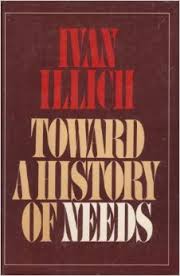
I will say that having read his book Toward a History of Needs I’m not quite sure myself. He fits one criteria for having a prophetic voice — neither the political right or left knew what to do with him in his day.  On the imgresone hand, Illich heavily criticized market-based solutions as essentially imperialistic projects that in the end only benefitted producers.  On the other hand, he spoke just as harshly against the industrialized “do-gooders” of the left and their projects like the Peace Corp and The Alliance for Progress.  He saw both sides as Tweedle-Dee and Tweedle-Dum — the same person with a different face, sharing essentially the same destructive perspective.

Illich’s main idea is that the “hygenic progress” of the last two centuries has not solved any problem mankind faces so much as it has created needs that have become mandatory for civilization. These “mandatory needs” continue to increase and drain both soul and wallet.  This favors not only producers but also, “anyone in the driver seat” (government bureaucracy). He cites many examples to prove his point, and we can add to those examples today.

Some of his examples (with hardly an exhaustive list) . . .

Medicine has become vastly more expensive over the last few decades without necessarily making us healthier. Pregnant women, for example, now have seemingly dozens of “mandatory” checkups involving expensive lab work to check on her health.  But babies are not measurably more healthy than they were 20-30 years ago.  These checkups did not come in response to a severe crisis, but as part of the logic of the “producers of health.”  Ilich also argues that most of the vast costs involving medical care for the elderly go more towards prolonging suffering than actually making us healthier.  Of course, this suffering in turn drives us back to the health producers.

Simple things like driving also fall prey to this logic.  In days of yore, you acquired driving skills more or less by osmosis and guided practice from parents.  Now prospective drivers need a certification from driving schools to prove their merit.  The fact that many who take courses from “driving schools” spend their time doing errands for the producer of the certificates should call for us to abolish the criteria altogether.  Instead, because we are a society of “hygenic progress,” we call for reform, not abolition, of such institutions, which bring in government bureaucrats once again.  The system continually empowers “those in the driver’s seat” literally and figuratively.

This dynamic impoverishes us financially by forcing us to pay for the certification and government authentication of our lives, and it also steals away time and personal initiative.  Citizens of “hygenic progress” societies will get boxed in continually.  We realize that one “must” have a car to survive in modern society (with the rare exception of a few cities), and the logic of car ownership has followed suit. No layman can repair their car anymore, which drives us toward complete reliance on the producers of car health.  Writing in the early 1970’s, Illich did not foresee the rise of digital technology.  Now, we “need” not just computers and internet, but cell phones and the like to “survive” the modern world.  Failure to keep up brings nebulous social penalties, along with more realistic drawbacks.  Who communicates by phone anymore?**

Education has gone through the same process.  Public education once was conceived as a free gift.  Now this gift is mandatory, with a mandated curriculum.  Initially the system called for you to stay through 8th grade, now one must stay until 16.  Of course, society’s demands for more pieces of paper to certify one as “educated” has increased. Now everyone “must” graduate high school to have any chance in society, and to get a “real job” everyone must go to college — though we know that many high school and college educations hardly dignify the name.  Now Master’s Degrees have become “required” in many professions.  Some of this might be acceptable if the certificates proved that you actually had a good education, when what it really proves it that you jumped through the required hoops.  The role of government oversight and financial enrichment of the producers of certificates (think of the growth of private companies in the standardized testing industry) again go hand in hand.

Of course not all want this outcome, but that’s just “the way it goes.”  I have an autistic son, and from time to time speculate on why autism diagnoses have dramatically increased over the last 20-odd years.  With the caveat that the question is complex and mysterious, part of me wonders if the increased regimentation in education makes those who lack the social skills necessary to navigate that world stand out in much bolder relief than previously.

Illich uses many more examples which I will pass over.  He astutely references the classical concept of “nemesis” from Greek mythology.  Nemesis served justice and punished hubris.  In the modern sense, nemesis stood for the punishment of a rash abuse of privilege.  In heroic literature the truly elite of society experience “nemesis” by going too far beyond the lot of mortals.  Now, Illich comments that nemesis has been democratized and no longer is reserved for rash abuse of a privilege.  Rather, “Industrialized nemesis is retribution for dutiful participation in society.”

At this point we may want to push back a bit.  Maybe the benefits of industrial society have plateaued somewhat, but if we do a before/after look since the start of industrialization, we see that life expectancy has gone up, and more people have access to more conveniences of life.  Who would want to return to pre-industrial living?  And while we can’t repair our cars, they do last a lot longer than they used to, which puts us back to the +/- calculus of the “reasonable” historian.  Some products over time became ubiquitous, but also cheap.  A perfectly good land-line phone, for example, costs no more than $15.  DVD players began by costing a few hundred bucks and now come at 1/10 of that price.  These examples seem to go against the idea that producers will get continually enriched at consumer expense.

I’m not sure how Illich would respond to these arguments, but I would guess that he would say that producers will continue to turn today’s luxuries into tomorrow’s “needs.”  And — they will continue to partner with government to make the needs mandatory — hence, good bye rabbit ears, hello to required conversion to digital.  DVD players are cheap, but look out for Blue-Ray, which will likely supplant DVD’s soon enough and start the cycle over again.

Of course prophets don’t just critique, they also offer hope and a way forward.  For Illich that means more creative and especially, autonomous action on the part of individuals.  We must escape the professionalization, the certificates of approval, and the commodification that governs modern lives.  We no longer make decisions — we have algorithms or rubrics to that for us.

However, a question remains — do we wish to be free? Do we even know what that means?  Would it matter if we did?  I am reminded of a passage in Machiavelli’s Discourses which captures the essence of the issue.  Are we a healthy body with a corrupt head, i.e. Rome at the time of the latter Tarquin kings? After the expulsion of Tarquin Superbus the Romans immediately had the ability to form a stable, successful, alternative government.  Or, has the whole body been infected, and cutting off the head will produce only more problems?  Much later in Rome’s history a new “Tarquin” arose in the form of Julius Caesar, but his death only made things worse for Rome — the whole body had become corrupt.

Illich also fails to discuss another question — is the situation he describes (if he correctly describes it — I am at least partially persuaded) a necessary or contingent consequence of industrialization?  If the latter, then we can work to change things.  If the former is true, then we need to pattern ourselves after the characters in many of Phillip K. Dick’s stories and go “through” the situation rather than running away from it, and find a spot of peace therein.

I suspect, however, that if Illich is correct, then we are living with contingent consequences of industrialization.  We can get pushed in certain directions but never off the road entirely.  While I would not call him a madman, nor would I yet call him a prophet.  He describes some of the technical reasons for our situation, but he fails to unmask the religious devotion that created this situation.  The key question, “What does industrial bureaucratic capitalism truly worship?” has yet to receive an answer.  Until we understand this, we will have no power to change our circumstances.  We need also to see that the situation Illich describes results not just from the confluence of bureaucrats and producers, but from everyone.  We “the people” cannot be part of whatever path forward may exist without acknowledging our own complicity.

Dave

*Hence his book Deschooling Society on the surface seems like a call to dismantle public education in favor of more market based approaches (the “Right” cheers).  But what Illich really calls for is that society “de-school” itself and fundamentally change the nature of the relationship between “school” and “society” (the Right and the Left look at each other quizzically).

**The confluence of the producers of society’s digital “needs” and government oversight continues with a vengeance with the rise of technology in education.  Now curricula get planned around the assumption that students have technology in the classroom.  Those who don’t will be given access.  The option to “drop out” — i.e., “I don’t want my child to have access to a tablet, phone, etc.” — doesn’t really exist.  Most teacher training now gets geared towards showing teachers how to better serve the god “Technology in the Classroom.”  All of this of course is “necessary” because we must “prepare students for the modern world.”  Meanwhile of course, we create the “modern world” via the use of technology in the classroom.  One hand washes the other.  This seems a similar argument to Hillaire Belloc’s The Servile State.

American History: The Civil War: Causes and Conclusion

For the coming test I want the students to think about the following question: ‘How did the causes of the war impact  how the war was fought, and how did these factors help lead to the ultimate victory of Union forces?’

The first thing they need to do is to discern what they believe to be the root cause of the war.  The three main options are:

1. Some say that slavery is the root cause of the war.  While slavery was not a direct issue in 1861, it influenced all the political controversies of the time, and all the previous political controversies, going back to the Declaration of Independence itself (where a section condemning slavery was removed from the original text).

2. Some say that the root cause of the war was growth of federal power that came to erode a proper constitutional balance between state and national government.  This theory sees the Confederacy not as radicals but as preservers of a truly American vision.

3. Both of the previous theories have good guys and bad guys (in the first, the South is the bad guy, in the second, the North), but there is another approach to the war that does not see good guys v. bad guys, what I will call ‘The Cultural Opposition Theory’ of the conflict’s origin (if nothing else, the name makes me sound smarter than I really am :).

This theory sees both sides drawing upon the founders vision.  We tend to think of the founders in 1787 having one coherent vision for the country, but this was not so.  The North latches on more to Alexander Hamilton’s idea of the U.S. having a strong national government with a manufacturing base.   The South adopts Jefferson’s vision of limited national power with an agricultural base.  Thus, both sides were right in a sense in claiming to be the inheritors of what it meant to be “American.”  These different ideas produce different societies that have different values, practices, and cultures.  These opposing cultures each have their merits, their strong and weak points.  But — they would inevitably come to blows at some point.  In this view the war doesn’t have a good guy or bad guy.  The conflict started because one of these visions had to win out in the end, though neither vision was “right” or “wrong” per se.

To the best of my knowledge these are the theories with the most prominence among historians.  There are a few others, such as those that historically see conflict inevitably associated with territorial expansion (in this case, the Civil War had its roots in the huge expansion after the Louisiana Purchase and the Mexican-American War) or those that use economics as the key to explaining human behavior.  If students are not satisfied with any of the suggestions I offered, they are welcome to come up with their own.

After making a case for the war, students then need to link the cause with how the war was fought, and then link again the fighting to the eventual Union victory.  This means that they have to synthesize what they know from 1800-1865 and create a unified narrative.  This is a challenge, but I hope that students will enjoy that challenge and rise to the occasion.

As always, students are welcome to show me any rough draft or outline of their thoughts before the test.

Dave Mathwin

11th Grade: “Fire all of Your Guns at Once”

Greetings to all,

This week we began the actual battles of the Civil War.  In previous years we tended to look at battles as isolated incidents unto themselves.  Last year, I wanted to begin to broaden their understanding of conflict at a deeper level.  We started to do this somewhat when we looked at Napoleon towards the end of last year, and we continue to deepen our understanding as they go farther in the rhetoric stage of learning.

I wanted the students to consider the following:

Who had the most important advantages in the conflict?  The traditional view usually argues that the North, with its larger population, established economy, and industrial might had the edge.  The picture below, for example, shows the differences in respective railway capacity:

Recently, however,  scholarship has tended to see the South as having the strategic edge.  After all, they merely had to ‘not-lose.’  The Union not only had to win, but win to such an extent that the South would not consider secession again.  The South also had a huge amount of territory, along with the psychological edge of defending their ‘homeland.’  A quick glance shows us that the Civil War had some of the same dynamics as the Revolutionary War, with the Americans playing the role of the Confederacy (to some extent) and using their advantages to victory in that conflict.  The North certainly had its hands full.

These respective advantages did not come about via magic, but by the accumulation of various conscious and unconscious choices made by each society.  The South, for example lacked industrial capacity in part because they wanted to avoid the inevitable cultural and political changes that come with industry.

Related to the idea of cultures, I wanted the students understand a few of the dynamics present in the conflict.

For the South:
We discussed that the South’s main advantage was that it could play on the defensive, play up their psychological ‘home field advantage,’ and merely, ‘not lose’ the war.  They would also have to be careful with resources.  They would not want to cede ground in this area to the North, as the North could easily overmatch their industrial production.

So far, so good.  But one of the tensions in this conflict would be how this strategy would fit with the notions of honor usually prevalent in more aristocratic, honor oriented societies.  De Tocqueville reported a conversation that surprised him in his travels in the South in the late 1830’s.  Even for a Frenchmen, the sense of honor he encountered surprised him.  While on a train, he asked the following of a gentlemen next to him. . .

Q. Is it true, then that people in Alabama are as accustomed violence as is said?

A. Yes, there is no one here who doesn’t carry weapons under his clothes.  At the slightest quarrel he’ll have a knife or pistol in his hand.  These things happen constantly, the state of society is half-barbarous.

Q. But when a man kills another like that, isn’t he punished?

A. He’s always brought to trial, and the jury always acquits.  I don’t remember a single man who was at all well-known to have to pay for his life for such a crime.  Besides, I’m no better.  Look at all these wounds [showed the traces of 4-5 deep scars].

Q. But surely you lodged a complaint?

A. My God, no!  I tried to give back as good as I got!

For the North:
No one doubts that there immense advantages of men and material, coupled with the need not just to win but really pulverize the South, should have committed them to a long term ‘anaconda’ like strategy.

But Lincoln, initially at least, eschewed this path, largely because of how he saw secession.  He believed that secession resulted from the manipulation of a wealthy elite — that the average southerner wanted back in the Union, but had been temporarily deluded.  He felt, therefore, that he needed a quick and dramatic victory to prevent the concrete of secession from settling, so to speak.  This victory would also serve as a kind of smelling salt to wake up the south, and bring them back into the fold.

Union General Irwin McDowell told Lincoln that the army stood nowhere near ready for offensive operations, but Lincoln’s political beliefs pushed McDowell to go for a quick victory.  “If you are green, so are they,” he reportedly told McDowell.  But of course, offensive maneuvers are always much more difficult than defensive ones, and the disaster of the Battle of Bull Run ensued, when the Union forces crumbled into nothingness.

Lincoln misjudged the South badly here.  Secession, as we saw last week, was supported by most Southerners, and one victory would not have swung the tide in any case.  Victory, if it came, would have to mean a longer, more rigorous, and grinding conflict.

Bull Run shows that the outcome of battles almost always has deeper roots than the fighting itself, and I hope the students saw this in class.

The President of the Confederacy, Jefferson Davis, also wanted compromise at the beginning of the war.  For example, he offered mid-western farmers the use of the Mississippi and pledged them access to New Orleans.  He, like Lincoln, figured that the Union did not really want to go through the trouble of war, and one quick victory would show them the folly of their ways.

But Davis, like Lincoln, misjudged his opponent.  For many in the North the issue went beyond economics or jilted pique.  Many felt at the time that democracy itself would be considered an international and historical failure if secession worked.  If Constitutional democracy meant one leaves the moment things don’t go your way, democracy had no future.  Secession would only serve as the first step in a broader conflict that would only serve, in time, to make America just like Europe, where wars broke out at regular intervals.  The misperceptions of both sides meant in part that the early phase of the war had little overall strategic effect.

When we remember that both the Puritan revolutionaries in England, and the more Enlightenment oriented philosophes in France, both entirely failed to bring about constitutional democracy, this attitude makes more sense.  In 1861 only England, of all European nations could claim some kind of viable democracy.

From the beginning then, Lincoln had a “cause,” or a grand ideal to fight for, but it was abstract.  In time, he would seek to transform the war even more, turning the nation’s eyes toward the slavery question.  This will give the North something more tangible to fight over.  Next week we will examine this as well as Lincoln’s attitude towards the Constitution.

Many blessings,

Dave Mathwin

11th Grade: Lord Grantham vs. the 49ers

Greetings,

This week we looked briefly at the California Gold Rush of 1848-49, where I want to touch on a few different issues:

1. The link with land and opportunity

Americans since early colonization often associated this country with opportunity – be it economic or religious in nature.  The Gold Rush did not present the lure of an easy life with easy riches.  Travel was long and dangerous, finding gold was not guaranteed, nor could you be sure to protect your claim.  Still, the possibility of changing your circumstance, of making something for yourself, proved irresistible to thousands.  The idea of opportunity has always been powerful for Americans. Often this idea of opportunity was linked with land.  We talked last year about how absurd the Americans must have seemed to the British with our near obsession for land.  After all, even before the Louisiana Purchase we far exceeded England in terms of size.  Today we still link home ownership, for example, with independence.

We can trace part of the difference in our approach to land in the different cultures.  In England many lived and worked due to the patronage of a benefactor, usually someone in the aristocracy.  In America the idea of patronage ran counter to our “do it yourself” mindset of personal independence.  There is a lot to say for our attitudes.

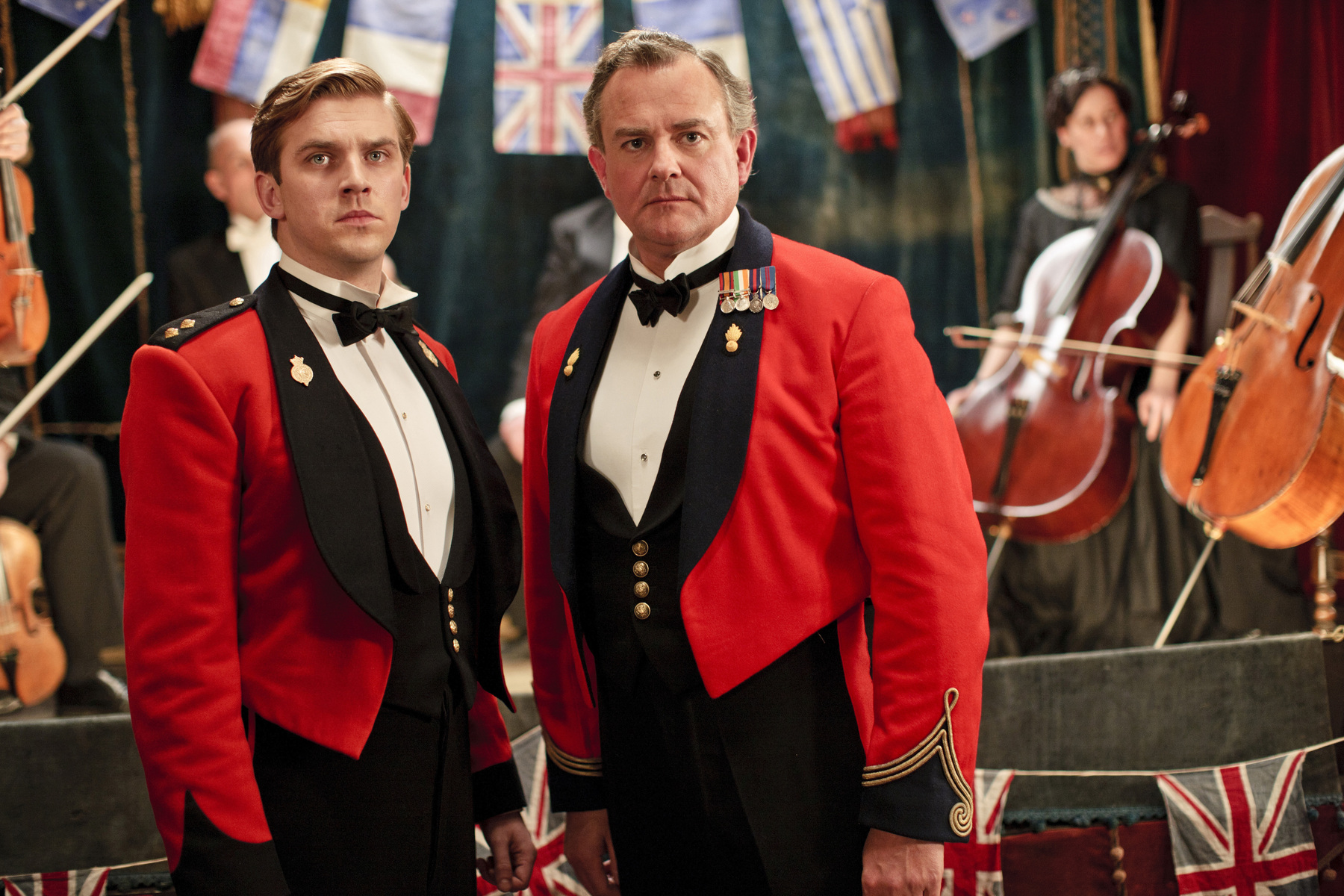
But we should not view this European mindset as mere laziness.  Many felt that if one had the means to hire a maid and a gardener, you had a duty to hire them and provide jobs.  It could be considered part of the duties of one’s “station in life.”  At its best, this mindset produced a sense of community and mutual responsibility. Mrs. Mathwin was a big fan of Downton Abbey, and I saw one scene where Matthew (who feels that all the servants are waste of time and money) is upbraided by Lord Grantham, who asks Matthew to think about where the butler will go if he had no job at Downton.  The best aristocratic tradition saw having servants as a means to provide for others.  But without a “benefactor class” in America, individuals had to make their own way, and land always played a key role in making that happen.

It is this belief in independence and opportunity that led many to oppose slavery who were not necessarily generous in their attitude to blacks.  This attitude can be just as puzzling to us today as those who favored slavery in the name of liberty.  But many Californians opposed slavery because slavery represented being rich enough to hire someone else to do your dirty work.  In this line of thinking, slavery stood against the “do it yourself” ethic inherent in the 49ers, and so stood against the idea of independence and liberty.  But we should be careful of thinking too highly of their motives.  Again, many of them had no love for blacks per se, however much they opposed slavery.  Others in the North shared this same attitude.  Unfortunately, strict abolitionists were a distinct minority.

2. Institutions Travel

It is probable that many of the 49er’s simply thought of themselves as seeking their fortune.  But institutions and economies would inevitably travel with them.  With money came the need to protect it, and for that you ultimately need political institutions (unless you would prefer lawlessness and spoils going to the strongest).  In our own Gold Rush Game played this week, students probably let the ‘individualism’ of the game go too far, and their hesitancy to form towns led to many of them being ‘killed’ by a rich outlaw.  The game will have to be tweaked a bit more next year to give more incentive to the formation of banks and towns.

3. Cultures Linger

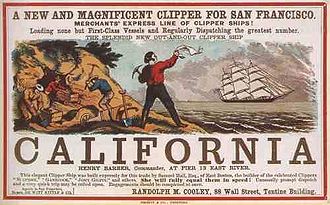
As a curious side note, the names of the towns created by the Gold Rush reveals a lot about the people there.  In contrast to much of the rest of the county that named towns with European associations (i.e. New York), Biblical references (i.e. Providence, Rhode Island), virtues (Philadelphia) or a virtuous past (i.e. Cincinatti for the Roman Cincinattus, and Columbus, Ohio).  Gold Rush towns had very different names like Devil’s Thumb, Rough and Ready, Hangtown, etc.  Clearly, many came to California with entirely different goals and outlook than those that settled North America initially in the 17th and early 18th centuries.  There are those that say that California today marches to a different drummer than other parts of the country, and clearly this has its roots dating to the Gold Rush. The culture of a particular place will often have deeper roots than we think, and our actions have longer ripple effects than we usually imagine.

I will look forward to updating you next week, when we delve deeper in the slavery question and other issues that began to split the country in the 1850’s.

Dave Mathwin

Liberty and Coercion

Almost every political philosopher I am aware of from Aristotle down through Montesquieu believed that a democracy/republic had to be small in size.  Self-government required, among other things:

  • A population where people know each other enough to trust each other to some degree.
  • A population where people can have enough land to support themselves, but a geography that does not allow any one particular faction to have too much land, thus gaining too much of an advantage over their fellows.
  • A relatively culturally homogeneous population that shares core values

The American experiment is unique in many ways, one of which being that Jefferson and Madison attempted to turn this reasoning on its head.  They argued that

  • Democracies/Republics floundered because of too much population concentration, not too little.
  • These population concentrations gave way to passions and factionalism that could easily destroy liberty by trampling on the minority (cf. Madison’s brilliant Federalist #10).
  • Hence, what Democracies/Republics need is not a small geography, but a large one.  People need to spread out so that 1) All will be sure to have land, and 2) No one particular faction could concentrate its power enough to override the rights of minorities (hence, Jefferson’s impetus for his semi-Constitutional Louisiana Purchase).

Maybe necessity helped them invent these ideas, maybe it sprung direct out of their heads.  Either way, with this reasoning Madison and Jefferson show their genius, confidence, and perhaps, their arrogance.  I have wondered if one might not view the whole of American history through the lens of this question: Were Jefferson and Madison right or wrong?*

I expected Gary Gerstle’s Liberty and Coercion to take on the grand question of the thorny question of the interaction between liberty and power, and how sometimes “liberty” for oneself means power over others.  Instead, he narrowed his focus and proceeded in a methodical way to show how over time the “police power” of the federal government grew.  Gerstle disappointed me by never exploring the relationship of our founding ideals to this question.  But at times his narrower focus allows him to make some incisive observations.

For example . .  .

Many presidents and perhaps many Americans had a desire to act in some measure of good faith with Native Americans, but things never went right.  Some might explain this via a grand clash of civilizations.  Gerstle looks instead at the inherent dilemmas posed by our philosophic commitments.  Our commitment to self-government limited the scope of federal government.  No one, whether a Federalist, Anti-Federalist, Democratic/Republican or the like, believed that a large professional army went well with liberty.  But with no money and no political will to even create agencies to establish firm borders and grant land titles, let alone enforce such borders militarily, various presidents found themselves giving in to the settlers “squatters rights.”  We wanted to prevent the national government from having too much power to coerce, but without this power, settlers had the liberty and the power to coerce others.

Time and time again, our sheer size made the relationship between governmental power and self-government difficult.

A similar line of reasoning happened with non-WASP immigrants, be they Catholics from Ireland/southern Europe or Asians settling in the west.  They did not have the same rights as others, but how could they?  For communal self-government relied on shared religious and cultural beliefs and habits.  If these immigrants did have these same values, they could possibly participate in the democracy.  Gerstle shared Teddy Roosevelt’s fury and frustration with the treatment of Japanese migrants in the U.S. just as he was negotiating sensitive deals with Japan.  But he had no ability to force local governments to do as he wished.

Here Gerstle misses an opportunity to connect our dilemmas with our founding ideology.  American colonization began with the idea of transplanting certain distinct communities intact.  But by the later 18th century Enlightenment ideas led to the bold “All men are created equal” mindset of the Declaration.  Simultaneously, America had no real justification to exclude anyone from its shores, but neither could they practice local, autonomous, self-government if they did.

The history of political philosophy has its revenge–or at least makes itself known.

Of course slavery is the preeminent manifestation of this dilemma.  On the one hand, I think most of the founders knew that slavery ran against their moral principles as a nation.  But their political principle of limiting the power of national government meant granting a lot of autonomy to the states.  The clash of these two propositions embedded the possibility of civil war into the fabric of our origins.

Gerstle cites one illuminating aspect of this problem that I had not heard of before.  After Nat Turner’s rebellion many abolitionist presses mailed anti-slavery publications “free of charge” to the South.  This infuriated President Jackson, who believed that such publications only sought to stir up more trouble.  He asked for Congress to ban their mailing.

But southerner John C. Calhoun recognized that such a ban would not serve southern interests.  They would gain in the short term but give away one of their core principles–the right of states to decide such questions.  He advocated against the ban.  But many states arrived at a solution by instructing local postal workers to simply not deliver this mail.  This at best awkward compromise could only last so long, however much it tried to resolve federal and state issues.**

States were seen early on as the means by which well-ordered communities could be established.  Thus, they had broad ranging police power.  The constitution reflects this by enumerating the powers of the federal government and giving everything else to the states.  Today the power of states is much weaker relative to even just a few generations ago.

This changed in stages.

The Industrial Revolution may have done more damage to the vision of the founders than any president or political party.  It broke down local rural life and lumped most people together in the cities as one amorphous mass.  Such conditions created a national state. Without any direct power to act, the government outsourced, deputizing local civic groups to undertake tasks related to civil order.

Whatever the successes such organizations had, they were destined for embarrassing failures.  They discriminated against blacks and immigrants.  They imprisoned without fair trials, and so on, all in the name of the Justice Department.  They needed stopped, but the only way to do so involved finding a way to increase the power of the national government.

Over time the national government used various legal strategies mostly related to the 14th amendment and the commerce clause to achieve their aims.  Perhaps the Industrial Revolution destroyed the possibility of self-government that our constitution depends on.  Rather than create a new constitution, we sought to stretch certain enumerated powers far beyond their original purpose.  Much hay has been made of the commerce clause, for example, which many conservatives lament.  However, our military and national defense (an issue dear to many conservatives) has also assumed a shape utterly unrecognizable to anyone who lived before W.W. II.  The size and cost of our military has in turn stretched the power of the presidency far beyond the vision of the constitution.  Gerstle cites many examples of how our military ballooned in size and then rapidly decreased when conflicts ceased.  Of course we can cite the strategic dilemmas faced by the U.S. after W.W. II as a justification for maintaining a large military.  In a very real sense, W.W. II did not end until 1989.

Strategic considerations aside, we should speculate if any other forces influenced this shift.

Eighteenth-century theorists drew upon the “citizen-soldiers” of times past.  Greece and Rome both provided examples of this.  On the one hand, we cannot have a militarized state, which would jeopardize our liberty.  On the other hand, we need national defense.  A nation of property owners motivated by legitimate self-interest would certainly rally to defend their land, their communities, if need be.  The first 175 years (give or take) of our history demonstrated this.  Right up through the end of W.W. I we demonstrated the ability to dramatically expand and contract the size of our military.

Perhaps our strategic situation changed so dramatically in 1945 that it necessitated the rise of a “military-industrial complex.” Or perhaps it was we ourselves that changed.  Gerstle does not speculate.

Embedded in this question is the relationship between liberty and order.  We have always recognized the need for someone to have the final say, and the need for people to “pursue happiness” in the way they see fit.  This has always meant tolerating things one may disagree with.  Should we ban pornography or not?  Do we grant the freedom of some to own slaves?  Do we grant the freedom of some to oppose same-sex marriages?  Who gets to decide?

Gerstle’s book rather prosaically shows how this power to decide has transferred over time from the states to the federal government.  This happened mainly under Democratic leadership.  But conservatives also played a role at crucial times with their traditional issues of national defense/military.  By “prosaically” I don’t mean that it was easy or unconvincing.  He has extensive research and uses a methodical style that makes him quite convincing.  But he leaves us with some unexplored questions and neglects to swing for the fences.

He makes clear the fact that ideas of liberty and coercion have always existed.  All we have done over time is basically transferred the power of coercion from the state to the national government.  As to whether representative government can exist in the post-industrial era, as to whether or not Jefferson was right or wrong, these grand questions go largely untouched.  I for one can’t help but admire the brilliance and confident boldness of Jefferson’s vision–though I think I disagree.  I wish Gerstle had done a bit more to inspire me one way or another, and done a bit more to help answer the perplexing question of the nature of America’s idea of liberty.

Dave

*Another possible historical lens would be the “wheel of fortune”–the idea that every civilization (and every ruler?) will experience a kind of boom/bust cycle.  The medievals would argue, I think, that this cycle was meant to teach us about redemption.  This lens would argue that some choices could delay the progress of the cycle perhaps even for a long time, but that “nothing lasts forever” and that some kind of decline remains inevitable.

Again, this idea had a historically long run, from the ancients down through Machiavelli at least.  Our founders, many of them heirs to the Enlightenment, would not have accepted this idea.

**The same held true for the Fugitive Slave Act.  Most pro-slavery advocates rejoiced at the new provisions of the law, but others saw that to achieve this they abandoned a key principle of keeping the federal government away from the slavery issue.

Without question slavery is a terrible moral evil.  We must realize that the issue had other dimensions to understand the colonial and ante-bellum period.  We may deplore the actions of another country or culture.  When should we use force to change them?  By what authority?

The Emperor Might Need New Clothes

Some years ago my students and I came across a remarkable passage in Madison’s notes on the Constitutional Convention.  The delegates debated some issue about term limits or representation, when one of the lesser known men commented that, in effect, “this constitution will last us about 75 years, after which we will have to make a new one.”*

This comment passed apparently without much notice or fuss at the Convention in Philadelphia.  Perhaps it was a generally assumed idea, or perhaps they simply had enough trouble in the moment to worry about arguing whether or not their document would last past their grandchildren.

This shocked everyone in class because we think of America like any other country, a more or less solid oak in the earth.  Of course, we have also been brought up with political rhetoric from both parties that venerates the constitution (though perhaps different parts of it).   Because Americans share little besides some form of faith in the Constitution, if that shakes, we all fall down.

Because American history has many unique aspects, I find getting an interpretive handle on our past very difficult.  I have taught American History for about 15 years and have only some educated and less than educated guesses.  Clearly, however, politically and culturally we are currently shifting in some direction or another at the moment.  How should we make sense of it?

One of the more remarkable periods of positive dynamic change occurred in Greece between the years ca. 800-500 B.C.  We know about the Bronze Age, but sometime after the Trojan War Greece descended into a dark age about which we know very little.  Perhaps Homer was the beginning of the rebirth.  Early on in his The Economic and Social Growth of Early Greece: 800-500 B.C. Chester Starr makes an interesting point.  Definite ideas or concepts like “equality” or “rights” did not guide the Greeks ca. 800 B.C.  Rather, the concept of eunomia, or “traditional right” formed the basis of Greek social and political interaction.  Sometimes they invoked eunomia against abuse of power by tyrants or aristocrats, at other times aristocrats invoked it rightly against the “mob.”  This flexibility surely gave them good ground on which to innovate.

This stands in contrast to our history.  We founded America on ideas, whether because we thought that the best way to go, or because we had no other choice.  We often agreed on the results we wanted, but rarely on the “why” of that result.  Even early colonial America had a great deal of cultural diversity, at least by 17th century measurements.  We have never really had a shared culture to build upon, except perhaps for a vague sense of Protestantism.

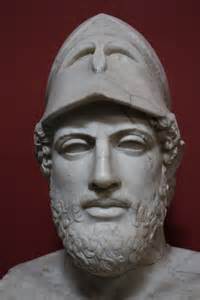
Starr goes to demonstrate that the creation of the much admired political unit of the city-state had at least part of its origins in the desire of the aristocracy to concentrate its power.  Later, asPericles of Athens we know, democracy arose in many Greek city-states, a tribute to the aforementioned flexibility.  But many Greek democracies still had their aristocratic imprint.  The outstanding reformer Pericles made Athens more democratic while definitely living and fashioning himself as an aristocrat, and not as a “man of the people.” His bust makes this clear.

All good things come to end, and the Greek system had played itself out by the time of Alexander, who had little trouble putting it to rest.  Still, all in all, a good run by any measure, one too that makes sense in some clearly defined stages.

In light of Greek history and our own, I offer some some highly speculative thoughts . . .

Theory 1

Since early colonization America has gone through several iterations:

  • Colonial America – 1600-1756
  • Revolutionary America – 1756-1828
  • Jacksonian America – 1828-1860
  • Progressive America – 1860-1929
  • New Deal America – 1929-1965
  • Global Power America – 1965-2001
  • ???

Obviously some of these dates can be disputed and overlap.  Basically, Theory 1 asserts that because America has been rooted in ideas and not culture/tradition, we subject ourselves to significant shifts every 2-3 generations (the first phase doesn’t really count, as we had no concept of an American “nation” until the mid 1700’s).  We can reinterpret our common language on the fly and create “new Americas” every so often–though of course each era has some connections to past eras.  This ability has its strengths and weaknesses.

This theory, if true, may comfort us now because the the shifting ground beneath our feet will settle again as it has for previous generations.  We’ve done this before, we can do it again.

Theory 2 . . .

proposes more unity for the majority of American history.  Yes, some cultural and political shifts happened over time.  But we consistently maintained faith in the democratic process, and in our reason for being.  Even in the Civil War, the Confederacy broke away not out of a rejection of the American ideal, but out of a belief that they represented the true America.  We had “confidence,” that crucial element of any civilization, even in the midst of our most profound domestic crisis.

But something significant happened in 1965.**  In this year we passed the Voting Rights Act, which could be viewed as the apotheosis of what America was supposed to be.  In this year also we dramatically increased our involvement in Vietnam, again, in some ways I think, out of a belief that this was what we were “supposed” to do.  We increased our troop presence initially at least with the general backing of Congress and the population at large.

However, almost immediately after we passed the Voting Rights Act the riots in America’s cities began.  Rioting continued sporadically in many major cities for the next few years.  Perhaps this was pure coincidence, but I think not, though I would not claim to really understand the reasons for the violence.  But I think that part of the reason might be an intuition that we had “done all we could do,” but that it wasn’t enough.  The supreme confidence we had in our democratic way of life taught us that things would always improve, but now we knew better.  Shortly after our troop surge in Vietnam waves of self-doubt began surging through the country.

The two phenomena are likely connected, though I’m not sure how.

Along with this, the counter-culture “hippie” movement went mainstream into popular culture and eventually most of academia.  Western icons like the Beatles went to India to learn see the world in a non-western way.  We lost confidence in our own culture, and we have not regained it.    We had never agreed fully on the why we did what we did, but we had agreed on what we did.  After this era we could no longer claim this for ourselves, and this makes the modern shift much different than others in our history.  The lack of political flexibility may have hastened the at least seeming collapse of the principles that guided us.  Some of the “vomiting up” of our past in some areas of our culture seems willfully self-induced.^

Recently The Guardian ran a great article about Tory MP Rory Stewart.  Stewart got a great education and attempted on two occasions to serve in difficult postings in Iraq and Afghanistan.  His comments say much about the state of the western world:

Ten years ago he would have listed 10 things Afghanistan needed to build a new state: rule of law, financial administration, civil administration and so on. “And, then you would say, well, how do you do that? Well, I’d say, by a mapping of internal and external stakeholders, definition of critical tasks – all this jargon talk. And I’ve only now just begun to realise these words are nonsense words. I mean, they have no content at all. We should be ashamed to even use them.”

They are nothing more, Stewart now acknowledges, than tautologies. “They pretend to be a plan, but they’re actually just a description of an absence. Saying ‘What we need is security, and what we need to do is eliminate corruption’ is just another way of saying: ‘It’s really dangerous and corrupt.’ None of that actually tells you how it’s done.”

And later,

In some sense I’m a romantic. I like the idea of organic history and tradition. But I think Britain is such a different place now, and changing so quickly, that I’m coming slowly, painfully, to accept that we need to start again.

I emphasize that these comments come not from a reactionary revisionist Liberal, but a member of England’s conservative party.

If we agree that we need to “start again,” in some way, will we agree on where to start from, and where we wish to go?

Dave

For anyone interested in further thoughts on America’s political culture, check out The Grumpy Old Man podcast with Audrey and Emily here.

*My apologies, I have looked back and forth for this comment and cannot find it again to save my life.

**A possible counter-date might be the end of W.W. II.  As Arnold Toynbee regretfully admitted, democracies are not well-equipped to handle something like nuclear weapons, though, so far no horrifying apocalypse.

^Trump gets rightly accused for excessive negativity, but why does no one focus on the obvious negativity from the Left?  Here is Clive Crook, via Marginal Revolution . . . 

Trump’s critics complain about his relentless invoking of crisis — despite agreeing with him that the system is collapsing. Conservatives keep telling us that the American project is in mortal danger, that liberty itself is at stake. Liberals keep telling us that global capitalism is wrecking everything that’s decent in society, that the U.S. is institutionally racist, and America’s traditional values are so much hypocrisy. I think back to the rapturous reception accorded by the left in 2014 to Thomas Piketty’s “Capital,” which argued, you may recall, that capitalism is an engine of injustice, headed for self-destruction; progressives everywhere nodded wisely in agreement. Here’s what puzzles many of them today: Why does Trump have to be so negative?

Entourage Trauma

In his wonderful book, Lost in the Cosmos Walker Percy guides his readers into uncomfortable (but also funny) questions about the human condition. In one scenario, he asks us to imagine a famous movie star stopping in a small town local grocery store. On the one hand, there is the prospect that he will be recognized and fawned over. He will have to take selfies, make witty remarks, give autographs, and so on. He will have to assume something of a mask. On the other hand–what if, having prepped himself for this eventuality, no one recognized him at all? Which is the worse fate?

Thinking about this dilemma made more sympathetic for athletes who bring entourages with them wherever they go. I used to see this phenomena motivated purely by ego and money. Now it looks like a coping mechanism for an entirely weird situation. Back in my father’s day athletes often had off-season jobs and lived in neighborhoods with other middle class families. Some had great renown but to see them you usually had to go in person. No highlight reels existed, so slow-motion footage, to make them seem super-human. How does a 23 year-old deal with extreme fame and fortune for having the talent of pretending to be someone else or putting a ball in a round cylinder? Such success could be traumatic, and the entourage a means of dealing with the world at a distance.

We can make similar diagnoses of cultures in general.

Historical comparisons of one era to another are no doubt tricky. We assume that anyone can easily make one thing look like another by selective choosing of our material. I admit that this was my first reaction to Kirby Farrell’s Post Traumatic Culture: Injury and Interpretation in the 90’s. Farrell attempts to link the 1890’s and the 1990’s examining its culture (books and movies) through the tense of personal and cultural trauma. The neat 100 year gap seems all too convenient at first glance.

I have mixed feelings about the book, which I experienced as a combination of excellent insights and thoughts that Farrell wielded the hammer of psychoanalysis and saw everything as a nail. It is possible, for example, that if a character in a story drinks a cup of coffee, it may be a simple background detail and not meant to conjure the idea of fetishizing the exotic, or some other such trope. And, while he cites a variety of examples of similar themes in the two decades, he never seeks to prove that the 1890’s/1990’s had more focus on his themes than other decades. Granted–proving this would involve a different kind of writing and research, but its lack allows for doubt about his thesis.

This premise nonetheless intrigued me. Certain things about the 1990’s in retrospect appear strange. I distinctly remember fearing nuclear war in the early 1980’s. But we first win the Cold War, and then the first Persian Gulf war in overwhelming fashion my senior year of high school. I remember thinking that a burden had lifted, that skies had cleared. The 1990’s–good times, right?

And yet, in looking back . . .

If we take music, for example, we see that in the 1980’s, songs about fun, love, and pastel colors routinely topped the charts in a time when many had real fears of nuclear annihilation. But almost immediately after the Cold War, grunge music dominated the airwaves. Bands like Nirvana, Pearl Jam, Rage Against the Machine, Soundgarden, etc. celebrated anger, alienation, confusion, and disillusionment. Fashion changed from accentuating and celebrating oneself with shoulder pads and coifed hair to wallowing in degradation with greasy hair, ripped jeans, and heroin chic.

None of this seemed odd at the time to me–it just was. I suppose some might tell me to get over myself, that culture changed because it changed, with no reason behind it. But if that’s true than there are no reasons for anything. Three explanations, then, present themselves to me:

  • People are by nature self-indulgent, and having no crises to validate us, we invented crisis to grant ourselves legitimacy.
  • Democracies especially need an outside enemy to maintain social cohesion and a sense of purpose–recall what happened to Rome’s republic after they conquered Carthage and Greece. Rome turned on itself as a body politic. But being less communally oriented than the ancient Romans, who destroyed their public institutions, we turned to destroy ourselves as individuals (i.e., heroin chic and ripped jeans)
  • We faced a (clinically) real sense of psychological trauma that fits a ‘normal’ pattern of human experience. Our cultural obsessions of the 1990’s could be termed not “self indulgent,” or ” typical of democracies,” but typical of modern man in general. The two decades had western man face a similar kind of challenge that evoked a similar response.

This last premise forms the basis of Farrell’s book.

He asserts that the 1890’s and the 1990’s shared important things in common:

  • The 1890’s saw the closing of the frontier for America and western Europe. As Cecil Rhodes remarked, “The world is all carved up now.” The idea of the problem of “no frontier” would be taken up as a major theme in American history, beginning with Frederick Jackson Turner.
  • In the 1990’s we had the sense of the “End of History,” with no enemies on the horizon, and nothing to do with ourselves.
  • The 1890’s had the sense that they had gone so far, that good times could not last. The encounter with the ‘other’ overseas would surely rebound and perhaps destroy them. They felt their culture endangered.
  • Our efforts to win the Cold War took into Asia, Africa, and South America. Our contact with the ‘other’ brought on the infamous ‘Culture Wars’ of the 1990’s–the sense with many that the key aspects of our identity faced grave threats.
  • Many accounts exist of people describing dread in confronting the enormous scale of life introduced by the Industrial Revolution. Yes, by the 1890’s people had lived with this change for nearly a generation. But the 1890’s saw the application of electricity to society begin, just as the 1990’s saw the internet begin to become part of the everyday. Both inventions dramatically altered our experience of creation, eradicating natural boundaries and expanding the scope of life unnaturally.

All of these factors combined gave us a real sense of dislocation, as we had lost our bearings and become unmoored. The man of internet lives everywhere and nowhere. The similarities asserted between the decades, which seemed arbitrary to me at first, make more sense upon reflection.

Farrell’s best insights come when he discusses the concept of the prosthetic, by which he means what we add to ourselves in attempt to make ourselves whole. An athlete’s entourage, for example, can be seen as a prosthetic, an artificially constructed way to deal with the world, to make us whole. In Schindler’s List, for example, Schindler creates much of his cache with Nazi elites through providing more and more extreme forms of entertainment. “Those who live by the sword, die by the sword.” The trauma that the Nazi’s inflicted on others cannot help but rebound back at them. To cope with this and to create something of an internal balance, or something of an escape, they douse themselves with physical pleasures–they escape their misery through a kind of “beserking.”* He cites numerous examples of how various forms of culture in the 1990’s manifested something similar–grunge music among them.

I remember reading parts of Barbara Tuchman’s The Proud Tower, her examination of life in Europe before W.W. I. In the preface, she mentioned that she thought to find a calm and tranquil world shaken out of a slumber of sorts by the war. Instead, she saw a world even in the 1890’s on the edge of its seat psychologically, and to a lesser extent, politically. Like 1990’s America, 1890’s western Europe stood atop the world, seemingly having it all. And yet–that fact seemingly hurt them more than it helped.

Farrell cites the novels of H.G. Wells from this period, almost all of them having an apocalyptic subtext. Conan Doyle based Sherlock Holmes’ whole existence on trauma–unable to handle real life, Holmes must live through the prosthetic of the trauma of others. The art of the briefly dominant pre-Raphaelite school focused so often on Arthurian themes of the end of a golden age, of mourning and loss. This style appears just as out of place as the dominance of Nirvana and Pearl Jam right after winning the Cold War. It would seem as if the golden age should be beginning, not ending. Farrell suggests that we could not handle the scale of life, and the power it conferred–“winning” as a kind of trauma. Oscar Wilde, the man of the 1890’s, seemed unable to function without masks–and in fact he celebrated the very idea of people masking themselves to others. As he wrote about in A Picture of Dorian Gray, however, those masks hid deeper and darker realities.

All in all, Farrell had too much of psychoanalytic lens on his subject to completely convince me of the connection between the 1890’s and the 1990’s. Not everything comes from trauma. But–he got a lot farther than I thought he would.

Dave

*With this term Farrell references the Viking warriors, who would put themselves into a frenzied state before going into battle, no doubt to disassociate themselves in some ways from the death they inflicted.

Authenticity, Man

Having flamed out on Charles Taylor’s A Secular Age, I was happy to find a more bite-sized chunk of his thought in The Ethics of Authenticity. I admit to approaching the book, like others of a traditional bent, leaning against the very idea of authenticity. “Get over yourself, already.” The search for meaning within the self can never go anywhere and remains something of an illusion. What, after all is there to really “experience?”

The whole concept of “authenticity,” born out of the 1960’s (or so I thought), has given rise to a whole host of modern problems. All of the issues with sex and gender have their roots here, as does a great deal of spiritual innovation with the church, along with the Trump presidency. Many inclined to read this book of Taylor’s might hope for a thorough denunciation from the venerable professor.

Of course, boring conservatives such as myself may not have always been such. We may remember the days of our youth when it seemed we had to break free from our surroundings to see what we were made of. Taylor taps into this, and so, while he criticizes much of what the “Authenticity” stands for, and finds it ultimately self-defeating, he reminds us that a kernel of something like the truth remains within this–in my view– unpleasant husk. Taylor writes,

The picture I am offering is rather than of an ideal that has been degraded . . . So what we need is neither root-and-branch condemnation nor uncritical praise; and not a carefully balanced tradeoff. What we need is a work of retrieval . . .

Taylor demonstrates that of what we term “authenticity” has its roots in Christianity. In the ancient world nearly every person received their identity by what lay wholly outside their control, be it birth, race, family, etc. The triumph of Christianity meant believing that an entirely other world lay outside of our normal lives, the Kingdom of God, in which there existed “neither Jew nor Gentile, neither slave nor free . . . (Gal. 3:28).” The book of Revelation tells us that God “will also give that person a white stone, with a new name written on it, known only to the one who receives it (Rev. 2:17). St. Augustine’s magnum opus told us that the City of God lies nestled, in some ways, within the City of Man, to be discovered by anyone willing to walk through the wardrobe.

18th century Romantic thinkers, primarily Jean-Jacques Rousseau, picked up this dormant thread, albeit thin sprinting with it in ways that St. Augustine would abhor. I find the 18th century an absolute disaster for the Church, but still, Taylor calls me to at least a degree of balance. There was something quite ridiculous and artificial about the French aristocracy, for example, ca. 1770, accurately portrayed (I think) in this clip from John Adams

Perhaps St. Augustine did see “the road to God as passing through a reflexive awareness of ourselves” (p. 27). Many have pointed out how psychologically oriented was Martin Luther’s view of salvation. John Calvin began his Institutes by asking his readers to heed the Socratic dictum to “know thyself,” for knowledge of God and ourselves have an inextricable link. But Taylor sees Rousseau as the main originator of the modern view of authenticity. For Rousseau, “Our moral salvation comes from recovering authentic moral contact with ourselves,” and, “Self determining freedom demands that I break free from external impositions and decide for myself alone” (p. 27).

Well . . . ok. I don’t like the concept of authenticity but perhaps the difference lies in the “time of day.” What I mean is, bacon and eggs smells wonderful on the skillet when you’re hungry before breakfast, but that same smell hits one very differently with a full belly after lunch. The early Romantic movement, just as with the early Enlightenment, had good points to make. Rousseau championed, among other things, mothers actually breast-feeding their own children–something dramatically out of fashion for his time. Connecting with “nature” and the “self” I suppose could lead to more morally responsible living. You cannot blame your birth or other circumstances for who you are. But let it linger too long and you get the ridiculous movie Titanic, riddled through with romantic and “authentic” ideology–the smell of bacon and eggs at 10 am after you have already eaten. Still, Taylor asks the reader to see the premise of the morning before jumping straight to the twilight.

As for today, Taylor points out a variety of ways in which the “authenticity” narrative has gone astray.

Rousseau and his followers helped fuel democratic movements at home and abroad, but having created democracies in part through the dignifying the self, these same democracies would make a mockery of the original golden thread. Liberated from tradition, democratic man seemed to attain authenticity not via stern moral struggle against tradition, but as a birthright. If we are all authentic, then are all special, and thus, we all need recognized and regarded by others.

Taylor’s insights show us why those, for example, like Kaitlyn Jenner can be granted moral weight. The Authenticity narrative tells us that such people have attained a status of “real” humans because of their “courage” to make war even on biology itself–the final frontier–in order to achieve their version of true personhood. And, while I believe that those who alter their sex (if such a thing is truly possible) make terrible and tragic decisions, Taylor hints at why those that make these decisions often find them so empowering. Seeking a “genuine” connection with the self is the modern version of a transcendent experience. We grant large amounts of authority to those that have them, like the mystics of old.

Taylor also points out the endgame in store for “authenticity” lay implicit in its origins. If the self is to be the guide, and self-actualization has the ultimate authority, then we have a contradiction. The self can never be absolute, certainly not over others. Telling someone about your “experience” is nearly as bad as telling someone about the dream you had last night. In the end, we require an outside reference.

Alas, logical contradictions will likely not derail the Authenticity movement. But it is possible that time may take of this in ways that logic cannot.

I mentioned above the analogy of the smell of bacon before and after breakfast, and the analogy holds true in other aspects of life. In his War and Civilization compilation Toynbee admits the allure of the “morning” of a military outlook when reading the Iliad. Homer’s battle scenes have a dramatically bracing effect. Then, fast-forward to 19th century, where Prussian militarists like Helmuth von Moltke give one an entirely different impression of essentially the same thing that Homer described:

Perpetual Peace is a dream–and not even a beautiful dream–and War is an integral part of God’s ordering of the Universe. In War, Man’s noblest virtues come into play: courage and renunciation, fidelity to duty and a readiness to sacrifice that does not stop short of offering up Life itself. Without War the World would be swamped in materialism

Toynbee comments that, “there is a note of passion, of anxiety, and of rancor,” here that takes far away from the Greek poets. Moltke continues, perhaps even aware that he sails too close to the wind;

It is when an institution no longer appears necessary that fantastic reasons are sought or invented for satisfying the instinctive prejudice in its favor, which its long persistence has created.

If the modern Liberal order was created in part on the back of Authenticity, then surely we might say that those who still champion the idea copy Moltke and indeed invent “fantastic reasons” for the path they take. Perhaps Authenticity has run its course and can go into hibernation. We will wake it up when the scales have tipped too far in the other direction.

Dave

Zombie Markets in Everything

This post’s title, of course, has its origins with Tyler Cowen . . .

It seems as if we are living in a tale of two cities. It is the best and worst of times. One the one hand, the economy is great, and unemployment is way down. Public intelllectuals like Steven Pinker proclaim that, however bad things may be in certain segments of life, all the most important indicators show remarkable growth and progress, such as a sharp decline in infant mortality. Momentary trends may not always look favorable, but the arc of the last 300 years shows a continual rise in progress thanks to science and the application of reason. The complaining and angst so prevalent in the media, then, resembles that of a spoiled child. If we could all just calm down and count our blessings . . .

But others like Jordan Peterson, John Vervacke, and Jonathan Pageau state that western civilization exists by a thin thread in the midst of a deep meaning crisis–a crisis that perhaps hits men harder than women. Rates of anxiety, depression, and suicide have risen dramatically over the last 20 years. I think Vervacke would tell Pinker that he sees only a fragmented surface. I suppose Pinker and others like him would say such people are fundamentally deluded.

Chronologically we have mirror images from both camps. Pinker and his crowd write that starting around AD 1700, the Enlightenment took hold and over the next few centuries the world became a dramatically better place. But for those on the other side, the Enlightenment disastrously contributed to all the problems we have now in relation to meaning and knowing our place in the world (though others would go further back still, into the Renaissance).

Most would say one or the other is true, and you have to choose. Below I propose a theory that will attempt a “both-and” explanation–a highly speculative one–that will attempt to explain how the economy can grow and life can improve in various measurable ways and we can still struggle with meaning. In fact, the two may have a symbiotic relationship.

The perception of a current meaning crisis has led to the dramatic recent rise of the psychologist as guru, i.e., Jordan Peterson. John Vervacke has less fame, and popularizes less than Peterson (I do not use the term ‘popularizes’ derogatorily). His analysis goes deeper, and his co-authored book Zombies in Western Culture: A Twenty-First Century Crisis gives a slightly sideways but effective analysis of modern culture. Vervacke et. al do not blame the right or the left, campus ideology, or Trumpism, for the decay. “Decay” is indeed the right word, for zombies are decomposed beings of some undefinable kind. Our modern disease has infected most all of us to some degree.

Each era has its monsters that help define its zeitgeist. As the Enlightenment settled across western Europe, and scientific materialism began to entrench itself as the dominant ideology, Mary Shelley wrote Frankenstein, which explores the limits of man’s powers over nature. The monster in the book of course, is not the “Monster” but Dr. Frankenstein, it’s creator. A few decades later we have Bram Stoker’s Dracula. In the Victorian era, the aristocracy still exists, but exists in a weird place in society given the nascent rise of democratic ideals. Everyone perhaps feels in their bones that the aristocracy no longer serve a real purpose, isolated as they are within a culture that no longer needs them. One notes that, in contrast with pre-modern Europe, in the modern age the monster is a twisted human, though perhaps still a kind of tragically grand monster. That is, at least there exists some kind of high aspiration for a Dr. Frankenstein or Count Dracula.

Vervacke argues that the zombie is the monster for the 21st century, and the graph below shows the dramatic increase of the word in the popular culture just recently, just as the Cold War ended.

Zombies have the following characteristics:

  • They move in packs, but have no connection to one another
  • They have no particular intent–they exercise no conscious will towards evil.
  • They live only to consume, and their hunger to consume cannot be satiated or even lessened.
  • Constantly on the move, they have no home base or concept of home.

In other words, they form the perfect monster for the democratic age.

The zombie personifies our crisis of meaning. The internet, globalization, etc. means we can indeed consume as we like virtually for free, but though we like to sing along, we “know not what it means.”* The market also thrives on fluidity and movement. It is best for everybody to give everybody else money, for example, rather than everybody put it under their mattress, even if that consumption has no real overall purpose or goal in mind.

So too the market of information thrives on abundance and transfer. But like zombies, we both crave and lack Mind, and so have no way to integrate our experience into a meaningful whole. Vervacke writes regarding this,

This is because the information we obtain from the world has never been more unreliable. Abundance is one dimension of the problem; one need look no further than news media to appreciate the sheer volume of (often irreconcilable) narratives.

And again,

Humans are animals who most fundamentally understand what reality is . . . by locating ourselves within larger narratives and meta narratives that we hear and tell . . . When such narratives collapse, we are lost in the dislocation, fragmentation, and disorientation of homelessness.

So far so good, but what of the other side of the coin, i.e., a strong economy, less violence worldwide, and so on? Vervacke gives us the link. If truly we are the “walking dead,” then lacking mind and the means to integrate our experience, we would naturally seek expansive consumption as a means of coping. This consumption is a byproduct of all of the intense focus on the material aspects of creation fostered in western culture during the time period Pinker cites. It indeed brought great blessings of a certain kind, but it could possibly be nearing the end of its string.

Of course all humanity throughout all time has sought some sort of solution for a lack of understanding of the self. But our typical response is indeed to consume. We are depressed, we might go shopping. We are anxious, we “stress-eat.” We are out of sorts, we might consume information by browsing Facebook or news feeds. Such actions can distract us for a time, but also creates an unsustainable cycle. It is this drive to consume that makes solving certain environmental problems so difficult for all of us, whether Green or not so Green. The “peace” of the modern world championed by Steven Pinker has in some ways brought this out of us.

In contrast [to times of war], in times of relative peace, internal issues become more focal and so the opportunity for a relative loss of social integration is greater, hence the increase in the suicide rate.

This antipathy to peace can lead to increased participation in what the authors call the “pseudo-religion” of politics. Politics gives us much that religion provides.

As politics is, by necessity of governance naturally integrative of other systems, it was a proximal replacement for [meaning]. . . . systematic complexity made [politics] a convincing imitator of that normatively as the influence of religion diminished. The 20th century, therefore, bore witness to the rise of the most potent political pseudo-religion we have known in the modern world.

We risk ending the “peace” we have then, by feeding upon our own body politic, unable to stop our consumption of so called “outrage porn.” specialized in by Twitter and news media of all kinds. We can see this process of disintegration at work since the time of the vampire as monster. First, modernism deconstructed the church, and told us that it could no longer function as a means of communal coherence. “Religion should be private.” We then expected the state could serve that purpose, and so we developed various rituals around the symbols of the idea of nationhood. By the mid-20th century, we saw the folly of that project, but no fear–we can rally around our freedom to consume. So we built malls, accurately described by James K. Smith as spaces constructed for liturgical communal consumption.** But this no longer holds either. Now, like zombies, we roam the internet to consume, with no defined space to bind us.

In the old tales, the hero slays the dragon, but Vervacke points out that our zombie stories offer little hope. The plague always seems to grow, and those that survive will be continuously on the run. Rebuilding something new in these scenarios becomes extremely difficult. Patrick Deneen, for example, has a persuasive critique of the whole modern enterprise in Why Liberalism Failed. He blames progressives and conservatives nearly equally but offers no alternative political reality to which we can aspire. Slightly more hopeful is Rod Dreher, whose The Benedict Option, while giving no grand solution, at least points us towards embodied liturgical relationships with others as a good beginning.

With a quick search I found one place in our culture where a cure for zombies is possible: Minecraft. I find it charming that such a thing exists within this relatively benign (I dislike video games) world building enterprise, and that even many teens still play this game. It is interesting to see how they use traditional archetypes for this cure. Among other things needed to cure local villagers from being a zombie is dragon’s breath. In other words, the monster may be the only hope for the monster. Jonathan Pageau has often talked about how once a culture reaches the outer limits of the fringe, it takes just a small tap for everything to come right round again. The clown, or the fool, or perhaps even the monster is needed to make things right. It may be that if we are indeed in such a dark place, dawn is not far behind.

Dave

*Those my age, or fans of the music of early 90’s music, will recognize the Nirvana reference. In retrospect grunge music might be seen as a harbinger of the meaning crisis. How is it that right after winning the Cold War, when we should have celebrated and entered something of a golden age, we plunged ourselves into music that fundamentally celebrated alienation?

**We need not absolutely throw the baby out with the bathwater. National symbols and national identity can do us good. Market exchanges often benefit both parties. The problem is putting a weight on such things that they cannot bear. The only way they can bear the load of culture for long is to give them a kind of steroid. Of course one recalls the specter of the early 20th century regarding the problems of nationality. I also remember post-9/11 how we were all encouraged to keep spending so the terrorists would not win. It can work for a while, but the body gives out eventually.

Time vs. Space Redux

Whether the conversations be thoughtful or awkward, Thanksgiving seems to be a time to think about the times we live in with our families. About a month ago I tried to think about our culture in deeper terms than merely red state vs. blue state, taxes, immigration, and so on. I think what’s plaguing us runs deeper (I base what follows on my previous post on this topic, which is here), though what follows should be seen as a thought experiment more so than anything definitive.

In that previous post I suggested that what might be “proper” tension between Time and Space could vary depending on the culture. So Egypt leaned heavily toward Space, Babylon towards Time, but both civilizations could be considered “great” in different ways. I have only scratched their respective surfaces, but if one reads their mythology and folklore I think we see that they both had some awareness of this necessary tension. My point previously was that we lack even this basic awareness and need to recast our thinking in order to understand our culture more fully.

The problem is not that we contain contradictions within ourselves. We overpraise consistency in most cases. We need the fluidity of Time and the stability of Space in some measure–a society built 100% on either reality would be both an absurdity and an impossibility. One can be 2-1 in favor of space, or 3-2 in favor of time. I think that our issue is, rather, that our different political sides embrace 100% of both without even realizing it. Our political choices then, border on the non-sensical and thus can only go into more subconscious symbolic realms.*

On the Left Time/Fluidity Scale:

  • Open borders–which makes the capital and labor maximally fluid
  • LGBT agendas (which often involve the erosion of the “fixed” state of nature and biology)
  • Maximal “Equality” for men/women (which includes strong pro-choice stances–“safe, legal, and rare” won’t cut it any more), which flatten out distinctions and traditions.

On the Right Time/Fluidity Scale:

  • Free market and free trade (few forces are more destabilizing to tradition, be it good or bad, then the free market, so though I apologize that I can only think of one example for the right, it is a really big one:).

On the Left Space/Stability Scale:

  • Higher minimum wage laws, which restricts the flow of free labor, along with a penchant for corporate regulation.
  • Safe spaces and tight restrictions on what can be said so that the “communal identity” might be preserved

On the Right Space/Stability Scale:

  • Build a wall, protect our borders
  • I don’t see a strident nationalism in the U.S. as a huge problem, but if it came it would certainly come from the right

Again, it is one thing to hold positions in some kind of balance, it is another to hold them maximally in different areas without even being aware of the contradictions.

Once we see that our differences run into mutually contradictory realms, we naturally look for who or what to blame for our predicament. Some say the iPhone, the internet, the 2008 stock market crash, identity politics, the War in Iraq, Newt Gingrich, and so on. But I think we have to go further back. If there is any consolation for us, I don’t think millennials, Get-X’ers, or Boomers started all this.

Perhaps we can begin with the Enlightenment. The Enlightenment valued (at least at the beginning) common things for common people. That era valued self-control of body and emotions. So far they lean heavily on the side of Stability/Space. But at the same time they gave strong preference to syllogistic reason, the province of the mind and the elite. Jefferson, Rousseau and others also propounded the most universal ideas (which have no boundaries) in the modern era–“all men are created equal,” and “the rights of man,” from the French Revolution, and so on. It is no wonder that the French Revolution swung so wildly so quickly.

Then we have the Romantic era. On the one hand, they praised emotion which put them heavily on the side of Time/Fluidity. But at the same time the Romantic movement gave birth to the modern recovery of folklore, fairy tales, and a kind of ethno-nationalism seen in Wagner, among others, all of which strongly favor Space/Stability.

The dramatic tension in the Romantic movement has a touchstone example in England’s empire. They spread throughout the globe (Time) but also sought to bring England’s culture (Space) everywhere they went. Such tension might very well produce something of a “schism in the soul” that Toynbee often wrote about.

In W.W. II both of the major Axis powers (Germany and Japan) sought to mimic the British in far, far more hideous ways.

  • Both Germany and Japan were strong ethno-nationalist states, yet both sought a significant increase of their territorial reach.
  • Both had strongly hierarchical views of authority (Space), but their military strategies strongly favored continual motion and speed (observe how Hitler took the traditional swastika image and pivoted it to give the impression of continuous forward motion. The problem being, of course, is that the swastika shape cannot “move.” It could not spin or roll forward. Thus, the inherent contradictions of Nazism were present right within its foremost symbol).
  • I believe that both countries perhaps subconsciously pursued impossible objectives that could only end in cataclysmic defeat–the kind of destruction that can come only with a violent clash of two opposing forces (I write a bit about this here).

In our own land we have struggled with the same dichotomies. Our blended form of government gets somewhat near a political balance of Time & Space. But in truth, we have no truly conservative tradition outside of democracy to call upon, which can lead to excess fluidity of the liberal democratic tradition. We have a strong sense of land (stability) being tied to liberty (fluidity) inherited from Aristotle, Locke, et al. but showed an outsized and continuous desire for more and more land–a quasi schizophrenia between Time and Space. Every political theorist on democracy thought that for it to work it needed contained in a small space–“stability” to balance out the “fluidity” of liberty. We said “no thanks” to that and immediately upon getting our independence, we began rapidly expanding our territory, believing that perhaps everyone else was wrong about this political calculus.

Possibly this can give us some perspective on the current Time/Space war in our culture. If it feels like it is accelerating, it may be because we are entering another election cycle, or perhaps it is the pace of life which our ubiquitous “time-saving” technologies push us towards. But I think too that both political parties contribute to this by jumping into the mosh-pit.

On the ACLU Twitter homepage their banner reads, “Fight for the Country We Want to Live In.” I don’t wish to pick on the ACLU per se–my point likely could have been made with other organizations, though I do fear that they too are becoming overly politicized. The country we “want” to live in? The country I want to live in is an impossible pipe-dream of my own personal fancies.** No one should want me to fight for the country I want to live in. The country I need involves something much more politically feasible–a balance between Time and Space, and left and right. That perhaps, is worth a fight.

Dave

A postscript from the recent British election which may show us how to reduce the tension between Time and Space:

He has done what no other conservative leader in the West has done: He has co-opted and thereby neutered the far right. The reactionary Brexit Party has all but collapsed since Boris took over. Anti-immigration fervor has calmed. The Tories have also moved back to the economic and social center under Johnson’s leadership. And there is a strategy to this. What Cummings and Johnson believe is that the E.U., far from being an engine for liberal progress, has, through its overreach and hubris, actually become a major cause of the rise of the far right across the Continent. By forcing many very different countries into one increasingly powerful Eurocratic rubric, the E.U. has spawned a nationalist reaction. From Germany and France to Hungary and Poland, the hardest right is gaining. Getting out of the E.U. is, Johnson and Cummings argue, a way to counter and disarm this nationalism and to transform it into a more benign patriotism. Only the Johnson Tories have grasped this, and the Johnson strategy is one every other major democracy should examine.

*By this I mean that we will make our political choices more from our gut and less from our head. This will likely give an advantage to Trump, who seems quite comfortable governing from his gut impulses.

**Growing up I swore that if I ever became King of the U.S.A., I would first and foremost make it illegal for bands to release a “Greatest Hits” album with one new song on it–something routinely done in the 80’s and 90’s. The internet has fortunately solved this for me, but in so doing it did take away what was to be a major plank in my policy platform.

11th Grade: Victory and Defeat Rest on Culture

Greetings,

This week we continued with W.W. II, and put a special focus on the impact a culture has on its army, and how that impacts the fighting itself.

When we think of qualities that an army needs to succeed, we would probably list

  • Unity
  • Order
  • Obedience
  • Hierarchical control

All of these qualities dovetail nicely with totalitarian societies.  Examples abound of the extreme sacrifices of individual Japanese soldiers in W.W. II.  They rarely surrendered.  They threw themselves on top of barbed wire and let fellow soldiers climb on top of them.  Surely any commander would prize these qualities.  And yet, democracies have a very favorable historical record in war against totalitarian regimes.  In fact, democracies get in much more trouble when they fight each other, i.e. The Peloponnesian War, The Roman Social War, World War I, etc.

What values, then, do democracies give their armies, and how does this help them win?  We looked at the Battle of Midway in June 1942 to help us understand this.  Both Japanese and American armies had brave soldiers, but their actions were byproducts of their cultures, and the values of Japanese society put them at a relative disadvantage.

For example:

  • Intelligence

Historians of all stripes universally agree that American military intelligence far outstripped Japans.  Is this coincidence?  Code breaking requires an extreme level of mathematical and analytic ability, and many people who possess that ability would not easily fit into a military lifestyle.  The U.S. army let these code breakers work independently.  Sometimes they showed up in uniform, sometimes they showed up in a bathrobe and slippers.  Sometimes they worked 9-5, sometimes they worked 24 hrs. straight and then took the next day off.  The U.S. tolerated all of their individual eccentricities, and it paid off with sterling results.

By June of ’42 we had broken the Japanese naval code and knew that they had planned a major assault on Midway.

In contrast, Japanese code breakers worked within a much more rigid structure.  They could not work independently, but had to take specific direction from superiors at all times.  They never achieved any measurable result.

  • Battle Plan and Strategy

All armies have a hierarchy, with orders that require obedience.  But different armies allow for more independence from their soldiers than others.  As we might expect, Japanese leadership insisted on strict, uniform control of all aspects of the battle.  To help achieve this level of control they grouped their air craft carriers all together, ostensibly to prevent free-lancing.  But it went both ways, for Japanese soldiers, not having been trained to act independently, could not do so.  The Americans, by contrast, spread out their ships.

The turning point of the battle came when an American dive-bomber squadron located the carriers (grouped together) they just happened to all be refueling, leaving tons of fuel exposed to attack.  The Americans needed only a few direct hits to essentially sink three carriers in six minutes.

Again, whatever role you assign to “chance,” it was no coincidence, especially when we consider that dive-bombers found the carriers when the squadron leader made a “best guess” of his own, and did not act on any specific order.  The military culture of the American army had some distinct differences from that of the Japanese, and this difference emanated from the society at large.

  • The Fate of the Commanders

When the Japanese carriers were hit, all of the Japanese admirals and captains gathered below deck to commit ritual suicide.  This action emanated directly from their code of “Bushido,” which penalizes failure and dishonor with death.

We can contrast this with General MacArthur of the U.S., who, when he suffered defeat and humiliation in the Philippines in 1942, fled the scene.  In 1944 he came back to liberate it.

Most historians I have come across argue that Japanese Generals and Admirals were at least the equal, if not superior, to their Allied counterparts.  Japanese privates had just as much, if not more, fighting spirit as the Americans.  All agree that the real difference between the armies could be found in their respective sergeants, lieutenants, and captains.  Allied soldiers of this rank could lead and adapt to changing conditions on their own, and their Japanese counterparts could not.

Interestingly, Hitler also had an obsession with “honorable” suicide, though few of his generals took him up on the idea.  Rommel eventually ignored Hitler’s “Victory or Death” order at El Alamein, though he later regretted he did not disobey even earlier than he did, for Montgomery’s artillery inflicted so much damage the Nazi’s never recovered in Africa.

A common theme running through all these factors is the honor given to individual life, something that totalitarian societies do not value.  In the end, such values not only don’t help your society, they don’t help your military either.

Have a great weekend,

Dave Mathwin

The Imperial Draftee

Children often hear, “This is going to hurt me more than it will hurt you,” before getting punished and of course they never believe it.  One day, they find out that it takes a lot of energy to come up with a punishment and enforce it.  In a similar vein, no one who wins the lottery believes that they will fall victim to the “curse” of great financial windfall actually making people more unhappy.

So too imperial states do not realize that extra conquests often presage a time of troubles,* and soon begin to work against them.  We usually think of the geo-political or financial burden of conquest, but it takes a psychological toll as well.

Here is a picture of a draftee into Japan’s army, with his family at a farewell gathering.

The Imperial Draftee

The picture should be blown up beyond screen size to get the full impact, and you can do that here.

We might guess that this picture was taken late in World War II, when all that seemed left for Japan was either surrender or “honorable” death.  But in fact, the picture is from 1939, when Japan’s fortunes seemed very much on the rise.  But this “rise” in fortunes may not have been all it seemed.  In 1939 Japan had reached a stalemate of sorts in China after quick and early victories.  To break the stalemate they began wanton and indiscriminate bombing of Chinese cities.  As David Derrick notes, Japanese tended to look somber in photographs, but here they appear beyond somber.  They are troubled , suffering from what Toynbee called a “schism of the soul.”

Whether your religion be Christianity, or in Japan’s case, Shintoism, people were not made to kill on such a scale.  Such actions take their toll.  It may hurt the conqueror more than the conquered.

*Readers of the linked post may note that while Japan technically was ruled by the Emperor, in fact they were controlled by a military oligarchy.

Stalinism as a Civilization

I have never quite agreed with Tolstoy’s famous quote, “All happy families are alike; each unhappy family is unhappy in its own way.”  The quote seems to indicate to me that goodness is static, while evil has “interesting” variety.  I see it the other way round.  The great saints of the Church demonstrate great variety, whereas all the bad guys of history have little to differentiate them.  What, after all, makes Pol Pot that much different from Mao, or Nero from Cambyses, or Hitler from Stalin?  On the contrary, St. Francis and St. Thomas Aquinas, to take two contemporary medieval examples, could not be more different.

Of course I could also be misinterpreting the quote badly.

Reading Magnetic Mountain: Stalinism as a Civilization I thought of Tolstoy’s quote again and rethought it a bit.  

Kotkin’s goal for the book intrigued me.  Ok, he states, of course Stalin was a bad guy and Stalinism proved enormously destructive in many ways.  But no regime can last for as long as Stalin’s did without him doing something right, or at least, appealing to large numbers of the population with his ideas and “results.” In other words, not everyone got oppressed, and some must have benefitted from what Stalin did.  More than that, enough must have truly believed in what Stalin sought to accomplish not to just obey his directives, but to revere him as well.  Kotkin seeks to uncover exactly how Stalinism “worked” in every day life and get us beyond our cardboard cutout of Stalin as “bad dictator” without leaving it entirely. Looking at the city of Magnitogorsk gives him ample opportunity to do so, for it was a city built from nothing almost overnight according to at least what Soviets planned as purely “socialist” or “Stalinist” designs.

Is it possible that, “All evil dictators are alike, but each of them does their “good” things in different ways?

The book begins by discussing briefly the context of the rise of the “Stalinist city.”  Part of the appeal of communism in the 1920’s lie in the seeming collapse of the west.  In retrospect World War I seems to be the death knell of Europe, and many at the time felt the same.  Capitalism had, obviously, exhausted itself and brought about the grisly destruction of the war.  What else could one expect on a system rooted fundamentally in economic and class exploitation.  Socialism was so obviously the way of the future, only a stubborn fool would cling to it still.

Or so the argument went.

Given that for many ca. 1925 socialism represented the way of the future, socialism needed to be on the cutting edge of technology. Socialism had rational roots, and this rationalism would inevitably flee tradition and embrace the hopeful future.

To that end, the Soviets faced a few problems.

The first is that Russia was far, far behind the west in terms of technology and industrialization.  They needed to catch up in a big hurry, and not just for reasons of security, but also for ideology.  Socialism must show itself superior to capitalism in all respects if their revolution would spread.

The second is that Russia never quite experienced the Enlightenment and may have been the most traditional of European societies.   These traditions had their roots in the daily rhythms of peasant village life and in the multitude of small villages scattered throughout the country — the kind of places adored by Tolstoy.  These villagers invariably looked down on “cities” as enemies to their way of life and their faith, often with good reason.

To build the new humanity sought by socialists nearly everything had to change within the Soviet Union.

The “Magnetic Mountain” served as a perfect template for all of Stalin’s most important plans. Everyone knew that the mountains nearby contained enormous quantities of iron ore deposits, some of the largest in the known world.  And because the area stood as merely a barren wasteland in the steppes, they could build on a blank slate.  The new steel plant would be the largest in the world, and the people who came to work could be drafted from the villages, forging a new kind of humanity in the process (the use of the term “forging” was deliberate, tying the plant and economic changes to the social and political changes they sought).

Kotkin uncovers some fascinating, but perhaps obvious details about the design of the city.  Not just the village, but the family itself presented a barrier to socialist reform.  The original design of the living spaces were apartments.  Apartments had the advantage of economic efficiency.  They also helped “forge the new humanity, breaking down the village and then family unit in one go.  The first apartments had no kitchens or common space within individual quarters.  They located the kitchen’s and common areas in more central locations — no one should be excluded, and no one could exclude themselves (later buildings allowed for more family space).  The design of the buildings discouraged families from creating distinct identities for themselves apart from the people as a whole.

Equality formed the bedrock value, so each apartment should have equal access to the sun. Unfortunately, this meant that, with no courtyard, each apartment had equal exposure to the brutally cold winds that roared across the steppe 6-7 months a year.  Finally, as socialists defined value through labor, all apartments got built on a line equidistant from the plant itself. The prominence of the massive plant in the geography and psychology of the city made it not unlike the role of churches in medieval towns.  Mankind will be defined by what he worships, whether that be God or labor.

One of the most dreary aspects of this period was the politicization of all aspects of life.  The Soviets faced the embarrassment of needing capitalist firms to design most of the major parts of the plant.  But . . . socialists could show their superiority by getting more out of the machines than believed by the capitalists.  So if part ‘x’ was predicted to operate at ‘y’ speed and efficiency, we could do better.  We will operate at ‘y + ?’ efficiency, thereby showing the superiority of socialist labor.  Of course, this resulted in a host of mechanical problems.

This forced them into an uncomfortable choice.  Either socialist labor was not superior, or . . . “wreckers” existed within the plant — counter-revolutionaries and capitalists.  So, now those that worked the machines too hard might be subject to “unmasking” by true patriots and devotees of the revolution.  Of course, if workers were to be true participants in the revolution they had to have the power to “unmask” — and be expected to.

As you might expect, many got unmasked. Limiting production turned into treason, for it was “counter-revolutionary.”  Under the principle of equality, many party members got unmasked as well (though many got reinstated on the back end — the party had to cover for itself).

But Kotkin shows that despite the madness of the method, it won many converts.  The Soviet Union did get transformed into an industrial colossus, and had enough social unity to withstand the withering Nazi onslought in W.W. II.  By most any rational calculus, Stalin and the Soviets should have closed up shop in 1941.  How did they avoid this fate?

We have recourse to the standard answers, which include

  • The Russian Winter
  • The deep reservoirs of Russian nationalism the Nazi’s unleashed that mobilized an entire population
  • The brutal tactics of the S.S. turning local populations against the Nazi’s
  • The over-extension of the Nazi forces and the sound interior lines of Soviet defenses.
  • And again, the industrialization Stalin began allowed them to churn out tank after tank after tank.

All of these factors played a role.

However, we cannot overlook the fact that Stalin also had converts.  His program worked in the sense that it gave people a a new purpose, a new sense of belonging, a new sense of destiny and their own place within History and the cosmos. Many remained ambivalent, some opposed him — mostly in secret.  But many others no doubt believed.

This should give us pause.  No man is an island.  We would like to think that we would not fall prey to the design of the buildings, the alluring glow of the plant and the comradeship of the work.  None of these, we think, would have any impact on us.  We would not believe, we would not be changed.

Hopefully, we would be right.  But one lesson of Stalin’s Magnetic Mountain is that people are inextricably influenced by their surroundings, sometimes even against their inclinations.