The Hitler Salute

I picked up Tillman Allert’s The Hitler Salute: On the Meaning of a Gesture primarily because I wondered why the infamous gesture could catch on so fast.

Two years after the Nazis took over a book of manners got published which listed and illustrated different forms of proper greetings.  Granted, the Nazi salute of outstretched arm with the accompanying “Heil Hitler!” got pride of place.  But the book also gave fourteen other accepted and traditional greetings, including handshakes, formal bows, hugs, curtsies, and kisses.  But a few years later, as one young German named Helga Hartmann recalled, things had changed:

I was five years old and my grandmother sent me and my cousin . . . to the post office to buy stamps.  . . . We went in and said, “Good morning.”  The post-office lady scowled at us and sent us back outside with the words, “Don’t come back until you’ve learned your manners.”  We exchanged glances and didn’t know what we had done wrong.  My cousin thought maybe we should have knocked, so we knocked and said, “Good morning” again.  At that point, the post-office lady took us back outside and showed us that the proper German greeting when entering a public building was a salute to the Fuhrer.  That’s my memory of “Heil Hitler!” and it has stayed with me to this day.

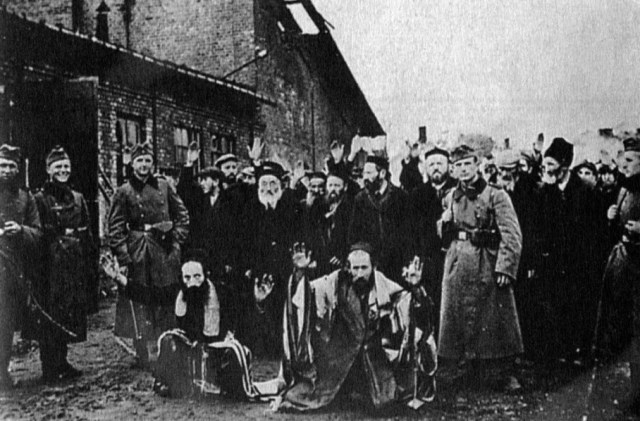
I firmly believe in the power of tradition over time, and the peril societies court when they chuck it wholesale.  It should never work.  And yet, it some sense the Nazi’s utter abandonment of many very basic social customs “worked” for a time.  With obvious exceptions (see the photo below), an entire society changed its form of greeting in an historical blink of an eye.

Allert’s book helped answer my question, but he spends most of his time discussing the sociological aspects of personal greetings, and this proved a welcome surprise for me–though I should have guessed it from the title.

Understanding both the greeting and its rapid ascent we need to see Germany in context.  German culture has a long history, but not the German nation.  As a distinct political entity “Germany” did not exist until 1871.  For centuries the patchwork collection of provinces and principalities had been the happy hunting grounds of older states such as France, Austria, and even Russia.  In the mid-18th century Prussia emerged in its own right largely thanks to its military and somewhat autocratic kings.  But it took both the Industrial Revolution and Bismarck a full century after this to unite Germany under Prussian political guidance.

Bismarck had certain key goals in German unification.  Above all he wanted to avoid uniting Germany along democratic lines. Each major leap forward in the process of unification happened because of wars–the application of force.  After Prussia won the Danish War, the Austro-Prussian War, the Franco-Prussian War, Germany lost W.W. I. The Versailles Treaty only added to Germany’s humiliation and frustration at the terms of the peace, their geo-political “encirclement,” and so on.  The lackluster Weimar Republic and the accompanying degradation (real or perceived) of German culture fueled the desire to reaffirm German unity.  The push for a universal German greeting began in earnest.

Allert directs our attention to the nature of greetings themselves.  Even a simple “hello” invites someone into a personal space, and creates the possibility of more/deeper personal relationships.  Almost all social greetings have this character.  We request that others allow us into their world as we invite them into our own.

“Heil Hitler!” functions much differently.  It demands rather than invites, and here we see a link back to the means of German unification itself under Bismarck.  Germany became Germany due to force and political manipulation.  Now the “German” greeting will bring social unity in the same way–by force.   Allert astutely points out that “Heil Hitler” cannot even be called a personal greeting, as it involves no personal contact (as a handshake) and no sign of individual respect (as a bow or curtsy).  It immediately makes a division between the abstract mass of those who support the regime and the undefinable minority of those who do not.*

Perhaps this helps explain why the new “greeting” caught on so quickly.  It is not a greeting at all.  We can imagine the awkwardness of switching from saying, “Hello,” to “A merry-jolly day to you,” or something along those lines.  It probably wouldn’t stick.  But if we had to stand on one leg and look at the ground instead instead of saying “hello,” maybe that might have a better chance?

“Heil Hitler” shares much in common with other aspects of Nazi life.  Just as this “greeting” is not really a greeting, so too the goose-step march is not really a march.  Both de-personalize and therefore dehumanize life.  This clues us in that the Nazi’s cared not so much for “Germany,” or their warped idea of purity, but ultimately about their perverted idea of the so-called beauty in death.  Their desire to raise the stakes of a personal greeting speaks of the nihilism at the bottom of their philosophy (which Father Seraphim Rose alludes to in his brief article below).

Dave

*In their recollections many recalled that they could always tell where their teachers stood in relation to the regime by how they “greeted” the students with the obligatory “Heil Hitler!” at the start of class.  None (I presume) could have taught without saying it.  But some teachers always looked for ways around the full measure of obligation.  One remembered that a particular teacher always walked in the door carrying large stacks of papers under his arms, making it “impossible” for him to raise his arm as he likely said “Heil Hitler.” Another entered invariably with a piece of chalk in his hand already.  He would raise his arm to begin writing on the board, then turn to the class and say “Heil Hitler” with his right arm still lingering on the chalkboard.  I have much sympathy with these teachers, whatever their circumstances might have been.

This, however, is a better epitaph . . .


From Seraphim Rose . . .

The chief intellectual impetus for Vitalism has been a rejection of the realist/scientific view of the world, which simplifies things and “dries them out” of any emotional life.  Unfortunately, however much the Vitalist might yearn for the ‘spiritual’ or the ‘mystical,’ he will never look to Christian truth to fulfill this need, for Christianity for them is as ‘outdated’ for him as the most dedicated rationalist.  

The Christian truth which the Enlightenment undermined and rationalism attacked is no mere philosophy, but the Source, the Truth of life and salvation, and once there begins among the multitude a conviction that Christianity no longer remains credible, the result will be not an urbane skepticism imagined by the Enlightenment, but a spiritual catastrophe of enormous dimensions, one whose effect will make itself felt in every area of life and thought.

Towards the end of the 19th century, a restlessness and desperation had begun to steal into the hearts of a select few of Europe’s intellectual elite.  This restlessness has been the chief psychological impetus for Vitalism; it forms the raw material that demagogues and craftsmen of human hearts may play upon.

Fascist and National Socialist regimes show us what happens when such craftsmen utilize this restlessness for their own purposes.   It may seem strange to some that such restlessness would manifest itself in places that had reached the seeming pinnacle of human cultural and political achievement, but such manifestations should not surprise us . . . .

Perhaps the most striking examples of this unrest manifest themselves in juvenile crime.  Gangs roam about and have senseless wars with each other, and to what purpose?  Such criminals come from the “best” elements of society just as from the “worst.”  When questioned, such people talk of boredom, confusion, an unidentified “urge” to commit these acts.   No rational motive appears for their actions.

There are other less violent forms this unrest takes.  In our own time we see a passion for movement and speed, expressed especially in the cult of the automobile (we have already noted this passion in Hitler), and in our adulation of athletes.  Add to this the universal appeal of television, movies, videos, which mainly serve to distract us and allow us to escape from reality both by their eclectic and “exciting” subject matter and the hypnotic effect of the media themselves; the prevalence of sexual promiscuity, being another form of the “experimental” attitude so encouraged by the arts and sciences.

In such phenomena “activity” serves as an escape–an escape from boredom, meaninglessness, and most profoundly from the emptiness that takes possession of the heart that has abandoned God and refuses to know their own selves.

In politics, the most successful forms of this impulse have Mussolini’s cult of action and violence, and Hitler’s darker cult of “blood and soil.”   Vitalism, in its quest for life, smells of Death [and indeed leads to death].  The last 100 years have shown a world-weariness and its prophets have declared the end of the Christian west.  Beyond Vitalism there can only be the Nihilism of destruction.  Nazism itself had this function.  Joseph Goebbels wrote,

The bomb-terror spares neither the rich nor poor; before the labor offices of total war the last class barriers have had to come down . . . . Together with the monuments of culture there crumble also the last obstacles to the fulfillment of our revolutionary task.  Now that everything is in ruins, we are forced to rebuild Europe.  In trying to destroy us, the enemy has only succeeded in smashing its own past, and with that, everything outworn and old has gone.

11th/12th Grade: The Nazi State and the Art of Purity

Greetings,

This week we looked at rise of the Nazi’s in Germany during the 1920’s and early 1930’s.

How can we make sense of the rise of the Nazi state?  While countries like Spain, Italy, the Soviet Union, Turkey, and Japan all experienced totalitarian regimes in varying degrees, none had quite the intensity and impact of Nazi Germany (though it would be fair to say that Stalin came close).  What distinguished the Nazi’s from other regimes?  How did a country with one of the richest cultural heritages in the world give themselves over to abject barbarism?

Naturally we think of the Nazi regime as one built on hatred and violence, and there is much truth to this.  But unless we see that the strongest appeal of the Nazi’s for people was their fervent hope, hope for better Germany and a better world, we will miss the fundamental basis of their appeal.

Germany, of course, had only recently been a nation (since 1871), but before that greater ‘Germany’ had often been the stomping grounds of Europe.  When the European powers wanted to fight they often came to the divided German principalities to do so, dating back to the 30 Years War in the early 1600’s.  As a political and national unit, “Germany” lacked the strength to prevent it. The Versailles Treaty made the incredibly foolish blunder of humiliating Germany with its war guilt clauses.  The Nazi’s vowed that they would erase the stain of humiliation the world had inflicted on Germany.   If we can remember what it feels like to be humiliated, we remember too the anger and desperation we felt, and the desire to do nearly anything to rid ourselves of that wretched feeling.  The Nazi’s claimed to be able to do just that.

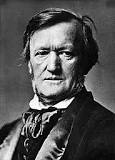
Richard WagnerHitler was obviously a cruel man, but he also believed that he had ‘high’ taste in art.  Many in the Nazi party leadership, like Hitler himself, were either failed artists, minor poets, or small time authors of some sort or another.  We saw Friday how Hitler was a big fan of opera, especially Wagner.  Hitler himself said that one could not understand Nazism without understanding Wagner’s music.  He filled his operas with romantic visions, grandiose themes and sets, and an idealization of antiquity.  All this moved Hitler, but perhaps Wagner’s deepest appeal lie in his theme of purity and sacrifice, and escaping the bonds of this ‘sordid’ world to achieve perfection, a kind of worship of death.

In Wagner we see a link between fulfillment and extinction.  In his Tristan and Isolde the two take a love potion, which also causes their death.  Wagner’s mistress, Cosima von Bulow, styled their relationship as a “death-in-love.”  Wagner became enamored with King Ludwig of Bavaria, and Ludwig of him.  Ludwig promised Wagner, “Rest assured that I will do everything in my power to make up for what you have suffered.  . . .I will procure for you the peace you desire in order that you may be free to spread the mighty wings of your genius in the pure aether of rapturous art.”  Once again, we see in Wagner not only life imitating art, but the concept of art and purity.  Hitler’s own death recapitulates in some ways the finale of Wagner’s Reinzi, where the hero, betrayed by those he trusted, dies as the city is engulfed in flames.  So too did Hitler die, feeling ‘betrayed’ by his generals, in flames, as Berlin burned around him.

When we think of Nazi rallies, one can see links with Wagner.  Many have commented on the theatrical nature of the rallies, as well as their over-the-top production.  They are spectacles that seek to overwhelm and get people to ‘lose’ themselves in the experience.

For the Nazi’s a great culture needed great art to embody and inspire it.  They had this in the past, in the form of Bach, Mozart, Beethoven, Goethe, Schiller, and so on.  They believed so strongly in this idea of a “healthy” culture that when the Nazi’s seized power, state doctors and ministers of culture often wore military uniforms.  Both doctors and artists had the charge of bringing ‘health’ back to Germany, be that health racial, moral, or cultural.  Doctors did not serve the individual, they served the “people,” the nation, the “race” as a whole, and this of course had horrible consequences later on.

In their eyes a ‘high’ culture would create a ‘healthy’ people, and a ‘healthy’ people would create an unbeatable army.  This is why they banned ‘mongrelized’ and ‘decadent’ culture like jazz (whose biggest stars tended to be either African-American or Jewish).  The Nazi’s didn’t just dislike the music, they viewed it as a threat to their national well-being.   But the same horrible logic applies to the euthanization of the mentally unfit.  Eventually we know that the ‘protection’ of the German nation meant the ‘protection’ of German blood.  Eradicating that threat meant eradicating the Jews, who had done more than anyone else to ‘pollute’ German blood over the years.  They had ‘infiltrated’ German society to a greater degree, and intermarried more than any other non-German ethnic or religious group.

Hitler, therefore, did not just promise an economic recovery, or to put people back to work.  He promised a kind of spiritual redemption on a national scale, one that primarily would touch the soul of the people.  Not surprisingly, he rose to power at a time when attendance in both Catholic and Protestant churches had been in decline.  Spiritual power has always been more potent (for good or ill) than mere political power, and this helps us understand Hitler’s hold on Germany.  We know how great art and music can move us.  But when we ascend to such heights of feeling the possibility of good and evil both increase.  Perhaps this is why a nation with such a rich cultural heritage could fall so far so quickly.

This has been a ‘heavy’ post so if you wish, join me and Looney Tunes in poking fun at Wagner, who certainly deserved it:

11th/12th Grade: The Left-Handed 1920’s

Greetings,
This week we wrapped up the Versailles treaty and introduced the “Roaring 20’s” in America, a time when the mood of the country shifted significantly away from the values of the Progressive Era, and what it meant to be an individual in America took on new meaning.  We discussed a few different things:
1. The Automobile
We take cars so much for granted these days we might forget about how they changed so much of ordinary  life when originally mass produced.  How did cars change things?
  • They made us more personally independent and mobile in general, although in time this became especially true for youth.  Cars became the equivalent of what making a name for yourself in the western frontier might have meant for generation in the 19th century.  Americans love cars, and not just for convenience sake, but because cars still feed our sense of identity and independence.
  • The car freed people from geographical limitations.  But this “freedom wasn’t free.”  The increase of our geographical mobility lessened ties to our local communities and families.  In an age less overtly Christian than previous ages, people would find their concept of community increasingly in the nation itself.
2. Prohibition
Prohibition failed in nearly every respect and must rank as one of our worst legal experiments.  It’s genesis had to do with a weird conflagration of unusual interests.  For example, the KKK backed prohibition as part of their overall anti-immigrant anti-Jewish agenda, but many women’s groups did as well.  The political power of women’s movements grew in the years prior to Prohibition, which culminated in the 20th Amendment giving them the right to vote.   In any case, Prohibition’s failure led to some good questions for us to discuss.
Why did it fail so badly?
Prohibition served as the last gasp of the Progressive Era, a time of energetic communal action to make things “better.”  But one can wind things so tight for only so long.  The war had exhausted much of that energy, and Warren G. Harding propelled himself to a landslide victory in 1920 based on his made up phrase, “A return to normalcy.”  And yet we picked just this time to forbid people from doing something they had always done, a juxtoposition made all the more awkward by the increased independence given by the car and the nation’s newfound status as a global economic power.
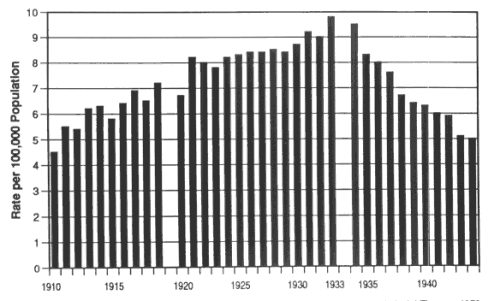
Here are a few indications of that failure, the first being crime rate:
Prohibition Era Crime Rate
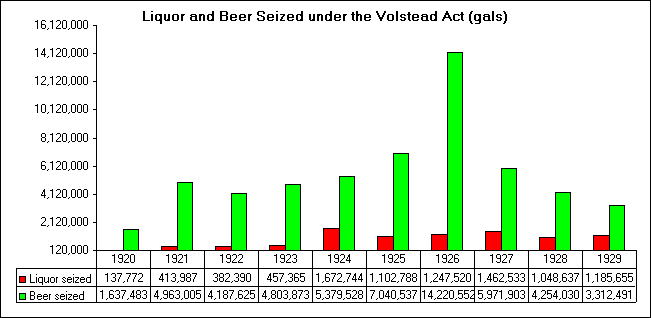
 People were certainly not drinking less during Prohibition. . .
What comparisons can be made with the Drug Wars of Today?
Many have compared our current failures in the “War on Drugs” to our failure during Prohibition.  Is such a comparison justified?
Prohibition and Crime Rates
Despite some important similarities, alcohol has been used and abused in every age.  It has formed the fabric of many religious rites and celebrations across time and space.  Narcotics simply do not have the roots in human experience that alcohol does.
Another difference is that, while the vast majority use alcohol appropriately, narcotics destroy the lives of most all who use them.
This does not mean, however, that practical realities may not force our hand in some respect.  Some in the class advocated strongly for much less tougher laws on even the strongest narcotics.
3. The Culture that Was the 1920’s
“Ragtime” reflected and helped fuel the image and feel of the 1920’s.  Here is Scott Joplin’s “Maple Leaf Rag”
We can see how the tempo and bounciness of the song reflects the spirit of the times.  But the innovation of “Stride Piano” in the later 20’s only fueled this sense of ‘movement.’  Here is James Johnson’s famous “Carolina Shout.”  Note the active and “bouncy” left hand in the bass clef, and how he plays around with standard meter.  The herky-jerky unpredictability of the song can be seen in sections like .49-1:12.  In the topsy-turvy world of prohibition, cars, women voting, and so on, here was music to fit its time.
To see a modern stride pianist where you can visually get a sense of the movement in the left hand, see the video below (fast forward to the 2:00 mark if you get impatient:)
Most of the time the right hand leads the way in piano music, but here the left steals the show, which again makes things seem upside down.   Music and society connect once more.
Hope you enjoy the music,
Dave Mathwin

11th/12th Grade: War Narratives and the Failure of Peace

Greetings,

We all know that peace treaties have a shaky track record.  When wars end we hope that the suffering might mean something, that it might translate into a political order that helps ensure that history does not repeat itself.  And yet, often these treaties fail.  We might think of the numerous wars between France and England, for example.  Various forms of “Punic Peaces” work, whether they take the form of utter destruction or sending Napoleon to St. Helena.  Most agree, however, that when we think of “peace” we often have something loftier in mind.

Some treaties do work.  The Civil War will not restart anytime soon.  Japan and the U.S. have been friends since 1945, and the same is true of our relationship to West Germany/Germany.  But many don’t work, and fewer treaties failed more spectacularly than the Treaty of Versailles after World War I.

Historians offer many theories to explain why treaties fail in general.  The typical mistakes usually fall into a few categories or patterns:

1. Failure to View the War as an Organic Whole

Though it may seem artificial, I think that major events should be viewed through a narrative lens.  World War I had its own prologue, beginning, middle, and end.  Wars tend to take on a life of their own once they get started.  As the “story” changes shape one can easily forget how it all started.  But this is a mistake.  A peace treaty should serve as the end of a story that had a certain beginning and middle.  If the end has nothing to do with the beginning, people will hate the ending and demand a rewrite, or at least a sequel.

I think this is one key reason why many treaties end up being no more than pauses in the action.  Combatants want an intermission, but don’t want the end to come just yet.  For them, there remains more to the story.

I think the victors in W.W. I would be strongly tempted to forget this principle.  Any analysis of the causes  of the war would have to blame a variety of factors and nations.  Certainly one could blame Germany mainly for the causes of the war, but other nations had their part to play as well.  Yet the combatants fought the war so grimly, and the death toll rose so unimaginably, that the victors would almost certainly think only of the fighting (the middle) and forget the beginning of the story.  The ending, then, would not fit within the story as a whole.

2. Failure to Look Ahead

Perhaps one can take my “story” analogy too far, because if we try and keep a war purely contained as its own entity, we miss the inevitable ripple effects that have spilled out into society because of the conflict.  Thus, a peace treaty has to deal with the war behind and look ahead to the world it made.  This need to “look ahead,” however, does not come easily.  We rarely see the nose on our own face, and lacking omnipotence, are left somewhat in the dark.

Treaties usually handle the “physical” aspects of ending wars such as reassigning territory, reparations, etc. but rarely consider the psychological aspects.  The horrors of the conflict imprint themselves on our minds, and the victors often want to “close the book” on that period as soon as possible.  We want to move on, relax, be happy.  The victors feel this way, at least.  But often the losers don’t want to move on.  They often want to dwell on the pain and humiliation they feel.  They want to be heard, and will not want to “move on.” Exhaustion on the side of the victors, more than apathy or ignorance, can be society’s greatest foe at this stage.

I think a good example of this is The Congress of Vienna, which decided that shape of Europe after the Napoleonic Wars of 1797-1815.  Millions died as the French Revolution convulsed the world and every monarch knew their days might be numbered.  My interpretation is that the assembled powers, smarting under years of war, tried to put Pandora, i.e. the French Revolution,  back in the box.  They suppressed popular movements, conceptions of “rights” — anything that smacked of the Revolution, and threw the baby out with the bath water.  Some might argue that the Congress of Vienna worked to keep the peace throughout the 19th century, but to my mind the Revolutions of 1848, The Crimean War, the wars of Italian and German Unification, the conflict between Turkey and Russia, and the eventual explosion that was World War I say otherwise.  Pressure cookers explode sooner or later.

3. Avoid Too Many Mixed Messages

Try as we might, mixed messages can’t be avoided.  As parents we give lip service to the ideal that we treat our children equally, but then reality sets in.  The age, gender, and personality of our children all play a role in how we parent.  We modify our expectations and begin to tailor certain things to certain children.  Children pounce on these discrepancies immediately and bemoan their fate, but if parents keep their different expectations reasonable  and at least mostly clear, we can keep the ship afloat.

Every peace treaty should have justice in view, but practical reality will always intervene.  Even the justly victorious must account for the fallenness of the world and the messiness of reality.  The vanquished will seize upon these crossed signals of justice and cry foul, but if the signal mixing is not too serious, they deal with it.

Problems come when the victors take a sanctimonious stance.  The infamous “War Guilt” clauses of the Versailles Treaty did just this.  Germany had to assume full blame for everything, despite the fact that no country had their hands clean during the conflict.  The infamous Article 231 reads,

The Allied and Associated Governments affirm and Germany accepts the responsibility of Germany and her allies for causing all the loss and damage to which the Allied and Associated Governments and their nationals have been subjected as a consequence of the war imposed upon them by the aggression of Germany and her allies.

Versailles also tried to reorder Europe along the idea of “national self determination,” and the elimination of empires.  Such was President Wilson’s grand vision for peace.  So, the war’s aftermath saw the creation of Czechoslovakia, Poland, Hungary, etc.  Except for Germany — Germans don’t get to be “self-determined.”   Some Germans went to Czechoslovakia, others to Poland, others faced occupation by the French.  We can compare the following two maps, the first showing the political divisions, the next, the ethno-linguistic ones, and the differences reveal themselves.

Europe, 1919

Overseas England and France kept their empires, however, but not Germany.  Neither did the U.S. give up its interests in the Philippines.  The gaps between “What we say,” and “What we do” grew very large at Versailles for the allies, and Germany noticed.

4. Don’t Kick them when They’re Down

This applies to Germany, but also Russia.  The Communist Revolution threw Russia into a tumult and made them persona non grata at Versailles.  They too lost big chunks of territory to Poland.  Both Germany and the Soviets had little to no choice on accepting the terms given their immediate internal domestic realities .   But both would seek to, in their mind, “set things to rights” as soon as they had a chance.  In Europe’s case, it took about 20 years for this to happen.

Next week, the Roaring 20’s back in America.

Blessings,

Dave Mathwin

11th/12th Grade: Haste Makes Chemical Weapons

Greetings,

We moved forward with  W.W. I this week, and this coming week we plan to discuss trench warfare and its companion, chemical warfare.

The map below shows Germany did have Turkey and Austria as allies, but both were very weak, leaving Germany to carry the overwhelming part of the burden against England, France, and Russia.  They knew they could not win a long a protracted war.  Trench warfare would do nothing if not slow the war down to a grind, and Germany knew that this would work against them.

Germany came up with two tactics to try and tip the scales in their favor: Chemical and Submarine Warfare (we will discuss sub warfare next week).

Chemical weapons were made with gas heavier than air.  The idea was that the gas would sink down into the trenches, killing men and perhaps, with high enough concentrations, make the trench unlivable.  This would flush them out of the trench, where they were sitting ducks.  Germany knew that they could not win a long war.   If they wanted victory, they believed, they needed a way to break the stalemate sooner rather than later.  Mustard Gas seemed like it might do the trick.

British 55th Division gas casualties 10 April 1918

England ruled the waves, and this allowed them to continually supply their troops in France and keep their economy moving forward.  Germany’s pre-war challenge to England’s naval supremacy fell short, but subs were a cheaper way to try and eliminate that lead.

Immediately the allied powers regarded both kinds of weapons as unfair and unlawful.  Most nations today agree that chemical weapons should be banned, but submarine warfare stuck around and became standard practice. Why do we make this distinction?  Is it justified?

In regards to chemical warfare:

  • It is a different form of killing, but it is a qualitatively different form?  Does anything separate being killed by a bullet and killed by gas?  Some argue that chemical weapons stay around and linger in the soil.  But what about unexploded land mines?  Should land mines also be banned?  In fact many argue that international treaties should do just that.
  • Sub Warfare was regarded as cowardly and ‘unsporting.’  It is also was patently ‘unfair,’ as it involved hiding from the enemy giving you an unfair advantage.  Thus, in the minds of many, war became murder.

At the back of all these issues is the ‘lawfulness’ of war.  Just war theory as it emerged from the early and Medieval church emphasized the ‘proportionality of response.’  But — if you don’t have ships, can subs be a ‘proportional response?’  If you lack the funds to make jets with precision guided weapons, can you instead develop an anthrax bomb?  Is that a proportional response?   Should war be essentially an affair of honor, like dueling?  Or is war really about victory, despite whatever gloss we put upon it?  We can also ask if moral action would always lead to victory, and what should a commander in chief do if moral action would make their country lose and suffer? Some students countered back to the original question – ‘Why are chemical weapons less moral than artillery shells?’

By the end of World War I, the European idea of war conducted in a gentlemanly way between ‘civilized’ nations disappeared.  Of course this would not be the first time in history that certain ideals about war would erode. Students who had me in the past may recall how the Peloponnesian War ended traditional ways in which the Greeks fought.

Some students thought that you could not introduce chemical weapons, but could use them if someone else did. What is the basis for this distinction, and does it work?

Some thought that Germany’s position of weakness justified their action, but this gets back to the question of whether or not some concept of right action or victory is most important in war.  Of course poorer countries today may not like being in an inferior position militarily, and may say that current bans on chemical and biological weapons are simply a way for the rich countries to maintain their advantage.

Whether the aggressor or not, Gemany’s ‘hurry up and win’ tactics hurt them strategically.  Their actions against Belgian civilians helped drum up political support for the war in France and especially England.  Their use of the submarine would ultimately bring in an entire new country against them, the United States.   It appears that for all their tactical success and ability (all agreed that Germans made the best trenches, for example), they lacked a workable long-term vision for how to win the war.

In this post I reviewed the book Just War and Christian Discipleship where author Daniel Bell makes the point that Christians need to abandon the “checklist” approach to war.  This attitude argues that the dominant theme in just war theory has been based on the idea that, “Because you did ‘x,’ now I can do ‘y.’  Such an approach, Bell argues, abandons the idea of war as a distinctly Christian calling, an activity like any other, designed to bring us closer to Christ.  Certainly Bell, I’m sure, would argue that chemical weapons have no place in a Christian concept of war.

Blessings,

Dave Mathwin

The Red Pants of France

Barbara Tuchmann’s The Guns of August discusses the controversies, dilemmas, and human drama in the days leading up to World War I. She puts a special focus on the war plans developed by France and Germany in the years leading up to the war. The two plans reflect much about the two nations. Germany’s Schliefflin Plan

  • Relied heavily on rail transport with precision timetables
  • Relied heavily on heavy artillery and all of the other goodies of industrialization
  • Involved violating Belgian neutrality, but no matter–the winner would determine the post-war narrative, and they had to go through Belgium to make their plan work.

France’s Plan 17 relied

  • Heavily on initiative in the field for individual commanders, with the emphasis on attack
  • Much more than Germany on the human element, “men win wars, not machines,” and so on–what the French called “elan.”
  • They eschewed heavy artillery, feeling that it would slow their men down and give them a dependent mindset.

Both sides had perfect awareness of the other’s plans, and both thought the strategic situation favored their own side. The French, with their army in red pants, hearkened back to an older time. Some called for the uniforms to be replaced with a more drab color less visible on the spectrum. The French general staff refused absolutely. The red pants embodied the spirit and will of the army, a refusal to bend to the industrial spirit of the age.

Alas, German organization, artillery, and precision destroyed the French army in first weeks of the war, inflicting at least 250,000 casualties. France had to adjust, and while they managed to stave off disaster at the Battle of the Marne, the dash and the human initiative would fade away just like the red pants. They too brought out heavy guns and “succumbed” to the Germany way.

As events unfolded, both sides ended up digging into the ground for what became known as Trench Warfare, which characterized the fighting in the western front right through 1918. Historians usually offer a variety of explanations for this unusual development–neither previous or future wars would ever use trenches so completely.

  • Some focus on the significant imbalance between defense and offense that existed between the western powers. Heavy weaponry for the most part had little mobility at this time, which limited offensive capability and gave an enormous advantage to the defensive.
  • Some focus on the narrow geography between the German and French borders, which meant an extreme concentration of men and machines. More space on the Eastern Front, for example, meant some more mobility and much less trench digging.

These explanations have merit but I think miss the larger picture.

The triumph of the metric system presaged military developments in World War I. The old systems of measurements had its roots in human experience and proportion, i.e., the “foot.” or the “stone” (about 14 pounds), which would be local and based on the weight of an actual stone in a particular town or region. The new system greatly maximized standardization, minimizing locality, and made it easier to count, measure, multiply, and so on. In other words, the new system granted one more power.* The Industrial Revolution continued this standardization, which naturally granted increased power to produce goods on a mass scale

But all of this power came from literally digging into the earth to obtain the necessary raw materials for the engines of industry and war. As industrialization reached its peak manifestation, the soldiers too dug into the earth. Perhaps the eastern theater of war saw less trench warfare because it had less industrialization. It seems a curious symmetry exists between the birth of the modern war machine and trench warfare, and we should endeavor to explain it. In other words, the creation of industrialization (digging into the earth), and its apotheosis (trench warfare) mirror each other (in the picture of the soldiers above, change the uniforms and the men could look exactly like miners). For Europe, World War I ended the belief in the inevitable progress of mankind, represented by science/industrialization and democracy. One can easily argue that science and democracy (in the form of mass media, mass mobilization, and mass production) made the war much more deadly than any previous conflict.

We can begin by noting the symmetry between birth and death. Interestingly, many ancient cultures buried people in the fetal position, linking birth and death in a circle, which I discussed here.

Perhaps this should not surprise us, as birth and death have something of a symbiosis.

We see a similar symmetry in rock music. I grew up partially in the Grunge Era. I took great delight in the transition from 80’s pop to Nirvana and Soundgarden. But anyone who reflects for a moment should see something odd going on with music in the 1990’s. In his excellent book on that decade, Chuck Klosterman made two keen observations:

  • The grunge attitude and aesthetic brought about the end of rock and roll. The whole foundation of rock music involved stardom, mass appeal, etc. Grunge artists had massive success while deriding, mocking, and hating that success, a kind of matter-anti-matter collision. In this sense, Kurt Cobain’s tragic suicide** can be seen as a harbinger, a death-knell for the genre as a whole. In many ways, the power that comes with stardom brings not life, but a kind of death, just as the power granted by industrialization ushered in an era of millions of deaths in war.
  • What was with the litany of songs with large portions of lyrics devoted either to nonsense, mere sounds, or garbled unintelligibility?

We’ll get to that list momentarily. We saw something similar at the birth of rock and roll in the late 50’s-early 60’s, in the form of a variety of songs with nonsense/unintelligible lyrics that made their way into the American psyche.

All of these songs share the exuberance that characterizes the birth of an era. The nonsense, the invented sounds, reminds one of little kids discovering their mouths for the first time.

In the 90’s you have Klosterman’s list of songs with nonsensical and unintelligible lyrics. But this time, the tenor, and atmosphere of the songs embrace not the excitement of new life but chaos, meaninglessness, and death.

  • Of course, Nirvana’s “Smells Like Teen Spirit,” with Weird Al parodying the song’s unintelligibility.
  • Blur’s “Beetlebum,” and “Song 2.” “Song 2” has a something of exuberance in it, but the video clearly shows it is the excitement of destruction, not creation. No coincidence then, that Paul Veerhoven used this song to promote his movie Starship Troopers, which parodied the meaninglessness of fascistic violence.
  • Trio’s “Da Da Da.” Volkswagen used the song expertly to hint at the banality of life for young men. Leave it to the Germans, I suppose.
  • Basement Jaxx’s “Bingo Bango.” Yes, the song has an upbeat mood to it, but the video hints at disorienting chaos.
  • “Mmmmm Mmmmmm Mmmmmm” by the Crash Test Dummies. The song has beauty, but it is the beauty of an elegy. The group’s other hit, “Coffee Spoons and Afternoons” talks about receding hairlines, hospitals, drinking coffee in the afternoon wearing pajamas–not exactly the stuff of birth.
  • At first glance, Hanson’s “Mmmmbop” may seem to have the stuff of “life” embedded within, but after listening for about 90 seconds, thoughts of anger, hatred, and despair flood one’s being. The song is hypnotically annoying/infuriating.

The end of rock music mirrored its beginning, but the mirror has cracks.

Historians date the birth of the modern state at different points. One can trace the beginnings in the later Renaissance, and things look more clear at the Peace of Westphalia in 1648. But to see the state as we know it, with its bureaucracy, centralization, uniformity of law, and military organization, we have to look at Napoleon. We have a fascination with Napoleon for good reason–undoubtedly he embodied something romantic, something of promise, in his early years.

But 100 years later, that civilization, while having much more power at its disposal, actually approaches its death–a variety of historians (Niall Ferguson, Oswald Spengler) see World War I as the end of the west. Certainly at least, Europe–the core of western civilization– has never recovered from that conflict. Western civilization’s power and identity had its start with going into the earth in hope that its raw materials would give us power to establish Kant’s dream of perpetual peace. It ended differently.

Dave

*A variety of people have pointed out this connection between counting, numbering, and power. This may be why King David suffered such a strong rebuke when he took a census in Israel. He tried to count “excessively,” i.e., he tried to consolidate power inappropriately at the end of his reign.

**In an interview with Vulture magazine, Klosterman commented,

What is so profound about Nirvana is that the relationship ended up becoming real. The song “I Hate Myself and Want to Die.” The idea that a person who writes that song also does commit suicide — that is so on the nose. People would say things like, “If that guy hates fame so much, why doesn’t he just stop?” We did not fully believe that Kurt Cobain was actually unhappy. And then when he killed himself, it made that music suddenly weirdly true.

He was presenting ideas in a culture where irony was the central understanding of all messages, and he seems to have had no ironic distance at all. It actually was incredibly sad and depressing to him that people he didn’t like loved his music. It legitimately bothered him that, say, homophobes liked his music. It bothered him in a way that for other artists, it would’ve been seen almost as branding.

11th/12th Grade: World War I: Tension between Diplomacy and Military Action

Greetings,

This week we examined four crisis that led to the outbreak of war in 1914.  In American World War II has always gotten more attention, but in Europe “the War” is still World War I, and I think with good reason.  World War II can be seen as a continuation of the first World War, and it was the first World War which ushered ended one world and brought forth another.
The outbreak of such a devastating conflict gives us a couple key points of focus:
  • Tension between Diplomacy and the Military — Diplomats, by their nature and job description, like to keep their options open and maintain the greatest possible flexibility.  This allows for the greatest amount of possible outcomes, and in their view, a greater chance for peace.
  • The military of course, needs to be fully prepared to face the worse case scenario, which is war.  It is wrong to view the military as always wanting war.  But, it is not unusual for them to argue that, in the event of war, we must be ready.  So often, political leaders will begin military preparedness in the midst of negotiations.  This rush to prepare, to call up troops, amass weapons, etc. inevitably narrows the options of the diplomats negotiating for peace.  If they are not careful, events will take on a life all their own.  In times of crisis, the goals of the diplomat and the general can easily veer in separate directions.
  • One of the problems in the days leading up to World War I was that in the minds of many ‘Mobilization means war.’  Once the Russian military began it’s mobilization, for example, Germany felt it must mobilize, and other countries followed suit on down the line.  It could be argued that no one really wanted war (this is debatable), but how could war be avoided if every nation acted as if war was imminent?
  • The Problem of Interpretation — As is often said by BIblical scholars, no one disagrees on what the Bible says (except in rare cases), they disagree on what it means.  It boils down to interpretation.  In the same way, does a strong military buildup send the message that 1) We are getting ready to fight you and want to be strong enough to win, or 2) We are a peaceful nation that wants a large military to deter any future attack.  If we were weak, we would be vulnerable, and invite war.  Thus, it is in the interest of peace that we build up our military.

The buildup of the German navy, for example, brings these issues into sharper focus.  For the entirety of the 19th century, England put nearly all of its security eggs in their naval basket.  They maintained one of the smallest infantries in Europe.  When Germany united in 1871 they immediately had the largest and best infantry in Europe.   This in itself posed no threat to England.  But in the 1890’s Germany begins a significant naval buildup, and one can have two basic perspectives.

  • Germany is a nation like any other, and with a powerful industrialized economy will come the desire to have a powerful navy.  This is only natural.  Secondly, France and Russia have an alliance against them, and to prevent blockade and encirclement in the event of war, it is only fair, just, and reasonable that they have a well-equipped modern navy.  Germany’s navy is rooted in self-defense, not aggression.
  • By building a navy, Germany did the one thing guaranteed to provoke England and turn them against themselves.  Their naval buildup was not necessary, so it cannot be termed self-defense.  England is their biggest trading partner and so any worries they have concerning their trade England can cover.  The only reason for Germany to build a navy, therefore, must be that they want to change the status quo, which they can only do through aggressive action.  The German navy means that Germany poses a distinct threat.

Which is it?

Blessings,
Dave

12th Grade: “The Center Cannot Hold. . .”

Greetings,

This week we looked at the beginnings of the Vietnam war under Kennedy and Johnson, up until the significant troop buildups of 1965.

One of my main goals with this unit is to avoid finger-pointing.  Hindsight is so often 20/20.  In truth the conflict in Vietnam posed questions that no one would wish to answer.  Vietnam’s dilemmas give no good answers, only hopefully less bad solutions.  When I think of the controversy surrounding the conflict, I am reminded of a comment of a monk named Columba Cary-Elwes, who wrote to a friend and professional historian in 1940,

I find we live in so criticizing an age that I spend my time summing people up — public figures, judging the motives of their actions and though I had the whole thing mapped out before me, as God must have, and I certainly have not.  We are always being given vulgar and crude and unkind judgments of people and peoples in the newspaper, and it becomes second nature.  I am going to try and not get caught up in this perfidious habit.  This arose out of Fr. Dunstan’s reminder that we are “near nothing” and we ourselves must try and imitate God, who is infinitely merciful.

We ourselves bear culpability for what happened in Vietnam, but to understand this we need to understand events in Europe in the aftermath of W.W. II England led the way in divesting themselves of their colonial empire.  To be fair, England emerged from the war with its reputation generally intact, whereas France humiliated itself in its capitulation to the Nazi’s.  Much of our modern image of France comes from this singularity, but for the previous 1000 years, France had the pre-eminent military in Europe, with luminaries such as Charlemagne, William the Conqueror, St. Joan of Arc, and Napoleon to their credit.  Their post-war agenda did not leave room for looking any weaker than they already appeared.  They were keeping their empire, thank you very much.  That included Indochina.

Some within Indochina looked to the U.S. for aid in their bid for independence.  After all, we too rebelled at one point from a European colonial power.  We declined.  Truman felt it more important to appease France (who wanted very much to join NATO to keep them out of the communist fold).  Unfortunately for us, (though not perhaps for the Vietnamese), this came back to bite us when France lost in Indochina and left NATO anyway.  A possible golden opportunity slipped away.

Historians debate the nature of this turning point in Asia.  Some assert that if FDR had lived, he would have made a different choice.  There are some intriguing quotes from FDR about how Europe was basically dead and how Asia represented the future.  But all we can do is speculate.

In the aftermath the U.N. created four nations, Cambodia, Laos, North and South Vietnam.  The division between north and south was certainly artificial, done for political reasons and not historical or cultural ones.  Was Vietnam within the purview of our strategic interests?  What kind of aid should we give them?

To understand our commitment to Vietnam, we need to go back to the Korean conflict.  Many believe now, and believed at the time, that our neglect to publicly proclaim our commitment to South Korea may have encouraged the North to invade.  We wanted to learn from the past, and so Eisenhower made our commitment to South Vietnam plain.  This, we hoped, would forestall an invasion from the north.

Well, it failed to do, which left us with a series of terrible dilemmas.

  • We could let South Vietnam collapse.  But what about then, our pledge to defend it?
  • We could give aid to the South and try and “prop them up.”  But how much aid should we give, and what form should it take?  Moreover, would the aid we gave them really solve the problems that South Vietnam had?

Johnson and his advisors knew full well that any aid to South Vietnam might be counter-productive.  We couldn’t keep them on life-support forever.  But eventually a new idea emerged.  Perhaps military engagement might force the South to get its act together.  If that didn’t happen, our military involvement might at least slow the North down and create a level playing field between the two nations.  While the South might not be better off, at least the North wouldn’t pose as much of a threat.

Such is the logic of war.  What I hope the students recognize is that not every story needs a dastardly villain.  Sometimes nations, as well as individuals, face only a series of bad choices, and have to make the best of it.  This, however, is not to say that the U.S. did in fact make the best of a bad situation, as we shall see.

We also looked at the 1960 presidential debate between John Kennedy and Richard Nixon, important for many reasons in our political history.  Most that heard the debate on the radio thought Nixon won.  Those that watched on TV (the majority) believed Kennedy won.  We saw a brief clip of the debate and discussed why that might be the case.

  • Nixon wore no makeup, while Kennedy did
  • Nixon looked much less comfortable on camera.  He shifted his eyes and smiled awkwardly.  Of course it’s not hard to miss his infamous sweating (towards the end of the clip).
  • Nixon wore a blase grey suit, Kennedy the classic politician dark blue.

This may also have helped originate many common tactics of candidates in debates, where candidates try to “stay on message” no matter what the question.  If you watch the clip, you see this perhaps more with Kennedy than Nixon.

Many of us lament the current state of our political discourse, and nearly all would agree that our modern presidential debates hardly dignify the word.  But the reality of our situation raises some interesting questions:

  • In the modern era, to what extent do we need presidents to be “actors,” and project a certain image?  Should it be an unwritten qualification for leadership?
  • TV is an inherently visual medium, and thus does not do well communicating written or spoken words (this was one of Neil Postman’s point in his Amusing Ourselves to Death).  Whether we like this or not, it is a reality of our culture and not likely to change soon.  Do we adjust the way we think of politics because of it?
  • If this concern for image has at least some legitimacy, what has it cost us as a democracy?

Later we will switch gears and look at the changes in music as a mirror for the changes in culture between W.W. II – Mid – 60’s.  I wanted the students to see our transition from broad based group oriented culture to a more individual/niche orientation.  Think for example of Glenn Miller.  He headlines, but the band is the star, and not him.  The music aims for a broad acceptance of broad cross-section of the population.  Culture in general happened on a big, broad scale.  Think of Cecil B. DeMille movies with their grand sets and dramatic scores, or Fred Astaire pictures with their big dance numbers.  Fewer African-Americans were bigger stars than Cab Calloway, but look how quickly he steps aside for the Nicholas brothers incredible dancing in this clip (certainly worth watching in its entirety — Fred Astaire himself called this the greatest dance number ever filmed):

Here is Fred Astaire himself in perhaps his most famous clip, a tribute to Bojangles.

The swing music of Glenn Miller, most popular in the 1940’s, showcased the big, broad, ensemble sound.

Overall, the theme here is akin to the summer movie blockbuster.  Go big or go home.

As we move into the late 50’s this begins to change, and we see this change first beginning in jazz music.  Ornette Coleman comes up with a different idea of what a musical note is. Coleman’s ensemble allowed for the musicians to each put their own individual, emotional interpretation on the music.

Thelonious Monk’s angular rhythms hit anything but the broad middle.  He created a sound totally his own.

In general, we see soloists rise in prominence in music, and this will presage the rise of individuals in society as a whole.  We should be careful.  The difference between an ensemble based sound and a preference for solos is not a moral one, so much as a change of emphasis.  We exist as members of groups and as individuals.  Both have importance, and our cultural expressions reflect both of these realities.  But, the change in emphasis does reflect broader changes in general.

We also saw how the niche of blues music morphs into the mainstream with rock and roll.  Artists like Elvis and the Beatles obviously gained huge followings.  But some of the British groups like The Who and The Kinks foreshadow disenchantment with the prevailing ethos.  Listen to “Everybody’s Going to be Happy,” and you can feel the intensity.  It’s not, “Everyone’s Going to be HAPPY! (YAY!) but “EVERYONE’S Going to be Happy.”  The Who appear to be harbingers of zany disregard for everything.  The song is called “Happy Jack,” and there are happy-sounding “la-la-la’s,” but the mood of the song gives a different message.

The music no longer aims for the broad middle.  As W.B. Yeats wrote in his famous poem, “the center cannot hold.”  Why did this happen, and what will be the results?  We will explore these questions next week.

Blessings,

Dave M

Just War as Christian Discipleship

Methodical.  Inexorable.  Annoying, sometimes provoking, and yet, ultimately convincing and convicting.  All these words sum up my 1441206817reaction Daniel Bell’s important book on the Christian just war tradition.

First the bad:

Bell could have used a better editor, and bears the hallmarks of a first book from the author.  He slides all too often into a repetitive and heavy didactic style, and uses paragraphs chock full of rhetorical questions that pile onto one another.  Not as bad as Mr. Chadband from Bleak House, but I might parody this habit of Bell’s thusly:

“And what are we to make of the Gadsden flag motto (used by Marines) “Don’t Tread on Me?”  Does it express a sentiment in line with the sacrificial love of Christ?  Does it encourage a transformative view of suffering?  Would such an attitude lead to just warriors?  What kind of motto’s should our soldiers use?  Is the church ready to inform the military about such things?”

So this was wearisome.

Bell also never applies his ideas to any particular conflict, which seems too easy for me.  Bell espouses some controversial ideas, but I wish he stuck his neck out a bit more and applied his thinking to some actual wars.  Granted, the reader can do this for himself, but Bell should have guided the reader a bit more in the interpretation of his ideas.

Despite these weaknesses, the book reminds us that the Church, nations, and militaries have almost completely lost touch with Christian concepts of “Just War” theory and practice.   Bell’s book does not condemn war outright.  Rather, he seeks to completely reframe the way we examine the issue, which may explain why both pacifist theologians and military chaplains have endorsed his work.

Speaking from a “Just War” tradition within the Church has its limitations.  Rarely did any accomplished theologian comment on the issue at length.  The Church’s most powerful voices on the topic, St. Augustine, and St. Thomas Aquinas, dealt with just war theory only in an in ad-hoc fashion.  Bell points out, however, that while the Church had few official individual voices on the topic, an agreed upon understanding more or less existed from the early days right up until the modern era around the 17th century.  Thus, Christians have access not just to Scripture, but also to an authoritative history of understanding of just war, what I will refer to as “The Tradition” in the rest of this post.

Bell’s main argument centers around his assertion that waging “Just War” has much more do with sanctification than a checklist of criteria that then give us justification to act as we please.  To fight justly means fighting as a Christian, with love for one’s neighbor and one’s enemy.  Fighting justly means not seeking to maximize personal well-being, or national safety, but working for the good of others.  Bell rejects pacifism.  There are times when acting faithfully might mean using force to achieve just ends.  But Bell argues well that if we cannot apply the central truths of the gospel message in how and when we fight, we have no business fighting at all.

This has many implications for us.

Self Defense

Modern understandings of just war often primarily focus on personal self-defense, or defending property, or maintaining a “way of life.”  But this approach puts ourselves, or our nation, before others.  Thus, “self-defense” can thinly disguise selfishness. As Augustine stated, “Christians should rather be killed than kill, rather suffer harm than harm others.”  Charity must prevail even under dire circumstances.

But as happens so often in this book, when you think Bell resolves the issue it deepens.  Christians can fight to defend others, particularly those who cannot defend themselves.  Christians can put others first by risking their own well-being to serve others.

If we wonder how we tell the difference between defense of self and others, Bell sympathizes.  The Tradition gives us no formula, no checklist, and this flows directly from the gospel itself.  For example, no checklist can tell you when you love your wife.  A husband cannot say, “I bought her flowers and watched the movie she wanted to see.  Therefore, I love her, and she should know I love her as long as I continue to do those things.”

What really guides the practice of Just War is not a list but just warriors themselves, who apply the gospel ethic to their situation.  This lack of black and white guidance may frustrate us at times, but Bell fears that the checklist mentality will give us carte blanche to do as we please once “the enemy” meets certain conditions.  I remember an anecdote about an ex-boxer bothered by a drunk. The drunk hit the boxer a few times, and the boxer responded, “The Lord told me to turn one cheek, and then the other.  He said nothing about a third time,” and proceeded to whale away on the unfortunate man.

The Purpose of War

From General Sherman we get the modern view that, “War is all hell.”  Those that follow Sherman believe that war remains essentially irredeemable, and making war as short as possible forms much of our strategy as to how we fight.

The Tradition offers another perspective.  In one sense we must treat fighting a war like any other activity.  We fight wars that we might grow in holiness, that we would grow closer to God.  For Christians war should develop the fruits of the Spirit.  If it can’t we have no business in it.

This may mean exercising patience.  It may mean that we fight in such a way where we give up physical advantages because of the moral problems that may result from our use of these advantages.  If we maximize the pain and suffering of our enemy in such a way that minimizes our own, we cannot claim to be just warriors following the call of Christ.

When We Fight

Following Christ means exercising charity towards one’s enemy, and charity requires us to give every reasonable chance to settle differences without violence through diplomatic pursuits.  We can use violence only when we know we have given other measures a fair try.  This raises questions about the impact of a large, professional, full-time standing army.  German theologian Karl Barth (no pacifist) argued that standing armies make it much easier for states to go to war than it should be.  Having an army always ready strongly tempts nations to use it much quicker than they ought.

We might reasonably ask whether or not one can exercise love and charity and kill another human being.  The Tradition says yes.  Justice can never rise to the dignity of the word if it stands separate from love.  “The Lord disciplines those He loves.”  Using force against another could be an act of charity.  You may be preventing them doing evil. Your “discipline” might move them to repentance.  Of course, once a person dies they cannot repent.  So the Tradition states that while we may at times use force, we must try not to kill our adversaries if we can avoid it.  Again Bell urges us to abandon the checklist in favor of Christ-like character.  Sometimes a just warrior may kill, but this killing must serve the gospel for the world and, crucially ourselves.  We cannot sacrifice our own souls or our own humanity in war.  One thinks, for example, of Joan of Arc, weeping over the English dead and praying over their wounded after a battle.

This might reduce the effectiveness of the military.  But it would be grossly uncharitable for us to urge that the military de-humanize itself and stand outside the Tradition so that we may be safer.  And–a dehumanized military would not serve us well in the long run anyway, and perhaps might even pose a threat to us.

Bell’s calls us all to own the call of “Just War.”  The military draws its direction from society, so the public must practice just policies if we want our military to do the same.  Again, the “just war” lifestyle is nothing less a Christian lifestyle, and we are all called to this.

In light of the witness of the Tradition, we have much to consider from not only our history (Sherman’s march through the South, carpet bombing in W.W. II, etc.) but also our current practice.  We already have extensive moral failures in how we use drones.  We waterboard but use the “checklist” mentality and avoid calling it torture.   The Guardian reports that we get doctors to harm prisoners by a perverse use of semantics.  The full articles is here, but the pertinent quote from it might be,

“Medical professionals were in effect told that their ethical mantra “first do no harm” did not apply, because they were not treating people who were ill.”

This does not mean that soldiers sin more than the rest of us.  Rather, soldiers sin in the same spiteful and selfish ways as all of us.  And this is part of the point Bell tries to make.  Fighting involves the application of our Christian faith just as much as teaching Sunday school.  Whatever, our problems as nation, whatever issues we have in the military,  all of us own them.

Bell touches on other topics, but at its core, the Tradition calls us back to our primary allegiance to Christ, not victory, the “mission,” expediency, country or tribe.  If our main concern is the salvation of our soul and the spread of His Kingdom, we will view war very differently than we do currently.  We may need to reevaluate why, when, and how we fight.  We may need to adopt the practice of  stepping outside our national context and ask if our side even represents justice in the first place.  This is what makes Bell’s book so necessary for us, and so difficult to accept.  As the Catholic theologian Jacques Maritain wrote,

We have no illusions about the misery of human nature.  But we have no illusions, either, about the pseudo-realists who cultivate and exalt evil in order to fight against evil, and who consider the gospel a decorative myth that we could not take seriously without throwing the machinery of the world out of order.

Oligarchies, Expansion, and a “Time of Troubles”

I posted this originally back in 2012.  While I could have added some new thoughts to the post I wrote directly on Eric Voegelin’s Science Politics, and Gnosticism (found here), I thought it better to include in this post as a sub-set on the idea of territorial expansion.

It may very well be that to read Eric Voegelin is to be confused.  I have had my struggles with his book Order and History: The Ecumenic Age.  But, remembering that he made a special study of gnostic ideas and philosophy, I found his thoughts on the origins of Gnosticism and its relation to territorial expansion very intriguing.

Gnosticism has many permutations, but at its core it propounds an opposition of matter and spirit, the soul and the body, and so on.  Some biblical scholars believe that the Apostle John may be attempting to counter Gnosticism in his epistles. Those who have read St. Augustine’s Confessions know that he involved himself in the gnostic ideas of Manicheism before converting to Christianity.  But gnosticism as a general philosophy pre-dates the coming of Christ by many centuries. Voegelin writes on its origins,

The genetic context to which I refer is the interaction between expansion of empire and differentiation of consciousness.  In pragmatic history, Gnosticism arises from six centuries of imperial expansion and civilizational destruction (p. 21).

Thus, we may assume that gnostic ideas had their roots in the first great ecumenic empire of the Persians, and this fits with the Zoroastrianism and its adoption by Darius I as the semi-official religion of his court.

As to the “why” behind the link between expansion and Gnosticism, I am less able to penetrate Voegelin’s thoughts.  But I believe that we can surmise the following:

  • Significant expansion destroys our sense of proportion.  If the empire is everywhere, it is nowhere.
  • Lacking perspective, we lack attachment to place.  Without attachment to place, we lose our attachment to creation itself.  As an old Irish proverb states (I’m not quoting exactly), “Those who travel much lose their faith.”
  • The power that comes with empire inflates one’s sense of self and distances us from others.  As Chesterton stated, one should pray in valleys, not mountaintops.

Related to the original post below, the disconnect from creation might form the spiritual basis of the problems faced by expansion.

Having recently glanced over The Goebbels Diaries I wondered —  did Hitler’s refusal to allow Rommel to withdraw at El Alamein, and his “fight to the last bullet” order to Von Paulus at Stalingrad arise not from hope of victory but desire for the extinguishing of matter?  As Germany’s territory increased, Hitler seemed more focused on a “refining” cataclysm for creation than in actual victory.  Once separated from creation, we come to hate it, with death as the (perceived) only escape.

And now, the original post . . .

Reading Explorers of the Nile spurred on a thought experiment.

While I have not been overly compelled by the story, there have been several interesting tidbits.  Regardless of one’s feelings toward the Victorian age in general, or the Brits in particular, one can’t help but admire the sheer will and energy of the second great wave of western exploration (the first being in the 15th-early 16th centuries via the Atlantic).  Many hundreds of men risked everything for the sheer thrill of discovery, and yes, for the glory of it as well.  In the early phases from ca. 1840-1860’s, most of this exploration seemed to me to have a generally innocent tinge to it.  The more acquisitive imperialism came later.

This energy and striving for glory reminded me of late Republic Rome, and the quote from Sallust in The Jurgurthine War, which reads,

I have often heard that Quintus Maximus Publius Scipio, and other distinguished men of our country were accustomed to declare that, whenever they looked on the masks of their ancestors, their hearts were set aflame in the pursuit of virtue [i.e. worthy deeds].  Of course they did not mean that the wax or the effigy had any power over them, but it is the memory of great achievements that kindles a flame in the breasts of eminent men that cannot be extinguished until their own excellence has come to rival the reputation and glory of their forefathers.

It struck me that it was during the later phase of the Republic that Rome grew the most in size.  If we look at a map of the Mediterranean at the beginning of the first Punic War in 264 B.C. . . .

Mediterranean, 264 BC

we see that Rome, though decent in size, does not dominate.  They have their sphere, along with Carthage, Egypt, Macedon, etc.

If we fast-forward 100 years we get a different picture, and as the map below indicates, Rome continues to grow almost geometrically down to the death of Caesar in 44 B.C.

Roman Growth Timeline

While Rome had a Republic at this time, I agree with Toynbee that while the government had democratic elements, it was for all intents and purposes an oligarchy.  The aristocratic senate dominated policy, however much voting by the masses took place.

Is there a connection then, between oligarchic democracies and expansion?  As time marched on from Charles I, England did by fits and starts become more democratic.  But 19th century England surely was not democracy in our sense of the word, and instead like the Republic showed strong oligarchic tinges.  As a monarchy, England’s overseas holdings were modest compared with the rest of the world, ca. 1800. . .

Colonisation, 1800

But a century later, after more democracy (while still having an oligarchy) and we see a different scene:

British Empire, 1920

As in late Republic in Rome, we have a near doubling in size.  Of course, something similar could be said of the other major European powers during the same time, many of them become more democratic after 1848, though again, like England, not fully so until after W.W. I.

Two examples do not really suffice to prove the connection.  But three will!

America gets accused of being an imperial power, but I think the charge false in our current, strongly democratic time.  It might have had more merit in the more oligarchic 19th century, however.

America, 1800:

America, 1800

America, 1900:

When America became more democratic in the 20th century, our expansion rapidly slowed.  Now, to be fair, we acquired Louisiana “fairly” from France by buying it, and Alaska fair and square from Russia.  But the same cannot be said for the Philippines, or the vast territory taken from Indians, including territory in Louisiana.  Both Abraham Lincoln and Ulysses S. Grant thought that our war with Mexico in 1846 to be manifestly unjust.

If we believe Thucydides, and call Athenian democracy in its golden age really a Pericles-led oligarchy of the best (a claim, to be fair, disputed by the great classicist Donald Kagan), we again see this principle of growth.  In 490 B.C. Athens stood as one city-state among many.  Not so 50 years later. . .

Map, Athenian Empire 431 B.C.

As to why oligarchic democracies have such expansionistic tendencies, I cannot say.  Perhaps it can be the subject of another post filled with wild theories.  But it does seem clear that this period of expansion leads to a “Time of Troubles,” for all parties involved.

For England and the rest of Europe, expansion gave way to the two World Wars.  America had its Civil War, caused largely by the exacerbation of the slavery issue.  The inflaming of the slavery question in its turn had its roots in the Mexican-American war in 1846.  Athens and the Greek world faced the Peloponnesian War (431-404 B.C.).  Though the proximate causes and results of these conflicts differ, they each have an age of expansion to precede it.

Any thoughts from anyone else, with more examples, or a connection between oligarchic democracies and expansion, are heartily welcome.

Blessings,

Dave

Revel in the Differences

I have noticed that it seems almost impossible for us to view the medieval period on its own terms. We work this out for almost any other civilization. The period has come under attack in two separate eras, from two different directions. First, we had the period from the late Renaissance through perhaps the end of the Cold War. This attack took the form of 1) Reason instead of “superstition,” and 2) Science over faith, and the like.* Today we see a neo-pagan revival, which has its manifestations in areas of culture such as Bronze Age Pervert, The Northmen, Bernard Cornwall/Netflix’s The Last Kingdom, and The Legend of Redbad. The basic theme of all of them centers around the strong reality of the pagan gods and practices, and the cruelty, venality, femininity and emptiness of Christianity.**

I think a variety of reasons exist for this critique. As I wrote here, one of them involves the idea of the awkward uncle vs. the stranger at Thanksgiving. Maybe your mom invites someone you don’t know to Thanksgiving dinner, a friend or co-worker. They may be great or interesting people, or not. Either way, it matters little. They are not “family,” so they inspire little emotional reaction. Having no attachments to us, we have no stake in how they act. But many of us have encountered the “crazy,” awkward Great Uncle. He’s family, so he gets an invitation, though some groan at the prospect. Maybe his mannerisms or his comments alienate people around him.

The unexpected guest might act obnoxiously as well, but the uncle inspires a much stronger reaction because of his family connection. Most people think he’s annoying and crazy. But maybe a few people think, “No–he’s the sane one–the rest of my family is crazy. Uncle Bill is great!” Those that love Uncle Bill, they tend to love the Middle Ages when they meet.

We have a strange connection to the Middle Ages. They are not nuclear family to us, but neither are they someone’s friend from work who shows up randomly. They are the Great Uncle. We can view civilizations like that of Egypt and China as a new guest at dinner. Showing hospitality to strangers has a universal history. But the awkward family member, i.e., the Middle Ages, gets a different treatment. We can argue and get mad at family, or passionately defend them. We wouldn’t do this with a guest. Some, for example, who seek to appreciate and praise the medievals get called fascists on Twitter. It’s Twitter, sure, but even on Twitter no one would call those who love ancient Chines or Meso-American civilization fascists.

Modern politics in the U.S. today has this same problem. True–many can see something recognizably American about both the guy in the loud oversized pickup with accompanying gun rack, and in the guy drinking a latte admiring the art in the Guggenheim. But . . . very likely neither of the two subjects in question will see this about the other. The Red State guy knows the Blue State guy is technically American, but he looks weird, and that’s unnerving, off-putting, bizarre. It inspires a gut-level horror reactions for both sides. As we have stopped mixing with each other, as technology and other factors allow us to narrow our scope, our fellow Americans increasingly look like the weird Great Uncle at Thanksgiving, though the Red and Blue guy would both show perfect politeness to a guest from Japan.

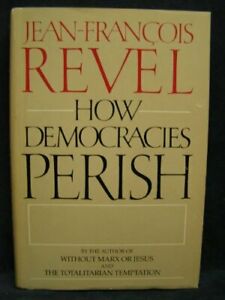
Jean Francois Revel was a French intellectual who pulled off the unusual feat of liking and defending America during the Cold War. He wrote How Democracies Perish not so much to praise America, however, but to express outrage and incredulity at other European intellectuals and politicians. Much of the book shows how the European press, and European governments, tended to commit a kind of suicide by showing much more suspicion, and less trust overall, to the Americans instead of the Soviets. He cites numerous examples of this with various press releases and newspaper articles regarding different aspects of Soviet and American actions. He compares European treatment of America’s involvement in Vietnam (quite harsh), with the Soviet invasion of Afghanistan, which many other Europeans of Revel’s class described as regrettable, but an understandable reaction against American ambition and aggression. He shows how the European press soft-pedaled the Cambodian genocide, but jumped down the throats of America when we failed to cooperate fully (according to the journalists, at least) with the Soviets on missile reduction.

Smart, sarcastic, old, Frenchies always provide a certain pleasure. Revel delivers the goods. But I think he misses something in the explanation of why this happened, and fails to expound on perhaps his most pertinent and brilliant insight.

As to what he misses in his explanation for Europeans’ attitude towards America, I present the ‘Uncle at Thanksgiving Dinner’ theory. We Americans come off as boorish, too loud, too simple, too whatever for many European sensibilities. But, we’re also clearly a chip off the old block. So that means that we come in for more criticism than those outside the family. Russia, China, Cambodia, . . . they have never been family to Europeans.^ This covers things only partially, I admit, but Revel looks almost entirely at the facts of the difference and mostly leaves off the reasons for it.

Revel’s best insight comes in the beginning of the book. He writes,

Democratic civilization is the first in history to blame itself because another power is working to destroy it.

. . . It follows that a civilization that feels guilty for everything it is and does and thinks will lack the energy and conviction to defend itself when its existence is threatened. Drilling into a civilization that it deserved defending only if it can incarnate absolute justice is tantamount to urging that it let itself die or be enslaved.

This condition has not always existed in America in Europe. But it did seem to grow as we grew more democratic.

Athens after Marathon in 490 B.C. started to show supreme confidence in itself. We see this in a variety of ways, in its literature, its innovations, etc. and this manifested itself in increasing democratic reform. On the eve of the Peloponnesian War, Athens went to war over what many would consider a trifle with the Megaran Decree, over the perception of whether or not they had bowed to Sparta or not. I’m not sure the Greeks would have thought this a trifle, but the point stands. They had great confidence and a thin skin.

Athens lost that war, but a curious thing happened. Their defeat ultimately failed to slow the progress of democracy. Athens may have been more democratic in 350 B.C. than in 450 B.C. I believe that much of the same trappings of democracy existed as in the Periclean era, but the aristocratic tradition which had moderated democracy, giving them an alternate framework to use (as well as the thin skin of the aristocrat) had no more presence. Phillip of Macedon in the 340’s B.C. provoked Athens just as much if not more than the Spartans in 430’s. Yet the Athenians responded much more tamely, much more “politely,” to Phillip than they ever did to Sparta.

Many might point to Athens’ great material prosperity, and then argue that this made them soft. Victor Davis Hanson I believe makes this argument in his book about the Peloponnesian War. This can explain some things, but not the whole picture. Athens had a great deal of wealth in the 430’s, perhaps more proportional wealth vis a vis other city-states than in later decades. This wealth gave no hindrance to their supreme confidence and a bullish imperialism. Likewise, England’s wealth ca. 1880 did nothing to curb their global dominance.

We may miss the fact that Athens’ democratic ethos had grown stronger since the advent of the Peloponnesian War. I believe that the technical Periclean structure had not changed much, i.e., they still had the same voting rights, jury pay, and so on. But they had “addition by subtraction”–the gilding of an aristocratic ethos that still lingered in the 5th century gave Athens an alternate framework to think with. It also gave them the confidence–and thinner skin–associated with aristocracies. But by 350 B.C., that aspect of Athenian life had departed, leaving them with an unvarnished democratic ethos.

Revel points out multiple examples of the following dynamic in Europe, which mirror that of Athens in the 4th century B.C.:

  • Europeans declare that NATO should avoid unduly antagonizing the Soviets
  • The Soviets do something antagonizing, such as clamp down on Poland, or invade Afghanistan
  • Europeans insist on a muted response, to avoid antagonizing the USSR any further.

This leads, naturally enough, to a weak foreign policy. Finding explanations in grand cultural and geo-political terms has great value. But I prefer bring issues into a smaller more human lens. With this above dynamic, the Europeans practice a kind of excessive politeness.

This is also pretty good.

Good manners should produce magnanimity and humility for those who practice them, and a deferential ennobling for those on the receiving end. But the excess of this virtue works against itself, creating slavishness on one side that likely will produce a prideful dominance on the other.

The main virtues of democracies involve

  • Openness, an openness to the ideas of others, and a belief that the clash of multiple perspectives will give rise to the truth, and related to this,
  • Inclusion, and the erasure of differences between people, a necessary bulwark of equality.

The problem comes when these virtues, not ultimate in themselves, get extended to a point where they lose their meaning. Those who practice inclusion with no discrimination . . . we call them prostitutes.^^. In such situations, one dies of the flood, where too many things converge, and so we lose distinctions and coherence.

This poses a difficult problem for us. We can see that in eras when western civilization had less democracy (in good and bad ways), say, ca. 1870-1914 we had much more energy, dynamism, and confidence. This resulted in a host of good and bad things–our era has both as well. As we grew more democratic (in good and bad ways) the virtues of inclusion could transform into slavishness. It is impossible to have it all. I am not criticizing democracy, only pointing out that as a political system, it has strengths, weaknesses and limits. It has not come to save us.^^^

Revel shows us that democracies weaken themselves by gorging on democratic virtues. inviting a newcomer to Thanksgiving dinner can have the paradoxical effect of keeping the family together. As George Harrison said, inviting Billy Preston to help them record Let it Be meant that the Fab Four had to be on their best behavior. But . . . invite the whole neighborhood and the identity of the family disappears. To preserve themselves, democracies should temper their virtues, for at their limits these virtues turn to vices.

Dave

*I recently rewatched Bill and Ted’s Excellent Adventure, that renowned 80’s classic. Our heroes go back in time to get greats from the past so they can pass their history class and eventually create universal harmony through glam rock. Everywhere they go back in time, they bring back greats from the past, including Greece, China, and so on. When they get to the medieval period, it’s all darkness, gloom, and people screeching about heretics. They have to rescue two “maidens” from that period forced into marrying some crusty old barons–there is nothing to preserve, nothing to bring back from the Middle Ages. In the movie it serves only as something to escape from. When the two “babes” are brought back into the modern era as part of their rescue, they are un-ironically introduced to the joys of credit cards and shopping malls.

**Albert Mohler has a great line which he uses on those who disparage aspects of the evangelical religious right: “If you don’t like the religious right, wait until you see the irreligious right.” By that he means not your typical agnostic libertarian, but the Neo-pagan worshippers of blood, soil, and violence.

It is interesting that such a revival would occur at a time when culture in various ways seems feminized. I would say that problem is not only Uber-femininity–though that is part of it–but also the reverse. In our culture today, the only way for a female character to be the hero is for her to act like a man, to be as tough, strong, as comfortable with killing, as a man. We have very little sense of the power of the true feminine virtues.

^How then to explain Europe’s current position with Russia as the ultimate enemy once again? Well, I know the ‘Uncle’ theory is incomplete–that’s a start. Also, there is the natural affinity with the underdog at work. But I think also that we went through a period between ca. 1985-2010 or so, that we started to think of Russia a bit more like family. Then, they “betrayed” the west and “reverted to form.” Europe will not forgive them for this.

^^Note how certain strands of feminist thought have turned completely against women. Most early feminists stood strongly against pornography and objectification of women. Now, some take the idea of supporting women so far that they declare “Sex work is work!” and demand equal respect for women who choose those “professions.” No one ever said that it wasn’t work. Objections to such practices had nothing to do with the definition of work.

^^^Democracy may not be my favorite form of government, but that is not the point. I wish that defenders of democracy would focus much less on arguments that it is better than other forms, whether or not such arguments hold weight. I wish we focused more on the fact that whatever its virtues and vices, democracy is our way of life and thus worth something because it is ours. This way of thinking has its limits too. Family is not absolute either. But it is a more solid foundation that debating democracy in the abstract.

The Metal Mountain

Originally published in 2021 . . .

***********

I am guessing that many of you have seen this video, of the dancing robots, from Boston Dynamics:

Most of the comments either say that this is the greatest or worst thing ever. I asked a science teacher friend of mine for his reaction. He said, “Really cool and impressive, but . . . also terrifying.” I had a similar, but flipped, reaction. I find the video viscerally horrible, and I had the strong urge to reach through the screen and smash the robots with baseball bats. But I have to admit–it is pretty cool.

“Both-And” trumps “Either-Or” in this instance, and so far my friend and I agree. But we can’t both be right in our emphasis.

In the pseudepigraphal Book of Enoch*, an apocalyptic text associated with Second Temple Judaism, we read of a “metal mountain” in chapter 52.

And after those days, in that place where I had seen all the visions of that which is secret, for I had been carried off by a whirlwind, and they had brought me to the west. There my eyes saw the secrets of Heaven; everything that will occur on Earth: a mountain of iron, and a mountain of copper, and a mountain of silver, and a mountain of gold, and a mountain of soft metal, and a mountain of lead.

And I asked the Angel who went with me, saying: “What are these things which I have seen in secret?”

And he said to me: “All these things which you have seen serve the authority of His Messiah, so that he may be strong and powerful on the Earth.” And that Angel of Peace answered me, saying: “Wait a little and you will see, and everything which is secret, which the Lord of Spirits has established, will be revealed to you.

And these mountains, that you have seen; the mountain of iron, and the mountain of copper, and the mountain of silver, and the mountain of gold, and the mountain of soft metal, and the mountain of lead. All these in front of the Chosen One will be like wax before fire, and like the water that comes down from above onto these mountains they will be weak under his feet. And it will come to pass in those days, that neither by gold, nor by silver, will men save themselves; they will be unable to save themselves, or to flee.

And there will be neither iron for war nor material for a breastplate; bronze will be no use, and tin will be of no use and will count for nothing, and lead will not be wanted. All these will be wiped out and destroyed from the face of the earth when the Chosen One appears in front of the Lord of Spirits.”

I am no scholar of such literature, but I believe a connection exists with the meaning of robots for us now and our current political situation–why both are full of wonder and terror all at once.

I begin my case in what seem will think a strange place . . .

We all remember the excitement of dating our spouse, or even dating in general. At the root of this excitement lies the mystery of possibility. A dating relationship has a great deal of “potential energy,” to use a scientific term. But we must convert this potential into actual energy, or the “potential” is dead and meaningless. We see the same relationship with money. If I receive an Amazon gift card, it is always fun browsing and imagining what I might purchase. Sometimes the actual purchase fails to live up to the fun of ‘window shopping.’ But if I never actually converted potential reality (the gift card) into lived reality (the book I would read), then the gift card is “dead,” lacking any purpose or telos.**

It is no coincidence that money–which represents a multiplicity of possible reality, traditionally comes from the earth in the form of precious metals. We can see the “mountain of metal” in Enoch symbolically as a mass of possibility attempting to reach up to heaven, akin to the Tower of Babel.

Whatever status we accord the Book of Enoch, this interpretation should not surprise anyone reading the early chapters of Genesis. Here we see that it is Cain and his descendants that cultivate the earth for its potential. They develop the earth for tools, cities, and weapons. This technological development leads to violence and disaster, the unleashed chaos of the Flood. When we understand that the paradise was located on a mountain (cf. Ez. 28), we understand the Fall as a coming down from “heaven” to “earth,” a physical as well as spiritual descent.^ After murdering his brother, Cain descends further into the earth in the development of various technologies. He becomes enamored with potentiality, and his descendants develop it for violent ends. We usually see new technologies creating disruption. While it might be a chicken-egg situation, I think the pattern in Genesis points to

  • First, chaos, then
  • Technological development

Might the 1960’s show forth this pattern? We had large scale social upheaval starting around 1959, then the space-race/moon landing.

The metal mountain–a mountain full of “dead” metal, can also be contrasted with the paradisal mountain bursting with life in Gen. 1-2. No one expects to see a mountain lush with life, but this is the kind of paradox that suffuses the Christian faith. Perhaps the metal mountain can be seen as a kind of anti-paradise. Most every culture has some kind of sacred mountain, as mountains represent a union of heaven and earth.^ The metal mountain, then, would represent a bastardization of this reality, an “earth only” mountain.

This is not to say that all cities, shovels, trumpets, and swords are evil in themselves, any more than the Tree of the Knowledge of Good and Evil was evil. But Adam and Eve were not ready for such a gift, not ready for the power such knowledge would convey. Acquiring this knowledge before its appointed time severed them from God, each other, and themselves. The theme of dangerous and thus forbidden knowledge has a reflection in other mythologies, most familiarly for us in the story of Prometheus who brought the tools of civilization to humanity.

So, yes, I fear the robots, not because they are evil but because I don’t think we can possibly handle such things rightly in our current moment. But I must acknowledge the romance of the “potential” the robots convey, just as I love to receive Amazon gift cards.

We can understand our current political situation with the same symbolic framework.

There are those on both the right and the left that want nothing to do with the mundane realities of “married” political life. Some on the left looted Portland for weeks, and others occupied Seattle. Some on the right did something similar with the Capitol. Both sides have elements within them that want to transcend politics, that want a divorce from the constitutional order. They are enamored with the possibilities of a brand-new trophy wife. Those on the left envision a utopia of equality from below. Those on the right envision a strong Caesar from above to lead them to glory and defend them from all evil. Both imagine a perfect marriage to Brad Pitt or Emma Stone is theirs for the taking. Again–we cannot deny the intoxicating nature of “potential.” Gold has always exercised this spell.

Many have remarked how social media, which exponentially increases the potential power of language, has exacerbated this problem. This makes perfect sense when we see language as the manifestation of potential from the earth, much like gold or silver coins.

In his The Language of Creation Matthieu Pageau develops this idea convincingly, and what follows here merely seeks to condense his description. If we think of letters as random marks condensed into form, we can see that this process of incarnating ideas in language essentially boils down to turning potential into reality, the same as turning a hunk of iron into a sword. First, the basic union of Heaven and Earth pattern illustrated by Pageau as developed in Scripture:

We should note well that “symbol” here means not an ephemeral representation of something real, but instead an embodiment of meaning, something more real than a mere fact.

Forgive the crude nature of the drawing below which attempts to illustrate the principle as it applies to language (also stolen from Pageau):

The internet adds even more potential to the reach of the human mind, and it is both terrifying and glorious.

The current political climate mostly reflects this terrifying aspect of the internet. Imagine our body politic as the guy in a marriage who constantly gets different women paraded before him, an endless array of options and perspectives. He might eventually grow tired of his wife, with so much intriguing “potential” before his eyes. Many elites and institutions have lost trust, and this accelerates the problem. But these untested political realities are the elusive fantasy girlfriend that you never have to live real life with.

Exposing ourselves to robots during such a chaotic time (in fact such things are more likely to appear during chaotic times–just like Cain’s tool-making was directly preceded by his wandering) may greatly exacerbate the “meaning crisis.” We should not storm the Capitol, ransack Portland, or mess around with dancing robots.

But . . . as much as we should hedge and protect our current political symbols and institutions, our political life is akin to, but not the same as, our sacramental married life. The unformed potential is not evil, but how we use it might be. No good can come to a husband witnessing a parade of super-models, but our political life needs more “give” than a marriage to stay fresh and alert. A political system needs to occasionally integrate new ideas. But the only thing one can do during a flood is batten down the hatches. Twitter, Facebook, Youtube–who can doubt they bring a “flood” of “biblical proportions?”

As usual, Genesis gives us the pattern from which to operate. We have the paradisal mountain with four rivers flowing through it. The mountain encases the dynamism of the rivers–“change” safely residing within solidity. Without this solidity, even small challenges to existing order will pose an existential threat. Maybe conservatives will have to tone down market dynamism. Maybe liberals will have de-escalate the speed of social change. Maybe that works, but we’ll need to turn our keys at the same time.

Dave

*The Book of Enoch is not regarded as canonical Scripture for any Christian group except the Ethiopian Orthodox. But, it was a book held in great respect by the early Church. The Apostle Jude quotes it in his epistle. We may say that it was part of the vernacular, perhaps, of the early Christians.

**It is in translating the “potential” into reality that determines a good or bad marriage. The husband/wife run the risk of things growing “dead” through the lack of potential. This can lead to affairs, or more benignly to the buying of sports cars. This is one reason (among others) why couples should have children–to have new “potential” come into reality. After a couple completes the child-rearing stage, which for many can last into their 50’s, they enter a new transformative phase of “death to glory.” The couple can no longer generate new “potential life,” and their hair grows gray. But even their gray hair manifests glory–“white light” streaming from their heads.

^The importance of mountains becomes obvious in Scripture once we get clued into this pattern, i.e., Mt. Sinai, Mt. Zion, Mt. Carmel, Mt. Tabor, the Sermon on the Mount, Christ crucified on the ‘Hill of the Skull,’ and so on.

Words in Play

Lots of pendulum swings happen in the history of thought, but these pendulum swings sometimes resemble more the bending of a line towards the form of a circle instead of opposite points on a line horizontally. In other words, when certain positions get to their extremes, they start to resemble what they claim to oppose. Reality, when warped, curves back on itself.

For example, one could argue that the age of imperialism in Europe came from the conviction that a) We are better than you, and b) We are different than you. This is a caricature, but we can let it stand for our purposes. In turn, this attitude called forth the work of Joseph Cambell, who argued in his religious analysis that actually, nothing has any difference from anything else. Narcissus, Christ, Osiris, and so on all participate in the same reality and are basically the same god. On the surface this looks like the opposite end of the imperialist impulse, but as imperialism grew, the mingling of cultures grew, and the differences between the cultures start to blur. For example, we have Rudyard Kipling as one of imperialism’s strongest advocates, but much of his writing shows a fascination not with English culture, but with that of India and Afghanistan.

So . . . McBain was entirely correct to conflate the Commies and the Nazi’s.

Plato and Aristotle give us the foundation to western philosophy. Many first notice their differences, and certainly they parted ways in key areas. Plato emphasized the unity of things via the world of the forms. He sought to draw everything up into the eternal, i.e., when we come to know and understand something, we are in fact remembering something we used to know.* Aristotle differed from his teacher and focused on particulars. We know him best through his extensive categorizations. He separates that we might see things more clearly. It seems they occupy opposite points on a line, with opposite strengths and weaknesses. But in certain ways they share the same strengths and faults. Aristotle critiqued Plato’s overgeneralizing of concepts, but he himself seemed to overgeneralize everything in the mythical/spiritual realm, consigning it all to irrelevancy. Like Plato, he criticized aspects of Athenian religion but could not see the particular threads of truth within it. In turn, Plato’s focus on finding the eternal kernel of truth led him to define concepts so finely that in the Laches a general does not know what courage is due to his faulty definition. They both over-generalized at times, they both hyper-categorized other times.

Avoiding this warping effect might involve taking Aristotle’s “advice:” If you drill a hole all the way through the earth and fall down from the North Pole, stop and hover at the halfway point. The key to healthy societies as well as healthy thought comes from fusing “Heaven” and “Earth,” and not by camping out at either locale.

I never knew that Plato’s dialogue Cratylus even existed until a few weeks ago. Here he focuses entirely on the role of language, and names in particular. The issue has relevance especially in times of societal breakdown. Without a common cultural framework, language loses its power as a conveyor of meaning and a means of discourse, i.e., we no longer have an agreed upon meaning for important words such as “male and female,” “racism,” “love,” and so on.

The dialogue begins with one extreme tentatively suggested by Hermogenes, who argues that, “whatever anyone agrees to call a particular thing is its name.” Socrates teases out the implication of such a position, which means that something can have infinite names, “And however many names someone says there are for each thing, it will really have that number at whatever time he says it?” Hermogenes reluctantly agrees.

Of course this won’t do, and Socrates leads Hermogenes out of this thicket. The problem of meaning has a link to the problem of virtue. If we can give names to anything we wish and have that in fact be its name, then we in effect, become the arbiters of reality itself. For, “some statements are true, while others are false,” and “it is possible to say things that are and that are not in a statement.” We are not God and cannot make reality come into being by merely declaring it so. Otherwise good and evil have no real existence outside of our own minds, and so we can call nothing truly good or evil at all. Meaning and coherence break down. The question of language is much more than academic.

So words and their meaning cannot come into being from below. The “bottom of the mountain,” so to speak, has too much individuation and division to provide a platform for societies. As our examples above show (i.e., Kipling, etc.), this extreme individuation shakes hands with extreme unity, for it cannot properly divide anything at all according to its nature. So in the end, with this view, everything mashes up together.

Socrates and Hermogenes then seek to go up to the “top of the mountain” to attempt to find the origin of names. Names function as a means of instruction, as a means of “divid[ing] things according to their natures. As Socrates comments,

So just as a shuttle is a tool for dividing warp and woof, a name is a tool for giving instruction, that is to say, for dividing being.**

Just as not all can use the loom, so Socrates asks, “Do you think every man is a rule-setter, or only those who possess the craft?” Hermogenes concedes that one must have the craft. Control of language cannot belong to the individual alone, but nor to “every man.” One must have “the craft.”

So Cratylus is right in saying that things have natural names, and that not everyone is a craftsman of names, but only someone who looks the natural name of a thing and is able to put its form into letters and symbols.

Undoubtedly language shapes our perception of reality, and possibly more than that, for in Genesis God’s speech creates reality as we know it. The names He gives fixes the distinctions between things, and Adam’s naming of animals gives humanity a cooperative role in the creative process.

The theological dilemma of, “Is something good because God declares it to be good, or does God declare something good because it is good already,” has a mirror in the dilemma about language.^ No one person can simply declare a word to be a word and have it fixed for all time. Socrates struggles with finding the absolute in each word. He had penetrating insights regarding the essence of truth, but stumbled in its application. The same hold true in Cratylus. The dialogue continues on a long excursion where Socrates seeks the unity of the principle embodied in names, and their particular Greek phonetics. Some of these endeavors succeed more than others. But in the end, Socrates must face reality–other cultures have different phonetical constructions for words embodying the same principles.

Socrates: Here is what I suspect. I think that the Greeks, especially those who live abroad, have adopted many names from foreign tongues.

Hermogenes: What of it?

Socrates: Well, if someone were trying to discover whether the names had been reasonably given, and he treated them as belonging to the Greek language rather than the one they were really from, then he would be in a quandary.

Hermogenes: He very probably would.

Socrates: . . . Consequently, though one might say something about these names, one mustn’t push them too far.

This realization leads Socrates nearer the truth, that language, like truth itself, involves a union of the masculine principle of declaration from those “who know,” from above, and the fluidity of things on earth. Socrates comments,

Perhaps you didn’t that [the names] are given on the assumption that the they name are moving, flowing, and coming into being. . . . Wisdom (phronesis) is the understanding of motion (phoras noesis) and flow. Or it might be interpreted as taking delight in motion. . . . Wisdom signifies the grasping of this motion.

For the rest of the dialogue Socrates struggles to find a way to unite the masculine and feminine aspects of language, but can’t quite get there. Still, he makes the crucial realization of the need for the seed from above, the plant from below, or the pattern and its manifestation must go together. For Adam in the Garden (Genesis 2) his names correctly manifested this, for at that time he had perfect communion with the Father above and the (Mother) Earth below. But since the sin entered the world, we essentially fail in proper manifestation of language, which furthers confusion of meaning.

But though we fall short, we still have the image of God within us, and can use Socrates’ insight to evaluate how we use words and their relationship to truth. There exists, for example, a certain method of Bible study among Christians that involves

  • Finding out the Hebrew/Greek meaning of a particular word
  • Grabbing a concordance to see where that word gets used in different parts of the Bible, and then
  • Using the meaning in one context to determine its meaning everywhere in Scripture.

This ignores the fluid aspects of language, and the central importance of context over strict phonetics. We all know that the word “radical” can be a math term in one context, an outdated term from the 80’s in another, an adjective for a political ideology, and so on.

Many of our current cultural debates, however, center around ignoring the fixed aspects of language. We can all acknowledge that the meaning of “male” and “female,” for example, have certain contextual fluidities determined in part by culture. Some men may be more effeminate, some women more masculine, than others of the same sex. But surely being either male or female cannot mean anything we wish it to mean. Biology certainly gives us constraints on the meaning of sex. The very fact that we call some men more masculine than other men shows that we have a defined concept of masculinity we cannot escape even if we wanted to. Indeed, some of those who wish to introduce more fluidity to the concept of sex/gender also decry “toxic masculinity” more than others.

It seems that we must see language, along with the reality language describes/creates, existing in a hierarchy. At the top we have God, who in Christian theology can only be defined as Father, Son, and Holy Spirit, one God in three persons. Then at the bottom we have words like “green,” a collection of phonetic sounds that can refer to a color, a newbie on the job, a person with sea-sickness, and so on. Yet while these phonetic sounds can take on meanings essentially unrelated to each other, they each manifest connections to a particular idea. More fluidity in language exists at the bottom of the mountain, but . . . not chaos. Then somewhere in the middle of reality, we have words such as “male and female,” which have more defined limits, along with a degree of contextual meaning.

Though the Cratylus fails to stick the landing on a unified theory of language, Socrates rightly intuits that correct naming is a “beautiful work.” We recognize beauty when we recognize a pattern, a pattern of the marriage of heaven and earth, of unity and diversity.^^ When this reality gets warped both the language absolutist and the language relativist both destroy the beauty of language and its meaning. Contrary to some, language is not a tool of power, but of meaning. When weaponized we lose beauty, wisdom, and also power. For in reality, power cannot truly exist without its connection to Heaven.

Dave

*I should state now that I am a rank amateur in my knowledge of Plato and Aristotle. My critique is not meant to deny their rightful place in the history of philosophy.

**Here we see more evidence of Andrew Kern’s suggestion that weaving and wisdom are interrelated in the ancient world, thus, the Luddites rebellion against mechanical looms had little to do with economics and much more to do with maintaining meaning and coherence in society.

^This dilemma is really no dilemma at all to those who understand Christian theology. The Church has always said that the answer to the above dilemma involves splitting the horns–things are “good” because God made them, and are stamped with God’s being and character.

^^I will attempt an explanation of my meaning by thinking about a spectacular sunset. We look up, and see light from above-that’s purity/Heaven. The light then transforms, becomes more fluid/diverse as it interacts with matter, the stuff of Earth. This combination produces the beauty we are drawn to.

While only God is eternal and infinite, this union of Heaven and Earth will continue into eternity. In His resurrection Christ continues to have a physical body. And when He returns, He will descend, and we will rise to “meet Him in the air.”

Command and Control

In the Soviet edition of Marxism-Leninism on War and Army published in 1972, a section reads,

Soviet military doctrine proceeds from the assumption that the imperialists are preparing a surprise attack against the USSR and other socialist countries.  At the same time, they consider the possibility of waging military operations escalating into military actions involving the use of nuclear missile weapons.

What struck me about this passage are the assumptions it makes and the consequences of those assumptions.  The Soviets assume we are the imperialists and will strike first. Would we want to forestall such an occurrence and strike first ourselves?  Perhaps we should.  Naturally, we would object to being called the aggressors in the Cold War.  From our perspective the Soviets showed their true colors in the closing days of W.W. II when they kept for themselves territory they took from the Germans.

But, if the Soviets thought that we would strike first, they might consider striking us first to prevent it.  Should we then strike them pre-emptively to prevent the Soviet’s pre-emptive first strike to forestall our first strike?

It all seems like a bizarre vaudeville routine, or one of Shakespeare’s mistaken identity comedies.

Nuclear weapons are of course very real, with extremely real consequences for their use.

And yet, I have always thought that a certain kind of unreality has always existed around nuclear weapons.  Children were told to “duck and cover,” and wrap their necks with newspaper for protection against nuclear attack.  We developed evacuation plans for cities that would never be used, for no such plan could have worked with 15 minutes notice before the bombs hit.  We never wanted to use the weapons, but they only had value if the other side actually believed we would use them, hence Nixon’s “I’m a madman” gambit to try and end the Vietnam war.  Nixon said to H.R. Haldeman in 1969,

I call it the Madman Theory, Bob. I want the North Vietnamese to believe I’ve reached the point where I might do anything to stop the war. We’ll just slip the word to them that, “for God’s sake, you know Nixon is obsessed about communism. We can’t restrain him when he’s angry—and he has his hand on the nuclear button” and Ho Chi Minh himself will be in Paris in two days begging for peace.

Eric Schlosser’s excellent book Command and Control gets at the heart of both the reality and unreality of the existence of  nuclear weapons.

A brief example . . .

The Titan II missile carried a destructive power 3x greater than all the bombs dropped in W.W. II combined . . . including those dropped over Hiroshima and Nagasaki.   But the weapon wasn’t very accurate, and very difficult to keep properly maintained. Still, because these weapons were our most powerful they had potentially significant deterrent value in the Cold War.  So that meant that they needed to be ready to go on a moment’s notice, as their silos would likely be some of the first hit in any massive first strike by the Soviets.

That in turn meant that they needed to be fueled and ready to go at 15 minutes notice, which meant they needed a special kind of fuel, Aerozine -50 .  I can’t imagine a fuel more volatile, as contact with leather, wool, rust, or other average products could cause it to combust.  That made the missiles prone to accidents with potentially horrifying consequences, and one such accident forms the backdrop of the book.

By the 1970’s Henry Kissinger, among others, wanted to make a deal with the Soviets.  We’ll get rid of our Titan II’s, you get rid of your big missiles.  But our Titan II’s were not as good as the Soviet’s comparable missiles, and the Soviets knew this.  No deal.

Kissinger wanted the Titans gone, but no one wanted to decommission them outright.  To take the missiles offline for nothing would show weakness, and lessen the amount of bargaining chips we had the next time we negotiated.

So they stayed.

But if they stayed, they needed to stay operational or it would be the same as giving them away for nothing.  So . . . no one liked the inaccurate, accident-prone, massively powerful weapon, but in the logic of departmental budgets and global politics, their silos stuck around.

As a friend of mine put it, a conspiracy of circumstances made madness look sane.  In a world where the image/symbolic value of nuclear weapons may have meant more than their reality, Kissinger’s stance makes perfect sense.  Indeed, as much as we might like to blame someone for this state of affairs, who would it be?  Even if we step all the way back and blame those that invented the weapons, we must then confront the possibility ca. 1941 that the Nazi’s might be building them, and we might want to get there first.  We all stepped through the looking glass more or less together from the Manhattan Project onwards.

When I first started this book I looked online at “nuclear weapons accidents.” I was utterly dumbfounded.  How could there be so many?  And given these accidents, how did nukes play such a large role in our policy?  This forms the bulk of Schlosser’s work.  Command and Control could have been just a laundry list of one accident after another, and  readers would be mere gawkers on the roadside.  Schlosser makes the book valuable because he looks behind the curtain (with massive amounts of footnotes) to show how the logic of nuclear policy developed.

At the heart of our possession of nuclear weapons lay a dilemma.  On the one hand, the weapons posed great dangers not just to those on whom it might be used, but to those who kept them.  Accidents happen, so naturally we should take great precaution to make sure we don’t have a nuclear accident.  So far well and good.  But the more safety restrictions one put on the weapons, the harder they became to use.  If they became too hard to actually deploy, they had no deterrent value.  If the weapons existed accidents would happen.  But how much effort should we put into preventing accidents if each safety measure made them less valuable as an actual weapon?  And again, if they didn’t function as weapons, deterrence broke down and the world became less safe.

Or so it seemed.

Different aspects of society had different opinions on this.  Scientists stressed safety, the military stressed the efficacy and availability of the weapon.  For example, a congressional committee reviewed security at Minutemen missile sites and found it lacking.  They mandated that access to the missiles be granted only with proper code identification.  The Air Force didn’t like it.  In event of an attack they would need quick access to the missiles, and who could tell who might need access if the normal command structure at the base broke down?  But in the end they complied with the congressional order.

They made the codes for all Minuteman sites 000-000-000.

Having a ready made deterrent also meant that we needed a lot of nukes in the air on planes, especially in the first 20 years or so of the Cold War.   Before we developed rockets and guidance systems the only way to get deliver the weapons was through planes.  The planes had to have the range to stay in the air long enough to get deep inside Soviet airspace.  This meant extensive use of the B-29 bombers, planes with a wobbly safety record.  The record is actually not that wobbly on paper, but we must factor in that these planes had to stay in the air constantly in case of surprise attack by the Russians   So if you expect a mishap once every 10,000 mission hours, that small number adds up quickly.  Every time a plane crashed or caught on fire meant a potential nuclear disaster.  Sometimes bombs got lost, sometimes they exploded, scattering radioactive material.  Sometimes the fact that the nuclear material did not detonate itself may have been a matter of chance.

Can we blame someone for this?  In my opinion, not really.  Accidents happen as part of life, sometimes no matter the precautions, and this means that nuclear accidents may be inevitable.

But there can be no doubt that the logic of the Cold War itself, along with departmental budgets, made accidents more likely.  For example, when various people or agencies raised safety concerns often little got done.  Acquiring new weapons was always preferable to fixing old ones, and this makes sense.  But rarely did older weapons get discarded.  More often than not, Kissinger’s logic mentioned earlier kicked in (of course this went way beyond Kissinger himself).

Yes, the Cold War and Mutually Assured Destruction no longer form part of the strategic calculus.  But Schlosser points out that the weapons still exist, and we must still deal with them.  To do so we must bring them firmly into reality.

One can’t help but wonder that if things were this bad in the United States, what were they like in Soviet Russia?  What about places like Pakistan today?  Amidst the confusion of alternate reality created by nukes, one things seems clear to me:  the fact that we have yet to blow ourselves up must be evidence that God exists, and that His mercy endures forever.

“Our danger is that we win all the battles except the last one.”

Despite a mountain of documentary evidence that survived the war in Germany, the prosecutors at Nuremberg had a difficult time establishing the guilt of some defendants.  Many of the top Nazi leaders had already died, and many of the accused found it quite convenient to blame things on those who could no longer answer.   What they knew and when they knew it, and where their responsibility lay was not always easy to ascertain.

Acclaimed military writer Basil Liddell Hart scored a great coup by getting several top German Unknowncommanders in W.W. II to talk to him about their war experience.  It proved all too easy for the generals to ascribe whatever success they had to themselves, and their failure to Hitler.  As Hart notes in his prologue, this means it’s hard to know how reliable Hart’s generals can be.  They may have invented self-justifications after the fact, and perhaps even believed such justifications.

Still, Hart’s The German Generals Talk succeeds on many levels.  While exact particulars remain cloudy in some cases, a definite overall picture emerges. Among other things, the paradigm the generals created (and we also tend to create) in regard to Hitler and the military needs tweaking, at least in some instances.

For example, we think of Hitler as a megalomaniac bent on conquest at all costs.  But how to explain, then, Hitler’s attitude towards Britain?  Hart shows that at least in the minds of the generals, Hitler wanted to back off of Britain.  At Dunkirk the generals thought that Hitler wanted the British to get away.  With Operation Sea Lion, generals complained that Hitler barely involved himself in the planning and seemed to care little for the details. He seemed almost relieved to break it off in its infant stages.

In truth, Hitler had always admired the British.  He praised them in Mein Kampf, which fit his racial view of the world.  The British, after all, had largely German and Nordic stock and thus were not Germany’s “natural” enemies.  Apparently Hitler believed that in allowing the British to save their honor at Dunkirk, they would more prone to accept a peace settlement.  Like Kaiser Wilhelm II, he implicitly thought that Germany and England were friends deep down.  Hitler’s egocentrism led to him to believe that everyone thought as he did.  All of us share this characteristic to some extent, but in Hitler it grew far out of proportion.  In this rare instance, his race theories actually made him less aggressive, and in this case, this instinct proved disastrous for Germany, a double irony.

Hart’s generals speak of how the army never really trusted or liked Hitler.  Every general interviewed sought to distance himself from Hitler in some way. But then this begs the question as to why very few military leaders stood up to Hitler, let alone actively tried to change the situation.  They explained their situation this way:

  • While many of the upper level officers might have gone against Hitler, their troops would not have.  Those from Major on down had been raised with the Nazi system and had much more loyalty to it.  Many officers doubted whether or not their troops would have followed them in rebellion.
  • The army had an ensconced officer corp with traditions that survived W.W. I.  But the Air Force and navies did not.  Many army officers believed these branches were comprised almost entirely of pro-Hitler sympathizers, as both owed their very existence to the Nazi regime.  Even if the army as a unit rebelled, the Air Force and Navy would not.

Hart offers little comment on this line of defense.  It has merit, and it touches on a larger question.  For democracy to thrive the army must be apolitical.  Is the Nazi army any different?  When do we want the army suddenly to get a conscience?  Commenting on on our military’s experience in Vietnam, one general stated that, “To argue that officers should be guided primarily by their conscience is to argue for military dictatorship.”  But of course we don’t want soldiers, or any human being, to reduce themselves to be a mere robotic arm of the state.

Interestingly the generals’ objections to Hitler had everything to do with Hitler’s military policies and nothing about the morality of the Nazi regime. Nowhere in this 300 page book is the Holocaust even mentioned, let alone the “killing groups” on the eastern front.  Maybe this has something to do with exactly who Hart interviewed, but I think it has more to do with the strict stratification of Nazi society, and the technocratic nature of their military education.  In the end, neither of these things can explain away their ultimate failure to act in any significant way.  None of them went nearly as far as Adolph Eichmann’s ridiculous assertion that, “I only transported people to the concentration camps.  I never actually killed anyone!” but they show the same tendency, albeit to a much lesser degree.

This point touches on how the generals conducted the war.  While Hart (a military man himself) often sympathizes with the military’s side of the story, he points out that the generals lacked strategic imagination.  At least at certain points and times, Hart shows how Hitler had greater grand strategic insight.  Hitler and his generals often clashed.  They had profound class differences.  The Prussian aristocracy surely resented the social mixing engendered by the Nazi regime.  But Hart shows that the differences between them also had roots in their personalities and training.  Hitler’s poetic mind gave him a potentially greater field of vision than his technocratic generals.

But this “greater field of vision” needs moral and “physical” roots.   Art has no merit for its own sake. Hitler often preferred the great, memorable, and perhaps imaginary deed to mundane reality.  If he were to win the war, it would have to be on his aesthetic terms.  So he ordered what in his mind were “gallant last stands” that really condemned his troops to slaughter.  The “Battle of the Bulge” had no real possibility of success due to lack of air support and supplies, but it would be so much more heroic than waiting behind fortified positions behind the Rhine.   Hitler seemed to live more fully in the world of Wagner’s operas than reality.

Hitler may have had at times greater strategic insight than his generals.  But this distance from reality made it so that he could never bother with mundane details.  As far as children are concerned, meat comes from the grocery store, and water comes from the faucet.  Hitler never either could or would take logistics like supplies into account.  That is why Germany could fall prey so quickly to “imperial overstretch.”  General Halder warned Hitler that, “Our danger is that we win all the battles except the last one,” and this proved prophetic in Africa, Russia, and even Europe.  Like Hannibal and Napoleon before him, Hitler forgot the need for political as well as military conquests.

It would be more satisfying for us if Hitler had a moment of self-revelation at his end.  But like many other Nazi leaders who took their own life, no such moment came.  Hitler never wavered from playing his part.  As various Nazi functionaries urged Hitler to flee Berlin, apparently it was Albert Speer who countered their advice by telling Hitler, “You must be on stage when the curtain falls.”  Speer knew that the best way to motivate Hitler was to play to his sense of theater.  Perhaps he wanted Hitler’s demise as much as some of the generals..

Dave