A Donut Shaped Universe

If anyone every feels a tinge of excitement opening Plato’s Republic for the first time, many find the text quickly snuffs it out. This foundational philosophical work starts off with a rather mundane conversation. Then, when Plato starts to talk about how the state should be built, one of the first points he makes is that no one should more than one job, one task. Stay in your lane, and do not deviate. Otherwise, “great evil” would result.

Such pronouncements strike moderns as absurd and non-sensical. I like Plato and think The Republic deserves its place in the canon, but I too never really liked the explanation given by various commentators about this section of the work.

Ah . . . but Jane Jacobs may have discovered the answer–one I had never heard or considered before.

All readers know the pleasure of discovering a new author, with the prospect not only of the current book in front of you, but of all of their other works. Well, historians get the same thrill as seekers of fiction, and I have to say . . . Jane Jacobs has been too long absent from my life. I am not sure if I agree with her, but that is not the point. The best teachers you have had may not have agreed with you, but pushed you to think, explore, and wonder.

But I have another qualification for a good historian–one cannot be simply a “one thing after another” type of historian. I would say that such people are in fact not historians–however good their research skills–for historians must create meaning. This means that historians must consciously synthesize even if they do not wish to overtly systematize. Jacobs showed in her most famous work (which I have not read) The Life and Death of American Cities that she can pick order out of the seemingly scattered flotsam of different neighborhoods.

One wants to agree with such people, and I find it annoying for the moment that I cannot decide quite what I think about one of her perhaps lesser-known works, Systems of Survival, a book that attempts to unify the entirety of history into two moral systems, or two ways in which civilizations, organizations, or movements, can order themselves. I admire the audacity of the attempt, and I love too that she organizes her thoughts in the form of hypothetical conversations–more books should take this accessible approach.*

Jacobs broadly identifies two “casts of mind” throughout history that derive from these two moral modes of being. The first, the “Guardian,” and the second, the “Commercial.” I think that “Cosmopolitan” fits better (my first minor disagreement with Jacobs), but I will stick with her terms. She has two of her characters demonstrate this with the following conversation:

Guardian: The love of money is the root of all evil.

Commercial: The love of power is the root of all evil.

G: History tells of the dynasties and the fates of nations and empires.

C: History tells us of how social, material, and economic conditions have changed.

G: The most valuable archeological findings are of art, religious artifacts, tombs, of kings, etc.

C: The most valuable artifacts are clues to how people lived everyday life, how they made their living, their tools and materials.

G: War and preparations for war are normal and peace a hiatus from war.

C: No–peace is normal, war is the aberration.

G: Man is a territorial animal.

C: People are city-building animals.

G: Knowledge is a weapon or possibly an adornment

C: Knowledge is a tool.

G: Intelligence gives us insight into others’ way of thinking–we should focus on what divides us.

C: Intelligence means primarily the ability to pick up new skills and good reasoning.  We should focus on what unites us.

G: China is prosperous at our expense.

C: China’s prosperity raises everyone’s standard of living.  Economic gain is not zero-sum.

G: ‘Ask not what your country can do for you, but what you can do for your country.’

C: The state exists for the sake of the people–that’s Locke, Rousseau, Madison–the social contract.

These casts of mind come from what Jacobs describes as two “moral syndromes.” By “syndrome” she simply means that the various parts of the moral system necessarily run together. She calls these the “Commercial” and “Guardian” moralities, and part of the vim and dash of the book is that she commits to the idea that these two “syndromes” are all that have ever existed. The values of each system are . . .

The “Commercial” Syndrome

Shun Force–Come to voluntary agreements

Be honest–collaborate easily with strangers

Compete–but respect contracts and other voluntary agreements

Use initiative and creativity

Be open to new things–change should be embraced

Be thrifty and efficient

Promote comfort and convenience

Dissent is valuable for the sake of the task

Invest for productive and practical results

Be optimistic

The Guardian Moral Syndrome

Shun trading, and exert prowess

Be disciplined and obedient

Value tradition and the ‘old ways’

Respect hierarchy–strive for loyalty

Make rich use of leisure–be ostentatious

Dispense largesse

Group exclusivity strengthens internal identity

Treasure honor

Jacobs has much to say about both, and of course both go right and wrong in different ways. In general, most of the world used to subscribe to a Guardian morality and now certainly the first world at least has shifted to the Commercial syndrome. But the shift has not been absolute, as ancient Babylon and classical Athens strike me as mainly “Commercial” in nature, and even “Guardian” civilizations had Commercial aspects. Cities, and any civilization with a port, generally need to adopt a commercial mentality.

I found myself much taken with her analysis, as it explains a lot of the success and frustrations we have with our predicament. The benefits of the Commercial syndrome seem almost second-nature. Our religious and political freedoms arise from it. The material comforts we enjoy come from the speed of innovation (and its accompanying trampling of tradition) over the last 250 years.** Many of our “freedoms” have also resulted from a variety of moral innovations, especially in the area of sexuality. To point out the obvious, if we like democracy we have to value collaborating with strangers.^

But a second look reveals its weaknesses. A “Commercial” society will never build pyramids or cathedrals–hence the constant critique of the vanilla-tapioca nature of democratic culture. The promotion of comfort will make it hard for us to sacrifice without an extreme need. The combination of valuing comfort and dissent make it hard to act as one with common purpose.

The Guardian Syndrome obviously has its associations with aristocracy and its attendant abuses–be they spiritual (such as pride), moral, (indolence) or otherwise–we see right away. But the Guardian syndrome can also give more civic-mindedness & “noblesse oblige.” Those in a Guardian society know their place and need not fight for it. Most every kind of environmental advocate, for example, uses aspects of the Guardian syndrome, i.e., hedging in and protecting defined spaces, and knows the futility of their approach to a Commercial syndrome society (something that Paul Kingsnorth discovered).

But back to Plato . . .

Jacobs surmises that what Plato might have meant by his condemnation of having more than one job or “calling” strongly correlates to these moral syndromes. When we “mix” these syndromes together we have the possibility of dangerous moral hybrids. A few examples . . .

  • In the 1980’s NYC sought to help fix crime on their subways by injecting the Transit Police (police have a natural Guardian morality) with certain Commercial incentives. The cops got rewards for things like efficiency, i.e., numbers of arrests, and competition (promotions for higher numbers). The result–Transit Police began falsely arresting people least able to fight the charges–the poor–who were mostly minorities.
  • The Nazi’s took certain aspects of the Guardian morality (such as defense of the homeland) and combined them with Commercial science, whose ‘innovation’ had spawned new racial theories, military ideas, and industrial capacity.
  • Marx hated bourgeois Commercial morality. But all of his theories lay rooted in western political categories of thought. One result–A generally Guardian mentality in terms of communal unity, but applied on a scale of universal Commercial ideology. Guardians tend towards being apolitical, but the Soviet Union also united the Guardian aspect of loyalty with Commercial ideological innovation. So–to be on the wrong side of the prevailing ideology=disloyalty to the state.

Yes, Jacobs also discusses positive moral hybrids, but seems to lean towards Plato’s conclusion that mixing them brings problems more often than solutions.

So far, so good. I found Jacobs’ thoughts stimulating and illuminating. Where I part ways with her comes with her theory of how these two moral syndromes developed. She postulates a material cause for each, with the guardian mentality arising from war, and the commercial from trade. But it is mind that generates matter, so to speak. It is mind that shapes matter. I won’t defend this proposition here, suffice to say, as a Christian I reject a strictly materialist argument for the origins of civilization. But, Jacobs has a point. These moral syndromes have ancient roots–more ancient than she supposes.

For civilizations to work, they must take into account both unity and diversity. Something must bring them together for a society to form at all, yet if this “something” binds them too tightly it will neglect their individuality. This has its roots in Being Itself. God is both Unity (1 God) and Diversity (3 Persons).

Christ, being both God and Man incarnated this duality/tension. He revealed to us both what I will “Open” and “Closed” ways of being. The Open way shows how God shows Himself in Nature (Ps. 19:1) or our fellow man (Mt. 25). Marriage is an icon of Christ and His Church. (Eph. 5). In other words, the Open way encourages us seek Truth in our experience of the world.

But just as often, we are encouraged to take the Closed way. We must gouge out our eye if it causes us to sin (Mt. 5). St. Paul often posits enmity between the world, the flesh, and the Spirit. Christ tells us that we must “hate” even our mother and father for the sake of the Kingdom. The Closed approach urges us to seek the Truth by narrowing, not broadening, our focus and shunning the trappings of this mortal coil that we might see God and God alone.

So is the Open or Closed way superior? The answer, of course, is ‘Yes.”

I love that the world Jacob’s presents has coherence–two halves, coming together to make a whole. The problem is that, like a donut, it lacks a center. Without this center, Jacobs’ outstanding observations lack any real meaning. But with the center, we have the possibility of real coherence.

And who would complain about having an extra bite of a donut?

Update . . . if only Jane Jacobs were here to comment on the Blue Angels flyover that happened Saturday (May 2, 2020), she might argue that one’s reaction to the event would pefectly pigenhole a person into one of the two aforementioned moral syndromes–if we keep in mind that heavily symbolic and “ostentatious” nature of the event:

Commercial:

  • This display wasted money that could have been used to so much better practical good
  • This display wasted time and effort.
  • This display foolishly misdirected our attention–encouraging the American public to look at the shiny object, rather than a) the problem itself, or b) the politicians and agency heads responsible for gross mismanagement of the whole pandemic.

Guardian:

  • We live by symbols, and having our most famous and powerful planes flyover gave the nation a powerful symbol of American pride and resolve.
  • These “unnecessary” displays are in fact, absolutely necessary. We are not materialists–we need such acts to lift us out of the mundane of our lives. We need ‘elevated’ out of our current circumstances. We need inspiration as a people if we are to win the “war” against the virus.
  • Leaders act responsibly when they provide these symbols for the people–something to inspire awe and help unify them.

*Another notable fact about Jacobs–she had no college degree and can be therefore classified as an amateur. Toynbee would have rejoiced.

**Though–different writers from different perspectives, such as Tyler Cowen, Ross Douthat, Peter Thiel, and even Jane Jacobs herself (in her last book Dark Age Ahead) have declared that innovation has essentially ceased in western economies.

^This kind of collaboration also seems on the decline, in Congress, in marriages (Republicans don’t marry Democrats, and vice-versa), etc.–and this may herald a decline in democratic practice.

Rebels Against the Future

(The Grumpy Old Man podcast that touches on some of these themes can be found here.).

**************************

A few years ago at the Circe Institute conference Andrew Kern made a startling statement.  In the midst of his opening speech he mentioned the Luddites.  I have always assumed (like most of us I suppose) that the Luddites attacked the mechanical looms for economic reasons.  But Kern suggested that perhaps the Luddites acted unknowingly for more fundamental reasons.

All throughout ancient literature (which people in the early 19th century would be familiar with) weaving relates strongly to wisdom.  So Penelope’s weaving, for example, is not merely a clever device to stall the suitors.  She represents wisdom and faithfulness in contrast to the suitors who grasp for power and wealth.  They will not confirm Odysseus’ death, rather they will take what they want in defiance of the pattern of creation and marriage.  The idea of the “fabric of society” closely relates to weaving, and so on.

So, Kern surmised, the Luddites didn’t just act to try and preserve their jobs.  They may have acted to preserve the idea of wisdom itself, though almost certainly not overtly but in a sub-conscious, Jungian sense.

I thought the idea intriguing at the time, but perhaps a bit of a stretch.  But I started to look for weaving in ancient literature.  To my surprise Plato uses weaving in his dialogue “The Statesmen” as an analogy for good government. With Jason and his Argonauts we see Medea the sorceress contrasted with Queen Arete, who is weaving when we first meet her.  In Homer’s The Odyssey we see a couple of references to the span of life compared to a thread (7.197-198, 24.38-29).  Melville uses similar imagery in chapter 47 of Moby Dickand we also see it in the Upanishads.  Isaiah 38:12 reads, “My life was with me as cloth on a loom, when she that weaves draws near to cut off the thread.”

The philosopher Porphyry uses very similar imagery in his On the Cave of the Nymphs, another reference to the Odyssey (13.102-112).  Here Homer refers to a murky cave which contains, among other things, “looms, likewise of stone, on which the nymphs wear weave sea-purple garments.”  Porphyry writes (and we should remember that he–unfortunately–believed in the pre-existence of the soul),

What symbol could be more appropriate than “looms” for souls descending to birth and the creation of the body?  , . . For flesh is formed in and around the bones, which in living beings resemble stones.

We should not miss the connections to the fundamental facts of weaving, birth, death, blood, and the like.

So perhaps Kern, and the Luddites themselves, were on to something.

I finally went in search of a book on the Luddites and came across Rebels Against the Future by Kirkpatrick Sale.  Sale gives a good overview of the Luddites but does little else.  He gives us some important perspective, showing us that the Luddites had nothing against technology per se, but only against, to quote from a Luddite letter, “Machinery hurtful to commonality.”   He clearly favors the Luddite cause and shows many examples of their courage.  Sale’s explanation for the Luddites ultimate failure, however, leaves out to my mind the most basic reason.  In resorting to violence, they at times fired upon common men like themselves, and thus abandoned their moral high ground.  Furthermore, their use of violence played directly into the hands of their adversaries.  Once they broke the law, the state naturally would defend the men behind the machines.  And the state had much more force to use than the Luddites.*  Had the Luddites exercised more patience and used a non-violent, grass-roots approach, history might have been different.  As to how different, Sale offers no thoughts.  Did industrial looms pose more of a threat than factories that performed other tasks?  Would it be possible to industrialize in some areas and not others?  If other countries industrialized their economy, and thus, their armies, what would the consequences be for a non-industrial country?  The age of imperialism might offer some hints on this, and questions about community balanced with security (among other questions) should be asked.

Sale just scratches the surface.  Maybe not much else exists to see.  Maybe the Luddites had no higher purpose than saving their jobs.  But I think the Luddites continual references to “commonality” hints that Kern had more insight than I first supposed.  I will hope to find other books that can take the issue deeper.

My favorite part of Toynbee’s sixth volume of his A Study of History deals with his examination of what he calls archaism.  “Archaics” in his context seek to recover their civilization in a time of crisis by using a time-machine to travel back to some imagined golden age.  We should much prefer archaism to “futurism.”  The past has the advantage of having an actual reality and thus restrains action somewhat.  The futurist has no such limitations, and the evil they work in their earnest desperation will likely be much more terrible.  Toynbee points out that archaists would usually rather be archaeologists than politicians.  Alas, political realities set in and something must give.  The impossibility of drawing back the masses to the past with you means that archaists often choose violence in the end.  And this ends up dooming their movement.**

I think the Luddites use of violence contributed heavily to their defeat, but I would not call them “archaists.”  They sat on the knife-edge of change and saw a darkness on the horizon.  The “past” they tried to preserve was in fact the present.  Given that they did not reject all technology they had no wish to futilely put the brakes on all aspects of societal change.  They saw clearly what the Industrial Revolution would do to their communities and their sense of self.  If they did not submit to “archaism” they had more psychological flexibility at their disposal, which makes their use of violence more troubling to me.  Perhaps in the end they simply lacked the very rare traits necessary to translate those ideas politically.

Or perhaps their concerns went far away from politics.  Perhaps they saw themselves as doomed crusaders, but bound, like crusaders, to something deeper and older than politics.

Maybe.

According to the Tradition of the Church, at the Annunciation the Virgin Mary was found by Gabriel in the Temple . . . weaving a veil for the Temple where she resided, and some icons of the Annunciation (such as the one below from the 14th century in Serbia) show this as well.

In Hebrews 10:20 we see the identification with Christ’s body with the veil of the sanctuary (10:20), and we know that both the Temple curtain and the Body of Christ were broken for the life of the world.  Father Maximos Constas writes, “With the strictest visual economy, then, Mary’s thread gives consummate expression the . . . continuum of conception and crucifixion.”^

From St. Epiphianos:

About Eve and Mary it was said, “Who gave women the wisdom of weaving, and the knowledge of embroidering? (Job 38:36).  For the first wise woman, Eve, wove material garments for Adam, whom she had stripped naked.  This labor was given to her, for it was through her that the knowledge of nakedness was acquired, and thus to her was given the task of clothing the perceptible body.

To Mary, on the other hand, it was granted by God to give birth to the Lamb and the Shepherd [cf. John 1:29, 10:11], so that from his glory we might be clothed in a garment of incorruptibility (1 Cor. 15:53-54).

And from St. Nelios the Ascetic:

The Theotokos [that is, Mary, the “Mother of God”] displayed such “wisdom and manifold knowledge” (Job 38:36) that, from the wool of the Lamb who was born from her, she was able to clothe all the faithful with garments of incorruptibility.  For all true Christians stand at the right hand of the King, in golden-fringed garments, embroidered in myriad forms of the virtues.

So it may be that the liturgy of the loom points us toward the wisdom of knowing salvation itself.  I’d like to believe that the Luddites thought likewise, and would love for someone to prove or at least suggest this in another book about them.

Dave

*Gene Sharp makes brilliant points about the benefits of non-violent struggle against states or state-sponsored entities in “From Dictatorship to Democracy,” available online.

**I.e, Tiberius Graachi, who committed himself almost entirely to non-violence.  But he did violate the Roman constitution and so became a law-breaker.  This may have cost his movement the fence-sitters they needed, and it also opened the door for the Senate to respond with force.

^The entirety of this paragraph owes everything to The Art of Seeing by Father Maximos Constans, pp. 108-109, as do the quotes below, found on p. 129

10th/11th Grade: Bismarck and “Unnatural States”

Greetings,

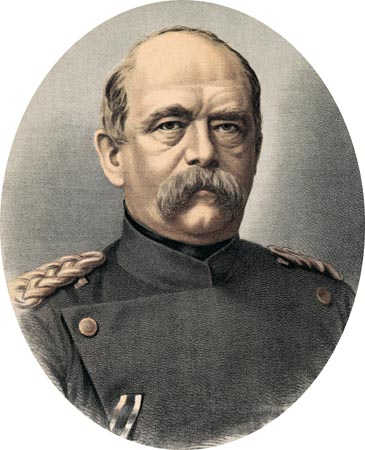
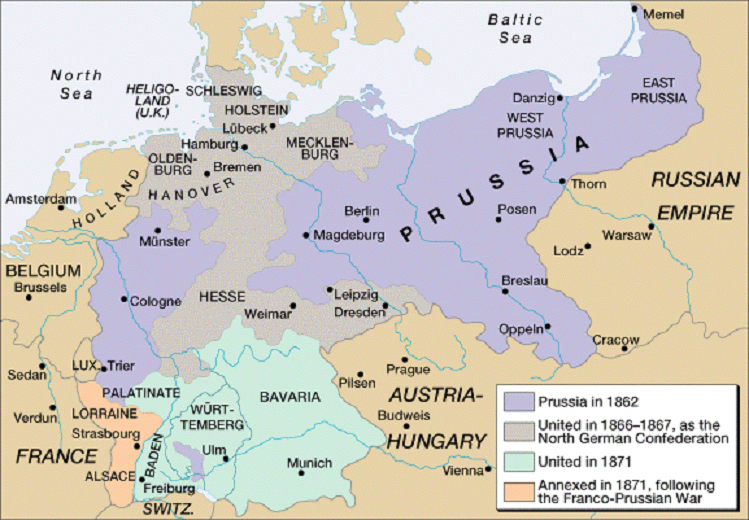
This week we began to look at German unification, orchestrated under the brilliant and controversial Prime Minister of Prussia Otto von Bismarck.

Bismarck raises some important and perhaps uncomfortable questions about leadership.  What is the line between serving the interests of your country and serving God?  Should nations be treated akin to how one would treat individuals, and therefore punished and rewarded like individuals?  Or, should nations be thought of as artificial entities that do not have to play by the same rules as people?  Cardinal Richelieu of France ((17th century) said that, ‘People are immortal and thus subject to the law of God.  Nations are mortal ] and are subject to the law of what works.’ That is, artificial and unnatural creations — one can’t imagine the universe as it is without gravity, but it would be the same universe without the United States.  This hearkens again to Richelieu who would have argued that while Frenchman are Catholic, France is not.  France can’t be Catholic any more than a cardboard box could be Catholic.  Frenchmen may be redeemed, but France will have no heavenly judgment or reward.  For better or worse, Bismarck would have agreed with him.  He also said,

If one wants to retain respect for laws and sausages, don’t watch them being made.

Politics for Bismarck was a dirty business, and there was no point pretending that success would not mean getting his own hands dirty.  But for Bismarck, the world of international politics remained essentially unredeemable, a conclusion Christians may not wish to share.

While there are many debatable aspects of Bismarck, a few things are beyond dispute.  He gained an advantage over some of his foreign political adversaries in part because he recognized what the Industrial Revolution would mean for politics before others.  He realized that

  • Mass production would lead to a ‘mass society,’ where mobilization of opinion could make a huge difference.
  • Old aristocratic Europe was finished, at least in the sense that kings and nobles could no longer act without direct reference to their populations.  The press and public opinion would be nuisances to others.  Bismarck saw them as opportunities for making Prussia’s actions much more potent.

Bismarck is  controversial because

  • He used democracy, but he did not believe in democracy. Bismarck “believed” in a strong state and saw democracy as a possible end to create that state. But he would also use other means to suit his purpose. In the end for Bismarck, ‘blood and iron,’ not speeches, win the day.  Force and strength were the best projections of power, though to be fair to Bismarck, he believed in a limited/surgical use of force.
  • Bismarck was the ultimate realist.  He believed that concerning oneself with justice, for example, could lead one to get carried away, to lose focus.  The primary motivation for policy should be whether or not it serves the interest’s of the state.  Don’t first concern yourself with rewards or punishments.  Do what serves the ends of the state.  A foreign policy built primarily on  morality (an example might be punishing or rewarding a country based on their human rights record) was not proper for a nation, however much individuals should be concerned with it.

As an example of his policy we can look at his actions during the Polish bid for independence from Russia.  When the Poles attempted to break from Russia almost every major power gave speeches expressing their support for the Polish cause.  They did so, no doubt, for a variety of reasons:

  • The Poles vs. Russia was a great underdog story and everyone loves an underdog
  • Independence movements were rife throughout Europe and everyone loves to bandwagon.
  • Polish success would weaken Russia’s power, and most wanted Russia weakened whenever possible.

Bismarck shocked everyone by not supporting the Poles, but even offering public support — and troops — to aid the Russians in crushing the rebellion.  Why did he take such a position?

  • Speeches make you feel good and important, but speeches themselves will not help the Poles one whit.
  • These speeches, however, will serve to alienate Russia, and you would have gained nothing and angered a major power. The words of encouragement you offered Poland (without actually helping them) might even alienate Poland as well (think of a situation where you are carrying something very heavy, and someone nearby offers words of encouragement but doesn’t lift a finger to help. You probably would not have warm feelings for that person).
  • No foreign power would actually send troops to aid the Polish, so again, the expressions of support meant nothing in reality.
  • The Poles, without foreign aid, would certainly lose.

Thus, it seemed far better to Bismarck to go against the grain and actually aid his country by standing up for Russia in their time of need.  Yes, other countries would get momentarily upset at Prussia’s actions, but again, it would mean nothing.  Bismarck planned to cash in  the favor he performed for Russia later, and he did in the Austro-Prussian War of 1866.

To put Bismarck’s actions in perspective, think of the “Free Tibet” movement that we occasionally hear about.  Lot’s of people make speeches to end Chinese occupation of Tibet.  But . . . no one will actually do anything about it.  No one would risk war with China over this issue.  The words of sympathy given to Tibet 1) Do nothing for the Tibetans, 2) angers China, which makes them 3) not just worthless, but counterproductive.

To put Bismarck’s actions here in perspective, imagine if a U.S. president not only did not support Tibet, but publicly supported China.

It would be a bold move.

This does not mean that Bismarck was personally amoral.  Rather, if nations are essentially ‘pieces on a chessboard’ they cannot be sinned against.  You can sin against people.  But you cannot sin against shapes on a map.  This hearkens back to Richilieu’s foreign policy for France some 250 years prior, and to Machiavelli before that. In the same way, no one would call you a ‘sinner’ if you bluffed in poker.  The poker game is in a sense, an alternate reality where different rules apply.  For Bismarck, the same is true of politics.  We see this philosophy come through in his famous musings after Prussia’s victory in the Austro-Prussian War:

We had to avoid wounding Austria too severely; we had to avoid leaving behind in her any unnecessary bitterness of feeling or desire for revenge; we ought rather to reserve the possibility of becoming friends again with our adversary of the moment, and in any case to regard the Austrian state as a piece on the European chessboard. If Austria were severely injured, she would become the ally of France and of every other opponent of ours; she would even sacrifice her anti-Russian interests for the sake of revenge on Prussia. . . .The acquisition of provinces like Austria Silesia and portions of Bohemia could not strengthen the Prussian state; it would not lead to an amalgamation of German Austria with Prussia, and Vienna could not be governed from Berlin as a mere dependency. . . .Austria’s conflict and rivalry with us was no more culpable than ours with her; our task was the establishment or foundation of German national unity under the leadership of the King of Prussia.

….To all this the king raised no objection, but declared the actual terms as inadequate, without however definitely formulating his own demands. Only so much was clear, that his claims had grown considerably since July 4. He said that the Austria could not be allowed to escape unpunished, and that, justice once satisfied, we could let the misled backsliders off more easily; and he insisted on the cessions of territory from Austria which I have already mentioned.

I replied that we were not there to sit in judgment, but to pursue the German policy. Austria’s conflict and rivalry with us was no more culpable than ours with her; our task was the establishment or foundation of German national unity under the leadership of the king of Prussia.

Passing on to the German states, the king spoke of various acquisitions by cutting down the territories of all our opponents. I repeated that we were not there to administer retributive justice, but to pursue a policy; that I wished to avoid in the German federation of the future the sight of mutilated territories, whose princes and peoples might very easily (such is human weakness) retain a lively wish to recover their former possessions by means of foreign aid.

If we wish to dismiss his ideas, we should pause first.  After all, it is wrong to kill, but a nation can commission soldiers to kill, and we do not say they sin necessarily by doing so.  People shouldn’t lie, but a nation can spies to disseminate false information.  Is this sin?  If we say no, we have a dilemma on our hands of how we think of states as they relate to ‘individual’ morality.

In the end, Bismarck’s creation of a unified Germany would radically change European politics.  Germany became the greatest land power on the continent immediately.  But the change went deeper than that — the rationale for how a state comprised itself changed.  The idea of a “Germany for Germans” would spread and eventually undo European empires, and sow the seeds of the militant democracies of the early 20th century.

The unification of Germany also was a harbinger of the new kind of state created by the Industrial Revolution. England had already experienced the Industrial Revolution and benefitted from it. But the warp speed creation of Germany, and how it utilized various cultural and military aspects of industrialization, would serve as a blueprint for other nations. Next week we will look at how the Industrial Revolution reshaped society.

Many thanks again,

Dave Mathwin

10th/11th Grade: Faces of Leadership

For our discussions this week, we looked at three different generals. . .

First we looked at Lee.  Though not a supporter of slavery or secession, he believed himself bound to defend his friends and his home of Virginia.  One might say that he did not fight for a ’cause,’ but for his friends.  Clearly he was a man of integrity and faith, an inspirational leader.  He also was able to size up opponents psychologically to a remarkable degree.  One sees in his eyes intelligence, melancholy, and a deep fire.

For the first 100 years or so after the war, scholarship on Lee remained entirely favorable to him.  For most, the South was doomed to defeat from the beginning.  Only Lee’s brilliant generalship staved off disaster, and in fact, even got them close to pulling off a “miracle” victory.

But recently many historians have taken a much different view of the South’s chances, and see the Civil War as one that they had every chance of winning.  This shift has led to a reevaluation of Lee himself.  If one believes that the South could have won by using a “bend, don’t break” approach, then we need to ask why Lee employed the strategy he did, and what its impact was.

Military historians have taken Lee to task for his offensives into MD and PA, both of which cost the South dearly.  Lee let himself be drawn into other broad ranging offensives actions, that even when successful (like Chancellorsville) came at great cost.   Some see more than just a tactical mistakes.  Some see Lee as a good general, but not a great one, a man bound by the honor dictates of the South’s culture.  Some see this sense of honor manifesting itself not only in his “need” to attack, but also in the vague deference he showed his subordinates.  Those who may be familiar with the Battle of Gettysburg know that for the first two days of the conflict, Lee did not have his top cavalry commander, Jeb Stuart, who spent time away from the army gathering supplies. But Lee bears some responsibility for this himself, as we can see if we look at the orders he gave Stuart as the army prepared to march into Pennslyvania.
Lee’s Orders to Stuart before Gettysburg
‘If you find that Hooker is moving northward, and that two brigades can guard the Blue Ridge and take care of your rear, you can move with the other three into MD and take position on Gen. Ewell’s right, place yourself in communication with him, guard his flank, keep him informed of enemy movements, and collect all supplies you can for the use of the army.’
General Longstreet took an opportunity to perhaps add some clarity to Lee’s intent of having his cavalry stick close by:
‘Lee speaks of your leaving Hopewell Gap and passing by the rear of the enemy.  If you can get through by that route, I think you will be less likely to indicate your plans than if you pass to our rear.  You had better not leave us therefore, unless you can take the proposed route in rear of the enemy.’
But the next day another set of orders arrived from Lee, which muddied the waters yet again. . .
‘You will be able to judge if you can pass around their army without hindrance, doing them all the damage you can.  In either case, after crossing the river [Lee presented two options to him of where to cross] you must move on and feel the right of Ewell’s corp’s collecting information and provisions.
Lee’s lack of clarity to Stuart about exactly what his job was may have been the reason for his absence at Gettysburg. But that’s not all.  Many lament that General Ewell did not seize the heights during the first day of the Battle of Gettysburg.  But Lee’s Orders to Ewell regarding the heights show the same ambiguity that he communicated to Stuart:
You are to take the heights, if practicable, but avoid any general engagement until the arrival of the others divisions of the army.
You may notice a certain deference in these orders.  Lee was a gentle man at heart.  But the ambiguity could be misinterpreted.  Was Stuart to get provisions,  or stay close to his flank? Longstreet,notice, speaks with more directness on what his priorities should be.  Should Ewell take the heights, or avoid a general engagement?  We enjoyed debating the merits of Lee’s offensives, with some students agreeing with recent critics of Lee, and others arguing that the South needed to try some kind of offensive to win, and they might as well have used Lee.

U.S. Grant had none of the dash or style of most important commanders, not even an impressive mustache like the Union’s Joshua Chamberlain.  He seemed every inch the average man from Ohio.  Rumors said he drank too much. Strategically, he displayed little creativity.  Yet he had a tenacity and single-mindedness that most other Union generals lacked.  As Lincoln said of him, ‘I can’t spare this man.  He fights.’

Grant stands in stark contrast to the elegance and pedigree of Lee, and in that way mirrors Lincoln.  Nothing about his bearing or manner spoke of anything to do with flash.  His tactics reflected his straightforward, methodical nature.  But to my mind there must have been something maddening about fighting Grant.  Never brilliant, he had tremendous consistency.  He kept moving, which demanded that you (his opponent) never slack.  He had an large reservoir of patience, and tended to see not what he lost in battles, but in what he gained.  His men believed in him. Lee, for all his gifts, could not beat him.

While Grant is best known for wearing Lee down at the end of the war, many consider his most impressive campaign to be his taking of Vicksburg in July 1863.  As the map indicates, he had to travel far and wide, but in the end, simply would not let go of his objective.  The capture of Vicksburg ensured Union control of the Mississippi and allowed them to choke the life out of the Confederacy.

3. At one point during the war William T. Sherman was out of the army, depressed, and even contemplated suicide.  Volatile and somewhat unpredictable, he got another command and began to earn the trust of Grant. After taking Atlanta in September of 1864, he had the idea of taking his army and marching it to Savannah, away from supplies and communication, targeting wealthy southern properties for destruction.  Many thought the idea foolhardy, but Sherman thought otherwise:

  • His army was composed mostly of men from the midwest, which was at that time the ‘west.’  These were independent minded and self-sufficient troops.
  • He believed that just these independent minded men might be especially motivated to ransack the property of wealthy southerners.
  • He also believed that this would help drastically shorten the war.  For Sherman, it was not so much the supplies that the South would not have, but the psychological impact of the property destruction.  The South, he believed, went to war to defend their property.  If he proved they could not defend what was most dear to them, the Confederate cause would lose legitimacy and promote desertions in Confederate armies.  Slaves, too, would leave their masters and again, this would hasten the collapse of the Southern cause.

Many controversies surround Sherman’s ‘March to the Sea.’  Those in favor of him would probably argue the following:

  • Sherman’s actions did shorten the war and saved lives in the process.  His campaign was much less costly in terms of human life than any of Lee and Grant’s battles.  It is much better that property be burned than men killed.
  • Sherman’s army liberated, directly or otherwise, thousands of slaves
  • Sherman was simply more far-sighted and innovative than other generals.  Don’t blame him for doing things no one else thought of.  If you are against his targeting farms, than you have to be against our destruction of civilian areas in World War II, which culminated in our atomic attacks on Hiroshima and Nagasaki
Those against him might say:
  • Sherman started the idea of ‘total war,’ which would lead to so many horrors of 20th century warfare.
  • Sherman’s targeting of civilian property was simply wrong and violated the ‘rules of war.’
  • Many starved in the south in the aftermath of his attacks
  • If the ultimate goal of the North was reconciliation with the South, Sherman worked against this.  His humiliation of the South lingered in their minds for generations and produced a bitterness that in some areas has still not gone away.

If Lee’s picture shows his aristocratic roots, and if Grant’s belies a plain pugnacity, Sherman’s face shows us all of his brilliance, all of his craziness, and the fact that he just doesn’t care. I wouldn’t want to face him.

A Culture of Victory, a Culture of Collapse

The evaluations of the historically minded often move like a pendulum.  I see this throughout my own life. Initially, like everyone, I thought Napoleon a great genius.  But then you think again . . . after all, he lost.  And what about what happened in Egypt, to say nothing of Russia?  And what of all those armies he beat from 1799-1809–nothing more than decrepit, out-dated Enlightenment entities destined for the trash-heap anyway.

After a while, however, I thought again and gave credit where due.  Sure, his armies were the perfect foil for the Austrians and Prussians, but he helped create the French army that formed that perfect foil.  Like any great leader he imprinted himself all over his army.  And we say that the armies he faced were bound for trash-heap only with the benefit of hindsight.  Napoleon put them there, after all.

But . . . he lost.

Writing about The Civil War comes with similar pitfalls.  As the states began to come together in the Progressive Era (ca. 1880-1920) we looked for unity and healing from our past, and we lionized Lee as a romantically doomed warrior, who nevertheless, performed heroic feats.  Lee’s generalship for that era stood second to none.  Beginning in the 1960’s historians swung the narrative.  They focused on Lee’s irascible temper, his huge losses, his weak opponents, his strategic failures at Antietam, Gettysburg, and so on.

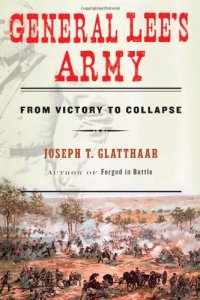
Joseph Glatthar’s excellent General Lee’s Army brings balance back to this narrative.  He studies the army of Northern Virginia in depth and concludes51tuzkutcjl that of course, Lee was a great commander.  He helped forge a great army with a great record in the field.  He deserves much of the credit he receives.

But . . . he lost, and we do well to remember this. Lee’s ultimate defeat may well have had something to do with Lee, and the army he commanded.

Glathaar shows us how the strengths and weaknesses of Lee and his army come from the same place by looking at culture, demographics, the life of the common solider, and those directly under Lee’s command.

We do have to take into account Lee’s frequent opponent, the Union’s Army of the Potomac.  From a pure match-up standpoint, it would have been interesting to have Lee, Longstreet, and Jackson oppose Grant, Sherman, and Thomas for the duration of the conflict.  As it happened Lee only faced Grant towards the end of the war, and then Grant had to work with the Army of the Potomac, where he inherited a completely different, and vastly inferior, operational and command culture than what he worked with out west.

In  A Savage War, the authors point out that the Army of the Potomac inherited a disproportionate number of soldiers recently graduated from West Point.  A West Point education tended at that time to over-emphasize math, engineering, and organization (something that U.S. Grant lamented in his memoirs).  Such skills have their place, but should not have pride of place in officer training.  Those that drank from the firehose of this approach would inevitably give way to excessive caution. Meticulous organization takes a lot of time.  In addition, once you have built something so “pure” and pretty, one might not wish to do anything that might get it dirty. This helps explain why McClellan (tops in his class at West Point) could think himself a great general even though he couldn’t actually win a battle.  He was excellent in doing what his education, at least in the narrow sense, trained him to do.

The plodding, rigidly organized Army of the Potomac gave Lee and his men a perfect target given their particular strengths.

Glaathar points out that the men in Lee’s army fully believed in their cause and came with the strongest of motivations.  Ante-bellum southern society had the duel influences of the aristocratic planter and the Appalachian border-settlers.  Both of these cultures emphasized honor and courage.  Both of these cultures preached a vision of manliness that gave way to no one.  Letters home from top officers on down the ranks show a constant desire for combat and to prove themselves.

Lee both understood and embodied this himself.  Many other accounts of his generalship focus on his ability to psychologically assess his opposite number on the Union side and devise the proper approach accordingly.  Glaathar adds to this, showing how Lee knew how to use his men expertly.  They proved superlative in the counter-attack, and could march quickly and fight hard back-to-back.  We see this at Bull Run, in Jackson’s Shenandoah campaign, and at Chancellorsville, as at other times.

But both the aristocratic planter and border settler culture had its weaknesses, and these too had a significant impact on the war.

Organization:

Appalachian border culture emphasized freedom of initiative and eschewed “systems” like tight and itchy collars.  Lack of formal structure gives one great freedom.  But an army of tens of thousands needs tight organization to act as a unit.  Without this organization, large scale offensives could never be undertaken.

Discipline:

Many in the south seceded because they did not want to be told what to do by anyone they did not like or respect.  They tended to run hot and cold alternatively.  Sure enough, Lee had a hard time enforcing discipline.  We hear a lot about Union armies looting in the South, but Lee’s army at times looted the Virginia countryside for supplies, stole from the bodies of dead Union soldiers,** and had a hard time maintaining equipment.  Many went AWOL unexpectedly not necessarily out of cowardice but because “they felt like it.”

Honor and Ego:

The aristocratic nature of the army came through in the upper echelon of the officers.  The bickered for position and rank.  At times they disobeyed directly if they felt insulted.   Some at times seemed to prefer maintaining their honor to winning a battle.

All of these weaknesses would make coordinated action over a large distance difficult.  Perhaps this is why Lee spread out his armies in his invasion of the north in 1863.  It gave each commander more independence. But . . . when the time came for coordinated action, invariably Lee’s forces could not pull it off.

Shelby Foote wrote that, “Gettysburg was the price the South paid for having Lee command their army.”  I’m guessing that he meant at least that no one is perfect.  But I surmise that he meant more.  The weaknesses of Lee’s army, and of much of southern culture, outed themselves at that battle.   There the Confederacy fought a weaker opponent, but in ways that favored Union’s strengths.  The good ground and interior lines of the Union forces at Gettysburg played right into the laps of the North’s slower, plodding, yet more bull-headed nature.^

Lee’s 1863 invasion may have been a mistake, but he intuited correctly that the South could not win a long and protracted war.  He emphasized the Confederacy’s logistical shortcomings, but the army had cultural shortcomings as well.  Perhaps Lee had read and recalled Tocqueville’s thoughts on aristocratic and democratic societies at war.  Tocqueville comments that,

In aristocracies the military profession, being a privileged career, is held in honor even in time of peace. Men of great talents, great attainments, and great ambition embrace it; the army is in all respects on a level with the nation, and frequently above it.

We have seen, on the contrary, that among a democratic people the choicer minds of the nation are gradually drawn away from the military profession, to seek by other paths distinction, power, and especially wealth. After a long peace, and in democratic times the periods of peace are long, the army is always inferior to the country itself. In this state it is called into active service, and until war has altered it, there is danger for the country as well as for the army.

It may be remarked with surprise that in a democratic army after a long peace all the soldiers are mere boys, and all the superior officers in declining years, so that the former are wanting in experience, the latter in vigor. This is a leading cause of defeat, for the first condition of successful generalship is youth. I should not have ventured to say so if the greatest captain of modern times had not made the observation.

A long war produces upon a democratic army the same effects that a revolution produces upon a people; it breaks through regulations and allows extraordinary men to rise above the common level. Those officers whose bodies and minds have grown old in peace are removed or superannuated, or they die. In their stead a host of young men is pressing on, whose frames are already hardened, whose desires are extended and inflamed by active service. They are bent on advancement at all hazards, and perpetual advancement; they are followed by others with the same passions and desires, and after these are others, yet unlimited by aught but the size of the army. The principle of equality opens the door of ambition to all, and death provides chances for ambition. Death is constantly thinning the ranks, making vacancies, closing and opening the career of arms.

. . . An aristocratic nation that in a contest with a democratic people does not succeed in ruining the latter at the outset of the war always runs a great risk of being conquered by it.

Dave

*Interesting parallels exist between Lee and Napoleon’s armies.  Both faced stiff, rigidly organized opponents.  Both emphasized movement, speed, and capitalized on the energy and spirit of their men.  Both had great success early, but both also suffered significant setbacks as their respective wars dragged on. Each faced manpower issues, but also, their opponents got better over time and neither Napoleon or Lee made the necessary adjustments based on the improvement in their opponents.

In fairness to the Army of the Potomac, the soldiers displayed extreme courage at Fredericksburg, and were stalwart in the defense at Gettysburg.

**Many southerners decry the actions of Sherman.  Glaathar demonstrates that Lee’s army did many of the same things, albeit on a smaller, less organized scale, as Sherman’s army.  And . . . they did this not just in Pennsylvania but in Virginia as well.

^Fredericksburg might serve as a good example of these qualities, with a negative outcome.

“The Civil War as a Theological Crisis”

The Enlightenment historian Edward Gibbon pointed out with some ridicule that in the Arian controversy, Christianity got into a kerfuffle over the smallest letter in the Greek alphabet — the iota.  At the Council of Nicea Arians wanted the word “homoiousios,” meaning “similar substance” inserted into the creed concerning the nature of Christ.  They were comfortable thinking of Jesus in divine terms, but not as an equal to the Father in His essence.  Led by Athanasius, the orthodox contingent objected, insisting on the word “homoousious,” meaning “same substance.”

For Gibbon and other Enlightenment oriented thinkers, this all seemed too much.  Such minutiae, such trifling, would upset things so unnecessarily.  Given that Gibbon liked nothing better than a well-oiled worldly machine, he saw the controversy as so many wrenches in the works.  Of course Gibbon missed the point entirely.  The difference between viewing Christ as fully God as opposed to merely “God-like” changes one’s conception of the entire universe, creation, and history itself.  When it comes to our theological understanding, what we worship will have dramatic consequences.

I’ve always believed that understanding religious belief formed the key to understanding any event in history, be it great or small.  Often this is more easily seen in the ancient world, where religion showed on the sleeves much more so than today. But men are men, and as a man thinks, so he is (Prov. 23:7).   Mark Noll  points out the religious roots and the religious mistakes of both North and South in his excellent The Civil War as a Theological Crisis.  Noll’s analysis gets to the heart of the real differences between North and South, and shows how these religious differences formed the roots of the political disagreements that led to war.  Both sides professed belief in the authority of the Bible, and both sides reached different conclusions.  That’s obvious to anyone, but Noll’s approach shows these different interpretations came from the same source American/Enlightenment source, and that makes this brief work a real treasure.

By 1850 America experienced a deep political crisis, but astute observers of the day saw that the roots went deeper. A Protestant ethos merged nicely with Democratic principles in America quite easily.  The individual should be able to read, reason, and think for himself.  Both Protestantism and Democratic government rest on the idea that truth always has a “plain” and obvious character.  It could be argued that an agreed upon “atmosphere” of sorts existed between Protestant denominations despite their differences (Noll takes this for granted and does not argue the point).  But in 1844 both Methodist and Baptist churches (the largest in the U.S. at that time) experienced deep schisms.  A broken Church will lead to a broken nation, and leaders from the North and South predicted this. Henry Clay opined that, “this sundering of religious ties . . . I consider the greatest source of danger to our country. In 1850 John Calhoun of South Carolina warned that if the great Protestant denominations finally broke, “nothing would be left to hold the States together except force.”*  Noll writes,

If we keep in mind that it was never only a matter of interpreting individual biblical texts, but always a question of putting actively to use the authoritative Book on which the national culture of the United States had been built, then we are in a position to understand why in 1860 battles over the Bible were so important, why divergent views of providence cut so deeply, and . . . why the Civil War illuminated much about the general character of religion in America.

First, the South.

Southern arguments in defense of slavery had the advantage of simplicity and (the apparent) strict fidelity to the Biblical text.  They pointed out that . . .

  • God allowed Israel to have slavery
  • Abraham and other luminaries owned slaves
  • Jesus never condemned the institution of slavery
  • Nowhere in the epistles is slavery ever condemned.  In fact, slaves are repeatedly told to obey their masters.  Paul, after finding Onesimus, an escaped slave, has him return to Philemon.

Thus, to argue (as abolitionists often did) that anyone who practiced slavery could have nothing to do with Biblical Christianity flies in the face of the entire and obvious biblical teaching on slavery.  The case was open and shut.

Northern arguments also strove for stark clarity and simplicity.

The most common arguments usually had the following characteristics:

  • Slavery had inextricable links to tyranny and moral abuses that the ethic of the Gospel strenuously opposed
  • Slavery contradicted principles of justice, love, and mercy found throughout the Bible
  • Slavery went against the general spirit of the “brotherhood of mankind” propounded by certain texts, like Galatians 3:28.

In other words, anti-slavery arguments inevitably used first principles but tended to avoid textual rigor and so failed to deal head-on with what pro-slavery advocates said.  Furthermore, many anti-slavery arguments wedded themselves to “natural reason,” “self-evident truths,” and “republican practices” and at times relied on these ideas more than Scripture itself.  Thus, as Noll comments, “The primary reason the biblical defense of slavery remained so strong was that biblical attacks on slavery were so weak.”  Again, Noll doesn’t dispute that slavery was wrong.  His point is one rarely made, that Northern arguments against slavery had some of the same flaws as pro-slavery arguments.  Thus, the two ships were likely to pass in the night.

Much better arguments against American slavery existed from some Protestants, and interestingly, some Catholics as well. Such arguments pointed out that . . .

  • Using Israel as an example for American slavery made the mistake of conflating Israel with America, a mistake Americans had been making for generations.
  • If the South could used ancient Israel for support, they should be informed by their practices.  For one, slaves had rights in Israel, and they did not in the South.  For another, Mosaic law prescribed years of Jubilee every 7th year and again at the 50th year in which all slaves were freed and all debts canceled.  The South never practiced this.  And again, slavery in Israel was not racial, perpetual, or hereditary. The South condemned themselves by asking to be judged by the law.
  • Certain biblical principles of justice, mercy, and love certainly applied to arguments against slavery.  But these more careful Protestant and Catholic voices applied them differently than most abolitionists.  For starters, they kept such principles clear of democratic ideology — on which Scripture remains silent at least directly (and pro-slavery arguments pointed this out).  The goal for the Christian, according to these arguments, was not so much to live in light of specific texts, but in light of the flow of history itself.  If God’s Kingdom is not just coming but is already here in Christ, we have to live in light of the “now” reality of God’s Kingdom. In God’s Kingdom we will not/do not enslave one another.  Evidence exists for this not just in Scripture, but in the early history of the Church.  Christians worked to liberate slaves and medieval civilization stood as the first major civilization in history to essentially eliminate slavery.  It got reintroduced only in the Renaissance, when pagan, Roman concepts of property and ownership tragically got transported back into Europe’s bloodstream.
  • The Roman example of slavery also condemned southerners, at least to an extent.   For one, Roman slavery lacked the racial character of Southern slavery.  In one of the best chapters in the book, Noll pulls from numerous sources that show that the real problem for the South was not slavery but race.

So whatever one might say about slavery in a general vacuum, no good arguments existed for slavery as practiced by the ante-bellum South.

Unfortunately such arguments never made it into the mainstream of American cultural life.  As to why, we might assume something along the lines of a “short attention span,” but this fits modern times more readily.  In fact, audiences flocked to hear discourses and debates of all kinds in the mid 19th century. Lincoln and Douglas in 1858 spoke for many hours at a time to packed audiences.  One debate on slavery lasted for multiple hours over multiple days to an audience of several hundred.  Rather, the reason lies in the common roots shared by mainstream arguments about slavery on both sides.

The mainstream arguments for and against slavery before the Civil War had the following characteristics:

  • They involve no more than a 1-2 step reasoning process
  • They insist on the “plain” character of truth.  Neither side could be described as anti-intellectual, but arguers for both sides seemed to show an exasperation with the need to develop arguments at all.  The truth was so obvious!
  • Anti-slavery arguments relied on “simple” principle, pro-slavery arguments on isolated small texts.  Both arguments only functioned along one track, one line of thought.

Whichever side won the argument (i.e., the war), the future for having the Church influence culture looked bleak.  The Enlightenment had done its dirty work.

Subconsciously perhaps, we reject oversimplifications because reality and our experience have more complexity and mystery than the Enlightenment can fathom.  Rejecting this truth condemned us to search aimlessly for generations hence to fill the void with politics, “The American Dream,” sex, and the like.**  Obviously western theologians could and did make nuanced and complex arguments, but western culture as a whole failed to notice or heed them.

As a buttress to his observations about slavery arguments, Noll includes a section on the idea of God’s providence as debated before and after the war.  True to form, both sides found obvious answers to the results of the conflict.  For the Southerners, even their defeat showed the rightness of their cause, for “God disciplines those He loves” — i.e. — “We are experiencing discipline, showing God’s love for us, showing the rightness of our cause.  For it is often true that the godly rarely prosper in this world.”  For the North, their arguments had a simpler character, though no doubt the South would have made them had they won the war.  “We won.  God was and is on our side.   Therefore we were/are right.”  Lincoln understood better, and pushed back on this simple approach.  We may always know that God has events in His hand, he agreed, but the particular application of His providence often remains a mystery to us.  Not even someone of Lincoln’s stature could get others to embrace this more nuanced view.

Noll’s work has great value for his illumination of the state of religion in 19th century America.  What makes it even more intriguing is how he reveals what may be the central problem of American political and educational life.  Our problem really resides not in short attention spans, not in one political party or the other, not the sexual revolution, or other such movement. Rather, Americans need to grapple with how our democratic ideology meshes with the nature of truth itself.

Dave

*Noll includes some interesting statistics showing the decline of religion and growth of government.  This should not surprise us, as Calhoun (not someone I’d like to agree with very often) foretold.

  • In 1860 about 4.7 million people voted in the presidential election, but in that same year between 3-4 times that many regularly attended church  on Sundays.  In 2004, about 115 million went to the polls, which equaled the number of regular church attendees in 1860 (Noll should take into account, however, the fact that women and many minorities did not vote in 1860).
  • In 1860 the number of Methodist clergy alone equaled the number of postal workers.  Today the ratio of postal workers to Methodist clergy approximates 9-1.
  • Before mobilization in 1860 the number of active duty military was about 1/2 the number of clergy in the country.  In the early 21st century, before mobilization for the war in Iraq, the ratio of military to clergy was about 3-1.
  • In 1860 the total income of the churches and religious organizations nearly equaled the federal budget.  Today the ratio of federal income to annual religion-related giving is about 25-1.
  • In 1860 about 400 institutions of higher-learning existed, with nearly all of them run by religious groups.
  • In 1860 there were 35 churches for each bank.  Today there are four churches for each bank.

**In an interesting digression, Noll points out that warfare and dramatic social change have often produced great works of lasting theological depth.  One thinks immediately of Augustine’s The City of God, but numerous other examples exist (St. Bernard during the Crusades, and St. Francis experienced a dramatic shift after fighting in a small war.  In the modern era, Bonhoeffer comes most clearly to mind).  By that model, the Civil War should have, but failed, to produce any significant theological insight, and this reveals a thin theology throughout North and South at that time.

Perhaps not surprisingly, the great storytellers of the 20th century, MacDonald, Lewis, Tolkien, Flannery O’Connor, Walker Percy — all came from liturgical and historical traditions.  Lewis and Tolkien both fought in W.W. I, and O’Connor and Percy both suffered from lifelong illnesses.

10th/11th Grade: Who Owns the Past?

Greetings,

This week we brought some of the  events leading up to the Civil War to a close, and examined a few different issues.  Studying the Civil War usually brings strong political passions to the fore, and this class has been no exception.  I wanted to try and cut to core of what divided the country, and reduce the argument to its essentials.

The past formed a key battleground between the North and South.  Both sides claimed sonship from what it meant to be an “American,” and both had different ideas on the meaning of liberty.

The South claimed to be the “heirs of the American Revolution” because

  • Our founders feared strong central authority, and set up a government designed to give primacy to the states.  Lincoln’s Republican administration would (in their view) upset this balance by restricting slavery and inserting themselves into their private lives.  The federal government had no right to arbitrate moral questions like slavery for the states.  For them to do so amounted to tyranny.  “Don’t tread on me,” might have been their motto.
  • The founders had a vision that was primarily political in nature.  They spent a great deal of time discussing the structure of government, and much less on its purpose.  If the structure of government changed, what it meant to be an American changed.

The North countered with

  • The founders vision obviously had political overtones, but primarily had a moral character.  The phrase, “All men are created equal, and endowed by their Creator with certain inalienable rights,” gives birth to our nation.  The founders did not fully follow through on that vision.  Therefore, a political system that seeks the perpetuation and extension of slavery can have nothing to do with what our country should be about.
  • The American Revolution did not fully finish until we found a stable government in the Constitution.  The Constitution, ratified by all southern states, sought to form “a more perfect union,” and increased the power of the federal government.
  • While many founders owned slaves, most of them believed (erroneously) that slavery would die out on its own.  The Northwest Ordinance of 1789 banned slavery in the newly created mid-western states, showing that the Federal Government did have jurisdiction over slavery in new territories, and showing that even slave states understood that slavery would not expand into new territory.

These differences have their resonance in many hot-button issues of the day.  Should the federal government make you wear a helmet on a motorcycle?  Should the federal government have the right to ban gay marriage or abortion?  What role do we want to give them in our private lives?  How much power should they have to stop evil?

Classical theorists on government like Aristotle drew rationale for the state based on the family, so an analogy of the family might help us.  We can imagine the parents as the originators of the family and those most interested in preserving family unity and harmony between siblings (i.e., the federal government).  We can put states in the role of grown children.  Some children seem to be leading wayward lives.  But what control should parents still have?  They might urge a child to stop doing ‘x’ behavior, but what if the child did not listen?  What power should the parents have?  Should they have access to a means of force to compel their 30 year old children to come to a family reunion or face punishment?  What kind of punishments can a parent of a 30 year-old mete out anyway?

Obviously the analogy breaks down at points.  But for the federal government to assert that slave-owning states must not own slaves sounded to southern states, “You do not have the ability to govern yourselves.  You are not equal to us, who have that ability.  You are lesser, and therefore we can dictate to you.”

Those against slavery might have used a different analogy.  Perhaps here the children are teens, not independent adults.  Independent adults are akin to separate nations with their own families, but the U.S. is still a family of 50 states.  Parents grant their teens a certain measure of independence.  But parents would grant their teen so much freedom that the integrity of the family unit gets jeopardized.

In the excerpts from Democracy in America that we discussed this week, De Tocqueville talked about how the ideals of liberty and equality ultimately compete against each other.  We cannot have equal amounts of liberty and equality, so we must choose where the balance lies.  Different people would give different priorities to either liberty or equality.

Scholars have debated for years the cause of the war.  Some say that war was about slavery, others say that slavery had nothing to do with it, and instead the war centered on the rights of the states.  I prefer to split the horns of the dilemma.  In 1861 the issue boiled down to Union v. Secession, but slavery formed the vast majority of the subtext related to this question.  It lurked underneath most every significant political debate from at least 1846 on, and in some ways, dominated discussions decades before that going back to the Missouri Compromise of 1820.  Economic issues did play a part, but they too had a lot to do with slavery.  The map below shows the concentration of slaves in the various states.  The darker the color, the higher the concentration.

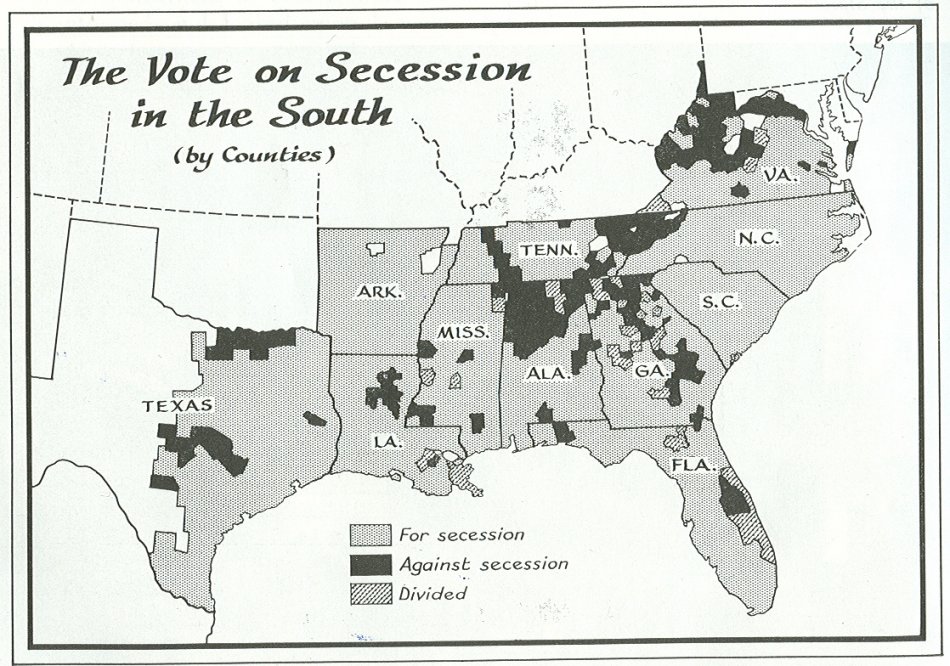
We see how slavery concentrated near water, or in low lying tidewater areas (i.e. Southeastern VA and MD).  This in turn led to the predominance of labor intensive cash crops like cotton or tobacco.  Below is a map of how various southern counties voted on the secession question.  Obviously, not all wanted secession.  The South was not monolithic.  But there is a striking link between the counties who voted for secession and the presence of slavery.  Clearly, the moral question of slavery and the political issue of slavery went hand-in-hand in 1860-61.

Slavery was a national issue in the Declaration of Independence, Constitution, in 1820, 1848, 1850, 1854, 1856, and 1859. It was the main topic of discussion in the Lincoln/Douglas debates of 1858. Why did the various compromises on the issue fail?  In fact, could they be said to have made things worse? As time went by and slavery became more prevalent, their attitude went from ‘necessary evil’ to ‘positive good.’  What can explain this shift?

I think we can say the following:
  • Industrialization in England and the north gobbled up cotton produced in the deep south and helped solidify the power of large plantation farms.  The North implicated themselves to a degree in this and did not mind getting cheap cotton from the South.
  • I don’t think we should miss the psychological/moral component.  Shakespeare’s line of “Methinks he doth protest too much,” applies here.  Those of you have (or remember having) smaller children know that when you say, “It’s time for bed,” and they immediately whine and shout, “I’m not tired! I’m not tired!” are in fact showing how tired they really are.

This hardening of their views on slavery covered over many contradictions.  Masters supposedly civilized their slaves, but they constantly feared slave insurrections.  Masters claimed to “enlighten” their slaves but often actually educating them was forbidden by law.

As I mentioned earlier a “North=Good, South=Bad” paradigm will not help us understand the period or the war itself.  Many northerners differed little in their view of blacks from the South.  Had the North treated blacks better, some of the evils of slavery might have been exposed sooner.  Of course, there were those in the south who respected blacks and treated them with dignity.  But it is still true to say that the North had an anti-slavery bent even if many had ambiguous feelings about abolishing it.  And it is still true to say that many in the South wanted not only to preserve, but extend an institution that broke up families and and allowed masters to use other humans as they saw fit.

These differences over slavery also had links to broader cultural differences rooted in the typical differences between urban and rural societies.  Generally speaking. . .

Urban areas

  • View change as a positive
  • Believe that we “should not stand still”
  • Look more to the future than the past

and Rural areas

  • Seek to avoid change whenever possible
  • Like to be guided by tradition
  • Look more to past than the future

These different values form different priorities, and this may also help explain the conflict.

The Frontier Garden City

I am no fan of the “Woke” but a few years ago Ross Douthat wrote a piece entitled “A Crisis our Universities Deserve,” which showed me that at the core of this movement lay something admirable. At some point in the 20th century, college lost its emphasis on ennobling the soul, the great virtues, ideas, etc., and became a means to make more money in life. Certainly in the early 90’s, most of the encouragement from society to go to college came in this form. Students today rightly rebel from this, want more from their education than this, and more from life in general. Many “woke” students seek something moral, something transcendent. Douthat commends them for this, at least.

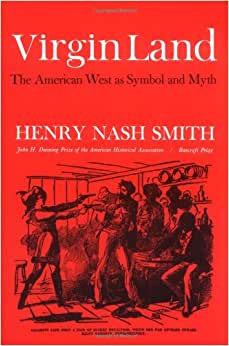
My public school education left me with the impression that the arc of American History bent towards the good, but of course we had x,y,z, and 1, 2,3, things wrong with us. The list of wrong things had grown since my dad’s day, but still stopped just short of overthrowing the basic arc. Subsequent generations have had the scales tipped. Manifest Destiny, the idea that History/God/Fate/Benign Providence wanted/needed America to span the continent, stood very near the core of our things wrong with us, and seemingly impossible to redeem in any way. After reading Henry Nash Smith’s Virgin Land: The American West as Symbol and Myth I had the realization that the Woke and the various champions of Manifest Destiny have a great deal in common, including a highly idealistic goals and a bent towards rebellion against the status quo.

This comparison may surprise some, but makes at least temperamental sense to me. My first reaction to the Woke and Manifest Destiny comes from the gut: “Ick . . . it’s just too much work, too much angst and yearning, too much of everything. Enough, already.” I feel Jerry Seinfeld should have a bit on this–he would agree with me, I’m sure. But one needs more of a foundation to denigrate these two major epochs of our country’s past and present, and one has to admire the energy and drive in both movements.

Smith shows that Manifest Destiny had no direct racial motivations. When race entered into the discussion from some, it usually involved spreading “free labor” across the continent to help limit and eventually squeeze out slavery. Manifest Destiny’s sharpest critics in fact often came from pro-slavery camps, who poured cold water on all of the messianic expectations of free labor across the continent. I found it curious as well that the native Indians got little mention. It strikes me not that they were discounted, but rather not counted from the start. Maybe promoters of expansion automatically assumed that the natives would go along with it. More likely, thoughts of overland Asian trade routes, the fusion of independence, wealth, and power, the sweep of empires throughout time–left no room to see particular people such as the natives. Certainly one could critique the impact of the idea on native peoples, but harming them seems absent from the original intent.

At its core, then Manifest Destiny

  • Believed firmly in America’s unique role in world history
  • Allied with many of the progressive causes of the day–causes that today would certainly look progressive–grants of free government things (not $, but land), the belief that the hand of government should engineer certain social and political ends.
  • Believed strongly in unity–national unity, but also a more expansive international unity, for which the United States could hold the standard. Walt Whitman wrote in his A Passage to India that

The people [are] to become brothers and sisters,

Their races, neighbors, to marry and be given in marriage,

The oceans to be cross’d, the distant brought near,

The lands welded together.

Whitman being Whitman, he waxes rhapsodically about how Man and Nature shall once again fuse together under the “true Son of God”–not sure whom this was supposed to be. We conclude, then, that Manifest Destiny involved not just our national greatness, but

  • A grand union of all humanity, abolishing all national differences and dismantling the hierarchies of the old, worn out traditional world.

All of these are strongly progressive causes.

The progressive Woke have their virtues, but their virtues lean so far in one direction that they have to overcompensate, consciously or no, towards the other pole. So while they talk of abolishing all forms of difference in some grand human unity on the one hand, with the other they proclaim a certain kind of radical individuality. We see this in their insistence that anyone can do anything they like with their body, sexuality, etc. On the one hand, the Woke can be fiercely anti-authoritarian and anti-institutional, but on the other, as Patrick Deneen has pointed out, they need Government writ-large to protect them from local, more traditionally minded majorities. And, while the Woke encourage a general sort of mixing, they have a hard time mixing in a fruitful manner, i.e., with relationships, marriages, and families.

With the heroes of expansion west, real or fictional, we see the same motifs. Civilization requires cooperation, but Cooper’s Leatherstocking, Whitman’s rhapsodies, and the real Daniel Boone can never settle and build. The unbounded horizon calls more strongly to them than any particular place. They decide things for themselves on the fly. Their freedom from the shackles of civilization gives them a newfound moral clarity and moral authority, for they are freed from all bigotry of place. They see with universal eyes. In his novel Old Hicks the then-famous Charles W. Webber (a product of Princeton), declares of the Texas Ranger that,

With them the primitive virtues of a heroic manhood are all-sufficient, and they care nothing for reverences, forms, and duties, as civilization has them, but respect each others rights and recognize the awful presence of a benign God in the grandeur of the mountain, forest, plain, valley, and river. . . . Such men do not look to society except with disgust . . .

Interestingly, as part of the plot, Webber has the head mountain man romantically pursue the wife of the villain, and marry her despite she actually being the wife of the evil Count. The “Laws of Nature” here easily become the Laws of God, which trumps the laws of man. Similar arguments today justify ditching traditional sexual ethics. For example, those that transition, or “come out,” are granted a carte blanche in their decisions regardless of its impact on those around them, for their very distance from society with these decisions grants them supposed insight and authority.

Webber wrote fictional characters, but life imitated art in some respects with the foremost advocates for the frontier. Francis Parkman, another ivy-league grad (Harvard) traveled west in the summer of 1842 following his sophomore year. In his journal Parkman showed disdain for most of the actual people he met, especially the livestock farmer, a foreshadowing of sorts of the frayed relationship between coastal elites and flyover country. After passing beyond civilization further into the forest, Smith notes that “[Parkman’s] tone changes completely.” The independent woodsman garners immense respect: “He is a remarkably intelligent fellow . . . resolute and independent as the wind.” Smith writes,

Parkman’s antithetical attitudes towards farmers and the hunters of the wilderness illustrate the fact that . . . two distinct “West’s” existed in the minds of many [advocates of the frontier from the east]. The agricultural west was tedious. Its inhabitants belonged to a despised social class. The Wild West was by contrast an exhilarating region of adventure in the open air. Its heroes . . . were in reality not members of society at all, but noble anarchs owning no master, free denizens of a limitless wilderness.

Advocates for Manifest Destiny could, like the Woke, see civilization in sweeping terms, and they could see the heroic individual. They both have a harder time with groups in between these categories, the basic societal building blocks of villages, farms, towns, etc.

A competing mythos, that of the west as paradisal garden, also informed America’s westward push. This motif had more to say for it, as it usually involved families, but still had its rose-colored glasses. Timothy Flint wrote against attitudes like Parkman’s, and gloried in farm life, writing in 1827:

Thousands of independent and happy yeoman reside [in the west], with their numerous, healthy, and happy families about them, with the ample abundance that fills their granaries, with their young orchards, whose branches must be propped to sustain the weight of their fruit, beside their beautiful rivers and beech woods, in which the squirrels skip, the deer browse, and the sweet red-bird sings, and with the prospect of settling their children on any of the dozens of farms that surround them.

James Lanman echoed such ideas in the 1830’s . . .

If, as has been remarked by distinguished statesman, cities are the sores of the political body where the bad matter of the state concentrates what healthful attitudes of mind and body are afforded by agricultural enterprise. The exhilarating atmosphere of rural life, the invigorating exercise afforded by its various occupations, the pure water, the necessities supplied for daily existence, leading to early and virtuous marriages, all point to this pursuit as best adapted to the comfort of the individual man.

I do not like to agree with the anti Free-soil crowd (often, though not always, secessionists and pro-slavery) on much of anything, but the “Messenger” was on to something in 1856, when it opined that

Farming is hardly a pleasant occupation, and the idea that it is comes from dreamers and poets. The actual, manual operations of farming are irksome and repulsive to the great mass of mankind.

Alas, reality set in for the devotees of the garden myth shortly after the Civil War. Smith writes,

The yawning gap between agrarian theory and post-war reality . . . comes out in the farmer’s crusades of the last 25 years of the 19th century. The western farmer had been told that he was not a peasant but a peer of the realm; that his contribution to society was basic, and all others peripheral or parasitic, in comparison cities were sores on the body politic. . . . He had been told that he was compensated for any austerity in his mode of life by receiving shelter from the temptations of luxury and vice, and against the ups and downs of the market. His outstanding characteristic was his independence of character and condition.

But after the Civil War Republican policy obviously favored the city against the country, the merchant against the farmer. And the western farmer found that instead of being independent, he was at the mercy not only of the Chicago and New York and Liverpool grain pits, but also of the railways and steamships lines that he must rely on to get his crop to market

I have read most of the volumes of Toynbee’s unabridged A Study of History. I think him a great master and I owe him a great debt, but I found the central theme of Volume III, which describes the growth of civilizations after their infancies, so annoying I stopped reading about halfway through some years ago. I have yet to pick it up again. Toynbee rightly reacted against material measures of progress. A civilization surely must be able to advance in more ways that territory and GDP. Toynbee developed a different approach, which meant a good start. But he ended with what he called “etherealization.” The idea seems to run along the lines of

  • A civilization develops an idea or technique that works for them, but that idea/process, has a limited growth potential because it is anchored to its locality
  • The civilization then extracts the core of the idea, removing it from its trappings, thus making it more transferrable across space.
  • This allows for more sharing of ideas, etc. which aids growth. The process is essentially cooperative and other oriented.

He takes, as an example, the alphabet as an etherealization of language, as opposed to ideograms. Alphabets transfer across cultures relatively easily, but China’s writing, among other things, will not allow for this, keeping them isolated.

Toynbee often nods via anecdote and analysis to “the old ways are best.” He wasn’t always consistent in his ideas, but this is not a fault. He usually explored possibilities as opposed to asserting things absolutely. But etherealization shows Toynbee’s weakness for too much generality, too much “Platonism” (but only in the worst sense of that word). Lifting something too far off the ground tends to make it dangerous and destabilizing to society, like a steroid. Supporters of Woke politics, and mid-19th century supporters of Manifest Destiny, have this same problem. What masks itself as “progress” in fact only abstracts what in embodied form might actually be good, though less dramatic, ideas.

American history mashes together so many competing concepts. Sometimes this results in great creative tension. We get into trouble when succumb to the lure of the unbounded everything America has always foolishly promised.

We should note that the Old Testament takes a dim view of cities. Cain builds the first one, from which evil and violence come, and then you have Sodom, the cities built by Hebrew slaves for Pharaoh, Babylon, Ninevah, and the like. But the end of the New Testament shows the final restoration taking place with a garden within a city–even cities get redeemed in God’s providence over history. So, the frontier, the farm, the city–every civilization that actually functions needs all three.

Dave

Inventing Vietnam

Like most Americans, I root against the New England Patriots.  It is nothing personal, but Americans root for the underdog, and the Patriots have been so successful they are never the underdog.  And yet, I can’t help but admire the brilliance of Bill Belichek.

He confirmed my admiration during a particular playoff game against the Steelers many years. ago.  The Patriots held a slim lead early in the game but the Steelers had a built a nice drive.  They resided just out of field goal range and faced a 4th and 1 somewhere around the Patriots 40 yard line.  The Steelers decided to go for it, and their home crowd cheered.

At this time the Steelers built their identity around a “smash-mouth” style of play and relied heavily on running back Jerome Bettis.  Everyone knew the Steelers would want to run the ball.  The Patriots of course also knew this.  They stacked the line of scrimmage and their defense sold out on the run.  I don’t recall if they had any safeties behind the line of scrimmage.  Their defensive formation triple-dog-dared Pittsburgh to pass.

I remember yelling at the TV for Pittsburgh to call a timeout.  They were obviously going to run, but if they had just flared out a tight-end it could have gone for a touchdown.  But Pittsburgh went ahead and ran the ball anyway.  And of course New England, having every single player right at the line of scrimmage, stopped it easily.  After taking over on downs Brady promptly completed a long pass for a touchdown and broke the will of the Steelers.

Game over.  In the first quarter.

I thought to myself, “How did Belichek know Pittsburgh would run?”  Of course he didn’t really know, but his defense said to me that he knew.  What Belichek, knew, I think, is that under stress, we revert to our comfort foods.  We can’t help it.  In a regular season game, with stress levels lower, maybe Pittsburgh calls a different play.  But in the playoffs?  He knew they would stress-eat the Ritz crackers and run Jerome Bettis over left-tackle even when a voice inside them probably told them to eat carrot sticks instead.  They couldn’t help it.

Civilizations contain a vast aggregate of personalities, but have a undeniable personality and predelictions all their own.  When we picture someone wearing a t-shirt and blue jeans, of course it fails to cover everything about America, but it covers enough.

Toynbee believed that western civilization reveals itself in its passion for mechanics.  He wrote,

The Hellenic civilization displays a manifest tendency towards a predominantly aesthetic rubric for orienting and defining itself.   The Hellenic tendency to view life as a whole distinctively in such terms that the ancient Greek adjective “kalos,” which denotes what is aesthetically beautiful, is used in addition to describe what is morally good.  In other words, Greek concepts of beauty and morality . . . were indistinguishable.

When we come to our own western civilization we find no difficulty discovering our own bent or bias.  It is, of course, a penchant towards machinery: a concentration of interest and effort upon applying discoveries of Natural Science to material purposes through the creation of social-clockwork devices, i.e. steam engines, motor cars, but also social engines like representative governments and military mobilizations.

We sometimes talk as if this appetite for mechanics was a quite recent occurrence in western civilization  . . . But this is precisely how westerners were viewed by the courts in Japan and China [in the early 1800’s, just prior to the Industrial Revolution]–as “barbarians” redeemed partially by our manifest and outsized technical ability.   The Byzantine princess Anna Comnena had the same impression of the first crusaders in 1099 A.D.  She called  their  crossbow a “devilish construction” that, while ingenious in its mechanics, fitted perfectly the barbarians who wielded it . . .

I thought of Toynbee’s analysis reading James Carter’s Inventing Vietnam.  A lot about this book revealed little about the Vietnam War that I had not read elsewhere.  I thought Carter missed some important opportunities to illumine the conflict.  But his basic thesis, that America essentially tried to invent, i.e. “call int0 existence” a country that did not really exist makes sense.  South Vietnam had no real governance, no real culture, no real identity at all, apart from some lines on paper at the U.N.

Carter demonstrates that we tried to create South Vietnam in the only way we knew how.  We went to our comfort food . . . lots and lots of mechanical stuff.

Everyone recognized fairly early on that South Vietnam occupied a precarious position in Southeast Asia.  President Diem failed to inspire confidence.  The North had nearly all the best political leadership.  The major battles of the war against France, and thus, the major political infrastructure to handle the war, happened in the North.  Even in the late 1950’s we realized the South Vietnam could collapse not so much because of the actions of North Vietnam but under its own weight.  Castles cannot built on air.*

But for many reasons, some well-intentioned and justifiable, and some not, we felt that we had to try.**  We sought to modernize their economy, and give thousands of South Vietnamese jobs through our massive construction projects.  We could maybe, just maybe “fast-track” their way towards gaining some kind of statehood.  If nothing else, in attempting this we stayed on familiar territory.  We knew how to provide material goods and benefits.

While Carter’s book disappointed me overall, he proves his main point.  Our efforts to “create” South Vietnam massively undermined our stated goals.

  • The massive surge in U.S. dollars in South Vietnam destabilized their economy
  • South Vietnam’s economy and infrastructure could not absorb the massive inflow of goods, which created a black-market economy almost immediately.  This “shadow economy” further eroded governmental authority.
  • Most significantly, construction projects facilitated the expansion of our war effort.  The expansion of the war effort led to more bombing in South Vietnam, and more troop activity.  The more war South Vietnam experienced, the more disruption they faced, the less chance the South Vietnamese government had of establishing themselves.

Each of these problems served to ensure that the South Vietnamese government had no control over its own destiny.  Many in the State Department and military realized this, but could do little else but press on.  We couldn’t help ourselves.  This is what we knew how to do.  We can reasonably assume that if we had defeated the North Vietnamese militarily, the overall strategic situation would have changed hardly at all since the 1954 Geneva Accords which divided Vietnam in the first place.  South Vietnam would not have been an independent country.

When our war in Afghanistan seemingly went well in late 2001, Secretary of Defense Donald Rumsfeld was a media darling.  His “transformation” doctrine of war, which emphasized smaller troop levels and increased use of technology, seemed to work.  But by 2006 Iraq was a mess, and by 2009 the situation in Afghanistan had significantly eroded.  In truth, much of the Rumsfeld doctrine hardly broke new ground.  It appealed directly to our comfort food of believing in, and relying upon, bigger and better stuff to solve our problems.  Some tech oriented environmentalists tap into this again with their pledge that new green technologies will solve economic and environmental problems.  If we looked closer we would see that our weaknesses, and of course also our strengths, have deeper roots than this.

Dave

*Marine General Victor Krulak commented in 1966 that, “Despite all our assertions to the contrary, the South Vietnamese are not–and have never been–a nation.

For a postscript below, Raymond Fitts’ article entitled, The Uses and Abuses of Technology in War

“The American effort in Vietnam was the best that modern military science could offer. The array of sophisticated weapons used against the enemy boggles the mind. Combat units applied massive firepower using the most advanced scientific methods. Military and civilian managers employed the most advanced techniques of management science to support combat units in the field. The result was an almost unbroken series of American victories that somehow became irrelevant to the war. In the end, the best that military science could offer was not good enough . . .”1

How is it that such a paradox developed? How could a world Super Power lose a war to a third or forth rate military power? The answer has many parts. One part of the answer must lie in the difference between military science and military art. The more technology a country has developed, the more it seems to depend on military science in stead of military art. Another part is in the make up of the combatants and their outlook toward warfare.

Despite the many analyses of the Vietnam war produced by the military, none has adequately considered the fundamental question of how the U.S. could so completely dominate the battlefield and yet lose the war. Senior military officers have published books and memoirs about Vietnam. They have all nearly ignored the insurgent portions of the war and devoted themselves to the conventional side of the conflict. The most celebrated analysis of the war made by a military officer was produced by Col. Harry G. Summers, Jr. His basic treatment of the entire war was as it ended, i.e., in a conventional invasion of South Vietnam by North Vietnam. He ignored the guerrilla tactics and insurgent strategies of the war. All these personal accounts of the war seem to be best summarized by the adage “If they has just turned us loose in 1965, the war would have been over quickly.”2 It is clear that had the war been nothing more than a conventional one, the US should have been more successful than it was.

A clue to understanding the Vietnam paradox lies in the term “military science.” No one can doubt the importance of military science to the success of military operations in today’s world. The firepower provided by today’s weapons dominates the modern battlefield. The procurement of those same systems is a complex science in itself. However, successful military operations are a combination of the application of military science and military art.3

As the term implies, military science is a systematic body of knowledge about the conduct of military affairs. It deals with issues that can be quantified with a considerable degree of precision. It generally deals with what one can or cannot do in military operations–the technical aspects of developing and employing military forces.

Military art is the systematic study and creative planing and conduct of military affairs.4 It involves strategy (including tactics), political-military affairs, leadership, and morale. In short, it deals with the inexact side of military operations. It is concerned with what military forces should or should not do and why. It is learned through a study of history.

Successful military campaigns are the result of some sort of balance between the two. The balance may, in fact, depend on the status of the opposing forces–their equality. Reasonable equality may not exist between opposing forces. The weaker side must then depend on superior military art to achieve victory.

The North Vietnamese and Viet Cong were forced to depend on the use of military art because of the overwhelming resources and superior technology of the U.S. The Communist confused the Americans with a package of political, psychological, economic and military warfare.

There is a considerable body of literature that suggests that the warfare of the future, especially with the end of the Cold War, will be on the low-intensity end of the conflict spectrum. If indeed such is the case, then the U.S. will need to rethink how it uses its technology to fight at this end of the spectrum. But to understand what constitutes the low-intensity conflict some definitions are necessary. Applications of technology in this environment will be explored to evaluate the effects of the use of technology.

Definitions

Low-Intensity Conflict

The American military establishment considers low-intensity conflict to be manifested in four different ways: (1) counterterrorism (assuming there is a terrorist to counter); (2) peace keeping: (3) peacetime contingencies (quick sharp, peacetime military actions like the air raid on Libya in 1986); and (4) insurgency/counterinsurgency. The inclusion of some of these terms in the definition of low-intensity conflict is debatable. Terrorism can be considered a tactic that can be used in any type of warfare. Peace keeping missions are meant to prevent the outbreak of a conflict. The essential difference between war-fighting and peace-keeping missions is that one makes the maximum use of force while the latter is committed to the minimum use of force. Direct action missions tend to be high in intensity but short in duration, a situation that is particularly unsuited for the term “low-intensity conflict.” We are thus left with insurgency and counterinsurgency claiming any legitimacy to the title “low-intensity” conflict.6 A low-intensity conflict includes not only the unconventional aspects of warfare but also economic, political and psychological warfare.

There is an important aspect about low-intensity conflict that needs emphasis. The level of intensity is a relative thing. For the soldier in the trenches, combat is always intense–he’s the one getting shot at. For the United States, Vietnam was not a highly intense conflict because it did not require the full resources of the country. For the North Vietnamese, the war was a high intensity conflict because it involved all the nation’s resources. The level of intensity is usually associated with the probability of occurrence of a certain level of conflict. Terrorism is at one end of the spectrum and is highly probable while all-out nuclear war is at the other end and is least likely.

Partisan vs. Insurgent Warfare

The difference between partisan warfare and an insurgency is what the guerrilla is trying to do to the government. The partisan is merely interested in throwing out a conquering power. The partisan may need help from an outside source. An example might the East Europeans trying to expel the Germans during World War II. An insurgent is trying to overthrow an existing government by any means. Insurgencies are the more insidious of the two in as much as it has no definite beginning; its origins are not military, they are political, economic, and psychological. The insurgency is self-sustaining; and does not need outside support. An insurgency sneaks up on the existing government slowly and quietly.

Successful insurgencies have a number of elements in common. Four characteristics are particularly important for the American military: the protracted nature of the war; the central role of the insurgent political infrastructure; the secondary role of the insurgent military; and the use of guerrilla tactics in military operations.7 An insurgency represents the total integration of political and military factors with the political factors always in complete domination.

Conditions are ripe for insurgencies in many parts of the Third World. They all have several things in common: the stark contrasts between incredible poverty for the vast majority of the population and the extreme wealth for the ruling elite; a small to non-existent middle class that can be a stabilizing influence and a conduit for the upwardly mobile; these same areas often times sit astride important trade routes or trade-route chokepoints; they might contain important deposits of raw material vital to the industrialized world.8 The insurgencies of the twentieth century have been scattered all over the world and have been the result, for the most part, of real or imagined inequities in political and economic power coupled with the perception of minimal opportunity for reform, either political or economic. When taken together, the unique aspects of insurgent warfare suggests that such struggles are different from conventional warfare.

The most important aspect of an insurgency is time. Both the French and the Americans found that their enemies used time as a weapon against them. The Vietminh and later the Vietcong purposely made the struggle longer waiting for the Americans and French to get tired of the endless blood letting and look for a way out of the conflict.

The rebels also need time to build up their political support and military strength relative to the government they are trying to overthrow. Time works for the insurgent in another way: every day the rebellion exists is another day that discredits the government and its ability to govern and control its own destiny. The defeat of the insurgent military threat is only an adjunct to buying time for the government to implement reforms and for those reforms to work..

Guerrilla Warfare

Guerrilla warfare is the classic ploy of the weaker against the stronger. The conventional European military operations are planned to obtain a quick victory while guerrilla warfare tactics are geared for the long haul. The guerrilla attempts to avoid a decisive defeat at the hands of the stronger enemy. They operate in small groups to avoid presenting tempting targets for government forces that usually have vastly superior firepower for its use.9

In fact, a guerrilla wins by not losing, while the government loses by not winning. In short, there is no room for the status quo. Each side must discredit the other by some means whether it be political, economic, psychological, or military. Generally, it is s combination of all these elements. The military aspects usually are fought to make space for the other aspects to work on the minds and pocket books of the population.

The American Way of War

There are several deep-seated reasons for the condition of the American armed forces: military men are still highly regarded in Europe but not much here; the European tradition of martial exploits is missing in America; a technological bias to create weapons that can kill from a distance; and a failure to create a well-motivated, well trained military force.10 Most Americans have not had to come to grips with the central role that military forces play in international settings Americans have not had to confront war as a political act.

Its long span of oceanic-based isolation has led the Americans to think of war as an aberration, a failure of political policy Americans see warfare as a great crusade to over-come a well defined enemy who was definitely evil. Simplistic approaches to political military problems are also indications that Americans have not been forced to deal with the role of force. Despite obstacles, Americans have expected to achieve their goals; the spirit of “can-do” has been a permanent part of their collective psyche.11

The Civil War was the first American conflict observed by professional European soldiers. The British, French and Greater Prussian General Staff sent representatives to observe both sides at war. The observers noted, with some distain, the American penchant for standing off at some distance from each other and throw enormous amounts of lead at each other, often times for hours on end. This method has become ineluctably part of the American way of war.

This proclivity to conserve lives has been all the more difficult because of a distinction in the military tradition: the population has always distrusted a large standing army, it has thus developed a strong militia to fight its wars. American armies have had to learn to fight by fighting. The U.S. has been willing to compensate for what it lacked in preparation by spending its national wealth. America’s war industry has overwhelmed its enemies with weaponry.12

The U.S. military has concentrated on the sciences of developing, deploying, and employing America’s overwhelming resources since the Civil War. The military has, as a result, not had to be very clever in the military arts because it could overwhelm its opponents in a sea of men, weapons, firepower, and logistics.13 This ability has lead to a 20th Century American trend in American thinking: modern American strategists and tacticians have sought to substitute fire and steel for American blood.14 General James Van Fleet, then commander of the Korean based 8th Army in 1952, is a good example of this mode of thinking. He was determined to use his artillery as a substitute for U.S. infantrymen.

The basic aim of the U.S. military, it seems, in peacetime is to buy hardware rather than use it. The main aim of each service is to get from Congress as much money as it wants. The peacetime emphasis has moved from fighting skills to procurement and the management of technology. The best way to a promotion is through running a successful procurement program in the Pentagon. Leadership in the field is a secondary consideration. What the American military has developed is a distorted sense of priorities and a general lack of seriousness about warfare. It has fallen into a push-button mentality that has a developed a passion for hardware to the neglect of strategy, tactics, and the intangibles of warfare.15 We have done a marvelous job of preparing for the next war only to find that we cannot afford to fight it.

In spite of all this high-technology, it has never been the decisive factor in any American war. The struggle to use technology and to deal with the enemies technology has been much more important.16 Using history as a guide, the American record with military aviation technology has been mixed at best. In World War I, the U.S. flew European designed and, for the most part, built aircraft. World War II showed the Japanese Zero was better than any U.S. front line aircraft at the beginning of the war and the MiG-15 was a superior surprise during the Korean conflict.17

The French Experience

France was the last of the European imperial powers to resist, by force, the loss of its colonies following World War II. The wave of independence following the war swept over all of the former European colonies. The wave gave the colonies a moral advantage that made the war in Indochina increasingly unpopular in France.

The French experience in Indo-china finally ended with the signing of a treaty between the Viet Minh and the French. The treaty divided the country into two halves: one half went to the Vietnamese communists, the other went to what became the Republic of Vietnam. The political turmoil over the next decade brought the U. S. into a war that the French could not win. The final disaster for the French was at a small town in northwestern Vietnam called Dien Bien Phu. Hot on the heels of Vietnam was another colony of France: Algeria. It seems that the French didn’t learn enough from Vietnam because they went through the same traumatic experiences in Northern Africa that they had in Asia. The two places were very different, but the guerrilla war fought by France in both countries contained the same French military responses to the insurgents.

Vietnam18

The French experience in Vietnam lasted eight long years. The Viet Minh experienced tactical defeats with huge losses when faced with the terrible destructive power of the French firepower. The Viet Minh accepted their losses and learned from their mistakes. Over time, they succeeded in dominating Indochina except for a few French “safe areas” around Hanoi and its immediate vicinity.

The only real advantage the French had was their mastery of and ability to conduct European-style machine warfare. They believed to the very end that the enemy could be crushed and Indochina subdued by concentrated firepower. Early on, they also learned that artillery and airpower had little effect on an elusive enemy that avoided a fight. What the French wanted was a large-scale battle of attrition that would grind the Viet Minh into the ground under a final massive avalanche of bombs and artillery fire. The strategy has two fatal flaws: (1) the French were frustrated by their inability to find and fix an enemy in an inhospitable environment; and (2) the French assumed that they alone possessed the ability to apply firepower in a battle of attrition.

Giap keep the pressure on the French by infiltrating soldiers into the Delta lowlands around Hanoi thus tying down French units. He initiated local attacks against the French units creating havoc in the colonial heartland. Giap also conceded to the French their superior firepower and willing spent lives to accomplish two things: first, to maintain his offensive and secondly to buy time to build a firepower base that could challenge the French in open warfare. To accomplish such things, surprise and secrecy were essential.

The Viet Minh learned from experience that under no circumstances should a column be caught in the open to be devastated by French firepower. They traveled by night in small groups to lessen the probability of being detected. They stayed in areas firmly under their control. Limited attacks outside of their protective base areas were planned carefully and by moving to and from the objective area without delay. If they were caught in the open, the men would scatter and hide before the French were able to adjust in and mass artillery fire on the position. The elusiveness of their tactics in combination with the difficult terrain greatly reduced the killing power of French firepower.

The Viet Minh also learned something about the application of airpower. Initially, it frightened the green, inexperienced insurgents and forced them to break off attacks. The French could rarely afford to send more than single aircraft to turn back attacks. The Viet Minh learned quickly that airpower employed in small doses possessed little destructive power. They also effectively dissipated French firepower by using a “hugging” tactic that began with a concentrated recoilless rifle, mortar, and machine gun attack on a fire base with the express intent of knocking out the defender’s radio–the sole means of calling for friendly fire. They then moved the entire force within the barbed wire outside the fort. Fortress and firepower proved to be no match for cunning, patience, courage and a willingness to sacrifice lives to achieve an objective.

Close air support became more effective as time went on. The pilots got to know their assigned areas of responsibility. They could bomb and strafe with particular destructiveness because they did not need to worry about the location of their own soldiers.

The French lost the first round of the war when they lost effective control over most of the territory and population in North Vietnam. The lesson to be learned here was that no amount of firepower or fortification can be effective against an insurgent without first obtaining the support of the people who inhabit the country.

The most effective innovation in firepower control was the use of light observation aircraft, specifically the Morane, to control supporting fires in support of an infantry unit in heavy contact. Such control often meant the difference between victory and defeat for the supported unit. The pilot had to be able to put the fire at very close ranges to the friendly forces.

The American observers present were not particularly impressed with the French airsupport system. It had airplanes dashing about from one fire fight to another in small groups (often only a few planes at a time). It was not their idea of a concentrated air campaign because it seemed so disorganized and without purpose. The close air support provided by the French air force, however, was sufficient as long as the enemy restricted himself to low-level hit-and-run tactics.

Both sides were learning from the battles. Giap learned that his forces were too lightly equipped to slug it out with the French and their overwhelming firepower. He therefore resorted to guerrilla warfare tactics using irregular forces against enemy strength and main forces against French weaknesses. He committed his forces only when there was a high probability of success.

On the positive side, Giap learned that the ability to stand up of French firepower increased with experience. A few well hidden machine guns made the effectiveness of French air attacks decrease appreciably. Giap did not have to match French firepower gun for gun to reduce its effect.

Giap also realized his own impatience with his early attempts at open warfare. He then decided that he would fight on his own terms. He sought to draw the French away from their bases thereby weakening the French ability to project and supply large fire-power intensive forces. He then attacked when the right combination of circumstances (weather, lines of communication, terrain) and available forces reduced or eliminated the French firepower advantage.

For the French, their victories convinced several commanders that the war could be won by fighting a decisive set-piece battle of attrition. They therefore sought to lure the Viet Minh into attacking well-prepared positions thus letting the enemy bleed to death in the face of French firepower. In doing so, however, the French made two critical mistakes. The first was to assume that their firepower was more effective than it really was. It was indeed effective early on, but as the enemy became better able to avoid it and developed their own firepower base more and more ordnance was needed to achieve significant results. Their second mistake was in not realizing that unless the attacker has an overwhelming advantage in firepower, causalities were likely to be about the same on both sides.

The French infantry effectiveness began to decline as a result of an accumulation of all of these factors. The French soldiers, because they were often green or shaken, needed more and more concentrations of firepower to keep them effective. The guerrilla retains the strategic initiative because he can determine the level of the conflict whenever the enemy’s firepower proves to be too destructive.

The French left and the Americans began to replace them only to have to learn the same lessons the French had, but without the benefit of consulting the French.

Algeria

The Indochina war was hardly over when fresh trouble broke out in Algeria, France’s colony in Northern Africa. Trouble had been brewing there for some time, just as it had in Tunisia and Morocco. France had settled both of the latter problems by granting them independence. But Algeria was part of metropolitan France and would always be French.

Extensive European land ownership and a local Moslem elite that controlled the economic and financial structure while the bulk of the population went hungry and landless made Algeria look a lot like Vietnam. The French never ruled comfortably and force lay just below the governmental facade.19 Algeria was not France: 90 percent of the wealth was in the hands of 10 percent of the population, nearly a million people were unemployed while nearly two million were underemployed.

Both sides in the rebellion understood much about the other. The French refused to realize the strength of nationalist feelings while the rebels did not recognize the obstinacy of the Europeans or the French military against them.20

French military forces numbered about 50,000 when the rebellion started on the 1st of November, 1954. By May of the following year there were 100,000 French soldiers in Algeria. The military commanders were not worried about “bandits” who would yield rather quickly to the superior power of the French army; they thought nothing of sending mechanized columns to subdue them. Apparently the lessons of Vietnam had not yet sunk in because any Vietnam veteran could have told them that mechanized columns sent anywhere did little more that provide convenient targets for guerrillas.

The French aggravated their situation with the measures taken by the police; numerous arrests for nearly arbitrary reasons and the brutal treatment of the detainees just fed the fire. Further French counter tactics remained the rebels best friend. The build up was still under way and the military commanders did not have the forces to carry out the traditional pacification tactics. The Army was in a particularly dangerous frame of mind after the losses in 1940 and Indochina left it with a monstrous inferiority complex.21 The French guerrilla warfare doctrine applied to Algeria was doomed from the start because the French had ignored the aspirations of the population –in Mao’s doctrine the very first lesson. In spite of their revolutionary doctrine, and the results in Vietnam, the French army continued to rely on the traditional techniques of fighting the Algerian war.

Despite their inept military activities, the French did have some advantages: approximately 400,000 soldiers in Algeria; the factious nature of the rebellion; and the lack of rebellion’s internal cohesion played a disruptive role amongst the rebels.22

The Battle of Algiers occurred after the 10th Parachute Division took over counterterrorism duties. The division was not kind in its tactics. The battle that followed was an outgrowth of their brutality that left many dead behind. Controlled genocide as policy seemed to work though. The rebel infrastructure in Algiers was destroyed and the French efforts in the countryside seemed to be working. The battle in Algiers sent more moslems into the arms of the rebels.

But the French off-set their gains with their garrison concept that took the bulk of their forces. The concept left the countryside to the guerrilla (a failing seen in Indochina). Several other factors degraded the effects of French tactics: the use of inexperienced conscript soldiers, an inadequate force for the mission (again a notion left over from Indochina), guerrilla reinforcements coming in from neighboring sanctuaries, rebel determination to throw them out, French barbarism, and finally the overall extent of the destruction of the country.23 The French barbarism even reached into neighboring Tunisia when an air force colonel ordered a Tunisian village bombed on the pretext that machine guns fired at French aircraft–some three miles away in Algerian skies.24

The French attempted to seal off the Tunisian border with a fortified barrier that was 40 meters wide and just over 250 kilometers long. The Morice Line used an electrified fence as its core. It was surveyed by radar and human patrols, covered by searchlights and artillery in places, and had its approaches mined. It still had its disadvantages: it was expensive to build, it required thousands of soldiers to patrol, it was a far as 50 miles from the border in some places and it could be outflanked.25

French tactics eventually became more effective and more mobile with the use of helicopters. But by this time President Charles de Gaulle realized that the French could fight in Algeria for a hundred years without resolving the issues that brought on the conflict in the first place. He finally put an end to the madness by granting Algeria its long awaited and much desired independence. Algeria wasn’t out of the woods yet, but at least it could set its own course.

The American Experience

Americans have had a love affair with technology since the inception of the country. It helped to develop a new continent from coast to coast through the train and the telegraph. Technology made up for the lack of people in developing a new country. That very love affair carried into the way Americans fought their wars. They took it with them to all of their wars since the Civil War. In a recent example it contributed mightly to their undoing.

Gadgets in Vietnam

The Vietnam experience was a bewildering disaster for the U.S. military. The battlefield effort gave the U.S. military an almost unbroken string of victories. On the one occasion, Tet Offensive of 1968, that the enemy stood and fought the American forces in a conventional style, the enemy was so badly beaten that it could not launch another major offensive for four years.26 The U.S. still did not win the war. Apparent military success could not be translated into political success in the larger war. The United States is so dominated by its technologies and its wealth that it has lost touch with people. The United States believes it can spread democracy and maneuver politics by technology and money only. This may well be a fatal error in the life of our nation.27 The loss of China to the communists and the French loss in Indochina made for rather unpleasant news in the U.S. about a new type of warfare coming onto the world scene. Insurgency was a type of warfare that was wholly unknown and unanticipated in America. This isn’t too surprising because the Americans lacked a number of overpowering attitudes that were, and are still common in the Third World: the depth of belief that comes from desperation, a tradition of humiliation that begets hatred; the immediacy of wide spread starvation in the face of corrupt plenty; the zeal of the patriot in the face of foreign invaders and finally a basic lack of interest in war.28

In tune with their propensity to use gadgets, the Americans invented “think tanks” to think up new devices and ways to use them; the think tank was supposed to devise new policies that would allow the U.S. military to fight an insurgency war. The think tank was a development that followed the end of World War II when the Department of Defense didn’t want of lose all of the scientific talent it had accumulated during the war. Insurgency provided the think tank’s biggest challenge after the Korean war.

So we sent our soldiers to Vietnam unprepared for what they were to face. They were so unprepared, that even the soldiers responsible for intelligence gathering could not speak Vietnamese. They had to hire Vietnamese to translate for them. The translators were as ill-prepared for their task as the American intelligence specialists were; some could only barely speak English at all let alone translate Vietnamese into intelligible English. Given such a starting point, it was hardly unlikely that the wrong story got told, especially with the Oriental propensity to tell a Westerner what he wants to hear.

The toughest technical problem was to just find and identify the enemy. The VC and the NVA did not, as a rule, fight in regiments and divisions. The lengths to which the U.S. gadgeteers went to solve this problem are truly awesome.

The U.S. tried bedbugs to sniff out people.29 The bed bug is supposed to be able to smell human food from a long distance. It then moves around making some small noises. The noises were what the gadgeteers tried to use to operate a meter showing the proximity to people. The think tanks devised a machine to be carried by one soldier and operated by four or five bed bugs. The sniffing tube was pointed at a suspected ambush site thus providing a sign to the soldier that somebody was hidden there. The machine failed combat test.

A “people sniffer”, using a chemical-physical apparatus, did have some successful field tests. The machine was supposed to be able to detect body odor of concealed guerrillas from 200 yards away.

Small infantry units had a small personnel radar that could detect moving human beings and alert defenders in the dark of impending attack. The attacks happened anyway.

The starlight scope turned out to be a useful gadget. It allowed a soldier to see in the dark by concentrating the light of the stars. Aircraft were even using them.

Sound was also used as an indicator in several gadgets: one gadget detected the sound of clothing rubbing against clothing; sensors were used on the Ho Chi Minh trail to detect the sound of trucks and other vehicles. Seismic detectors were used to detect the trembling of the ground as heavy trucks and tanks drove by. Infrared detectors were developed for use to find heat sources beneath the jungle canopy. Special photographic films were developed to detect the dead vegetation used as camouflage.

American gadgeteers seldom reckoned with the propaganda effects of the usage of their gadgets. The bed-bug episode drew a wave of negative editorial comments in the Vietnamese press.

Then their was Operation Ranch Hand. The operation was designed to defoliate the jungle hide-outs of the VC and NVA. It was eventually used to destroy the rice crop. The trick back-fired in a big way because of the special status of rice in the Oriental mind: to waste it is a cardinal sin. Westerners killing whole fields not only deprived the owner of the rice but handed the Viet Cong a propaganda coup of the first magnitude. The destruction of the rice fields drove more peasants into the hands of the waiting VC. The VC then used it as the basis of a charge of germ warfare to exterminate the Vietnamese people.30

The Americans tried tear gas to disable people. The U.S. news men got a hold of the idea about “non-lethal” gas warfare in South Vietnam. The story drew instant and hostile reactions. Napalm also drew adverse reactions from the American public. Despite its military value, it provided a propaganda coup for its detractors.

The M-16 rifle that the infantry used in Vietnam generated a lot of controversy. There was its propensity to jam blamed on the users not keeping it clean while Marines died because of the defects. There was a controversy over the ammunition used–the contracts for its manufacture were suspect. And again the user did the dying.

Other gadgets included such things as the M-26 and M-79 grenade launchers, Claymore mines, airborne miniguns and the AC-47 that used them, Aluminum dust that was sprayed on trails so that radar could follow them, navigation systems for aircraft, Snake-eye bombs, CBU [Cluster Bomb Unit] that generated propaganda for the enemy because unexploded bomblets killed and maimed civilians that stumbled upon them, the Bullpup missile, special jungle clothing, a computer (IBM 1430) to help the intelligence specialists gather and sort data, and finally, of all things, lie detectors.31

The Army tried to use its old technology to provide target information. It brought in the AN/PQ-4 counter-mortar radar. The radar tracked an incoming mortar shell and back plotted its trajectory. A skilled operator could plot the mortar position to about 50 meters. Unfortunately, it was too old and easy to fool. It had a very narrow sector scan and the operator eventually got tired of looking at the screen. The enemy put his mortars where the radar wasn’t looking and fired when the operators were least likely to be alert.

The AN/TPS-25 ground surveillance radar was more modern and could detect a moving vehicle up to six miles away. It was meant for use in a conventional European war and couldn’t pick up small groups of men at a walking pace.32

Ground sensors were used as an aid in the search for targets. But for them to be effective, they had to be precisely located. Most of the sensors were dropped from slow-flying airplanes thus making them hard to locate accurately.

The enemy learned, in time, to counter the sensors in some fashion when he could not avoid them altogether. The sensor system was only effective when used in conjunction with other methods such as patrols, radars, scout dogs, and aerial sightings. Yet the system was all that provided the precision target information with the consistency necessary for effective target engagement by indirect fire.

There were some technological success stories. The AC-47 with its mini-guns proved to be great operational success. A few dedicated individuals managed to develop a system appropriate to the war being fought in Vietnam despite the Air Force’s denigration of the ideal of using an obsolete aircraft for anything (it wasn’t fast enough or the latest in technological innovations). The gunship was used to provide a large volume of firepower in a very small area for infantry engaged in heavy combat, especially at night. Other aircraft used in the gunship role, the AC-130 and AC-119, also saw action. The AC-130 saw action along the Ho Chi Minh trail in Laos.33

Americans have had a plethora of mechanical devices or military hardware in Vietnam. Unfortunately, in this war the relations between human beings and abstract ideas were decisive. Our gadgets were superb but just not enough.

Gadget Driven Tactics

Not long after the siege of Plei Mei (early in the war), in the Central Highlands, General Kinnard commanded the 1st Cavalry Division. He was instructed, by General Westmoreland, to destroy the forces that had attacked Plei Mei. The situation was considered perfect for the Division’s style of air mobile warfare. Kinnard moved his artillery into the battle area by helicopter so that it could support his infantry as soon as they touched the ground. General Kinnard hoped that his scattered units would lead the enemy to believe the units could be defeated in detail. Kinnard planned to use the units not engaged as a reserve to be moved by helicopter to reinforce any units in contact with the enemy. Holding terrain meant little in his style of warfare. The heavy lift helicopter gave isolated units the reassurance that they would and could be supported with an inexhaustible supple of artillery guns and ammunition.34 A road bound relief force could itself become a victim of an well planned ambush. The enemy commander, Colonel Ha, had learned that all he had to do to even the match was to separate the Americans from their firepower.

Another battle that made news was the battle of the Ia Drang. The lesson learned there was that firepower would be the pivotal factor in the tactical battle. The Americans goal was to use his firepower quickly to gain the advantage. (Throughout the war experienced infantry commanders were the loudest proponents of fighting battles with firepower.) The enemy’s objective was to separate the Americans from their firepower or to strike quickly and get away before firepower could shift the odds against them. The Ia Drang battle also taught the Americans that the only way to bring a reluctant enemy to battle was by sending out platoon sized units to search him out. Then the enemy was attacked with standard tactics. Unfortunately additional maneuver forces in the enemy’s rear didn’t mean that the enemy was trapped. In the jungle it was easy for him to disappear thus braking contact at will.

When an enemy base camp was found deep in the jungles and marshes of Vietnam, the conventional wisdom for attacking it was to determine its dimensions, isolate it with a strong cordon and then pound it with firepower. Occasional forays were made into the area to check on the results of the attack by fire, then the fire was repeated. This cycle was repeated as often as desired or needed. The preservation of soldier’s lives was the overriding tactical imperative.

Artillery became the fire support system of choice in Vietnam. It was always available in any weather or at any time of day. The artillery was scattered all over the countryside and concentrated by firing more shells at the enemy. Reinforcements from the Air Force and Army aviation ensured that overwhelming firepower would eventually be achieved. And despite the observer’s opinions of the French methods, the Americans learned to use spotter aircraft just as the French had during their stay in Vietnam.

Close air support from fighter aircraft was, and still is, the best way to deliver overwhelming firepower quickly and precisely against tanks, fortifications, and bunker complexes. Such bunker complexes made up enemy base camps in the deepest parts of the southern swamps and under the jungles of the rest of the country. But the enemy did not always stay at home. Often times, when major offensives were run against such base camps, it was found to be lightly defended or empty altogether. When the enemy did stay at home, a major battle ensued and airpower served its purpose very well.

Airpower in Vietnam followed a phenomenon of recent origin; a trend among Western nations to expect too much from aerial firepower, an expectation that might well be the product of our search for a technical means to win wars without expending lives.35 It took one 105 mm light artillery battery to fire 2000 rounds over a two hour period to equal the effects of a single pass of a flight of F-4s against a target thus making it more desirable for the Infantry to want to see the fighters work for them.

A major problem for fire support efforts was the acquisition of useful intelligence. A guerrilla force had to be found, fixed, targeted, and engaged with a fury of concentrated firepower that was timed to overwhelm it before it could break and run. All major ground forces eventually employed small patrols to destroy the enemy guerrilla with long-range fire power.

North Vietnam’s Giap finally realized the American public did not differentiate between front-line casualties and support troops. He then went after the fire bases used by the artillery. This did two things for him. It reduced the firepower available to the Americans and it caused casualties. Reducing the artillery available was an advantage to him because the Americans rarely moved against the NVA when the engagement was beyond the range of artillery. The less there was of it, the smaller the advantage to the enemy and the smaller the territory he could control. The enemy attacked the fire bases using a “hugging attack” that was launched from within the perimeter wire or from within the garrison itself. These tactics lessened the effectiveness of artillery and air strikes. The growing causality lists sapped morale and national will at home.

Giap tried to use tactics against the Americans that had worked against the French. The Americans fortified their fire bases to withstand the heaviest assaults and succeeded where the French had failed because of their overwhelming firepower.36 But military forces that concentrate on protecting itself forfeits the tactical and strategic initiative to the enemy. As the U.S. forces dug in, they also undermined their own offensive spirit.37

It was common practice to fire artillery at points in the jungle that were supposed to be enemy points of interest: assembly points, way points to elsewhere, temporary base camps of various sized units, and communications nodes. The Army fired and fired and fired with results that are still unknown. This type of fire was known as Harassment and Interdiction fire. Artillery units made very little effort to assess their H & I programs by early morning surveillance or the dispatch of ground patrols to investigate an area recently engaged. Perhaps this failure serves as the greatest indicator of the confidence fire planners placed in the value of H & Is.38

The Russian Experience

The Russians have not been immune from involvement in insurgencies as the counterinsurgent. They spend many years supporting “wars of national liberation” with advisors, equipment, money and weapons to make life difficult for the Western world. They were successful at making life difficult alright, but the results of the insurgencies were mixed.

Afghanistan39

The Soviet love affair with the tank soured quickly with their involvement in Afghanistan. Soviet tactical doctrine directed that tank forces operate as part of a combined arms force with mechanized infantry, artillery, and engineers. Yet in Afghanistan tank units went into combat with out the benefit of mechanized infantry. The tank’s clumsiness in rough terrain makes it vulnerable to ambushes when they have lost the advantage of surprise.

The actual invasion was the easiest part for the Soviet Army. It was, however, an army geared for conventional offensive warfare. Once in Afghanistan, it proved to be a lumbering beast better suited to fighting in the European low lands rather than the rag-tag civilians in the mountains and deserts of Afghanistan. The Soviet 40th Army rolled across the border after an airborne brigade landed at airports to take such places for themselves and to deny them to any resistance. The invasion was swift and surprising. It was planned for winter time when Western countries were preparing for Christmas and New Year’s Day. The weather was bad making guerrilla activity difficult.

Riots broke out in Kandahar. The rioters attacked anything representing either the Soviets or the new government. Soldiers sent in to control the riots couldn’t do so. MiG-17s were sent to strafe buildings and open areas but the Afghan pilots couldn’t attack their own people. The Russians sent in the 66th Motorized Division into Kandahar after the riots. The Soviet air force followed with a fleet of helicopter gunships and attacked positions in the nearby mountains almost immediately.

The Russians had tried initially, to overawe the resistance by a massive display of armor: six divisions in 4500 tanks, T-54s and T-64s, heavy artillery and APCs rolled into Afghanistan after the Airborne takeover of key locations. Afghan units were expected to subdue the rural resistance and keep it to a minimum. Bad planning was obvious from the beginning. Casualties were very high from the start and the population was not overawed. In fact, the resistance became more effective as the winter snows melted.

The Russians discovered that their main battle tank could not fight guerrillas entrenched in high mountain passes because the guns could not be elevated high enough or traversed far enough to fire at the enemy positions. The uneven terrain made it difficult to fire accurately and their engines overheated in the hot, thin air. Inexperience drivers often times snapped the treads trying to negotiate the difficult trails of the country. Some of the early battles were disasters for the round bound Soviet forces.

The Soviets also found it difficult to support their maneuver forces with firepower. Their doctrine was too firmly rooted in meticulous planning and deliberate bombardment by artillery and airpower. Obsessive obedience to a central authority permeated the higher reaches of the command structure. Change in the Soviet army came from the top down as befits a structured, autocratic society. Lower level commanders were driven by strict regulations and tactical “norms” in extreme detail. The result is a rigid method of warfare that leaves little to chance. When things go wrong, commanders excuse failure by showing his fidelity to the planned concept of operations. It is the operational norms that are at fault, that is, the scientific calculations are wrong. The solution was to change the norms.

The rebel leaders learned that they could, very often, attack a Soviet formation and get away without taking any artillery fire at all. This may well have been due to the cumbersome fire support system that was too inflexible to respond. It might well have been due to the reluctance of the ground commander to ask for the support unless it had been planned ahead of time. Not only was the system too “preplanned” oriented, it was also meant to support the main effort and not to save lives.

As in the Indochina wars, firepower played a key role in the protection of Soviet facilities and lines of communication. Mine fields were laid around major installations to such an extent that the Mujahideen did not dare attack the installations. By the summer of 1980 the ubiquitous fire base appeared as the Soviets and reliable Afghan forces sought to extend their influence farther and farther into the countryside.

The Soviets failed to solve the problem of convoy protection. The distances involved were to great for an interlocking, mutually supporting network of position artillery to cover main supply routes. The supplies had to be flown to their destination or sent by heavily protected convoy. Convoys were extremely vulnerable to ambushes without aircraft overhead. The Soviets paid a high price in men and equipment to supply their outposts because the Mujahideen ambushed so many convoys. That left a limited number of fuel and ammunition for the outpost to spend on local combat operations. Too many soldiers were tied up in convoy protection.

The Soviets experimented with various means to add more flexible firepower to their convoys: they tried putting a 4-barreled 23 mm anti-aircraft gun in a truck. They mounted a 30 mm grenade launcher in BTR-60 and some BMP vehicles. They also sent self-propelled guns with their convoys.

Two things became apparent to the Soviet commander: a war that had started out as a war of intervention had become a war of attrition, and a major transformation of Soviet tactical doctrine was necessary if the Army was to prosecute the war with any degree of proficiency. One change was their version of the forward detachment with its own organic firepower. They also decentralized their control of the artillery by splitting it up into less than the usual battery of 18 guns. They also learned that the most important single weapon in a war against a guerrilla was the helicopter–something that could well have been apparent from the French and American experiences. They also learned that to conduct a counter guerrilla campaign they needed to rely on the initiative and self-reliance amongst the junior leaders–the very things a centrally controlled army cannot deal with.

In a war without fronts or a clearly defined enemy, an infantry commander rarely knows what fire support he will need ahead of time. He must find and fix the enemy before he can employ heavy firepower with effect. The Soviets attempts to achieve decisive effect using ground delivered firepower was hampered by an obsolete and inflexible fire support doctrine. They also relearned that soldiers who are dug-in and defending mountainous terrain are nearly impossible to dislodge with indirect firepower.

The Mi-24 Hind was the Soviet version of the attack helicopter. It could carry a wide range of weapons and the pilots could talk directly to the ground commander. It could even carry a squad of infantry into a battle area. The Mujahideen learned to fear the Hind. It was the only weapon in the Soviet repertoire that could thwart effectively a guerrilla operation in the field and cause substantial casualties amongst the rebels. The Hind was the centerpiece of the firepower system in Afghanistan.

Soviet interdiction campaigns do not seem to have been very successful in reducing the fighting strength of the Mujahideen. Such campaigns have little effect against a light, mobile and thinly scattered guerrilla force despite the effects such a campaign might have against a conventional force. The Soviets could not stop movement of supply caravans along the borders or inside the country for the first three years of the war.

Several other reasons might also explain the ineffectiveness of the interdiction campaigns. Soviet munitions proved to be unreliable in the mountains.. The pilots were unable to exercise any initiative at all. They attacked what they were told to attack even if a village, for instance, was uninhabited and the rebels were driving down the road just a few miles away. There were numerous reports of such events. The pilots even flew, nearly right over, past rebel bands in the open without firing a shot at them.

The Soviets employed two basic tactical methods when they ventured into rebel-held territory. The first was to cordon off an area and then search for rebels from the population. The second was to organize “kill zones” (sounds like the Russian counterpart to the American “free-fire zone” of Vietnam) and then attempt to push the rebels into it and overwhelm them with firepower. The Soviets still lacked preparation: they used reserve soldiers who lacked even enough training to take cover from sniper fire; their officers had no maps of their routes; the officers weren’t briefed on the kind of resistance they might encounter; and the units were better versed in the local languages than they were in military tactics.

Despite their overwhelming military strength, the Soviet forces could not conquer Afghanistan. The cities, main roads, and the airbases were taken in a matter of days. Their mechanized army of more than a 100,000 made little progress in reducing insurgent control over the countryside and its control over the cities and the roads was increasingly challenged. They found that shock tactics based on massive air and armored firepower can hurt and scatter the guerrilla groups but not destroy them. The difficult terrain and fighting qualities of the Mujahideen made it evident that pacification would take more forces that the Soviets had deployed.

Road blocks made travel difficult and hazardous. Convoys were necessary with no garantees of their arrival at their destination. The effectiveness of the so-called bandits emphasized the failure of the Soviets to impose control. The Soviets were forced to use terror and destruction in order to crush the opposition. They depended on massive amounts of firepower in conducting search-and-destroy missions and punitive bombing attacks. They used gas and napalm in reprisals against resisting villages. There were many cases of indiscriminate slaughter as a result of bombing, strafing, artillery fire and helicopter attack. Terror weapons brought no advantage because the Soviets had too few soldiers to secure areas decimated by gas or bombing attacks. The population learned to anticipate such attacks thus lessening the effects. But the costs guaranteed nothing but hostility for use of such weapons.

Afghan Mujahideen tactics conformed to the classic requirements of guerrilla warfare. There were small group actions at night in territory remote from centers of power and within a supporting population that inflicted damage on the entrenched authority with vastly greater military resources. The Mujahideen were felt everywhere but lacked the weapons and organization to seriously threaten the Soviet position.

The rebels had a several things going for them in their fight against the Russians. They had the difficult countryside and their expertise with light weapons; their attacks often times took place at night while they hid in the general population when they weren’t actually fighting. They had their own stamina and ability to improvise that worked with their growing ability to organize themselves. Their motivation for the fight was a mixture of fatalism and dedication unique to Islam. They accepted the hardships of defending their way of life and religion.

Such were the conditions upon which they accepted the mission of holy warrior defending what is virtuous and meaningful against the destructive infidel. To die for such a cause was a good thing. The entire population faced massacres, weapons that it could not cope with and the presence of a superpower with a seemingly endless supply of manpower and firepower without letting up its resistance.

When the following spring arrived, the population rallied to fight the Soviets along with refugees who slipped back into the country. They fought with a hodge-podge of weapons that ranged from left-over WWI British Lee Enfields to home made flintlocks. The Soviets brought in seven motorized rifle divisions and the 105th Airborne for a total of 85,000 men. They also introduced five Air Assault brigades. By the end of two years, the Soviet force was at 105,000-110,000 soldiers. By 1985 the total stood at around 115,000 soldiers.

Their failed assault on the Kunar Valley despite overwhelming military superiority (200 MiGs, Su-24s, and helicopter gunships) left serious questions about their ability to contain, let alone destroy, a tightly organized and reasonably equipped resistance front.

The Soviets realized that more soldiers were needed but the Kremlin was unwilling to send them. They needed newer tactics and did manage to develop some that worked. The Russian Special Forces were respected by the Mujahideen for their ability to fight.

In the end, the Russians too left their insurgent war with a bad taste in their military mouths. They had the enemy outmanned and outgunned several times over but could do no better than the French and Americans in Indochina.

Chechnya40

The Russian experience of insurgent warfare wasn’t over just yet. The people of Chechnya wanted and demanded their own independent state. Their demand was the result of the break up of the former communist ruled USSR. Once again the Russians sent in the high technology equipment.

The Chichnians used classic insurgent warfare tactics in their conflict with the Russians. Only this time the rebels had a much better complement of high-technology equipment than the Afghans had. The Chechens made wide use of ambushes and good use of communications and intelligence from covert agents.

When the Russians sent their air force into the fight, the pilots had only a poor understanding of Chechen tactics. Part of those tactics included controlling mobile air defense weapons with radios and celluar phones and constantly changing the weapons systems positions. Because they had no reliable data on the disposition of Chechen weapons, the pilots were forced to operate from maximum possible ranges when using their weapons.

The Russians had learned to use a system developed in Indochina by both the French and Americans. They had learned to use the Forward Air Controller (FAC) to direct the aircraft in their attacks on the rebels. One of the primary Chechen targets for intelligence was the FAC. This mitigated the already disappointing results of the Russian air force.

Against no credible threat, other than a few ZSU-23/4 air defense artillery pieces, the Russian air force was unable to make any major impact on the course of the fighting. The performance of the air force against a lightly armed guerrilla force was less than sterling for several reasons: the rough terrain in which the combat took place; the harsh weather conditions; a general lack of training time for the pilots; old equipment; and finally poor stocks of supplies. One helicopter in ten was lost while one in four was damaged. One Russian Colonel blamed pilot performance on the tactics of retaliatory strikes against an enemy who used hit-and-run tactics constantly. Such tactics took the initiative away from the pilots; such a loss led to belated responses to rebel attacks thus reducing combat capability.

Results and Some Lessons Learned

The results of the intervention of France, the U.S. and the Russians were decidedly one-sided. The super powers of the First World overwhelmed their opponents with technology, equipment, and manpower and still lost the war. In the war of ideas its really true that the pen is mightier than the sword and ideas are harder than bullets and bombs. The wars were settled politically with the major powers leaving the country over which they fought–with the single exception of Checnya. Chechnya was unique in that it was surrounded by Russian territory; the rebels had no where to hide and no one to help them. While they made life difficult for the Russian military they would have a very difficult time obtaining their goals.

A common error in the cases studied here is readily apparent: the intervening power did not consider what it was that the people living in the country wanted for themselves. The major powers seemed to think that they already know what was best for the common people of the country when in fact the politicians had no real idea what was wanted at the grass-roots level.

For the Americans, their political objectives were poorly understood. The military strategy and tactics were designed for a very different sort of war. Morale in the field declined and support for the war disappeared because of the growing casualty list with no end of the war in sight. The problem was that the American version of reality no longer fit the real world.

A nation should never consider intervention in a small war without first considering what firepower and technology can do and what its limitations are. Modern nations have consistently overestimated the worth of their technology and the destructiveness of their firepower. Their expectations were greater than the machines they used could deliver. No matter how good the technology of target selection is, it will never be able to locate an irregular force in dense enough numbers for firepower to have a decisive effect.41

It is also apparent that such a lesson has not been learned. There are senior officers that still think that small detachments will escape detection but that larger, battalion size and bigger, will be found and decimated because when insurgents launch conventional operations they become exposed to crushing defeat.42 Experience dictates otherwise: the Chinese smuggled a quarter of a million men into Korea without anyone being the wiser; in Vietnam, 90 percent of the Viet Cong attacks were made with less than battalion sized units. The NVA moved down the Ho Chi Ming Trail in an uninterrupted, and increasingly large, stream despite the American interdiction campaigns against such traffic. At Dien Bien Phu, the Viet Minh decimated the French while at Khe Sanh it was the NVA and VC that was crushed. A mixed bag of results does not make a golden rule.

The unsuccessful American effort in Vietnam illustrated two important topics: the overwhelming tradition and the U.S. fascination with technology, it was supposed to be more efficient but efficiency does not equal effectiveness; victory on the battlefield does not necessarily mean victory in war.43

At best, modern firepower is an indiscriminate thing especially when used in populated areas. A misplaced artillery round can do more harm than good. It takes a disciplined and limited use of firepower to be effective. The fire controller must know when enough is enough and turn off the rain of destruction when that point has been reached. Firepower must be apportioned to the intensity of the conflict. It cannot compensate for bad strategy.

The American, French and Russians all discovered that there seems to be a relationship between the quality of the maneuver forces and the quantity of firepower necessary to make them effective in combat. In counterinsurgent warfare, massive firepower and large unit operations can be counterproductive. The Americans and Russians should have learned this from their search-and-destroy missions. The lesson seems to be that small units are what are needed for an effective counterinsurgency.

Another lesson all three powers should have learned from their experiences was that there is a premium placed on simple and durable equipment that requires a minimum of maintenance. The equipment must be cheap enough to be affordable by Third World countries or to be given freely by the U.S. Perhaps this is the reason the gunship did so well in Vietnam.

All three countries should have noticed that the insurgent is not without several tactical advantages: knowledge of the terrain: a very short logistical tail; they know the people who provide unlimited intelligence data; to win, the insurgent needs only to survive; the insurgent discovers that napalm is not the atomic bomb; shells do no harm when they are dropped in the wrong place; and many now enjoy having first-rate weaponry.44

In short, there is much to be learned by studying the history of insurgent warfare. Chief among them is that technology is not the answer to everything a country tries to do. In the end it is the human element that will persevere; it is the human element that makes the difference in winning and losing an insurgency. Without recognizing this, technology will be to no avail.

Telegraph, the Change

When you teach the same classes year after year as I have, one starts to realize that what seems like great material one year seems to fall flat in another. Many reasons exist for this, some of them obvious, such as whether or not you taught the lesson on a Tuesday or a Friday, or at the beginning or the end of the day. Sometimes more mysterious factors present themselves, such as whether or not you have a critical mass of students interested in the topic.

Thankfully, some things work even if you teach it last period on the day before Christmas vacation, such as Assyrian tortures with 8th grade boys, and the Kennedy-Nixon debates. I am always impressed how students, with very little context or introduction, immediately pick up that “somethin’ ain’t right” with Nixon–setting aside the infamous sweat on his lower lip.

What Nixon gets wrong has nothing to do with what he says. Students note, too, that the debate, while it suffers somewhat from the medium of television, has some actual substance to it from both candidates. The problem lies deeper, in the “atmosphere” around Nixon.

At times I think that Marshal McCluhan, for all his brilliance, sees everything as a nail, armed as he is with his significant insight into how the “medium is the message.” But his comments about this seminal debate in 1960 led me to following him down a rabbit hole of sorts, and wondering if our current cultural angst has its roots in transformation of our media landscape.

In a famous interview McCluhan describes the differences between what he calls “hot” and “cool” mediums, saying,

Basically, a hot medium excludes and a cool medium includes. Hot media are high in completion, and low in audience participation. Cool media are high in participation. A Hot medium extends a single sense with high definition . . . A photography for example, is “hot” whereas a rough sketch cartoon is “cool.” Radio is a hot medium because it sharply and intensely provides a great amount of high definition auditory information that leaves little or nothing to be filled in by the audience. A lecture is hot, a seminar is cool.

He continues by suggesting that television is not even a strictly visual medium. Its low definition (here we must remember that McCluhan is speaking around 1968. He might think differently about today’s “high definition” tv’s) means that we the audience have to be “drawn in.” Those who come across “hot” rather than “cool” will put off their audience. He continues

Kennedy was the first tv president . . . . TV is an inherently cool medium, and Kennedy had a compatible coolness and indifference to power, bred of personal wealth, which allowed him to adapt fully to tv. [Without this] any candidate will electrocute himself on television–as Richard Nixon did in his disastrous debates with Kennedy. Nixon was essentially hot, he presents a high-definition, sharply defined image . . . that contributed to his reputation as a phony. . . . He didn’t project the cool aura of disinterest and objectivity that Kennedy emanated so effortlessly and engagingly.

McCluhan’s analysis explains why those who listened to the debate on the radio gave the edge to Nixon. It has nothing per se to do with the content of their messages, but the medium itself.* Nixon’s earnest and direct manner worked much better on radio. McCluhan makes clear in the interview that the process of our interaction with this new media would transform western society–a society built upon the printing press.

I think McCluhan overstates his case a bit, but his analysis of media and culture have a great deal of explanatory power. I will try to present him as best as I can, starting with a long excerpt from the interview (slightly edited for clarity by myself–the ‘M’ is McCluhan):


M: Oral cultures act and react simultaneously, whereas the capacity to act without reacting, without involvement, is the special gift of literate man.  Another basic characteristic of [pre-modern] man is that he lived in a world of acoustic space, which gave him a radically different concept of space-time relationships.

Q: Was phonetic literacy alone responsible for this shift in values from tribal ‘involvement’ to civilized detachment?

M: Yes.  Any culture is an order of sensory preferences, and in the tribal world, the senses of touch, taste, smell, and hearing were more developed.  Into this world, the phonetic alphabet fell like a bombshell . . . literacy put the eye above all else.  Linear, visual values replaced an integral communal interplay.  The writing of the Egyptians, Chinese, and Mayan were an extension of multiple senses–they gave pictorial expression to reality and used many signs to cover a wide range of data.  The achievement of phonics demands the separation of both sight and sound from their semantic and dramatic meanings in order to render speech visually.  

As knowledge is extended in alphabetic form, it is localized and fragmented into specialities, creating divisions of function, classes, nations.   The rich interplay of the senses is sacrificed.

Q: But aren’t their corresponding gains in insight to compensate for the loss of tribal values?

M: Literacy . . . creates people who are less complex and diverse.  . . . But he is also given a tremendous advantage over non-literate man, who is hamstrung by cultural pluralism–values that make the African as easy a prey for the European colonialist as the barbarian was for the Greeks and Romans.  Only alphabetic cultures ever succeeded in mastering connected linear sequences as a means of social organization. 

Q: Isn’t the thrust of your argument then, that the introduction of the phonetic alphabet was not progress, but a psychic and social disaster?

M: It was both.  . . . the old Greek myth has Cadmus, who brought the alphabet to man, sowing dragons teeth that sprang up from the earth as armed men. The age of print, which held sway from 1500-1900, had its obituary tapped out by the telegraph, the first of the new electric media, and further obsequies were registered by the perception of curved space and non-Euclidean mathematics in the early years of the century, which revived [pre-modern] man’s discontinuous space-time concepts–and which even Spengler dimly perceived as the death-knell of Western literate values.  The development of tv, film, and the computer have driven further nails into the coffin.  It is tv that is primarily responsible for ending the visual supremacy that characterized all mechanical technology.  

Q: But isn’t TV primarily a visual medium?

M: No, quite the opposite.  . . . The TV image is a mosaic mesh not only of horizontal lines but of millions of tiny dots, of which the viewer is only able to pick out 50 or 60 from which he shapes the image; thus he is constantly bringing himself into involvement with the screen and acting out a creative dialog with the iconoscope, which tattoos its message directly onto our skins.  Each viewer is thus an unconscious pointilist painter, like Seurat.  

Q: How is tv reshaping our political institutions? 


M: For one thing, it is creating an entirely new type of national leader, a man who is much more a tribal chieftain than a politician. 

In his The Medium is the Message McCluhan quotes a poem of Yeats,

Locke sank into a swoon;

The garden died;

God took the spinning jenny

Out of his side

McCluhan sees the man’s interaction with media thusly:

  • Pre-literate man was essentially oral. He lived in an sensory integrated world, and an “immediate” world. He lived in a world he could cohere into a totality of experience. His sense of space-time, how he got his information, etc. came within an embodied context.
  • True–a few unusual people might have been merchants who traveled a lot, whose sense of time and space might have been somewhat different, but these people were rare, on the fringe of society.
  • The printing press both mechanized information and intensified how we received it, “assuring the eye a position of total dominance in man’s sensorium. . . . The schism between thought and action was institutionalized, and fragmented man, first sundered by the alphabet, was at last diced into bite-sized tidbits.”

Commenting on the poem above, McCluhan writes, “Yeats presents Locke, the philosopher of linear and mechanical association, as hypnotized by his own image, but the “garden” of unified consciousness had ended.”

“Literate Man,” as McCluhan names western man from 1500-1900, valued highly the detachment cultivated by textual interaction. Indeed–we have to detach ourselves to a degree to read at all. We see the values of literate man producing “detached” scientific exploration and experimentation, promoting distance, toleration, and a political transformation away from the directly personal monarchies to impersonal democratic republics. Perhaps we can say that such values peaked in the late 18th century. We begin to see with 19th century Romanticism a yearning for a more holistic way of life. McCluhan’s focus stays on media, with

  • The invention of the telegraph for McCluhan was the beginning of the end of “Literate Man,” a point he admits to borrowing from the enigmatic Oswald Spengler. The telegraph both began the process of altering our perception of time and space, and made information more direct and immediate, a feature of pre-literate experience.
  • The radio followed suit quickly, then tv, etc. We saw cultural conflict and disintegration in the 1960’s because television accelerated the process of a cultural transference away from literate man. Our educational system offered all of the values of literate man, a complete mismatch with the desire for holistic integration our interaction with modern media produces.**
  • Had McCluhan lived to see the internet (some say he clearly predicted it), he would likely say that such instantly available means of breaking down time and space might very well put the nails in the coffin of Literate Man and cause a deep cultural division. Indeed, McCluhan’s analysis can shed light on the division between Gen X–the last generation not raised with the internet–and Millennials, etc. Many under 30 today care little for the Literate Man values that helped found our country, i.e., rational debate, give and take, etc. They want a more integrated communal experience.^

Our current political struggle, then, pits not Republicans against Democrats–who knows what it means to be a Republican or Democrat anyway now?–but against literate/printing press man values of privacy, debate, and individualism vs. the tribal/internet man values of community and integrated life. We see this conflict running through different aspects of our society, such as in journalism. The old journalistic ethic taught that the reporter should cultivate distance and a degree of objectivity. The new school of reporting seeks engagement, communal change, etc.

McCluhan admitted that early in his career he saw the decline of “Literate Man” as a moral catastrophe, but by the late 1960’s he committed himself to trying to observe (ironically, perhaps, a quintessential Literate Man pose) and not attach value judgments to his preferences. But with an additional 50 years of perspective on the influence of new media, I think we should venture some conclusions about its impact.

I agree that no absolute moral difference exists between Printing Press Man and Integrated/Tribal Man. McCluhan’s focus on the telegraph makes one realize that the technological/cultural changes many of us think are 15-20 years in the making are really 150 years old. McCluhan points out rightly that the advent of the printing press, industrialization, etc. into traditional societies was at least in part “a psychic and social disaster.” But he put less attention on the switch back the other way–it too will be experienced as a “disaster” by Literate Man for society to go back to Integrated Man.

I agree too that something mysterious exists with our relationship to media, which includes not just radio and the internet, but all of the ways in which we seek to extend our being, including our clothes. A meshing of man and media leads to a switch in perception and how we act. For example, our reaction to COVID had just as much to do with the media we use as it did with the disease itself. I am not saying that COVID is just the flu, but it is not the Black Plague either. Without online shopping, Zoom, etc. we would never have taken the measures we did with COVID. Some will say, “Thank goodness we had Zoom so we did not have to go into work, and more lives were saved.” Others, like myself, see something not so much sinister as deeply skewed. The media we use focuses our attention, and our view of the world is “made” from where we direct our attention. COVID and the internet worked symbiotically to form our decisions.

McCluhan rightly points out the many advantages of pre-modern societies. He saw us recapturing some of those values as our media landscape transformed. I wouldn’t mind a return of some pre-modern values. But contrary to McCluhan (if I understand him rightly), we don’t see these values returning. Or rather, we see them returning, but in a distorted way. No question, visiting a waterfall would be an “integrative” experience–sight, smell, touch, etc.–in ways that seeing the waterfall online would not. The continual availability of a fragmented online experience has not given us a holistic society but one where, according to some accounts, one in four young adults take some form of anti-depressant. McCluhan might say that this is exactly what we should expect when we ask kids to spend 7 hours a day in a detached, “Literate” environment when the media they use calls them to an entirely different way of life. I would perhaps argue that what we see now is a combination of

  • Literate Man reaching the end of its days
  • No good Integrated Man alternative available.

One can argue that there was an “Anti-Nature” strand in the history of Literate Man, with its extreme focus on linear thought and the eye. But so far, the new Integrated Man all in all shows no signs of actually wanting to create a holistic society. For example,

  • Many of the same environmentalists who want us to be closer to nature also tell us not to have children. But few other things are more “natural” than men and women getting married and having children. How can one speak of integration of our experience while excluding humanity from that experience?
  • Many advocates of an extreme individual fluidty/”rights” with their bodies (abortion, sexual differences, etc.) also are quite rigid about certain other areas around race, speech, etc.

Most all of us use the internet not as a tool of integration but escape. Television, in some ways at least, brought people together, i.e., we all watched “I Love Lucy,” “The Cosby Show,” and the Super Bowl.

Richard Rohlin noted that one can define conservatism simply as love of one’s parents. By that he meant our biological parents, but also our spiritual fathers, our culture, our past. We need not believe that our parents are perfect, or even particularly “good.” We love ourselves and hopefully know that we have deep flaws that need work, but we cannot build or change anything by starting with a void, a negative. America’s problem, as it relates to McCluhan, can be boiled down to

  • Conservatives should embrace tradition, but American “Conservatives” hearken back to a tradition of individually oriented, linear, and “cool” world. This is perhaps one reason why appeals to the past in American politics never quite seem to work, and only seem to further individualism.
  • Modern progressives seem to seek a more communal and holistic vision of society, which has the earmarks of “Tradition.” However, progressives tend to reject the past outright as evil. They seek the impossibility of a traditional society constructed out of revolutionary ideology.

If neither vision can succeed, then our solution has to lie beyond adaptation or understanding of our new media. McCluhan shows us where we are better than most, but he can’t say where we need to go.

Dave

*McCluhan commented about Lyndon Johnson in a spot-on analysis . . . “[Johnson] botched [tv] in the same way that Nixon did in 1960. He was too intense, too obsessed with making his audience love and revere him as father and teacher. Johnson became a stereotype–even a parody–of himself, and earned the same reputation as a phony that plagued Nixon for so long. The people wouldn’t have cared about Kennedy lying to them on tv, but they couldn’t stomach Johnson even when he told them the truth.”

He also noted how Nixon rehabilitated his image by changing his tv demeanor, starting with his appearance on the Jack Parr show in 1963. “In the recent [1968] election,” he comments, “it was Nixon who was cool and Humphrey who was hot.” Correctly, he noticed in 1968 that this was a mask for Nixon. His presidency would prove this the case. If there is anything one can say about Nixon–he was not someone who “invited people in.”

**We see the maddening apotheosis of literate man in the form of the ultra-scholar who only seeks to point out facts, and never wants to commit to a conclusion, never wants to integrate his knowledge into anything cohesive or final. As for McCluhan’s point about “immediacy” and “participation,” think of the impact of television on the Civil Rights movement in the 1960’s. Everyone could see the images, the marches, and participate to a degree in the “cultural moment.”

^Note the stereotype of the detached, unengaged Gen X’er, with slacker anti-heroes, i.e., The Breakfast Club and Bill and Ted’s Excellent Adventure, etc. — very different movies, but with the same overall theme. Today’s heroes tend to be about “family”–think Amazon’s series The Expanse and the Fast and Furious franchise.

The Internet of Things

Nature is not always “natural.” We “naturally” recognize a standard above nature. For example, nuclear weapons are made from the very stuff of nature (atoms, etc.) but strike as distinctly unnatural in their effect. We understand that technology in warfare has progressed over time. We can process at least some of these changes as a kind of natural progression of what has always been. So, a rifle is akin to a bow and arrow, artillery has its origins in the catapult, and so on. But nuclear weapons turns nature itself against us. Watching nuclear weapons detonate can transfix us with a kind of horrifying beauty. We know that we have encountered something on a different plane . . .

Historians and others have many explanations for our current cultural moment, and I will try my hand in what follows.

I recently heard a priest online state that, “We are still fighting World War I.” Obviously he wasn’t referring to the physical fighting, or the geopolitical situation. Germany, England and France are friends now, more or less. I suspect that he meant that we still fight the war in cultural or religious sense, that we have not understood or solved the central question of the war, which I think runs like so:

How is it that a culture brimming with confidence and optimism (in general), possessing an overwhelming share of global GDP, and controlling in a direct or indirect way perhaps as much as 50% of the globe, throw it all away in a mind-numbingly horrific 30 stretch (1914-45)? Again, while western civilization ca. 1900 had real flaws, we can envy their confident, secure identity and purpose. We have never as a culture come to terms with why western civilization tumbled down the hill, and we still have not learned the basic lessons that period can teach us.

In the biblical narrative, mankind begins by living in Eden, a garden on a mountain. After their exile from Eden, they come down from the mountain, closer, in a sense, to Earth, farther from communion with God. Immediately, Cain’s descendents go further into the earth, using what dig up to build cities and other implements of iron (Gen. 4:22). With this knowledge they tame animals. They gain the power to manipulate nature. But this power makes them uneasy and thin-skinned. It brings them no security–in fact, one could argue that Lamech’s speech (Gen. 4:23-24) comes either from fear, hubris, or both. The Scriptural pattern then is*

Increase of Power=Increase of Vulnerability=Violence, Destabilization, and Dislocation

This sense of “dislocation” struck Cain with full force just after demonstrating his possession of power over the life of his brother (Gen. 4:14).

Of course western civilization has significantly increased its power by using raw materials of the earth in the Industrial Revolution. Our physical power increased exponentially, but not via new machines only. We should also see the preceding political movements towards more democracy as a movement “down the mountain.” Monarchy is a “top of the mountain” form of governance. It concentrates identity into a single point. This concentration, however, limits possibility and potential, which in turn limits power. Moving “down the mountain” gives more possibilities, more “weight,” to political actions (the bottom of the mountain is obviously heavier than the top). Thus, we can see our Constitution as a kind of technological development, one that increased our power vis a vis the rest of the world. If the pattern holds, it should have also made us more “touchy” and prone to violence.

Most shake their heads in disbelief when they see what triggered W.W. I. The various chains of causation–the German navy, Russian interest in the Balkans, Austria-Hungary’s weakness, etc. have a logic to them. But I wouldn’t buy any argument that said that all this was worth war. It seems to me that we see every major power an with advanced case of touchiness and paranoia, a grave sense of insecurity. World War I has a parallel in the Peloponnesian War between Athens and Sparta. By 431 B.C. Athens had grown wealthy and extended its territorial reach throughout the Aegean Sea. But rather than have all of this make them more secure, it seemed to open them up to great fear about it being taken away. As with Lamech and Germany, Athens went to war in the end over the Sparta’s reaction to the Megaran decree–an insult only in the barest sense of the word. To those that say, “If it wasn’t the Megaran decree it would have been something else,” I agree. But this proves my point. Touchy people will get mad at just about anything.

If the Industrial Revolution represented a movement down the mountain to what lies underneath it, so nuclear weapons means traveling even further down into the physical structure of matter itself. What could be more “natural?” This of course granted us enormous destructive power. But surely, it is not natural that handful of people scattered throughout the world should have the ability wipe out billions of people in under 30 minutes. Wielding a knife gives one power, but it is very difficult to accidentally hurt or kill someone else with a knife. A gun gives more power, and hence, it is easier to accidentally–or intentionally–kill someone with a gun.

With nuclear weapons, a small accident, malfunction, or misunderstanding–let alone an actual act of malice–could kill millions.

We need not restrict our purview to weapons only. Cars, for example, give us great power to move quickly. But to enable this, we had to construct roads, a massive traffic apparatus, etc. that leaves us vulnerable to serious injury and death. We could drive well, and our car could work perfectly. But many things are outside of our control. If someone else makes a mistake, or if someone’s else truck blows a tire, it could endanger us easily.

Other digital technology, such as the internet, continues our journey down the mountain. We can manipulate atoms now to vastly increase our communicative ability. We can gain information from anywhere, know anything from any time, and so on. We all know the satisfaction that comes from shopping online, watching a funny youtube, and so on. But virtually every commentator on our current cultural situation acknowledges that internet often hurts more than it helps. With Twitter perhaps especially, we experience the destabilization that comes with chaos. Twitter gives us a sea of information with no editing, structure, or system to guide us. We talk of the “Internet of Things” as it relates to connecting our appliances and other tools to the worldwide web. The moniker is ironic–what the internet gives us is a plethora of “things” with no coherence.

If we mistrust each other it is not because of our weakness but because of the outsized power we possess. At the top of the mountain we can orient ourselves, we can locate ourselves vis a vis our surroundings. At the bottom, however, we have only multiplicity and no unity. This in turn has led to an acute sense of dislocation, which in turn feeds a tendency towards all the wrong kinds of identity, as we have seen recently.**

Fixing western civilization–we all want to see the day, in theory at least. But coming to a solution will mean lightening our load to climb back up the mountain.

Dave

*We see this not just in Genesis 4. The Tower of Babel could be another example of Increase of Power=Dislocation–quite literally in that case. In 1 Samuel 24, King David takes a census, something for which he is punished. It seems incomprehensible to us that taking a census should be a sin. Yet, in the narrative even the amoral Abner warns David against taking this action. If we see the pattern, a census increases ones knowledge of “particulars” dramatically. It is a journey “down the mountain” that makes David quite vulnerable. Abner’s reaction should clue us into the innate understanding they had of this pattern, the danger of David “trying to throw his arms around the world.”

It should not surprise us, then, to see a repeat of this pattern as the New Testament begins. It is not a coincidence that the birth of Christ, the King who would in time destroy the Roman Empire, is preceded by a census (Luke 2).

**In terms of sexual identity, we no longer seek even to mine the minutiae of nature. Instead we wish to transcend it entirely. We have accumulated such power over nature that we feel we can discard it at our leisure. Obviously there is a link here between our current sexual identities and our environmental issues. Here exists a possible link-up between social conservatives and environmentalists.

The Idea of an “Empire of Liberty”

How we label things, or how we construct their meaning and place in history, obviously will say a lot about us.

The Constitution serves as a good example.

The Constitution has its flaws, its oversights, and some ungainliness about it.  We understand that it’s obviously not perfect. But it surely has worked on some level, having lasted this long.  Because it has worked (or at least we assume it has — more thoughts on this later), we think of it as a very “modern” and forward-looking document.  This matches how we think of ourselves.  We are a “progressive” people, the documents that define us must also have the same character.

But in his two books Empire of Liberty, and The Idea of America acclaimed historian Gordon Wood makes the point that the Constitution tried in fact to stem the rising tide of “liberty” and change unleashed by the “spirit of ’76.” The Constitution may not have been a completely “reactionary” document but it was a response to a quick erosion in society of what many elite revolutionaries like Adams and Madison held dear.

Through various quotes and citations, Wood lists the changes seen and feared by such men in the 1780’s . . .

  • A loosening of traditional relationships between men and women — parents had much less control over who their children married.
  • Riots and protests against professors at the few (and elite) colleges by many students demanding curriculum changes, attitude changes, and the like
  • A decided turn against the virtues of the ancient Romans and a great movement toward the ideas of tolerance and conviviality as the means to hold society together
  • Democratization of religion, which became much less authority driven and much more ‘touchy-feely.’
  • Extreme partisan politics on local levels, with stories of violent behavior in state legislatures rampant.  The rise of the “party-spirit” in politics bewildered many.
  • Both “free love” and drugs going mainstream into the culture

Ok — the last is not true, but if one looks at the list, it looks quite familiar to us, making us think of the 1920’s or the 1960’s, or today.  Maybe we must face the fact that this is what America was, is, and ever shall be.  As Alfred North Whitehead once said, “The major advances in civilization are processes which all but wreck the societies in which they occur.”

Wood asserts that while the Constitution succeeded in establishing a structure that put up some barriers to change, overall the idea of liberty and “the people” triumphed over the Constitution’s conservative aspirations.  In the end, the idea liberty and the reality of the voice of the people ended up remaking the Constitution in its own image.  The Anti-Federalists, those who opposed the Constitution’s ratification, lost the battle but won the war.  The best the ideals of Washington and Adams can do now is fight rear-guard actions against the overwhelming power of the “people.”

Though initially shocking to our sensibilities, the idea of a reactionary Constitution helps make sense of much of American history down to the present day.  It also partially explains why appeals to the vision of the founders, or the intent of the founders falls on deaf ears.  For one, Madison and others probably believed that the factional “evils” they saw in state governments would not transfer to the national legislature.  Perhaps Madison wanted a stronger national government because he thought that only the “better sort” would get elected to the national legislature and thereby elevate discourse.  This “better sort” would not fall prey to party politics.  He sought then, more power not so much to the national government but to the “better men.”  However strong Madison’s hopes on this score, they quickly proved illusory.  Madison and others like him either misinterpreted or remained ignorant of exactly what their revolution had wrought.**

At a deeper level, two other questions arise.  Can the structures of organizations curtail underlying driving principles that form such organizations?  I tend to side on this one with the Jurassic Park dictum, “Life finds a way.”  The early “conservatives” could not call upon the spirit of self-determination in 1776 and then expect to put the toothpaste back in the tube once the Revolution had accomplished what they wanted it to.  The population at large could rightly retort, “What about us?” Bowing to the “will of the people” became a necessity, and eventually, a foreordained, positive good. Even a Constitutional “literalist” or “minimalist” like Jefferson gladly dispensed with his principles with the Louisiana Purchase, among other instances.  Like a nuclear blast, the concept of “liberty” leveled everything in its path.  What mattered to most was not the past, but the future.  The founders had done their part, but our vehement abhorrence to anything smacking of aristocracy made us quickly resistant to anything resembling the determining “tyranny of the past.”  John Adams, among others, quickly tried to assert that, “Wait!  That’s not what we meant!”  Most responded with some form of “I don’t care!”  Within a generation of the Constitution’s ratification, “egghead” professions like that of lawyer already were viewed as “elitist” by many, especially towards the frontier.  The seeming radical nature of the “Jacksonian Revolution” actually had its roots laid years prior.

Wood deals with the slavery question related to these political questions, but I found his analysis of the relationship between Americans and Native Americans more intriguing.  He writes,

Conceiving itself as a composite of different peoples, the British Empire could somehow accommodate the existence of Indians within its territory.  But the new American Republic was different: it contained only citizens who were presumably equal with one another.  Since the United States could scarcely imagine the Indians as citizens equal to all other American citizens, it had to regard Native Americans as members of foreign nations with which treaties had to be negotiated.  Of course, most of the Indians themselves had no desire to become citizens of the American Republic.

While the 17th century colonists did fight with Indians, little doubt exists that American Independence proved a disaster for Native Americans.  Problems began years before the war itself — one of the driving issues behind the Sugar Act and Stamp Act involved keeping colonists off Native American land.  Wood’s reasoning fits with de Tocqueville’s thoughts on equality, and the problem persists today. We have yet to work out the tension between liberty and equality.  When the “people” speak (however we measure this) we cannot tolerate deviation from the norm.  The example of Bruce/Caitlin Jenner speaks to this.  How many ESPN commentator’s could keep their jobs and declare that Jenner is tragically mistaken in his actions?  To be fair, had ESPN existed 50 years ago, could anyone have then applauded his actions and kept his job?

One unsaid implication of Wood’s book is pride of place between the American and French Revolutions.  Most see the American Revolution as giving birth to the French Revolution, with the French Revolution as the bastardization of all that went well in America, then withering on the vine as Napoleon took over.  But we might instead see the French Revolution as the real victor, with its sense of the power and authority of the “people” in more or less full swing by the early 19th century in America.  He who laughs last laughs loudest.  Or perhaps both of these positions wrongly presume an essential difference between the two events.  Maybe the American Revolution started to resemble the French Revolution because they had the same origins — fraternal if not identical twins.  If we consider this option, then we may need to reevaluate America history as a whole — an exciting if not daunting task.

“A man’s worst difficulties begin when he is able to do as he likes.” — T.H. Huxley

Dave

*We should note that those at the the Constitutional Convention had different ideas, and others whom we might consider “founders” like Patrick Henry, John Adams, and Thomas Jefferson were not at the Convention at all.

**Wood cites a variety of sources to demonstrate that the traditional understanding of the need for the Constitutional Convention being the weaknesses of the Articles of Confederation are false.  Many had perfect awareness of these weaknesses and their fix remained relatively simple.  The real concerns of men like Madison and Washington lie rather in their observations of the petty bickering of state legislatures, and the fact any man Jack seemingly could get elected to state legislatures.

Mapping the Middle

Some years ago I listened to an interview with a historian whose name I cannot remember, but she made a startling observation I had never before considered. We cherish the idea of voting in our secret booths. Many regard it as impolite to ask who one voted for. But this method, so cherished as a foundation of democratic practice, has a purely modern origin.* In ye olden days we voted in public, sometimes simply by standing on one side of a room, with those voting for the other guy on the other side, and then counting heads. In a republic, thinking went, one should live openly with their fellow man. The idea of ‘private’ political opinions would have seemed absurd and anti-democratic to Americans of the early-mid 1800’s.

I come back to this nugget often, for it reminds me that things we assume about the ‘absolute’ meaning of America, or democratic identity, may not be quite what we assume. Stories like this also should help us reflect on whether or not the more things change, the more they stay the same.

Gordon Wood needs no praise from me. I find his analysis consistently penetrating and illuminating. One reason for this . . . he seems to know how to appreciate the weirdness of American history and maintain tension between competing perspectives. For those who praise America’s unique role in the history of western civilization, he can say, “Yes, but . . . ,” and for those that decry our faults, he says the same. He draws us into an appreciation for the tensions and oddities of our national life. The best historians make the past seem at once strange and yet familiar. Wood accomplishes this with deep learning and a light touch. His book Power and Liberty: Constitutionalism in the American Revolution serves as a great summary of some of his previous work.

Some surprising details emerge here. We know that the founders had many differences on a variety of issues, but I didn’t know that they had unity in their condemnation of . . . Rhode Island. They objected not to their religious oddities, inspired by the likes of Roger William’s and Anne Hutchinson, nor to their commercial turn–something Alexander Hamilton, at least, appreciated. No, they directed their universal ire towards Rhode Island’s use of paper money. “The cry for paper money,” John Adams commented, “is downright Wickedness and Dishonesty. Every Man must see that it is the worst engine of Knavery that ever was invented.”

Of course we can choose to smile benignly and call them curmudgeons, but Wood reminds us in a variety of other places the radical and progressive nature of the American Revolution. The fact that more or less everyone across the spectrum condemned Rhode Island should tell us something. All knew that paper money represented a loosening of the hierarchy, and a preference for debtors over creditors, Whether they consciously intuited it or not, paper money also meant a more fluid and democratic society than perhaps any of the founders desired.

In discussing the Constitutional Convention, Wood mentions a curious bifurcation in American society. Some progressives and libertarians call the Constitution basically the byproduct of a conspiracy. This groups sees America in the 1780’s as flourishing and in no need of significant alteration. As usual, Wood answers, “Yes, but” and adds nuance. Various state economies performed well in this decade, but the problem lay in the strong commercial push for markets and regulated trade. The government under the Articles of Confederation had no powers regarding trade. This desire for markets ran so deep that Wood suggests a significant portion of Americans would have allied with any foreign power that would ensure their products access to the sea. George Washington commented of such folk in 1784 that, “the slightest touch of a feather would turn them any way.” We needed some kind of stronger national government. But Wood agrees that had the American people actually known how strong a government some of the delegates to Philadelphia wanted during the summer of 1787, they might very well have shut down the process entirely.

Most key members of the Convention sought to supersede state government power with the Federal government, but the theme that almost no one who helped start the American Revolution truly understood what they had unleashed runs throughout Wood’s work. This sometimes had good effects such as with the slavery question. Wood argues that we had a blindness about African-American slavery before the Revolution because we had a basic blindness towards white “slavery” as well. White “indentured servitude” was indeed not the same as “slavery” as we know it, but it was close, most particularly in the idea that owners could sell the labor contracts of their servants. Also,

“because labor was so valuable in America, colonists enacted numerous laws to control the movement of white servants and prevent runaways. There was nothing in England resembling the passes required for traveling servants. . . . No wonder newly arriving Britons were astonished to see how ruthlessly Americans treated their white servants. ‘Generally speaking,’ said William Eddis upon his introduction to Maryland society in 1769, ‘they groan beneath a burden worse than Egyptian bondage.'”

This started changing when the rhetoric of revolution started focusing on “slavery” to England, making “slavery” unacceptable to many for the first time–again–this was not the plan. Wood, a critic of the 1619 Project, wants to focus on the significant progress made by the revolutionary impulse to end slavery/servitude in most of the colonies, rather than its tragic persistence in some. Of course, slavery didn’t just persist in southern colonies, it actually dramatically expanded from 1775-1850. At least here, Wood cannot explain how the impulse that ended slavery in some places seemed to increase it in others. By the early 19th century, one could accurately describe America both as dramatically more and less free than England.

Perhaps because Wood possesses great knowledge and a great ability to parse the details, he cannot quite bring the unusual disparities of America into an explanatory whole. We have already touched on the freedom/slavery divide, but others exist too:

  • Some wanted much less central unity than England had, some wanted much more power for the federal government over states than King George ever had over colonies.
  • The equating of land with freedom, and the “ravenous” appetite for land among colonists that shocked European observers, despite land’s vast abundance.

If we see America in a spatial, symbolic/mythological way an explanation emerges.

Many look at medieval maps and wonder, “what in the world . . . ?

The Hereford “Mappa Mundi,” ca. 1250 (?)

At first glance, and at a second and third glance, the map gives very little physical information. At times the physical data it gives is not even accurate, such as the separation of England and Scotland on the map above. But if we see the map as a means of guiding us to understanding how to navigate the world, or a “map of meaning,” we see as the medievals (and other cultures before them) saw.**

This post has little to do with the map directly, so I will limit my comments to its application for America. If you magnify the map, you see that towards the edges, one meets strange creatures. Reality starts to blur, there exists at once a strange mixing and a strange separation of bodily form, yet also, if managed rightly, a chance for wisdom and new growth. This happens on the “fringe” of reality. Most every great story involves the hero leaving home and being remade, casting bread upon the waters that it might return–in short–heroes must successfully navigate the fringe.^

The key to managing the fringe first involves understanding its meaning. We can consider alcohol as one example of how the fringe works. Taverns and bars have always been a place to meet others and mix. This is not an arbitrary social convention. Alcohol serves to “loosen” us, which is why we should drink only in the evening, as our being naturally gets looser as we move towards sleep. This “loosening” facilitates mixing and mingling with others more easily. So, “Can I buy you a drink?” works better as a pick-up line than, “Can I buy you some carrots?”

But one must be careful. If we stay too long on the fringe–i.e., drink too much–our being splits. We may discover too late that we have “mixed” with someone we should have avoided. Notice too that those who get drunk tend to experience either an unnatural extremity of the fringe (they are over-social, thinking everything is funny, etc.) or they get surly and overly anti-social–i.e., they seek to return “home” from the fringe but return misshapen. They attempt to recalibrate their mixing but their “monstrous” form, acquired from too much transformative “mixing potion,” means they cannot “tighten” themselves with proper form and grace. The moral of the story–one should not stay too long on the fringe.

Though we may not see it easily now, for European settlers in the New World, America was “the fringe,” The glories, degradations, and strangeness of America have their explanation here. Europeans traveled out to the edge, and decided not to return but camp out for good. This has several implications:

  • I have already alluded to the “more free,” and “less free” polarity.
  • Those who wanted to try and implement extreme forms of religiosity might find a home here. The Puritans could implement their views, but the continual implementation of their ideas required close knit communities, which “the fringe” would naturally work against.
  • Those who wanted to basically try and transplant something of the society of the English gentry, like many of colonists in Virginia, could achieve this only through strenuous effort and hence, malformation. This could explain the large number of slaves in Virginia.
  • Washington’s desire that we eschew political parties had no chance of success whatsoever. The fringe brings out extremes and divides us.
  • It might additionally mean that the fringe would define America. Examples might be–American literature has its origins with Twain, who lived out west on the edge of civilization. Many of our folktales involve strange, misshapen people, or those who lived in continual movement (Daniel Boone, Jonny Appleseed, Paul Bunyan, etc.). African Americans, who resided obviously on the social fringe, created some of the best and most noteworthy culture, especially in terms of music. Finally, when we got out as far we could physically go on the fringe (California), we made this “fringe of the fringe” America’s heart with the advent of Hollywood.

We can quickly see that some of this is good (who wouldn’t take American 20th century music over any and all European countries?), some bad, and some of it confusing. It is the fringe, however, that defines American life, and this means that we will experience extremes, and that the lines between “good” and “bad” will blur quickly, right before our eyes. This template also explains much of early American history and the heightened versions of good and bad we see.

Thomas Jefferson took great pride in helping Virginia, and in time, all of America, to develop the practice of religious tolerance and avoiding state sponsored religions. Wood suggests that Jefferson thought this meant that a democratic people could arrive at an “enlightened” understanding of religion that would abandon dogma. Madison thought differently, and knew better. We allowed for toleration only because we feared the monopoly that other religions might gain. Mutual collision, and not mutual understanding, made us “healthy.” Lacking a defined core, “collision” was our last, best option.

The American Revolution saw the European fringe break decisively from the core. Once free, new practices embedded in the ideas of revolution spread rapidly. Having lived on the fringe, Americans could navigate the changes rather easily. When a society with a more traditional core, such as France, tried something similar, it had a much more disruptive impact. When the ideas migrated into an even more traditional society like Russia toward the end of the 19th century, an oppressive tyranny reigned for 70 years, instead of the five we saw in France.

Americans love to spread their ideas, and always have. We believe that our beliefs and practices should transplant everywhere. Many of us look around us and surmise that significant change is coming for western civilization. I don’t think I will like many of the changes coming, but I take some comfort in knowing that America has a large bandwidth for adaptation. My concern lies in what happens when these new ideas migrate into more traditional societies. The impact there will be more traumatic (i.e., Russia and Ukraine?).

Ok, my concerns also lie with us. We need a middle to navigate the extremes, but alas, “middle ground” will always be elusive on the fringe.

Dave

*The historian was not entirely sure of why this switch happened, but speculated that it likely had something to do with Victorian ideas of propriety, and with the new involvement of women voting. In ye olden days, fisticuffs on Election Day with those on the other side were relatively normal occurrences. But with the new system, one didn’t know how the other voted, which made fighting much less likely.

**In this case, obviously the creators of the map knew that England and Scotland were geographically connected, but they remained culturally separate in their experience. The map then, reflects an understanding of their experience, not a mere physical representation.

^There is a great present in Scripture about the core, fringe, etc. if one knows how to look. Consider creation in 6 days, and leaving 1 untouched, leaving something on the edge of plowed fields, not weaving one’s garments to totality (i.e., leave the edge of your garments with a fringe), and so on. But just as Christ ministered first on Israel’s geographic fringe, He came to back “home” to Jerusalem.

A.J. Toynbee: “Hannibal’s Legacy” in 2 vols.

I have republished this because of the partial similarities in theme with Hillaire Belloc’s Waterloo, reviewed here.

And now, the original review. . .

This is a great work, probably a labor of love to write and certainly at times to read. It bogs down in parts, at times too technical and obscure. But if you let it wash over you and absorb the full effects, one sees the book’s great value. It’s theme of how war pressures a society, and how victory can be turned into a defeat of sorts, is entirely relevant for us today.

First, the weaknesses:

  • Toynbee’s subject fits an epic scope, but the book becomes very technical at times. He loads the writing with untranslated Latin phrases. I realize he may have had the specialist in mind with because he does not do this in his other writings. But it’s still aggravating and pointless.
  • The book is too long. I admire his desire to touch on everything related to the subject (such as animal husbandry habits), I often lost focus and momentum reading it.

But don’t let this stop you. Look at me for example. I skipped big chunks of it and here I am, confidently reviewing it!

Toynbee believed that studying the classical world had importance not so much because of its influence on western civilization, however true that may be, but because we have with the Hellenic world a complete story fairly well documented. Given the uniformity of human nature, their story can be instructive for all us.

His argument runs like this:

1. One key to understanding the Hellenic world is the city-state model. Time and again, this model proved its superiority over other political organizations in the Mediterranean and beyond. The Greeks beat Persia for example. Organized along these lines, the Romans were poised to better their less well organized neighbors.

2. Conflict is part of life, and Rome eventually and continually got into conflicts with provinces around them. Their inward structure and at least moderately progressive alliance structure gave them a final advantage in these various conflicts.

Toynbee does not exalt Rome as the paragons of ancient virtue. But neither does he dismiss the good parts of what made them great. It’s ok to discover good things about western civilization!

Their victories solved some problems but created others. By the mid 4th century B.C. Rome’s expansion had done two things

  • It brought them up to the Mediterranean which likely would have inevitably involved them in conflict with Mediterranean naval powers. Should this conflict come the impact on Rome would be far reaching, win or lose. But this particular law of unintended consequence is faced by every civilization.
  • More importantly, Rome’s territorial expansion put great stress on the concept of the city-state. City-state’s work well when their is enough familiarity with one another to share rights, privileges, and responsibilities equally. When done, the resulting social cohesion can be personally fulfilling and politically dynamic.

Now such cohesion would be impossible. They were too big. Rome had a choice to make. They could either a) Transition into a more bureaucratic state with more central authority, b) Expand the base of their rights and go to a broad-based representative democracy, or c) Forget social cohesion and extend the power of their ruling class to these other areas as well.

Given their aversion to monarchy, ‘a’ was not likely, but ‘b’ was possible. Alas, they chose ‘c.’

Toynbee elsewhere makes the somewhat dubious assertion that the Hellenic world (which included Rome in his view) began to collapse in 431 BC with the Peloponnesian War. As it applies to Greece, it works, but not Rome. His argument here though, that Rome began to lose itself somewhere around 350 BC makes more sense. This is when Rome makes the transition from some kind of admirable democracy to a less admirable oligarchy.

3. It is the nature of oligarchies (like most regimes) to maintain control. Rome was still progressive in some ways, but in moral/political matters going half-way is worse than nothing. For example, most would rather not be invited to a party at all, instead of being invited and then told, “You can’t eat that. These rooms are off limits, etc.” They could be benevolent at times, but insisted on control. This dynamic often led to a unity of prominent families over and against the masses. They condescended to give allies some rights, but never equality.  This made them vulnerable.  Pride often does.

4. This was the climate that Hannibal hoped to exploit when he invaded. The traditional narrative is that Rome, pressed to the brink by a military genius, rallied itself and  gained the victory. They add lots of territory in Africa and Spain. It’s a triumph for western civilization.  Rome’s victory over Hannibal saved them from coming under the thumb of an an elitist merchant class oligarchy that would never have let them exercise their political wings.  That was the best case scenario, with the worst case being utter destruction.  Hurray — western civilization is saved!

Not so fast, says Toynbee.  He dedicates the vast majority of vol. 2 to showing the unintended negative ripple effects of Rome’s victory. Some of them were inevitable, but most Rome had a direct or indirect hand in.  They could have avoided their fate.

The Effects:

  • Rome had treated allies generally well before the 2nd Punic War, and often imposed extra burdens on themselves, sparing allied troops certain duties. After the war (during which some key allied states left for Hannibal) this was no longer the case. Rome now often gave the extra/harder duties to their allies. This is just part of the psychological scars the war left on Rome.
  • Much of the SE Italian population and land had been devastated by the war. Many peasants fled to the cities, which caused a manpower shortage in terms of raising troops from the provincial areas. But Rome, being less trusting, would not let their allies short them in any way on troop requirements any longer. But the extra burden came at a time when they were much less able to meet it.

  • New territory had to be manned, but this meant that troops would be away from farms for long extended periods, making their farms unprofitable. The people who get stationed in Spain can’t come back to vote. If they can’t vote they have no power. Legions in Spain would end up serving for 5-10 years at a time. Out of sight out of mind — until you can’t possibly ignore it any longer.  They do not return as happy campers.
  • In general, the war destroyed the average independent peasant farmer. Wealthy oligarchs could easily buy up lots of cheap property and turn them into plantation farms. But who could work these farms? A free peasantry might get called off to war. Slaves made more sense, and of course, were readily available from the conquests. Thus, slavery expands in Rome during and after the 2nd Punic War, which would rot away the core of Rome’s traditional republican values.
  • As the army grew more disconnected from the social and political life of Rome, their habits became more self-serving. Hence, their abuse and looting of the provinces, of seeking conflict for the sake of loot, and of their increased loyalty to the commander instead of Rome itself.
  • Religion changed in Rome as they became exposed to the more emotive Mediterranean faiths. Traditional Roman religion could not provide for the new needs of the people to deal with the trauma of the war. Of course for the most part, the ruling oligarchy responded as they usually did, with force to suppress. But as you might imagine, this did not work very well.
  • The Romans lost perspective in many foreign crisis. ‘Hannibal’ was everywhere, and so what should have been perceived as a minor threat became a major one, which led to the more frequent drafting of larger armies. This put even more stress on an already stressed peasantry.

The main theme of the post-war years is the oligarchy attempting to maintain their hold on power, but shooting themselves in the foot with most every attempt. For example,

  • Vast new flocks and herds required shepherds to watch them. Shepherds need to be armed against theft and animal predators. But shepherds were often also slaves.  So. . . we see a sharp increase in slave rebellions against the oligarchy.  The Romans armed their potential destroyers.
  • The oligarchy maintained their power through accumulation of land, which led to wealth. Their wealth, along with Rome’s Mediterranean expansion, allowed them to acquire more exotic goods from all over. But this created a new class of wealthy merchants who inevitably challenged the oligarchy for control, and the resulting political tension spilled over into violence.

In the end Rome’s response to their victory led to the destruction of the oligarchy, first in their alienation of the peasantry, then in their fratricidal civil wars, and finally, in their death at the hands of the Principate with Augustus.

What lessons can be learned?

Rome made many mistakes, but many of these were not unusual mistakes. When people win the lottery they take the money and don’t consider the consequences. Most civilizations would take the territory gained in war in the same way.

The fact that Rome ‘lashed out’ and became more controlling and paranoid is also not unusual given the horrific shock and destruction Hannibal inflicted. In their minds it must have been ‘prudence.’ ‘Fool me once,’ and all that.

But Rome was not doomed to follow this path. Though Toynbee does not mention this specifically, I believe that his thesis fits with his overall belief that civilization routinely destroy themselves through acts of pride, fear, and envy. Only sacrificial love can allow a civilization to maintain itself long-term. This is not mere sentimentality. In fact, he takes 800 pages with gobs of footnotes from obscure German historians who wrote books with very long titles to prove his point. If we cast our bread upon the waters, we’ll get it back eventually.

For us today, in light of 9/11, the lessons are similar.

We cannot compare the shock of 9/11 to what Rome endured in the 2nd Punic War. The two events are not even close in magnitude, so the fact that our reaction has not been as extreme as Rome’s is nothing to write home about. We should be thankful.

However, in some areas, such as the extension of our military, the possible ‘tightening’ of our society, the easy way which our civilization can give way to fear, should be a warning to us. Through acts we could and perhaps could not help, we find ourselves stretched economically and more divided culturally than before. We would be silly to suppose that are automatically immune from Rome’s fate.

To close the review (too long!) in the true style of Toynbee’s book (also too long!), I need to include a large appendix. So, below is ‘Exhibit A’ for the change of Rome’s character: the expansion of slavery beginning with the first Punic War (264 B.C.) and ending with the destruction of Carthage in 146 B.C.

Expansion of Roman Slavery During Punic Wars (not a complete list): 264-146 B.C.

  • 262 B.C. 25,000 Agrigentines sold into slavery
  • 258 B.C. Myttisstraton massacred by Romans, survivors sold into slavery
  • 258 B.C. Camarinans population into slavery
  • 254 B.C. 13,000 Panormitans, into slavery
  • 241 B.C. 10,000 Carthaginian POW’s into slavery
  • 230 B.C. Romans buy large batch of slaves from Boii
  • 214 B.C. 25,000 killed or enslaved by Fabius Maximus
  • 210 B.C. 2,000 artisans from New Carthage enslaved
  • 210 B.C. Akragas population into slavery by Valerius, leaders executed
  • 210 B.C. Anticyrans sold into slavery, though they had previously made a good faith pledge with Rome
  • 209 B.C. African POW’s in Hasdrubal’s camp enslaved by Scipio
  • 207 B.C. Dymaeans enslaved by Galba
  • 204 B.C. 8,000 African civilians sold into slavery
  • 202 B.C. Wholesale African populations enslaved by Scipio
  • 189 B.C. Samean population enslaved by Fulvius
  • 177 B.C. 5700 from Istrian towns enslaved
  • 177 B.C. 80,000 killed or captured by Sempronius Graachus
  • 171 B.C. Haliatus population massacred, 2500 survivors enslaved
  • 171 B.C. Anti-Roman party at Thisbe enslaved with families
  • 167 B.C. 150,000 from 70 Molossian towns enslaved by direct Senatorial order
  • 155 B.C. Delminium population enslaved by Scipio Nascia
  • 146 B.C. Remaining women-children survivors from the seige of Carthage (perhaps 50,000?) enslaved.
  • 146 B.C. Captured Corinthians massacred, women and children enslaved, liberated Greek slaves re-enslaved by Romans
  • 133 B.C. Numantines enslaved by Scipio Aemilianus

8th Grade: Go Down Gamblin’

Greetings,

This week we looked at one of Rome’s most controversial figures, Julius Caesar.

Caesar stands as one larger than life, and inspires many different reactions.  Many view him quite differently, and he begs the question, “Who was he?”

1. Some see him as a rare combination of political and military genius, not seen again until perhaps Napoleon.  But some counter that he got carried away, went too far, and ended up assassinated.  How much of genius could he have been?  One could say the same about Napoleon, by the way.

2. Others see a man of the people, dedicated to helping Rome’s less fortunate and ending the reign of an elite’s aristocracy’s hold on Rome.  But why then, did he himself amass a massive personal fortune?

3. Still others see a man bent purely on personal gain, dedicated to destroying whatever stood in his way.  His killers did not commit murder, but performed a judicial execution on behalf of the state on a criminal.  Those that disagree point out that no real Republic existed for Caesar to betray anymore.  The patricians sought power just as Caesar did and cloaked that under the auspices of “preserving the Republic.”

4. Finally, some see Caesar as a man dedicated to preserving order in Rome after nearly a century of political strife.  The Republic failed to prevent multiple small level civil wars, and so a “strong-man” needed to arise to bring stability to Rome.  And yet others counter that Caesar went out of his way to antagonize the patricians, who (like them or not) surely were needed to ensure Rome’s stability.

Truth may reside in all these theories, but one struggles to make sense of them all, to find a coherent center.  I believe that one way we can do this is to see Caesar as a gambler at heart.  He had the ability to quickly seize the initiative and take great risks with great rewards that accompany them.  He read people superbly, and at times could conceal his intentions.  He had high levels of self-confidence.  He would have identified with the Bob Seger song I referenced for this posts title. But like many gamblers, he did not know when to stop.  The compulsive gambler must eventually lose.

We see different examples of this principle at work throughout his life.  He married the niece of Marius, who lost a civil war with the dictator Sulla.  Sulla had Caesar on a list for execution, but decided to spare him on account of Caesar’s mother — on one condition.  Caesar had to divorce his wife, a relative of Sulla’s greatest enemy.

Caesar refused.  No doubt his refusal stemmed in part from his love for his wife.  But clearly another part had to do with the fact that Caesar would not back down to anyone.  No one would tell him what to do.  Or did he just want to see how far he could push the mighty Sulla?

Later on at his mother’s funeral he unveiled statues of his uncle (by marriage) Marius, whose likeness had been forbidden since Sulla’s time.  It’s hard to know if he genuinely sympathized with the cause or just loved tweaking authority.  His rejection of his patrician ancestry puzzles some.  The patricians could have guaranteed Caesar wealth and status.  But of course, it would have been wealth and status on their terms, not his.  Siding with “the people” gave a him a blank slate upon which he would stand or fall by himself.

Other such “all or nothing” instances exist in his life.  He went into massive debt to run for Pontiff, and had he failed he would have gone to jail disgraced.  Naturally, he succeeds, and uses the power of that office to amass a new fortune.  We get the phrase, “Crossing the Rubicon” from his life as well.  He had no qualms about going “all in” even without the strongest of hands.

I’m a believer in the power of images/faces to reveal a lot about the past.  What does Caesar’s face tell us?

Of course this is not the only bust of Caesar in existence.  The one below, in fact, may be the only surviving bust from his actual lifetime, and perhaps it tells a different story:

One of the few that Caesar could not overwhelm with either his charm, force of personality, or force of arms was Cato the Younger.  Cato opposed all that Caesar did, and not always because Caesar went outside the system.  For a long time Caesar worked carefully within the Republic, but Cato still opposed every idea he had.  Cato feared that Caesar had an insatiable attitude for recognition and control, so he must oppose even lawful and possibly good ideas lest they work and enhance Caesar’s reputation.

Even historians who do not like Caesar debate the merits of Cato’s stance.  Did it antagonize and push Caesar further than he would otherwise have gone?  Did it make him despair of the Republic as a whole?  Could the Republic still function, as Cato thought, or had it died long ago, as Caesar believed?  I hope the students enjoyed thinking through these questions.

After Caesar assumed power in Rome, he acted in a number of highly provocative ways:

  • He wore red boots.  A bold fashion statement, yes, but also a political statement, since red boots were associated with the exiled and despised Tarquin kings from centuries earlier.
  • He allowed himself to be named “Dictator for Life.”
  • Some sources say that while presiding over the Senate, he sat on a throne of sorts overlaid with gold.
  • He packed the Senate with his friends and supporters, making that institution politically useless.
  • He had a fling with Cleopatra.  This might cause eyebrow raising and gossip left to itself.  But then Caesar put a statue of Cleopatra up amongst other heroes of Rome.

The question of whether or not Caesar plotted to assume kingship had deep implications.  Rome’s Republic built itself primarily on the rejection of monarchy.  Rome made a law stating that anyone who sought kingship could be killed.  The conspirators believed, or at least said that they believed, that Caesar planned to do just that.

Others counter that Caesar already had all the power kingship could bring.  Before his assassination he planned on a large-scale military expedition against Parthia that would have taken him out of Rome for perhaps a couple of years.  Some argue that it made no sense for him to seek monarchy.

Perhaps the way to see through this dilemma is to see Caesar, for the sheer thrill of it, seeing just how far he could push things.  Like most gamblers, he eventually went too far.

Many thanks for a great year,

Dave