8th Grade Literature: The Dog Days

One of the advantages of reading ancient texts is that they expose us to an unfamiliar world with an unfamiliar way of thinking. But for us to appreciate this we sometimes need to look behind some of the archaic or strange phrases we encounter to help the story make sense. After we get a sense of the story’s meaning, we can then consider its application for us today.

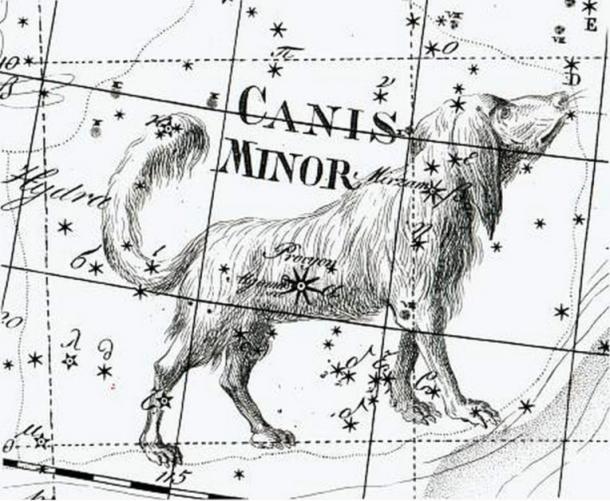
At a few different points in the story the narrator compares Jason’s attractiveness to the star Sirius. This star appeared close to the sun betweeen July 3-August 11, the so called “dog days” of summer. The Sirius star is the brightest sun in the constellation Canis Major (hence the term “dog days”). Some surmise that the ancients believed that the closeness of this bright star added to the heat of the sun, intensifying all things about what summer brings.

We can perhaps easily understand why human beauty would be linked with that of a star. The brightness of Sirius stands out above all other stars in the sky, just as when we notice that special someone across the room, all others fade from view. But in comparing Jason to Sirius in particular, Apollonius gave a foreshadowing hint that his audience in AD 300 would have understood immediately in a way we do not.

The ancient Greeks valued temperance and finding a mean between extremes. Cold and heat both bring good things, but the extremes of both are destructive. Excessive heat brings destruction to crops and to the soul. We know that on hot days, for example, crime increases. Our tendency towards anger and lethargy increases with extreme heat.

Romantic feelings are also associated with heat, but it is Spring, not Summer, that we associate with romance. Summer brings excess, and this foreshadows the destructive relationship Jason will end up having with Medea. The brightness of Sirius is a foreboding brightness. Too much light can harm just as much, or perhaps even more, as too much darkness.

But there is a flip side to the dog associations Apollonius foists upon Jason, and this subtlety helps makes The Argonautica literature worthy of our attention

Dogs had a dual place in ancient and traditional socieities (something we have touched on regarding Roland in this post). To recap briefly, dogs are, on the one hand,

  • Linked with false prophets and unrestrained appetite

but on the other,

  • Associated with obedience, humility and protection.

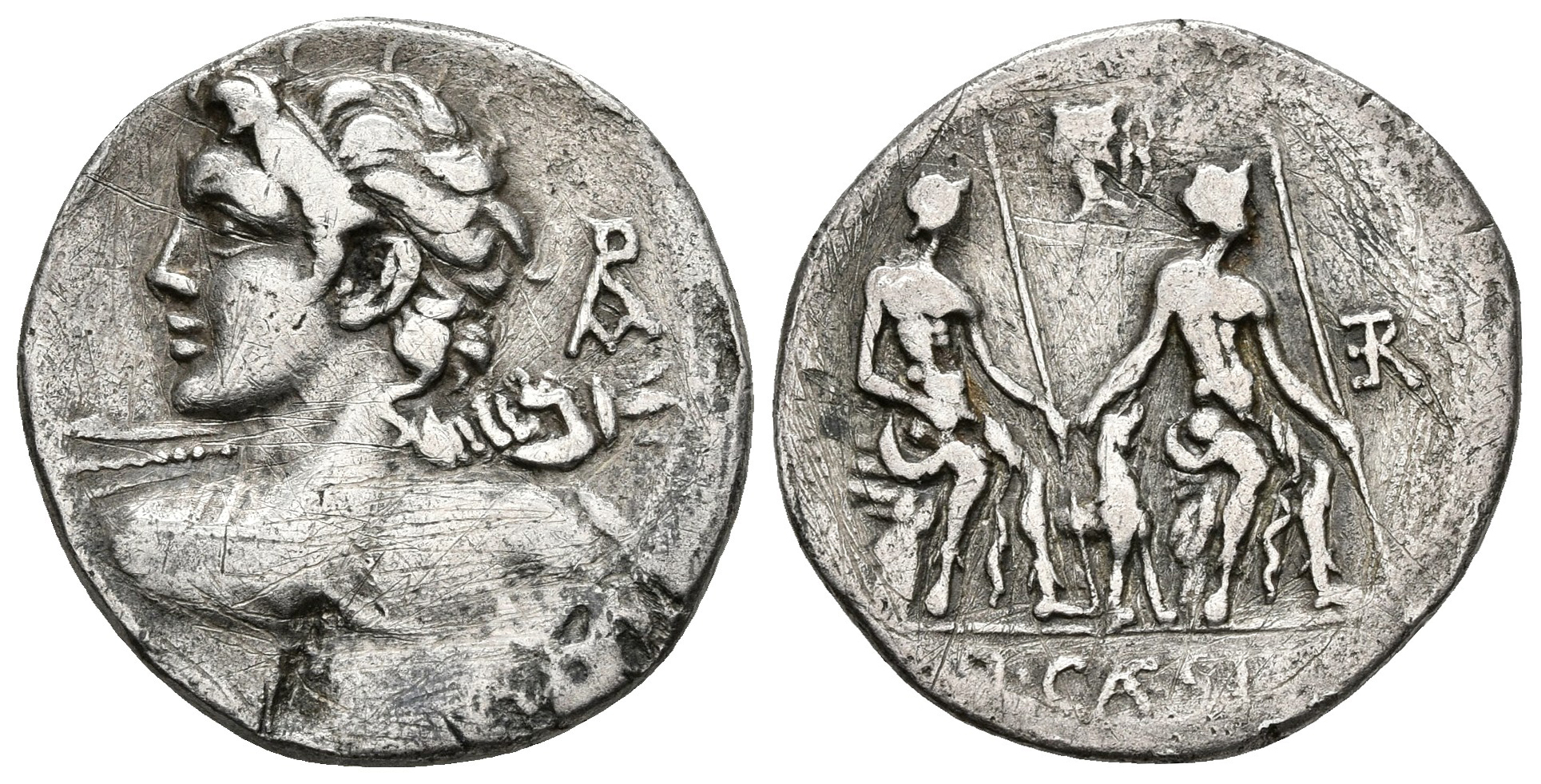
As noted previously, Jason does not exercise typical heroic leadership. He is not an unstoppable warrior like Achilles. He does not lead from the front like Roland, or possess the single-minded brilliance of Captain Nemo. Jason does show great concern for his men. He is a guardian, of sorts, for his crew, and this fits with how dogs were viewed in the Roman empire. We see here two Lares on a coin, and you can see the dog form:

Here is a later image, where they take a more distinctly human form:

So this connects positively to Jason’s leadership, and Apollonius includes this imagery to let you know of Jason’s strengths.

But dogs in the ancient world were never quite fully domestic creatures as we are used to today. They guarded borders, but would not have been brought inside the home. But Jason is the son of a king, and he should be king himself, were it not for his usurping uncle. Throughout the story, however, Jason rarely seems comfortable as a leader. He hangs back, he worries, he has insecurities. Initially his crew thought Hercules should lead. In one instance, he decides to leave an island at night because of a fair wind, but everyone knows that we have bad associations with night because of the confusion it can bring. Sure enough, Jason ends up leaving Hercules behind by mistake, and turning a ship around in the ancient world to row against the wind is basically impossible. In another instance, friendly hosts mistake Jason and his crew for invaders (again, this happens at night), and Jason accidentally kills the host king. When it comes time to box the brutish Amycus to allow them to leave his island peacefully, it is not Jason that steps forward, but another crew member.

Those who know the full story of Jason (which we will discuss at the conclusion of the Argonautica) understand that Jason will continually feel trapped and pressed by circumstances, and not able to transcend them. He never attains the greatness associated with other Greek heroes.

All this is wrapped up in Apollonius’ references to him as Sirius, the dog star, which many in the ancient world feared to see.

8th Grade Civics: Value Propositions

This week we looked at a debate about immigration to highlight a crucial skill Aristotle wishes to teach us, a skill democracies are prone to lack. As we saw last week, advocates of different political ideologies or platforms tend to absolutize the values their position highlights, while forgetting that their position inevitably fails to cover every conceivable value. We are finite creatures, and our values are finite, in the sense that every gain/advance will come at a cost. We have to leave something behind.

This is experientially true. If you want to get married and have a family, you have to sacrifice the fun of dating and meeting other people. If you have children, you have to leave behind the life of doing what you like and disposable income. You can certainly argue that married life with a family is a better choice than a life of perpetual dating. But worst of all would be the person who tried to have both at once. The married person who also wanted to date other people would wreak a great deal of havoc. The perpetual dater might simply provoke raised eyebrows.

Theologically this rings true as well, i.e., “Except a seed fall to the ground and die, it remains only a single seed; but if it dies, it produces much fruit” (John 12:24). If we are to have life, either spiritually or physically, we must have death, whether that be physical death (the food we eat) or the death of a way of life (giving up a life of dating for marriage).

When faced with a controversial and thorny political issue such as immigration, I wanted the students to use Aristotle’s template to do the following:

  • See the strengths of each side of the argument
  • Understand the costs/what you have to sacrifice to achieve your aim
  • Discern that the debate was not about good values vs. bad values, but involved deciding which kinds of values to prioritize over other values.

The debate we viewed can be seen here:

Both speakers made good arguments, but I wanted the students to see the key underlying assumptions each side brought to the debate. How we view those key assumptions will likely determine what side we favor.

Not everyone loves argument by analogies, but I think analogies have a lot of power to distill key principles of an argument.

The “Pro” side of the debate (Prof. Kaplan) argues that people should be able to travel freely to seek out the best life for themselves they possibly can. He uses the analogy of a house and guest in the following manner:

  • Kaplan declares that he is not arguing that whomever wishes should be able to come to his house if he does not want them in his house.
  • If he wants someone to come in his house, and that someone wants to come, he should be allowed to come to Kaplan’s house. True, his neighbor might disapprove, but what business is it of theirs anyway?
  • He asserts that the “Con” side of the debate essentially argues that people should not have the freedom to extend invitations to people to come over to their house, and that those invited should not have the freedom to accept. This is absurd.

The “Con” side of the debate (Prof. Wellman) also uses the illustration of a house, but with a different emphasis from Kaplan:

  • He asks us to imagine that he leaves his house and goes to a conference for a week. When he returns, he asks his wife what she did while he was gone. She replied that she played cards with friends, got her hair done, and volunteered. Wellman implies that it would be absurd for him to object to such activities.
  • But, his wife then adds, I also decided to adopt a child from a foreign country. Here he is–meet your new son! Wellman declares that he would have every right to object to this action. His wife’s “freedom of association” has dramatically impacted his own freedom of association without his consent.

There are some deeper foundations to the arguments from both sides.

Kaplan, a libertarian, seems to believe in two key principles. The first is that the individual is the primary unit of society, and so our laws should be oriented around maximizing individual freedom. Secondly, libertarians tend to believe that maximizing economic freedom (which includes the free movement of labor) is a primary way to boost freedom overall. Economic growth is a moral issue, for greater economic growth means a better life for more people, especially those on the border between the lower and middle classes. So, in his analogy of the house, the homeowner is an employer and the guest is a potential worker.

I am not sure of the philosophical background of Wellman, but he argues that the group (though perhaps not necessarily the family, a la Aristotle) is the primary political decision making unit. Decisions that involve altering the makeup of a household/political community should be made by the community as a whole (or their representatives). In his “house” analogy he envisions a family rather than an employer.

Both analogies are persuasive, and both have their limits. Kaplan’s analogy doesn’t work as well when the guest wants to blast heavy metal music out of his window, which would obviously adversely affect the community. Wellman’s analogy makes perfect sense when comparing adoption to citizenship. But what if his wife just invited a friend over for coffee (maybe similar to a temporary work visa)? Hypothetically Wellman might still object to associating with his wife’s friend, but in that case our sympathies go to his wife. We would expect Wellman to bear up with the “incovenience” of the temporary association.

Deciding between these two positions boils down to the key divide between seeing the group/family or the individual as the primary political unit of society. Kaplan is suspicious of governments exercising authority over the individual, and Wellman much less so.

Hopefully, the students will see how their beliefs about these key “fork in the road” questions influence their position on immigration, whatever that might be.

Have a great weekend,

Dave

8th Grade Civics: Aristotle and the Problem of the Good

This week we continued to look at Aristotle thoughts on how societies actually function and the downstream effects of how we make decisions.

Democracies foster freedom, which we appreciate. This freedom inevitably produces disagreements, but we expect this and factor it into our society and politics. But Aristotle wants to see what it is we disagree about, why we disagree, and whether or not we are aware of what this means.

In Book III of his Politics Aristotle writes,

Who shall govern when different groups within a state seek power? Suppose, for example, that we want only the “good” to govern—that is, those who live best and possess the best abilities– no matter their number [that is–if they are the majority or a small minority]. It is always best for the good to govern, but if within a state, there exists no common method of determining who is “good” [i.e., no common moral or religious criteria to decide] then such a method is not open to the populace. 

Criteria are necessary. If oligarchies wish to make the “good” those with a sufficient amount of wealth, or proper birth, then such a claim can be understood by all. But not all will agree with the criteria. 

How can even expediency agree with such a view? If we say that birth or wealth confer the right to rule, what about those with better birth, or more wealth? In only a short time, then, will such a system descend into the rule of one man.

But those who favor the rule of the many [democracy] have similar problems. Should the many rule simply because they are more numerous? We have seen, however, that the “good” are in short supply. If we give rule to the many because they are stronger than the few, or simply more numerous, we are logically driven to conclude that where one man or one group is stronger than another, they should have more power than others. But neither would we want what is best to be determined by mere counting.

All of this shows that neither birth, nor wealth, nor mere numbers, are the proper principle from which to govern a state.

Aristotle begins by making the obvious assertion that every society should want those that are “good” in power making decisions for us. We would naturally want those who are wise, just, intelligent, and so forth to govern. The problem arises when we have no concrete, agreed upon method for determining what wisdom and justice mean. For example, does one gain wisdom through growing up poor in an isolated rural area, or by growing up wealthier in an urban area and traveling the world, attending great schools, and so forth? We could say that both paths could or could not produce wisdom. But this wouldn’t help us unless we know how to choose between the two kinds of wisdom when presented to us. Likely, most would disagree about that question.

In absence of any concrete criteria about the more important metaphysical questions, societies turn to something more measurable, such as birth, wealth, or in the case of democracies, numbers. This has the advantage of being obvious and measurable, i.e., “Everyone from one of these 10 families can govern, or everyone with ‘x’ amount of money can govern. In the case of democracies, those with the majority of votes can govern. This can eliminate disagreement about who gets to rule, but as Aristotle points, out this gets us nowhere towards discovering “the good.” Ultimately, societies that disagree about the nature of ultimate “goods” will eventually, most likely, either devolve into factional principalities, or require force to hold everything together via force and centralization of power.

As mentioned, democracies give a great deal of freedom to its people to form their own conclusions and give them rights that they may express their opinions freely. In fact, one can argue that democratic societies almost encourage disagreement. This solves and creates problems all at once.

We discussed in class that we have problems as a society not so much because one side is good and the other is bad, but because we fail to agree how to properly order different virtues. We used the following example:

Imagine that you have a group of 100 people living in the wilderness. Other groups of people live around you, some are hostile, some are friendly, some could go either way. You built walls around your enclosure to protect your group and to give them a defined place to call home.

One night Tom and Bill are charged with guarding the walls and the gate of entrance. At the gate a man knocks. You don’t know him, but he appears hurt and sick. Do you let him in?

Tom thinks not. You are not sure about this man. He could be a spy, he could be faking, he could be dangerous, he could even be an assassin. Your primary duty is to protect the people behind the walls. Tom’s heart strings are tugged, but he steels himself to his primary duty of protecting those behind him.

Bill wants to let him in. The man seems to be strong and skilled. If we help him, he could help us and strengthen our community. Besides, we have a duty to care for those in need that goes above our duty to defend the walls.

The question should not be, “Who is the bad one, Tom or Bill?” Both Tom and Bill have good values and want to do good things. The question instead should be, “Who wants what is best in this circumstance?”

If Tom and Bill (symbolic stand ins for the community at large) actually instead agreed either to let him in or not, you have a cohesive society with a clear hierarchy of values. If they disagree, well, let the games begin.

We can drill down further. This decision might be context dependent. Suppose that instead of one man at the gate, there were thirty. Here the risk/reward of letting them in increases dramatically, and one can reasonably think that the risk outweighs the reward. But if we change the scenario from thirty men to one small child asking for asylum, the risks disappear, and it seems obvious that Tom and Bill should let them in (though one student objected, stating that, “No way! She could be one of those specially trained child assassins! :).

But even as the decision becomes context dependent, one still needs an agreed upon hierarchy of values to ensure a stable society. Without this, Aristotle suggests, you will need to be guided by concrete criteria that will solve the surface level problem. But, while an individual or a society can bury the metaphysical issue for a time, it will return. When it does, such questions will demand an answer.

8th Grade Literature: Back to the Front

This week we started our next book, The Argonautica, sometimes called Jason and the Argonauts. The story involves a sea journey with a motley assorted band of travelers in search of the famous golden fleece. The story contains a variety of tropes common in all epic literature, but the author, Appolonius oF Rhodes, adds a unique twist to the story that sets this text apart from other Greek epics, one that dovetails nicely with some of the questions we explore in civics class.

All stories of epic heroes inevtiably look to interpret the past. The hero has already done his work and lived on in the minds of men. The author then celebrates the hero and his accomplishments. The hero may be a complicated figure, but his mission and his impact is not. Epics usually are about the founding of a city/civilization, (The Aeneid) or the re-founding, or transition between two epochs (like The Lord of the Rings, or perhaps The Iliad and The Odyssey).*

But The Argonautica, written around AD 300, is not like this. The author has a different agenda, which perhaps comes from his different political and historical context.

Right in the beginning of the story, we notice some odd things for a heroic epic:

  • The crowd that gathers to see the crew off on their adventure are not cheering, but crying and wailing for those they fear never to see again.
  • The men of the ship do not pick Jason to lead them, but Hercules. Hercules defers to Jason, but the choice of Jason as the leader was made by him, not the crew.
  • Right after the ship leaves the harbor, we see Jason full of doubt, not confidence. His doubt is immediately contrasted with the swagger of a another crewmember.

Apolloinius wants us to wonder about the nature of Jason’s heroism, or perhaps even question it entirely, again, an odd way to begin an epic poem about a famous hero.

The first known written Greek epic poem was very likely the Iliad, which dates to somewhere around 800 BC. But the story of Jason chronologically predates Homer and the events of the Trojan War (in one scene we see the crew waving to the infant Achilles, for example). Homer wrote in the context of the end of the Bronze Age/Greek Dark Ages and the beginning of the city-state era. Thus, he could look back wistfully in part because he could look forward with hope.

But Apollonius writes in the midst of a free-fall decline of the civilization he inhabited. The third century AD saw Rome continuously involved in civil wars. The Roman Emperor at the time Apollonius wrote was Diocletian (reigned 284-305 AD). Diocletian at least understood the crisis, and did attempt to hold back the tide of Rome’s cultural collapse. Unfortunately, his most significant attempt to restore Rome involved an all-out persecution of Christians, which had the unintended effect of hastening Rome’s demise.

We have no idea what the story of Jason entailed originally. We can guess how Apollonius reinterprets the tale, as he has Jason faced with a serious of impossible choices. Unlike other epic heroes, Jason seems to have limited agency over events. His actions seem scripted for him. At his best, Jason finds a way to negotiate his way out of difficulty. This is certainly an important political skill, but it may not be “heroic.” Jason’s world mirrors that of Apollonius’ world in certain respects. The best one can hope for is to kick the can, and hope that maybe things will turn out ok in the end.

In this structure we see the tragic dimension of much of Greek literature. GK Chesterton may have said it best, when he wrote that,

It is said that Paganism is a religion of joy and Christianity of sorrow; it would be just as easy to prove that Paganism is pure sorrow and Christianity pure joy.

Such conflicts mean nothing and lead nowhere. Everything human must have in it both joy and sorrow; the only matter of interest is the manner in which the two things are balanced or divided.

And the really interesting thing is this, that the pagan was (in the main) happier and happier as he approached the earth, but sadder and sadder as he approached the heavens. The gaiety of the best Paganism, as in the playfulness of Catullus or Theocritus, is, indeed, an eternal gaiety never to be forgotten by a grateful humanity.

But it is all a gaiety about the facts of life, not about its origin. To the pagan the small things are as sweet as the small brooks breaking out of the mountain; but the broad things are as bitter as the sea. When the pagan looks at the very core of the cosmos he is struck cold. Behind the gods, who are merely despotic, sit the fates, who are deadly. Nay, the fates are worse than deadly; they are dead.

*Tolkien wrote his great work in the years right after World War II.

8th Grade Civics: Aristotle on justice and Justice

We tend to think of “Justice” almost exclusively in terms of the proper punishment of bad behavior. If someone robs a bank, we say that justice is done if he is caught and sent to prison. If someone is wrongfully accused, we declare that justice is done when the judge dismisses the case.

The ancient world, however, had a broader conception of the word “justice,” using it to describe all things being rightly ordered in one’s life and in the life of the body politic. A rightly ordered world might involve things that are directly moral, or sinful. So, for example, having one’s bed could be a portion of having a “just” house, but not making the bed would not necessarily be a sin. It would however, be a defect.

We see this use of justice in Old Testament frequently, such as in Psalm 54, which reads, “O God save me in thy name, and judge me in thy strength.” Here the psalmist is not asking God to punish him for his sins–far from it. Rather, God’s judgment and His salvation are one in the same. The psalmist is asking God to rightly order his being, to put him back together again appropriately, which would involve much more than overt sin.

Aristotle noted long ago that different forms of government have different forms of justice which both make sense and are incomplete all at once. He writes,

What are the oligarchic and democratic ideas of justice? Both sides have part of justice on their side, and both sides fail to express justice in its fullness. 

In democracies justice means equality, especially in the distribution of political power. That is, political power should be put in the hands of as wide a range of people as possible. A poor man, for example, holding power with no experience or education, is considered a triumph. This creates, in their view, a stable state where everyone feels included, and this is “justice.”

In oligarchies, inequality in the distribution of power is considered just. If people are not equal in wisdom, education, wealth, and the like, they should not have an equal share of political power. This helps the state have rulers that are best able to govern. In turn, a well governed, stable state will be “just.” 

The advocates of democracy and oligarchy both make erroneous judgments. Democrats hold that if men are equal in basic humanity, they should be equal in the distribution of power and property. Oligarchs hold that if men are not equal in talent, wisdom, and skill they should not be equal in most anything else.

True justice means that those who have contributed to the proper end [it’s reason for being] of the state, should have rights, property, and power in proportion to that contribution. For that reason, all must pay attention to the “goal” of the state in which one lives.

Aristotl’e ideas might seem confusing, but if we break the concepts down into something smaller and more in line with our experience, it might make more sense.

Imagine a family has three sons, Bob (18), Joe (12), and Sam (6). One evening the mom discovers that the she has three Oreo cookies left in the pantry. What would be just, and most likely to lead to a harmonious order within the family. Most would probably suggest that here the focus should be on pure equality, i.e., each son gets one cookie each.

But imagine now that the mom has three different sized pieces of steak, small, medium, and large. Most would likely not argue that justice requires them to cut up all the steaks and give each the same amount. Here most would lean towards something along the lines of the oldest getting the biggest steak, the youngest the smallest, and so on. To be sure, this is still “equality,” but it manifests itself differently here. If the family also had a 6 month old son, no one would suggest that justice demands he should get steak, as his stomach could not even digest it properly.

Parents usually treat their children differently when it comes to bedtimes, to the great annoyance of the younger siblings. Most, however, intuit that it would not be just to have all three go to bed at the same time. Here the context differs, and the meaning of justice would differ as well.

Ideally a state will have a degree of flexibility around their concept of justice, allowing for context to have its say. But as Aristotle suggests, what direction a society leans toward will depend on what that society values as its purpose or goal. For example, if you live in a society that believes that age should be respected above all else, you would defer decisions to the elderly, and you would give them the best seat at the table, and so forth. This is not equality, but it is justice according to one’s guiding principles.

An example more close to home comes from Elaine Calabro’s article in The Atlantic about Canada’s practice of MAiD, or “Medical Assistance in Dying.” The practice has grown from allowing euthanasia only in cases of advanced terminal illness, to those who simply want to avoid suffering. Calabro writes, “At the center of the world’s fastest growing euthanasia regime is the concept of patient autonomy. Honoring a patient’s wishes is of course a core value in medicine. But here it has become paramount.” Some physicians express moral or practical objections, but most who work in the industry find their work meaningful. As one physician noted regarding his work in assisted suicides, “We’re so happy [the patient] got what they wanted.” Given the basic values that created the practice, its expansion was “inevitable” according to the author.

Here we can note that a core value, i.e, people fulfill their purpose by achieving their desires, which drives much of economy, politics, etc. has simply morphed into the medical and ethical field. Hence, “Justice” in this case means giving people their autonomy, their say, in the most important life decisions. One can easily see how various other democratic practices and ideals come from this same source. This shows how one particular view of justice works in some areas (we should pick our political leaders, and pick what we want for desert)* might not work in other areas of life. We have already seen how parents use different views of justice depending on context in family life, and this is a good argument for its application to political life.

But which form of justice should be used when, and why? This is at the core of many of our current political disagreements. Aristotle also hints at the fact that these “justices” must somehow be connected to Justice in some final sense. Without agreement on Justice, we will struggles with our mini justices.

Dave

*I have a variety of friends who have traveled in Europe, and especially as one moves south and east (Italy, Greece, etc.) they notice that when going to a restaurant, often the proprietor will size you up and tell you what you will have. If you object and point to the menu, saying, “I was hoping for some lamb instead of the pork,” you will simply be told that “There is no lamb, only pork.” Eventually you agree to “submit” or leave the restaurant.This shows a different culture around food, but also a different culture around authority, tradition, the individual, and so on.

8th Grade Literature: Just the Facts

As the story continues and the characters spend more time in the Nautilus, students noted that many of the chapters contain boring lists of different plants and fish they see under the waves. This may surprise those who remember certain iconic moments in the story, such as the attack of the squid and the Nautilus’ attacks of other ships. But many chapters do contain lists of fish and other technical details of undersea life and life at sea.

These portions of the story do not resonate with me very much, and I have sympathy with the student’s reactions. But such portions of the story also give us an opportunity to gain insights into the mind of the author and the times in which he wrote.

We can first note that the story was originally published in installments in a bi-monthly periodical. It is possible that Verne includes such detail merely to lengthen his story and get paid more for publishing more. But the story was a smash hit when it debuted in 1870, and we should surmise that while financial gain may have played a part in this narrative choice, it cannot entirely explain it.

When we get incrongruity between our time and the past, this gives us an opportunity to notice how cultures change over time and what that reveals not just about them, but us as well.

Verne published his book at a time when people generally had

  • Faith that the future would be better than the past, and
  • Trust that science, and the increase of knowledge that science would bring, would be the main cause of that progress.

Captain Nemo is a bit of a superior type, and frequently in the story we see him correcting various views held by the enlightened and gentlemanly Prof. Arronax. Nemo’s travels and knowledge give him “the truth” about various historical and especially naval events. The reading public likely heavily bought into the common cutural narrative about the connections between knowledge, power, and progress. The facts obtained by the Professor about the nature of undersea life would likely have been viewed in 1870 not as random data points but priceless treasures that could help mankind advance.

The fact that these sections of the book fall on deaf ears in our day says much about us as well. The 20th century revealed that the power that comes with science has revealed itself as a double-edged sword. The knowledge that can heal us can just as easily be used to destroy us. The cataclysmic conflicts of WW I and WW II taught us this, as did Hiroshima and Nagasaki.

But we also no longer trust science as a discipline. Our trust in institutions in general has eroded, which has led to many over the last several years calling into question various things that science was supposed to have settled for us. On the other side of the 20th century, science has lost its charm and its persuasive hold on the culture at large.

One might say that Verne wrote at the “high noon” of the West’s trust in science. At the beginning, trust in science might have needed explained. At the end of an era, science would need defended. Here, in our story, the trust placed in science by all characters is implicit. They are fish who do not know they swim in water.

The embedding of the story in a sea of facts perhaps helps us focus more intently on the main character of the story, the mysterious Captain Nemo.

The other main characters are somewhat stock. They do not change and the character is easily defined.

  • The Professor wants to learn and discover new things
  • Conseil (the Professor’s servant) wants to obey his master and classify the Professor’s observations
  • Ned wants to hunt and eat. At different times in the story, he also wants his freedom.

Captain Nemo is more complex, but Verne also wrote his most famous character after a type, the “Byronic Hero,” named after Lord Byron. Byronic heroes have the following characteristics:

  • They are socially isolated by their own choice
  • They have suffered some great, unkown tragedy that has marked them for life
  • They are intelligent and arrogant
  • They are highly emotional, and given to violent outbursts of temper
  • He has significant personality flaws and knows it, making him a “tortured soul.”

The story makes no attempt to explain Captain Nemo’s origin. We can reasonably surmise it involves the death of his family, but otherwise we have only scattered hints. Verne did well to leave Nemo as a sketch instead of a finished portrait. It is the mystery of Nemo, and the questions we have about his actions, that make the story compelling. It says something of our age at least, and perhaps of humanity in general, that we prefer mystery to fact.

Have a great weekend,

Dave

8th Grade Civics: Machiavelli, Watergate, and Getting Good at Being Bad(?)

Greetings Everyone,

This week we continued our look at Machiavelli, and paired up chapter 8 of The Prince with the presidency of Richard Nixon.

Nixon is best known for the Watergate scandal that led to his resignation during his second term in 1974. This is a fair verdict of history. However, we do well to remember that Nixon had a variety of foreign policy successes during his tenure, such as

  • Initiating a policy of detente, and the SALT treaties signed with the Soviet Union which contributed to easing the nuclear arms race.
  • Assisting in peace negotiations between Israeal and other Arab nations duirng the Yom Kippur War of 1973.
  • His historic overture to China and our opening of diplomatic relations. While we may wonder today at the ultimate legacy of our shift in China policy over the last 50 years, at the time it was a revolutionary move that likely helped hasten the end of the Cold War.

Domestically, Nixon had several initiatives that may surprise some who know him only through the prism of Watergate:

  • He started several new government agencies, such as the EPA, OSHA, and the National Oceanic and Atmospheric Administration
  • He took the US economy off of the gold standard
  • He reshaped financial policy by creating the Office of Management and Budget*
  • He passed the Clean Water Act

Some of these policies were popular, some not, but we cannot question that for a time he was an effective political leader and easily won reelection in 1972. But the Watergate scandal, and Nixon’s actions during the scandal, unraveled everything very quickly, and we should consider why this was the case. For that, we turned to Machiavelli’s insights about rulers who exercise “villainy.”

Machiavelli begins chapter eight of The Prince discussing two infamous rulers, and begins with Agathocles of Sicily, writing,

The son of a potter, he led a life of the utmost wickedness through all the stages of his fortune. Nevertheless, his wickedness was accompanied by such vigor of mind and body, that having joined the miltia, he rose through its grades to become praetor of Syracuse. . . . He [then] called together the people and Senate of the city, having imparted his design to fight Hamilcar the Carthaginian, . . . at a given signal had the senators and all the rich men of the city murdered, [eliminating all who could oppose him]. . . . And although he was twice beaten by Carthage and ultimately beseiged, he was able not only to defend the city, . . . but also [expand its territory into Africa] and [eventually] brought the Carthiginians to terms. In the end, he maintained his position as prince by many courageous and perilous expedients.

It cannot be called virtue to kill one’s fellow citizens, betray one’s friends, be without faith or pity, and without religion, by which methods one may indeed gain an empire but not glory.

Machiavelli goes on to cite the example of someone contemporary to his own day, who used many of the same methods as Agathocles. Later in the chapter, he continues,

Some may wonder how it came about that Agathocles, and others like him, could, after infinite treachery and crueltry, live secure for many years in their country without being conspired against by their subjects; although many others have, through their cruelty, been unable to maintain their position in times of peace, to say nothing of the uncertain times of war.

Machiavelli then answers his query, writing,

I believe this arises from the cruelties being used well or badly. “Well” used may be called those (if it is permissable to use the word of evil) which are committed once for the need of securing oneself, and which afterwards are not persisted in, but which are exchanged for methods as useful to the citizens as possible. Cruelties ill used are those which , although at first few, increase rather than diminish with time. Those who follow the former method may remedy in some measure their condition with God and man, as did Agathocles. As to the others, it is impossible for them to maintain themselves. . . . a conqueror must arrange to have all his cruelties come at once, so as not to have to resort to them every day . . .

We can first note that almost no political leader follows his advice, and indeed, in a democratic system, following his advice (supposing that one should do so, a different question entirely) becomes almost impossible. To get elected, one must promise good things, and certainly not state that one will begin their term by doing various evil deeds. To get elected, one must at least give the appearance of either a) healing the harms done by the previous leader, or b) prevent the harms that the challenger will introduce should they be elected.

The elected leader usually then enjoys a honeymoon period, an era of good feelings, where people assume the best and enjoy the change. Then, later, when the leader makes missteps, they are judged harshly for them. Among other things, these missteps go against the grain of their earlier cultivated image.

For presidents that serve two terms, the second term usually brings crisis and controversy. Truman’s second term had the Korean War, Johnson’s second term had violence in cities and the escalation in Vietnam. Nixon had Watergate, and Reagan the Iran-Contra scandal. Clinton had the Monica Lewinsky scandal and impeachment. Bush had to face increasing difficulties and costs in Iraq, as well as the financial crash of ’08. The good feelings engendered by Obama in his first term disappeared during his second. There appears little escape from this pattern.

Perhaps one problem modern political leaders have is that they have little chance to exercise physical courage in any direct way. This limits their chances to win the favor of the people and renew their mandate, so to speak. Agathocles, for example, didn’t just take political risks that paid off, he regularly risked his own life.

Crtics of Machiavelli assert that he encouraged rulers to do evil things, or at least, gave them a pathway for doing so. This is possible, but I think we have to think more deeply about his words. Machiavelli does not say one can be a great ruler by doing evil, but q successful one. There is a difference. If one regards politics as an inevitably dirty business, then one needs to be aware of how to use the dirt. The divide, I think comes between those who think the dirt cannot be avoided, and those who think that it can. Machiavelli would tell us that the problem with modern leadership is not the dirt on their hands, but that they tell us that their hands are clean.

Dave

*I would suggest that the “throughline” for understanding both his foreign policy successes, his domestic policy initiatives, and the Watergate scandal is that of control. Nixon was not process oriented but idea oriented. He was suspicious of collaboration and had a hard time trusting others. He believed he was the one who best control events and outcomes. So, taking the economy off the gold standard gave the Fed more control over the economy, his budget reorganization put more power into the executive branch, and perhaps he created other federal agencies to extend executive power even in areas traditionally not managed by government. As for Watergate, rather than come clean at first and accept minor damage, he believed he could control the messaging and prevent problematic fallout. His miscalculation on this (in addition to his actual obstruction of justice) led to his demise.

A Culture of Victory, a Culture of Collapse

The evaluations of the historically minded often move like a pendulum.  I see this throughout my own life. Initially, like everyone, I thought Napoleon a great genius.  But then you think again . . . after all, he lost.  And what about what happened in Egypt, to say nothing of Russia?  And what of all those armies he beat from 1799-1809–nothing more than decrepit, out-dated Enlightenment entities destined for the trash-heap anyway.

After a while, however, I thought again and gave credit where due.  Sure, his armies were the perfect foil for the Austrians and Prussians, but he helped create the French army that formed that perfect foil.  Like any great leader he imprinted himself all over his army.  And we say that the armies he faced were bound for trash-heap only with the benefit of hindsight.  Napoleon put them there, after all.

But . . . he lost.

Writing about The Civil War comes with similar pitfalls.  As the states began to come together in the Progressive Era (ca. 1880-1920) we looked for unity and healing from our past, and we lionized Lee as a romantically doomed warrior, who nevertheless, performed heroic feats.  Lee’s generalship for that era stood second to none.  Beginning in the 1960’s historians swung the narrative.  They focused on Lee’s irascible temper, his huge losses, his weak opponents, his strategic failures at Antietam, Gettysburg, and so on.

Joseph Glatthar’s excellent General Lee’s Army brings balance back to this narrative.  He studies the army of Northern Virginia in depth and concludes51tuzkutcjl that of course, Lee was a great commander.  He helped forge a great army with a great record in the field.  He deserves much of the credit he receives.

But . . . he lost, and we do well to remember this. Lee’s ultimate defeat may well have had something to do with Lee, and the army he commanded.

Glathaar shows us how the strengths and weaknesses of Lee and his army come from the same place by looking at culture, demographics, the life of the common solider, and those directly under Lee’s command.

We do have to take into account Lee’s frequent opponent, the Union’s Army of the Potomac.  From a pure match-up standpoint, it would have been interesting to have Lee, Longstreet, and Jackson oppose Grant, Sherman, and Thomas for the duration of the conflict.  As it happened Lee only faced Grant towards the end of the war, and then Grant had to work with the Army of the Potomac, where he inherited a completely different, and vastly inferior, operational and command culture than what he worked with out west.

In  A Savage War, the authors point out that the Army of the Potomac inherited a disproportionate number of soldiers recently graduated from West Point.  A West Point education tended at that time to over-emphasize math, engineering, and organization (something that U.S. Grant lamented in his memoirs).  Such skills have their place, but should not have pride of place in officer training.  Those that drank from the firehose of this approach would inevitably give way to excessive caution. Meticulous organization takes a lot of time.  In addition, once you have built something so “pure” and pretty, one might not wish to do anything that might get it dirty. This helps explain why McClellan (tops in his class at West Point) could think himself a great general even though he couldn’t actually win a battle.  He was excellent in doing what his education, at least in the narrow sense, trained him to do.

The plodding, rigidly organized Army of the Potomac gave Lee and his men a perfect target given their particular strengths.

Glaathar points out that the men in Lee’s army fully believed in their cause and came with the strongest of motivations.  Ante-bellum southern society had the duel influences of the aristocratic planter and the Appalachian border-settlers.  Both of these cultures emphasized honor and courage.  Both of these cultures preached a vision of manliness that gave way to no one.  Letters home from top officers on down the ranks show a constant desire for combat and to prove themselves.

Lee both understood and embodied this himself.  Many other accounts of his generalship focus on his ability to psychologically assess his opposite number on the Union side and devise the proper approach accordingly.  Glaathar adds to this, showing how Lee knew how to use his men expertly.  They proved superlative in the counter-attack, and could march quickly and fight hard back-to-back.  We see this at Bull Run, in Jackson’s Shenandoah campaign, and at Chancellorsville, as at other times.

But both the aristocratic planter and border settler culture had its weaknesses, and these too had a significant impact on the war.

Organization:

Appalachian border culture emphasized freedom of initiative and eschewed “systems” like tight and itchy collars.  Lack of formal structure gives one great freedom.  But an army of tens of thousands needs tight organization to act as a unit.  Without this organization, large scale offensives could never be undertaken.

Discipline:

Many in the south seceded because they did not want to be told what to do by anyone they did not like or respect.  They tended to run hot and cold alternatively.  Sure enough, Lee had a hard time enforcing discipline.  We hear a lot about Union armies looting in the South, but Lee’s army at times looted the Virginia countryside for supplies, stole from the bodies of dead Union soldiers,** and had a hard time maintaining equipment.  Many went AWOL unexpectedly not necessarily out of cowardice but because “they felt like it.”

Honor and Ego:

The aristocratic nature of the army came through in the upper echelon of the officers.  The bickered for position and rank.  At times they disobeyed directly if they felt insulted.   Some at times seemed to prefer maintaining their honor to winning a battle.

All of these weaknesses would make coordinated action over a large distance difficult.  Perhaps this is why Lee spread out his armies in his invasion of the north in 1863.  It gave each commander more independence. But . . . when the time came for coordinated action, invariably Lee’s forces could not pull it off.

Shelby Foote wrote that, “Gettysburg was the price the South paid for having Lee command their army.”  I’m guessing that he meant at least that no one is perfect.  But I surmise that he meant more.  The weaknesses of Lee’s army, and of much of southern culture, outed themselves at that battle.   There the Confederacy fought a weaker opponent, but in ways that favored Union’s strengths.  The good ground and interior lines of the Union forces at Gettysburg played right into the laps of the North’s slower, plodding, yet more bull-headed nature.^

Lee’s 1863 invasion may have been a mistake, but he intuited correctly that the South could not win a long and protracted war.  He emphasized the Confederacy’s logistical shortcomings, but the army had cultural shortcomings as well.  Perhaps Lee had read and recalled Tocqueville’s thoughts on aristocratic and democratic societies at war.  Tocqueville comments that,

In aristocracies the military profession, being a privileged career, is held in honor even in time of peace. Men of great talents, great attainments, and great ambition embrace it; the army is in all respects on a level with the nation, and frequently above it.

We have seen, on the contrary, that among a democratic people the choicer minds of the nation are gradually drawn away from the military profession, to seek by other paths distinction, power, and especially wealth. After a long peace, and in democratic times the periods of peace are long, the army is always inferior to the country itself. In this state it is called into active service, and until war has altered it, there is danger for the country as well as for the army.

It may be remarked with surprise that in a democratic army after a long peace all the soldiers are mere boys, and all the superior officers in declining years, so that the former are wanting in experience, the latter in vigor. This is a leading cause of defeat, for the first condition of successful generalship is youth. I should not have ventured to say so if the greatest captain of modern times had not made the observation.

A long war produces upon a democratic army the same effects that a revolution produces upon a people; it breaks through regulations and allows extraordinary men to rise above the common level. Those officers whose bodies and minds have grown old in peace are removed or superannuated, or they die. In their stead a host of young men is pressing on, whose frames are already hardened, whose desires are extended and inflamed by active service. They are bent on advancement at all hazards, and perpetual advancement; they are followed by others with the same passions and desires, and after these are others, yet unlimited by aught but the size of the army. The principle of equality opens the door of ambition to all, and death provides chances for ambition. Death is constantly thinning the ranks, making vacancies, closing and opening the career of arms.

. . . An aristocratic nation that in a contest with a democratic people does not succeed in ruining the latter at the outset of the war always runs a great risk of being conquered by it.

Dave

*Interesting parallels exist between Lee and Napoleon’s armies.  Both faced stiff, rigidly organized opponents.  Both emphasized movement, speed, and capitalized on the energy and spirit of their men.  Both had great success early, but both also suffered significant setbacks as their respective wars dragged on. Each faced manpower issues, but also, their opponents got better over time and neither Napoleon or Lee made the necessary adjustments based on the improvement in their opponents.

In fairness to the Army of the Potomac, the soldiers displayed extreme courage at Fredericksburg, and were stalwart in the defense at Gettysburg.

**Many southerners decry the actions of Sherman.  Glaathar demonstrates that Lee’s army did many of the same things, albeit on a smaller, less organized scale, as Sherman’s army.  And . . . they did this not just in Pennsylvania but in Virginia as well.

^Fredericksburg might serve as a good example of these qualities, with a negative outcome.

8th Grade Civics: Machiavelli Explains Vietnam

This week we continued our look at the Vietnam war. The fall of South Vietnam has many causes, but given our limited time with this period, we need to try and find the “core” of why our policies and military intervention failed to prevent North Vietnam from absorbing South Vietnam.

Machiavelli’s speciality involves viewing different events through a few key principles, one of them involving how states get created and how people come to rule them.

He writes,

Those who solely by good fortune become princes from being private citizens have little trouble in rising, but much in keeping atop; they have not any difficulties on the way up, because they fly, but they have many when they reach the summit. Such are those to whom some state is given either for money or by the favour of him who bestows it; as happened to many in Greece, in the cities of Ionia and of the Hellespont, where princes were made by Darius, in order that they might hold the cities both for his security and his glory; as also were those emperors who, by the corruption of the soldiers, from being citizens came to empire. Such stand simply upon the goodwill and the fortune of him who has elevated them — two most inconstant and unstable things. Neither have they the knowledge requisite for the position; because, unless they are men of great worth and ability, it is not reasonable to expect that they should know how to command, having always lived in a private condition; besides, they cannot hold it because they have not forces which they can keep friendly and faithful.

States that rise unexpectedly, then, like all other things in nature which are born and grow rapidly, cannot have their foundations and relations with other states fixed in such a way that the first storm will not overthrow them; unless, as is said, those who unexpectedly become princes are men of so much ability that they know they have to be prepared at once to hold that which fortune has thrown into their laps, and that those foundations, which others have laid before they became princes, they must lay afterwards. 

Machiavelli goes on to cite examples of men who gain power through nepotism, such as Cesare Borgia, who demonstrated enormous energy and creative drive. Borgia had the respect of some, and the fear of most. He had many successes. And yet, as Machiavelli notes, even a man of such ability as Borgia had his power eroded almost the moment his father died. If Cesare Borgia failed, we can count on almost everyone failing in some way in such a position.

We will understand Machiavelli better if we understand his terminology, especially the word “Fortune.” For example, a person might get into Harvard not because of their achievements but because of a large contribution from their parents. A king might place his favorite in charge of a conquered province, regardless of his connection to the people there or his experience. All this would be an example of Fortune at work.

Very few places in Machiavelli’s day made political decisions via elections, so his advice may seem outdated. But if by “princes” we take “rulers” more generally that will help us understand his words more clearly.

When looking at South Vietnam, we should first realize that in many ways, the state was created by “Fortune” artificially. True, the Vietnamese people had existed for centuries, and Vietnam as a region had existed for centuries. But after the French lost control of what was then called Indochina in 1954, Vietnam was partitioned into North and South Vietnam by treaty. The US had a heavy hand in making sure this happened, and we had good reasons for doing so. We wanted to stop the spread of communism, for one (the North was basically communist controlled) and we wanted to preserve the long southern coastline for shipping, trade, and other security reasons. But South Vietnam was essentially created by “Fortune” and its president, Ngo Diem, was in power at least partly due to our influence.

Machiavelli would have said that the fall of South Vietnam 1975 had a lot to do with the circumstances of its founding in 1954. It would have taken extraordinary leadership to overcome the inherent problems involved in its somewhat artificial creation. Unfortunately, President Diem displayed some of the worst characteristics of leaders created by Fortune.

To be fair to Diem, he was an intelligent man and a staunch anti-communist. He likely also held sincere Christian beliefs. He had a real desire to see South Vietnam succeed. He showed courage in the war for independence from the French, for in eschewing both communism and colonialism, he made himself vulnerable to reprisals from both parties. He wanted a democratic Vietnam, and had well thought out ideas of how to map democracy onto Vietnamese culture and history.

Having said this, many leaders created by Fortune can forget that they did not truly earn their position. This can lead them to overconfidence, which in turn leads them to isolate themselves from the populace.* Diem made several missteps, among them

  • He was a Catholic in a largely Buddhist part of Vietnam. Historians debate the nature of his treatment of Buddhists as democratic equals, but his policies towards them failed to connect. Eventually, he ended up cracking down on the civil liberties of Buddhists.
  • He held elections, but almost certainly rigged them in his favor, or at least, significantly exaggerated the extent of his winning margins.
  • He practiced nepotism, giving family members key governmental posts. If these family members had great ability, this could have mitigated the political cost of nepotism. As it was, his family members were corrupt and unstable. One of his brothers, for example, was a professed admirer of Hitler.

When the US finally decided to withdraw its support of Diem in 1963, a successful coup attempt happened almost immediately. But one coup can lead to another, and South Vietnam never again had a stable government. After hearing about the coup Ho Chi Minh, the leader of North Vietnam, reportedly stated that, “I can hardly believe the Americans would be so stupid.” The North Vietnamese government wrote that,

The consequences of the 1 November coup d’état will be contrary to the calculations of the US imperialists … Diệm was one of the strongest individuals resisting the people and Communism. Everything that could be done in an attempt to crush the revolution was carried out by Diệm. Diệm was one of the most competent lackeys of the US imperialists. Among the anti-Communists in South Vietnam or exiled in other countries, no one has sufficient political assets and abilities to cause others to obey. Therefore, the lackey administration cannot be stabilized. The coup d’état on 1 November 1963 will not be the last.

Indeed, this unfortunately proved prescient. South Vietnam experienced many other changes in leadership over the next several years, and no regime ever had anything like stability. In such an environment, American military efforts were akin to pouring water into a sieve. South Vietnam crumbled as the US inevitably withdrew its support, and US culture crumbled as well, with the domestic and foreign scene mirroring each other in some ways.

Dave

*The story of South Vietnam partially foreshadows what happened in Afghanistan in 2001-2020. Our invasion helped install Hamid Karzai in power, and he began his term in office with significant international acclaim and support. Based on my very limited knowledge it seems to me he was a better leader than Diem, and smarter about how he tried to unite different factions. Karzai was intelligent and courageous. In time, however, his relationship with the U.S. soured, and he was accused of corruption from different facets of the Afghan and international community. Afghanistan could not maintain the momentum of the early 2000’s, and in time the Taliban returned. This quasi-democratic interregnum lasted about 20 years, roughly the same amount of time South Vietnam existed.

8th Grade Literature: Mobilis in Mobili

We continued with 20,000 Leagues Under the Sea this week and got our first introduction to Captain Nemo.

I hope that the students in the class will not only understand the events of the stories we read, but also understand the meaning of events within the story. That is, the students will hopefully learn to see how literature can entertain them but also challenge them to potentially think and see the world differently. This means learning how to read, in the sense of learning how to discern authorial intent within the text.

So, for example, the characters of Professor Arronax, Ned Land, anmd Conseil assert that the crew of the Nautilus are “pirates” multiple times after entering the vessel. Clearly, Verne means to ask the question as to whether or not Nemo should be considered among likes of Blackbeard. The story may reject this notion, but Verne introduces it to us for a reason. He wants us to entertain the possibility.

No one questions that Captain Nemo is the most important and enigmatic character of the story. The fact that Nemo has lived on in our cultural parlance, and that his character has been adopted into other stories, shows that Verne hit the mark with his creation. Before the characters formally meet Nemo, they are introduced to his motto, another clue to its importance in unlocking the meaning of the story. Around the ship the characters see the letter “N” surrounded by the words

Mobilis in Mobili

The phrase can be translated literally as “Moving in a Moving Thing,” but is better captured more colloquially as “moving within motion,” or some also suggest, “changing within change.”

Verne could be described as a writer of popular fiction, but there is a lot to unpack in this phrase as it relates to the story.

Not coincidentally, the phrase is associated with a submarine and a crew that never touches land. They are always within water, which is continuously fluid and changing its shape. So, from a metaphysical point of view, the Nautilus and her crew must always “change within change,” but this continuous flux becomes in itself a new stasis. Land represents stability, and without land, they will need to continuously adapt. This continuous adaptation still produces recognizable patterns.

This lends insight into Nemo’s later assertion that he is bound by no law other than his own. Without the stability of land, there can be no fixed law of conduct. Yet, this continuos change does produce something resembling stability within Nemo’s personality. His law resembles that of civilization, but it still stands slightly askew, and hopefully the students will see this.

The fact that Nemo’s super submarine is called the Nautilus also reveals much. The word choice has several levels of meaning:

  • In Greek, the word nautilus means simply, “sailor.”
  • The nautilus is a sea creature within a shell. It is the sole living creature whose bony structure is in fact a shell. The submarine becomes the skin of the crew, an extension of themselves.
  • Metaphorically, the grooves of the shell spiral downward continuously, a foreshadowing of the end of the book, as well as a metaphor for Nemo’s life. Under the sea, enclosed in the sub, there would be no natural way to measure the passage of time. Without the ability to mark time, one will be in danger of not being able to discern meaning from experience.

The Nautilus offers a kind of luxury and temporary interest for the scholar, Professor Arronax. But for the more normal Ned Land, the sub is nothing more than a prison. Here again Verne wants us to consider not only if meaning requires time, but also if meaning requires stability. Is the world Nemo built enough to sustain him psychologically and morally, or will it leave Nemo only to the whims of his moods?

We will continue to explore these questions as we get into the meat of the story in the following weeks.

Dave

8th Grade Literature: Jiro Dreams of Sushi

Greetings all,

This week we mostly took a break from 20,000 Leagues Under the Sea as students finished their rough drafts of their Song of Roland essays. In the syllabus I handed out at Orientation, I mentioned that we would be seeing two movies this year that fit with the themes of our particular unit. Both Old Man and the Sea and The Song of Roland have similar characters and ask some of the same questions. Both Roland and Santiago

  • See their life almost wholly through their job/vocation (knight and fisherman)
  • Dedicate themselves to their task with great courage, risking their life for their “calling.”
  • Avoid “thinking too much”–analysis leads to paralysis for both men. For both men, the truth of their lives comes in their actions.
  • Achieve greatness, but they could also both be accused of having too narrow a focus. They have to sacrifice a great deal to become who they are.

Our movie for this unit is Jiro Dreams of Sushi, a documentary about the man many believe to be the greatest sushi chef in the world. His restaurant is small, nestled in the midst of a metro train stop. But foreign dignataries have come to dine at his establishment, and there is a now such a long wait list for diners that one must call long in advance to get a seat.

The movie has a great to reccomend it. It immerses one into the world of sushi and the personality of Jiro. While obviously no documentary can explore every area of anyone’s life, one gets the sense that the film captures the essence of Jiro the man. One can admire a great deal about Jiro:

  • He has worked with sushi since he was a little boy. He has no real formal training and everything he knows he gleaned from his own experience.
  • He could have easily grown rich through various means involving franchising, promotionals, etc. but he keeps a low profile. Sure, he is reasonably well off as an individual, but one immediately senses that it is not money, but the craft that drives him.
  • He has a wholehearted dedication to perfection in his craft. Only a small percentage of what he and his staff make actually gets served.
  • Critics say the key to his success is the simplicity and purity of his dedication. He serves sushi, and only sushi. There is no music, fancy lights, or even conversation in his restaurant. Nothing is there to distract from the food.

Jiro is probably more evocative of Santiago instead of Roland, but as you can see, he shares similarities with both of them. Both Hemingway and the author of The Song of Roland have a great fondness for their main characters. But their admiration for Santiago and Roland, respectively, is not uncritical. Great literature knows how to ask questions of itself. Jiro Dreams of Sushi also has great admiration for its subject. But it would not be such an influential documentary film if the movie only involved hero worship.

A closer viewing of the film reveals the costs of Jiro’s life and achievements. Like Santiago, he seems a bit of a loner. The movie shows him visiting with friends and family, but this seems added on merely as an attempt to show him as “well rounded.” Jiro does not get that gleam in his eye from visiting family. Like Roland, his dedication to his own sense of calling leaves little room for other voices. As one restaurant critic says, no truly great chef is interested in collaboration. One senses that perhaps he should have retired some time ago and let his son take over, but this seems an impossibility for him.

My hope is that the students will notice some of these shadows around Jiro’s bright sun, and that this might help him understand what we have read so far this year.

8th Grade Civics: Aristotle helps explain Vietnam

In Book V of his Politics Aristotle writes that

Constitutions are preserved when their destroyers are at a distance, and sometimes also because they are near, for the fear of them makes the government keep in hand the constitution. 

Wherefore the ruler who has a care of the constitution should invent terrors, and bring distant dangers near, in order that the citizens may be on their guard, and, like sentinels in a night watch, never relax their attention. He should endeavor too by help of the laws to control the contentions and quarrels of the notables, and to prevent those who have not hitherto taken part in them from catching the spirit of contention. 

Some of this may seem jarring to us, as Aristotle is usually so calm and reasonable! Still, we should try and understand him.

First, by “constitution” Aristotle means something much more than the laws or political processes of a particular state. He refers more broadly how a particular order is “constituted,” in all its parts, i.e., its decision making, laws, culture, economics. One can think of their own familes as a kind of “constitution.” Parents make some “laws” that are explicit (perhaps, “no phones at the dinner table”), and there are some things that your family just “does not do.” You have ways of making decisions as a family that might vary, but would vary in a predictable fashion.

Let us suppose that mom and dad have a family meeting and declare together that “We are going to the beach this summer for vacation. You accept this as final even if perhaps you preferred to go elsewhere. You can now prepare to enjoy the beach as best you can. But what if dad says “beach” but mom says, “cabin in the mountains.” Their division would spark division amongst the children. Everyone would see the possibilities, and everyone would have an opinion. The uncertainty breeds division.

But division over where to go on vacation is relatively harmless. Imagine a different scenario with more at stake. Someone new moves into the neighborhood. He does live next door, but he is on your street several houses down. Some say that the new neighbor is a nicy guy, even if he is quirky and a bit mysterious. No one seems exactly sure what he does for work, of if he has a family. But he seems a bit lonely, so its important to reach out. Others say that he is a bad guy, mysterious for all the wrong reasons. He is someone to be avoided. But no one can say anything definitively.

Now imagine if your parents lacked clarity on how they viewed him. Sometimes they see him as a potential threat, sometimes they see him as a someone they should reach out to. They send mixed messages. They cannot decide. The kids too would be confused, and likely divided themselves. All kinds of theories would emerge in favor of every kind of approach.

This is the problem Aristotle alludes to. A threat far away is no problem. We have clarity on the situtation, and can relax. A threat close by also unites us, and again, it is the clarity that unites. A possible threat maybe in gray zone, maybe not, will pose a problem for the constituted order, even if they never actually attack. Their mere presence in the miasma of the in-between will breed internal division and disunion. Most “constitutions,” after all, are eroded from within rather than without.

It is the lack of clarity that divides internally.

In our own nation’s history we can think of some recent examples. Before we entered WW II, for example, the nation was seriously divided over whether or not we should involve ourselves in wars so far away, whether in Africa or Asia. Yes, the Nazi’s were bad, but how much did their “badness” impact us? After Pearl Harbor, we no longer had any doubts about the threat they posed, and we enetered the war entirely united.

This principle played itself out in our own living memory. After 9/11 as a nation we had clarity about our invasion of Afghanistan. We were attacked, and our attackers were there. We had our “Pearl Harbor” moment regarding Islamic terrorism. We invaded Afghanistan under a banner of national unity.

A few years later, we invaded Iraq with much less national unity and much less clarity. Was Iraq a threat? Well, maybe. Perhaps they had weapons of mass destruction, and perhaps Saddam Hussein would actively try to help those who wanted to harm us, but maybe not. We had no national agreement, but invaded anyway. The war lasted longer than we thought, cost more than we thought, and likely contributed to the financial collapse of 2008. One can argue that politically and culturally, we have not recovered from the fallout of these events.

Should we have invaded either country? The question is certainly important, but we can understand Aristotle’s point even better if we eliminate what we “should have” done from the equation. After all, the invasion done under the banner of unity did not have ultimate success (the Taliban is back in power), and the one conducted under national strife seems to have had some positive lasting effects (the constitution we helped install in 2005 still holds in Iraq). The question Aristotle wants us to consider is which conflict proved worse for our own constituted order, and here we have an obvious answer.

When we look at the Vietnam War, we again have a conflict almost guaranteed to cause internal division and threaten our constitution. We can see the violence and massive cultural changes in terms of family breakdown, the sexual revolution, drug culture, etc. as a byproduct of our involvement in a war in which we lacked clarity on the nature of the threat.

One the one hand, protecting South Vietnam could be seen as vital to our interests for many reasons:

  • We had pledged to defend the country from communist agression. Whether or not we should have done this, once declared, we had to back up our words if we wanted our words honored in other places throughout the world.
  • We had an interest in stopping the spread of communism, which was/is an evil ideology that wrecks great harm wherever it goes.
  • South Vietnam’s coastal geographic position made it a key strategic point of all of Southeast Asia.

But the fall of South Vietnam could be seen as not a threat to us for equally valid reasons:

  • Chinese and Soviet communism did pose a threat to us. But Vietnamese communism was more nationalistic, and thus, no real threat to the United States
  • Furthermore, Vietnam had a history of conflict with China. It would be in our interest not to fight them but to court them as an ally against China.
  • The perceived moral imbalance of a wealthy industrialized power attacking a poor peasant nation would never hold politically in the US, a country that mythologizes the underdog.

At the risk of oversimplifying a complex period in our history, our lack of clarity over a threat in the grey area led us into a labryinth that could only lead to the altering of our constittuted order.

8th Grade Civics: Machiavelli on Having it Both Ways

Alexander the Great’s conquest of Persia provides the backdrop for one of Machiavelli’s more insightful observations about how countries are composed and hold together.

Persia had a vast army and a vast amount of territory. Furthermore, the Persian empire was comprised of different ethnic and tribal groups, as well other assimilated civilizations such as Egypt and Babylon. Yet, with an army of between 40-50,000, within ten years Alexander had destroyed all resistance to his control over most of Asia. Alexander died without having the chance to consolidate any of his gains, and we might then expect that Persia would revolt against the Macedonians and reclaim their freedom. But this failed to materialize. In fact, the Macedonians fought amongst themselves for control of the region, and still Persia did nothing. How could this be?

Machiavelli writes:

Considering the difficulties which men have had to hold to a newly acquired state, some might wonder how, seeing that Alexander the Great became the master of Asia in a few years, and died whilst it was scarcely settled (whence it might appear reasonable that the whole empire would have rebelled), nevertheless his successors maintained themselves, and had to meet no other difficulty than that which arose among themselves from their own ambitions.

I answer that the principalities of which one has record are found to be governed in two different ways; either by a prince, with a body of servants, who assist him to govern the kingdom as ministers by hisfavour and permission; or by a prince and barons, who hold that dignity by antiquity of blood and not by the grace of the prince. Such barons have states and their own subjects, who recognize them as lords and hold them in natural affection. Those states that are governed by a prince and his servants hold their prince in more consideration, because in all the country there is no one who is recognized as superior to him, and if they yield obedience to another they do it as to a minister and official, and they do not bear him any particular affection.

The examples of these two governments in our time are the Turk and the King of France. The entire monarchy of the Turk is governed by one lord, the others are his servants; and, dividing his kingdom into sanjaks, he sends there different administrators, and shifts and changes them as he chooses. But the King of France is placed in the midst of an ancient body of lords, acknowledged by their own subjects, and beloved by them; they have their own prerogatives, nor can the king take these away except at his peril. Therefore, he who considers both of these states will recognize great difficulties in seizing the state of the Turk, but, once it is conquered, great ease in holding it. The causes of the difficulties in seizing the kingdom of the Turk are that the usurper cannot be called in by the princes of the kingdom, nor can he hope to be assisted in his designs by the revolt of those whom the lord has around him. This arises from the reasons given above; for his ministers, being all slaves and bondmen, can only be corrupted with great difficulty, and one can expect little advantage from them when they have been corrupted, as they cannot carry the people with them, for the reasons assigned. Hence, he who attacks the Turk must bear in mind that he will find him united, and he will have to rely more on his own strength than on the revolt of others; but, if once the Turk has been conquered, and routed in the field in such a way that he cannot replace his armies, there is nothing to fear but the family of this prince, and, this being exterminated, there remains no one to fear, the others having no credit with the people; and as the conqueror did not rely on them before his victory, so he ought not to fear them after it.

The contrary happens in kingdoms governed like that of France, because one can easily enter there by gaining over some baron of the kingdom, for one always finds malcontents and such as desire a change. Such men, for the reasons given, can open the way into the state and render the victory easy; but if you wish to hold it afterwards, you meet with infinite difficulties, both from those who have assisted you and from those you have crushed. Nor is it enough for you to have exterminated the family of the prince, because the lords that remain make themselves the heads of fresh movements against you, and as you are unable either to satisfy or exterminate them, that state is lost whenever time brings the opportunity. 

Essentially Machiavelli points out that

  • Some countries are hard to conquer but easy to hold once defeated. They have greater unity from the top-down, but once that unity is shattered, it cannot make itself whole again. We might think of such countries akin to a brick wall. It is very hard to put one’s fist through a wall, but once you break the wall, it cannot reconstitute itself.
  • Some countries are easy to conquer but make it quite difficult to maintain the conquest. Their internal divisions open the door to the invader, but those same internal divisions will guarantee you will have problems in the future. Such countries resemble water. One can easily put one’s fist through water, but the most one can do is move or scatter it. Given the right conditions, that pool of water can easily return.

We can use Machiavelli’s framework to help explain historical events closer to our time.

During WW II, Germany and Japan functioned much like Persia or the Ottoman Empire of Machiavelli’s day (though it is important to remember that Machiavelli’s categories are not moral categories–one can be bad or good and have strong unity). After their military defeat, both Japan and West Germany rebuilt themselves with extraordinary speed. Neither Nazism or military dictatorship made even a pretense of returning to Germay or Japan, respectively. Their (extreme) unity, once shattered, disappeared into the ether, with an entirely new society emerging.

Our experience recently with Afghanistan highlights Machiavelli’s second category. With its many tribes and difficult geography, we were able to quickly defeat the Taliban and establish a new government. However, all we really accomplished was the scattering of water. In time, the Taliban reemerged and regained control. Our experience mirrored that of England in the 19th century, and Russia, both in the 19th and 20th centuries.

I wanted the students to consider whether America resembled more of ancient Persia, or if we are more like medieval France. The students had different arguments for both sides, which was great to see.

For centralized unity defining America, they argued that

  • While a few “weird” states exist (such as Florida and Alaska) for the most part most states function in the same way and have similar cultures.
  • We have unified executive control over the military from top to bottom.
  • We share common political and cultural events, such as elections, political debates, the Super Bowl, etc.
  • We share enough of a common vision of what it means to be an American, such as agreement over our rights as citizens.

For the “water” analogy fitting America, they argued that

  • There are a variety of states, scattered throughout the country, that may have similar poltical systems, but very different cultures (Texas, California, Lousiana, etc.).
  • We have a great deal of political disagreement. While we technically have one president, a strong minority of Americans will not support him.
  • While we agree on our rights, such as the right to vote and free speech, these rights are generally used to divide us and not unite us.

I enjoyed the students’ thoughts on this important question.

It is possible that a country can change its identity. The France Machiavelli mentioned went from the “water” model to the “brick wall” starting in the 17th century under King Louis XIV. By the time of the French Revolution in the late 18th century, what happened in Paris determined everything in France. America may have gone through periods in our history when we functioned in a more centralized or de-centralized manner, and we may change again.

One of Machiavelli’s talents involves letting us know that one can rarely if ever have it both ways. Strong unity, or strong disunity both have their advantages that are somewhat exclusive. We have to own our choices, and understand their consequences.

Enjoy the weekend,

Dave

8th Grade Civics: Aristotle and the Veiling of Authority

This week we continued with Aristotle and examined the idea of how monarchies function and preserve their power. Aristotle was a good Greek, and so in the final analysis he did not view monarchy as the best form of government. However, he acknowledged that monarchies had strengths, and we looked at his advice (which Machiavelli likely would have agreed with) regarding how kings can maintain their power and authority.

He wrote that,

A king will best preserve his throne through moderation. The less he exercises authority, and in the fewest areas of civic life, the greater his power. 

To start, kingship in certain religious contexts is best preserved through mystique, which is ruined by excessive action. The less areas of action, the less his subjects will envy him. The survival of Spartan kingship may be attributed partly to the original division of power between two kings, and partly to the moderation afterwards by Theopompous. He may have strengthened the kingship by divesting himself of some of its powers.

Despotic tyrannies may be preserved in two ways, one of which was proved by Periander of Corinth, who found men of spirit who might oppose him and had them executed. But additional measures are possible, the main being the forbidding of common meals, associations, clubs, and education, or in other words, making every citizen a stranger to his fellow man.

Another line of policy involves getting information about everyone through a network of spies. This entails a secret police, like the female spies employed at Syracuse, or the eavesdroppers sent by the tyrant Hiero to public gatherings.

We can consider both the legitimate and illegitimate use of moderation and “veiling” one’s power.

Aristotle alludes to the mystique of kingship that exists in part because of its overt connections to religion. In pre-modern Christian societies one assumed the throne “by the grace of God.” There was a conscious acknowledment that one did not “earn” the kingship through merit. Being the oldest son of the reigning monarch meant nothing in of itself. In other ancient societies, some kings reputedly had special connections to the gods, and in some places (such as Egypt), kings were demi-gods themselves.

Religion has power both through what it reveals and what it conceals. Recall the times in the gospel when Christ tells people not to tell about His healing miracles (ex: Mt. 16:20), or the fact that He spoke in parables (Mk. 4:12) to obscure meaning.

Veils are meant on one hand to obscure our view, but on they other, they reveal something else. Think, for example, of the robes and regalia of a king. In part such accoutrements are there for symbolic purposes. They also help the ordinary man disappear, and then subsequently reveal “the king.” In crucial moments (such as depicted in the video, when Charles II dissolved Parliament) words are best kept to a necessary minimum.

In a more down to earth manner, most parents know that they cannot comment about everything their kids do. They instinctively know that if they comment on everything they will soon lack the ability to speak about anything to their kids. Especially as your kids get older, you have to pick your spots. When my own kids were teenagers, I remember discovering that my attempts to rationally explain why they could not go “X” party only resulted in prolonged arguing and frustration. After I switched to simply stating “You cannot do ‘X,’ end of story, there was still anger, but less frustration, and it was much less prolonged. Such is the power that comes with veiling authority.

As your status elevates, you should speak less, but conversely, what you say carries greater weight. My paternal grandparents, for example, never told me what to do, except on two occasions, once when I was twelve, once when I was nineteen. In both instances, there was no question my mind about heeding their advice. Speaking to me so rarely meant their words carried great weight. Of course my parents dealt with in a more direct manner on a daily basis, and consequently had to say much to me than my grandparents. Naturally, sometimes I listened to my parents, and sometimes I did not.*

In monarchies no necessary “reason” existed as to why a particular family assumed the throne. No one needed a “reason.” Someone in medieval France or ancient Babylon did not need “convinced,” no defender of the king needed to syllogistically prove why “X” should reign. It was an accepted fact of their existence, akin to the rising and setting of the sun. In democracies, the very fact that we have choice means that person X might not have been president if only a, b, or c had happened. The opposition party immediately tries to minimize the reach of the current president, and begins planning to unseat him in the next election.

Aristotle mentions how monarchy can distort itself into a tyranny through the use of informants and a secret police. Such measures make sense for monarchies, in a way, for they parody the power that comes from the mystery of kingship. A well trained secret police can have great effectiveness because we both fear and revere secrets. Secrets have authority, whatever the end to which they are put.

Democracies value transparency and openness. We naturally distrust those who keep secrets, and voters need informed on the issues. Many see the rise of social media and Youtube as a great boon to our democratic political life. I grew up in an age of curated information. For political news to reach me, it had to pass down through various institutional filters in government and the media. Now we can get so much more information so much more quickly, and have no need of the institutional filters that existed for so long. Politicians can also speak more directly to people anytime they want on any issue.

But politicians, like parents, should not spout off indescriminately. They should in some measure hoard their ammunition and craft something of a mystique.** We can grant that democratic leaders need more visibility to the people they represent. But if everything is worthy of comment, quite soon nothing will matter to anyone. Those in power will find their arsenals either empty or full of duds.

Dave

*This dynamic may explain a common frustration of parents–they tell their kid to do ‘x,’ dozens of times and get no result. Someone adjacent to the family says the same thing and they immediately think it’s a great idea.

**Teachers should do the same. Don’t be the teacher that lets your students know a laundry list of your personal likes, dislikes, voting habits, etc. or students will not see you in the mantle of “teacher,” but just as another regular Joe on Instagram.

8th Grade Literature: Introduction to 20,000 Leagues Under the Sea

Next week we will start our next book for the year, Jules Verne’s 20,000 Leagues Under the Sea. Verne’s stories captivated the people of his time. Many of his books have been made into movies, which is one measure of cultural resonance. His stories had straightforward plots and generally stock characters, which aided their serialization into the popular magazines of the day. So on one level, I hope that the students enjoy the story as an adventure tale.

But like any great author, a particular worldview informs the work, and the story raises interesting questions for us to consider.

The Relationship Between Technology and Freedom

Verne wrote in the mid-late 19th century, a time of enormous technological change, perhaps a shift greater than what we have experienced the last twenty years or so. The Industrial Revolution not only remade the economy, it shifted how we worked and lived as a society. This period saw the spread of democratic ideals throughout Europe and America as well, and the casting off of traditional institutions and ideas. Elites across the western world lost a great deal of status, which culminated in World War I. So one the one hand, the growth of political freedom and technology went hand in hand.

Yet in our day, we see that the relationship between technology and freedom is not so straightforward. Our phones give us immediate access to information everywhere, but they also track us and have a way of fixating our attention. Computers allow us to be more creative and productive at work but this also means that work can follow us anywhere at anytime. Cars allow us to roam with more speed and flexibility than at any previous time in history but they break down frequently and require us to work long hours to maintain them.

This paradox is not confined to our day. For example, most saw the obvious benefits of the Industrial Revolution in the abundance of goods at cheaper prices for a great mass of people. In very real ways, the standard of living went up. To achieve this, millions of people had to work menial, robotically repetitive jobs in factories for 12-14 hours a day.

In Verne’s story, Captain Nemo consciously sought to free himself from the constraints of civilization’s laws and mores, and takes to the sea . . . where he spends his life confined in a metal shell. The Nautilus gives and takes away from Nemo and his crew in equal measure. We shall explore this relationship as we read.

The Relationship Between Man and Society

We often define freedom as the absence of constraints, i.e., no one tells me what to eat for lunch, or what movie to see, or who to vote for. In this respect Nemo and his crew are “free.” But as already noted, this form of freedom comes with a price. Philosophers and theologians outline another view of freedom, one where the constraints put upon us actually aid us in achieving our proper ends as men and women. For example, a train is certainly constrained by the tracks on which it moves. Yet those very constraints help the train be what it what it was created to be. Without tracks, a train cannot fulfill its proper “end,” or (to use Aristotle’s phrase) “telos.” A train sitting in the woods has no freedom to be a train.

So too, our families, communities, and our country certainly put constraints upon us. Children and adults alike resent them at times. We might rather play the video game than do our homework. We might rather finish our movie than clean the kitchen or change the diaper of a crying child. On a societal level, our politicians can annoy and disappoint us, and we may pine for other lands where the grass seems greener. Captain Nemo is the classic “tortured soul” that our culture has trained us to admire. We can certainly appreciate Nemo’s courage, intelligence, and devotion to his crew. But we need to see how Nemo’s separation from civilization has also warped his sensibilities. Our connections to those around us shape who we are, and without them, we are left with the freedom of the void.

Many business leaders, politicians, and the like, reflect that it is “lonely at the top.” I remember my pastor in college confiding to me that most all of his truly good friends were other pastors. They shared a common bond that others cannot quite relate to. So too, a ship’s captain will likely find the highest level of kinship with other captains. But because Nemo has severed ties with the world, he cut himself off from the possibility of that kinship. He has his ship, his books, and his studies, to comfort him.