Alexander Nevsky and Humphrey Bogart

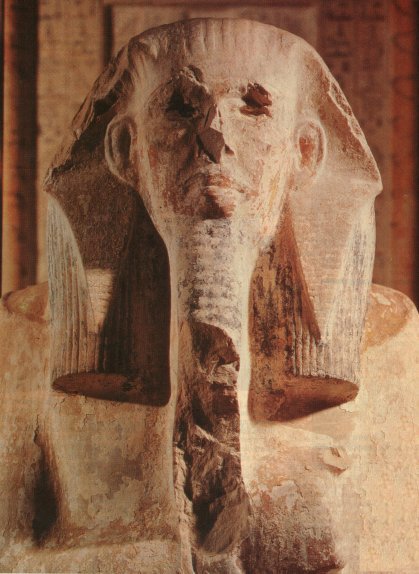
Whenever I teach about ancient Egypt that civilization always impresses me with its “weight.”  I mean that the Egyptians expressed an utter confidence in the meaning and purpose of their civilization.  We see evidence for this in a variety of places, but I draw attention to the “Tale of Sinuhe,” one of the more beloved early Egyptian folktales.  The story recounts some impressive adventures of Sinuhe abroad, but the climax of the story is not found there.  Sinuhe triumphs when he returns home, when he receives the favor of the king, and (strange to our ears, no doubt) when the king grants him a lavish tomb.  The story concludes,

There was constructed for me a pyramid-tomb of stone in the midst of other pyramids.  The draftsmen designed it, the chief sculptors carved in it, and the royal overseers made it all their concern.  Its necessary materials were made from all precious things one desires in a tomb shaft.  Priests for death were given to me.  Gardens were made for me just as is done for the highest servants.  My likeness was overlaid with gold.  His majesty himself made it.  There is no other man for whom the like has been done.  So I was under the favor of the King’s presence until the day of death had come.

All Sinuhe ever needed was in front of him the whole time, a Hallmark card ending if there ever was one.

Of course the Exodus dramatically and deservedly shook this confidence,* and at times the “weight”and “presence” of Egypt would no doubt feel oppressive and claustrophobic  (as it does for me with the Great Pyramid of Giza), but, nevertheless, they had a marvelous run.

Recently reading a collection of tales from medieval Russia, I had a reaction not unlike the one I have with Egypt.  Russia is different than America — obviously.  But how so?  A quick look at literary luminaries reveals much.  The Adventures of Huckleberry Finn undoubtedly deserves its high praise, but then one reads The Brothers Karamazov (roughly contemporary works) and discovers something entirely different.  Twain bounces here and there and constructs a fanciful lark (for the most part) out of the idea of rebellion against society.  Though he is thoroughly American, there remains something of the delightful English politeness about him, making his points in circuitous fashion.  Dostoevsky writes from a much more solid, earthy foundation.  The “earthiness” of his foundation gives it all the more spiritual impact.  He writes not of ideas at all — except to criticize them and the very concept of “ideas.”  Instead he comes from a place of absolute confidence in a particular reality.  In his stories the rebels are the bad guys, who try and introduce discontent into the Russian soul.

Just as we have no particular historical roots as a nation, so our folktales take on a whimsical character and have no particular roots in history (i.e., Paul Bunyan, Johnny Appleseed, etc.).  Even when Twain makes his best points, they take the form of jokes.  Dostoevsky . . . not so much.**  So Russian folktales usually seem to have much more direct historical roots and could rarely be described as “whimsical.”

In the tale told of about the Polish king Stephen Bathory’s siege of the Russian town of Pskov (ca. late 16th century) we see all of these characteristics.  It speaks of “Holy Russia” without a trace of irony.  When the “pagan” king’s army advances past some of the outer defenses, the story turns:

. . . in the Cathedral of the Life-Giving Trinity the clergy incessantly prayed with tears and moaning for deliverance. . . . [they] began to weep with loud voices, extending their arms to the most holy icon.  The noble ladies fell to the ground and beat their breasts and prayed to God and the most Pure Virgin; they fell on the floor, beating the ground with their heads.  All over town women and children who remained home fervently cried and prayed before holy icons, asking for the help of all saints and begging God for the forgiveness of their sins . . .

After an extended poem on the power of God the tide turns, and the people rally.  But they need to stem a breach in the defensive wall.

. . . [the Russian commanders] ordered that the icons be brought to the breach made by the Poles.  Once the holy icon of the Holy Virgin of Vladimir had protected Moscow at the time of Tamerlane.  Now another was brought because of Stephen Bathory . . . and this time the miracle happened in the glorious city of Pskov,  . . . for divine protection invisibly appeared over the breach in the wall.   . . .  All the commanders, warriors, and monks cried out in unison, “O friends, let us die this day at the hands of the Lithuanians for the sake of Christ’s faith and for our Orthodox tsar, Ivan of all the Russias!

In his marvelous, Everyday Saints, Archimandrite Tikhon of the Pskov Caves Monastery related a story about a particular bishop caught in an unfortunate position amidst a large crowd.  Uncertainty reigned in Moscow in a public square during the collapse of communism in the early 1990’s.  Some soldiers came over to shield the bishop from the crowd and began to take him into their vehicles for protection.  Many in the crowd, however, thought the soldiers were imprisoning the bishop.  The Archimandrite relates that several people rushed out towards the bishop, saying, “It is happening again [i.e., the Communists imprisoning church officials]!  This shall not be!  Come brothers, let us help this good priest.  Let us die for him!”  Soldiers dissuaded them from hurling themselves on their bayonets only by careful explanation of their purpose.

A particular sense of reality is evident, and an absolute confidence.

Our heroes play different roles.  Even the golden age of Hollywood, when America supposedly bursted with confidence, gave us heroes like Humphrey Bogart — a man “in the know,” and somewhat detached.  We love the reluctant hero.^  Russians remember instead princes like Alexander Nevsky, who when attacked by the Swedes, supposedly went immediately to church, where

remembering the song from the Psalter, he said: “O Lord, judge those who offended me.  Smite those who set themselves against me, and come to my aid with arms and shields.”

Before his death, Alexander took the most strict of monastic vows, the “schema.”

Alexander’s reaction today could only be mocked by the west, just as Putin’s physicality — be it swimming in icy lakes or wrestling tigers, or whatever — becomes late-night fodder.  But Putin, consciously or not, sincerely or not, very likely taps into something deep within the Russian soul and Russian history — the fearless leader of absolute confidence with not a trace of detached irony.^^

Those who do not like President Obama sometimes don’t see that his appeal has little to do with his policies.  Rather, he embodies a certain idea of American hip culture.  He tells deprecating jokes with wry humor, a wink, and a nod.  He appears on Marc Maron’s podcast and Comedians in Cars Getting Coffee with Jerry Seinfeld. So too we in the west, I think, fail to understand Putin’s popularity.  Perhaps he channels Alexander Nevsky, not Humphrey Bogart.^^^

Dave


*I favor a late Exodus date, and so see Ramses II as the beginning of the end, and not an “Indian Summer” after the decline had already begun in earnest.

**Of course Dostoevsky can sometimes be very funny.  I laughed aloud at various points in The Brothers Karamazov, and The Gambler. But Twain was known as a humorist, and while the idea of Dostoevsky as a one man show is funny, the show itself . . . would not be.

^Might Tom Cruise’s Ethan Hunt of the Mission Impossible movies serve as an exception?  He has none of the smirks of a James Bond.  Hunt “believes” — believes in what?  Who knows?  Who cares?   We don’t watch the movies out of love for the Ethan Hunt character, but for the stunts, scenario’s, etc.

^^The Archimandrite Tikhon has been involved with some controversy and mystery due to his “relationship” with Putin.  An excellent interview with him is here — recommended.  The interviewer represents a typical western perspective and the Archimandrite shows that he is not a modern-westerner.  We should realize that a) Putin may have a sincere religious faith, and b) St. Petersburg will not orient Russia in the way that Peter the Great or other westerners might wish.

^^^Russia has experienced a dramatic rise in religious affiliation since the communist collapse, but not a corresponding rise in regular church attendance, at least according to one Pew Research study.  I don’t mean to suggest that Putin faithfully believes and practices like Prince Alexander.  If left utterly detached from the Faith, Russia’s earthiness will become frighteningly barbaric. As many have noted — Russia is a land of great sinners and great saints.
 

Death by Abstraction

“A theology without practice is the theology of demons.”  So said St. Maximos the Confessor.  Abstractions have never held any weight within Christianity.  The devil believes, and it makes no difference.  The Incarnation explodes the possibility of the efficacy of “abstraction.”  God became a particular man at a particular time in a particular place.*

We see this theological truth spill out into other areas.  Beware, for example, of vague descriptions of “Human Rights.”  Without application in a particular context, such “rights” have no meaning.  Hence France’s “Declaration of the Rights of Man” declared in 1789 gave absolutely no protection to anyone during the Reign of Terror in 1793.  The Committee of Pubic Safety interpreted such rights as they pleased to do what they wished.  Beware the man with grand visions of glory who cares nothing for the actual human cost.  On such foundations were the great tyrannies of the 20th century built.

A great deal of debate exists as to the question, “What is America?”  Different answers have been given to this question, but we don’t often stop to question why we have so much debate about our identity.  I think the root of this problem lies in the commonly accepted idea (whether it is true or false) that America has its origin in certain ideas about liberty, freedom, and so on, not in any particular experience in history.  In a few other posts on this blog I muse on this question (see here and here if you have not wearied of me quite yet:).

Some historians argue that America took a decided turn with the victory of the North in the Civil War.  Proponents of this do not necessarily assert that the South was “good” and the North “bad,” though some may argue this.  Some in this school of thought, like Clark Carlton from Tennessee Tech, don’t even put the focus on the good of one side vs. the other, or on state’s rights and federal power, but rather on culture and the idea of what America actually is or should be.

Carlton argues that the two sides in the Civil War represented two different ideas about America.  The North, dominated by a New England ethos, believed that America had its roots in certain ideas that should have application everywhere for all men.  The South, rooted in a very different migratory pattern (discussed brilliantly by David Hackett Fischer in Albion’s Seed, by far the best book I’ve read on colonial America), saw America as a place to transplant a certain kind of Anglo-Celtic way of life.

I lack the wherewithal to discuss the merits of this theory, except to say that it has enough plausibility to deserve consideration.  For the moment let’s assume its core proposition and explore its possible merits.  For the theory to hold water, we would need to trace the development of abstract ideas throughout the history of New England and see its pernicious effects.**  Of course this means that we find that they did in believe such abstractions.

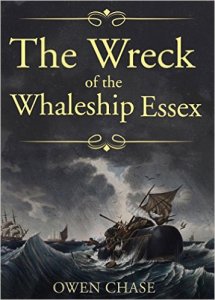
Recently I read the The Wreck of the Whaleship Essex by Owen Chase, written in 1821.  The book tells of the shocking attack and sinking of their ship by a sperm whale, the inspiration for 51-cWJypx5L._SX355_BO1,204,203,200_Melville’s Moby Dick.  Most American whaling crews hailed from the New England area, as did the Essex.  The account held my interest all the way through.  For our purposes here, I couldn’t help notice, however, how the author spoke about God.  I don’t believe he ever used the word “God,” referring instead to “Providence,” or “the benefits of the Creator,” or something like that.  Certainly they never made any reference to Jesus Himself.  Such language left me cold.  Whether or not the author and his crew believed in Christ I cannot say, but this impersonal and ultimately abstract language is certainly not a Christian way to speak about God.  It seems to exactly mirror the Transcendentalists like Emerson, who of course hailed from New England.^

As their journey in the lifeboats continued, their supplies of food obviously dwindled.  At first when crewmen died they buried them at sea decently.  But after several weeks they grew more desperate, and fell to eating parts of the deceased crew’s body before burial.  They did so even though they still had small amounts of bread left, so they had other options.  One of the lifeboats even eventually drew lots to see who would be shot, so his flesh could be consumed.  A man named Owen Coffin drew the short straw and apparently submitted to his fate willingly.

So all in all eight crewmen survived, but at what cost?  I do not judge them too harshly.  They endured severe trials and privations.  After several weeks I’m sure they had nothing left physically, mentally, and emotionally.  I have never endured anything remotely akin to their ordeal.  Yet in the writing of the account itself I expected some remorse, some second-guessing of their practices, especially given the time proximity of their rescue to their cannibalism.  In hindsight, such horrors probably were not even necessary for their strict survival.  But Mr. Chase has no such reflections.

I can’t help but wonder if their cold and distant manner of speaking about God might contribute to their cold, impersonal view of each others lives and bodies.  This surprised me because earlier in the book he wrote touching passages about the attachment of the crew to each other.  After the ship sunk the crew found themselves in three separate lifeboats.  Chase talks movingly of losing sight of their fellow ships at night and their frantic efforts to find each other lest they be separated.  But in the end, I suppose, their abstract notions of life won out.

But this crew did not invent such a way of speaking.  These abstractions must have had their roots somewhere.  We might start with the New England Puritans.  Initially, it seems that the Puritans were anything but abstract in their views.  They practiced a very particular way of life and belief.  But a second look tells otherwise.  I have no wish to “pile on” the Puritans, who get a lot of bad press, much of it undeserved.  I admire certain things about them.  But their strong Calvinism does lead one to a kind of abstraction regarding God.  God’s abstract “will” often asserts itself to the fore in Puritan theology, pushing more personal characteristics such as love, mercy, etc. to the periphery.  Their conception of the “will” of God swallowed up all individual personality.  So I think we can say that abstraction had its roots in the foundation of New England society.^^

The American Revolution had many of its roots in New England, and there again we can say that they had an attachment to abstractions.  They began by charging the British with violating their rights as British citizens in 1765, but ended by conceiving of Lady Liberty (a goddess?), and human rights that should apply to all men everywhere.

This abstract seed has grown many branches, some good and some bad.  The root issue seems to be the idea that once a certain group of people latch onto a particular incarnated meaning of “liberty,” they seek to apply to all everywhere.  So we have the New England abolitionists on the one hand, and LGBT rights on the other.  Both have very different seeming applications, but both might have the same root.+

In the end I’m not sure “abstraction” was a distinctly New England problem.  Carlton sees the Civil War as a turning point for American ideals of abstract liberty, and here I disagree.  Perhaps New England held to such “abstractions” more than others, but by 1800 at least these ideals had spread most everywhere.  Where I agree with him fully, however, is that latching onto abstract propositions to guide us has resulted in many theological and civil problems.

As we end the Christmas season, may the truth of the Incarnation lead us in a different direction.

Dave


*Hence the importance of the prologue of St. Luke’s gospel, the historical books of the Old Testament, and various other portions of Scripture.

**I don’t mean to leave aside the possible pernicious effects of Anglo-Celtic culture.  For his part I don’t believe Carlton means to glorify this culture.  Rather, he seems to assert that the culture was uniquely their culture, and thus they (and not anyone else) had ownership of its strengths and sins, slavery obviously among them.  Their moral life remains their responsibility and not those of other states/countries, or the Federal government.  Perhaps he might continue to argue that taking it out of their hands in a way absolved them of ownership and responsibility — creating a pernicious distance between themselves and their political and cultural lives.  Did this then lead to actually more mistreatment of blacks?  It seems hard to argue this, as slavery ended because of the Civil War.  But . . . perhaps this “distance” gave them more subconscious permission to continue subjugating blacks as an act of defiance?  This would be a pretty radical idea, one that we could not test and can therefore only speculate.  But it does seem a bit of a stretch to me.  Still, I am only speculating as to his argument.

^Such manner of speaking about God is not only confined to New England, however.  Washington, Jefferson, and other southerners spoke in a similar  way.  This may cast doubt on Carlton’s thesis.

^^We can find other examples, I think.  The Puritans did not really grow a local culture, but rather “imported” and imposed a large measure of it from the Old Testament — or at least their interpretation of it.  We might argue that Puritan culture was the byproduct of abstract theological ideas.

+On the issue of slavery Carlton argues that the New England abolitionists accomplished nothing in part because of their abstractions.  They had no roots in the culture they critiqued.  They merely espoused vague notions of liberty.  He wanted southern abolitionists (such societies did exist, at least in the upper South) to solve the issue — alas, they did not.  But neither, I suppose, did northern abolitionists.  They both failed alike to avert Civil War. As to why America could not solve this issue legislatively, as England did, I’m not sure.

Men Behaving Badly

Byron Farwell’s The Great Anglo-Boer War offers an intriguing glimpse into the waning days of Victorian England, deals with some difficult moral dilemmas, and entertains with good writing and good stories.  When one combines the myopia of Victorian Brits and the self-righteousness of the Dutch Boers, it can lead, if nothing else, to entertaining reading.  The whole episode reminded me of the failed Rob Schieder TV show Men Behaving Badly.   I saw exactly 0 episodes of this show, but I do remember the promo, which had Schieder’s character standing by a sink full of dirty dishes.  He narrated,

What does a guy do when all of his dishes are dirty?  Well, the way I see it, he could a) Buy more dishes, b) Rent another apartment, or c) Find suitable dish-like replacement from your natural surroundings (holds up a frisbee).

My guess is that was about as good as the show got.

Who is one to root for in this conflict?

On the surface, you have an imperial nation at the high-water mark of its power, fighting in land not their own against a group of rag-tag farmers who only wish to be left alone.  Our underdog instinct wants to kick in, but then we remember the Dutch Boers woeful mistreatment of the indigenous local African population and back off on any potential support.  So perhaps we can root for the Brits?  After all, “Empire” is not, or should not be, a dirty word in and of itself. Sometimes empire-states can serve the common good.  And one can make a legitimate argument that England’s empire on balance did more good than harm, where no such argument exists for say, the French or Germans.

But then you see their reasons for their fight against the Dutch, and you throw up your hands.  The British and the Dutch had their separate spheres of influence in South Africa, and managed to tolerate each other.  But then miners found gold in the Dutch portion and a variety of treasure-seeking Brits came to seek their fortunes.  The Dutch understandably did not embrace their presence.  Almost exclusively they farmed and cared nothing for mining.  They had a narrow, pious view of how life should be led that did not mesh well with the more rambunctious materialistic miners.  Some kind of conflict between them would be inevitable.

The British couldn’t face the idea of their citizens not getting the royal treatment.  Without citizenship, the miners naturally could not vote, and the Dutch passed a law aimed squarely at the miners making the residency requirement for voting 14 years.  The British were outraged, and some minor scuffles ensued, followed by negotiations.  The Dutch agreed to lower the residency requirement to seven years, two shy of the five years the British wanted.

It took someone like Foreign Secretary Alfred Milner to make this difference into a war.  A brilliant scholar, perhaps his German ancestry led him to develop an outsized passion for all things British, especially the Empire.  Was it his mixed ethnic background that subconsciously put so much racial language into his speech?  He once stated,

I believe in the British race.  I believe that the British race is the greatest governing race that the world has ever seen, and I believe there are no limits to its future.  It is the British race which built the Empire, and the undivided British race which can alone uphold it. . . Deeper, stronger, more primordial than material ties is the bond of common blood, a common language, a common history and traditions.”

His Credo, published posthumously, somehow unfortunately only added to his popularity. . .

I am a Nationalist and not a cosmopolitan …. I am a British (indeed primarily an English) Nationalist. If I am also an Imperialist, it is because the destiny of the English race, owing to its insular position and long supremacy at sea, has been to strike roots in different parts of the world. I am an Imperialist and not a Little Englander because I am a British Race Patriot … The British State must follow the race, must comprehend it, wherever it settles in appreciable numbers as an independent community. If the swarms constantly being thrown off by the parent hive are lost to the State, the State is irreparably weakened. We cannot afford to part with so much of our best blood. We have already parted with much of it, to form the millions of another separate but fortunately friendly State. We cannot suffer a repetition of the process.

As an aside we can see that the Nazi’s did not invent all of their horrible language about “race,” and “blood.”

To our point, with this attitude Milner could make a mountain out of a molehill.  His extreme sense of British dignity could be quite easily tweaked.  When some in England felt that with the concession of the Boers war could be avoided Milner stated, “No no no.  If enforced rigidly their government would be able to exclude anyone they deemed undesirable.”  As Farwell noted, why Milner thought that the sovereign Dutch state could not exclude people they deemed undesirable implied that the Dutch had no sovereignty where England was concerned.

Milner’s counterpart Joseph Chamberlain also saw these minor disputes in absolute terms.  He argued for war as well, stating,

We are going to war in defense of principles, the principle upon which this Empire has been founded, and upon which it alone can exist.  The first principle is this–if we are to maintain our existence as a great power in South Africa, we are bound to show that we are both willing and able to protect British subjects everywhere when they are made to suffer injustice and oppression.  The second is that in the interests of the British Empire, Great Britain must remain the paramount Power in South Africa.  [The Dutch] are menacing the peace of the world.

That last sentence is almost breathtaking in its foolishness.  How could a small group of Dutch farmers who denied British citizens the vote in Dutch elections and taxed them 5% on their profits menace the peace of the world?  Not unless the British see their own peace as the world’s peace, or their own inability to get their way everywhere as tantamount to a rupture of “world peace.”

I could not bring myself to root for the British.  Even British opponents of the war, like Major General William Butler, show this same insufferable posture.  Butler forecasted many troubles the British faced in the war, and afterwords commented, “I was able to judge of a possible war between us and the Boers with a power of forecast of a quite exceptional character.”

The war progressed in the way we might expect.  The rugged South African terrain gave the Dutch farmers plenty of hiding space, and British arrogance and unfamiliarity with their surroundings made for a few massacres.  The Dutch were better shots and had better rifles.  But then, British persistence kicked in.  They poured in more money, more troops, and even had an upswing in Victorian enthusiasm, and eventually wore the Boers down.  They took pages out of Sherman’s book by burning crops and farms (they targeted more broadly than Sherman did) and starving troops in the field.  They anticipated the Nazi’s not only in racial language, but also in the use of concentration camps.

But the peace settlement showed that England had only won battles, and in fact, lost the war.  They could not stay in South Africa, and eventually the Dutch gained their complete independence.  As for “upholding British prestige,” the Germans did not think much of it and thus crashed through Belgium in 1914.  So England lost what it both indirectly and directly fought for within a few years of the war’s conclusion.

What lessons can we deduce from this conflict?

1. The expansiveness of late-stage empires

The end of the Victorian era saw a huge expansion of the the Empire.  As the reign waned, they had to loosen their belts.  The same happened, albeit with less success, under Louis XIV in France, and with Augustus’ bid to get into Germany at the end of his life.

I have no good explanation for this.  My only stab might be that when we get older, we don’t really change, but our characteristics come into sharper focus, be they good or bad.  The same might hold for civilizations at the end of epoch. Expansive minded rulers might take a while to find their sea legs, but then once they/the civilization have made their characters, their expansive nature could accentuate itself more and more as time went on.

2. The Persistence of the Armies of Empire

The British troops showed remarkable tenacity and a passion for glory, much like the Roman army in its heyday.  Mounting British casualties early on did nothing to abate this.  I think we can say that rather than the expansiveness creating the armies, the armies provide the possibility of it in the first place.

3. Empires in their late stages make mountains of molehills

Pericles did this with the Megaran Decree, and Victoria did it in South Africa.  To some extent, Napoleon did this with Russia.  When empire-states do this, they always justify their extreme action under the aegis of defending their reputation throughout the world.  For them, their action proves their vitality, but in reality, it may only prove that they have grown old, cranky, inflexible, and overly touchy.

4. The futility of force alone

On certain extreme political ends, some might say that, “violence never solves anything.”  This is quite obviously untrue.  But violence alone, apart from any other political or moral power, will rarely solve problems, especially for the aggressor far from home.  The British experience in India should have taught them this lesson, for they established themselves there with very little force, and rarely had to use it to stay.

Milner wanted to make South Africa something of a second India, but their brutal tactics could never win over the local population.  The Dutch never wanted to be British the way some Indians did.  Even many Indians that eventually fought for independence used their British educations to do so.

I like the ‘Redux’ version of Apocalypse Now, and I think this scene sums up in some ways the position of the Dutch and the British.

Like sand falling though our fingers, South Africa slipped away despite their military victory.

Fun with Lists

A colleague of mine who also teaches history recently asked me to play an enjoyable game of “Name your Top Five Historical Events between the Roman Empire and the Reformation in western Europe.”

With some brief banter back and forth we came to an agreement fairly quickly on four and I inserted a fifth.  They are, in order of when they occurred,

  1. The conversion of Constantine, ca. 313 A.D.
  2. Charlemagne named Holy Roman Emperor, 800 A.D.
  3. The first Crusade, 1097 A.D.^
  4. The Black Plague ca. 1348 A.D.
  5. Columbus, 1492

As we considered these five, I rejoiced at our selections.  For, while the list is quite prosaic and hardly original, it reflects a shared worldview between us, and a shared philosophy of history.

For you see, the list has no technological innovations.  Not even the printing press!  I had to pat ourselves in the back in a moment of self-satisfaction.

Some context . . .

I like James Burke’s old show from the 1970’s Connections.  In a typical episode Burke will start with some everyday modern phenomena and then ask, “How did this come to be?”  He will then, by a serious of ingenious jumps and skips back in time, declare that, “If it were not for the discovery of the wood grouse in 1756 B.C., the modern computer would never have come to be.”

Or something like that.

I exaggerate, but sometimes Burke gets carried away.

In the first episode, Burke travels from a power outage in NYC to the invention of the plow in ancient Egypt (it actually makes some sense).  But implicit in Burke’s theme lies the idea that technology creates and then drives civilization.  I don’t buy it.  Yes, the plow probably helped ancient people produce more crops, but what brought people together in the first place?  Ok, people would gather by rivers for sure, but what would make them organize themselves into communities?

It would not be the plow.  Before the plow, some kind of common bond must have drawn people together — almost certainly a religious bond.*  Of course, it is this shared belief that still holds civilizations together today, not technology.

Admittedly not everything on that list involves a directly spiritual concern, so a brief defense of the selections seems in order:

Neither one of us thought Charlemagne’s title purely political.  It represented a hope of reorganizing society spiritually and culturally (yes, political as well) along more unified lines.  Some argue that the Holy Roman Empire never amounted to much, but it had a long run as a political and organizing force in Europe.

Whether or not the Crusades had justification in 1097, the conduct of the Crusaders and the ultimate failure of the enterprise seriously weakened the Church as an organizing force in European society.  From around 1200 A.D. on, the state had much more say than previously vis a vis the Church. Whether an improvement or not, certainly this represented a new means of how people interacted with one another.

The Black Plague killed millions, and in the process effectively ended the feudal system, which had governed Europe arguably since the time of Charlemagne.  In time a new middle class would arise with a new way of relating to one another

Columbus is in some ways a stand-in for Renaissance-era exploration as a whole.  As Felipe Fernandez-Armesto argues in his excellent book Pathfinders, exploration did not start based on new technological discoveries.  Exploration began because the way people viewed their place in the world had changed.  In that sense, Columbus is a stand-in for an entirely new way of thinking.

The printing press certainly had significance.  Probably it makes our top 10?  But the printing press has little effect without there first existing a desire to read, a desire to interact with the world in a different way through the printed page.  We should not imagine a world always hungry for books, just begging someone to invent a machine that could make them more accessible.

I am reminded, for example, of a story about Elizabeth I and toilets.  Apparently indoor plumbing was created in her day, and some enterprising inventors offered her the chance to use it. Who among us would refuse indoor plumbing?

She refused.  Having to go to the bathroom offended her sense of royal dignity.  The bathroom, in the form of the chamber pot, would come to her.  What good is being Queen if you can’t order the bathroom around anyway?

The story illustrates the point about the printing press.  It’s not about the invention, but the culture surrounding the invention that matters.  Culture and belief drive technology, and not vice-versa.

Dave

^In the interest of fairness, this represents my choice more so than an absolute unified agreement between the two of us.  As I mentioned, we were lock-step on the other four.

*Not surprisingly, armed with his materialistic view of history, Burke essentially reduces all of the religion and mysticism of Egypt down to applied science.

A Vast Gulf of Minor Mistakes

I am very much enjoying Phillipe Aries The Hour of our Death, a magnificent and thorough study of the history of how western civilization dealt with death from its founding in the Middle Ages until now.  The book has many virtues, perhaps chief among them is how illumines the vast gulf he points out between the medieval and modern world in how they dealt with death.  I look forward to commenting more on Aries’ wisdom another time.

For now, however, two minor gaffes on Aries’ part can’t get out of my head.  So with apologies to Aries. . .

He begins talking about death in the Song of Roland, a good place to start as 1) the story comes from the early middle ages, 2) it has the hallmarks of fully developed civilization (unlike the histories of Nottker and Einhard), and 3) it has a lot of death.  He makes excellent points about how the rituals that (spoiler alert) Roland, Turpin, and Oliver perform before their deaths have the effect of “taming” death and reducing its sting.  So far so good.  But then he asserts that, “thoughts of reunion on the other side of death,” or even the vitality of the afterlife, had no part in their consciousness because they do not mention it.  Aries quotes from Roland’s wistfulness at losing the land’s he conquered in death as evidence that early medieval man did not think much of the next life in death.  We might respond that the argument from silence does not convince very much, or perhaps, that it is good evidence for how Roland felt, but perhaps not necessarily the whole of the middle ages.  We could also debate the extent to which literary evidence should count as historical evidence.

In a fascinating segment Aries discusses how over time the place of burial mattered more and more.  Eventually, burial within the church itself came even to supersede burial within church lands, or the church graveyard.  He cites one example,

In the 17th century the parochial mass was said at the altar of the blessed sacrament.  “Beneath this altar lies the body of Claude d’ Aubray, knight.  Having had on this earth a wholehearted and singular devotion to to the precious body of our Savior, he desired that on his death he be laid to rest and buried next to the Blessed Sacrament, that he might obtain mercy through the prayers of the faithful who prostrate themselves before the very holy and venerable sacrament and be born again with them in glory.”

Granted, such burials did not come without a fee.  But it is here that Aries, I think, misinterprets the purpose.  He views the special burial as a kind of exchange — the deceased do ‘x’ so that they get ‘y,’ and thus descends into a legalistic understanding of spiritual concerns.  Though throughout the book Aries offers implicit criticism in how the modern world deals with death and admires much of how the early modern world handled things.  He seems to have particular admiration for the early medieval world.  But, alas, he cannot escape his own modern, scientific outlook and assumes the same about the past.

We might say in response that, yes, such burials brought a certain cost, but funerals today cost as well, and likely cost more.  Regardless, proper burial requires work and workers need paid.

But we can go a bit further.  Aries assumes that such burials were seen as beneficial to the dead in the way that buying milk with a few dollar bills benefits the consumer.  But our relationship with God, let alone our relationships with people, do not work this way.  We don’t buy flowers for our wives to earn their favor, but for other, less concrete reasons.  Parishioners do not cross themselves, for example, for God, but for themselves.  Ritual acts proceed primarily from devotion, not duty.  So too, burial within the church or within church lands has nothing to do with any kind of “exchange” for salvation, but as a way for the dead to plant their flag in the “City of God,” represented by the church.  Thinking differently about death requires us to change our perspective on many other issues.

Others in earlier centuries share in Aries’ misunderstanding.  He writes,

Erasmus finds [belief] in the virtues of the last rites superstitious for the same reason [as other 17th century writers]: because they seemed to designed a dissolute life to be saved ‘in extremis.’

Heaven forbid that someone be saved in their last moments after a dissolute life!  That would upset the whole notion of righteousness as a kind of exchange.  This legalistic understanding is not limited to our modern times.

Aries’ book illumines much, and even his modern understandings reveal the vast gulf between the modern and early modern worlds.

The Social State

As the American History class reads through some excerpts from De Tocqueville, questions about the nature of equality have arisen consistently, especially in regards to the recent Supreme Court decision on marriage.  The students (and to a somewhat lesser extent, myself) seem plowed over by the speed of how things have changed.  In 2004, some argued that the issue of homosexual marriage helped mobilize conservatives to defeat John Kerry.  Ten years later many acted as if the high Court’s decision was an inevitable byproduct of the times.  The shift came swift and sure, and in some ways out of nowhere.

What happened, and why?

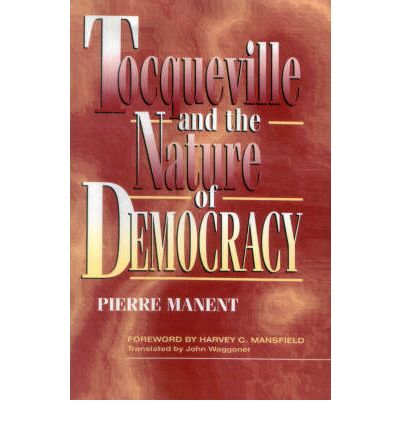
One could advance many reasons and theories.  An extended treatment of the topic would involve an in depth look at theological and cultural shifts, and so forth.  Pierre Manent’s De Tocqueville and the Nature of Democracy helped me see one piece of the puzzle in stark clarity.  In discussing De Tocqueville’s general political theory, he writes,

Tocqueville draws distinctions between three types of regimes: those where power is external to society (absolute monarchies), those where it is both internal and external to society (aristocracies, who reside outside the people, but reside there due to custom and tradition, thus from within the culture), and finally, the United States, where the society “acts by itself on itself,” because “there is no power except that which emanates from within.”  He paints the picture of regime where the social bond is immediately political.

Aha!  Here we have it, as he asserts that democratic governments have no guidance from “the state,” rather, it comes from everyone, or no one in particular.  This is why we don’t always see these changes coming.

Manent continues to enumerate two main characteristics of such regimes.

  • Invisibility — De Tocqueville writes, “In America the laws are seen, their daily execution is perceived, everything is in movement around you, but the motor is discovered nowhere.”
  • Omnipresence — This invisible power is present and active.  “In the New England states, the legislative power extends to more objects than are among us.” “In the United States, government centralization is at a high point.  It would be easy to prove that national power there is more concentrated than it has been in any of the ancient monarchies of Europe.”  De Tocqueville referred, of course, to the 1830’s — not today.

This means that, among other things, we cannot blame the courts, the media, Hollywood, or any other particular entity in society.  If we don’t like something we have only two choices: blame everyone, or no one at all.

Tocqueville thought in the 1830’s that this power still mainly operated through legislative bodies and elections.  Today, I can’t think of a strong legislative body in any particular state, let alone Congress itself.  Change now, even more so than Tocqueville’s day, comes from the mist of the air.  It concentrates quickly and becomes universal.  “The social bond is immediately political.”  One can debate whether or not the Supreme Court’s decision truly reflected the “average American.”  But we cannot deny that the “spirit of the age” gave the Court’s decision that feeling of inevitability.  We didn’t see it coming because American politics truly operate from the people, not even from our elected officials — hence the enormous power  of this force.  We can elect new leaders.  Even kings die eventually.  The people will always remain.  Our institutions. then, even our guaranteed rights, should not be seen as natural byproducts of democratic government, but foreign agents sent to sabotage this unseen motor.  Tocqueville believed that the insertion of the Bill of Rights checked democratic feeling, and proved the wisdom of the founders.*  In general, he predicted that the massive power of the people would run through every possible crack in the Constitution and widen it immeasurably.  One only has to see how we have used the commerce clause** for good and ill as yet another exhibit of Tocqueville’s keen perception.

As we might imagine, this “motor” must derive its primary source of energy from a passion for equality, not liberty.  Tocqueville pointed out often that at some point these two governing principles become mutually exclusive and cancel each other out.  “Liberty” might produce more individual works of great genius, but equality will give us “immediate pleasures” and a more equitable foundation for democracy.  He predicted that equality would rise in prominence as the years went by and he predicted accurately.

We might think that the idea of “marriage equality” shows that we have reached the apotheosis of this democratic idea, but if we look at the culture at large I have my doubts.  Movies like “Elysium” and “Snowpiercer,” tv shows like “Mr. Robot,” broader trends like the “Occupy” movement — all show that we may not be done with “Equality” just yet.  This in turn made me think about a comment A.J. Toynbee made about a link between capitalism and communism.  He writes in Volume Five of his A Study of History,

However that may be, the modern Western World seems to have broken virgin soil in extending the empire of Necessity into the economic field — which is indeed a sphere of social life that has been overlooked or ignored by almost all the minds that have directed the thoughts of other societies.  The classic exposition of Economic Determinism is of course Karl Marx; but in the western world of today the number of souls who testify by their acts to a conviction that Economic Necessity is Queen of All is vastly greater than the number of professing Marxists, and would be found to include a phalanx of arch-capitalists who would repudiate with horror any suggestion that were fundamentally at one, in the faith by which they lived, with the execrable prophet of communism.

Many of us grew up with Democracy and Communism as bitter enemies.  But Tocqueville and Manent have made me wonder, if in communism we simply have democracy’s final and untenable form.

Dave


*Though the Bill of Rights was not in the original Constitution, we can agree with Tocqueville if we interpret “founders” more broadly.

**Article 1, Section 8, Clause 3 of the U.S. Constitution, which gives Congress the power “to regulate commerce with foreign nations, and among the several states, and with the Indian tribes.”  We have used the commerce clause as the basis for labor laws, farm subsidies, gun control, etc., etc. in ways I’m sure the framers of the Constitution never imagined.

Historians of Fortune

My disclaimer to all my posts is that I am strictly an amateur historian, and perhaps no more so than in the post below . . .

A frequent topic of conversation among historians is the nature of decline and fall.  Is the collapse of a particular civilization essentially inevitable, or can a civilization continue unto the end of all things?  Others nuance the dilemma a bit by stating that decline and fall remains eminently likely but possible to stave off.

Discussion about decline in the ancient and medieval world involved the concept of Fortune.  For the ancients, Fortune could often have the sense of arbitrary incoherence.  Troy must fall — Hector knows this.  As to why or to what end, he has no idea and seemingly cares not to know.  Not even Zeus seems to know why Troy must fall.  Fate, that awful word, never strayed far from the mind of the ancients.

Medieval thinkers sought to have a generous spirit and wanted to give Fortune a place in the Divine scheme.  Dante describes Lady Fortune as one of God’s servants.  She dispensed with blessings and setbacks indiscriminately, yes, but not for an unknown purpose.  God always wants to show forth his kingly munificence and have that imaged on Earth for all to see.  At the same time, all must learn humility, for without humility, who can be saved?   Blessings and rewards (in Fortune’s kingdom) not so much because of sin or righteousness but to teach grand lessons about salvation.  That is why Fortune is “Lady Fortune,” for the same reason St. Francis called death “our Sister, Bodily Death.”  Both have the gentle, nurturing female touch despite the pain they bring.

Eric Voegelin’ s treatment of Polybius in his Order and History intrigued me.  Perhaps the most famous section of Polyblius’ work is in Book VI where he discusses the cycle of rise and fall that preys upon all civilizations.  What makes this section of particular for me is that Polybius writes about Rome’s rise from ca. 270-200 B.C., but writes himself around 140 B.C. when cracks in the Republic started becoming evident.  It gives Polybius an unusual vantage point.

Voegelin, a notable critic of “disembodied” interpretive methods of history, makes two points worth noting in his treatment of Polybius.

The first surrounds the idea of cause and effect.  At times Polybius, like his fellow Greek Herodotus before him, has a tendency to extend the cause beyond comprehensible reason, placing the fulcrum for events he discusses have orgins long before anyone living at the time can recall.  Of course Polybius distinguishes between direct and distant causes, but the question is one of proportion.  If everything can be a cause, then nothing is a cause.  If the real cause has roots beyond the knowledge or experience of anyone living, then things “just happen.”  Both practices could be described as gnostic because both encourage us to live in a world without responsibility, in a state disconnected from creation.

The second concerns Polybius’ ultimate failure to find a true cause.  This leads him in turn to focus first on the bare reality of Rome’s practices, how they built forts, how they made laws, and so on.  He pays little attention to whether the laws be good or bad, or what particular advantage the forts might have given them.  This focus on the pure “physics” of things likely explain his drift into explaining everything with the Wheel of Fortune, which has in his mind an arbitrary quality.  Polybius quotes from the last Macedonian king with evident approval, who said,

If you take not an indefinite time, nor many generations, but just the last 50 years, you will see the cruelty of Fortune.  Fifty years ago do you suppose that the Macedonians or the Persians, if some god foretold it, would have believed by the present time that the Persians, who once ruled the world, would by now have ceased to be a name, while the Macedonians, who were then not even a name, would be rulers of all?  Yet this Fortune, who never keeps faith, but transforms everything against our reckoning . . . has lent him these good things until she decides to dispose differently of them (XXIX, 21).

Later Polybius, with Scipio in at the destruction of Carthage he records Scipio’s foreboding that now that Persia, Macedon, and Carthage had been destroyed, perhaps Rome would now be next.  But just as with the king of Macedon, no intelligible cause would exist.  Fortune does what she wills, leaving mankind ‘not guilty’ for whatever happens.

Of course others took up this idea before Polybius, notably Plato himself in The Republic.  Some accuse Plato of gnosticism and he can drift in that direction at times, but his analysis has its roots not so much in disembodied fate but in the lives of individuals.  When thinking about the transition from oligarchy to democracy he discusses the choices and desires of individuals.  So the “oligarchic man/men” lead the transition from timocracy to oligarchy.  The “democratic man” in turn brings about democracy, and so on.  The city-state contains the accumulated souls of its inhabitants, thus the city too might be said to have a “soul” in aggregate.  It too chooses.  It too has responsibility.  A brief excerpt discussing “democratic man” shows his method:

Yes, I said, he lives from day to day indulging the appetite of the hour; and sometimes he is lapped in drink and strains of the flute; then he becomes a water-drinker, and tries to get thin; then he takes a turn at gymnastics; sometimes idling and neglecting everything, then once more living the life of a philosopher; often he-is busy with politics, and starts to his feet and says and does whatever comes into his head; and, if he is emulous of any one who is a warrior, off he is in that direction, or of men of business, once more in that. His life has neither law nor order; and this distracted existence he terms joy and bliss and freedom; and so he goes on.

Plato refuses to submit everything to “Fortune/Fate” and this makes hima  greater thinker, and in another sense, the greater historian (see — this is why you read this blog, so you can find out shocking things such as, “Plato was a more profound thinker than Polybius.”  Thank goodness for A Stick in the Mud!).

Structure vs. Sound

I always enjoy musicians who can talk intelligently about their music.  Glenn Gould combined his brilliant technique with a brilliant mind, and thankfully, availed himself of many opportunities to speak.

The video appeals to me on a number of levels.  For starters musician and filmmaker Bruno Monsaingeon almost parodies the speech and approach of a rather stuffy French intellectual (though I would never assert that’s what he actually was). What really intrigued me, however, was their discussion of whether or not one can truly play Bach on a piano instead of a harpsichord, which leads then to other digressions.

Gould breaks down composers into two types:

  • The first seek to create the “ultimate” piece that can only be played in very specific ways, in very specific settings.  Such composers, he argues, concern themselves primarily with the reception of the music rather than the music itself.
  • The second (whom he clearly prefers) concern themselves with the structural integrity of the music itself.  Gould always admired Bach for his “vertical and horizontal” integrity.  That is (I think) the piece went somewhere definite (vertical), but never at the expense of the relationship of the notes to each other (horizontal).

Certainly Bach has been a much more enduring composer than either in the first group Gould mentions.  Who can think of Paganini without the violin, or Liszt without some long-haired guy playing the piano?  But Bach shows up everywhere, with mandolins, saxophones, organs, and in different genres like jazz and even some heavy-metal.  His structural integrity allows then, for improvisation and modification.*  The fact of his endurance and applicability must give us hints as to how to operate in other areas of life.

Historian Arnold Toynbee talked about the traps that civilizations fall into that bring them down.  I appreciate that Toynbee often gave a spiritual focus to this topic, and focused on “idolization” of ephemeral techniques or institutions as one key problem.  In other words, at some point in the past a particular institution or method helped achieve some great good.  The solution to our present concerns then, means returning to some point in the past.  Toynbee comments,

We can see that this nemesis would bring on social breakdowns in two distinct ways.  On the one hand it would diminish the number of possible candidates for playing the creator’s role in the face of any possible challenge . . . On the other hand . . . these ex-creators, by virtue of their previous work, will now be in positions of power and influence. In these positions they will not be helping the society move forward any longer; they will be “resting on their oars.”

Classical education, it seems, can easily fall into the temptations of the first category of composers above.  We, perhaps unlike others, seek the “perfect” for all time in our educational content and methods.  This in turn can lead us to idolize the past, freeze it, and bring it forward to today.  But if we do this we forget that education involves primarily the transmission of certain experiences and beliefs from one generation to the next.  For it to transfer, it must have life, which means it must have some degree of wiggle-room and applicability in different contexts.  Athens’ own history is an example.  With their curiosity and passion for eternal things they might have created the idea of classical education.  But eventually they became a parody of themselves.  “For the Athenians and the foreigners who were there spent their time in nothing else but either to tell or hear some new thing” (Acts 17:21).

But then one might counter — isn’t that what public schools essentially do?  They have a curriculum that is essentially interchangeable and standardized.  This curriculum, based on the standardized test, can then be easily transferred from one teacher to another.  In many classical schools, curriculum seems much more teacher-centric and would not transfer nearly as easily.

However, such approaches to curricula are essentially gnostic.  They have no incarnation.  Without a definite incarnation of an idea or method in the person of a particular teacher, there can be no power, no application, no life.  The Spirit could not descend until after the Son had come.

Perhaps we can conclude by saying that if one ever writes curriculum, pay extra attention to its structure instead of its sound.  When we play Bach, let Bach be Bach.  But be sure to put something of yourself into your own performance. I have never understood objections to those who say, “But Bach wouldn’t have played it that way.”  We do not go to concerts to hear Bach play, after all.**

Dave

*I remember reading one musician who said something like, “If Bach was alive today he would be a jazz musician.”  For those interested I include here part of an interview with the famous jazz pianist Keith Jarrett conducted by fellow piano player Ethan Iverson, on the subject of Bach.

EI:  Do you play the piano every day?

KJ:  Now I do, yeah. There was a long time in my life (when I was ill) when I didn’t practice really at all regularly, but now, yes, I do. It really depends on what I am working towards or away from or both. Sometimes I have to slowly erase one thing and move towards another.

I was just working on Bach over the last few months, and now I have to shelve that and pretend that I know how to do a solo concert, and while I’m pretending that, that’s practicing. But! I thought I was going to shelve the Bach, but now I’m playing the Bach, and for the last twenty-five minutes I do the other thing and it works very well. Because by the time I do the finger-work that Bach requires, and the control thing, my fingers are ready to be completely out-of-control and in-control at the same time. I didn’t realize that it was helping me improvise until Gary Peacock looked at me between sets and said, “Whatever you’re doing, keep doing it.”

EI:  So, at one point, going between jazz and classical felt like more of an embouchure change than it does now? Is it beginning to even out?

KJ:  It really depends. When I was getting ready to record Mozart I couldn’t have mixed both. And in general, that’s the case. I generally don’t mix things. But I’ve seen how it seems to work this time, and I’m just taking advantage of it. Probably I’m in better shape than I was before, due to some of the patterns Bach forces upon you. The jazz player doesn’t ever play these patterns: they don’t come up; certainly not in the left hand. And working on the fingering puts you in a hypnotic state, playing the same phrase down one half step at a time or down a scale, and you’re doing the same fingering but it isn’t the same fingering, depending on how many black keys are involved. And Bach has this crazy ability to change key in the middle of a scale. So you’ve changed harmonic center in the process of playing what you thought was a simple scale so you can’t take your eyes off the music. And even with the bass line, if you stop looking you think you know what it is, but he always thought it out so well that it’s not always not predictable, but his note is always better than yours.

EI:  Do you work out your fingerings early on, or keep experimenting?

KJ:  I’ve had all kinds of experiences. With the Shostakovich, I just played it and played it and played it. When I realized I was going to record it, I had to say to myself, wait: I’ve got to find an edited version of this with fingerings! Because what I normally do is find different fingerings every time I play, probably. I just improvise that part of it. It works sometimes, but it doesn’t work in the studio, when you don’t want to do a second take. So I went through three different editions of the Shostakovich and ended up with absolutely no fingering: theUrtext, with no fingerings at all, and that’s always what I prefer in the end. With the Bach, I’ve been able to stick with that. I don’t even like making a mark on the page…

**If you listen to Glenn Gould recordings of Bach you will usually hear him humming faintly in the background.  Some object to this, but I like it.  It reminds me that the music I’m hearing doesn’t come to me disembodied, but from a real person in love with the music he plays.  Thus, Gould recordings can nearly achieve the immediacy of a live performance.

Loving History, Knowing History

Thanks to Marginal Revolution once again for sharing a fascinating but perhaps not surprising article about ethics professors. The upshot is, apparently, they do not act any more ethically than the rest of us.

So the natural question arises then, what good are professors who teach ethics?  Would it be possible for an ethics professor to live badly and teach ethics well?  What about other disciplines?

Of course 99% of ethical questions seem perfectly obvious to answer.  So, as a friend pointed out, professors of ethics have to make their hay in the disputed areas where debate exists and the classroom might get a bit more interesting.  The article states,

An ethicist who feels obligated to live as she teaches will be motivated to avoid highly self-sacrificial conclusions, such as that the wealthy should give most of their money to charity or that we should eat only a restricted subset of foods. Disconnecting professional ethicists’ academic enquiries from their personal choices allows them to consider the arguments in a more even-handed way. If no one expects us to act in accord with our scholarly opinions, we are more likely to arrive at the moral truth.

In other words, there lies the implicit belief that to teach well one must distance oneself from the material so as to be more “even-handed.”

This gets at the whole purpose of teaching and education in general.  What follows below attempts to reproduce a conversation I had with a good friend and colleague.

If we hope to arrive at satisfactory conclusions regarding ethics or other subjects, we must start first with theology, the “queen of the sciences.”

One can take two basic approaches to God:

  • Know something, believe something, then finally love something, or
  • Love something, believe, then know

Scripture and the history of God’s people clearly endorse the latter option, though in modern times we tend to prefer the first.  In the Psalms we see numerous examples of something like this:

  • The author struggles with evil
  • Doubts God’s presence, His goodness
  • Goes to worship God, then
  • Arrives at the right knowledge and understanding of who God is

So too in the Gospels, Jesus rebukes the people when they ask for a sign.  We shouldn’t interpret this so much as Jesus saying, “You’re so weak and impatient!” but more like, “That’s not how you can truly know me,” which is what He wants for all of us.

The idea of establishing some kind of clinical distance from God and taking a piece of him out to examine is utterly absurd. Surely even skeptics would agree that such an approach would not allow us to know God, and if it could, what kind of God would we have?  So the best theologian would have the best prayer life, whatever form that took.

In an ecumenical environment the Bible teacher might need an even-handed approach with certain topics.  In teaching baptism he may need to give arguments for and against infant baptism.  But his goal should be to have students love baptism.  If a student came to the said teacher privately and asked, “Which do you believe?” we would rightly be aghast if he said, “I have no commitment either way.  It’s all the same to me.  I baptized one of my kids as an infant and another as an adult.”  The teacher would not love baptism.  For him, the discussion he led remained a mere game.  He would not teach his students to love baptism, but to think of baptism as a mere game.

So “detachment” from a particular conclusion may have its place at times, but knowing how and when depends.  The idea of “analyzing” God is absurd for so many reasons.  He is mystery and entirely transcendent.  Perhaps the level of analysis we apply has to do with the degree of mystery and transcendence in our subject.  A music teacher hears a piece of music and thinks, “What a great song.  I love it.”  This love then might lead them to analyze the piece and its tempo, chord changes, and so on.  But who would begin with analysis?  No one says to themselves, “This song has ‘x’ tempo, ‘y’ chord changes, and ‘z’ meter, so therefore I love this song.”  The transcendent qualities of great music, and the mysterious nature of its effect on us, renders that approach almost meaningless.

Indirectly the study of History should lead us to the love of God, just as in any other subject.  But that’s not the first port of call, but the second.  Directly History involves the study of people.  Most of us know that we remain a mystery to ourselves. What of our perception of others, and how should this impact our methodology?  Music has transcendent qualities, but do everyday people?  The question is difficult.  In biology the need to lead with “love” over “analysis” gets much reduced because we have dominion over matter.  As Pascal stated, matter might crush us, but we know it does so, while matter has no consciousness. We should analyze the bacteria before deciding whether or not to “love” it.

For the relationship between love and analysis for the History teacher, let us imagine three different teachers numbered 1-3:

  1. This teacher has a passionate love and identification with the colonial cause and the American Revolution.  With just as much passion, he also teaches his students that Nazi fascism is evil.  His students absorb his passion and his conclusions in both subjects.
  2. This teacher has no firm conclusions about the American Revolution and feels it a “tough call either way.”  He teaches both sides of the argument well.  When teaching W.W. II, however, he also teaches the evil of Nazi fascism.  His students split on their opinions about the Revolution.  On fascism they come out of his class with a more full understanding of evil.
  3. This teacher has no firm conclusions on either the American Revolution or W.W. II.  When it comes to the Nazis he remains “objective” and even-handed, giving arguments for and against the merits of their world view.  Some of his students take the British side, some the American.  Some of his students take the Allied side, some identify with the Axis powers.

Teacher ‘3’ should never teach.  His teaching would lead people either to cynicism or evil living.  No good history teacher should consistently produce students who apply their knowledge to live evil lives.

But would we prefer teacher ‘1’ or ‘2’?

Theology has two basic approaches to God.  One is the way of affirmation — what we can truthfully say about God (Dante stands as the greatest master of this “way” still today, in my opinion).  Apophatic theology stresses that we can know God best by stating what He is not.  God is so fundamentally “other” from us that our affirmations will always remain deeply inadequate.  Both approaches have their place.  In the discipline of History I think the way of negation safer.*

We can say with certainty that God is not “in” the Nazi regime.  We lack the same certainty when discussing the American Revolution.  In History in general I think we can more often say what God is not than what God is.

This should not mean that we should have a goal of the “detached” teacher.  When we think of great teachers we had in the past we probably think of teachers that had a definite point of view.  They loved something about their subjects.  The key to teaching History well must lie in deciding what the proper object of love is in the study of History.

If we attach our love too heartily to particular people, eras, or civilizations we will likely obscure their faults and not teach them truly.  But a worse fate would mean becoming one of those historians that loves to point out everything bad about everything and seems to enjoy nothing at all.  The first teacher would wrongly order his love but at least love something.  The second has only cynicism and no sympathy for anyone or anything.

Nor should we say that what we love the process of investigation or method in the study of history.  We can use the term “love” in this case to mean “I find a certain process of investigation useful.”  But who can truly “love” a process?  What good is the process?  Where does it lead?

So to return to our question above . . .

I lean towards teacher #2.  Teacher #1 has the distinct advantage of communicating a clear passion (of course the American Revolution is just a stand-in for other events/people, political parties, that involve moral grey areas, etc.).  It’s easier to have a passionate dislike as opposed to something positive, so he gets credit there as well.  But teacher #2 can still have passion and communicate a love for much more than a process even if he has more caution in what he attaches himself to.  Applied rightly, the method he uses extends his sympathy and his humility.  This humility goes beyond intellectual humility.  The historian sees the complexity of a situation and realizes that salvation cannot come in this world and that failure inevitably comes.  We would not necessarily have acted more wisely had we been in their place.

What we love through this method, finally and hopefully, involves a vision and a desire for the Kingdom of God made manifest.  This should not preclude us having a warm attachment to certain people and places in history.  It might protect us from the danger of idolatry inherent in the “Way of Affirmation.”**  It seeks our own redemption as we identify with those in the past.  It seeks the redemption of others as we see their need for transformation of the fallenness of the world.

The dance between idolatry and detachment will always remain delicate, but we should understand that we’re near the truth when we see this tension.  Such tension lies throughout Christianity.  God is One God in three distinct Persons.  Christ is God and man, and so on.  When faced with such a dilemma we affirm both equally and finitely hold them in tension as best we can.

The time has come to end this rambling before I exhaust any more of your patience.

“Too late!” say my kids.

Dave

*The way of affirmation usually involves metaphors or similes.  The potential problem with this is our reference point which inevitably involves our own experience.  For a few centuries we said God designed the universe like a clock maker makes a clock.  Now that the clock has gone out of fashion, we no longer use this metaphor.  Did God create like a clock maker? Maybe, but probably not?  How can we be sure?  Perhaps we can see some faint or very basic connection between creation and the clock, but I think it safer to say God did not create the universe like a clock.

**The danger of the “Way of Negation” would probably involve a safe detachment that precluded practicing love.  Taken to extreme, could such an approach prevent one from loving even oneself?  If that happened, we could not love others either.

Boise St., Live at Fillmore East, 1970

I like some jazz music, but have always regretted not appreciating the so called golden era of jazz from the late 50’s – early 60’s.  The prevalent pattern of 1) Introduce idea/theme, then 2) Long solos from every member of the group, and 3) Resolution with reprise of theme never grabbed me.  I prefer a more melodic approach, and a more band/team oriented approach.  No doubt much exists in the music that I do not understand, but there you go.

My favorite “all-time jazz great” has always been Miles Davis*, but his music sometimes fell into the above mentioned pattern.  Then I heard this:

Wow.  The first time I heard the music, I was so blown away I didn’t notice that the song is still basically, theme/solos/theme. After I noticed, I didn’t care.  The song is so fun, funky, jazzy, so “everything” I no longer thought about structure at all.  It takes us beyond structure and into play, into freedom.**

At about the same time I heard this song I read Michael Weinreb’s thoughtful and entertaining defense of college football, A Season of Saturdays.   In one section of the book he discusses the fact that “free-spirited” play calling tends to work much more effectively in college than in the pros.  You can have a wishbone offense, a spread offense, a pistol offense, and so on.  You can have coaches that take a more laid-back approach to the game with great success, i.e. Steve Spurrier, or “gambling” coaches like Les Miles. But . . . these coaches don’t succeed in the NFL.

When thinking about the possible surprise elation inherent within college football, one has to think of Boise-State vs. Oklahoma in the Fiesta Bowl a few years ago.  First the 4th and 18 play for to tie the game:

And to win the game, the most old-fashioned of crazy trick plays . . .

I realized the possible connection between Miles Davis and these Boise State plays when I had the same reaction as the announcer of the hook and ladder at the .07 mark as I did to “Directions” at about the 6:05 mark.  Both moments take you out of yourself entirely.  And while certainly pro football can have those moments, I agree with Weinreb (with no empirical backing, just an impression) that they happen more often in college football.  Going from 300 or so Division I programs down to 32 NFL teams narrows the field of talent to such a degree that so much depends on meticulous execution over crazy inspiration. Perhaps these kinds of wild, unexpected moments link together jazz and college football, two quintessential American creations.

The question I asked myself as I read was whether ultimately I agreed with his premise that college football should stick around and continue to have its place in the American consciousness.  Weinreb writes well, and I especially appreciated his soft touch — he doesn’t force his point.  But in the end, disagree.  College football can exist, sure, but needs scaled back drastically.  One caveat is that I fall into a demographic that Weinreb admits will probably not understand his book.  I grew up in an area dominated by professional sports, and I attended a Division III liberal arts college where maybe 500 people showed up for football games on Saturdays.

But still . . .

Wienreb focuses on his strongest argument, how college sports in particular bring us together in unexpected ways, and this gives college football (more than college basketball, I would agree) a kind of transcendence.  I don’t deny this — rather, it’s because I do agree agree with Weinreb on this point that I think we should try and bring college football back to earth.  One of the great aspects of music is that it can serve as a vehicle for transcendence, but music appreciation never (or hardly ever) devolves into tribalism.  Something always goes a little bit wonky when music gets involved with competitiveness, but college football can’t exist without it.  The rivalries can in certain places define one’s whole existence (Auburn-Alabama, Ohio St.-Michigan, etc.).  Such tribalism usually has a detrimental impact on us, giving us real animosity based on purely invented and artificial reality — i.e — there is no real reason for students at Notre Dame to hate USC.***  This transcendent tribalism leads to a kind of worship.  Weinreb attended Penn St., and in one chapter recalls a time when after a dramatic football win on the road, students stormed the stadium, took down a goal post, paraded to Joe Paterno’s house, and deposited it on his front lawn. Weinreb uses this story to support his argument, but I think it supports mine.  This presentation of the “sacrifice” on the “altar” looks a lot like worship of a false god to me.

The partial unreality of college life as a whole gets magnified exponentially in “big-time” college football.   Many of the best players on many of the best teams do not really attend the university.  Their classes, living situations, facilities, their treatment in general on campus gives them a life totally apart from other students.  The logic works like this:

  • We must have football because it creates such wonderful communal moments
  • But these communal moments are predicated on ultimately on winning
  • So — we must attract the best players to win
  • So — we have to create an additional unreal world apart from the actual campus community to attract players — some of whom don’t really belong at the university academically anyway — in order to foster this communal experience.
  • We then give ourselves to this imagined community, which involves imagined hatreds

The academic scandals involving fake classes, fake grades, and so on should not shock us in the least. After all, in some places college football is a god, and gods need appeased.  Plenty of evidence, anecdotal and otherwise, exist to show how athletics tilt and twist universities in weird, unnatural ways.

I’m certainly not against sports in general.  God made our bodies to do wonderful things.  And, as our bodies are a form of revelation, the exuberant moments we experience in athletics are genuine, true pointers to Ultimate Reality.  I also don’t blame people desiring such communal transcendence and their willingness to sacrifice for it.  Again, we were made for such things.

The more we strip everyday life overtly of the sacred, the more we will seek to find it in other, perhaps less obvious ways. But seeking it in college football, as Weinreb admits we do, will in the end not give us answers, but instead, much to answer for.****  We will defend and sacrifice for the tribe to achieve it, making idols of our parochial communities.

Dave

*Miles Davis must surely rank as one of the great, if not the greatest bandleader of all time.  Of course he was a legend, but he helped turn countless sidemen into legends, like Ron Carter, John Coltrane, Tony Williams, Jack DeJohnette, John McLaughlin, Herbie Hancock, Chick Corea, Keith Jarrett — this astounding list goes on and on.

**Being beyond structure doesn’t mean that one is anti-structure, anymore than being beyond rationality means being anti-reason.  Of course the song has a structure and abides by certain rules of music, but one is not conscious of the pattern — therein lies self-forgetfulness.

***I loved my college experience as have many others, but I think one reason for the appeal of college is its fantasy-like existence.  In some ways our K-12 years have many more roots to “reality,” with family, age diverse community, and so on.

****I.e., the Penn St. scandals

Toynbee, “The Idolization of the Parochial Community”

Unhappily, Polytheism begins to produce new and pernicious social effects when its domain is extended from the realm of Nature-worship to a province of the realm of Man-worship in which the object of worship is parochial collective human power. Local worships of deified parochial communities inevitably drive their respective devotees into war with one another. Whereas Demeter our common Mother Earth is the same goddess in Attica and in Laconia, the Athene Polias of Athens and the Athana Chalcioecus of Sparta, who are the respective deifications of these two parochial communities, are bound to be rival goddesses in spite of their bearing the same name. The worship of Nature tends to unite the members of different communities because it is not self-centred; it is the worship of a power in whose presence all human beings have the identical experience of being made aware of their own human weakness. On the other hand the worship of parochial communities tends to set their respective members at variance because this religion is an expression of self-centredness; because self-centredness is the source of all strife; and because the collective ego is a more dangerous object of worship than the individual ego is.

The collective ego is more dangerous because it is more powerful, more demonic, and less patently unworthy of devotion. The collective ego combines the puny individual power of each of its devotees into the collective power of Leviathan. This collective power is at the mercy of subconscious passions because it escapes the control of the Intellect and Will that put some restraint on the individual ego. And bad behaviour that would be condemned unhesitatingly by the conscience in an individual culprit is apt to be condoned when it is perpetrated by Leviathan, under the illusion that the first person is absolved from self-centredness by being transposed from the singular number into the plural. This is, however, just the opposite of the truth; for, when an individual projects his self-centredness on to a community, he is able, with less sense of sin, to carry his egotism to greater lengths of enormity. ‘Patriotism is the last refuge of a scoundrel’;5 and the callousness of committees testifies still more eloquently than the fury of mobs that, in collective action, the ego is capable of descending to depths to which it does not fall when it is acting on its individual responsibility.

The warfare to which parochial-community-worship leads is apt to rankle, sooner or later, into war to the death; and this self-inflicted doom is insidious, because the ultimately fatal effects of this religion are slow to reveal themselves and do not become unmistakably clear till the mischief has become mortally grave.

In its first phase the warfare between deified parochial states is usually waged in a temperate spirit and is confined within moderate limits. In this first phase the worshippers of each parochial god recognize in some degree that each neighbour parochial god is the legitimate sovereign in his own territory. Each local god will be deemed to have both the right and the power to punish alien human trespassers on his domain who commit a grievous wrong against him by committing it against his people; and this consideration counsels caution and restraint in waging war on foreign soil. It tends to prevent war from becoming total. The bashful invader will refrain, not only from desecrating the enemy’s temples, but from poisoning his wells and from cutting down his fruit trees. The Romans, when they had made up their minds to go to all lengths in warring down an enemy community, used to take the preliminary precautions of inviting the enemy gods to evacuate the doomed city and of tempting them to change sides by offering them, in exchange, honourable places in the Roman pantheon. When a local community has been exterminated or deported in defiance of the local divinity and without regard to his sovereign prerogatives, the outraged parochial god may bring the usurpers of his domain and scorners of his majesty to heel by making the place too hot to hold them except on his terms. The colonists planted by the Assyrian Government on territory that had been cleared of its previous human occupants by the deportation of the Children of Israel soon found, to their cost, that Israel’s undeported god Yahweh had lost none of his local potency; and they had no peace till they took to worshipping this very present local god instead of the gods that they had brought with them from their homelands.

Thus the conduct of war between parochial states is kept within bounds, at the start, by a common belief in the equality of sovereign parochial gods, each within his own domain. But this belief is apt to break down, and, with it, the restraint that is imposed by it. They break down because the self-worship of a parochial community is essentially incompatible with the moderation commended in such maxims as ‘Live and let live’ and ‘Do as you would be done by’. Every form of Man-worship is a religious expression of self-centredness, and is consequently infected with the intellectual mistake and the moral sin of treating a part of the Universe as if it were the whole—of trying to wrest the Universe round into centering on something in it that is not and ought not to be anything more than a subordinate part of it. Since self-centeredness is innate in every living creature, it wins allegiance for any religion that ministers to it. It also inhibits any living creature that fails to break away from it from loving its neighbor as itself, and a total failure to achieve this arduous moral feat has a disastrous effect on social relations.

A further reason why it is difficult to keep the warfare between parochial states at a low psychological temperature is because parochial-community-worship wins devotion not only by ministering disastrously to self-centredness. It wins it also by giving a beneficent stimulus to Man’s nobler activities in the first chapter of the story. In the histories of most civilizations in their first chapters, parochial states have done more to enrich their members’ lives by fostering the arts than they have done to impoverish them by taking a toll of blood and treasure. For example, the rise of the Athenian city-state made life richer for its citizens by creating the Attic drama out of a primitive fertility-ritual before life was made intolerable for them by a series of ever more devastating wars between Athens and her rivals. The earlier Athens that had been ‘the education of Hellas’ won and held the allegiance of Athenian men and women, over whom she had cast her spell, for the benefit of the later Athens that was ‘a tyrant power’; and, though these two arrogant phrases were coined to describe Athens’ effect on the lives of the citizens of other Hellenic city-states, they describe her effect on the lives of her own citizens no less aptly. This is the tragic theme of Thucydides’ history of the Great Atheno-Peloponnesian War, and there have been many other performances of the same tragedy that have not found their Thucydides.

The strength of the devotion that parochial-community-worship thus evokes holds its devotees in bondage to it even when it is carrying them to self-destruction; and so the warfare between contending parochial states tends to grow more intense and more devastating in a crescendo movement. Respect for one’s neighbours’ gods and consideration for these alien gods’ human proteges are wasting assets. All parochial-community-worship ends in a worship of Moloch, and this ‘horrid king’ exacts more cruel sacrifices than the Golden Calf. War to the death between parochial states has been the immediate external cause of the breakdowns and disintegrations of almost all, if not all, the civilizations that have committed suicide up to date. The decline and fall of the First Mayan Civilization is perhaps the only doubtful case.

The devotion to the worship of Moloch is apt to persist until it is too late to save the life of the civilization that is being destroyed by it. It does break down at last, but not until a stage of social disintegration has been reached at which the blood-tax exacted by the waging of ever more intensive, ferocious, and devastating warfare has come palpably to outweigh any cultural and spiritual benefits that the contending parochial states may once have conferred on their citizens. . . 

Pope John Paul II and the Body in Art

We live in a deeply confused age regarding sexuality and the body.  We can understand Justice Potter Stewart’s “I know it when I see it,” concept regarding pornography in terms of necessary legalese, but especially in this day and age, Christians (and the world) need more specific guidance.  How are we to understand how the body can be used in art?

I wish I had the time and theological understanding to devote to John Paul II monumental Man and Woman man-and-woman-he-created-them_3He Created Them, where he developed a full-fledged “theology of the body.”  Though I read only very small portions of the text, those few parts have made a huge impression on me.

First, he makes the observation that nakedness is mentioned in a spousal connection, which means that nakedness is a kind of gift of one to the other — a revelation, in fact.  For this can rightly be called a gift because it involves a kind of mutual possession of one another — “I am yours and you are mine.”

These ideas of possession and gift lead to another truth, that the body itself is a form of revelation.  I had never realized this before, but of course it makes perfect sense.  We talk often of how the beauty of flowers, or the variety of the birds, or the majesty of mountains, reveal something about God Himself.  But we (or perhaps just I) forget that the body of course is part of that same creation that will reveal something of the Creator.  And perhaps the body may reveal more than mountains or flowers, as He made humanity of all creation in His image.

These truths deserve more contemplation than I can give them.  But I do think that John Paul’s wisdom can give us profound guidance on the nature of the body and how the body can or should be used in a “public” way.  He writes,

Artistic objectification of the human body in its male and female nakedness for the sake of making of it first a model and then a subject of a work of art is always a certain transfer outside this configuration of interpersonal gift that belongs originally and specifically to the body.  It constitutes in some way an uprooting of the human body from the configuration and a transfer of it to the dimensions of artistic objectification specific to the work of art or the reproduction typical of the works of film and photographic technologies of our time.

In each of these dimensions, and in each of them in a different way, the human body loses that deeply subjective meaning of the gift and becomes an object destined for the knowledge of many, by which those who look will assimilate or even take possession of something that evidently exists (or should exist) by its very essence on the level of gift–or gift by the person to the person, no longer of course in the image, but in the living man.  To tell the truth, this act of “taking possession” happens already on another level, that is, on the level of artistic transfiguration or reproduction.  It is, however, impossible not to realize that from the point of view of the ethos of the body, understood deeply, a problem arises here.  It is a very delicate problem that has various levels of intensity depending on various motives and circumstances, both on the side of artistic activity and on the side of knowledge of the work of art or its reproduction.  From the fact that this issue arises, it does not at all follow that that human body in its nakedness cannot be the subject of works of art, only that this issue is neither merely aesthetic, nor morally indifferent.

This, I think, trumps “I know it when I see it.”

The Shadow of Arginusae

Towards the end of the Peloponnesian War Athens had to fight for its very life.  Their catastrophic defeat in Sicily in 411 B.C. meant that their survival depended on maintaining their lifeline of supplies from allies in the eastern Aegean Sea.  This meant in turn that Athens would have to win virtually every naval battle to stay afloat.

At the battle of Arginusae in 406 B.C. the Athenians got a decisive victory over the Spartan League.  Athenian custom and religion dictated bringing home the bodies of the slain to give them proper burial.  Unfortunately a storm arose in the aftermath of the victory, and in the ensuing confusion the Athenians retrieved just a fraction of their dead.

You might think that the Athenians would rejoice in the victory and shrug off the failure to retrieve the dead.  After all, they might not have survived as a city-state had they lost.  Instead, (due in part to a confluence of unusual circumstances described expertly by Donald Kagan in The Fall of the Athenian Empire) they put the eight victorious generals on trial for impiety and dereliction of duty.  They found all eight guilty, and executed all eight that same day.

A few days later the Athenians lamented their actions and believed they had committed an injustice.  Such an injustice needed rectified, so they put the prosecutor on trial for inciting them to murder.  He was found guilty, and he too was put to death.

This unfortunate incident no doubt deeply impacted Socrates, and in turn Plato, and from there the whole attitude of western political thinkers toward democracy.  In the modern era, ardent defenders of democracy like I.F. Stone argue that such ancient and early-modern critics cherry-picked their objections to democracy and took certain incidents out of proportion.  I wonder, however, whether or not the above incident isn’t symptomatic of democracies in general, and if the essential critique offered by Plato and his followers might have merit.

I thought of the Battle of Arginusae when a friend sent me a fascinating graph of the speed of social change in America in the 20th century.  With the Supreme Court hearing arguments on the constitutionality of gay marriage it seems appropriate to consider our history of seismic shifts [note to the reader–this post was written originally a couple of months before the courts made gay marriage the law of the land.  We have seen since then how fast it has gained traction, and how quickly the marriage issue has spilled over into transgender issues.  The speed of the change is all the more remarkable considering that in 2004 many states voted to try and prevent gay marriage from becoming law, and in 2008 President Obama supported what I believe he called “traditional marriage”].

Of course the ability to change quickly is in itself neither good or bad, as with speed we can adopt either good or bad courses of action.  What we should consider, however, is what this means for us as a democracy, and where this puts us relative to other democracies at other times.

Change began to accelerate in the 20th century, and this coincides with two other shifts in American life.  The first was the rise of the prominence of the U.S. internationally, and along with that the inevitable rise of executive power. With a few exceptions, the 19th century saw congressional dominance, the 20th executive dominance.  No one president or party can be blamed for this, if blame is what you seek.  As with Rome, the growth of power inevitably centralizes power.  Add to that, the Constitution puts foreign policy mostly in the hands of the executive.  The centralization of power in the executive makes change come more quickly, if for no other reason than efficiency.

But this in itself can’t explain the radical leaps noted above in the graph, because changes in Civil Rights and gay marriage have not come primarily from executives, but from the courts, which are supposed to be more immune to the whims of the people, be those whims good or bad.

We might also recall that De Tocqueville astutely predicted that modern democracies could create an unstoppable force when the idea of equality joined with the idea of majority power.  This force, when mobilized, created magnificent massed armies (think Generals Sherman, and Patton).  But this same power could apply to our social lives and our moral compass.  Democracies, De Tocqueville argued, would not create tyrants in the traditional sense.  They would leave the body alone. Rather, they can at times kill the soul through enormous and unseen social pressures.  So just as our military efforts could go from nothing in December 1941 to significant victory in June of 1942 ( the Battle of Midway), so too we can move with the same speed and power socially.  This power would be great enough to steamroll even the supposedly resistant-to-change court system.

But this won’t work entirely either, for it presumes that the courts were the last domino to fall during these seismic social changes, whereas with abortion, civil rights, and gay marriage, they have spearheaded change.*

With this realization we get pressed beyond typical right/left categories and our modern, narrow vision, beyond arguments about activist courts and the like. This should let us know that we may be nearing our prey.

I have two possible explanations to suggest:

The first deals with the fact the courts interpret the Constitution.  While the founders no doubt positioned the courts as above the political process to make them slower, this very position in many ways allows them to move faster. They have no Congress to lobby.  But I still think this fact leaves out part of the explanation.  If the founders set up the Constitution to greatly reduce the power of mass democracy (and the fear of “mob rule” runs throughout the Constitutional Convention debates as recorded by Madison) then we might wonder whether or not we live under a different Constitution altogether.  Of course the words remain the same, but how we interpret and stretch it (note how the commerce clause experienced this in the 20th century) changed over time.  The founders hoped for the Senate to dominate our government.  Now we have powerful courts, an extremely powerful executive, and an almost exclusively reactive legislature that asserts itself only when it stands in the way of what the executive wants to do

Thus, when the courts interpret the Constitution today, they in fact interpret a different constitution then the one the founders set up.  That explains the significant and rapid social changes.

The second hypothesis . . .

I think that the Constitution sought to create a senatorial democratic-infused oligarchy based on the Roman Senate of old.**  If true, at first glance we obviously have a different constitution than the founders envisioned. But a second glance might suggest that not a great deal has changed.  If polling data that suggests most Americans are pro-life and not in favor of gay marriage is correct, then we still can say that an oligarchy rules us.  This oligarchy no longer resides in the senate, however, but in other places, be it media, the courts, and so on.  If correct, then at least some of the fundamental guiding principles of the Constitution have not changed, but how we apply them has.

Finally, we have the idea proposed by Christopher Ferrara in his thought provoking book Liberty: The God that Failed.  Ferrara suggests that for Americans, the idea of liberty never had connections to tradition, religion, community, and so on but always stood for individuals defining themselves against them.  Liberty means power, power to do as one wishes, whether that be to own slaves or change the definition of marriage.  As to the good Americans have done (civil rights and racial equality, a relatively open immigration policy, etc.), one could argue that we often do these things irrespective of law, or stretch existing laws beyond recognition to justify them.  Good laws, bad laws, traditions, all become very inconvenient and discarded in a pinch when we decide we want something else.  Historically we have remarkable consistency on this score, whether Washington bypassed Pennsylvania’s laws on slavery, or Andrew Jackson ignored the Supreme Court against the Cherokees, or the modern explosion of executive orders from both parties, and so on, and so on.  Washington the Federalist is supposed to be the conservative, while historians speak of the “Jacksonian Revolution.”  But perhaps they had a lot more in common than we might suppose.

I still think the first possibility  above the likeliest by a slight margin, but I waffle, and like many of us, I am confused, overwhelmed, and ultimately not quite sure what’s going on.

But those really in the know have another theory . . .

Dave

*Incidentally, one look at the graph shows that there must be a strong connection between women voting, prohibition, and equality.  I think we can tie prohibition to the idea of equality in ways akin to laws about motorcycle helmets and seat-belts, i.e. we’ll all be safe and healthy together — instead of liberty (I’ll smoke and drink and ruin my life if I want to — it’s my life after all — and you can’t tell me otherwise).

**Before we pass judgment, consider that the Roman Republic must surely rank as one of the most successful governments of all time by most measurements.  They had roughly 350 years of relatively problem-free yearly elections and created an empire rooted in concepts of law that last to this day.  So strong were Rome’s institutions and ethos that they still held it together long into its “empire” phase, despite some ridiculously bad emperors along the way.

Mixed Messages

At this point in the school year different classes I teach touch on a similar theme . . .

Why did the French Revolution happen to such a nice guy as Louis XVI?

Obviously answering this question involves many factors, but one clearly is the problem of the mixed message and the tension that creates.  Louis worked hard to reform much of France.  He spent less money, he spent less time at Versailles, he believed in the power of science to transform the country, etc. etc.  In his excellent Citizens, Simon Schama points out that Louis’ scientific passions helped undo his regime.  He uses the example of ballooning.  Louis invited many not in the nobility to come to Versailles to witness some of the first hot air balloon experiments.  Again, we see Louis the nice, modernizing king at work. But as Schama points out, ballooning meant

  • The presence of “commoners” at Versailles, previously the exclusive stomping grounds of the nobility
  • The mingling of commoners and nobility
  • The commoners traipsing over the hallowed Versailles grounds to follow the balloon, ignoring traditional boundaries in the immaculately kept gardens
  • Absorption in the “boundary-free” nature of flight itself (this last one might be a stretch, but perhaps he’s onto something).

A few years later when the Estates General wanted to “modernize” and merge the three estates into one “National Assembly” dominated not by the nobility, but by the “everybody else,” Louis protested.  “That’s not how we do things.  We should preserve the ancient and inviolable traditions of France.”  One problem Louis had, however, was that he had been subtly changing those inviolable traditions.  He could not ride the tiger of the changes he helped bring about, and it cost him (and France) dearly.

A less overt, but no less impacting tension of “mixed messages” got introduced into Rome’s Republic ca. 200 B.C.  One can’t help admire the stability and effectiveness of Rome’s government from the founding of the Republic ca. 508 B.C. through the 2nd Punic War.  They had new elections every year, with new people in new offices most every year, and they thrived.  Part of the reason for this lay in the conservative nature of its society.  A society of farmers values stability and cohesion.  You see this cohesion demonstrated in this brief clip of how they fought.  In Rome’s prime, no barbarian horde of individual warriors ever stood a chance against a disciplined Roman maniple.

Naturally such a well-run state would have success and expand.  This expansion, however, threatened the very social cohesion that made them great in the first place.  The governing structure of Republican Rome had no idea how to navigate the dramatic change from its agricultural rustic roots to its “Mediterranean Empire” status, and even if they did, the Republic was built largely to prevent change. Rome grew great by preserving its identity through preserving their traditions.  This tension between Rome’s success and Rome’s identity helped lead to a century of intermittent civil war and the eventual collapse of the Republic between 44 and 27 B.C.

I have always enjoyed college basketball, and the men’s “March Madness” tournament is usually my favorite sporting event of the year.  I did not pay as much attention this year, partially due to business, and partially because watching college basketball has become much more a chore than I remember.  The pace of the game gets mangled by constant fouling (the Kentucky v. West Virginia game averaged more than 1 foul per minute of play), and constant timeouts (in televised games coaches get five timeouts plus eight mandatory tv timeouts).  While one might expect that constant fouling would mean more easy points in the form of free throws, in fact scoring is down across the board, no doubt due in part to the fact that no offense can ever establish a rhythm with continual game stoppages.

If this were professional basketball the solution would be relatively easy in the form of rule changes to make the game more entertaining.  But there lies the rub for the NCAA, because their sports don’t exist, in theory at least, for entertainment. The players are “student-athletes.”  They play the game to learn (hence, a mountain of opportunities for coaches to pound whiteboards and teach during timeouts), not entertain.  Charles Pierce lays some of this out expertly in his recent Grantland column here.  Pierce writes,

What’s fascinating to me, though, is not how to fix the problem [of scoring]; it’s how the problem doubles as the perfect expression of the current state of the NCAA and the amateur model itself. Because neither of college basketball’s twin personalities came into being spontaneously. They both exist by design, and whether the outcomes of that design are deliberate or not, the principles underlying it are deeply bound up with the contradiction at the heart of the NCAA’s idea of itself.

Here’s what I mean by that. Men’s college basketball has to be entertaining, because the NCAA, which derives most of its annual revenue from the tournament, wants it to make a lot of money. But men’s college basketball can’t prioritize entertainment too openly, because then the commercial motive would be obvious and would threaten the NCAA’s supposed reason for being.3 “We refuse to admit that we are selling it,” as Bilas recently said. This is how it’s possible to devote a tournament engineered for maximum fun to a style of basketball that elevates pseudo-moral qualities like instruction, teamwork, and sacrifice over carnal indulgences like, I don’t know, jumping, or the ball occasionally going into the basket.

The tension between basketball as revenue stream and the student-athlete model have been stretched to the breaking point.  The NCAA will have to make a difficult choice, and have boxed themselves in.  They can choose between . . .

  • Basketball is primarily entertainment/revenue driven and so we make rule changes based on that principle, which sacrifices the student-athlete principle, or
  • Basketball is about being a student-athlete and not money, and so changes will only be made that enhance the “student” aspect of the athletes.  Time-outs will stay, and money will disappear.

I suppose a third option exists, one the NCAA will likely take.  They will make rule changes, but under the cloak of improving the student-athlete experience.  They may believe this story.  Whether they believe it or not, they will increase the volume of their mixed message much further that I would think possible.  The NCAA as we know will be living on borrowed time.

One can say many things about Kentucky’s John Calipari, but his message is perfectly clear.

Ages of Refinement

I admit that the museum’s in D.C. are generally all great, even though despite living within striking distance I rarely visit them.  Recently, however, I got a chance to visit Manhattan and the Metropolitan Museum of Art — an experience on a whole different level.  One couldn’t possibly see everything, but I spent some time in their extensive Egyptian wing and a thought struck me.

The museum laid out the pieces chronologically, not topically, and this gives one a chance to see the development of Egyptian style and technique over millennia.  Now, very little changed over time — as a culture Egypt had a very strong identity and they did not necessarily value originality — but I had a flight of fancy that subtle differences emerge upon close inspection.

Below is some work from Egypt’s “Old Kingdom” ca. 2500 B.C.

Old

Old Kingdom

Old Kingdom

Next, examples from their “Middle Kingdom” ca. 1400 B.C.

Middle Kingdom

Middle Kingdom


And finally, work from the “Late Kingdom” ca. 700 B.C.

Late Kingdom

Late Kingdom

Egypt Late Kingdom

No civilization lives out its time as a perfect bell-curve of steady rise, peak, and smooth decline.  Ebbs and flows interject themselves.  But we can safely say that Egypt as a “power” was on the rise early, perhaps peaked during the reign of Thutmose III in the Middle Kingdom period, and certainly continually waned after around 1100 B.C. and into the Late Kingdom.

But the artistic quality does not follow this bell curve.  In general their art evidences a steady increase at least in technical skill down through the Late Kingdom well past their political decline.  One could argue, however, that we see the most latent spiritual power in their earliest art.  The somewhat stoic solidity of their craft in the Old Kingdom seems to be bursting with energy just waiting to get released. Might we say then, that the increase in technical skill not only does not mirror an increase in the overall health of their civilization, it might even be evidence for their decline?

We see something similar in the history of Rome.  Here, for example is a bust of the hero of the 2nd Punic War, Scipio Africanus ca. 200 B.C.

Fast-forward about 400 years and we find ourselves in the reign of the Emperor Commodus.  At this point Rome controlled more territory than at any point in its history, but no one would suggest that Rome stood taller and healthier in 180 A.D. than at 200 B.C.  And yet,

once again we see that technical skill in the arts has increased, and again we can draw similar conclusions about this increase as we can in Egypt.  Rome has declined, but technical skill has gone up.* We can also see a great deal more “spiritual” strength in Scipio than we can in Commodus, again similar to Egypt.

All this should be taken in the spirit of this blog as a whole.  I am a rank amateur making a guess. But if my guess be correct, why might it be so?

We can understand why a civilization might lack technical refinement in its earlier stages.  It has little to do with intelligence, I’m sure, and perhaps more to do with not having developed a clear style or sense of themselves.  But if the early stages show some of the clumsiness of youth, it also displays some of the (irrational) confidence of adolescence as well.

For convenience I label the later stages — like those that produce the Commodus bust — as ages of “refinement.”  I don’t think that “refinement” means an inward turn — inward turns of a civilization can bring great spiritual insights (this post here discusses this possibility in Byzantine civilization), and I don’t think either the Egyptian or Roman art shows that.  Rather, the refinement in the above art appears excessively “outward” to me, a decoration, perhaps even a covering over, of an inward reality.  In the case of Commodus, for example, his desire to show himself, a Roman emperor, in the guise of the Greek Hercules, bodes ill for himself and Rome. “Refinement” then represents a stage occupied not with deeper spiritual things but with “protesting too much.”

We can see this in Rococo art, for example, and the resulting storm that followed.  One can see the French Revolution of 1789 as the fall of one type of European Civilization.  It’s nice to celebrate simple happiness — nothing wrong with that.  But for my money Rococo (mid-late 1700’s) goes too far . . .

Schloss Ludwigsburg

The monstrous retribution that fell upon that civilization both in terms of the French Revolution specifically, and the Napoleonic Wars generally, has its harbinger with the drastic change in art represented by Jacques-Louis David.  All sense of “refinement” gets sacrificed to stark reality, in this case, the consul Brutus receiving back the bodies of his sons he ordered executed for treason to the Republic.

Returning to Egypt, while the architectural and sculptural achievements of the era of the late kingdom Pharaoh Ramses II impress in terms of scale, we do not see the same spiritual depth as in Akhenaton a century before him,

Ramses II

or the stark humanity of the much earlier Pharaoh Djoser (perhaps akin in style to bust of Scipio above, which might place their respective civilizations in the same spiritual framework).

Djoser - statue en calcaire

If this is a good/correct guess for these civilizations, we can ask whether or not it appears to be a law of civilizations generally, but   We may wonder too where our civilization fits in this suggested interpretative framework.  I think it obvious that many of our cultural creations do not evince the clumsy confidence of adolescence.  I’m tempted to say that we focus on ways to multiply purely external pleasure, which might put us in an “Age of Refinement.”  But if I say these things I will be following the pattern of every ancient historian in my, “Kids these days,” attitude, as well as most men generally past 40.  I don’t know if I’m quite ready to embrace that just yet.


*There may be another parallel between Rome and Egypt — we might say that Thutmose III (ca. 1450 B.C.) and Marcus Aurelius (ca. 160 A.D.) represent similar places in the respective histories of Egypt and Rome.  Both perhaps represent an “Indian Summer,” — a brief but ultimately failed rally against the tide.

We Still Consult our Oracles

This post has had a few different lives.  It was one of the first posts on the blog years ago, but occasionally I come across a bit of information that might confirm what is a favorite and wild theory of mine.  I cannot prove the assertions I make, but I “feel” it to be true.  Below is the original post. . .

******

For some time I have had a pet theory that I am far too proud of.

When we look at the ancient past we sometimes see law in the hands of the priesthood, or at least understanding of the law in their hands.  When civilizations are at this stage it is not uncommon to see people spend a lot of time going to oracles to help interpret law, make sense of their surroundings, and so on.

When we see this historians and archaeologists immediately think, “This civilization is in its early, pre-sophisticated stage.”  We assume that the obfuscation of law and the concentration of those who interpret in the hands of a select few must mean that their society has yet to come to intellectual maturity.

But then, look at us today.  What layman can understand our laws?  Who can fathom the depths of the health-care bill?  Who can actually read it, let alone make sense of it?

Only a special class of people, our priests, whom we call “lawyers.”

Not having understanding, the layman seek out their oracles to bring clarity to the foggy mysteries of law.  Some go to FOX, CNN, Stephen Colbert, Rush Limbaugh, or NPR.  They interpret for us. They become our ‘mediums’ to give us access to the secret knowledge.  But notice, we never interact with the law itself.  Nor do we interact with the ‘holy’ priesthood of lawyers.

And yet no one would say we are an unsophisticated civilization in its “early stages.”  If anything we are far too sophisticated.  But this sophistication may really be a form of regression, albeit a regression that cleverly hides behind advancing technology.

So, when we look at the past and see priests and oracles playing a large role maybe we should not think, “New, unsophisticated civilization,” but ponder the possibility that instead we see, “Old, over-complicated, tired civilization,” one with possibly a more vibrant and clearer past.

********

That was the original post of a couple years ago, but recently I came across somethings else that made me think of the topic again.

UnknownIn Toynbee’s Cities on the Move he makes a fascinating observation to begin his examination of the city throughout history.  He begins by looking at the nomadic character of early civilizations, where those who kept flocks had to keep their livestock moving to find land to graze.  He also cites the “slash & burn” agricultural practices of the earliest civilizations.  He then writes,

Our pre-nineteenth-century ancestors would have been surprised but perturbed if they could have seen present-day descendants of theirs who had seceded from the sedentary way of life as the pastoral nomads had seceded from it three or four thousand years earlier.  They would have hardly believed that any human being who once lived in a fixed house would prefer life in a traveling car.  The trailer towns in present-day Florida would have reminded our forefathers of the pastoral nomads of huts or tents.  The daily orbit of the present day commuter would have recalled the annual orbit of the nomad or shepherd; and it would have seemed appalling that ‘civilized’ sedentary populations should have been driven by economic necessity once again to become peripatetic.   . . . It is a spiritual misfortune for a worker to be alienated emotionally from the place where he has done his work and earned his living. . .

This modern sense of rootlessness manifests itself in our lack of connection with where we work and where we live.  So many notables of past eras, be they Thucydides, Socrates, Cicero, Dante, Machiavelli, or Browning all professed a great love for their respective cities.  We may pine for our homes, but I doubt that anyone pines for Centreville or any of the other random suburbs throughout America, which exist mostly as the equivalent of bus stations to take people somewhere else.

The most recent update to this post comes in the form of . . .

UPS drivers now use a system called “Orion” to guide their routes, and nearly all do not like it.  The formula they use makes no sense to the drivers, leading to what Alex Tabborok called “Opaque Intelligence.”  He writes,

I put this slightly differently, the problem isn’t artificial intelligence but opaque intelligence. Algorithms have now become so sophisticated that we human’s can’t really understand why they are telling us what they are telling us. The WSJ writes about driver’s using UPS’s super algorithm, Orion, to plan their delivery route:

Driver reaction to Orion is mixed. The experience can be frustrating for some who might not want to give up a degree of autonomy, or who might not follow Orion’s logic. For example, some drivers don’t understand why it makes sense to deliver a package in one neighborhood in the morning, and come back to the same area later in the day for another delivery. But Orion often can see a payoff, measured in small amounts of time and money that the average person might not see.

One driver, who declined to speak for attribution, said he has been on Orion since mid-2014 and dislikes it, because it strikes him as illogical.

He continues with what I think is the key point, “Human drivers think Orion is illogical because they can’t grok Orion’s super-logic. Perhaps any sufficiently advanced logic is indistinguishable from stupidity.”

I’ve always thought Chesterton’s The Everlasting Man an underrated work.  Here he attempted to reframe the typical evolutionary way of viewing history made popular especially by H.G. Wells’ Outline of History.  He may cinch the argument with his opening lines in the chapter “The Antiquity of Civilization:”

The modern man looking for ancient origins has been like a man watching for daybreak in a strange land and expecting to see that dawn breaking behind bare uplands or solitary peaks.  But the dawn is breaking behind the black bulk of great cities long built and lost to us in the original night; colossal cities like the houses of giants, in which even the carved ornamental animals stand taller than the palm trees. . .  The dawn of history reveals a humanity already civilized [i.e. see how quickly “civilization” develops in the early chapters of Genesis].  Perhaps it reveals a civilization already old.  And among other important things, it reveals the folly of most of the generalizations about the previous and unknown period when it was really young.