Authenticity, Man

Having flamed out on Charles Taylor’s A Secular Age, I was happy to find a more bite-sized chunk of his thought in The Ethics of Authenticity. I admit to approaching the book, like others of a traditional bent, leaning against the very idea of authenticity. “Get over yourself, already.” The search for meaning within the self can never go anywhere and remains something of an illusion. What, after all is there to really “experience?”

The whole concept of “authenticity,” born out of the 1960’s (or so I thought), has given rise to a whole host of modern problems. All of the issues with sex and gender have their roots here, as does a great deal of spiritual innovation with the church, along with the Trump presidency. Many inclined to read this book of Taylor’s might hope for a thorough denunciation from the venerable professor.

Of course, boring conservatives such as myself may not have always been such. We may remember the days of our youth when it seemed we had to break free from our surroundings to see what we were made of. Taylor taps into this, and so, while he criticizes much of what the “Authenticity” stands for, and finds it ultimately self-defeating, he reminds us that a kernel of something like the truth remains within this–in my view– unpleasant husk. Taylor writes,

The picture I am offering is rather than of an ideal that has been degraded . . . So what we need is neither root-and-branch condemnation nor uncritical praise; and not a carefully balanced tradeoff. What we need is a work of retrieval . . .

Taylor demonstrates that of what we term “authenticity” has its roots in Christianity. In the ancient world nearly every person received their identity by what lay wholly outside their control, be it birth, race, family, etc. The triumph of Christianity meant believing that an entirely other world lay outside of our normal lives, the Kingdom of God, in which there existed “neither Jew nor Gentile, neither slave nor free . . . (Gal. 3:28).” The book of Revelation tells us that God “will also give that person a white stone, with a new name written on it, known only to the one who receives it (Rev. 2:17). St. Augustine’s magnum opus told us that the City of God lies nestled, in some ways, within the City of Man, to be discovered by anyone willing to walk through the wardrobe.

18th century Romantic thinkers, primarily Jean-Jacques Rousseau, picked up this dormant thread, albeit thin sprinting with it in ways that St. Augustine would abhor. I find the 18th century an absolute disaster for the Church, but still, Taylor calls me to at least a degree of balance. There was something quite ridiculous and artificial about the French aristocracy, for example, ca. 1770, accurately portrayed (I think) in this clip from John Adams

Perhaps St. Augustine did see “the road to God as passing through a reflexive awareness of ourselves” (p. 27). Many have pointed out how psychologically oriented was Martin Luther’s view of salvation. John Calvin began his Institutes by asking his readers to heed the Socratic dictum to “know thyself,” for knowledge of God and ourselves have an inextricable link. But Taylor sees Rousseau as the main originator of the modern view of authenticity. For Rousseau, “Our moral salvation comes from recovering authentic moral contact with ourselves,” and, “Self determining freedom demands that I break free from external impositions and decide for myself alone” (p. 27).

Well . . . ok. I don’t like the concept of authenticity but perhaps the difference lies in the “time of day.” What I mean is, bacon and eggs smells wonderful on the skillet when you’re hungry before breakfast, but that same smell hits one very differently with a full belly after lunch. The early Romantic movement, just as with the early Enlightenment, had good points to make. Rousseau championed, among other things, mothers actually breast-feeding their own children–something dramatically out of fashion for his time. Connecting with “nature” and the “self” I suppose could lead to more morally responsible living. You cannot blame your birth or other circumstances for who you are. But let it linger too long and you get the ridiculous movie Titanic, riddled through with romantic and “authentic” ideology–the smell of bacon and eggs at 10 am after you have already eaten. Still, Taylor asks the reader to see the premise of the morning before jumping straight to the twilight.

As for today, Taylor points out a variety of ways in which the “authenticity” narrative has gone astray.

Rousseau and his followers helped fuel democratic movements at home and abroad, but having created democracies in part through the dignifying the self, these same democracies would make a mockery of the original golden thread. Liberated from tradition, democratic man seemed to attain authenticity not via stern moral struggle against tradition, but as a birthright. If we are all authentic, then are all special, and thus, we all need recognized and regarded by others.
Taylor’s insights show us why those, for example, like Kaitlyn Jenner can be granted moral weight. The Authenticity narrative tells us that such people have attained a status of “real” humans because of their “courage” to make war even on biology itself–the final frontier–in order to achieve their version of true personhood. And, while I believe that those who alter their sex (if such a thing is truly possible) make terrible and tragic decisions, Taylor hints at why those that make these decisions often find them so empowering. Seeking a “genuine” connection with the self is the modern version of a transcendent experience. We grant large amounts of authority to those that have them, like the mystics of old.

Taylor also points out the endgame in store for “authenticity” lay implicit in its origins. If the self is to be the guide, and self-actualization has the ultimate authority, then we have a contradiction. The self can never be absolute, certainly not over others. Telling someone about your “experience” is nearly as bad as telling someone about the dream you had last night. In the end, we require an outside reference.

Alas, logical contradictions will likely not derail the Authenticity movement. But it is possible that time may take of this in ways that logic cannot.

I mentioned above the analogy of the smell of bacon before and after breakfast, and the analogy holds true in other aspects of life. In his War and Civilization compilation Toynbee admits the allure of the “morning” of a military outlook when reading the Iliad. Homer’s battle scenes have a dramatically bracing effect. Then, fast-forward to 19th century, where Prussian militarists like Helmuth von Moltke give one an entirely different impression of essentially the same thing that Homer described:

Perpetual Peace is a dream–and not even a beautiful dream–and War is an integral part of God’s ordering of the Universe. In War, Man’s noblest virtues come into play: courage and renunciation, fidelity to duty and a readiness to sacrifice that does not stop short of offering up Life itself. Without War the World would be swamped in materialism

Toynbee comments that, “there is a note of passion, of anxiety, and of rancor,” here that takes far away from the Greek poets. Moltke continues, perhaps even aware that he sails too close to the wind;

It is when an institution no longer appears necessary that fantastic reasons are sought or invented for satisfying the instinctive prejudice in its favor, which its long persistence has created.

If the modern Liberal order was created in part on the back of Authenticity, then surely we might say that those who still champion the idea copy Moltke and indeed invent “fantastic reasons” for the path they take. Perhaps Authenticity has run its course and can go into hibernation. We will wake it up when the scales have tipped too far in the other direction.

Dave
Risky Business

In Goodbye to All That Robert Graves wrote that in W.W. I, young officers went through some distinct stages in their acclimatization to trench life. For the first couple months, the new man was a danger to himself. Ignorant of how things worked, he easily could walk in the wrong place at the wrong time and be injured or killed. Then, from around month three to six, the officer functioned well, armed with more knowledge but maintaining a healthy fear. The real problems came after the sixth month, when the officer now became a danger to others. The abnormal risks of trench life were now normal life for him, which influenced the officer to take stupid chances that foolishly cost lives–choices that the officer would not recognize as abnormally risky at all. Graves, of course, experienced this first hand as a young officer himself.

Diane Vaughn’s excellent The Challenger Launch Decision made me think of Graves’ remark. Ultimately I lacked the patience and technical familiarity to fully benefit from her magnificent analysis of the decision to launch the Challenger in January 1986. A sociologist by training, she still demonstrated a solid command of the technical information. But she focused not on what happened but the working cultures of engineers, managers, and NASA in general. The end result lends a great deal of complexity to our standard understanding.

After the tragedy, the standard understanding of the event went something like . . .

  • NASA faced unusual pressure to launch as part of their two pronged effort to 1) Advertise civilians in space (teacher Christa MaCualiffe), and 2) Be included in the President’s State of the Union address.
  • The unusually low temperatures created the possibility of the failure of the ‘O-Ring’ to seal. Design engineers noted this possibility and passed their concerns up the chain of command.
  • Design engineers indeed did initially recommend canceling or delaying the launch, but faced with strong pressure from NASA managers, changed their minds and approved the launch.

Events seemingly fit a Hollywood script–plucky engineers, lone dissenters faced down by The Man, with tragic results.

But Vaughn painstakingly points out that this narrative dramatically oversimplifies what happened.

First, the idea of risk . . .

Vaughn gives a helpful picture for us regarding perception of risk. Imagine a butcher shop, with its variety of saws, knives, etc. A two year old around said saws and knives would have no perception of any risk whatsoever. His mother would have an entirely different perspective. The butcher himself would have yet a third perspective. He understands the equipment, knows that it can be dangerous, but accommodates his life to work around and manage these risks. Without willingness to do so, he could not be a butcher at all.

So too, Vaughn reminds us that space flight remains extremely risky, at least relative to almost anything else our government undertakes. When the general public, unfamiliar with such risks, sees engineering reports that describe “possible” malfunctions (or some other such phrase) we react in ways that NASA personnel would not. To attempt to fly into space at all meant assuming a great deal of risk to begin with. That something might go wrong was perfectly obvious, the more relevant questions for NASA routinely ran along the lines of:

  • What is the likelihood of something going wrong?
  • Does this likelihood exceed the threshold of “acceptable risk?”
  • Why do you think it would go wrong? Is this a theory, or do you have testing data to back it up? If you have data, is that data conclusive or conjectural?

NASA had known for years about the problems with the solid rocket booster design and performance. They had known that what happened to the Challenger might possibly happen. The Solid Rocket Boosters (SRB’s) always worried NASA. They launched in spite of these concerns because, “we are in the business of launching rockets”–they routinely “pushed the envelope.” If you don’t want risks. then you don’t want to go space. No one thought the shuttle design perfect–far from it–but the shuttle was what they had to work with.

Vaughn suggests that NASA made the important decisions about the SRB’s years before the Challenger Launch, when they accepted a design that all knew had flaws, and then began a process of systematically normalizing these flaws. Bigger flaws then became smaller flaws, because the starting point itself had flaws built in.

Most Americans accept, however, that space travel has risks. What seemed abnormal and negligent were the events leading up to the launch. We had a launch in unusually low temperatures, a launch to which the SRB design engineers from Thiokol objected to the night before. They had fears that the rubber O-rings might not seal properly and allow too much explosive gas to escape at any temperature below 53 degrees. Of course this is exactly what happened.

But NASA managers strongly criticized Thiokol’s assessment and (seemingly) put pressure on them to change their opinion. Larry Mulloy stated, “My God, Thiokol–when do you want me to launch? Next April?” Another NASA manager, George Hardy, stated that he was “appalled” by their recommendation. Thiokol went back to confer among themselves and then reversed their position. The rest is tragedy, and on the face of it NASA seems horribly guilty.

Vaughn has plenty of criticism for NASA throughout her lengthy book. The book gives copious details about the budgetary issues, design choices, and the engineering culture that was NASA between the early days of shuttle development and January 1986. I will focus on the launch decision itself, because what made The Challenger Launch Decision such a great read for me is that by the end of it, I perceived these seemingly damning comments given above entirely differently. Vaughn devotes at least half of the book towards this end. NASA bears ultimate responsibility for the disaster, but Thiokol bears much of the blame as well. Events proved them right, but those that objected to the launch were not right for the right reasons, or perhaps, for reasons that the engineering culture of NASA would be able to hear and act upon.

Of course NASA had known of the the O-ring problems for years.

Thiokol’s stated position that the design flaws [of the SRB] are not desirable but acceptable.  Neither NASA or Thiokol expected the rubber O-ring sealing joints to be touched by hot gases of motor ignition, much less be partially burned.  However, as tests and flights confirmed damage to the sealing rings, the reaction was to consider the amount of damage “acceptable.” At no time did management recommend a redesign of the SRB . . . 

Presidential Commission Report on Challenger

From the beginning, a certain understanding of risk developed within NASA.

As in all previous space programs, certain residual risks have been accepted by management.  These residual, or acceptable risks, which remain after all feasible corrective actions have been taken, have been thoroughly reviewed . . . 

The conclusion of this review is that there is no single hazard nor combination of hazards that should be considered a constraint to launch.  All phases of Shuttle development and operations are continually being monitored to ensure that the aggregate risk remains acceptable.

Space Shuttle Safety Assessment Report, 1981

Before the Challenger, NASA had 24 successful launches in different kinds of weather. Yes, the O-rings would always be damaged, but that damage stayed within the bounds of “acceptable” wear and tear.

Vaughn collected a great deal of documentation and first hand testimony to describe what happened on the fateful eve of the disaster. NASA had several critiques of Thiokol’s recommendation to postpone the Challenger launch.

The 53 Degree Limit

As mentioned above, on the night before the launch SRB designers Thiokol declared that they could not recommend any launch when the outside temperature dropped below 53 degrees.

For NASA, this posed some terrible problems.

Whether [NASA’s Richard Mulloy’s] choice of words was a precise as perhaps it could have been, it was certainly a valid point, because the vehicle was designed to launch year-round.  Thiokol was proposing significant changes to the whole shuttle program on the eve of launch.  

NASA Engineer Larry Wear

The implications of trying to live with the 53 degree [limit] were incredible.  And coming in the night before the launch on such a weak basis was just–I couldn’t understand it.  

NASA Engineer Bill Riehl

And from Richard Mulloy, of the “launch next April!?” comment:

There are currently no launch criteria for joint temperature.  What you are proposing to do is to create a new launch criteria [not backed up by data], after we have successfully flown 24 launches with the existing criteria.  With the new criteria we may not be able to launch until April.  

I was frustrated.  Their analysis was dumb.  The data said one thing, the recommendation another.  Their 53 degree limit did not solve the technical issue, which was–what temperature did the joint need to be, [not what temperature it was outside]?

I find Mulloy’s point about joint temperature rather than outside temperature most crucial. Also, the Challenger launch had already been delayed several times, and on some of the other proposed launch days the temperature was below 53 degrees. None of the postponements were based on temperature, and Thiokol never raised this objection at any time before. The launch was scheduled for January 27, when it was 37 degrees out, and postponed, but not for cold temperatures. Again, Thiokol failed to raise temperature objections January 27. Thiokol engineer Jack Kapp admitted that,

Most of the concerns we presented . . . we had a very difficult time having enough data to quantify the effects we had talked about.  A lot was based on engineering “feel.”

It seems unreasonable to me to ask that the NASA cancel a launch and completely revise launch criteria based on “feel.” In fact, in the various O-ring tests, the worst damage the equipment had ever sustained came on a day of high outside temperature. Thus, no data existed to show that low temperatures had a conclusive impact on the ability of the O-ring to seal. And yet, NASA said they would have canceled the launch had Thiokol stuck to their guns.

George Hardy, of the “appalled” comment, also stated according to many witnesses that he would not launch against designer advice, and also said, “For God’s sake, don’t let me make a dumb mistake.” If Thiokol truly thought they were on to something, they failed to state their case in a way that could convince NASA or even convince themselves beyond the standard nerves everyone has for a launch. They had no data. They had a “feeling.”

Now of course–they were right about this feeling! This adds to the Challenger tragedy. They had a hunch, but could not translate that hunch in a way that could lead to meaningful action. NASA would have listened to them, but Thiokol could not speak in a way they–or even themselves–could understand. Canceling would have meant that

  • New launch protocols would have been introduced without any real data to back it up
  • The number of shuttle launches planned would have to be drastically reduced
  • NASA management would have to have a reason for the cancellation to their bosses, and would have been asked to base it on a “feeling.”

To cancel the launch would have essentially upended the entirety of NASA’s culture. This is exactly what should have happened. But Vaughn wants us to see that, all things considered, it is not reasonable for us to expect that either Thiokol (which did reverse their recommendation to cancel) or NASA to do this. We do not have a Hollywood script with heroes and villains. The Challenger astronauts died not at the hands of craven management, but as part of something much larger. Vaughn’s analysis shows us that questions we should ask in the aftermath of the tragedy are much more complicated than we might have thought. Once an organization establishes a culture, some decisions almost seem to get made automatically.

Vaughn wrote her book in 1996, and if anyone at NASA read it, it had no impact. We may remember the destruction of the Columbia in 2003 upon re-entry. It’s heat shielding was very likely damaged upon launching when insulation foam from the external tank dislodged during liftoff and struck the left wing. The tank needed insulation to keep the fuel cold enough, but it routinely dislodged during launch, as we might expect given so much thrust and vibration. Unfortunately, this time a large piece dislodged and struck the shuttle in a vulnerable spot during liftoff under the left wing. Columbia lost control and disintegrated upon re-entry. The official investigation into the crash stated that,

Cultural traits and organizational practices were allowed to develop . . . and reliance on past successes [served] as a substitute for sound engineering practices. Organizational barriers prevented communication of critical safety information.

Some might take solace in the fact that NASA’s culture of risk appears to have changed. In their partnership with Space-X, for example, their criteria holds Space-X to a 1 fatality for every 230 launches. Some applaud this reform. But others find this impossible–how can NASA hold Space-X to a standard that no space program at any time and place have ever been accountable to? How much risk must we accept to make progress?

Dave

Time Me

This post is slightly dated, as it was originally written three years ago.  I repost it based on our discussions in class this week . . . . .

****************************

I don’t follow baseball vey closely, nor do I watch many games.  I had no interest in watching the Home Run Derby before the All-Star game.  Unfortunately I still listen too frequently to sports talk radio.  After the said derby, commentators proclaimed that the new rules involving time limits had made the experience much more enjoyable.  “The clock saved the Home Run Derby,” proclaimed one radio host.  After discussing it briefly, they quickly turned to other areas of life where clocks could make things better, like for teenage daughters in bathrooms, bank lines, and so on.  If only we could have more clocks in our lives!

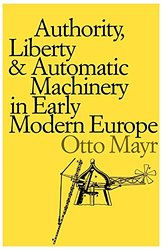
This got me reflecting a bit on the the invention of the clock.  Besides fire and the wheel, I have a hard time thinking of other inventions with as much staying power.  The influence of the clock goes so deep we don’t notice it.  Part of the motivation for me to read Authority, Liberty, & Automatic Machinery in Early Modern Europe by Otto Mayr was the hope that, among other things, he would give some perspective on the clock and its impact.

By “clock” Mayr means the mechanical clock.  People used sun-dials from ancient times, but even the most reliable  sun dials (in Egypt where the sun always shined) did not facilitate an acute subdivision of our experience of time.  In other more cloudy locales the sun-dial had even less influence.  The mechanical clock came on the scene in the late middle-ages and immediately made a dramatic impact on that society.  People fell in love immediately.  In his Paradiso Dante used the metaphor of the movement of a clock’s implements to describe the movement of the angels in heaven, and this merely stood as one example among many. The rare dissenting voice did exist.  The Welsh bard David Gwillym wrote,

Woe to the black faced clock which awoke me on the ditch side.  A curse on its head and tongue, its two ropes and heavy wheels, its weights, yards, and hammer, its ducks which think it day and its unquiet mills.  Uncivil clock like the foolish tapping of a tipsy cobbler, a blasphemy on its face.

But on the whole the “ayes” substantially overwhelmed the dissenters.  People praised the precision and complexity of the instrument, and almost immediately various metaphors for God’s design of the universe arose.  And as we might expect, no people sang such great peans to the clock as in Germany.

Such was the scene on the continent.  Yet those in England reacted far differently.  Yes, many liked the clock and it came into general use.  But far more dissented in England than in other places. In Love’s Labor Lost Shakespeare uses a “German clock” as an epithet.  In Richard II Shakespeare flips all the positive clock metaphors and in a soliloquy by Richard has the clock stands for a symbol of undue self-consciousness and a failed life.

Now sir, the sound that tells what hour it is

Are clamorous groans, that strike upon my heart

Which is the bell.  So sighs, and tears, and groans

Show minutes, times, and hours . . .

Why did they feel this way?  Here we get to the heart of the main idea of Mayr’s book.

Mayr believes that ultimately the answer lies in the different kinds of political cultures of England and the continent.  Briefly, authoritarian style politics had far more “boots on the ground” in places like Germany and France, which explains their love of the clock.  He develops the connection thusly: England’s political theory emphasized balance.  Whether they invented the idea of the “separation of powers” is beside the point.  They had a long history, predating the Magna Carta, of seeking equilibrium between different political bodies, which the European continent lacked.  This led England to put much more emphasis on developing “feedback” technologies.  These devices did not exert power so much as prevented one element from gaining too much power.  The thermostat serves as a good example of such a device.  It helps create balance.  Neither heat nor cold win the day. Notably, thermostats only come on when they need to correct the temperature.  Otherwise they lie dormant.

We may balk a bit at this distinction.  We may not consider the clock a device associated with unchecked power.  The clock may always be “on,” we surmise, but it exerts no direct influence over us.  Perhaps, but I think Mayr has a good point.  During the talk show I mentioned earlier, for example, all the ideas that people had related to people having to move faster because of the presence of the clock. They wanted the clock to make people act in certain definite ways.  Our speech reflects this as well. We “answer to the clock,” and so forth.  This idea played itself out politically.*  France had Louis XIV, Robespierre, and Napoleon. Prussia had Frederick the Great.  When England’s Charles I attempted to reign more independently he faced a revolution and the loss of his life.  Mary Tudor and James II also failed to introduce significant changes.**

The book moves along nicely to show how other “self-regulating” systems developed in England.  Aside from the political self-regulation between king, parliament, and courts, Adam Smith developed the idea of a self-regulating economy. Mercantilism, the prevailing economic theory in the 18th century, called for one to dominate other countries via exports over imports.  Smith believed the market could work much like a thermostat and correct itself with no government interference.  Central control of trade not only was unnecessary, but counter-productive.  We need not wonder about the veracity of Smith’s theory here.  What seems obvious from Mayr’s extensive knowledge is how developments throughout a particular culture have a common root.  The thermostat and Smith’s free market ideology come from the same place.

If the clock occupied pride of place for inventions from 1300-1800, what shall we say about our own day?  We would first need to decide what invention has pride of place in our society.  One would at this moment probably say the smart-phone, but we might wonder if in 10 years we will have moved on.  So we should settle on something larger, like “digital technology.”  As Peter Thiel has commented frequently, we have dramatically advanced the world of “bits” while the world of atoms has remained stagnant.  We need to look beyond mere profit and opportunity to understand why we have done so.

The digital universe excites us perhaps mainly because it has no discernible limits.  The powers of computers change all the time.  We can assume different identities, and so on.  We can always have our music.  We can contact anyone we want at any time.  It seems at times as if we can defy reality itself.  The world of atoms, however, confronts us with limits.  And if our recent behavior surrounding gender and sexuality give us any clues, we do not like limits.^  Our politics may soon start to reflect this and our corporate practice.^^  Who can say exactly where this will end up?  But if the trend continues we may need to revisit De Tocqueville’s dilemma regarding liberty (no limits on our actions) and equality.  We cannot have unfettered doses of both, for at some point they work against each other.  We must choose.  We still live in the real world.

Dave

*Compare Bishop Bousset’s explication of absolute monarchy for Louis XIV to James I (King of England) own writing on the subject.  Both reach similar conclusions, but in very different ways.  Bousset’s writing has an inexorable logical methodology.  James I writes more haphazardly, and more poetically.

**Henry VIII may be the exception that proves the rule.

^I re-watched The Matrix recently and noticed something curious.  At the end of the movie Neo speaks into the phone to the machines and tells them that he will show people “a world without limits, a world of possibility” and so on, and then proceeds to fly in the air.  But surely he refers to the world of the Matrix?  This is the world that offers the possibilities of dodging bullets.  In reality we remain subject to gravity.  On board their ship they have to wear dingy clothes and eat protein goop.  So what did Neo really mean?

True to form, the story starts to bleed out in the next two installments.  The Wachowski’s can’t stay content to let Neo be limitless merely in the Matrix (which makes some sense within their invented world).  By the end of Matrix Revolutions Neo can stop the Sentinels in reality just as he could stop bullets in the Matrix.  The Wachowski’s refuse even stay within the limits of their own story.

^^I like Amazon, but I found it a bit odd that they essentially tried to start their own holiday (Prime Day).

If Civilization is Worth Doing, it’s Worth Doing Badly

Historian Arnold Toynbee takes the long view–the very long view, on the fall of Rome.  We think of Rome as a grand empire, but Toynbee reminds us both in his book Hellenism, and in Hannibal’s Legacy, that Rome originally organized itself very much like other Greek city-states.  The early Roman Republic was essentially a polis.  As they grew in size, the political dynamics changed until little to nothing remained of its more democratic past.  But if we think of Rome as a “Republic” first and foremost, we should place the decline of Rome somewhere in the transition between the 3rd-2nd cenutry B.C. at the absolute latest.*

Toynbee takes this approach because he sees civilizations operating in a spiritual sense.  He focuses on the beliefs, the internal coherence, the relationships between different groups in society, and so on.  He has long sections in volumes five and six of his multi-volume A Study of History on the “schism in the soul” present in declining civilizations, which might strike one with a more materialist bent as rather absurd.

Niall Ferguson takes a different approach, and I believe that I see common themes in his books, Civilization, Colossus, and Empire.  Ferguson sees civilization running on various physical platforms, such as the quality of roads, a good sewer system, and a good way of gathering and using tax revenue.**  He eschewed the idea of slow, steady decline–or at least one that we could observe in any meaningful way.  For him, the system works until suddenly it doesn’t, and no one can really predict when it will stop working. This explains why no one saw the collapse of the Soviet Union coming, or various stock-market crashes.  The collapses, when they come, will therefore come out of the blue suddenly.

Joseph Tainter’s The Collapse of Complex Socieities is a short, dense, book about a difficult subject. Tainter does a good job with his argument, which I admit even I though I disagree with some of his basic premises.

His argument boils down to a few key points:

  • Major civilizations tend to experience an early period of rapid growth through the ‘low hanging fruit’ of available territory, resources, etc.
  • This growth inevitably leads to specialization, stratification, and complexity which initially serves growth–though this “low-hanging fruit” won’t last forever.
  • The civilization plateau’s and the structure established to help it grow becomes an inextricable  part of society just at the moment that it is no longer really needed.
  • When the ‘low hanging fruit’ disappears, further expansion (be it territorial, trade-oriented) becomes less and less profitable, and eventually starts to work against the civilization.
  • Finally, the complex structure gets too unwieldy, a ball and chain, as the state has to spend more and more to get less and less. But now we depend on the structure.   It has become too big to fail, but like a house of cards, easy to knock over.

Tainter supports his theory well from civilizations across time, and uses very obvious info, like territory, and some other more unusual information, like crop yields, colonial administrations, and so on. No doubt there are many lessons for economists here.

But, while his book is valuable, it has big holes.

In his quest for absolute objectivity, he rejects all value-judgment theories of collapse. If you can’t measure it, it’s not useful. We can never be sure exactly a civilization really believes, and even if we could, it is not an objective field of study, so has nothing to contribute to the study of collapse. After a brief summary of  the work of people like Gibbon, Toynbee, Spengler, and others he dismisses them with a wave of his hand. But as C.S. Lewis once pointed out, very few people are actually German economists. Any study of history must involve people, which will involve more than graphs on paper.

This over-emphasizing of economics shows up in what is actually a thought-provoking idea. What happens after collapse, he argues, may actually be beneficial to society, because it removes a great deal of inefficiency that the old system labored under. Collapse, might be the cleansing forest fires of history, events to almost welcome.

This sounds good on paper, but no actual human being who lived through collapses would have agreed with him. Imagine living in Western Europe ca. 550 AD and thinking, “Boy, I sure am glad for the fall of Rome. Of course, our ramshackle village could be overrun, destroyed, and our people pillaged who knows when by some Goth, Ostrogoth, Visigoth, Vandal, Hun, or some other kind of Goth I have forgotten about. But I’ll take that any day over the economic inefficiency of the late Roman Empire.”

To augment Chesterton’s oft-quoted phrase (If a thing is worth doing, it’s worth doing badly,” “If civilization is worth doing, it’s worth doing badly.”

Dave


*I love and admire Toynbee for many reasons.  But in some places he puts the decline of Rome at 431 B.C. (!), the same year as the outbreak of the Pelopponesian War in Greece.  He does this mostly because he sees much more similarity than difference between Greece and Rome.  One can make that argument, and he does so decently in his Recollections, but to carry it so far as to say that Rome began declining when Athens hit the wall goes way too far.

**In some ways the difference between Toynbee and Ferguson boils down, as (almost) always, to the differences between Plato and Aristotle.  Both are great–I prefer Toynbee and Plato.

Epilogue

I almost always find Toynbee stimulating, and I include some of his collected thoughts on the fall of Rome . . .

It is indeed, one of the tragic ironies that the idealists that arise within the ruling class should tread the same path of social migration as the wastrels.  The Graachi worked far greater havoc through a nobility [in the late Republic] to which someone like Commodus could never aspire. Commodus did far less damage by his own social truancy [i.e., pretending to be Hercules, fighting in the arena, etc.], by engaging in a vulgarity that represents a spiritual malaise, to which the Graachi would never fall.  

By their ‘downward migration’ towards the plebs, the Graachi incurred the wrath of their fellows, who punished them severely for abandoning their class privilege.  Commodus is uneventfully swallowed by the slough in which he delighted to wallow, whereas the Graachi released a kind of demonic energy into the masses of Rome.

*********

Seneca writes ca. A.D. 60 concerning the social function of the Emperor in one of his treatises. . .


“He is the bond that holds the Commonwealth together, he is the breath of life is breathed by his subjects, who in themselves would be nothing but a burden and a prey if they were left to their own devices through the removal of a presence which is the soul of the Empire.


Their king is safe?  One mind informs them all;

Lost?  They break faith straightway.

*********

If this calamity, written about by Vergil in his Georgics (IV, 212-13), which he imagines overtaking the bees, would overtake us, the people would be safe so long as it does not snap the reins, or–if they refuse to be bridled again.  Should this happen–then the texture of this mighty empire would be rent and its present tidiness would fly apart into a hundred shreds. Rome will cease to rule the moment they cease to render obedience.”

A foretaste of the fulfillment of the prophecy that Seneca made to the Emperor Nero was inflicted on the Roman world in A.D. 68-69 as an immediate result of Nero’s tyranny; but the first time round this calamity acted as a stimulus, for after the chaos Rome got Vespasian as emperor and relative calm.  Though Domitian (d. A.D. 96) tried his utmost to revive the chaos by claiming deity for himself, the tide was turned by a series of beneficial philosopher emperors who succeeded one another from Nerva (A.D. 96) through Marcus Aurelius (d. A.D. 180).

It was only after Marcus that the new “time of troubles” set in, and even then foolishness of Commodus managed to right itself after the civil wars of Severus, who repeated Vespasian’s work, though with a rougher and less skilled hand.  It was only after the death of Alexander Severus (A.D. 235) that the storm broke with shattering and uncontrollable violence.

*********

And finally, some of his thoughts on the drawn out length of Roman decline:

In the downward course of a civilization there is truth in the saying of the philosopher Heraclitus: “War is the father of all things.”  The sinister concentration of the resources of a civilization upon the business of fratricidal warfare may generate a military prowess that will place their neighbors at their mercy, may create a military technique that may grant them a far reaching technical mastery over the merely “Material World.”   

Since it is common to reckon success primarily by power and wealth, the opening chapters in the decline of a civilization will be hailed as times of blessing and growth, and this misconception can persist even for centuries.  Sooner or later, however, disillusionment is bound to follow, for a society that is hopelessly divided against itself is almost certain to try and double down on military might, for that is what seemed to work initially.

For example, we see the money-power and man-power won for Greek society by Alexander the Great, and these same vast resources used to intensify the civil wars between Alexander’s successors.  This same power swept into Roman hands through the meteoric rise in Rome’s land and wealth ca. 241-146 B.C. was just as quickly spent in the various civil wars that wracked Rome before the rise of Augustus and the Pax Romana.  For Spain, the treasure gained in the new world and the free labor of the essentially enslaved native populations was the food for their wars in Europe during the late 16th and early 17th centuries–the same wars that brought them into second-rate power status in Europe.

Thus the increasing command over the environment gained is apt to bestow upon a society a disintegration that puts a greater driving power into the suicidally demented society’s chosen work of self-destruction; and that story turns out to be a simple illustration of the theme that, “The wages of sin is death” (Rom. 6:23).  And again, the empires of industrialized Europe in the late 19th century gained the material resources to nearly destroy European civilization in our great Western civil war of 1914-18.

[Toynbee goes on to argue at length that Augustan synthesis bought Rome time, and brought Rome increased prosperity, nevertheless, it was an “Indian Summer” that lasted about 175 years that did nothing to fix Rome’s basic issues or  prevent the coming winter.]


“It was . . . Soap Poisoning!”

Abstract logic is the weapon of choice of most teenagers. Certainly this tool can intoxicate, but . . . it can often be fool’s gold.

For example, a parent tells their teenage driver to be home from a night out with friends at no later than 10:30. The teen arrives home at 10:50 and shrugs, “It’s not that big of a deal.” The teen will often attempt to atomize the parental rebuke with logic: “It’s just 20 minutes. if I was 20 minutes late coming home from work you wouldn’t care, or 20 minutes late coming home from school, you wouldn’t care. So to get angry about this particular 20 minutes only shows utter arbitrariness in your distinctions. It is your power, and your power alone to define what constitutes a meaningful 20 minutes is why I am in trouble, and no other reason.”

Ah yes, nothing burns so fiercely in the teenage soul as the apparent arbitrary nature of various parental decisions and distinctions. The teenager may suffer consequences, but they will suffer them rejoicing in their moral superiority. They see, they know the Injustice, and dream that perhaps one day, one day, parents will be struck by a terrible self-knowledge . . .

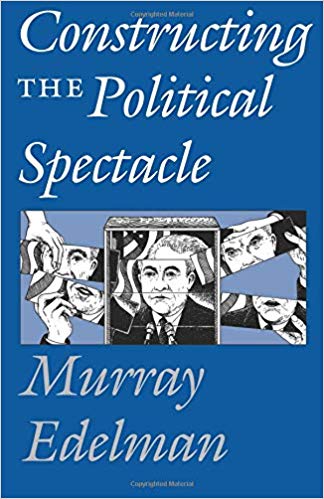
Reading Murray Edelman’s Constructing the Political Spectacle left me feeling that I was listening to a 16 year-old who thinks he has discovered the secret truth of the universe that somehow everyone over 30 for the last several millennia has missed.

Edelman’s bases his book on the idea that our politics do not reflect an objective reality that we recognize, but a constructed reality made by those in power. Often, politicians will do things to perpetuate their power artificially by creating enemies or crises. We create such things via the terms we use, or the definitions we create. Very skillful politicians construct reality with tone or posture. It seems to me that Edelman believes we are puppets on the strings of language, a fairly standard postmodern perspective.

As an example of his perspective, Edelman discusses the idea of a political crisis through the Cuban Missile Crisis. We called the Russians placing missiles in Cuba a “crisis,” one that nearly triggered war. But we had missiles just as close to Russia as they did to us–many more of them, in fact. Another narrative of seeing the Russians striving for greater global security through strategic parity emerges. Which narrative we pick will depend on which definition we use, and the definitions those in power chose elevated the government’s status. The “Cuban Missile Crisis” was a crisis only because we defined it so–we could have easily chosen other language to create a different reality.

Certainly we have to get below the surface narrative that favors our side, but the equivalency Edelman attempts make sense only in a pure abstraction. In the real world we know that placing missiles under a cloak of deceit (which the Russians did in Cuba) means that we have to see beyond merely where missiles are located and how many each side has. In the same way, we know that when a teenager comes home 20 minutes late from school, and another time comes home 20 minutes late from being out with his friends at night, the difference between these two 20 minutes is hardly arbitrary.

Other problems exist with the book . . .

  • He discusses how political leaders have power in part because of their visibility. They can control the symbols by which they are viewed, which in turn makes them seem more than just figments. But every leader since the dawn of time has been invested with some kind of symbolic/semi-sacred (in some cases fully sacred) authority. Has every civilization simply not had the advantage of getting to Derrida’s philosophy? It seems much more reasonable to assume that these symbolic forms mean something real, and are not just pure manipulations.
  • He discusses how political leaders might create enemies to boost their power, i.e. Wag the Dog. Sure, it can happen sometimes, but some enemies are real. ISIS is not a semantic construction. How would Edelman propose we tell the difference between real and fake enemies?
  • He criticizes the use of semantic and symbolic constructions to achieve collective action. Yes, this can be bad sometimes, but he never reminds us that it can also be done for good ends. I had the suspicion that collective action itself was presumed guilty, but surely we cannot exist apart from some occasional collective action.

As I read my frustration with Edelman grew, and not so much even because I am conservative and every example he used in the book made conservatives (or those with power, such as generals) the bad people for how they used symbols and defined the terms. After all, people can write books that critique conservatives, and I can learn from them. No–my frustration stemmed from the assumptions his arguments made about those on the left, and even himself. Edelman’s thesis leaves us with the following choices:

  • Only bad conservatives know how to wield symbols and construct the political spectacle in their favor, which makes those on the left either blind sheep or slaphappy stupid.
  • Those on the left can construct political realities but not get others to follow very often, which seems to cede much of the high ground to conservatives–maybe their policies really do represent the majority of citizens?– or assume that the great mass of people are dumb and easily manipulated, but only by conservatives (the left must lack the talent?)
  • Every unified political action is nothing more than symbol and word manipulation, which means that those on the right and left are “bad” when they try and do this.
  • Not to mention, Edelman himself becomes “bad” for trying to impose his narrative of definitions and language on me, the innocent reader. “Don’t impose your ‘there is no Narrative’ narrative on me, man. I just want to live and let live.

I have been quite critical of Edelman, but he, like other postmoderns, latches onto an important truth. The teenager has to arrive at a point where they realize that their parents are not gods and that the world they live in–constructed largely by their parents–has many arbitrary elements in them. Applying these insights into society and politics has its place. The Enlightenment modern project needed taken down a notch or two. But the teen can’t stay in a constant critique. He needs to build something, but Edelman gives us no tools for the task.

Andrew Kern of the Circe Institute has a helpful breakdown of different kinds of education. First, there is the Pragmatic education, then the Traditional, then the Wisdom education. Each type, Kern reminds us, is based on faith in something.

  • A Pragmatic education bases itself on the belief that all that is worthy is what can be seen, measured, and useful for his brute survival–food, water, shelter.
  • A Traditional education respects the past and knows that things exist beyond what he can see or measure–his society, or heritage, for one. He believes in the value of this inheritance, and receives the proper training to honor that tradition and to sacrifice for it.
  • A Wisdom education tries to do more, to stand outside the Tradition and ask questions of it. It tries to get at the roots of a society. It can lead one to see faults within the Tradition and hopefully correct it when needed. If the Traditionalist has faith in an unseen inheritance, it is still an earthly oriented inheritance. A Wisdom education believes in something transcendent above all traditions. 

One might think that Edelman gives us wisdom, because of his ability to see through traditions. I disagree. First, true education has to lead us somewhere, and Edelman merely deconstructs. Second, a wisdom education has to involve love, has to involve a giving of oneself to something higher. No societal critique works without roots in love of the Tradition.* I sense nothing of this in Edelman. He gives us logic-chopping straight from the freezer.

But even a “Wisdom” education rooted in love of the Tradition would not fully complete our education. Kern reminds us that there remains a fourth and final stage of education, one that even many Christians miss, just as the Corinthian church in St. Paul’s day missed it. The proof of their failure was their disunity. They used all of their wisdom to fight with each another. Indeed, being able to evaluate a tradition doesn’t mean that we will agree on what is right or wrong about the tradition. Perhaps one might arguably see some of this division of mind present even in Solomon, the wisest of the wise, and the presumed author of the somewhat confusing book of Ecclesiastes.

The final stage of education, then involves something beyond critique, and into the realm of Play, into the great dance of the Triune God, where unity and diversity cohere in the foundation of Being itself, where we are fully united one with another but are never more our own unique selves simultaneously.

Herein lies the Secret of the Gospel, and the answer to Edelman.

Dave

*If we could summarize the basic problems with the political Left and Right, it would be

  • The Right wants to uphold the Tradition with little to no critique of it.
  • The Left simply critiques the Tradition without any love for it (or, if they praise America, they praise it almost exclusively for being able to correct its mistakes–a perpetual motion machine of self doubt, and sometimes, self loathing).

Both sides have something to offer, and both sides often see with one eye closed. As I mentioned elsewhere, the first half of the 20th century shows us the horror that unquestioning love of a Tradition can bring. Since then we see the spiritual and moral vacuum of deconstruction with no place to stand with no map available.

Familial Anxiety

Perhaps Mary Douglas’ Catholic faith gave her great perception in her examination of the so-called “Bog Irish,” who emigrated from Ireland to London to find work in the mid-20th century.

This group of Irish Catholics found themselves in a country that had long persecuted them on some level, and who had slim tolerance for their faith. What bound them together was their observance from abstinence from meat on Fridays. Perhaps they did not always pray or love their neighbor as they should, but they faithfully avoided eating meat on Fridays. Whatever one feels about such practice, it had the effect of binding themselves together as a “peculiar people” in the midst of exile.

Of course, the injunction against eating meat went beyond mere cultural significance, as each Friday fast could link us in some small physical way to Christ’s death. In the late 1960’s modernist Catholic bishops made the decision to eliminate the obligatory Friday abstinence. Some of them seemed to worry about their parishioners seeming “weird” to the surrounding culture. In general, they expected that the faithful could take their zeal for Friday abstinence from meat and apply it instead to other more “meaningful” good works, such as prayer and serving their fellow man.

But the opposite happened. For Douglas, anyone versed in the actual history of human experience should have known this. The removal of the binding ritual did not create more good works, but less belief, and most likely, fewer good works. The “good works” asked for by the bishops, of course, should be done by any Christian, but “we live by symbols,” as Douglas states, and the removal of the ritual removed the ground that their faith rested on. No identity=no faith. Douglas writes,

The Catholic hierarchy today [1968] are under pressure to underestimate the expressive function of ritual. [They exhort] Catholics to invent individual acts of almsgiving as a more meaningful celebration of Friday. But why Friday? Why not be good and generous all the time? As soon as the symbolic action is denied value in its own right, the floodgates to confusion are opened.

[As] there is no person whose life does not need to unfold in a coherent symbolic system.. . . there is a dreary conclusion for those who turn to good works to solve problems about their own identity. They are liable to be frustrated on every count. First, it would seem that they must give their good causes over to bureaucratic energies of industrial organization, or they will have no effect. Second, . . . they will never be able to arrange their personal relations so that a structure of non-verbal symbols can emerge. For only a ritual structure makes possible a wordless channel of communication that is not entirely incoherent.

Douglas, p. 38, pp. 50-51

She then points out that the Maccabean martyrs (cf. 1 & 2 Maccabees) equated not eating pork with the entirety of obedience to God’s law. Their abstinence from pork formed an integral part of a whole way of existing.

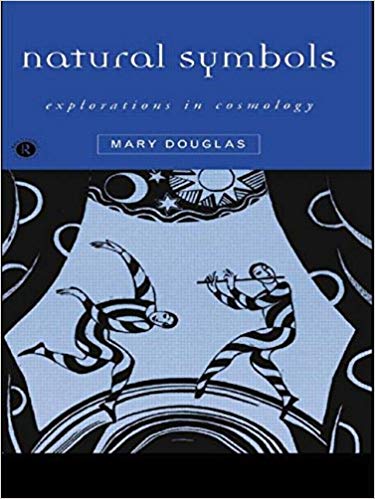
Mary Douglas’ title, Natural Symbols, Explorations in Cosmology may be daunting to many, as it was to me. But she writes in a manner to match her clear, concise perception I thought her work superior to Ruth Benedict’s. Benedict could describe entwined patters of culture well, but she seemed to not quite grasp the meaning of these patterns. Perhaps Douglas built on her work, for she not only sees the patters, she perceives their meaning–perhaps her Irish Catholic background helped her with this.

As an entry point into this shift, Douglas first looks at how families function. She offers two basic modes, what she calls “Positional” and “Personal.”

Positional families

  • Value truth, piety, and duty
  • The cardinal sins relate to failures to live into the expectations of the group, or to maintain the appropriate ritual behaviors. Discipline takes the form of, “You should know that members of our group do not act that way.”
  • Have a wide network/structure over the individual, to which the individual has reference to

Personal families

  • Value sincerity, authenticity, individuality
  • The main sins relate to failures to “be all that you can be,” and discipline takes the form of “How could you do this to me?” or, “How could you do this to yourself?”
  • Celebrate the individual triumphing over the structure

For most of human history, we have had some kind of positional family structure, but now most everyone in the western world has grown up in at least a mostly “Personal” family. The consequences of this shift have profound implications for us, and involve, among other things, a movement from the concrete to the abstract.

Douglas points to the Reformation as the origin of this shift with some merit, but I will take a flyer and point to the Renaissance as when this began. We can see this in the art of the Renaissance and the medieval era which preceded it.

Many might assume that medieval religious art was ‘obscurantist.’ Certainly they used symbols in their art, but it communicated a concrete message. St. Anthony the Great, for example, had great stature but the depictions of him tell us that, “you can be like him, he is one of us.” So too the statues astride their cathedrals. Whatever “legends” may have been told about such saints, they lived real lives as you and I did.

But, to take perhaps the most famous example, who can be Michelangelo’s “David?”

Of course, no one can be such a man, and thus David becomes not a saint or even a man, but an ideal in the ether. The Renaissance also revived an interest in mythology. I agree that myths are not simply lies, and that they can have value in leading one to truth. But one must careful with such stories. The pagan could believe that Marsyas was literally flayed by Apollo, but not the man of the Renaissance. So any depiction of such an event ca. 1500 would inevitably be transmuted into an ideal. And indeed, the beloved Sister Wendy, in fact, explained Titian’s masterpiece as showing something akin to the intense “challenge of the artist,” whatever that might mean.

Alas, one of my great heroes, A.J. Toynbee wrote that such “etherialization” of concrete principles was a prime factor in the growth of civilizations, but Douglas argues that what this usually leads to is cultural confusion.* This movement toward abstraction continued in the west as the Reformation over time removed the liturgies, images, and sacramentalism from their worship. This put everything inside one’s head or heart, and again, put things in abstract categories–such as the unknowable “elect” for the Calvinists.

The different ways of conceiving reality always take on particular manifestations in our bodies, the main way we express meaning and our cosmological belief. A moment’s thought about this shows its truth. When Douglas wrote this book (1970), of course, it was even more obvious. The 1960’s started tight and neat but ended with long hair, open collars, psychedelic prints, and so on. We know the “Law and Order” look–what policeman has long hair and a scruffy beard (unless going undercover to mix with the more dangerous types)?** So too, no non-denominational pastor could ever think of wearing anything but jeans, and perhaps a polo shirt.

Thus, what happened in the 1960’s was a real revolution, and not just kids blowing off steam. Douglas cringes at contemporary commentators who called the destruction wrought by various riots and protests in the 60’s as “mindless.” College campuses exist as liturgical institutions, a manifestation of a particular order and authority structure. Today we see many of the same things as in the 60’s, such as more casual dress and campus protests. It would not surprise Douglas to see such behaviors coupled with a loosening of other body oriented morality, especially the highly charged area of sexual morality. Perhaps some of the intended meaning of such acts may not be conscious, but they are far from “mindless,” as they point towards a very definite goal.

Most educators have noted a rise in the anxiety of their students. Different theories exist for this phenomena. Some explain it with the rise of social media and their attendant lack of real personal connections. Others point out that the 9/11 generation has come of age in the age of terrorism, where threats can come from anywhere anytime.

No one I know of has pointed out that the rise of anxiety may come from the continual loosening of our societal structures, both in worship, family, dress, and so on. But Douglas hints at this quite strongly. True, the “Personal Family” structure brings many benefits. She mentions that this path often develops strong verbal skills and meshes nicely with the need to do well in social environments like school, which dominates the lives of children. Besides, even if we wanted to orient ourselves in a more “Positional” way many of us have no tradition, social class, or family history to build upon.

Teens today not only have jobs and careers to choose, but whole selves to construct, a heavy burden to carry.^^ Add to this that the reasons for doing or not doing a thing could be endless. Douglas writes,

Above all, the [“Personal Family”] child’s behavior is controlled by being made sensitive to the feelings of others, and by inspecting his own feelings. Why can’t I do it? Because father’s feeling worried; because I have a headache. How would you like it if you were a fly? Or a dog?^ In this way the child is freed from a system of rigid positions but made a prisoner of a system of feelings and abstract principles. (emphasis mine).

Douglas, pp. 26-27

We have had many good anthropologists, but I am not aware of any who wrote with such clarity as Mary Douglas.

Dave

*I acknowledge that energy can be released in the early stages of breaking with concrete societal forms, and perhaps this is what Toynbee saw and admired. I liken it, however, to taking a fussy toddler bundled in bulky clothes. You take them out of the crib, remove the onesie, and they are so happy, arms and legs unfettered! They whirl around like spinning tops for five minutes. But then, the look of, “What do I do now?” strikes them, and of course, the pajamas will have to come back on sooner or later.

I should say that Douglas may disagree with me, as she thinks that loose “etherialization” (to use Toynbee’s phrase) can continue indefinitely if it is paired with loose social structures.

**Douglas asserts the universality of the patterns she describes, but how to explain the long beards of Orthodox monks, priests, etc? The Orthodox are likely the most liturgically formal of all Christian denominations, yet have the most unkempt facial hair. Perhaps we could see the connection in a kind of manly disdain such priests/monks have for the world. But again, there may be limits to this, as for Old Testament Jews–another structured and highly liturgical society–long beards for men were normal and could not be seen as a form of distancing oneself from society.

But . . . this pattern certainly played out in Greece and Rome, two similar civilizations. The Greeks loved the sea, and thus valued beards and more fluid and flowing hair. Their society was more fluid as well. The Romans valued farming, and with it, law and order. With that comes shorter hair and clean shaves. Not until the empire was past its prime did we see the Romans going native, sporting beards and longer hair.

The pattern hold also for the Egyptians (clean-shaven, less ornamentation in dress, more order focused) and the Babylonians (more fluid as a society, more fluid in their dress).

^We might add today, “Do you feel like a boy? Or a girl?” The Personal Family’s predilection for rebelling against all forms of imposed identity have stretched out to rebelling against Nature itself.

^^It is no coincidence that we invented technologies to help us in this very endeavor, and that these technologies would further advance abstraction. In addition–we usually view the creation of public schools as a response to industrialization. Douglas might want us to view the creation of the public school system as a response to the dominance of the Personal Family model. If we have a self to construct apart from the family/neighborhood, we will need a tangible place to do so.

Renaissances and Ghosts: “Contacts Between Civilizations in Time”

This is not a book unto itself, but merely one-third of Volume 9 of his multi-volume A Study of History series, subtitled, “Contacts Between Civilizations in Time.” However, it can stand apart from the other sections, and it is so dense and at times so insightful it deserves its own treatment.

Naturally when one mentions “The Renaissance,” in the West, we think of the Italian Renaissance of the 15th century, but this, Toynbee states, serves us poorly for three main reasons:

1. There have been many “renaissances” throughout history and to call the one we know “The Renaissance” narrows our vision and prevents us from seeing patterns throughout time and place.

2. When we think of The Renaissance we think mostly about its art, but the classical style came from a broader classical culture.  One thing inevitably spills over into another.

3. Finally, what a “renaissance” really involves  is not so much a resurrection of an idea in the sense of new life, but an act of necromancy designed to bring back to life a dead past.  Think Frankenstein instead of a “new heavens and new earth.”  After all, we cannot bring back the dead, but we can contact a dead past’s “ghost.”  It is this concept of a Renaissance as an act of necromancy that gives this part of the book its unifying theme and key spiritual insight. With that in mind. . .

Toynbee begins with the Italian Renaissance, with which most of us are familiar.  Imagine yourself in Florence, ca. 1400 A.D.  Let’s suppose that you discover the artistic classical style and you begin to replace the prevailing gothic way of seeing the world.  Soon you find yourself, however, noticing the classical political ideology can lend credence to your fight for more independence for  parochial communities (i.e. Venice, Florence, etc.) in one fell swoop.  The city-state system experiences a revival in Italy, which leads to a different role for the Church.  In time, the nation-state is born.  So, “one thing leads to another.”  We cannot expect that we can revive just the artistic style without the accompanying framework.

But if you want the blessings, you get the curses.  The parochial nation-state idea nearly destroyed Europe from 1914-1945, just as it destroyed Greece from 431-338 B.C.  As Toynbee indicates, there is a reason for the death of a previous civilization, and “if you latch onto a decayed society’s social ethos, you will likely suffer their fate.”

This leads naturally into his “necromancy” template.  He makes a few points,

1. Necromancy is by definition an act of desperation (i.e., Saul and the witch at Endor, the rise of spiritualism and seances in England during World War I).  The desperate act may be warranted/worth the cost, or it may be a reaction in the wrong direction.

2. Necromancy reveals not only desperation but a lack of confidence.  Necromancy signals an abdication in our ability to create something new and the passive acceptance to what others already did for you.  Regine Pernoud made similar points in Those Terrible Middle Ages.  But there may be more to it; a renaissance may reflect something deeply lacking in the era in which it happens.

3. When civilizations connect with each other in living “space,” the interaction between the two has potential for equality and mutual exchange, but not with ghosts.  While in Hades, the ghost has no power.  You live; it does not.  But call up the ghost and you discover, like Hamlet, that the ghost has all the power.  You have no influence over the dead, who cannot hear you.  All you can do is listen to them.  Again — you have abdicated something of yourself by reviving the ghost.  “Renaissances are bound to be insulated experiences,” Toynbee commented.  You are now in his power.  The US helped support the revival of the ghost of 19th century Sudanese Wahabi’ism in Afghanistan in the 1980’s, and that did not work out so well for us.

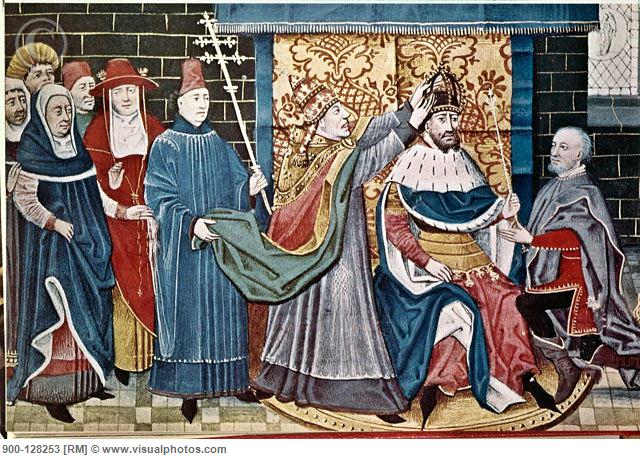
But maybe drastic times call for drastic measures.  Take Charlemagne, for example, who along with Pope Leo III revived the ghost of the Roman Empire.   Was it worth it?  Many historians credit Charlemagne with reviving civilization itself in Europe for the first time in three centuries.  Perhaps inventing a new model would have been preferred, but how much do we blame them given the chaotic times?

Still, even if we agree with Pope Leo and Charlemagne, we must count the cost.  Empires mean conquest; conquest means death, centralization, and other attendant evils.  You can’t have Charlemagne be the “Holy Roman Emperor” without bringing back the filth attendant to the glory.

4. The effect of the ghostly presence will depend in part on geography.  Reviving a direct family member works differently than a distant cousin.  So in Italy the effect of the reviving the classical ghost would be like bringing back the stern father, while in the north the response would have more latitude, and probably, more creativity.

Of course the closer the relation, the greater power the ghost has.

We will also have a difficult time getting the ghost to leave.  In Europe the classical artistic style faded within a century, but in architecture it remained centuries longer, and politically longer still, into the 20th century.

However necessary they may be, renaissances remain unpredictable and dangerous.   Approach at your peril.

Just as renaissances are messy and unpredictable, so too evaluating them remains difficult.  Toynbee cuts through the grey in his typically incisive way, saying,

“Renaissances must be judged by their hindrance or help to the soul with the sin of idolatry.”

Here Toynbee shows his great insight that all human affairs have a theological dimension.  A renaissance may help pry us from a lifeless and destructive present, or it may make us greater slaves to an even more lifeless past and put us, “Out of the frying pan and into the fire.”

Dave

I enjoyed this analysis on the dangers of calling up ghosts in the music industry.

Cultures are all Different, except when they’re the Same

It strikes me as a plausible proposition that anthropology developed primarily as a science out of democratic cultures. The openness fostered by democracy may contribute to curiosity and a desire for travel. Many consider the Athenian Herodotus the “Father of History,” but his work has many anthropological dimensions as well. I discussed in another post the archetypal Feminine within democracy, so it may be no surprise that the most famous anthropologists in the 20th century were two women, Margaret Mead and Ruth Benedict.

We can imagine the stereotypical male being almost a parody of an anthropologist–narrow, rigid, calling anything different “stupid,” or “dumb” (this could have been a marvelous Monty Python skit with John Cleese). So we can see how typical feminine traits of fluidity, appreciating context, nurture and acceptance, and so on, might fit women best–in general of course.

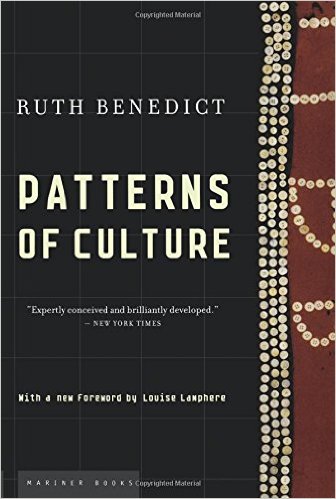
Many have written extensively on Ruth Benedict’s classic, Patterns of Culture, and I will not seek to say what has already been said. Briefly, however, Benedict seems to have two main goals:

  • To show that cultures are fundamentally different from one another, and are developed internally, not dependent on race or geography
  • Benedict of course makes many interesting observations about the societies she observes and her work has great merit. But, just as John Cleese might marvelously enact a parody of an anthropologist in the field, so too anthropologists can sometimes parody themselves. It is possible to be so open, so fluid, as to lose one’s moorings.

By this I mean that, of course cultures are different from one another, but this should not surprise us at all. People are different too. What I find more striking are the similarities across cultures that testify to the essential unity of human nature. For example, Benedict tackles how different cultures treat adolescent girls. In one place, young teens are primarily feared. The transformation they undergo has an element of sacredness about it, but, the sacred can also bring terror. So the young girls are sent away from the community to live in tents apart for months at a time. In another culture, they are celebrated and receive something akin to adoration, with men of the tribe literally bowing to them as potential and future mothers of the tribe. In Polynesian cultures, Benedict asserts that no one makes a big deal of adolescence at all. No ceremonies exist to mark the passing from youth to young adulthood, but . . . during this time teens are granted a great deal of sexual freedom, which they readily take advantage of until marriage.

Benedict’s strong accentuation of differences, however, have her miss the overall point. Each of these cultures treat the teen years as a distinct phase of development, each other them apply different standards of conduct for teens and others in the tribe treat them differently than either children or adults. To me, this seems more striking than their differences.

I find this emphasis on difference–not at all unique to Benedict among anthropologists–as a symptom of the democratic cultures from whence they arise which also stress individual differences and uniqueness. Paradoxically, I think this leads us towards a fascination with cultures that are tightly interlocked and cohesive, for democratic cultures can produce no such thing.

When a book gets reviewed positively by diverse thinkers such as Rod Dreher and Cornel West, one should take note. Patrick Deneeen’s Why Liberalism Failed partially indulges in too much romanticism for the past. His book is more of an essay or a thought-piece, and so it has holes. Still, I find his paradoxical analysis that Liberalism–by which he means the liberal democratic order that forms the foundation of both Republicans and Democrats–has failed because it has in fact done everything it set out to do, compelling, and an interesting companion to Benedict and other anthropologists.

Deneen argues that the Liberal order, which had its origins in with the work of Hobbes and Locke, set out to create a radically new society with a very different conception of how an individual relates to the state and one another. Traditional societies saw the state fundamentally as a community of persons pointed in the same direction with the same values.

Liberal society starts with the premise that recognizing and maximizing individuals, and the inherent competition that comes with it, will create a more prosperous and workable state. Liberalism seeks to free us from all group oriented authorities that are not consensual, be it tradition, community norms, etc. It achieved its goals in spectacular fashion and we all partake readily of what it has to offer. It has brought unprecedented prosperity, but left us adrift at sea in a mass of individuals. In turn, this has led to the rise of statism, and emotionally driven authoritarian politics. Gone is the world of George H.W. Bush. Welcome to the world of Trump and Ocasio-Cortez. The success of Liberalism has brought us to place that will naturally usher in its demise.*

Deneen explains himself well on any number of podcast interviews, and the book has various and detailed reviews. I will mention two of his main points that might help us understand the polarity of the self-loathing expressed by some in academia and the progressive left, and the chest-thumping of the more nationalistic right.

Deneen mentions that Liberalism is supposed to make men “free” and “liberal” in their disposition. But the whole tradition of the liberal arts expounds a very different meaning of freedom. The great thinkers and writers from the ancients down through Austen and Dickens all characterize freedom as living with limits, be it the limits of nature, tradition, or the law of God. But the Liberal order defines freedom as acting without any constraint, be it constraints on the market, on family, on biology, and so on. So, Wal-Mart should be free to eradicate mom-and-pop Main Street. And, if every civilization that ever existed defined marriage in a certain way, that stricture simply sets up another bowling pin for the Liberal order to knock down. The whole history of the human past has no authority over the now.

Our orientation towards living without limits has led to our striking crisis of inequality. Our solution to this, however, is not to champion the limitations taught by the liberal arts, rooted in God, natural law, or nature itself, but instead to blame liberal education for being “impractical.” For Deneen, an insistent STEM emphasis only continues to feed the beast, though he surmises that we will avoid violence. John Locke himself argued that, of course his proposed new order would bring about a new kind of inequality. But this new inequality will give us much more overall prosperity, and indeed he was correct. Even the poor may not mind inequality so much because we all have iphones.** Still, the benefits of a liberal economy do not feed the soul.

So too, Deneen argues that Liberalism destroys “culture” as part of its operating procedure. To develop, culture requires place, habit, tradition, and local difference, none of which have a role in the Liberal state. We have no place, and if we live in a particular place for long, it may not have any “place” about it (suburbs are wonderfully convenient and give many obvious benefits, but most are interchangeable with each other).

I think this might explain why many in the west have a fascination with other cultures. The Pueblo and the Dobu people profiled by Benedict have a tight culture in which roles and identity stand out with perfect clarity to all who live within them. We may not want to live among them but we long for their sense of solidity. Conversely, the Dobu do not send out anthropologists to find out about us. A man who is full need not scavenge for food.

This may help explain the progressive liberal drive to limit free speech. They seek not the liberal idea of freedom, but taboos that might give us identity. I completely object to their methods and their goals, though I understand the impulse. You can only celebrate diversity for so long, until you realize that everyone has the same need to define themselves as a people, and we cannot define ourselves without living within limits .

Deneen’s book has few solutions in mind, and this has frustrated some reviewers. But he does he offer the following from Edmund Burke’s Reflections on the French Revolution:

In this enlightened age I am bold enough to confess that we are generally men of untaught feelings, [and] that instead of throwing away our old prejudices, we cherish them . . . . W are are afraid to put men to live and trade each on his own private stock of reason, because we suspect that this stock of each man is small, and the individuals do better to avail themselves of the general captital of nations and of ages. . . . Prejudice renders a man’s virtue his habit, and not a series of unconnected acts. Through just prejudice, his duty becomes part of his nature.

Dave

*In an interesting aside, Deneen points out that James Madison specifically sought to develop a government where different political interests were inexorably pitted against one another. He eschewed the idea of community almost from the start. These different and intractable differences would preserve liberty for each group by each interest group canceling each other out. Alas, he probably envisioned several kinds of difference, and not just two.

Or . . . perhaps just two versions of the same impulse? Many criticize Trump for his relationship to facts. But Oscasio-Cortez recently derided those who are “more concerned about being precisely, factually, and semantically correct than about being morally right.”

**Deneen said in a recent speech that he leads at Notre Dame a class on the idea of utopia, from ancient days until now. At the end, he polled the class to ask them which society of those he presented would they least want to live in, and which they would most want to live in. They all said 1984 is the one they wouldn’t want to live in. But which would they choose? A handful chose the world Wendell Berry presents in Hannah Coulter. But about half the class said Brave New World.

“It was stunning that they saw it as a utopia,” Deneen said. “That’s liberalism succeeding, and that’s liberalism failing.”

“The (Optimistic) Spirit of Medieval Philosophy”

There exists an “old saw” approach to Christianity that runs something like this: A long time ago Christians devoted themselves to practical matters of personal morality.  The early Church lived as a community of love devoted to good works.  Then, along comes ________ (this “blank” takes many forms — St. Paul, St. Athanasius, St. Augustine, etc.) and Christianity forever tainted itself with “theology” and a philosophical turn of mind completely at odds with the spirit of Christ and his early followers.”

I believe firmly in the idea that every organization gets the culture they deserve.  Perhaps the Church over time has contributed to the great error described above by focusing too much on morality as such and not on transformation.  Perhaps Christian education has concerned itself too much at various times with mere outward good results and good looks rather than giving a firm foundation in eternal principles.

But I also think that those that attack the “philosophical” elements of Christianity have a conscious or unconscious agenda to keep religion tucked away in its own small corner.  “You Christians please continue to be nice to each other and try and help others.  We’ll handle the big stuff.”

In his The Spirit of Medieval Philosophy Etienne Gilson sets out to refute those who wish to keep Christian belief in a 1124081small corner.  Gilson was a pre-eminent scholar and philosopher in his day, and alas for me, some of his philosophical vocabulary went over my head.  But one of the great strengths of his work is its simplicity.  He asks the critic to please, just actually read the Bible and Christian theologians honestly, and the idea that Christian belief was never “philosophical” melts away.

For starters we have the book of Job as a deep philosophical statement on the nature of suffering.  Many Old Testament history books like the book of Judges show artful arrangement to make pointed statements about the nature of man.  We have Ecclesiastes and many Psalms.  Some would say Jesus said nothing “philosophical” but this can only possibly hold water if one discounts the Gospel of John entirely.  Then of course we have the “dreaded” St. Paul who “intruded” with his theological cast of mind, and so on, and so on.

Gilson’s main point, however, deals with the Middle Ages.  Here most critics (at least in his day) stated that whatever philosophy the medievals attempted strictly copied from the Greeks.  They had no originality.  Gilson’s quick retort to this deals with the nature of originality itself.  In one sense, “all philosophy is a footnote to Plato,” as Alfred North Whitehead stated.  Of course the medievals took some ideas from the Greeks.  What philosopher would not?

Others (like Edward Gibbon) charge the medievals with dimming the light of reason with the obscurantism of faith and revelation.  Gilson shows with many examples that the bulk of medieval thinkers saw reason enhanced, not diminished, by faith.  He writes,

By revealing to man what he could not actually know, revelation opens up the way for the work of reason.

God’s gift of rationality now has more to chew on, and thus gets more of a workout.  For the medievals revelation makes mankind more rational, not less.*

But the bulk of the book forms Gilson’s main point that the medievals creatively used and transmuted Greek philosophy rather than copied them rote.  They had a strong desire to save everything they could and use it for Christian purposes.  My favorite example of this comes from Boethius. Gilson writes,

Fate had weighed too heavily on men’s mind’s to be too summarily dismissed.  Boethius took the trouble to put up some rather complicated architecture in order to ensure it a niche in the Christian temple.  Providence is then the divine intelligence comprehending all things in the world; that is to say their natures and the laws of their development.  As reunited therefore in the divine ideas the universal order is one with Providence; as particularized, broken up, and so to speak, incorporated with the the things it rules, the providential order may be called Fate.  All that is subject to Fate is thus subject to Providence, since Fate depends on Providence as a consequence on its principle.

Boethius himself wrote,

For as the innermost of several circles revolving around the same center approaches the simplicity of the mid-most point . . . while the outermost, whirled in an ampler orbit takes in a wider sweep of space–even so whatever departs from the Primal mind is involved more deeply in the meshes of fate, and things are free from fate in proportion as they seek to approach the center; while if aught cleaves close to the supreme mind in absolute fixity, this too, being free from movement, rises above Necessity.  Therefore as is reasoning to pure intelligence, as that which is generated to that which is, time to eternity, a circle to its center, so is the shifting series of fate to the steadfastness and simplicity of providence.

I admit I don’t fully understand it, nor might I buy what he sells. Whatever the explanation, I think it best to avoid the word “Fate” altogether.  But who wouldn’t smile at Boethius’ boyish enthusiasm and deft mental gymnastics? Aquinas, to my mind a more mature and clearer thinker than Boethius, rejects this concept of Fate as well.  I’m sure that Aquinas understood him, and I’ll stick with his analysis.

Of particular interest to me was Gilson’s explanation of the medieval view of history.  Previous historians in the Greek and Roman tradition did brilliant work.  But even the best of the ancients, i.e. Herodotus, Thucydides, and Polybius, all show the tendency toward Fate and Inevitability.  For Herodotus, everyone eventually crosses the boundaries of natural law — even Cyrus — and gets crushed for it.  Thucydides sees civilization doomed by the passions and fears of man that lie just below the surface.  Even the more spiritually minded Polybius sees mighty Rome caught up in the grand cycle of growth, peak, and decay from which they cannot escape.

Medievals demonstrated originality in their historical vision.  They saw linear progression where others saw only vicious cycle.  With revelation illumining reason we can build on the past, move forward, and advance.  The medievals had humility in relation to the past.  They knew the Romans and Greeks had done better than they in most ways.  But they never felt imprisoned by that presumption.  Rather, they sought to press on and hopefully help carry mankind to a better place.  In comparison to what came before, Gilson rightly claims this as an original philosophical development.

This view of history has its roots of course in theology.  History is a poem, which makes sense only when we know the beginning and the end.  Thanks to revelation, we know both, and can now see Christ building His kingdom on Earth, one that grows as a mustard seed.  If God be true, we have the opportunity to progress in relation to the past, though of course we may reject that chance.  This explains Boethius’ desire to save Fate from the chopping block — we must save everything so we can build on everything — but it also explains Aquinas refusal to yield.  God binds no one by Fate.  Otherwise, how can God’s kingdom advance?

The medievals, often portrayed as dour and gloomy, strike me as a hopeful people.

Dave

*Perhaps one example of this is the doctrine of the Trinity, a reality beyond the realm of reason.  But after revelation announces the doctrine, reason and experience can then deepen our understanding, which seems to be the experience of the early Church.

Stalinism as a Civilization

I have never quite agreed with Tolstoy’s famous quote, “All happy families are alike; each unhappy family is unhappy in its own way.”  The quote seems to indicate to me that goodness is static, while evil has “interesting” variety.  I see it the other way round.  The great saints of the Church demonstrate great variety, whereas all the bad guys of history have little to differentiate them.  What, after all, makes Pol Pot that much different from Mao, or Nero from Cambyses, or Hitler from Stalin?  On the contrary, St. Francis and St. Thomas Aquinas, to take two contemporary medieval examples, could not be more different.

Of course I could also be misinterpreting the quote badly.

Reading Magnetic Mountain: Stalinism as a Civilization I thought of Tolstoy’s quote again and rethought it a bit.  

Kotkin’s goal for the book intrigued me.  Ok, he states, of course Stalin was a bad guy and Stalinism proved enormously destructive in many ways.  But no regime can last for as long as Stalin’s did without him doing something right, or at least, appealing to large numbers of the population with his ideas and “results.” In other words, not everyone got oppressed, and some must have benefitted from what Stalin did.  More than that, enough must have truly believed in what Stalin sought to accomplish not to just obey his directives, but to revere him as well.  Kotkin seeks to uncover exactly how Stalinism “worked” in every day life and get us beyond our cardboard cutout of Stalin as “bad dictator” without leaving it entirely. Looking at the city of Magnitogorsk gives him ample opportunity to do so, for it was a city built from nothing almost overnight according to at least what Soviets planned as purely “socialist” or “Stalinist” designs.

Is it possible that, “All evil dictators are alike, but each of them does their “good” things in different ways?

The book begins by discussing briefly the context of the rise of the “Stalinist city.”  Part of the appeal of communism in the 1920’s lie in the seeming collapse of the west.  In retrospect World War I seems to be the death knell of Europe, and many at the time felt the same.  Capitalism had, obviously, exhausted itself and brought about the grisly destruction of the war.  What else could one expect on a system rooted fundamentally in economic and class exploitation.  Socialism was so obviously the way of the future, only a stubborn fool would cling to it still.

Or so the argument went.

Given that for many ca. 1925 socialism represented the way of the future, socialism needed to be on the cutting edge of technology. Socialism had rational roots, and this rationalism would inevitably flee tradition and embrace the hopeful future.

To that end, the Soviets faced a few problems.

The first is that Russia was far, far behind the west in terms of technology and industrialization.  They needed to catch up in a big hurry, and not just for reasons of security, but also for ideology.  Socialism must show itself superior to capitalism in all respects if their revolution would spread.

The second is that Russia never quite experienced the Enlightenment and may have been the most traditional of European societies.   These traditions had their roots in the daily rhythms of peasant village life and in the multitude of small villages scattered throughout the country — the kind of places adored by Tolstoy.  These villagers invariably looked down on “cities” as enemies to their way of life and their faith, often with good reason.

To build the new humanity sought by socialists nearly everything had to change within the Soviet Union.

The “Magnetic Mountain” served as a perfect template for all of Stalin’s most important plans. Everyone knew that the mountains nearby contained enormous quantities of iron ore deposits, some of the largest in the known world.  And because the area stood as merely a barren wasteland in the steppes, they could build on a blank slate.  The new steel plant would be the largest in the world, and the people who came to work could be drafted from the villages, forging a new kind of humanity in the process (the use of the term “forging” was deliberate, tying the plant and economic changes to the social and political changes they sought).

Kotkin uncovers some fascinating, but perhaps obvious details about the design of the city.  Not just the village, but the family itself presented a barrier to socialist reform.  The original design of the living spaces were apartments.  Apartments had the advantage of economic efficiency.  They also helped “forge the new humanity, breaking down the village and then family unit in one go.  The first apartments had no kitchens or common space within individual quarters.  They located the kitchen’s and common areas in more central locations — no one should be excluded, and no one could exclude themselves (later buildings allowed for more family space).  The design of the buildings discouraged families from creating distinct identities for themselves apart from the people as a whole.

Equality formed the bedrock value, so each apartment should have equal access to the sun. Unfortunately, this meant that, with no courtyard, each apartment had equal exposure to the brutally cold winds that roared across the steppe 6-7 months a year.  Finally, as socialists defined value through labor, all apartments got built on a line equidistant from the plant itself. The prominence of the massive plant in the geography and psychology of the city made it not unlike the role of churches in medieval towns.  Mankind will be defined by what he worships, whether that be God or labor.

One of the most dreary aspects of this period was the politicization of all aspects of life.  The Soviets faced the embarrassment of needing capitalist firms to design most of the major parts of the plant.  But . . . socialists could show their superiority by getting more out of the machines than believed by the capitalists.  So if part ‘x’ was predicted to operate at ‘y’ speed and efficiency, we could do better.  We will operate at ‘y + ?’ efficiency, thereby showing the superiority of socialist labor.  Of course, this resulted in a host of mechanical problems.

This forced them into an uncomfortable choice.  Either socialist labor was not superior, or . . . “wreckers” existed within the plant — counter-revolutionaries and capitalists.  So, now those that worked the machines too hard might be subject to “unmasking” by true patriots and devotees of the revolution.  Of course, if workers were to be true participants in the revolution they had to have the power to “unmask” — and be expected to.

As you might expect, many got unmasked. Limiting production turned into treason, for it was “counter-revolutionary.”  Under the principle of equality, many party members got unmasked as well (though many got reinstated on the back end — the party had to cover for itself).

But Kotkin shows that despite the madness of the method, it won many converts.  The Soviet Union did get transformed into an industrial colossus, and had enough social unity to withstand the withering Nazi onslought in W.W. II.  By most any rational calculus, Stalin and the Soviets should have closed up shop in 1941.  How did they avoid this fate?

We have recourse to the standard answers, which include

  • The Russian Winter
  • The deep reservoirs of Russian nationalism the Nazi’s unleashed that mobilized an entire population
  • The brutal tactics of the S.S. turning local populations against the Nazi’s
  • The over-extension of the Nazi forces and the sound interior lines of Soviet defenses.
  • And again, the industrialization Stalin began allowed them to churn out tank after tank after tank.

All of these factors played a role.

However, we cannot overlook the fact that Stalin also had converts.  His program worked in the sense that it gave people a a new purpose, a new sense of belonging, a new sense of destiny and their own place within History and the cosmos. Many remained ambivalent, some opposed him — mostly in secret.  But many others no doubt believed.

This should give us pause.  No man is an island.  We would like to think that we would not fall prey to the design of the buildings, the alluring glow of the plant and the comradeship of the work.  None of these, we think, would have any impact on us.  We would not believe, we would not be changed.

Hopefully, we would be right.  But one lesson of Stalin’s Magnetic Mountain is that people are inextricably influenced by their surroundings, sometimes even against their inclinations.

Cortes and Alexander the Great

Sometimes how historical figures are perceived has much more to do with how perceptions change over time than what people actually did in their own lifetimes.  Sometimes certain people in the past take on a romantic hue that also can distort our vision.

I thought about this phenomena while reading Five Letters of Cortes, a collection of letters Cortes sent 51iimHx9yvL._SY344_BO1,204,203,200_back to the continent detailing events in Mexico.  The book interested me because historians today routinely treat Cortes as a great villain, and I wanted to see how he measured up to that reputation in his own words. Scholars of course debate the veracity of some details Cortes narrates (without giving much credence to the idea that he simply told the truth as he saw it).  But my interest was not what happened so much as how Cortes wanted his readers to perceive him, regardless of whether or not he spoke fairly and truly.

As I read I thought of how history views Alexander the Great.  The two men have some similarities. Both sought glory, perhaps Alexander most of all.  Both conquered and destroyed a foreign people and culture with at least questionable justification.  Both dealt with internal disputes in their own ranks. Both used diplomacy to great effect, perhaps Cortes most of all.  And yet, history loves Alexander and despises Cortes, generally speaking, and we should ask why.

A few things stood out to me in Cortes’ letters.

  • Cortes de-emphasizes violence and tries to play up his relationship with the natives when he can.  He writes early in the first letter that, “the Indians went among us with as little fear as if they had already had dealings with us for many years.”  He seems proudest when he makes friends.  The “battles” (not battles in a traditional sense) and violence that occur happen when things break down, or in response to a tough situation initiated (in Cortes’ view) by the misunderstanding of the natives.
  • Cortes clearly admires the natives.  A modern westerner expecting to find a racially motivated imperialist will be disappointed.  He describes the sacrifices and violence surrounding Aztec religion in a lengthy passage:

And always on the day before some important enterprise they burn incense in their temples, and sometimes even sacrifice their own persons, some cutting out their tongues, others their ears, still others slicing their bodies with knives in order to offer to their idols the blood which flows from their wounds; sometimes sprinkling the whole of the temple with blood and throwing it up in the air, and many other fashions of sacrifice they use . . .

One very horrible and abominable custom they have which we have seen in no other part, and that is that whenever they wish to beg anything of their idols, in order that their petition may find more acceptance, they take large numbers of boys and girls and even of grown men and women and tear out their heart and bowels while still alive, burning them in the presence of those idols . . .  Some of us have actually seen this done and they say it is the most terrible and frightful thing that they have ever seen.  . . . Your majesties can therefore be certain that there can be no year in which they have not sacrificed some three to four thousand souls.

As to what the Spanish should do in light of this, I leave the reader to decide.  Cortes continues,

Your majesties may therefore perceive whether it is their duty to prevent such loss and evil, and certainly it will be pleasing to God if by means of, and under the protection of your royal majesties, these people are introduced to and instructed in the Holy Catholic Faith . . .

And yet, after describing the most horrible aspect of Aztec society, Cortes concludes the section by writing,

For it is certain that if they should ever serve God with that same faith, fervor, and diligence [as their idols] they would work many miracles.   We believe that by the aid of interpreters who should plainly declare to them the truths of the Holy Faith and the error in which they are, many, perhaps all of them, would quickly depart from their evil ways and come to true knowledge, for they live more equably and reasonably than any other of the tribes which we have hitherto come across.

Cortes also hates the fact that some of the Spanish use the Indians as currency in slaves.  This, he argues, earns the “notorious” Diego Velazquez followers, and Cortes urges the king to remove him from any position of authority at once.

Spanish commentary on the Aztec king Montezuma strike a poignant note.  Multiple sources all converge on the idea of admiration for the man.  Here is Diaz de Casillo writing,

The Great Montezuma was about forty years old, of good height, well proportioned, spare and slight, and not very dark, though of the usual Indian complexion. He did not wear his hair long but just over his ears, and he had a short black beard, well-shaped and thin. His face was rather long and cheerful, he had fine eyes, and in his appearance and manner could express geniality or, when necessary, a serious composure. He was very neat and clean, and took a bath every afternoon. He had many women as his mistresses, the daughters of chieftains, but two legitimate wives who were Caciques in their own right, and only some of his servants knew of it. He was quite free from sodomy. The clothes he wore one day he did not wear again till three or four days later. He had a guard of two hundred chieftains lodged in rooms beside his own, only some of whom were permitted to speak to him.”

When Moctezuma was allegedly killed by being stoned to death by his own people Cortés and all of us captains and soldiers wept for him, and there was no one among us that knew him and had dealings with him who did not mourn him as if he were our father, which was not surprising, since he was so good. It was stated that he had reigned for seventeen years, and was the best king they ever had in Mexico, and that he had personally triumphed in three wars against countries he had subjugated. I have spoken of the sorrow we all felt when we saw that Montezuma was dead. We even blamed the Mercederian friar for not having persuaded him to become a Christian.

Of course Cortes used violence at times directly and on purpose, however much he wanted to avoid it. In one such instance, we have both Aztec and Spanish sources for the same event.  Regarding a terrible massacre, the Aztecs write,

Here it is told how the Spaniards killed, they murdered the Mexicans who were celebrating the Fiesta of Huitzilopochtli in the place they called The Patio of the Gods

At this time, when everyone was enjoying the celebration, when everyone was already dancing, when everyone was already singing, when song was linked to song and the songs roared like waves, in that precise moment the Spaniards determined to kill people. They came into the patio, armed for battle.
They came to close the exits, the steps, the entrances [to the patio]: The Gate of the Eagle in the smallest palace, The Gate of the Canestalk and the Gate of the Snake of Mirrors. And when they had closed them, no one could get out anywhere.
Once they had done this, they entered the Sacred Patio to kill people. They came on foot, carrying swords and wooden and metal shields. Immediately, they surrounded those who danced, then rushed to the place where the drums were played. They attacked the man who was drumming and cut off both his arms. Then they cut off his head [with such a force] that it flew off, falling far away.
At that moment, they then attacked all the people, stabbing them, spearing them, wounding them with their swords. They struck some from behind, who fell instantly to the ground with their entrails hanging out [of their bodies]. They cut off the heads of some and smashed the heads of others into little pieces.
They struck others in the shoulders and tore their arms from their bodies. They struck some in the thighs and some in the calves. They slashed others in the abdomen and their entrails fell to the earth. There were some who even ran in vain, but their bowels spilled as they ran; they seemed to get their feet entangled with their own entrails. Eager to flee, they found nowhere to go.
Some tried to escape, but the Spaniards murdered them at the gates while they laughed. Others climbed the walls, but they could not save themselves. Others entered the communal house, where they were safe for a while. Others lay down among the victims and pretended to be dead. But if they stood up again they [the Spaniards] would see them and kill them.
The blood of the warriors ran like water as they ran, forming pools, which widened, as the smell of blood and entrails fouled the air.
And the Spaniards walked everywhere, searching the communal houses to kill those who were hiding. They ran everywhere, they searched every place.
When [people] outside [the Sacred Patio learned of the massacre], shouting began, “Captains, Mexicas, come here quickly! Come here with all arms, spears, and shields! Our captains have been murdered! Our warriors have been slain! Oh Mexica captains, [our warriors] have been annihilated!”

Then a roar was heard, screams, people wailed, as they beat their palms against their lips. Quickly the captains assembled, as if planned in advance, and carried their spears and shields. Then the battle began. [The Mexicas] attacked them with arrows and even javelins, including small javelins used for hunting birds. They furiously hurled their javelins [at the Spaniards]. It was as if a layer of yellow canes spread over the Spaniards.

And the Spanish version of the same event:

Cortes wanted to entirely understand the cause of the Indians’ rebellion. He interrogated them [the Spaniards] altogether. Some said it was caused by the message sent by Narváez, others because the people wanted to toss the Spaniards out of Mexico [Tenochtitlan], which had been planned as soon as the ships had arrived, because while they were fighting they shouted “Get out!” at them. Others said it was to liberate Moctezuma, for they fought saying, “Free our god and King if you don’t want to die!” Still others said it was to steal the gold, silver, and jewels that the Spaniards had, because they heard the Indians say, “Here you shall leave the gold that you have taken!” Again, some said it was to keep the Tlaxcalans and other mortal enemies out of Mexico. Finally, many believed that taking their idols as gods, they had given themselves to the devil.

Any of these things would have been enough to cause the rebellion, not to mention all of them together. But the principal one was that a few days after Cortes left to confront Narváez, it became time for a festival the Mexicas wanted to celebrate in their traditional way. . . . They begged Pedro de Alvarado to give them his permission, so [the Spaniards] wouldn’t think that they planned to kill them. Alvarado consented provided that there were no sacrifices, no people killed, and no one had weapons.

More than 600 gentlemen and several lords gathered in the yard of the largest temple; some said there were more than a thousand there. They made a lot of noise with their drums, shells, bugles, and hendidos, which sounded like a loud whistle. Preparing their festival, they were naked, but covered with precious stones, pearls, necklaces, belts, bracelets, many jewels of gold, silver, and mother-of-pearl, wearing very rich feathers on their heads. They performed a dance called the mazeualiztli, which is called that because it is a holiday from work [symbolized by the word for farmer, macehaulli]. . . . They laid mats in the patio of the temple and played drums on them. They danced in circles, holding hands, to the music of the singers, to which they responded.

The songs were sacred, and not profane, and were sung to praise the god honored in the festival, to induce him to provide water and grain, health, and victory, or to thank him for healthy children and other things. And those who knew the language and these ceremonial rites said that when the people danced in the temples, they perform very different from those who danced the netoteliztli, in voice, movement of the body, head, arms, and feet, by which they manifested their concepts of good and evil. The Spaniards called this dance, an areito, a word they brought from the islands of Cuba and Santo Domingo.  While the Mexica gentlemen were dancing in the temple yard of Vitcilopuchtli [Huitzilopochtli], Pedro de Alvarado went there. Whether on [the basis of] his own opinion or in an agreement decided by everyone, I don’t know, but some say he had been warned that the Indian nobles of the city had assembled to plot the mutiny and the rebellion, which they later carried out; others, believe that [the Spaniards] went to watch them perform this famous and praised dance, and seeing how rich they were and wanting the gold the Indians were wearing, he [Alvarado] covered each of the entrances with ten or twelve Spaniards and went inside with more than fifty [Spaniards], and without remorse and lacking any Christian piety, they brutally stabbed and killed the Indians, and took what they were wearing.

I have no wish to downplay a terrible massacre.  For our purposes, however, a few things surprised me about the Spanish account.

  • We might expect ‘righteous’ conquistadors rejoicing in their deed.  Some accounts of the Crusaders massacring civilians in Jerusalem in 1099 sound this way.  Instead we them troubled and very much aware of the fact that they departed from their faith with their actions.
  • Confusion, not certainty, dominates the text.  They search for answers and have a hard time understanding what it is they face or why it happened in the first place.  Some historians/sources apparently indicate that the Spanish may have believed that they were about to do another human sacrifice, though the account above does not hint at this or use it as an excuse.

One can disagree with the reasons for the Spanish presence in the new world.  One can lament the results of the Spanish conquest and the subsequent treatment of the natives.  But I found my overall opinion about Cortes changed from reading his writings, though I still lack a great deal of familiarity with the events in general and other particular sources to come to definite conclusions.

But other historians presumably do not.  And this brings us back to my question earlier about comparing Alexander and Cortes.  Some historians fall over themselves fawning about Alexander, and no one treats Cortes this way, despite their similarities.

Alexander had a few points in his favor . . .

  • The fact that he was king and thus the focal point of all narratives about him.  Cortes reported to the emperor, there were other conquistadors, Montezuma is a striking figure, etc.
  • Alexander destroyed the Persians in classic and dramatic pitched battles, the events of which featured himself.  The Aztecs died partly as a result of cunning diplomacy, Montezuma’s attitude, some skirmishes, etc.  Lacking a Battle of Issus or Gaugemela, we have a hard time latching onto Cortes to fully appreciate his skills (you don’t have to approve of Cortes to admire certain aspects of him).
  • Alexander operated within a “heroic” culture where for the most part, great deeds needed no particular justification. Even modern treatments of Alexander pick up on this, consciously or no.  I can’t recall any in depth discussion from ancient writers, for example, about Alexander’s motives, or the justice of his cause.  They simply don’t matter.  Cortes operated within a much different (and certainly superior) moral framework that calls much of the Spanish enterprise into question.
  • Of course we cannot discount the fact that, however well intentioned Cortes may have been, those that followed often exploited the natives for wealth and personal gain.  We should not directly blame Cortes for this, but his association with it taints him inevitably, and perhaps with some justice.

Of course unlike Alexander, Cortes never killed those close to him out of paranoia or political expediency (i.e. as Alexander did with Parmenio and Callisthenes), nor did he murder his friends in fits of drunken rage (Cleitus).  But these acts usually get overlooked amidst the grandeur of Gaugemela.

Whatever we may think of Cortes, sifting through accumulated historiography about him is a tricky business, especially in light of his own words.


Sherlock Holmes and the Solar System

I knew I would like E.M.W. Tillyard’s book The Elizabethan World Picture early on when Tillyard references Shakespeare’s famous, “What a piece of work is a man,” speech from Hamlet.  He writes,

This has been taken as one of the great English versions of Renaissance humanism, an assertion of human dignity over medieval asceticism.  Actually, it is within the purest medieval tradition.

Hah!  Take that those who exalt the Renaissance over all else!  Tillyard goes on to add how Shakespeare writes within the medieval “chain of being” tradition, which they derived from the Church fathers.  He could have added something about Psalm 8, but we’ll let it slide.

Tillyard talks about how he began the book trying to get at the context of Shakespeare, but found that his subject grew on him until he found he had to continually peel back layers of the onion.  It’s hard not to gain a kind of fascination and admiration for the medieval view of reality, and this is the book’s real subject.

C.S. Lewis tackled the exact same thing in his excellent The Discarded Image.  Tillyard’s book lacks the depth and insight of Lewis, but his writing is also much more accessible.  I wish I had started with him first.  The fact that so much of the book deals with the medieval view of the world rather than strictly the Elizabethan stands as one of Tillyard’s main arguments.  Yes, the Reformation broke with certain things from the past, but in the main they kept much of the medieval synthesis intact.  The Scientific Revolution, not the Reformation, ended that view of the world.

The medievals borrowed from the classical tradition, Scripture, and the Church fathers to give themselves a very distinct world filled to the brim with sharp corners.  Their universe had

Order and Unity: Everything had its place, everything played a part.  In that sense it was crowded, with nothing out of place.  But it was purposeful.

  • Sin and Progress: Medieval people believed in the reality of the first, but the possibility of the latter. A healthy tension resulted from a clear view of human folly on one hand, and the love of God on the other.  Tillyard writes,

This is one of things that most separates the Elizabethan from the Victorian world.  In the latter there was a general pressure of opinion in favour of the doctrine of progress: the pessimists were in opposition.  In the Elizabethan world equal pressure existed on both sides, and the same person could be simultaneously aware of each.

In our day, we seem to believe in nothing in particular, though a belief in progress and progress alone would I’m sure be more insufferable.

  • Hierarchy: The “Chain of Being” meant that an infinitely long descending ladder from God down to the creatures far beneath the sea.  Earth itself had a rather humble spot on this ladder.  But the main feature here were the connections.  Air had superiority to earth, and earth to water.  Air is linked to water through earth, and so on.

The system had many advantages.  Tillyard includes many quotes from the period and one immediately realizes how much authors had to work with and build upon.  They could know that their audience would understand a multitude of sacred and secular references, and have a shared view of the world.  Modern authors have to do so much more work for much less assumed reward.  Tolkien had to create an entirely new world to write an epic.

But we should be careful not to romanticize such a world.  Their cosmology did not directly conflict with Christian teaching, but neither was it inherently Christian, and as such left much to be desired.  It was so crowded one did not have much space to maneuver.  The only ones who seemed to have that freedom were fairies, and their role in redemptive history remained undefined — not a good place to be.  Such a cosmology might easily arise in a time that begged for stability in the aftermath of the Dark Ages, and just as easily would wear out its welcome in due course, and even Shakespeare had his fun with it just as he depended upon it.  Tillyard quotes from Twelfth Night in a revealing passage that links parts of the body with constellations:

Sir Toby Belch: I did think by the excellent constitution of thy leg it was formed under the star of a galliard.

Sir Andrew Aguecheek: Ay, tis’ strong, and it does indifferently well in a flame-coloured stock.  Shall we set about some revels?

Sir T: What shall we do else?  Were we not born under Taurus

Sir A: Taurus: that’s sides and heart.

Sir T: No, sir, it is legs and thighs.

Tillyard comments,

Characteristically both speakers are made to get the association wrong; and Shakespeare probably knew that to Taurus were assigned neck and throat.  There is irony in Sir Toby being right in a way he did not mean.  He meant to refer to dancing — legs and thighs — but the drinking implied by neck and throat is just as apt to the proposed revels.  The present point is that the serious and ceremonious game of the Middle Ages has degenerated into farce.

This clip from the excellent Sherlock series from BBC recalls Holmes’ famous quote on his knowledge of the solar system:

Who wants to disagree with Sherlock Holmes?  But he is wrong — one’s view of the solar system does matter.  We have yet to find a workable replacement for Ptolemy and the medievals, and this surely has impacted our cultural life as a whole, and our individual sense of our place in the world.  Like Major Tom, we float aimlessly and need to find a place to stand.

Maybe We Don’t Stink at Parenting

A mantra thrown around the column circuit from time to time is the idea that, back in the good old days, parents were parents and children were taught responsibility, duty, and thrift.  Scenes like this no doubt abounded. . .

Embedded in this picture is the idea that adolescence as a distinct stage of life was an invention of the Victorians in the mid-19th century.  This essentially artificial creation of a previously non-existent stage  then created all sorts of problems that we deal with in the modern world, as our youth postpone “growing up” well beyond what is “normal,” or at least what existed before the Victorians ruined everything.  Many commentators point to the laws against child-labor, and the increase of wealth during the late 19th century that allowed for children to have more leisure, and so on.  The argument makes sense logically.

In her book The Life Cycle of Western Europe, ca. 1300-1500 (“Take courage,” I thought to myself as I picked it up, “The book can’t possibly be as boring as the title.”), Deborah Youngs sets out, at least in part, to debunk this modern notion.  The medievals viewed life as happening in 4-5 distinct stages, with different expectations for each stage.  Childhood, and yes, adolescence, has its roots far beyond the Victorians.  Logical, common sense must give way to the historical record.

Youngs crafts no narrative but her book managed to hold my interest due to the surprising amount of information she gives you in a short book.  Thus, while her work contains no lofty insights, it gives the reader plenty to chew on.  Among some of the highlights:

  • The medievals in general were much less concerned with one’s actual age, however much they fixated on “stage of life.”  When Henry IV of France sought an annulment of his marriage based on the fact that he was too young to give legal consent, no one could remember exactly when he was born.  Opinion varied — some said he was 12 at the time of the betrothal (which would have allowed an annulment) and some said he was 15 (he would have to stay married).  
  • Adolescents (12-18) were universally acknowledged to be in an irresponsible stage.  Medieval literature expected erratic behavior from them.  They simply had too much “heat” in their bodies and too little reason to control it.  Many of us might have an image of an authoritarian and rigid medieval culture, but to my mind they were surprisingly tolerant.  For example, boys who engaged in homosexual activity under 18 were given a “free pass” of sorts.  After 18, not so much.  Some might not find this “tolerant” at all. But if you account for the fact that they believed homosexual behavior to be a great sin, then by their standards they were tolerant, at least in this respect.
  • Some might guess that medieval culture expected all to be “saints” from the toddler years on, but again, the data confounds our expectations.  The key for them was “acting your age.”  Each stage came with certain expected behaviors.  True, acting outside these expectations brought censure, but this held true even with “good” behavior. For example, regarding piety, they had a saying: “Young saints make old devils.”  Those who have read Belloc’s The Path to Rome might recall him saying that he always felt much more comfortable when altar boys made faces at each other rather than standing with scrupulous and solemn attention to duty.  If boys were boys, he took it as a sign that all was right with the world.

In this way, some medievals had more of a sense of “stages of life” than most moderns, who see human nature as more fungible than those in the past.

Youngs argues for no main thesis, but underneath her writing runs the current of the universality of human nature.  We lack a sense of the past, and this opens us up to think unrealistically about the present.  We exaggerate our virtues, vices, problems, and successes.  Youngs reminds us that six year olds have always been noisy, and that twelve year olds have never been responsible.  Parents, take heart, we are not alone.

Most of their ideas regarding “stages of life” bear a general similarity to ours, with one exception: the final stage.  I think if you asked most people what kind of death they preferred they would answer, “Quick and painless.”  Medievals had a different perspective.  A quick death robbed one of the chance to prepare, to “pack” for the final journey.  Medievals wanted the chance to reconcile with God and man, and provide a firm legal pathway for their relatives.  Here I think they had an advantage over us.  In general they did not ignore or flee from death, but called a spade a spade.  Again we are faced with the possibility that medievals did a better job facing reality than we do currently.

Mayan Collapse and the NFL’s City-State Culture

I wish I had tried harder in math class. I always said to myself that I would never have to use all those formulas in real life, but it turns out that it would have dramatically aided my appreciation of John Lowe’s book on the mystery of the collapse of Mayan Civilization, The Dynamics of Apocalypse: A Systems Simulation of the Classic Maya Collapse.

I usually enjoy historical works that focus on the bigger picture, or at least connect a smaller scale event to something larger. But I know its also important to turn the binoculars around sometimes, and Lowe’s book accomplishes this well. I don’t mind his narrow and technical focus. Had I understood more math (most of it appears to be geo-spatial formulas) I surely would have understood his arguments better, but he does a decent job of summarizing the conclusions of all his deductions.

The mystery surrounding the apparently sudden collapse of Mayan civilization draws many different theories. What makes the case more curious still is that certain areas of Mayan civilization continued to thrive after other areas stopped functioning practically on a dime. Some speculate that the Mayans simply abandoned some large urban areas for reasons unknown.

Lowe begins by dealing with various theories of collapse he rejects.

The Environmental Argument

Lowe admits that many archaeologists find themselves drawn to ecological arguments because the two sciences lend themselves to similar kinds of analysis. But the evidence points away from this. Rainfall remained steady or increased in depopulated regions. Perhaps one might wish to say that the abandoned areas had too much rain and got choked by the jungle, but no . . . other swampy Mayan population sites experienced no depopulation.

Some suppose an over-extension of farming or denudation of soil quality. But no–Rowe points out that the Mayans used different kinds of sophisticated farming techniques that would have kept soil relatively healthy. Of course some form of soil erosion took place. In fact, most of it took place in the northeast Petan region. But again–this region experienced depopulation last among Mayan cities.

Disease

Others suppose disease wiped out the Mayans. But if the Mayans had an interconnected civilization that remained relatively homogenous ethnically, why did this disease not wipe out all of them? Most of the truly virulent diseases have their roots in the Old World, and the Old World would not visit the Mayans until some 600 years after the Mayan collapse.

W.H. McNeil proposed something along the Roman model. As he saw it, disease was not solely responsible for Rome’s collapse, but contributed greatly to it. Two plagues struck Rome in the 2nd and 3rd centuries A.D. and had the net effect of depopulating the countryside, setting in motion a chain of events from which Rome was not culturally or politically healthy enough to recover from. But whereas we have plenty of internal evidence for the plagues in Rome, all of the written accounts we have from the Mayans indicate that disease played no factor. Some later sources indicate how healthy people were before the Spanish came. If we cannot rule disease out absolutely, we can safely call it unlikely to have contributed to a collapse.

Ideological Collapse

Much of the rest of the book deals with the more sophisticated and slippery arguments surrounding Mayan beliefs. The basic approach of these scholars argues that, however much certain physical factors might have contributed, the main cause of the fall must have its roots in Mayan religious beliefs.

We know that, for example, the Mayans had a strong sense of cyclical time. D.E. Puleston argues that the general collapse came at the end of an important 250 year cycle, and perhaps the Mayans believed in the need for a general “reset” of their civilization. But the holes in this theory reside in that not all of the Mayans obeyed this “reset,” if it occurred. And other time cycles don’t quite fit the model, so Lowe finds this explanation lacking.

Others, seeing that very specific modeling of ideology can’t quite fit, propose a more general internal negative feedback loop, of sorts. Conditions deteriorate, which makes you double-down on the system of belief, which makes you pour more resources into that system that already leaks. The extra pressure on the system causes it to leak even more, leading to collapse. Rowe remains open to this approach, but it cannot arise to anything more than the level of a guess.

Rowe runs the risk of subjecting everything to such rigorous examination (and complicated mathematical formulas), that he runs the risk of cutting the beef so thin no one can see it. But he eventually gives some of his own theories, which rely on the historical city-state collapse model of ancient Greece and Mesopotamia. Before examining this, I admire that someone with such an analytical bent as Rowe can consider some historical parallels and other paths that one cannot strictly measure.

The city-state model has the advantage of keeping both independence and interdependence at play simultaneously. This flexibility ideally can make them more creative and adaptive. They avoid putting all eggs in one basket, and can theoretically benefit from innovations other city-states make. But the intricacy of the system can make them vulnerable as well. The Greeks stopped cooperating and left themselves vulnerable to assimilation from the north (just as the Mayans from the south likely assimilated to the northern regions) in the form of Macedonia. When cooperation against a possible hegemon remained impossible or ineffectual, the whole house of cards comes tumbling down.

This may not be quite fair to Rowe. While I admire his book, Rowe is much more clear with his writing when critiquing other theories. He has had time stating a positive truth clearly, held back by all the possible caveats that no doubt lurk in his brain. I may not have read him accurately, especially at this point of the book.

I think his idea of a political collapse has merit, but I believe we need more focus on the ideological explanations. For example, one can say that the Mayans stopped cooperating, but they appeared physically able to do so if they wished. Why didn’t they, then? You can argue for the power of a northern Mayan hegemon akin to Alexander the Great, but the historical record doesn’t indicate this. Even if it did, it still could not explain why the Mayans could not cooperate.

Alas, I have nowhere near the familiarity with Mayan belief systems to propose anything specific. But I can suggest an analogous situation to illustrate my point with the Redskins and the NFL.

First, we can view the NFL as a civilization of city-states. The NFL has customs and laws shared by every team, but every team has its own independent leaders and cultures. Some teams are healthier than others, but all share in a degree of common fate. The city-state model roughly works.Now, the Redskins. In the early phases of their existence the team had a very modest amount of success. They entered their “golden era” around the early 1970’s, and it lasted until January 1992 with their last Super Bowl victory. I lived through this golden era and it was gloriously fun.

Such a run of success created an enormous cache of goodwill among the fans. I have no wish to make this anti-Dan Snyder post or to catalog the many abuses of fan goodwill and the terrible decisions from the late 1990’s until today. There is more here for those interested. But, many outward edifices of a successful team still appeared in place. Fans came to games, fans cheered their team, paid for jerseys, the team made money, etc. One of the puzzling things about the Mayan collapse is that certain elements of their civilization, such as the high quality of their pottery, lasted right up until the end. We see this too with Roman coins. They maintain their weight and intricate design for decades after most historians (with the possible exception of Gibbon) mark the beginning of the end.

This year the team started 6-3 and seemed playoff-bound in a weak NFC East. But underneath lay definite problems, such as terrible performances for key home games, fans and players feuding, etc. And then, suddenly, for the last game of the year–utter collapse, as Eagles fans outnumbered Redskins fans at least 2-1 in the Redskins stadium.

The Redskins had issues in the past with other teams’ fans buying up tickets. The problem came in spurts for different teams, especially big name teams like the Steelers. But for a divisional rival . . . nothing like this has ever come close to happening before.

Of course the NFL can absorb one terribly dysfunctional team. The NFL, for now, need not worry too much. Faith in the “shield” continues on. But, imagine a scenario where

  • The Redskins don’t recover anytime soon and become dead weight in the league
  • A few other franchises (perhaps Jacksonville, Tampa Bay, the Jets) slide into similar positions
  • The concussion and player safety issue grows in importance
  • Domestic abuse and other player issues continue

Then we might see a very sudden collapse of faith, and a sudden exodus from stadiums and television sets. One might imagine abandoned stadiums to accompany abandoned temples.


Bored Borders

I know very little about the great civilizations of Meso-America, so I was intrigued to at least skim through Tales of the Plumed Serpent: Aztec, Inca, and Mayan Myths.   I have long thought that the myths and folkore of a civilization form one of the best entry points for the novice.  Each of these cultures had remarkable achievements in nearly all marks of what we generally call “civilization.” Their architecture and engineering alone can rival that of Egypt and Rome.

Of course, studying these cultures comes with the big elephant in the room of human sacrifice.  We associate this primarily with the Aztecs, and they may have practiced this on a larger scale than other civilizations in the region.  But the Incas and Mayas both offered human victims on their altars. Some of their myths, as we might expect, help lay the foundation for such terrors.

I understand that any editor should have a light touch in such a collection.  One wants to let the stories speak for themselves. And yet, the extreme desire to stay “neutral” in itself reflects a certain worldview.  On page 87 the editor includes a section on human sacrifice, and writes,

Further to the south, the Incas practiced human sacrifice too.  One notable and particularly poignant custom was the rite of “capacocha,” in which the victims were usually children.  After going to Cuzco to be blessed by the Inca priests, the “capacochas” returned home in procession along straight routes called “ceques.”  Here they were either buried alive in subterranean tombs or killed with clubs and their bodies left on mountaintops.

The word “poignant” seems dramatically inappropriate for such a description.

True, the Spanish found much to admire about the religious zeal of the Aztecs, for example.  Perhaps some of the victims volunteered out of a genuine sense of zeal. But surely we should not assume that children “volunteered.” Surely we have not so lost our way that we cannot call children being buried alive “horrifying,” or at the very least, “tragic.”  

I can’t help but surmise that if the Greeks or Romans practiced this, different words would have been chosen to describe them. For Meso-American cultures suffered under European colonialism, and this seems to mean that, having been granted victim status, they can do no historical wrong.* But the situation has much more complexity than this.

NOVA’s documentary about the deciphering of the Mayan language called Cracking the Mayan Code has many things to recommend it. But it begins with the obligatory castigation of Spanish priests destroying the manuscripts of the Mayans, who clearly did so out of “ignorance” of the Mayans and contempt for their culture. At no point are we encouraged to consider whether or not Mayan culture should remain entirely entact. One can find things to admire about the ante-bellum South, for example, but slavery had to go, and removing slavery might mean altering other aspects of ante-bellum culture. However messy this might get, I would be surprised if many in academia object to the damage done to southern culture in the effort to destroy slavery.

The Spanish priests perhaps prescribed a stern remedy for the Mayans by destroying their manuscripts, but we should at least consider:

  • Did the priests believe that the foundations of human sacrifice needed eradicated?
  • Did the manuscripts provide a religious foundation for human sacrifice?
  • Should the missionaries attempt to end human sacrifice? If destroying the manuscripts helped accomplish this, should we see this as worth the cost of the loss of knowledge about Mayan language and history?
  • Did the priests see themselves as part of the “lineage” of the prophet Elijah, who proposed a contest with the prophets of Baal (whose worship also occasionally involved human sacrifice), or St. Boniface, who chopped down the oak of Thor? If so, was this connection justified?

We must at least entertain these questions, but on many campuses this would not be easy to do.

Acquiring such nimble minds would be entirely necessary for reading Henry of Livonia’s chronicle of Baltic Crusades in the 13th century. A brief synopsis of his account is almost impossible. Some converted under early missionary work, and the church sent other clergy to help establish churches in the area. Some fought against the church by attacking and murdering clergy and other Christians, others reneged on their conversions, making things even messier and more confusing. And so it went. The introduction to his text reveals that in the 19th century, German scholars revered Bishop Berthold for his tenacious will in establishing the church in the area. The editors rightly raise some eyebrows at this, for no one who reads the text would admire the bishop for his love, understanding, and perspicacious wisdom, whatever other qualities he possessed. And of course we know what the early 20th century had in store for Germany. But as one might imagine, today the editors see only the destruction of culture and cruelty, wildly swinging the pendulum of analysis. Even a cursory reading of Henry shows his appreciation for local cultures, but also the tension that comes when we encounter destructive pagan cultural practices. We should cultivate the boundaries of our minds so that we can make judgments without rushing to stark ideological conclusions that have no sympathy for one side or the other. When the introduction to Henry of Livonia reveals is that this is not a strictly modern problem, and that may be of some comfort.

As the center of our own culture erodes the our physical and mental boundaries inevitably become more porous. Douglas Murray tackles this in The Strange Death of Europe: Immigration, Identity, Islam. Murray writes with conviction but this is not a screed. He at least appreciates the tension between maintaining a cohesive identity as a culture and helping those in desperate situations. If we cannot recognize this tension debating the issues will go nowhere.

The problem Europe experiences over these issues, however, runs deeper than the plight of the desperate. First of all, many of those who migrate appear not to be desperate refugees but young Moslem men looking for greater economic opportunity. That, of course, does not make them bad people by any definition, but it should alter the debate somewhat. Murray believes that European leadership has distanced itself from their people. Their willingness to allow more migrants significantly outdistances the desires of most voters. But to the extent that this is true, the problem can easily get fixed in subsequent elections.

The immigration issue exposes deeper rifts in beliefs about democratic practice. Those on the right and left both believe in democracy. Conservatives tend to see democracy as somewhat fragile. Democracy can work only with healthy institutions and an instinctive level of trust between people that comes from shared values and a shared culture. If your candidate loses the election, you can shrug your shoulders and try next time, knowing that, whatever your differences on tax policy or budget allocations, you know that nothing substantive about your life will change. The moment you stop believing this about other candidates from other political parties, fear may drive you to do more than simply shrug your shoulders

Many liberals these days** (so it seems to me–I am a conservative, so forgive and feel free to correct any misrepresentation), believe that democracy is primarily a powerful idea, not a complex practice or culture. Ideas can transfer easily, thoughts have no borders. So, democracy requires little more than belief in “freedom” or “equality,” and participation–“make sure you get out and vote”–to work successfully.

Conservatives might balk at the prospects of bringing in millions of mostly young men who neither share your religion, your cultural values, your shared democratic practice, and no history or context for understanding the issues. If recent immigration policies tell us much, liberals tend to believe that this poses no fundamental problem to continuing our democratic practice.

For Murray, the deeper problems involve a profound spiritual malaise, a great crisis of confidence Europeans feel about their own institutions and culture.

One can argue that civilizations should function much as individual people function, and have the capacity to exercise humility and repentance, though this is dicey and comes with many complications. But granting this and leaving the question aside, one could argue that western civilization has much to repent of, such as imperialism, slavery, etc. Of course western civilization is hardly alone in committing such sins, but we can only repent of our sins, and not those of others. But as St. Paul writes in 2 Corinthians, and St. Peter and Judas demonstrate, there is a godly sorrow that leads to life, and a sorrow that leads to death.

Much of Murray’s book indicates that large swaths of the political class of Europe may wish for something akin to an atoning annhiliation of their culture–akin to Van Gogh cutting off his ear. Recently an op-ed piece from Todd May in no less than the New York Times argued that for the good of the Earth, humanity as a whole should make itself extinct. But most on the far-left only desire this of western culture. Consider a very small smattering of examples:

  • Sweden’s PM Frederic Steinfeld stating that, “only barbarism is genuinely Swedish.”
  • The extreme reluctance of law enforcement agencies to publish the ethno-national information of the accused when they come from Moslem areas, lest they (so I suppose) seem racist.
  • In the aftermath of the coordinated sexual assaults in Cologne, Germany on New Years Eve 2015, the response of some was to give instructions to women on how they should behave around young migrant men. What makes this troubling to me is the assertion that Germans should adjust to the behviors and culture of their guests, and not vice-versa (no one would, or should, make the equal assertion that Germans abroad should expect their hosts to conform to German cultural norms).
  • The failure of states to aggressively try and curb the rise of anti-semitism in areas of high Moslem concentrations.

All of his examples illustrate Murray’s main theme of internal cultural immolation,^ a drastic diagnosis, but one that seems apt.

The problem of borders often raises its head often in history. On the one hand borders strike us as entirely artificial. Nothing in the nature of the universe would have it that America occupy a certain amount of space with a certain amount of prosperity. If borders be artificial, no good reason exists to prevent anyone from moving anywhere.

But, on the other hand, borders must exist, for without them we would have no way to order our lives politically or economically. Borders lack the legitimacy of natural law they have a relationship to natural law. I think national boundaries are akin to our relationship with food. There is nothing that says we must have either chicken, pizza, or salad, but we must eat some kind of food to survive. Some form of national and cultural boundaries, then, seems necessary to our existence.

The borders in our mind are more crucial. Maintaining distinctions in creation is one of the hallmarks of Genesis 1. Light is not darkness, morning is not evening, trees are not fish, and men are not women. As we review Incan mythology, we have to say that burying children alive is worse than being merely “poignant.” We must not assume that a pagan culture is by definition “oppressed” when they come into contact with the Christian west. We have to have conversations about emotionally difficult subjects like immigration. If the viral malaise that stymies this bores its way into other borders of our mind, eroding the entirety of our mental structure, so our cultural structures. will follow suit. And because chaos has no differentiation, the sameness of all things can get boring–as well as dangerous.

Dave

*Without excusing the subsequent actions of the Spanish and Portuguese in the least–actions that many contemporary Europeans themselves criticized–one must remember, for example, that Cortez had a great deal of help in bringing down the Aztecs. Many other local tribes rallied around him, and perhaps they did so at least in part because they wanted to protect themselves from the Aztecs sacrificing them on their altars.

**Some could also lump the neo-conservatives of the early 2000’s into this group, so perhaps this is not exclusively a liberal belief.^I will go on record as saying that I agree with Murray that Europe is a undergoing a kind of cultural suicide, but I don’t see this necessarily as a recent phenomena of the last 15-20 years. In other words, it’s not primarily the fault of too much immigration. Perhaps this is merely a symptom. Rather, Europe began this process many decades or perhaps centuries ago. Europe as we know it had its foundations with the Church, and has painstakingly eroded that foundation. Without this, the edifice built upon this now non-existent foundation will have to collapse.