Tolerance and Intolerance

I appreciate writers with strong points of view who take big swings. I wince at those who swing and miss badly, but I can usually admire the effort. I can usually forgive those whom I think get things wrong if I perceive that they try to see different sides of an issue. For example, I think Arthur Miller gets the Puritan witch trials mostly wrong in The Crucible, but he still writes a good play, because he clearly understands the strengths of the Puritans and what virtues might have led them down a wrong path. One can see good and bad, but misinterpret the place and balance of each in a particular epoch. What sends me to an early grave are those who see different possible sides of a civilization and interpret all sides negatively as it suits their purpose.

For example, the Old Testament has come under deconstructive criticism for the last 150 years or so, as various Germans have tried to reduce the authority of the text by pointing out two contradictory things:

  • The texts are a mashup of various Sumerian, Babylonian, Egyptian etceteras that contradict each other at a variety of places, or
  • The text is the work of a devious editor, carefully culling and sculpting a single product from a variety of sources, who tries to present a Potemkin village of unity, and hence, authority. Thank goodness for all those 19th century Germans, who, after millennia of wool pulling by said devious editors, finally exposed their wicked ways.

In other words, the Old Testament is made to seem meaningless for completely opposite reasons. Choose whatever view of the text you like–you can’t win either way. Or, you can have any color you like, as long as it’s black.

The Middle Ages, a relatively recent battleground for modern political controversies, also gets it with both barrels for different reasons. On the one hand,

  • They were strongly authoritarian and narrow, throttling heretics and witches, science and philosophy, at their leisure, or
  • That out of weakness, unable to stamp out pagan gods and folkways, they stooped to a muddy, broad syncretism in culture and religion.

Hypothetically they could resemble one or the other, but not both at the same time.

Every civilization must have its “narrow” traits, for we must define ourselves in some particular way in order to distinguish from others. And, every civilization has its broad traits, for every human friendship, marriage, or political association will involve some kind of “mixing” and compromise. Intolerance and tolerance both have their place–just make sure you have the proper places for them. The historian then, must construct a narrative by attempting to see how and why civilizations made their choices, by attempting to find their modus operandi, and work outwards from there. If they fail to see this central point of departure, they will conflate things in all the wrong ways.

Ultimately I found myself conflicted by John Williamson’s The Oak King, the Holly King, and the Unicorn, which attempts to explain medieval symbolic thought and culture. Williamson knows many facts, and I found some of his observations about the famous unicorn tapestries illuminating. But at times, he commits the worst of errors, stooping to sheer imbecility.

For example . . .

As the title indicates, he devotes a portion of the book to showing the role of oak trees in the medieval mind. Now, most anyone who has seen an oak tree and noted their size and age, might easily guess as to why such wondrous things might fascinate anyone. But for his answer as to why the medievals valued oaks, Williamson quotes approvingly from Joseph Frazer, who writes,

“Long before the dawn of history, Europe was covered with a vast primeval forest which must have exercised a profound influence on the thought as well as the life of our rude ancestors who dwelt dispersed under the gloomy shadow or in the open glades and clearings of the forest. Now, of all the trees which composed those woods the oak appears to have been the most common and the most useful.” Thus [writes Williamson], it was natural enough that the oak should loom so large in the religion of a people who “lived in oak forests, used oak timber for building, oak sticks for fuel. “

So–the “rude” ancestors who lived in a “primeval” forest “must have”–surely they must have–had a fascination with oaks because of the particular geography they inhabited. They then passed this fascination on down to their ancestors. Ok, I think this wrong-headed, but it is a coherent point of view.

But, in the next few paragraphs, Williamson then shows the universality of the importance of oaks, citing that the Greeks and the Norse both gave a high place to oak trees also–neither of which lived in geographies with dense “primeval” forests. So they “must have” been fascinated with oaks because they were not so plentiful where they lived? Almost on the same page, seemingly without realizing, Williamson

  • Shows that the medievals got their ideas from “rude” ancestors in their one, narrow, backward part of the world, and
  • They borrowed from universal, pre-Christian “pagan” ideas from more developed civilizations with more developed mythologies.

It baffles me, and keeps me up late at night clacking on the keyboard, that Williamson cannot see the inherent contradiction.* To make matters worse (if possible), Williamson never wonders why a similar symbolic meaning for oak trees has permeated different cultures across time and space. His curiosity extends only to the facts, and not to the reason for, or the meaning of, the facts, despite the fact that anyone who has seen an oak tree can make a better guess than he. This too I find incomprehensible and indefensible, and errors of approach like this find their way into different aspects of the book.

Williamson has strengths as an author. Many see the medievals lack of experimentation as an inherent weakness. Williamson sees it as at least a semi-deliberate choice, and I say bravo to him for that. Medieval people preferred bringing things together rather than pulling them apart. They constructed, while we deconstruct. Science, or certain kinds of science, has the marvelous ability to break things down into smaller components–no doubt a useful skill at times. Williamson rightly recognizes, however, that science cannot give the kind of cohesion that medievals sought. The medievals constructed cohesion and meaning through story and symbol, realms where science has little to no part to play.

I also appreciated Williamson’s insights into holly, which strangely I had never thought of before, despite a variety of Christmas hymns that reference holly. Every culture has more or less associated winter with death, but evergreens remind us of the promise of new life even in the midst of death. The red berries on holly trees add extra meaning, with a foreshadowing of Christ’s shed blood even in His birth. Williamson then deftly turns to an interpretation of Sir Gawain and the Green Knight with insights that I had thought of before related to oak and holly, and the interplay between winter and summer, death and life, that mirrors the tension between the Green Knight and Gawain.

Kudos to Williamson for seeing that medieval people, and most any other pre-modern people, consciously constructed their world through participation. They of course concerned themselves to a point with belief in a more abstract sense. But participation mattered much more to them, that is, entering into the reality professed through ritual reenactment. He applies this pattern to medieval thoughts about unicorns. I address whether or not unicorns actually physically existed in another post. For us “literal” existence of the unicorn is what really matters, but not so for medieval people. For them, the meaning of the unicorn was its reality. We might understand this, if we say that “obviously Santa Claus exists.” We know what he looks like, and how he is supposed to act. We know that when he steps outside of certain bounds, he will be unmasked as “not really Santa.” In this sense, most of us interact with Santa every year.

“Ah,” one might say, “but we can visit Santa at the mall, whereas we cannot hunt unicorns unless they actually exist somewhere.”

This is certainly a fair point.

But given the Christological symbolism of the unicorn hunt–the ‘wooing’ of God through beauty, the death of the Christ figure, etc.–medieval people entered into the hunt through participation in the liturgical cycle. Even supposing that unicorns physically existed and that medieval people really hunted them (this is not my view), the unicorn hunt tapestries did not depict an actual hunt, for the final frame has the unicorn resurrected, enclosed in a wedding band of sorts, “married” to the people as an image of salvation, it’s wounds still visible just as Christ’s.

So despite my heavy criticism of Wiliamson earlier, he understands and appreciates certain aspects of medieval thought better than most. But as mentioned earlier, he has no larger frame into which he can think about the bigger, more important questions of why Christians used classical and mythological sources as they did.

Those who seek for a “pure” Christianity unmixed with any particular culture will seek for a long time. Some aspects of Mosaic law resemble laws from Babylon and other cultures. Certain parts of Genesis seem written at least partly in response to surrounding creation narratives. Some decry the “Greek” influence on the early church fathers but Judaism and Greek culture had interacted for centuries prior to Christ’s coming, at least as far back as the Septuagint translation of the Old Testament, from which the Apostles quoted in the New Testament. Very early in the church’s history depictions of Christ took on some Roman forms and tropes.

True, the Church warred against the pagan culture around them, showing their “intolerance.” But almost all of our written sources from the classical world come down to us only because monks copied, preserved, and protected those manuscripts. Many are aware of this fact, yet few take it into their heads why the Church encouraged such behavior. It takes quite a leap of faith to imagine monks scattered throughout saying something like, “The Church has grown stronger and more numerous through the blood of countless martyrs for three centuries. We have done what no other civilization accomplished and conquered Rome. But we have no confidence in our message or our faith. Let’s copy their manuscripts, and incorporate their artistic style, and maybe if we’re lucky they’ll hear us out and convert.” Most sane people look at Dante, for example, and marvel at his integration of biblical and contemporary history, and classical and Christian culture. We don’t assume that he made Virgil his initial guide due to the weakness of his faith. We should not do so with the civilization that produced him.

One must decide how to interpret medieval incorporation of pre-Christian ideas, whether they acted out of weakness or confidence.

Every reason exists within the history of the church to see this move as one of confidence, a consistent outworking of bedrock theological principles.

If, as the Creed declares, that all things were created in, through, and by Christ, then we might naturally expect creation to witness to that fact. In the 3rd century Origen wrote that,

The apostle Paul teaches us that the invisible things of God may be known through the visible, and that which is not seen may be known by what is seen.  The Earth contains patterns of the heavenly, so that we may rise from lower to higher things.  

As a certain likeness of these, the Creator has given us a likeness of creatures on earth, by which the differences might be gathered and perceived.  And perhaps just as God made man in His own image and likeness, so also did He make remaining creatures after certain other heavenly images as a likeness.  And perhaps every single thing on earth has something of an image or likeness to heavenly things, to such a degree that even the grain of mustard, which is the smallest of seeds, may have something of an image and likeness in heaven.

Dionysius the Areopagite later wrote (perhaps 6th century AD?) concerning hierarchies and their images that,

The purpose, then, of Hierarchy is the assimilation and union, as far as attainable, with God, having Him Leader of all religious science and operation, by looking unflinchingly to His most Divine comeliness, and copying, as far as possible, and by perfecting its own followers as Divine images, mirrors most luminous and without flaw, receptive of the primal light and the supremely Divine ray, and devoutly filled with the entrusted radiance, and again, spreading this radiance ungrudgingly to those after it, in accordance with the supremely Divine regulations. 

We can add St. Maximos the Confessor (7th century) to our query, one of the very greatest minds of the Church. He picked up these threads and developed the idea of the Logos and the logoi, that is, how the diversity of things coheres in the Logos/God-Man (without confusing or diminishing any particularity). One commentator writes,

The supreme unity of the logoi is realised in and by the Logos, the Word of God himself which is the principle and the end of all the logoi. The logoi of all beings have in effect been determined together by God in the divine Logos, the Word of God, before the ages, and therefore before these beings were created; it is in him that they contained before the centures and subsist invariably, and it is by them that all things, before they even came into existence, are known by God. Thus every being, according to its own logos, exists in potential in God before the centuries. But it does not exist in act, according to this same logos, except at the time that God, in his wisdom, has judged it opportune to create it. Once created according to its logos, it is according to this same logos again that God, in his providence, conserves it, actualises its potentialities and directs it toward its end in taking care of it, and in the same way by his judgment he assures the maintenance of its difference, which distinguishes it from all other beings.

Here–and elsewhere–lies the foundation for how to deal with the pagan past. It need not be wholly good, for “all the gods of the nation are demons” (Ps. 96:5). But, pagans also are made in the image of God, and so the Church knew that fractals of the Logos lay there as well. Here lies an entire framework for medieval people to examine and integrate the past. One might debate what to include, and what to exclude, but clearly they knew the necessity of both.

As we approach Epiphany, the pattern for how to see as the medievals saw shows itself in the Scriptures and prayers of the Church. The magi, likely from Babylon, looked to astrology, and a star guided them to the maker of stars. “Those who worshiped the stars were taught by the stars to worship You, o Sun of Righteousness” (Christmas troparion). The “Sun” here is not a typo. God uses their idolatry and affirms something of it–that’s tolerance, if you like. But the Church also shows where the magi fall short, and transforms their false faith into a pointer to Truth, the Sun who is the Son. At a certain point, one cannot tolerate paganism and remain a Christian.

To my mind, this is the project of Christendom in a nutshell.

Dave

*Any student of mine, past or present, actually reading this post who wants to get revenge on me in any way . . . you need not worry about putting a tack on my chair, or not turning in homework, or talking in class. You simply need to go onto graduate school, get an advanced degree in Cultural Studies (or something like that), get published, and write the kind of nonsense as Williamson has here. I guarantee you will make me question the very reason for my existence.

When Williamson strays from the details and attempts to draw broad conclusions, he makes blood boiling mistakes dealing with Christian and pagan distinctives. For example, on page 98, he compares Christ to “other vegetation deities . . . such as Narcissus and Adonis.” Narcissus and Christ?! I ask you!

Dueling for your Health

In Mere Christianity C.S. Lewis makes a provocative point about the modern mind.  In discussing love and marriage, he observes that we have a hard time talking about degrees of good and bad.  We can only discuss absolutes and never relative goods.  This leads to a narrowing of societal discourse.  So he writes about duels that,

They ask you what you think of dueling.  If you reply that it is far better to forgive a man than to fight a duel with him, but that even a duel might be better than a lifelong enmity which leads to continuous secret efforts to ‘do the man down,’ they complain that you have not given them a straight answer.

V.G. Keirnan’s book The Duel in European History has certain strengths but lacks some of the necessary subtlety that Lewis urges.  He has a lot of juicy gems and some incisive points.  He searches for a unified field theory of dueling, which I admire.  He seems to think that dueling’s best explanation lies in a quasi-Marxist theory of maintaining class dominance, which fails in my view for a few reasons.  Of course dueling had something to do with class, but not always. Of course dueling is wrong, but . . . maybe not always?

Some personal examples . . .

I had a good friend growing up and we did various things together.  Around our freshman year we decided to add some spice to our various games of ping-pong, poker, H-O-R-S-E, or video games.  We invented consequences for the loser of these contests.  These consequences either brought great discomfort (put hot pepper on your tongue for five minutes, run barefoot in the snow, eat a spoonful of mustard, etc.), or great embarrassment (fall down dramatically in a restaurant, sing loudly in the middle of the street, etc.).  Looking back, many of these things were essentially harmless and created some good memories.  I should say too that losing brought no shame, but to back out of the “consequence” would have been unthinkable and damaging to the friendship.  You made a pledge, now see it through.

But . . . I think a lot our motivation stemmed from boredom.  No longer could we play “just for fun.”  The game itself no longer satisfied.  As you might imagine, with this motivation the consequences themselves inevitably intensified over time.  Also it seemed that we both sought to find great enjoyment in the suffering of the other person, what the Germans call “schadenfreude.” So perhaps on balance this was “primitive” or “destructive.”

Another example . . .

In college I remember walking into my dorm room one day and seeing my roommate and another guy on the hall wrestling.  It was not purely play, neither were they “fighting” in any real sense of the word.  They engaged in something in between those two.  Some sort of personal disagreement lie at the heart of this–I have no idea what.

I stayed to watch.  Keirnan might want to ascribe the fact that I watched to some sort of love of destructive spectacle.  Obviously I preferred watching the “match” to opening my biology textbook. Keirnan has a point.  But I also stayed to act as a kind of “second” for my roommate should level of fighting go too far.  Soon enough a few others came and watched, much for the same reasons, I’m sure.

After several minutes one of them agreed to say “uncle” and they stopped.  Commendations for both participants flowed from the audience.  It seemed entirely natural that now we should all go to dinner, and the first 15 minutes of conversation had most of us laughing about this or that moment in their match.  The two participants seemed entirely reconciled and never again had another such incident.  One of them had “lost,” but that carried no consequence.

I would love to know what Keirnan would think about this “duel.”  Can duels ever be good for you or society, and if so, why?  To answer this question we need to think about why duels happen in the first place.

Before we think about anything possibly positive about duels, Keirnan deals well with their obvious problems:

  • Most duels occur inextricably bound up with the sin of pride.  Perhaps this, even more so than the violence, explains their consistent condemnation by the Church.
  • Many duels bring death or grave physical harm that had no relation to the nature of the “offense” that caused the duel in the first place.  For example, towards the end of the era of dueling poets and musicians fought over particular points of artistic criticism.
  • At certain points in history duels happened not to settle disputes, but to prove manhood or courage.  Duels might then morph almost into a way of life–a way of life that can only end in death.
  • And yes, Keirnan has a point about the “social-control” aspect of dueling as its link to aristocracies.  Democratic peoples resort to dueling at a vastly lower rate than aristocratic nations, and this tells us something.

None of this surprises the reader.  But Keirnan has more interesting parts of his book.

From his tour through the history of the duel, we may guess at when duels tend to emerge more so than other times.

First, it appears that the amount duels rose in times of significant cultural and political shift.  Two main examples hint at this possibility.  First, dueling increased in the 17th century as the power of monarchs increased.  Increased power to the king meant perhaps that aristocrats felt the need to “strut their stuff” and duel more often.  They may have had the political motive of settling disputes outside of royal courts–an act of survival.

In time the power of the state grew and aristocracies declined.  Duels faded gradually through the 18th century.  But the coming of the Industrial Revolution revived it again.  Here we have part two of their attempt at survival, as the Industrial Revolution made mince-meat of the aristocratic class. This time, however, the dueling had no obvious political purpose.   Also–as to how they thought dueling would ensure their survival . . . ?  Maybe they thought they needed to leave the stage in dramatic and pointless fashion?  I don’t buy the “irrational” motif Keirnan may favor, but he can put this one in his corner.*

In his eyewitness account of the English Civil War, Edward Hyde, the Earl of Clarendon, spends his first chapter criticizing the government of Charles I.  One might suppose that certain policies impoverished England and this led to rebellion.   In fact, as Hyde and other historians point out, England enjoyed relative prosperity during Parliament’s long exile under Charles.  The problem lay not in the suffering of the country, but in part in its lack of suffering.  At length Hyde argues that Charles’ chief error lay in not giving England’s political class anything to do for several years.  They had nothing to do in part because times were good in most respects.  In other words, boredom and restlessness helped lead to the Civil War.

Keirnan mentions this as well at certain points in his narrative, and this rings true with my own experience that I mentioned above.  At some point, things got stale and we wanted to liven them up.  But I keep coming back to the question of the possible validity of some kinds of duels.

I had a long talk with my wife about this and she brought up several interesting questions about my experiences.  “Couldn’t we have had mercy on one another and forgiven the consequence?”  I answered that would not have been possible.

“But why not?”

True, many duelists had “mercy” on their combatant by firing in the air or some other such method.  But this was possible because they had already “won” by showing up and standing for the contest.  Victory was a side benefit.  They had already proven themselves.

For my friend and I, we could only prove ourselves by going through with the consequence.  That was the whole point.  When reminiscing about what happened we never said, “Remember that time you made that shot and won at H-O-R-S-E?”  Instead we reflected, “Remember that time when your feet bled from running in the snow, or when I had to sing the Police’s “Roxanne” in the middle of my street?”  Going through with the consequence gained us fame, not winning the contest.

To “forgive” a consequence in our case would have made the whole process pointless.**

So on the one hand we “proved ourselves” as “men” without doing any real harm to ourselves or others.  We bonded over this.

But on the other hand, it had all the negatives I listed above.

I still wonder about the possible ancillary benefits of duels.

Amidst the many reasons for duels–obscene pride, class control, the destructive impulse, etc.–what stands out to me most is boredom.  In some way, shape, or form, deep down we know that we need to suffer to be who we need to be.  Democracies don’t encourage suffering in any way.  We are told to gratify our desires.  Most modern American manifestations of Christianity have no concept of voluntary suffering and many churches do all they can to accommodate, not challenge, the modern man.

I think if we can recover the true purpose and place of suffering, we may get closer than Keirnan to understanding duels.  And it is here that I must demur, for I have been a somewhat silly teenager, but I am not a saint.

-Dave

*I generally disagree with Marxist interpretations of history but they sometimes have merit.  Kiernan’s class emphasis makes historical sense, but not logical sense–at least to me.  Aristocrats have power because of their birth.  They do not need to “earn” it in the modern sense of the word.  Clearly dueling at times served a purpose of validating their status as aristocrats.  But why feel this need?  Again, they never had to earn their status in the first place.  Perhaps the duel represented for some a kind of atonement oriented suffering for their societal position?  Perhaps this might allow them to feel that they had “earned” their role?

I wonder why democracies eschew the duel.  After all, in theory all of their citizens are born equal and must distinguish themselves in some way from their fellow man.

**In fact I believe this happened once and only once in our years of performing “consequences” and I was the lucky recipient.  If memory serves, we were playing some kind of basketball video game and I had lost multiple times, which meant I had to drink a concoction consisting (I think) of raw egg, tabasco sauce, and mustard.

But my friend did not simply just “forgive” this consequence.  Rather, he had to back out of plans we had made for the following day and in compensation released me from drinking the miserable concoction.

Needless to say, however grave and disappointed I made myself sound when he told me this, I accepted his offer quite readily!

The Etiquette of Battle

A friend of mine has a friend who teaches in a classics department at a university.  On different campuses different kinds of progressive ideologies have more sway, and at this particular school the administration required the classics professor to document how he would help his students encounter “the other” in the time periods he studied.

This in itself is a worthy goal, for getting outside of the prejudices and perspectives of one’s own time is one of history’s great benefits.  Like C.S. Lewis said about great literature, history can get one outside of oneself, and ultimately can prepare us for worship.

My friend’s friend made the argument that in studying the Greeks and Romans one studies “the other.”  We need nothing else.  Many aspects of their society make them very weird indeed to our current sensibilities.  Anyone from ancient Greece or Rome would feel completely out of place in the modern world.

Alas that his argument held no sway with the administration.*

But we need not go back thousands of years to get at “the other.”  Even certain aspects of European culture from just a few centuries ago would suffice.  We inherited a great deal from the Enlightenment era, but even so, we could not imagine settling disagreements as they did.

I have dealt with the subject of dueling before, but wish to speculate on the connections between dueling, warfare, and ceremony.

Many unwritten rules governed duels, but eventually a man named Crow Ryan (perhaps a pseudonym?) codified them into the “Code Duello.”  No need to review all 26 stipulations, but a few examples will help illustrate for us how they thought.  First, the hierarchy of insults:

I. The first offence requires the first apology, though the retort may have been more offensive than the insult. Example: A tells B he is impertinent, etc. B retorts that he lies; yet A must make the first apology, because he gave the first offence, and (after one fire) B may explain away the retort by subsequent apology.

II. But if the parties would rather fight on, then, after two shots each (but in no case before), B may explain first and A apologize afterwards.

N.B. The above rules apply to all cases of offences in retort not of a stronger class than the example.

And

V. As a blow is strictly prohibited under any circumstances among gentlemen, no verbal apology can be received for such an insult. The alternatives, therefore, are: The offender handing a cane to the injured party to be used on his back, at the same time begging pardon, firing until one or both are disabled; or exchanging three shots and then begging pardon without the proffer of the cane.

N.B. If swords are used, the parties engage until one is well blooded, disabled, or disarmed, or until, after receiving a wound and blood being drawn, the aggressor begs pardon.

VI. If A gives B the lie and B retorts by a blow (being the two greatest offences), no reconciliation can take place till after two discharges each or a severe hit, after which B may beg A’s pardon for the blow, and then A may explain simply for the lie, because a blow is never allowable, and the offence of the lie, therefore, merges in it. (See preceding rule.)

It seems obvious to me (someone correct me if I’m wrong) that the code prohibited “blows” because any Joe Six-Pack can use their fists.  Fists then, would offer no opportunity to distinguish oneself as a gentleman.  In addition, fists lack the deadly power of pistols or sabres.  If we’re going to fight, let’s really fight and not play around as children. To use your fists on someone communicates to them that they are not “worth your sword.”  The contest wouldn’t count because it would lack any real gravitas.

But I think that fists lacked the proper ceremony that helped legitimize dueling.  The rituals of the duel gave the duel the power to confer status on the participants.  We see an example of this ceremony from a scene in Barry Lyndon:

This short scene captures much:

  • The setting for the duel serves the immediate purpose of being away from the law or other bystanders.  But it also is a “genteel” spot that elevates the occasion.
  • The seconds do their duty and attempt a reconciliation before the event.
  • Once the apology was refused, they must fight.  Though Captain Quinn looks as if he had second thoughts, he cannot back down now.
  • Captain Quinn’s second accepts the results and even encourages the other to get away so as to avoid the police.**

The word for duel comes from the Latin “duo” and “bellum,”–a “two-person war,” shortened to “duel.”  It should not surprise us that at the height of dueling, war itself had some of the same rituals.

Another scene from Barry Lyndon shows the ritual nature of battle to some extent.  Neither side employs any strategy.  They declare themselves plainly and come at each other simply and openly.

The first 1:30 of this next clip show the ritual nature of battle well:

In his magnificent The Centurions, Jean Larteguy has the character of Jacques Glatigny, who hails from an established French military family, muse on how things have changed during the French disaster at Dien Bien Phu:

Glatigny’s reaction [he has just been captured near Dien Bien Phu] was that of a regular officer; he could not believe that this “officer” squatting over him and smoking foul tobacco was, like him, a battalion commander with the same rank and responsibilities as his own.  

Glatigny thought that his “opposite number” looked much like a peasant.  His face was neither cruel nor intelligent but rather sly, patient, and attentive.

So this was one of the officers of the 308th Division, the best unit the Vietminh had; it was this peasant from the fields that had beaten him, Glatigny, the descendant of one of the great military dynasties of the West, for whom was was a profession.  He looked at the Vietminh captain with some confusion.  They had fought against each other on equal terms. Their heavy mortars were just as effective as French artillery, and the French air force had not been able to operate over the battlefield.  They had fought hand-to-hand and the position had changed several times throughout the battle, but there remained neither respect, hatred, or even anything resembling interest on his inscrutable face.

The days when the victorious side presented arms to the vanquished garrison that had fought bravely were over.  There was no room left for military chivalry.  In the deadly world of Communism the vanquished was a culprit and reduced to the position of a man condemned by law.  

Up to 1945 the principles of the old world still held.  Second Lt. Glatigny was then in command of a platoon outside Karlruhe.  He had taken a German major prisoner and brought him back to his squadron commander, of the same social class as himself.  The commander had established his HQ in a forester’s cottage.  They saluted and then introduced themselves.  The captured major, after all, had fought gallantly himself and came from a vaunted division of the Wehrmacht.  

The German and the Frenchman, completely at ease with one another, discussed where they might have fought against each other since 1939.  To them it was of little consequence that one was the victor and one the loser, provided that they had observed the rules and fought bravely.  They respected each other and became fast friends.  The major drove the captured German to the prison in his personal Jeep and before departing, shook hands.

Democracies tend to eschew ceremony as elitist, and this has some truth to it.  Ceremonies need presiding, and those that know how to conduct them must have some kind of training not available to all.    But without ceremony we will have a hard time finding meaning in our military endeavors–or in general, for that matter.  This perhaps sheds light on the current problem of the “War on Terror.”  What are we doing, where are we doing it, how are we fighting, and to what end?

But one can have the opposite reaction.  Many students who view the videos above see the actions of the army and the duelists as essentially meaningless.  Two of the clips above come from Stanley Kubrick’s highly praised Barry Lyndon, and one might interpret the movie as an indictment of the meaningless nature of Lyndon’s life in pursuit of aristocratic status.

Maybe, maybe.  But if we eschew one form of ceremony, we will need to replace it with something else, as nature abhors a vacuum.

Dave

*For the administration in question, the “other” had to be defined ethnically.  The Greeks and Romans were “white.”  This tendency of some progressives to label people primarily or almost exclusively by their gender and ethnicity is quite unfortunate and even dangerous, but that is another post.

**Those who have seen the movie know that this is not quite the whole story . . .

11th/12th Grade: The Athenian Assembly

Greetings,

This week we looked at some debates in the Athenian Assembly, and discussed the merits of their democratic processes.

Athenian democracy certainly had some similarities to our own system, but most initial observers would I think be struck by the differences.  Anyone familiar with C-Span would report that Congressional sessions often devolve into a process few understand, with rigid rules.

Both the language used and the process itself probably lead in part to laws that no one can really understand.  Here for example, is an honest-to-goodness random page from the controversial health-care law, though any law would do. . .

‘‘(2)(A) For calendar quarters in 2014 and each year there-

after, the Federal medical assistance percentage otherwise

determined under subsection (b) for an expansion State

described in paragraph (3) with respect to medical assistance

for individuals described in section 1902(a)(10)(A)(i)(VIII) who

are nonpregnant childless adults with respect to whom the

State may require enrollment in benchmark coverage under

section 1937 shall be equal to the percent specified in subpara-

graph (B)(i) for such year.

‘‘(B)(i) The percent specified in this subparagraph for a

State for a year is equal to the Federal medical assistance

percentage (as defined in the first sentence of subsection (b))

for the State increased by a number of percentage points equal

to the transition percentage (specified in clause (ii) for the

year) of the number of percentage points by which—

‘‘(I) such Federal medical assistance percentage for

the State, is less than

‘‘(II) the percent specified in subsection (y)(1) for the year . . .

How can we debate what no one really understands?

As an aside, this has led to a pet theory of mine — if you would enjoy a rabbit hole click here.

Some practices that look foolish to us make more sense in this light.  The Athenians often insisted that proposed laws be voted on that same day.  This could lead to short-sightedness and lack of depth.  But I think one reason the Athenians did this was to keep the debates centered on one issue.  They had no ridiculous “riders” to bills.  It also meant that issues needed clarity and simplicity so that all could understand.  In the ancient world. laws could also be simpler because they didn’t write on paper.  Their laws had to fit on a single stone or clay tablet, which in itself limited their focus.

Athenian politics operated much more dynamically, probably because the main decision making body in Athens was comprised of whichever 5-7,000 citizens happened to show up for a particular session.  Votes were usually taken on the same day someone proposed a particular law or action, so the language had to be plain and direct.  We don’t need to assume word-for-word accuracy from Thucydides to rest comfortably with this assertion.  In fact, Thucydides probably “dressed up” the sessions a bit for his narrative.  If we think of British Parliament, we might get some idea of how the Athenians probably operated.

One student commented that, “They’re like a pack of monkeys!”  but we should not underestimate the strengths of this approach.  Some students noted that in the British system obfuscation behind elaborate formality might be much less of a problem.  The “common” approach to debate gives everyone a chance to participate.

Speakers at the Assembly took many more risks than any of our politicians.  In a number of Thucydides’ speeches, for example, speakers criticize the people, the “demos.”  No politician could ever get away with calling out the “American people” for our faults and survive, but in Athens some of their most respected politicians did this often.  Perhaps we have much thinner skin, or perhaps we worship democracy more than our ancient forebears.  We could partly attribute this to a strong aristocratic tradition in Athenian history which served as a silent, but often distant alternative to democracy, and again, we have no other tradition to use as an internal reference point for our policies.

If we find our political process frustrating we may find Athens a wonderful breath of fresh air.

However, the approach has its drawbacks.  The rollicking nature of the process could get out of hand.  In the discussion on whether or not to attack a Spartan contingent on the island of Pylos, the “dove” Nicias took a gamble and tried to bait the “hawk” Cleon, by urging Cleon to take command personally of the expedition if he wanted to fight the Spartans so much.  Cleon demurred, claiming correctly that he had no legal authority to command any expedition, but the crowd was into it, and did not buy that “excuse.”  Cleon had to assume command illegally or face shame forever, and he chose the former.

As fate would have it, he and Demosthenes led the Athenians to a shocking and crushing victory over Spartans, making him an instant hero.  All’s well that ends well? Perhaps.  For its strengths, the rough-and-tumble nature of the Assembly could lead to extra-legal actions such as these.  This time it worked out, but when something similar happened in the aftermath of the Battle of Arginusae years later, the results would bring disaster upon Athens.

For those interested, below is a famous debate in the Assembly about the fate of Mytilene, one their rebellious allies.

Blessings,

Dave

(36) When the captives arrived at Athens the Athenians instantly put Salaethus to death, although he made various offers, and among other things promised to procure the withdrawal of the Peloponnesians from Plataea which was still blockaded. Concerning the other captives a discussion was held, and in their indignation the Athenians determined to put to death not only the men then at Athens, but all the grown-up citizens of Mytilenè, and to enslave the women and children; the act of the Mytilenaeans appeared inexcusable, because they were not subjects like the other states which had revolted, but free. That Peloponnesian ships should have had the audacity to find their way to Ionia and assist the rebels contributed to increase their fury; and the action showed that the revolt was a long premeditated affair.17 So they sent a trireme to Paches announcing their determination, and bidding him put the Mytilenaeans to death at once. But on the following day a kind of remorse seized them; they began to reflect that a decree which doomed to destruction not only the guilty, but a whole city, was cruel and monstrous. The Mytilenaean envoys who were at Athens18 perceived the change of feeling, and they and the Athenians who were in their interest prevailed on the magistrates to bring the question again before the people; this they were the more willing to do, because they saw themselves that the majority of the citizens were anxious to have an opportunity given them of reconsidering their decision. An assembly was again summoned, and different opinions were expressed by different speakers. In the former assembly, Cleon the son of Cleaenetus had carried the decree condemning the Mytilenaeans to death. He was the most violent of the citizens, and at that time exercised by far the greatest influence over the people.19 And now he came forward a second time and spoke as follows:–

(37) ‘I have remarked again and again that a democracy cannot manage an empire, but never more than now, when I see you regretting your condemnation of the Mytilenaeans. Having no fear or suspicion of one another in daily life,20 you deal with your allies upon the same principle, and you do not consider that whenever you yield to them out of pity or are misled by their specious tales, you are guilty of a weakness dangerous to yourselves, and receive no thanks from them. You should remember that your empire is a despotism21 exercised over unwilling subjects, who are always conspiring against you; they do not obey in return for any kindness which you do them to your own injury, but in so far as you are their masters; they have no love of you, but they are held down by force. Besides, what can be more detestable than to be perpetually changing our minds? We forget that a state in which the laws, though imperfect, are inviolable, is better off than one in which the laws are good but ineffective.22 Dullness and modesty are a more useful combination than cleverness and licence; and the more simple sort generally make better citizens than the more astute. For the latter desire to be thought wiser than the laws;23 they want to be always getting their own way in public discussions; they think that they can nowhere have a finer opportunity of displaying their intelligence,24 and their folly generally ends in the ruin of their country; whereas the others, mistrusting their own capacity, admit that the laws are wiser than themselves: they do not pretend to criticise the arguments of a great speaker; and being impartial judges, not ambitious rivals, they hit the mark. That is the spirit in which we should act; not suffering ourselves to be so excited by our own cleverness in a war of wits as to advise the Athenian people contrary to our own better judgment.

(38) ‘I myself think as I did before, and I wonder at those who have brought forward the case of the Mytilenaeans again, thus interposing a delay which is in the interest of the evil-doer. For after a time the anger of the sufferer waxes dull, and he pursues the offender with less keenness; but the vengeance which follows closest upon the wrong is most adequate to it and exacts the fullest retribution. And again I wonder who will answer me, and whether he will attempt to show that the crimes of the Mytilenaeans are a benefit to us, or that when we suffer, our allies suffer with us. Clearly he must be some one who has such confidence in his powers of speech as to contend that you never adopted what was most certainly your resolution;25 or else he must be some one who, under the inspiration of a bribe, elaborates a sophistical speech in the hope of diverting you from the point. In such rhetorical contests the city gives away the prizes to others, while she takes the risk upon herself. And you are to blame, for you order these contests amiss. When speeches are to be heard, you are too fond of using your eyes, but, where actions are concerned, you trust your ears; you estimate the possibility of future enterprises from the eloquence of an orator, but as to accomplished facts, instead of accepting ocular demonstration, you believe only what ingenious critics tell you.26 No men are better dupes, sooner deceived by novel notions, or slower to follow approved advice. You despise what is familiar, while you are worshippers of every new extravagance. Not a man of you but would be an orator if he could; when he cannot, he will not yield the palm to a more successful rival: he would fain show that he does not let his wits come limping after, but that he can praise a sharp remark before it is well out of another’s mouth; he would like to be as quick in anticipating what is said, as he is slow in foreseeing its consequences. You are always hankering after an ideal state, but you do not give your minds even to what is straight before you. In a word, you are at the mercy of your own ears, and sit like spectators attending a performance of sophists, but very unlike counsellors of a state.

(39) ‘I want you to put aside this trifling, and therefore I say to you that no single city has ever injured us so deeply as Mytilenè. I can excuse those who find our rule too heavy to bear, or who have revolted because the enemy has compelled them. But islanders who had walls, and were unassailable by our enemies, except at sea, and on that element were sufficiently protected by a fleet of their own, who were independent and treated by us with the highest regard, when they act thus, they have not revolted (that word would imply that they were oppressed), but they have rebelled; and entering the ranks of our bitterest enemies have conspired with them to seek our ruin. And surely this is far more atrocious than if they had been led by motives of ambition to take up arms against us on their own account. They learned nothing from the misfortunes of their neighbours who had already revolted and been subdued by us, nor did the happiness of which they were in the enjoyment make them hesitate to court destruction. They trusted recklessly to the future, and cherishing hopes which, if less than their wishes, were greater than their powers, they went to war, preferring might to right. No sooner did they seem likely to win than they set upon us, although we were doing them no wrong. Too swift and sudden a rise is apt to make cities insolent and, in general, ordinary good-fortune is safer than extraordinary. Mankind apparently find it easier to drive away adversity than to retain prosperity. We should from the first have made no difference between the Mytilenaeans and the rest of our allies, and then their insolence would never have risen to such a height; for men naturally despise those who court them, but respect those who do not give way to them. Yet it is not too late to punish them as their crimes deserve. And do not absolve the people while you throw the blame upon the nobles. For they were all of one mind when we were to be attacked. Had the people deserted the nobles and come over to us, they might at this moment have been reinstated in their city; but they considered that their safety lay in sharing the dangers of the oligarchy, and therefore they joined in the revolt. Reflect: if you impose the same penalty upon those of your allies who wilfully rebel and upon those who are constrained by the enemy, which of them will not revolt upon any pretext however trivial, seeing that, if he succeed, he will be free, and, if he fail, no irreparable evil will follow? We in the meantime shall have to risk our lives and our fortunes against every one in turn. When conquerors we shall recover only a ruined city, and, for the future, the revenues which are our strength will be lost to us.27 But if we fail, the number of our adversaries will be increased. And when we ought to be employed in repelling the enemies with whom we have to do, we shall be wasting time in fighting against our own allies.

(40) ‘Do not then hold out a hope, which eloquence can secure or money buy, that they are to be excused and that their error is to be deemed human and venial. Their attack was not unpremeditated; that might have been an excuse for them; but they knew what they were doing. This was my original contention, and I still maintain that you should abide by your former decision, and not be misled either by pity, or by the charm of words, or by a too forgiving temper. There are no three things more prejudicial to your power. Mercy should be reserved for the merciful, and not thrown away upon those who will have no compassion on us, and who must by the force of circumstances always be our enemies. And our charming orators will still have an arena,28 but one in which the questions at stake will not be so grave, and the city will not pay so dearly for her brief pleasure in listening to them, while they for a good speech get a good fee. Lastly, forgiveness is naturally shown to those who, being reconciled, will continue friends, and not to those who will always remain what they were, and will abate nothing of their enmity. In one word, if you do as I say, you will do what is just to the Mytilenaeans, and also what is expedient for yourselves; but, if you take the opposite course, they will not be grateful to you, and you will be self-condemned. For, if they were right in revolting, you must be wrong in maintaining your empire. But if, right or wrong, you are resolved to rule, then rightly or wrongly they must be chastised for your good. Otherwise you must give up your empire, and, when virtue is no longer dangerous, you may be as virtuous as you please. Punish them as they would have punished you; let not those who have escaped appear to have less feeling than those who conspired against them. Consider: what might not they have been expected to do if they had conquered?–especially since they were the aggressors. For those who wantonly attack others always rush into extremes, and sometimes, like these Mytilenaeans, to their own destruction. They know the fate which is reserved for them by an enemy who is spared: when a man is injured wantonly he is more dangerous if he escape than the enemy who has only suffered what he has inflicted.29 Be true then to yourselves, and recall as vividly as you can what you felt at the time; think how you would have given the world to crush your enemies, and now take your revenge. Do not be soft-hearted at the sight of their distress, but remember the danger which was once hanging over your heads. Chastise them as they deserve, and prove by an example to your other allies that rebellion will be punished with death. If this is made quite clear to them, your attention will no longer be diverted from your enemies by wars against your own allies.’

(41) Such were the words of Cleon; and after him Diodotus the son of Eucrates, who in the previous assembly had been the chief opponent of the decree which condemned the Mytilenaeans, came forward again and spoke as follows:

(42) ‘I am far from blaming those who invite us to reconsider our sentence upon the Mytilenaeans, nor do I approve of the censure which has been cast on the practice of deliberating more than once about matters so critical. In my opinion the two things most adverse to good counsel are haste and passion; the former is generally a mark of folly, the latter of vulgarity and narrowness of mind. When a man insists that words ought not to be our guides in action,30 he is either wanting in sense or wanting in honesty: he is wanting in sense if he does not see that there is no other way in which we can throw light on the unknown future; and he is not honest if, seeking to carry a discreditable measure, and knowing that he cannot speak well in a bad cause, he reflects that he can slander well and terrify his opponents and his audience by the audacity of his calumnies. Worst of all are those who, besides other topics of abuse, declare that their opponent is hired to make an eloquent speech. If they accused him of stupidity only, when he failed in producing an impression he might go his way having lost his reputation for sense but not for honesty; whereas he who is accused of dishonesty, even if he succeed, is viewed with suspicion, and, if he fail, is thought to be both fool and rogue. And so the city suffers; for she is robbed of her counsellors by fear. Happy would she be if such citizens could not speak at all, for then the people would not be misled. The good citizen should prove his superiority as a speaker, not by trying to intimidate those who are to follow him in debate, but by fair argument; and the wise city ought not to give increased honour to her best counsellor, any more than she will deprive him of that which he has; while he whose proposal is rejected not only ought to receive no punishment, but should be free from all reproach. Then he who succeeds will not say pleasant things contrary to his better judgment in order to gain a still higher place in popular favour, and he who fails will not be striving to attract the multitude to himself by like compliances.

(43) ‘But we take an opposite course; and still worse. Even when we know a man to be giving the wisest counsel, a suspicion of corruption is set on foot; and from a jealousy which is perhaps groundless we allow the state to lose an undeniable advantage. It has come to this, that the best advice when offered in plain terms is as much distrusted as the worst; and not only he who wishes to lead the multitude into the most dangerous courses must deceive them, but he who speaks in the cause of right must make himself believed by lying. In this city, and in this city only, to do good openly and without deception is impossible, because you are too clever; and, when a man confers an unmistakeable benefit on you, he is rewarded by a suspicion that, in some underhand manner, he gets more than he gives. But, whatever you may suspect,31 when great interests are at stake, we who advise ought to look further and weigh our words more carefully than you whose vision is limited. And you should remember that we are accountable for our advice to you, but you who listen are accountable to nobody. If he who gave and he who followed evil counsel suffered equally, you would be more reasonable in your ideas; but now, whenever you meet with a reverse, led away by the passion of the moment you punish the individual who is your adviser for his error of judgment, and your own error you condone, if the judgments of many concurred in it.

(44) ‘I do not come forward either as an advocate of the Mytilenaeans or as their accuser; the question for us rightly considered is not, what are their crimes? but, what is for our interest? If I prove them ever so guilty, I will not on that account bid you put them to death, unless it is expedient. Neither, if perchance there be some degree of excuse for them, would I have you spare them, unless it be clearly for the good of the state. For I conceive that we are now concerned, not with the present, but with the future. When Cleon insists that the infliction of death will be expedient and will secure you against revolt in time to come, I, like him taking the ground of future expediency, stoutly maintain the contrary position; and I would not have you be misled by the apparent fairness of his proposal, and reject the solid advantages of mine. You are angry with the Mytilenaeans, and the superior justice of his argument may for the moment attract you; but we are not at law with them, and do not want to be told what is just; we are considering a question of policy, and desire to know how we can turn them to account.

(45) ‘To many offences less than theirs states have affixed the punishment of death; nevertheless, excited by hope, men still risk their lives. No one when venturing on a perilous enterprise ever yet passed a sentence of failure on himself. And what city when entering on a revolt ever imagined that the power which she had, whether her own or obtained from her allies, did not justify the attempt? All are by nature prone to err both in public and in private life, and no law will prevent them. Men have gone through the whole catalogue of penalties in the hope that, by increasing their severity, they may suffer less at the hands of evil-doers. In early ages the punishments, even of the worst offences, would naturally be milder; but as time went on and mankind continued to transgress, they seldom stopped short of death. And still there are transgressors. Some greater terror then has yet to be discovered; certainly death is no deterrent. For poverty inspires necessity with daring; and wealth engenders avarice in pride and insolence; and the various conditions of human life, as they severally fall under the sway of some mighty and fatal power, lure men through their passions to destruction. Desire and hope are never wanting, the one leading, the other following, the one devising the enterprise, the other suggesting that fortune will be kind; and they are the most ruinous, for, being unseen, they far outweigh the dangers which are seen. Fortune too assists the illusion, for she often presents herself unexpectedly, and induces states as well as individuals to run into peril, however inadequate their means; and states even more than individuals, because they are throwing for a higher stake, freedom or empire, and because when a man has a whole people acting with him,32 he magnifies himself out of all reason. In a word then, it is impossible and simply absurd to suppose that human nature when bent upon some favourite project can be restrained either by the strength of law or by any other terror.

(46) ‘We ought not therefore to act hastily out of a mistaken reliance on the security which the penalty of death affords. Nor should we drive our rebellious subjects to despair; they must not think that there is no place for repentance, or that they may not at any moment give up their mistaken policy. Consider: at present, although a city may actually have revolted, when she becomes conscious of her weakness she will capitulate while still able to defray the cost of the war and to pay tribute for the future; but if we are too severe, will not the citizens make better preparations, and, when besieged, resist to the last, knowing that it is all the same whether they come to terms early or late? Shall not we ourselves suffer? For we shall waste our money by sitting down before a city which refuses to surrender; when the place is taken it will be a mere wreck, and we shall in future lose the revenues derived from it;33 and in these revenues lies our military strength. Do not then weigh offences with the severity of a judge, when you will only be injuring yourselves, but have an eye to the future; let the penalties which you impose on rebellious cities be moderate, and then their wealth will be undiminished and at your service. Do not hope to find a safeguard in the severity of your laws, but only in the vigilance of your administration. At present we do just the opposite; a free people under a strong government will always revolt in the hope of independence; and when we have put them down we think that they cannot be punished too severely. But instead of inflicting extreme penalties on free men who revolt, we should practise extreme vigilance before they revolt, and never allow such a thought to enter their minds. When however they have been once put down we ought to extenuate their crimes as much as possible.

(47) ‘Think of another great error into which you would fall if you listened to Cleon. At present the popular party are everywhere our friends; either they do not join with the oligarchs, or, if compelled to do so, they are always ready to turn against the authors of the revolt; and so in going to war with a rebellious state you have the multitude on your side. But, if you destroy the people of Mytilenè who took no part in the revolt, and who voluntarily surrendered the city as soon as they got arms into their hands; in the first place they were your benefactors, and to slay them would be a crime; in the second place you will play into the hands of the oligarchic parties, who henceforward, in fomenting a revolt, will at once have the people on their side; for you will have proclaimed to all that the innocent and the guilty will share the same fate. Even if they were guilty you should wink at their conduct, and not allow the only friends whom you have left to be converted into enemies. Far more conducive to the maintenance of our empire would it be to suffer wrong willingly, than for the sake of justice to put to death those whom we had better spare. Cleon may speak of a punishment which is just and also expedient, but you will find that, in any proposal like his, the two cannot be combined.

(48) ‘Assured then that what I advise is for the best, and yielding neither to pity nor to lenity, for I am as unwilling as Cleon can be that you should be influenced by any such motives, but simply weighing the arguments which I have urged, accede to my proposal: Pass sentence at your leisure on the Mytilenaeans whom Paches, deeming them guilty, has sent hither; but leave the rest of the inhabitants where they are. This will be good policy for the future, and will strike present terror into your enemies. For wise counsel is really more formidable to an enemy than the severity of unreasoning violence.’

(49) Thus spoke Diodotus, and such were the proposals on either side which most nearly represented the opposing parties. In spite of the reaction there was a struggle between the two opinions; the show of hands was very near, but the motion of Diodotus prevailed. The Athenians instantly despatched another trireme, hoping that, if the second could overtake the first,34 which had a start of about twenty-four hours, it might be in time to save the city. The Mytilenaean envoys provided wine and barley for the crew, and promised them great rewards if they arrived first. And such was their energy that they continued rowing whilst they ate their barley, kneaded with wine and oil, and slept and rowed by turns. Fortunately no adverse wind sprang up, and, the first of the two ships sailing in no great hurry on her untoward errand, and the second hastening as I have described, the one did indeed arrive sooner than the other, but not much sooner. Paches had read the decree and was about to put it into execution, when the second appeared and arrested the fate of the city.

So near was Mytilenè to destruction.

A Can of Corn

I was never a great baseball player but I had my moments. Somehow, though I am not tall and never was very fast or in possession of a strong arm, I fanangled my way into playing the outfield. Compared to the infield, one had less action, but the action was superior and more intense. The stakes were higher. Muff a grounder and no one really notices, but not so a fly ball. Of course chasing down a long moon shot had its pleasures, but my favorite moments were always the high, lazy fly balls, the “cans of corn” as known in baseball parlance. You knew you would catch these, and so you could just stand under them serenely, watching the ball spin against the blue sky. Time stood still, one needn’t worry about Republicans or Democrats, the past or the future–it was enormously satisfying.

This will sound weird, but Odell Shepherd’s The Lore of the Unicorn, an examination of various arguments before and against the existence of the fabled beast, struck me in just this way. There were so many ways this book could have gone wrong. We would be disinclined to believe a medieval writer. In the 17th century the book would have been too technical. In the 18th century it would have had way too many commas and semi-colons. A 19th century treatment would be too emotional and romantic. Bill Bryson on this topic would be too jocular and snarky. But Shepherd brings a light writing style combined with proper reverence for the sources pro and con.

Why not unplug for a bit and consider the unicorn?

When I began the book I thought the foundation for belief in the unicorn’s existence in the pre-modern west rested on a few old Greek guys, and that is true. But, it is only partially true, and true in more complex ways than I expected:

  • Ctesias wrote about the unicorn around 400 B.C., but he lived much of his life in Persia in service to the Persian kings. Xenophon writes that Ctesias healed the wound of Artaxerxes II after the Battle of Cunaxa. Seeing as how Ctesias kick’s this question off, we’ll quote him in full.

“There are in India certain wild asses which are as large as horses, and larger.  Their bodies are white, their heads dark red, and their eyes blue. They have a horn on their forehead which is about 1 ½ feet long.  The dust from this horn ground is made into a potion that protects against poisons. The base of the horn is pure white, but the top is the purest crimson, and the remainder is black.  Those who drink from this horn, they say, are not subject to epilepsy.

The animal is exceedingly swift–powerful and fierce, so that nothing can overtake it.”

  • Aristotle thought Ctesias untrustworthy overall, but he agreed with him that the unicorn did exist.

“We have never seen an animal with a solid hoof (i.e., not cloven) and two horns, and there are only a few with a solid hoof and one horn, as the Indian ass [unicorn] and the oryx.  Of all animals with a solid hoof, the Indian ass alone has a talus [he large bone in the ankle that articulates with the tibia of the leg and the calcaneum and navicular bone of the foot].

Animalium Book 3, Chapter 41

Perhaps only second to Aristotle in authority for such questions would have been

  • Pliny the Elder, ca. 60 A.D.

The Orsean Indians hunt an exceedingly wild beast called the monoceros, which has a stag’s head, elephant’s feet, and a boar’s tail, the rest of its body belng like that of a horse.  It makes a deep lowing noise, and one black horn two cubits long projects from the middle of its forehead. This animal, they say, cannot be taken alive.

Natural History, Book 8, Chapter 33

Some of what we read here may perplex us, such as the multi-colored horn (did he see painted or decorated horns?) and the fact that the unicorn is not white. If we take also the testimony of Appolonius of Tyana and Aelian, we get some basic agreement, but more disagreement than I expected. Pliny introduces the question of whether or not we should be thinking of a rhinoceros. All in all, the ancient sources appear to me to operate basically independently.

If you have a King James Bible, one notes that several passages mention a unicorn (Num. 23:22, Deut. 33:17, Ps. 39:6, Is. 34:7, Job 39:9-10, etc.). Some of these passages could possibly refer to a rhinoceros, and others, not so much, i.e., in Psalm 39:6 the unicorn is said to “skip like a calf”–rhinos don’t skip. Also, different passages mention “exaltation” like the horn of a unicorn, and a rhinoceros horn doesn’t quite fit this.

For some, the fact that the Bible mentions the unicorn is proof that it never existed, since for them the Bible contains so much fanciful gobbledygook. Others assert that the unicorn can’t exist because they haven’t seen it and don’t know anyone who has. These silly attitudes merit little attention. But I have also seen Christians who say, “The Bible mentions unicorns, so if you believe in the authority of the Bible, you must believe in unicorns.”

The question has more complexity, however. It mainly involves the translation of a two key words: “re’em” in Hebrew and “monoceros” in Greek. St. Justin Martyr, St. Ireneaus, and St. Basil the Great all seem to profess belief in the unicorn based on how they translate the Greek along with other factors. But St. Jerome, St. Ambrose, and St. Gregory the Great all believed that the passages quoted above speak of a rhinoceros and may have denied the existence of unicorns altogether. We cannot say that such men denied the authority of Scripture.

Still, for medievals the case for the unicorn remained stronger than the case against. Even Albert the Great, teacher to St. Thomas and one of the best scientific minds of that era, believed in its existence (though doubted the horn’s medicinal effects). Interestingly, belief in the unicorn may have increased in the Renaissance as the ancient Roman arts of poisoning found a new home in the classically obsessed Italians. Various dukes traveled with unicorn horns (so called) in hopes of having them ward off poisons.

But in time, belief in the unicorn ebbed away, and why this happened deserves attention as well, but more on this later. All throughout the history of unicorn belief, skeptics have weighed in with alternate theories.

Theory 1: The Unicorn as Rhinoceros

We have touched on this briefly already from the Bible, but a few other points of interest could be mentioned:

  • With its very tough hide, the rhino cannot be hunted in the standard way other beasts can
  • Like the ancient descriptions say, the rhino is very strong
  • Some even today believe in the medicinal powers of its horn
  • The “elephant’s feet” from Pliny’s description match that of a rhino.

For me, however, this stretches things a bit too far. More persuasive, in my view is

Theory 2: The Unicorn as the African Oryx

  • Like the descriptions of the unicorn, it is tall, fast, and powerful
  • It somewhat matches the colors mentioned by some ancient authors
  • Its location in Africa matches that of many ancient sightings
  • The oryx was known as difficult to hunt and rare even in the time of Oppian (ca. 160 A.D.).
  • As for the two horns, there are two possibilities: 1) African natives testify that when two oryx’s fight, sometimes a horn can break off, or 2) Some naturalists suppose the possibility of a genetic anomaly occurring and an onyx being born with just one horn.

And, one rare form of the species, the Arabian Oryx, is actually white:

Some also think that Aristotle thought that unicorn was in fact, the oryx.

I much prefer this theory to the unicorn as rhinoceros. I am very nearly convinced, but still . . . two horns is not one horn, and the ancients and medievals could count.

Theory 3: The Unicorn as a Transmuted Eastern/Christian Myth

St. Isidore of Seville (7th century) did believe in the unicorn, and he had a strong influence on the formation of medieval bestiaries. He writes,

“Rhinoceron” in Greek means “Horn in the nose,” and “Monoceros” is a Unicorn, and it is a right cruel beast.  And he has that name for he has a horn in the middle of his forehead of 4 feet long. And that horn is so sharp and strong that he throweth down all, and all he rests upon.  And this beast fights oft with the elephant and wounds him and sticks him in the belly, and throws him down to the ground. And a unicorn is so strong that he cannot be taken with the might of hunters.  But men that write of such things say that if you set out a maid [i.e., a virgin] he shall come. And she opens her lap [or possibly, her breast], and he lays his head thereon, and leaves all of his fire, and sleeps thereon.

In the ancient Persian capital of Persepolis there is a curious image of what appears to be a unicorn and a lion:

Lions represent the masculine and kingly power. Some see in this image, then, that either 1) The power of the king was mighty enough even to hunt and kill a unicorn, or 2) The masculine sun triumphs over the feminine moon, day triumphs over night (it seems even in Persia unicorns may have been thought of as white in color).

I agree with Shepherd that we should view this image mostly in mythological rather than historical or political terms. But Shepherd makes nothing of the violent depiction here, and the contrast with the medieval version of the similar story.

We have already noted the power of the unicorn and that no one can capture or contain him. The medieval versions of the story go deeper into the archetypal patterns. First, the singular horn. Shepherd cites numerous stories of how single-horned beasts had a position of great honor. For example,

  • Plutarch relates that Pericles’ farmhands presented him with a one-horned bull (the horns had merged into one) as a mark of thanks and honor.
  • One-horned cattle are seen as bending towards the king in Ethiopian carvings.
  • In the Jewish Talmud, Adam offers to God a one-horned bull after his exile from Paradise, the most precious thing he owned.

The singularity of the horn unites all these instances. In the standard bestiary of the middle ages, the author writes as a postscript,

The unicorn signifies Christ, who was made incarnate in Mary’s womb, was captured by the Jews, and was put to death. The unicorn’s fierce wildness shows the inability of hell to hold Christ. The single horn represents the unity of God and Christ. The small size of the unicorn [relatively, one must assume–an elephant is certainly bigger], is a symbol of Christ’s humility in becoming human.

Even as far back as The Epic of Gilgamesh, the feminine has always humanized or tamed the masculine. This pattern finds its ultimate expression in the Incarnation itself, where the Virgin Mary contains the uncontainable God, and, dare we say, “humanizes” God? They went on to say that that through the virtues of the spotless Virgin Mary, humanity “wooed” God–the so-called “Holy Hunt.”

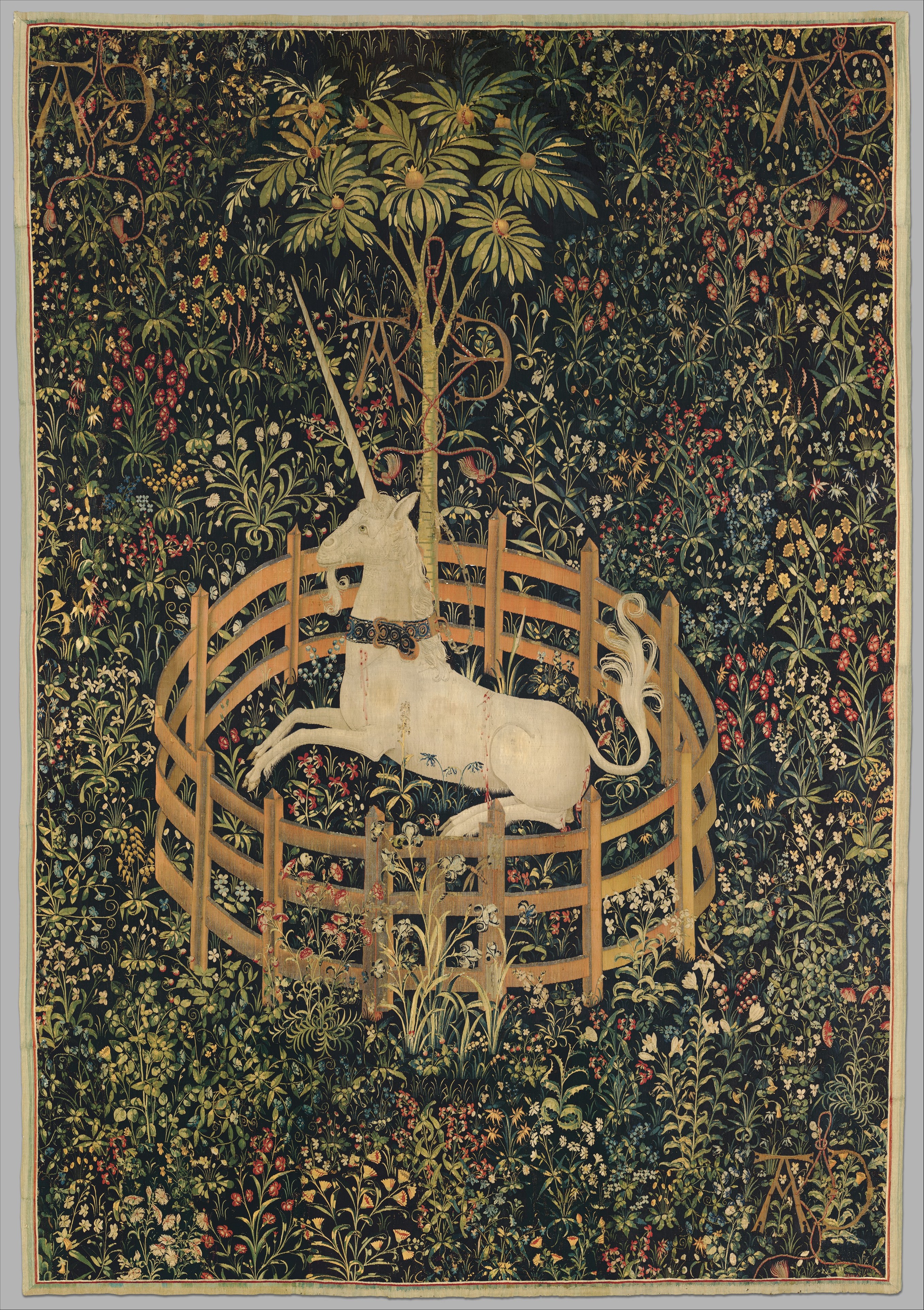
So, it should not surprise us that in the famous Unicorn Tapestry, the unicorn is captured within a circular fence, reminding us of a wedding ring–God binding Himself to humanity.

Lions make their way into this tapestry as well, though in a different way than ancient Persia:

So, some argue that the maybe the medievals never really thought the unicorn was a real beast, but simply a helpful story to convey spiritual truth. Or, if they did believe in a real unicorn, they did so only as a mistake, a pleasing and helpful tale incarnated too far in their fertile imaginations.

My one beef with Shepherd’s marvelous book is that he refuses to pick a side in this debate, but I will do so.

I am able to accept that the theory of the unicorn as rhinoceros has merit, but I am not convinced. It does have one horn which many regarded as salutary. But the horn is not “exalted,” and the rhino simply lacks the grace, dignity, and metaphorical heft history has placed upon it.

The oryx theory very nearly convinces me. The speed, elusivity, and necessary “dignity” of the beast are present. Imagine a genetic anomaly with an Arabian oryx with one horn and it nearly solves the problem stem to stern. But oryx’s have two horns, and as we have seen, the singular horn stands as a crucial fact in the case. True, in a pure profile one would only see one horn of the oryx. But again, oryx’s do move, and people can count to two.

In fact, Shepherd mentions many citings of the unicorn throughout the centuries. Yes, hypothetically all could be mistaken, exaggerating, or lying. Maybe some saw the Arabian oryx. And yes, it seems strange that in the era of iphones, that none would have a picture if it existed. Possibly it did exist and went extinct some centuries ago.

What I can’t abide are those that say that because the medievals allegorized at length with the unicorn, it shows that they are easily fooled or cannot tell the difference between fact and fiction. It also minimizes the importance of the patterns laid down throughout all the ages–as if isolated”facts” that have no meaning had greater importance than all of our stories. Undeniably certain myths existed around the unicorn, but myth is not a symbol for “falsehood.”

Which brings us to why belief in the unicorn has sharply declined over the last few centuries, and especially in our day. Belief in dragons declined rather markedly after the Middle Ages, if they were ever literally believed in at all. Clearly many ancient and medieval people believed literally in unicorns. Unlike other so-called fanciful beasts, unicorn belief persisted after the medieval era, into the Renaissance and beyond. Even in the 17th century some still believed in the unicorn, as did some British explorers into the 19th century–a Major Latter wrote in 1820 that he had definitely seen a unicorn in Africa. None of this has happened with dragons.

I think the reason for the decline, regardless of whether the unicorn ever existed or not, is that we have lost the stories, we have lost the reasons for anything being anything in the first place. True, if the unicorn had not existed, the medieval people might have made him up–it fits that well into their symbolic world, just as it did for other cultures. I suppose this could be slight critique against them if one really felt the need for it. But we, on the other hand, have no need for anything to exist for any particular reason, including ourselves. Many of us are, as Walker Percy brilliantly deduced some 40 years ago, Lost in the Cosmos.

I think a discussion on cable news over whether or not the unicorn existed would reveal a lot about us, such as the role of tradition, science, and the sexes. I say, we should get at all our major worldview questions not through Twitter, CNN, Fox, or the National Review, but through pleasant cans of corn like the one Odell Shepherd has given us. These moments that stop time are likely the most important of all.

Dave

11th/12th Grade: Democracies and their Allies

This week we continued our look at the Peloponnesian War and especially at Athens’ crucial decision regarding their ally Platea.

Platea had been a long time ally of Athens, and a strategically important one because of its geographical location near Thebes, a Spartan ally.  Sentiment and history also bound Athens and Platea, as these two city-states were the only ones to show up at the Battle of Marathon.  Thus, they forged their alliance not just out of mutual need but out of a shared history.

As part of their strategy the Athenians purposely decided to use their infantry sparingly, and rely on their navy to win the war.  Unfortunately almost immediately Thebes took the opportunity to attack Platea and add to their territory.  Platea had success in their initial resistance but knew that ultimately they could not outlast Thebes and would lose.  They asked for Athenian help.

Usually of course, allies come each others’ aid.  But in this case, Athens wasn’t so sure. To get to Platea would mean fundamentally altering their strategy for the entire war. Using Athenian infantry meant exposing their own city to attack by the more deadly Spartan infantry.  The chances of the Plateans maintaining control after the Athenians inevitably left were slim.  How should they respond?

The dilemma the Athenians faced is akin to what we faced regarding West Berlin in the Cold War.  Undoubtedly it was a great coup to have part of a significant city be “on our side” right in the heart of the Iron Curtain.  West Berlin stood as a constant embarrassment to the puppet regime in East Germany.  President Kennedy made this famous speech regarding the city.

But surely much of our talk regarding West Berlin was bravado.  The city remained immensely vulnerable, and we had no way of guaranteeing its security.  If they were attacked, the best we could do would be to retaliate somewhere else.  Would defense of this city truly be worth a world war?  If push came to shove, should the U.S. let its bluff get called, or would we go “all in” on West Berlin?

Though the issue doesn’t have the relevance it once did, the problem of Taiwan and China also has resonance with the Athenian dilemma.  In the aftermath of communist takeover of China, the nationalists fled to Taiwan.  Taiwan had a long history of being a part of China, but the communists lacked the naval strength to take the island from the nationalist party.  We immediately recognized Taiwan as the “true China” and pledged its defense.

Early on this was almost as easily said as done.  China had no real navy or air force.  Recently of course, this has changed.  Their navy has greatly improved, and they have the world’s largest air force.  Defense of Taiwan has become a much more difficult problem.  Not only are they so far away, not only would defending Taiwan require large amounts of our naval resources, war with China would cost a great deal more now than even 25 years ago.  When push came to shove, would we truly risk so much for Taiwan’s sake?

For the most part the students agreed that Athens really shouldn’t help Platea, and neither would they really have started World War III over West Berlin.  This prompted the question, “Are democracies more likely, less likely, or just as likely to keep these kinds of alliances as other forms of government (such as monarchies or oligarchies).

If we believe that different forms of government have their own personalities, their own strengths and weaknesses, then we might expect them to act differently in different circumstances.  Some  might point out that aristocratic governments might indeed be more willing, for aristocracies have a great deal in common across national lines.  A duke in country ‘X’ has more in common with a duke in country ‘y’ than he does with a factory worker in his own country.  Thus, alliances between aristocratic countries will be more personal, and less politically abstract.

Some suggested that since monarchies and aristocracies rely much more on tradition than democracies, the past assumes much more importance for them — thus past alliances hold more weight.  Often aristocracies put a strong emphasis on a shared honor code, and this too might give them more internal incentive to keep past agreements.

De Tocqueville suggested the democracies would be inherently more practical than aristocracies.  In a famous passage he wrote,

Nothing is more necessary to the culture of the higher sciences, or the more elevated departments of science, than meditation; and nothing is less suited to meditation than the structure of democratic society. We do not find there, as amongst an aristocratic people, once class which keeps in repose because it is well off; and another, which does not venture to stir because it despairs of improving its condition. . . .  Men who live in democratic societies not only seldom indulge in meditation, but they naturally entertain very little esteem for it.

Thus, he concludes that aristocracies can be driven much more by ideas than democratic countries, who will usually use “practicality” as a guide for their decisions.

Whether or not De Tocqueville is correct, the issue of alliances and when to uphold them will always be relevant.  Athens preserved its infantry by refusing to come to Platea’s aid (to be fair to Athens, much of their population was stricken with a deadly plague) but Platea paid the price.  They succumbed to a joint Theban/Spartan attack.  The Thebans executed all their men, and sold their women and children into slavery.  Platea simply ceased to exist.

Next week we will see how the war expanded and changed its character as time went on.

Blessings,

Dave

9th/10th Grade: Ramandu and the Scientific Revolution

Greetings to all,

We spent the week looking at three key figures of the Scientific Revolution.  An explosion of scientific awareness and knowledge occurred from the beginning of the 17th to the middle of the 18th centuries.  Some of the great minds in history like Descartes, Galileo, and Newton made extraordinary discoveries and changed the way we viewed the world.  All three of these men may have been devout believers but their ideas seemed to push people away from Christianity.  Why was this?

In the aftermath of the devastating period of religious wars that ended after the Thirty Years War in 1648, people began to search for a new way of understanding the world.  During the Middle Ages things were understood first as a whole, then broken into its component parts.  Now knowledge would begin with the particulars.  One gained understanding of a thing through observation and induction.

This new way of understanding is perhaps best encapsulated by a conversation in C.S. Lewis’ ‘The Dawn Treader.’  In this volume of “The Chronicles of Narnia,” the character Eustace meets a retired star named Ramandu (in Narnia stars are personal beings), and tells him that “in our world a star is  a huge ball of flaming gas.”  “That is not what a star is,” replied  Ramandu, “but only what it is made of.”  Eustace represents this new way of understanding as a result of the Scientific Revolution, the star the old.  Eustace has a reductionistic view of reality, one influenced by our modern scientific outlook.  The star sees things more in terms of their teleological purpose — who we are should be defined not by our biology, our circumstances, or even our choices — all measurable, tangible things.  Rather, our identity should come from we were made for, our design, our “telos.”

Perhaps one can see the impact this might have on Christianity, which would ultimately be robbed of mystery and imagination.  Without mystery and imagination, orthodox belief about the incarnation, the trinity, and the atonement, among others, cannot be sustained.  The full impact of this way of thinking for society would not be felt until the 20th century (at least in my opinion), but we will see the beginnings of its effects in the Enlightenment and French Revolution, and more debatably, perhaps also in the founding of America.

We began by looking at Francis Bacon, the “Father of the Scientific Method.”  He believed that science had long laid imprisoned by dogma.  Medieval Science had largely proceeded along the following lines.

1. Deduction over Induction

Deduction works like this:

All Men are Mortal

Socrates was a Man

Therefore, Socrates was mortal.

We have a certain conclusion based upon a universal premise.  But of course, the premise must be assumed, it can’t be proven.  In other words, you have to work from assumptions, from ‘faith.’

2. The Dominance of the Past

Aristotle, Ptolemy, and others held great sway over Medieval science.  Part of this fact was rooted in humility.  If you and Einstein did the same problem and arrived at different results, would you trust Einstein or yourself?  Part of this attitude had its roots in the loss of so much scientific heritage after the fall of Rome, and the fact that the Romans were not particularly scientific to begin with.  This led to an assumption that past thinkers were smarter than you.

In general, Medieval society was not geared towards innovation, both in economics, industry, and science.  That is not to say that no innovation existed in the Medieval world.  It did exist, especially in architecture.  But,  it was not their priority.

Bacon sought to overturn the whole basis of science by focusing not on unproved assumptions, but measurement, observation, and experimentation.  He favored Induction.  If we return to our previous syllogism we see it would run this way.

Socrates was a man

Socrates was mortal

Therefore, ???

What can you say in the final analysis?  You cannot say that all men are mortal.  You can only say that Socrates is mortal, or perhaps that ‘Some men (meaning at least 1 man) are mortal.  Nothing needs to be ‘taken on faith,’ but on the other hand, no ultimate truth can be discovered.  Modern science would be much more effective at advancing our specific knowledge of the finite world, but would not be able to communicate any grand meaning.

Marshal McLuhan wrote in 1964 that, “The medium is the message.”  This idea has many facets, but one of them is that the form of communication will have a decisive influence over what exactly we communicate.  Bacon did much for Science in freeing from over-reliance on accepted theory. But, if Science has as its “modus operandi” observation and experimentation, then the ability to do something becomes the reason for doing it.  Hence, science  can gallop far ahead of a society’s moral compass, i.e. abortion, nuclear weapons, cloning, and so on.

We see this specifically in the philosophy of Descartes.  Descartes fought in the 30 Years War and must have thought that the world he knew, all the old certainties, were crashing down about him.  He sought a new path to certainty.  Ultimately he wanted a fresh basis for acting in the world which certainly included God and the Church.  What went wrong?  With his famous phrase, “Cognito ergo sum” (I think, therefore I am) Descartes builds his system on

  • Doubt.  He found that he could doubt everything — except the fact that he was doubting.  This doubting proved that he must be thinking, and if he was thinking he must exist.
  • Himself.  It is the individual thinking man on which Descartes builds his universal system.  But we are finite, and not universal.  Thus, any system built upon something finite would be bound to fail.  In a famous Socratic dialogue, the philosopher Protagoras proclaimed that ‘Man is the measure of all things.’  “Which man?” was the essence of Socrates’s famous reply.

Again, and again, with Thomas Hobbes, Galileo, and perhaps even Newton we will see this phenomena.  Galilelo, for example, said,

“In every hypothesis of reason error may lurk unnoticed, but a discovery of sense cannot be at odds with the truth.”

Is this indeed true?  Are our senses infallible?  Is what we can measure the highest standard of truth?

A great deal of good came from the Scientific Revolution, and many of these pioneering scientists professed a Christian faith.   What I want the students to recognize for how, however, is the reductionistic view of reality shared by most of these Scientific pioneers.  Descartes, for example, reduced everything to doubt, while Hobbes reduced everything to motion.  The de-mystifying of the world around us would not serve Christianity in the long run.  Below are Descartes’ own drawings.  Who would not admire their elegance and grace?  I do feel, however, that they belie something of Descartes’ materialism.

It is not so much the conclusions they reached, but how they reached them, that should have been of great concern to the Church.  Unfortunately the Church’s hold on the populace had diminished, mostly thanks to their own actions, wars, and brutalities.  We see this spirit of reaction against the concept of ‘faith’ in general throughout these eminent men.  Many, like Bacon, Descartes, and Galileo, seemed to be honest Christian men who thought they did Christianity a favor.  No doubt in some respects they did.  But some of  their assumptions were just as unproven as Aristotle’s.

Next week we will continue with a few other thinkers of the Scientific Revolution as we work towards the mid-term exam.

If you are curious, I include below some primary source text from the period indicating the shift that took place.

The Great Divide: Primary Sources on the Scientific Revolution and Religion

The fierceness of violent inspirations is in good measure departed: the remains of it will soon be chased out of the World by the remembrance of the the terrible footsteps it has everywhere left behind it.  And yet, though the Church of Rome still preserves its pomp, yet its real authority is also decaying.   This is the present state of Christendom.  It is now impossible to spread the same cloud over the world again: the universal disposition of this age is bent on rational religion.

Let it be a true observation that many modern naturalists have been negligent in the worship of God; yet perhaps they have been driven on this profaneness by the late excesses of enthusiasm.  The infinite pretences to . . . Divine inspiration that have abounded in this age have carried several men of wit so far as to reject the whole matter.   From hence it derives that [for religion to recover its place] it must not endeavor to cast a veil of darkness, but chiefly to allay spiritual madness.

Sprat, The History of the Royal Society for Improving Natural Knowledge, 1667

Man’s lot is so unfortunately placed that those lights that deliver him from one evil precipitate him into another.  Cast out ignorance and barbarism, and you will overthrow superstition.  But in the act of illuminating men’s mind’s regarding these [mental disorders], you will inspire them for a passion to examine everything, and they will apply the fine tooth comb, and they will go into such subtleties that they will find nothing to content their wretched Reason.

Bayle, The Dictionary, 1696

It is worthy to be observed and lamented that the most violent of these defenders of truth, the “opposers of errors,”  . . .do hardly ever let loose this their zeal for God, with which they are so inflamed, unless they have the civil magistrate on their side.  As soon as court favor has given them the better end of the staff, they begin to feel themselves the stronger, then presently peace and charity are laid aside.

One finds that, as soon as Christians were in a position to persecute, they leveled the same reproach against religious error that Paganism leveled at Christianity.  Unhappy advocates of intolerance!  Your malady must indeed be a bizarre one, considering that it is proof against being cured by the application of lex talionis.

John Locke, A Letter Concerning Toleration, 1689

When [the spirit of religious division] is rife, you need have no fear that the multiplicity of sects will create many skeptics.

Bayle, Letters, ca. 1690

The doctrine of right and wrong is perpetually disputed, whereas the doctrine of lines and figures is not so, because men care not so what be the truth as pertains to their lust or ambition.

Thomas Hobbes, Leviathan, 1651

Mechanics is the paradise of the mathematical sciences, because with mechanics, we reach the fruit that mathematics can be made to bear.

Mechanical science is most noble above all sciences, because this one is the means by which all living bodies that have the power of movement perform all their operations.

Science is the Captain and Practice the rank and file. . . .   People who fall in love with Practice without Science are like the skipper who boards ship without rudder or compass and who consequently never knows where he is going

Leonardo da Vinci

All knowledge is to be got the same way that a language is: by industry, use, and observation.

Whatever other hurt or good comes by such holy speculative wars, yet certainly by this means the knowledge of Nature has been very much retarded. . . .  The wit of men has been profusely poured out on religion, which needed not its help, and which was thereby made tempestuous.  Experimental Philosophy [i.e. Science] will prevent men spending the strength of their thoughts about disputes by turning them into works.

Sprat, The History of the Royal Society of London, 1667

It cannot be denied that it is rare to find any great religious devotion in people who have tasted of the study of mathematics, or have made any progress in the province of Science.

Bayle, The Dictionary, 1696

Only let Mankind regain their rights over Nature, assigned to them by the gift of God, and obtain that power, whose exercise will be governed by right reason and true religion.

F. Bacon, Novum Organum (emphasis mine), 1620

I perceived it to be possible to arrive at a knowledge highly useful in life, . . . .to discover a practical philosophy, by means of which — knowing the force and action of fire, water, air, the stars, the heavens, . . .we might also apply them in the same way to all the uses to which they are adapted, and thus make ourselves the lords and possessors of Nature.

Rene Descartes, Discourse on Method, 1637


Have a great weekend,

Dave

“Therefore,” and “Nevertheless”

Towards the end of the Benedictine office of Lauds there exists a prayer which uses the old King James English which seems like a shock of cold water amidst the pleasant praises of God’s majesty–“and blessed are the paps which gave suck to Christ the Lord.” Such language could put off different people for different reasons, but mostly I think it boils down to a “disturbing” physicality and particularity. High-flown theological language suits us better. A Christian must confess that the second Person of the Trinity became a male human being in all fulness. The Benedicitine office, as other prayers of the Church, puts the focus on “higher” things of majesty and praise, but rightly will not conclude without bringing us back to earth and ourselves, reminding us of this stark truth. Clearly, Christ did nurse at the breasts of the Virgin Mary, and we must decide whether we celebrate this or feel embarrassed and horrified by it.

Many react with such embarrassment to time. Temporality flows inexorably, which makes those moments of glory, grandeur, and insight we experience at once so powerful and frustrating. We long for their return, but they will not come even for the asking. Our society in general seems embarrassed and frustrated by Time (manifested in some respects with bands like Kiss, Judas Priest, and even the Rolling Stones apparently still touring). Some may accept Time in the sense of merely resigning oneself to its power, but while this may be a superior attitude over ignoring or “rebelling” against Time, it too seems to see the physicality of time not as a blessing but as part of what we must endure in our going hence.

William Lynch’s Christ and Apollo: Dimensions of the Literary Imagination examines the question of physicality and particularity in theology and literature. I lack the depth and breadth of reading needed to truly benefit from this book, but the applications of his insights go beyond the literary and into life and redemption itself. Lynch keeps focus on his crucial question: Does God accomplish His purposes through the finite, or in spite of it? Authors, “regular people,” and civilizations face the temptation to either ignore or despise creation, thereby failing to see through it and discern the patterns of grace. Lynch diagrams this basic idea like so,

with the diagram on the left as the proper path. Heraclitus may have had the same intuition, stating that, “the way up and the way down are one in the same.” Tension has always existed in Christian thought between 1) Moving down “the mountain” as moving away from God (a pattern present from the Garden of Eden, Mt. Sinai, Mt. Tabor, etc.), and seeing that movement as a kind of death, and 2) Recognition that we have no other option other than to take this passage down into death to return to God whole, i.e., “He who wishes to save his life must lose it,” and “unless a seed falleth into the earth and die, it bears no fruit.”* Escape from this tension provides only an illusion of freedom, and in fact produces a kind of slavery to a fear of things, and even of ourselves. Our glimpse into the infinite comes only through the finite.** Dante’s grand cosmological vision would not have been complete without tethering it to 14th century Florence. In The Brothers Karamazov, Dostoevsky knows that Aloysha’s great mystical visions can only come through his engagement with his wretchedly dysfunctional family.

But many modern authors cannot embrace this paradoxical pattern. Lynch examines a few different metaphysical categories to demonstrate the paradox. For Proust, time is man’s greatest enemy. The cubist painter can not accept the finite image–instead they must represent all of the possible angles of vision of the minding a futile attempt to see only the abstract. Lynch writes,

Perhaps the most ambitious, most brilliant, and most sophisticated vendetta launched against time was that of Descartes, who first put forward the notion of a pure intelligence within us not subject to time. . . . when that ambition takes the form of a desire to wipe out the succession and the partial quantities of time, and to live in an isolated area of the personality where the temporal has no meaning or power, then a grave folly has been committed. . . . The “man in the street” knows what the intellectual does not: that true reality is contained within the dramatic temporal life of the body. The peasant knows he will be healed not only by doctors but also by time. [He knows that time] is as much a part of him as his own skin, out of which he cannot leap.

Christ and Apollo, p. 50, 53

Christ exemplifies this true approach to time as a positive good: He refuses to cling to childhood (Lk 2:41-52), He refuses the easy path to glory (Mt. 4), and allows His death to come to Him “in the fullness of time” (Gal. 4:4).

Different literary genres can make the same mistake of rejecting creation. In tragedy, Lynch cites the modern tendency that “exaltation must come from exaltation, and that infinites must come out of infinites.” This path leads to two consequences:

  1. The idea that the achievement of great tragedy has its roots in the mystical conquest of the “human spirit” against pain–the tragic figure as exalted conqueror, which
  2. In fact makes the writing of tragedy more difficult, not easier, because it seems that tragedy, like death, doesn’t really exist.

Comedies too can make the same error. Comedy (in the modern sense of “what makes us laugh”) often deals with the breakdown of order and expectations–all well and good. But if we ask ourselves why A Midsummer Night’s Dream still gets staged four centuries after its debut, we need look no further than that “the play, [even] in its wildest fantasy [in Act 5], is only dealing with Snug the joiner and Bottom the weaver.” T.S. Eliot commented that, “human kind cannot bear very much reality.” “I am not so sure of that,” Lynch writes, “The bigger truth is that they cannot stand very much unreality.”

Perhaps part of the problem lies in that great literary minds can see their idea so clearly that the idea burns away all around it if they fail to take care. Here then, lies Lynch’s “Univocal Man:”

He is, emotionally, full of extraordinary energies–in fact, a kind of energy seems to mark the whole of his character. He has a genius for a unilateral passion, and is, and therefore always has been–a passionate center of good and bad in civilization. . . . Superficially, then, he resembles the religious genius. . . . It is only by exercising great caution that we will avoid this profound mistake and will refrain from giving this character the veneration that is not his due. . . . The univocal man has no respect for reality; he is contemptuous of it, or distorts it, or flattens it–or he refuses to take responsibility in the face of it. . . . The univocal man is not free. He is rigid, unbending, fixed. One can understand the fixity of the idea of logic and essences, but his fixed ideas are born of a fixity of all the forces of his personality and a refusal to remain open to existence. . . . To put the matter simply, these would reject all the unities and relations projected by any sentence, for example, “The horse is white,” for a horse is a horse, and white is white, and that is the end of the discussion.

pp. 141, 144, 147

We might say that the Univocal man has too much “purity” in him. He cannot or will not mix his idea with the stuff of reality. That this should happen to a literary type is no surprise. In general they write because they are gripped by an idea or image.^ The one who mixes things up too much would likely never have the clarity or organization to get anything down on paper to begin with. Lynch shows us Eugene O’Neil, who wants us to be sad, and so gives us Sadness in Mourning Becomes Electra, with her mansion as her prison. Or, even more absurdly, he gives us Laughter in Lazarus Laughed, with this ridiculous passage where Lazarus speaks to Caligula,

You are proud of being evil! What if there is no evil? Believe in the Healthy God called Man within you! . . . Believe! What if you are a man and man is despicable? Men are also unimportant! Men pass! Like rain into the sea! The sea remains! Man remains! . . . For Man death is not! Man, Son of God’s laughter, is! . . . Believe in the laughing God within you!

Alas, too many exclamation points. O’Neill wants rapture but he attempts to achieve it by rebounding off of creation and denying it altogether. Only a fool would say that “death is not.”

With a denial of creation will come an absence of transcendence, purchased at the price of avoiding all mess. George Bernard Shaw claimed a sort of spiritualism but could not stand religion actually practiced, writing,

In Italy, for instance, churches are used in such a way that priceless pictures become smeared with filthy tallow-soot, and have to be rescued by the temporal power and placed in national galleries. But worse than this are the innumerable daily services which disturb the truly religious visitor. If these were decently and intelligently conducted by genuine mystics to whom the mass were no mere rite or miracle, but genuine communion, the celebrants might reasonably claim a place in the church as their share of the common right to its use. But the average Italian priest, personally unclean and with a chronic catarrh in his nose from living in frowsy, ill-ventilated rooms, punctuating his gabbled Latin only by expectorate hawking . . . this unseemly wretch should be seized and put out . . . until he learns to behave himself.

Whatever communion Shaw desires, it would have to include rite, miracle, and perhaps even the dirty priest, for it to happen at all. But for Shaw, such things are too messy and not “spiritual” enough. We should not suppose that he would enter in absent the dirty priest, either–something physical would always bar his way. It is much easier to comment online, or even to read books.

We in our day have the bigger and smaller problem of not even being able to enter into politics. The problem is smaller in that religion is more important than politics, but bigger in that we cannot hope to solve big questions if we cannot solve smaller ones. Too many on the right and left want nothing to do with mixing their ideas in the mess of politics. Some want a Caesar from above to wave a magic wand, some want the “innocent” people to rise up from below to abolish the Bill of Rights. Neither will achieve anything like an ordered communion, for neither wants to find the path to grace through creation. They do have their dreams. These dreams will have to content them, for they can know nothing of sorrow or joy.

Dave

*Perhaps this might explain in part Christ’s sometime reluctance to work miracles. Miracles, could, hypothetically, interrupt the U-shaped pattern and hinder us on our journey back to God.

**If we learn to see this pattern and interpret the Scriptures more analogically and less in a directly moral fashion, many things make themselves more clear. For example, we should honor the elderly not simply because of their wisdom–for some have none of it–but because they are closer to death, and thus also closer to glory. So too, this explains why the Church has always warned less against the “earthly,” “physical” sins of gluttony, too many women, etc., than the “spiritual” sins of pride. Many have gone down the path of fleshly indulgence and found the place where it turns upwards to God. But no path to God exists through pride. Of course, it is best still not to dabble in either.

**The literary, educated types–one always has to watch out for them . . .

Time vs. Space

This post was originally written in 2019 . . . .

*******************************

In an essay he wrote a few years ago called “The Four America’s” conservative columnist David Brooks pointed to the need for a new unifying narrative for America. What he called the “Exodus” paradigm held from our founding as a nation until recently. We told ourselves that America was essentially replaying the story of the Israelites, who fled religious oppression in Egypt, and came to the promised land to be a light unto the nations. Americans too fled oppression in the old world and came to a new one, establishing a special and unique nation that could broadcast freedom to the rest of the world. We existed to inspire others to follow in our footsteps.

Obviously this national myth no longer holds the imagination of our culture. In some ways we can lament the loss of this sense of mission and purpose, but I also think that the story never quite fit to begin with. Granted, every myth compresses and synthesizes, but our treatment of Native Americans and slavery stand as massive exceptions that the myth simply cannot hold within it. Our relative ignorance of these “anomalies” in our story* for centuries then naturally led people to focus almost exclusively upon the “exception” to the story, and so the pendulum swung entirely in the other direction. I am no friend of the modern progressive left, but reluctantly, I understand why they exist. We will have to endure them at least a little longer, it seems, perhaps as penance for our sins.

In addition, the Exodus story works wonderfully for a pioneer people, but less well for a major superpower. And, finally, even a cursory look suggests the possibility that the Enlightenment had just as much, if not more, influence on our founding than Christianity.

Brooks then suggests four other off-shoots from this myth, though admits that neither of them work even as well as the Exodus narrative.

  • The Libertarian myth sees us as “a land of free individuals responsible for our own fate.” It celebrates choice and the free market. It borrows from the freedom element of the Exodus story, but economic choice isn’t as powerful as religious choice. And–simply focusing on personal choice and responsibility cannot sufficiently unify us.
  • The “Globalized America” narrative celebrates a sliver of the “America as beacon for the world” from the Exodus story, as well as the dismantling of old hierarchies celebrated by our founders. But this story fails to provide an America distinctive enough to give us an identity.
  • “Multicultural America” borrows from the “Exodus” story with its narrative of oppression and the idea of a melting pot nation. But in always focusing on the exceptions and purely personal identity, no common core can be built to rally around.
  • The “America First” story gives us a common core and reinforces American distinctives, unlike the above three options. It has a brashness that can be bracing, especially compared to the other options. But it leaves out the inclusive aspect of the American story. It can tend to produce a “patriotism for the sake of patriotism” whirlpool. It gives America no transcendent reason to exist beyond its mere existence.

I agree with Brooks that neither of these four approaches are even as good as our discarded “Exodus” story. I agree that we need another narrative, but am not sure how we’re going to get one in our polarized culture. But as to what polarizes us a country–we don’t agree on this either. This is not only America’s problem–most everywhere else at least in the developed world seems to have the “first world problem” of no unifying narrative.** But we do not look deep enough for the cause of this rift, and blame different sides for the wrong reasons.

Though democracies have done much to alter traditions, they cannot change the basic ways in which the world works and the ways we perceive the world, at least on a subconscious level. Ancient creation stories agree in many ways, perhaps most fundamentally in that they conceived of creation as a harmony of contrasting forces. “Salvation” in a Christian sense is about the marriage of Heaven and Earth, and of course, the Incarnation is Christ the God-Man uniting Heaven and Earth in one Person. I do not intend this post to be an explicit argument for the truth of the Christian story, but I do believe it contains the most coherent and best “version” of all the ancient cosmologies. Biblical cosmology overlaps with many other ancient cosmologies, and this only serves as a point in its favor. Acknowledging these huge questions, from here on I will proceed by discussing ancient cosmologies in general.

The modern age measures time in what I would consider to be rather an insane way:

The second (abbreviation, s or sec) is the Standard International ( SI ) unit of time. One second is the time that elapses during 9,192,631,770 (9.192631770 x 10 9 ) cycles of the radiation produced by the transition between two levels of the cesium 133 atom . . .

This has advantages, as it allows to universalize and quantify precisely, but it happens completely outside of our experience, and thus, time can have little real meaning for us. The way we parse out units of time remains essentially arbitrary. For the ancient world, time had a manifest reality because it brought observable change. Day turns to night, and then night turns to day. Seasons change, and death and new life come with these changes. Thus the ancients conceived time as something moving, fluid, in flux–like water, but also solid and experientially verifiable.

Space gives us stability. Time allows us to become, but we need to “be” something to “become” anything (apologies to Brad Goodman). Time needs space to act upon. The relationship between time and space can only work well when we have a strong concept of the unity of heaven and earth. Possibly, we could have an acceptable range of this relationship. Some parents are more strict and some more permissive, but as long as one avoids the red line on either side, families can be stable and healthy.

For example, ancient Egypt leaned heavily on the side of space. They lived within a narrow strip of land, with the “chaos” of desert and death right next to them. Even their greatest architectural achievements mainly had the psychological effect of weights pressing on the ground. The Nile flooding formed in integral part of Egyptian life, but they put all their energy into controlling the Nile flood. Theirs was a “masculine” civilization all in all, and some historians criticize them for being too rigid and not sufficiently adaptable to change.

Babylon favored the fluidity of time (too much so, I would say, but we’ll let it pass for now–they had a long and storied history, after all). The Euphrates bisected their city, and they sought not to control the river–they had no great need to do so anyway–but to utilize it for their benefit. One of their main deities, Ishtar, was goddess of love, war, marriage, and prostitution, and sometimes was pictured with a beard. Aristocratic males were known to cross-dress and temple prostitution was the norm. Babylon was the quintessential cosmopolitan city–home of every philosophy and religious idea in existence in their known world. Theirs was a “feminine” civilization, in the sense that they had little devotion to the concept of a stable, unified form.

We can debate the merits of both civilizations, but should acknowledge that although they had different answers as to the balance between time and space, both at least were conscious of the realities of both. Our problem is twofold: 1) We lack even basic awareness of these concepts on a metaphysical level, and 2) We have abandoned the “marriage” of Heaven and Earth (a mirror also for “Time, and “Space” respectively) in Christ, and so have lost any hope of holding them in tension. With both freed from each other, Time makes war on Space, and vice-versa.^

Some argue that Time reigns supreme. In favor of the victory of Time, we see the rapid expansion of “time saving” technologies. Cars and planes compress space, but nothing compresses space quite like the internet. We erode boundaries of privacy, and we live in a “hot-take” world of moving information. Very few media outlets can afford patient reflection. Time’s triumph–thinking in terms of the “fluid” aspect of time–seems most evident in our culture’s support for people changing genders.

But, not so fast . . . “Space” does not take this lying down. If Democrats propose open borders, Trump will build a wall. In countries such as Poland and Hungary we see a resurgence of a strong nationalistic mindset. As we do more to celebrate exceptions and fluidity in the west, at the same time we have more absolute boundaries enforced by the culture as to what we can and cannot say. College students demand rigid “safe spaces” on the one hand while simultaneously affirming the legitimacy of every possible identity–a perfect incarnation of the intense stalemate between time and space. And–every spot on earth is mapped out, which means that space has complete definition. No country would possibly consider negotiating space with another country to resolve a dispute. Lest our modern avoidance of this seem perfectly natural, it stands in sharp contrast to politics before perhaps 1789, where king’s would routinely trade provinces here and there as diplomatic chips.

So today we have both “Time” and “Space” making a strong play for dominance, and just like the whole family suffers when dad and mom fight, so too we suffer in the midst of this contest. But children have little hope of solving their parent’s problems. We have more control of ours. We need the King to return to end the vicious squabbling of princes. When the dust settles, then we may see clearly enough to tell ourselves the story we all need to hear.

Dave

*I suppose there are those that would not call slavery and our treatment of Native Americans as anomalies to the story. Israel did have slaves–and some might draw a parallel to our treatment of Native Americans with what Israel did at Jericho. I disagree with this interpretation, but I want to acknowledge its existence.

**I know some do not want a unifying narrative because they fear the unity that this provides, and the concentration of power it gives. We saw the destructive potential of this in the early 20th century. But you can shove this basic human need under the carpet for only so long, and the longer we wait, the more chances for a destructive “pendulum swing” identity to emerge.

^Those familiar with Jonathan Pageau’s Symbolic World podcast will note my debt in what follows to episode 62, along with Matthew Pageau’s The Language of Creation.

Comparing civilizations on the Time/Space axis can be fun and illuminating. Clearly America, along with Babylon, heavily leans in the direction of “Time.” We have pioneered many so-called “time saving” technologies. The great Tyler Cowen proclaimed that our decline in physical mobility is a worrisome problem. We love our cars, and some argue that we lost our mojo as a civilization the moment the frontier closed. Bob Dylan mythologized the rolling stone, and who can possibly forget Journey telling us that the wheel in the sky keeps on turning, and that he doesn’t know where he’ll be tomorrow?

We have countless writers and other aspects of our culture that celebrate movement, the open road, etc. I can think only of Wendell Berry as perhaps our only cultural contributor of note who writes in celebration of Space.

9th/10th Grade: Richelieu and the New World Order

Greetings to all,

This week we looked at the 30 Years War and previewed the coming change towards the ‘Scientific Revolution.’

The 30 Years War was a devastating conflict in terms of loss of life.  But it was also devastating in a psychological, moral sense.  For decades Catholics and Protestants killed each other, burned towns, committed atrocities, all in the name of the Christian faith.  The map below shows the casualties in various parts of Germany alone.

Part of the reason the war became so destructive is that various nations, like Sweden, Spain, and France found reasons to get involved at various times during the war and extended it artificially. But part of the reason that religious conflicts  persist in general is that:

  • It is difficult to compromise or negotiate with religious belief
  • Victory in a religious war is hard to define

One can only come to terms in a religious war when either

  • Both sides are completely exhausted, or
  • You change what the war is about, making it something that you can compromise on, such as possession of territory.

This is in fact what happened, and this second reason is a clue to the coming transformation in the worldview of Europe.  Since the start of the Reformation, Catholics and Protestants had both lead with religion in the political and philosophical realm.  Now, their focus shifted towards the more tangible and measurable. We will explore this in more depth in coming weeks.

Essentially, we see a shift from theory, which would include intellectual ideas as well as the unproven realm of ‘faith,’ to experience, observation, and the natural world.  It is the Dutch school of the 17th century that  exemplified this change.  One can see it in the work of Van Hals:

Here are practical, reasonable men.  They are a long way from the emotionally and spiritually moved men from, say, Carravaggio’s work just a few decades earlier.  This passion for representing reality apart from meaning reached it’s peak with this work of Paulus Potter:

.Probably the artist who married the best of the observational school with meaning had to be Rembrandt.   He depicted people “realistically,” but he managed to depict them as morally imaginative as well.  We think of him as a painter, but he was best known in his day for his etchings.  Here is one example:

If the Dutch exemplified the change in art, the French did so in the political realm.  Cardinal Richelieu is known for many things, but this quote exemplifies his philosophy:

‘People are immortal, and thus subject to the law of God.  States are mortal [that is, ‘unnatural,’ artificial, man-made creations], and are thus subject to the law of what works.’

Richelieu believed that nations did not interact with each other in the way that individuals did.  After all, people cannot kill each other, but nations can have armies that kill each other without necessarily sinning.  People can’t lie, but nations can send spies to other places where they ‘lawfully’ engage in deception.  It might be similar to people bluffing in poker.  They are trying to deceive, but are they sinning?  Most would say not, because when we play poker we enter into a world that has its own set of rules set apart from normal life.  Frenchmen will be judged by God.  But the geographical entity we call ‘France’ will pass away, it will not be judged.  Thus, ‘France’ could play by different rules than Frenchmen.

This famous painting of him shows his famously lean, intelligent frame:

With this perspective, Richelieu astounded and infuriated his contemporaries.  As France’s chief minister, he sought to serve the entity ‘France.’  This meant that:

  • France would intervene on behalf of Protestants in the 30 Years War, despite the fact that they were a Catholic nation.  Except that Richelieu didn’t see ‘Catholic France,’ but ‘France, where most people are Catholic.’  Richelieu fought not to protect Catholics, but the entity France, which he did not want surrounded by Catholic Spain.  Spain fought in the 30 Years War in part to recover the Netherlands, territory they had lost in the early 1600’s.  This new perspective shocked many, but it would be the way of the future
  • He believed that strengthening France would have to mean strengthening the king.  This in turn meant weakening the nobles.  We will see this European turn  away from the feudal era, and toward more centralized authority.  It would be another Frenchmen, Louis XIV, that would push these ideas even further later in the 17th century.

Dave Mathwin

Bottoms Up

I wonder what the “revisionist” historians of the 1960’s might say if they knew how they contributed to the rise of “Trumpism” (they might not mind having helped birth Sanders). At that time a variety of scholars challenged academic and social norms, some good norms and some bad ones, and quite successfully overturned the established historical narratives. No longer need history tell just of kings and battles, no longer would history depend on a “top-down” narrative. Now the bottom mattered, and often mattered much more than the top, in determining the true meaning and purpose of history.

To focus only on the 1960’s however, means focusing on the bloom of the plant and missing the tilling of the soil. Perhaps one sees this process beginning two generations prior with the rise of a passion for folktales in the late 19th century. Some of the greatest historians of the early-mid 20th century like Toynbee and Christopher Dawson sought to broaden the scope of their inquiries. And–certainly not every historian before them only talked of kings and battles. Polybius found the key to Rome’s greatness in its institutions. St. Augustine’s masterful City of God incorporated a variety of approaches in his analysis of the fall of Rome. But still–one cannot question that a decisive revolution in academia 50-60 years ago succeeded in overthrowing the “normal” meaning and practice of history.

This habit of questioning the establishment has now left the ivory tower and entered into the mainstream. For example, many more now question vaccinations than used to be the case. The flat earth society has a legitimate looking website. Despite general scientific consensus many deny global warming. Most people now get their political news and perspectives from Youtube or podcasts and not mainstream networks such as ABC or CNN. Both Trump and Sanders tell their strongest followers that the system is rigged, and both seek to overthrow a variety of political norms.

If you are like me, there are things about this shift that you like, and things you don’t like. But it is hard to disentangle them at a larger sociological level. It may be a package deal, take it or leave it.

Carlo Ginzburg’s work fits squarely within this school. His Night Battles: Witchcraft and Agrarian Cults in the 16th & 17th Centuries gives a detailed look at a strange episode in European history. He uses many primary sources and uses them well. But it seems to me that he consistently assumes that everyone on the “bottom” is ill treated by those on the “top,” and this assumption I cannot buy into.

First, I praise Ginzburg for his respect for the peasants in the book. Other authors might treat the subject of supernaturalism and witchcraft with words like “superstition” or worse, dress it up in condescending, overly complex language, i.e., “cultic fetishism.” Ginzburg takes the stories the peasants tell at face value and rarely attempts to deconstruct them.

Second, I praise him for finding such an unusual story to examine, which runs something like this:

  • In the late 16th and early 17th centuries, the church in northern Italy became aware of an unusual practice involving battles taking place between witches and the bendamenti over the health of the years crops.
  • The witches came usually as disembodied spirits, and the bendamatti usually appeared in this guise as well–those they were the good guys in this contest–they fought against the witches to protect the crops.
  • They fought four times a year, always during the Ember day fasts in the church calendar, but the clashes did not seem to be overtly violent, and often ended with both groups together drinking wine–though the witches would always end the evening by peeing in the wine casks.
  • The people questioned invariably believed themselves to fight on behalf of God and for the people, and against evil and all its works.

Strange as it may sound, testimony from different people from different places,who would not have known each other, confirm this basic outline of events.

I had the feeling, however, that Ginzburg’s approach put the church on the side of an oppressing power. Certainly anything that involved the supernatural and witches would arouse the attention of the Church. Naturally, they would investigate. Ginzburg’s word choices about these conversations revel much–his even-handed and sympathetic approach to the peasants does not extend to the church. To cite just a few examples . . . (all italicized portions are my emphasis) . . .

Gasparutto had barely finished speaking about the apparition of the angel ‘made of gold’ when the inquisitor broke in with an abrupt insinuation . . . ‘

Father Felice could no longer contain himself. ‘How could you make yourself believe that these were God’s works? Men do not have the power either to render themselves invisible . . . nor are God’s works carried out in secret.’ It was an impetuous, frontal attack.

A cowherd of Latisana, Menichino, admitted to being a benandante and asserted that he went out at night in the form of smoke to fight the witches. During his trial . . . the inquisitor asked him, in the usual insinuating manner . . .

In Gasparo’s case as well, we observed the inquisitor twist the interrogation . . .

This attitude of Ginzburg, expressed in these and many more such examples, should give us pause. Surely the peasants’ no doubt sincere belief that they were indeed doing God’s work in should warrant at least a degree of skepticism and suspicion? And surely the priests cannot be blamed if they seek to fit these stories into what they already understand? Everyone does this most all the time, not just those with “power.”*

Beyond that, anyone remotely familiar with monastic literature and spiritual discipline knows that Satan often appears as an angel of light. Many well-known stories existed to confirm this, and no doubt the priests knew of them. Other details in some of the stories, such as smoke, and the lack of invoking the name of Christ, warrant much suspicion on behalf of the priests. And, unless we want to believe the worst about the inquisitor priests, we should assume that their concerns ultimately rested not with maintaining their “narrative” but with the souls of those they questioned.**

Ginzburg’s many strengths make his work interesting, but he seems to self-consciously over-compensate for centuries of history written from the standpoint of those in power, the “winners” (or at least–Ginzburg’s perception that this has been the case). His whole approach raises the larger question about whether it makes a difference if we tell of history from the bottom up, or the top down. Why did the latter approach dominate for so long, and why then have we just recently abandoned it?

Our beliefs about history should not boil down to who has power. We often assume that only the winners write history. But Thucydides, an Athenian, wrote the best account of the war that Athens lost. Polybius and Josephus wrote intelligently about Rome even though both represented those conquered by Rome. And sometimes the ‘winners’ can write with more understanding than the losers. For example, I find Livy’s take on Hannibal a bit more sympathetic and persuasive than Polybius’. The record shows that history can be about much more than the power and manipulation of the privileged elite.

So too, we need a different explanation other than power and manipulation to explain why history often gets written from the “top down” and not the “bottom up.”

Let’s take the very phrase, “Bottoms Up!” as a starter. Legend has it that it originates with the tricks played on Englishmen to get them to join the navy, involving a coin at the bottom of the glass. But most every story of the phrase involves more than moderate drinking. Whatever story we pick, the basic symbolic meaning seems clear. Heavy drinking makes things “topsy-turvy.” It can put your bottom on top in a metaphoric and literal sense. This is why it is right and proper for us to look askance at someone who starts to drink early in the day. When we awake, things are new again, we return to our center, recharged from rest. We might drink in the evening as our body begins to wear down and fray at the edges. That is, as our physical state morphs into something more “fringe-like,” we can mirror with our alcohol consumption.

Whether or not this makes absolute physical sense, it makes complete metaphorical sense. Civilizations have followed this pattern for millennia. When you drink alcohol early in the morning, you act against this pattern, this way of mirroring reality. “To everything there is a season,”–a time exists for right order and for messing with that order, but nary the two should mix.

So too in creation we see that the “seeds” of things, the encapsulating ideas, come from “above.” Seeds fall literally from above and contain the whole of the oak. They germinate what lies below. If someone has an idea it comes from the intellect, which lies on the top of your body. It flows downward into the rest of the body and gets incarnated, taking up residence in the heart, the mediator of heaven (intellect) and earth (the belly, etc.).

Sacred history shows forth this same pattern. The books of Samuel, Kings, and Chronicles show that Israel’s fortunes rested on its kings and priests–as they went, so did Israel. The sins of the fathers get passed down generations, as attested by Deuteronomy, and almost any sociological study.

To write history from the “top-down,” then, need not be a form of hero-worship, placating those in power, an exercise in sycophancy, or a form of oppression. Many of these “top down” accounts were in fact critical of those they chronicled. In its simplest form this method merely seeks to mirror reality itself. The recent trend among historians to view the world differently may indicate a general flattening of our worldview, a sub-conscious rebellion against hierarchy and Natural Law.

But while this might be true in certain cricumstances, it may go too far as a general statement.

A famous ancient Persian proverb states, that one should debate important matters twice: once while sober, once while drunk. If we take this symbolically as well as literally we see that approaching questions from unusual places and angles certainly has its place. King David himself played the fool (1 Sm. 21), there is Amos the prophet (not from the priestly tribe), John the Baptist, and so on. And we have the words of Christ that, “the last shall be first, and the first shall be last.”

So, even if one might argue that ‘top-down” historical approaches should take priority, certainly we should have histories like those of Ginzburg that take a different approach, for they too reflect something true about the nature of reality. My objection to Night Battles lies not, then, in the subject matter, but in his unspoken assumption that Earth must be at war with Heaven. We should rather look forward to their union.

Dave

*I wonder what “power” Ginzburg believes the church had. It could not really stop these events from occurring, for example.

**We should also note that, while the church certainly was a powerful organization at this time, it was also in one sense the most democratic institution. A commoner could theoretically distinguish themselves in piety, learning, etc. and rise to positions of “power” within the church. Many of the priests who questioned the bendetti may have grown up peasants themselves.

Also of note is that for many (though to be fair, not all) of the people questioned, the church imposed very moderate forms of penance, indicating that they had some hesitancy as to what they were dealing with, and sympathy for those they interviewed. The priests were hunting witches, but it does not seem like they engaged in a witch-hunt.

11th/12th Grade: The Origins of the Peloponnesian War

Greetings,

This week we started our unit on the Peloponnesian War.  This conflict took place between 431- 404 BC, and was chronicled by one of the founders of History itself, Thucydides.  Thucydides’s genius lay far beyond his dispassionate recording of events.  He concerned himself not only with battles, but also the deeper political, economic, and psychological contexts.  He was a commentator on democracy and human nature itself.  We will attempt to follow his lead, ranging back and forth between ancient and modern times.

We will also shortly begin our own Peloponnesian War game, in which the class is divided up into 5 different teams, each of whom participated in the actual Peloponnesian War.  The game is designed to give each side certain strengths and weaknesses, and different means of winning.  Generally speaking, the teams that have won in the past have focused not merely on eliminating enemy soldiers, but instead on forging a synergy between their economics, politics, and diplomacy, with their military action arising from that context.  This usually means that things start slow, but tend to pick up as weeks go by.

Most of us are used to thinking of democracy as a permanent fixture in our lives, but the Athenians lost, regained, lost, and finally regained democracy during and after the conflict.  Why did this happen?  Does war put more pressure on democracies than other forms of government?  On another note, are democracies naturally inclined toward expansion, or are those democracies that have expanded a product of historical coincidence?

Our study of this conflict should always have the idea of democracy behind it, for the war as a whole, and Athens’ role in it particularly, can teach us a lot about democracies.  Fundamentally, we should consider what makes a country “democratic.”  I offered the students the following choices:

  • In country ‘X’ the people are ruled by a king, but the laws of the realm allow for free speech, equal treatment under the law, freedoms of assembly, religion, etc.  In short, all the trappings we usually associate with democracy, except the people did not elect their leaders.
  • In country ‘Y’ the people have a representative democracy where they elect all their leaders.  But the elected government (which won 60% of the vote) uses their power to restrict the rights those that opposed them.

Which country is more democratic?  Does democracy have more to do with the process than the result?

As we look at the origins of the conflict, we will consider criteria for a ‘just’ war.  What kind of strategy should Athens have pursued, and does it teach us how democracies tend to, or should act, in war?

First, some of the background to the war.

Prior to ca. 500 B.C., Athens was not one of the major city-states of Greece.  They were not nobodies, but they could not be called a New York, LA, or Chicago.  Perhaps a Philadelphia. Their moment came during the Persian Wars, where their staunch resistance and military success propelled them into a potential leadership role.  How did they handle it?

They helped from what was known as The Delian League, a mutual defense alliance with other city-states that rimmed the Aegean against Persia.  Member states could contribute money or ships. As one might expect, nearly all chose the ‘money’ option. It was easier, for starters. But it also made sense.  Since Persia might return any time it made sense to fund the best navy and get more of the best ships out into the Aegean, and Athens had that navy.

But what if Persia did not look like it was coming back?  Can you leave the Delian League? Athens said no. They had some good arguments:

  • Persia was still a major power and could decide to come back at any time.
  • If a city-state left they could potentially make an alliance with Persia, which would threaten all of their neighbors.
  • Even if a city-state did not make an alliance with Persia, they would still get security.  Athens could not let Persia establish a beach-head anywhere in Greece.  Therefore they would get free security, which was unfair.

We can still imagine that the other city-states failed to be impressed with these arguments.  Athens, the one-time champion of the ‘little guy’ had become the block bully in the minds of many.  How should we view Athens? Who was right? Here is a map of the Greek world at the time the war began:

I think we have to appreciate Athens’ dilemma, but if we look elsewhere for clues, it appears Athens had fallen into what Toynbee called “The Idolization of the Parochial Community.’  That is, once Athens stood for something, something outside itself. Now, despite the progressive nature of Athenian democracy, drama, philosophy, and so on, Athens seemed to justify its actions based on how it related to themselves and themselves alone.  This can be seen in their siding against certain democracies when it looked like doing so might advantage them in some way. One can see the comparisons with pre-World War I Europe, with democracy at home, and imperialism and a form of subjugation abroad.  By 431 B.C. the Greeks had made their society into a fireworks stand where anything might upset the apple cart. Athens’s power, their rivalry with Sparta and Corinth, created a potential disaster. If you are interested, I include below an excerpt from Toynbee’s ‘An Historian’s Approach to Religion’ on the idea of parochial communities.  When war breaks out next week we will consider a few different issues.

  • To what extent is a country’s reputation part of its power and security?  Can threat’s to your reputation be considered a threat to your security?  Should war’s be fought if no physical danger is immediately present?  How much importance did reputation have in the Greek world?  Does that make the actions of Athenians and Spartans more or less defensible?
  • Traditionally, just war theory within the framework of Christian thought has focused on 1) The cause, 2) The goal, and 3) Proportionality of response.  One may fight defensively, but not start wars.  One can fight to defend the innocent, but not merely to extend one’s power.   If a rival invades with 1000 troops, you cannot counter with 100,000 and destroy him utterly.  Did Sparta or Athens begin the war?  Can either side lay claim to fighting a just war?
  • Corinth was a city-state covered in faded glory, anxious to reclaim it, and one that burned with indignation at Athens for wearing the mantle of ‘top dog.’  Does Corinth share any similarities with China and Russia today?  How should Athens have dealt with the overly touchy Corinth?How do the ideas of just war fit into the context of the Peloponnesian War?  How do they fit into the modern period? What constitutes an ‘attack’ upon us?  Would a cyber-attack be an act of war that would allow us to kill others? What does the possibility of weapons of mass destruction do to the concept of pre-emption in war?  Are the old guidelines relevant today, or do they need rethought?
Dave Mathwin
Toynbee, “The Idolization of the Parochial Community”
Unhappily, Polytheism begins to produce new and pernicious social effects when its domain is extended from the realm of Nature-worship to a province of the realm of Man-worship in which the object of worship is parochial collective human power. Local worships of deified parochial communities inevitably drive their respective devotees into war with one another. Whereas Demeter our common Mother Earth is the same goddess in Attica and in Laconia, the Athene Polias of Athens and the Athana Chalcioecus of Sparta, who are the respective deifications of these two parochial communities, are bound to be rival goddesses in spite of their bearing the same name. The worship of Nature tends to unite the members of different communities because it is not self-centred; it is the worship of a power in whose presence all human beings have the identical experience of being made aware of their own human weakness. On the other hand the worship of parochial communities tends to set their respective members at variance because this religion is an expression of self-centredness; because self-centredness is the source of all strife; and because the collective ego is a more dangerous object of worship than the individual ego is.
The collective ego is more dangerous because it is more powerful, more demonic, and less patently unworthy of devotion. The collective ego combines the puny individual power of each of its devotees into the collective power of Leviathan. This collective power is at the mercy of subconscious passions because it escapes the control of the Intellect and Will that put some restraint on the individual ego. And bad behaviour that would be condemned unhesitatingly by the conscience in an individual culprit is apt to be condoned when it is perpetrated by Leviathan, under the illusion that the first person is absolved from self-centredness by being transposed from the singular number into the plural. This is, however, just the opposite of the truth; for, when an individual projects his self-centredness on to a community, he is able, with less sense of sin, to carry his egotism to greater lengths of enormity. ‘Patriotism is the last refuge of a scoundrel’;5 and the callousness of committees testifies still more eloquently than the fury of mobs that, in collective action, the ego is capable of descending to depths to which it does not fall when it is acting on its individual responsibility.
The warfare to which parochial-community-worship leads is apt to rankle, sooner or later, into war to the death; and this self-inflicted doom is insidious, because the ultimately fatal effects of this religion are slow to reveal themselves and do not become unmistakably clear till the mischief has become mortally grave.
In its first phase the warfare between deified parochial states is usually waged in a temperate spirit and is confined within moderate limits. In this first phase the worshippers of each parochial god recognize in some degree that each neighbour parochial god is the legitimate sovereign in his own territory. Each local god will be deemed to have both the right and the power to punish alien human trespassers on his domain who commit a grievous wrong against him by committing it against his people; and this consideration counsels caution and restraint in waging war on foreign soil. It tends to prevent war from becoming total. The bashful invader will refrain, not only from desecrating the enemy’s temples, but from poisoning his wells and from cutting down his fruit trees. The Romans, when they had made up their minds to go to all lengths in warring down an enemy community, used to take the preliminary precautions of inviting the enemy gods to evacuate the doomed city and of tempting them to change sides by offering them, in exchange, honourable places in the Roman pantheon. When a local community has been exterminated or deported in defiance of the local divinity and without regard to his sovereign prerogatives, the outraged parochial god may bring the usurpers of his domain and scorners of his majesty to heel by making the place too hot to hold them except on his terms. The colonists planted by the Assyrian Government on territory that had been cleared of its previous human occupants by the deportation of the Children of Israel soon found, to their cost, that Israel’s undeported god Yahweh had lost none of his local potency; and they had no peace till they took to worshipping this very present local god instead of the gods that they had brought with them from their homelands.
Thus the conduct of war between parochial states is kept within bounds, at the start, by a common belief in the equality of sovereign parochial gods, each within his own domain. But this belief is apt to break down, and, with it, the restraint that is imposed by it. They break down because the self-worship of a parochial community is essentially incompatible with the moderation commended in such maxims as ‘Live and let live’ and ‘Do as you would be done by’. Every form of Man-worship is a religious expression of self-centredness, and is consequently infected with the intellectual mistake and the moral sin of treating a part of the Universe as if it were the whole—of trying to wrest the Universe round into centring on something in it that is not and ought not to be anything more than a subordinate part of it. Since self-centredness is innate in every living creature, it wins allegiance for any religion that ministers to it. It also inhibits any living creature that fails to break away from it from loving its neighbour as itself, and a total failure to achieve this arduous moral feat has a disastrous effect on social relations.
A further reason why it is difficult to keep the warfare between parochial states at a low psychological temperature is because parochial-community-worship wins devotion not onlyby ministering disastrously to self-centredness. It wins it also by giving a beneficent stimulus to Man’s nobler activities in the first chapter of the story. In the histories of most civilizations in their first chapters, parochial states have done more to enrich their members’ lives by fostering the arts than they have done to impoverish them by taking a toll of blood and treasure. For example, the rise of the Athenian city-state made life richer for its citizens by creating the Attic drama out of a primitive fertility-ritual before life was made intolerable for them by a series of ever more devastating wars between Athens and her rivals. The earlier Athens that had been ‘the education of Hellas’ won and held the allegiance of Athenian men and women, over whom she had cast her spell, for the benefit of the later Athens that was ‘a tyrant power’; and, though these two arrogant phrases were coined to describe Athens’ effect on the lives of the citizens of other Hellenic city-states, they describe her effect on the lives of her own citizens no less aptly. This is the tragic theme of Thucydides’ history of the Great Atheno-Peloponnesian War, and there have been many other performances of the same tragedy that have not found their Thucydides.
The strength of the devotion that parochial-community-worship thus evokes holds its devotees in bondage to it even when it is carrying them to self-destruction; and so the warfare between contending parochial states tends to grow more intense and more devastating in a crescendo movement. Respect for one’s neighbours’ gods and consideration for these alien gods’ human proteges are wasting assets. All parochial-community-worship ends in a worship of Moloch, and this ‘horrid king’ exacts more cruel sacrifices than the Golden Calf. War to the death between parochial states has been the immediate external cause of the breakdowns and disintegrations of almost all, if not all, the civilizations that have committed suicide up to date. The decline and fall of the First Mayan Civilization is perhaps the only doubtful case.
The devotion to the worship of Moloch is apt to persist until it is too late to save the life of the civilization that is being destroyed by it. It does break down at last, but not until a stage of social disintegration has been reached at which the blood-tax exacted by the waging of ever more intensive, ferocious, and devastating warfare has come palpably to outweigh any cultural and spiritual benefits that the contending parochial states may once have conferred on their citizens. . . 

9th/10th Grade: Light and Darkness in New England

Greetings,

This week we examined Puritan society in New England during the 17th century. We will not examine much else in regard to North American colonization, but I feel that a focus on the Puritans is appropriate.  Of all the early colonization efforts, theirs had the most influence on the formation of what America would become, for better or worse.

We first looked at what motivated North American colonization in the first place.  Sometimes we tend to think that such colonization must have resulted from great oppression of the lower classes.  In reality many in England who came to North America had some limitations on their lives under Charles I, but all could live out their daily existence without much change, and most of them came from the middle-classes.  After all, a journey across the Atlantic did cost money, and the poor did not have much of it.

The basic characteristics of most who came probably consisted of. . .

  • People not afraid to take risks.  A journey across the ocean in a boat this small (see below) would not be for the faint of heart.
  • People who could afford (see above), but given the risk-reward ratio of sailing across the ocean to hew civilization out of the wilderness from scratch, very few if any of the aristocracy (who “had it all” in Europe) would come.  Hence, though Europeans (all who came from places with aristocracies) founded American civilization, from the start they had an anti-aristocratic bias.
  • While many who came sought their financial well-being, I believe the majority came for deeper reasons.  One could find business opportunity at home if need be.  Many who came were fired by an idea, or at minimum, the sense of adventure.  The risks were too great, and the rewards too uncertain, to be motivated by much less.

All these categories fit the Puritans, and then some.

We have some unfair misconceptions of the Puritans.  They were not, “Puritanical” in their morals.  At Harvard College, which they founded, a mug of beer came with the “meal plan” for lunch. . . and breakfast.  A surprising number of sermons (which were lengthy) dealt with sexuality.  In one town a married woman complained to the Church elders that her husband was not, shall we say, performing his husbandly duties in the bedroom.  The husband got put in the stockade for a day, with a sign around his neck indicating the reason for his being there.

But the Puritans were deadly serious about their mission, and about life in general.  They wanted to leave England not so much because they were sorely oppressed, but because England would let them fully live out how they perceived God’s call on their lives.  The Puritans did not want merely to tweak society, but remake it from top to bottom along more Biblical lines.  England simply offered no room for this, and so, like Constantine (Constantinople) and Ikhneton (Amarna) before them, they sought a fresh canvas to live out their vision.

They did not do this blindly.  After all, God had already called a people to flee a wicked land, and led them to a new place where He gave them special laws to live as a witness to the nations.  The Puritans modeled themselves on Israel, which perhaps explains the vast increase in Old Testament names like Jacob, Joseph, Sarah, etc. in Puritan communities.*  Some went so far as to give their children hortatory names, with actual examples like. . .

  • Fight-the-good-fight-of faith (last name, Snat)
  • Kill-sin (last name, Pemble)
  • Humiliation (last name, Scratcher)

And the very unfortunate young lady who was named

  • Flee-fornication (she married a man named Goodman, last name, Woodman).

They saw their mission not just for themselves, but for all of Christendom.  If they could show the world the blessings that came from living according to God’s law, other places would repent and copy them.  Thus, their success was imperative, not just for themselves, but in their eyes, for all the world.  They were to be a “City on a Hill.”

The light that they hoped would shine could not be dimmed in any way.  While they came to have the freedom to exercise their faith, they could not afford to have “error” contaminate them.  Within their communities they granted no freedom of religion to others, and came into conflict most frequently with Quakers.

This strong sense of mission made a huge impact on Puritan communities.  When compared with other places in Europe or North America, the Puritans had a much lower illegitimate birthrate, and a much higher literacy rate.  Man for man the Puritans gave more sacrificially than their contemporaries.  Nowhere else was their more attention to Scripture, more “clean and sober” living.

As with any zealous people, however, this sense of mission had a darker side.  Since their entire society had a spiritual overtone, all that happened could be explained in spiritual terms.  If you went sailing on the Sabbath (forbidden in Puritan communities) and drowned, well, that was what you get for breaking God’s law.  If you had a toothache, no doubt you had sinned with your teeth.  The Puritans frowned on taverns, not because of alcohol, but because it tended to lead to boisterous singing.  All that energy was better spent elsewhere.  The Puritans wanted no blending, no syncretism with what they considered “pagan.”  The Puritans did not celebrate Christmas, which ’12 Days’ has its roots in the Roman festival of Saturnalia, and fined those that did celebrate it.

We can trace this approach back to the Puritans attitude about life in general.  Typical was this quote from Puritan Richard Sibbes,

There are two grand sides in the world, to which all belong: there is God’s side and those that are His, and there is another side that is Satan’s and those that are his. . . two contrary dispositions that pursue one another.

And from another fellow Puritan,

God hath placed us in the world to do him some work.  This is God’s working place; He hath houses of work for us: now, our lot here is to do work, to be in some calling. . . to work for God.

While the Puritans had many strengths, many of their weaknesses made themselves manifest in the infamous Salem Witch Trials.  When approaching this event, we should keep a couple of things in mind.

  • Could witchcraft real?  That is, is it possible that someone could give themselves over to Satan and use that power to work evil in the world?
  • If yes, then how would you know if someone was a witch?
  • If you thought someone was a real witch, what should be done with them?  As we discussed in class, if they had real powers, those powers would not be limited by geography.

In 1692, Salem experienced a burst of hysteria and a flurry of accusations over witchcraft.  They did not dispense with people on mere whims.  They had trials, brought forward witnesses, and had standard of evidence.  Those convicted usually had several witnesses against them, and many claimed to see spectres of the accused out and about in the community.  Astral Projection is a claimed power of witches.

If convicted, you had a chance to repent and be spared death.  However, one problem with the trials was the court’s demand that to demonstrate repentance, the accused name other witches in the community.  Refusal to name others could be taken as a sign that you had not really repented after all.

Within a few months they put the brakes on this runaway train, mainly because 1) They recognized that the trials tore the community apart, and this could not be the work of God, and 2) Significantly, they did not discount “spectral evidence,” or claim that the witnesses lied, but rather, that spectral evidence could be faked by demonic powers, again revealing their worldview.  They believed in evidence, but their standard for evidence, for better or worse, differs a good deal from ours today.

Though the trials stopped, they revealed deep divisions within Salem itself and a sign of the failing of the Puritan dream of a unified, godly community.  As the map below indicates, most of the accusers (‘A’) came from the poorer western sections of town, and most of those accused came from the wealthier eastern section.

The Puritans would fade away in the 18th century, but their stamp upon America remains, especially in regard to “family values,” and education.  In the early colonial era, New England could be described as perhaps the most “conservative” area, and is now one of the most liberal.  Some see this as evidence that, being wound so tight, New Englanders simply “snapped” and went the other way.  Some trace this to the influx of immigrants in the mid 19th century and beyond.  Personally, I tend to see more continuity.  In the 19th century, New England formed the hotbed of the abolitionist movement, and I think the Puritan, crusading spirit lives on, for better or worse, in New England today.

Blessings,

Dave

*One can see cultural differences reflected in how those in colonial Virginia, for example, named their children, with a predominance of famous English kings (William, Henry, etc.) and classic English female names like Margaret.  Clearly, Virginia had a more traditional Anglo-centric emphasis to their society.

The Logic of a Lack of Conviction

This post was originally written in 2018 . . .

****************************

One of Arnold Toynbee’s missions involved reacting against the Enlightenment-inspired Whig historian that saw progress as inevitable and assured.  For this school the advance of science and the decline of religion–the influence of priests or the Church over the state–served as ‘Exhibit A’ of this march towards continual progress.  Toynbee developed an overall pattern of history that worked against this notion.  In his critique he warned against the pollyanna idea of equating the decline of religious belief with improvements in civilization.  Rather, he cautioned, failure to believe in the God of the “higher religions” would not lead to a pleasant garden of pure reason, but rather encourage attachment to the “darker gods” of tribalism and paganism.

On Marginal Revolution Tyler Cowen linked to an article by Shadi Hamid, in which he wrote that,

In polarized times, political competition comes to resemble tribal warfare. Everyone is under pressure to close ranks and boost morale. Lacking an animating vision beyond expert-led incrementalism, center-left politicians and pundits have few options to rally the Democratic base other than by attacking adversaries and heightening partisan divides. The other option—laying out an alternative that differs from what Hillary Clinton or even President Obama offered—requires ideological conviction.

That would explain why Rep. Adam Schiff —previously “known as a milquetoast moderate,” according to the New Yorker—has emerged as one of the most outspoken figures in the Russian collusion investigation. Before being appointed to succeed Mrs. Clinton in the Senate, Kirsten Gillibrand was an upstate New York representative who belonged to the Blue Dog Coalition. Her 2013 New Yorker profile was titled “Strong Vanilla”—and she now boasts the upper chamber’s most anti- Trump voting record.

Cowen added that,

When people don’t believe in so much with conviction, the logic of the crowd will sometimes dominate, because actual belief is no longer such a constraining force.  This is one reason why a totally secular “Enlightenment” society is not in every way to be welcomed . . .

Hamid comments later in the article that, “Lack of real belief,” and lack of genuine religious communities, is often more of a problem behind terrorism than is “excessively fanatical belief.”

Both President Obama and President Trump inspired strong reactions from their political opposition.  Republicans seemed for the most part to simply oppose whatever policy Obama supported, and Democrats now seem to be following suit.  However effectively this rallies their political base, it leads to a steep decline in democratic practice, a rise of tribal mentalities, and a resurgence of the “darker gods” mentioned by Toynbee.  In 2018 we can easily see that neither religion, nor social institutions, nor even a common social class unites us now.  Toynbee wrote in his An Historian’s Approach to Religion that,

The erosion of the west’s traditional institutions and common outlook . . . has been progressive.  The unity of the clergy in western Christendom was broken by the Reformation.  The unity of the Western “Republic of Letters” as it had existed down to the generation of Erasmus and St. Thomas More, was broken when Latin was ousted by the local vernaculars, and it was re-established only very imperfectly when Latin was partially replaced by French in the 17th century.  The unity of the West European aristocracy–a polygot social circle knit together by intermarriage–was broken by the French Revolution, by the smothering of the aristocracy in Britain in the 19th century in the embrace of the prolific middle class, and by the rise of the United States, where the West European aristocracy had never taken root.

He penned those words in 1956, and we  might follow this up by adding that post-modernism has contributed further to this erosion.  We no longer have a common belief in progress, and even our faith in democracy itself has declined.

Machiavelli wrote during a time of political upheaval in Italy, and understood the temptation to lash out and “fight fire with fire.”  But in his Discourses on Livy he advocated a different course in a chapter he titled “Temporize with Evil.”

In connection with this league against Rome we have first to note, that when a mischief which springs up either in or against a republic, and whether occasioned by internal or external causes, has grown to such proportions that it begins to fill the whole community with alarm, it is a far safer course to temporize with it than to attempt to quell it by violence. For commonly those who make this attempt only add fuel to the flame, and hasten the impending ruin. Such disorders arise in a republic more often from internal causes than external, either through some citizen being suffered to acquire undue influence, or from the corruption of some institution of that republic, which had once been the life and sinew of its freedom; and from this corruption being allowed to gain such head that the attempt to check it is more dangerous than to let it be. And it is all the harder to recognize these disorders in their beginning, because it seems natural to men to look with favour on the beginnings of things. Favour of this sort, more than by anything else, is attracted by those actions which seem to have in them a quality of greatness, or which are performed by the young. For when in a republic some young man is seen to come forward endowed with rare excellence, the eyes of all the citizens are at once turned upon him, and all, without distinction, concur to do him honour; so that if he have one spark of ambition, the advantages which he has from nature, together with those he takes from this favourable disposition of men’s minds, raise him to such a pitch of power, that when the citizens at last see their mistake it is almost impossible for them to correct it; and when they do what they can to oppose his influence the only result is to extend it. Of this I might cite numerous examples, but shall content myself with one relating to our own city.

Cosimo de’ Medici, to whom the house of the Medici in Florence owes the origin of its fortunes, acquired so great a name from the favour wherewith his own prudence and the blindness of others invested him, that coming to be held in awe by the government, his fellow-citizens deemed it dangerous to offend him, but still more dangerous to let him alone. Nicolò da Uzzano, his cotemporary, who was accounted well versed in all civil affairs, but who had made a first mistake in not discerning the dangers which might grow from the rising influence of Cosimo, would never while he lived, permit a second mistake to be made in attempting to crush him; judging that such an attempt would be the ruin of the State, as in truth it proved after his death. For some who survived him, disregarding his counsels, combined against Cosimo and banished him from Florence. And so it came about that the partisans of Cosimo, angry at the wrong done him, soon afterwards recalled him and made him prince of the republic, a dignity he never would have reached but for this open opposition. The very same thing happened in Rome in the case of Cæsar. For his services having gained him the good-will of Pompey and other citizens, their favour was presently turned to fear, as Cicero testifies where he says that “it was late that Pompey began to fear Cæsar.” This fear led men to think of remedies, and the remedies to which they resorted accelerated the destruction of the republic.

His advice is sound, but it requires conviction to heed.  We can’t “temporize” unless we know equally well what we want to happen as well as what we wish to prevent.

9th/10th Grade: The Puritans in Power

Greetings,

This week we looked at the aftermath of the trial and execution of Charles I in England, and the ascension of the Puritans, represented by Oliver Cromwell, to power.

It’s hard to get more controversial than Oliver Cromwell.  Some see him as a champion of republican liberty, while some go so far as to label him a proto-fascist.    The facts are that the army dominated Parliament, and so Cromwell dominated Parliament.  He used this power to clear Parliament out of many of his opponents. He then went on campaigns in Ireland and Scotland to put down Stuart inspired resistance known for their brutality, and attempted to resign upon his return.  When this seemed impossible, he continued in power and became ‘Lord Protector’ of England and practically a king in all but name.

If you are a fan of Oliver Cromwell, you look at the events this way:

  • He did not have the luxury of waiting for Parliament to decide on a proper course.  Society will not stop to wait while the Revolution makes its decisions.  Cromwell felt that if Parliament would not act, society might descend into anarchy.
  • His campaigns were brutal, but you could argue that they were traitors and needed to be killed.
  • His attempt to resign shows that he was not interested in power as such, and wanted broader based democratic government.

Those against could just as well argue that

  • His lack of patience with Parliament may have had much more to due with the fact that he viewed Parliament as ineffectual not because they couldn’t function, so much as they would not agree with him.
  • His brutality during the Irish campaign became notorious, as he executed even those who surrendered voluntarily.  This poisoned Anglo-Irish relations for centuries to come.
  • His assuming essential monarchical powers does not help those who argue that Cromwell was not interested in power for the sake of power alone.

The English Civil War gives witness to a key principle of revolutions in general.  For an existing power to get overthrown, one usually needs significant power to oppose it.  For the existing power to in danger of getting overthrown usually (not always) means some kind of misrule and perhaps abuse of power which would affect many people.  However, this abuse of power would not affect everyone in the same way.  So, while the government falls because many opposed it, they did not oppose it for the same reasons.  After the revolution, the victorious discover that they could agree on what was wrong, but not what to do in its place.

Who gets the power in these circumstances?  Usually whoever exerts the most direct control over the army.  The dynamic that played out in England may resemble what happened in Egypt, for example, after they overthrew Mubarak.

Cromwell’s attempt to found a republic also raises uncomfortable questions about the line between morality and practicality in politics.  In his Discourses on Livy Machiavelli argues that any major shift in power, especially to a more democratic form of government, must be the work of one man (I include the full text at the end of the post).  In the end, the changes in government must have a point of unity, a point of control.  One might think that the American Revolution defeats this argument, but I think it unlikely the colonies would have successfully transitioned without George Washington, who “had” to serve as our first president.  One need not agree with Machiavelli’s moral implications (he excuses Romulus’ murder of his brother) to see the practical side of his ideas.

What did the Revolution Accomplish?

At first glance it seems the revolution accomplished little.  After Cromwell’s death Parliament recalled Charles I son Charles from exile and asked him to be King Charles II.  Charles did not rule without Parliament as his father had, but the powers of Parliament had clearly declined.  People rejoiced in Charles’s return from exile in France.  On the surface, since Charles II would have succeeded his father had their been no civil war, it seems like nothing changed.

But the proof would be felt in the long term.  Parliament had set a precedent.  Even in recalling Charles, they showed that it was they who could make kings as well as unmake them.  This would be felt most clearly after the Glorious Revolution of 1688, when Parliament kicked out James II and brought in William and Mary to be king in 1689.  Of course, William and Mary could reign, but on Parliament’s terms, not their own.

Still the aftermath of the Revolution does show the power of embedded habits and tradition.  We should expect that in uncertain times we fall back upon what we know — hence — Charles II.

The “Restoration” under Charles II had many strengths.  After the tumult of the previous 15-20 years people desperately wanted to relax and live their normal lives.  Charles II proved to be a very different man than his father, both in governing style and in temperament, as this portrait reveals.

Pulling off those shoes would require, if nothing else, a sense of humor, something Charles I lacked.  He also had more political sense regarding Parliament, and though he had little strong religious feeling himself (until the very end of his life, apparently) this at least meant that the religious furor that had wracked England for the past few decades could subside.

Niccolò Machiavelli (1469-1527):
Founding a Republic,
Excerpt from Discourses I, 9


To found a new republic, or to reform entirely the old institutions of an existing one, must be the work of one man only

It may perhaps appear to some that I have gone too far into the details of Roman history before having made any mention of the founders of that republic, or of her institutions, her religion and her military establishment. Not wishing, therefore, to keep any longer in suspense the desires of those who wish to understand these matters, I say that many will perhaps consider it an evil example that the founder of a civil society, as Romulus was, should first have killed his brother, and then have consented to the death of Titus Tatius, who had been elected to share the royal authority with him; from which it might be concluded that the citizens, according to the example of their prince, might, from ambition and the desire to rule, destroy those who attempt to oppose their authority. This opinion would be correct, if we do not take into consideration the object which Romulus had in view in committing that homicide. But we must assume, as a general rule, that it never or rarely happens that a republic or monarchy is well constituted, or its old institutions entirely reformed, unless it is done by only one individual; it is even necessary that he whose mind has conceived such a constitution should be alone in carrying it into effect. A sagacious legislator of a republic, therefore, whose object is to promote the public good, and not his private interests, and who prefers his country to his own successors, should concentrate all authority in himself; and a wise mind will never censure any one for having employed any extraordinary means for the purpose of establishing a kingdom or constituting a republic. It is well that, when the act accuses him, the result should excuse him; and when the result is good, as in the case of Romulus, it will always absolve him from blame. For he is to be reprehended who commits violence for the purpose of destroying, and not he who employs it for beneficent purposes. The lawgiver should, however, be sufficiently wise and virtuous not to leave this authority which he has assumed either to his heirs or to any one else; for mankind being more prone to evil than to good, his successor might employ for evil purposes the power which he had used only for good ends. Besides, although one man alone should organise a government, yet it will not endure long if the administration of it remains on the shoulders of a single individual; it is well, then, to confide this to the charge of many, for thus it will be sustained by the many. Therefore, as the organisation of anything cannot be made by many, because the divergence of their opinions hinders them from agreeing as to what is best, yet, when once they do understand it, they will not readily agree to abandon it. That Romulus deserves to be excused for the death of his brother and that of his associate, and that what he had done was for the general good, and not for the gratification of his own ambition, is proved by the fact that he immediately instituted a senate with which to consult, and according to the opinions of which he might form his resolutions. And on carefully considering the authority which Romulus reserved for himself, we see that all he kept was the command of the army in case of war, and the power of convoking the senate. This was seen when Rome became free, after the expulsion of the Tarquins, when there was no other innovation made upon the existing order of things than the substitution of two consuls, appointed annually, in place of an hereditary king; which proves clearly that all the original institutions of that city were more in conformity with the requirements of a free and civil society than with an absolute and tyrannical government.

The above views might be corroborated by any number of examples, such as those of Moses, Lycurgus, Solon, and other founders of monarchies and republics, who were enabled to establish laws suitable for the general good only by keeping for themselves an exclusive authority; but all these are so well known that I will not further refer to them. I will adduce only one instance, not so celebrated, but which merits the consideration of those who aim to become good legislators: it is this. Agis, king of Sparta, desired to bring back the Spartans to the strict observance of the laws of Lycurgus, being convinced that, by deviating from them, their city had lost much of her ancient virtue, and consequently her power and dominion; but the Spartan ephors had him promptly killed, as one who attempted to make himself a tyrant. His successor, Cleomenes, had conceived the same desire, from studying the records and writings of Agis, which he had found, and which explained his aims and intentions. Cleomenes was convinced that he would be unable to render this service to his country unless he possessed sole authority; for he judged that, owing to the ambitious nature of men, he could not promote the interests of the many against the will of the few; and therefore he availed himself of a convenient opportunity to have all the ephors slain, as well as all such others as might oppose his project, after which he restored the laws of Lycurgus entirely. This course was calculated to resuscitate the greatness of Sparta, and to give Cleomenes a reputation equal to that of Lycurgus, had it not been for the power of the Macedonians and the weakness of the other Greek republics. For being soon after attacked by the Macedonians, and Sparta by herself being inferior in strength, and there being no one whom he could call to his aid, he was defeated; and thus his project, so just and laudable, was never put into execution. Considering, then, all these things, I conclude that, to found a republic, one must be alone; and that Romulus deserves to be absolved from, and not blamed for, the death of Remus and of Tatius.