11th/12th Grade: Roosevelt and the Modern Presidency

Greetings

This week we started on what is known as ‘The Progressive Era’ in America (dated ca. 1880-1920), or the Victorian Era in England (ca. 1860-1900).

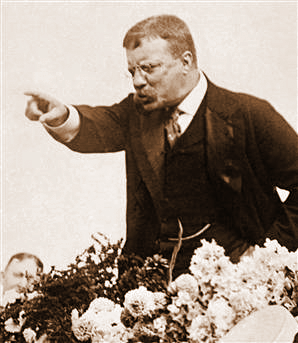
We first looked at how Teddy Roosevelt embodied this period in American history.  Born a bit sickly and weak, he transformed himself into a ‘healthy’ and physically vigorous man.  He believed that nothing good in life came easily.  Struggle was essential to growth and achievement, so he rarely backed down from either a personal or political challenge.  His relentless energy and enthusiasm reflected America’s ‘can do’ spirit of the time.  This is certainly revealed in some famous photos of him:

Teddy Roosevelt is known as the first ‘modern’ president for a variety of reasons.  He made the presidency the focus instead of Congress.  His energy and drive made him a national figure.  A keen and perceptive man, he also understand the power of the modern press to craft and publicize an image.  Of course with Roosevelt there was a strong connection between these images and reality, but he used them nevertheless.  These famous photos of him with his family garnered national attention, for example:
I handed out a sheet of quotes from Roosevelt that I hope accurately reflect his beliefs and personality.  While he was a Republican, you can see that he would probably not fit into the Republican party of today in some crucial ways.  These quotes are at the bottom of this update.  We also looked at the phenomena of expansion and imperialism.  While Europeans had been colonizing on some level since the age of exploration, we see a significant expansion throughout Europe and the United States at this time.  Clearly, something was in the air.  What made this period so focused on imperialistic pursuits?  We can postulate a few possible answers:
  • Industrialization allowed for bigger and more powerful things to be built, which made sea travel over longer distances possible
  • Rapid industrialization would create the need for raw materials to be imported
  • England had always had an empire.  Industrialization meant that others could try and catch up.  England, wanting to keep its lead, would expand to do so.
  • Missionary efforts, while probably not the motive for imperialism, was certainly a by-product of it.
These are good answers, but they do not quite touch on what expansion reveals about the heart of western civilization at this time.There are two main schools of thought:
The traditional view states that expansion is the sign of health.  By 1900 western civilization controlled perhaps as much as half the globe.  Expansion requires energy and drive, and this in turn, requires health.   In this line of reasoning, western civilization peaks as its territorial and ideological expansion peaks.  Niall Ferguson adheres to this, arguing that western culture peaked around the turn of the 20th century.
The minority view states the opposite.  The first historian I am aware of to advance this theory was Oswald Spengler, a quirky German recluse who first published his ‘Decline of the West’ in 1926.  Spengler interpreted the life of civilizations much in the way we might view the life of an individual.  For Spengler, a civilization is healthy when it possesses a vibrant ‘inner-life’ and is at peace with their place in the world.  When a civilization exhausts its inner life, the only thing left is to extend the possibilities of the self outwardly.  So — expansion is sign of boredom, of weakness, of an actual lack of vitality.  Just as we would think that a person who needed constant variety would be bored, so too civilizations.

Spengler’s analysis was not greeted with wild enthusiasm at the time, as you might imagine.  His work generated a lot of controversy due to the variety of atypical opinions he espoused.  He also wrote sentences like, “So we see that historical investigation can be reduced to interpretation of morphological symbolisms” — sentences that might make you wonder if you’ve been had.  Still, his thesis would be picked up and reinterpreted later by AJ Toynbee, and to some degree by Kenneth Clark.  It deserves consideration.

Teddy Roosevelt Quotes:
War
  • Preparation for war is the best guarantee of peace.
  • I killed a Spaniard with my own hand, like a Jackrabbit!
  • When I took my gun to Cuba, I made a vow to kill at least one Spaniard with it, and I did!
  • The most absolutely righteous foreign war of the century! – Opinion on the Spanish American War
  • I deserve the Congressional Medal of Honor, and I want it.
Business and Government
  •  The greatest corporations should be responsible to popular wish and government command.
  • . . .in no other country was such power held by the men who had gained these fortunes.  the government was impotent.   Of all forms of tyranny, the least attractive and the most vulgar is the tyranny of mere wealth, the tyranny of plutocracy.
  • As a people we cannot let any citizen live or labor under conditions which are injurious to the common welfare.  Industry, therefore, must submit to the public regulation as will make it a means of life and health.
  • We stand for a living wage.  Wages are subnormal if they fail to provide for those in industrial occupations.  A living wage must include . . . enough money to make morality possible, to provide for education and recreation, to for immature members of the family, to maintain the family during sickness, and to permit reasonable savings for old age.
Nationalism and Imperialism
  • Of course our whole national history has been one of expansion. . . . That the barbarians recede or are conquered. . . . is due solely to the power of the mighty civilized races which have not lost the fighting instinct, and which by their expansion are gradually bringing peace in the red wastes where the barbarians held sway.
  • We shall never be successful over the dangers that confront us; we shall never achieve true greatness, unless we are Americans in heart and soul, in spirit and purpose, keenly alive to the possibility implied in the very name American, and proud beyond measure of the glorious pleasure of hearing it.
  • It is, I’m sure, the desire of every American that the people of each island, as rapidly as they show themselves ready for self-government, shall be endowed with self-government.  But it would be criminal folly to sacrifice the real welfare of the islands . . . under the plea of some doctrine which, if it had been lived up to, would have made the entire continent of North America the happy hunting ground of savages. — TR urging that America put down the rebellion in the Philippines after the Spanish-American War.
  • America’s duty to the people living in barbarism is to see that they are freed from their chains, and we can free them only by destroying barbarism itself.
TR the Conservationist
  • The lesson of deforestation in China is a lesson mankind should have learned already.  Denudation leaves naked soil, they gullying down to the bare rock.   When the soil is gone men must go, and the process does not take long.  What happened in other parts of the world will surely happen in our own country if we do not exercise that wise foresight which should be one of the chief marks of any people calling itself civilized.
  • Forests do not exist for the present generation alone.  They are for the people, [which] always must include the people unborn as the people now alive, or the democratic ideal is not realized.
  • As a people, we have the right and duty . . . to protect ourselves and our children against the wasteful development of our natural resources.
  • 512 — The number of animals Roosevelt and Kermit killed while on safari in Africa, including 17 lions, 11 elephants, 2 rhinos, 9 giraffes, 47 gazelles, and other creatures including the kudo, aardwolf, and klipspringer.
Being President
  • My view was that the executive officer was a steward of the people bound actively and affirmatively to do all he could for the people, and not content himself with . . . keeping his talents undamaged in a napkin.  I declined to adopt the view that what was imperatively necessary for the nation could not be done by the president unless he found some specific authorization to do it.  My belief was that it was not only his right but his duty to do anything the needs of the nation demanded unless it was forbidden expressly by the Constitution.
  • I do not believe any president has had as much fun as I have.
Miscellaneous
  •  ‘Why, that’s bully!’ — One of his favorite expressions
  • Why couldn’t they call them ‘Theodore Bears?’  — He hated the name ‘Teddy.’
  • I will make this speech or die.  — Said after an assassins bullet had passed through his lung while campaigning for president in 1912.
  • Father wants to be the bride at every wedding, and the corpse at every funeral — Remark attributed to one of Roosevelt’s sons.

Healing Hierarchies

A good education should expose people to “otherness,” but our current discourse gives far too narrow a definition of “otherness.” We tend to focus on ethnicity or gender differences, and not necessarily other ways of perceiving the world. I believe the best form of “otherness” comes through exposure to other worldviews, other ways of thinking, and this can come in the most unlikely of places.
Many generally assume that we share much in common with medieval Europeans, and perhaps this accounts for our striking reaction when we find profound differences. We can judge them quite harshly when they do not match our expectations. But if we started from a different mindset we might see them more clearly as fundamentally different from us. This, in turn, would help us actually learn more from them.

No scholarly consensus exists that I am aware of on the identity of St. Dionysius the Areopagite, except that he was not the Dionysius encountered by St. Paul in Athens. Perhaps “St. Dionysius” wrote in the tradition developed by this same Dionysius. Whoever he was, his writings had enormous influence over the medieval world, as C.S. Lewis points out in his great work The Discarded Image. In one section he writes,

In my opinion a hierarchy is a sacred order, a state of understanding, and an activity approximating, as closely as possible to the divine . . .  The goal of hierarchy, then, is to enable beings to be as like unto God as possible and to be at one with Him. Hierarchy causes its members to be images of God in all respects, to be clear and spotless mirrors  of reflecting the glow of primordial light and indeed of God Himself. It ensures that when its members have received this full and divine splendor they can then pass on this light generously and in accordance with God’s will to those members further down the scale.

We might expect St. Dionysius to praise hierarchy as a form of divine order on earth, and indeed he does just this. What might surprise us, however, is how he uses the term “generous” in regards to hierarchy, and how communally oriented his hierarchical vision is.

Author Andrew Louth comments on this passage that,

What St. Denys means, is that hierarchy is a radiant display that reaches out from God throughout the whole created order and draws it back into union with Him.  Whereas hierarchies to modern ears evoke separation, exclusion, [and perhaps exploitation], for St. Denys it connotes inclusion and union.

How far back in time should our concept of “western civilization” go? Lots of possible answers exist, but most would probably include the Middle Ages. Yet, St. Dionysius had a significant impact on the life and culture of the medievals, and in this passage he entirely runs against the grain of one of our major assumptions today regarding hierarchies. For St. Dionysius, it seems that hierarchies include rather than exclude because it ensures that everyone has a place, and that everyone has responsibility for someone else. The coherence of the world inhabited by St. Dionysius also allowed for everyone to know their place and, in theory, navigate it successfully.

St. Dionysius’ passage calls to mind an observation by Tocqueville, who warned at the potential downsides of democratic individualism. In a a guest post on the U.S. Intellectual History blog Jordan Heykoop commented that,

Americans are lonely. “Americanization”–understood by European intellectuals and political leaders in the twentieth century as an export of American products and values, an investment strategy to control the economies of other countries, an attempt to educate foreigners in the superiority of American institutions, or a process of modernization, all in the name of the free market–was in some sense an export of glorified loneliness.

A democratic and capitalist spirit cultivated this loneliness in America. Alexis de Tocqueville observed that aristocracy made “of all citizens a long chain that went up from the peasant to the king. Democracy, on the other hand, “breaks the chain and sets each link apart” as it constantly draws each individual “back towards himself alone and threatens finally to confine him wholly to the solitude of his own heart.” People in a democratic era are no longer bound through loyalty and obligation, values which are far-reaching and stable, but through common interest, which is malleable and subjective. Individuals gather to negotiate and calculate their interests, then disband. This sense of equality breaks social and communal links and leaves the individual looking inward for identity, place, and meaning.[

For Max Weber, a Protestant society, free from the structure and liturgy of the Catholic [or Orthodox] Church, cultivated a deep inner loneliness in which individuals worked desperately to discern signs of God’s favor. This discipline and sense of calling in a worldly vocation created the foundation for a capitalist spirit–the conditions under which a free market economy could thrive. America is the paragon of these processes. Late capitalism had become a “monstrous cosmos,” a world where the values of hard work and the sense of inner loneliness remained entrenched, but was completely unhinged from any religious foundation or teleological connection.

Even supposing that you agree with Haykoop, we cannot snap our fingers, import the distant past, and make everyone feel comfortable again.* We are a democracy and cannot invent or import a hierarchy wholesale from nothing.

Perhaps the greatest expounder of St. Dionysius’ ideas was St. Maximus the Confessor. The back cover of Andrew Louth’s book on St. Maximus encourages us with the statement that St. Maximus is the theologian for a world in crisis. Indeed, St. Maximus shows us how practical theology can be.

Monistic religions leave no room to breathe, no room for distinctions, and thus create tyrannies. For example, though officially an atheistic state, the “party” represented a monistic tyranny in Soviet Russia. By definition, the “Party” was always correct, and all outside it cannot belong to the body politic. Such outsiders needed dealt with. Polytheistic religions might give more freedom in theory, but lack any point of unity. So these societies tend to succumb to (in Toynbee’s phrase) “the idolization of the parochial community.” Wars of all against all arise, like the Peloponnesian War in Greece at the end of the 5th century B.C.

By the 7th century A.D., the Church had worked out the doctrine of the Trinity (more or less), but had yet to fully develop the doctrine of Christ and the relationship between His deity and humanity. One key issue involved whether or not Christ had one divine will, or two wills in one person, a human and divine will. Maximus asserted that Christ had to have a human will to be fully human. In addition, it is the submission of Christ’s human will to His divine will that makes a pathway for us to become more like Christ and thereby “participate in the divine nature.”

Perhaps St. Maximus is best known for his development of the cosmic nature of redemption, and Christ’s fulfillment of various patterns within redemptive history.As one example of this, we can examine the Christ’s entering into the pattern of the right and left hand, and simultaneously affirming and transforming that pattern.

The idea of a “righteous” right hand and sinister “left-hand” go far back into history–at least the to Egyptians–but other ancient cultures used it as well. Even so-called “rational” cultures like the Greeks used such categories frequently. Indeed, while many today will mock such as ideas as superstitious, unless we want to fully embrace chronological snobbery, we must assume a universal truth to this pattern and category even if we fail to understand it.

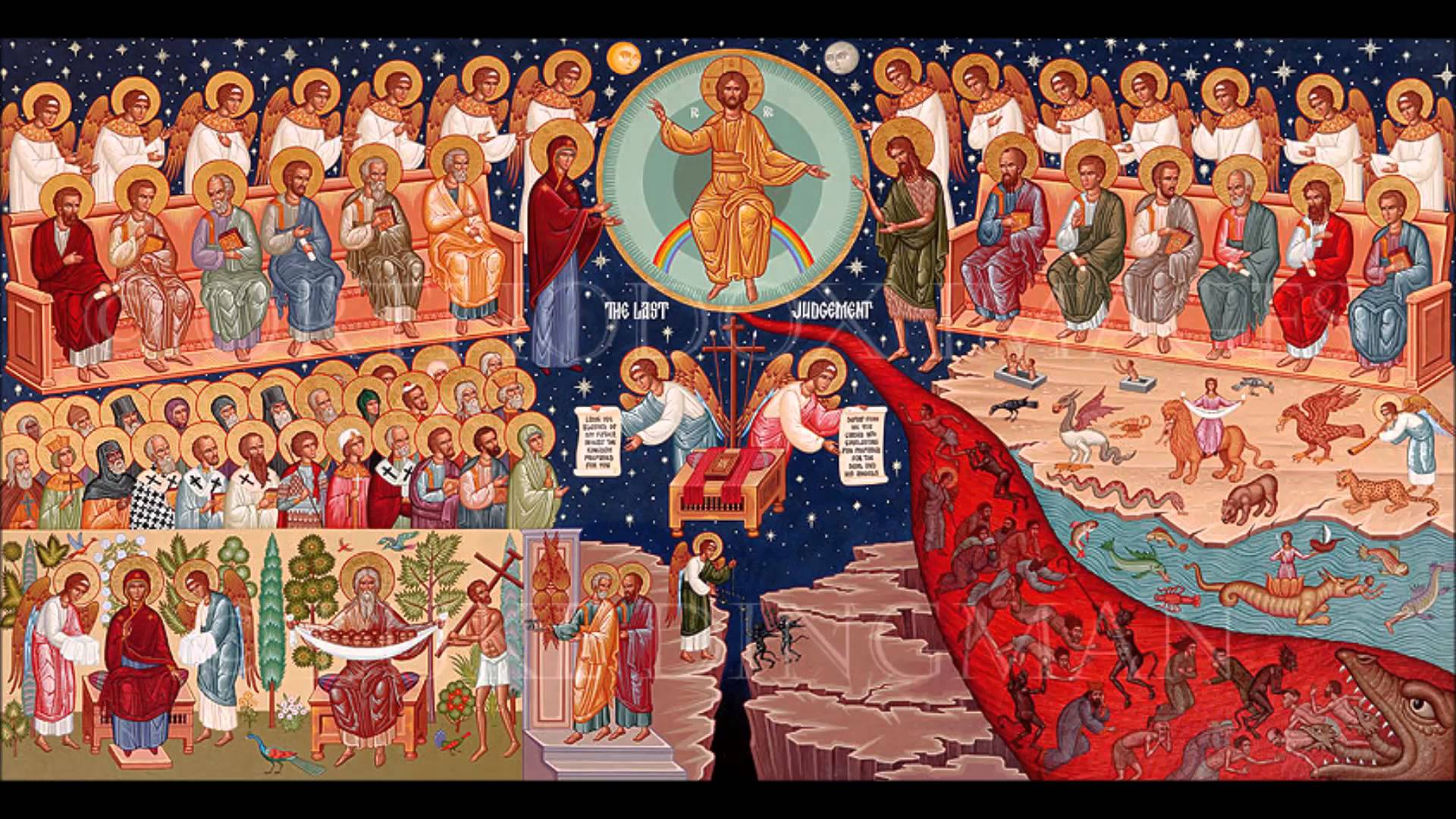
Christ used such imagery when speaking of the last judgment in Matthew 25, and icons of this event depict this consistently.

Perhaps the most famous icon of Christ is the “Pantocrater” image, with Christ blessing all with his right hand, and holding the Scriptures (which also represents separation, categorization, and therefore some sense of judgment), with his left.

But we should hold back if we assume that Christ categorizes His creation merely terms of right and left imagery. Two of the greatest saints of the Church are of course Mary His Mother and St. John the Baptist. Mary bears God within her womb, and spent her formative years in the temple in Jersusalem–right at the very center of God’s presence. John the Baptist, on other hand (a phrase that indicates that we too still use something of the right/left imagery) wears odd clothing, eats odd food, and resides in the wilderness outside the city, in the realm of chaos. So, the Church depicts Mary on the right of Christ, and St. John on the left to indicate a hierarchical difference between them

Yet obviously the “left-handedness” of St. John does nothing to diminish his status per se in the kingdom. Christ calls him “the greatest among men.”

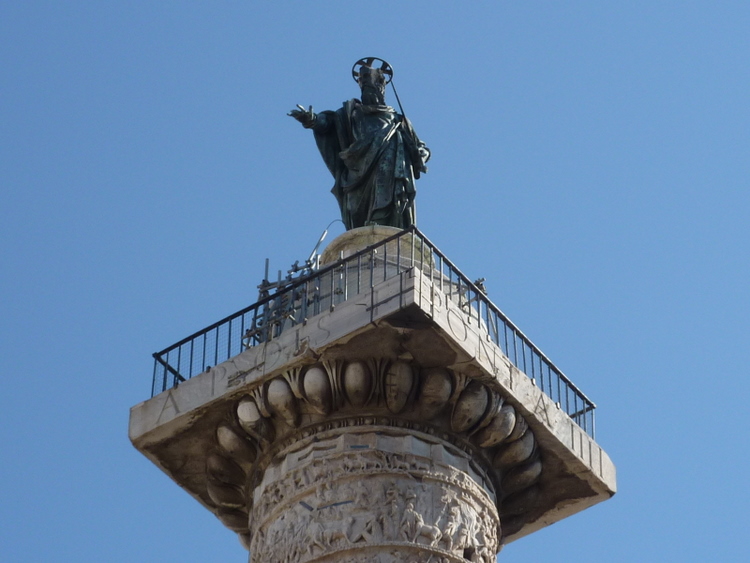
We see the same treatment of the two great apostles of the Church, Saints Peter and Paul. St. Paul comes later, he’s younger, and he actively persecuted the church. He comes as one “unnaturally born,” to use his own words. St. Peter was one of the original twelve, the “rock,” a witness to the resurrection, and the preacher at Pentecost. Peter will therefore be shown on the right of Christ, Paul on the left.

Yet we remember too Peter also denied Christ, and Paul rebuked him for embracing the teaching of the Judaizers in the book of Galatians. The right hand has its faults just as the left hand. The hierarchy can be both affirmed and transcended at the same time.

We need a St. Maximus’ today, or at least we need to heed his wisdom. On the right of the political spectrum we have those that affirm the values of order and unity at the “center.” They are wary of the fringe’s of society, and this can make for rigid authoritarianism. The far left exalts the fringe above the center, idealizing the exception rather than the rule.** But if the falcon’s widening gyre leaves no center at all, we will have chaos. Or rather, we will have a hierarchy, but one that will invert basic reality and create a purposeless and powerless structure, with the “oppression olympics” and the race not towards strength, purpose, and so on, but towards impotent victimhood as one example of this.

Christ shows us that submission of the human to the divine does not debase the human, but exalts it. Rather than set the right hand against the left He affirms both without denying the place of either. In fact, for the right and left to work properly, they need each other. His hierarchy includes rather than excludes. This, our only viable political path forward, gives witness to deep theological truths. Of course, St. Maximus suffered for these truths and for this way of life,^ and perhaps we may need to as well.

St. Peter on the right (of Christ that is, imagining Him at the center), St. Paul on the left

*The medieval period had its share of rebellions, violence, etc. I am not trying to glorify the past so much as point out the difference in how they saw their place in the world, and to attempt to put a finger on our current malaise.

**We should ask the question whether or not we have a genuine “right hand” in America. The left is socially liberal but wants more government control over the market. The right tends towards more social conservatism but wants the market to operate without restrictions to maximize efficiency, not seeing how the market easily disrupts traditional communities and economies (for example, when Wal-Mart comes to a small town, say goodbye to Main Street). In the end, libertarians embrace both “left-handed” sides of things.

As Patrick Deneen has commented, we have solid anti-authoritarian safeguards built into our national DNA, but it appears that we lack an antidote for excessive individualism. Of course, both sides have elements of the excessive fringe and the excessive center embedded within them. For the right, the excessive center manifests itself in dangerous forms of nationalism, but their fringe enters with its exaltation of individual rights. The left praises every form of fringe behavior as liberation from group consensus, but their “center” manifestation that all must adhere to proper speech guidelines, for example (note the various numbers of people banned from Twitter, for example, who do not conform to proper speech as defined by the socially powerful).

What we witness now, in fact, is what happens when we lose sight of Christ, the Son of Man, and the Son of God.

^As an old man the theological and political tide turned against St. Maximus, and he had his tongue and right hand cut off. He died without seeing any earthly vindication of his theological vision.

The Burden of Nineveh

David F. Noble’s The Religion of Technology starts with an intriguing premise. Many, he argues, assume that religion and technology have a long standing enmity with each other. This narrative, bolstered by the urban legend of the church’s opposition to Columbus, and a misunderstanding of what happened with Galileo, runs deep in our cultural mindset. The triumph of Enlightenment thinking for some seals the deal in religion’s ultimate defeat by the march of progress and reason. Noble’s book sets out to show the opposite, that the creation of technology has always stemmed from a religious impulse, and that many of the world’s great technological pioneers created with a distinctly religious aim in mind.

Noble makes a few interesting claims. On the one hand, he points out that the church sponsored, or helped create certain technologies, such as the heavy plow in the Frankish empire, and a variety of other things. He also attempts to show such sponsorship meant a departure from established Orthodoxy, assuming that such ‘orthodoxy’ stood against technical development, and then traces this religious impulse down to the modern day. I can appreciate any attempt to help understand and heal the divide between religion and science, and Noble’s work accomplishes this to a slight degree. His problems stem from his lack of understanding of the meaning of technology, and the Scriptural tradition related to the topic. He misses crucial nuance and context.*

For starters, how anti-technology can Christian orthodoxy be if

  • The Old Testament has a variety of sections in which craftsmen are praised, especially those who build the temple.
  • Adam was told to tend and develop the garden. One might suppose that he would do so with more than just his hands.
  • Jesus was the (earthly) son of a carpenter

But Noble rightly points out ambiguity in the text and tradition, for we also see

  • That Cain’s line was the first to develop technology
  • That the early chapters of Genesis show that those that develop technology use it first for bad ends
  • That cities get a bad rap in OT at least, with Cain, Babel, Sodom, Egypt, and the like.

Noble makes no attempt to resolve these seeming contradictions and place technology in its proper context.

First we need to understand the meaning of mankind in creation, and why Cain developed tools and cities.

One can read Genesis 1 in a variety of ways. I think it best read as, at its core, an explication of the meaning of creation. Mankind comes last, but throughout the process of creation we see continual duality, first cosmically between light and dark, and then later between sea and dry land, fishes and birds, plants and animals, and so on. This dualities get closer together until we get the creation of man and woman. Mankind has the role of mediating between heaven and earth, of being the center point of the ladder of meaning that travels between what lies above and below.

The picture deepens when we see the Garden in Genesis residing on a mountain. The idea of a mountain bursting with life–this kind of paradox permeates the Christian faith, a paradox that we need to understand to interpret technologies role correctly. When Adam and Eve leave the garden, they descend down the mountain, a descent away from heaven toward earth, from meaning to fact. This “fall” downwards also gives one more earthly power, which makes sense as a kind of parody of heavenly wisdom.

In the Old Testament, as well as in other mythic traditions, the problem with technology comes not with the thing itself, but mankind receiving or grasping it before the proper time. We see this in the myth of Prometheus, for example. In the Garden, the tree of the knowledge of good and evil was declared “good” along with the rest of creation. To help destroy man the snake tempts them to take it before the proper time.** Cain’s subsequent wandering takes him down under the mountain, in fact. He begins to look not up to heaven but under the earth. He and his descendants build cities, tools, and even musical instruments. All of this has its roots in death–even the earliest instruments came from the horns or skins of dead animals. Naturally, actual physical death comes right on the heels of these technologies (Gen. 4:23-24).

Alienated from God, mankind no longer can properly unite heaven and earth. Many have speculated on the proper interpretation of Genesis 6:1-4. The early church saw these verses as the Book of Enoch interprets them. Fallen angels have, likely through demonic possession of some sort, join with women and their offspring become the Nephilim, a race of giants. Others see it in simpler terms, with the godly line of Seth intermarrying with the ungodly line of Cain. I prefer the former option, but either way, we see again the same problem, that of improper mixing, and mankind failing to properly mediate between heaven and earth. Once again, this results in violence and the flood. The flood represents chaos and a return to a formless void, but it only mirror the chaos already introduced by mankind who fell to the temptations of technology.

Science participates in the same pattern of uniting heaven and earth as other areas of life. No contradiction should exist between science and religion. Scientists take an idea, a hypothesis, and try and coherently unite that idea (what is ‘above’) to observable phenomena (what is ‘below’). One might argue that the power Science grants has a kinship with the power of words properly structured in a great speech. But, science seems to operate on a different scale. We many not initially see that the increase of power granted by technology serves in turn to make us more vulnerable. This shows itself in any number of ways in our experience. For example, if in traveling from New York to California we

  • walked, it would take us a long time, but the worst that could happen more or less is that we would sprain our ankle, or
  • ran, we could go a bit faster, but in falling, with the extra momentum, we could do more damage to our legs and feet, or
  • drove, we would get there faster still, but if something went wrong with the car we could get badly hurt in an accident, or
  • flew in a plane, we would go fastest of all, but if even a small thing goes wrong with the craft, death would be the likely outcome.

This quick sketch no doubt leaves many unanswered questions, but hopefully this shows that reticence the Church expresses about technology has nothing to do with fear of change, or control, but in something far deeper and more important. However, the biblical narrative develops another parallel track regarding the use of technology that begins just as the detrimental effects of the Fall take root. With Adam and Eve now naked and ashamed, God makes them a “garment of skin,” a covering, that allows them to encounter the world and each other. Such garments come from the death of animals, and we can see them as the first “technology.” This technology allows mankind to interact with the world. The garments come from death and are a concession to death, but serve a good purpose.

This turning of death into life also forms part of the pattern of creation, for “Christ was slain from the foundation of the world.” For, while the OT shows us the problem of cities within the patterns, the NT shows us that even the idea of the city becomes part of the glorification of all things (Rev. 20-21). We see hints of this in the OT as well, with the construction of the Tabernacle, which can be seen as a “covering,” a means for us to encounter God, since seeing Him directly would destroy us. The Temple later serves something of the the same purpose, but interestingly, many of the materials and craftsmen for the Temple came from foreign nations. such as Tyre and Lebanon, which allows to see two things simultaneously:

  • A foreshadowing of the gathering in of all nations to under the coming Messiah, of God reconciling all things to Himself in Christ, and
  • That these coverings come from Outside, they are not quite part of the “core” of kingdom culture, that the Temple is “tainted” in some way.

Noble makes the great point that our technological impulse is essentially religious. Done rightly, it can manifest our calling to unite Heaven and Earth properly. But a wrong application leads toward a potentially demonic path, where our worst impulses to make ourselves into one of the old gods. Noble fails to see this pattern and so he cannot coherently organize his thoughts to make a point beyond mere observations of particulars. To say that technological development cuts against “religious orthodoxy” is too strong a claim. To say that Church tradition has usually expressed a wariness with new inventions puts us nearer the truth. We need such caution on today’s rapidly expanding digital technology to give us a chance to navigate it rightly, and give us the best chance avoiding violence and destabilization.

In War and Civilization, a short work compiling Arnold Toynbee’s thoughts on the relationship between war and society, Arnold Toynbee quotes from a prominent biologist that,

One seductive and ultimately fatal path [of Evolution] has been the development of protective armor. An organism can protect itself by concealment, by swiftness in flight, by counter-attack, by uniting for counter-attack by others of his species and also by encasing itself within bony plates and spines. The last course was adopted by ganoid fishes of the Devonian with their shining armor. Some of the great lizards of the later Mesozoic were elaborately encased. Always the experiment of armor failed. Creatures adopting it tended to become unwieldy. They had to move relatively slowly. Hence they were forced to live on vegetative matter compared to living on more “profitable” animal food. The repeated failure of armor shows that, even a somewhat low evolutionary level, mind triumphed over mere matter. It is this sort of triumph which has been supremely exemplified in Man.

Toynbee used this analogy of armor as a reference point to the David and Goliath story. David’s rejection of armor gave him more than a potential tactical advantage over Goliath. We can see David refusing armor as a putting off of the Garments of Skin, as a return to something like the Garden. Jesus cursing the fig tree accomplishes much the same thing, which we can see as Christ reversing the fall–fig leaves formed the first covering for man (Gen. 3:7). And, when Jesus tells us that “the Son of Man has no place to lay his head,” He refers directly to the humility of His poverty. But he also hearkens back to the fact that He has no covering, that He shed his garments, so to speak.

With his commitment to seeing history through a spiritual lens, Toynbee arrived, perhaps unwittingly, had some of these same hesitations regarding power–another “covering” akin to the Garments in Genesis. He writes about the Roman Empire:

In the downward course of a civilization there is truth in the saying of the philosopher Heraclitus: “War is the father of all things.”  The sinister concentration of the resources of a civilization upon the business of fratricidal warfare may generate a military prowess that will place their neighbors at their mercy, may create a military technique that may grant them a far reaching technical mastery over the merely “Material World.”   

Since it is common to reckon success primarily by power and wealth, the opening chapters in the decline of a civilization will be hailed as times of blessing and growth, and this misconception can persist even for centuries.  Sooner or later, however, disillusionment is bound to follow, for a society that is hopelessly divided against itself is almost certain to try and double down on military might, for that is what seemed to work initially. 

For example, we see the money-power and man-power won for Greek society by Alexander the Great, and these same vast resources used to intensify the civil wars between Alexander’s successors.  This same power swept into Roman hands through the meteoric rise in Rome’s land and wealth ca. 241-146 B.C.  was just as quickly spent in the various civil wars that wracked Rome before the rise of Augustus and the Pax Romana.  For Spain, the treasure gained in the new world and the free labor of the essentially enslaved native populations was the food for their wars in Europe during the late 16th and early 17th centuries–the same wars that brought them into second-rate power status in Europe.

Thus the increasing command over the environment gained is apt to bestow upon a society a disintegration that puts a greater driving power into the suicidally demented society’s chosen work of self-destruction; and that story turns out to be a simple illustration of the theme that, “The wages of sin is death” (Rom. 6:23).  And again, the empires of industrialized Europe in the late 19th century gained the material resources to nearly destroy European civilization in our great Western civil war of 1914-18.  

War and Civilization centers around Toynbee’s examination of Assyrian civilization. Assyria stands as the poster child of how a quick, massive expansion of power actually can bring about a swift ruin and complete dissipation of that power. Such near instant bursts of physical growth bring with them commensurate problems, hence Toynbee’s chapter entitled, “The Burden of Nineveh.” With this in mind, we have a possible lens through which we can know whether or not we choose our garments well or poorly. We can begin by realizing that whatever coverings we put on will not actually solve our psychological, spiritual, or physical longings, though they can deceive us not thinking so. Sometimes these coverings hinder and obscure the best parts of us. But at times they are a necessary expedient to cope with challenges we face. Different people, and different civilizations might need to choose differently depending on circumstance. We should walk these paths with caution. The only way to avoid the deception of our garments of skin is to wear them with humility.

Dave

*Noble annoyed me early on by quoting with approval Max Weber’s idea that Christianity revived Roman polytheism. I can appreciate that Christianity is not strictly monistic as is Islam and perhaps Judaism, but Noble should know better. I suppose he left it in for supposed shock value, since it adds nothing to his thesis.

**We can see this same element in human sexuality. It is good, created by God. Only when we are properly prepared, in the right context (marriage between a man and a woman) can this “power” be wielded in a good and proper manner.

The Law of Gus

Ostensibly, this post discusses Michael Oriard’s fine book, Brand NFL, which I enjoyed. This post also serves as a companion piece to another post from about a year ago, “Every Sacrifice Needs a Witness.” I will try not to repeat points I have already made. I mention both of these things because I am starting in what will seem like an unrelated place for a book largely about football marketing and labor relations.

First, there exists a theory about sportscaster Gus Johnson. articulated by Bill Simmons:

I keep mentioning the Law of Gus without ever really defining it, so let’s do it right now. If Gus Johnson is calling an NFL game, the odds quintuple that (A) the lead will change hands in the fourth quarter; (B) someone will complete a long pass in a big moment that will make Gus’ voice hit an octave only dogs can hear; and (C) the game will go into overtime or at least come damned close. It seems impossible that the mere presence of an announcer would alter the course of the game, but . . .

Here are some of Johnson’s greatest moments and phrases . . .

One might perform some kind of statistical analysis of Johnson’s games, and perhaps discover that indeed there are more big moments, more exciting comebacks, than for other announcers. One could come up with any number of plausible materialistic explanations for this, i.e., Johnson is the best announcer, so they put him on the best games. Possibly, one might grant some kind of psychological reason–the players know that Johnson is announcing and that if they make a great play they will attain youtube immortality with the Gus Johnson call in accompaniment.

But . . .maybe there exists some kind of transformation of reality when Gus Johnson announces a game. Perhaps at times he is not merely a sportscaster, but a ringmaster. Otherwise, how could Vermont possibly beat Syracuse? I mean, Vermont?

Secondly, why do so many athletes pray before and during a game? On the one hand, it seems so silly. Surely God cares nothing for a mere game, and surely . . . athletes know this? Yet the behavior persists. Growing up I played baseball in high school, and we prayed the Lord’s Prayer before games, though my coach seemed indifferent to religion. I confess that praying before a baseball game seemed a bit off to me then and now, but football . . . that’s different. Though I never played high school football, I never experienced a combination of more fear and elation than in 10th grade, when catching a pass in a playground game with friends, I juked John–a merciless tackler now embarrassed and enraged–and then had to outrun him for 40 yards. Never again would I run as fast as I did that day, and strange (and sad) as it may seem, I still remember the exact words of praise I received from one friend after that run.

Aside from the “foolishness” of associating prayer with sports, many would object to differentiating between sports and the “appropriateness” of prayer at such events. If prayer “works” with one sport, it should work with another. But I would rank the major sports from Most to Least appropriate to associate with prayer thusly:

  • Football
  • Hockey
  • Basketball
  • Baseball

My explanation . . .

Football involves the highest levels of 1) Danger/”sacrifice” and 2) Communal action. Baseball involves some danger (batters facing a 95 mph fastball, pitchers dodging a comeback line drive), but that danger is limited to just a few people at a particular moment. Baseball might have more danger than basketball, but much less communal action. One could stand out in right field all day and have literally zero impact on the game. In basketball everyone on the court can rebound, pass, etc. and will have to do so at some point. During football games, almost anyone can get injured on almost any play, and, in contrast to baseball (but not hockey or basketball quite as much) everyone on the offense or defense has to move together, i.e., “communal action.”* It is in “communal action” that sports mimic religion, and that added element of danger and drama provide catharsis to players and fans alike. Just as every Sunday, in liturgical worship, worshippers go through the journey of death and resurrection.

As good as Oriard’s book is, it never even broaches subjects like this, and so his analysis comes up a bit thin at times.

Oriard played NFL football for Kansas City, and he combines his personal experience with good writing and insightful analysis in certain parts. I loved his take on the relationship between the changing passing rules and the increasing size of lineman, a nice compliment to Michael Lewis’ The Blind Side. Though he has an obvious bias in his discussions of the labor issues that beset the NFL between 1974-1987, I found it hard to disagree with him, or to dispute his claim that labor peace contributed significantly to the NFL’s rise to prominence in the 1990’s.

At times, however, Oriard wants it both ways. He laments the “paternalism” of the NFL’s in the 1950’s and 60’s with its coaches treating players like a strong, willful, caring, but occasionally crazy father. But when that era ended and players got more power, they also seemed to get into more trouble. Or–more likely, became bigger targets for journalists in the post-Watergate era, trained to always look for what lay behind the curtain. So, when players started to get exposed for taking drugs, did that primarily implicate the league, the player, or the fan who looked the other way so long as the players performed on the field?

Oriard’s method of laying out the issues, is quite familiar to us, and helpful in a way. We have our tradition of two political parties, prosecution and defense, etc. But we have no way to “break through” the common divides over such questions with the lens Oriard gives us. Another example—Oriard professes confusion as to why the public tended to side with the owners in the strikes during the 70’s and 80’s. Most of the time, people side with workers against “the man,” but not when it came to athletes striking. Oriard offers the possibility that the public wanted nothing to do with a dispute between billionaires and millionaires as an explanation. But that would only work if the public blamed each side equally. Besides, players did not really become “millionaires” until the late 1980’s at the earliest. Oriard frames the issues well, but his frame needs enlarged.

That fans tended to side with owners in labor disputes has its true explanation in the fact that elite athletes exist outside normal categories. Obviously they have outsized physical gifts, but I mean something more: their participation in liturgized communal danger “transforms” them into something more than a regular person. They morph into priests of ritualized conflict. We, the fans, acknowledge this, but perhaps only semi-consciously. Players may not be as rich as owners, but we do not watch highlights of owner’s meetings, we do not put owners on the covers of magazines, and we do not dream of being an owner–we dream of being Lebron, Tom Brady, Messi, and so on. Money is nothing compared to one’s ability to break tackles and run for 80 yards. When the chance to participate, however indirectly, in such a transformation gets “taken away,” we naturally focus on those to whom we give glory.** Mary Renault’s imagining of Theseus at Crete with the bull dancers in her The King Must Die give us perhaps a more accurate picture than Oriard. For Renault, the bull-dancers were pampered, feted, praised, glorified . . . and not expected to live long. No one cared about those that owned the bull-dancers one way or another.

As Oriard notes, when people dislike baseball they call it boring, but when they dislike football they find football “inhuman.” Not having the religious lens, again Oriard can’t quite see why this might be, beyond the violence of football. But both criticisms are correct. Baseball between two bad teams in August can personify boredom. The ritualized violence of football indeed both degrades and transcends normal human life. The ancients that went into battle understood this, the Greeks, the Vikings, and so on. This should give us additional perspective on the goal and achievement of medieval chivalry. To go into battle and remain something akin to a normal human being–neither a beast nor a dark god–stands as a tremendous achievement for a civilization. To reject Achilles and Alexander the Great as models for war, you need a strong, real, and powerful replacement.

I thought Oriard spot-on when discussing the narrative of domestic abuse and violence off the field. He showed decisively that players do not commit more crimes than the average person, and are not more violent than the average citizen. But in his discussion of drug-use, Oriard misses the religious side of the question. To share another brief personal example . . . very few fans ever came to our high school baseball games. But one day we played our arch rival. Late in the game, I came up with the bases loaded, down a run. I hit a line-drive over the 3rd baseman’s head, and I as I ran to first, I heard the roar of the crowd. Alas–it went foul by an inch or so–had it been fair at least 2 runs score, maybe we win, and maybe I’m the hero. When it might have gone fair, running down to first, hearing the crowd . . . I experienced something akin to transcendence. As it turned out, a couple of pitches later I grounded into a double-play–inning over. We ended up losing. Anyone who has played organized sports can relate to this experience. What one might feel in front of 50,000 instead of 150 I can only guess. That one might try and artificially recreate that feeling of transformation makes perfect sense, though a losing proposition from the start.

Of course I think religion important and often neglected as a subject, but I don’t praise every religion, any more that I applaud football’s connection to religion. In fact, football’s strong religious associations make it a viable competitor to the “higher” religion of Christianity. In addition to labor peace, football’s rise might also have something to do with the decline of institutional religion in America. Indeed, love it or not, football seems the quintessential sport for a civilization founded at the edge of the world, a place where utopia mingles easily with violence.

Dave

*One can apply this lens to other sports . . . soccer, large amount of communal action, but little danger (despite the writhing of various soccer players), bullfighting and bullriding, with its high levels of danger with almost no communal action related to that danger, and Formula 1, with its high level of danger, and high levels of communal action–but only behind the scenes, and the drivers being the only ones subject to great risk.

**One simple test for the religious nature of the sport and how much it draws in fans to the ritual participation is–do fans storm the field/court? They do so in football, and basketball too. But . . . not baseball.

Tolerating Toleration

I have written on a few occasions that those who write history books can fall into one of two errors:

  • Over-emphasizing the differences between things, which means that nothing can be compared to anything with any confidence, and
  • Over-emphasizing the similarities between things, which these days means that everyone is either Hitler or Stalin.

The best historians combine factual mastery with poetic gifts. They see rhyme and rhythm, but they never force it, letting the “occasional” square pegs stand aside from the round holes when appropriate.*

The first error (the “differences” error) is more useful. If you over-emphasize particular facts at the expense of synthesis, you have hopefully uncovered many useful pieces of information. But these kinds of historians are in my view not really historians, but researchers. They have definite skills, but play too close to the vest. Without extending themselves and taking a risk, they limit their impact.

The second error involves more chutzpah and dash, and so I tend to be more forgiving to those who synthesize too much. Toynbee, one of my great heroes, conflated Greek and Roman civilizations to such a degree that he claimed that Rome began its decline in 431 B.C., the year the Peloponnesian War started in Greece. Such an assertion perhaps has some grandeur in its theatricality. But no one could claim that this whopper arose from intellectual laziness on his part.

Other times, however, errors of the second kind can only arise from a combination of laziness and willful blindness. These types of errors of the “Over-emphasizing similarities” school are more dangerous than the “differences” school. When you aim higher, you fall farther.

One “similarities” error that has lingered on in the scholarship of late antiquity, and subsequently in the public consciousness, involves the interplay between Christianity post-Constantine and the older paganism. Sir Geoffrey Elton–a knight no less!–expresses this basic idea concisely, writing,

. . . religions organized in powerful churches and in command of the field persecute as a matter of course and tend to regard toleration as a sign of weakness or even wickedness towards whatever deity they worship. Among the religious, toleration is demanded by the persecuted who need it if they are to be triumphant, when, all too often, they then persecute in their turn. . . . To say this is not cynicism but sobriety of judgment.

Ugh–one can just imagine Sir Geoffrey Elton saying this with some British smugness. Intolerable, I say! It just won’t do!

So, Elton, followed by Peter Garnsey, and Francois Paschoud on the French side–and a host of others–mash everything up and declare that basically no difference existed between the intolerance of Rome towards Christians, and intolerance of Christians towards Roman pagans.

But even a brief look at this assertion shows its utter fatuity.

How did Rome persecute Christians? Over a span of 250 years (though not continuous over that period, but sporadic in its intensity) Rome imprisoned, tortured and killed thousands and thousands of Christians. Many died in a gruesome manner, as even Roman sources hostile to Christians attest. By the late empire, feeding Christians to lions in the arena was old hat. Even mild, tolerant, and “good” emperors like Trajan admitted that, yes, if push came to shove, Pliny should arrest and even execute Christians.

How did Christians persecute pagan Romans once in “command of the field?” They closed and sometimes destroyed temples. They refused to give state funding for pagan rites. They closed the Academy of Athens. Some sporadic–and important to note–non-state sponsored violence probably happened in some instances. One can cite the era of Theodosius I, from AD 379-395, where

hands and feet . . . were broken; their faces and genitals smashed . . .

But this violence was not directed at people but at the statues of gods and goddesses. However “purposeful” and “vindictive” (as one historian terms it) such actions may have been, it is not quite the same thing as watching people eaten alive for entertainment.**

Enter historian Peter Brown to set the record partially aright. Alas, I have only slight exposure to Brown, an acknowledged master of late Roman antiquity. My first impressions peg him tending towards the “differences” error, but this might suit him well to clean up the typical sludge created by Elton et. al. on this issue. He entitled chapter 1 of his work Authority and the Sacred: Aspects of the Christianization of the Roman World, “Christianization: Narratives and Processes,” which can only elicit one response:

But chapter two deals with the question of religious toleration in a much more promising manner.

Brown points out a few helpful counterpoints to Elton and his crew.

Most every ruler’s first priority involves money, which comes mostly through taxation. Any ruler of moderate ability understands the tricky nature of taxation, and how it relies upon a network of trust and compliance that is not easily enforced. Brown comments,

It is easy to assume that a tax system . . . so successful, indicated the indomitable will of the emperors to control the souls of their subjects as surely as they had come to control their wealth. In fact, the exact opposite may be the case. In most areas, the system of negotiated consensus was usually stretched to its limits by the task of exacting taxes. It had little energy left to give ‘bite’ to intolerant policies in matters of religion. It is no surprise that many sources indicate a clear relation between taxation and toleration. Faced by demands of Porphyry of Gaza for permission to destroy the temples of the city, supposedly in 400, the emperor Arcadius is presented as having said: ‘I know the city is full of idols, but it shows “devotio” in paying taxes and contributes much to the treasury. If we suddenly terrorize these people, they will run away, and we lose considerable revenues.”

Brown also stresses that late imperial Rome even in the Christian era involved shared power among elites. And these elites had strong common bonds between them that crossed religious lines. Brown writes again,

As far as the formation of the new governing class of the post-Constantinian empire was concerned, the fourth century was very definitely not a century overshadowed by [religious conflict]. Nothing could have been more distressing to the Roman upper-classes than the suggestion that ‘Pagan’ and ‘Christian’ were overriding designations in their style of life and choice of friends and allies. . . . Rather . . . studied ambiguity and strong loyalty to common symbolic forms . . . prevailed at this time.

Pagan and Jewish religious leaders, Brown notes, received not just toleration, but sometimes even support from the empire.

It would be wrong to imply, as Menachem Stern has done, that [Libanius and the rabbi Hillel] . . . found themselves drawn together “under the yoke of Christian emperors.” They were drawn together by common enjoyment of an imperial system that conferred high status on them both. . . . Both enjoyed high honorary rank, conferred by imperial codicilli–those precious purple letters of personal esteem signed by Theodosius in his own hand.

Theodosius, it bears mentioning, is often thought of as one of the great “intolerant” emperors.

So far, well and good. Brown, with his eye for detail and his great reluctance to generalize, gives an admirable riposte to the traditional academic narrative. But something still needs addressed. Brown blocks effectively, but asserts little beyond, “It wasn’t as clear cut as many think,” he seems to say. But everything is complicated. The historian should at least offer a way to make the complicated intelligible.

Alas, the elephant is still in the room, in the form of two important questions for scholars like Elton and Garnsey–questions that Brown fails to ask:

The first: toleration may be a good thing, but what are its limits? One can praise the virtue of getting along despite differences. Everyone knows this already, however. It’s not a hard thing to say. The hard thing means saying when the differences have become so great that co-existence no longer works, when the house divided cannot stand.

Drawing this line ultimately comes down to values, and values come from religious beliefs. My second question to Elton, etc. would be, “What is your religion? You seem to be neither pagan, nor Christian–and that’s fine. But what or who is your God/god? And what does He/She/It not like? What do you not tolerate? Surely He/She/It can’t like everything.

Brown avoids such questions, and that’s too bad. He has my respect, and a historian of his heft should apply his knowledge to this problem. As for our own situation in our own time, such questions have unfortunately become more than just theoretical. I believe that the media accentuates the differences between Americans for profit. Also, professional tweeters are more divided than average Americans. But a breaking point lies out there somewhere for all of us. We must acknowledge this, and at the same time, hope that we never find it.

Dave

*This observation might seem quite obvious, and so it is. But it is rooted in the profound truth of the nature of the Trinity–unity and diversity at the root of all being.

**I admit this is not the whole truth of all of Christian history. There were times and places where it got worse than this in the next 1000 years. But though it did at times get worse than what I describe above, it never equaled what Rome did.

Symbolic Matters

In Ezra Klein’s podcast with Rod Dreher, the subject of media and culture was front and center. They conversed at length with each person making important points, and I commend them both. Klein brought up what is a fairly standard critique of conservative Christians, that is (in sum), “Why so much focus on gay and transgender issues when there are many poor and suffering people in the world? Surely the Bible says at least as much about the poor as it does about sexuality?”

Dreher had a fine response, and no doubt the format might have limited his remarks. But I think Klein, and possibly Dreher to a lesser extent, fail to take into account the strong symbolic role sexuality has played in most every culture, and the role of the body as one of the primary means of communication.

Dreher linked to a post of Scott Alexander at Slate Star Codex who speculates that the Pride/LGBT etc. movement may become the new civil religion in America. Alexander–who I believe writes as a supporter of his proposed theory, comments,

Am I saying that gay pride has replaced the American civil religion?

Maybe not just because it had a cool parade. But put it in the context of everything else going on, and it seems plausible. “Social justice is a religion” is hardly a novel take. A thousand tradcon articles make the same case. But a lot of them use an impoverished definition of religion, something like “false belief that stupid people hold on faith, turning them into hateful fanatics” – which is a weird mistake for tradcons to make.

There’s another aspect of religion. The one that inspired the Guatemala Easter parade. The group-building aspect. The one that answers the questions inherent in any group more tightly bound than atomic individuals acting in their self-interest:

What is our group? We’re the people who believe in pride and equality and diversity and love always winning.

Why is our group better than other groups? Because those other groups are bigots who are motivated by hate.

What gives our social system legitimacy? Because all those beautiful people in fancy cars, Governor Gavin Newsom and Mayor London Breed and all the rest, are fighting for equality and trying to dismantle racism.

Again, based on Smith’s book discussed below, if it happens it should not surprise us, given the strong symbolic role that body has in our existence.

In the letters of the Roman magistrate Pliny to the emperor Trajan, Pliny asks him about the official policy towards Christians. Christians have been brought before him, and he has condemned them to execution, but such matters are not trivial, and he wanted to make sure he followed the letter and spirit of the law.

Trajan wrote back and declared that, yes, if Christians appear before him, who will not recant, then such people should be executed. Trajan agreed with Pliny that Christians generally had nothing else against them other than that they professed the Christian faith, so, no need to seek them out. But Pliny should continue to follow the law. Christians continued to face death for being Christians.

But Trajan never addressed Pliny’s second question, which was (in sum), “Why, if Christians are generally good citizens who do not disturb the peace, do we need to punish them in the first place?” Many rank Trajan as one of Rome’s best emperors, but Rome loved practicality and viewed the Greeks as sissified for all of their reflective philosophizing. My guess–Trajan probably regarded the question with slight derision and, being a nice guy, politely ignored it. The law is law, end of story.

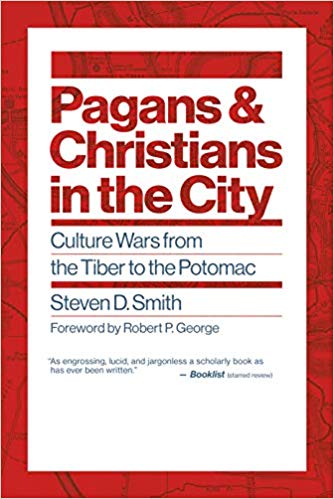
Steven D. Smith begins his insightful work Pagans and Christians in the City: Culture Wars from the Tiber to the Potomac with this historical nugget, for he wants to attempt to answer Pliny’s unanswered question of “why?” Christian luminaries such as Tertullian, Athenagoras, and St. Augustine all pointed out the utter folly and injustice of Rome’s actions. In persecuting Christians, they argued, Rome removed its best citizens. Without discounting the truth of Rome’s cruelty, Smith considers if the Romans may actually been right in their instinct (without articulating it coherently) that Christianity truly posed a threat to their way of life. Gibbon, Pelikan, and many others point out that the Church did triumph over Rome, and that the Church, while able to reside peacefully within Rome, truly meant to end Rome’s way of life.

Recently we have witnessed a variety of almost entirely symbolic prosecutions and attacks of bakers, florists, and pizza joints who do not join in with the prevailing sexual orthodoxy. In a series of articles, Libertarian UVA Law professor Douglas Laycock bemoans the attitudes of those on the left. Plenty of options exist for gay couples for all marriage-related services. Why ferret out those who do nothing to stop you but simply disagree with your choices? Such people do nothing to impinge the freedom of homosexuals. In the same vein, why do conservatives attempt to stop people from engaging in sexual practices they object to, but have no impact on the lives of those who object? Both sides strive for the same symbolic but essentially “meaningless” victory, and it ruins our political discourse.

Laycock sounds quite reasonable, but Smith points out that these “victories” for which different sides strive have a great deal of symbolic value attached to them. Though symbols may not fit into a strictly rational worldview, Smith concludes that, “we live by symbols” and can derive meaning only from symbols.* Furthermore, religious belief always demands communal expression, and symbols shape and embody that expression. From this point, Smith’s book explores what the modern culture wars are all about through the lens of Christianity’s first conflict with imperial Rome.

Many today will likely admire the Romans for their tolerance, and wonder why Christians could not accommodate themselves to Rome. Rome, after all, found a way to accommodate a great many different religions into their empire. But no society can tolerate everything. And we, too, have “zero-tolerance” policies for what we truly deem important, such as drugs or sexual harassment, and so on. With the example of offering incense to the emperor, which many Christians refused to do, we can invent the following conversation:

Roman: You Christians are impossible. We let you hold your bizarre religious gatherings–albeit outside the city–but we let you hold them. We let you believe whatever you want to believe. We give you the benefits of the greatest empire the world has ever known, and you enjoy those benefits. We do so much for you, and we ask but very little, that you acknowledge the blessings of the authority under which you live. If you live among us we must know that you will follow our laws, and this is how you pledge yourself to that. You are disobedient. You are uncharitable–you take from us and give nothing back. And so . . . we cannot trust you, and how could we do so, after giving so much and receiving back so little?

Christian: We should be grateful for all that Rome does for us, and indeed, we pray for those in authority during every liturgy. In our sojourn here on Earth we can partake of much the world has to offer, and justice demands that we give honor where it is rightly due. But your policy asks us to accommodate our monotheism to your polytheism. You suppose that sacrifices to the emperor are a small accommodation, but you ask us to abandon monotheism and accept polytheism. You ask us to change our religious beliefs, which is surely the most significant accommodation you could possibly ask.

Striking parallels exist between imperial Rome and our own day, and the conflicts engendered between Christians and pagans. One such area involved creation and the natural world. For the Romans, the gods infused the world around them with their presence, and every city had its sacred sites. Christians rejected this direct immanence by emphasizing the transcendent nature of God that had little to no overlap with pagan belief.

But the complexity of Christianity greatly mitigated these differences regarding creation. While God is transcendent, He is also imminent. Many scriptural passages talk of creation praising God, and God calls humanity to steward creation. Christians too had/have their sacred sites involving saints, relics, pilgrimages, and the like. So too today, while many viewed as “anti-science” come from certain segments of the evangelical community, Christians and “pagans” find much common ground with moderate environmentalists, though will eventually part ways over certain particulars.

A much more significant divide came with sexuality, where the Roman approach to sexual ethics looks strikingly modern (what follows applied almost entirely to men in the ancient world, not women):

  • Sexual behavior was entirely natural, and few restrictions should be placed upon it.
  • Sex was “healthy,” and self-denial in regard to sex was considered mildly dangerous and “anti-human.”
  • Sex brings us closer to the divine, for all the stories of the gods (goddesses, not as much) have them cavorting with various women.
  • Use of the male sexual organ had a halo of sacredness surrounding it, but how one used it had very few restrictions. One could “sleep with” slaves, prostitutes, or even other men or boys, provided that one was never the “female” in such a relationship.

I am not the person and this is not the format to give a full treatment of the traditional Christian view of sexuality. But in brief:

  • The Fathers of the church quickly realized the Scriptural hints about the sacred nature of sexual behavior, and its connections to our life in God. But . . . sex serves at most as a pointer to a more fuller, transcendent reality that will be present only when the Kingdom of God is fully present. It is not an end in itself.
  • Many Christians believed in the sanctity of sexuality in some way, but the sanctity of sex is the reason for the various restrictions Christians placed on sexual behavior. To protect its meaning and purpose, sex needs strong fences, such as limiting it within marriage between a man and woman
  • Living fully as human beings meant taming and restricting our “appetites,” for the ability to do separates us from the beasts. So, while the Romans thought that the more or less indiscriminate indulgence in sex made us more human, Christians believed it made us sub-human–just as over indulgence in eating would do the same, i.e., a dogs will eat anything put before them, as much as they are given.

How deep these differences really go, Smith asserts, comes down not to logic and private self-interest, but the more nebulous (but simultaneously more real) world of symbol. Symbols cannot be fully explained, but have to be experienced–one knows it when we live it. I lament the effect the culture wars have had on eroding our social fabric and institutions. But though Smith never quite explicitly states it (that I found), he strongly hints that such wars will inevitably be fought. For our culture to have cohesion it must have meaning, and this meaning can only come from a common communal understanding. Symbols work only in this way.

Clearly, for us today as the Romans then, sexual behavior occupies a crucial space within our culture. We may not believe sex to have the sacredness that it did for the Romans, at least in an overtly conscious sense. We likely relate sex in America to our deep beliefs about personal expression and the self. What unifies modern and ancients on both sides, Smith suggests, is the divide between the transcendent and the imminent.

For example, Smith states, no one really questions the motto, “In God we Trust” on our money, but “one nation, under God,” in the Pledge of Allegiance has received significant constitutional scrutiny. Smith finds the difference in the word “under,” which assumes a transcendent deity in ways that “In God we Trust” does not (this “God” need not be above us but exclusively “among us” for us to define and control).

If Smith is right about this in particular, so much the better, for it gives us clarity in a confusing debate. But his other assertion holds more weight. Our disagreements about sex** may very well be an unconscious proxy for our ideas about meaning and community. Perhaps Smith doesn’t excuse the culture wars, but suggests they will continue. It also suggests that our diseased political culture has not caused this divide. Rather, we might flip our normal way of discussing the culture wars on its head. Perhaps our divergent ideas about sexuality (dating back at least to Roe v. Wade and the Sexual Revolution) have fractured our idea of meaning and community, and this fracture manifests itself in various ways.^

Our founders put priority on minimizing centralized power. They knew that humans can get contentious, but sought to make lemonade out of lemons. Our propensity to conflict would create different interest groups, but in the end they would all cancel each other out, preserving liberty. Thus, the Constitution was not meant to create a tight-knit political community, but essentially sought to prevent its formation.Obviously, this experiment has worked on a number of levels. But now that most churches and other community defining organizations have declined in numbers and importance, we have lost our ability to determine meaning in any kind of public sphere. Tocqueville warned us that this might happen if our more private and local communal connections eroded. And so, here we are, seeking meaning from the only viable institutions most of us have any familiarity with–the federal government. This may be what distinguishes our current cultural problems from those we previously experienced, and why we invest so much emotional and moral weight into our politics.^^

Following Smith’s largely unspoken line of thought brings us to a sober realization. Our seemingly silly fights might actually have great importance. If we can focus on the real issue at hand, perhaps we could make progress in solving them.

Dave

*This comment may seem confusing or silly if you think of symbols as images only. If we take the older meaning of symbol and apply the term to ways of understanding beyond the literal and physical, it makes more sense. Parents of teens will surely have encountered this before. Your child asks for “reasons” and “explanations” for your various edicts, but you can’t always provide to the degree they wish. No amount of explanation suffices, for you want them how to live “into” a world, one that can’t be entirely shown them from the outside.

**This includes abortion as well. Some hard cases exist on the fringe of the issue, but at its root is the issue of human autonomy and sexual freedom. I believe it likely that most of the debate about “when life begins” for the pro-choice side is a smokescreen for the right to create a “safe space” for us to adopt a more pagan attitude towards sexual behavior.

^The rapid changes in accepted sexual morality recently may be extra evidence for Smith’s claim. He points out that Seinfeld may have been a turning point. Most every character led sexual lives that would not have fit into any previous sitcom. But to balance this, the show did not promote the main characters as morally serious in any way. From there, we had Friends, and then The Office which were still comedies but the moral seriousness of the characters increased as their sexual ethics remained much the same as in Seinfeld.

^^Perhaps the one place where people can find some semblance of community and belonging is college campuses, and perhaps this is why many students and professors have sought to make their campus into a kind of temple and dramatically infuse it with doctrinaire ideologies, sacred spaces, and taboo speech. Like Ross Douthat, I deplore a great deal about the campus protests, but I understand the impulse. While I admire efforts from a quite ideologically diverse group of people like Joe Rogan, Dave Rubin, Camille Paglia, and Candace Owens to further free-speech and open debate, we need to realize that such things in themselves will not save us.


Slant Deeds to Straight Times

I very much appreciate Peter Thiel’s contributions to public discourse. I likely lean away from his overall optimism about technology–I wish we could think of a way to grow economically without needing to radically altering the labor market and our sense of things with the latest invention every few years. That said, those who can combine business acumen, incisive cultural commentary, and theological insight deserve a listen.

The subject of Constantine came up in his recent interview on the Meeting of Minds podcast with Jerry Bowyer. Thiel alluded to the problems of governance in accordance with truth and goodness. Politics is inevitably icky, and linking Christianity with such ickiness has always proved problematic. Thiel made the intriguing comment that given the chaotic nature of the times, perhaps Constantine had it right in postponing his baptism and official conversion until near his death.

I had never thought this way before about Constantine, and while I wished Thiel had continued his thoughts on this point, the fact that he left it at that leaves me room to speculate with abandon.

To understand politics, and to try and have some sympathy with Constantine’s decision, we need to see the difference between Authority and Power. Hopefully both have a strong relation to each other. But in strange times, they tend to move further apart.

“Authority” contains the core, and the origin, of a particular action. The core must be solid, and stable. For Authority to work, it has to embody this reality. Authority gives legitimacy, or impetus, or perhaps even permission, to Power.

“Power” applies Authority, and so must have more fluidity and movement. It is this movement which gives Power, well, its power. This motion will have an effect, however, regardless of its association to Authority. That is why we hope that Power will always stay connected to legitimate Authority.

Some examples of this Authority-Power dynamic at work . . .

  • An army waits to go right or left. The general, back at HQ, gives the order. The corporals and privates eventually start to move and they begin the attack. The general has authority, but has no power by himself. What can one man do? But, the general actuates Power, and gives Power its purpose. The army starts to move. Authority (hopefully) tames and directs Power.
  • In chess the King/Authority moves little, and hence has little Power. Power belongs to the Queen, and so she has the most freedom of movement. But everything depends on the existence of the King/Authority.
  • People often stated about Queen Elizabeth that she had no real power. Very true. But she was beloved nearly the world over because we instinctively realized that she embodied Authority to near perfection. Her bearing, countenance, and behavior all spoke of Authority. It was crucial, in fact, that she rarely sought to have Power–this allowed her to maintain Authority.
  • We see these patterns on Earth because it is the foundation of all things in the life of the Trinity. God the Father does not “move.”** He is, in a way, the Origin. God the Son moves more, but His movement is somewhat “restricted” to going down and then up again in a specific place. It is the Holy Spirit, the “power of God,” which “blows where it wishes” (John 3:8) going to a fro throughout the Earth.

When Authority and Power have no clear connection, then things get a little weird, and actually have to get a little weird, to set the times right again. Think of King Saul pursuing David. God’s anointed king (Saul) betrayed his calling, making authority in the realm more or less of no effect. Note, for example, the story of Jonathan and the honey, or the fact that Saul cannot catch David. David must then resort to weirdness to come to a place where things get right again, even to the extent of

  • Feigning insanity to ingratiate himself with the Philistines, and
  • Leading a portion of the Philistine army

Centuries later, with the Romans occupying Palestine and the Jewish religious leaders failing the people, no true Authority existed among the people of God. It took a man dressed in camel skins who ate bugs to bring hope and point to the one who “taught with authority” (Lk. 4:32).

Many legends and folklore point to this same dynamic. When King Richard languished in prison and King John took the throne, the only honest men were the thieves in the forest with Robin Hood. When we remember that the forest for medievals meant a dark, dangerous, unpredictable place, this dynamic looks even stranger. Once King Richard returned, the merry band disbanded.

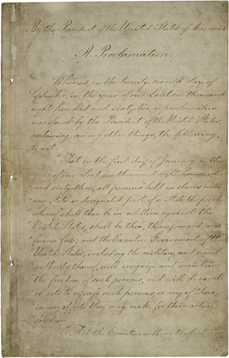
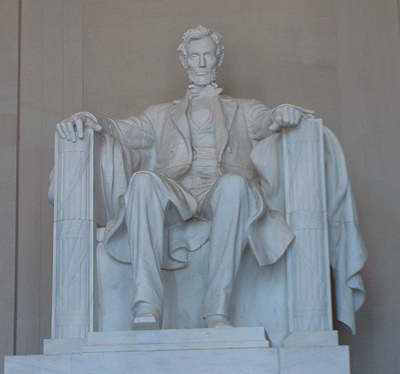
Understanding this relationship gives us a good lens to understand controversial political actions. For example, some criticize Lincoln for the Emancipation Proclamation, usually on two fronts:

  • Lincoln had no Constitutional authority to issue the edict, and
  • The edict actually accomplished nothing, serving as a mere empty symbol

Though I am no Lincoln expert, I suspect that he thought that Authority (i.e., the Constitution) had fled the scene by 1860. The Constitution already suffered mightily “de facto” by the very fact of the secession of several states. The Constitution was designed to bind the states together. More importantly, “Authority” failed to solve slavery, our most pressing moral, cultural, and political problem. Not only could operating under the Constitution not solve the slavery problem, slavery got much worse from 1788-1860.

This meant that Lincoln might have to lean into the weird, and use Power to knock Authority back into place. The Emancipation Proclamation was weird, no question. One can argue that it actually freed no slaves at all. But if one looks at a bit of a slant, we see that it set in motion events that led to Authority set back in place with the 13th Amendment banning slavery. Lincoln rightly intuited that the U.S. could not exist on any other basis, because otherwise the Constitution could not serve the role of Authority for the nation.

All of this brings us to Constantine.

Constantine remains an ambiguous and problematic figure for many westerners for a few different reasons.

  • Some see him as corrupting the church by linking it with the state
  • Some see him as using the church to further his own power
  • Some see him as a hypocrite, using Christianity as a cover to accomplish certain political ends.

Of course, Christians at the time saw him much differently.

  • He ended Diocletian’s persecution of Christians
  • He commissioned the building of numerous churches, including the Church of Holy Sepulcher in Jerusalem
  • He restored property taken by Diocletian to Christians/Churches
  • He used the Church as the main arm of charity for the state
  • He made Sunday, the “Lord’s Day,” a holy day with no work mandated, allowing space for everyone to attend church
  • He exempted clergy from civic duties, significantly contributing to the church’s freedom
  • Perhaps most importantly, by “neutering” pagan religion and removing the foundation of the state from pagan sacrifices, he made it possible to found civilizations on an entirely new basis.

But for sure, many of his other actions raise eyebrows, such as the possible execution of his son, his turning on Licinius, Crispus, and the like. And then, if he was such a Christian, why postpone baptism until the end of his life?

Certainly, Constantine presents us with many conundrums. But we might get more clarity if we think of him as exercising Power in an attempt to create a new Authority. His behavior will look odd and wrong looking straight on, but if we look from angle, we might see different things.

Rome experienced an almost absurd amount of political instability in the 3rd century AD, as the following list shows:

  • Septimius 193–211 
  • Caracalla 211–217 
  • Geta 211–212
  • Macrinus 217–218 A.D.
  • Diadumenianus 218 A.D.
  • Elagabalus 218–222 A.D.
  • Alexander Severus 222-235

The Soldier Emperors

  • Maximinus I 235–238 
  • Gordian 238 A.D.
  • Balbinus and 238
  • Pupienus (in Italy) 238
  • Gordian III 238–244 A.D.
  • Philip the Arab 244–249 A.D.
  • Trajan Decius 249–251 A.D.
  • Trebonianus Gallus 
  • (with Volusian) 251–253 A.D.
  • Aemilianus 253 A.D.
  • Gallienus 253–268 
  • with Valerian 253–260 A.D.

Gallic Empire (West)

following the death of Valerian

  • Postumus 260–269 A.D.
  • Laelian 268 A.D.
  • Marius 268 A.D.
  • Victorinus 268–270 A.D.
  • Domitianus 271 A.D.
  • Tetricus I and II 270–274 A.D.

Palmyrene Empire

  • Odenathus c. 250–267 A.D.
  • Vaballathus 
  • (with Zenobia) 267–272 A.D.

The Soldier Emperors (continued)

  • Claudius II Gothicus 268–270 A.D.
  • Quintillus 270 A.D.
  • Aurelian 270–275 A.D.
  • Tacitus 275–276 A.D.
  • Florianus 276 A.D.
  • Probus 276–282 A.D.
  • Carus 282–283 A.D.
  • Carinus 283–284 A.D.
  • Numerianus 283–284 A.D.

Obviously, any reality of Authority had flown the coop in Rome, and only Power remained. After winning the battle at Milvan Bridge, Constantine entered Rome as someone not yet a Christian, but sympathetic to Christianity, where Christianity remained a distinct minority faith. The life of any Roman general at this time meant dancing on the edge of a knife. Those too ambitious too soon would likely get noticed in a bad way by those in power. But armies wanted their generals ambitious. The success of the general inevitably meant good things for them. Generals–and Emperors as well–not ambitious enough might have their army turn on them and kill them.

In interpreting Constantine, we must take into account that he tried simultaneously to a) End a century of civil wars, and b) Not just re-establish an old Authority but install a new one. His situation was more precarious, and more weird, than that of Lincoln. In this light, establishing New Rome (what would later be Constantinople) went far beyond politics or military policy. In New Rome he could lay the foundation of a new Authority, from whence could flow a moderated, tamed Power. Those who simultaneously blame him for hypocrisy and for postponing his baptism should look again. In delaying joining the Church officially, Constantine perhaps tried to avoid the very things he gets blamed for. Maybe what he did had to be done. To do them as a formal, official, Christian would have sullied the Church.

Neither Lincoln or Constantine stand without blemish.^ But neither of them had the chance to play entirely fair. Still, both used Power rightly. The proof lies with the Authority they established.

Dave

*These next few paragraphs have a deep debt to Jonathan Pageau’s thoughts found here.

**I lack the knowledge to know if Thomas Aquinas meant something like this Authority/Power distinction in his “Unmoved Mover” argument for the existence of God. If so, I find that argument more convincing.

9th/10th Grade: You Can’t Go Home Again

Greetings,

This week we continued with Rome’s decline and saw the rise of Constantine, and with it a significant change in the history of the west.

The 3rd century AD was a bad one for Rome.  General after general assumed power, with no real progress or change to show for it.  In 284 Emperor Diocletian took control, and one might surmise, here for the first time in a while was a sane man.  He realized that:

1. Rome was too big to control himself.  He divided up the empire into administrative regions and delegated much of his power, which was quite unusual for a Roman emperor.

2. Rome’s problems went far beyond the military.  They had a ‘spiritual’ or ‘moral’ problem at heart.  Diocletian sought to revive Roman values, tradition, and religion.

Diocletian was a man of insight in this regard, but his solution begs the following questions:

1. Can you ‘go home again’?  Can you use force to create things like patriotism, or belief in general, for that matter?

2. Was Christianity a threat to Rome?  In one sense the answer is of course, ‘no.’  In general Christians were good citizens who could have breathed new spiritual life into Rome.  But in another sense, Diocletian shows his insight by recognizing that Christians were indeed a threat to Rome’s values of strength, pride, and power.  Christianity baffled Rome by preaching weakness and humility.  His persecution of Christians was Rome’s last and most intense.  It’s failure only helped contribute to the ‘triumph’ of the Church.

I mentioned in class that I feel bad for Diocletian.  Far from being mad with power, he actually sought to divest himself of power to make Rome more secure.  He saw the various political and economic problems Rome faced and realized that their real problems lie deeper — in culture and morality.  He had some keen insights, but came to disastrous conclusions from those insights.

We see some of this transition in the busts made of Diocletian.  Here, early in his life, he reflects the typical Greek image so prevalent among his predecessors:

But later in life, he abandoned that for a much more Roman look, consistent with his goal of revitalizing Rome:

Still, Diocletian’s persecution of Christians only continued Rome’s blindness.  They failed to see their own selves as the problem.  Typically, they projected their problems onto others.  As many historians have noted, Rome’s own decadence, decline, and violence helped create a spiritual vacuum that Christianity filled.

Not surprisingly, Diocletian’s passion for re-ordering Rome through direct control spilled over into his desire to control Rome’s economy and manage prices throughout the empire.  Price-controls in any circumstance almost always have negative effects.  Price-controls across an expanse as vast and diverse as the Roman empire would without question bring disaster.

With the rise of Constantine, some new questions emerge:

1. Would Constantine’s support of the Church be good for society?  Would it be good for the Church?  If we arrive at different answers for those questions, should we favor the Church or society?

2. Constantine claimed to be a Christian, but as emperor he had many official duties related to the old Roman religion.   Can a leader have ‘two bodies,’ one public and the other private?  If he represents more than just himself, might he have duties that put him in conflict with his private convictions?  What should leaders do in these situations?  Does Constantine’s dual roles put his ‘conversion’ into doubt?

On another note. . .

Next week I want to show the students another kind of archeological evidence.  Roman fort design changed over the centuries, and these changes tell a story.

In the second century AD, their forts looked like this:

2nd Century Roman Fort

The relatively little effort put towards defense shows the openness and confidence of not just the army itself, but the army’s sense of security in occupied territory.  Rome may very well have expected a good relationship in its provinces.

But we see things change in the next century:

3rd Century Roman Fort

Now they placed much more emphasis on defense, and the trend continues in the 4th century, where Rome not only focused on defense, but made sure to build forts on the high ground:

4th Century Fort Design


The nature of Rome’s army, and the nature of its relationship to the world outside Rome, had changed dramatically.

Dave Mathwin

11th/12th Grade: The Politics of Emancipation

Greetings,

This week we put a special focus on the Emancipation Proclamation, in its context and meaning for its time and beyond.

Critics of Lincoln then and now point out that when the war began slavery, or ending slavery, was not seen as a motivating factor in the conflict.  In an immediate and particular context in 1860-61, this was undoubtedly true.  Before Lincoln even took office several Southern states seceded, but many (VA, NC, AR, TN, KN, MD) had not.  Lincoln believed he needed to stop the bleeding as quickly as possible.  To make the war about slavery might have driven every slave state out of the Union and made reunification impossible.

But very soon after the war started events began to take over and push policy in a different direction.  Slaves ran away and took shelter with Union forces.  England might recognize the Confederacy if the war had nothing to do with slavery.  If it did, Lincoln knew that England could never go against a country trying to end slavery when they themselves had already abolished the slave trade.  By 1862, Lincoln thought the time had come to make slavery an official issue of the war.

Historians have their fashions just as any other discipline, and opinion has swayed back and forth on Lincoln’s actions and motivations surrounding his famous Proclamation.

Most of us grew up with the idea of Lincoln as the “Great Emancipator” who freed the slaves with the Emancipation.  In this view, Lincoln gets the lions share of credit for ending a great stain upon our democracy, culture, and so on.

More recently, however, scholarship has shifted.  Many critics, both from the “Long live the South” community and African-American scholars have pointed out that:

  • Technically, the Emancipation freed no slaves, since the only slaves that Lincoln freed were slaves in areas in rebellion — areas he did not control.  Slavery in the border states loyal to the Union remained untouched.
  • Some African-American scholars have argued that slaves had begun to liberate themselves by leaving plantations, finding Union armies, etc. long before the Emancipation Proclamation.  Thus, Lincoln only added window dressing to an already existing reality.  He jumped on the band-wagon and got credit he did not deserve.
  • Some constitutional scholars argue that Lincoln had no authority to end slavery by executive fiat.  The Constitution did not forbid slavery, therefore at the very least Congress would have to make a law regarding slavery, or more likely, a Constitutional amendment would be needed.

With these two extreme points on the pendulum, others have come down somewhere in the middle.  The Emancipation Proclamation, they argue, had no technical legal authority, and in this sense made no difference.  But the Emancipation did accomplish other things, i.e.

  • It freed no slaves but did transform the war into a war of liberation, giving extra moral impetus to Union armies.
  • It sent a clear message to England (who had at times seriously considered recognizing the Confederacy) that the war would now be about slavery, and England (having banned slavery and the slave trade themselves) could not now easily side against a country trying to end slavery in their own territory.
  • It did not start slaves freeing themselves, but it gave active encouragement to other slaves who may not have considered it otherwise.  Not only that, the Emancipation guaranteed slaves legal protection from Union armies.
  • While slaves in the border states could keep their slavery, Lincoln’s message surely implied slavery’s eventual demise across the nation.

But this “middle ground” position still leaves open the question of Lincoln and the Constitution.

Lincoln believed that he had a right and a duty to defend Constitutional democracy.  History told him that wars and democracies do not always mix well.  Athenian democracy destroyed itself in the Peloponnesian War.  Many believe that Rome’s many wars brought down its Republic.  Machiavelli praised Rome for at least making the possibility of a temporary dictatorship a provision of its constitution, as it seemed better to do something drastic by law than otherwise.  But even this did not save them from the Emperors.  French Revolutionary democracy quickly turned into Napoleonic dictatorship.  Lincoln himself knew that some of his generals, like George McClellan, contemplated the possibility of military dictatorship.  Today we think of Lincoln as a strong war leader but many at the time saw him as weak, bumbling, inexperienced.  We can’t sit back comfortably this side of history and tell Lincoln, “There, there, it will be alright.”

Lincoln’s perception of the danger of dictatorship led him to embrace occasionally aggressive measures, and a “generous” reading of the Constitution.  The Constitution does allow for the suspension of habeus corpus, for example.  Article I, Section 9 reads,

The Privilege of the Writ of Habeas Corpus shall not be suspended, unless when in Cases of Rebellion or Invasion the public Safety may require it.

This seems straightforward, but this clause is part of the section on the legislative branch of government, not the executive.  Of course, the Constitution does not explicitly forbid presidents from suspending the right themselves, but it could be said to imply it.  In fairness, Confederate president Jefferson Davis also suspended habeas corpus, but the fact that he receives less criticism than Lincoln is probably fair.  We did not, after all, build a hagiographic memorial to Jefferson Davis.

Subsequent presidents have also suspended the writ, perhaps FDR most famously during W.W. II.  Lincoln felt that this expansive use of power helped him seize firm control of the government, which in turn he felt would prevent the far worse evil of military dictatorship.  Lincoln’s critics argue that in order to achieve this, he assumed semi-dictatorial powers.  How one evaluates Lincoln depends on. . .
  • How grave you feel the threat was to the Constitution
  • How flexible your view of the Constitution is
  • To what extent you feel that strange times call for unusual measures, or if it is during those times that absolute discipline must be maintained even if it a worse evil results.  As many have said, “The Constitution is not a suicide pact.”  But of course, we established a Constitution specifically to protect liberty and put restraints on the powers of government.
  • The extent to which you feel that “America” means a certain process of separation of powers, or a more nebulous idea of freedom.

Other issues exist besides the problem of Habeus Corpus, such as his establishment of martial law in Missouri.  In some ways, Lincoln felt that the Constitution established by the founders had not been sufficient to deal with the crisis.  It proved insufficient to deal with slavery.  Thus, he felt he had the right and the duty to act outside the system.  On this view, Lincoln did well to preserve so much of the original founders vision for America while facing an unprecedented crisis that no other president has faced.

Lincoln also believed that the American people would quickly revert back to normal after the war.  A sick man will take necessary medicine, but once cured he stops.   The overall result proves Lincoln correct in his assessment, but events in Missouri (where governors and state officials refused to give up martial law in spite of Lincoln’s orders to do so), for example, showed that granting extreme powers and giving them up are two different things.  Sometimes, people get addicted to prescription drugs.

Blessings,
Dave

Mix and Match

I recently moved to a more rural area, but for most of my life lived in suburbia. Suburbia has many charms, but everyone knows that community almost never happens in such areas. Of my 40 years of suburban living, I surmise that I had only a semblance of a relationship with perhaps 6-7 families. I guess this is fairly typical.

I remember some years ago voicing an idea to my wife: What if on a corner house, someone was allowed to set up a small bar or cafe? Maybe even one for each street? My mind raced to the possibilities of front yards set up as family friendly areas with a few games and such. I thought that this could work, and communal bonds form. People generally want to get to know others, but nothing in the suburbs helps foster this in any way. In fact, everything more or less works against it.

Of course even if my idea would work in principle, it would fall afoul of zoning laws. As Jane Jacobs points out in her Dark Age Ahead, “purity” formed one of the key principles of zoning laws in the 20th century. Thou shalt not mix commercial and residential areas. One of Jacobs’ tasks in this, her final book, was to question this and other sacred cows.

In his A History of Needs (1978) Ivan Illich heavily criticized various aspects of the modern world on both the right and the left. Broadly speaking, we could group his attacks under the banner of his intolerance for what he termed “hygienic industrial ‘progess.'” Basically, whatever “made sense” in terms of measurement, neatness, and uniformity we counted as “good.” Illich thought most often the opposite would result.

Jacobs has a few main lines of attack, though she wished that readers would take Dark Age Ahead as a hopeful book in the end. I see her as essentially an heir of Illich, one who urges us to abandon our fixation with “purity” and stratification in order to achieve something more real.*

Zoning laws come under particular fire from Jacobs, though she is hardly a free-market libertarian. She writes,

Only in 1916 did zoning take appreciable hold in North American culture. The three ideas that shaped zoning were these:

  1. High ground coverages are bad.
  2. High densities are bad
  3. The mingling of commercial or other work uses with residences is bad.

All three assumptions are rejections of cities and city life, devised by utopians and reformers who tried to overcome public health problems and “disorder” with these abstract, dysfunctional solutions.

Jacobs continues to argue that people object not to these particular things, but poor versions of their implementation. In theory at least, we should have the ability to legislate proper boundaries for all of the above. Jacobs hints at the real issue governments shy away from fruitful messiness–the lack of ability for them to effectively control outcomes. Organic “messiness” resists the neatness governments require, for governments these days govern mainly through data, which requires order to collect.

Jacobs sees that our “Dark Age” cometh because we rely on abstractions and theories, and refuse to properly observe. We might say that proper observation means noticing proper mixing. One of her touchstone examples involved the Chicago heat wave in the summer of 1995, where hundreds of elderly people died. One could easily observe the cascading effects, as overloaded power grids shut down, children opened hydrants, which meant no AC and no water for some poorer neighborhoods.

The CDC came in to study the problem, and Jacobs spares them not a whit. The study, conducted by nearly 100 intelligent people, found that people died because they remained in their rooms and faced heat stroke and dehydration. The study discovered what any 3rd rate medical examiner might–the medical cause of death. Congratulations.

Thankfully, another researcher named Eric Klinenberg came in and performed a far more useful task. He noticed that in some neighborhoods, the death rate was 10x that of other locales. The difference lay not in the temperature or even the direct access to AC and water, but in neighborhoods. In some boroughs, the at-risk elderly had people to check on them and give direct aid. This happened because different groups of people knew each other, and the elderly trusted those that came to check because they had seen them around. The CDC study pointed out that many who died did not follow the well publicized advice to leave apartments and go walk in the neighborhoods, go to a store with AC, etc. Klinenberg pointed out that neighborhoods with exorbitant fatalities had no place for people to walk to, no businesses to enjoy AC in, etc., because of zoning laws that do not mix the residential and commercial.

For Jacobs, such limited thinking by one of our top scientific institutions, combined with neighborhoods that do not allow for real life to take place, risks conjuring up a new Dark Age. The “high” of our institutions cannot properly assess the “low” of everyday life and appreciate what actually makes civilization possible.**

As Jane Jacobs wrote Dark Age Ahead (2005) we experienced the erosion of the situation in Iraq, and some might say, the end of American hegemony. In 2019 the Rand Corporation published a study entitled The Battle for Baghdad: Lessons Learned–and Still to be Learned. I feared that the book would have a know-it-all tone and paint everyone as idiots who should have known better. I found it fair and sympathetic to most everyone, while at the same time avoiding explaining everything away.

More than enough blame exists between civilians and the military to go around. The authors point out that some things went right–food and water distribution went according to plan. Few Iraqi’s died of starvation, malnutrition, or improper medical care. Huzzah for us, but aside from that . . . well. . .

The long list of what went wrong begins with:

  • The U.S. has a good record with humanitarian relief. It is one of our strengths. We spent tons of time and resources planning for such aid, but never had a chance to implement it effectively, because the war continued long past the conventional stage. We prepped for something that we never could implement.
  • Conversely, time and money spend prepping for humanitarian aid was not spent on preparing for the political, cultural, and asymmetrical military mess we had after we took Baghdad.
  • We expected that the Iraqi government would continue to function after top-level ministers and advisors (i.e. Saddam’s cronies) left office. Since Saddam’s regime depended on highly centralized decisions, we assumed that those ministries operated as effective state structures. If so, then the top leadership could be replaced without much fallout, and no large-scale reconstruction would be needed. Instead, we badly misread the nature of Saddam’s governance and Iraqi society.
  • The military won a brilliantly clean conventional campaign. As for what came next, as one commentator put it, “The military wanted to put a civilian face on it, while the civilians [State Department] wanted to put an Iraqi face on it, and meanwhile we had 150,000 troops on the ground, and a UN order saying that what we were doing wasn’t what we thought we were doing, which was an occupation.”
  • The question of looting confused many people on the ground at the time. One general talked of how he saw the looting as non-violent wealth redistribution. They expressed no hostility towards the army or each other. He saw the looting as a natural response to Saddam’s oppression, as a communally peaceful way to solve a problem, so why stop it? In hindsight of course, this “wealth redistribution” set the stage for lawlessness later.

We need to seek a path through such confusing events and attempt to find a central cause or problem.

I tentatively venture that the core problem involved just what Jacobs diagnosed stateside, a failure to embrace or even recognize beneficial messiness/appropriate mixing between agencies, peoples, and so forth. We can see this through a couple of different issues.

To start, a lack of cooperation between the Departments of Defense and State led to an elimination State’s meaningful role, for all intents and purposes. We always need unity of command, but not unity of perspective. This lack of cooperation hurt our available intellectual resources.

This lack of good internal mixing led to external problems. In a variety of instances, the authors cite the problems of our preference to tear down existing structures and build from scratch, rather than use what we found already in existence. This preference was surely easier on paper, but its application in a society with complex social dynamics proved most difficult.

Another example that fit this failure to mix pattern might be the “De-Ba’athification” of top level Ba’ath party officials close to Saddam. The authors acknowledge the deep complexity of the problem. Saddam governed Iraq as a mostly secular Sunni Moslem in a state where Shia’s and Kurds formed 80% of the population. Indeed, the removal of these generally corrupt party officials met with strong approval from this broad 80%. However, this move scarred and humiliated Sunni’s publicly. The authors strongly suggest that perhaps these officials needed removed, but not removed as a matter of public policy, which would bring public shame. Sunni insurgent groups very likely arose from this action. They felt threatened by the new order, and responded in kind.

The U.S. also usually sought to tear down existing structures of government and rebuild from scratch. Iraq had so much unexpected complexity, it made sense to seek more simplicity and clarity. However, this move also backfired. We failed to build an infrastructure for effective governance.

The theme I see often involves a strong avoidance of “mess.” Our democratic, Enlightenment inspired, science driven culture loves clarity, transparency, and simplicity. These values serve us well, up to a point. They fail us in situations akin to Iraq, where we need to ditch many of the qualities that form our society, and hence, our military as well. Among other things, our values lead us towards greater standardization and speed. These qualities will not promote the wisdom to recognize a good “mess” when we need to.

Jane Jacobs began her diagnosis of this problem with her groundbreaking The Death and Life of Great American Cities. The pristine clarity sought by developers, the separation of residential and commercial, would prevent real communities from developing like those that saved the lives of many of Chicago’s elderly in 1995. Jacobs thinks that “the people” often get betrayed, in.a sense, from on-high. Perhaps. I tend to think that democracies get the kind of culture they want, and thus, the kind they deserve. Our current cultural polarization, i.e., our failure to mix well, may not be the byproduct of the debacle in Iraq but its cause.

Dave

*For the sake of clarity, purity is not a morally bad or good thing–it is a descriptive term of something that can sometimes be good, sometimes be bad, depending.

**One can see significant similarities between the CDC’s handling of this limited incident, and their handling of COVID 25 years later.

9th/10th Grade: The Window of Roman Architecture

Greetings to all,

I am a believer in the revealing power of architecture in a civilization.  There are many ways to get insight into the past, but I think that architecture is one of the best, for it puts a civilization’s creative power on display, and it involves much more than the work of one individual.  One of themes I wanted to stress with this was a shift in emphasis in how Rome built its buildings, and what this revealed about them as a civilization.  Arches, for example, were a great innovation used in aqueducts to bring water into cities.

The design of cities pushed people toward the center, which was in keeping with Rome’s Republic (literally a ‘public thing’).

But as time went by, arches are used to build monuments to emperors, and whatever talent they possessed went to make things like the Emperor Hadrian’s villa:

Here below is the general outline of the whole of Hadrian’s villa:

And again, another so-called “good emperor” of Rome (Marcus Aurelius) put his focus on the building of private monuments, like this personal “arch” monument below (contrasted with the public use of the arch for water above)

And another personal monument column to add to that. . .

If Rome was committed to understanding the changes in their culture, perhaps they may have been used for good, but Rome would not do this, and preferred to live in the past.  Their innovations (never a strong point) dried up, and whatever was new in Rome was simply borrowed from the Greeks (as the statue in Hadrian’s villa indicates).  Rome had grown stale and petrified, but would they see this?  As we noted, this would not be likely, for another thing the architecture reveals is whereas in the past their energies were directed to the public sphere, now most of what they did centered around the emperor.

A bored and uncreative people will  tend to think bigger is better all the time.  The Romans were no exception. Like an addict, it takes more and more over time to get the same response.  As the activity’s reward decreases, more effort only gives diminishing returns.  As we began our discussion of the games, we saw  how an old Etruscan funeral rite grew into an unregulated black market trade, to ‘opening act’ for the chariot races, eventually growing to a hideous and repulsive spectacle on a grand scale before tens of thousands.  How did this happen, and what does it say about Rome?

We need to see not only the moral dimension of this problem, but the political one as well.  The Games served to enhance the prestige of the emperor and keep people amused and distracted, in a sense, from the reality around them.  One may recall the Wizard of Oz’s line not to look behind the curtain.  The whole system of Empire had degenerated essentially into a military dictatorship by Vespasian’s time.  No emperor could ill afford a populace too rowdy or too thoughtful.  The Games helped buy them off.
Casinos, for example, want you to lose money, but not all of your money.  After all, they want you to leave happy so you will come back.  When you start to lose too much, often times an employee will appear suddenly, encourage you to stop, and offer you a coupon for a free steak dinner at their award winning restaurant. Their goal of course, is that you think, “Hey, that casino is really great for giving me this free dinner,” instead of, “I just lost X amount of money at that casino.”  I think the Games worked much in the same way.
Certain emperors, of course, may have felt more of a need to establish their legitimacy than others.  Claudius, for example, was a big proponent of the games, and he was the ‘runt’ of the Julio-Claudian line, and Caligula’s uncle.  Vespasian built the Colosseum specifically for the games, and he came to power after a year of civil war.
There are other means of cementing your power, notably, buying your friends.  This dynamic was not, I think, the main reason for the debasement of Roman currency, but it surely did not help.  I passed this chart out to the students showing the general decline of currency value, with some being more responsible than others.  Those emperors that rose to power after a change in dynasty often did so after civil war (marked with an *), and would have extra need to buy the loyalty of key people, and especially, key army legions (though to be fair, Nerva does not fit this pattern).

9th/10th Grade: Bad Roman Fathers

Greetings,

This week we looked at the aftermath of Nero’s suicide in 68 A.D.  Having no heirs, Nero did not establish any process for a succession.  Three generals, Galba, Otho, and Vitellius ended up holding power alternately before the last, Vespasian, remained standing and took up Imperium himself and stability returned.

The Civil Wars did not last long and probably did not impact the common people very much, but this “Year of 3 Emperors,” portended ill for Rome.

  • It showed that in the absence of any family successor, power could simply go to the strongest
  • The system Augustus established at least maintained a fictional role for the Senate.  Some emperors (like Claudius) used the Senate to a moderate degree.  Now however, the Senate lost all role in who governed Rome.  The mask was off the pig.  Power belonged to the army, not to any of the pre-existing public institutions.

Vespasian looks like a solid sort, and he ruled well by most standards.  He eliminated a massive debt (largely through raising taxes).  He had no obvious vices to bring himself or Rome down.  He began the project that turned the land that housed Nero’s ridiculous private palace into a large public building for all people, known then as the Flavian Amphitheater (after his family name), known to us as the Colosseum.

One of the main functions of this intricately engineered building was to house the gladiator contests, that by Vespasian’s time, became more and central to Rome’s way of life.  What began as a holdover from old Etruscan funeral rite ca. 600 B.C. then became ad hoc neighborhood entertainment by 50 B.C., and finally turned into a horrendous spectacle where criminals (and Christians) were tortured and killed for amusement by 100 A.D.  When we realize that Rome financed much of the construction from looting the Temple in Jerusalem, and that thousands of Jewish slaves built it, we see that even when Rome tried to go “good” it brought about a terrible evil.  We discussed how this could happen. . .

1. Among other things, the Romans demonstrated what happens to addicts.  More and more is needed as the ‘drug’ gives less and less back, but it becomes so much a part of you that stopping is near impossible, at least humanly speaking.  Along those lines we discussed how in Scripture sin is described as a ‘power,’ a kind of black hole like vortex.  We delude ourselves when we think that we can easily jump back and forth between sinning and not sinning.  Quicksand doesn’t work that way.

2. The games satisfied Rome’s need for glory and courage.  Rome believed that they were still Rome, but very few citizens fought anymore.  Cicero, among others, thought the games served the purpose of ‘toughening’ the citizens. The Pax Romana created a breathing space for Rome that they could have used to transform themselves to some degree.  However, the very foundation of the Augustus’s principate system was built on the idea that Rome had not changed.  The games allowed the Romans to imagine that they were just like their ancestors, tough and able to deal with violence.

3. The games were also related to Rome’s broken political system.  Like the Wizard of Oz, Rome’s emperors could ill afford the citizens a look behind the curtain.  The games proved a marvelous distraction for the populace.  Also, since all power became centralized with the emperor, he needed to appear all powerful.  The bigger the spectacle, the better it tended to reflect on the emperor.

But the political problem had broader foundations than this.  With the rise of wealthy landowners gobbling up the small farms, thousands ended up flocking to the cities to find work, especially Rome.  What could be done with these people? Ultimately. . .

4. The games also show Rome’s continual band-aid approach to its problems.  They were not good at making hard choices about who they were at this point in their history.  The games distracted people and bought the short term favor of the lower classes, but it produced nothing for their society.  Whole armies of soldiers, slaves, and animals perished, countless money was spent, merely to enhance the image of the emperor and entertain the people.   But no creative or productive activity flowed from the games.  It was all ‘sunk costs.’

5. The Romans viewed the games as a means of displaying their power, in at least two ways.  First, it meant that Romans could say something to the effect of, “Look at what we can make people do for us!”  Perhaps this was more subconsciously believed than stated.  But the variety of people and the different fighting styles they employed did serve as a visual reminder of the scope of their power.

Had Rome been more productive or creative economically, this population influx might have led to a economic revolution of sorts for Rome, if we imagine the mid-late 19th century Industrial Revolution on a smaller, less technical scale.  However, being economically creative can’t just happen when you want it to.  It takes a foundation in education and attitude that Rome did not have.

Thus, the games reveal not only Rome’s moral bankruptcy, but its political and economic stagnation.

7. Finally, the games reflect Rome’s social and cultural climate “gone bad.”

When thinking of how the empire functioned we cannot lose hold of the context of Rome’s past Republican history.  Rome’s revolution in 508 B.C. created some measure of what we would call democracy, but it mainly gave the aristocracy/patricians more direct control over policy.  Americans view aristocracy as a dirty word, but Rome’s Republic functioned very well for many centuries.  One reason for this is that Rome’s aristocracy usually considered themselves patrons and acted as “patrons of Rome” without being overly “patronizing.”  The “patrons” sought to look after the lower classes, to provide for them, give them gifts, and sometimes be the stern father figure.  In fact, the patrons of Rome came from the “patrician” class, i.e. the “fathers.”

Good Roman fathers have many roles.  They lead worship.  They provide law.  They provide continuance of the family line.  Sometimes, too, they give gifts.  “Here’s 20 bucks, go have a good time at the movies with your friends,” and so on.  Emperors served as Rome’s ultimate patrons.  The Civil Wars of 133-31 B.C. decimated Rome’s aristocracy and left the Senate impotent.  Thus, whereas before Rome had many “fathers,” now for the most part, they have just one, the Emperor.

We understand Roman reaction to their emperors better if we view it through this lens.

  • Augustus cast the perfect balance between stern, reliable Roman father upholding the morals of Rome, with a sprinkling of gifts (of money, bread, etc.) and indulgence.
  • Tiberius was a great manager of money, but viewed as a miser.  He never threw a party, never gave gifts, etc.  He had no “heart.”
  • Caligula was a disaster — completely unreliable, giving no family stability
  • Claudius didn’t look the part, which was a drawback.  He had some problems with women — also a drawback.  But in the main he followed Augustus’ model.
  • Nero was the dad in perpetual mid-life crisis, who spent your inheritance and that of his brothers. He steals from other families when that runs dry.  He quits his job to become a very unsuccessful opera-singer and provides no leadership, no example, for his children.

Roman fathers had to show that they identified with their children’s interests.  The Roman Games were one big party, given as a gift.  Of course because Rome’s political system meant that they had just one father, the party had to be huge to cover the whole population.  The expense, the expectation, and the length of the games (by the 2nd century the games might last 4-5 months) all grew as each emperor tried to establish his credentials as a proper Roman father.*

All of this is bound to catch up with them at some point.  This week we will take a look at Rome’s decline through the lens of economics and architecture, and begin to find our way towards the coming of Constantine.

Dave

 *We want dads to provide the party for his teenage children, but not really to join in the party.  That would be weird and off-putting, most “un-fatherly” conduct.  Hence, the Romans did not like it when Emperor Commodus “joined the party” by participating personally in the gladiatorial games.

Despair and Exaltation in Ancient Rome

The phenomena of Roman gladiators has gotten lots of attention over the years, and that’s no surprise.  One way of quickly getting a sense of an ancient people is to seek what details stand out and makes them look odd, impressive, or otherwise shocking to modern eyes.  The gladiatorial games, like human sacrifices for the Aztecs, Egyptian tombs, or medieval cathedrals all fit the bill.

We usually see the gladiatorial contests as evidence of Rome’s decline.  Rome got wealthy, Rome got bored and decadent, and so it needed the bread and circuses to maintain order in a tumultuous political climate. “How sad,” some say, “and how dramatic a change from Rome’s hard and flinty past!  But, when a big empire goes south, it will go south on a grand and terrible scale.”

So the story goes.  But, what if, like Tweedle-Dee and Tweedle-Dum, we had it contrariwise?  What if the Rome of the gladiatorial games is simply the Rome that always was, and money and power just gave them more opportunities to expand their sense of themselves?  Such are the implications of Carlin Barton’s eye-opening The Sorrows of the Ancient Romans: The Gladiator and the Monster.  Barton wants to show us that our modern categories of thought and experience will not work for Rome.  We cannot say, “Well, we like football so we’re just like the Romans.”  This shallow method will not cut it for Barton.  She asks us to go deeper and to notice the Romans on their own terms, and gives us plenty of food for thought to reconsider the meaning of Rome, and what it means that Rome was a “religious” society.

Barton examines the gladiatorial games, one of the more sensational aspects of Rome’s past.  The title focuses on the concept of “sorrow,” but Barton tries to examine the games through a lens of the tension between asceticism, discipline, glory, indulgence, and exaltation.  We might think of the Romans as orderly people who lived in the middle of the road.  If true, Barton suggests that they could do so only by holding opposites in constant tension.

For an example we have the Roman triumph.  Anyone familiar with Roman lore and tradition knows that Rome itself, not a particular individual, occupies the heroic position.  They wove their fear of too much individualism into their laws and customs.  They valued communal fraternity so much that one of their laws states that,

If any person has sung or composed against another person a song such as was causing slander or insult…. he shall be clubbed to death,+

and they valued order and gravitas to the extent that they banned excessive mourning at funerals.

But at the same time they gave massive official “Triumphs” to certain generals on occasion, where the whole city came out to shower the victor with praise.  But as the victor processed, his soldiers could–and perhaps should?–sing bawdy or insulting songs about their general in direct violation of law, while a slave rode with him as well to remind him of his mortality.*

Barton tries to explore this at least seeming tension through the lens of the so-called “circuses” of Rome, which Barton writes were a, “Powerful opera of emotions in which the gladiator was the star.”

Most people, most of the time, imagine themselves doing good more often than not, and suppose that others will naturally share the assumptions they make about themselves.  The same holds true for countries and perhaps especially for imperial powers, who tell themselves that they come with blessings for all, and get a shock when they find themselves not always as appreciated as they feel they deserve.**  So too with gladiators and the games, the Romans saw themselves as benefactors.  Barton pushes back on the modern notion that they served as mere entertainment for a swelling populace that needed distracted.

The Romans saw themselves as giving gladiators a chance to redeem their low-estate, even to become something more than a mere man–an act of generosity.  The crowd attends to cooperate and encourage this transformation, not so much to gratify idle curiosity but rather to partake in a kind of religious apotheosis.  To begin, the military oath had a great deal of similarity to the gladiatorial oath. Seneca wrote,

You have enlisted under oath.  If any man say that this is a soft or easy form of soldiering they will only wish to mock you.  But be not deceived: the words of this most honorable of compacts are the very same as those of the most foulest [i.e., the gladiator’s oath]: to be burned, to be bound, to be slain by the sword.  You must die erect and invincible. What difference will it make if you gain a few more days or years? We are born into a world in which no quarter is given.

Thus, Barton comments, the gladiator became a kind of soldier/philosopher, one who lives between life and death, understands both, and can mock at both.  This in turn gave him license to become a new man.   If the emperor claimed his life, one might see it as akin to a god claiming his own.  His death, then, was not necessarily a cause for sorrow.

This gives us a new image of the crowd’s role at the games.  The crowd does not so much cheer for life, or death, but for a communal religious right.  Seneca again comments,

I judge you wretched because you have never been wretched yourself.  You have passed through life without an adversary. No one will know what you are capable of, not even you yourself will know.  And so there are men of their own accord [i.e. gladiators] come forward to challenge reluctant misfortune, and sought an opportunity to blazon forth their worth when it was about to pass into obscurity.  Great men glory in adversity, as do brave men in battle. 

The injuries inflicted by the powerful must be borne, not just patiently, but with a glad countenance.  At the table of a king every meal is a delight. So must they drink, so must they respond, so must the laugh at the funerals of their loved ones.

To glory in suffering is to become glorious.  So even in death, the gladiator wins.  He shows his exalted status by despising life.  As one commented on D. Junius Brutus: “He behaved so basely that he deserved to live.”  The crowd could occasionally assume risk as well, flocking to rickety theaters that could collapse or catch fire at any time.  They cheer on the gladiator toward his glorious suffering just as they–albeit in a more limited fashion–participate in that same suffering, that same embrace and defiance of death.

With this in place we can view the decadence of the Romans in new light.  Gladiators lived beyond normal life, so they could indulge themselves freely, embracing the extremes of life and death.  St. Augustine commented that the life of the gladiator involved licenstious cruelty, an excess of indulgence in everything.  And yet at the same time, they functioned as Rome’s ascetics, able to abandon their very lives to the people of Rome.  Their lives do not belong to them and in so doing their lives can belong to all. They simultaneously embraced both extremes, the demi-gods of Rome who lived beyond the lot of mortals.

This is why the crowd could cheer even the losers in combat, for in their death they display their superiority to death, unblinking, and unafraid.  It was only when the combatants shrank from death that crowd turned on them, and then with stern vengeance.  Showing fear of death made them normal once again, and once they became “normal” they turned the games into something shameful and cruel, rather than something “exalted.”  A gladiator’s fear of death ended the crowd’s participation in the ritual and suddenly transformed the event to a mere butchery.  Who wants to see that?

This is why Rome embraced fleshly decadence as a kind of asceticism.  In Rome one must learn to endure all things and keep going.  A Roman can embrace everything and maintain his dignity.  He can die, and he can eat, vomit it all up, and eat some more.  He can endure death and every form of excess life throws at him and “triumph.”  It is hard to say whether the banquets and excess of late-Republican Rome derived from gladiator culture or vice-versa, but I suspect the former.  J.E. Lendon at the University of Virginia seems to suggest in his Soldiers and Ghosts that the Romans had an extraordinary ability to do almost anything to avoid shame.  That ability could include

  • A strong aversion to any kind of trickery in warfare.  The only honorable way to fight was to march straight into the enemy and smash them in the mouth.
  • A strong aversion to a fear of death and ready acceptance of suicide as superior to even small personal or political failures among the political elite, and
  • As Barton points out, a refusal to accept any limits not just on pains^ but even on the pleasures that one could endure, such as eating six meat pies, spewing it out, and still look forward to eating the seventh.  We know that no matter how much one loves pizza, for example, there comes a point after eating too many slices that one starts to despise pizza. For the Romans, the man who lost the ability to desire had lost something of himself.

One might see the how these practices could stray into some rather bizarre sexual realms.  Clearly gladiators enjoyed status as sexual objects, and Barton is hardly the first to discuss this.  But she did, if it be possible, help me understand Caligula, at least indirectly.  Of course no one can possibly excuse Caligula via “understanding!”  But in Caligula we see the same kind of excess of cruelty, physical and sexual indulgence, along with religious ecstasy as we see in gladiators.  Caligula claimed a kind of deity for himself.  Perhaps this was insanity, but perhaps he was simply following the gladiator ethic of testing himself, pushing himself, to extremes of vice and religious glorification, courting disaster but not shirking from the challenge.

Maybe.

I found Barton’s book in turns fascinating and perplexing.  I don’t know what it means for understanding the breadth of Rome’s existence from start to finish.  In the preface to his history, Livy wrote that, “Of late wealth has brought us avarice, and abundant pleasures, yearning–amidst both excess and the desire to perish and destroy all things.”  It is a familiar trope of ancient historians, but that has no particular bearing on the accuracy of his interpretation.  Still, I tend to see what happened with gladiators not as a weird appendage of the late-Republic/Empire, but as an integral part of Rome that lay under the surface initially, and grew in prominence over time.

For example, the Romans established the office of aedile very early in their history in the 5th century B.C.  Most aspects of how they functioned look very Roman in our usual sense of the word, as they maintained buildings, streets, laws, etc.  But, they also had charge of public entertainments or other public events, such as large funerals.  Aedlies were expected to fund these out of their own pocket, and many could easily go bankrupt during their time in office.

But the Romans saw the role of aedile as a crucial stepping stone to higher office, where the opportunities for glory and riches increased.  Caesar risked everything and beggared himself to win the election of pontiff, then used the office for fabulous gain.  This pattern was established long before him, however, this yo-yo between poverty and wealth, despair and exaltation.

It seems fitting to give the last word here to an important critic of all of this mess, St. Cyprian of Carthage, who wrote,

Man is killed for the pleasure of man, and to be able to kill is a skill, an employment, an art.  He undergoes discipline in order to kill, and when he does kill, it is a glory. What is this, I ask you, of what nature is it, where those offer themselves to wild beasts, whom no one has condemned, in the prime of life, of comely appearance, in costly garments?  While alive they adorn themselves for voluntary death and miserable as they are, they even glory in their sufferings

Dave

+It seems particularly Roman to me that their wouldn’t say, “shall be executed,” but rather the more stark, “shall be clubbed to death.”

*Some might say that these exceptions have much in common with medieval carnivals or days of “misrule.”  I disagree, and I assume Barton would as well.  The medieval carnival temporarily suspended normal reality to a) reset/refresh the existing order, and b) demonstrate the reality of a world beyond our own.  The Romans seemed to live in perpetual earthly tension within one plane of existence.

**I do not mean for this to serve as an all-encompassing statement on the question of how empires do or do not benefit those under their control.  The question is complicated and perhaps no one good general answer exists.  All I mean to assert here is that imperial powers assume that they are helping and not hurting.

^If we look at the 2nd Punic War, one can imagine almost any civilization surrendering in 216 B.C. after Cannae.  Poylbius points out the political structure of Rome as one of the keys to their ultimate victory and ability to persevere.  Certainly that helped.  I think the real key, however, was Rome’s culture/religion that told them to suffer–to embrace suffering.  This should tell us that:

  • Indeed, what we saw with gladiators was present earlier in Rome’s history (in a more noble form).
  • Culture and religion trump politics.  One can see a parallel in W.W. II where Germany inflicted unimaginable losses against the Soviets in the first few months their attacks.  Any rational man would assume a surrender would be forthcoming.  Yet, somehow, the Soviets kept going and eventually destroyed the Nazi’s.  The Soviets and the Romans had very different political systems, but both drew from religions that taught them how to suffer–albeit in different ways for different reasons (in the case of the Soviets it was Orthodox Christianity, which made a significant unofficial comeback during the war).

Animalia Agonistes

Given that I was 17 when Nirvana released Nevermind, the album obviously completely blew me away. For some time the subversive nature of the lyrics eluded me, lost as I was in the joy of our culture granting new-found permission to wear flannel shirts untucked. But then, one notices their audience mockery, such as in “In Bloom”–“He’s the one who likes all our pretty songs, and he likes to sing along, but he knows not what it means.”

I confess to feeling a bit guilty for thinking of this song in reference to the monumental achievement of J.M.C Toynbee and her book Animals in Roman Life and Art (yes, she was the sister of that Toynbee). I have no wish to mock as did Kurt Cobain, but I confess frustration with the traditional British historian. The British, like all cultures, should own and even celebrate their quirks. And perhaps nothing quite says “British” like the charming codger who has spent his entire life curating a particular old building, and can tell you everything that has ever happened to every plank of wood. This same trait gets passed on to many of their historians, our esteemed author included. In her day she stood as a substantial authority on Roman art in general, and perhaps the authority for the Romans and animals–no small achievement.

But she takes all of that knowledge and . . . writes a reference book. She fails to make her facts into a poem, to make her knowledge sing. Knowing everything, she “knows not what it means.”

I will make a meager attempt to do so.

But first, some of the fascinating facts about Romans and their relationship to animals.

Some years ago I saw a documentary on gladiators, and the video mentioned the “ecological disaster” inflicted upon wildlife. Surely, I thought this must be overdramatized. Apparently not! The numbers are numbing:

  • Some 9000 animals were killed at the inaugeration of the Colosseum, many of them “ordinary” animals which were not ferocious, such as foxes. Women killed some of these animals.
  • Trajan killed 11,000 to celebrate his Dacian Triumph
  • In one show, Nero’s bodyguard brought down 400 lions and 300 bears
  • Having beasts fight each other formed part of the spectacle as well.
  • From the late Republic on, having thousands of animals killed (most of them threatening) for a particular “celebration” was rather ordinary–the examples are too numerous to list to here, though Toynbee lays them out nicely.
  • All in all, some estimate that as many as 1,000,000 animals died in the arena (not to mention 400,000 humans), and it does indeed appear that certain species disappeared from certain regions of the globe due to this.

Some other more “tame”(zing!) factoids:

  • Elephants may have become a symbol of divinization for the Romans by the time of Emperor Tiberius. In addition, the Romans appear to have been able to train elephants to do unusual tricks, including walk a tightrope.
  • Aelian noted that he had seen a monkey trained to drive a chariot.
  • Lions were frequently featured on tombs by the age of Augustus, and dogs also were symbols of death.
  • On rare occasions, they kept bears as private pets.
  • In contrast to Judeo-Christian civilizations (and most others), the Romans regarded snakes as beneficial creatures.
  • The Romans had little regard for the tortoise, but the term they used for their interlocking shields was “testudo,” obviously borrowed from turtles. Turtle shells were also prized as baths for infants.

And so on. The book has hundreds of observations akin to these. So far, so good–she brings forward a variety of interesting facts. She helpfully reminds us that in a civilization that Rome’s relationship to its animals would have been much closer than ours. They relied on animals for farming, transport, and the like far more than we, and perhaps more than other contemporary civilizations (given their size, road structure, mobility of their army, etc.). But the data points never take us anywhere. Some might find this a humble attitude. I do not. Certainly there are plenty of times when one should keep their mouth shut, but I think Chesterton’s quote applies here:

What we suffer from today is humility in the wrong place. Modesty has moved from the organ of ambition and settled upon the organ of conviction, where it was never meant to be. A man was meant to be doubtful about himself, but undoubting about the truth; this has been exactly reversed. We are on the road to producing a race of men too mentally modest to believe in the multiplication table

If you are the world’s foremost authority on animals in Roman art, surely you can risk some of your accumulated capital and venture some highly educated guesses. Alas that she does not.

Two points in particular raised eyebrows with me that might shed a more general light on Roman civilization.

One is from page 68, where she writes,

[Here] two mosaic panels show a well-maned lion devouring a dark grey fawn. . . . The lions are arena beasts . . . [Another example] shows a lion holding in its maw the head of an antlered stag, which drips abundantly with blood. Lively amphitheater scenes are indeed, not uncommon on the floors of well-mannered houses.

Later, on page 83, she writes about leopards and describes another mosaic:

Above the three are dying leopards, each transfixed murderously by a barbed spear, writhing in agony, one rolled over on its back. Below, two venatores, one labeled MELITTO, are each driving a spear into the leopard’s chest, from which gush streams of blood. A dying leopard, also speared, lies in the background. . . . the realism with which they are portrayed is excruciating; and this picture raises in a most acute form the problem of how householders could wish to perpetuate such scenes of carnage on the floors of their home.

Though the problem be “acute,” she says not one word about it!

In a few other instances, usually involving lions or elephants, Toynbee tells of written texts that speak of people starting to sympathize with animals in the arena, even coming to root for them against their human counterparts, with thousands in the crowd weeping as they were killed. One might expect that such instances would serve as a spark for moral revolution, but this never came close to happening. Objections to the practice in any written record can be listed easily on one hand over a period that spans many centuries.

Can we put these curiosities together?

On one hand we have the “modern” answer to the problem which would run like so:

  • The Romans were a calloused, bored, and violent people. Such people would go to the games, cheer the games, and celebrate the games. The fact that they decorate their floors with scenes from the games is not much different than us putting up posters of our sports heroes in action.
  • Yes, they did lament the cruelty of the games at times. But again, when a player gets badly injured we too get quiet. If the injury is particularly bad players and fans might cry. But though the injury may cause us pause, this will not stop us from watching the next game or even the next play.

This explanation might be true, but I doubt it is. It seems too neat, too comfortable to the modern mind, to fit an ancient civilization.

We can start an alternate inquiry by asking what purpose the games served in Rome. Based on Carlin Barton’s wonderful insights, we can say that the games did not serve strictly as entertainment, but rather as an extension of their religious belief. Moderns like to separate religion from other aspects of life, the ancients would not have understood this distinction.

Most know that the Romans saw themselves as “tough” and “hard,” so we naturally assume that their drunken revels were a departure from that, a sign of decadence. But the Romans saw these seemingly disparate aspects as part of the same cloth. We are hard on ourselves in the army–we are hard on ourselves at parties too. We will eat until we cannot eat, then vomit, and eat some more–and still strive to enjoy it all. We push ourselves to endure both pain and pleasure in its maximum degree. Moderation?–not a thing in Rome.

My guess, then, with the animals and the arena, is that they could weep for them not so much because they felt sorry for them, but because they saw them as partners in the struggle of life. They weep for them falling as they would lament the deaths of their soldiers. Toynbee points out the close and varied relationship Rome had with animals, so this might fit with her work. So too, they have mosaics of dying animals in their homes not to revel in their destruction, but to honor them as fellow participants in the “Roman way,” just as we have posters of our sports heroes to honor their achievements.

So too, seeing lions and elephants as symbols of death and divinization might explain why they participated in the arena. Just as a Roman could be “divinized” by transcending normal human attributes such as fear of death, so too the animals could achieve this same level, in a sense. The title of this post recalls Milton’s poem, “Samson Agonistes.” Milton portrays Samson as a great champion,, but one imprisoned also by his “inner struggle” (a rough translation of “agonistes”)–and perhaps glorified by this same struggle? The Romans may have thought they were being generous in sharing their glory by sharing their struggle with the animals.

I may be wrong, but I do feel that ancient civilizations are generally “weirder” than we usually expect, and taking this approach will eventually lead to the right answer. Given how many unusual observations Toynbee made, it grieves me that she failed to use her enormous gifts to attempt a synthesis.

9th/10th Grade: Fiddling with Flames

Greetings,

This week we looked at Emperors Claudius and Nero and the problems he caused Rome.

Claudius had his good points.  He was intelligent and hard working.  Some of his legislative and judicial reforms improved things in Rome.  His bust tells us that he was a “normal” guy, and he did not demonstrate any of the insanely cruel tendencies of Caligula.

But generally he is known for three things:

1. The conquest of Britain

What Julius Caesar began in the most tentative way, Claudius finished.  Ostensibly, Rome did this because Gaul may have been receiving aid from across the channel.  To me at least, however, this conquest served no real purpose for Rome accept to continue to delude itself that it was still strong as ever.  Some conquests could potentially make geographical sense even if based on shaky moral grounds.  It’s hard to see how the conquest of Britain fits into any category except that of  Claudius’s ego.  But it may simply been a way to solidify his legitimacy as emperor.  In other words, Claudius (a scholar, a man with a speech impediment and slightly deformed shoulder — not things Romans would have valued) may have thought that some kind of conquest was necessary to prove himself as a Roman leader.

Claudius may have further justified the action as ‘for the good of Rome,’ because if his regime faltered civil war might result, and Rome as a whole would suffer.  If we accept this line of reasoning we see how Rome’s system of government may have worked against the chances of Rome’s success.

We talked of how empire expansion can in some ways, resemble acquisitions done by companies.  I I listened months ago to an interview with the CEO of Ebay, who mentioned that the company’s mission was to “connect buyers and sellers.”  Previously Ebay bought Skype, and then under his tenure, sold it off again.  I asked the students if they had ever used Skype to call a business or seller, or if they had ever received a business call on Skype.  No one had, and this was Ebay’s CEO main point.  However neat Skype may be, it did not fit within their company mission.  Dumping even a “neat” product made their company healthier.

So too, territorial acquisitions have to make some sense, have to fit within the “mission” of the conqueror for it to have any hope of benefitting them (I realize that for the moment, I am not directly considering the moral issue of conquest).  I can’t see how Britain’s conquest could possibly fit within Rome’ s interests, though one student suggested that it fit perfectly well — Rome only cared about being bigger than before.

2. The expansion of the civil service

Claudius can be admired for having a soft spot for recently freed slaves who showed intelligence.  But, being clever, he used them to expand his own power.  The civil service was in many ways necessary, but it was also a tool to bypass whatever vestiges remained of Republican government in the Senate and other elected officers.  The Senate did little to object.  Some have commented that our own predilection for appointing ‘Czars’ (“Education Czar,” “Drug Czar,” over the last 20-25 years for the war on drugs, the economy, trade, etc. does the same thing, putting more and more in the hands of the executive branch.

3. His taste in women

For all his intelligence, Claudius had a blind spot when it came to women.  His first wife was named Urganulilla (enough said there), who may have murdered his sister.  Some suggest he divorced his second wife for emotional abuse.  His third wife had numerous affairs and probably involved herself in a plot to overthrow him.  Grudgingly, he executed her for treason.  His fourth wife probably instigated his death via poisoned mushrooms.  Well, no one’s perfect!

Claudius seemed to have a thing for women stronger in personality than him, and maybe was a glutton for punishment.  Perhaps a connection exists between his taste in women and his love for the gladitorial games, which he frequented.

Nero’s reign, like that of Caligula and other bad emperors, raises a question: Can anyone be, in historian Will Durant’s words, “both omnipotent and sane?”  Nero was not on the scale of say, Caligula, but clearly he distanced himself from reality.

He had a passion for the arts.  He spent much of his time devoted to singing.  He held concerts, where attendance was unofficially mandatory for Rome’s political class.  The Roman historian Seutonius writes that some  feigned death or heart attack in hopes of being carried out of these concerts early.  No doubt many volunteers rushed to the scene to “help” if they could.  Nero appears not to have noticed.

Nero’s passion surely must have struck the Romans as bizarre.  Imagine a campaign ad for a president that showed him, not shaking hands or looking smart at a desk, but taking lessons in how to sing an opera aria.

Nero attended the Greek Olympics in AD 68, giving many concerts to “wild applause.”  Nero also entered the chariot race, but alas, his chariot broke during the competition and he did not finish.  Nevertheless the Greeks awarded Nero first prize, and gave him their most distinguished award for excellence in competition.  Any normal person should have seen right through this, but Nero appears to have missed what the Greeks were trying to accomplish.  He proclaimed that the Greeks recognized “true greatness” and in appreciation removed Greece from the list of provinces that paid annual tributes to Rome.

Whatever their faults, no one ever said the Greeks were idiots.

I find something almost childlike about Nero’s utter lack of self-awareness.  But as we have said in previous updates, distancing oneself from reality to such a degree, combined with great power, would inevitably lead to disaster.  Nero’s self-delusion manifested itself in other ways.  He may have murdered his mother to obtain the divorce and remarriage he sought.  He may have had a hand in the great fire of 64 AD that burned much of Rome.  Nero had always talked of redesigning Rome on more aesthetic lines, and now with much of the city destroyed he could (Christians became a convenient scapegoat).  He almost certainly did not really “fiddle while Rome burned,” but the story points to a truth about his character.

When he died by suicide, he is reported to have lamented, “What a great artist dies with me!” delusional to the bitter end.  Few of us will always like the limits imposed on us by law, custom, circumstance, and conscience, but maybe these are some of the things God uses to keep us from being enslaved to our own self, and trapped in our own view of reality.

The aftermath of Nero’s death removed all traces of what remained of the Republic.  While under Augustus, the Senate at least served as a rubber stamp, now the position of emperor simply went to the general who could control Rome.

The Romans were glad enough to get rid of Nero, but eliminating him meant the end of the Julio-Claudian dynasty and a power vacuum that needed filled.  Rome burned in A.D. 64, but Rome itself played with fire with a political system bound to rupture at some point.

Blessings,

Dave