Telegraph, the Change

When you teach the same classes year after year as I have, one starts to realize that what seems like great material one year seems to fall flat in another. Many reasons exist for this, some of them obvious, such as whether or not you taught the lesson on a Tuesday or a Friday, or at the beginning or the end of the day. Sometimes more mysterious factors present themselves, such as whether or not you have a critical mass of students interested in the topic.

Thankfully, some things work even if you teach it last period on the day before Christmas vacation, such as Assyrian tortures with 8th grade boys, and the Kennedy-Nixon debates. I am always impressed how students, with very little context or introduction, immediately pick up that “somethin’ ain’t right” with Nixon–setting aside the infamous sweat on his lower lip.

What Nixon gets wrong has nothing to do with what he says. Students note, too, that the debate, while it suffers somewhat from the medium of television, has some actual substance to it from both candidates. The problem lies deeper, in the “atmosphere” around Nixon.

At times I think that Marshal McCluhan, for all his brilliance, sees everything as a nail, armed as he is with his significant insight into how the “medium is the message.” But his comments about this seminal debate in 1960 led me to following him down a rabbit hole of sorts, and wondering if our current cultural angst has its roots in transformation of our media landscape.

In a famous interview McCluhan describes the differences between what he calls “hot” and “cool” mediums, saying,

Basically, a hot medium excludes and a cool medium includes. Hot media are high in completion, and low in audience participation. Cool media are high in participation. A Hot medium extends a single sense with high definition . . . A photography for example, is “hot” whereas a rough sketch cartoon is “cool.” Radio is a hot medium because it sharply and intensely provides a great amount of high definition auditory information that leaves little or nothing to be filled in by the audience. A lecture is hot, a seminar is cool.

He continues by suggesting that television is not even a strictly visual medium. Its low definition (here we must remember that McCluhan is speaking around 1968. He might think differently about today’s “high definition” tv’s) means that we the audience have to be “drawn in.” Those who come across “hot” rather than “cool” will put off their audience. He continues

Kennedy was the first tv president . . . . TV is an inherently cool medium, and Kennedy had a compatible coolness and indifference to power, bred of personal wealth, which allowed him to adapt fully to tv. [Without this] any candidate will electrocute himself on television–as Richard Nixon did in his disastrous debates with Kennedy. Nixon was essentially hot, he presents a high-definition, sharply defined image . . . that contributed to his reputation as a phony. . . . He didn’t project the cool aura of disinterest and objectivity that Kennedy emanated so effortlessly and engagingly.

McCluhan’s analysis explains why those who listened to the debate on the radio gave the edge to Nixon. It has nothing per se to do with the content of their messages, but the medium itself.* Nixon’s earnest and direct manner worked much better on radio. McCluhan makes clear in the interview that the process of our interaction with this new media would transform western society–a society built upon the printing press.

I think McCluhan overstates his case a bit, but his analysis of media and culture have a great deal of explanatory power. I will try to present him as best as I can, starting with a long excerpt from the interview (slightly edited for clarity by myself–the ‘M’ is McCluhan):


M: Oral cultures act and react simultaneously, whereas the capacity to act without reacting, without involvement, is the special gift of literate man.  Another basic characteristic of [pre-modern] man is that he lived in a world of acoustic space, which gave him a radically different concept of space-time relationships.

Q: Was phonetic literacy alone responsible for this shift in values from tribal ‘involvement’ to civilized detachment?

M: Yes.  Any culture is an order of sensory preferences, and in the tribal world, the senses of touch, taste, smell, and hearing were more developed.  Into this world, the phonetic alphabet fell like a bombshell . . . literacy put the eye above all else.  Linear, visual values replaced an integral communal interplay.  The writing of the Egyptians, Chinese, and Mayan were an extension of multiple senses–they gave pictorial expression to reality and used many signs to cover a wide range of data.  The achievement of phonics demands the separation of both sight and sound from their semantic and dramatic meanings in order to render speech visually.  

As knowledge is extended in alphabetic form, it is localized and fragmented into specialities, creating divisions of function, classes, nations.   The rich interplay of the senses is sacrificed.

Q: But aren’t their corresponding gains in insight to compensate for the loss of tribal values?

M: Literacy . . . creates people who are less complex and diverse.  . . . But he is also given a tremendous advantage over non-literate man, who is hamstrung by cultural pluralism–values that make the African as easy a prey for the European colonialist as the barbarian was for the Greeks and Romans.  Only alphabetic cultures ever succeeded in mastering connected linear sequences as a means of social organization. 

Q: Isn’t the thrust of your argument then, that the introduction of the phonetic alphabet was not progress, but a psychic and social disaster?

M: It was both.  . . . the old Greek myth has Cadmus, who brought the alphabet to man, sowing dragons teeth that sprang up from the earth as armed men. The age of print, which held sway from 1500-1900, had its obituary tapped out by the telegraph, the first of the new electric media, and further obsequies were registered by the perception of curved space and non-Euclidean mathematics in the early years of the century, which revived [pre-modern] man’s discontinuous space-time concepts–and which even Spengler dimly perceived as the death-knell of Western literate values.  The development of tv, film, and the computer have driven further nails into the coffin.  It is tv that is primarily responsible for ending the visual supremacy that characterized all mechanical technology.  

Q: But isn’t TV primarily a visual medium?

M: No, quite the opposite.  . . . The TV image is a mosaic mesh not only of horizontal lines but of millions of tiny dots, of which the viewer is only able to pick out 50 or 60 from which he shapes the image; thus he is constantly bringing himself into involvement with the screen and acting out a creative dialog with the iconoscope, which tattoos its message directly onto our skins.  Each viewer is thus an unconscious pointilist painter, like Seurat.  

Q: How is tv reshaping our political institutions? 


M: For one thing, it is creating an entirely new type of national leader, a man who is much more a tribal chieftain than a politician. 

In his The Medium is the Message McCluhan quotes a poem of Yeats,

Locke sank into a swoon;

The garden died;

God took the spinning jenny

Out of his side

McCluhan sees the man’s interaction with media thusly:

  • Pre-literate man was essentially oral. He lived in an sensory integrated world, and an “immediate” world. He lived in a world he could cohere into a totality of experience. His sense of space-time, how he got his information, etc. came within an embodied context.
  • True–a few unusual people might have been merchants who traveled a lot, whose sense of time and space might have been somewhat different, but these people were rare, on the fringe of society.
  • The printing press both mechanized information and intensified how we received it, “assuring the eye a position of total dominance in man’s sensorium. . . . The schism between thought and action was institutionalized, and fragmented man, first sundered by the alphabet, was at last diced into bite-sized tidbits.”

Commenting on the poem above, McCluhan writes, “Yeats presents Locke, the philosopher of linear and mechanical association, as hypnotized by his own image, but the “garden” of unified consciousness had ended.”

“Literate Man,” as McCluhan names western man from 1500-1900, valued highly the detachment cultivated by textual interaction. Indeed–we have to detach ourselves to a degree to read at all. We see the values of literate man producing “detached” scientific exploration and experimentation, promoting distance, toleration, and a political transformation away from the directly personal monarchies to impersonal democratic republics. Perhaps we can say that such values peaked in the late 18th century. We begin to see with 19th century Romanticism a yearning for a more holistic way of life. McCluhan’s focus stays on media, with

  • The invention of the telegraph for McCluhan was the beginning of the end of “Literate Man,” a point he admits to borrowing from the enigmatic Oswald Spengler. The telegraph both began the process of altering our perception of time and space, and made information more direct and immediate, a feature of pre-literate experience.
  • The radio followed suit quickly, then tv, etc. We saw cultural conflict and disintegration in the 1960’s because television accelerated the process of a cultural transference away from literate man. Our educational system offered all of the values of literate man, a complete mismatch with the desire for holistic integration our interaction with modern media produces.**
  • Had McCluhan lived to see the internet (some say he clearly predicted it), he would likely say that such instantly available means of breaking down time and space might very well put the nails in the coffin of Literate Man and cause a deep cultural division. Indeed, McCluhan’s analysis can shed light on the division between Gen X–the last generation not raised with the internet–and Millennials, etc. Many under 30 today care little for the Literate Man values that helped found our country, i.e., rational debate, give and take, etc. They want a more integrated communal experience.^

Our current political struggle, then, pits not Republicans against Democrats–who knows what it means to be a Republican or Democrat anyway now?–but against literate/printing press man values of privacy, debate, and individualism vs. the tribal/internet man values of community and integrated life. We see this conflict running through different aspects of our society, such as in journalism. The old journalistic ethic taught that the reporter should cultivate distance and a degree of objectivity. The new school of reporting seeks engagement, communal change, etc.

McCluhan admitted that early in his career he saw the decline of “Literate Man” as a moral catastrophe, but by the late 1960’s he committed himself to trying to observe (ironically, perhaps, a quintessential Literate Man pose) and not attach value judgments to his preferences. But with an additional 50 years of perspective on the influence of new media, I think we should venture some conclusions about its impact.

I agree that no absolute moral difference exists between Printing Press Man and Integrated/Tribal Man. McCluhan’s focus on the telegraph makes one realize that the technological/cultural changes many of us think are 15-20 years in the making are really 150 years old. McCluhan points out rightly that the advent of the printing press, industrialization, etc. into traditional societies was at least in part “a psychic and social disaster.” But he put less attention on the switch back the other way–it too will be experienced as a “disaster” by Literate Man for society to go back to Integrated Man.

I agree too that something mysterious exists with our relationship to media, which includes not just radio and the internet, but all of the ways in which we seek to extend our being, including our clothes. A meshing of man and media leads to a switch in perception and how we act. For example, our reaction to COVID had just as much to do with the media we use as it did with the disease itself. I am not saying that COVID is just the flu, but it is not the Black Plague either. Without online shopping, Zoom, etc. we would never have taken the measures we did with COVID. Some will say, “Thank goodness we had Zoom so we did not have to go into work, and more lives were saved.” Others, like myself, see something not so much sinister as deeply skewed. The media we use focuses our attention, and our view of the world is “made” from where we direct our attention. COVID and the internet worked symbiotically to form our decisions.

McCluhan rightly points out the many advantages of pre-modern societies. He saw us recapturing some of those values as our media landscape transformed. I wouldn’t mind a return of some pre-modern values. But contrary to McCluhan (if I understand him rightly), we don’t see these values returning. Or rather, we see them returning, but in a distorted way. No question, visiting a waterfall would be an “integrative” experience–sight, smell, touch, etc.–in ways that seeing the waterfall online would not. The continual availability of a fragmented online experience has not given us a holistic society but one where, according to some accounts, one in four young adults take some form of anti-depressant. McCluhan might say that this is exactly what we should expect when we ask kids to spend 7 hours a day in a detached, “Literate” environment when the media they use calls them to an entirely different way of life. I would perhaps argue that what we see now is a combination of

  • Literate Man reaching the end of its days
  • No good Integrated Man alternative available.

One can argue that there was an “Anti-Nature” strand in the history of Literate Man, with its extreme focus on linear thought and the eye. But so far, the new Integrated Man all in all shows no signs of actually wanting to create a holistic society. For example,

  • Many of the same environmentalists who want us to be closer to nature also tell us not to have children. But few other things are more “natural” than men and women getting married and having children. How can one speak of integration of our experience while excluding humanity from that experience?
  • Many advocates of an extreme individual fluidty/”rights” with their bodies (abortion, sexual differences, etc.) also are quite rigid about certain other areas around race, speech, etc.

Most all of us use the internet not as a tool of integration but escape. Television, in some ways at least, brought people together, i.e., we all watched “I Love Lucy,” “The Cosby Show,” and the Super Bowl.

Richard Rohlin noted that one can define conservatism simply as love of one’s parents. By that he meant our biological parents, but also our spiritual fathers, our culture, our past. We need not believe that our parents are perfect, or even particularly “good.” We love ourselves and hopefully know that we have deep flaws that need work, but we cannot build or change anything by starting with a void, a negative. America’s problem, as it relates to McCluhan, can be boiled down to

  • Conservatives should embrace tradition, but American “Conservatives” hearken back to a tradition of individually oriented, linear, and “cool” world. This is perhaps one reason why appeals to the past in American politics never quite seem to work, and only seem to further individualism.
  • Modern progressives seem to seek a more communal and holistic vision of society, which has the earmarks of “Tradition.” However, progressives tend to reject the past outright as evil. They seek the impossibility of a traditional society constructed out of revolutionary ideology.

If neither vision can succeed, then our solution has to lie beyond adaptation or understanding of our new media. McCluhan shows us where we are better than most, but he can’t say where we need to go.

Dave

*McCluhan commented about Lyndon Johnson in a spot-on analysis . . . “[Johnson] botched [tv] in the same way that Nixon did in 1960. He was too intense, too obsessed with making his audience love and revere him as father and teacher. Johnson became a stereotype–even a parody–of himself, and earned the same reputation as a phony that plagued Nixon for so long. The people wouldn’t have cared about Kennedy lying to them on tv, but they couldn’t stomach Johnson even when he told them the truth.”

He also noted how Nixon rehabilitated his image by changing his tv demeanor, starting with his appearance on the Jack Parr show in 1963. “In the recent [1968] election,” he comments, “it was Nixon who was cool and Humphrey who was hot.” Correctly, he noticed in 1968 that this was a mask for Nixon. His presidency would prove this the case. If there is anything one can say about Nixon–he was not someone who “invited people in.”

**We see the maddening apotheosis of literate man in the form of the ultra-scholar who only seeks to point out facts, and never wants to commit to a conclusion, never wants to integrate his knowledge into anything cohesive or final. As for McCluhan’s point about “immediacy” and “participation,” think of the impact of television on the Civil Rights movement in the 1960’s. Everyone could see the images, the marches, and participate to a degree in the “cultural moment.”

^Note the stereotype of the detached, unengaged Gen X’er, with slacker anti-heroes, i.e., The Breakfast Club and Bill and Ted’s Excellent Adventure, etc. — very different movies, but with the same overall theme. Today’s heroes tend to be about “family”–think Amazon’s series The Expanse and the Fast and Furious franchise.

8th Grade Literature: The Joy of Battle

This week we continued with The Song of Roland and delved into the topic of the violence in the story.

Those familiar with this story will note partial similarities to Homer’s The Iliad, and perhaps these similarities were intended by the author. Both stories have extended battle scenes with vivid descriptions of the violence, with limbs cracked, armor pierced, heads split, and so on. Both stories have their authors and their characters exulting in the carnage. Here is just one example:

Gradonies was bold and brave, a strong intrepid fighter. Now he finds himself faced with Roland. And though he has never seen him before, he recognizes him by his proud face, noble body, his regard for bearing, and he is filled uncontrollable dread. He tries to escape but fails, for the Count strikes him with such force that the blow splits the helmet, nose piece and all, cleaves through his nose, and his mouth, and his teeth, and his whole body and the coat of linked chain mail encasing it, the gilded saddle, both sides of the silver saddle tree, and deep into the horse’s back. He kills them both. Nothing could have saved them.

And another, this one involving not just a ‘regular’ soldier, but a high ranking clergyman, the Archbishop Turpin:

Nothing can turn [the Archbishop] aside: he charges against Abisme and strikes him on the shield studded with amethysts and blazing rubies, which a devil in Val Metas had given to the Emir Galafres, who in turn presented it to Abisme. Turpin strikes him; he does not spare him; and after one blow I don’t think the shield was worth a farthing. He chops through the body from one side to the other and kicks the corpse onto the bare ground.

The French say: “That was a noble stroke! The cross will not suffer while the Archbishop is there to protect it.”

We might expect such similar language from Homer’s tale of pagan Greece, but The Song of Roland fashions itself squarely within a Christian worldview, and means to communicate a Christian message. We might understand as Christians the need for violence at times. But violence is necessary only when something is wrong in the world. Some might assume that if we must fight, we should conflicted about it and have a heavy heart about our task. Above all, we certainly should not revel in it.

Whatever you may think about this sentiment (and it is one shared by many moderns, Christian or otherwise), it certainly was not one shared by the author, and we should consider why.

I remember years ago my next door neighbor had her grandson living with her on the weekends for a few months. He was in training to be a police officer. When I asked where he hoped to be assigned, she replied, “He wants to be right in the thick of it in downtown Baltimore. He wants to be where the action is.” Naturally this attitude worried his grandmother, but she said most of his academy friends felt the same way.

Some of you may know that one of my sons recently graduated from his training to be a firefighter, and is now working regular shifts at a local station. His first week was slow. Sure, a few interesting things happened on some other shifts, but his shift had it easy. This meant some downtime at the station, and some light days. You might think that a job where not much happened might be appealing, but my son was frustrated. In his view, he didn’t become a firefighter to play cards. He wanted action.

One can have two perspectives on this:

  1. These are the wrong attitudes to have. If one wants “action” as a police officer or firefighter, then one “wants” crime and property destruction to occur. The world would be better without crime or fires or medical emergencies. We do have to deal with them, but we should not be “excited” to deal with such things.
  2. Since crime and fire do exist, we need to have people trained to deal with them. If we need to deal with them, wouldn’t it be better to enjoy the work? Is fighting crime or fire something one can do to the glory of God? If so, they should ideally find joy in the task. Probably, the cop who enjoyed the job is more likely to be better at it than someone who hated it.

One might think that Roland as a character belongs to the past, but not necessarily. He is a type, although one we don’t see much of anymore. In CS Lewis’ autobiography Surprised by Joy he recounts his experiences meeting different kinds of soldiers in the trenches of WW I. He writes,

Perhaps the best of all us was Wallie. Wallie was a farmer, a Roman Catholic, a passionate soldier (the only man I ever met who really longed for fighting) and gullible to the [highest degree]. The technique was to criticize the Yeomanry. Poor Wallie knew that it was the bravest, the most efficient, the hardest and cleanest corps that ever sat on horses. He knew all that inside, having learned it from an uncle in the Yeomanry when he was a child. But he could not get [his words] out. He stammered, and contradicted himself, and always came at last to his trump card: “I wish my Uncle Ben were here to talk to you. He’d tell you.” Mortals must not judge but I doubt whether any man who fought in France who was more likely to go straight to Heaven if he were killed. I would have been better employed cleaning his boots than laughing at him. I may add that I did not enjoy the short amount of time I spent in the company he commanded. Wallie had a genuine passion for killing Germans and a complete disregard of his own or anyone else’s safety. He was always striking out bright ideas at which the hair of us subalterns would stand on end. Luckily, he could be easily dissuaded by any plausible argument that occurred to us. Such was his valor and his innocence that he never suspected us of any but a military motive.

Charlemagne’s battle cry is “Mountjoy!” and his sword is named “Joy” (as translated from the French), so we know his approach. Some might assume that Charlemagne was a war-mongering sadist, but the story will not allow for this interpretation. Among other things, there are the last lines in the book, which read,

The King has gone to bed in his vaulted bedroom. God sends St. Gabriel to visit him, and he says, “Charles summon all of the hosts of your Empire and enter the land of Bire by force of arms, and rescue King Vivien, for the pagans have laid seige to him in the city of Imphe, and the Christians there are pleading and crying out for you.”

The Emperor does not wish to go.

“Oh God,” says the King, “my life is a burden!” And the tears run from his eyes and he rends his white beard.

We should not read this as Charles contradicting himself or his life’s work. Rather, a faithful reading of The Song of Roland causes us to examine our own life critically, just as Charlemagne had to do with his.

8th Grade Civics: Machiavelli and Janus

This week we began our first reading of Machiavelli, one of the more controversial and intriguing political thinkers in history. I hope that the students will find him enjoyable and thought provoking.

Machiavelli comes with a reputation. To say that someone is “Machiavellian,” means that they are conniving, amoral, and without scruple. His most famous work, The Prince seems to famously advocate that “the ends justify the means,” another phrase from which many of us shrink.

Students are welcome to their opinion of Machiavelli, whatever that might be. But first we have to make sure we understand him first if we want to reject him.

First, we can tackle the troubling phrase, “the ends justify the means.” As a categorical absolute, this statement makes no sense. It makes as little sense as its opposite, “No ends justify the means.” This phrase usually means means that anything that one does to achieve a legitimate goal is justified. But even the most extreme devotee of this idea would not say that anything one does to achieve a goal be within bounds. When faced with an “end,” such as discovering buried treasure, we realize that some means would be justified to find it, and some would not. So context matters.

For example, if a single guy on sabbatical from his job with some money to burn wanted to take a few weeks to run around the globe in search of treasure, most would think that fine. If a family man on a tight budget did the same thing, we would raise an eyebrow and question the proportionality of the end and its means.

Machiavelli never directly said, “the ends justify the means,” but it is true that, while he recognized context and limits, he willingly expanded the boundaries of ends and means in ways not explored previously.*

Machiavelli did not invent poltical science as a discipline, but he did found its modern incarnation. Previous to Machiavelli, political thinkers started with an “absolute,” a particular idea of the good. They then sought to have the state in question molded to that absolute idea. For Plato, this meant the world of the Forms. For Aristotle, this was Nature. But other civilizations followed along this model. Medieval society, for example, had as its guiding star the phrase “on earth as it is in heaven,” and sought to model their political order around the heavenly order of seraphim, archangels, angels, and the like. Ancient Egypt looked back to a mythic past of harmony and balance, and Pharaoh’s ruled in attempt to recreate this balance, which they called Ma’at. Many other examples exist.

Machiavelli started from the other end. He wanted rulers to look at the situation they faced in real time first and not concern themselves with “ideals” not immediately relevant to their experience. But that is not to say that Machiavelli had no “end” in view. He wanted the Prince to stay in power, but not, I think, for the sake of power itself, but to bring about stability. Stability in itself was a worthy aim, because its lack would almost assuredly usher in violence on a broad scale.

In The Prince Machiavelli deals with various scenarios in which a ruler might strengthen or jeopardize his ability to stay in power.

Our first example involved what Machiavelli described as a “Mixed State.” Let us suppose you have a country (Redland) in which you have a Redland ruler with Redland people. Unfortunately their king is incompetent or destructive in his rule in some way. This leads to some in Redland to conspire with the king of Blueland to come in to Redland, and take over Redland for himself. Taking Redland would be relatively easy. After all, the fight is not fair, and it is not fair in your favor. Blueland’s army has to fight Redland’s army, but Blueland also has the assistance those within Redland who actively conspire to get you to take over, so your victory is quite likely.

But once Blueland takes over Redland, Blueland’s ruler will face many problems quickly, in fact, more problems than if they defeated them “straight up.”

For one, Blueland has to reward those in Redland who helped you to win. But how much should one trust such people? If you don’t reward them, they will turn against you just as they turned against their previous ruler. If you reward them too much, you will alienate your own army, as well as strengthen those who have already proved untrustworthy to their ruler.

If Redland has a different culture, customs, and language than Blueland, you will face additional problems (Machiavelli cites the example of Louis XII of France who quickly conquered, and then quickly lost, the city-state of Milan). Ideally, you can get away with changing as little as possible (mimicking the general policy of the Romans and Cyrus the Great of Persia). If you make the mistake of introducing new forms of taxation on the conquered people to pay for your conquest, you start the clock on your expiration date as the new king of Redland.

So far Machiavelli merely analyzes the problems. This aspect of Machiavelli is not what makes him controversial.

The controversy comes in what follows. A commentator from another era might have then said, “So, we see that Blueland should not conquer Redland even if invited in by a Redland faction.” Machiavelli essentially says, “If you find yourself in a position akin to the king of Blueland, how do you then maintain your power?” He does not concern himself with the morality of the conquest, but supposes the conquest as a thing that happened. The question then becomes, “What do I do now?” rather than “What should I have done?” Some argue he goes farther, and in effect tells rulers how to do the wrong thing and get away with it. Personally I don’t go this far in my reading of Machiavelli, but I understand how others might. Regardless of what we think of what Machiavelli is doing, he certainly puts the emphasis on the pragmatic over the ideal.

He lays out the options:

  • If you withdraw entirely from Redland and effectively say, “Whoops, my mistake,” there will be chaos not only in Redland but also among your own people in Blueland, as you will look like an idiot who puts his hand to the plow but doesn’t see it through. You might lose power in both places. Again, rulers might want to keep their power for selfish reasons, but amidst political chaos, violence increases and many suffer. So withdrawal from Redland would likely help no one.
  • What most attempt is some kind of half-measure, where you try to govern your new territory from Blueland and find yourself continually frustrated. This would be akin to trying to babysit toddlers via Zoom. It wouldn’t go so well.
  • Most are not willing to do one of the two things that at this point must be done. You can either 1) Occupy Redland, or 2) Destroy Redland and repopulate it with people from Blueland.

Both paths come with problems. Occupying Redland will be expensive, and requires a great deal of energy and determination. Do you have the money and patience for this? Most do not.**

The quickest and easiest solution is to burn the territory and scatter the populace. Then, you resettle the land with your own people. This saves you the cost of paying your army for years on end, and gets all the bad stuff out of the way right at the start. The Normal Conquest of 1066, for example, largely fits this pattern. This obviously involves a lot pain and suffering for people in the short term. But it actually creates long term stability. Better to rip off the band-aid in one go than to prolong uncertainty and instability for decades.

Is this “the ends justifies the means?” Yes, and no. He does not counsel that Blueland should have invaded in the first place. He does argue that once Blueland has gotten their hands on a “Mixed State,” they have only bad choices in front of them. The best of the bad choices is the “morally correct” one, the choice that 1) Preserves stability in the long run, and 2) Deals quickly and decisively with the problem.

Again, Machiavelli differs from previous political theorists in that, while those before Machiavelli directed their ideas toward a particular end or goal, be it Nature, Heaven, a Golden Age, Machiavelli has it both ways. Like the Roman god Janus, he has two faces, not just one.

I look forward to seeing how the students will react to Machiavelli’s approach as the year continues.

Dave

*Our squeamishness about “the ends justify the means” is exposed somewhat in our love of stories where a man has something horrible happen to his friends or family, and then goes on a rampage to get his daughter back, or avenge his partner’s death, or something like this. Most often these movie heroes cause a great deal more destruction than they themselves experienced, but we cheer them on anyway.

**The Romans grew their power in Italy largely through this method, which requires extraordinary patience and conviction of purpose, something Machiavelli does not mention, though perhaps he does elsewhere.

Old Virginia

I have read very few books on the topic of American slavery, but Alan Taylor’s The Internal Enemy: Slavery and War in Virginia, 1772-1832 is the best book I’ve read on the subject.  It has gotten national attention, and deservedly so.  Taylor reveals alternate angles and puts a human faces on a great national disaster.  He avoids getting preachy, and he doesn’t need to be, for his writing, and the story he tells, does it for him.

As to why one should focus on Virginia. . . .  Well, first, it’s his area of expertise.  But Virginia arguably had more influence on the founding of this nation than any other state, and so the focus has justification in any sense.  Virginia has more than slavery in its history of course, but slavery had an enormous impact on us as a whole, and so in some ways Virginia’s story is America’s as well.

Two things make this book a great success.

Taylor puts special focus on the lives of struggling plantation owners.  Some of them believe, or at least almost believe, in the injustice of slavery.  But they also felt trapped.  Many had debts from living the required “Virginia Gentlemen” lifestyle that needed paid off.  Many farms started failing due to bad weather and failing soil.  Many also worried that freeing slaves might create a de facto army of those who would eagerly do them in.  In their minds at least (Taylor’s book has copious original source footnotes) they had inherited tiger riding from their fathers and could not get off.  Many at least wanted no more slaves in Virginia than they already had, for fear of tipping the ethnic balance against them even more.  But again, they trapped themselves by their view of slaves as property.  The whole practice of slavery built itself on a certain idea of property, and the liberty of property. Within this framework ownership of slaves could never be restricted. Countless idealistic 20 year olds become weary and defeated 40 year old inheritors of failing estates.  The web of of sin ensnared just about everyone, including many who  initially wanted nothing to do with it.

Of course this sense of feeling trapped had a way out, but it would involve not just tinkering with the existing social system, but destroying it root and branch.  Most simply did not have either the vision or the courage to do this (as an aside — if we judge a man by his contemporaries George Washington shines brightly while Jefferson flows along with the mass.  Washington not only freed his slaves but provided land for them and a fund for their medical care.  This may have been easier for him because he had no children, but still, he who sought so much to be a Virginia gentlemen for much of his life willingly let that go at the end.  Of course this does not excuse everything, but should be noted).

This web involved not only personal contradictions but political ones as well.  Virginia state politics routinely pitted county vs. county, so certainly they had no love for the federal government.  But when war with the British came many demanded federal troops to protect their plantations and prevent slaves from running away, and many demanded federal restitution for runaway slaves.  At least in Taylor’s book, few if any saw the hypocrisy in this, a willful blindness that sin often creates.

Another fascinating plot in the book deals with the impact of the American Revolution on slavery in Virginia.  Many founders believed that slavery would die out hopefully on its own within a generation of the American victory.  Many perhaps followed Jefferson’s assertion (in his original draft of the Declaration) that slavery had a lot more to do with the British than the Americans, and once they left, the condition of slaves would inevitably improve.

The laws of primogeniture seek to keep estates intact by preventing them from suffering division among multiple heirs.  As long as slaves counted as part of an estates’ property, freeing them brought many difficulties under primogeniture law and custom.  In abolishing primogeniture laws, many may have thought that their absence would indirectly help slavery disappear.  But in increasing social and political freedom, they increased their economic freedom as well.  In a cruel twist of unintended consequence, slave owners now found many more ways to profit from their slaves, including selling and even renting them at much greater rates.  And this meant, first, that slave families got broken up much more frequently than before.  Secondly, it meant that the possibility of some cordiality and respect for slaves by masters (Taylor shows how this did happen on occasion) due to familiarity and stability eroded quickly.  In other words slaves became much more like disposable assets rather than valuable family heirlooms.  Finally, the extra profits from slavery made a political solution to the problem much more difficult.  Too many hands got dirty.

Matters complicated themselves further during the War of 1812, when invading British armies sought to liberate slaves whenever possible.  Many slaves “switched sides” and served with British regiments as scouts and guides in what was unfamiliar territory for the British.  Who does one root for in these circumstances?

Today we cannot safely distance ourselves from this and claim it has nothing to do with us.  Maybe your entire family grew up in Maine.  But Virginia’s story is part of all Americans, and the state certainly played an unusually significant rol in the founding of the United States. We have to face this, and should not spare anyone in any era.  Marginal Revolution recently posted the following blurb on George Washington (full article can be found here)

During the president’s two terms in office, the Washingtons relocated first to New York and then to Philadelphia. Although slavery had steadily declined in the North, the Washingtons decided that they could not live without it. Once settled in Philadelphia, Washington encountered his first roadblock to slave ownership in the region — Pennsylvania’s Gradual Abolition Act of 1780.

The act began dismantling slavery, eventually releasing people from bondage after their 28th birthdays. Under the law, any slave who entered Pennsylvania with an owner and lived in the state for longer than six months would be set free automatically. This presented a problem for the new president.

Washington developed a canny strategy that would protect his property and allow him to avoid public scrutiny. Every six months, the president’s slaves would travel back to Mount Vernon or would journey with Mrs. Washington outside the boundaries of the state. In essence, the Washingtons reset the clock. The president was secretive when writing to his personal secretary Tobias Lear in 1791: “I request that these Sentiments and this advise may be known to none but yourself & Mrs. Washington.”

Ugh.

Kenneth Clark made the astute observation in his Civilisation series that a society really depends on confidence — confidence in institutions, in laws, in “what we’re about,” and in each other.  Without this belief, civilization will collapse quickly, for the foundation upon which our laws, economy, etc. stand will cease to exist.   With it, a society can withstand even great disasters (i.e. Rome in the 2nd Punic War).  And this raises the problem of how we teach our past.  What will happen to us if we can have no “confidence” in the sense Clark meant it?

Someone recently asked me the great question, “Is it the duty of a Christian teacher to promote patriotism, love of country, and devotion to the American way of life?”

To me this question should receive a strong and resounding “No,” in the main, but with a smaller, qualifying, parenthetical “Sort of,” attached to the epilogue of the “No.”

As C.S. Lewis pointed out in Mere Christianity Christians easily fall into the trap of what he called “Christianity and. . . ”  We should apply our Christianity to all areas of life certainly, but “Christianity and Pacifism,” or “Christianity and Low Taxes,” easily morphs into “Pacifism and Christianity,” which then leaves you with just “Pacifism.”  The Truth stands above all civilizations and must remain so in order that civilizations might learn, repent, and change.  Whenever the Truth gets co-opted into an agenda for creating citizens, Truth is the first casualty, but down the line the civilization gets harmed by the collateral damage.  The City of God must never get confused with the City of Man, for the good of both.

But. . . Christians are also called to love particular places, and invest in those around them.  We don’t live disembodied lives, we live as unique people in unique contexts.  To hate and denounce the history of one’s country, or merely to live apart from it in a disembodied state to me seems akin to hating one’s own body.  I don’t appreciate the whitewasher of our country’s sins, but his fault is almost always childlike, like the 8 year old who believes that the sports team he roots for always wears the white hat.  I have much less stomach for the cynical debunker of everything, of the professor who only seeks to get students not to believe in anything, in order that they might believe only in the professor.

A third type exists, seen in what I suspect may be the trend in high school history textbooks today.  This path seeks to uncritically praise other cultures (especially non-western cultures) while giving hefty criticism to one’s own (I have seen this with my oldest son’s textbook).   This has the appearance of humility, i.e. “think of others as better than yourselves.”  But I think it falls short of that, for it’s not rooted in an actual love of one’s own place.  The “virtue” comes at far too cheap a price. This approach reminds me of the teenager who thinks that his parents are hopelessly stupid — if only we could be like this family, or that family, or any other family but their own.  In other words, this view falls fails as an intellectually mature perspective.

Christian teachers do not have a duty to “see the best side of everything,” but they should encourage a healthy sense of appreciating where they are, for it is where God has placed them.  We must come to terms with our country just as we must come to terms with ourselves.  But hating oneself is not Christian.  St. Francis used the term “Brother Ass” for his body/himself.  Chesterton made the great point that, like a donkey, our bodies can be stubborn, stupid, foolish, and even willfully spiteful at times.  But how could one really hate a donkey?  Just look at that face!

The term, and the attitude seem appropriate to have towards one’s country.  “No one hates his own body” (Eph. 5:29).  I am guessing that just about every nation could qualify for the moniker, “Brother Ass.” I confess I don’t know exactly what this means in light of our past with slavery, Native Americans, and so on.  I also couldn’t say how African-Americans, for example, might react to my proposed metaphor.  But for now . . . it will serve as a place for me at least to start.

Dave

8th Grade Literature: The Dog of God

Those who say that all great literature lends itself to multiple interpretations speak truly . . . up to a point. Great stories have a points of tension in them, both for the characters and the reader. But the variety of interpretations is not infinite. Among other things. our interpretations should be constrained by the text, and we should look for clues in the text–and the worldview from which the author wrote–to clue us in on how we should read the story. Part of being a good reader involves being a good person. You listen and seek to understand. You show willingness to take the author seriously and refrain from imposing one’s own agenda on the story.

Part of our problem in following this advice is that we live in a time in love with ambiguity. One need only look at the plethora of stories in which we are encouraged to take the side of those we formerly thought of as villains, who have been “tragically wronged and misunderstood” (such as the movies Cruella, or Wicked, or even Shrek) for example. Other controversial historians suggest that maybe Churchill was the “real” bad guy of World War II. Others indulge in Holocaust denial. The list could go on. In short, we don’t like our narratives neat and tidy anymore. This is very likely not a sign of sophistication, but of boredom. We don’t have the strength, as Chesterton noted, to see the sun come up every day and rejoice like a little child, and say “Do it again!”*

In earlier ages of any civilization, one usually sees more confidence, with stories that avoid inversion. The Song of Roland is one of these kinds of stories. That’s not to say that it never asks questions or paints its characters all one color. The trick is knowing how to read the story like a person of that time would read it, to see where we have solidity and where the narrative is open to interpretation.

For example, Shakespeare’s Hamlet has many points in the story around which the narrative turns. First and perhaps foremost is the ghostly appearance of Hamlet’s father. Most moderns take it as a given that Hamlet should act as the ghost commands, and it is his failure to act that condemns him. But if we give credence to the Christian context in which Shakespeare wrote, we see that

  • Hamlet’s father (if it is his father) insists that Hamlet commit murder to avenge him and give his spirit peace. Murder and vengeance to help someone in the afterlife does not sound like sound Christian doctrine to me.
  • The ghost’s appearance involves the upending of the natural order, turning night to day.
  • Hamlet’s friends are all either afraid or deeply skeptical of the ghost. They urge Hamlet not to listen. Hamlet ignores them.
  • The ghost is associated with sulphur and torment in the text. This is not a particularly subtle point about the origins of the ghost.
  • Hamlet ultimately following the ghost’s advice leads to the overthrow of the kingdom and the death of most everyone around him.

There are plenty of points open for debate about Hamlet, as it is one of the great plays of western civilization. But how we should view the ghost is not one of them. We have a place to begin.**

The basic narrative of The Song of Roland runs as follows:

  • Charlemagne has conquered much of Spain, but has one remaining stronghold to tackle. His army is weary, so perhaps he could make a deal rather than fight?
  • Marsiliun (the pagan holdout king) is also looking for a way to avoid all out war with Charlemagne, but he doesn’t want to lose his honor and merely surrender.
  • Ganelon, insulted (perhaps legitimately, perhaps not) by Roland, conceives of a plan. He goes to Marsiliun and offers to trick Charlemagne and get him to leave only a portion of his force in Spain while the rest of his army retreats.
  • Ganelon puts a cherry on top and also ensures that Roland and the cream of Charlemagne’s army will remain behind. Marsiliun can then attack and overwhelm Charlemagne’s vastly outnumbered rear guard, which will cripple Charlemagne’s army for good.

The story has moments when both Ganelon and Marsiliun are given praise for various traits, such as courage, nobility, and cleverness. Ah, we moderns might think, might Charlemagne, that vicious conqueror, be the true villain? Perhaps Ganelon really was wronged and got his just revenge on Roland?

There is a point in the story, however, when the author expresses his thoughts in a way quite possibly obscure to us, but absolutely clear to the medieval mind. This happens with the dream of Charlemagne in lines 725-36. In his vision, Charlemagne sees a boar and a leopard attack him. From within the castle comes a large hound, who begins fighting both the boar and the leopard.

For us, when we see an animal, we see its physical characteristics and classify it accordingly. We may ascribe some meaning to the animal, such as “dog’s are man’s best friend,” or that cat’s are enigmatic, but we tacitly assume that these meanings are not inherent to the animal, but imposed somewhat arbitrarily by culture, and hence not entirely “real.” The medievals had the opposite approach. They started with meaning first, and then went to physicial characteristics. When they saw an animal, they first saw what it signified in the spiritual life, and then saw its particular physical attributes.

In Charlemagne’s vision we have three animals:

  • The boar–the boar was of course a pig, and pigs in Scripture were unclean. Pigs were emblematic of those who wallow in filth (sin) and have no discernment about what they eat (i.e., they are driven wholly by appetite and have no moderation). But, no question, boars could be fierce and courageous beasts. Hunting a stag might mean an enjoyable afternoon. But hunting boar was a serious, dangerous business. Marsiliun is the boar, the dangerous pagan king. He is admired for his ferocity and courage, but he cannot change and cannot repent. He must be hunted and destroyed.
  • The leopard–the medievals saw the leopard as the result of “adultery” between the lion (leo) and the “pard” (perhaps the panther?). This might account for the mixed, spotted coat of the leopard. The leopard will therefore be cunning and treacherous. The leopard lives in “two worlds” but is at home in neither. Thus, Ganelon is the leopard, the traitor, the one who cannot be praised either as an honest, valiant pagan or a “clean” Christian knight. He is not “misunderstood.” He is the story’s greatest villain.
  • The dog, which requires a fuller treatment below.

The medievals caught both the spiritual ambiguity of the dog in Scripture and Jewish tradition, as well observing how dogs behaved. On the one hand, against dogs, you have

  • Dogs are often associated with corpses and refuse
  • False prophets are sometimes called “dogs”
  • Dogs eat blood (I Ki 21:19) and return to their own vomit.

But . . .

  • The Book of Tobit has a dog as a faithful companion and guardian, akin to the archangel Raphael.
  • In Jesus’ parable of Lazarus and the Rich Man, it is a dog who stays faithful to Lazarus, and “heals” him through the licking of his wounds.
  • In the story of Canaanite woman who agrees to be a “dog” and receive “scraps,” Jesus commends her faith and humility.

In short, dogs came to be viewed positively overall, even if they were a bit wild. Still, it was their tenacious loyalty and obedience that won over the medieval heart.

Roland is the dog in the vision. Here we have both “firmness” and ambiguity in the story. Roland is the good guy. But as the story states, he is a bit wild and uncouth. He is absolutely faithful and displays a true humility of service. It is also true that things might have gone better for everyone in the story if he was a little smarter, and if he could match Ganelon’s cunning. But then, if Roland had these qualities, he would not be a “dog.” He would not be the Roland we know.

Ambiguity in our stories can make them interesting and can test our particular way of seeing the world. But if we don’t know how to see a text as its original audience heard it, we will simply be left in the worst place of all–our own particular predilections and prejudices. We will be stuck in our time and place.

This post here further explores ancient and medieval dog symbolism, for those who wish a deeper dive.

Have a great weekend,

Dave

*The actual quote is, “The sun rises every morning. I do not rise every morning; but the variation is not due to my activity, but to my inaction. Now, to put the matter in a popular phrase, it might be true that the sun rises regularly because he never gets tired of rising. His routine might be due, not to a lifelessness, but to a rush of life. The thing I mean can be seen, for instance, in children, when they find some game or joke that they specially enjoy. A child kicks his legs rhythmically through excess, not absence, of life. Because children have abounding vitality, they are in spirit fierce and free, therefore they want things repeated and unchanged. They always say “Do it again”, and the grown-up person does it again until he is nearly dead. For grown up people are not strong enough to exult in monotony. But God is strong enough to exult in monotony. It is possible that God says every morning, “Do it again” to the sun; and every evening, “Do it again” to the moon.”

**I know that many will disagree with me about this, and I am not a Shakespeare expert. But one counter people put forward to the ghost’s possibly benign intentions is that Hamlet muses whether or not the ghost be from Heaven or Hell. This is no evidence at all. Hamlet is not a reliable narrator. He might actually be crazy. This might be the secret reason why he was not made king after his father’s death. This could be an interesting point of contention. Maybe Hamlet is a depressive nutcase from the very beginning! Again, I’m all about tension, interpretation, and ambiguity in great literature, but we need to look for clues as to where to find it.

8th Grade Civics: Aristotelian Fractals

Greetings All,

In the first post of the year, we talked about the debate various theologians and political scientists have had about whether or not government is a byproduct of sin, or would have existed regardless of whether or not we live in a fallen world. Part of this debate involves what we think the proper function of government should be, and how we arrive at government in the first place.

Aristotle developed a philosophy that supports the idea that the state is “natural,” that is, the state arises from what it means to be human apart from the reality of sin. He writes,

Because it is the completion of associations that exist by nature, every city exists by nature, having itself the same quality from which it grew. It is the logical end to which natural associations move, and the nature of things exists in their “end,” or purpose. Now self-sufficiency of a state is its proper end, and so the best place for a city to aim.

He who is without a city [community] is either a poor sort of being, like one whom Homer wrote about when he said,

‘Clanless and lawless and heartless is he.’

The man who is by such nature unable to join a city at once plunges into a passion for conflict, war, and strife. He cannot bond with his fellows, and only seeks to chop down rather than to plant.

Aristotle saw the family as the natural result of the family. When we think of our identity, we might assume that we are “ourselves” in a completely isolated way. But if we pull back, we see that we are who we are because of a variety of factors completely outside our control. Biologically, we inherit our DNA from our parents. Culturally, we are influenced by our families, our neighborhoods, and things that happen to us. Whenever we use the word “I” we cannot escape the reality of “Thou.”

If we define the self by those around us, Aristotle found it perfectly reasonable to argue that we need connections to others to realize our humanity in general, and our individual identities specifically. The state arises from the need for families to come together not so much to decide matters of right and wrong, but to expand our identity. Those without connections to others will become bestial, and lose something crucial to themselves. Just as our identity comes from others as people, so too families need to find their place among a larger group of familes.

Aristotle’s ideas might be more than mere theory. This development of family, to clan, to state, might actually have taken place in the Greek and Roman world, among other places.

Part of understanding Aristotle’s concept involves grasping the nature of “fractals.” We can define a “fractal” as a pattern that repeats itself at different scales, with smaller fractals containing the essence of the carrier of the pattern.

We should ask ourselves if

  • The family is a fractal of the state

Or

  • The state is a fractal of the family.

The difference is subtle, but has importance. If we prefer the former, the state gives legitmacy/support to the family. If the latter, the state derives its legitimacy/support from the family. But whichever side we might prefer, a relationship between the two remains. We all see, for example, political polarization, and a decline of our political culture. If we beleive in Aristotle’s connection between the state and family, this decline should not surprise us. The family has been in crisis for some time in our country. One is a fractal of the other.

Dave

The Internet of Things

Nature is not always “natural.” We “naturally” recognize a standard above nature. For example, nuclear weapons are made from the very stuff of nature (atoms, etc.) but strike as distinctly unnatural in their effect. We understand that technology in warfare has progressed over time. We can process at least some of these changes as a kind of natural progression of what has always been. So, a rifle is akin to a bow and arrow, artillery has its origins in the catapult, and so on. But nuclear weapons turns nature itself against us. Watching nuclear weapons detonate can transfix us with a kind of horrifying beauty. We know that we have encountered something on a different plane . . .

Historians and others have many explanations for our current cultural moment, and I will try my hand in what follows.

I recently heard a priest online state that, “We are still fighting World War I.” Obviously he wasn’t referring to the physical fighting, or the geopolitical situation. Germany, England and France are friends now, more or less. I suspect that he meant that we still fight the war in cultural or religious sense, that we have not understood or solved the central question of the war, which I think runs like so:

How is it that a culture brimming with confidence and optimism (in general), possessing an overwhelming share of global GDP, and controlling in a direct or indirect way perhaps as much as 50% of the globe, throw it all away in a mind-numbingly horrific 30 stretch (1914-45)? Again, while western civilization ca. 1900 had real flaws, we can envy their confident, secure identity and purpose. We have never as a culture come to terms with why western civilization tumbled down the hill, and we still have not learned the basic lessons that period can teach us.

In the biblical narrative, mankind begins by living in Eden, a garden on a mountain. After their exile from Eden, they come down from the mountain, closer, in a sense, to Earth, farther from communion with God. Immediately, Cain’s descendents go further into the earth, using what dig up to build cities and other implements of iron (Gen. 4:22). With this knowledge they tame animals. They gain the power to manipulate nature. But this power makes them uneasy and thin-skinned. It brings them no security–in fact, one could argue that Lamech’s speech (Gen. 4:23-24) comes either from fear, hubris, or both. The Scriptural pattern then is*

Increase of Power=Increase of Vulnerability=Violence, Destabilization, and Dislocation

This sense of “dislocation” struck Cain with full force just after demonstrating his possession of power over the life of his brother (Gen. 4:14).

Of course western civilization has significantly increased its power by using raw materials of the earth in the Industrial Revolution. Our physical power increased exponentially, but not via new machines only. We should also see the preceding political movements towards more democracy as a movement “down the mountain.” Monarchy is a “top of the mountain” form of governance. It concentrates identity into a single point. This concentration, however, limits possibility and potential, which in turn limits power. Moving “down the mountain” gives more possibilities, more “weight,” to political actions (the bottom of the mountain is obviously heavier than the top). Thus, we can see our Constitution as a kind of technological development, one that increased our power vis a vis the rest of the world. If the pattern holds, it should have also made us more “touchy” and prone to violence.

Most shake their heads in disbelief when they see what triggered W.W. I. The various chains of causation–the German navy, Russian interest in the Balkans, Austria-Hungary’s weakness, etc. have a logic to them. But I wouldn’t buy any argument that said that all this was worth war. It seems to me that we see every major power an with advanced case of touchiness and paranoia, a grave sense of insecurity. World War I has a parallel in the Peloponnesian War between Athens and Sparta. By 431 B.C. Athens had grown wealthy and extended its territorial reach throughout the Aegean Sea. But rather than have all of this make them more secure, it seemed to open them up to great fear about it being taken away. As with Lamech and Germany, Athens went to war in the end over the Sparta’s reaction to the Megaran decree–an insult only in the barest sense of the word. To those that say, “If it wasn’t the Megaran decree it would have been something else,” I agree. But this proves my point. Touchy people will get mad at just about anything.

If the Industrial Revolution represented a movement down the mountain to what lies underneath it, so nuclear weapons means traveling even further down into the physical structure of matter itself. What could be more “natural?” This of course granted us enormous destructive power. But surely, it is not natural that handful of people scattered throughout the world should have the ability wipe out billions of people in under 30 minutes. Wielding a knife gives one power, but it is very difficult to accidentally hurt or kill someone else with a knife. A gun gives more power, and hence, it is easier to accidentally–or intentionally–kill someone with a gun.

With nuclear weapons, a small accident, malfunction, or misunderstanding–let alone an actual act of malice–could kill millions.

We need not restrict our purview to weapons only. Cars, for example, give us great power to move quickly. But to enable this, we had to construct roads, a massive traffic apparatus, etc. that leaves us vulnerable to serious injury and death. We could drive well, and our car could work perfectly. But many things are outside of our control. If someone else makes a mistake, or if someone’s else truck blows a tire, it could endanger us easily.

Other digital technology, such as the internet, continues our journey down the mountain. We can manipulate atoms now to vastly increase our communicative ability. We can gain information from anywhere, know anything from any time, and so on. We all know the satisfaction that comes from shopping online, watching a funny youtube, and so on. But virtually every commentator on our current cultural situation acknowledges that internet often hurts more than it helps. With Twitter perhaps especially, we experience the destabilization that comes with chaos. Twitter gives us a sea of information with no editing, structure, or system to guide us. We talk of the “Internet of Things” as it relates to connecting our appliances and other tools to the worldwide web. The moniker is ironic–what the internet gives us is a plethora of “things” with no coherence.

If we mistrust each other it is not because of our weakness but because of the outsized power we possess. At the top of the mountain we can orient ourselves, we can locate ourselves vis a vis our surroundings. At the bottom, however, we have only multiplicity and no unity. This in turn has led to an acute sense of dislocation, which in turn feeds a tendency towards all the wrong kinds of identity, as we have seen recently.**

Fixing western civilization–we all want to see the day, in theory at least. But coming to a solution will mean lightening our load to climb back up the mountain.

Dave

*We see this not just in Genesis 4. The Tower of Babel could be another example of Increase of Power=Dislocation–quite literally in that case. In 1 Samuel 24, King David takes a census, something for which he is punished. It seems incomprehensible to us that taking a census should be a sin. Yet, in the narrative even the amoral Abner warns David against taking this action. If we see the pattern, a census increases ones knowledge of “particulars” dramatically. It is a journey “down the mountain” that makes David quite vulnerable. Abner’s reaction should clue us into the innate understanding they had of this pattern, the danger of David “trying to throw his arms around the world.”

It should not surprise us, then, to see a repeat of this pattern as the New Testament begins. It is not a coincidence that the birth of Christ, the King who would in time destroy the Roman Empire, is preceded by a census (Luke 2).

**In terms of sexual identity, we no longer seek even to mine the minutiae of nature. Instead we wish to transcend it entirely. We have accumulated such power over nature that we feel we can discard it at our leisure. Obviously there is a link here between our current sexual identities and our environmental issues. Here exists a possible link-up between social conservatives and environmentalists.

8th Grade Civics: Name and Fact

Greetings Everyone,

This year, before we delve into specifics about America towards the spring semester, we want to take time to examine the big questions about culture and governance that apply to all civilizations everywhere.

To that end, we spent time this week with Aristotle’s thoughts on what makes a state. We looked at an excerpt from his Politics which reads,

It must be the case that only a shared sense of goodness and justice amongst its citizens can make a state. Merely occupying the same territory together with other men cannot make a state, as can be shown through example. If the citizens of Megara and Corinth [bitter rivals, but very close geographically] were put under one government together, that would not make them one in fact. 

Nor can a state be made merely through common association and interest. Suppose a group of people with different professions—a carpenter, a farmer, a merchant— all living together exchanging goods under a common system of law. Imagine their number to be in excess of 10,000 [a very big number for ancient Greeks]. Imagine these people had nothing in common other than the necessities of living and obedience to the law. 

The members of this group all might come together in a common place to exchange goods and services, but if each person treated their own house and their own person as a state unto itself, how could they be a state, even  if they happened to occupy the same geography?

It is clear, therefore, that a city is not only people occupying the same geography under the same law. Their true unity must come from their common purpose and common life together. True– no state can exist without a sufficient number of people living under the same law. But this in itself cannot make a state.

Aristotle wants us to distinguish between “name” and “fact.” We can all understand, for example, that if I held up a pencil and called it a pen, that would not in fact make it so. Even if I made this assertion for years, the pencil would not be any closer to a pen than when I started.

We can take this a bit deeper. Imagine someone made a robot that looked just like you. It talked like you, walked like you, and more or less mimicked you perfectly. We might even call this robot by your name. But the robot is not you. Among other things, it lacks what we cannot directly see or observe, such as a soul, a conscience, thoughts and beliefs, and so forth. Calling it “you” would not make it so. In other words, we properly name things not just by what they are made of, but by their purpose, their “telos” or end. What a thing is made from is not what a thing “is.”

If we apply this concept to country’s, we may find ourselves a bit uncomfortable. Aristotle pushes us to think of a state as more than a group of people following the same laws, within a defined border, exchanging goods and services. This, he argued, may be a country in name but not in fact. It may look like a country from the outside, but from the inside, nothing exists to bind the people together. The people have no shared purpose, no shared “telos,” no shared love.

I asked the students to think about whether or not Aristotle would call the United States today a country in fact, or in name only.

In favor of the “name only” position some argued that

  • We do not share a common religion
  • We do not share a common culture
  • We do not have a common point of attention with movies, music, or other media
  • We are deeply divided politically, with many not trusting our basic institutions
  • We have essentially become “states unto ourselves.” With online shopping, we don’t even need to interact with each other to buy and sell things

But others countered that

  • Sports provide us a way to come together across cultural, religious, and polticial divides
  • American ideals of freedom and self-determination still unite (almost) all Americans
  • When we have to, as in the case of natural disaster or war, we can still “rally round the flag.”
  • Sure, Americans fight with each other, but we always have. Think of our nation’s identity like a big, noisy family that argues with each other but still get together for Thanksgiving and Christmas. We find a way to “hug it out.”

As always, the students are encouraged to take whatever position they think correct and defend it as best they can.

Thanks so much for your support, and have a great weekend,

Dave

8th Grade Literature: Medieval Epic Poetry

This week we started our next book, The Song of Roland. This work does not enjoy the fame of Beowulf, but I find it just as compelling. I believe W.S. Merwin’s translation in particular captures the stark energy the tale tries to express. The punches the story throws are quick, but dense, and intense as well.

Often literary critics tend to look down their noses at early artistic attempts of civilizations. Certainly, this holds true in some cases. American literature before Twain and Melville left much to be desired. Our country’s early literary efforts were clumsy as we sought for a voice. But sometimes the ‘unearned confidence’ of youth can lead to works of great confidence and vitality. Einstein, for example, never topped himself from when he came up with the theory of relativity at age 26. Lennon and McCartney may have done their best work in their mid-20’s with Rubber Soul and Revolver. Perhaps one might think of other examples (this post discusses this phenomena in regard to Egyptian and Roman art).

What The Song of Roland may lack in refinement it makes up for in energy. Yet, it still fits the criteria for an epic literary work (I use the word ‘epic’ here in a technical sense).

Epic literature celebrates the main values of the civilization from which it originates, yet also shows the limit of such values, or calls them into question. Courage, for example, ceases to be ‘courage’ when it morphs into stupidity. Loyalty is a great virtue, but not when it turns blind. In our case here, the medievals impress us with their courage and fealty, but the author (who is unknown) wants us to wonder how far things should be pressed. If your life consists of serving Charlemagne, should you continue to be courageous and loyal even if those actions might hurt the king in the long run? This is one example of The Song of Roland’s great literay merit–it has the maturity to question itself even as it celebrates its heroes.

Great epic heroes have a sense of tragedy about them, but they show their strength in living and choosing freely even when they feel that circumstances have conspired against them. I hope that the student’s will see this in the text. In an age where being a victim, feeling betrayed, etc. gives credence to a resigned and defeatist approach to life, the characters in The Song of Roland always feel that they have a choice to act freely, and always believe they can be victorious even if they lose.

Some believe that the story closely mirrors an actual historical event in Charlemagne’s reign, while others see signficant exaggeration and distortion of a minor incident. I don’t think this debate matters much. There is evidence in the text that the author did not not intend to record events per se, but to take his readers into the more important realm of exploring how both life and death can have meaning beyond what history might tell us.

I hope the students enjoy the story! Have a great weekend,

Dave

The Idea of an “Empire of Liberty”

How we label things, or how we construct their meaning and place in history, obviously will say a lot about us.

The Constitution serves as a good example.

The Constitution has its flaws, its oversights, and some ungainliness about it.  We understand that it’s obviously not perfect. But it surely has worked on some level, having lasted this long.  Because it has worked (or at least we assume it has — more thoughts on this later), we think of it as a very “modern” and forward-looking document.  This matches how we think of ourselves.  We are a “progressive” people, the documents that define us must also have the same character.

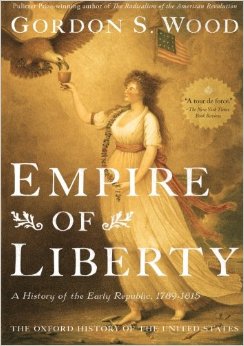
But in his two books Empire of Liberty, and The Idea of America acclaimed historian Gordon Wood makes the point that the Constitution tried in fact to stem the rising tide of “liberty” and change unleashed by the “spirit of ’76.” The Constitution may not have been a completely “reactionary” document but it was a response to a quick erosion in society of what many elite revolutionaries like Adams and Madison held dear.

Through various quotes and citations, Wood lists the changes seen and feared by such men in the 1780’s . . .

  • A loosening of traditional relationships between men and women — parents had much less control over who their children married.
  • Riots and protests against professors at the few (and elite) colleges by many students demanding curriculum changes, attitude changes, and the like
  • A decided turn against the virtues of the ancient Romans and a great movement toward the ideas of tolerance and conviviality as the means to hold society together
  • Democratization of religion, which became much less authority driven and much more ‘touchy-feely.’
  • Extreme partisan politics on local levels, with stories of violent behavior in state legislatures rampant.  The rise of the “party-spirit” in politics bewildered many.
  • Both “free love” and drugs going mainstream into the culture

Ok — the last is not true, but if one looks at the list, it looks quite familiar to us, making us think of the 1920’s or the 1960’s, or today.  Maybe we must face the fact that this is what America was, is, and ever shall be.  As Alfred North Whitehead once said, “The major advances in civilization are processes which all but wreck the societies in which they occur.”

Wood asserts that while the Constitution succeeded in establishing a structure that put up some barriers to change, overall the idea of liberty and “the people” triumphed over the Constitution’s conservative aspirations.  In the end, the idea liberty and the reality of the voice of the people ended up remaking the Constitution in its own image.  The Anti-Federalists, those who opposed the Constitution’s ratification, lost the battle but won the war.  The best the ideals of Washington and Adams can do now is fight rear-guard actions against the overwhelming power of the “people.”

Though initially shocking to our sensibilities, the idea of a reactionary Constitution helps make sense of much of American history down to the present day.  It also partially explains why appeals to the vision of the founders, or the intent of the founders falls on deaf ears.  For one, Madison and others probably believed that the factional “evils” they saw in state governments would not transfer to the national legislature.  Perhaps Madison wanted a stronger national government because he thought that only the “better sort” would get elected to the national legislature and thereby elevate discourse.  This “better sort” would not fall prey to party politics.  He sought then, more power not so much to the national government but to the “better men.”  However strong Madison’s hopes on this score, they quickly proved illusory.  Madison and others like him either misinterpreted or remained ignorant of exactly what their revolution had wrought.**

At a deeper level, two other questions arise.  Can the structures of organizations curtail underlying driving principles that form such organizations?  I tend to side on this one with the Jurassic Park dictum, “Life finds a way.”  The early “conservatives” could not call upon the spirit of self-determination in 1776 and then expect to put the toothpaste back in the tube once the Revolution had accomplished what they wanted it to.  The population at large could rightly retort, “What about us?” Bowing to the “will of the people” became a necessity, and eventually, a foreordained, positive good. Even a Constitutional “literalist” or “minimalist” like Jefferson gladly dispensed with his principles with the Louisiana Purchase, among other instances.  Like a nuclear blast, the concept of “liberty” leveled everything in its path.  What mattered to most was not the past, but the future.  The founders had done their part, but our vehement abhorrence to anything smacking of aristocracy made us quickly resistant to anything resembling the determining “tyranny of the past.”  John Adams, among others, quickly tried to assert that, “Wait!  That’s not what we meant!”  Most responded with some form of “I don’t care!”  Within a generation of the Constitution’s ratification, “egghead” professions like that of lawyer already were viewed as “elitist” by many, especially towards the frontier.  The seeming radical nature of the “Jacksonian Revolution” actually had its roots laid years prior.

Wood deals with the slavery question related to these political questions, but I found his analysis of the relationship between Americans and Native Americans more intriguing.  He writes,

Conceiving itself as a composite of different peoples, the British Empire could somehow accommodate the existence of Indians within its territory.  But the new American Republic was different: it contained only citizens who were presumably equal with one another.  Since the United States could scarcely imagine the Indians as citizens equal to all other American citizens, it had to regard Native Americans as members of foreign nations with which treaties had to be negotiated.  Of course, most of the Indians themselves had no desire to become citizens of the American Republic.

While the 17th century colonists did fight with Indians, little doubt exists that American Independence proved a disaster for Native Americans.  Problems began years before the war itself — one of the driving issues behind the Sugar Act and Stamp Act involved keeping colonists off Native American land.  Wood’s reasoning fits with de Tocqueville’s thoughts on equality, and the problem persists today. We have yet to work out the tension between liberty and equality.  When the “people” speak (however we measure this) we cannot tolerate deviation from the norm.  The example of Bruce/Caitlin Jenner speaks to this.  How many ESPN commentator’s could keep their jobs and declare that Jenner is tragically mistaken in his actions?  To be fair, had ESPN existed 50 years ago, could anyone have then applauded his actions and kept his job?

One unsaid implication of Wood’s book is pride of place between the American and French Revolutions.  Most see the American Revolution as giving birth to the French Revolution, with the French Revolution as the bastardization of all that went well in America, then withering on the vine as Napoleon took over.  But we might instead see the French Revolution as the real victor, with its sense of the power and authority of the “people” in more or less full swing by the early 19th century in America.  He who laughs last laughs loudest.  Or perhaps both of these positions wrongly presume an essential difference between the two events.  Maybe the American Revolution started to resemble the French Revolution because they had the same origins — fraternal if not identical twins.  If we consider this option, then we may need to reevaluate America history as a whole — an exciting if not daunting task.

“A man’s worst difficulties begin when he is able to do as he likes.” — T.H. Huxley

Dave

*We should note that those at the the Constitutional Convention had different ideas, and others whom we might consider “founders” like Patrick Henry, John Adams, and Thomas Jefferson were not at the Convention at all.

**Wood cites a variety of sources to demonstrate that the traditional understanding of the need for the Constitutional Convention being the weaknesses of the Articles of Confederation are false.  Many had perfect awareness of these weaknesses and their fix remained relatively simple.  The real concerns of men like Madison and Washington lie rather in their observations of the petty bickering of state legislatures, and the fact any man Jack seemingly could get elected to state legislatures.

Mapping the Middle

Some years ago I listened to an interview with a historian whose name I cannot remember, but she made a startling observation I had never before considered. We cherish the idea of voting in our secret booths. Many regard it as impolite to ask who one voted for. But this method, so cherished as a foundation of democratic practice, has a purely modern origin.* In ye olden days we voted in public, sometimes simply by standing on one side of a room, with those voting for the other guy on the other side, and then counting heads. In a republic, thinking went, one should live openly with their fellow man. The idea of ‘private’ political opinions would have seemed absurd and anti-democratic to Americans of the early-mid 1800’s.

I come back to this nugget often, for it reminds me that things we assume about the ‘absolute’ meaning of America, or democratic identity, may not be quite what we assume. Stories like this also should help us reflect on whether or not the more things change, the more they stay the same.

Gordon Wood needs no praise from me. I find his analysis consistently penetrating and illuminating. One reason for this . . . he seems to know how to appreciate the weirdness of American history and maintain tension between competing perspectives. For those who praise America’s unique role in the history of western civilization, he can say, “Yes, but . . . ,” and for those that decry our faults, he says the same. He draws us into an appreciation for the tensions and oddities of our national life. The best historians make the past seem at once strange and yet familiar. Wood accomplishes this with deep learning and a light touch. His book Power and Liberty: Constitutionalism in the American Revolution serves as a great summary of some of his previous work.

Some surprising details emerge here. We know that the founders had many differences on a variety of issues, but I didn’t know that they had unity in their condemnation of . . . Rhode Island. They objected not to their religious oddities, inspired by the likes of Roger William’s and Anne Hutchinson, nor to their commercial turn–something Alexander Hamilton, at least, appreciated. No, they directed their universal ire towards Rhode Island’s use of paper money. “The cry for paper money,” John Adams commented, “is downright Wickedness and Dishonesty. Every Man must see that it is the worst engine of Knavery that ever was invented.”

Of course we can choose to smile benignly and call them curmudgeons, but Wood reminds us in a variety of other places the radical and progressive nature of the American Revolution. The fact that more or less everyone across the spectrum condemned Rhode Island should tell us something. All knew that paper money represented a loosening of the hierarchy, and a preference for debtors over creditors, Whether they consciously intuited it or not, paper money also meant a more fluid and democratic society than perhaps any of the founders desired.

In discussing the Constitutional Convention, Wood mentions a curious bifurcation in American society. Some progressives and libertarians call the Constitution basically the byproduct of a conspiracy. This groups sees America in the 1780’s as flourishing and in no need of significant alteration. As usual, Wood answers, “Yes, but” and adds nuance. Various state economies performed well in this decade, but the problem lay in the strong commercial push for markets and regulated trade. The government under the Articles of Confederation had no powers regarding trade. This desire for markets ran so deep that Wood suggests a significant portion of Americans would have allied with any foreign power that would ensure their products access to the sea. George Washington commented of such folk in 1784 that, “the slightest touch of a feather would turn them any way.” We needed some kind of stronger national government. But Wood agrees that had the American people actually known how strong a government some of the delegates to Philadelphia wanted during the summer of 1787, they might very well have shut down the process entirely.

Most key members of the Convention sought to supersede state government power with the Federal government, but the theme that almost no one who helped start the American Revolution truly understood what they had unleashed runs throughout Wood’s work. This sometimes had good effects such as with the slavery question. Wood argues that we had a blindness about African-American slavery before the Revolution because we had a basic blindness towards white “slavery” as well. White “indentured servitude” was indeed not the same as “slavery” as we know it, but it was close, most particularly in the idea that owners could sell the labor contracts of their servants. Also,

“because labor was so valuable in America, colonists enacted numerous laws to control the movement of white servants and prevent runaways. There was nothing in England resembling the passes required for traveling servants. . . . No wonder newly arriving Britons were astonished to see how ruthlessly Americans treated their white servants. ‘Generally speaking,’ said William Eddis upon his introduction to Maryland society in 1769, ‘they groan beneath a burden worse than Egyptian bondage.'”

This started changing when the rhetoric of revolution started focusing on “slavery” to England, making “slavery” unacceptable to many for the first time–again–this was not the plan. Wood, a critic of the 1619 Project, wants to focus on the significant progress made by the revolutionary impulse to end slavery/servitude in most of the colonies, rather than its tragic persistence in some. Of course, slavery didn’t just persist in southern colonies, it actually dramatically expanded from 1775-1850. At least here, Wood cannot explain how the impulse that ended slavery in some places seemed to increase it in others. By the early 19th century, one could accurately describe America both as dramatically more and less free than England.

Perhaps because Wood possesses great knowledge and a great ability to parse the details, he cannot quite bring the unusual disparities of America into an explanatory whole. We have already touched on the freedom/slavery divide, but others exist too:

  • Some wanted much less central unity than England had, some wanted much more power for the federal government over states than King George ever had over colonies.
  • The equating of land with freedom, and the “ravenous” appetite for land among colonists that shocked European observers, despite land’s vast abundance.

If we see America in a spatial, symbolic/mythological way an explanation emerges.

Many look at medieval maps and wonder, “what in the world . . . ?

The Hereford “Mappa Mundi,” ca. 1250 (?)

At first glance, and at a second and third glance, the map gives very little physical information. At times the physical data it gives is not even accurate, such as the separation of England and Scotland on the map above. But if we see the map as a means of guiding us to understanding how to navigate the world, or a “map of meaning,” we see as the medievals (and other cultures before them) saw.**

This post has little to do with the map directly, so I will limit my comments to its application for America. If you magnify the map, you see that towards the edges, one meets strange creatures. Reality starts to blur, there exists at once a strange mixing and a strange separation of bodily form, yet also, if managed rightly, a chance for wisdom and new growth. This happens on the “fringe” of reality. Most every great story involves the hero leaving home and being remade, casting bread upon the waters that it might return–in short–heroes must successfully navigate the fringe.^

The key to managing the fringe first involves understanding its meaning. We can consider alcohol as one example of how the fringe works. Taverns and bars have always been a place to meet others and mix. This is not an arbitrary social convention. Alcohol serves to “loosen” us, which is why we should drink only in the evening, as our being naturally gets looser as we move towards sleep. This “loosening” facilitates mixing and mingling with others more easily. So, “Can I buy you a drink?” works better as a pick-up line than, “Can I buy you some carrots?”

But one must be careful. If we stay too long on the fringe–i.e., drink too much–our being splits. We may discover too late that we have “mixed” with someone we should have avoided. Notice too that those who get drunk tend to experience either an unnatural extremity of the fringe (they are over-social, thinking everything is funny, etc.) or they get surly and overly anti-social–i.e., they seek to return “home” from the fringe but return misshapen. They attempt to recalibrate their mixing but their “monstrous” form, acquired from too much transformative “mixing potion,” means they cannot “tighten” themselves with proper form and grace. The moral of the story–one should not stay too long on the fringe.

Though we may not see it easily now, for European settlers in the New World, America was “the fringe,” The glories, degradations, and strangeness of America have their explanation here. Europeans traveled out to the edge, and decided not to return but camp out for good. This has several implications:

  • I have already alluded to the “more free,” and “less free” polarity.
  • Those who wanted to try and implement extreme forms of religiosity might find a home here. The Puritans could implement their views, but the continual implementation of their ideas required close knit communities, which “the fringe” would naturally work against.
  • Those who wanted to basically try and transplant something of the society of the English gentry, like many of colonists in Virginia, could achieve this only through strenuous effort and hence, malformation. This could explain the large number of slaves in Virginia.
  • Washington’s desire that we eschew political parties had no chance of success whatsoever. The fringe brings out extremes and divides us.
  • It might additionally mean that the fringe would define America. Examples might be–American literature has its origins with Twain, who lived out west on the edge of civilization. Many of our folktales involve strange, misshapen people, or those who lived in continual movement (Daniel Boone, Jonny Appleseed, Paul Bunyan, etc.). African Americans, who resided obviously on the social fringe, created some of the best and most noteworthy culture, especially in terms of music. Finally, when we got out as far we could physically go on the fringe (California), we made this “fringe of the fringe” America’s heart with the advent of Hollywood.

We can quickly see that some of this is good (who wouldn’t take American 20th century music over any and all European countries?), some bad, and some of it confusing. It is the fringe, however, that defines American life, and this means that we will experience extremes, and that the lines between “good” and “bad” will blur quickly, right before our eyes. This template also explains much of early American history and the heightened versions of good and bad we see.

Thomas Jefferson took great pride in helping Virginia, and in time, all of America, to develop the practice of religious tolerance and avoiding state sponsored religions. Wood suggests that Jefferson thought this meant that a democratic people could arrive at an “enlightened” understanding of religion that would abandon dogma. Madison thought differently, and knew better. We allowed for toleration only because we feared the monopoly that other religions might gain. Mutual collision, and not mutual understanding, made us “healthy.” Lacking a defined core, “collision” was our last, best option.

The American Revolution saw the European fringe break decisively from the core. Once free, new practices embedded in the ideas of revolution spread rapidly. Having lived on the fringe, Americans could navigate the changes rather easily. When a society with a more traditional core, such as France, tried something similar, it had a much more disruptive impact. When the ideas migrated into an even more traditional society like Russia toward the end of the 19th century, an oppressive tyranny reigned for 70 years, instead of the five we saw in France.

Americans love to spread their ideas, and always have. We believe that our beliefs and practices should transplant everywhere. Many of us look around us and surmise that significant change is coming for western civilization. I don’t think I will like many of the changes coming, but I take some comfort in knowing that America has a large bandwidth for adaptation. My concern lies in what happens when these new ideas migrate into more traditional societies. The impact there will be more traumatic (i.e., Russia and Ukraine?).

Ok, my concerns also lie with us. We need a middle to navigate the extremes, but alas, “middle ground” will always be elusive on the fringe.

Dave

*The historian was not entirely sure of why this switch happened, but speculated that it likely had something to do with Victorian ideas of propriety, and with the new involvement of women voting. In ye olden days, fisticuffs on Election Day with those on the other side were relatively normal occurrences. But with the new system, one didn’t know how the other voted, which made fighting much less likely.

**In this case, obviously the creators of the map knew that England and Scotland were geographically connected, but they remained culturally separate in their experience. The map then, reflects an understanding of their experience, not a mere physical representation.

^There is a great present in Scripture about the core, fringe, etc. if one knows how to look. Consider creation in 6 days, and leaving 1 untouched, leaving something on the edge of plowed fields, not weaving one’s garments to totality (i.e., leave the edge of your garments with a fringe), and so on. But just as Christ ministered first on Israel’s geographic fringe, He came to back “home” to Jerusalem.

8th Grade Literature: Iceberg Theory and the Hemingway Paradox

Greetings all,

WIth this blog I hope to keep you updated on some aspects of our class. I will not convey everything about our week, but hope to give you insight into some of the main points of focus and discussion. I hope you find this helpful.

Our summer reading was Hemingway’s Old Man and the Sea, his most famous and best beloved story. The plot is simple, perhaps almost aburdly simple. A poor, elderly fisherman named Santiago journeys out on his skiff. He hooks and fights a huge marlin for three days. He eventually lands the fish, but then has the problem of getting it back to shore intact. As he rows back to shore, sharks come and eat the fish, leaving him with nothing but its skeleton when he lands. But Santiago remains content. He is a fisherman and has done what a fisherman should do. He knows who he is.

Hemingway’s story has several important themes, such as man vs. nature, and the essence of human life, dignity, and identity. But at the heart of the story is a paradox, rooted both in Hemingway’s style of writing, and in his development (or lack thereof) of his main character, Santiago.

First, his style of writing . . .

Many credit Hemingway, along with Mark Twain, of pioneering a distinctively American style of writing. He uses simple sentences and simple words, at times writing in a somewhat offhand, stream of consciousness. He rarely if ever introduces large metaphysical or theological questions. What you see is what you get. In this way, Hemingway’s writing mimics the plain, open approach of the common man. Many famous commentators, such as Alexis de Tocqueville, see Americans as primarily doers, not thinkers. Hemingway doesn’t argue, but rather leans into this conception of American identity.

Hemingway may not have invented his particular style, but he pioneered a concept of writing called Iceberg Theory. His approach allows the reader only to see the surface of the characters–what one can observe in “real life.” Most authors give the reader insight into the character’s thoughts and inner life. Hemingway rarely grants this insight. For the most part, the reader gets to observe the characters but is limited to seeing their actions and words. In this way, Hemingway presents his readers with something more realistic. In real life when we observe others we would not have omniscent access to their thoughts and motivations. Hemingway writes in the same. Of course his characters have deep seated motivations just like any person, but they remain below the surface. We have to guess as to what lies beneath.

Herein lies the paradox of Heminway’s style, which is both transparent and opaque all at once.

On the one hand,

  1. Hemingway’s writing reflects everyday reality that all experience all the time. His writing is “common” and “relatable” in this sense.
  2. His plots and his characters are open books, making them, in a certain sense at least, easily understandable to anyone.

On the other hand,

  1. While we can easily discern the plot of the story, without access to the character’s inner life we have no easy way to determine why anything happens. This is no coincidence, as Hemingway seemed much more interested in the “what” than the “why.” “Why” questions are burdensome and hinder one from living fully.
  2. This in turn, means that an author lauded for his humble and transparent prose can write stories that confuse his readers. Many of the students, for example, perfectly understood the plot but had “no idea what happened.” With this comment, they meant that they had no idea what the story meant, or how they might apply it to their lives.

We can push further, and see how Hemingway mirrors the paradox of American individualism and society as a whole. Many foreign visitors to America are surprised by the frank openness of most Americans they encounter. Frew other countries are as immediately transparent with those outside of their community as are Americans. But Americans are also much less communal than people in most other countries. Our suburbs, technology, and habits isolate us from one another. Both of these observations can be true at once.

The character of Santiago perfectly melds with Hemingway’s style of writing. Santiago constantly reminds himself throughout the story to stop thinking, and focus on the moment in front of him. He is a beloved figure in his village. But at the same time, he lives alone, with no family and no direct connections to the village around him. He has one friend, but in keeping with the “Hemingway paradox,” this friend is a much younger boy. The boy loves Santiago, but of course, cannot really relate to him or connect with him.

This coming Monday, the students will discuss some aspects of this paradox in our first formal discussion.

Thanks so much and have a great weekend,

Dave

8th Grade Civics: The One and the Many

Greetings Everyone,

Welcome to the first post of the year. I hope that students will find these updates helpful for review, and parents will enjoy getting a sneak peek into the classroom. Perhaps these updates can help you continue the conversations we have at school at home if you so wish.

One of the main goals of the year involves understanding our own system of government, how it functions, and what we value. To best do that we want to begin at the beginning, and that means not 1776 or 1620, but with the created order. When we understand the world God made and note the crucial emphases God gives us in Geneis, we can then see how to interpret our experience of creation and how to best live within it. As Romans 1 states, when we properly understand the created order, we can better know God, and the same is of course true in reverse.

With that in mind we looked at Genesis 1 and 2, making a few important observations::

  1. Unity and Distinction–Creation has an inherent unity, as all comes from God, and everything arises from the formless waters. But from this unity, God then makes distinctions between night and day, sea and land, male and female, etc. This expression of the one and the many has its roots in the nature of God Himself, who is one God in Three Persons, Father, Son, and Holy Spirit. The relationship between the one and the many has occupied the mind of many theologians and philosophers, but also has significant implications for how we think about political order.
  2. Names–God creates through speaking and naming, and in giving various aspects of creation names, He gives them an identity apart from other things. This is how God makes order out of what was once “formless and void” (Gen. 1:2).
  3. Mankind–There are many, many implications for mankind being made in God’s image that we cannot unpack here. For our purposes, however, we can say that having the image of God means that we are made like God (at least in some ways) and should pattern our actions after Him. Scholar Meredith Kline has suggested that the first three days of creation involve God “subduing” creation, with days four through six about “filling” creation. Mankind are given the same task. We are meant to mimic God. So Adam names the animals, and Adam and Eve are to “fill” the earth.

This has implications for how we view the purpose and role of governments in the world.

We can interpret Scripture in a linear fashion, from Genesis to Revelation, and this certainly has importance. But at least as important (if not more so), is viewing history and Scripture Christologically. In chapter one of his gospel, the Apostle John obviously references Genesis 1 (“In the beginning was the Word . . . ) and reframes our view of the world. In some ways, the Incarnation is the creation event, of which Adam and Genesis 1 and 2 are images, or reflections. We can thus read scripture and history forwards and backwards through Christ, for all things cohere in Him (Col. 1:16).

This has enormous implications far beyond my ability to comprehend, let alone apply fully to our class this year. However, for our purposes we can note a few implications for thinking about political order. For one, we see the primacy not of the world, or civilization, but of the human person (i.e., “the sabbath was made for man”). A human being is one person, mirroring the unity of God. But we are also composite creatures, (body and soul), which perhaps dimly reflects the distinction in the Godhead.

As I mentioned at Orientation, my goal for the class is not so much to change anyone’s opinion, but to help students unpack why they reach their conclusions. To that end, what one believes about proper powers and roles of government has its roots in how we see government in relation to the fall. Christians have disagreed about this question for many centuries, but we need to see the downstream implications of our view. On the one hand,

  • Augustine (and others) see government as a byproduct of sin, and would have no reason to exist without sin. Thus, government’s role should primarily involve dealing with the problems caused by sin. Some who believe in “limited government” look to Augustine for inspiration.
  • Thomas Aquinas (and others) see government existing before the fall, and part of our role as image bearers of God. Just as God governs the cosmos, so we, being like Him, bring order to our world. Thus, those of this school would not necessarily limit government’s functions to dealing with sin, but perhaps want to expand its functions into the promotion of harmony and the “good life.”

Both sides have good arguments, and we will continue to unpack them next week.