11th/12th Grade: The Left-Handed 1920’s

Greetings,
This week we wrapped up the Versailles treaty and introduced the “Roaring 20’s” in America, a time when the mood of the country shifted significantly away from the values of the Progressive Era, and what it meant to be an individual in America took on new meaning.  We discussed a few different things:
1. The Automobile
We take cars so much for granted these days we might forget about how they changed so much of ordinary  life when originally mass produced.  How did cars change things?
  • They made us more personally independent and mobile in general, although in time this became especially true for youth.  Cars became the equivalent of what making a name for yourself in the western frontier might have meant for generation in the 19th century.  Americans love cars, and not just for convenience sake, but because cars still feed our sense of identity and independence.
  • The car freed people from geographical limitations.  But this “freedom wasn’t free.”  The increase of our geographical mobility lessened ties to our local communities and families.  In an age less overtly Christian than previous ages, people would find their concept of community increasingly in the nation itself.
2. Prohibition
Prohibition failed in nearly every respect and must rank as one of our worst legal experiments.  It’s genesis had to do with a weird conflagration of unusual interests.  For example, the KKK backed prohibition as part of their overall anti-immigrant anti-Jewish agenda, but many women’s groups did as well.  The political power of women’s movements grew in the years prior to Prohibition, which culminated in the 20th Amendment giving them the right to vote.   In any case, Prohibition’s failure led to some good questions for us to discuss.
Why did it fail so badly?
Prohibition served as the last gasp of the Progressive Era, a time of energetic communal action to make things “better.”  But one can wind things so tight for only so long.  The war had exhausted much of that energy, and Warren G. Harding propelled himself to a landslide victory in 1920 based on his made up phrase, “A return to normalcy.”  And yet we picked just this time to forbid people from doing something they had always done, a juxtoposition made all the more awkward by the increased independence given by the car and the nation’s newfound status as a global economic power.
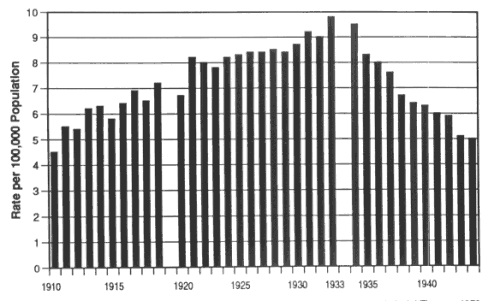
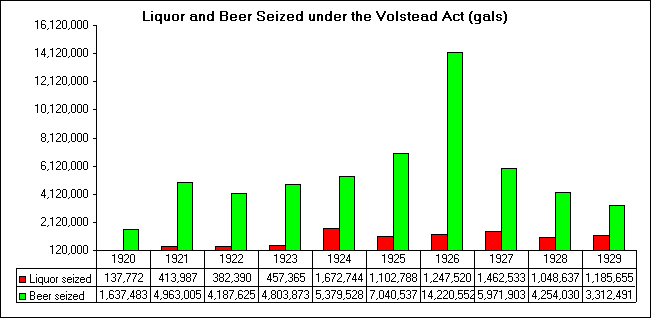
Here are a few indications of that failure, the first being crime rate:
Prohibition Era Crime Rate
 People were certainly not drinking less during Prohibition. . .
What comparisons can be made with the Drug Wars of Today?
Many have compared our current failures in the “War on Drugs” to our failure during Prohibition.  Is such a comparison justified?
Prohibition and Crime Rates
Despite some important similarities, alcohol has been used and abused in every age.  It has formed the fabric of many religious rites and celebrations across time and space.  Narcotics simply do not have the roots in human experience that alcohol does.
Another difference is that, while the vast majority use alcohol appropriately, narcotics destroy the lives of most all who use them.
This does not mean, however, that practical realities may not force our hand in some respect.  Some in the class advocated strongly for much less tougher laws on even the strongest narcotics.
3. The Culture that Was the 1920’s
“Ragtime” reflected and helped fuel the image and feel of the 1920’s.  Here is Scott Joplin’s “Maple Leaf Rag”
We can see how the tempo and bounciness of the song reflects the spirit of the times.  But the innovation of “Stride Piano” in the later 20’s only fueled this sense of ‘movement.’  Here is James Johnson’s famous “Carolina Shout.”  Note the active and “bouncy” left hand in the bass clef, and how he plays around with standard meter.  The herky-jerky unpredictability of the song can be seen in sections like .49-1:12.  In the topsy-turvy world of prohibition, cars, women voting, and so on, here was music to fit its time.
To see a modern stride pianist where you can visually get a sense of the movement in the left hand, see the video below (fast forward to the 2:00 mark if you get impatient:)
Most of the time the right hand leads the way in piano music, but here the left steals the show, which again makes things seem upside down.   Music and society connect once more.
Hope you enjoy the music,
Dave Mathwin

8th Grade: The Country Rome and the City Rome

Greetings,

This week we started our unit on the Romans, where will remain for the rest of the year.  We began by looking at Italian geography and made the following observations:

  • Roman civilization began not in the more fertile southeast of Italy, but in the more challenging south-central area near Rome itself.  We have met the concept that civilizations flourish not in ideal circumstances, but moderately challenging ones, as in other civilizations like Egypt.
  • We noted that unlike Greece, Italy favored more agriculture. While Italy is a peninsula and never too far from water, it has a fairly even coastline without many ports.  The best ports are in the southeast, but Rome did not get there until nearly five centuries of its history had elapsed.  By that time, Rome had a thoroughly rural bent to their way of life.
  • If one stands in Rome, it seems the land tended to run downhill in a north-eastern direction.  If true, even slightly, this may help explain why Rome’s conquests ran initially towards that direction.  This in turn meant that Rome would not have any significant interaction with the naval oriented cultures of Greece and Carthage until around 300 B.C.  So, while Greece and Rome would inevitably share certain similarities due in part to their common geography, Rome developed along different lines than Greece in the early part of its history.

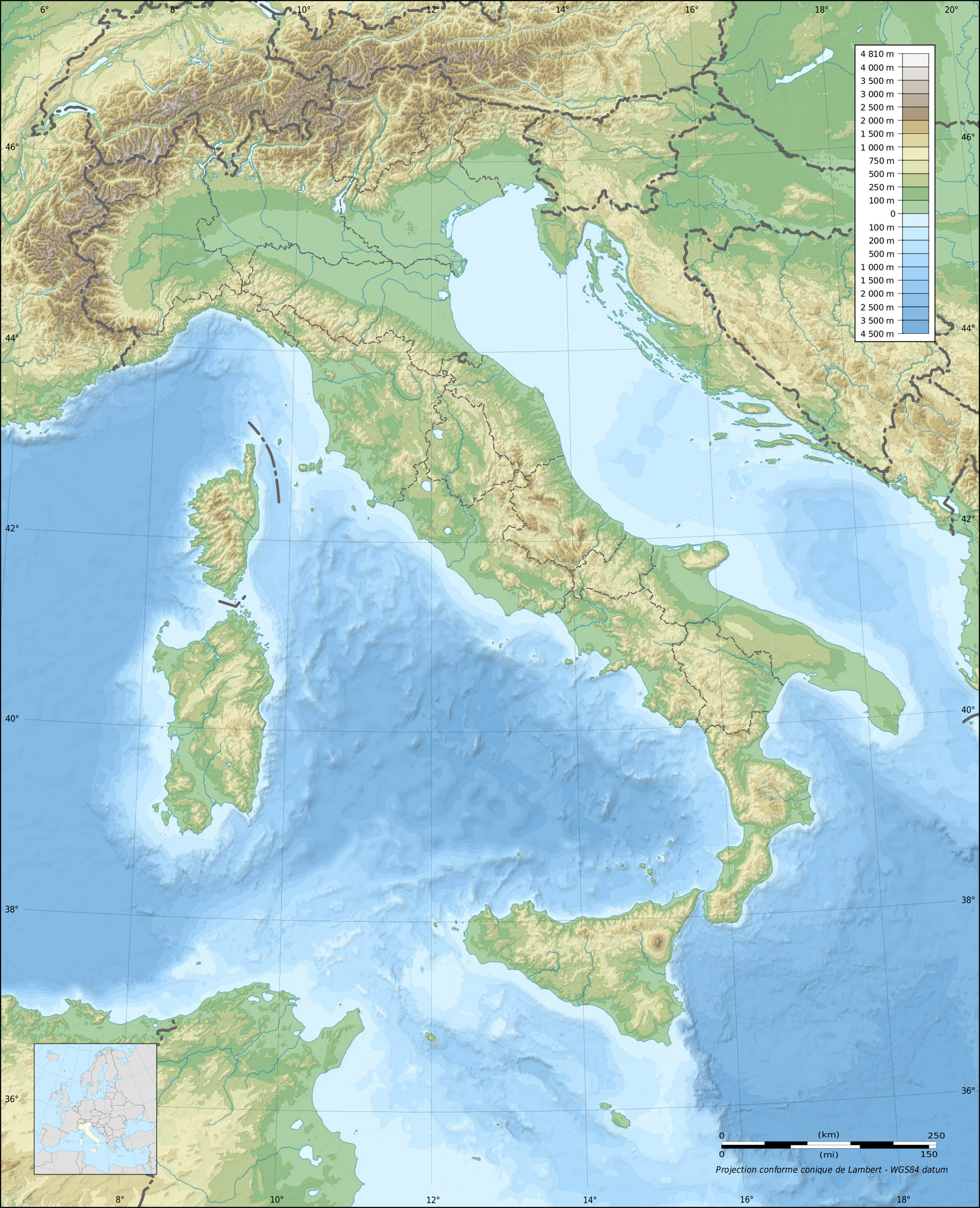
Here is a topographical map of Italy:

This agricultural bent of Rome shaped their civilization in ways similar to other agriculturally oriented areas, like Egypt.  Just like rural cultures today, Rome based much of their way of life around tradition, the past, routine, and practicality.  Both urban and rural cultures have strengths, but a key question for Rome would how they would react when they did interact with the more cosmopolitan Mediterranean.   When it comes, this clash will determine the fate of Rome, Greece, and Carthage.  As Rome conquered others, they could not avoid confronting the possibility of changing their own identity.

We likened Rome to a young farm boy (we’ll call him ‘Jim’)who goes off to New York City for college, and postulated three different outcomes.

  • Benign Awkwardness — Jim doesn’t really fit in city life, and knows it.  He try particularly hard to fit in either, and soon wearies of his clumsy attempts.  He keeps his rural identity, plugs along more or less alone at school, goes home on weekends, and returns home after graduation.
  • A Happy Medium — Here Jim keeps his roots, but also approaches NYC with an open mind.  He learns to see the good and bad of both city and rural life, and picks and chooses from both like a cafeteria menu.  The experience changes Jim, but he learns to enjoy both environments without changing who he fundamentally is.  This ideal reaction, however, is probably the least likely of the three possibilities I list here.
  • Drink from the Fire hose — Jim becomes completely enamored with his new surroundings.  He chucks his rural identity and jumps in with both feet into city life.  Tragically, he doesn’t even manage to attach an urban identity to himself.  He so obviously ‘tries too hard’ that he fails to find acceptance, and this rejection only makes him try harder.  His actions leave him with no identity at all.

How Rome faces this challenge will be the subject of our study in the weeks to come.

Next week we will look at Roman religion and the extreme emphasis on the practical over the theoretical.  Again, it will help us if we remember that Rome was a nation of farmers, who often have little use for theory and speculation, and who focus on soil, crops, and so on.

Ancient chroniclers agree that the Romans were a religious people, unlike the Greeks.  But their sense of religion was also much different than in Egypt, for example, another ancient “religious” people.  In Egypt, their beliefs filtered down into the government, architecture, and where they lived.  Their literature is filled with stories of the gods.  They wrote psalms/hymns of praise to their gods.

We see nothing like this in Rome.  The Romans had devotion to their religious duties, but they saw “religion” usually in terms of “checking off the box.”  They would do what they needed to do, but rarely did their religion touch their souls, and a variety of stories from their past illustrate this.

Machiavelli recounts a story from Livy, where a Roman general wanted to attack the enemy, which I recount below. . .

The consul Papirius, in conducting a war against the Samnites, [saw a favorable moment to fight], and ordered that the priests take the auspices.  The birds, however, did not eat.  But the chief priest, seeing the great desire of the army to fight, and their confidence in victory, reported to the consul that the auspices were in fact favorable.  But one of the assistant priests told the consul that the chief priest lied.  . . . And so the consul put the Chief Priest in the front ranks of the army, and it happened by chance that a Roman arrow struck the chief priest, whereupon he died. When Papirius heard this, he declared that whatever wrath the gods felt toward them had been appeased, and thus by apparently to accommodate his designs to the auspices, Papirius gave battle without giving the appearance of neglecting his religious duty.

Was the general ‘impious?

According to the Romans, not at all.  He did his duty.  He took the sacrifices.  A priest told him that the gods approved.  And they won.

Machiavelli relates another story. . .

Appius Pulcher acted just the contrary way in Sicily during the first Punic war; for wishing to fight the Carthaginian army, he caused the priests to take the auspices, and when they reported that they did not eat, he said, “Then let us see whether or not they drink,” and threw the birds into the sea.  He then went into battle and was defeated, for which he was punished in Rome.

The historian Livy goes on to say that Pulcher was not punished for losing, but for his brazen impiety.  Paprius “kept up appearances,” whereas Pulcher did not.  But I have doubts.  If Pulcher had won the battle, would he have been punished?  What these stories show, I think, is that Rome really worshipped Rome itself.  All things bowed to glory of Rome.  Was then their religion a mere smokescreen?  We know, for example, that Roman religion technically forbade offensive war of any kind, yet they became one of the greatest conquering empires they world has ever known.  Something it seems, gave at some point.

Blessings,

Dave

8th Grade: Burning Out vs. Fading Away

Greetings,

This week we wrapped up our look at ancient Greek civilization.  The death of Alexander the Great allowed for the Greek city-states to try and rebel once more from Macedon.  They did not have the strength to do it on their own, so they asked for help from Rome.

As the Greek’s found out, however, it’s dangerous to ask Rome over to visit.  They had a knack for overstaying their welcome.  From around 200-150 B.C., Greece became a satellite of the then mighty Romans.  Their culture lived on in a kind of degenerated way afterwards (see Luke’s comment in Acts 17:21), but as an independent political entity, they were done.

As we leave Greece and introduce Rome I wanted the students to think about the following choice.  I chose basketball because of March Madness, but one could apply the same concept to other areas of life.  In class we had fun thinking about the ultimate hamburger, for example.

Choice #1

You will be given the ability to dunk, but only one time.  However, this dunk can be the most spectacular dunk you can possibly imagine.  You can jump from half-court, do a double summersault reverse spin, twirl, reverse jam — whatever you can think of.  Furthermore, you will execute this dunk in stadium full of people, and it will immediately go viral on You Tube.  The dunk will be forever known as the greatest dunk of all time.

Or

Choice #2

You will be given the ability to dunk as often as you like.  You will be able to dunk in games, but the dunks will be unimpressive, and not noteworthy in any way.  But it will be a dunk, and you will be able to do it whenever you wish.

This choice illustrates one of the differences between Greece and Rome.  In their heyday Greece ended up bequeathing more towards the formation of the future than perhaps any other civilization.  They practically invented science, literature, drama, democracy, and so on.  But their run was relatively brief.  They followed Neil Young’s dictum, “It’s better to burn out than fade away.”  They compressed most of their brilliance into about a 100 year period of practically unmatched excellence, but the intensity of the heat may have led to their fire putting itself by devouring all the oxygen around them.

Rome will have many similarities with Greece, as we might expect from sharing the Mediterranean basin.  But I think that one of their differences is that Rome would not have agreed with Neil Young.  They were good, sometimes very good, at most things they tried.  And they managed consistently to achieve this level of “very good” for much longer than Greece maintained their “excellent” status.  But, the Romans never achieved the level of brilliance of Greece.

What kind of dunk the students choose will probably reflect what side they will defend in one of our year’s great debates on whether Greece was superior to Rome, or vice-versa.

Next we will examine Roman civilization.  As usual we will begin with geography.  If we look at a topographical map of Italy, how might we expect Italian geography to influence Roman civilization?  How might this differ from how Greek geography influenced the Greeks?

Many thanks,

Dave

11th/12th Grade: War Narratives and the Failure of Peace

Greetings,

We all know that peace treaties have a shaky track record.  When wars end we hope that the suffering might mean something, that it might translate into a political order that helps ensure that history does not repeat itself.  And yet, often these treaties fail.  We might think of the numerous wars between France and England, for example.  Various forms of “Punic Peaces” work, whether they take the form of utter destruction or sending Napoleon to St. Helena.  Most agree, however, that when we think of “peace” we often have something loftier in mind.

Some treaties do work.  The Civil War will not restart anytime soon.  Japan and the U.S. have been friends since 1945, and the same is true of our relationship to West Germany/Germany.  But many don’t work, and fewer treaties failed more spectacularly than the Treaty of Versailles after World War I.

Historians offer many theories to explain why treaties fail in general.  The typical mistakes usually fall into a few categories or patterns:

1. Failure to View the War as an Organic Whole

Though it may seem artificial, I think that major events should be viewed through a narrative lens.  World War I had its own prologue, beginning, middle, and end.  Wars tend to take on a life of their own once they get started.  As the “story” changes shape one can easily forget how it all started.  But this is a mistake.  A peace treaty should serve as the end of a story that had a certain beginning and middle.  If the end has nothing to do with the beginning, people will hate the ending and demand a rewrite, or at least a sequel.

I think this is one key reason why many treaties end up being no more than pauses in the action.  Combatants want an intermission, but don’t want the end to come just yet.  For them, there remains more to the story.

I think the victors in W.W. I would be strongly tempted to forget this principle.  Any analysis of the causes  of the war would have to blame a variety of factors and nations.  Certainly one could blame Germany mainly for the causes of the war, but other nations had their part to play as well.  Yet the combatants fought the war so grimly, and the death toll rose so unimaginably, that the victors would almost certainly think only of the fighting (the middle) and forget the beginning of the story.  The ending, then, would not fit within the story as a whole.

2. Failure to Look Ahead

Perhaps one can take my “story” analogy too far, because if we try and keep a war purely contained as its own entity, we miss the inevitable ripple effects that have spilled out into society because of the conflict.  Thus, a peace treaty has to deal with the war behind and look ahead to the world it made.  This need to “look ahead,” however, does not come easily.  We rarely see the nose on our own face, and lacking omnipotence, are left somewhat in the dark.

Treaties usually handle the “physical” aspects of ending wars such as reassigning territory, reparations, etc. but rarely consider the psychological aspects.  The horrors of the conflict imprint themselves on our minds, and the victors often want to “close the book” on that period as soon as possible.  We want to move on, relax, be happy.  The victors feel this way, at least.  But often the losers don’t want to move on.  They often want to dwell on the pain and humiliation they feel.  They want to be heard, and will not want to “move on.” Exhaustion on the side of the victors, more than apathy or ignorance, can be society’s greatest foe at this stage.

I think a good example of this is The Congress of Vienna, which decided that shape of Europe after the Napoleonic Wars of 1797-1815.  Millions died as the French Revolution convulsed the world and every monarch knew their days might be numbered.  My interpretation is that the assembled powers, smarting under years of war, tried to put Pandora, i.e. the French Revolution,  back in the box.  They suppressed popular movements, conceptions of “rights” — anything that smacked of the Revolution, and threw the baby out with the bath water.  Some might argue that the Congress of Vienna worked to keep the peace throughout the 19th century, but to my mind the Revolutions of 1848, The Crimean War, the wars of Italian and German Unification, the conflict between Turkey and Russia, and the eventual explosion that was World War I say otherwise.  Pressure cookers explode sooner or later.

3. Avoid Too Many Mixed Messages

Try as we might, mixed messages can’t be avoided.  As parents we give lip service to the ideal that we treat our children equally, but then reality sets in.  The age, gender, and personality of our children all play a role in how we parent.  We modify our expectations and begin to tailor certain things to certain children.  Children pounce on these discrepancies immediately and bemoan their fate, but if parents keep their different expectations reasonable  and at least mostly clear, we can keep the ship afloat.

Every peace treaty should have justice in view, but practical reality will always intervene.  Even the justly victorious must account for the fallenness of the world and the messiness of reality.  The vanquished will seize upon these crossed signals of justice and cry foul, but if the signal mixing is not too serious, they deal with it.

Problems come when the victors take a sanctimonious stance.  The infamous “War Guilt” clauses of the Versailles Treaty did just this.  Germany had to assume full blame for everything, despite the fact that no country had their hands clean during the conflict.  The infamous Article 231 reads,

The Allied and Associated Governments affirm and Germany accepts the responsibility of Germany and her allies for causing all the loss and damage to which the Allied and Associated Governments and their nationals have been subjected as a consequence of the war imposed upon them by the aggression of Germany and her allies.

Versailles also tried to reorder Europe along the idea of “national self determination,” and the elimination of empires.  Such was President Wilson’s grand vision for peace.  So, the war’s aftermath saw the creation of Czechoslovakia, Poland, Hungary, etc.  Except for Germany — Germans don’t get to be “self-determined.”   Some Germans went to Czechoslovakia, others to Poland, others faced occupation by the French.  We can compare the following two maps, the first showing the political divisions, the next, the ethno-linguistic ones, and the differences reveal themselves.

Europe, 1919

Overseas England and France kept their empires, however, but not Germany.  Neither did the U.S. give up its interests in the Philippines.  The gaps between “What we say,” and “What we do” grew very large at Versailles for the allies, and Germany noticed.

4. Don’t Kick them when They’re Down

This applies to Germany, but also Russia.  The Communist Revolution threw Russia into a tumult and made them persona non grata at Versailles.  They too lost big chunks of territory to Poland.  Both Germany and the Soviets had little to no choice on accepting the terms given their immediate internal domestic realities .   But both would seek to, in their mind, “set things to rights” as soon as they had a chance.  In Europe’s case, it took about 20 years for this to happen.

Next week, the Roaring 20’s back in America.

Blessings,

Dave Mathwin

8th Grade: The Possible Alexanders

Greetings,

This week we examined the brief and turbulent life of Alexander the Great, a man who has enthralled people for centuries.  No one conquered more people quicker than he.  Of course, his early death immortalized him and helps us tend to see his successes.

I offered the students four different ways of thinking about Alexander, adopted by different historians in different times and places.

  1. Historian J.F.C. Fuller sees in Alexander one the great men of the ancient world.  In him we see statesman, philosopher, and man of action all rolled into one.  He at times sunk to the morals of his time, but often rose above them.
  2. Some see Alexander as the embodiment of a romantic ideal, a young boy out to change the world, an idealist visionary.  A variation of this view would be one that does not see Alexander in primarily moral terms, but views him as a “force of nature.”  We do not call a tornado good or bad, but we cannot help but stand and stare, perhaps even in spite of ourselves.
  3. Some see him as a great military leader, but a failed statesman.  Great generals win battles, but great statesman get men to transform their view of the world.  Regardless of how we view Alexander’s desire to unite East and West, he failed to sell this to his men and his dream collapsed.
  4. Still others, like Victor Davis Hanson, see in Alexander a common thug, a man who lived to kill.  He massacred Thebans and most in Tyre after their defeats.  Like Stalin, most of those close to him ended up dead.  He demanded practices like prostration, and may have believed what his mother told him, that he was the Son of Zeus.  Hanson sees admiration for Alexander as dangerous, a symptom of boredom and our will to escape this boredom through death.

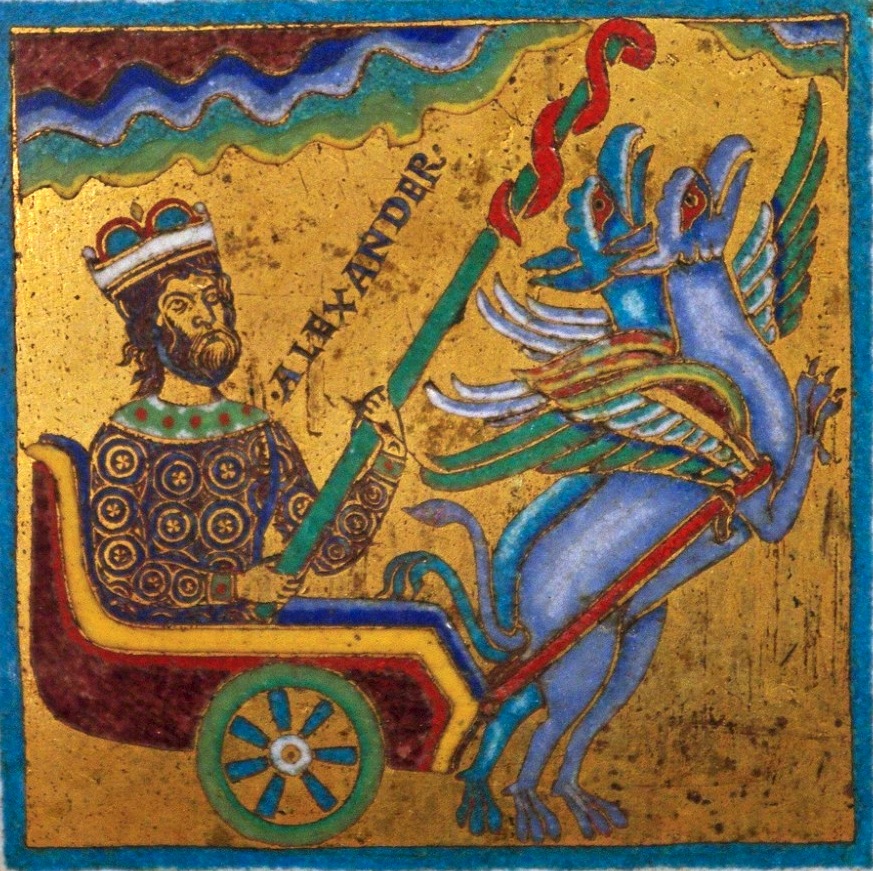
This image of Alexander, though made long after his death, captures something of his madness, focus, brilliance, and lust for conquest:

alex11

alexander2

The battle that defined Alexander’s life and career was Guagemela in 331 B.C.

He had already beaten the Persians decisively twice, but this time Darius III, king of Persia, seemed to have learned his lesson.  He choose a wide open plain for battle, which could maximize his numeric advantage which was probably at least 5-1.  He brought with him chariots, one of the fearsome weapons of the ancient world.  He gave more heavy weaponry to his infantry.

Many of Alexander’s advisors urged him to wait, to go around, or perhaps fight Darius at night.  Alexander would have none of it.  He would not, he argued, “steal his victory.”

How did an army of around 45,000 defeat an army at least 5x its size?

Part of understanding Alexander’s victory is to see that many problems that most generals traditionally worried about Alexander felt he could ignore.  For example, most generals would take troops to protect supplies, but Alexander didn’t mind if the Persians raided his supplies.  If he won the battle, he could march straight to Babylon and have all the supplies he needed.

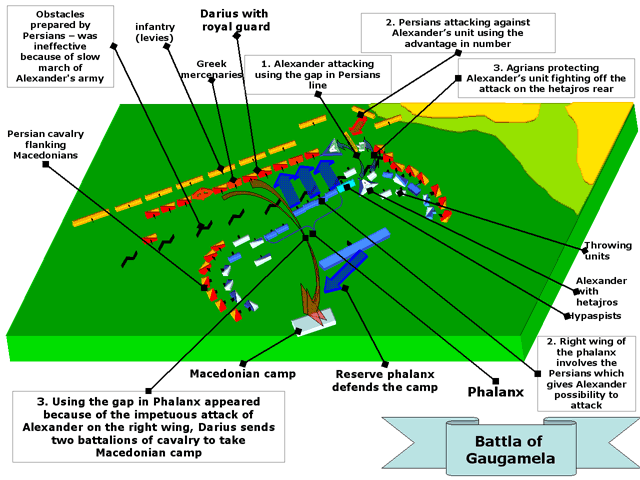
Alexander also believed that he make up for his lack of numbers by speed.  In fact, he probably hoped that the deficiency in his own numbers might provoke the Persians to over-commit themselves in a certain area, leaving a gap in their lines.  By a lightning quick cavalry thrust from what may have been the best cavalry in the known world at the time, Alexander could cause panic and confusion in the ranks, and once that set in, Persia’s numbers would work against them.  Imagine a horrible accident on the interstate that forces people to turn around and redirect their route.  In that case, this redirection would be much more easily accomplished with fewer numbers.  The large amount of cars, or people in our case at Guagemela, would make for nightmarish confusion.

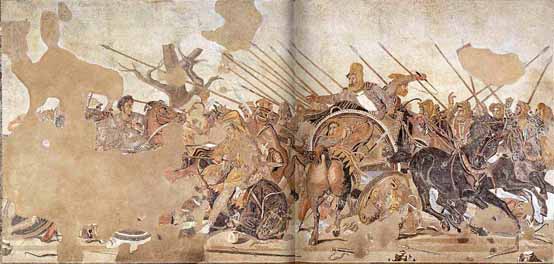
Here are a couple of depictions of how things went.

It was the gap in the Persians indicated by the map directly above, that gave Alexander the opening he needed.  He plunged through and rode right at Darius, who lost his nerve and fled.

I confess that I am cheating a bit with the image above, because most think that this mosaic depicted Darius’s flight at the Battle of Issus two years earlier.   But accurate or not, Darius fled the scene in both battles, and this, just as much as Alexander’s cavalry charge, cost the Persians the battle.

Guagemela stands for all time as Alexander’s most impressive victory and crowning achievement.  It also may have marked a turning point in his character.  Darker elements always latent in him rose to the surface much more often than before.

Dave

The Bottom of the Mountain

“Whatever we may think of Alexander–whether Great or only lucky, a civilizer or a sociopath–most people do not regard him as a religious leader. And yet religion permeated all aspects of his career.”

This opening line of the book blurb for F.S. Naiden’s Soldier, Priest, and God: A Life of Alexander the Great, sucked me right in. I too had viewed Alexander nearly solely through a narrow political and moral lens, and had never really considered his religious views and acts as central to his successes and failures. The book was too long for me. I would have preferred if he assumed reader knowledge of the standard elements of the Alexander narrative. But what Naiden draws out from his expertise in ancient religious rituals helps us see Alexander afresh in certain ways.

Historians tend to think about Alexander along three standard deviations:

  • Great visionary and magnificent strategist, one of the truly “Great Men” that, naturally, and tragically, few could truly follow
  • Fantastic military leader with flawed political skills. After Gaugemela in 331 B.C., his political skills become more necessary than his military skills, and so his fortune waned and his decisions got worse
  • A thug and barbarian who lived for the chase and the kill. He never really changed, or “declined,”–he always was a killer and remained so until his death.

Soldier, Priest, and God tries to bypass all of these paradigms, though touches on each in turn. Naiden’s Alexander is a man who mastered much of the trappings and theater of Greek religion, which included

  • The hunt
  • Prowess in battle
  • A religious bond with his “Companions,”–most of whom were in the elite cavalry units.
  • Responding properly to suppliants

As he entered into the western part of the Persian empire, i.e., Asia Minor, he encountered many similar kinds of religious rituals and expectations. The common bonds and expectations between he and his men could hold in Asia Minor. But the religious terrain changed as Alexander left Babylon (his experience in Egypt had already put some strain between he and his men, but it could be viewed as a “one-off” on the margins), and he had to adopt entirely new religious forms and rituals to extend his conquest.

Here, Naiden tacitly argues, we have the central reason for Alexander’s failures after the death of Darius. Some examples of Naiden’s new insights . . .

Alexander’s men did not want to follow him into India-they wanted to go home. Some view this in “great man” terms–his men could not share Alexander’s vision. Some view this in political/managerial terms–his army signed on to punish Persia for invading Greece. Having accomplished this, their desire to return was entirely natural and “contractual.” Naiden splits the horns of this dilemma, focusing on the religious aspects of their travels east.

Following Alexander into the Hindu Kush meant far fewer spoils for the men. Some see the army as purely selfish here–hadn’t Alexander already made them rich? But sharing in the spoils formed a crucial part of the bonds of the “Companions.” The Companions were not just friends, as Philip had created a religious cult of sorts of the companions. It wasn’t just that going further east would mean more glory for Alexander and no stuff for his men. It meant a breaking of fellowship and religious ritual. This, perhaps more so than the army being homesick, or tired, led to Alexander having to turn back to Babylon.

Alexander killed Philotas for allegedly taking part in a conspiracy against him. Others see this as either Alexander’s crass political calculus, or a sign of megalomania, or paranoia. Naiden sees this action in religious terms.

  • Philotas was a Companion. To execute him on the flimsy grounds Alexander possessed could amount to oath-breaking by Alexander, a dangerous religious precedent. “Companionship” bound the two together religiously, not just fraternally.
  • Philotas did not admit his guilt but presented himself as a suppliant to Alexander and asked for mercy. True–not every suppliant had their request granted, but Philotas fit the bill of one who should normally have his request met.

Killing Philotas, and subsequently Philotas’ father Parmenio (likely one of the original Companions under Philip), should be seen through a religious lens and not primarily psychologically (Alexander is going crazy) or politically (politics is a dirty business, no getting around it, etc.).

We also get additional perspective on the death of Cleitus the Black. We know that he was killed largely because of the heavy drinking engaged by all during a party. We know too that Cleitus had in some ways just received a promotion. Alexander wanted him to leave the army, stay behind and serve as a governor/satrap of some territory. Why then was Cleitus so upset? Naiden points out that Alexander had not so much promoted Cleitus, but made him a subject of himself, as well as exiling him from the other Companions. The Companions shared in the spoils equally, and addressed each other as equals. As satrap, Cleitus would have to address Alexander as king and treat him as other satraps treated the King of Persia. Hence, the taunt of Cleitus (who had saved Alexander’s life at the battle of Granicus), “this is the hand that saved you on that day!” came not just from wounded pride, but as an accusation against Alexander’s religious conversion of sorts. Alexander had abandoned the “Equality” tenet of faith central to the Companions.

We can imagine this tension if we put in modern religious terms (though the parallels do fall short):

  • Imagine Alexander and his men are Baptists of a particular stripe. They grew up in Sunday school, reciting the “Baptist Faith and Message.” They join Alexander to punish Moslems who had tried to hurt other Baptists.
  • As they conquer, they link up with other Baptists. There are Southern Baptists, Regular Baptists, Primitive Baptists, and so on. They go to worship with these people, and while it might be a bit different, it is still familiar. All is good.
  • Flush with success, the go further. Now they meet more varieties of Protestants–some non-denominational churches, Lutherans, Presbyterians, some Assemblies of God, etc. Ok, from a traditional Baptist perspective, it’s getting a little weird, but we are still more or less on familiar ground.
  • Now we go to Egypt and–what!–Alexander seems to be joining in on a Catholic service. Ok, this is bad, but at least very few in the army saw this, and we don’t have to spread the news.
  • Now as we get into Bactria and India Alexander seems to be converting to something unrecognizable. He seems to be breaking with the Baptist Faith and Message and repudiating his past. Or is he? He might be converting to Islam, or what else, I have no idea. We can no longer worship with him. In hindsight, his killing of Philotas was a decisive move in this “conversion.”

Naiden points out that Alexander never officially becomes king of Persia, and attributes this largely to the religious ideology behind the Persian monarchy that Alexander could not quite share or, perhaps understand. As he went into Bactria and beyond, not only had he grown religiously distant from his men, but he could no longer understand or adapt to the religions he encountered. He found himself constantly torn between acting as a king to those he conquered, and as a Companion to his army. In the end he could not reconcile the two competing claims, and perhaps no one could.

Alexander stands as perhaps the most universal figure from the ancient world. Obviously the Greeks wrote about him, as did the Romans, but stories cropped up about him in India, Egypt, Israel, Byzantium, and within Islam as well. Naiden mentions this but fails to explore its meaning. Naiden has a remarkable ability to find facts and present a different perspective. But he never explores how and why most every ancient and pre-modern culture found in Alexander something universal. Though it will strike many as strange the most common image of Alexander has him not riding into battle on his famous horse, but ascending into the heavens, holding out meat so that large birds will carry him up into the sky.

This image comes from a medieval Russian cathedral:

The story comes from the famous Alexander Romance, and runs like so:

Then I [Alexander] began to ask myself if this place was really the end of the world, where the sky touched the earth.   I wanted to discover the truth, and so I gave orders to capture the two birds that we saw nearby.  They were very large, white birds, very strong but tame.  They did not fly away when they saw us.  Some soldiers climbed on their backs, hung on, and flew off with them.  The birds fed on carrion, so that they were attracted to our camp by our many dead horses.  

 I ordered that the birds be captured, and given no food for three days.  I had for myself a yoke constructed from wood and tied this to their throats.  Then I had an ox-skin made into a large bag, fixed it to the yoke, and climbed in.  I held two spears, each about 10 feet long, with horse meat on their tips.  At once the birds soared up to seize the meat, and I rose up with them into the air, until I thought I must be close to the sky.  I shivered all over due to the extreme cold.  

Soon a creature in the form of a man approached me and said, “O Alexander, you have not yet secured the whole earth, and are you now exploring the heavens?  Return to earth quickly, or you will become food for these birds.   Look down on earth, Alexander!”  I looked down, somewhat afraid, and I saw a great snake, curled up, and in the middle of the snake a tiny circle like a threshing-floor.  

Then my companion said to me, “Point your spear at the threshing-floor, for that is the world.  The snake is the sea that surrounds the world.”

Admonished by Providence above, I returned to earth, landing about seven days journey from my army.  I was now frozen and half-dead.  Where I landed I found one of my satraps under my command; borrowing 300 horses, I returned to my camp.  Now I have decided to make no more attempts at the impossible.  Farewell.  

Here we have the key to understanding the meaning of Alexander as the ancient world saw him.*

The person of a king becomes the focal point of “bodies.” For example, a single, jobless, man living alone in his parent’s basement has only himself as a “body.” His identity includes only himself–his identity includes nothing outside of himself. Thus, he grows stale. Now imagine said man gets a job. He adds the identity of others to his own. If he gets married, now he has bound his identity to another person. This is why marriage has always been viewed as a religious rite within almost every society past and present, Christian or otherwise. Only God/the gods can effect this kind of change in a person. Then the couple has children, and the man has added more “body” to himself. Then one day he has grandchildren and ascends to the level of “paterfamilias.” His “body” includes multiple families.

A king of Macedon has more “body” than the average Macedonian. As we have seen, Macedonian kingship didn’t function like kingship elsewhere, either politically or religiously. Still, kingship has roots in every culture. But everyone knew that this kind of adding of body involved something of a risky and religious transformation–something akin to marriage. If one goes too far you risk losing everything. We can think of Alexander as holding folded laundry in his hand. He bends down to pick up a book, and can do that, then a plate, and it works, then a cup, etc.–but eventually one reaches a limit as to what you can add to oneself, and everything falls to the floor.

I have written before about the biblical image of the mountain in Genesis. Adam and Eve seek to add something to themselves that they should not. As a result they must descend down the paradisal mountain, where more multiplicity exists, and less unity. This leads to a fracturing of their being, and ultimately violence. This is King Solomon’s story as well. He receives great wisdom–the ability to take in knowledge from multiple sources and achieve penetrating insights (many scholars have noted that the biblical books traditionally ascribed to him contain tropes and fragments from cultures outside of Israel). But he goes too far–he strives for too much multiplicity, too much “adding of body,” as is evidenced by his hundreds of marriages to “foreign women.” This brings about the dissolution of his kingdom, the same result Alexander experienced after his own death. But before Alexander lost his kingdom, many would say he lost himself, with executions, massacres, and other erratic behavior. Like Solomon, he lost his own personal center in his attempt to add body to himself ad infinitum.

The story of the Ascension of Alexander hits on these same themes. He tries to ascend to a unity of the multiplicity through the multiplicity itself (note the use of body in the form of the meat to accomplish this). But it can never work this way. When you attempt to ascend via a Tower of Babel, you get sent back down.

The universality of this problem manifests itself today in these two kinds of people:

  • Purists who believe that even the slightest deviation from an original aim or interpretation destroys everything. Things here get so dry and lifeless that it brings the “death” of the desert.
  • Compromisers who want to stretch anything and everything to fit anything and everything. No exception ever endangers the rule–everything can always be included. Here you have the flood–undifferentiated chaos with nothing holding anything together. Eventually you reach points of absurd contradiction, and then, conflict.

Alexander’s life fits this tension between purity/unity and multiplicity:

  • He could take in Greece
  • He could take in Asia Minor
  • Perhaps he could just barely take in Egypt
  • But beyond that–though he could “eat” other kingdoms further east, they certainly didn’t agree with him.

Indeed, why invoke a blessing from God on food before we eat? We ask, in fact, for a kind of miracle–that things dead might be made life-giving. We too ask for help on the potentially treacherous path of making that which is “not us” a beneficial part of our being. We cannot have real unity without multiplicity, and vice-versa. But no blessing will save us from every deliberate choice to drink from the firehose and ingest foreign gods.

Dave

*Understanding this episode in The Alexander Romance will clue us in on how to read ancient texts. We should not assume that the ancients believed that this story was true in a scientific or “literal” sense. It was true in a more profound, metaphorical, and spiritual sense.
11th/12th Grade: Haste Makes Chemical Weapons

Greetings,

We moved forward with  W.W. I this week, and this coming week we plan to discuss trench warfare and its companion, chemical warfare.

The map below shows Germany did have Turkey and Austria as allies, but both were very weak, leaving Germany to carry the overwhelming part of the burden against England, France, and Russia.  They knew they could not win a long a protracted war.  Trench warfare would do nothing if not slow the war down to a grind, and Germany knew that this would work against them.

Germany came up with two tactics to try and tip the scales in their favor: Chemical and Submarine Warfare (we will discuss sub warfare next week).

Chemical weapons were made with gas heavier than air.  The idea was that the gas would sink down into the trenches, killing men and perhaps, with high enough concentrations, make the trench unlivable.  This would flush them out of the trench, where they were sitting ducks.  Germany knew that they could not win a long war.   If they wanted victory, they believed, they needed a way to break the stalemate sooner rather than later.  Mustard Gas seemed like it might do the trick.

British 55th Division gas casualties 10 April 1918

England ruled the waves, and this allowed them to continually supply their troops in France and keep their economy moving forward.  Germany’s pre-war challenge to England’s naval supremacy fell short, but subs were a cheaper way to try and eliminate that lead.

Immediately the allied powers regarded both kinds of weapons as unfair and unlawful.  Most nations today agree that chemical weapons should be banned, but submarine warfare stuck around and became standard practice. Why do we make this distinction?  Is it justified?

In regards to chemical warfare:

  • It is a different form of killing, but it is a qualitatively different form?  Does anything separate being killed by a bullet and killed by gas?  Some argue that chemical weapons stay around and linger in the soil.  But what about unexploded land mines?  Should land mines also be banned?  In fact many argue that international treaties should do just that.
  • Sub Warfare was regarded as cowardly and ‘unsporting.’  It is also was patently ‘unfair,’ as it involved hiding from the enemy giving you an unfair advantage.  Thus, in the minds of many, war became murder.

At the back of all these issues is the ‘lawfulness’ of war.  Just war theory as it emerged from the early and Medieval church emphasized the ‘proportionality of response.’  But — if you don’t have ships, can subs be a ‘proportional response?’  If you lack the funds to make jets with precision guided weapons, can you instead develop an anthrax bomb?  Is that a proportional response?   Should war be essentially an affair of honor, like dueling?  Or is war really about victory, despite whatever gloss we put upon it?  We can also ask if moral action would always lead to victory, and what should a commander in chief do if moral action would make their country lose and suffer? Some students countered back to the original question – ‘Why are chemical weapons less moral than artillery shells?’

By the end of World War I, the European idea of war conducted in a gentlemanly way between ‘civilized’ nations disappeared.  Of course this would not be the first time in history that certain ideals about war would erode. Students who had me in the past may recall how the Peloponnesian War ended traditional ways in which the Greeks fought.

Some students thought that you could not introduce chemical weapons, but could use them if someone else did. What is the basis for this distinction, and does it work?

Some thought that Germany’s position of weakness justified their action, but this gets back to the question of whether or not some concept of right action or victory is most important in war.  Of course poorer countries today may not like being in an inferior position militarily, and may say that current bans on chemical and biological weapons are simply a way for the rich countries to maintain their advantage.

Whether the aggressor or not, Gemany’s ‘hurry up and win’ tactics hurt them strategically.  Their actions against Belgian civilians helped drum up political support for the war in France and especially England.  Their use of the submarine would ultimately bring in an entire new country against them, the United States.   It appears that for all their tactical success and ability (all agreed that Germans made the best trenches, for example), they lacked a workable long-term vision for how to win the war.

In this post I reviewed the book Just War and Christian Discipleship where author Daniel Bell makes the point that Christians need to abandon the “checklist” approach to war.  This attitude argues that the dominant theme in just war theory has been based on the idea that, “Because you did ‘x,’ now I can do ‘y.’  Such an approach, Bell argues, abandons the idea of war as a distinctly Christian calling, an activity like any other, designed to bring us closer to Christ.  Certainly Bell, I’m sure, would argue that chemical weapons have no place in a Christian concept of war.

Blessings,

Dave Mathwin