This week we began looking at Macedonian civilization, and as usual we began with geography.
The map shows Macedon as a land-locked and mountainous area, and we would expect this kind of terrain to have a particular emphasis on its people. . .
Map
Mountainous areas are always difficult to control, leading to weak central governments
Usually an aristocratic warrior elite seeps into the culture, which usually divides the people into warring clans (for this and the above point, think of Afghanistan, which has a similar geography to Macedon).
With this environment, we usually see a low level of cultural output, due to their relative isolation and internal divisions (this is not the case with Scotland, but Scotland is not land-locked as Macedon is).
I was glad to see the students start to make connections between Macedon, Assyria, and Sparta. All three share a similar geography, and all three share a similar geographic position — on the periphery of their respective societies. Sparta and Assyria had stronger central governments than Macedon, but their similarities should make us realize of the power of geography to shape the course of a civilization.
As I mentioned, Macedon had little role in Greek civilization for many centuries. But as luck would have it, Macedon saw the rise of the charismatic and ruthless Phillip II just at the very moment of grave political weakness for Athens, Thebes, and Sparta. Opportunity knocked for Macedon. Phillip looked every inch the tough customer he portrayed, wearing an eye patch over his wounded eye for necessity, and probably, for effect as well. But Phillip combined his personality and appearance with a keen understanding of how to maximize the qualities of his society into a formidable military machine.
One key to the effectiveness of his military was that he matched the personality of his culture with his army. Infantrymen in other Greek city-states often came from the middle-upper classes. He owned land and had a stake in the politics and way of life of his city-state. The Athenian hoplite, for example, therefore oriented himself toward defense of what he had. He wore heavy armor and carried a large shield. This was not a mobile force, but one geared to “make a stand” to defend home turf. A standard Greek military formation might look like this:
In contrast to other city-states, Macedon had virtually no middle class. Anyone recruited for the infantry would be either poor or a mercenary. This type of man would not fight to defend anything in particular. He has no stake in the society for which he fights. Such a man might be motivated to take from others, however, and this would require shifting the balance toward an offensively minded and equipped infantry, which you see below:
In addition to the long spears you see above, their soldiers also carried a long dagger, another offensive weapon. While the image above does show the Macedonians with shields, I agree with Victor Davis Hanson (and others) that argue that Macedonian shields had no real function in battle. They were worn apparently mostly around the neck and draped to the side (as both arms would be needed to wield their spears). Some argue that the shields were used in battle, but mainly as a prop for their spears. If this is so, we see that even their shield served as a offensive weapon of sorts.
Phillip’s infantry gave them much more firepower at the point of attack. Not only did they have longer spears, but because they had to stand sideways to hold the spears, they could fit more men in each row. Some students wisely pointed out that the Macedonians would be vulnerable to a quick flanking movement, but the Greek infantry Phillip faced was “heavier” infantry, and not equipped for fast movement. They could not exploit this weakness of Phillip’s force (though a century later, the Romans would do so).
I hope that the students understood that militaries don’t, or at least should not, be created in a vacuum. They function best when they are a direct product of the civilization from which they arise. Next week we will continue by looking at the most famous Macedonian of all, Phillip’s son Alexander.
This week we examined four crisis that led to the outbreak of war in 1914. In American World War II has always gotten more attention, but in Europe “the War” is still World War I, and I think with good reason. World War II can be seen as a continuation of the first World War, and it was the first World War which ushered ended one world and brought forth another.
The outbreak of such a devastating conflict gives us a couple key points of focus:
Tension between Diplomacy and the Military — Diplomats, by their nature and job description, like to keep their options open and maintain the greatest possible flexibility. This allows for the greatest amount of possible outcomes, and in their view, a greater chance for peace.
The military of course, needs to be fully prepared to face the worse case scenario, which is war. It is wrong to view the military as always wanting war. But, it is not unusual for them to argue that, in the event of war, we must be ready. So often, political leaders will begin military preparedness in the midst of negotiations. This rush to prepare, to call up troops, amass weapons, etc. inevitably narrows the options of the diplomats negotiating for peace. If they are not careful, events will take on a life all their own. In times of crisis, the goals of the diplomat and the general can easily veer in separate directions.
One of the problems in the days leading up to World War I was that in the minds of many ‘Mobilization means war.’ Once the Russian military began it’s mobilization, for example, Germany felt it must mobilize, and other countries followed suit on down the line. It could be argued that no one really wanted war (this is debatable), but how could war be avoided if every nation acted as if war was imminent?
The Problem of Interpretation — As is often said by BIblical scholars, no one disagrees on what the Bible says (except in rare cases), they disagree on what it means. It boils down to interpretation. In the same way, does a strong military buildup send the message that 1) We are getting ready to fight you and want to be strong enough to win, or 2) We are a peaceful nation that wants a large military to deter any future attack. If we were weak, we would be vulnerable, and invite war. Thus, it is in the interest of peace that we build up our military.
The buildup of the German navy, for example, brings these issues into sharper focus. For the entirety of the 19th century, England put nearly all of its security eggs in their naval basket. They maintained one of the smallest infantries in Europe. When Germany united in 1871 they immediately had the largest and best infantry in Europe. This in itself posed no threat to England. But in the 1890’s Germany begins a significant naval buildup, and one can have two basic perspectives.
Germany is a nation like any other, and with a powerful industrialized economy will come the desire to have a powerful navy. This is only natural. Secondly, France and Russia have an alliance against them, and to prevent blockade and encirclement in the event of war, it is only fair, just, and reasonable that they have a well-equipped modern navy. Germany’s navy is rooted in self-defense, not aggression.
By building a navy, Germany did the one thing guaranteed to provoke England and turn them against themselves. Their naval buildup was not necessary, so it cannot be termed self-defense. England is their biggest trading partner and so any worries they have concerning their trade England can cover. The only reason for Germany to build a navy, therefore, must be that they want to change the status quo, which they can only do through aggressive action. The German navy means that Germany poses a distinct threat.
I hope the school is going well for you and your family. I already can tell that I will enjoy this class. They are enthusiastic participators and willing and able to track with me and think about the issues before us.
As I told the students, before we move into the actual study of certain civilizations, I thought it appropriate to think of what we mean by the term ‘civilization,’ and what this might have to do with a Christian worldview. I gave the students an example of a desert island divided into two halves. Both halves have a government (a despotic king), religion (worship of a bloodthirsty god), laws and a way of life, (everyone pick up a stick and try and bash in the head of someone on the other side of the island). They have a large enough group of people and a defined location, if one happens to believe that these are important criteria.
We discussed whether or not this be could be termed ‘civilization.’ Even if it was a place where you would not want to live, was it ‘civilization?’ While I acknowledge that defining the concept is a bit slippery, in the end I think we can give a clear answer in the negative.
The definition I am using for civilization in this class is from historian Will Durant, who stated that civilization is, “Social order that promotes cultural creation.” Life on our hypothetical island could not allow for ‘cultural creation.’ No buildings could be built, no books written, not even advances in weaponry could be made if everyone’s daily life consisted entirely of sleeping, eating, and fighting.
I believe the definition we are using is a good one because human society should help us live out what it means to be made in God’s image. The first thing we see about God is that He creates. A society that did not allow for human creation would deny a fundamental tenet of what it means to be human. Being made in God’s image means many things, but surely it must include something of what J.R.R. Tolkien called ‘sub-creation’ on our part. If we look back on the island example, is the life lived there really human life? Even beavers build dams, and otters make water slides for themselves. Living just to eat, sleep, and fight would put us below many animals.
This week we also looked at the basic elements of all civilizations. What purpose do civilizations serve, and how do they function? Ultimately, civilizations exist to provide a means of human interaction, a structure that allows us to live out God’s image and call on our lives. While none of the civilizations we will study will be ‘Christian’ civilizations (if such a thing is even possible), the closer one gets to this goal, the better off people are. While we may not need civilizations per se, we do need each other. God Himself is a kind of Community (Father, Son, Holy Spirit) and as we are created in His image, so too we need to live in community with one another to make us fully human.
We examined what I call the Five Elements of Civilization:
Geography
Suppose that you and your friends wish to do something together. You would need to agree on a location to meet. For there to be profitable human interaction, we need a defined physical space to do so. Obviously, the geography must provide a minimum of food, water, etc. for civilization to exist. But as we discussed, ideal geographies do not tend to foster civilizations. When things are too easy, we never need to learn, invent, or progress. Historically speaking, we need a challenge to thrive. On the flip side, some geographies present such an extraordinary challenge that man’s nearly heroic adaptation to them binds them into such narrow confines as to stunt the growth of civilizations (one might think of desert nomads or Eskimo peoples in the Arctic).
Over the course of the year we will see the subtle influence of geography on the way people live.
Economics
No one can be completely self-sufficient. “No man is an island.” We neither know all or can do all things well. We need others to help us, but also need to have a means of exchanging goods and services fairly so these beneficial trades can take place.
A strict barter economy makes perfect sense. I have apples, you have wood. If we trade we both get something we easily know to have a direct value. With one I can build a house, with the other I can avoid hunger. Barter economies have the great advantage of simplicity, but the great burden of a complete lack of flexibility. Imagine doing your weekly shopping, having to load up the wagon with bushels of grain, a few pigs, etc. Then, you can only get what you need in return only if someone needs what you have.
A money economy helps solve some of these problems, and money began with precious metals. But who made the first exchange of a shiny metal for a bushel of wheat? You cannot eat, wear, or live in shiny metal. The same is true of paper money. In itself, it’s only a piece of paper. You could write on it, or perhaps burn it for a few seconds of heat. The money has value not for anything in itself, but because of our agreed upon belief about what it represents. Hence, the link between the health of our economy and the trust we place in our government and those around us.
A good economy will foster helpful and just exchanges of goods and services, which in turn fosters honoring social interaction.
Politics
Or — what I call the outward structure of civilization. We need an agreed upon way of making decisions, and we need to know what is expected of us. For example, we must decide if we are to drive on the right hand side or the left, or no one would drive at all. We must also have an agreed upon way of deciding what side of the road we drive on, or nothing can ever get accomplished.
Laws serve a good purpose if they help grow helpful interaction between people. They oppress if they stifle such social interaction.
Religion
Or – what I call the inward structure of civilization. Since no one can write a law code that covers every situation, if we are to interact with others successfully we need a strong set of unwritten rules that everyone follows. If someone cuts in line at the grocery store, we do not have the option of calling the police, for example. This unwritten code comes ultimately from our religious beliefs. We don’t cut in line in the final analysis because we believe in Justice.
I encouraged the class to think about religion more broadly than just what happens on ‘Sunday,’ in a given civilization. As Jesus said, “Where your treasure is, there your heart will be also,” or to put it another way, “You are what you worship.”
Religion is in a broad sense what we give ourselves to truly, not merely our lip service. A society might outwardly worship God, gods, or possibly even ideals and values like freedom, and so on. Everyone worships something, and we cannot help but be conformed to the object of our worship. This ultimate devotion becomes the main spring of our values.
Many modern historians often make materialistic arguments for the origin of civilization. They will say things such as, “When river valley ‘x’ began to dry up the people came together to maximize their food input and begin to specialize. From this early social organization governments arose, and then these governments codified religious belief to enforce their power.”
And so on, and so on.
I entirely disagree with these kinds of explanations, at least as the primary explanatory concept. Such theories completely misunderstand human nature. Why do relationships happen? We do not enter into a relationship with people based on the need to survive. We are made for relationship (“It is not good for man to be alone”). We are drawn together by our common loves, by our common worship. We were made for worship, and this is why religion forms the heart of any civilization.
Culture
In the narrow sense, culture is what we do with our free time. A person’s hobbies are often a better insight into who they are than their jobs. In a broader sense, culture is about how we interact with God’s creation, and how we outwardly express our inner values and strengths. Broadly then, culture speaks to our values, and a bit more narrowly, culture is that which makes life enjoyable (reading books, playing games, etc.), and sets us apart from the rest of creation.
Of course every culture can and should have room for purely “fun” activities, but ideally our recreation truly engages in “re-creation,” whereby we image the God who creates.
My goal through all this was to try and show how each element is not an island, but impacts other areas. These elements are interconnected and depend on one another. For example, I asked the students to think about American culture, and clearly, we value sports very highly. We put a great deal of time, attention, and money into sports. What might this say about us, and what might be the connections to other areas of our society?
Some students suggested that it means that we love competition, and I thought this an excellent insight. Indeed, we see competition baked into our political system (candidates compete for votes against each other), and our economic system as well. Some of you may be old enough to remember Hechinger hardware stores, and Crown Books, both of whom lost out in competition with other companies. These are just the kind of connections I want students to make. Well done!
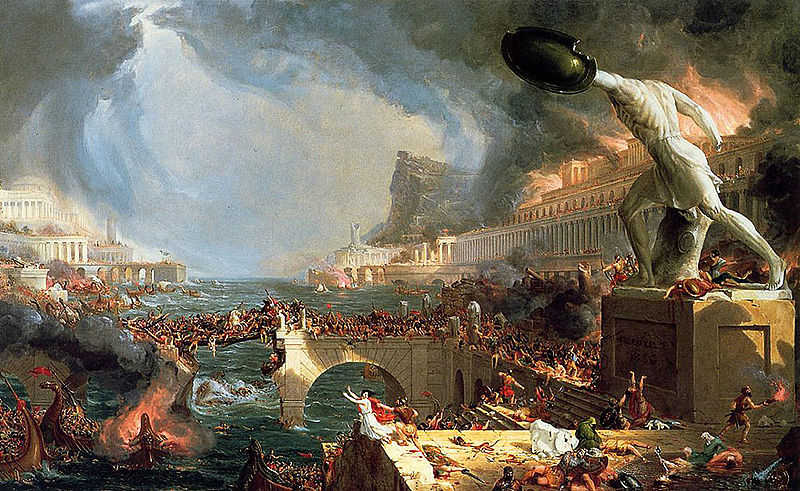
Next week we will begin looking at actual civilizations, and begin applying this theoretical interpretative model to reality. We will begin to look for the patterns and truths that history reveals to us. Below I include the famous set of paintings by Thomas Cole called The Course of Empire. I do not necessarily agree with everything regarding Cole’s interpretation of history, but it is a wonderful visual image of a thought provoking theory, from a civilization’s beginning to its end.
It is sometimes possible to enjoy a book that one cannot understand very much of, provided that
The author has a great deal of fun with the subject, and
The author clearly and deeply understands the subject, which allows him to express his ideas clearly.
I confess to knowing nothing about almost all of the authors CS Lewis discusses in his wonderful English Literature of the Sixteenth Century. Anecdotes exist that indicate Lewis felt real heaviness and irritation in cranking this one out, but this does not come across in the writing. It reads light as a feather. Lewis generously shares his opinions about literature, but mixes these opinions with a marbling of philosophy, history, and cultural analysis. All this makes Lewis’ work come alive and relevant for today. This is some of Lewis’ best writing, and his wit and humor shine on most every page.
Lewis finds this era worthy of extended examination because it stands at a nexus of a variety of momentous shifts:
The early 16th century saw the last vestiges of the medieval worldview have their final say
The early-mid 16th century saw the high water mark of Renaissance humanism and classicism
The entire 16th century saw tumultuous religious upheaval caused by the Reformation, followed on by the Counter-Reformation.
Lewis keeps his focus on the literature, as is proper, but his opening chapters also set the stage historically and culturally. For the historian, Lewis goes to great lengths to reset the balance between the Middle Ages and the Renaissance, but I have covered that topic elsewhere. His basic point for in these opening chapters involves prepping us for the fact that literature at a nexus of cultural death and rebirth tends not to be very good. Things eventually sorted themselves out with Sidney, Spenser, and Shakespeare, but the early to middle part of the century left much to be desired. The main fault of the writers of this time involved a hyper-exaggeration of a certain strengths of cultural movements, which robbed much of their writing of life and merit.
To be sure, the political, cultural and religious tumult eventually settled into a new equilibrium, and after that, writers could borrow from different literary genres much more freely and productively, but until that happened, very little of anything transcendent value got written.
This dynamic makes sense to us if we scale down this larger point to something more tangible to our own experience of, for example, adolescence. Our early teen years involve an ending of childhood and the beginning of something else, akin to a larger scale cultural breakdown and rebirth in our immediate personal experience.
I grew up playing drums and listening to a lot of my dad’s music. This was a pre-headphone era, so we all heard what he played on the living room stereo. I got a healthy dose of the Beatles, Otis Redding, Willie Nelson, and Beethoven, among others. I enjoyed almost all of it. But as a 16 year old drummer, I wanted something else (unfortunately it took a few more years before I appreciated Ringo and Al Jackson), and a way to distinguish myself. One day, my cousin’s friend played for me the opening 30 seconds of Rush’s “The Spirit of Radio,” and it was all over for me. I was enchanted. I had never heard progressive rock, so I dove in headfirst. I immediately went to Tower Records and bought Permanent Waves, Moving Pictures, and Hemispheres.* For the next year, I then decided that everything about my drumming, and many other things about my life besides, must conform to Neil Peart’s particular style.
This improved my drumming in certain small ways but ruined it in others. Things got misshapen. If one believes (as I did), that even when drumming for my high school jazz band I should act like Neil Peart, you sound like an idiot. It took hearing a recording of my playing at the county jazz festival, and the judges comments, to make me realize I needed to snap out of it. I spent the following summer listening Glenn Miller and Count Basie, and at least partially fixed things for my senior year.
This was a classic, “It’s not you, it’s me,” problem. Neil Peart has much to teach any drummer, but not if you become enslaved to his aura. In that state, one plays drums essentially to convince an audience, and you lose all sense of proportion.
Times of personal and cultural death and rebirth offer many opportunities. In separating certain aspects of life from a larger context, we can see them with more clarity, and this is exciting. I’d like to think that in college, I could throw in occasional progressive wrinkles without being bound by them. Unfortunately our internal instability in those moments of initial discovery make it very difficult for us to take fruitful advantage of whatever insights we gain. The same applies to a culture at large. In the midst of breakdown, when things come apart, we notice what we had never seen before. This is great as far it goes, but it has to kept in balance.
Lewis shows us how this dynamic plays out in the literature of the period.
Oftentimes, what seems like an era in the fullness of its strength actually ends up being something akin to “terminal lucidity,” a burst of energy many dying patients experience before passing. For example, the 1980’s seemed like the crest of a wave of American confidence. We had Reagan-era optimism. We won the Cold War. We grew economically. We wore bright colors and made our hair big. But look again, and we see that some of what we were about shows an uncomfortable exaggeration of a theme. We should never have attempted, for example, “Hands Across America.” Big hair is one thing, and glam-metal fashion ca. 1988 quite another.
This “hyper-extension” of cultural posturing naturally collapsed, leading to completely opposite atmosphere. Now we had grunge music with lyrics about how bad things were, loose clothes (anyone who tucked in their shirt at my high school in 1990 would have been hopelessly labeled as a nerd), and “heroin chic.”
In neither era do men or women look particularly normal, with both exaggerating certain ideas to a point of being ridiculous.**
I much prefer medieval literature to that of the Renaissance, but by the end of the Middle Ages, we saw the same kind of unfortunate exaggerations. Lewis suggests that Scotland’s king James IV perfectly encapsulates the problem with the period. “Peak” medieval chivalry ca. 1350 had much to commend it. It ennobled men, and greatly elevated the status of women.^ The courtly love tradition had its good parts, though the best literature of the period grappled with some of the contradictions and tensions involved in knightly service of ladies. The literary figure of Lancelot encapsulates this well.
James IV (b. 1473, d. 1513) had many good qualities. He was open hearted, high spirited, and generous in the best spirit of chivalry. He had courage, but a variety of contemporaries remarked that he had too much courage to be king. He needed more prudence and policy. Many of his contemporaries felt that James never should have fought the Battle of Flodden, where he met his death (in Henry IV, Pt. 1 Shakespeare may have had James IV as a model in mind for Hotspur). As to the service of ladies, James IV almost parodies the medieval complexity and tension by abandoning himself to countless prostitutes and fathering a variety of illegitimate children. His exaggerated chivalric ideals made chivalry itself look ridiculous.
So too, late medieval literature had little balance and often none of the sense of play of the best medieval prose from previous decades. Lewis cites the work of John Fisher, who drank heavily from the medieval moral sense, but alas, could not let an idea go once he fixed himself upon it. In his The Perfect Religion, he instructs a nun to be
Grateful for being created to live in a Christian society. As Lewis states, this is well and proper. But Fisher continues, telling the nun to be
Grateful for being created at all. This is still a good sentiment, but perhaps was already covered in the first injunction? Fisher doesn’t stop there, however, urging that she remain
Grateful that she was created as a human being, and not a toad, and tops this off with the counsel that
She be grateful that she was created instead of all the other people that might have been created instead of her.
Lewis rightly points out that by the third injunction, Fisher has descended into absurdity (“she” could never be a toad—not an option for a human being,) and by the fourth, a work intended to promote Catholic orthodoxy seems to promote a gnostic heresy of the pre-existence of souls and the separation of the body from personhood. Lewis writes, “Fisher’s sincerity is undoubted, but his intellect is not as hard at work as he supposes. We can’t hold Fisher accountable for not answering his questions, but he doesn’t seem to know that he is raising them.”
This lack of balance spilled over into the religiously polemical works of Fisher and Thomas More. Both wrote defenses of purgatory, and both in their zeal latched onto certain rogue strands of late-medieval asceticism. In Dante, the souls in Purgatory sing psalms joyfully, and their bodies suffer in service of redemption, and is in fact an integral part of their redemption. For Fisher and More, we have denigration of the body, so that the purgation is for the sake of purgation itself, and their vision of purgatory means a practically pointless circle of suffering.
We should expect this tendency to exaggeration during times of cultural fragmentation. What was once solid now moves apart. The bell curve of ABC, CBS, and NBC turns into a thousand scattered points, first with cable news, then with the internet. When this scattering happens, we naturally lose our bearings and find what we can to latch onto. What we latch onto, however, will be isolated from a larger context, and thus will lose its relationship to the broader whole.
I have mentioned two late-medieval/early modern Catholics, now for some early Reformation humanists (though it was certainly possible to be a Catholic humanist, i.e. Erasmus). John Colet wished to return to a more pure age, and thus urged a strict “anti-body,” morality upon his readers. He saw no real difference between marital union and fornication, and in fact wished that no one would get married. Marriage and the body proved to messy for his taste. He acknowledged that no marriage would mean the end of the human race on earth, but oh well, these things happen.
The humanists loved classical culture, either for its perceived purity, hardy innocence, or merely because the classical age was not feudal and medieval, the worst of all sins. This meant that he abandoned allegorical or symbolic interpretations of the Bible in search of a platonic “pure” meaning of the text. Others shared these views, but his thoughts on the subject of Latin take him into absurdity in a similar way to Fisher. On the one hand, as mentioned, he was a strict moralist with gnostic tendencies. This led to a distrust of much of pagan literature. On the other, he hated all things medieval, and that meant hating medieval church Latin, which had been “corrupted” from the past that was pure, not in morality, perhaps, but in its use of language. Lewis writes,
{For Colet] the spirit of the classical writers was to be avoided like the plague, and their form to be imposed as an indispensable law. When he founded St. Paul’s school, the boys were to be guarded from every word that did not occur in Vergil or Cicero, and equally, from every idea that did. No more deadly or irrational scheme could have been propounded. Deadly, because it cut the boys off from all the best literature in the Latin world, and irrational, because it put absurd value on certain arbitrary elements dissociated from the spirit which begot them, and for whose sake they existed. For Colet, this seemed a small price to pay for excluding all barbarism, all corruption, all “adulterated” Latin.
We noted above that when something reaches its end, it can mimic strength through one final, exaggerated effort. It might seem on the one hand that Latin had no greater champion than Colet, who sought to emphasize only the “best” Latin. But Lewis points out that all of the efforts of the Renaissance humanists to preserve the purity of latin in fact killed it. A variety of medieval people actually spoke latin (churchmen and merchants), or at least some version of latin. Only a very few scholars knew classical Latin, and fewer still spoke it, and then only in the academy. The attempt to save Latin destroyed it.
It is usually more fun to read a review where the critic pans rather than praises. I have focused on the first half of the book, where the literature, with a few exceptions, stunk. But we should remember that the century ended with some of England’s greatest writers, and with Shakespeare we have an “all-timer.” When we recall Shakespeare’s best work, we see how much more comfortable he was with tension and play than the previous generation. He incorporated medieval and modern elements without going out of his way to defend either. Stylistically, he stuck to certain meters and forms, but not all the time. He could happily dance between them. His characters are rich, both particular to his time and universal.
This can give us hope for our own future. We live in an era where many of the old categories of meaning and belonging have vanished. As a result we see the same kinds of intensification and exaggeration that beset the 16th century. But they learned, and so might we. The path forward comes from Thomas More’s most famous and least understood work, his Utopia. As mentioned previously, Lewis felt that much of More’s polemical work fell prey to the vices of the age. Those vices, he argues, cloud our perception of Utopia. Many moderns attempt to find a point to the work, obscured or otherwise, that will clue us in to More’s meaning in the text. Much of More’s other work had a definite argument. So too must Utopia, right? Was More secretly supporting communism, or was he a closet Protestant? Or perhaps he sought to make some other political point buried in code?
Lewis points out, however, that any attempt to pin the book down specifically one way or another will fail, because More writes in this text like a medieval. Given that medievalism was practically dead at this point, it is no wonder that even his contemporaries remained confused. But Lewis argues the book has no particular point. It’s meant as a romp of this and that, no more, no less. The medievals loved to bandy ideas about and put them in tension and opposition to one another. For them, this was fun–and that signifies of a more healthy age than either our own or the early 16th century. They were more interested in play, we in logical, deductive writing that makes a point and gets somewhere definite.
For us, as for the 16th century, the way out of our predicament involves not stronger arguments, but a greater sense of fun. More shows us that even politics, whatever our position may be, can bear the weight of humor in any age.
*I also bought what was at that time their most recent album, Hold Your Fire. Rush fans may relate to my utter shock, bewilderment, and even anger at going from “Red Barchetta” to “Time Stand Still” in the space of 30 seconds. To this day I still feel that Hold Your Fire is a ridiculous album. Not until Counterparts would I start to forgive them.
**At first glance no two things could seem further apart than the late 80’s and early 90’s aesthetic. But both participate in the same cultural breakdown, and are likely, therefore to share some crucial commonalities. A second glance shows that, surprise, surprise, they have androgyny in common. In glam metal, a lot of guys dressed similarly to women (tight pants, makeup, etc.) and in grunge, a lot women looked like men (short hair, lack of showering, no care for appearance, etc.) No doubt grunge devotees would have been horrified to learn that they shared a crucial similarity with hair metal, but there you go.
In one section of the book, Lewis shows that Thomas More (Catholic) and William Tyndale (Protestant), who wrote page after page attacking one another, actually had a lot in common. Both had similar economic ideas. And on Henry VIII annulment and remarriage to Anne Boleyn, the hot-button issue of the day, they were in lock-step agreement. Both seem to have missed this fact at the time.
^For an example of this, note the famous story from Froissart about how Edward III heeded his wife’s call for clemency for the population of Calais.
 grave political weakness for Athens, Thebes, and Sparta. Opportunity knocked for Macedon. Phillip looked every inch the tough customer he portrayed, wearing an eye patch over his wounded eye for necessity, and probably, for effect as well. But Phillip combined his personality and appearance with a keen understanding of how to maximize the qualities of his society into a formidable military machine.
 In addition to the long spears you see above, their soldiers also carried a long dagger, another offensive weapon. While the image above does show the Macedonians with shields, I agree with Victor Davis Hanson (and others) that argue that Macedonian shields had no real function in battle. They were worn apparently mostly around the neck and draped to the side (as both arms would be needed to wield their spears). Some argue that the shields were used in battle, but mainly as a prop for their spears. If this is so, we see that even their shield served as a offensive weapon of sorts.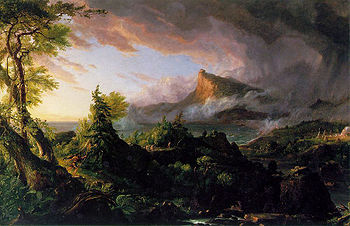






 A Stick in the Mud