The American “Prestige”


In our senior Government class, we spend a good amount of time discussing the question, “What is America?” throughout the year.  The question is deceptively simple, and we have a difficult time answering it.  We discussed Book 1, Ch. 4 from The Prince recently in class, and it spurred some interesting discussion.

The text reads as follows . . .

Why The Kingdom Of Darius, Conquered By Alexander, Did Not Rebel Against The Successors Of Alexander At His Death

CONSIDERING the difficulties which men have had to hold a newly acquired state, some might wonder how, seeing that Alexander the Great became the master of Asia in a few years, and died whilst it was yet scarcely settled (whence it might appear reasonable that the whole empire would have rebelled), nevertheless his successors maintained themselves, and had to meet no other difficulty than that which arose among themselves from their own ambitions.

I answer that the principalities of which one has record are found to be governed in two different ways: either by a prince, with a body of servants, who assist him to govern the kingdom as ministers by his favour and permission; or by a prince and barons, who hold that dignity by antiquity of blood and not by the grace of the prince. Such barons have states and their own subjects, who recognize them as lords and hold them in natural affection. Those states that are governed by a prince and his servants hold their prince in more consideration, because in all the country there is no one who is recognized as superior to him, and if they yield obedience to another they do it as to a minister and official, and they do not bear him any particular affection.

The examples of these two governments in our time are the Turk and the King of France. The entire monarchy of the Turk is governed by one lord, the others are his servants; and, dividing his kingdom into sanjaks, he sends there different administrators, and shifts and changes them as he chooses. But the King of France is placed in the midst of an ancient body of lords, acknowledged by their own subjects, and beloved by them; they have their own prerogatives, nor can the king take these away except at his peril. Therefore, he who considers both of these states will recognize great difficulties in seizing the state of the Turk, but, once it is conquered, great ease in holding it. The causes of the difficulties in seizing the kingdom of the Turk are that the usurper cannot be called in by the princes of the kingdom, nor can he hope to be assisted in his designs by the revolt of those whom the lord has around him. This arises from the reasons given above; for his ministers, being all slaves and bondmen, can only be corrupted with great difficulty, and one can expect little advantage from them when they have been corrupted, as they cannot carry the people with them, for the reasons assigned. Hence, he who attacks the Turk must bear in mind that he will find him united, and he will have to rely more on his own strength than on the revolt of others; but, if once the Turk has been conquered, and routed in the field in such a way that he cannot replace his armies, there is nothing to fear but the family of the prince, and, this being exterminated, there remains no one to fear, the others having no credit with the people; and as the conqueror did not rely on them before his victory, so he ought not to fear them after it.

The contrary happens in kingdoms governed like that of France, because one can easily enter there by gaining over some baron of the kingdom, for one always finds malcontents and such as desire a change. Such men, for the reasons given, can open the way into the state and render the victory easy; but if you wish to hold it afterwards, you meet with infinite difficulties, both from those who have assisted you and from those you have crushed. Nor is it enough for you to have exterminated the family of the prince, because the lords that remain make themselves the heads of fresh movements against you, and as you are unable either to satisfy or exterminate them, that state is lost whenever time brings the opportunity.

Now if you will consider what was the nature of the government of Darius, you will find it similar to the kingdom of the Turk, and therefore it was only necessary for Alexander, first to overthrow him in the field, and then to take the country from him. After which victory, Darius being killed, the state remained secure to Alexander, for the above reasons. And if his successors had been united they would have enjoyed it securely and at their ease, for there were no tumults raised in the kingdom except those they provoked themselves.

But it is impossible to hold with such tranquillity states constituted like that of France. Hence arose those frequent rebellions against the Romans in Spain, France, and Greece, owing to the many principalities there were in these states, of which, as long as the memory of them endured, the Romans always held an insecure possession; but with the power and long continuance of the empire the memory of them passed away, and the Romans then became secure possessors. And when fighting afterwards amongst themselves, each one was able to attach to himself his own parts of the country, according to the authority he had assumed there; and the family of the former lord being exterminated, none other than the Romans were acknowledged.

When these things are remembered no one will marvel at the ease with which Alexander held the Empire of Asia, or at the difficulties which others have had to keep an acquisition, such as Pyrrhus and many more; this is not occasioned by the little or abundance of ability in the conqueror, but by the want of uniformity in the subject state.

Machiavelli’s distinction helps make sense of other historical events.  We can look, for example, at Napoleon and Hitler’s invasion of Russia/Soviet Union.  At first glance, Russia must have seemed akin to Persia in Napoleon’s eyes.  After all, Czar Alexander I certainly looked like most other autocrats in history.  But . . . for most of Russia’s existence it resembled France.  Tales in the old Russian folk-epics reveal a shaky relationship of the people to their ruler, but more importantly, old Russia had several distinct provinces/cities that competed for precedence and had their own history and identity.  Napoleon found Russia easy to enter but hard to hold.  The Nazi’s found the same true even 130 years later.  When force no longer sufficed to hold the Soviet Union together ca. 1989-91, the old identities resurfaced almost immediately.

“Never get involved in a land war in Asia,” also has some of the same logic behind it.  A country like China has the appearance of resembling Persia, just as Russia did.  But most of China’s history reveals competing provinces, dialects, and an uncertain relationship to the emperor until later in its existence.

So we asked the question, “Which kind of kingdom is America?”  Does it resemble France, or Persia?  In contrast to Russia, China, or France,  Persia did not have a long, zig-zag run-up to the height of its power.  Their civilization had a jump-start, meteoric rise under Cyrus the Great, who immediately set a pattern of charismatic dominance over the whole of his empire.  In future generations the Persians took their cue it seemed almost entirely from future dynamic leaders like Darius.  Their reliance on this pattern shows even in the failed rebellion of Cyrus the Younger, who fit this mold of dynamic leader better than his brother Artaxerxes II.  The fact that he almost succeeded with no other claim to rule besides his personality says a lot about Persia.

Some students thought that America had a beginning akin to that of France or Russia.  We had different colonies in different parts of the Atlantic coast that developed entirely apart from each other.  These colonies came together only to fight against a common enemy, but essentially remained separate kingdoms until sometime after the Civil War — perhaps not even until into the Great Depression.

The majority thought otherwise.  True, the first colonies hardly interacted with one another, but they came to America with similar purposes from similar cultures.  At the core, they were about the same thing, which is why the French-Indian War could so easily unite them and start us thinking about the “people.”  When examining the history of China, Russia, or France one sees a host of regularly occurring rivalries, small conflicts, and so on.  But America we only see one big blowup  — the Civil War.  The Civil War showed that obviously, we differed on much.  But it was the kind of big blowup that occurs in families, when often unity exists. It was the exception that proved the rule.

I acknowledge much merit in the “France” argument, but in this case I sided with the majority.  Tocqueville noticed back in the 1830’s the tendency towards centralization in our democratic experiment, and the already growing power of the majority.  He wrote,

The very essence of democratic government consists in the absolute sovereignty of the majority; for there is nothing in democratic states that is capable of resisting it.

We have different political opinions, but in no political election is any fundamental question of identity at stake.  Many rejoice/lament the election of a particular president.  But whoever may win the election, the next day our lives remain unchanged.

In Book Five of his Poliitcs Aristotle speculates that democratic constitutions* remain most safest when threats to said constitution remain either far away or very close.  The first seems obvious.  When nothing threatens us we live at ease, and it’s easy to have peace with others.  A very near threat like an invasion would bind us together quickly.    This kind of threat might also be merely an obvious one, like the Japanese attack on Pearl Harbor, which immediately united a divided country in the war effort.

The in-between threats, however, pose a real challenge.  Since the danger is neither obvious or near, we can easily divide not just on how to respond but whether or not to respond.  We might think of the Vietnam War as an example of this, and sure enough, it brought on significant internal changes to our constitution.  The “War on Terror” fits into a similar mold. Should we intervene here or there?  Should we increase surveillance or not, what about privacy rights, and so on.  And, true to Aristotle’s form, we see increased political polarization with this “intermediate” threat.

But our class speculated on exactly what an “invader” — whatever form that might take — would find.  Once Cyrus the Younger died in the Battle of Cunaxa his cause died with him.  Once Darius III died, Alexander had essentially conquered Persia.  But at what would America’s enemies take aim?  Not the president, surely, for at any given time half the country will not like him.  Not the capital, either.  As the British discovered in 1813, burning D.C. did little to aid their war effort.  One could hypothetically detonate a strong EMP in the atmosphere to knock out our electrical system.  But that would take out any first or second world country and so that answer lacks enough specificity to the United States.  This “absolute sovereignty of the majority,” would be hard to pin down.  Where is it?  And how would one attack it?  Get too close, and the unity of the people to defend their “constitution” would quickly emerge.

The “prestige” in magic is the trick’s big reveal, and of course sometimes what is revealed is nothing at all.  This would happen perhaps to an invader, who might never find the rabbit inside the hat.  Rather, as Aristotle suggests, and the experience of Rome certainly plays out, democracies will be far more likely to erode themselves from within as opposed to without.

Dave


*By “constitution” he does not mean merely a written document, but our way of relating to one another in general.



The Mirror Crack’d

Some years ago I saw a video about the emergence of Greek culture and the talking heads discussed the magnificent achievements of Greek drama.  Before talking about the drama itself, they mentioned the origins of drama, though only very briefly.  After all, Greek drama began in the worship of Dionysius, a confusing and strange subject for modern ears. I found it fascinating to watch the speakers deal with this aspect of Greek civilization.  They hated being on unfamiliar territory — unfamiliar not so much intellectually, that is, but ideologically and experientially.

Briefly,

  • Dionysian worship started with women sneaking off illegally, or at least shamefully, for their rites. Dionysius himself occupied, at minimum, the barest fringe of Greek religion.  Some of the commentators latched onto this, for it promised a narrative we could identify with.  “Aha!  A sisterhood of oppressed women, sharing radical beliefs! And observe the vital contribution they made to their society and the world at large, etc.”  But Dionysian rites also involved men, too, so they couldn’t press that narrative too far.
  • The Dionysian rites for women also seemed to involve ecstatic experiences invoking bulls, snakes, wine, and so on. This too got the barest mention, for the “oppressed sisterhood” narrative didn’t really match the fact that Dionysius was a fertility god.  So the women may have been praying and dancing furiously for the chance to have children, a very traditional “role” (ha!) for women to play.
  • To add insult to injury, male Dionysian worship may have invoked blessings to “survive ordeals.”  This got no mention at all.  It appears that these “rebels” danced around madly and got drunk to attempt to fulfill the most prosaic of traditional gender roles of “tough guy,” and “nurturing mother.”  This square peg had no place in their round hole interpretations.

So, after passing over all this in the quickest fashion, finally smiles came to their faces as they talked about the drama itself. Here they felt far more comfortable.  Greek drama “allows for the community to come together and deal with issues of importance,” or something like that.  Ah, yes, the “humanism” of the Greeks.  This we understand, so this they talked about at length.  Gone were any of the unusual religious associations involving Dionysius.  The important thing to us is the emergence of drama, for without the emergence of drama, how could we watch Dumb and Dumber today instantly on Netflix?*  And we very naturally assume that what is important to us must have been of prime importance to the Greeks.  Dionysian worship, then, got relegated to a mere carrying device for what we understand and what we feel is important.  As a friend of mine stated, whenever we use a word to describe an ancient people that they themselves did not use (in this case, the word “humanism”), we will likely reach false conclusions. The talking heads are not unusual. Most of us unfortunately avoid confrontations with the “other.”

I’m not an Alfred Lord Tennyson fan (to be fair I’ve read hardly anything he wrote), but his poem “The Lady of Shallot” intrigues me in one way.  The Lady in question deals with a curse, and can only look at reflections in a mirror to ascertain reality.  The mirror of course serves as a poor substitute of reality, and later cracks upon her sad and untimely death.

Out flew the web and floated wide-

The mirror crack’d from side to side;

“The curse is come upon me,” cried

The Lady of Shalott.

Tennyson’s work came from the same spiritual place as the dreaded pre-Raphaelites, whose paintings reveal an intense desire to recover something of antiquity.  And yet the grossly over-dramatized version of the past in their eyes reveals far more about themselves, with their aspirations fit perhaps for the teenage soul more than an adult world (hence L.M. Montgomery has her young Anne of Green Gables grow fascinated with the “Lady of Shallot”).

All of us tend to distort reality to fit our own images of it, but the way the Parthenon has been interpreted over time stands as one of the more curious episodes of this typical human folly.  Joan Breton Connelly chronicles this and gives her own interpretation of the architectural masterpiece in her recent book, The Parthenon Enigma.  The building occupies pride of place in the history of western civilization.  Its marble facade inspired those who saw it to grand notions of ideal beauty.  The building’s perfect proportions inspired noble visions of clarity and a sense of true humanity.  Certain technical achievements of the building are practically unparalleled.

But we made the building in our own image, and Connelly writes to set the record straight.  Ever since the Enlightenment we have seen the Parthenon as reflecting the “humanism” of the Athenians.  We have some justification for this.  If you trace the religion of the Athenians one sees a clear descent from Aeschylus (who takes religion seriously) to Thucydides (who didn’t).  The Athenians elected Pericles to multiple terms of their highest office, and he certainly fits the humanist mold. Observers therefore assumed, as the Parthenon was Pericles’ project that it would reflect his values.  Then again, maybe not.

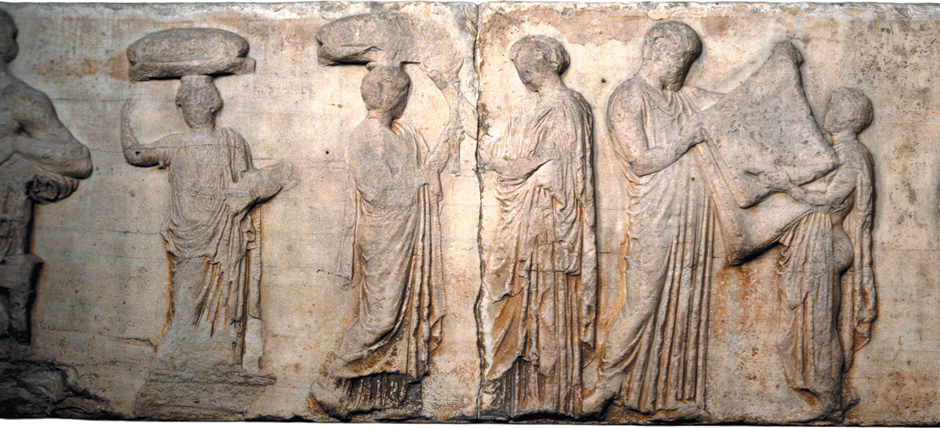
She has two main arguments, with the first drawn from the he Parthenon friezes, long thought to depict contemporary Athenians mingling with the gods.  Connelly has an ironclad argument that Athens instead hearkens to not to its present but its mythological past.  At Athens’ founding it had a king named Erechtheus, who had three daughters that sacrificed themselves that Athens might survive (images below on a Parthenon frieze).  Athens makes an explicit statement, and explicit prayer of hope, that death might come from life with the Parthenon.

Amidst our wondering at the architectural genius of the building and the democratic (and therefore mostly familiar) practices of the Athenians, we forget that the Parthenon was a temple to Athena.  Excavations show that they built the Parthenon on top of an older temple, so clearly the Parthenon was sacred space, and not merely civic space with a civic purpose.

Corinthian_Column_Head_JerashModern eyes miss many such death-life associations in Greece.  For example, look up any article on Corinthian columns and you will likely see something about their fancy, or perhaps excessive, ornamentation.  Certainly Corinthian columns do not fit with Enlightenment sensibilities about classical decorum and proportion — such people always prefer the Ionic column (I prefer the Ionic — to the right — as well so I don’t mean to cast stones).  But Connelly points out that the plants in Corinthian columns hearken back to ancient myths about death and rebirth in their city.  Articles may describe Corinthian columns as “one example of a Greek votive column” (as one site does) without paying any attention at all to the fact that “votive” columns, like votive candles, have a distinctly religious purpose.  It’s almost as if they use the big words to obscure the meaning.  We will have the Greeks be “humanists” by hook or crook.

A fascinating sub-plot is the length Victorian society went to deny that the Parthenon originally was painted.  Evidence after evidence turned up, mostly brushed aside and denied with too much protest.  A painted Parthenon would overturn all of their ideas of classical beauty and classical purity.  Whole artistic theories got erected on an unpainted Parthenon, and they could not let it go.  This in turn clouded their vision in other areas, and allowed false ideas about the Parthenon to persist well into the 20th century.

725-1422641769E21CEBE6B

Did the Parthenon have no contemporary political meaning?  Perhaps . . . perhaps Pericles wanted to heal the fractious wounds of a prosperous democracy.  Success has never sat well with democracies, and it would make sense that Athens would want to go back to its founding and a story of sacrifice for the common good.  All this rings partially true, but the bulk of the evidence makes the Parthenon an overtly religious shrine — one that seeks life from death.  Plenty of evidence exists that Athenians saw it this way themselves.  For example, during the plague that struck during the Peloponnesian War, sick Athenians came to the Parthenon for refuge, as well as for healing, and possibly, to die.  It would be hard to imagine them doing so if the Parthenon was their equivalent of our Capitol or Washington Monument.

But this interpretation also challenges my own thoughts regarding the Parthenon.  The “humanist” interpretation fit how I tended to see the late 5th century Athenians as essentially worshippers of themselves.  This view gets lots of support from seeing contemporary Athenians mixed with gods on the Parthenon friezes.  With the Parthenon cast in this new light, I think that interpretation gets challenged but not overthrown.  I think other evidence exists for seeing the Athenians as self-worshippers, and perhaps the Parthenon itself still supports that view.  But this will need rethinking on my part.

The lesson of this book is the peril of using history rather than receiving and letting it change you. Self-idolatry is alas, not only confined only to the Greeks, or the Enlightenment and Victorian eras.

Dave

*To be fair, this is actually a pretty good movie . . .

8th Grade: All Good Things Must Come to an End

Greetings,

This week we saw the great golden age of Periclean Athens collapse into the abyss of the Peloponnesian War.  We began the week by asking why “Golden Ages” tend to last not much longer than a generation.

  • Some suggest that the success and power a golden age brings would bring about the envy of others, and this envy could turn into a threat.
  • Another might suggest that the generation that grew up with the ‘golden age’ in place would likely have a much different experience than their parents.  I found this comment especially perceptive.  As we saw last week, golden ages usually arise from a creative response to a particular challenge.  Those that grow up without the challenge won’t have the experience or ‘training’ to continue what their parents started.
  • Last week we also noted how golden ages require a variety of factors coming together at once, some physical and others psychological.  No one can reasonably keep all the plates spinning for long.  Eventually nature dictates that something will begin to spin off the axis sooner or later, and this will drag other things down with it.

Some of their comments did in fact apply directly to the outbreak of the Peloponnesian War, especially#1.  Athens went from plucky underdog in 490 B.C. to the then equivalent of the New York Yankees or New England Patriots by 431 B.C.  Many city-states lined up against them with Sparta. We did not spend a great deal of time on the war itself, as during their senior year we devote a few weeks entirely to this conflict and the issues it raises, but we did touch on a few key points

1. How in war the unexpected and unforeseen can occur

Of course the unforeseen can always occur, in war or at any other point.  But since war requires a great deal of planning, many assume that the conflict will go as we wish.  The making of the plans itself creates that expectation.  Yet, in war as in life, things rarely go according to our preconceived version of events.

2. Peace treaties may not be what they seem

After 10 years of intermittent conflict, both Athens and Sparta signed a treaty called the Peace of Nicias.  But treaties in name may not be in fact.  Some treaties bring real peace, some only reflect a desire to call a ‘time out’ in the fighting.  Unfortunately for Athens, this treaty turned out to be one of the latter.

3. War Stresses Democracy

War will put stress on any form of government and any society.  Some wars brought down monarchies — like W.W. I.  We assume that democracies are more stable, but the Peloponnesian War brought out many weaknesses within Athenian democracy and for a time ended it within Athens.  We looked at how desperation and panic act on a democratic people in the battle of Arginusae.  The Athenians won this battle, but the generals failed to pick up the dead and give them proper burial, something that could be considered sacrilege, and sacrilege could be punished by death.  Grief stricken, the city put the generals on trial, found them guilty, and executed them.  A few days later they regretted their actions. They put the lawyer who prosecuted the generals on trial for murder, found him guilty, and executed him also.

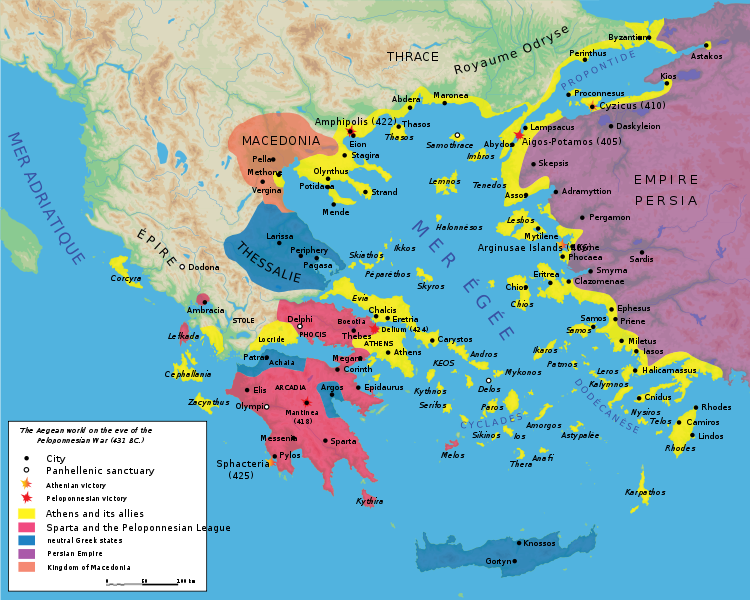
Ostensibly, Sparta won the Peloponnesian War.  But in truth the war had no real winners in Southern Greece.  All exhausted themselves in the conflict.  Thebes, involved in the conflict but slightly to the north, emerged as the strongest party in the more immediate aftermath of the war.  But it would be Macedon, further still to the north, and never involved in the fighting at all, that would eventually assert absolute supremacy over Greece in the person of Phillip of Macedon and his son Alexander.  We’ll look at them next week.

You can see the geography of it below here, with everything pink or yellow caught up in the fighting (with even blue areas involved sporadically), and Macedon waiting patiently above in brown.

Peloponnesian War

For those of you who have seen From Russia with Love, the scene where “Number 1” talks about the Siamese Fighting Fish is a good parallel, if we think of Macedon as the fish who stays out of the fight.