This week we focused on The Persian Wars, a conflict that historians claim marks a transition point between Eastern and Western dominance. Persia staked a lot of their invasion, and their failure would lead to the rise of Greece in general, and Athens in particular. Our main focus Thursday and Friday lay with the Battle of Salamis, one of the more crucial naval engagements of the ancient world. As I mentioned back in September, one of the things we focus on this year and throughout the history curriculum is how to make choices. This can be applied in a variety of different settings, and this week I wanted the students to consider that on the level of strategy and tactics.
The Fleets
The Persian fleet was bigger, with a variety of incorporated Greek city-states that had surrendered to Persia. Ionians, Phonecians, Egyptians and more went into the mixture. In general, their ships were lighter and faster. Athens controlled the Greek fleet, and in general they had heavier, bulkier ships. But the weight of the ships did perhaps produce an innovation, that of a ramming prow. This in turn, led to a change in how the Athenians fought. Whereas most ancient navies wanted to get close and board other ships, the Athenians wanted to use their prow to ram other ships and sink them with a broadside charge.The Persians had sacked Athens, and the Athenians in desperation abandoned their city, got in their boats, and headed for the island of Salamis.
The Questions:
Would an immediate battle be more to the Persians advantage, or the Greeks?
If a battle were to be fought, what side would have the advantage in wide open water? What about in more narrow confines?
I enjoyed the student responses to this question, and most of them did get around to seeing that
Battle now definitely favored the Greeks, and
The geography of the Bay of Salamis definitely favored the Greeks.
Why?
The Athenians needed a battle. The Persians did not. With Athens abandoned they could have simply occupied the city, and hemmed in the fleet at Salamis. If they wait eventually a tired and bedraggled fleet would have to come out of hiding and face the Persians on their terms. Fighting in the bay itself would mean narrower corridors where the Persians could not use their numbers and speed to their full effect. Think of a heavier boxer vs. a lighter, quicker opponent. The heavier one (Athens) seeks to trap or corner the other to take away his advantage. By fighting in the bay, the Persian fleet gave up much of its advantage.
The Result
Again, with so many of our choices there are no guarantees. We must weigh the options and make our best guess. But it is important not to choose blindly. So why then, did the Persians attack the Greeks?Here we are back, at least possibly, to the personality of Xerxes. We saw that both Herodotus and the Book of Esther show us a king who was not wicked, but perhaps indolent, and someone who tended to flit from one thing to another. Note that Esther 1 begins by describing lavish parties amidst opulent splendor. Herodotus mentions that Xerxes wanted the invasion over as soon as possible. Ideally, of course, the Persians should have bottled up the fleet, entrenched themselves in the city, and watch Athens suffocate to death. When Themistocles sent a messenger to lie to the Persians about the disorder in the Greek ranks, the Persians jumped at the chance and moved into the bay to attack. Xerxes seems a suggestible, impatient type. “Let’s get this over with. . .” The result was a complete victory for the Greeks. It turned the tide of the whole Persian invasion. Having been smacked on the nose, Xerxes decided enough was enough. He withdrew most of his navy from the region. His infantry at current levels could not live off the land in Greece, and besides, winter approached. Without the navy to supply them, Xerxes withdrew a good portion of his troops back to Persia. The Battle of Platea in 479 BC would, for all intents and purposes, finish them off.
The “Center of Gravity”
Clausewitz used the term “center of gravity” to describe what one colonel described as a “factor of balance” in a campaign. This does not have to be something purely physical, but in this case, the “factor of balance” in the Persian Wars would surely include control of the sea. In invading Greece en masse as they did, Persia made naval superiority a key to the campaign. But for about 75 years prior to this they concentrated their strength on their infantry. They did not play to their strength. But we might also conclude that the whims of Xerxes would constitute part of the “center of gravity.” The Book of Esther gives us clues. Note how casually he decides on the Jews destruction, and how quickly he reverses course. Of course, it’s good that he changed his mind! My point, however, is that Xerxes never seemed fitted for the role of a noble kingly persona. He would much rather not be bothered. In every conflict, the hidden factor can often be each combatant’s internal political system. In this case, the nascent democracy of Athens had an advantage over the indolent monarchy of Persia.
Despite ourselves, Machiavelli fascinates us. He writes with an enviable brevity and clarity, and then supplies a pertinent historical example to back up his point. Had he been a worse writer, we would care much less about him. There exists as well an easy transference of his thought–he fires the imagination of the global strategist and everyone who has played Risk.
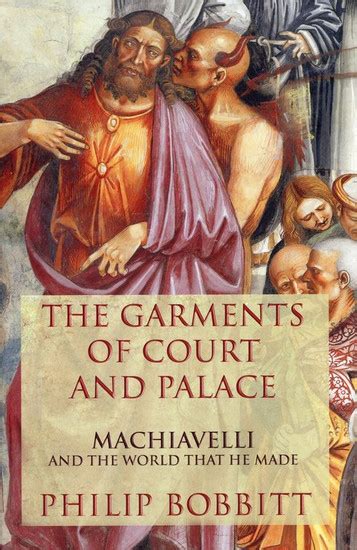
The Garments of Court and Palace has a grand air about it. The title comes from a phrase of Machiavelli, describing his perception of how one had to don a different persona, in a sense, to enter into the political realm. One can write rather easily how Machiavelli advocated for a dangerous amoralism in statecraft. One could also write about how a conflicted Machiavelli seemed a chameleon of sorts depending on time and place. Again–such books would be easy to write and have no reason to exist. But Philip Bobbitt has an entirely different approach, arguing that
Not only was Machiavelli not a amoral thinker, and
Not only was he not a chameleon, but
He was a consistent thinker with a distinct aim of promoting virtue, whose teachings fit easily within a Christian worldview
Now there’s an argument for you. This is a book worth writing.
I have great respect for Bobbitt. I found his Shield of Achilles revelatory and prophetic in certain ways. He takes big swings and at his best writes with the clarity of Machiavelli. I found Bobbitt’s argument ultimately a bridge too far. To go along with him fully, one would have to agree that essentially all of Machiavelli’s contemporaries, and nearly every political philosopher since then, had him wrong. For me, there exists too many areas of Machiavelli’s thought one can’t quite stuff into Bobbitt’s construction, leaving Bobbitt’s only option to impersonate Michael Palin’s befuddled George Bernard Shaw, i.e., “What Machiavelli merely meant . . . “
Still, Bobbitt succeeds in getting one to see Machiavelli more clearly within his time. And while I do not agree with the totality of Bobbitt’s argument, the book reveals the problems of the modern state in fresh ways. Bobbitt rightly argues that Machiavelli had prophetic insight far ahead of his time, and we must grapple honestly with him.
Machiavelli’s world faced great changes, changes that, as usual, were not immediately obvious to nearly everyone living through them. The Black Plague and the breakdown of the Church meant that the personal connections that guided law and culture in the feudal era no longer applied–however much some still wished to make it so. Bobbitt sees Machiavelli clearly perceiving this shift, and attempting to orient Italy and all of Europe towards a new constitutional order. But periods of transition bring great uncertainty, and the need for attendant flexibility. Bobbitt writes,
Imagine you wish to train yourself to be a professional poker player. Part of that training must involve learning all the tricks of the trade, marking cards, palming a card, dealing from the bottom, and so on. But must you practice these tricks yourself? I suppose it depends on how good your game is, and whether the persons with whom you are playing will enforce the rules once you have exposed the cheat. To the question, “Must it be this way? Can’t we do better?” the answers do not lie entirely within your power.
In sum, Bobbitt sees Machiavelli playing a slippery game of poker, both in his personal life and in his writings–yet, with an ultimately just and moral goal in mind. “Republics must be founded by one man,” as Machiavelli wrote in his Discourses. So,
First, the chaos must end, and existing structures cannot end it. It takes someone operating outside those structures to bring order, and then
A republic can emerge, one that governs communally and perhaps abstractly, rather than personally
Of Machiavelli’s two major works, one can very broadly say that The Prince attempted to accomplish the first goal, and The Discourses the latter. Machiavelli must sometimes, then, assume the appearance of Janus, the Roman god who faced in opposite directions.
We can consider the idea of deception. On the face of it, people should never lie or deceive. But few people would actually make this an absolute claim. You might not like your wife’s dress, but if she loves it, you’ll say you think it looks great. In the Bible, men of faith use deception. King David pretended insanity amongst the Philistines. Ehud manipulated King Eglon so that he might kill him. Rahab protects the spies by lying. We praise them for such actions. But we know the difference between “good” lies and true lies. While David rightly deceives the Philistines, he wrongly deceives Uriah, husband of Bathsheba, and suffers for it. Bobbitt places Machiavelli within a traditional moral structure because virtuous people know how and when to deceive for the common good. Machiavellian morality is “good” morality, because he flexibly orients it towards the formation of a virtuous state. Bobbitt makes other such arguments throughout with different aspects of Machiavelli’s thought, and it has merit up to a point.
At root, Bobbitt believes that states evolve and that wise and “good” rulers adapt to changing circumstances to maintain the supremacy of “good” states over bad ones. The state will be formed via “strategy, law, and history,” to use Bobbitt’s terms, and one must use Machiavellian wisdom to appropriately ride the crest of the wave. Republics have a much better chance of adaptation because of their composite nature. Machiavelli cites the Roman example of Fabius and Cicero. Fabius was right in 218 BC to adopt his cautious approach to Hannibal, but a few years later, the situation had changed. Yet–Fabius had not changed with the changing situation. Indeed, few can do so. But because Rome was a Republic, they had the more aggressive Scipio at their disposal. And, because of the Republic’s ability to pool wisdom from a large group, they chose correctly with Scipio. A monarchy or principality had more limitations, and indeed, Hannibal, for all his greatness, could not quite adopt changes in his own strategy when his fortunes started to ebb.
Again, so far so good. But we should go deeper into the nature of the new state Machiavelli heralded and why we should remain uncomfortable with a full embrace of his ideas. I think the final answer lies in the fact that the state Machiavelli saw coming and wanted to bring about would not allow one to safely and wisely live out his advice. So, in what follows below, I make my own grand, foolhardy attempt to solve the Machiavelli conundrum.
The feudal kingdoms that Machiavelli saw retreating from the scene had a few things in common:
Relationships, more so than laws, determined the way of life in a particular region
Particular land was not so much owned, but held in a trust, of sorts with the surrounding culture and people
While various leaders had certain boundaries of church, custom, etc., power resided in people, not principles, ideas, or even laws.
Machiavelli hoped for, and foresaw, a state that would
Be governed more by laws than specific people
Be governed more by procedures of representative bodies than by people directly
Have a more Roman/absolute/legal concept of ownership of land
The modern state, therefore, would be more fixed and abstract in nature.
Though in many ways a modern, Machiavelli still had some roots in the traditional pre-modern world. He understood that sometimes the hero has to go the margins of behavior–like King David. He understood that when facing the evil of disintegration one sometimes has to fight fire with fire. Sometimes society’s solid moral core cannot defeat the monster. You need Godzilla to battle Ghidorah. The law can do nothing to Terry Benedict, so we cheer when “Ocean’s Eleven” take him down. But we should still remember that the guys of “Ocean’s Eleven” are not really good guys. You cannot build a society on Danny, Rusty, and the Mormon twins.
If one sees Machiavelli’s advice within this traditional pattern of reality–a Core, Fringe, and the Chaos beyond, a lot of his advice in The Prince makes sense. People can make difficult moral judgments. People can experience different levels of reality and process them accordingly. Hence–for all of its “radical” nature, The Prince can actually make sense within a traditional society, where governing relationships remain distinctly personal and not abstract.
Machiavelli reacted strongly against the medieval approach, but the irony might be that The Prince is actually a treatise that might find a place in the pre-modern world under certain circumstances.
Machiavelli’s problem . . . modern states cannot experience life this way. We remain too distant from reality with the multitude of hedges of laws and institutions. People can make judgment calls–laws cannot. Bobbitt himself declares that states get their formation through the intersection of “strategy, law, and history.” But he leaves out, “personal relationships.” Modern states have very little to do with personal connections and much more to do with contract, procedure, and so on.*
What about Machiavelli’s Discourses, which many, Bobbitt included, see as a great treatise for modern democratic-republics? The Discourses has many insightful things to say, but we must remember that Rome is the subject. The “imminence” of pagan religion shines through inLivy’s work. The Roman self, Roman religion, and Roman politics all seem intertwined. One could say that Rome worshipped Rome (I include an excerpt from the Discouses below which I think illustrates this). Thus, when the Roman state “moved” the Romans “moved” with it. Of course, if the identity of the state lies in the King/Prince, then when he “moves” we can move with him, because we have a personal tie to him, and he physically embodies the principality/realm where we live.
Not so in the modern age, which still have some tension between the state and that which resides outside the state. It can take various forms across the spectrum, including:
A strong sense of the Kingdom of God residing within and without the state
A strong sense of the autonomous individual
No coherent cultural “north” on the compass
A sense of the “destiny” or purpose of the nation, which lies at least somewhat outside the actions of the nation–this has different manifestations on the right and the left.
I believe this explains our frustration and puzzlement with Machiavelli. We recognize his wisdom. We feel that we should apply at least some of it, but our detachment from our institutions won’t allow us to access it.
Dave
*Hence–suburbia and why we do not know our neighbors, disembodied forms of exchange, and so on.
Machiavelli on Roman Religion
Auguries were not only, as we have shown above, a main foundation of the old religion of the Gentiles, but were also the cause of the prosperity of the Roman commonwealth. Accordingly, the Romans gave more heed to these than to any other of their observances, in undertaking new enterprises; in calling out their armies; in going into battle; and, in short, in every business of importance, whether civil or military. Nor would they ever set forth on any warlike expedition, until they had satisfied their soldiers that the gods had promised them victory.
Among other means of declaring the auguries, they had in their armies a class of soothsayers, named by them pullarii, whom, when they desired to give battle, they would ask to take the auspices, which they did by observing the behaviour of fowls. If the fowls pecked, the engagement was begun with a favourable omen. If they refused, battle was declined. Nevertheless, when it was plain on the face of it that a certain course had to be taken, they take it at all hazards, even though the auspices were adverse; contriving, however, to manage matters so adroitly as not to appear to throw any slight on religion; as was done by the consul Papirius in the great battle he fought with the Samnites wherein that nation was finally broken and overthrown. For Papirius being encamped over against the Samnites, and perceiving that he fought, victory was certain, and consequently being eager to engage, desired the omens to be taken. The fowls refused to peck; but the chief soothsayer observing the eagerness of the soldiers to fight and the confidence felt both by them and by their captain, not to deprive the army of such an opportunity of glory, reported to the consul that the auspices were favourable. Whereupon Papirius began to array his army for battle.
But some among the soothsayers having divulged to certain of the soldiers that the fowls had not pecked, this was told to Spurius Papirius, the nephew of the consul, who reporting it to his uncle, the latter straightway bade him mind his own business, for that so far as he himself and the army were concerned, the auspices were fair; and if the soothsayer had lied, the consequences were on his head. And that the event might accord with the prognostics, he commanded his officers to place the soothsayers in front of the battle. It so chanced that as they advanced against the enemy, the chief soothsayer was killed by a spear thrown by a Roman soldier; which, the consul hearing of, said, “All goes well, and as the Gods would have it, for by the death of this liar the army is purged of blame and absolved from whatever displeasure these may have conceived against it.” And contriving, in this way to make his designs tally with the auspices, he joined battle, without the army knowing that the ordinances of religion had in any degree been disregarded.
But an opposite course was taken by Appius Pulcher, in Sicily, in the first Carthaginian war. For desiring to join battle, he bade the soothsayers take the auspices, and on their announcing that the fowls refused to feed, he answered, “Let us see, then, whether they will drink,” and, so threw them into the sea. After which he fought and was defeated. For this he was condemned at Rome, while Papirius was honoured; not so much because the one had gained while the other had lost a battle, as because in their treatment of the auspices the one had behaved discreetly, the other with rashness . . .
This week we looked at Spartan civilization and began our look at the beginnings of democracy in Athens. We will have a test next week on Early Greece.
We began our look at Sparta by examining its geography. They had access to a limited water supply via a river, but otherwise a variety of mountains nestled them inland, and they had little contact with the sea. We have seen this kind of geography before — in Assyria. Geography never commands, but it does suggest, and like Assyria, Sparta developed with an almost exclusive focus on warfare. One historian commented
When the Spartans found their ploughlands too narrow for their population, they did not turn their eyes to the sea, like the Corinthians or Megarians. The sea is not visible either from Sparta city or at any point on the Spartan plain. The natural feature which dominates the Spartan landscape is the towering mountain range of Taygetus.
Archeological records indicate a significant shift in Spartan civilization sometime around the year 730 B.C. According to tradition a group of Dorian Greeks invaded Sparta successfully, and became the “new” Spartans, enslaving the locals called Messenians. But they quickly faced a problem. The Messenians vastly outnumbered them and had already attempted one revolt. It seemed likely that other revolts would follow, and eventually they would overwhelm their conquerors.
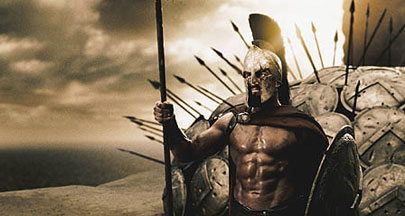
The Spartans could have retreated, or they could have simply slaughtered the inhabitants and moved on somewhere else. But their solution to the problem seems uniquely Greek to me. They transformed their society by militarizing it, making every male a soldier, allowing themselves to continually have a challenge to master. All this provided extra opportunity for showing “arete,” or, “excellence.” No longer could one choose to be a shoemaker, farmer, and so on. By 620 B.C., after the second war between Sparta and its enslaved population, every male now carried a spear, and the slaves grew the food. Herodotus records one Greek commenting to the Persians in 480 B.C. that
Free though the Spartans are, they are not free altogether. They too serve a master in the shape of Law. They show this by doing whatever their master orders, and his orders are always the same: ‘In action it is forbidden to retire in the face of the enemy forces of whatever strength. Troops are to keep their formation and either conquer or die.
They sacrificed everything to make this happen. Making every male a soldier, and using the slaves to farm did consolidate their conquest. But 1) All traces of cultural creativity disappeared, 2) No personal freedom of job, lifestyle, or travel, was allowed, 3) Boys were separated from their families at a young age, 4) Slave economies lack effeciency, so resources were precious. Any infant deemed physically unfit was usually killed, and so on. Spartan society ‘stopped’ in sense. But they developed the most feared heavy infantry force in ancient Greece, and that was enough to give them power and influence.
This ideal impacted their marriages. They arranged to have the strongest men marry the strongest women to create the best chances of strong sons. If marriages did not produce strong children, they were encouraged to look elsewhere. Women bought into this ideal as well. They spent their time training their bodies to have children.
Their society had all the strength of a high powered rifle bullet. Powerful, yes, but narrow in its application. The Spartans sacrificed what most would consider to be the things that made life worth living, such as personal freedoms, family life, cultural experiences, etc. Truly, you are what you worship.
Was it worth it? Some might argue that their slaves lived better lives than the Spartans. It appears they had more variety in their diet, and possibly more personal freedom as to who they married. Of course, they had harsh lives under the constant watch of Spartan overlords, but did the Spartans live much better? The Spartan world and lifestyle had all the narrowness of slavery. The old adage, “This will hurt me more than it hurts you,” might stand true for the Spartan regime.
Aristotle wrote the best epitaph of the Spartan system, saying,
Peoples ought not to train themselves in the art of war with an eye to subjugating neighbors who do not deserve subjugation. . . . The paramount aim of any social system should be to frame military institutions, like all social institutions, with an eye to peace-time, when the soldier is off duty; and this proposition is borne out by the facts of experience. For militaristic states are apt to survive only so long as they remain at war, while they go to ruin as soon as they complete their conquests. Peace causes their metal to lose its temper; and the fault lies with the social system which does not teach its soldiers what to make of their lives when off duty.
Arnold Toynbee concurred and wrote,
The superhuman–or inhuman–fixity of Sparta’s posture, like the [doom] of Lot’s wife, was manifestly a curse and not a blessing.



 A Stick in the Mud