Democratic Personalities and Democratic Laws

I posted originally some years ago–you will see the dated references–and repost it now in conjunction with our Government class discussions this week.

The original post is follows . . .

******************

Barring any unusual excitement at the Democratic and Republican conventions, it appears that many Americans will feel caught between a rock and a hard place regarding their two main choices for president.  Many blanch at the thought of “President Trump,” and I wondered if history might suggest hope for such a possibility.

Our founders may have had Republican Rome as their model, but as the U.S. continues to approach a more immediate democracy perhaps we should look to ancient Athens for a historical parallel. Athenian democracy experienced several points of crisis, with perhaps the most notorious coming after their defeat in the Peloponnesian War when they put Socrates on trial.

Many reasons have been given as to Socrates died at the hands of the Athenians. I am intrigued by the theory Mark Munn expounds in his book The School of History.  Munn argues that by 399 B.C. Athens searched desperately for stability.  Their democracy had transformed significantly under Pericles ca. 450-435 B.C., then switched to a partial oligarchy after the Sicilian disaster in 411 B.C., then back to a democracy by 410, then back to oligarchy in 404-03, then to a restored democracy once more.  But the democracy that ruled Athens ca. 400 B.C. was not the same that Athens experienced a generation earlier.

It seems a reasonable conclusion its heyday, Athenian democracy was driven by great personalities and not by procedures.  Pericles stands as the foremost example of this, but others come to mind.  Herodotus and Thucydides’ histories give us a picture of dynamic men acting on inspiration.  Callimachus votes to attack at Marathon. Themistocles devises his own plan apart from the generals to win the Battle of Salamis.  Even lesser men like Nicias, Alcibiades, and Cleon sparkle on the page.*  Exact fidelity to the law itself did not concern the demos.  At their worst, the Athenians may have just wanted a diversion from their politics out of boredom, but another interpretation might point to the fact that the Athenians in this period of their history trusted in inspirational leadership of the moment, as opposed to fidelity to the expression of the “general will” embodied in law.  One might even call it a humble characteristic of Athenian democracy.  “The People” passed laws but willingly stepped aside at points in the face of “personality.”

But in time the plague, the disaster in Sicily, and their ultimate defeat by Sparta exacted a heavy psychological toll.

With the final restoration of democracy in Athens in 401, Athens moved away from dynamic leadership and towards the exacting nature of the enthronement of law.  Law offered a clear path and if nothing else, stability.  Munn argues that this passion for law and this movement away from “personality” put Socrates afoul of the will of the people.  The orator Aeschines, born in 389 B.C., wrote,

In fact, as I have often heard my own father say, for he lived to be 95 years old and had shared in all the toils of the city, which he often described to me in his leisure hours–well, he said that in the early days of the reestablished democracy , in any indictment for an illegal motion came into court, the matter was no sooner said than done . . .. It frequently happened that they made the clerk str and told him to read to the the laws and the the motion a second time; and they convicted a man of making an illegal proposal not because he had overleaped the laws entirely, but that one syllable only was contravened.

Socrates probably did run afoul of the exacting nature of Athenian religious law after 401 B.C., and he certainly ran directly counter to the spirit behind such laws with his claims to personal, divine inspiration that transcended any earthly authority/law.  He was a throwback to time associated with chaos, and to be frank, military disaster.

Of course democracies traditionally have the “rule of law” as a bedrock principle, and we should prefer exacting rule of law to the whims of a despot.  But few civilizations can match the cultural achievements of Athens in 5th century.  Also, the personality driven democracy of the 5th century certainly outperformed the law driven democracy of the 4th century.**  Perhaps one lesson we might draw from this is that a mixing forms and styles of government might outperform monochromatic governments, much like mutts are generally healthier and less crazy than pure-brads.^

Observers of Trump often comment that, aside from his ideas on immigration, he seems to have no particular policies (others would disagree).  Yet, unquestionably, he is a “personality,” one that much of the media, for all their antipathy towards him, cannot resist.  Is it possible that such an injection of “personality” might be what could help us from stale rigidity in our political life?  Certainly we have plenty of bureaucracy, plenty of incomprehensible law, as it stands now.

That would be the best case scenario for this next election cycle.  Unfortunately, there are many other directions in which it might go.

Dave

*Cleon’s expedition and victory in Pylos during the Peloponnesian War is evidence of this preference for personality over procedure.  It was technically illegal for Cleon to even lead the expedition in the first place, but the Assembly could not resist enjoying the personal rivalry between Nicias and Cleon, and allowed/shamed Cleon into having his chance, which he then took advantage of.

**The great achievements of the 5th century came to a halt during the Peloponnesian War, a self-inflicted wound if there ever was one.  But the 4th century did no better, succumbing to Macedon after decades of vanilla tapioca laziness (as the traditional interpretation has it, anyway) in 338 B.C.

^Some might argue on behalf of the 4th century by citing that it produced Plato and Aristotle, luminaries 1 and 1a in western philosophy.  This argument should not be pushed too far.  A glance at the history of philosophy shows that most advances in this field occur in times of societal breakdown or even decay.  This is in contrast, I think to other areas of cultural achievement, whose health usually parallels that of the rest of society.  The 4th century had no Parthenon, no Euripides, etc.
Valleys of Neptune

Several years ago I attended a conference in which Dr. Peter Kreeft was one of the featured speakers.  I have read a few of Dr. Kreeft’s works and liked them all, and especially enjoyed his essay on surfing, one of his great loves.

During one of the lunch breaks I had the immense good fortune to find myself sitting next to Dr. Kreeft at one the random round tables in the dining area.  I asked him for some surfing tips and he proved gracious and helpful.  Based on his love for the sea I also wanted to run a pet theory of mine by him.

The theory runs something like this. . .

Mankind’s greatest feats of creativity have always come near water.

  • Egypt had the Nile and the Mediterranean
  • Babylon had the Tigris and Euphrates
  • Greece had the Mediterranean
  • Northern Europe gave birth to the Gothic Age, by the English Channel and the North Sea
  • London then led the way with the Channel, North Sea, etc.
  • The Dutch had a brief but brilliant golden age, again right on the water
  • In America the great cultural centers have always been Boston, New York, L.A., etc.

Even when sometimes you think of an exception, the theory still holds. Chicago is in the middle of the U.S., but has the Great Lakes.  Twain invented American Literature in the Mid-West. . . but his formative years were spent on the Mississippi.

And so on, and so on.

Assyria was in the Ancient Near East, but not creative in many ways that contributed to humanity. They did not live near any great body of water. The Greek city-state of Sparta was one of the few far away from the Mediterranean, and their culture stagnated.  Rome obviously had lots of power, but came to the Mediterranean late in their game and thus borrowed a great deal from everyone. Their creative cultural contributions pale in comparison to Greece, but also Egypt and probably Babylon as well.

Some might suggest that the key is majestic expanse, not just water.  But I disagree.  The Great Plains have majestic expanse in spades and have not led the way in creative impulse.  The Himalayas have the tallest mountains on Earth but have not produced great thinkers, architects, etc.  Sparta was surrounded by mountains on all sides and may have been one of the more culturally stagnant of all civilizations.  Of course mountains and plains have a beauty all their own and can inspire, but they do not appear to have the universal impact of water.  I still think there must be something to water itself.

A purely rational or mechanical view of this would probably put the emphasis on the fact that living near water would inevitably result in overseas trade, which would blend cultures and ideas to a degree that would naturally lead to creativity.

But I think that this puts the cart before the horse.  For a civilization to think of something beyond survival and necessity, it has to think outside of itself, and for that it needs inspired.  It is this sense of inspiration that opens them up to travel, other cultures, and other things.  In other words, substantial bodies of water subconsciously unlocks our creativity and then civilizations take advantage of the opportunities before them.

“What do you think?” I asked Dr. Kreeft.

“I agree.”

There followed a pregnant pause but all I could think was, “He agreed!  Yee-ha!”

He continued (I paraphrase his words), “There is something about water that ties us to creation itself.  It is where we came from.”  And with that, he politely excused himself.

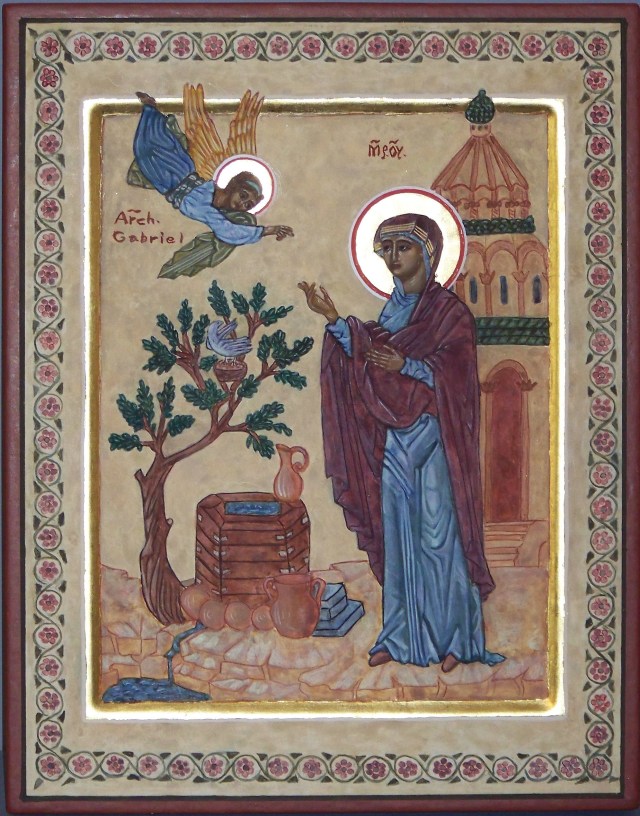
Part of me wanted him to say more, but upon reflection he had in fact said it all.  I doubt very much that by the “where we came from” comment he meant anything in a purely Darwinian sense.  Genesis 1 talks of creation being drawn up through water.  Our new creation involves the waters of baptism.  1 John 5 talks mysteriously of the three-fold agreement of the Spirit, water and blood.  I know of a physics teacher who begins the year by looking at ancient views of creation and the cosmos, and mentions Thales’ idea that all matter comes from water.  The students tend to scoff until they re-read Genesis 1.  There is the Tradition of the Church which portrays Mary hearing the Annunciation, with the attendant re-creation of all things through the Incarnation, sitting by a well.  The creation of the “new Adam” would obviously take us back to Genesis 1, just as St. John does in the opening of his gospel.

In the Odyssey (13.102-112) Homer refers to a cave sacred to nymphs which contains “ever flowing springs of water.”  Also in the cave are “jars made of stone,” along with “looms, likewise of stone, in which the nymphs weave sea-purple garments.”  The Neo-Platonic philosopher Porphyry writes,

The “garments of sea-purple” are obviously the flesh, which is woven together from blood; the sea-purple dye is derived from blood, and the wool that it colors is also the vital fluids of animals.  All flesh is thus fashioned from blood through blood . . .

To this day Jimi Hendrix stands firmly entrenched as the greatest electric guitarist of all time.  He did things with the guitar that still no one else can equal.  I don’t think it coincidental that some of his most intriguing songs (“Rainy Day, Dream Away,” “Castles Made of Sand,” “May This be Love,” “1983 . . .A Merman I Should Be”) involve water.  Perhaps in some way he understood the power and meaning of water as Peter Kreeft did that day at lunch, a serendipitous moment for me if there ever was one.

8th Grade: Victory and Defeat

Greetings,

This week we looked at the Trojan War and its aftermath in Greece.

In some ways the Trojan War belongs to province of literature rather than history, because no real “history” books describe the events as we know them.  But that does beg the question, what is evidence?  Is Homer’s Illiad a kind of historical evidence for the Trojan War?   That of course depends.  As part of our study of the Trojan War we looked at different kinds of historical evidence, and the strengths of each.

The points in favor of “Historical Accounts” seem obvious to most:

  • We know the author, and we assume that either he was a eyewitness himself, or had access to eyewitnesses, or access to the records of eyewitnesses.
  • The fixed nature of the text means the story cannot change over time.

But we should be careful not to discount Oral Tradition

  • Do we unnecessarily give undue weight to books merely because they are written down?  Why is reading a book more trustworthy than hearing a story?
  • Books have a fixed text, but many times we remain at the author’s mercy.  He may  twist and distort the truth in his writing, and we give it extra weight because it is writing.
  • Books are the product of one man, but oral tradition comes from whole communities.  Thus, some argue, oral tradition has more external checks upon its veracity than texts.

Archeological evidence is both the strongest and weakest of the three

  • Archeology gives us direct access to the past, often times unfiltered.
  • But, in contrast to texts or traditions, archeology usually gives us only a fragment of the story, and must be fitted into a larger context that archeology often cannot provide.

The best extended treatment I have seen of the evidence for the Trojan War is Michael Wood’s In Search of the Trojan War.  Unfortunately, this video series is nearly 35 years old and parts of it stand outdated.  Time has tended to confirm and extend evidence for the conflict.  If interested you can view a more “popular” (and shorter) account here

The aftermath of the conflict did not turn out as the Greeks no doubt hoped.  We know the Greeks plundered Troy for gold, jewels, and slaves, and we might expect that this sudden influx of cash, and the long-awaited return of its leaders might lead Greece into a golden age.

In fact the opposite happened, and Greece descended into a dark age that lasted somewhere between two and four centuries.  It certainly appears at least that the immediate aftermath of the Trojan War brought general dissolution to the Greek mainland.

Why did this happen?

In the end we can do little better than speculate, but in class we advanced a few theories:

  • In winning the war, Greece won the lottery.  But by a decent margin, lottery winners report that their winnings made them less happy, not more.  The added wealth brings added stress, and conflict over that wealth with much higher stakes.  Perhaps the same thing happened to Greece on a grand scale.
  • Civilizations, like individuals,  tend to thrive when responding to a challenge.  Greece especially emphasized this through their doctrine and practice of arete.  But the massive cash infusion might have made them rest on their laurels, making them less vigilant about things in general.
  • The Trojan War took most of Greece’s leaders away for 10+ years, according to tradition.  When parents go out for the night they have a talk with their kids — “be good to your babysitter, or when I get home I’ll ask how you behaved and then you will be punished.”  Thus, babysitters have a delegated, proxy authority in the eyes children.  But what if mom and dad never came home?  Would the sitter still have authority?

I asked students to envision what would happen if, on their block, every parent went out for the night, and everyone had a sitter.  But, only 2/3 of the parents returned to their homes, leaving the sitters there permanently.  Without mom and dad to enforce the sitters’ word, their authority would collapse almost immediately.  What would happen to the block?  If even just five parents did not return, what would happen to the “society” of the block, and its social interaction?  When we realize that many “parents” of various Greek provinces did not return from Troy, we can imagine the results for the whole of Greek society.

Dark Ages usually occur when fear and instability lead to isolation, and then isolation leads to a breakdown in the way society functions.  Perhaps this is what happened with Greece.  Dealing with failure requires careful thought and wise action, but so to does dealing with success.

Next week we will leapfrog a few centuries and focus on how Sparta and Athens emerge from the Dark Ages.

Blessings,

Dave

8th Grade: Water and Mountains in Greece

Greetings,

This week we began Greek civilization.

We began where we began where we began our look at Egyptian civilization, with geography.

Greek geography has three dominant features I wanted the students to notice: water, mountains, and climate (below is rough topography of the region)

MapTopoGreece

I believe water had a few key impacts on the Greeks:

1. Psychological — it is nearly universal human reaction to be drawn out by large bodies of water.   At least I tend to think it is.  Most of us have probably vacationed at the beach before.  Have most of you, like me, stood looking at the horizon of the sea and thought, “One day I shall go forth and seek out boldly new lands and new places”?

Alright, maybe not for everybody.

But why does waterfront property sell at such a high price?  Water may not call us all to adventure, but it does seem to impact our psyche in some way.

2. Water also serves as a means to communicate and interact with others.  So those that live near water tend to explore and trade, and this in turn creates vibrant economies and cultures.  England, the Netherlands, and Venice might be examples of this.

In the end, we can see why great cultural explosions often come from places near water if we combine the possible psychological and obvious practical effects (Greece, Renaissance Italy, the Dutch, England)  Of course like most things, this has its limits.  Witness, for example, classical music from Bach though Strauss, Russian music and literature, etc. in essentially land-locked places.  Still — it seems to me that there may be a connection between water and a civilization’s creativity.  I expand on these possibilities here for those interested.

Mountains and Soil

1. Greece had farmers, but in general the soil was rockier and poorer than in the Fertile Crescent.  This in turn, of course, might only serve to push them outwards all the more.

2. The mountains divided them geographically, which in turn divided them politically.  These mostly independent communities may have helped originate, or at least broaden, the concept of self-government.  All of the civilizations we have studied so far have chosen the ‘big’ route to success, partly through choice and partly through circumstance.  In contrast, the Greek philosopher Aristotle believed the ideal political community should have more than 5000 citizens.

Climate

If most people could pick their ideal climate it would probably be between 50-80 degrees, light breeze, low humidity.  This would be a general description of a Mediterranean climate, and one impact this had on the Greeks was that they lived life outdoors.  So — as they interacted with other areas throughout Greece and the Mediterranean, they also interacted a lot with each other, and this too might have helped contribute to the creativity of ancient Greek civilization.

After looking at geography we went to another key foundation of ancient Greece and looked at their concept of ‘Arete,’ which I think can be best translated as ‘excellence.’  ‘Excellence’ is an amoral concept.  The Greeks admired people who were ‘excellent’ people.  Odysseus was excellent at cleverness and like a cat, always landing on his feet.  Achilles is admired because no one can best him in battle.  But neither would be considered moral people in any Christian sense.  Arete tells you to continually pursue excellence, to never rest on one’s laurels.  One of the problems with arete, however, is that it does not tell you when to stop, something that we will see working itself out in Greek civilization.

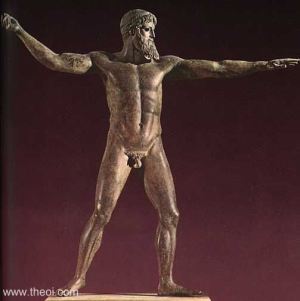
We have discussed before that what a civilization worships is what it follows after at all costs, and this may not be found ultimately in the gods themselves.  One question I posed to the students was, which came first, the Greek gods, or Greek arete?  Greek gods have power and beauty, but not morality.  In Greek sculpture their is not much difference between how gods and men are depicted.  This one is of Poseidon:

Posiedon

And another famous one of the discus thrower (stance obviously different, but the ‘body’ is the same:

I should say that the students were right to point out some minor differences, as the gods usually tend to look more imposing or regal, but in general the gods were just somewhat better versions of mankind.

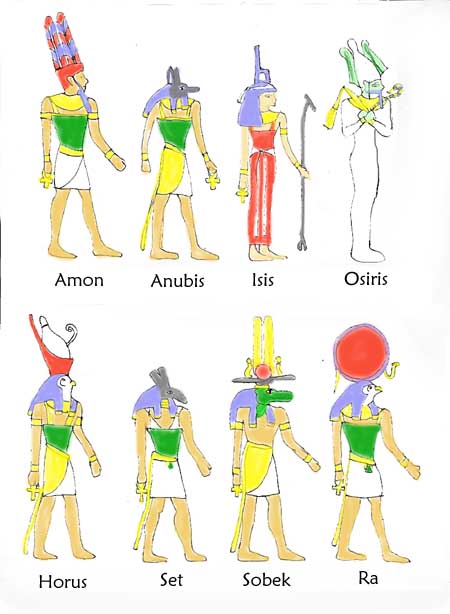
We can contrast this with the Egyptian gods.

Egyptian Gods

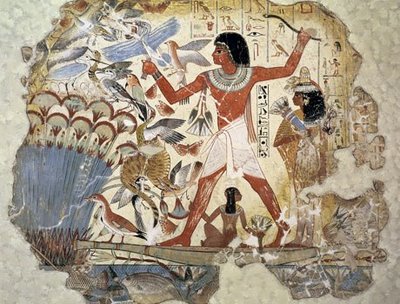
The difference is more than mere artistic technique.  When they wanted, the Egyptians could be quite expressive, as this tomb painting with birds shows.

Often times the Greeks depicted the gods in motion, perhaps reflecting the fluid nature of their civilization.  The Egyptians, in contrast, often showed their deities in a static posed, often with arms crossed, reflecting the more stable, tradition oriented nature of the Egyptians.

Next week we will look at the Trojan War and the possible historical roots of the conflict.

Thanks again,

Dave

Democracies and their Aristocracies, pt. 2

This is a post of multiple lives, written originally about 4-5 years ago, reposted based on class discussions . . .

*********************

This serves as a companion piece to this post of some time ago . . .

Thanks to Martin Gurri, who makes an excellent point in his new book.  The information revolution may very well serve mass democratic movements, and that may not be a good thing . . .

**********************

Many events leading up to the Peloponnesian War helped increase tensions between Athens and Sparta.  I never ascribe to theories that make certain events “inevitable,” but given the history between two of Greece’s pre-eminent powers, war was probably a better than 50-50 bet as tensions between them increased in the mid-5th century B.C.  Athens’ decision to build walls around the interior of the city and its harbor clearly added to these tensions.

I had always interpreted Athens’ decision in almost entirely military terms.  The Persians sacked their city in 480 B.C., and the Athenians recovered it only after a last stand naval battle in Salamis.  The psychological and physical scars of that event would naturally lead to a desire for more defense.

Naturally such an action strained things between Athens and Sparta.  Athens had a great navy, Sparta had its infantry.  Each could hurt the other in its own way, a kind of ancient application of “M.A.D.”  Now, Athens could hypothetically hurt Sparta or its allies without worrying too much about the consequences.  As great as Sparta fought in open battle, they had limited abilities in siege warfare.  Athens could remain safely behind the walls of Athens.  You could see the walls of Athens as a first strike weapon, one that allowed them to sally forth with Sparta not able to retaliate in kind.  So too, when President Reagan proposed his SDI “Star Wars” defense, many believed the invention would create a more dangerous world, not a safer one.

Peter J. Fleiss’ book Thucydides and the Politics of Bipolarity showed me a side of this issue I had not realized before.  Athens’ walls would never have been built without a decisive shift towards democracy in mid-5th century Athens.

Like almost any other place in the ancient world, Athens’ identity came from its landowning farmers.  However, around 600 B.C. the wealthier oligarchs gained an unstable amount of power via the Code of Draco.  At this point, Athens chose a tyrant named Solon to take control of Athens for 20 years, beginning in 590 B.C.  The choice revealed a lot about the Athenians.  Solon had wealth, which earned him the trust of the aristocracy, but . . . he was not an aristocrat, which earned him the respect of the people at large.

Solon embarked on a program to bring social stability back to Athens.  He had to walk a tightrope between competing factions and earned high praise from the ancient world for his reforms. For our purposes here, we note that

  • He refused to redivide land and let the wealthier aristocrats keep what they had acquired from the newly poor.
  • At the same time, he taxed the wealthy at a much higher rate
  • He helped grow a middle class by encouraging the growth of a merchant fleet

The growth of merchants provided a valve to let off social steam.  In addition, many of the city’s poor got jobs rowing the ships.  Solon attempted balance in his reforms, but hindsight shows us that the power of traditional elites was on the clock.

The economic story of Athens ca. 590-450 B.C. mirrors what happened to Rome when she started to shift to a more merchant oriented economy from 200-60 B.C.  Rome’s shift helped to destroy the very elites who profited most from this shift.  The power of elites rests on tradition.  Tradition comes from continuity, and continuity comes from land.  This has been the way of things from the days of yore.  Once cash money, and not land, formed the primary currency, the land-owning elites lost much of their power.

As Athens naval might grew the population shifted to more urban areas.  Of course poorer farmers resided outside the 350px-pelopennesian_war_walls_protecting_the_city_431_b-ccity walls, but we can be sure that the older, established families had most of their land outside the city limits.  This land would be the first target of any invading army.  Building the wall would allow for more protection, but any defensive structure sends a double message.  The Germans, for example, could invade Poland with confidence in 1939 because the Maginot line signaled a purely defensive posture for France along the frontier.  Building the walls around the city signaled that in the event of war Athens would willingly let the majority of its exterior farms fall into Spartan hands–until the war was won, of course.

Popular democracy would be the only plausible political vehicle to accomplish this.  Land of the elites outside the walls would suffer before the merchant class within the city.  In the event of a Spartan invasion, the navy, and the poor who rowed the ships, would rise even more in importance.  Only the navy could then procure food for the city under siege.  When the time came, Pericles proposed this exact strategy.*  At the start of the Peloponnesian War Athens retreated inside its walls and let Sparta have the run of the countryside, while their navy shouldered the military load.

Athens’ walls signaled a cultural shift as well.  Some of the established elites outside the walls were obviously more conservative, and might have had more in common with the average Spartan than the average Athenian inside the city.  The walls repudiated the statesmanship of leaders like Cimon who sought rapprochement with Sparta.**

To me Pericles’ strategy could have the hallmarks of the “tyranny of the majority” problem discussed by so many political philosophers.  Older, elite families lost land, but more importantly, they lost the possibility of gaining status in the war.  In the Greek world, status gave power, not vice-versa.  Pericles’ proposed strategy greatly limited the chances of the landed gentry gaining honor and status via battle, while greatly increasing the chances of the “demos” to gain in both departments.^

The failure of Pericles’ strategy, partly caused by the unforeseen plague that hit Athens, does not prove that democracies need elites.  But their failure in the overall war effort might suggest it.  Solon gained fame, honor, and success by pursuing a political agenda that both rewarded and burdened both the people and the elites.  In the 100 years after Solon left power, Athens went from an also-ran to a major power in the Greek world.  As democracy grew, so too did the people’s opportunities to strike back at their own elite.  They should have resisted the temptation.  As Tocqueville wrote, democracies usually win their wars, but that’s only when they unite against a common enemy.  In Athens’ day the political infighting that began the war lasted only until their situation got desperate.  We can’t measure the effect, but it surely hampered their efforts.  We might wonder if things would have been different if Pericles pursued a military strategy that allowed for participation and honor for both the people and the gentry.

Our recent election saw much ink spilled on the question of “elites.”  Some argued that Clinton is “elite” because of her connections and long political career.  Others argue that Trump is elite because of his wealth.  Whatever your definition, “elite” has become a dirty word.  That’s a shame, because history tells us that healthy democracies need, and perhaps even embrace, their “elites.”

Dave

*Thucydides argues that such a strategy would have worked had the Athenians had the discipline to stick with it.  This comment has always perplexed me for three main reasons: 1) At some point the Athenians would have had to deal with the Spartan infantry, and a policy of withdrawing behind walls would only embolden the Spartans, 2) The Athenians did have patience.  They tried this strategy for about 4 years, with no real success.  Initially the Spartans came, burned what they could, and left.  But eventually they realized they could come and stay for much of the year with impunity, because the Athenians never challenged them, and 3) Thucydides shows some disdain for the popular democracy throughout his narrative, and this policy only strengthened the hold of the demos on affairs of state.

**The mood shifted decisively with Cimon’s ostracism.  He father fought and won the Battle of Marathon.  Cimon himself had many noteworthy victories against the Persians.  Everything about “traditional values” pointed to a long and respected career for Cimon.

^This is one reason why I disagree with Thucydides’ assertion that Pericles’ time in power created an aristocratically leaning government with some democratic underpinnings.  Here I agree with Donald Kagan that Periclean democracy was really fully democratic.