Politics Make Strange Cities

I am republishing this based on a brief, but interesting article I read about Cairo, with info and links inserted below . . .

************************************************************************

The ancient Persian Empire usually doesn’t get the credit it deserves.  I reflected on this as my son read the graphic novel 300.   I give the book credit for its entertainment value and reasonable historical accuracy.  But at one point the story declares that in fighting Persia, the Spartans fought to preserve freedom and the light of truth and reason.  This strikes me as an almost dangerous absurdity, considering that the Spartans enslaved a native population and practiced infanticide, among other horrors.  The Persians built their extensive empire largely on the back of tolerance (note the praise for Cyrus the Great from the prophet Isaiah), pioneered some legal improvements, and often paid even their lowliest workers.  One can root for the Greeks against the Persians, as I do, but not quite for the reasons given in 300.

The Persians also are interesting case study in the building of cities.  As a people they originated in the mountainous Iranian plateau, but as their empire spread, Persian natives found themselves far afield from their native climate.  How could they hold their rapidly expanding empire together?  I already mentioned the legal and philosophical approach, but they matched this by having three distinct capital cities scattered in different parts of their empire.

Only Ecbatana, their summer capital, had any proximity to their place of origin.  It made sense to make it their summer capital as it lay further north.  But they gave Susa prominence in the South by making it the final/first stop on their royal road, and they willingly went further south still to Persepolis for symbolic purposes.  Having three different capitals demonstrated the broad-minded, inclusive approach of the Persians.

The very flexibility that allowed them to grow so quickly, however, proved a double-edged sword.  Being Persian came to mean nothing more than having a better economy — in other words — very little about Persia touched the soul.  When Alexander invaded between 333-323 B.C., many willingly and easily switched allegiances to him.

I admire Persia’s feat of flexibility.  No capital city today could “move” to a new location every few months.  We have far too much bureaucracy to achieve that.  Also, they “walked the walk” as well as talked.  They said they were inclusive, and they demonstrated this “on the ground.”  But Persia’s story begs the question of whether or not one can invent history on the fly, whether one can “create out of nothing” a culture and a way of life.  I touched on my skepticism about invented cities in this post, and the reasons for the failures of St. Petersburg to lead Russia are quite similar to Persia’s ultimate demise.

Cairo is about to attempt an experiment not unlike Persia.  With their population growth outpacing their geography, they plan to build a massive “New Cairo” directly adjacent to the old city to serve as Egypt’s capital.

Ordinarily I might think this a fool’s errand, but Egypt has gone through several distinct historical phases and may not quite have a distinct identity in the modern era.  Maybe, just maybe, this could work (read more here).

America has some similarities to Persia, especially lately with our emphasis on tolerance.  Again, there are many worse things to be known for, and besides, I think being “American” involves more of an inner identity than Persia ever had.  But, we, like Persia, invented our capital city, and we might inquire how that has worked out.

Like Persia, we picked the location of our capital for purely political reasons.  Tradition and geographical position probably pointed to Philadelphia as the best choice.  But, despite a lack of clarity on exactly how we ended up making the decision, it appears that we decided on Virginia both to help them ratify the Constitution and perhaps to honor Washington, Madison, Jefferson, etc.  To build the buildings we had to clear a swamp and import people into it the city from outside.  The transience of the D.C. area has to do with military and government turnover, but has its roots in the fact that most everyone in the region originally got imported. Their homes lay elsewhere.

Thus, D.C. never had a history of its own. It had to be invented, and history has to “happen”–it can’t be invented.  So while New Orleans has Bourbon Street, Memphis has Beale Street, New York has Harlem, D.C. has K Street, where lobbyists and bureaucrats cut a rug.  Not exactly the stuff of legend.

As Toynbee pointed out in Cities on the Move, no city worthy of the name can sustain itself.  It has to import the necessities of life, but evens out the balance sheet in other ways.  All capital cities, for example, export law and national directives.  But one also hopes that they might export some sense of cultural identity, some sense of “soul” for the nation (with the caveat that it need not dominate, but only add flavor).  D.C. will never be able to do this, and we should not expect it.   The town got created out of nothing purely for the function of exporting administration, and a leopard can’t change its spots.

It is a shame that all D.C. can export is bureaucracy, but our invention of the capital does testify to our inherent flexibility as a nation.  Our lack of attachment to History itself has given us the ability to adapt quickly to challenges and allowed individuals in every generation to make of themselves what they will.  The question for the future remains whether or not the lack of cohesive cultural and historical identity will ultimately hurt us as it hurt the Persian Empire 2500 years ago.

Song of Wrath

For years now I have wondered how many books actually get published.  In the Christian book world every year, for example, books on prayer, grace, parenting, and so on tumble off the shelves each year.  Those I glance at sound almost exactly the same.  Of course it’s no business of mine that books are published, but nonetheless, I am surprised.

The same phenomena exists in the world of history as well, perhaps especially in ancient history. Here we deal with limited sources and unsure timelines, and so it seems that one can say only so much.  When dealing with the Peloponnesian War I thought that we had reached our limit.  The advent of archaeology and the concomitant renewed interest in the ancient world in the late 19th century begot groundbreaking history on ancient Greece. This all culminated, I thought, with Donald Kagan’s masterful four-volume work published in the 1960’s-70’s.  Having read portions of those books, I thought that the final word had been uttered.  Victor Davis Hanson’s uneven A War Like No Other, and Nigel Bagnall’s  disappointing book on the conflict proved to me that indeed Kagan had the last word. Now saying anything else would put one in an awkward position . . .

Or so I thought.

After all, in any field we should encourage new books because we have to encourage new ways of thinking.  Maybe 90% of what gets published never need see the light of day but that 90% might be needed to get the 10% that shines new light just where it’s needed.

Enter J.E. Lendon, Virginia’s own spirited iconoclast, and his new book Song of Wrath.

Every student of the Peloponessian War rightly begins with Thucydides, and he impresses immediately with his penetrating analysis and fluid arguments.  He talks little about what would be for us, the curiosities of ancient life (commonplaces to them of course), and instead focuses on what moderns would tend to appreciate.  For Thucydides, practical power politics and universal psychological principles explained the war.  But Lendon points out that the very fact that Thucydides has to argue for his point of view shows that he departed from traditional ways the Greeks understood conflict.  He did not reflect, then, a typical Greek understanding of the war.  This does not mean he was wrong, but it means that we must wonder if this great authority spoke rightly.  In the end, Lendon admirably challenges some of Thucydides’ key beliefs and conclusions.

Lendon begins his work by discussing Achilles.  The Iliad begins with a seemingly petty dispute between Agamemnon and Achilles over who has the right to a captured slave-girl.  Agamemnon pulls rank on Achilles and takes Achilles’ woman which leads Achilles to withdraw from the fighting altogether.  Most every modern reader inevitably views Achilles as a total heel, a petulant jerk who would rather see his companions die than accept Agamemnon’s decision, however unfair it may be.  And yet Achilles, not Agamemnon or Odysseus, remained for centuries a revered hero of the Greeks, nearly worshipped by such luminaries as Alexander the Great.

How can this be?

Lendon uses this as a window into what the Greeks valued and how they structured their world.  Once we see the great value they placed on rank and honor, we understand the reasons for the war, and the reasons for certain strategies pursued by both sides much more clearly.  Achilles earned his reputation by sacrificing all to the Greek concept of honor.  We know that he sacrificed long life for glory in battle for starters, but he also willingly defies his king and his friends to preserve his honor.  He reenters the conflict not when his honor receives satisfaction, but when his friend Patroclus dies.  When Achilles fights  he does so not for Agamemnon, but to revenge Patroclus, another key Greek concept.  After slaying Hector, Achilles goes too far and succumbs to hybris.  He drags around Hector’s body and initially refuses burial.  For this, he suffers ignominious retribution in the form of an arrow from spineless Paris. But — he had a magnificent run before he ran aground, and that’s what mattered most.

If we understand honor, revenge, and hybris, Lendon argues, we will understand the Peloponnesian War.

Some might suppose this to be a mere gimmick, but I found this lens suddenly made sense of things that had always puzzled me.  Take the strategy of Athens’ star politician Pericles in the wars earliest days.  Thucydides records Pericles arguing that,

[Sparta’s] greatest difficulty will be want of money, which they can only provide slowly; delay will thus occur, and war waits for no man. Further, no fortified place which they can raise against us is to be feared any more than their navy. As to the first, even in time of peace it would be hard for them to build a city able to compete with Athens; and how much more so when they are in an enemy’s country, and our walls will be a menace to them quite as much as theirs to us! Or, again, if they simply raise a fort in our territory, they may do mischief to some part of our lands by sallies, and the slaves may desert to them; but that will not prevent us from sailing to the Peloponnese and there raising forts against them, and defending ourselves there by the help of our navy, which is our strong arm. For we have gained more experience of fighting on land from warfare at sea than they of naval affairs from warfare on land. And they will not easily acquire the art of seamanship; even you yourselves, who have been practising ever since the Persian War, are not yet perfect. How can they, who are not sailors, but tillers of the soil, do much? They will not even be permitted to practise, because a large fleet will constantly be lying in wait for them. If they were watched by a few ships only, they might run the risk, trusting to their numbers and forgetting their inexperience; but if they are kept off the sea by our superior strength, their want of practice will make them unskilful, and their want of skill timid. Maritime skill is like skill of other kinds, not a thing to be cultivated by the way or at chance times; it is jealous of any other pursuit which distracts the mind for an instant from itself.

The Athenians, Thucydides, and the ancients who commented on the war all approved of Pericles’ strategy, which the above quote outlines in bare detail.  Essentially Pericles wanted to make Athens an island by bringing the population within its walls and refusing to fight the Spartans on land.  Then, with their superior navy they could ravage the Peloponnesian coasts.  Most moderns, on the other hand (myself included) have thought little of his approach.  At best it appears a recipe to avoid losing rather than actually winning.  At worst, it’s a passive strategy guaranteed to give all the advantages to the other side.

Lendon argues that we misunderstand the strategy because we misunderstand the Athens’ war aims.  Athens did not care about imposing their will on Sparta, or finding their “center of gravity” (a la Clauswitz) so much as they desired equal rank with Sparta.  Sparta had the rank of “hegemon” in the Peloponnese, Athens sought hegemon status in Attica and thus, equal status with Sparta in the Greek world.  Sparta will ravage our lands, but we can ravage theirs as well.  We don’t need a “shock and awe” response because we strive not to prove our absolute superiority, but our equality.  Besides, the Athenians would wish to avoid the hybris of seeking something beyond their station. They contented themselves with equality, follow the unspoken rules of war, and avoid the wrath of the gods.*

Armed with this perspective, suddenly other aspects of the war made sense to me. Before I criticized Athenian coastal raids for wasting time and resources to achieve purely symbolic results. This led me to make broader conclusions about the vacillating nature of democracies at war.

Lendon argues of course, that honor and rank have everything to do with symbolism. The Athenian coastal raids had nothing to do with “imposing their will” or tactical advantage, and everything to do with displaying status.  So Lendon’s work not only entertained me, it has forced me to reconsider most of my lesson plans for teaching the war.  Grudgingly . . . I give Lendon my thanks.

Does any of this new analysis have a modern application in war?  Some have suggested that 3rd-world warfare resembles many of these “traditional” concepts of honor and symbolism, and that we must abandon all the Cold-War principles that guided our statecraft.  Some argue that acts of terrorism have a lot more to do with symbols of honor than tactical advantage. I cannot comment on this as I lack the knowledge to do so.  But I do think we see a lot of the same principles in our modern political scene.  Democrats and Republicans both press for legislation that will give them “honor” in their districts or with their national following, and often this legislation has mere symbolic value.  Both sides too can obstruct purely for reasons of status, or to refuse honor to the other side.  Some might argue that this is part and parcel of any democracy.  If so, we will need to redefine our definition of democracy, and accept that at least in its modern context, it has little to do with Christianity. It may bear much more direct similarity to our pagan democratic ancestors, and to the song of wrath sung in ancient times . . .

Sing, goddess, the anger of Peleus’ son Achilleus
and its devastation, which put pains thousandfold upon the Achaians,
hurled in their multitudes to the house of Hades strong souls
of heroes, but gave their bodies to be the delicate feasting
of dogs, of all birds, and the will of Zeus was accomplished
since that time when first there stood in division of conflict
Atreus’ son the lord of men and brilliant Achilleus. . . .

*In Kagan’s great work he comes close to understanding this.  He addresses the modern puzzlement over Pericles’ strategy by pointing out that the Athenians essentially voted for it on multiple occasions and kept it going even after a plague struck their city  In other words, he points out that the strategy surely made sense to them and they must have thought it effective for their purposes.  Lendon argues that after a few years, Athens could have made a legitimate argument that they had won and proved themselves.  The problem with such conflicts lie in that they need interpreted, and Sparta did not interpret events as the Athenians did.  So the war continued, and in time ended with defeat for Athens in a way no one could misconstrue.

8th Grade: Cyrus and the Medo-Persian Empire

Greetings,

This week we began our next civilization, Medo-Persia, and began the story of the origin of Cyrus the Great as told by Herodotus.

There are those who dispute the story’s accuracy.   It does resemble in some ways the stories of both Moses and Paris of Troy.  We can trust the Moses story, but we need not immediately discount the Cyrus story merely for that it resembles the story of Moses. The story of Paris seems to reside in myth and folklore, but again, this should not immediately preclude the veracity of the Cyrus story.  These are interesting questions to ponder, and I don’t know if we can find absolute answers.  What it obvious is that it is a great story.  If you ask your children about it, I’m hoping they can retell it to you if you would like.  You can find it in full online in Herodotus’ Histories in Book 1, beginning in chapter 107.

The Persian Empire had its flaws, but did most things right and represented a vast improvement over the Babylonian, and especially the Assyrian empire.  Some of this had to do with historical coincidence, but a lot of it had to do with the values and practices of Cyrus, the empire’s founder.

Some things to note. . .

1. Cyrus arose to power at a time when no other dominant power dominated the ancient Near East.  Egypt had been on the wane for some time, Assyria was destroyed, and the Babylonians had lost their former shine.  Thus, Cyrus was able to expand by slowly incorporating smaller kingdoms into his realm, without a major challenge posed by any other empire.

2. I think the biggest factor, however, was Cyrus’s foreign policy/diplomacy.  According to Herodotus, he set the tone during his usurpation of the Mede King Astyages.  Cyrus was half Mede, half Persian.  Conquering the Medes in the traditional sense would have meant conquering himself.  He spares Astyages and integrates Median and Persian alike.

Cyrus used this same model for most all of his conquests.  He wanted expansion, but he also strove for incorporation and integration.  He tolerated a variety of customs and religions.  You got the benefits of security and participation in Cyrus’s growing network of trade and prosperity.  Very little about your daily life would change. True, the former king would be exiled to a distant palace, but Cyrus tried to promote from within.  He might use local lesser magistrates to rule in his stead.  In class I put it this way: If Cyrus conquered the U.S. he might exile the President and V.P., but perhaps promote the Senate Majority leader and Secretary of State.  He would create loyalty to himself by this, because those promoted would owe their position to him.  The transition of leadership would be softly felt by the locals.

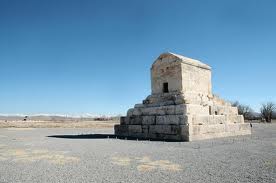
It could be said that Cyrus positioned himself as a ‘liberator,’ and not a conqueror.  He could somewhat truthfully pledge that you would be better off under his dominion.  Slavery came close to disappearing in his realm.  The only thing he asked in exchange was that your army get attached to his and you pledged your loyalty to his person.  He succeeded like few others, and we will not see such effective empire builders until we look at Rome.  One sees something of his personality and humility in his surprisingly simple tomb.

This method of course differed significantly from others that we have seen so far.  One tremendous benefit of this method was that it appears that the Persians had far less slavery than previous civilizations.  As we progress, however, we will see that the splendid machine known as the Medo-Persian empire did have an Achilles heel. What, after all, did it mean to be Persian?  Can an empire’s identity revolve only around economic advantage and efficiency?  The other possible weak link was the army.  This was the one sticking point in an otherwise tolerant (at least for the time) regime.  They mandated and enforced military participation throughout their empire.  This army grew so huge and so multi-national that it might conquer merely by showing up.  But what held the army together?

The history of Persia will in some ways revolve around this question, as we shall see in the weeks to come.


Dave