The Best Reason for Democracy is . . . Democracy?

Several years ago I read an article where the man interviewed had positive things to say about some developments in Italian democracy.  “The people are now ready to criticize and poke fun of their leaders,” he commented.  “We’ll know we have arrived as a democracy when the people can criticize themselves.”  At the time I read this, I thought, “Good for you, Italy.  One day you may join us.  We’ve got something better here.”  But upon reflection, I’m not so sure this is true.  How many politicians, for example, could get away with criticizing the American people?  How many political documentaries create a divide between us and them, whether they come from Rush Limbaugh or Michael Moore?  It always appears to be “their” fault, never “our” fault.

Judgments about one’s own society, however, are tricky.  To see the nose on one’s face you need a mirror.  Without significant experience of democracies on a historical scale, the example of Athens from 508-338 B.C. will always prove important for us to get our bearings.

Writing critical assessments of things or events can be more fun than offering praise. Critical people can sometimes come from a distant and cynical spiritual place, and we shouldn’t give much weight to their comments.  Sometimes, however, criticism arises out of love, and this should grab our attention.  Loren J. Samons’ What’s Wrong with Democracy does this.  He seeks to get past our modern adulation of democracy, and thus, our adulation with classical Athens.  When we examine them afresh, he argues, we won’t always like what we see.  In his criticism Simons sometimes overreaches and sometimes seems to contradict himself.  But his book is, as historian J.E. Lendon stated, “cleansing.”
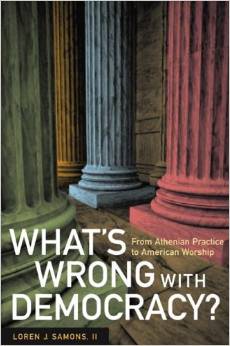
Amidst the various topics Samons discusses, I think the essence boils down to the following question:

What is democracy really about after all?

Christopher Ferrara tackled this question head-on in his book Liberty: The God the Failed.  Samons takes a more indirect approach, but still feels that democracy, standing by itself, may lead to little more than a means to perpetuate whatever we happen to desire.  The only reason we will have for democracy is . . . democracy.

He looks at Athens’ financial history and its relationship to democracy.  He traces a few distinct stages:

  • An early phase where the ‘tyrants’ got overthrown and the franchise expanded.
  • The heralded Periclean phase, often seen as the high-point of democracy.  But Samons points out that this phase of democracy was made possible only by 1) Their silver mines, and 2) The imperial tribute they received from their client states.  The practices we tend to admire about them, such as paying people to attend the Assembly, and large cash payments for their very large juries (101-501) people, could happen only because of their predatory practices abroad.
  • The era after the Peloponnesian War, where they lacked the cash reserves of earlier times, but refused to modify their practices.  This led to serious financial problems and hard choices for the Athenians.  Yet, when faced with the task of defending themselves against Macedon or continuing to vote themselves cash payments, they consistently chose the latter.

Perhaps the Athenians didn’t just simply make bad choices, perhaps the kind of democracy they practiced would naturally encourage them to make bad choices.  If democracy is all about “serving the people” or “giving the people what they want,” then democracies will inevitably choose to short-term gains and quick fixes.  Salmons wrote his book before our own failure to arrive at a budget, or to either 1) Decrease spending, or 2) Raise taxes made itself manifest. Is our own system of government equipped to make hard choices?  Given how we consume energy, we may also have to conclude that our democratic lifestyles have a predatory aspect.

Samons’ next points out that in Athens, their more aristocratic past provided a healthy check on democracy.  Having a different past gave them a compass from which to orient their democratic practice.  It could also serve as a reminder that democracy need not serve as the be all and end all of political life.  In America we have no such check, which leads us to nearly worship democracy as a vital part of our existence.  This in turn, has led to a confused and misguided foreign policy.  On a couple of occasions Athens even voted to switch to a more aristocratic oriented governance, which Samons views as healthy.  In time, Athens banned any alternative to their democracy, and this choice contributed to their eventual conquest by Macedon.  They refused to allow any other method of making decisions, even when they methods they employed to make choices had no real hope of facilitating good outcomes.

On this issue Samons has weaker arguments.  True, I very much wish that we would appreciate democracy because it is ours, instead of investing it with angelic qualities. But the political instability in Athens from 411-400 B.C. was not always as smooth as Samons lets on.  Political exiles and political murders came with such transitions. Having the alternative to democracy came at a price.

However, if a democracy has no reference point outside itself, we should consider whether it may be worth the risk to have such an alternative.  Currently we have no particular ‘North Star’ of religion or virtue to guide our own political practice, and this will lead to everyone scrambling for whatever they can get. We may be in a position now where we could really benefit from a distinct alternative to borrow from, to get some separation from democracy that we might understand its strengths and weaknesses more clearly.  If we have no firm moral guidelines derived from a common faith, the check on democracy may have to come from other viable political ideologies and practices.  Of course such an alternative is entirely unthinkable in our modern context. This may bode ill for us.

This lack of an outside reference point for many modern historians  impacts how they view ancient critics of Athens.  Invariably, whether the ancient chronicler be Thucydides, Xenophon, Socrates, or the “Old Oligarch,” they get discounted due to their “aristocratic bias.”  Now, naturally all historians have bias — even democratic ones. But we cannot dismiss them for this bias alone, however uncomfortable their conclusions may be.  Perhaps the the extreme form of democratic bias comes in the form of the book by I.F. Stone on the trial of Socrates. I applaud Stone for his enjoyable and Herculean efforts to partially exonerate Athenian democracy while writing about one of its great crimes.  His book rises to the level of a  great counter-factual history.  But in the text Stone spills a lot more ink discussing Socrates’ “aristocratic bias” then in blaming the governmental system that executed him unjustly.

Critics of Salmons conclusions have two good points.

Salmons offers some good criticisms of Athens in particular and democracy in general. But he proposes no alternatives.  What does he want?  Would he prefer a monarchy or a dictatorship?  I grant this makes the book somewhat unsatisfying, but I can’t fault him for it.  To develop a viable alternative with historical and philosophical backing would require another book.

More problematic is Salmons’ seemingly simplistic take on the problems Athens faced. Surely he realizes that other forms of government have their problems too?  Yes, Athens had issues, but exactly how much blame can we put for their problems on democracy?  Would their problems have been less with a monarchy?  He can say that Athenian democracy made bad decisions, but kings make bad decisions, oligarchies make bad decisions, and so on.  For his book to really work he would have to show that democracies will make more bade decisions, or more catastrophic decisions, then other forms of government.  He fails to do so.

Even still, these flaws don’t bother me that much.  Salmons modestly set out to 1) Give a more balanced picture of Athenian democracy, and 2) Pour some cold water over our ardent devotion to democracy.  He succeeds, and this makes his book worthwhile.

Machiavelli is at various turns a cold man, a dangerous man, and a wise one.  Below I include a section from his Discourses on Livy where he discusses the merits of Rome’s Republic building into its foundation an alternative to the Republic when necessary. This, I think, was Machiavelli in one of his wiser moments.

Dave

Book XXIV

Those citizens who first devised a dictatorship for Rome have been
blamed by certain writers, as though this had been the cause of the
tyranny afterwards established there. For these authors allege that the
first tyrant of Rome governed it with the title of Dictator, and that,
but for the existence of the office, Cæsar could never have cloaked
his usurpation under a constitutional name. He who first took up this
opinion had not well considered the matter, and his conclusion has been
accepted without good ground. For it was not the name nor office of
Dictator which brought Rome to servitude, but the influence which
certain of her citizens were able to assume from the prolongation of
their term of power; so that even had the name of Dictator been wanting
in Rome, some other had been found to serve their ends, since power may
readily give titles, but not titles power. We find, accordingly,
that while the dictatorship was conferred in conformity with public
ordinances, and not through personal influence, it was constantly
beneficial to the city. For it is the magistracies created and the
powers usurped in unconstitutional ways that hurt a republic, not those
which conform to ordinary rule; so that in Rome, through the whole
period of her history, we never find a dictator who acted otherwise than
well for the republic. For which there were the plainest reasons. In
the first place, to enable a citizen to work harm and to acquire undue
authority, many circumstances must be present which never can be
present in a State which is not corrupted. For such a citizen must be
exceedingly rich, and must have many retainers and partisans, whom he
cannot have where the laws are strictly observed, and who, if he had
them, would occasion so much alarm, that the free suffrage of the people
would seldom be in his favour. In the second place, the dictator was not
created for life, but for a fixed term, and only to meet the emergency
for which he was appointed. Power was indeed given him to determine by
himself what measures the exigency demanded; to do what he had to do
without consultation; and to punish without appeal. But he had no
authority to do anything to the prejudice of the State, as it would have
been to deprive the senate or the people of their privileges, to subvert
the ancient institutions of the city, or introduce new. So that taking
into account the brief time for which his office lasted, its limited
authority, and the circumstance that the Roman people were still
uncorrupted, it was impossible for him to overstep the just limits of
his power so as to injure the city; and in fact we find that he was
always useful to it.

And, in truth, among the institutions of Rome, this of the dictatorship
deserves our special admiration, and to be linked with the chief causes
of her greatness; for without some such safeguard a city can hardly
pass unharmed through extraordinary dangers. Because as the ordinary
institutions of a commonwealth work but slowly, no council and no
magistrate having authority to act in everything alone, but in most
matters one standing in need of the other, and time being required to
reconcile their differences, the remedies which they provide are most
dangerous when they have to be applied in cases which do not brook
delay. For which reason, every republic ought to have some resource of
this nature provided by its constitution; as we find that the Republic
of Venice, one of the best of those now existing, has in cases of urgent
danger reserved authority to a few of her citizens, if agreed among
themselves, to determine without further consultation what course is to
be followed. When a republic is not provided with some safeguard such
as this, either it must be ruined by observing constitutional forms,
or else, to save it, these must be broken through. But in a republic
nothing should be left to be effected by irregular methods, because,
although for the time the irregularity may be useful, the example will
nevertheless be pernicious, as giving rise to a practice of violating
the laws for good ends, under colour of which they may afterwards be
violated for ends which are not good. For which reason, that can never
become a perfect republic wherein every contingency has not been
foreseen and provided for by the laws, and the method of dealing with it
defined. To sum up, therefore, I say that those republics which cannot
in sudden emergencies resort either to a dictator or to some similar
authority, will, when the danger is serious, always be undone.

We may note, moreover, how prudently the Romans, in introducing this new
office, contrived the conditions under which it was to be exercised.
For perceiving that the appointment of a dictator involved something of
humiliation for the consuls, who, from being the heads of the State,
were reduced to render obedience like every one else, and anticipating
that this might give offence, they determined that the power to appoint
should rest with the consuls, thinking that when the occasion came when
Rome should have need of this regal authority, they would have the
consuls acting willingly and feeling the less aggrieved from the
appointment being in their own hands. For those wounds or other injuries
which a man inflicts upon himself by choice, and of his own free will,
pain him far less than those inflicted by another. Nevertheless, in the
later days of the republic the Romans were wont to entrust this power to
a consul instead of to a dictator, using the formula, _Videat_ CONSUL
_ne quid respublica detrimenti capiat_.

But to return to the matter in hand, I say briefly, that when the
neighbours of Rome sought to crush her, they led her to take measures
not merely for her readier defence, but such as enabled her to attack
them with a stronger force, with better skill, and with an undivided
command.

Impress Imbalance

I encourage my students to play, “Would you rather?” games, i.e., “Would you rather eat 500 live ants or 1 live cricket?” Often questions like this involve no specific moral quandary, but the practice of creating and defending mental hierarchies has great value, even when such hierarchies are relative. Comparing civilizations has something of the apples/oranges dilemma, I admit. And reigning cultural relativism tells us not to judge. But I believe that the mental process involved in deciding whether Greece was better than Rome, or in this case, whether or not Egypt has the leg up over Babylon, helps bring clarity and meaning to the study of history–even if one should hold on loosely to these kinds of distinctions.

Many have used various criteria for evaluating civilizations, such as how long they last, the power they accumulated, their technology, and so on. I think a better lens involves us seeing how each civilization aligns itself with the reality of creation–with the patterns and Truth found in the created order, available for any with eyes to see.

Henri Frankfurt’s Kingship and the Gods gives us more than a rundown of Egyptian and Sumerian/Babylonian kingship. He seeks to integrate religion and politics not just with their history, but also the geography and the general patterns of living from both cultures. He reveals his method early in the introduction, writing,

Mesopotamian society was entirely adapted to the cyclic succession of the seasons.  While each winter resolved its harshness in the spring and the plague of summer was succeeded by autumn rains, human society moved through a succession of seasons in which humanity joined in of the cosmic crisis of life, death, rain, and drought.  The [Babyonian] sees a dramatic conception played out in nature between the divine and the demoniac, between forces of order and chaos.

The most important seasonal celebrations in [Babylon]  centered around the bewailing of the death of Tammuz and his rebirth on the New Year–his victory over death  and his sacred marriage to the mother-goddess.

Egypt, too, reflected the natural rhythm of the seasons in the course of the official year.  But their celebrations differ profoundly in character from those in Babylon.  In the plain of the two rivers, the festivals were never free from anxiety, and those which we know best show a change from deep gloom to exaltation.  In Egypt, festivals provided the occasion to affirm that all was well, for Egypt viewed the universe as essentially static.  Revolts against the established order happened, but never got classified as anything more than a few ripples under the surface.

The rich Nile valley lies isolated and protected on both sides by a vast desert, while Mesopotamia lacks clear boundaries and was periodically assaulted on its fringes by mountain tribes.  Egypt derived its prosperity from the Nile, which never fails to rise, even if the floods differ in effectiveness.  But Babylon depended on uncertain rainfall and  the Tigris was an unaccountable, turbulent, and dangerous river. 

Some might then conclude that religion means nothing more than a natural phenomena, though Frankfurt himself does not suggest this.* Rather, Frankfurt wants to integrate our vision of each society–to see Egypt and the Egyptians as one and not many. When we pull back and see the integrated whole of a civilization, the impression they leave comes into greater focus.

If I had to choose between Egypt and Babylon, I would likely choose Egypt, but one of their key weaknesses lay in their failure to appreciate the feminine aspects of creation and experience. Nearly every religion I am aware of sees creation as essentially feminine, Christianity included. As C.S. Lewis commented, we all stand as essentially feminine in relation to God. All in the Church, whether man or woman, are the “bride” of Christ. Various pagan beliefs have “Mother-goddesses,” whereas Christianity might talk of “Mother Earth” in a slightly more abstract way, as St. Francis did in his “Canticle of the Sun.” Egypt had no “Mother Earth”–for them the earth itself was not even feminine. The idea of power had strong play in Egyptian thought, and so rather than the traditional “receiving and transforming” aspect of Earth, the Egyptians saw supreme power in the male diety of Ptah or Geb. In some creation stories, Ra stands on the Primeval Hill to create, again over-emphasizing the male aspect of reality. Apparently Egypt did not want creation to have any derivative existence.

Most every religion, including ancient Israel, had harvest festivals of some kind. Nearly all of these festivals focus on the idea of death, the earth receiving death, and then having that death transformed into life. Harvest festivals connect us with birth and new life, and so highlight feminine aspects of life in general. A proper conception of this pattern must allow for three days in the tomb, so to speak. So in Greece, as elsewhere, the seed could be identified with the king (think of Mary Renault’s classic, The King Must Die), who “dies” for the people to give them grain. No grain comes without the earth receiving and transforming the seed. But things were different in Egypt. Yes, the king ceremoniously started the harvest by cutting a symbolic stalk, but the forgoing ceremony emphasized that he was the wheat which went up to the cloud, not the chaff that fell to earth. Frankfurt comments that,

All we know of the Egyptians shows they would have found [a festival centering on the death of the seed] distasteful. They did not readily admit the shadow side of life, perhaps on hedonistic grounds, but also because, in their static conception of the world, grief had no [place].

We see this in the Egyptian harvest prayers, i.e.,

Osisris is Unas in the mounting chaff

His loathing is the earth;

He has not entered Geb to perish.

He is not sleeping in his house (i.e., tomb) upon earth

So that his bones may be broken.

His hurt is driven out!

He has purified himself with the Horus Eye.

Unas is up and away to heaven;

Unas is up and away to heaven

With the wind, with the wind!

A Christian might be tempted to see here a foreshadowing of victory over death in the resurrection. Perhaps an aspect of that exists here, but along with Frankfurt I extend a word of caution–even God Himself “submitted” to the pattern of first going down before rising up. The Egyptians seemed to want to short-circuit the process. A Christian might think of something akin to banishing “worldly sorrow”–something the Babylonians struggled mightily with–but they should have remembered that “blessed are those that mourn,” and that it is usually our moms that take pity on us when we scrape our knee or need visited in the hospital.

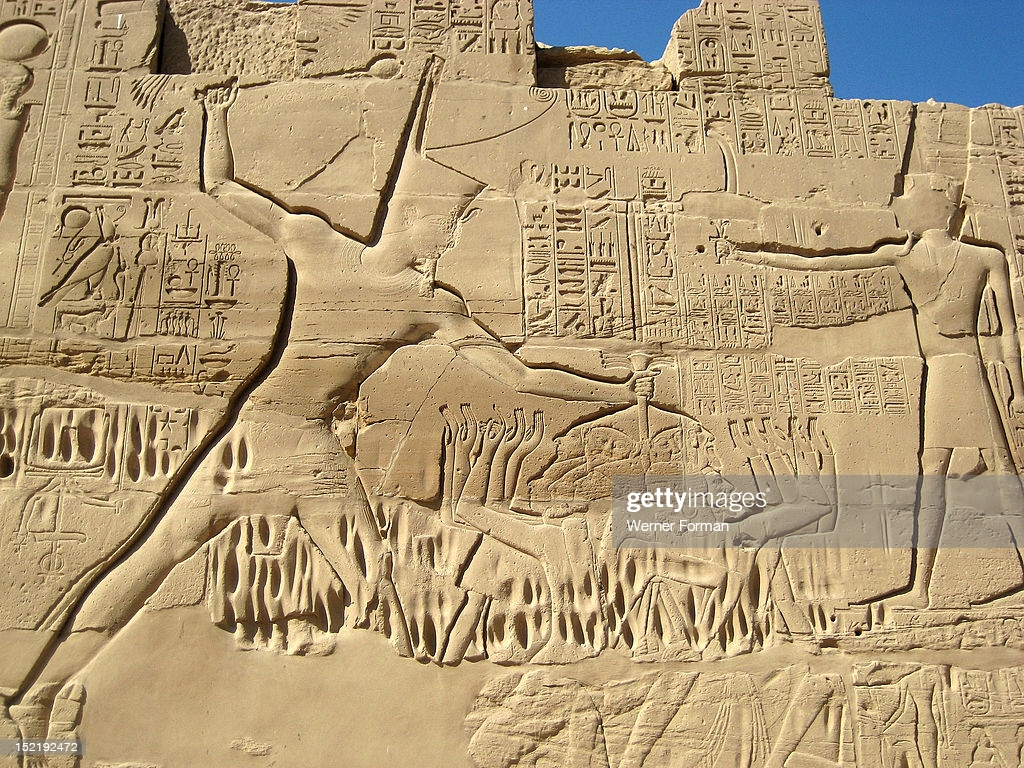
This same imbalance shows in their depictions of royalty. Certainly every society has a hierarchy and kings might naturally be depicted in some outsized way to show his importance. But in Egypt, one often sees only the king, as in this relief of the conquests of Thutmose III:

Tuthmosis III smiting his enemies, the Cannaanites, at the Battle fo Megiddo from the north wall of the Great Hypostyle Court, Egypt. Ancient Egyptian. New Kingdom 18th Dynasty, 1473 BC. Karnak. (Photo by Werner Forman/Universal Images Group/Getty Images)

If we compare this to how Babylon depicted one of its greatest kings, Nebuchadnezzar a contrast immediately becomes evident:

and

I have mentioned a few times above that Christians should be cautious in interpreting Egypt’s religion in an overly Christological manner. Now, I offer the same caution to women in general. Some might look at certain aspects of Egyptian belief and celebrate that even the feminine earth has been raised to the level of the masculine sky. But in fact Egypt did not raise the feminine up–they (mostly) abolished the feminine aspects of reality from their experience.

Most every traditional belief system sees the following pairings:

Masculine

  • Strength
  • Vertical Hierachy
  • Steady/Unchanging

Feminine

  • Compassion
  • Togetherness
  • Protean

This “exchange,” this relationship between these two different aspects of reality, help form healthy civilizations just as they form healthy families. Historian Kenneth Clark noted when guys and gals are separated too stridently for too long in social situations, the level of discourse tends to decline in both camps.

The history of Egypt, perhaps akin to the history of China (of which I know much less about) could plausibly show forth this pattern of the elimination of feminine qualities. In his A Study of History Toynbee makes the case that after the pyramids, Egypt tightens and “freezes up.” Much of Frankfurt’s religious analysis comes from this post-pyramid era, and the evidence shows an exaggerated desire to eliminate all variability, all doubt and grief, from their way of life. Such an attitude surely helped contribute to their failure when confronted by Moses.

Babylon shows us the opposite problem–too much of the archetypal feminine. As Frankfurt aptly points out, the stately nature of Egyptian geography shows a direct contrast to that of Babylon. Women go through more changes overall than men**–this is neither a virtue or vice–and so a civilization that over-emphasized feminine qualities would tend towards too much change, and not enough solidity. This shows up in Babylonian creation mythology, with its constant conflict and shifting alliances between different gods. It arises in their depictions of the goddess Ishtar, sometimes shown wearing a beard. Aristocratic Babylonian men followed the trend in their religious beliefs and may have engaged in cross-dressing, and so on.

Other manifestations of this imbalance show up:

  • Coronation rituals for Babylonian kings took place in the temple of Ishtar, and their royal insignia came from the goddesses “Lady of the Crown,” and “Lady of the Scepter.”
  • Frankfurt suggests that, while obviously Egypt and Babylon had various religious festivals, Babylon had more festivals that “required” everyone to participate at the same time in unison–it is the mom who generally wants to have everyone home for the holidays, etc.
  • In Egypt, water was effectively tamed. For the Babylonians, “the ways of water are devious. It avoids obstacles rather than conquering them, goes around and yet gets to its goal.” Traditional religions always associate water with the feminine, and we see something of the “mystery of Woman” (guys are not that mysterious) in Babylonian views of water.

For clarification, I am not here suggesting that any of these things are good or bad per se. The question is more of emphasis.

One sometimes hears silly things such as, “If only women were in charge throughout the world then there would be no wars, and everyone would love each other.” But Babylon had an empire as well. And Babylon for biblical writers became (along with Egypt), an archetypal tyranny, albeit with some different manifestations than that of Egypt. I have written elsewhere of the possibilities of feminine tyranny, and will not rehash that here. In Egypt’s case, the excessive emphasis on order “naturally” called forth the chaos of the 10 Plagues. For Babylon, the undue emphasis of the market, of change and flux, of possibility, inevitably called forth excessive order–it is no coincidence that Babylon produced the world’s first known extensive code of law and punishment.

Ancient Egyptian and Babylon societies show us that masculine and feminine “gods,” when freed from proper relationship with the other side, become demons.

Dave

*I would not say that Egyptian and Babylonian religions were false because of this either. Obviously, a Christian would say that such beliefs had deep flaws, while at the same time one can affirm the aspects of the Truth that they professed. Occasionally, a skewed religious belief can at times show forth an aspect of Truth in a more compelling fashion, as they give it undue emphasis in the wrong place. Still, all in all, I think the key problem of pagan religions was their inescapable imminence of the gods. The undue focus on imminence leads to a narrowing, an entrapment of sorts, a tautology. You see this today whenever an argument is based on the fact that, “It’s 2021.” In other words, whatever we happen to be doing must be right because we are in fact doing it–the ethics of imminence. One is inevitably influenced by our surroundings, including our geography. We should not be trapped by it, to be excessively determined by it.

**I think it fair to say that puberty involves more changes for women than men. Marriage involves more change for women. Women obviously go through a lot of change in terms of conceiving and giving birth to children, and then, menopause, and so on.

8th Grade: Babylon’s “Ball of Confusion”

Greetings,

This week we began our look at Babylonian civilization.

Babylon had many things going for it.  They were the quintessential cosmopolitan city of the ancient world.  Their geography funneled trade, cash, and resources towards them.  Much of ancient learning concentrated itself there.  This would be a city in general more tolerant, vibrant, and diverse than most other cities in the ancient world.  I hope that the students remember our examination of the geographical influence of all of this.  ‘Cosmopolitan’ cities throughout history have to be accessible, which usually puts them in relatively flat areas near water.  One thinks of New York, London, and Los Angeles as examples.  Of course, such cities not only need favorable geography, but they need to be accessible and open-minded culturally as well.  Geography can bring you to water, but can’t make you drink.

But enormous cracks in the foundation lay below the surface.  Babylonian creation accounts paint a bleak picture: Ultimately things “come to be”  because of chaos and confusion amongst the gods.  Unlike in Genesis 1, creation had no intentionality or design behind it.  Nor can we say that the “good” gods triumphed over evil.  Rather, one side simply emerged as the stronger.  This impacted Babylonian thought in several ways:

  • Humanity is an afterthought that exists to be manipulated by the gods
  • Stability and order are generally absent (a stark contrast to Genesis 1).This chaos spilled over into other areas.
  • Sin, at root, was not your fault, as you could be ‘jumped’ by malicious spirits (jinn) who would lead you down the wrong path
  • Ishtar was their major goddess – goddess of love and marriage but also war and prostitution.  She was again, a goddess, but was often depicted with a beard.  The ambiguity was reflected in the statue of her to the side, which shows her as a warrior showing quite a bit of leg for an ancient goddess.
  • Not surprisingly, this gender confusion spilled over into society, as Herodotus tells us of the fad among society’s elite for cross-dressing
  • Not surprisingly, Babylon was known for its immorality, and notorious for its rampant temple prostitution, among other things.

A society where so much is left to chance is bound to try and find a way to explain it all, and this may have led to the Babylonian passion for dream interpretation.*  A whole list of possible dreams and their meanings was drawn up, but this did not necessarily help.  One tells us that if you dream that you eat meat you will have a son.  Later, it says that if you have meat in a dream you will not have a son.  How could one know the truth?

Or perhaps, with the mysteries of the universe completely unknowable, one might stop looking and settle for the ‘eat, drink, for tomorrow we die,’ philosophy.  It is any surprise that Babylon is conquered in Daniel 5 as they are partying?  Perhaps we might also surmise that Babylon’s endless possibilities led in the end to boredom.  We looked at this famous Babylonian text,

Babylon’s View of Life: “The Dialog of Pessimism,” (M stands for Master, S for slave)

M “Slave, agree with me!”

S “Yes, my lord, yes!”

M “I will love a woman!”

S “So love, my lord, love!

The man who loves a woman forgets want and misery!”

M “No, slave, I will not love  a woman!”

S “Love not, my lord, love not!

Woman is a snare, a trap, a pitfall;

Woman is a sharpened iron sword

Which will cut a young man’s neck!”

M “Slave, agree with me!”

S “Yes, my lord, yes!”

M “Straightaway order me water for my hands,

I will make a libation to my god!”

S “Do my lord, do!  As for the man who makes a libation

To his god, his heart is at ease;

He makes loan upon loan!”

M “No slave, I will not make a libation!”

S “Make it not, my lord, make it not!

Teach the god to run after thee like a dog.”

M “Slave, agree with me!”

S “Yes, my lord, yes!”

M “I will give money to my country.”

S “So do, my lord, so do!

The man who gives money to his land,

His alms have been put in the palms of the god

Marduk himself.”

M “No, slave, I will not give alms to my land!”

S “Do it not, my lord, do it not!

Look upon the ruined mounds of

Ancient cities and look around;

Behold the skulls of those of earlier and later times.

Who is the evildoer, who is the benefactor?”

M “Slave, agree with me!”

S “Yes, my lord, yes!”

M “Now then, what is good?

To break my neck and thy neck,

To fall into the river — that is good!”

S “Yes my lord.  Who is tall enough to reach up to heaven;

Who is broad enough that he might encompass the earth?

M “No slave, I will kill only you — you go first!”

S “But, you my lord, would not last three days after me!

Or consider this collection of Babylonian proverbs, which speak similarly:

Without relations, she conceived!  Without eating, she became fat!

When I labor, they take away my reward.  When I increase my efforts, who will give me anything?

The strong man is fed through the price of his hire, the weak man through the price of his child.

My feet keep walking, my knees do not tire, yet a foolish man pursues me with sorrow.

Am I not a thoroughbred steed?  Yet I am harnessed with a mule and must draw a wagon.

I dwell in a fancy house, yet some clay pours over me (i.e., the roof leaks).

The life of the day before yesterday is that of any day.

You are placed in a river and your water at once becomes stinking; you sit in an orchard and your fruit becomes bitter.

Will ripe grain grow?  How do we know?  Will dried grain grow?  Who can tell?

Very soon I will be dead.  Let me eat, drink, and spend.  Soon I will be well.  Let me save for later!

You go and take the field of your enemy.  The enemy comes and takes your field.  

The fox had a stick with him.  He asks, “Whom shall I hit?”  He has a legal document.  He asks, “Whom shall I challenge?”

No agreement can be reached when the women talk without ceasing.

Into an open mouth, a fly will enter!

The horse, after he had thrown his rider, lamented, “If my burden be like this always, soon I shall be weak!”

The dog understands: “Take it!”  He does not understand.  “Put it down!”

As I mentioned in class, in studying Egypt, Assyria, and Babylon–in that order–is not so much chronological but thematic in purpose. In Egypt, we see a self-contained, stable culture that highly valued stability and balance. With Assyria, we saw a culture that was ‘self-contained’ and homogeneous to a certain extent, but who highly valued movement. With Babylon, we have a a creation account that demonstrates chaos, and a geography that maximizes diversity. Each set of circumstances and beliefs creates different kinds of civilizations.

And–as long as we have ‘confusion’ as our theme, who can forget:

https://www.youtube.com/watch?v=5HjUxggPd6E

Many thanks,

Dave

Revel in the Differences

I have noticed that it seems almost impossible for us to view the medieval period on its own terms. We work this out for almost any other civilization. The period has come under attack in two separate eras, from two different directions. First, we had the period from the late Renaissance through perhaps the end of the Cold War. This attack took the form of 1) Reason instead of “superstition,” and 2) Science over faith, and the like.* Today we see a neo-pagan revival, which has its manifestations in areas of culture such as Bronze Age Pervert, The Northmen, Bernard Cornwall/Netflix’s The Last Kingdom, and The Legend of Redbad. The basic theme of all of them centers around the strong reality of the pagan gods and practices, and the cruelty, venality, femininity and emptiness of Christianity.**

I think a variety of reasons exist for this critique. As I wrote here, one of them involves the idea of the awkward uncle vs. the stranger at Thanksgiving. Maybe your mom invites someone you don’t know to Thanksgiving dinner, a friend or co-worker. They may be great or interesting people, or not. Either way, it matters little. They are not “family,” so they inspire little emotional reaction. Having no attachments to us, we have no stake in how they act. But many of us have encountered the “crazy,” awkward Great Uncle. He’s family, so he gets an invitation, though some groan at the prospect. Maybe his mannerisms or his comments alienate people around him.

The unexpected guest might act obnoxiously as well, but the uncle inspires a much stronger reaction because of his family connection. Most people think he’s annoying and crazy. But maybe a few people think, “No–he’s the sane one–the rest of my family is crazy. Uncle Bill is great!” Those that love Uncle Bill, they tend to love the Middle Ages when they meet.

We have a strange connection to the Middle Ages. They are not nuclear family to us, but neither are they someone’s friend from work who shows up randomly. They are the Great Uncle. We can view civilizations like that of Egypt and China as a new guest at dinner. Showing hospitality to strangers has a universal history. But the awkward family member, i.e., the Middle Ages, gets a different treatment. We can argue and get mad at family, or passionately defend them. We wouldn’t do this with a guest. Some, for example, who seek to appreciate and praise the medievals get called fascists on Twitter. It’s Twitter, sure, but even on Twitter no one would call those who love ancient Chines or Meso-American civilization fascists.

Modern politics in the U.S. today has this same problem. True–many can see something recognizably American about both the guy in the loud oversized pickup with accompanying gun rack, and in the guy drinking a latte admiring the art in the Guggenheim. But . . . very likely neither of the two subjects in question will see this about the other. The Red State guy knows the Blue State guy is technically American, but he looks weird, and that’s unnerving, off-putting, bizarre. It inspires a gut-level horror reactions for both sides. As we have stopped mixing with each other, as technology and other factors allow us to narrow our scope, our fellow Americans increasingly look like the weird Great Uncle at Thanksgiving, though the Red and Blue guy would both show perfect politeness to a guest from Japan.

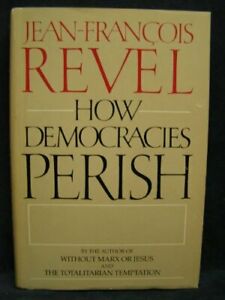
Jean Francois Revel was a French intellectual who pulled off the unusual feat of liking and defending America during the Cold War. He wrote How Democracies Perish not so much to praise America, however, but to express outrage and incredulity at other European intellectuals and politicians. Much of the book shows how the European press, and European governments, tended to commit a kind of suicide by showing much more suspicion, and less trust overall, to the Americans instead of the Soviets. He cites numerous examples of this with various press releases and newspaper articles regarding different aspects of Soviet and American actions. He compares European treatment of America’s involvement in Vietnam (quite harsh), with the Soviet invasion of Afghanistan, which many other Europeans of Revel’s class described as regrettable, but an understandable reaction against American ambition and aggression. He shows how the European press soft-pedaled the Cambodian genocide, but jumped down the throats of America when we failed to cooperate fully (according to the journalists, at least) with the Soviets on missile reduction.

Smart, sarcastic, old, Frenchies always provide a certain pleasure. Revel delivers the goods. But I think he misses something in the explanation of why this happened, and fails to expound on perhaps his most pertinent and brilliant insight.

As to what he misses in his explanation for Europeans’ attitude towards America, I present the ‘Uncle at Thanksgiving Dinner’ theory. We Americans come off as boorish, too loud, too simple, too whatever for many European sensibilities. But, we’re also clearly a chip off the old block. So that means that we come in for more criticism than those outside the family. Russia, China, Cambodia, . . . they have never been family to Europeans.^ This covers things only partially, I admit, but Revel looks almost entirely at the facts of the difference and mostly leaves off the reasons for it.

Revel’s best insight comes in the beginning of the book. He writes,

Democratic civilization is the first in history to blame itself because another power is working to destroy it.

. . . It follows that a civilization that feels guilty for everything it is and does and thinks will lack the energy and conviction to defend itself when its existence is threatened. Drilling into a civilization that it deserved defending only if it can incarnate absolute justice is tantamount to urging that it let itself die or be enslaved.

This condition has not always existed in America in Europe. But it did seem to grow as we grew more democratic.

Athens after Marathon in 490 B.C. started to show supreme confidence in itself. We see this in a variety of ways, in its literature, its innovations, etc. and this manifested itself in increasing democratic reform. On the eve of the Peloponnesian War, Athens went to war over what many would consider a trifle with the Megaran Decree, over the perception of whether or not they had bowed to Sparta or not. I’m not sure the Greeks would have thought this a trifle, but the point stands. They had great confidence and a thin skin.

Athens lost that war, but a curious thing happened. Their defeat ultimately failed to slow the progress of democracy. Athens may have been more democratic in 350 B.C. than in 450 B.C. I believe that much of the same trappings of democracy existed as in the Periclean era, but the aristocratic tradition which had moderated democracy, giving them an alternate framework to use (as well as the thin skin of the aristocrat) had no more presence. Phillip of Macedon in the 340’s B.C. provoked Athens just as much if not more than the Spartans in 430’s. Yet the Athenians responded much more tamely, much more “politely,” to Phillip than they ever did to Sparta.

Many might point to Athens’ great material prosperity, and then argue that this made them soft. Victor Davis Hanson I believe makes this argument in his book about the Peloponnesian War. This can explain some things, but not the whole picture. Athens had a great deal of wealth in the 430’s, perhaps more proportional wealth vis a vis other city-states than in later decades. This wealth gave no hindrance to their supreme confidence and a bullish imperialism. Likewise, England’s wealth ca. 1880 did nothing to curb their global dominance.

We may miss the fact that Athens’ democratic ethos had grown stronger since the advent of the Peloponnesian War. I believe that the technical Periclean structure had not changed much, i.e., they still had the same voting rights, jury pay, and so on. But they had “addition by subtraction”–the gilding of an aristocratic ethos that still lingered in the 5th century gave Athens an alternate framework to think with. It also gave them the confidence–and thinner skin–associated with aristocracies. But by 350 B.C., that aspect of Athenian life had departed, leaving them with an unvarnished democratic ethos.

Revel points out multiple examples of the following dynamic in Europe, which mirror that of Athens in the 4th century B.C.:

  • Europeans declare that NATO should avoid unduly antagonizing the Soviets
  • The Soviets do something antagonizing, such as clamp down on Poland, or invade Afghanistan
  • Europeans insist on a muted response, to avoid antagonizing the USSR any further.

This leads, naturally enough, to a weak foreign policy. Finding explanations in grand cultural and geo-political terms has great value. But I prefer bring issues into a smaller more human lens. With this above dynamic, the Europeans practice a kind of excessive politeness.

This is also pretty good.

Good manners should produce magnanimity and humility for those who practice them, and a deferential ennobling for those on the receiving end. But the excess of this virtue works against itself, creating slavishness on one side that likely will produce a prideful dominance on the other.

The main virtues of democracies involve

  • Openness, an openness to the ideas of others, and a belief that the clash of multiple perspectives will give rise to the truth, and related to this,
  • Inclusion, and the erasure of differences between people, a necessary bulwark of equality.

The problem comes when these virtues, not ultimate in themselves, get extended to a point where they lose their meaning. Those who practice inclusion with no discrimination . . . we call them prostitutes.^^. In such situations, one dies of the flood, where too many things converge, and so we lose distinctions and coherence.

This poses a difficult problem for us. We can see that in eras when western civilization had less democracy (in good and bad ways), say, ca. 1870-1914 we had much more energy, dynamism, and confidence. This resulted in a host of good and bad things–our era has both as well. As we grew more democratic (in good and bad ways) the virtues of inclusion could transform into slavishness. It is impossible to have it all. I am not criticizing democracy, only pointing out that as a political system, it has strengths, weaknesses and limits. It has not come to save us.^^^

Revel shows us that democracies weaken themselves by gorging on democratic virtues. inviting a newcomer to Thanksgiving dinner can have the paradoxical effect of keeping the family together. As George Harrison said, inviting Billy Preston to help them record Let it Be meant that the Fab Four had to be on their best behavior. But . . . invite the whole neighborhood and the identity of the family disappears. To preserve themselves, democracies should temper their virtues, for at their limits these virtues turn to vices.

Dave

*I recently rewatched Bill and Ted’s Excellent Adventure, that renowned 80’s classic. Our heroes go back in time to get greats from the past so they can pass their history class and eventually create universal harmony through glam rock. Everywhere they go back in time, they bring back greats from the past, including Greece, China, and so on. When they get to the medieval period, it’s all darkness, gloom, and people screeching about heretics. They have to rescue two “maidens” from that period forced into marrying some crusty old barons–there is nothing to preserve, nothing to bring back from the Middle Ages. In the movie it serves only as something to escape from. When the two “babes” are brought back into the modern era as part of their rescue, they are un-ironically introduced to the joys of credit cards and shopping malls.

**Albert Mohler has a great line which he uses on those who disparage aspects of the evangelical religious right: “If you don’t like the religious right, wait until you see the irreligious right.” By that he means not your typical agnostic libertarian, but the Neo-pagan worshippers of blood, soil, and violence.

It is interesting that such a revival would occur at a time when culture in various ways seems feminized. I would say that problem is not only Uber-femininity–though that is part of it–but also the reverse. In our culture today, the only way for a female character to be the hero is for her to act like a man, to be as tough, strong, as comfortable with killing, as a man. We have very little sense of the power of the true feminine virtues.

^How then to explain Europe’s current position with Russia as the ultimate enemy once again? Well, I know the ‘Uncle’ theory is incomplete–that’s a start. Also, there is the natural affinity with the underdog at work. But I think also that we went through a period between ca. 1985-2010 or so, that we started to think of Russia a bit more like family. Then, they “betrayed” the west and “reverted to form.” Europe will not forgive them for this.

^^Note how certain strands of feminist thought have turned completely against women. Most early feminists stood strongly against pornography and objectification of women. Now, some take the idea of supporting women so far that they declare “Sex work is work!” and demand equal respect for women who choose those “professions.” No one ever said that it wasn’t work. Objections to such practices had nothing to do with the definition of work.

^^^Democracy may not be my favorite form of government, but that is not the point. I wish that defenders of democracy would focus much less on arguments that it is better than other forms, whether or not such arguments hold weight. I wish we focused more on the fact that whatever its virtues and vices, democracy is our way of life and thus worth something because it is ours. This way of thinking has its limits too. Family is not absolute either. But it is a more solid foundation that debating democracy in the abstract.

8th Grade: The Definition of Collapse

Greetings,

This week we very nearly wrapped up Assyrian civilization.

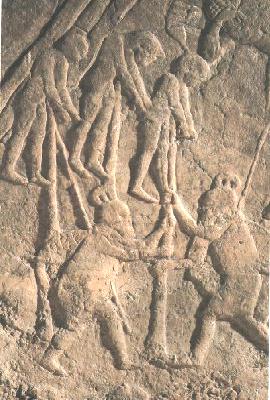
Last week I mentioned our look at Assyria’s religion and the concept of ‘Imperial Overstretch’ as factors in Assyria’s decline.  This week we considered Assyria in light of Christ’s words to Peter and the Apostles, ‘Those who live by the sword die by the sword.’

In a fallen world, force can have a legitimate place in government.  But both from a historical, moral, and political perspective, force can never be the foundation for order.  Force can gain acceptance, or have legitimacy, if people see it as an extension of justice.  But when a power uses force detached from justice, people sense that they use violence merely to serve their own selfish ends.  This inspires them to seek justice/revenge, and this is why violence apart from justice is a wasting asset.

All of the problems Assyria faced they brought upon themselves.  They treated subject populations brutally out of a combination of a) religious belief, and b) policy that sought the quickest route towards “getting everyone in line” with their conquests.  But as their power grew, the attention they could give to subject territories lessened, which reduced their chances of stopping rebellions.

Eventually too, their obsession with violence and conquest would be bound to turn back on themselves.  After Ashurbanipal II completed the conquest of the fertile crescent, (which left nothing for the next guy) Assyria descended into civil war (having no one left to fight but themselves).  Simultaneously, they faced rebellions from a few major provinces, which mean that they faced a dire crisis from within as well as without.  They had nothing left on which to stand, and collapsed completely within a few short years.  Regarding their incessant militarism and addiction to violence, Toynbee comments,

The loss and misery which Assyria inflicted on her neighbors is beyond calculation, and yet the legendary remark of the schoolmaster to the boy he is whipping–‘It hurts you less than it hurts me,’–would be a pertinent critique of Assyrian military activities. . . .  The full and bombastic Assyrian record of victories abroad is significantly supplemented by rarer and briefer notices of troubles at home that give us an inkling of the price at which Assyrian victories were purchased.

An increasing military strain revenged itself with increasing frequency of palace revolutions and peasant revolts.  As early as the close of the second bout of aggression in the ninth century B.C. we find Shalmaneser III dying in 827 B.C. with his son on the war-path against him, and Ninevah, Asshur, and Arbela in rebellion. . .

Toynbee goes on then to cite rebellions in 763, 760, and 746, and ca. 730 B.C., and then he continues,

After this the two streams of domestic stasis and foreign warfare merge into one; after Ashurbanipal’s death this swells into a mighty river whose rushing waters bear Assyria away to her now inevitable doom.  During the last years of Assyrian history the domestic and foreign aspect of Assyria’s disintegration are hardly distinguishable.

Can a civilization be rooted entirely in a frontier mentality and lifestyle?  Assyria was located on the ‘frontier’ of Mesopotamian civilization.  Like many frontier people, they could be inventive and self-reliant.  But their beliefs, their foreign policy led them to conquest ‘a outrance’ as the French say.   Assyria’s attacks against Babylon come with an animosity that a farmer in West Virginia might feel for Manhattan investment bankers.  But frontiers need a home base, and with this attack, Assyria was cutting off its face to spite its nose.  The arm which held the sword stabbed the heart.  Without Babylon, Assyria suffered much in the same way that the West Virginia farmer would suffer.   Without the banks, where would be the corporations to buy the food they grew?  If they always looked outward, could they build a solid cultural foundation on which to rest?  While some aspects of Assyria’s cultural heritage can be disputed, no one would doubt that in comparison to Egypt, Babylon, and Persia, Assyria’s cultural output was quite low.  Their architecture, art, and literature all were inferior to their neighbors.

In the end, Assyria contributed heartily to its own demise.  I quote now from Ashurbanipal II, the last great king of Assyria, who wrote as he saw things crumbling around him:

‘The rules for making offerings to the dead. . . which had not been practiced, I reintroduced.  I did well unto god and man, to dead and living.  Why have sickness and misery descended upon me?  I cannot away with strife and dissension.  Misery of flesh and mind oppress me.   Death is seizing hold of me. With lamentation and mourning I wail day and night.  O God wilt thou deal thus with me?  Even as one who has not feared God and Goddess I am reckoned.’

Historian Arnold Toynbee comments,

‘This confession is  . . . moving in its sincerity and in its bewilderment, but above all illuminating in its blindness. When this mood overtook him, did the last of the Assyrian war-lords never find himself reciting that terrible catalogue of cities sacked and people’s wiped out by Assyrian arms — a list which concluded with his own sack of Susa and annihilation of Elam?’

One sees a complete lack of self-awareness on Assyria’s part.  It’s as if they erased their conscience through centuries of systematic cruelty.  They reveled in their conquests and never questioned their actions, celebrating them in their meager artistic achievements.

Next week I will update you on our investigation of Babylon.