8th Grade: He Who Lives by the Sword. . .

Greetings,

This week we looked at Assyrian civilization.  Their meteoric rise was surpassed only by their complete and total destruction at the hands of several enemies.  What made them who they were?

We first looked at their geography. . .

1. Assyria began in the north of the Fertile Crescent, in one of its less fertile areas, nestled in mountains towards the fringe of that region.  We discussed how people who live in mountainous regions tend to display similar characteristics.  Necessity might force them to rely on hunting.  They grow to be tough and adaptive, and generally warlike, with built in mistrust of foreigners due to their relative isolation (think Afghanistan).  Assyrians had similar characteristics.

2. Their geography may have lent impetus to their expansionist desires.  These tough, warlike people were generally surrounded by more wealthy civilizations that might have been a bit ‘softer’ than the Assyrians.   Nomadic civilizations (those that have to/choose to follow ‘the herd’) can never be as wealthy as more agrarian civilizations, for they can never stay in one place long enough to produce anything.  Perhaps they could not resist all they saw around them.  Perhaps after a while, jealousy and envy took hold.

Then we looked at their army . . .

1. Mountainous regions generally are not as populous as other places, but the Assyrians managed to create a brilliant militia force.  Without the mass of other armies (nomadic hunting oriented civilizations inevitably have smaller populations) they had to rely on speed and movement.  But their citizens, used to hunting, would have been used to moving, tracking, and outwitting their prey.

In class I compared their army to the new ‘Blur Offense’ in football popularized by the University of Oregon.

2. The Assyrian army was a lightning fast ‘light infantry’ force, overwhelming their opponents by swift and brutal assaults.  Of course the makeup of the army impacted their foreign policy, which

  • Usually did not emphasize diplomacy.  They could not integrate their conquered foes into their army (think about how the effectiveness of a Navy Seal platoon would be diminished by adding army regulars into their ranks).
  • So – how do you hold onto your territory?  The Assyrian army was not generally interested in occupation. They wanted movement.  If ‘you are what you worship,’ we would expect the Assyrians to use terror as a weapon, and so they did.  My guess is that the students will remember the various forms of torture and death the Assyrians inflicted if you are curious enough to ask them.
  • With the conquered cowed into submission the Assyrians could move on.  We looked at Paul Kennedy’s concept of ‘Imperial Overstretch,’ when size becomes a disadvantage as opposed to an advantage.  Clearly the Assyrians suffered from this, for as we discussed, fear is a wasting asset.  It tends to be a very effective short term, but disastrous long term policy.

Some of you may remember the boxer Mike Tyson, and I think he is a good representation of the Assyrian army.  Tyson was almost always the smaller man in the ring, outweighed and outreached by his opponent.  But his lightning speed confused his opponent, and he hit with such devastating force that he surely “ruled by fear” over his foes.

The students had fun with excerpts from these clips in class.

Then we looked at their religion. . .

The Assyrians were polytheistic, but tended to emphasize the worship of their war god Ashur.  Ashur demanded blood, as the Assyrians obliged, presenting large amounts of the severed heads of their enemies at worship services.  Interestingly, apparently the most common way of representing Ashur was on his winged disc, which hearkens back to the dominance of movement in Assyrian civilization.

For this coming week we will continue to see connections between Assyria’s religion, army, and foreign policy.  For them, as for all of us, “you are what you worship.”
Thanks so much,
Dave

Janus

Machiavelli inspires polarizing reactions. I find that often that initially I immediate reject his idea, largely because there is something I don’t quite trust about him. But, just as often, I end up rethinking my initial reaction and revising my thoughts.

One such instance happened for me reading Machiavelli’s assertion that republics must have their foundation with one man, writing in the Discourses (I.9),

But we must assume, as a general rule, that it never or rarely happens that a republic or monarchy is well constituted, or its old institutions entirely reformed, unless it is done by only one individual; it is even necessary that he whose mind has conceived such a constitution should be alone in carrying it into effect. A sagacious legislator of a republic, therefore, whose object is to promote the public good, and not his private interests, and who prefers his country to his own successors, should concentrate all authority in himself; and a wise mind will never censure any one for having employed any extraordinary means for the purpose of establishing a kingdom or constituting a republic. It is well that, when the act accuses him, the result should excuse him; and when the result is good, as in the case of Romulus, it will always absolve him from blame. For he is to apprehended who commits violence for the purpose of destroying, and not he who employs it for beneficial purposes.

Machiavelli often engages in this kind of paradoxical thinking, i.e., “if you want peace the ruler must sometimes be cruel,” and so forth. As his logic applies to republics, he argues that concentration of power in the hands of one initially will allow for the spreading out of power later.

America’s history seems to contradict this–don’t we have founding fathers, and anyone who knows anything about them sees a multitude of disagreements about various important ideas about what they wanted. And yet, America has managed reasonable success as a republic for 250 years. But before rendering a judgment here, I realized that two of history’s most famous republics, Athens, and Rome, had foundations in one man–Theseus and Romulus.

The stories of two men, as told by Plutarch and other sources, agree in certain general particulars, especially in regards to their uncertain parentage. Both functioned as kings in their respective realms, but neither ruled as king’s in the sense that we might assume in our modern context. It seems that both functioned primarily as religious leaders and as military commanders primarily. Later, both Athens and Rome underwent significant political changes contemporaneously in the years 509/508 BC. But Rome and Athens had many differences, reflected in the lives of Theseus and Romulus.

We can chart the differences between Athens and Rome

Athens

  • Attached to water–their key lie in their navy
  • As they had roots with water, they were active in trade
  • We see this physical movement linked with significant intellectual exploration–they basically invent modern concepts of science, philosophy, literature, etc.

Rome

  • Attached to land–their key lie in their infantry
  • Ringed round with their famous seven hills, Rome remained devoted to land and agriculture. They disdained trade.
  • This rootedness to place has its echoes in Rome’s intellectual conservatism, espoused most fully in writing by Cato the Elder. Rome’s main contribution to future civilizations would be in law, i.e., how people in the same community relate to one another.

When one looks at the lives of their so-called mythical founders, we see striking parallels. Theseus hardly could keep his feet still, roaming from one place to another, never truly even settling in Athens. He had a variety of women that he “married”/grew familiar with. We moderns would diagnose him with wanderlust. Athens’ narrative seems to me to always involve something beyond Athens, the next colony, the next discovery, the next idea or theory.

Romulus founded the city of Rome and stayed there. Plutarch has much good to say of him, but with no sugarcoating–many found him a “hard” man. He gained glory through military exploits on land against Rome’s neighbors. Rome always made the narrative about Rome itself.

Though an Athenian by birth, Plato thought little of Athens’ legacy. In The Republic Socrates continually affirms conclusions that limit movement–we shouldn’t move jobs, we shouldn’t trade, we should limit too the “movement” of our souls by restricting the kind of music we listen to. In The Laws Plato writes,

Athenian Stranger. And now, what will this city be? I do not mean to ask what is or will hereafter be the name of the place; that may be determined by the accident of locality or of the original settlement-a river or fountain, or some local deity may give the sanction of a name to the newly-founded city; but I do want to know what the situation is, whether maritime or inland. 

Cleinias. I should imagine, Stranger, that the city of which we are speaking is about eighty stadia distant from the sea. 

Ath: If the city were to be built at the seaside and were going to be well supplied with harbors but ill-supplied with the necessities of life from the soil, then it would have needed mighty saviors and divinely inspired legislators to escape the moral confusion and moral corruption that are the inevitable penalty of such environments.  

For the sea is an insidious neighbor which makes itself agreeable to the daily interaction [between good soil and good harbors], but is salt and bitter inasmuch as it fills the country with tradesmen’s business, and the souls of the country with deceit, and the body politic with distrust–each seeking advantage over his fellow man and neighboring states.  

These social evils are to some extent counteracted if the soil produces something of everything; and, if it is a rough and highland country . . . it will not be able to do so.  If it could not, it would produce a large export surplus and would attract to itself the equivalent import of gold and silver currency–and that is the greatest moral disaster that can overtake a country.

[As for sea power], it would have profited the Athenians to lose seventy times seven children a year to the tyrant Minos [referring here to the ancient legend of the Minotaur] before turning themselves in defense to a sea power instead of heavy infantry, and so lose the  power of standing fast, acquiring instead the habit of perpetually jumping ashore and then running back to their ships at a run hardly after landing.  

This method of warfare erases any sense of shame at being too cowardly to risk one’s life by standing one’s ground and receiving the enemy’s attack.  It suggests facile and “plausible” excuses for taking to one’s heels–never of course in disorder but always “according to plan.”  

There is nothing so demoralizing for infantry as their allied fleet riding at anchor in their rear.  Why, even lions, if they took to tactics of that sort, would run away from deer.

Cle: Yet all the same, sir–well, what about the Battle of Salamis?  That, after all, was a naval battle, in which the Athenians beat the barbarians, and it is our belief that this victory was the salvation of Greece.

Ath: I know that is the general view . . . But in [my] belief, it was the land battles of Marathon and Platea that were the day-spring of the salvation of Greece and its crowning mercy.  . . . My good friend, I am afraid that the course of my speculations is leading me to say something depreciatory of legislators; but if the word be to the purpose, there can be no harm. And yet, why am I disquieted, for I believe that the same principle applies equally to all human things? 

Cle. To what are you referring? 

Ath. I was going to say that man never legislates, but accidents of all sorts, which legislate for us in all sorts of ways. The violence of war and the hard necessity of poverty are constantly overturning governments and changing laws. And the power of disease has often caused innovations in the state, when there have been pestilences, or when there has been a succession of bad seasons continuing during many years. Any one who sees all this, naturally rushes to the conclusion of which I was speaking, that no mortal legislates in anything, but that in human affairs chance is almost everything. And this may be said of the arts of the sailor, and the pilot, and the physician, and the general, and may seem to be well said; and yet there is another thing which may be said with equal truth of all of them. 

Cle. What is it? 

Ath. That God governs all things, and that chance and opportunity co-operate with him in the government of human affairs. There is, however, a third and less extreme view, that art should be there also; for I should say that in a storm there must surely be a great advantage in having the aid of the pilot’s art. You would agree?

Plato willingly gives a nod to the need for the “pilot’s art.” but concedes to it almost as a result of the Fall, so to speak.

Aristotle saw things differently. One of the quietly “subversive” sections in his Politics comes when he compares the constitutions of Sparta and Carthage and finds Carthage superior. I think some exaggerate the attraction some Greek theorists, including Plato, had for Sparta. But certainly with its minimal trade, almost no navy, and fearsome infantry, Sparta resembled the kind of society Plato wanted in certain respects. Carthage had more in common with Athens, an almost exclusively maritime power that relied on mercenaries for infantry. He writes

The constitution of Carthage is general accounted a good constitution, one that is peculiar in many respects, but the chief thing about it is the likeness . . . to the Spartan. . . . Many of the institutions at Carthage are certainly good. It is a proof of a well-ordered constitution that Carthage, with her large populace, should steadily keep to the same political system: she has had no civil dissensions worth mentioning, nor any attempt at tyranny.

[He then goes on at length to discuss the oligarchic and democratic elements in the constitution, and how it sometimes deviates in both directions. The oligarchic leaning comes based on the election of those by wealth–acquired from trade more often than not].

Carthage has a constitution which is in practice oligarchical; but they avoid the dangers of oligarchy by encouraging the diffusion of wealth [made possible by the constant shifting of goods and money through trade].

I think Aristotle saw that being open like Carthage or closed like Sparta was not the problem. The problems for both soceities would come when they could not maintain that equilibrium. If Sparta started to “move,” as they chose after the Peloponnesian War, it exposed contradictions and tensions within their own culture. They never recovered from their defeat at Leuctra, at the hands of Thebes, of all places. Aristotle wrote around 350 B.C., knowing the fate of Sparta. But Carthage’s problems started about 150 years later. Once Carthage lost the ability to trade and roam at leisure after the 1st Punic War, their days were similarly numbered. They had their first insurrection when, partly due to the changing terms of the Roman treaty, and partly due to the destruction of much of their fleet, they could no longer trade. Without the free flow of money, they could not pay their mercenaries, and one thing leads to another.

It seems that Machiavelli might have been onto something after all. The influence of the founders made a definite imprint on both civilizations. And this draws us back to America. We have a few options:

  • George Washington is our actual founder. He was the point of unity during and after the Revolution, without which–we never would have made it as a country.

On the one hand, we can say that

  • His two terms in office set a clear precedent
  • He embodied a spirit of political compromise, such as using Jefferson and Hamilton in prominent ways in his administration, and
  • We have to admit, his owning of slaves, but then also his freeing of his slaves, may have influenced us in both directions.

But I have doubts. Washington’s life and demeanor seem to have no real influence on the culture of the United States.

We can argue, then, that we have no founder. America is a bumpy ride, carried along by change, and so on. We should stop looking for a center and embrace change for its own sake. But this view to me holds no water. America did succeed in various ways, we grew, we built things, and so on. One can’t do all of this on quicksand.

Or we can assert that we are founded on an idea, or a set of principles, and not on a particular person. This explains or messy founding. And–it explains why the ideas, not limited by time and space, could travel so far so fast, just as we ourselves did across the country. It explains why we disagree so much seemingly about the same thing–the incarnation of the ideas might take different form in different places.

Theseus and Romulus overlap, as do Aristotle and Plato. But in the end we must choose a point of emphasis.

Aristotle, for his part, would have approved of our attempt at a mean between ideas, of commerce and agriculture, of conservative and liberal, and so on. But he surely he too would disapprove of how far the idea of democracy has traveled, for what we call democracy he would have termed mob rule. Plato might approve of our founding in the “purity” of an ideal, but I am convinced he as not as gnostic as some make him out. I think that he would see that ideas rooted only in the mind would cause too much “movement” in our culture. In The Republic, Plato only looked at the state as a means of understanding the souls of real men.

The exact nature of the historical reality of Theseus and Romulus even Plutarch wondered at, and so we in America, built more on history than myth, can extrapolate a bit to find our founder. Perhaps we should name Janus, he who looked in opposite directions. This would explain our ability to move, our ability to always find something accommodating and infuriating all at once in America. Yet in the end, Janus still was one person, and perhaps the good ol’ U.S. of A can remain one as well.

Dave

*Hannibal without question was a brilliant battlefield commander and leader of men. But . . . military men write all of his biographies and hence see things from his point of view. What is needed (if it exists I haven’t seen it) is a biography of Hannibal written by a career politician. Most criticize Carthage’s Senate for not backing Hannibal and going for Rome’s jugular after Cannae. They lament the Senate’s focus on keeping trade open and the money flowing from Spain. But, armed with Aristotle’s thoughts, perhaps the Senators were onto something, consciously or no. Without access to trade, Carthage could not be Carthage, and so would surely collapse, as happened in the 3rd Punic War.

The Mysteries of the Monotheistic Pharaoh

I loved The City of Akenaten and Nefertiti: Amarna and its People. I loved it even though I skipped large chunks of it, and some of what I read went beyond my understanding.  This may sound strange, but Barry Kemp’s work is such an obviously great achievement that it goes beyond whether I like it or not.   All that to say, I do really like the book, and wish I had knowledge and the ability to follow him all the way down the marvelous rabbit holes he traverses.

The book puts a capstone on Kemp’s 35 years excavating the city of Amarna, a city built by Akenaten IV (sometimes known as Ikhneton).  Akenaten has long fascinated Egyptian scholars, mostly because of his religious beliefs.  He departed from the religious beliefs that dominated Egypt for centuries and clearly attempted to change the religious landscape of Egypt in general.  He may have been a monotheist, which adds to the potentially radical nature of his rule.

Differing interpretations swirl around his time in power, as we might expect.  Some like to view him as a great rebel against the constraints of his society.  Some view him as a great religious reformer.  Today, given the overwhelming influence of tolerance, the mood has switched to seeing him as a tyrant and usurper.  I hoped Kemp could help sort out some of these dilemmas.  His book reveals much, and also creates more mystery at the same time.  After reading we get no absolute conclusions.  Usually when authors do this I get frustrated.  But in Kemp’s case, who can blame him?  The historical record is 3400 years old.

But before we get to this, Kemp and the publisher deserve praise for the aesthetic aspects of the book.  It feels good in your hands.  It has thick and glossy paper.  The text and numerous illustrations mesh very nicely.  The book has an almost ennobling quality.  You feel smart just looking at it.

I also have to admire Kemp’s style.  If I had spent 35 years in excavations at Amarna and then wrote a book it would almost certainly have a shrill, demanding tone.  “I spent all this time here and now you are going to look, see, and appreciate it all!”  But Kemp writes in a relaxed, thoughtful manner that seems to say, “Ah, how nice of you to drop by.  If you’d like, I have something to show you.”

So many kudos to Kemp.

But now on to Akhenaten himself.

What was he really trying to do, and how did he try and accomplish it?

Clearly Akenaten wanted something of a fresh start for Egypt.  He moved his whole seat of government and started building a new city called Amarna.  In Egypt’s history this in itself was not all that radical, and other rulers have done something similar, notably Constantine with “New Rome.”  Unlike “New Rome”/Constantinople, however, Amarna appears to be way off of Egypt’s beaten path.  This idea in Egypt means something different than it might for us, as nearly all of life got compressed within a few miles of the Nile.  Even so, Akenaten chose a place rather out of the way by Egyptian standards, perhaps the equivalent of the U.S. making its new capital Des Moines.

Perhaps Akenaten didn’t just want a fresh start, he wanted a totally clean slate upon which to build, free from all outside interference (shot from British excavations in the 1930’s below).

Early Excavations at Amarna

So he was a radical, then?

Perhaps, but in building a city, how radical could one be?  Most cities tend to look like other cities.  He faced limits of resources and experience.  So Amarna looked like most other cities, but a few subtle differences might reveal a lot.

For example, the builders made the entrance to the “Great Aten Temple” much wider than usual temples, so wide that one could not envision doors ever being present.  This may mean nothing other than they ran out of material.  But interestingly, most city-dwellings had this same open feel to it.  In great detail Kemp describes how the houses in the city had few boundaries.  Slaves, officials, and commoners would use the same pathways in and out of the same houses.

Kemp also mentions that the plain of Amarna itself presented itself as very open and flat.

No conclusion forces itself as definitive here.  We can say that,

  • Most places in Egypt had a similar geographic layout to Amarna
  • The houses may have been constructed in an ad-hoc fashion due to lack of resources or time
  • Maybe Akhenaten wanted a really open feel to the front of the Great Temple, but that may not have any particular connection to anything else.  Or maybe they had a plan for very large, ostentatious doors that never got realized.

Or perhaps we should see intentionality in all these elements.  And if intentionality is indeed present, what might that reveal that he really did have a grand vision for real change in Egyptian society.

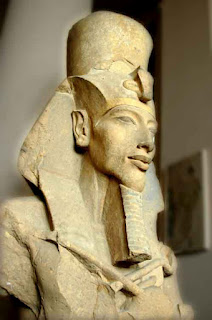
Another intriguing problem deals with Akhenaten himself.  The most famous statues linked to him and his reign look generally like this:
This one makes him look more thoughtful and perhaps more humanized

Akhenaten

Both statues reveal an intense and thoughtful man, given to much introspection.  Or possibly, obsession?  Kemp points out that the offering tables in the temples stood much larger than those in other standard Egyptian temples.  Was he consumed by an idea, or a Reality?  His faces here perhaps reveal just this.

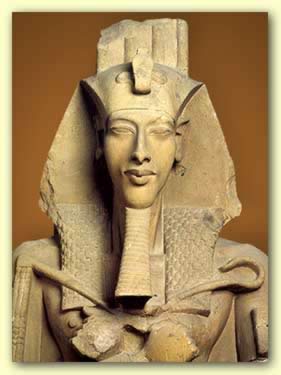
And yet, it is entirely possible (though far from certain) that he actually looked like this:

What should we make of this?

One possibility is that the last image is not of Akhenaten at all, and this solves the riddle by eliminating it.  But Kemp thinks this last sculpture to be an accurate portrayal of what he really looked like.  I’ll go with the guy who spent his life studying the ruins.

So if he portrayed himself differently than he actually looked, it must have been a propaganda tool of manipulation?

No, Kemp thinks not.  Pharaoh’s often had the moniker, “Lord of the Appearances.”  They would be seen by people often, even commoners.  And this would likely be all the more true in the isolated and not terribly large city of Amarna.  Besides, the statue directly above dates from Akhenaten’s time and surely was “official” and not black market.  Kemp often cautions us not to look for consistency in Ancient Egypt, or at least our modern and Greek influenced sense of consistency.

Kemp suggests that the image Akhenaten projected may have had to do with his role as teacher of righteous living.  Certainly it seems he viewed himself this way, and others did too.  This may not make him a prig necessarily, because it was a role Pharaoh’s often assumed, perhaps as a matter of tradition.  The austere intensity of the first two busts (at least 6 ft. high) help confer the image of a deeply felt inner life that he wanted to communicate.  And since the Egyptians loved visuals more than the written word, his busts carry his theological message.

I didn’t buy the modern, “Akhenaten as a religious tyrant” argument before reading the book, and I think Kemp indirectly argues against this.  For one, we find small statues of other gods in scattered Amarna households.  Their houses were small and the statues of normal size.  Given the free-flowing nature of Amarna neighborhoods, other citizens would easily know about the statues.  For Akhenaten to have no awareness of these gods would mean that he had no secret police, no informants, and this speaks against the possibility of ‘tyrannical rule.’  He almost certainly knew about the gods, and tolerated them, however grudgingly.

Or perhaps he actually wasn’t a monotheist?  But then, how radical could he have been?  Or perhaps he had strong views and wanted wholesale change but approached the issue pragmatically.  Neither option gives us a Stalin-esque tyrant.

Other curious details make me lean away from the “tyrant” position.  Cities designed before Akhenaten had rigid layouts and exacting aesthetics.  But as Kemp writes elsewhere, “Most of this city was built around a rejection of, or an indifference to, a social prescription and a geometric aesthetic.” Instead, “organic harmonies” and “personal decision making prevail instead.”  My bet is that Akhenaten may have been too consumed with his religious ideas to really be a tyrant even if he wanted to.

Akhenaten seems to have had a “smart-bomb” approach to religious reform, at least politically.  His main innovation/change might appear slight to some of us.  The Egyptians depicted their gods in at least partial human form.

But over and over again, Akhenaten depicted himself only with Aten, and in these images, Aten has no quasi-human form.  The sun itself sufficed for him.

And this image from the Aten temple . . .

So perhaps in this area we see clarity of vision and consistency of follow-through, as to what it means, I don’t know.  It fits, though, with his overall theme of simplifying religious belief.

Kemp shows us that Akhenaten worked hard at cultivating the image of a good life at Amarna.  Many wall murals show him as a generous provider and consumer of goods.  Excavations reveal that this may not have been entirely propaganda, but Kemp reminds us Akhenaten reigned during a prosperous and secure time in Egypt.  But in 2006 excavators discovered a series of tombs for commoners that reveal high incidents of early childhood death, malnutrition,or skeletal injury.   This could throw us right back to the Stalinist image some have of him.  But the high incidents of childhood death could reveal an epidemic in Amarna, which would spread rapidly in its densely packed population.  Hittite records tell of a plague that spread from Egyptian prisoners of war during Akhenaten’s time.  As to the injuries, I can’t say whether or not this is typical for when new cities get built.  Akhenaten may have harshly driven the people to work harder and more dangerously than normal, or it may have been par for the course with ancient construction projects.

The insistence on building a new city may reveal an element of monomania, but certainly other pharaohs did the same thing.  The pyramid builders demanded vastly more labor from their people/slaves.  Besides, Akhenaten had many critics within Egypt after his death, but no one blamed him for building a city.  This fit within the normal roles pharaohs played.

Akhenaten likely saw himself as a religious liberator of the people.  I see a man with a purity of vision, but also a pragmatist in good and bad ways.  He possessed great intelligence and valued introspection.  I see him dialoguing with himself, along the lines of, “I want ‘x.’  But the people only know ‘y’ and expect ‘y.’  So I will try and lead to them to ‘x’ through a modified version of ‘y’ — not to say that I hate everything about ‘y’ — just some things.” If I’m right, this  inner wrestling match would lead to inconsistency and confusion in his own mind.  Perhaps he lost his way a bit.  “I must have a nice new city to show the people the greatness of the truth,” or something like that.

Or maybe not.  I wish I knew more.  Akhenaten provides a great template for a historical novel.

Perhaps he went too far, but I do think he had good intentions.  Of course much evil gets done with this mindset.  We all know where the road of “good intentions” leads.  But it’s hard to say for certain what evil he actually did.   But he did seek to remove certain key beliefs about the afterlife.  The traditional Egyptian’s journey to eternity had many perils and thus required many charms, protections, and so forth.  All this gave a lot of power to certain priests.  Akhenaten’s tomb stands in marked contrast to almost all other kings for its simplicity.  Clearly he sought in some ways to “democratize” death in his religious beliefs.  I think that Akhenaten wanted to simplify things in general for the common man.  But then again, his tomb contains other traditional pieces, such as the “shabti” — special figures designed to do conscripted labor in the next life.  So even the intense, focused Akehenaten either conceded to some traditional beliefs or really believed these apparently inconsistent ideas.

The mystery of Akhenaten continues.

We know that his religious ideas more or less died with him, and indications exist that foreshadow this even during his lifetime. Very few people changed their names to reflect the new ‘Atenist’ belief, and this we know from the many tombs in the area.  Had his beliefs caught on the switch in names would have also, as happened at other times in Egyptian history.  The narrative that we naturally accept about his attempt at religious change sounds similar to this text from Tutankamun, who may have been his son.

…the temples and the cities of the gods and goddesses, starting from Elephantine as far as the Delta marshes . . .were fallen into decay and their shrines fallen into ruin, having become mounds overgrown with grass . . .   The gods were ignoring this land.  If an army was sent to Syria to extend the boundaries of Egypt it met with no success at all.  If one beseeched any goddess in the same way, she did not respond at all.  Their hearts were faint in their bodies, and they destroyed what was made.

But Kemp shows that the above text doesn’t reflect the truth.  Akhenaten kept open most all the temples in the land, and left his reforms for Amarna.  And as we’ve seen, he apparently let the worship of other gods go on unofficially even in Amarna itself.  So if Akhenaten engaged in political hocus-pocus (and maybe he didn’t) then at least two played that game.

So by the end of the book we arrive where we started.  But Kemp’s extraordinary archaeological skills take the reader as far as they can go.  From here on, one must take a leap into the realms of poetry, which is where History really belongs.

8th Grade: Elements of the Exodus Debate

Greetings,

Last week we looked at the monotheistic pharaoh Akhenation IV, also known as Ikhneton.  Ikhneton had many distinctive qualities — a most unusual pharaoh.

  • He was a monotheist, a tremendous contrast to the polytheism of his surrounding culture.
  • He likely had only one wife — a significant departure from the usual practice of pharaoh
  • He wrote poetry

The surviving images of Ikhneton are not typical for pharaohs either.  His bust does not exude power, but rather thoughtfulness, depth, and caring.  The image to the right with his family highlights this as well.  Again, as far as I know, for pharaoh’s to depict themselves like this in public was quite unusual.

Where did these beliefs and practices come from?  A few theories exist:

1. He learned them from the Jews, possibly enslaved during his reign.

2. He learned them from stories he heard about the Exodus, which may have happened about 75-100 years before he came to power.

3. Perhaps God appeared to him in a vision.

4. Perhaps he learned it from creation around him.

Did he believe in the true God under a different name?  I wanted to pose the following to the students:

  • Whether or not Ikhneton believed in the true God, he was certainly at least far closer to the truth than his countrymen.  What should he do with this knowledge?  If people don’t believe him, should he use force?  What would the responsibility be of the average Egyptian who agreed with him?  Is Ikhneton responsibility different because of his position of power?
  •  Ikhneton’s project to ‘convert’ his countrymen failed almost entirely.  Why was this?  Can any kind of force ever work in religious matters?  If so, which kind?  What does his failure tell us about the power of tradition.
  • While many historians come down hard on Ikhneteon, we looked at the Book of the Dead to understand exactly what it was that Ikhneton fought against.  Here we see inside Egyptian religion, and are confronted with a maze of charms, spells, and formulas to assure a good afterlife.  I can’t imagine anyone keeping it all straight, and this gave enormous power to the priesthood of their hundreds and hundreds of gods.  Ikhneton did fail, and perhaps went about his project in the wrong way.  But Egypt remained trapped in a religion that gave enormous power to the priesthood.

In this way, Ikhenton’s story can have meaning for our own day.  We too need to consider the strengths and weaknesses that come whenever religion is associated with law.

We also looked at the Exodus.  As Christians we can have confidence that the Exodus was an historical event, but there is not a great deal of evidence within  Egypt itself to support it.  Some modern scholars use this as evidence against the Exodus, but we discussed in class why Egypt might want to “cover-up” such events.

An interesting possibility involves the presence of the Hyksos in Egyptian history.   The word “hyksos” can apparently mean either “foreign invader,” or “foreign dweller.”  Egyptologists propound different theories as to their identity, with some believing them to have been occasional foreign invaders, others foreign immigrants.  A couple of curious details, however, may link the Hyksos to the Exodus:

  • The dates given for the Hyksos presence in Egypt correspond roughly to the time span the Israelites spent in Egypt (ca. 1800-1300 B.C.)
  • Many Hyksos names appear to be semitic in origin
  • Many debate whether or not the Hyksos coexisted peacefully or not with Egyptians.  But if their co-existence was sometimes peaceful, sometimes not, that would fit the Exodus narrative.

I am intrigued by the theory that suggests that the Hyksos may have been the Israelites.  It would fit with the “foreign immigrant” theory, and melds also with the narrative in Exodus 1, which indicates that the as the Israelites grew more numerous they had less favor with some in Egypt.  Thus, when the Egyptians talk about “expelling” them from the land in possibly ca. 1300-1200 B.C. they may have engaged in the ultimate historical spin.  In the official Egyptian narrative then, the Israelites didn’t leave due to plagues, God, etc., but because we forced them to leave!  It was a great moment of national pride!  I should stress, however, that this is only a theory–a lot disagreement exists over who the Hyksos were and when they resided in Egypt.

After ca. 1200 B.C. archaeologists note a transition in how the Egyptians built cities.  Previously, most Egyptian cities had no walls, contrary to Mesopotamian cities of the same time.  After ca. 1200 B.C., most Egyptian cities had walls, marking a transition perhaps to a more unstable, frightening period.  Clearly, the 10 plagues would have devastated and de-stabilized Egypt significantly, and this of course weakened them.  The presence of walls may very well reflect the kind of dramatic decline the plagues would bring.

Still, I stress that this is only a theory.

Whenever we think the Exodus took place, we should realize that the plagues exposed every foundation that Egypt built its society and identity upon.  In class I compared the plagues to waking up and realizing that the life you thought you led wasn’t real, and actually you lived as a nomad in the Sahara with an entirely different family.  The psychological impact must have been devastating, which explains why many Egyptians left with the Israelites.  I also think it explains why many stayed.  With such a radical change required, many might prefer to live in a dream.

Wide disagreement exists within the scholarly community on when the Exodus took place, but there are two main theories:

1. An ‘Early’ Exodus somewhere around 1450 B.C.   1 Kings 6:1 talks of ‘480 years’ between the Exodus and Solomon’s reign,B.C.  And might the Hyksos invasion, which took place around the same time, have been facilitated by the disaster of the plagues?  Could we then see the rally of Egyptian civilization under Ramses II as a kind of Indian summer, a last gasp?

2. A ‘Late’ Exodus somewhere around 1250 B.C., which would be at the time of Ramses II.  Didn’t Ramses build a new city, which would fit with the Israelites task of making mud brick, as described in Exodus?  Might ‘480 years’ be a symbolic number (12 x 40, or the completion of the wandering of the tribes)?  I wanted the students to think through the various possibilities, with the caveat that faithful Christians can easily disagree on this, as the Bible does not speak with absolute clarity.

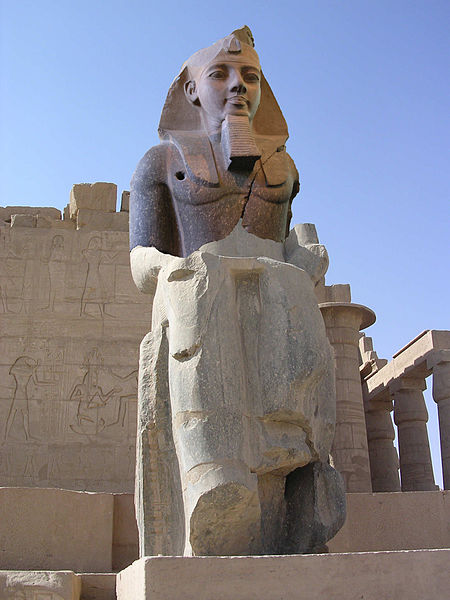
Still, the images of Ramses II seem to reflect the kind of image conscious, stubborn, and arrogant man Moses must have confronted (much different than Ikhneton’s):

Good evidence exists on both sides of this question.  Here is one interesting piece of ‘internal evidence’  on the historicity of the Exodus from Egypt itself that may recall the plagues and confirm parts of the Exodus narrative, the Ipuwer Papyrus, which has some possible parallels with the Exodus account, though it is important to stress the date of the papyrus is in great doubt, and may in fact precede the Exodus by at least 400 years):

1. The Plague of Blood as mentioned in Exodus 7: 14-25

Ipuwer 2:3 “Pestilence is throughout the land, blood is everywhere.”

Ipuwer 2:9 “The River (Nile) is Blood. Men shrink…and thirst after water.”

2. The Plague on Egyptian Livestock as found in Exodus 9: 1-7

Ipuwer 5:5 “All animals, their hearts weep. Cattle moan.”

3. The Plague of Hail and Fire as mentioned in Exodus 9: 22-26

Ipuwer 9:23 “The fire ran along the ground. There was hail, and fire mingled with the hail.”

Ipuwer 2:10 “Forsooth (Help Us), gates, columns, and walls are consumed by fire.”

4. The Plague of Locusts as mentioned in Exodus 10: 1-20 (possible allusion)

Ipuwer 6:1: “No fruit nor herbs are found…Oh, that the earth would cease from noise, and tumult (uproar) be no more.”

Ipuwer 4:14: “Trees are destroyed and the branches are stripped off.”

5. The Plague of Darkness as mentioned in Exodus 10: 21-29

Ipuwer 9:11 “The land is without light.”

6. The Plague on Egypt’s Firstborn in Exodus 12

Ipuwer 2:13 “He who places his brother in the ground is everywhere.”

Ipuwer 3:14 “Groaning is throughout the land, mingled with lamentations.”

Ipuwer 4:3 “Forsooth, the children of princes are dashed against the walls.”

Ipuwer 6:12 “€œForsooth, the children of the princes are cast out in the streets.”

7. Freeing of the Slaves and their Pillage of Egypt as seen in Exodus 12: 31-36

Ipuwer 1: “The plunderer is everywhere, and the servant takes what he finds.”€

Ipuwer 2: “Indeed, poor men have become wealthy.”

Ipuwer 3: “Gold, silver and jewels are fastened to the necks of female slaves.”€

Ipuwer 5: “Slaves (who have now been freed) are throughout the land.”

Ipuwer 10: “€œThe king’€™s storehouse has now become common property.”

And here is a good discussion of the evidence for and against various dates for the  Exodus, if you are interested.

Blesssings,

Dave