The Burma Campaign

My grandfather fought with the 101st Airborne Division in Europe during W.W. II, and received a Silver Star for bravery in action.  But I remember on more than one occasion him saying that he was grateful he fought in Europe instead of the Pacific/Asian theater.  The jungle, he said, might have been too much for him.
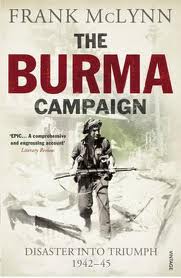
I couldn’t agree more.  Jungle warfare sounds like a nightmare to me.  Frank McLynn’s fine book does nothing to dispel my notions.

For jungle warfare, how about Burma? — home to large amounts of man-eating crocodiles and tigers.  Of the 2500 known species of snakes in the world, only about 200 pose any threat to mankind.  But just about all of them can be found in Burma, a country with the largest known concentration of deadly snakes on the planet.  True, most of them avoid mankind if they can.  Alas, not the small krait, the most feared of all Burmese snakes.  Called “The Two Step” (that’s as far as you can walk if bitten before you collapse and die), these snakes had no problem hiding themselves in the dark corners of tents, or in sleeping bags and boots.

All this to say nothing of the monsoon rains or the malaria infested mosquitos.

Perhaps its our general aversion to the jungle, or our familiarity with Europe, that has led us to overlook the massive war in Burma between 1942-1945, which at various times involved more than 600,000 allied troops.

I say to my students that. . .

  • Military problems are really political problems
  • Political problems are really cultural problems
  • Cultural problems are really religious problems.

I am 100% sure that I did not invent this idea, though I can’t place its origin.  And while I can’t prove it in every case, it sure sounds good, and I expect that it’s true.

But I do think one can see the above principle work itself out in most cases, including the Burma campaign.

For example, Japan had tremendous initial success in Burma as they had all over Southeast Asia in the early days of the war.  Their “bushido” mentality helped form a fearsome army that overwhelmed Allied forces initially.  But this same mentality led them towards an unrealistic view of themselves and their opponents.  Their rigid culture formed a rigid military that did not believe that their opponent could ever learn and adjust their tactics, because after all, they never adjusted their own.  British forces eventually climbed up the learning curve and started to hammer the Japanese by 1944.

Yet, the Japanese continue to do the only thing they know how to do — attack.  Bushido cares primarily about honor, not victory.  Perhaps what the Japanese sought most was not even honor, but an “honorable” death.  Their “attaque a outrance” over Asia seemed to court death and destruction.  As McLynn notes, by war’s end they had the United Kingdom, the U.S., the Soviets, and China as enemies.  Not even the Nazi’s showed such insanity.  Perhaps Japan worshipped death most of all, and as C.S. Lewis noted, we must be careful what we wish for, lest we actually receive it.  Japanese tactics did not change during the war, no doubt due in part to their rigid culture.  But it may also have to do with the fact that they pointed their car to head over the cliff.  The Imphal campaign, where the Japanese planned a massive attack knowing that they their troops would lack the necessary supplies to succeed, again illustrates this concept.

The book starts by describing England’s role in Burma, and their record left much to be desired.  Thankfully for them (though not the Burmese), the Japanese proved much worse landlords, and this I think relates to the paragraph above.  I am reminded of Chesterton’s comment that,

Thieves respect property.  They merely wish the property to become their property, that they may more perfectly respect it.

An attitude I think, that reflects the British and Japanese in Burma.  The Burmese in the end, could tell the differences between British respecters of property and the Japanese, who sought only destruction.

George MacDonald Fraser’s memoir of his time in Burma sheds additional light.  Strikingly to me, at least, he hardly mentions the snakes, tigers, and crocodiles, and mostly concentrated on the mosquitos.  He respects the Japanese, but certain anecdotes he relates make it clear that the Japanese did not seek military success above “honorable” death.  He tells tales of soldiers charging entrenched British positions with nothing more than a sword, yelling maniacally.  After Imphal the Japanese were surely beaten, but none of them ever surrendered.

Fraser’s account  also hints at the coming political transformation of Asia, especially regarding India.  Churchill feared using the Indian Army to fight in Burma since he wanted to keep the British empire intact after the war.  An army that fought to defend India would inevitably bring home a sense of pride that would translate into independence.  Of course the independence movement had begun before the war in India, but the war certainly accelerated it.  One Indian soldier, puffed with patriotism, flew too close the sun and insulted a Gurkha while exalting his own Indian people.  The gurkha needed a dozen men to prevent him from killing the Indian in reprisal (as a brief aside, what would one not believe about the exploits of Gurkhas?  Fraser tells of one Gurkha regiment, who, on a whim, attacked a lost and bewildered Japanese detachment with no guns — only knives — killing all and suffering no casualties themselves).  The Brits explained to the gurkha that if he killed the Indian he would be tried for murder and hang.  This did nothing to deter him.  One of them changed tactics and said that if he killed the Indian he would be thrown out of the army and he would never receive his officer’s commission.  That, and that only, did the trick.  The gurkha finally backed down after a long and profuse apology from the Indian.

Fraser doesn’t talk much about anyone higher than his immediate circle, but McLynn makes a few interesting observations about allied leaders in Burma.  Churchill was known for being impetuous, and he tended to like people with just that quality.  Just as Churchill’s political career survived numerous missteps and disasters, so too he supported Mountbatten and Windgate (leaders of the special forces in Burma, who specialized in dramatic, but possible ineffective campaigns).  All three had enormous self-confidence.  Churchill and Mountbatten had both been involved in political/military disasters that should have ended their careers.  But luckily for the Allied cause only Windgate may have actually bordered on insanity.  The jungle, perhaps, can do that to you.
Democracies and their Special Forces

Originally posted in 2015 . . . .

*********************************************

Field Marshal Viscount Slim memoir Defeat into Victory: Battling Japan in Burma and India is generally regarded as one the finest, if not the finest military memoir.  Having read it (and not having read many others) I won’t dispute the claim.  I often have a hard time with books written by ex-officers, who I find usually bog down in details.  I also, to be fair, have a hard time with spatial relations and without solid maps right in front of me I often get lost.

Slim’s writing bears some marks of what usually gives me trouble with books like this.  What distinguishes this book is his sense of style and humor.  He shares many anecdotes that paint himself a bit poorly.  He shares honest introspection about his actions without getting too much inside his own head.  When he asserts opinions of people he likes or dislikes he admits that others have different opinions.  Finally, he seemed interested in the campaign as a whole, more so than his role in it.

One of his slightly controversial opinions involved Orde Wingate.  Wingate was just the sort of commander that would appeal to Churchill.  Like Churchill he loved the knight-errant approach to war, and so the Chindits, or special forces, of the Burma campaign, gave Wingate a chance to sally forth boldly behind enemy lines.  The direct military effectiveness of his operations seemed limited, though even Slim admits that he boosted morale through the exploits of his men in the aftermath of a complete defeat inflicted by Japan.

Slim’s concluding comments interested me most about this aspect of the Burma campaign.  He thought that England’s reliance on special forces, and the mythology surrounding special forces, did not serve an overall good purpose.  He mentions the variety of special forces the British used (i.e. mountain divisions, amphibious divisions, long-range penetration divisions, and so on).  He acknowledged that some showed great examples of courage but writes,

Yet I came firmly to the conclusion that such [special forces] . . . were wasteful.  They did not give, militarily, a worth-while return the resources in men, material, and time they absorbed.

To begin with, they were usually formed by attracting the best men from the normal units by better conditions, promises of excitement, and not a little propaganda.   . . . The result of these methods was to undoubtedly to lower the quality of the rest of the army, not only by drawing off the cream from it, but by encouraging the idea that certain of the normal operations of war were so difficult that only specially equipped elite corp could undertake them.  Anything, whatever short-cuts to victory it may promise, which thus weakens the army spirit is dangerous.

. . . The level of initiative, training, and weapon skill required in a commando is admirable; what is not admirable is that it should be confined to a few small units.  Any well-trained infantry battalion should be able to do what any commando can do . . .   This cult of special forces is as sensible as to form a Royal Corp of Tree Climbers and say that no soldier who does not wear its green hat with a bunch of oak leaves stuck in it should be allowed to climb a tree.

Slim retracts a wee bit of this statement when he acknowledges that certain special units devoted to intelligence and sabotage, which fall outside the duties of standard training for  a soldier, but reiterates his main point when he stresses that the multiplication of special forces in Burma made unified command difficult to attain.

Our current war on terrorism presents many political and military challenges.  We have responded in part by significantly increasing the prominence of our special forces, both in budgets, deployments, and perhaps also in a surrounding “mythos” about them.  Like Slim, I am grateful for their courage and dedication.  Perhaps unlike him, I am not willing to apply his thoughts wholesale to our current situation just yet.  We face different sorts of military challenges now as opposed to W.W. II.  But we should not assume that we can do whatever we like militarily without it  having consequences on our values and political practices.   We should at least ask whether or not the increase of special forces may distance the military from the general public, or whether or not the military will be for “the common man” in the near future.

Special Forces demand, among other things, a great deal more secrecy, something else Slim abhorred.  Along with drones, they can be used with less public notice and oversight.  Democracies do not thrive with a populace disconnected from its government.  Is there a parallel between the increase of special forces use and the recent NSA scandals?  In other words, a military disconnected from a general democratic population may work (even unconsciously) to undermine the political application of democratic values.

Other wars have brought about shifts in our country’s values, sometimes for the better.  Maybe this current war will lead us into a better place as well.  Whatever the case, we cannot escape some kind of social and political change if we continue to fight in almost exclusively in a clandestine manner, and these changes will likely alter how we practice democracy at home.

“Our danger is that we win all the battles except the last one.”

Despite a mountain of documentary evidence that survived the war in Germany, the prosecutors at Nuremberg had a difficult time establishing the guilt of some defendants.  Many of the top Nazi leaders had already died, and many of the accused found it quite convenient to blame things on those who could no longer answer.   What they knew and when they knew it, and where their responsibility lay was not always easy to ascertain.

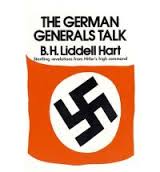
Acclaimed military writer Basil Liddell Hart scored a great coup by getting several top German Unknowncommanders in W.W. II to talk to him about their war experience.  It proved all too easy for the generals to ascribe whatever success they had to themselves, and their failure to Hitler.  As Hart notes in his prologue, this means it’s hard to know how reliable Hart’s generals can be.  They may have invented self-justifications after the fact, and perhaps even believed such justifications.

Still, Hart’s The German Generals Talk succeeds on many levels.  While exact particulars remain cloudy in some cases, a definite overall picture emerges. Among other things, the paradigm the generals created (and we also tend to create) in regard to Hitler and the military needs tweaking, at least in some instances.

For example, we think of Hitler as a megalomaniac bent on conquest at all costs.  But how to explain, then, Hitler’s attitude towards Britain?  Hart shows that at least in the minds of the generals, Hitler wanted to back off of Britain.  At Dunkirk the generals thought that Hitler wanted the British to get away.  With Operation Sea Lion, generals complained that Hitler barely involved himself in the planning and seemed to care little for the details. He seemed almost relieved to break it off in its infant stages.

In truth, Hitler had always admired the British.  He praised them in Mein Kampf, which fit his racial view of the world.  The British, after all, had largely German and Nordic stock and thus were not Germany’s “natural” enemies.  Apparently Hitler believed that in allowing the British to save their honor at Dunkirk, they would more prone to accept a peace settlement.  Like Kaiser Wilhelm II, he implicitly thought that Germany and England were friends deep down.  Hitler’s egocentrism led to him to believe that everyone thought as he did.  All of us share this characteristic to some extent, but in Hitler it grew far out of proportion.  In this rare instance, his race theories actually made him less aggressive, and in this case, this instinct proved disastrous for Germany, a double irony.

Hart’s generals speak of how the army never really trusted or liked Hitler.  Every general interviewed sought to distance himself from Hitler in some way. But then this begs the question as to why very few military leaders stood up to Hitler, let alone actively tried to change the situation.  They explained their situation this way:

  • While many of the upper level officers might have gone against Hitler, their troops would not have.  Those from Major on down had been raised with the Nazi system and had much more loyalty to it.  Many officers doubted whether or not their troops would have followed them in rebellion.
  • The army had an ensconced officer corp with traditions that survived W.W. I.  But the Air Force and navies did not.  Many army officers believed these branches were comprised almost entirely of pro-Hitler sympathizers, as both owed their very existence to the Nazi regime.  Even if the army as a unit rebelled, the Air Force and Navy would not.

Hart offers little comment on this line of defense.  It has merit, and it touches on a larger question.  For democracy to thrive the army must be apolitical.  Is the Nazi army any different?  When do we want the army suddenly to get a conscience?  Commenting on on our military’s experience in Vietnam, one general stated that, “To argue that officers should be guided primarily by their conscience is to argue for military dictatorship.”  But of course we don’t want soldiers, or any human being, to reduce themselves to be a mere robotic arm of the state.

Interestingly the generals’ objections to Hitler had everything to do with Hitler’s military policies and nothing about the morality of the Nazi regime. Nowhere in this 300 page book is the Holocaust even mentioned, let alone the “killing groups” on the eastern front.  Maybe this has something to do with exactly who Hart interviewed, but I think it has more to do with the strict stratification of Nazi society, and the technocratic nature of their military education.  In the end, neither of these things can explain away their ultimate failure to act in any significant way.  None of them went nearly as far as Adolph Eichmann’s ridiculous assertion that, “I only transported people to the concentration camps.  I never actually killed anyone!” but they show the same tendency, albeit to a much lesser degree.

This point touches on how the generals conducted the war.  While Hart (a military man himself) often sympathizes with the military’s side of the story, he points out that the generals lacked strategic imagination.  At least at certain points and times, Hart shows how Hitler had greater grand strategic insight.  Hitler and his generals often clashed.  They had profound class differences.  The Prussian aristocracy surely resented the social mixing engendered by the Nazi regime.  But Hart shows that the differences between them also had roots in their personalities and training.  Hitler’s poetic mind gave him a potentially greater field of vision than his technocratic generals.

But this “greater field of vision” needs moral and “physical” roots.   Art has no merit for its own sake. Hitler often preferred the great, memorable, and perhaps imaginary deed to mundane reality.  If he were to win the war, it would have to be on his aesthetic terms.  So he ordered what in his mind were “gallant last stands” that really condemned his troops to slaughter.  The “Battle of the Bulge” had no real possibility of success due to lack of air support and supplies, but it would be so much more heroic than waiting behind fortified positions behind the Rhine.   Hitler seemed to live more fully in the world of Wagner’s operas than reality.

Hitler may have had at times greater strategic insight than his generals.  But this distance from reality made it so that he could never bother with mundane details.  As far as children are concerned, meat comes from the grocery store, and water comes from the faucet.  Hitler never either could or would take logistics like supplies into account.  That is why Germany could fall prey so quickly to “imperial overstretch.”  General Halder warned Hitler that, “Our danger is that we win all the battles except the last one,” and this proved prophetic in Africa, Russia, and even Europe.  Like Hannibal and Napoleon before him, Hitler forgot the need for political as well as military conquests.

It would be more satisfying for us if Hitler had a moment of self-revelation at his end.  But like many other Nazi leaders who took their own life, no such moment came.  Hitler never wavered from playing his part.  As various Nazi functionaries urged Hitler to flee Berlin, apparently it was Albert Speer who countered their advice by telling Hitler, “You must be on stage when the curtain falls.”  Speer knew that the best way to motivate Hitler was to play to his sense of theater.  Perhaps he wanted Hitler’s demise as much as some of the generals..

Dave

9th/10th Grade: The Social Revolution of the Longbow

Greetings,

This week we looked at the beginning of the 100 Years War (1337-1453), and especially the Battle of Crecy in 1346. The battle, though a major victory for England, did not prove decisive in the long run.  However, it is perhaps the most famous battle of the war because it foreshadowed the beginning of the end of chivalry, and with it, the feudal system as a whole.

As we noted a few weeks ago, the Church in particular, and the feudal system in general, tried to limit the possibility of conflict.  So, only a certain group of people should fight, and then, fight in a certain way with certain weapons.  Riding on horseback with lance and sword required a great deal of training, which in itself restricted who could possibly fight.

This is part of the reason why the Church tried to prevent the widespread use of the crossbow.  The simplicity of the design meant that anyone could use this weapon, a kind of medieval version of point and click.  And, at close enough range, a powerful crossbow could pierce a knight’s armor.  Some suggest that the Church sought only to protect the privileges of the nobility in their attempt to ban the crossbow, but I believe it’s more than that.  The crossbow posed a threat to limited warfare, restricted to a narrow class.  With a crossbow almost anyone could join the fight.

The English had a tradition of using the longbow.  Though simpler in design, longbows had much more power than crossbows, and could be fired more quickly.

Another difference between them, however, is that longbows require much more developed skill than a crossbow.  Like riding and swordsmanship, it required time and practice to attain proficiency.  Hence, longbowmen, though peasants, became a kind of privileged nobility.

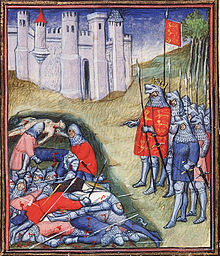
At Crecy the English had longbows, but the French did not, and this proved decisive in the battle.  Muddy ground, combined with French disorganization gave the English bowmen plenty of shots at the French forces.  The French suffered untold thousands of casualties and had to flee the field.  We might be tempted to chalk this up to the ‘fortunes of war, but if we peel back layers, we see that it was no coincidence that the English had longbows and the French did not.  Armies that take the field are a byproduct of specific political cultures, and the battle at Crecy was no exception to this.

Longbows posed an even greater threat to the knightly nobility than crossbows, and the longbow could be expected to meet with the resistance of the nobility.  It would take a strong central government to allow for the longbows development.  The king would need a great deal of authority over local nobility to make this happen.

Since the Norman conquest, England had in fact this tradition of strong kingship, starting with William the Conqueror himself, but also Henry II, Edward I, and Edward III, who many believe started the 100 Years War.  These kings created special laws to further ensure the longbow’s use, including

  • Protecting forests with yew trees
  • Giving peasants with longbows time off from certain feudal duties to practice their skill
  • Giving longbow hunters the right to hunt in some normally protected forests
  • Finally, those who accidentally killed or injured others with the longbow were exempt from legal punishments.

Clearly, the longbow was not just a technological innovation, it was an innovation of a particular political environment.  To raise the longbow to the status of the sword meant elevating the status of peasants, or at least some peasants.  The longbow was not just a weapon, it foreshadowed a social revolution.

The Church found out that stemming innovation is a fruitless endeavor, but they correctly judged the consequences of the introduction of these weapons.  The feudal system could approach fairness if each group in society served legitimate needs of other groups.  The nobility had certain privileges, but also difficult military duties that endangered their lives, took them away from home frequently, and so on.  But if the peasants did not really need them for protection anymore, what was the reason for the existence of the nobility and their privileges?

Next week we will look at how Crecy may have spurred on peasant revolts in France, and the devastation of the Black Plague.

Thanks so much,

Dave

Carnival Time

One of my favorite of ESPN’s 30 for 30 documentaries is “The Guru of Go,” about Loyola Marymount University’s run-and-gun style of basketball.  Those who follow college basketball today know that scores routinely end up in the 60’s, but LMU routinely scored in the 90’s and had many games of over 100 points or more.  Their command over their own style of play “forced” other teams to try and keep up.  But . . . even when teams could stick with Loyola Marymount  in the short-term, the fact that they got caught up in the fast pace meant that they played on enemy territory.  Inevitably, the pace would wear down opponents and Loyola would shoot ahead, leaving the other guys wheezing on the bench.

Most every Christian in the west of an orthodox (small “o”) bent acknowledges that the so-called culture war is over and has been for some time.  We lost.  This might surprise someone transported from, say, the 1980’s when it appeared that “victory” was at hand, with the ascendancy of the moral majority and political conservatism firmly entrenched.  Now looking back we see that marshaling coalitions and votes for laws and Supreme Court justices only meant playing on enemy territory.  Rather, the “City of God” cannot arise using the tools of the “City of Man.”  Like Loyola’s opponents, we got enticed into playing a game ill suited to us–a secular game on secular turf.

Charles Taylor’s A Secular Age will likely prove too deep and dense for me to glean much from.  He writes in a conversational style but with deep concepts and many variations of thought.  One needs a great deal of focus to follow him.  But I felt, perhaps rashly, that the whole of his thesis made sense when he discussed . . .

medieval carnivals.

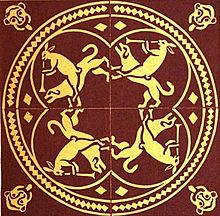
Medieval carnivals took some different forms in different times and places.  Some days merely involved eating and drinking too much, such as “Fat Tuesday.”  Some had more complexity/absurdity, such as the “Lord of Misrule,” which happened around Christmastide.  In this space of time a sub-deacon or even a peasant might get appointed as chief of festivities, which obviously involved eating and drinking, among other things.   Other such similar days had dukes serve as peasants and peasants occupy manorial houses, and so on.  So in the carnival emblem to the side, all of creation seems reversed, as the hare triumphantly rides the hunting hound.

Most commentators point out that such festivals allowed people to let off steam, especially necessary in a structured and hierarchical society such as medieval Europe.  Even some contemporary clerics acknowledge this role for the carnival.  But this forms only the baseline for understanding the role of the carnival.  The emblem of the hare and hounds attest to something grander at work.

Those committed to Christianity know that it provides a means to understand all of experience, not just life after death.  Much of our Christian life involves holding things in tension.  So we believe that God is one God in three persons, neither favoring the unity or the plurality, but going “straight ahead.”  Jesus is fully God and fully man, “without confusion,” as stated by the Council of Chalcedon.  The Church hymns the Virgin Mary as the “unwedded bride.”  For the Mother of God both terms truly apply, without confusion.  Scripture is the Word of God, written by particular men at particular times, and so on it goes.  Christians rightly recognized the Incarnation as the focal point of human experience, for in the coming of Christ creation gets remade and reborn, as John attests in his Gospel by obviously referencing Genesis 1.  After the Incarnation we live in a new world, but in many ways outwardly it exactly resembles the old world.

In the world B.C.*, people saw childlessness as a curse.  Of course children are a blessing in a physical, natural sense, but at a deeper level we were meant to perpetuate the continuing natural order as a means of bringing about the coming of Messiah.  No children meant no participation in redemption.

In the kingdom to come, however, we will neither marry nor be given in marriage.  Thus, we honor monastics.  At the baseline, we honor them for their sacrifice.  But their vows of poverty and chastity mean that they do not live in ordinary time. Their lives transcend the ordinary needs of the world with its buying, selling, and saving, and also reflects the reality of the new creation wrought by Christ. They live partially in eternal time, which contains all time.  They “neither marry, or are given in marriage,” and of course in the heavenly kingdom no one needs money.**  Monastics may or may not live exemplary lives, but the fact of their “station in life” puts them closer to eternal time than laity and even priests, who must concern themselves with affairs in the world.

In his essay Leisure, the Basis of Culture, Josef Pieper makes that case that the only way to escape the cycle of work is to receive breaks in time from without.  Even vacations, he points out, cannot be “leisure” if we view them strictly as breaks from work.  Modern views of labor probably originated with Marx and his followers, and certainly we should sympathize with the “proletariat,” if we wish to use the term.  But as Pieper wryly remarks, “Proletarianism cannot obviously be overcome by making everyone proletarian.”

Ordinary time may be strictly linear, but not “eternal time.”  Eternal time contains all moments.  We the laity, despite our ordinary and natural station, can still at times participate in eternal time.  Taking the crucifixion as an example, Taylor writes,

Meanwhile the Church, in its liturgical year, remembers and re-enacts what happened . . . [at Christ’s crucifixion].  Which is why this year’s Good Friday can be closer to the Crucifixion than last year’s mid-summer’s day.  And the Crucifixion itself, since Christ’s passion here participates in God’s eternity, is closer to all times than they in secular terms are to each other.

Put in other terms, on this view tracts of secular time were not homogenous and interchangeable.  They were [differentiated] by their placing in relation to higher time.

Medieval carnivals did not participate in sacred time, but they did recognize the duality.  By breaking down the natural order of ordinary time, they testified to the reality of sacred eternity, where a completely new order will forever take hold of the cosmos.  Thus, the breaking down of the order gives it new life, the secular/ordinary order gets reborn freshly after each carnival.  It makes perfect sense that the “Lord of Misrule” would “reign” during Christmastide, for this time on calendar celebrated the breaking in of the eternal into temporal via the Incarnation.  “How can the guests of the bridegroom fast while He is with them (Mk. 2:19)?”

Carnivals did not protest against the prevailing order so much as re-affirm it.  Recognizing its temporary and inferior status was the only way it could be reaffirmed, the only way order could perpetuate.

We remember Henry VIII for his many marriages, but it makes perfect sense that an absolutist like Henry would also abolish the days of misrule at Christmastide.  This too accompanies his seizure of monastic lands.  The monastic vocation and the carnival testify to this tension in time, and to the transitory nature of the state.  No statist like Henry likes such things.  Worlds other than those they made frighten and confuse them.

We see too that whatever its intentions, by abolishing liturgies and the church calendar, the Reformation paved the way for secularization.  Bit by bit Protestant denominations moved away from the “sacred time” of the church calendar year. Taylor cites Walter Benjamin’s description of “homogenous and empty time” as the mark of modern consciousness.  “On this view,” Taylor writes, “time [has no meaning in itself] but is like a container, indifferent to what fills it.  Without “eternal liturgics,” and without a sense of time as a gift to mold and shape us, all that is left is for us to fill time with meaning.  And so we have, and created the secular state thereby.

This secular victory is quite empty, however. The homogenization of time makes everything sterile.  Nothing can have real meaning.  Without fasting, our materialistic civilization cannot even feast.  With the homogenization of time comes the homogenization of space–including space for worship.  With no delineation of either time and space, it’s no wonder that, to riff on Milton Friedman, “we’re all secular now.”

We see this view of the homogeneity and plasticity of time permeate our society. Take Fridays for example.  Back in ye olden days Fridays for everyone involved fasting of some kind, for each Friday participated in some way in the Crucifixion–not just in memory, but in reality.  After abandoning the dual sense of time described above we instead oriented time around our work/school week.  Now Friday has taken on the opposite role in our secular liturgy as a day of release, fun, and celebration.  Imagine a family trying to establish something of the older sense of Fridays, and the enormous accompanying societal/liturgical pressure to go out and have fun with friends from work or school facing them square in the face.

“Resistance is futile.”

Of course, this same story has been played out in so many other areas. Without Advent we get Black Friday.  Without Paschaltide we get “Spring Breakers.”

In a recent conversation with Hank Hannegraaf Rod Drehrer recounted his meeting with a group of evangelical pastors near the election.  While Drehrer understood why one might vote for Trump “in sorrow,” as an alternative to Clinton, he admitted an utter incredulity in seeing some pastors positively enthused about Trump.  The response from another evangelical who shared his lament was, “You have to understand, they have no Plan B.  Politics is the only way they can conceive of changing the world.”^

The statism of Henry VIII–and others– has born disastrous fruit.

Many on the more secular left might lament Trump’s election and see it as proof that the “war has yet to be won,” or something like that.  They can relax and break out the cigars.  The war was won long ago, the rest has been mopping-up operations here and there.

I find it hard to tell if Taylor laments or merely describes the shift towards secularism.  He does state that at most all those who hope for a return can do is indulge in nostalgia.  I agree that the tide ran out long ago, but I have more hope.  A proper and effective response will first recognize that turning the battleship will take generations of small faithfulness in our lives and homes.  We should begin with a developing a new sense of time.

Dave

Written (originally in 2018) on the Feast of the Chains of St. Peter, and the Commemoration of St. Paul the Apostle

*The attempt to replace B.C./A.D. with BCE/CE may only be meant as a sop to political correctness or inclusivity.  No doubt people mean well.  But still, the switch is at root an attempt to remake our understanding of time.  Though I lament this shift, it is in many ways long overdue, as we no longer order our lives around the impact of the Incarnation.  It took the French just four years of Revolution to switch their calendar.  It will take us much longer, because we have nothing to replace it with.  We lack the bold audacity of the French, which is a good thing, considering that tens of thousands died in the French Revolution and millions died in the Napoleonic wars.

**Visitors to the monasteries on Mount Athos notice that two different clocks are used in many of the monasteries.  One, the familiar ordinary/secular time, the other clocks measure the now nearly extinct “Byzantine” time (Byzantine clock seen bel0w) to reflect this dual reality.

^So too the French Revolutionaries, which explains the failure of their festivals.  They sought to ape medieval carnivals, but key differences persisted:

  • They were attempting to construct a new order, not deconstruct an existing order.
  • Thus, their festivals had a much more didactic emphasis than medieval carnivals, which
  • Made them much more boring.

Conversations with Stalin

This post was originally written in 2018

*******************************

Some might argue that history constrains us.  Certainly many teenagers keenly feel the question, “Why does it have to be this way?  Why must the world work as it does?”  The dynamism of youth and their imaginations certainly can do wonders for any society.

We may suppose that a world without historical awareness will create a glorious whole new world of possibilities.  But . . . history rather pedantically suggests that the opposite of the case.  Recall the French Revolution, for example.  They remade everything, even their sense of time.  But this confusion and disruption led to terrible tyranny and mass incarceration.  The communist regimes of the 20th century show this same tendency.   Only the most bold would call Soviet-era culture stimulating and full of possibilities.  Their narrowness of vision–a narrowness made possible and even likely by their disrespect to history–created a terrible tyranny.

Many comedians have commented that they no longer wish to perform at many college campuses.  Students in today’s climate seemingly cannot operate with dual levels of reality.  They cannot make distinctions between jokes and real life, assuming a 1-1 correlation of all aspects of reality, a flat world.  Caitlin Flanagan of The Atlantic wrote that,

Two of the most respected American comedians, Chris Rock and Jerry Seinfeld, have discussed the unique problems that comics face on college campuses. In November, Rock told Frank Rich in an interview for New York magazine that he no longer plays colleges, because they’re “too conservative.” He didn’t necessarily mean that the students were Republican; he meant that they were far too eager “not to offend anybody.” In college gigs, he said, “you can’t even be offensive on your way to being inoffensive.” Then, in June, Seinfeld reopened the debate—and set off a frenzied round of op-eds—when he said in a radio interview that comics warn him not to “go near colleges—they’re so PC.”

When I attended the convention [The National Association for Campus Activities] in Minneapolis in February, I saw ample evidence of the repressive atmosphere that Rock and Seinfeld described, as well as another, not unrelated factor: the infantilization of the American undergraduate, and this character’s evolving status in the world of higher learning—less a student than a consumer, someone whose whims and affectations (political, sexual, pseudo-intellectual) must be constantly supported and championed. To understand this change, it helps to think of college not as an institution of scholarly pursuit but as the all-inclusive resort that it has in recent years become—and then to think of the undergraduate who drops out or transfers as an early checkout. Keeping hold of that kid for all four years has become a central obsession of the higher-ed-industrial complex. How do you do it? In part, by importing enough jesters and bards to keep him from wandering away to someplace more entertaining, taking his Pell grant and his 529 plan and his student loans with him.

But which jesters, which bards? Ones who can handle the challenge. Because when you put all of these forces together—political correctness, coddling, and the need to keep kids at once amused and unoffended (not to mention the absence of a two-drink minimum and its crowd-lubricating effect)—the black-box theater of an obscure liberal-arts college deep in flyover territory may just be the toughest comedy room in the country.

In the same vein, Alex Tabborok recently commented that,

It has been said that we live in an increasingly divided media universe but on many issues I think we live in an increasingly uniform media universe. Social media is so ubiquitous and the same things sell so widely that I suspect the collective consciousness is less fragmentary than in the past.

I thought of this issue reading transcipt trials of two Soviet authors in the late 1960’s, Yuli Daniel and Andrei Sinyavsky. The authors were not in trouble for any direct attacks against the state or against communist doctrine per se.  Obviously no writer who valued his safety would write in this way.  The problems with their work lay elsewhere.  Among the issues raised:

  • There are no clear good and bad characters in your stories.  How then can the people understand the story (i.e., the story alienates the masses, which is de-facto anti-communist)?
  • Which characters in the story definitively represent the author’s point of view?  In other words, which character speaks for the author, and which characters serve as foils?

This particular attack assumes that 1) The relationship between characters in the story and the author is always strictly linear and 1-1, and 2) This relationship is necessary for clarity in the story, and 3) Without this clarity, how can we judge if you are a threat to the state or not?

Both authors seemed terribly confused by attacks made against them, pleading “not guilty,” an unusual move in trials of this sort.  They tried to explain basic literary theory of story and character, but to no avail.  Their judges simply couldn’t accept this mental construct.  By definition character’s must express a direct relationship to the author.  Character’s who criticize the state must reflect the author’s mind.  The author’s tried to point out that some of these characters fare badly in the story, but the prosecutors shot back that not all who criticized the state “got their just desserts.”   Here is a brief excerpt from Yuli Daniel’s trial, which begins with the prosecutor reading an excerpt from one of Daniel’s stories:

Prosecutor (reading): “I hate them [referring to those in power] so much I have spasms, I scream, I tremble.”   Well, Daniel, what are we to make of this?

Daniel: That is an epigraph to the character’s thoughts (laughter in the courtroom, Daniel looks around nervously).

Prosecutor: Who is that you hate so?  Who do you want to destroy?

Daniel: To whom are you talking?  To me, or to my character, or to someone else?

Prosecutor: Who is your positive hero?  Who expresses your point of view in the story?

Daniel: I have told you, the story has no entirely positive hero and there doesn’t have to be one.

Prosecutor: Who expresses the author’s credo?

Daniel: The characters do express the author’s thoughts, but only in part.  No single character represents the author.  Maybe [my story is] bad literature, but it is literature, and it doesn’t divide everything into black and white.  . . . The indictment states that I express my ideas “through the mouths of my characters.”  That is a naive accusation, to put it mildly.

Neither author had success discussing the nuance of how stories work.  Both received labor camp sentences of 5-7 years.

In his Conversations with Stalin Milovan Djilas tells of his initial fascination with Stalin and the Soviet Union and his subsequent disenchantment in a few short years.  Many other works give many more details about the horror and oppression in Stalinist Russia.  What made Djilas’ account interesting was that he framed his account not so much in terms of how it all went wrong, but how it managed to work at all.  That is, we know Stalin was bad, but if he was so bad, why did Soviet Russia prosper and gain power, at least in certain ways?

He explores this in different ways.  For example, no one questions that the purges in the military during the 1930’s sacrificed thousands to Stalin’s paranoia, but Djilas had met many of the commanders put in place after the purges, and admitted that they were almost all quite adept, fearless, and devoted.  Naturally, Stalin had his entourage that rarely, if ever, challenged him.  As you would expect, one always had to constantly avoid saying the wrong thing by following keenly the bouncing ball of “official” opinion. But unlike most other autocrats throughout history, Stalin did actual work and remained very well informed.  He could incisively size up personalities in the room and control it with ease.

What struck me most of all, however, was this comment of Djilas:

“The world in which the Soviet leaders lived–and that was my world too–was slowly taking on a new appearance: horrible, unceasing struggle on all sides. Everything was stripped bare and reduced to strife which only changed in form and in which only the stronger and more adroit survived.  Full of admiration for Soviet leaders before this, I now succumbed to a heady enthusiasm for the inexhaustible will and awareness that never left them for a moment.  That was a world in which there was no other choice other than victory or death.”

Perhaps unconsciously, Djilas reveals that Maxism has its roots not in economics, politics, or a new conception of proletarian culture, but in a new religious understanding of the world–a naked struggle for will and power.  It is this elemental understanding of things that can give regimes who build on this faith a concentrated vitality, akin to the power of art in certain barbarian civilizations.*  Perhaps Stalin understood this as well, to great and terrible effect.

Today most of us immediately understand the danger’s of the far-right, perhaps because the far-right has a crystal-clear idea of what they want and express it forcefully.  Many on the far-left, on the other hand–quite prevalent on many campuses today–seem to think that their ideas will lead to a bright, sunlit land where everyone loves everyone else (the far-right has no such plan and no such delusion).  But if you can’t take a joke, you will dramatically narrow your world, after which, you will have nothing to fall-back on other than the paganism of power and will.

Dave

*Though I would love to claim this insight about “barbarian art,” it belongs entirely to the inimitable Kenneth Clark.  He argued that the concentrated narrowness of barbarian civilizations can give their art a certain vitality.

8th Grade: The Parthenon

Greetings,

Recently we spent time looking at the Parthenon in Athens, which, along with Egypt’s Great Pyramid, stands as a seminal achievement of ancient architecture.  I think that looking at architecture is one of the best ways to gain insight into the past.  I didn’t come up with this idea, but borrowed it from the man to whom this site pays homage.  As I have said before, a civilization might throw a banking system together haphazardly, but would not do so with a sculpture.  And buildings, more so than individual works of genius, reveal more because they involve the mind and skills of whole civilizations.

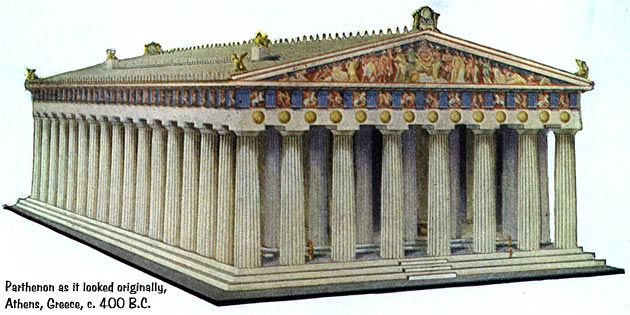
Here is what the building probably looked like ca. 432 B.C.

Parthenon Original

They built it atop of their Acropolis, the highest point in the city which served as Athens’ religious epicenter.

Acropolis Recreation

The building as it looks today. . .

Of course most people when first gazing upon the Parthenon usually think, “Yes it’s good, but what’s the big deal?”  We understand instinctively perhaps the influence this style has had on western culture.  Banks, the Supreme Court, and almost any other building that wants to convey wisdom and trust copy this style.  That in itself should clue us in that the Athenians had something special in their design, but we have to look closely to see the real genius of the Athenians.

When we look at tall buildings like skyscrapers on the Washington Monument, at least from certain angles, the buildings do not appear straight.  Built with 90 degree right angles, our eyes fail to perceive the perfectly straight.  I don’t understand the science of why this happens, but we have all experienced it.  Part of it has to do with how our converging line of sight deceives us.  For example. . .

the top line appears longer, but is in fact the same size as the bottom line.  In this second image the middle lines appear bowed, but are perfectly straight.

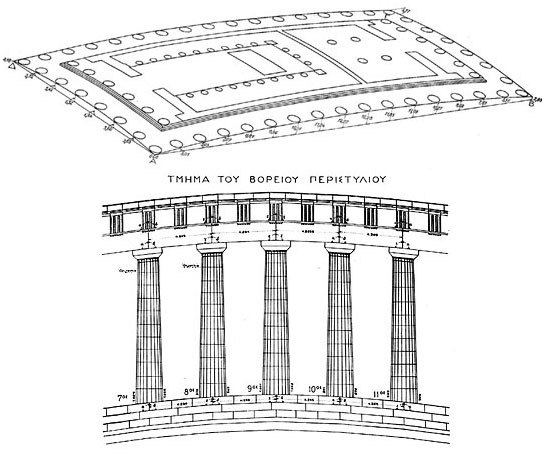
The Athenians understood this and built the Parthenon to compensate for the tricks our eyes play.  Each column has extremely slight variations throughout its many cylinders, sometimes with fractions of a millimeter the only thing distinguishing one block from another.  But the cumulative effect compensates for our vision and always makes the columns appear perfectly straight.  The following images exaggerate the effect, but give us the basic idea of what the Greeks accomplished:

Parthenon Columns

In fact a close look at the Parthenon reveals few right angles.  Each of the thousands of column drums remains an unique construction to that particular column.  This is not a lego set of interchangeable parts, but each part of the building stands as work of art unto itself.  If you have the time and interest, this video, and especially the last 30 minutes, give a good overview of their techniques in creating this building.

We can and should marvel at its construction, but we should go one step further and ask what the Parthenon means, and whey the Athenians built it as they did.  In class we focused on a few key areas:

  • The Greek Ideal of Perfection

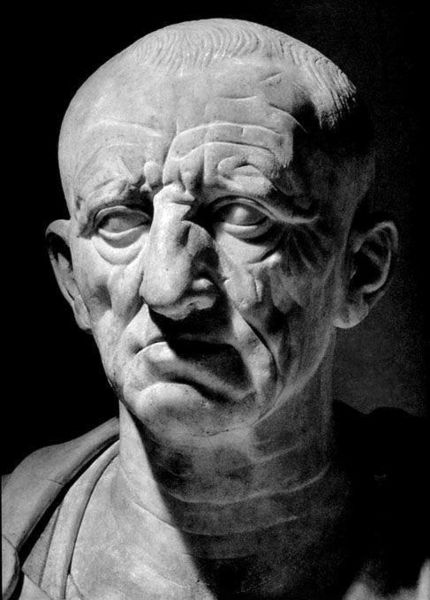
In much of their philosophy and politics, the Greeks searched for the abstract ideal beyond the visible, a trend that would not really shift until Aristotle.  The Romans, for example, or at least the early Republican Romans, rarely idealized people when depicting them,

Cato the Elder

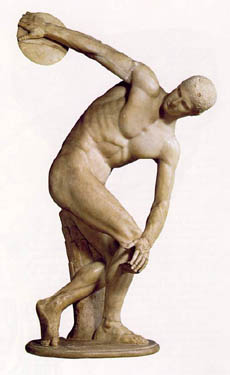
but we can say with only slight exaggeration that the Greeks did nothing but idealize people in their sculpture.

The Athenians went to tremendous lengths to bring make this ideal of perfection at least  seem  real among them in stone.

  • A Theological Statement

In theory, the Athenians built the Parthenon as a temple to Athena.  Originally a huge 35 foot statue of Athena overlaid in gold stood right at the center inside the building.  But architecture rarely lies.  The figures on the outside of the Parthenon tell a different story.  Here the Athenians put sculptures of Athenian heroes, with the clear intent of showing that the gods and men can intermingle, that Athens itself can achieve the perfection the gods embody.

That, at least, is one interpretation.

But another interpretation argues that this “temple” to Athena merely served as a cover for their true (even if subconscious) intent to glorify themselves.  It would be as if we built a church and called it “Trinity Church,” but put images of George Washington, Abraham Lincoln, etc. throughout (this actually begs the question of whether or not American flags should reside in churches, or perhaps whether or not the Capitol building is a church of sorts).

  • Mankind as the Measure

The Greek philosopher Protagoras has received a lot of bad press over the years for his comment that, “Man is the measure of all things,” and deservedly so.  But before we critique him we should understand the context of what he said and ask ourselves if the Greek gods were good “measures” of things.  Clearly, Protagoras and other philosophers had a measure of genuine spiritual insight in rejecting standard Greek religion as a guide for their lives.  The gods lived lives free of consequence, free of any restraint other than the power of other gods.

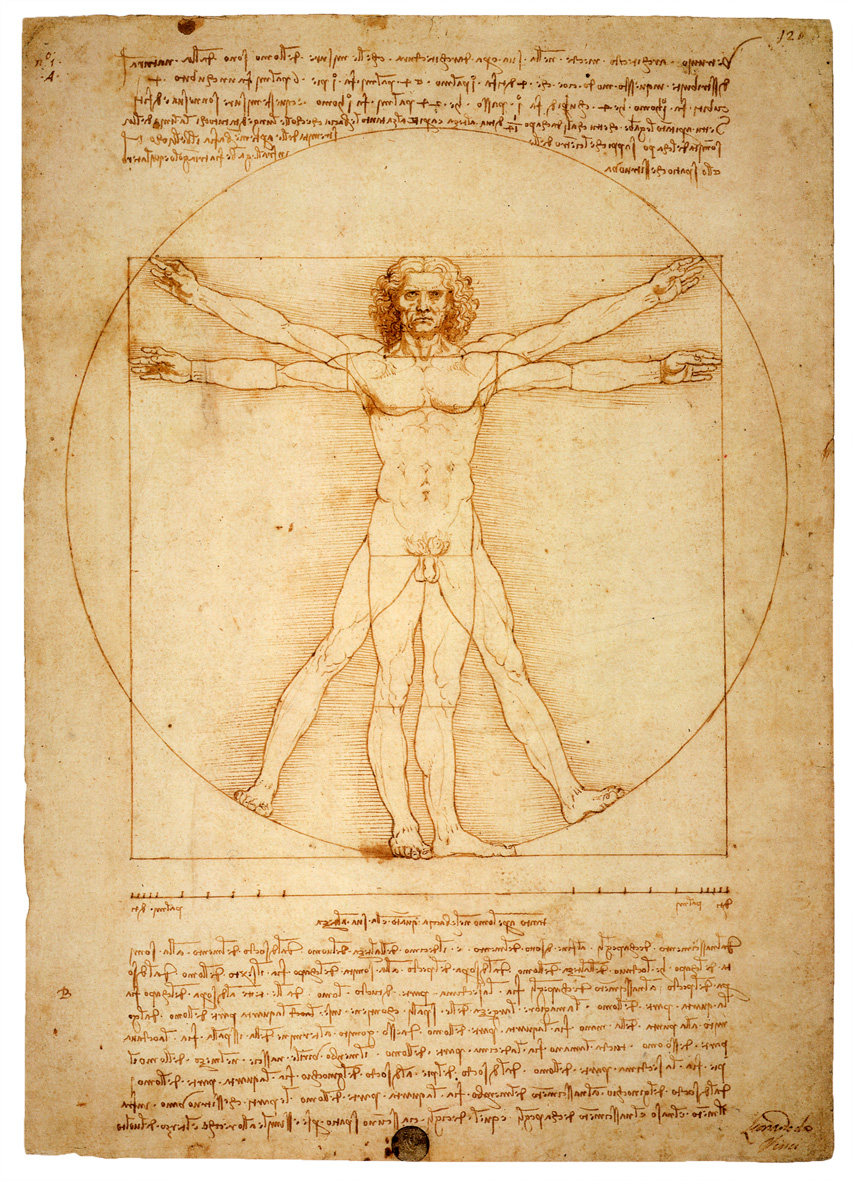
In the Parthenon the Greeks did not use the “eternal” or “mystical” dimensions as in the pyramids.  Some suggest that the proportions of the building in fact reflect the proportions found in the human body, as represented in Da Vinci’s famous “Vitruvian Man” (named after a famous Roman architect).

Vitruvian Man

What exactly the Greeks meant by this phrase, “man is the measure of all things” is not clear to me. It may have been a statement of moral relativism, or it may have been a theological/cosmological assertion that mankind functioned as a “microcosm” of the cosmos itself.  After all, we have physical elements to our being and spiritual elements.   Our higher, “heavenly” aspect (the intellect) guides our “lower,” more earthly parts, and so on.  Again, I’m not sure how to unwrap this phrase, and I’m happy to add it to the list of mysteries surrounding the Parthenon.

Blessings,

Dave