Time in Joint

Historians tend towards the romantic, which means they can develop an undue fascination with decay. The best historians add to this a grand sweeping view of all things and thus see (with good reason) the vicissitudes of time and the sin to which all men are drawn. Historians hopefully are not cranks or kill-joys–rather they at least believe themselves saying, “I’ve seen this movie before . . . . ”

Exceptions exist of course, but Polybius, while writing of the glorious successes of the Republic saw the wheel of time moving that same Republic inexorably towards decline. Oswald Spengler also shared the basic assumption that civilizations, like every living thing, had its inevitable death built into their DNA. Plato too saw forms of government moving in a definite cycle, and Machiavelli–though departing from Plato as much as he could philosophically–shared this basic assumption. He hoped that practical wisdom could elongate the good parts of the cycle and shorten the bad ones, but sought nothing beyond that. Toynbee, being more influenced by Christianity than any of the aforementioned greats, saw more hope but still admitted that every civilization he studied had declined and disappeared.

All of these historians (others could be mentioned, such as Thucydides, and though Herodotus may have been the most hopeful, he did not write about the Peloponnesian War) dealt with civilizational decline but not with the concept of time itself. Some might say that historians should not bother about “Time” and let it stand as the purview of either science or theology. Well, history involves a degree of science, and no one can write about mankind without at least subconsciously thinking about God.
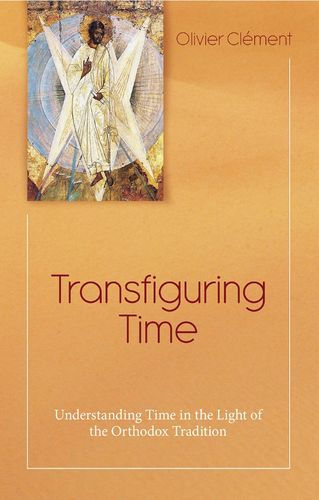
Enter Olivier Clement, and his dense, difficult, but still fascinating Transfiguring Time: Understanding Time in Light of the Orthodox Tradition. I cannot claim to have understood him thoroughly, but I hope to have gleaned the most important aspects of his work.

History shows us that civilizations had two main ways of conceiving of time, either as cyclical or linear. The cyclical view dominated most pre-Christian civilizations. Clement writes that

For primitive society, authentic time is the dawning moment of creation. At that moment . . . heaven was still very close to earth. . . . This first blessedness disappeared as a result of a fall, a cataclysm that separated heaven and earth . . . Thereafter he was isolated from the divine and from the cosmos.

The whole effort of fallen man was therefore to seek an end of this fallen state in order once again to be in paradise.

One sees this in the mythologies of most civilizations I am aware of. For the Greeks, Egyptians, Meso-Americans, etc. history begins with the gods ruling on earth in some capacity, a golden age of harmony and justice.

As the gods fled, all people had left to them was mimicry. By participating in the “cycles” initiated by the gods they could perhaps glean something. So we marry because heaven and earth were once married. We farm because of the motif of life from death, death from life we see played out in agriculture. Night becomes day, and day becomes night. Clement writes,

One important symbol (and ritual), the dance, sums up this conception of time. According to a very ancient tantric expression, the cosmos is the “game of god,” the divine dance. Primitive cyclical time is nothing less than the rhythm of this dance, ever tighter cycle in which the dancer is drawn in and assimilated.

Clement acknowledges that much truth exists in this conception of time, but emphasizes that it is fruitless in the end and thus, hopeless, a “hellish” repetition.* “Time is always experienced as degradation” as we move further out from the original marriage of heaven and earth. As we move further out, our connection lessens, hence the origin of ecstatic religious manifestations as an attempt to escape the cycle of reality and return to innocence. The Dionysian cult, for example, was universally acknowledged as “new” by the Greeks in the 5th century. Toynbee mentions that in the aftermath of Hannibal’s invasion, the more disciplined Romans found themselves “plagued” with an onslaught of much more emotional religious expressions. The old gods could no longer meet the new needs

This severing of man from meaning makes time itself meaningless. Eventually not even the regularity of the cycles can entice. One sees this clearly in the Viking epic Egil’s Saga. The prose sparkles, and the poetry is even better. But in the end we have feast, feud, violence, victory–rinse and repeat. So too in other cultures. Clement cites the famous story of Narada from the Sayings of Sri Ramikrishna which illustrate this well:

Narada, the model of piety, gained the favor of Vishnu by his fervent devotion and asceticism.  Narada demanded of Vishnu that he reveal to him the secret of his “maya.” Vishnu replied with an ambiguous smile, “Will you go over yonder to fetch me a little water?”  “Certainly, master,” he replied, and began to walk to a distant village. Vishnu waited in the cool shade of a rock for him to return.

Narada knocked at the first door he came to, eager to complete the errand.  A very beautiful young woman opened the door and the saintly man experienced something entirely new in his life.  He was spellbound by her eyes, which resembled those of Vishnu. He stood transfixed, forgetting why he had come. The young woman welcomed him in a friendly and straightforward way.  Her voice was like that of a gold cord passed around the neck of a stranger. 

He entered the house as if in a dream.  The occupants of the house greeted him respectfully.  He was greeted with honor, treated as a long lost friend.  After some time he asked the father of the house for permission to marry his daughter who greeted him at the door.  This is what everyone had been waiting for. He became a member of the household, sharing its burdens and joys.  

Twelve years passed.  He had three children and when his father-in-law died he became head of the family.  In the 12th year the rainy season was especially violent. The rivers swelled and floods came down from the mountains and the village was swamped with water.  During the night the waters swept away houses and cattle. Everyone fled.  

Holding his wife with one hand and two of his children with the other, with the third perched on his shoulders, Narada left with great haste.  He staggered along, battered by torrents of water. Suddenly he stumbled, and the child on his shoulders fell and plunged into the flood. With a cry of despair Narada let go of his two other children and flailed away to try and reach the littlest one, but he was too late.  At this moment, the raging water swept away his wife and two other children.  

He lost his own footing, and the flood took him away, dashing his head against a rock.  He lost consciousness. We he awoke he could see only a vast plain of muddy water, and he wept for his loss.  He heard a familiar voice, “My child, where is the water you said you would fetch me. I have been waiting for almost ½ an hour.”  

Narada turned and saw only desert scorched by the mid-day sun.  Vishnu sat beside him and smiled with cruel tenderness, “Do you now understand the secret of my maya?”

Commenting on this story, Clement cites two Hindu scholars, who write that,

The nature of each existing thing is its own instantaneity, created from an incalculable number of destructions of stasis.

and

Because the transformation from existence non-existence is instantaneous, there is no movement.

Thus, for Hindus as well as Greeks, eternity is seen in opposition to time, with immobility being the means of entering into eternity, which is again, in opposition to all that is transitory on earth.**

Viewed against other pre-Christian societies, Israel of the Old Testament looks quite different in their view of time and space. Some comment on the “crudeness” of the anthropomorphic language in the Old Testament about God, but this language, “demonstrates that eternity is oriented towards time, and that eternity marches with time towards encounter and fulfillment.” Clement uses the word “courtship” to describe this relationship, which I find most apt. One might then say that the Old Testament culminates in the Virgin Mary bearing the union of Heaven and Earth in the person of Christ. Time takes on a linear dimension and events take on definite meaning. True–time is part of creation and thus partakes of the curse of the fall–it marches us towards death and non-being. Existence gets mechanized. But this also means time will be redeemed, and this process of redemption begins not at the future “Day of the Lord,” but in the Incarnation itself, and in the everyday “now.”

The Christian worldview has elements of the cyclical time of many pre-Christian civilizations. Many medieval calendars, for example were often expressed in a circular, not linear, manner.

The Church is both eschatological and paradisal–a paradise regained–though importantly, a paradise regained that will be greater than that which was lost. Levitical liturgical life prescribed yearly festivals that mirrored the seasons of the year. In some ways, the world is a “game of God,” as St. Maximos the Confessor states.^ The liturgy recapitulates not our vain longings for a return as in pagan cultures, but the real interaction of time and eternity at the heart of existence.

In the Old Testament, time had meaning in part because it moved to a definite fulfillment with the coming of the Messiah. With the Messiah rejected, the Jewish people lost their connection with the eternal purpose of time. Now time as a straight line simply ends in death, and proclaims the reign of death just as strongly as the vain repetitive cycles of the most ancient cultures.

If I understood Clement rightly, he argues that the Christian sense of time preserves the best of both Jewish and pagan time–the cyclical and the linear–while introducing an entirely new element. The liturgical cycles give us continual entrance into a defined pattern life as we move in a distinctly forward direction towards the Day of the Lord. But these cycles don’t just recall the past or proclaim the future, but bring about an intersection of eternal and temporal. Liturgical prayers often speak of the “today” of the historical event celebrated. And if time is part of creation, then the “line” of history too will be redeemed and circumscribed by eternity.
As to the implications on blog about history and culture, well, here I have less confidence than in my attempts to understand Clement. But if I may venture forth . . . it does seem that an undue amount of political commentators have fallen prey to the romantic idea of cyclical and irretrievable decay. Right after Trump was elected, for example, a new edition of Plutarch’s lives detailing the end of the Roman Republic got published. Some now on the right feel a leftist totalitarianism on the rise. But Clement would tell us that is at precisely these times that we must remember: time no longer bears us unceasingly towards decay. If we so choose, we can live in a world infused with the paradise of eternity.

Dave

*Clement mentions that many ancient societies buried their dead in the fetal position as an indication that the cycle of life/death was to repeat ad infinitum. Many Native American tribes did this, as did the Egyptians, apparently. As far as I know, Christians have never buried their dead in a like position, testifying to a different theology of time and redemption.

Egyptian Mummy

Cremation practiced at times by the Greeks and others also testifies in some ways to the futility of the cycle–we began as nothing and return to nothing.

**Clement notes some similarity between this concept of “immobility” and Orthodox ascesis. Many monastic fathers speak of “stillness of heart” and “remaining in your cell.” Again, Clement acknowledges the complexity of the topic and the need to emphasize that sometimes the differences are not of “kind” but of degree & orientation.

^The idea being not something arbitrary but something playful and in flux, compared to the stability of the heavenly realms.

Room 237

In western Canadian native culture, they tell a story about the South Wind and a skate. The South Wind’s volatility caused many problems for the people, making it impossible for them to fish and gather shellfish on the shore. They decide to fight the winds to make them behave. Some people and fish embark on an expedition to tame the wind, and have success. The South Wind agrees only to blow from time to time at certain periods, so that people can get on with their lives.

In his Myth and Meaning: Cracking the Code of Culture Claude Levi-Strauss sees more here than a nice story. He focused on the presence of the skate, which like a flounder, presents itself as a “normal” fish but is actually quite thin. When lying on the bottom, the skate presents an easy target, but a simple twist of its body will suddenly make it a much more difficult target. The skate, then, presents a kind of binary, a yes/no option to the world. He writes,

If the South Wind blows every day of the year, then life is impossible for mankind. But if it blows only one day out of two–‘yes’ one day and ‘no’ the other–then a compromise becomes possible between the needs of mankind and the conditions of the natural world. Levi-Strauss comments,

Thus, from a logical point of view, there is an affinity between an animal like the skate and the kind of problem the myth is trying to solve. The story is not true from a strictly scientific point of view be we can only understand this property of the myth at a time when computers have come to exist and provided us with an understanding of binary operations which had already been put to use in a very different way with concrete objects or beings by mythical thought. So there is no divorce between mythology and science.

As moderns we love to parse and divide, and so many theories exist about the functions of myths (I am guessing that ancient/traditional society have no such theories). Bronislaw Malinowski championed the “Functionalist” school–myths describe how we make life work regarding our basic human needs and drives. Claude Levy-Bruhl took an entirely different approach, arguing that the key difference between “primitive” and modern people came down to “emotional” and “mystic” representations from the former vs. scientific for the latter.

Strauss had a different approach, one I think closer to the truth. Traditional or “primitive” man had the ability to think in a disinterested, scientific way, but went about it differently than moderns. Strauss argued that we need to see more science in the past, and more myth in the present. True, the “scientific mind,” as described by Descartes, seeks “to divide the difficulty into as many parts as necessary in order to solve it.” But in the end, we must find coherence in order to manifest the order of the cosmos. As Strauss argued, if humanity the world over seeks order and meaning, it must be because order and meaning exist in the world.

The link between scientific and mythological thinking shows up sometimes in suprising places.

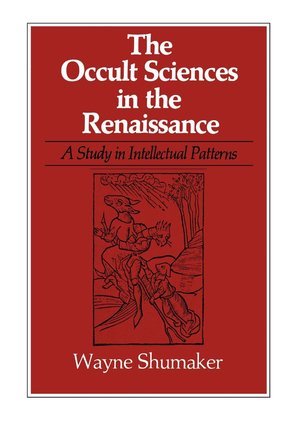
In his The Occult Sciences in the Renaissance Wayne Shumaker gives an interesting perspective on the Renaissance–one not in keeping with our natural expectations. He agrees with historian Paul Kocher–both note that the best attacks on Astrology during the Renaissance–Elizabethan era came almost entirely from ecclesiastics, including Pope Sixtus V, Pope Urban VIII, William Fulke, John Calvin, William Perkins, John Chamber, and George Carleton. Kocher continues,

And who, on the other side, spoke up for astrology? To the bewilderment of the modern analyst, chiefly the foremost scientific men of the age . . . an almost solid front of physicians, astronomers, and other natural philosophers, renowned for their achievements.

Kocher, Science and Religion in the Elizabethan Era, p. 267

Our typical assumptions about the Renaissance need reviewed, and Shumaker writes with great clarity and precision to facilitate this.

The argument for astrology in the Renaissance came from medieval roots, to be sure. To understand the medieval approach we have to reorient our assumptions about the nature of space, the relationship between the physical and the spiritual, and the concept of identity.

Space

  • Moderns see emptiness, a void, with objects moving that only occasionally and remotely have an interactive relationship based on mass.
  • Ancient and medieval people saw a universe crammed with life, be it the gods, angels, intelligences, etc. All these beings have a continuous relationship with one another.

Physical and the Spiritual

  • Moderns tend to separate the two. We have symbols, but what is really real is matter, what we see, observe, measure, etc. Spiritual realities exist, perhaps, but the two worlds do not mix
  • Ancients and medievals saw the two as constantly intermingling and influencing one another. This has ultimate expression in the mass, where heaven and earth meet in the transformation of the eucharistic elements into the Body and Blood of Christ, and the ripple effects flow from that.

Moderns acknowledge that physical things like weather impact our moods and can alter events. Ancients and medievals extended that sphere of influence into the heavens. Many in the Renaissance took in one step further. Shumaker writes that,

the Renaissance defense of astrology rested very heavily on the alleged power of “rays” to exert influence by means of light and heat. The rays of the sun operate upon us sensibly, and those of the moon, which was known to influence the tides, could be concentrated sufficiently by a concave mirror to produce warmth. Is it credible that rays from other cosmic bodies can affect us?

Identity

  • Moderns focus a great deal on the idea of the “true self,”* which must be liberated from the constraints of every influence to act freely and shine brightly. We eschew accepting that outside entities or forces should have any role in forming our concept of the self.
  • Ancient-medieval people readily understood that family, place, the gods/God all formed core aspects of our identity that no one really questioned or fought back against.

Astrology (as distinct from astronomy) must at first glance seem very distant from the modern mindset. And yet, modern science and astrology had a partnership for a time. They went their separate ways as a couple might divorce, not because they had a natural enmity. We can begin to understand this connection if we look at one of the horoscopes prepared for King Henry VIII of England, which relied on very precise observations. Its original rendering looked like this:

Which in modern observational terms would translate to something like this:

One translation of the horoscope reads,

This horoscope, in which there could be no greater good or any greater evil–because Venus is in the 9th house with Aldebaran and the Tail an in sextile with Mercury–shows a change in the laws which will not be revoked but will remain settled. Also the moon, in the 7th house and in quartile with the sun, while Saturn is in trine aspect with Venus, places as has been described, and Mars is in trine with the lord of the 7th house, Jupiter, announces divorce and much trouble with wives, to the point that one will be capitally punished. Saturn is in opposition with Mercury, since Mercury . . .

Some excerpts from the horoscope of Cicero, the famous Roman, composed in 1547:

The ornament of eloquence and mouth of the Romans has in his horoscope (i.e., the first house) the heart of a Lion, and with it, the sun, the Tail (the descending node of the moon), Mercury, Venus, and Mars: by these his fluency and high authority were determined. Almost the same things are reported of Petrarch . . .

And again, a horoscope of Emperor Charles V:

Charles V, born February 25, at 4:34 am . . . A peculiarity is the noting of stellar magnitudes within named constellations. In Book I of the Supplementum Almanach, Cardan discussed the names and powers of some 46 stars. Here he finds significance in their magnitudes . . . . Jupiter is with the third star in the water of Aquarius, a star of the fourth magnitude, and the nature of Saturn, with very little of that of Jupiter. . . . The sun is with a star in the back of Perseus, of the 2nd magnitude, and of the nature of Mars and Mercury . . .

We see in these examples language of precise measurements of time and space, with very little overt religious language or mysticism. The key to proper astrology involved knowing the precise date and time of birth, and coordinating that with known star charts and planetary movements. Observation, notation, comparison to other known data–all of this fits snugly within a scientific frame. As Shumaker notes, “We can set aside our doubts and accept [Renaissance] astrology as meeting all the requirements of a true science.”

Renaissance astrologists shared certain characteristics with their medieval forebears. Michael Ward’s Planet Narnia ingeniously attempts to demonstrate that each of the Narnia books has as its subtext the influence of a particular planet in the medieval cosmos. Lewis, as a Medieval-Renaissance scholar, certainly knew much about how medievals thought, thought part of Ward’s argument involves accepting that Lewis employed a certain strategy.

But whether Lewis attempted this with full intentionality or not I think beside the point. The Narnian stories show forth the medieval attitude to the cosmos, and the contrast shows how Renaissance astrology represented a decisive shift. Ward’s insights show us the Moon’s presence in The Silver Chair, or Saturn’s presence in The Last Battle, but one can read the story, understand and enjoy it without awareness of this fact. For the medievals, the planets had a role to play in events, based on some of the principles explained above, but the influence was subtle, “atmospheric,” with human agency, choice, and responsibility holding center stage.

Astrology met the characteristics of a “true science,” but that adds nothing to the truth claims of astrology. In fact, we can say that such claims are false not only because of the various attacks against it rooted in proper theological thinking, but because astrology as a science involves the same kind of precision completely removed from human experience that we see in conspiracy theories. In the documentary Room 237, director Rodney Ascher explores the variety of conspiracy theories associated with Stanley Kubrick’s movie The Shining, a horror movie based on a book by Stephen King. The movie seems like a departure from the grand projects Kubrick usually attempted (such as 2001, and Barry Lyndon made before, and Full Metal Jacket made after), that a variety of people assume that Kubrick must have put a deeper, more mysterious meaning into The Shining.

A variety of people come forward in the film to propose that The Shining is actually about

  • American imperialism, especially related to the subjugation of Native Americans
  • How Kubrick helped NASA fake the moon landings
  • The Nazi Holocaust and the need to let go of grief

As Chuck Klosterman pointed out in a review, the movie exercises a spell of sorts–one can get drawn into the world of the various theorists interviewed. The main problem with all of these theories, however, is that they rely on a method of watching the movie completely inaccessible to anyone when the film was released, including Kubrick himself. The “proof” offered by the various theorists relies on stopping and enlarging certain precise frames of the movie, or running the film backwards and forwards simultaneously, or digital reproductions. Indeed, such theories likely never would have materialized had DVD’s never been invented. Sure, we can analyze movies and look for subtexts, but we will not find their meaning by breaking it down into its smallest component parts.

The scientific Renaissance astrologists relied on the same technique as the conspiracy theorists. If one looks very precisely at a few certain facts, i.e., the fact that ‘X’ was “born at 4:34 AM and not 5:12 AM, then we note that the position of ‘Y’ and ‘Z’ star had a position relative to ‘A’ planet” and so on, and. so on. They forget that none of these methods of measurement or observation were accessible for the vast majority of human history, or relevant to anyone who gives birth to and raises a child.

Science relies on deconstruction, certainly a useful and important skill. I am no more “anti-science” than any of the ancient critics of astrology. But we come to Meaning through Love, which involves “symboling” things together. Myth can nest Science within it, in the best sense of the meaning of “myth.” When science goes too far it resembles “myth” in the worst sense of the meaning of the word. Descartes had it wrong–dividing the difficulty into many parts will often pull us farther away from the solutions we seek.

Dave

*Note the theologically liberal search for the “historical” Jesus that can somehow be sifted from the gospel texts.

9th/10th Grade: ‘Faith,’ Reason, and The Crusades

Greetings,

This difficult era of the crusades raises many questions for us:

1. Did the Crusades attempt to stem the tide of Moslem aggression, or did they in fact cause more Moslem unity and a resurgence of Moslem power?

Some see the Crusades as a legitimate attempt to strike against Moslem expansionism.  Others argue that the Crusades forced the Moslems to unite once again. Having been invaded by the West, they determined to renew their attacks against them.  Do the Crusades bear any blame for the eventual collapse of Constantinople in 1453?

2. What role should faith and reason play in everyday affairs?

The Third Crusade is a good example of this problem.  Richard I fought his way to Jerusalem, but went home in part because he believed he could not hold the city even if he took it.  Therefore, it was pointless to risk his live and the lives of his men for nothing.  Some criticized his actions, saying something to the effect of, “You must step forward in faith, and watch God bless you.  This is what faith is all about!   You cannot think of this in practical terms. That is not thinking with faith.  Put  a foot into the Jordan, and then watch it part.”

We see this same question also running through the idea of the tragic Children’s Crusades, though here the Church strongly opposed Europe’s youth to no avail.* How should the balance between ‘faith’ and ‘reason’ guide our daily lives?  How should we answer the argument of many young people who participated in the ‘Children’s Crusades,’ which ran something like this:

  • God has called his people to crusade for Jerusalem.  We believed so in 1097.  Has God changed?  He is the same, yesterday, today, forever.  Therefore, His call is the same.  We must still vie for the Holy Land.
  • But how shall we go?  Let us not trust in princes, horses, or chariots (i.e. Ps. 20), let us know that our trust is in God, by marching out in true faith.  We see in Scripture that Moses led the Israelites to the Red Sea and it parted. Joshua marched around the city, and it fell.  Guided by God’s word, we shall emulate their example.  God shall make a way for us to take Jerusalem, and do so in a way so that all glory goes to him.
  • Many argue that the problem with the Crusades was a lack of organization, supplies, or reinforcements.  This only betrays worldly thinking.  Would more supplies have made the Crusaders less greedy in 1204?  Would it have made them less violent inside Jerusalem’s walls in 1099?  No, the problem has been our lack of faith and obedience.
  • Jesus pointed out the strength and purity of the faith of children.  Therefore, who better than the Church’s youth to undertake this venture?

We know that the Children’s Crusades ended in utter disaster.*  But what would you say in response to their argument?  How can you disprove them? What is faith’s relationship to reason?

3. The west attempted at least seven times at retaking Jerusalem.  What should this tell us about them?

  • That they were foolishly stubborn?
  • That they were intensely dedicated and willing to make great sacrifices for achieving their goal?
  • That they were a people of faith willing to trust in spite of adversity?
  • That they were foolish, naive, and used ‘faith’ as a cover for their prejudice and desire for gain?

In the end, the Crusades would have many unintended consequences.  The West was exposed to Greek literature and philosophy for the first time.  St. Thomas Aquinas, the Renaissance, and Exploration may all have been by-products of this, among other things.  The Crusades also raise many questions about using violence as means to bring about the Kingdom of God that are still with us.  If we agree with the Crusades, should we also agree with the bombing of abortion clinics?

Next week we will return to our look at Medieval Feudal society, and I hope that the students will be confronted with good questions.

Dave Mathwin

*I should note that scholars debate when these crusades took place, and whether or not there was one crusade or two.  A few even doubt whether or not they were children at all, as some believe they may have been a mass of landless unemployed.  My rendering in class will be the traditional story.

Guenon and the Monsters

A recent local article mentioned that one Fairfax County School (Herndon HS) will cease allowing students to use their phones in class. Anyone familiar with reality knows that listening to one’s phone in class, or texting, or scrolling through Instagram, will hinder the learning process. Of course, the rule has loopholes that some will exploit. Perhaps more embarrassing for our civilization than the actual presence of phones in class–teachers may give students a 5 minute “phone break” during instruction if necessary. Most interesting to me from a cultural perspective, however, was the stated rationale for the policy: the phones need removed, for they may distract from other students learning. I applaud the school’s principal move to ban phones. The rationale for the decision, however, will not allow any real progress in education.

When we cannot state the obvious–i.e., students with phones out distract themselves far more than others–we have discovered a sacred cow of our times. But this fits in with other aspects of our culture. So strong runs our belief even in the power of a 15 year-old to define their lives ad nauseam, that parents, teachers, our society, will not attempt to define reality for them. We will not tell them that phones hurt themselves, for we likely would have no response for, “It might hurt others, but not me,” and no idea what kind of general embodiment we should ask for from our children.

If this reads so far like a cranky reactionary, well, that can be me at times. But I have far to go to reach the crankiness of Rene Guenon. He appreciated essentially nothing of modern life. But we should not dismiss him. The Crisis of the Modern World shows real prescience (he wrote this in 1927). His symbolic framing of the topics he examines make his work intuitive to understand and important for our times.

First, what failed to impress me about the book:

  • Guenon has some brilliant insights in his critique of the modern west, but he ascribes nothing good at all to the West and finds salvation only in the East. I understand taking a big swing for effect, but in this case, the book made me want to think of ways to defend the west. His overreach has the opposite effect on me.
  • I cannot tell quite where Guenon stands religiously, which I think important in a work like this. On the one hand, he has much to praise about Hinduism. On the other, we know he converted to Islam a bit after writing this work. He also argued that the West’s only hope lay in the faint possibility of revival of true Catholicism. Perhaps he dabbled in the idea of Perennialism, which seems to run counter to his main point of commitment to a tradition. Or–perhaps Guenon at the time of this writing lacked internal clarity himself, and if so it shows a bit in this book.

Now, on to the good stuff. . .

Guenon begins by critiquing the modern west’s view of linear progress. We see time functioning as a line, and our technological and political progress demonstrating that this line moves upwards. We no longer have the same attachment to the idea of inevitable progress as 100 years ago, but we still measure progress in material terms, i.e., how the economy functions, what new technology we invent, etc. But the core of our problem lies here. How we measure time and progress put us in continuously impossible situations that we cannot comprehend, due to the angle of our vision, akin to someone who scratches their irritation and wonders why it still itches.

Ancient and traditional societies put their focus on retaining meaning within their culture, not in increasing power or wealth. Our focus on power over our environment has led us “down the mountain” towards disunity of mind and society in general. The ancient world also tended to see time as cyclical, which Guenon thinks key to his thesis about time. I disagree, but it influences his view of how our culture has moved from “higher” to “lower” things. He writes,

It will doubtless be asked why cyclic development must proceed in this manner, in a downward direction, from higher to lower, a course that will at once be perceived as a complete antithesis to progress as the moderns understand it. The reason is . . . it implies a gradual increasing of distance fro the principle from which it proceeds; starting from the highest point, it tends downward, and as with heavy bodies, the speed of its motion increases continuously until finally it reaches a point at which it is stopped. This fall could be described as “progressive materialization.”

The project of the western world for the last 500 years or so has generally involved deconstruction of the world through a focus on gaining power over our environment. Rather than a circle, I prefer the image of a mountain to explain this process, something that I will not rehash in full here (I have written about this in other posts linked above). Of course mountains have a prominent role in almost every traditional culture, including ancient Israel (Mt. Sinai, Mt. Zion, etc.). The top of the mountain allows one a unity of vision, though it entails a necessary blending of various particularities. Descending down the mountain comes naturally. It’s easier than going up. This downward movement also gives you increased ability to see particular things with greater distinction and contrast to other things around it. But to accomplish this, one must sacrifice a unity of perspective. The methods western society employs lead us to chaos and disunity, which will manifest itself in our souls and our societies.

For example, we can take the idea prevalent in modern parlance that trade will unify countries and draw them together. The more trade, the more unity. Guenon argues that, in fact, increased trade between peoples will likely lead to more conflict, not less. Perhaps we see the pattern. Trade in goods means focusing on materiality, and focusing on matter means dividing reality–and we divide to conquer. Guenon wrote just shortly after the horror of W.W. I. But in the years leading up to that conflict, Germany and England were primary trading partners.

Thirty years ago many argued that the U.S. should increase trade with China to cement good relations between us, which would help China improve its record on human rights. In fact, what has happened is just as Guenon would predict–China and the U.S. like each other less, and trade in material goods has only served to increase China’s power. A more immediate example–Europe’s use of Russian oil and gas has done nothing to make them like each other more. Perhaps trade may make disparate cultures a bit more alike, but history shows that we tend to fight more with those who look a bit skewed to us, rather than those who are completely different. For example, lots of historians pour vitriol on the Middle Ages, which has similarities and differences to the modern world, but no one “hates” ancient Egypt, which maintains a proper, non-threatening distance from us. In any case, when we act against the pattern of reality, we suffer for it.

The political schisms the western world experiences now have their origin in our souls. Many marvel at why, despite unprecedented material opportunities and prosperity, we see such a spike in suicide, escapist drugs, depression, and other mental illnesses. Guenon sees an obvious connection. A focus on “materiality” inevitably means a focus on particularity, which means division. Two years ago many believed that the presence of COVID might at least have the silver lining effect of bringing us together and helping heal our political divisions. Of course, our intense focus on the particularity of tiny molecules and the various means of treating said molecules have driven us even farther apart, which again Guenon could have predicted.*

But because Guenon has a primarily cyclical view of reality, a degree of hope exists, for this is not the first time civilization has experienced this descent into “progressive materialization.” In the history of the world, he sees in the 6th century B.C. a period when unity descended into division. He writes,

In the sixth century [B.C.] changes took place for one reason or another amongst almost all peoples . . . for example, in China, where doctrine previously established as a unified whole divided clearly into two distinct parts: Taoism, reserved for the elite and comprising pure metaphysics . . ., and Confuscianism, . . . whose domain was that of practical and social applications. In India . . . this period saw the rise of Buddhism, that is to say, a revolt against the traditional spirit . . . Moving westward we see that for the Jews this was the time of the Babylonian captivity and perhaps one of the most astonishing of all these happenings is that a short period of 70 years should have sufficed for the Jews to forget even their alphabet . . .

. . . for Rome it was the beginning of the ‘historical’ period, which followed on the ‘legendary’ period of the kings. [In Greece also], the 6th century was the start of so-called ‘classical’ civilization, which alone is entitled–according to the moderns–to be considered ‘historical.’**

This moment in Greece inaugurated the discipline of philosophy, so dear to the western intellectual tradition. What began more or less in innocence devolved into an exaltation of the rational, and hence, the analytical side of man over and above all things.

The tendencies that found expression among the Greeks had to be pushed to the extreme . . . before we could arrive at “rationalism,” a specifically modern attitude that consists in not merely ignoring, but expressly denying, everything of a supra-rational order.

Christianity arose via the collapse of western civilization in the 5th century A.D., and reasserted more traditional ways of knowing. We can see this in how history got written, with the examples of Ammianus Marcellinus, writing at the time of Rome’s decline. His precise factual accuracy has high value in today’s world. But even Gibbon found him unreadably dull and shortsighted, commenting that, “The coarse and undistinguishing pencil of Ammianus has delineated his bloody figures with tedious and disgusting accuracy.” We can compare him with the author/s? of the roughly contemporaneous Alexander Romance, which had universal appeal, with eventual versions written in Greek, Latin, Syriac, Armenian, and Ethiopian, to name a few. Many dismiss the work as “fantastical” (it has Alexander encountering mythical beasts such as centaurs) but it had broad appeal for a reason. The work seeks to interpret the life of Alexander, and thus communicate meaning, not facts. Traditional cultures understand this difference in ways that elude us, making much of the “legendary” histories written in the past unintelligible to us.

With medieval culture Guenon believes that we see the turn of history’s wheel back towards the apex of the cycle. They focused on wisdom through inhabiting meaning over analysis. But the wheel keeps turning, which brings us to the Renaissance. For Guenon, moderns get it backwards. The “Middle Ages” was not merely a bridge between “civilization” (which the term “Middle Ages” implies), but a time of actual civilization in between decayed epochs. As for the Renaissance,

As we have said . . . . the Renaissance was in reality not a rebirth but the death of many things; on the pretext of being a return to Greco-Latin civilization, it merely took over the outward part of it, since this was the only part that could be expressed clearly in written texts; and in any case, this incomplete restoration was bound to have very artificial character, as it meant a re-establishment of forms whose real life had gone out of them centuries before. . . . Henceforth there was only ‘profane’ philosophy and ‘profane’ science, in other words, the negation of true intellectuality, the limitation of knowledge to its lowest order, namely the empirical and analytical study of facts divorced from principles, a dispersion of an indefinite multitude of insignificant details . . .^

All of this ends with the ‘Individual’ as the only form of reality left that we recognize, hence the problem one encounters in a public school when you want to ban cellphones. Our individuality has generated the chaos of defining one’s own reality through social media, or through simple assertions of will, as Neo lamely articulated in the third Matrix installment. Some try and plug the holes in the ship by earnestly urging us to focus on the “facts.” Alas, like those that focus on trade, or “the science,” to bring us together fail to see that the “facts” can never accomplish that task. Focusing on meaning by examining things outside of their context separates things from other things, and so it will divide selves from other selves.^^.

The distortions of the modern have created a reality that Guenon calls “monstrous.” A “monster,” by definition, is something that exists internally and externally out of proper proportion. We may think that we have traded unity for diversity, and since both have their place, we will at least have one even if we lack the other. Guenon disagrees, “since unity is the principle out of which all multiplicity arises.” So–we will be left only with a naked assertion of will whereby we seek to subsume all things into ourselves. This brings the flood, and a restarting of the cycle.

As powerfully as Guenon writes, I push back in one particular. Guenon, influenced by his possible religious Perennialism, hovers perhaps a bit too far above the mountaintop. He seemingly fails to see that the reality he wants to inhabit has irregularities. The orbiting of the planets, like our own bodies, lack perfect symmetry. Parts of reality are “weird,” and we occasionally see creatures and situations that defy categories. Exceptions to rules exist. Where Guenon is right, however, is that those exceptions don’t destroy the form, but merely give it room to breathe.

Dave

*Many social conservatives like myself who want to rein in society’s affirmation of school-children wanting gender reassignment surgery put the focus on biology–“there are only two genders,” and so on. I have seen Ben Shapiro, for example, consistently go to this well. But focusing on “the science” perpetuates confusion, for the same reasons discussed above. A focus on deconstructing physical matter will never answer this question, because one can always find exceptions when looking to deconstruct. Those that push back against him are wrong in their conclusion but at least partially right in their method. “Why should I submit to matter?” they seem to be saying. “Shouldn’t the lower serve the higher?”

**Curiously, Guenon fails to note that at around exactly the same time in Greece and in Rome, we see a movement towards more democracy. I would not call the Roman Republic ‘democratic,’ but certainly it was more democratic than their previous era. I find it curious that he passes on a chance to point out another move away from unity towards diversity/particularity.

^Guenon later writes that philosophy, following this form, has grown obsessed with abstractions and “problems,” and multiplying difficulties rather than expounding “wisdom.”

^^COVID did indeed present us with an opportunity, but one that we missed. Rather than exclusively focusing on how to combat the disease, and whether or not this or that measure helped prevent it and by how much, we should have focused on how to preserve meaning and coherence amidst the disease. Instead, we were basically told to stay at home and watch Netflix.

8th Grade: The Clash of East and West at Marathon

Greetings,

This week we looked at Persia’s expansion in Europe under Darius as they crossed the Hellespont into Greece.  Why did they do this?  I think there are a variety of possibilities.

  • We talked before about the ‘Burden of Cyrus.’  His extraordinary accomplishments made Persia a world power.  However, this legacy could be a burden as well as a gift.  Both with Cambyses and Darius we see this ‘need’ to do something grand that Cyrus did not do, something that would allow them to leave their own mark on Persia.  For Cambyses, this took the form of the conquest of Egypt.  For Darius one could argue, it took the form of conquering Greece.  One needs only look at how childhood stars often fare in their adult lives to see the problems of too much success too quickly.
  • The answer could be simpler.  Expansion may erase current enemies but it usually creates new ones.  The Aegean Sea may simply have been the ‘next’ enemy for Persia given their previous expansion through Asia Minor.
  • A more obvious and practical reason may have been Athens’ support for rebellions against Persia amongst “Greek” cities in Asia Minor.  Though this support amounted to little more than a token gesture, Darius may have felt than any slight to Persian power needed dealt with.  If this story is true, it has similarities to Emperor Claudius’ decision to invade Britain (Britain may have been giving aid — in the barest sense of the term — to conquered Gauls) during his reign in Rome.
  • Herodotus records a few stories that suggest that Darius may have had personal motivations for conquering Greece involving a personal attendant of his who was Greek.  The stories may or may not be true, but they might have a ring of truth.  It is not unknown for kings or country’s to act at least in part with this kind of motivation.

We wanted to realize, however, that expansion across the Aegean would be a different kind of expansion than the Persians were used to.  Almost the entirety of their empire was land based.  Anyone can walk.  Not everyone can sail.  Their expansion overseas would mean the creation of a whole wing of their empire.  Embarking on the sea would put them in a position where they would need a strong presence but have little experience.  In contrast, most Greek city-states grew up on the water.  Persia would still be able to muster an overwhelming advantage in raw manpower.  For most city-states this would be enough.  But as we shall see, not for all.

We looked at the Battle of Marathon in 490 B.C., and what it revealed about Persia.  Persia’s defeat at Marathon hardly spelled doom for Persia, but it did demonstrate their weaknesses, and perhaps, the fact that they had finally stretched out their imperial arm too far.  The map below shows them coming right up against classical Greece at this time:

Persian Empire

Persia was, in general, less oppressive and more tolerant than previous empires.  They provided economic advantage and security.  But being part of Persia did not come with any sort of identity.  One might argue that Persia was all head, but no heart, and on some level people need inspired.  They possessed huge armies, but the majority of those armies had conquered troops that probably felt little reason to fight for Persia.  Thankfully for Persia, most of the time their huge numbers meant that they often did not have to fight at all.  In fact, Persia’s absolute requirement for military service for all eligible males shows them at their least tolerant.  When one father asked King Xerxes to exempt his youngest son to stay on the family farm, Xerxes executed his son, hacked his body in two, and had his departing forces march between the pieces of his son’s body as they left the city.  They allowed for no exception to their ‘No Exceptions’ policy.

At Marathon, the Athenians gained a tactical advantage by focusing their attack on the non-Persian members of Persia’s force.  The Persian force collapsed quickly as large portions of their force beat a hasty retreat.  They may have been willing to follow orders and march where told.  Why would they risk more than that?  What were they fighting for?  On a variety of occasions, Herodotus speaks of the bravery and skill of the purely Persian troops. But the conquered and incorporated troops proved to be a hindrance rather than an asset.

I also think that the Athenian victory was part psychological.  They ran at the Persians — they actually attacked!  Herodotus hints at the shock the Persians must have felt under such a circumstance.  In Greece, Persia would meet a people who refused to accept their ‘deal.’  The fact that Persia needed to build a navy to deal with this threat put them in an unusual position, like fish out of water.  We will see in a few months how and why the Greeks defeated Persia when their clash grows into something much more than a skirmish.

Many thanks,

Dave

9th/10th Grade: The Crusades and “The Fog of War”

Greetings,

In his famous work, On War, the Prussian Carl von Clausewitz commented,

War is an area of uncertainty; three quarters of the things on which all action in War is based are lying in a fog of uncertainty to a greater or lesser extent. The first thing (needed) here is a fine, piercing mind, to feel out the truth with the measure of its judgment.

This truth makes itself felt in many areas, with the Crusades certainly among them.

This week we began to look at the Crusades.  The Crusades would be one of the defining events of medieval civilization and they raise many questions.

Why did they go on the Crusades?

We understand some of the parallels from the Crusades to today, with religiously motivated conflict once again making a return to history.  But every a cursory look at the Crusades repels most modern observers.  Their reasons and motivations seem entirely foreign to us.  When we examine Crusading literature, for example, we cannot help but be struck at the importance they placed not on “holy war” against Moslems, or “breaking Moslem power,” (very general, broad reasons), but  specifically the recovery of Jerusalem, and more specifically still, the recovery of the Church of the Holy Sepulchre, where Christ may have been buried and raised from the dead.  Many miracles were recorded at the site in the Middle Ages, which we moderns may or may not believe.  But there can be little doubt that nearly all medievals believed God was present in a special way at this church.

Exterior, Church of the Holy Sepulchre

Church of the Holy Sepulchre, Interior

Many may have a hard time relating to this today.  We tend not to think of some places as more special than another.  For early medievals, however, Jerusalem was part of their spiritual inheritance.  Not having access to it might be the equivalent of not being able to have access to the Bible for some Protestants.

One need not read Scripture every day to be a Christian.  But if someone or some power decided that Christians could no longer have access to Scripture, that would be a problem.  If we see Scripture the way medieval Christians viewed Jerusalem, we would see that the Bible is part of God’s gift to the Church.  God need not ‘prove’ His love by giving us this, but He gave us His word as a gift, for our benefit.  It is part of His inheritance for us.  Should we seek to recover our inheritance?  Would we be justified in using violence to do so?

As for the medieval view of Jerusalem, I tried to explain it to student using the idea of experience and inheritance.  Suppose for a moment that there is a special place associated with your childhood and your family.  Take, for example, your grandfather’s house that had a place you enjoyed.  In my case it would be the stream in his backyard.  I had many great times there building forts, shooting bb guns, playing elaborate games of tag. Now suppose that upon his death he left the property to me in his will from now until doomsday. Let’s suppose that circumstances prevent me from staying on the property, and I get word that someone else occupies  the property and dumps toxic waste into the stream.  If I didn’t care, what it would say about how I view my grandfather, or my inheritance?

Of course, even if my analogy accurately describes the west’s view of Jerusalem, it still begs a variety of questions.  In what sense was Jerusalem the ‘inheritance’ of Christians?  Is it only history that makes it special, or are certain places (such as the Holy Sepulchre) really a literal “fount of blessing” for the Christian faithful?  If it were, what would be best way to regain it?  What methods would be justified?  Should they even attempt to do so, or ‘turn the other cheek?’

So why did people go?

  • Some went out of a general sense of holy duty.
  • Some, and perhaps many, went in a sense of a pilgrimage, in response to the call for soldiers to exercise penance (indeed, I think we have understand the idea of penance to understand the Crusades).
  • Some went out of a sense of adventure.
  • Some went out of response to the stories of Moslem persecution of Christians. Historians argue that the stories medieval Christians heard contain some exaggeration, and that may be true.  Exaggeration or not, the stories were believed, and we should keep in mind that some of the stories of Christian persecution were undoubtedly true.
  • Some argue that some went in the hopes of adding land to their existing estates.   I admit this possibility in isolated cases, but find it unlikely for the majority.  If their main concern was to add wealth, they would have stayed home and managed their estates.  The Church, for example, enacted several provisions against molesting the property of crusaders.  Their long absence surely would have opened their property up to danger in their absence.
  • Some may have seen it as a way to break the political and military power of the Moslem empire in half, and perhaps hasten its decline.

While the motives of the Crusaders may have varied, there are a few that I believe do not fit the period.  Some say that the Crusades were motivated by anti-Moslem bigotry.  This may have been true in isolated cases,  but the purpose of the Crusades cannot have been to ‘kill Moslems.’   Plenty of Moslems, for example, resided in Spain and were much closer than Jerusalem.  Also, the Crusaders occasionally made alliances with Moslems on their way to Jerusalem, which they would not have done if their avowed purpose was to kill as many as possible.  Also, while some may have wanted to add to their territory, the Crusade in itself was enormously expensive. Nobles who left paid their own way, as well as their attendants, along with being absent from their estate, which also would have reduced their income.

The Crusades had numerous causes, and sifting out the most important is very difficult.

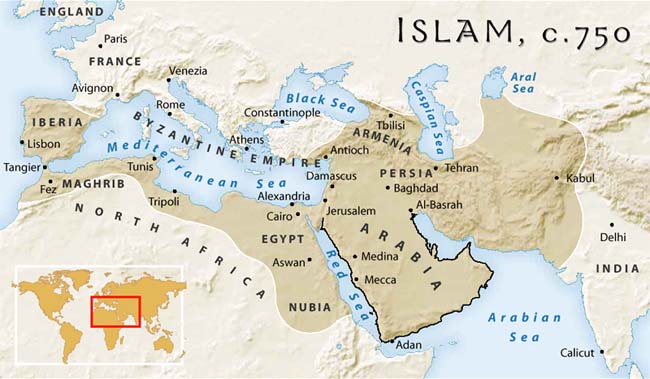
One indirect cause surely was the rise of Moslem power from 630-750 A.D.  From modest beginnings in Arabia, they quickly grabbed the near entirety of the mid-east, along with North Africa and Spain.

But the Crusades do not begin until the late 11th century, so the growth of Islam cannot be the main proximate cause.  Some suggest that around 1050 AD a new breed of tough warrior Moslems called Seljuks caused great alarm in the west.

Moslems had also taken territory from the Byzantine empire, composed largely of Orthodox Christians.  Their appeal to the west for help opened the door not only to political reconciliation, but also reconciling of eastern and western churches, a tempting prospect.

The rise of the power of the state also contributed.  Before mid 11th century, the state generally was weak vis a vis the hold of Church on society.  With the overall stability of the civilization by 1050 came the rise of more powerful monarchs who could control more and more the lives of the warrior caste. Pope Gregory VII, for example, raised his own army of “holy warriors” to combat the rising power and threat of Henry IV.  Since fighting and violence is not in itself wrong, the Church sought to “Christianize” or refine it in the lives of Europe’s warrior caste.

All this of course, does not answer the question of whether or not the Crusades were a good idea, from either a purely military or Biblical perspective.  Even today the Crusades raise important questions:

  • Can violence be used in the name of Christ to achieve ‘holy’ ends?  If we think in Augustinian terms, can violence be part of the ‘City of God?’  Or, can the ‘City of God’ borrow from the ‘City of Man’ without being tarnished?   Can one kill others for God and His Church?  If so, how does this fit within the Christian ethic of loving our neighbors?  If not, is being a soldier wrong for a Christian?  Nearly the whole history of the Church would say ‘no’ to this question.  If a soldier cannot kill ‘for God,’ then for whom should he kill?  How can we know whether or not one truly fights for God?
  • In what sense should the Crusade be thought of in practical terms, and in what sense should the idea of a ‘leap of faith’ enter the picture?
  • Why did the Crusades not result in the reunion of East and West, as many hoped?  What impact did they have on the future of East/West relations?

All in all, the Crusades raise important and profound questions for us today.  At certain times the Crusades have been romanticized.  Today for some the Crusades are the ultimate example of religious bigotry.  Of course, the Mideast has its own remembrance of the Crusades which we do well to consider.

We will delve more into these questions next week.

Blessings,

Dave

11th/12th Grade: Stravinsky and the Victorians

Greetings,
This week we wrapped up our look at the Progressive/Victorian Era.  I wanted to look at things in a little different way, by asking if there are there any possible links between Darwinism and Victorian morality.  Victorians devoted themselves to duty, both to country and family.  But as many have noted, Victorian morality was ‘defensive’ in nature.  That is, it focused on protecting themselves from outside forces. This is reflected by the segregation of Europeans from other natives in the imperialized countries, among other things. This is not a Christian concept because love is ‘positive’ in nature and should push us out of ourselves.  We see this ‘defensive’ attitude in their fashion:
Womens’ dress reflected  this idea of protection and isolation.  Darwinism says that we are little different from the animals, thus, we need protected from the ‘animal’ instincts just below the surface.  As some students commented, the women are not allowed to look like women at all.  Does modesty require a denial of femininity in general?  Men’s fashion does not change nearly as much as women’s, but even the men seemed quite buttoned up in their multi-piece suits:
Queen Victoria herself set the tone by projecting soberness and duty:
As we discussed in class, ‘modesty’ does not mean denying one’s femininity.  I would even argue that Victorian fashion projected the idea that they needed to protect themselves from themselves as well as the world.
Can patriotism become a religion in its own right?  Arnold Toynbee remarked that the ‘victory’ of science over Christianity proved disastrous.  It did not and could not eliminate religion.  Rather, it turned people from a ‘higher’ religion to the ‘lower’ pagan religions.  Toynbee writes further about the turn of the 20th century,
‘The most serious symptom was that, professedly Christian countries . . . .were by this time, practicing the primitive pagan worship of the bee-hive by the bee and ant-heap by the ant.  This idolatry was not redeemed by being concealed under the fine name of patriotism’ (Study of History, vol. 7b).
Along these lines, we discussed briefly Stravinsky’s (very likely a Christian) premiere of his ‘Rite of Spring’ in 1913. which was meant to depict pagan ritual.  Shocked and horrified people nearly rioted at performances.  Did they do so because Stravinsky destroyed traditional artistic conventions of what music and dance should be, or because the he held up a mirror to a society that refused to see themselves for what they were (or perhaps both)?  We watched this clip in class:
All religion involves sacrifice.  If God was no longer present to sacrifice Himself, if man robbed the Crucifixion of its reality and power, would the sacrifice have to come from within the community?  If so, would this help explain the advent of the cataclysmic conflicts in the west during the first half of the 20th century?  It might also help explain the not often discussed dark underbelly of the Progressive/Victorian Era, the rise of eugenics.  My personal take is that Stravinsky was trying to unmask the very carefully cultivated civilized veneer of European society.  I think they thought of themselves this way, with Strauss’s famous, ‘Blue Danube’ waltz.
Dave Mathwin