Nothing quite says “hip” like a corporate cruise ship. For those like myself whose musical tastes in the 1980’s went towards the progressive rock of the 70’s, well, one could punch no faster ticket to the top of the high school social scene than to wear a shirt from Yes’ “Tales of Topographic Oceans” tour. What if one combined these Wonder-Twin powers and had a cruise dedicated to all of the bands that broke up 30 years ago? What if one could combine a non-stop buffet with non-stop mellotrons and Moogs?
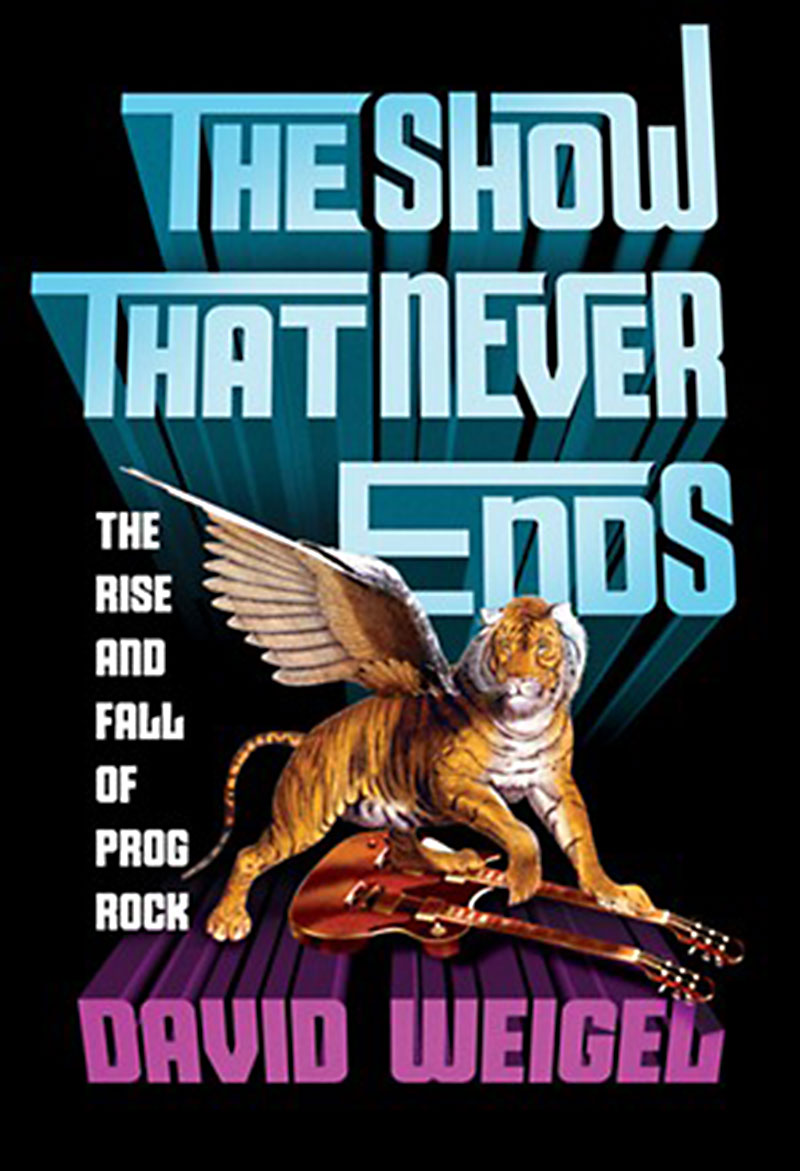
Such is the starting premise for Dave Weigel’s amusing The Show that Never Ends: The Rise and Fall of Prog Rock. Such a cruise actually happened. Weigel booked his passage, and started interviewing. His book quickly gets into the history of various bands and the genre as a whole. Weigel writes as a fan and as a journalist, so he gives the reader many nuggets of the brilliance and pretentious stupidity of most every band featured.*
The stories of King Crimson, Yes, Genesis, ELP (the bands Weigel focuses on) have their particularities of course, but the similarities of their narrative arc struck me the most. These similarities manifest themselves despite the significant differences in the music of the groups above. Basically their stories boil down to
- Band creates a brilliant, groundbreaking sound that wins them critical praise and popularity.
- Band then begins shortly thereafter to experience significant interpersonal tension, and often, radical turnover in its members.
- Bands then get second lives of sorts by completely embracing 80’s pop conventions, entirely altering their sound (King Crimson avoided this final step probably because they had decisively broken up by the time the 80’s came).
I am not saying that any of this is “wrong,” per se. Culture changes, people change, I get it. But the changes were very stark, rapid, and essentially uniform.
- Emerson, Lake and Palmer go from Tarkus to this.
- Yes goes from Tales of Topographic Oceans to this.
- Rush opens their Hemispheres album in 1978 with an 18 minute suite (about the conflict between reason and emotion, with the section between 1:58-2:45 among their very best vignettes), and then four years later this is their biggest hit.
An argument about whether such changes were good, bad, or indifferent has merit, but the full abandonment of one ethos for another is notable in itself.
Genesis combined significant musical change and strong commercial success in both the progressive and pop incarnations more than any other band. I had no real knowledge of their output in the 1970’s before this book. In the 1970’s Phil Collins’ drumming is magnificent–inventive, swirling, yet powerful as well, as he demonstrates on “Down and Out” from 1978.
Even in 1980 Genesis showed strong ties to the progressive scene on their opening track for Duke, “Behind the Lines.”
Just three years later, we have an entire reboot of the band.
And, while I am scrupulously avoiding value judgments here, no one can forget the absolute horror of Invisible Touch from 1986. Genesis had completely transformed, leaving them with nothing left to declare, except “I Can’t Dance.”**
The band Rush created the catalog I most admired between 1975-1982. I practically made altars to them in high school, and so when I discovered their transition to pop with the mid-late 80’s releases, I had a hard time adjusting and still feel conflicted. I heard interviews from the band explaining the change and they said things like
- We don’t want to do 20 minute songs in 17/16 time for the rest of our lives (wise and fair, but does that mean you want to do 4 minute songs in 4/4 time for the rest of your lives?).
- We’ve never listened to the critics.
- We’ll always be our own entity, marching to our own drummer
- We’ll always follow our own muse, and the music we make comes from that muse within.
Ok, fine. Every band says stuff like that. But how is it then, that all these prog bands, while “listening to the muse from within” and being completely “their own individualized creative team,” all end up in the same place, chucking progressive conventions and embracing those of pop? How did it all end so quickly, and all end in the same place?
Some might say that no one could possibly recover from Spinal Tap’s unmasking of the whole progressive genre:
Others suggest that the corporatization of record companies explains the shift. In the “golden age,” bands could be signed and allowed to develop over time. Now, hits had to be churned out more regularly, and this meant the need for more immediately radio friendly material.
We can acknowledge that record companies want to sell records. This explanation might have some merit, but it ignores the fact that bands like Yes, Genesis, ELP, Jethro Tull, and so on all sold millions of albums as progressive acts in the 1970’s. “Selling records” doesn’t answer the question. Others might point to the music press, which gushed over prog rock in 1970 and uniformly despised it by 1978. Of course, all of these bands talked about following their own path, never listening to the critics. But even if they in fact tacked towards the critics, what led the critics to all suddenly change their mind?
Tocqueville has a great deal to say about the individualism in democracies, and how everyone tends think they are their own man, while at the same time following the general mass, but this cannot explain how the general mass decides to like or not like something.
Others might point to shifts in the culture that happen every 10 years or so, that everyone participates in. These shifts happen in politics, fashion, automobile design (i.e., remember SUV’s?) so they happen in music as well. This has the merit of putting music within a larger context. But at the same time, it lacks specificity. And, it still begs the question of why cultures shift so rapidly. How does that happen? If we think of prog rock as a civilization of sorts on a small scale, it would be akin to punk rockers becoming bank clerks within a few years, or if the Greeks chucked their Homer and embraced contemplative mysticism minutes of each other.

If one looks at any ancient or pre-modern civilization, one notices a clear orientation and direction that lasts for hundreds and sometimes thousands of years. Mario Baghos terms this orientation as an “Axis Mundi,” an intersectional point that encompasses death, life on earth, and heaven above. His From the Ancient Near East to Christian Byzantium: Kings, Symbols, and Cities explores the axis mundi’s of Sumeria, Egypt, Babylon, Greece, Rome, and then looks at early Christian Rome and Byzantium.
Baghos’ terms, such as Axis Mundi, and “Ecosystem Agent” need some fleshing out to understand his point. We start with a pyramid text from Pharaoh Pepi I, ca. 2300 B.C.:
Look, Osiris is come as Orion, the lord wine-colored with goods. Live! Live, as the gods have commanded you, live. With Orion in the eastern arm of the sky shall you go down. Sothis is the one who will lead you in the Marsh of Reeds to the perfect paths in the sky.
In this brief vignette we have
- What is above (Orion, as god and constellation–likely one and the same in their mind)
- What is below (the marsh of reeds), which completes the vertical axis, and
- The horizontal axis, with the reference to the path of the sun
The Greeks had similar patterns of thought, as exemplified by their writings on the oracle of Delphi, of which Strabo below is an example.
Now although the greatest share of honor was paid to theis temple because of its oracle, since of all the oracles in the world it had the repute of being the most truthful, yet the position of the place added something. For it is almost in the center of Greece as a whole, and it was also believed to be in the center of the inhabited world, and people called it the navel of the earth. In addition there is the myth, told by Pindar, the the two eagles (though some say crows) which had been set free by Zeus met there, one coming from the west, and the other from the east. There is also a kind of navel to be seen in the temple, and on it are the two likenesses of the birds of the myth.
Again, we have the idea a center point, and an intersection horizontally between east and west. Other stories have the origins of Delphi associated with Apollo becoming a dolphin and swimming to this point, which gives us a vertical axis of above (Apollo) and below (the water and sea creature), as well as a lexical history (dolphin, Delphi).
Rome focused more on earthy practicality than either Egypt or Greece, and this shows in some of their Axis Mundi descriptions. First, with Romulus and the inauguration of the Comititium:
. . . within which were deposited first fruits of all things the use of which sanctioned by custom as good and by nature as necessary; and every man brought a small portion of the soil of his native land and were cast in among the first fruits and mingled with them. They call this trench, as they do the heavens, by the name of “mundus.” Then, with this as the center, they marked out the city in a circle around it.
And–from Plutarch’s life of Numa Pompilius, regarding the Temple of Vesta:
Numa Pompilius built the temple of the Vesta where the perpetual fire was kept, of a circular form, not in imitation of the shape of the earth, believing Vesta to be the earth, but of the entire universe, at the center of which the Pythagoreans place the element of fire, and call it Vesta. And, they hold that the earth is neither motionless nor situated in the center of surrounding space, but that it revolves in a circle around the central fire . . .
Rome’s difference with previous civilizations comes out in that we see less direct reference to what is above (which we see most strongly in Egypt). But we have references to circles in both texts, the shape of eternity, and fire in the second, an “airy” substance (with the Vestal fire being possibly the most important place in Rome). We see a reference to “under the earth” with the trench and the soil as the “earth.” And though Rome undeniably thought more about earth than the heavens, we note the crucial role played by augurs–those who observed birds–in the whole of their society.
Baghos shows that early Christian culture in both and east and west grew with a similar understanding. Many medieval towns formed because of the acts of various saints in a particular place, usually involving their martyrdom. These saints descend in death, then ascend through the power of God, then descend again, by God’s leave, in the form of their relics, of which thousands of examples exist of miracles wrought through them. Churches would then get built on/near their grave, and towns would form around these churches. Each church in each locale formed its own Axis Mundi.
The concept of “Ecosystem Agent” also factors into Baghos’ analysis. An “Ecosystem Agent” functioned in many ancient civilizations as a focal point in the flesh of the civilization’s Axis Mundi. Such people were almost always kings in the ancient world. In Egypt, the Pharaoh literally was a god, in Babylon and elsewhere, the king may not have been divine himself, but functioned as the first touchpoint between the gods and his people. Numerous sources show that at the beginnings of civilizations, kingship had a priestly function, and may have even began specifically as a priestly, not a political office. Greeks of the classical era, and Romans under the Republic may not have shared entirely in this, as they had no kings. But we could say that they spread out their Ecosystem Agent functions to different offices, with the parts making a whole. During the Roman Empire, emperors served in this function, as the words of Munantius Plaucus (87-15 B.C.) show regarding Augustus:
The founding of Rome under Augustus is more honorable [than that of Romulus], inasmuch as sacred places too, and those in which anything is consecrated by augural rites are called “august” (augusta) from the increase (auctus) of dignity . . . as Ennius also shows when he writes, “After by augury august illustrious Rome had been founded.
In other words, Romulus founded the city by observing birds, and that’s great and all, but Augustus remakes Rome with his own person.
As Christian culture developed, we see both continuity and a decisive break from the past. On the one hand, Christ’s kingdom “is not of this world” and we should never try to make it so. On the other, Christ comes not just to save our souls, but our bodies, and all of creation. Everything gets eventually remade because of Him. We, as His servants, need to cooperate with this union of Heaven and Earth that He inaugurated in His Incarnation. Baghos writes,
In relation to the Logos’ transcendent governance of the cosmos, we can discern a distinct difference with ancient cultures. But the model is not rejected, but transformed and at times flipped. For example, many ancients viewed the celestial realm as immutable, and so disturbances in the heavens often heralded death for kings. This paradigm is inverted in Matthew’s gospel, in which the appearance of the strange star announces the birth of the true king.
St. Ignatius of Antioch [early 2nd century] in his Epistle to the Ephesians sees “the Church and Cosmos worshiping symphonically together. The 2nd century apologist St. Clement of Alexandria transfers the mythological metaphor of Orpheus’ songs as reshaping the cosmos, to the “celestial Logos, who sings the foundational principles throughout creation.”
St. Irenaeus [mid 2nd century] relates the content of this teaching to Christ as “the Word, the Maker of All, . . . who has manifested Himself to men, giving His gospel under four aspects, but bound together by one Spirit. He comes to this conclusion after a discussion on why there are four Gospels. Since the number four “is wholly even” and thus represents equality and stability, there can be only four gospels that mirror cosmic stability.
Here Baghos quotes Irenaeus who writes,
Since there are four zones of the world in which we live and four principal winds, while the Church is scattered throughout all the world, and the “pillar and ground” of the Church is Gospel and the spirit of life, it is fitting that she [the Church] should have four pillars, breathing out immortality on every side, and making men alive.
The spiritual and the physical connect and mirror each other at every point. But Christ Himself is the Axis Mundi, and the Ecosystem agent, though saints, kings, priests, and the ordinary man may perform some of those functions, in a limited way, as God’s viceroys.
This historical and theological event had significant implications for culture.
The older pre-Christian model had a great deal of stability, but it bound people to a kind of earthly absolutism. Christianity freed people to be anywhere, but . . . without being nowhere. The difference matters. The early Christian/medieval model meant that since Epiphany at least, the entire cosmos was sacred. But, the union of heaven and earth “needs” the participation, in a sense, of Christ’s body to make it manifest. And, since unity and diversity are present in Godhead Himself, the particularity of places and people should be preserved as well as the unity of all. Hence, the formation of lots of localisms throughout the pre-modern world, the kind of associations that Tocqueville thought essential to maintaining democracy.
The problem came between the years 1400-1700, when people decided that they could dispense with all earthly incarnations of the sacred and just look to “Providence” from above. This in turn gave rise to ideas of universality of rights, of ideas, and so on. I don’t say that this was bad in itself–it helped create America, obviously. But it means that if a thing can be everywhere it can also be nowhere. Culture will be more ubiquitous, and less stable and impactful.
All this means that Prog music, a byproduct of the cultural upheaval of the late 60’s, could not, and perhaps should not have lasted long. It used trappings of classical European culture sometimes with love, but also to subvert. Such is the nature of chaos. It comes and goes.
There are those who say that we moderns have abandoned all of that sacred stuff that ancients and medievals obsessed over, and now have built our civilization around interest, economics, and the like. Some praise such a development. Others declare secularization the source of our woes. Those like myself, however, believe that having a civilization without an Axis Mundi and Ecosystem Agents cannot really happen. We have them, of that I’m sure. As to what or where they are, the answer, my friend, may be blowing in the wind.
Dave
*My favorite such nugget may be the dispute between drummer Bill Bruford and lyricist/frontman Jon Anderson of Yes. Bruford could stand Anderson’s meandering, abstruse lyrics no more. “What is this rubbish, this ‘Total Mass Retain?’ What does it mean? How we can we put this kind of song out?” Anderson retorted that, how could he [Bruford] not understand that, “My lyrics take the form of colors, of pastiches of colors.”
I mean, really.
Bruford ended up leaving the band. The parting seemed somewhat mutual, however.
I played drums growing up so naturally my sympathies go to Bruford on this one. But my wife pointed out that Anderson may have been pompous, by Bruford was being a fool. “You say that Yes has just released what many consider to be the greatest progressive rock album ever, and Bruford is their drummer. He is living the dream, and leaves because he doesn’t understand the lyrics?”
She has a point. Ringo, after all, stuck around after “I am the Walrus.”
Such are the pitfalls of art.
**Yes, I find Invisible Touch impossible to listen to, but I do not think that prog=good, pop=bad. I would take Yes’ 90125 over their Topographic Oceans and Relayer albums every time. Genesis’ “No Reply at All,” and “Just a Job to Do,” stand far above over lots of what they did with Peter Gabriel back in the day.
As to the volatility of the membership of most all of these bands, I speculate that
- A great prog song is better than a great pop song in the way that a perfectly made French pastry is better than an ordinary piece of toast with butter.
- But . . . while the impact is deeper with the French pastry, the vein is narrower. It requires perfect mixing and perfect timing. Otherwise, the pastry gets ruined.
- Toast, on the other hand, is always good more or less. It is easy to make–it has a very broad appeal, but obviously has much less deep penetration.
- Prog bands are like French pastries, they have to be perfectly balanced to work well, and thus, can easily go wrong. They are volatile constructions. The only prog band that really made it long-term was Rush, who had a perfectly balanced sound between the three, and very well defined roles for constructing the music (Peart with lyrics, Lee and Lifeson with the music).
 A Stick in the Mud