Festivals of the French Revolution

The modern west, and certainly the United States, has a weird relationship with sports.  Many reasons exist for this, including the fact that sports involve great skill and entertain us.  One key to their hold on us, however, certainly involves the fact that our culture has no communal rituals and emotions.  Politics remains too divisive and negative to provide this.  Democracy tends to prioritize individual vis a vis the group.  Most forms of American Protestantism have no liturgies and no “physicality” to provide the necessary framework for shared experiences.  Sporting events can provide this.  Many fans have pre-game routines, rituals, dress–“liturgies,” in effect.  These routines come with the eating of certain foods, and so on.

All this to say, sports functions much more like a religion than many of our churches–at least in terms of visible manifestations.  Perhaps too, this explains the growth of round-the-clock, all year coverage of seasonal sports.  Our need for communal “religious” experience overpowers even our well-founded moral concerns about certain sports such as football.

Because non-liturgical Protestants formed the ethos of America many of us have little experience with religious communal celebrations.  Often they involve parades, food, music, and a physical embodiment of a particular belief or historical event.  Below, for example, is footage from the festival on the Greek island of Cephalonia, where the relics of St. Gerasimos reside.  On the saint’s feast day, one such embodiment happens when the body of St. Gerasimos “passes over” the town.

The French Revolution sought to transform all of French society.  To do so, the revolutionary leaders recognized that they needed to eliminate Catholicism from the hearts and minds of the people–easier said then done.  The church dictated the calendar and its rhythms, with a proliferation of festivals.  These festivals formed the habits, which formed the hearts, of the French.

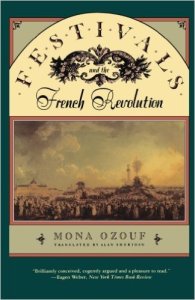
They needed new festivals to replace the traditional Catholic celebrations.  Mona Azouf takes up this oft-neglected topic in her book, Festivals of the French Revolution.  
I believe Jaroslav Pelikan made the observation that Christian feasts all celebrate events that happened in observable time.  We celebrate the Incarnation, resurrection, and ascension of Christ.  We have days for remembering the Mother of God and saints of whose lives we have a record.  The only obvious exception to this is Trinity Sunday.  But the Trinitarian nature of God is not an abstract concept, but the concrete–though also mysterious–reality of the Universe.  Celebrations of actual things can have a “natural” atmosphere about them.

We can envision a joyous party for a team when they win the championship.  But what about a team that, during the season itself, had a banquet to celebrate “Victory”?  Things might get awkward quickly.

This challenge confronted France’s revolutionary leadership.  If they wanted wholesale change, then everything old would have to go.  They eliminated a great deal of the previous political leadership.  They transformed the military.  They killed or exiled many recalcitrant aristocrats.  They went farther than almost any other revolutionary group I know of and literally changed the calendar.  They understood that the Gregorian calendar, despite its mainly pagan roots, had been thoroughly Christianized and formed the unconscious rhythms of daily French life.  Some argued that the new France needed no celebrations.  Now that they had banished oppression, each day would have a moderate and joyous character.  But eventually even the die-hards realized that they needed to give the people holy-days (i.e. holidays) to create a new national liturgy.

The festivals for the new calendar attempted to change the concept of time.  They also attempted to alter the concept of space.  Most old Catholic festivals took place in the town near the church.  This meant that the majority of events happened within view of the cathedrals (always the tallest buildings) and in the town streets.  Of course having the church building silently governing the festival would not do.  But the narrow streets and the inevitable buying and selling of goods in the market, conjured up thoughts of secrecy, narrowness, “feudal conspiracy,” and the like.  Festivals of the Revolution often took place in wide fields away from towns and cities.  There they could escape the church building, and the open fields also aided their ideology of equality.  In addition the French Revolution’s obsession with “Nature” had its role to play.  Everything seems new and promising in a lush meadow at springtime.

So far so good.  Here is one contemporary description of the “Festival of Liberty:”

The procession began late, around noon; it was not that the people were made to wait, as by despots at court festivals.  The people turned up at daybreak in large numbers . . . but all waited until all had arrived.  They took pleasure in each other’s company; nonetheless it was time to leave.

On the site of the Bastille an inauguration of the Statue of Liberty was held.  Here more gathered, and it should be noted, they were favored with perfect weather.

There was no excess of pomp; no gold dazzled the eye or insulted the citizens’ humble and honorable poverty.  No soldiers dripping with braid came to cast a condescending eye on the poorly dressed crowd as they passed.  Here actors and witnesses merged, each taking part in the procession.  They had little order but a good deal accord with one another.  No one indulged in the vanity of the haughty gaze, no one set out to be a spectacle.  Boredom, that son of uniformity, found no foothold among the various groups; at each step the scene changed–everyone wanted a part in the Festival of Liberty.

The festival banished luxury, but notable commemorative objects had their role.  The procession opened with the Declaration of the Rights of Man, written on two stone tablets such as the 10 Commandments, though that is no match for the Declaration.  Four citizens proudly carried this noble burden, each reading aloud those immeasurable first lines: “Men are born free and remain free and equal.”

Four busts followed in like manner.  “Ah, there is Voltaire, that old rascal who made us laugh so much at the priests.  That other, worried looking individual [Roussaeu] loved the nobles even less and never sought their favor.  Who is the third?  It is an Englishman, Sydney, who put his head on the block rather than bend a knee to a king.  That old man there, we know him well.  It is Franklin, who can be more rightly called the Liberator of the New World than a certain fop who lives not far from here [i.e. Louis XVI].

The two coffins that followed threw a somber coloring over events as we remembered the martyrs of the massacre at Nancy [some soldiers refused to obey their royalist leaning officers and were shot].  

Preceded by their chains, suspended from trophies and born aloft by young ladies dressed in white, marched our loyal soldiers [loyal to the Revolution that is], with several regular citizen volunteers.  They in turn preceded the Chariot of Liberty, which used the same wheels as the chariot that served for the enshrinement of Voltaire at the Palace of Reason.  Let us not forget that philosophy gave us Liberty.

The chariot, modeled on the antique, was of imposing construction.  On one side David sketched the story of Brutus the Elder of Rome, himself sentencing his royalist sons to death for their disobedience to the law.  On the other he depicted William Tell, aiming a javelin, the target of which was an apple on his own son’s head.  But at his feet we spy another javelin, one that gave independence to Switzerland by slaying the Governor of Austria.  The Lady of Liberty rests on her throne, her hand at her side holding a club, with a gaze that would make king’s blush.   We should never forget that the sceptre of liberty is a bludgeon to her enemies.  It should also be said that six daggers formed the prow of the front of the chariot to threaten any despotism bold enough to impede the march of liberty.

With steady steps 20 democratic horses drew the chariot of the sovereign of the French people.  Their progress had none of the insolence of those idle coursers fed at the stables in Versailles.  They did not hold their heads high; their manes had no gold plait, nor were there plumes adorned.  They walked rather ploddingly, but they kept a steady course.  

Four hundred thousand citizens came to one spot with nary a mishap.  The soldiers on foot had no need to mark the route, none had need to go before the crowds with bayonettes to make way.  Words of peace contained this multitude, it fell into line at the sight of an ear of corn presented to it rather than a musket.

Even a breezy reading of this account reveals that the new foundation was not close to drying.

How do celebrate with the threat of force lingering?  We know of the many imprisonments and beheadings in general, but even here, “Lady Liberty” holds a club. Brutus kills his sons.  The chariot has daggers in the front, and so on. I have some sympathy . . . the only way to completely turn your country 180 degrees is by wrenching the wheel and holding on for dear life.  The question, remains, however . . . how much can you celebrate when you have the sword of Damocles hanging over your head?

A big difference exists between saying, “Everybody dance now!” and, “Everybody dance now.

No particular rhyme or reason exists for how the festival looks and proceeds.  Certain decisions will have to be arbitrary on some level of course.  Perhaps we understand, for example, that “democratic horses” would move “ploddingly” at a “steady” pace. But what if the choreographer had the horses hold their heads high and gallop down the causeway to show the “energy of liberty”?  Would that have been “democratic”. . . or “aristocratic?”

Many such confusions and differences in perception led to imprisonments and even death during the Reign of Terror.

Ultimately Azouf argues that the festivals served not as an emblem of the Revolution’s success but it’s failure.  One cannot invent out of thin air an embodiment of abstract ideals and expect everyone to go along with it.  Azouf herself comments that the revolution in general, and the festivals in particular, represented France’s attempt to reject the entirety of their history–tantamount to rejection of their very selves.  No one can sustain such efforts for long.

And yet . . . while the king eventually came back to France it did not take long to banish him again.  The cultural victory of the French Revolution’s de-sacralization campaign (which, as Azouf points out, involved “sacralizing” different values) took a long time, but France’s subsequent history shows that the revolutionaries won the political battle.

We too have a similar inheritance as the French, having undergone our own radical break from the past at much the same time.  We in time developed some national festivals (the World Series, the Super Bowl, the 4th of July, Thanksgiving, etc.).  Time will tell whether or not this age of atomized individualism will wash those away.  If so, Azouf’s work testifies to the fact that at our core we need such celebrations, and even atomized individuals will find a way to create new festivals.


“The Sword and the Olive”

The modern history of Israel poses many questions, their 65 years lived at breakneck speed have given us many lessons.  But the questions about their state, the Palestinians, their neighbors, and so on are enormously complex.  Some historians seek to tackle all aspects of the problem but books of that nature can often be too long, heavy on details, weak on conclusions, leaving readers with no clear answers and no path to discover them on their own.

With problems of this sort, I tend to think that books that focus on one particular aspect of the issues often serve readers better than all-encompassing tomes.  The narrowness of focus makes no pretense to answer every question, but it can provide a clear narrative arc, and thus give definite shape to at least some of the puzzle pieces. Martin van Creveld’s The Sword and the Olive fulfills this purpose, much like Byron Farwell’s The Armies of the Raj.  Creveld does not tackle the broader “should” questions (i.e. should Israel have been given ‘x’ land, should they occupy the West Bank, etc.), but traces the effects of various decisions nicely in this history of the Israeli army.

While various militarized Zionist groups long predated W.W. II, the Israeli army takes as its main starting point the formation of the state.  Early on Creveld introduces one of his main themes, that the trauma of the Holocaust created a moral weight to the Jewish cause.  This in turn formed a social cohesion that enabled an army to achieve near mythical status within a few short years.  Creveld lives in Israel and I assume is Jewish himself, but he attempts no sugarcoating of either Jews, Palestinians, or Arabs.   His seeks to show, however, that whatever the strength of Palestinian claims, the Jews simply had stronger ones in the immediate context of the post-war years.  When Palestine lingered under lame-duck British authority thousands of Jewish immigrants poured illegally into Palestine and settled beyond established boundaries.  These illegal settlements received protection from Jewish militias.  The British discovered that sometimes the strong must suffer the actions of the weak.  How could the British enforce their authority and detain/fire upon people with numbered tattoos on their arms from Auschwitz in 1947?   Every British “victory” over Jewish militias only made their position more and more untenable.

The story of the “War for Independence” in 1948 had a similar theme.  Palestinians outnumbered Jews but tended to spread out in rural areas, whereas Jews settled in mostly urban areas and therefore had a more formal political structure.  The countries that attacked Israel shared few common goals and even had some conflicting ones.  The psychological sense of mission and purpose gave Israel a great army.  As Napoleon remarked, “In war the moral is to the physical as three is to one.”

Israel was a democracy in many ways, but their initial victory helped lead to some generally non-democratic ideas.

  • Democracies at least like to think of themselves as defensive in nature, and so did Israel.  But the nature of their geography led to a sense of being continually under siege.  In war, they developed a “strike-first” mentality — war must always be fought on the enemies territory.  They would have ironically agreed with the Prussian Frederick the Great’s motto of “Audacity, audacity, and still more audacity!”  Even more ironically, this led Israel to develop tactics that strongly resembled the blitzkrieg of 1939-41.
  • As Tocqueville noted, most democracies have a generally ambivalent attitude toward the army, but not Israel.  After 1948, and especially after 1967, the army had near god-like status within the state.  This led to a political structure where the army had very little official civilian oversight, and even less in practical terms.
  • The sense of unity had to do with their circumstances, but also perhaps due to the settling of Israel by many eastern-European Jews with socialist leanings.  In any case, Israel quickly developed strong censorship laws with anything to do with security.  They deemed this necessary given that they felt alone not only where they stood geographically, but also in the international arena.  The Holocaust showed that the world would abandon Jews if it suited them.  The media helped develop these laws.  But democracies are also open societies, so usually censors had the job of keeping Israeli’s ignorant of what everyone else around the world knew.

Some of these contradictions would have to work themselves out at some point.

The psychological and moral factors of the post-war years created a juggernaut military with sky high morale.  But Israel’s very success would help to change this dynamic.  Occupying more territory meant the need to increase the size of the army.  This in turn meant more recruits, and the social cohesion that once characterized the army — an army where everyone knew everyone else — began to erode.  An army with a civilian-militia ethos turned professional.  Israel condensed about 200 years of Roman history (ca. 202-27 B.C.) into about 20 of their own.

Israel soon developed a much stronger military than their neighbors, but they kept their siege mentality.  This meant that when they engaged the PLO in the 1970’s, and especially in Lebanon in the early 1980’s, that the strong/weak dynamic that had served them so well psychologically had now flipped against them.  They were now strong and secure, their enemies had “weakness” on their side.  The “us against the world” attitude that served them so well now fought against them.  Now Israel faced an identity crisis.  What would they do with success?  Bold, aggressive, and occasional “outside the lines” actions could be tolerated and even expected when “fighting for one’s life.”  But they did not get the same pass under these new circumstances.  No one thought that PLO hideouts within Lebanon posed anything more than a nuisance to the state.  As Creveld commented, the strong should never fight the weak for very long.  Lao-Tsu noted similarly that a sword thrust into sea-water turns to rust.

The unquestioning public support that the military enjoyed for so many years now eroded, and this led to erosion within the army itself.  Their war in Lebanon had far fewer casualties and far less real fighting than their previous wars, but the number of psychological maladies effecting soldiers skyrocketed, as did the number of civilians who refused to serve, or found medical exemptions for their service.  The power of the government to investigate the military increased, albeit only slightly.  Certainly soldiers no longer wore their uniforms off-duty, as once was common.

The Israeli army today still maintains a high level of professional competence and tactical superiority over its neighbors, but they unquestionably lost something of the “soul” of their army.  And because Israel made the army such a integral part of their identity, something in Israel itself has no doubt been lost as well.  What Vietnam was for us, Lebanon was for them.  If our experience proves any kind of mirror, they can recover some of what they lost, but Israel will not be able to go home again.  The golden age of the Israeli military has come and gone.

9th/10th Grade: The Gods Athirst

Greetings,

This week we continued to look at the French Revolution through a few different events.

As I mentioned last week, how the French defined the “people” of France would be crucial to how the revolution itself would take shape.  I asked the students how they would define who the “people” of America would be, and I got the following responses:

  • Anyone who lives here (but does this also include illegal immigrants, or people here legally on visas, green cards, etc.?)
  • Anyone who is a citizen (but would this include those who live here legally but are not citizens?)
  • Anyone who “believes” in American values and our way of life (but would this mean that someone living in Sweden could be part of the “people,” and would it exclude a citizen who did not believe in the American way?

The concept is obviously hard to define even for us, with a settled way of life and political traditions.  Imagine how much harder, then, it would be to define “the people” in the midst of internal upheaval and the threat of foreign invasion.  We sparked a good debate when I proposed the following scenario:

Imagine that America has undergone a major political revolution.  We have replaced our form of government with a divine-right monarchy that holds power tenuously throughout the country.  Of course, there are many who object to these changes and wish to see a return of the old ways.

Now suppose that China has decided to invade America with the express purpose of restoring the constitution and the president ousted by the revolution that replaced him with a king.  We can further suppose that the ex-president had good relations with China and the current king wants to alter all of our trade agreements with them.  Many oppose the invasion out of a sense of patriotism and/or loyalty to the Revolution, but many others hope for a Chinese victory and a restoration of the Constitution.

Which group would be more “American?”  The group that wanted to defeat China, or the group that hoped for a Chinese victory over American forces?

The question carries enormous weight, for only “the people” of France will get the rights due to the French people.

With this in mind, we can look at two key events.

1. The Storming of the Royal Residence: August 10, 1792

One of the keys to kingship working is the perceived mystical distance between the king and other men.  No one makes a king, kings are born.  He does not chose his life, God chooses him to rule by virtue of his birth.  As a man, a king is no different from anyone, but as king he takes on a different identity.

Royalty has always sought to maintain this distance through their dress, their manners, their homes, and so on.

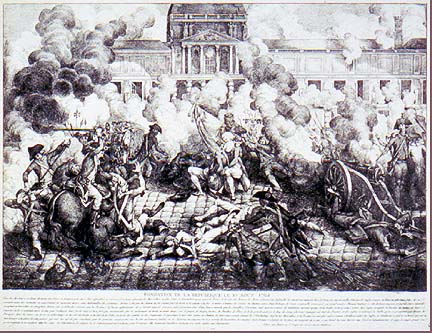
At the start of the revolution many still wanted a strong king in France.  As the revolution progressed most slowly abandoned tat idea until Louis’ very existence threatened the revolution itself.  Finally on August 10 a mob stormed the palace, brutally slew many of the guards and servants, and might have done the same to Louis and Marie had they not escaped.  In one act, the people eradicated the perceived distance between the monarchy and themselves.  Louis had no power left.

2. The September Massacres, 1792

The events of August 10 did not cause the Austrians and Prussians to invade France all by itself, but it did propel those armies to greater alacrity in their attempt to restore Louis’ power.  As the armies moved closer to France, many feared that prisons in France (which contained ‘counter-revolutionaries’ after all) would be liberated to serve as “5th Column” to aid the foreign invasion.

From September 2-5 mobs went to various prisons, monasteries, and convents in France systematically butchering most of those inside.  The death of Marie Antoinette’ friend Princess Lamballe exemplifies France’s descent into paganism.  They cut off her head and paraded it in front of Marie’s prison window.  Then, according some accounts, they also cut out her heart and ate it.

3. The Death of Marat

Jean-Paul Marat failed at most things in life before he came to edit the tabloid “The Friend of the People.”  More than others he celebrated and encouraged the violence of the revolution, at one point calling for the deaths of hundreds of thousands of the “enemies of the people.”  A young woman named Charlotte Corday believed in the Revolution but also thought Marat a tyrant.  She gained access to him and plunged a knife into his chest.

Corday hoped that Marat’s death would quell violence, but tragically it had the opposite effect.  She hoped to end tyranny, but created a martyr.  It also served to confirm the paranoia of many other revolutionary leaders.  Who could you trust?  Corday posed as a revolutionary, but struck against it.  Anyone, in fact, could secretly be an enemy.  Marat’s death did not create the Reign of Terror, but it did help contribute to it.

If you have interest, Simon Schama has an excellent treatment of David’s famous painting of Marat’s death below.

One of the ways in which they attempted to smoke-out counter-revolutionaries was through the then equivalent of a modern day block party.  Usually attendance at such gatherings was mandatory, for they meant to celebrate the revolutionary oneness of the people.  It sounds harmless enough, but these “parties” terrified many.  You had to be careful not to stand out in the crowd.  The government had proclaimed the need to strike out against “fanaticism” and “moderation.”  If you showed too much enthusiasm for the Revolution, you probably were not being natural and so only sought to mask your true anti-revolutionary intent.  If you showed too little enthusiasm, you again showed your lack of zeal.  This is why these “parties” terrified so many.  You had to avoid standing out in the crowd.

What would you wear to such gatherings?  If you overdressed, you could be seen as “better than others.”  If you underdressed, you obviously showed no respect for the “people of France.”  What food should you bring?  Bring too little, you’re a cheapskate, don’t care about the people, etc.  Bring too much and you fall prey to the “you think you’re better than us,” suspicion, or perhaps others might think that you have secretly hoarded goods and hidden wealth from “the people.”

This fear of being labelled a hoarder proved especially potent.  The revolution had not improved economic conditions in France, contrary to expectations.  But with their Enlightenment beliefs, the removal of the bad monarchical institutions should have, by definition, fixed the problem.  The fact that everything did not work well showed that the Revolution must have been undermined from within.  Hence, the need to find hoarders, the secret enemies of the people.  Saturn had turned on his children — the gods athirst.

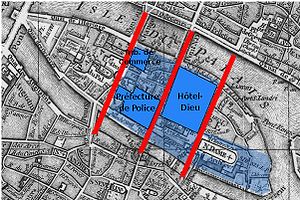
I also wanted the students to think about how the layout of the city can contribute to the possibility of a revolt.  Many in 1789 commented that few cities had a layout more conducive to revolution than Paris.  Here is an image of the city in 1788:

I then asked the students to redesign the city to make revolution less likely, which meant of course they had to think about why the city might be susceptible to revolution in the first place.

A few generations later Napoleon III wanted the city redesigned specifically to discourage the possibility of further revolution.  The map below indicates some of his changes, with the red strips representing broad thoroughfares, and the the darker blue representing wide public spaces.

Many thanks!

Dave M

9th/10th Grade: The Inevitability of Revolutionary Violence?

Greetings,

This week we saw the French Revolution immediately take a dangerous turn, and I wanted us to consider why violence formed such an integral part of the Revolution.  I think we can offer a variety of possible answers to this question.

Historian Simon Schama made an interesting observation regarding the nature of the change that gripped France.  If we go back to the France during the heyday of Versailles, we see the king rigidly controlling events.  The spectacle of Versailles began with the king and sometimes ended with him as well.

Louis XVI had a modernist, progressive bent.  He loved science, and joyfully hosted some of the first ballooning experiments on the grounds of Versailles.  The experiments were a great triumph, but in some ways worked against Louis.  With the balloons up in the air, nature controlled the spectacle.  The wind blows,i.e., nature speaks, and the reaction occurs.  The air was public space.  We see this concept of the Revolution as a “force of nature” in David’s drawing of the Tennis Court Oath (note the rush of wind occupying the top areas of the painting).

The revolution then, was a “force of nature” in the minds of many,  outside the control of the king, or anyone else, for that matter.  One must follow where it led — you had no choice.

Traditionally historians have viewed the Revolution as happening in two phases:

1) The idealistic, peaceful, “good” phase from 1789-1792, and

2) The ugly, destructive phase that began in 1792 and lasted until 1794.

Following Simon Schama and his stellar book Citizens, I disagree with this characterization.  Violence and political action went hand in hand in 1788, for example, a year before the Revolution proper began.  Bastille Day in 1789 saw the mob beat Captain DeLaunay to death and put his head on a pike.  The language of blood had much cache in the rhetoric of the time, with orators often proclaiming their desire to shed their blood for the cause, or the need for blood to “water the soil of the fatherland,” blood as the “cement of the new republic,” and so on.

Part of understanding the violence involves understanding the nature of sin itself.  How often have we thought that if we do this one bad thing, we can quickly then step back, shut the lid on our misdeeds, and return to righteous behavior.  But as Scriptural language makes clear, once sin has room to maneuver it tends to take control.  Once they used violence to achieve small objectives, it began to have a life and logic of its own.  Pandora’s box had opened.

Part of the reason for the violence also involves what the French tried to accomplish with their revolution.  Stop and ponder for a moment how many political questions we take for granted. Who gets rights?  Who is a citizen?  How should we apportion political power?  Americans disagree a lot about politics, but nearly all our arguments deal with what to do within the existing system.

But what if we had to completely rethink all of those things on the fly, for this is what the French faced.  Naturally they had many disagreements about fundamental political questions.  Under pressure from foreign powers, did the French have the space and time to decide these questions?  The lazy way out would mean violence.  One can weary of talking endlessly, especially under pressure.  “Since we cannot agree on who gets the last cookie and I’m tired of talking, I’ll shove you out of the way and grab it myself.”

The art of the period reflected some of this change of mindset.  The artistic style called “Rococo” tended to dominate in the period prior to the Revolution, with this painting as perhaps the pre-eminent example:

The emphasis here was on light, softness, and the pleasures (though its critics used the word “frivolity) of life.  Art presaged the political shift of the Revolution.  The colors got bolder, the subject matter more serious, and the focus shifted from celebrating life to facing death.

Here is Jacques Louis-David’s “The Oath of the Horatii,” from a story in Roman history that celebrated the sacrifice of the three brothers for Rome.

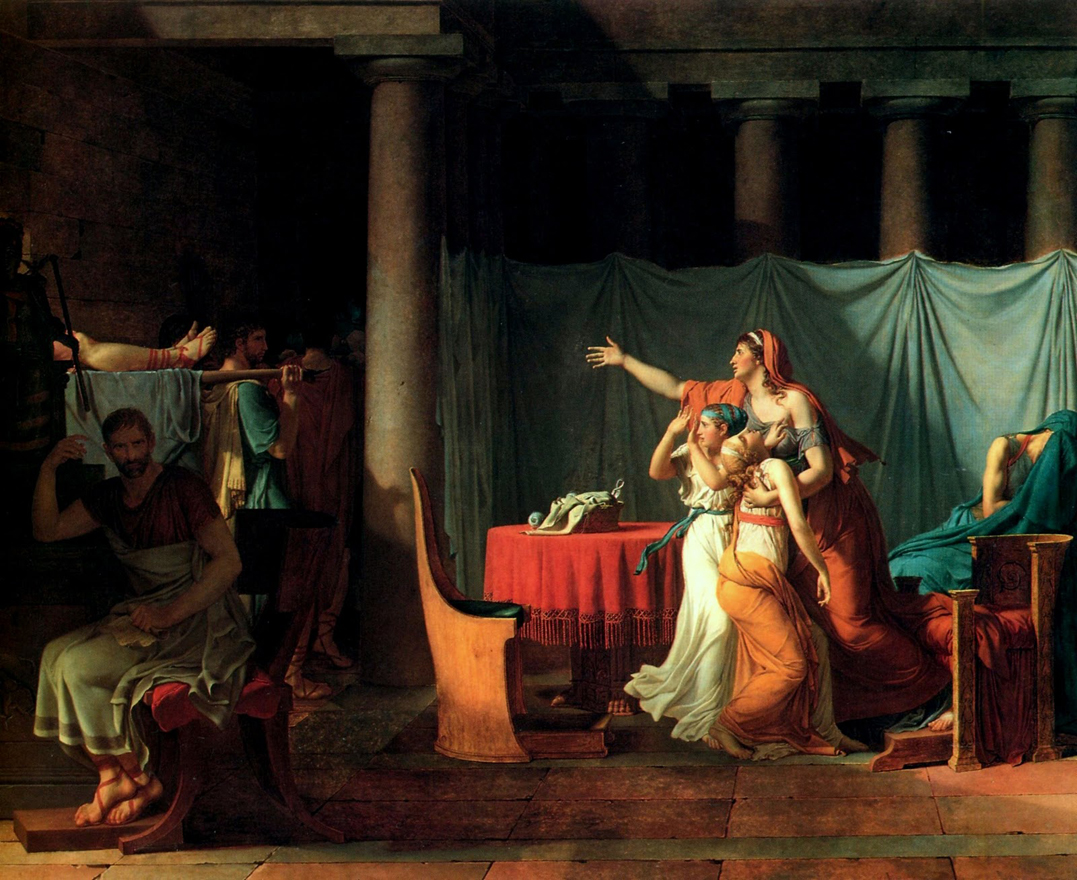
And below, “Brutus and His Sons,” which again uses Rome as the narrative template.  Brutus served as one of Rome’s first consuls, its chief law enforcement officer.  But two of his sons participated in a plot to bring back the monarchy.  The punishment was death, and Brutus had the duty of executing the punishment.  As in the picture above, the men have steely resolve while the women swoon:

The semi-apocalyptic tone of the art no doubt captured the existing mood, but also propelled French society toward violence.

We also cannot underestimate the climate of fear that gripped France.  They knew that their attempts to remake their society would draw the ire of other nations.  Austria and Prussia sent armies to invade their country, and France itself had to deal with an army whose aristocratic officer corp had largely fled or been discredited.  But once the French began the Revolution, they could not turn back.  They had already done enough to face punishment from other nations or a restored Louis XVI.  If, for example, you knew you would be hung for the thefts you committed, would you try and kill the witnesses?  What more could the authorities do to you?  Facing domestic uncertainty and international pressure, success became mandatory for the revolutionaries.  This desperation surely contributed to the violence.  Tragically (and not surprisingly) they eventually turned this fear and desperation on each other.  Saturn would eat his children.

It was in this climate of fear that the French had to decide who constituted the “people” of France.  Usually nations decide this along the lines of birth, but many in France thought this could not work, since not all favored the Revolution.  If those who did not go along with the Revolution were “oppressors” of the people, could oppressors of the people be part of the people?  Why give rights to those who work against the nation? This led to the French defining citizenship along ideological lines, which had a disastrous impact on the Revolution.

Violence played a crucial part in this decision too.  On Bastille Day crowds already began executing people without trial.  If those executed were part of “the people” then their actions were obviously illegal.  But to call those actions illegal would call the whole revolution into question.  So, the natural conclusion would be that those executed were not in fact part of France after all, and not deserving of rights.

Next week we will see where these ideas lead the Revolution.

9th/10th Grade: Romanticism

Greetings,

This week we looked at Jean Jacques Rousseau and the Romantic movement.  Last week in our examination of  the Enlightenment, we said that it both built upon the past (Scientific Revolution) and reacted against it (Louis XIV’s Versailles).  So Romanticism both reacted against the Enlightenment emphasis on reason and built upon its rejection of current society.

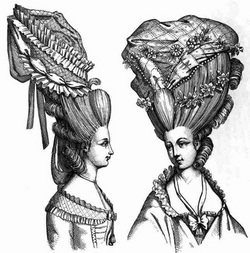
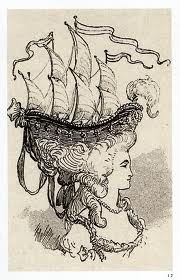
We think of the Romantics praising the virtues of emotion, but we should not interpret the word ’emotion’ in a narrow sense.  Rousseau focused more on our ‘gut,’ or our ‘inner man.’  For Romantics society itself was humanity’s enemy.  All of its trappings, like wigs, crevattes, five-fork dinners, etc. put a ridiculous husk over the kernel of our true selves.  Anyone who ever felt uncomfortable among the wine and cheese set, for example, can identify with at least some of what Rousseau preached.  Manners and mores, if taken too far, can be elitist, exclusionary, and anti-human.  When we consider that the picture to the left depicted actual hairstyles as worn by aristocratic ladies, we begin to identify with what the Romantics advocated.  Rousseau wanted to return to what was “natural.”  It makes sense, then, that one of his main causes involved getting mothers to breast feed their own children, rather than handing them over to wet-nurses.

Rousseau and the Romantics wanted to free people from society to live as they were truly meant to live.

For them, mankind need not fear logic and reason, but instead  needed to realize that they do not come first in human development.  We add them later, whereas our emotions arise naturally from within us from the very start.  Reason, on the other hand, must be imposed from without.  So our ‘guts’ are better guides to behavior than our reason.

From a Christian perspective one can say that God gave both emotion and reason, and that both can guide us to truth.  We come back to the idea of truth in tension.  Unfortunately we see the abandonment of this tension in Rousseau, who thought for example, that the tragic Lisbon earthquake was God’s judgment against cities.  C.S. Lewis’ famous essay “Men Without Chests” makes the point that, as valuable as our heads and our guts are, they need the “Chest” to act as a moral mediator.  Separated from right moral guidance, both emotion and reason turn tyrant. Jonah Goldberg has a humorous but insightful take on what happens when men are left to their own devices here.  When the forces of Enlightenment and Romanticism combined and then turned against each other in the French Revolution, the results would be less humorous.

Like the Enlightenment movement, the Romantics were on to at least a part of something.  One example of this is the idea of breastfeeding.  For centuries women in the elite of society considered it “vulgar” to breastfeed their own children and farmed them out to wet-nurses. One of the first goals of the “Romantic” movement was to get women to see that what was “natural” in this case was good.  What could be more “unnatural” than the separation of mother and infant child?  And yet, such practices persisted.

The problem of course lay in how one defined “natural.”  If every “natural” thing has a direct moral imperative, then we must define “natural” very carefully.  Like the Enlightenment then, the Romantics did not see the world or humanity as basically fallen, and this would bring forth terrible consequences in due course.

We looked at the tragic case of Louis XVI.  In him we have a good man who, in turbulent times, lacked the foresight to be a good king.  As a French king, he probably thought that supporting the Americans against the British was just something that French kings do.  But Louis’ aid to the colonies, which involved people trying to overthrow a monarchy, can be compared to bringing the kudzu plant to the U.S.  You are importing your own destruction, though Louis likely did not see this, just as we did not with the infamous plant.  When an idea (like some plants) gets transplanted away from its native soil the results may be much different than we anticipated.

As the official diplomat to Paris, Ben Franklin knew exactly what chord to strike with the French.  He knew that the French idealized the Americans as fulfilling Rousseau’s dream of living close to nature, and milked that as much as possible.  To the left is a famous portrait of Rousseau, and the outfit Franklin donned for his portrait in France while on a diplomatic mission.

Louis attempted to enact many helpful reforms, and this makes his tragedy more poignant.  Many have the mistaken idea that France rebelled against a decrepit regime bent on maintaining the status quo at all costs.  In fact, many philosophes felt that France had the perfect king for the times.  Louis worked hard at fiscal responsibility.  He abandoned much of the waste and foolishness of Versailles. He avidly patronized the sciences, and founded the first known school anywhere for the blind.  France did not rebel against a king who refused to change, they rebelled against a king who tried hard to modernize France.  We shall have to unpack the significance of this later when we look at his trial under the Revolutionary government.

Usually no matter how often we criticize our Presidents we profess admiration for our First Ladies.  Not so in France.  Marie Antoinette, queen of France, was hated almost from the moment she set foot in the country.  Many stood against her from the very start, but her actions, innocent though many may have been did not help her cause.

The bad press began the moment the French found out that Louis’ bride hailed from Austria, a traditional rival of France, a step-child.  Louis, and thus France as a whole, was seen as “marrying down.”

Strike one against Marie.

Marie was desperate to please.  So, if the above picture showed how high-born ladies should wear their hear, she would do one better.   She wore this hairstyle (the picture is accurate, not satirical) to commemorate a French naval victory.   The French, with their vicious eye for taste, could easily detect when someone tries too hard.

So, as the Romantic movement gained acceptance, the pendulum swung the other way.  Marie eagerly dove headfirst into the new style.  She would be “simple.”  She asked Louis to build her a special estate where she and her friends could pretend to be farm girls and feed sheep, milk cows, and so on.  Again, Marie seems to be “trying too hard” to almost ludicrous proportions.

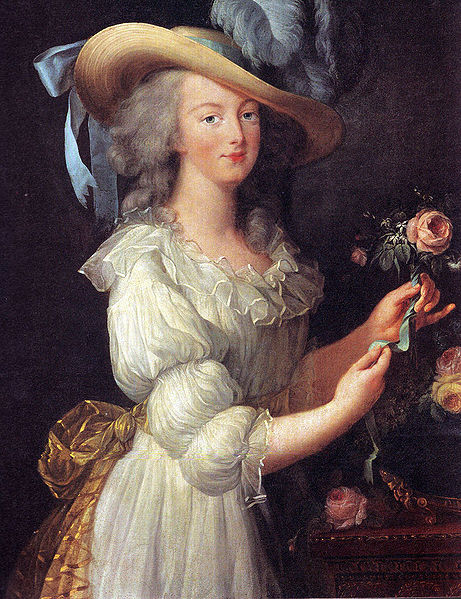
Her friend Elisabeth Vigee-Lebrun painted the famous portrait of her to the left.

This new image would surely work, right?  In this portrait she was elegantly simple, just as Rousseau would want her.  Marie very much hopedInstead, once again the French detected desperation, someone who obviously was not “natural.”   “You are queen of France.  Act like one, dress like one!”  the French seemed to say.  Marie did not figure out how to act like a queen to anyone’s liking, perhaps not even her own.

When Marie finally had children, she settled down, and enjoyed her role as a mother.  But much damage had already been done.  Part of this damage stemmed from the personality differences between Louis and Marie.  Introverted Louis never liked parties, and used any excuse to retire early (one source indicates that Marie purposely set Louis’ clocks ahead in hopes of having Louis retire even earlier).  Once Louis left, Marie felt like she could cut loose, and played cards and danced the night away.   Much of this behavior was very likely innocent, but it raised many eyebrows, and rumors flew.  Louis, did what any wealthy, decent, and befuddled husband might do and bought her lots of expensive things.  Marie got the blame for this, not Louis.  In time various epitaphs floated around France, including, “The Austrian Whore,” and “Madame Deficit.”  Marie could never understand the impact of her actions, and how important image was to her success in politics.

Next week we will see Louis lose control of events in the French Revolution, and how France’s abandonment of what Lewis called “the chest” would wreak terrible havoc.


Dave