Teacher Bodies

There is a section of Plato’s Laws in which the “wise” Athenian states that,

Countless ages before the foundation of modern states, they say there existed a form of government in the age of Cronus that was a great success.  The traditional account tells of the happy life led then, and how they had everything in abundance without toil.

The reason alleged for it is this: Cronus knew that human nature is never able to take complete control of human affairs without falling to arrogance and injustice.  Bearing this in mind, he appointed kings; but they were not men, but beings of a higher order, that is, spirits.  We act on the same principle today in regards to our domesticated animals.  We don’t put goats in charge of goats, or cattle in charge of cattle, but control them ourselves.

The story has a moral for us, for when men rule a state we have no respite from toil.  We should make every effort to imitate life under Cronus; we should run our private and public lives in obedience to whatever divine spark remains in us, and dignify this distribution of reason with the name ‘law.’

But today . . . most take the line that laws should be given not to the end of attaining virtue or even waging war, but to safeguard the interests of the established political system, whatever it is, so that it is never overthrown and remains always in force.  The point is this–whoever is in control lays down the law, right?

For many of us this may seem remarkably modern, and perhaps even a cynical, viewpoint on politics as nothing but the manipulation of power to serve the interests of power. But from his other writings, and indeed, the whole of The Laws we know that Plato may have not thought much of the politics of his day, but certainly believed in the possibility of a better world through the application of the right political practices. His reference to the time of Cronus likely hearkens to his belief that this wisdom had to come from outside or above the world of experience.

Plato seems to be saying that when one abandons a transcendent ideal, the power of men over other men can only get reduced to pure power. If I am right about that, perhaps Plato is wrong. I’m not sure that any concept of power can come without a “spiritual” reason, plainly spoken or otherwise.

K.R. Bradley’s Slaves and Masters in the Roman Empire: A Study in Social Control bears all of the marks of the professional classicist–long on important and impressive detail (he cites some primary sources I have never heard of before), a bit short on style. Yet a philosophy emerges behind Bradley’s many details, one that Plato might understand: When men must rule other men who have no wish to be ruled, one must use a complex system of rewards and punishments, all towards the goal of maintaining control–of maintaining power. Bradley’s concern lies there, and only there, and therein lies my objection.

Writing about slavery brings with it certain necessary introductory statements:

  • Just because slavery was a common social institution in the ancient world does not mean that it is ok. Indeed, the existence of slavery anywhere at anytime is tragic.
  • Although slavery is bad, it might be that certain forms of slavery at certain times and places was better than other forms. Calling one form of slavery better than another would not mean that the better form was “good,” in itself, but only less bad.

First let us consider the concept of power and control. On the one hand we have the theocratic forms, where God, a god, gods, or their representative(s) make judgments in their name. These forms very obviously appeal to something outside the system to run the system. To that extent at least, Plato would approve. But what of systems that have no defined referent? Well, just because we cannot definitively name the outside referent/intelligence doesn’t mean it isn’t there.

We can use the example of school. Of course students are not slaves, but very few of them over 12 want to be there, and they outnumber all those in authority by a large margin. Teachers obviously benefit from centuries of social expectations, but to control a class, they need to liturgically fulfill certain expectations of what a teacher is and does. If you go too far outside the lines, you break the spell, and your authority disappears, something Key and Peele know well (see clip here–for some reason it would not imbed in the post).

The materialist might argue that obviously the teacher in question could restore order in the class. Of course, the clip above is not real life. But those who have taught know that reestablishing control in such a situation would involve a great deal of work and some deft maneuvering. That control could possibly come from force, i.e., “Everyone be quiet or get sent to the office,” accompanied with stomping and yelling. But that kind of power has a very short shelf life. Threat and fear cannot provide a foundation for learning–it is a strictly materialist structure. Students know this, and will always defeat a teacher who uses force too often, akin to Paul Kennedy’s “imperial overstretch.”

If we reflect on our experience, a teacher has authority when they put on the “body” of a teacher. This means

  • Knowing your subject
  • Being on time for class
  • Having everything ready for class

And so on. One must continually inhabit this “body” every time you enter a classroom. I have taught for 24 years, but if I set up the projector to play a video, quiet everyone down, press “play,” and technology fails me, I have about 7 seconds to get it to work. Otherwise, the “teacher” flees and the spell breaks. Order resets only as I re-inhabit the teacher body.*

Certain aspects of Roman slavery in the Imperial age may surprise us:

  • Slaves were encouraged to marry and have children, and exemption from work came especially to women with at least 3 children.
  • Emancipation from slavery may not have been common per se, but was a regular feature built into the institution.
  • Cato (I had heard of before) and Columella (not heard of him before) both testify that slaves had certain holidays designated just for them, and along with designated times of rest, had perhaps about 75 days off during the year (this would apply at least to rural slaves, who probably had worse treatment than household slaves).
  • During these slave holidays, they had relative freedom of movement
  • Romans wrote admiringly of slaves who stood by their masters, and saw them capable of living out the Roman virtues of pietas and fidelity.

The fact that republican Rome had three major slave rebellions between 140-70 B.C., and none to speak of in the imperial era could well mean that Rome found a better “pattern” of slavery, with “better” obviously not meaning “good.” Bradley takes this to mean only that Rome found a better systems of rewards and punishments, a better means of psychological manipulation. Perhaps . . . but it seems to me that Bradley has a very one-dimensional view of power. He forgets the collective intelligence inherent in any group. Again, slavery is bad, but even an oppressive system cannot work solely based on a materialistic appeal to fear, or even a proper balancing of reward and punishment. Something must guide it.

Bertrand de Jouvenel’s On Power: It’s History and Growth, at certain moments at least, brilliantly shows what happens to governmental authority over time, increasing even though nobody necessarily intends such growth. Every revolution in the modern era shows this pattern. Lenin was much worse than any czar, Mao much worse than Chang Kai Shek, Robespierre outdid by great enormities anything Louis XVI envisioned, and so on. Even the American Revolution followed this pattern. George III may lacked a certain mental alacrity, but he never seized property and exiled any of his political foes among the colonists. The newly minted United States performed this task instead with those who remained loyal to the British. And speaking of slavery, slavery increased dramatically after the Revolution, despite the, I believe, genuine expectation that it would disappear within a generation. A variety of economic and sociological reasons exist for why they were wrong, but “the rest of the story” must exist somewhere. Democracy, conceived as a rebellion against tyranny, may be most prone to this logic precisely because “the people” cannot repent as an individual might.

The latter sections of this book (which I have not yet read, but skimmed portions) promise much in the way of historical examples. In the early sections Jouvenel explores various theories of the origins of power itself. Here he stumbles a bit, for he cannot quite figure out where power comes from. He begins with nominalist conceptions of power, which means that abstract concepts have no validity, but we assign names for convenience. He admires Rome’s Republic, stating

[The Romans] of “the Senate and people of Rome.” [They] had little need of the word “state” because they were not conscious of a thing transcendent, living above and beyond themselves . . . . In this conception, the reality that Rome bequeathed to the Middle Ages, the only reality is men.

Jouvenel says rightly that Romans never thought of a “state,” but they did think of a Senate that functioned as a body, and they had the “people” also represented as a body. Individual men cannot be the only reality. Senators made up The Senate. He quotes Aquinas approvingly when he wrote,

Any group would break up if there were none to take care of it. And in the same way the body of a man, like that of any other animal, would fall to pieces if there were not a directing force within it seeking the common good of all members. . . . In every mass of men there must be the same principle of direction.

Jouvenel examines some other philosophical ideas about power and can only conclude that,

Power possesses some mysterious force of attraction by which it can quickly bring to heal even intellectual systems conceived to hurt it. There we see one of Power’s attributes. Something it is which endures, something which can produce both physical and moral effects. Can we yet say that understand its nature? We cannot. Away then with these fine theories which have taught us nothing . . .

These “fine theories” essentially belong to the field of “emergence” or bottom-up ideas about the establishment of power. Our experience shows us that some kind of intelligence, some kind of reality, hovers above or around certain activities. For example, in an Orthodox worship service there are a variety of prayers or confessions repeated every week that I have memorized over the years. But . . . this memorization of mine applies to the church service only. If you stopped me on the street randomly and asked me to repeat the confession before communion, I wouldn’t get it right. The materialist would ascribe this likely to mere mental association, and while that no doubt plays a part, I’m convinced

From here he explores what he calls “Magical” theories of power, some of which still exist in traditional societies. Most interesting to me from this group is Joseph Frazer’s “Sacrificial King.” This form requires some kind of descent from the king to renew the power of the office. This sacrifice can take various forms, and some would not look like sacrifices to us now, but this principle of descending to ascend, and having this process repeated, enacts a pattern where authority rarely gets abused. The taboos surrounding the office have a binding strength that prevents such abuse.

I am convinced that here we have the true origins of real power (though obviously some manifestations of this model cited by Jouvenel deviate sharply from Christian morality), for it models descent and ascent of Christ Himself.

To return to classroom experience, our best teachers likely instantiated a definite pattern into their classroom–that forms the “high” aspect of their authority. But they likely also “descend” and come alongside you to help you with class or possibly a personal issue. When they do this, they in effect climb into the body of “Teacher.” Those who own slaves can succeed in putting an imprint of themselves on the people they “own.” Bradley shares some stories of slaves who grew very attached to their “owners” and even suffered and died on their behalf. But such power does not deserve the name because it fails to free, and instead can only end in death. On the flip side, some today argue that suffering gives power, hence, the so-called “victim Olympics.” But Christ does not receive power from on high merely because of His suffering, but because He conquered death in His suffering. Today’s “sufferers” often wish to remain victims, thinking that only the descent gives one power. Not so–recall a teacher from your past who “descended” and got too familiar with their students. Without an aspect of an Imprint from above, the body of “teacher” leaves those who only descend post haste. Students walk all over such “teachers.”

Comparing citizens to students breaks down quickly–not nearly as quickly as the comparison of citizens to slaves. But we cannot escape the fact that some guiding collective imprint from above forms our interactions with each other in the state. Whether or not this collective intelligence be angel or demon will depend on how their pattern of being mimics both the suffering and glory of Christ.

Dave

*When this happens, I will sometimes fix the problem, and then leave the room for 10 seconds merely to give me an occasion to re-enter and reestablish the body of a teacher–just like the Spanish Inquisition.
The Way of the Fox

I can always count on a few “Let’s conquer Canada!” “jokes” a year from my students.  We might be studying the Mexican-American War and someone will say, “No, no, no.  We need to find our ‘true north’ and fight Canada!”  If it’s the Spanish-American War it could be, “Spain?  Why Spain?  We should fight Canada!”  If it’s W.W. II . . . “We fought on the same side?  Phooey.  After the Germans, on to Canada!”

Mild groans or exasperated rebukes (from the girls) usually ensue.

So it comes as a delightful surprise (to the boys) to actually find out that we did try and conquer Canada in 1775.

Because the idea of conquering Canada is such a passe joke, we assume that George Washington was crazy to order such an attempt.  In the minds of many our invasion comes to nothing more than a madcap escapade, a schoolboy’s lark.

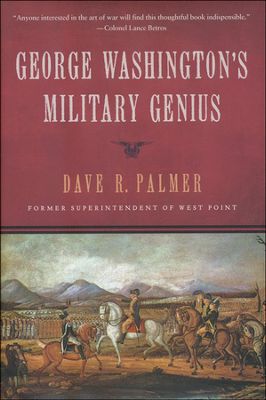
Dave R. Palmer argues in his book The Way of the Fox (newer editions have a different title indicated by the cover to the right) that in fact such an invasion not only nearly succeeded, but also made sound strategic sense.  Palmer seeks to rescue Washington from his saccharine and wooden image and recasts him as an effective and in some ways brilliant grand strategist for the American Revolution.  And yes, this includes his invasion of Canada.

Today many think of Washington as either a great man/demi-god or nothing more than a member of elite/exploiting class.  Both views are cardboard cutouts.  Palmer shows us someone who thought carefully and with subtlety, someone who adjusted his thinking on multiple occasions to deal with changing reality.  British generals often referred to Washington as the “old fox,” sometimes with contempt because he would not fight, sometimes with admiration for his cleverness.  The moniker should stick — it brings Washington and the war to life.

First and foremost Washington stood as the perfect symbol for the Revolution. Certain qualities made him the obvious choice for command, such as his experience, his height, his bearing, and the fact that he hailed from the South.  But none of these things would matter if Washington failed to think in broad strategic terms effectively. Palmer divides the Revolution into three stages, and correspondingly sees Washington adjust his strategy each time.  Washington made specific mistakes as he went, but in terms of broad strategic goals Palmer has Washington never miss a beat.

Palmer argues that revolutions possess an offensive character by their very nature.  They seek to effect change and so must act accordingly.  Thus, Washington was entirely right to begin the war with an aggressive strategy that sought to expel the British.

This failed to fully succeed, which allowed the British to send massive reinforcements.  This meant that Washington, now outmanned and outgunned, needed to withdraw and avoid having his army destroyed by a pitched battle he could not win.

France’s entry after 1778 changed the situation yet again.  Now momentum and manpower lay with the Americans. Washington needed to take advantage of the alliance while it lasted.  So during this period Washington should have sought to press his dramatic advantage, which he did with great effect at Yorktown.

I take no issue with either Palmer’s interpretation or Washington’s actions for phases two and three.  But it’s the first phase, which includes the invasion of Canada, where we can push back most easily.  It seems to me that Washington should have been cautious until the final phase where the advantage finally tipped in his favor.  His aggressiveness at the start of the conflict seems out of place to me.

True, at the beginning of the war you have an emotional high that you can capitalize on.  But you will have undisciplined and untested troops. What’s more, they will not yet have developed that cohesion that great armies have of sharing routines, time, space, and danger.  Think of Caesar’s legions — nothing remarkable when they started into Gaul, and unbeatable five years later.  In our Civil War one reason for the South’s early success had to do with the offensive burden the North faced.  When General Irwin McDowell objected to offensive action at Bull Run in 1861 due to the lack of experience of his men, Lincoln replied that “[both sides] are green together.”  Yes, but McDowell knew that a green attacker has a lot more to worry about than a green defender, and so it proved.

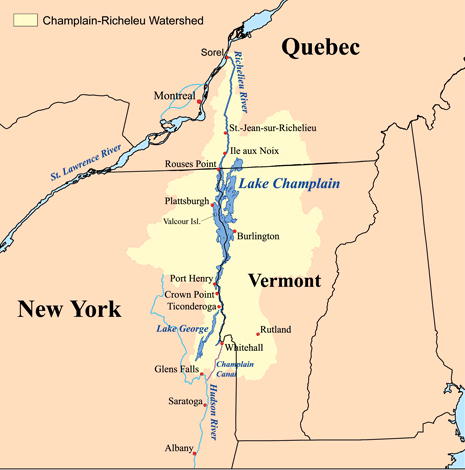
Beyond this psychological reason, Palmer asserts another more narrowly strategic goal for invading Canada.  America’s size and her numerous ports put a huge strategic burden on England.  Colonial armies could easily retreat inland and lead British forces on goose chases through the wilderness.  Add to that, the layout of the land presented very few “choke points” at which the British could use their superior manpower to any real effect.  Perhaps the only such point lay at the nexus between England and Canada — the Hudson River.

Flowing from north of Albany down to New York City, British control of the Hudson would have allowed them to control the upper third of the colonies.  Controlling New York and Boston would have meant control of America’s biggest ports.  Cutting off New England would further mean nabbing most of the colonies financial resources and a hefty portion of its intellectual political capital.  Everyone on both sides of the Atlantic agreed that control of the Hudson could determine the war.

So if it makes sense for Washington to defend the Hudson, why not go just a bit further into Canada itself?  To capture Quebec would have given the colonies everything else in Canada.  Success would have prevented England from having a free “back door” entry point into the colonies via the St. Lawrence River.  Shutting down the St. Lawrence would topple another domino by cutting off England from potential Indian allies* out in the west.

Reading Palmer’s lucid and logical defense, I found myself almost persuaded.  Palmer urges us to remember that the failure of Benedict Arnold’s invasion (yes, that Benedict Arnold) — and it nearly succeeded, does not prove that the idea or the goal was faulty.  Had it paid off, the war might have been over within a year or two instead of eight.

Yes, but . . .

Arnold  lost in Quebec and Washington lost in New York City.  Palmer gives a generous interpretation of Washington’s actions in New York and believes that politically speaking, Washington had to defend the city.  Maybe so.  But if he had to defend the city for the sake of politics, then why also invade Canada and divide your forces? Palmer wants it both ways.  He believes that circumstances called for an aggressive campaign in 1775-early ’76, but that politics and not military necessity alone forced Washington’s hand to defend New York.  This seems to admit the fact that Washington should have given ground and played defense in New York alone.

All in all I agree that Washington brilliantly guided the colonies to victory, and Palmer argues this decisively.  He points out also that Washington faced a bungling and confused command structure in England.  But Washington had Congress to deal with, who although more intelligent and capable by far than their British counterparts, had much less experience in running a war.  By any measure, Washington deserves his place as one of the great generals of the modern era.

But I can’t let go of the invasion of Canada.

If we try and evaluate Washington’s gambit in Canada we should try and compare it to similar kinds of military actions across time.  My case remains that the invasion made logical sense in a certain way.  He was not reckless or foolhardy to try.  But I feel that he should have focused more on defense, and perhaps even success might have hurt him in the long run.  The colonies might have had the direct motivation to expel the British, but would they support long-term the occupation of Canada?**

I can think of three campaigns that might be comparable in certain ways . . .

  • Athens’ invasion of Sicily in 415 B.C.
  • Hannibal attacking Rome directly instead of defending Spain
  • Napoleon going on the offensive in Belgium in 1815 instead of rallying the people to “defend France.”
  • Our invasion of Iraq in 2003***

Sometimes foxes can be a bit too clever.  Still, unlike Athens, Hannibal, and Napoleon, Washington committed a relatively small portion of his forces to the plan.  As a general most would not rank Washington with Hannibal, Napoleon, and the like.  But Palmer argues that not only should we put Washington in their company, but given his military and political success, make him the general of the modern era.

Dave

*This no mere fancy.  In 1777 the British did invade via the St. Lawrence and did gather some Indian allies for their “Saratoga” campaign.  That escapade ended in disaster for the British, but Washington’s strategic fears did come true nonetheless.

**Strange as it may sound now, Palmer points out that the motivation to occupy and settle Canada ourselves might have existed not on strategic but religious grounds.  Many in 1775 saw Canadian Catholicism as a mortal threat to our freedoms and would have gladly occupied it in the name of liberty.  Certainly we showed the ability to expand and settle territory in the west. Why not in the north as well?

***Right or wrong, Bush enjoyed overwhelming support to fight in Afghanistan in 2001.  It made sense to us in the way that (again, right or wrong) responding to Pearl Harbor made sense.  But his case in 2003 was much less compelling, at least to the international community.

From Puritan to Yankee

Recently I found myself talking politics with a Trump supporter.  Interestingly, he mentioned very little about his policies or personality.  Rather, he seemed drawn to him because of the multitude of attacks against him.  No one, he argued, deserved what Trump receives from at least some in the media.  Politics had very little to do with this, for this same person said that he liked both Obama and Hillary Clinton for much the same reason–in his mind of them have been attacked to an unfair extreme.

I have no great love for the Puritans, and perhaps this might explain why I sometimes seek to defend them.  I certainly felt this way at the start of Richard Bushman’s From Puritan to Yankee: Character and Social Order in Connecticut, 1690-1765.  When describing Puritan society in the first chapter he invariably uses words like, “austere,” “imposing,” “monolithic,” and that most dreaded word for an academic who originally published this book in 1967, “conformity.”*

Later in the book Bushman shows his excellence as a historian of a certain type, but I did not like the first chapter.

We naturally have difficulty in understanding and evaluating the Puritans.  They look like us in many respects, but then part with modern society in other radical ways.  It is the heretic, rather than the unbeliever, who always poses the greater threat.  Hence, our natural distaste for the Puritans.  But we must keep certain things in mind.

First of all, the Puritan ideal of social order oriented around religion hardly broke new ground.  They borrowed from the medieval idea of the “great chain of being,” and in orienting their society around religion they merely did what most civilizations practiced up until that point.  Numerous examples of this exist, with the Egyptians, early Romans, the Mezo-American civilizations, and the aforementioned medievals to name a few (this should clue us in on the radical nature of post-Enlightenment western society–more on this later).

Secondly, many moderns, progressive or otherwise, would likely admire some of the main goals of Puritan society.  The Puritans sought to live a common life together by minimizing  (though not eliminating) economic competition and distinctions in wealth.  Bushman himself notes that in the early days of settlement even the richer members of society lived much in the same way as their neighbors, working fields and milking cows like anyone else.  Bushman and others may not realize that such a society cannot exist with modern notions of liberty that tell us to “find our own way,” “follow your heart,” and so on.  Societies like the early Puritans must get their formation from shared conviction that only comes with religious belief. You cannot have one without the other.  One Puritan stated, “Law should serve free exercise of just privileges.  Without this, lives and liberties would be a prey to the covetous and cruel.”  Modern notions of liberty, in the view of early Puritans, would lead to exploitation and alienation.

Bushman himself cites early in chapter two that this shared communal life allowed government in Connecticut to be, in his words, “flexible” in ways that “minimized local conflicts.”  This hardly seems “austere,” or “monolithic.”

True, certain “upper-crust” Puritans (apologies for the emotionally laden word choice) had a fear of any of the “lesser sort” getting into political power.  We can snub our noses at this.  But we should remember that it is 1700.  Puritan Connecticut was more democratic than the England of William and Mary, and infinitely more so than Louis XIV France or Frederick the Great’s Prussia.  Almost every other European society at the time shared these same fears of “lesser men” ruining everything. We have good evidence that many of our founders decades later had these same fears, as of course did every major western political thinker from Homer on down the line.

Finally, nearly all the early Puritan settlers came from the same east-Anglia towns and villages.  They knew the content of Puritan theology, they knew Puritan leadership.  It’s not as if the Puritans pulled a bait-and-switch on the journey across the Atlantic–“You thought you signed up to run wild and free in the woods, but no!  Now that we have you in the middle of the ocean, welcome to John Calvin!”

If some settlers grew frustrated with Puritan leadership, well, they knew what to expect.

So yes, the Puritans need criticism, but criticism with the right context in mind, and aimed in the right place.

After chapter one, Bushman shows his great skill at sifting through data to form larger conclusions.  He puts the focus on the problems settlers faced due to a growing population, which would necessitate an inevitable territorial expansion of the colony.  Some civilizations, like the Romans, link most everything in life to land.  Some see the beginning of the  Roman Republic’s political problems beginning the moment land in Italy disappeared for their soldiers.**  Not every civilization operates with this mentality.  Carthage, for example, and possibly Periclean Athens, largely freed themselves from land as a measure of identity (they had different problems).  But our early settlers fit well within the Roman mindset.

In the first generation or two land distribution remained equitable.  The size of the colony allowed everyone to attend the most important churches pastored by the acknowledged town leaders in piety and purpose.  The population’s proximity to these churches and to town hall bound the colony together politically.

But time marches on, and fathers want the same for their younger sons as for the oldest. In a settled mostly aristocratic society like England of the time, the younger sons of even minor aristocracy join the army or perhaps the clergy.  You see this even in Austen’s novels 100 years later.  Settlers in the new world, however, believed in equality, more or less, and wanted everyone to have an equal chance.

Expanding the size of the colony meant greater distances from the town center.  Naturally those predisposed to want to lead the settlement would stay close to its center.  Those with some disaffection towards leadership might more easily head a few miles outbound.  With this even small scale migration came an inevitable tension, and an inevitable choice.

The colony could either, a) Split off in different settlements and grant autonomy to each.  However, this came with the problem of effectively ending the Puritan dream.  Those who left for outbound land tended towards a more enterprising, individualistic mindset.  Or they could, b) Increase the power of the original settlement’s leaders and weaken the participatory democracy carefully crafted by the original settlers.

As is typical of most any democratically government they chose neither absolutely, though probably favored option ‘b.’  Everyone recognized that the social order had suffered due to increased wealth–a wealth occasioned by expansion (again, similar to Rome ca. 200-75 B.C.).  But try as they might, too many things swirled in conflict with one another to make sense of it all.  In the end tensions increased between eastern and western settlers in most religious and economic matters.  Once they let the’Yankee’ mentality of individual enterprise get its foot in the door, their social construct had its days numbered.

Let us give credit where due.  Bushman’s work should help us to see certain larger issues with more clarity.  For example, Thomas Jefferson bucked historical convention in his belief that a republic should have lots rather than a little territory.  He hoped that the Louisiana Purchase would allow everyone to practice self-government and live free and independently on their own land.  But–if everyone can live free and independently from one another, how can we maintain order?  Only by doing as the Puritans attempted to do–by increasing executive authority.  If we want the kind of liberty envisioned by Jefferson, let us count the cost.  Rome saw this same increase of executive authority as their territory expanded beyond Italy.  Whatever our uniqueness as a nation, we cannot escape history.

But in the end I think Bushman misses the real point.

Bushman mentions religious issues and gives them due treatment, but he gives pride of place to the decline of Puritanism to land and economic issues.  He deals with the source material masterfully.  But he seems to argue that certain geographic and social issues caused the religious issues to manifest themselves later.  We can acknowledge the influence of geographic and economic factors.  But in the end, I think he puts the cart before the horse.  The key to Puritan disintegration must be found in their religion.

For example . . . the Roman Republic experienced some of the same stresses faced by the CT settlers, with a much larger population over much larger territory.  Yet, the Republic maintained its central identity for at least two and perhaps three and half centuries, in contrast to Puritan ideals lasting no more than  two generations.  Egyptian civilization also had some of the same issues regarding land, and though obviously not a republic, maintained their identity for perhaps 1500 years.

Yes, democracies traditionally have a problem maintaining identity and cohesion.  One can a make a good case that Pericles built the Parthenon primarily as a way to reestablish unity by calling people back to their religious roots, whereas we today tend to look at this period in Athens as the pinnacle of democratic experience. This “pinnacle of democratic experience” may have had more cracks than we initially assume.  Athens at this time certainly had lots of money, which tends to work ill upon democracies.  If Thucydides tells only mostly the truth, they did not have much social cohesion. Rome lasted longer than CT or Athens with similar geographic and economic factors at play, and so I feel a reason exists beyond land distribution and the expansion of trade that Bushman focuses on.^

In the Puritans particular case we should note that their theology departed from traditional orthodox Christianity in certain respects.  Their emphasis on the will of God rather than the love of God reduced their faith to more of a philosophy, a handbook of propositions for life.^^  They had no appreciation for sacraments and thus no way for the grace of God to be made manifest in their lives except by how they thought. This led to impersonal abstractions gaining sway.  The famous (or infamous if you prefer) 5 Points of Calvinism work on the mind like a geometric proof, inexorably moving toward a foreordained conclusion.  Abstract ideas, however, are slippery things, and ideas floating in the air don’t always land on the ground in the same form for repeated generations.  Like a point in infinite space, various lines can connect with it and go almost anywhere.

Interestingly, Puritans created a government structure that tended toward defending an abstract notion of rights.  As the colony expanded, Bushman documents a swell of lawsuits and disputes centered around the “claims” of one settler vs. another.  Communal relationships disappeared as “rights” dominated public discourse.  Religious revivals like the Great Awakening followed this pattern in some ways..  The religious impulse coming from this revival did not push people back into communal life.  Rather, we see a rise in the individualistic idea of the “liberty of the conscience” gaining the upper hand among the (formerly) Puritan settlers.

Whatever the merits of my very incomplete analysis above, by the early 19th century New England certainly had adopted a vague mixture of theism and deism as its unofficial religion–a death by abstraction.

We see hints of 1776 as this abstract notion of rights grew.  In time colonial corporations made grants of land to settlers.  When royal officials came over and examined these title deeds they annulled them outright.  No “corporation,” they argued, can grant title to anything.  What is a “corporation” after all?  It’s surpra-personal identity meant it had in effect no personality, and with no personality, how could it truly exist?  A king can grant title, for the king is an actual person, and actual people can own things and give them to others.

The colonists may have nodded “sure!” to these royal representatives, but likely crossed their fingers behind their backs. Though kingship has the advantage of being personal, a king across an ocean has perhaps even less personality than a corporation.  In any case, they no longer had a connection to government rooted directly in either religious belief or social ties. They put their eggs in propositions, in “rights,” in “liberty of conscience,” which no one can touch.  Their point in infinite space must be free to go where it pleases.

A standard debate among historians of the American Revolution involves the question of whether or not the founders were radical or conservative in their ideas.  Years ago I would have answered with the latter, but not anymore.  Bushman’s work accompanies Bernard Bailyn’s and Gordon Wood’s thesis that our stodgy, wig-wearing founders had radical ideas.  For the first time, society would not be oriented around God/the gods.  Nor would social order have its roots in personal relationships, i.e., feudal society, or the lives and patronage of prominent families.  Now for the basically the first time, society would be organized around certain ideas, or we might almost say, geometric axioms.  What Bushman’s book shows us is that you don’t need to go to 1776 to see these principles at work.  If you wish, you can content yourself with a small CT settlement, ca. 1700.

*******************

*Here I must give credit to the playwright Arthur Miller.  His work The Crucible certainly criticized certain aspects of Puritan society.  And yet in his preface to the play he spends most of his time trying to get the reader to sympathize with the Puritans.  This sympathy, in fact, serves as the only solid basis for critique.

**I think the land issue a contributing factor accompanying deeper causes for Rome’s Republic, much in the same way I think Bushman overstates land issues as the primary cause for the collapse of the Puritan ideal.  In Rome’s case, one can see a shift in religious belief occasioned by their contact with Greece and the Mediterranean as the precursor to their political and social fragmentation.

^This is another great example of how Bushman’s book shed’s light on larger issues.  Most every commentator on Plato’ Laws calls Plato a grumpy old fart for banning trade from his theoretical realm.  But increased trade undeniably negatively impacted CT’s social order. Farmers deal roughly with the same soil and the same weather.  Surplus food grown by one poses no real threat to other farmers.

But trade seems to encourage more of the competitive spirit.  Trade deals more with luxuries than necessities, so unsold surpluses can ruin a merchant.  Hence, the extra competition to sell, and so on.  The rise of money and trade certainly played a role in the demise of Rome’s Republic.

^^I realize that this one sentence is hardly a reasonable defense for my views on Puritan theology,   My apologies–to defend them here is a bridge too far for me.  If I am correct, however, there are some  similarities in Puritanism to Stoicism (I stress “some”–the Puritans probably gave much more room for the emotions than the Stoics), a religion for Greece and Rome’s intellectual elite, but not for the masses.

9th/10th Grade: Liberty and Terror

Greetings,

This week we finished the preliminaries of the American Revolution and will start the fighting in earnest after the weekend.  I hope that our examination of the events leading up to the Revolution has  helped see the issue from both sides.  Can we get out of our American skin and at least sympathize with the British?  Quite a few of the students have developed some sympathy with the British perspective, which shows me that they are thinking and honestly engaging the material.
One crucial issue involves the ‘Sons of Liberty.’  Were they freedom fighters or terrorists?  Against them we might say that. . .
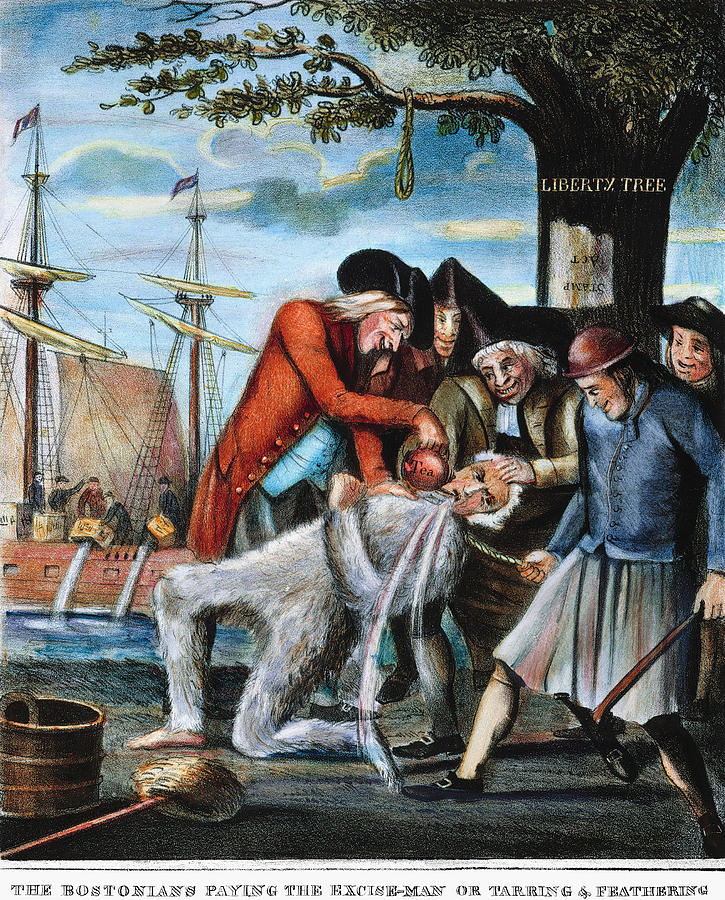
  • They used violence, and the threat of violence, to achieve political ends.  They destroyed property, tarred and feathered people, etc.
1773 Engraving
Man Tarred and Feathered for not Buying War Bonds
  • They used force to rob people of their freedom.  For example, lets take the Tea Act.  Let us suppose that you lived in Boston and in general, supported the British perspective in this debate.  This would have put you in the minority, but it’s a free country, right?  You have been looking forward to drinking tea again, but after the Tea Party you can’t.
The pro-British colonists could easily say that, “You Sons of ‘Liberty'” act under the cloak of freedom.  But you are not willing to let the people choose freely.  If the tea gets unloaded and you convince people not to buy it, well and good.  If you can’t then you don’t represent the people anyway.  You use force to take away my liberty to buy tea, which is perfectly legal, so you can have your way.  Your violent acts show you don’t really trust people at all.
In their favor we could argue that
  • A variety of peaceful means of protest had been tried, and those failed to even be acknowledged by Parliament.
  • They would often warn people beforehand, and as far as I know, they did not kill anyone.

In response to #2 above, the Sons of Liberty might say,

  • “It is true that we deprive you of your liberty to buy tea.  But, this was for your own good and that of the whole community.  If people bought tea we would become slaves to the British.  It is right to take away the liberty to destroy yourself, just as we would take away your right to buy heroin on the open market.  If you become an addict, that effects everyone around you.
  • The same is true for tea in this case.  If you buy it, everyone will indirectly suffer a loss of their liberty, yours included.
We are faced with a tough choice here.  If we say that they are in fact ‘terrorists,’ what does this do to our view of the Revolution itself?  If we say they are ‘freedom fighters,’ how do we respond to acts of terror today?  Some of them at least claim that the current political situation has left them with no other option.  Since they have no planes, tanks, and missiles they will fight with what means they have available.  Are they ‘freedom fighters’ too?
Or, does the label ‘terrorist’ or ‘freedom fighter’ depend on the purpose of the acts and the end in view? Lincoln believed that Revolution was a moral, and not a political right.  In this vein of thought the line between terrorist and freedom fighter can be drawn by the purposes they serve.  So, if Al Queda attempts to establish a Medieval caliphate on the Mid-East they are terrorists, but the Sons of Liberty act for “freedom for all.”   But does this mean that, “the ends justifies the means?”  I do not mean to say that suicide bombers and the Sons of Liberty are the same.  There is a big difference between smashing a customs house and the willful and random destruction of human life.  But we must at least ask ourselves if there are in fact, uncomfortable similarities.
This week I wanted the students to consider whether or not the American Revolution can be justified from a Biblical perspective.  This of course involves moral and political questions in general, but I did want them to consider the issue specifically in light of Romans 13:1 -7.
It reads:

1 Let everyone be subject to the governing authorities, for there is no authority except that which God has established. The authorities that exist have been established by God.2 Consequently, whoever rebels against the authority is rebelling against what God has instituted, and those who do so will bring judgment on themselves. 3 For rulers hold no terror for those who do right, but for those who do wrong. Do you want to be free from fear of the one in authority? Then do what is right and you will be commended. 4 For the one in authority is God’s servant for your good. But if you do wrong, be afraid, for rulers do not bear the sword for no reason. They are God’s servants, agents of wrath to bring punishment on the wrongdoer. 5 Therefore, it is necessary to submit to the authorities, not only because of possible punishment but also as a matter of conscience. 6 This is also why you pay taxes, for the authorities are God’s servants, who give their full time to governing. 7 Give to everyone what you owe them: If you owe taxes, pay taxes; if revenue, then revenue; if respect, then respect; if honor, then honor.

Related to the America Revolution, I think prominent Christian thinkers would have viewed this passage differently in light of our study.
Luther:
I think he would have been anti-Revolution and pro-British.  He strongly supported secular authority in general.   I think he would have told the colonists to be quiet and get back in line.  He may have thought the colonists concerns with taxes made them too worldly.
Calvin:
He developed what he called the ‘Lesser Magistrates Theory.’  He was not in favor of revolution coming from the people as a whole, as he believed it violated Romans 13.  But what if those in authority violate their trust?  And what if ‘lesser magistrates’ (i.e. colonial officials, Continental Congress?) took up the mantle on behalf of the people.  These ‘lesser magistrates’ are still people ‘in authority’ and they can lawfully lead a Revolution provided it was for the right reasons, etc.  Perhaps this is why many New England Presbyterians and Congregationalists supported the Revolution.
Aquinas:
I can’t say exactly what he would have thought and will make a guess.  I do think that Aquinas saw government originating not in a ‘top down’ way,’ but in a more ‘bottom up’ way in line with his thought of the natural law and the fact that he believed that government, or some sort of organizing principle, would have come about even if mankind had never sinned.  He might have emphasized that governments originate with the people, and they have power only ‘to do good.’  When they stray from that, they lose their real power.  Evil never has authority over anyone.
We know what John Wesley, the great Methodist evangelist, thought it quite hypocritical that slave owners would talk loud and long about “liberty.”
Friday we took a break from our heavy discussions over the past few weeks and did an activity comparing 18th and early 19th century American art and architecture to England’s at the same time.  Of course there are many similarities, as one might expect.  After all, the two places were, and still are, similar in many ways.  I wanted the students to focus on the differences.  In the end I think we deduced that:
  • American art at times lacks developed style and technique
  • Americans tended to be simpler and more straightforward people
  • Americans did not have the wealth of the English, and clearly were not an aristocratic people
  • European art could tend to idealize the frontier experience of nature.  Naturally, having not experienced it, one could more easily idealize it.  American art did not portray an idealized nature.
  • Clearly too, Americans and the British thought of themselves differently.  The British are more “cultured,” while the Americans seems more “sober-minded.”
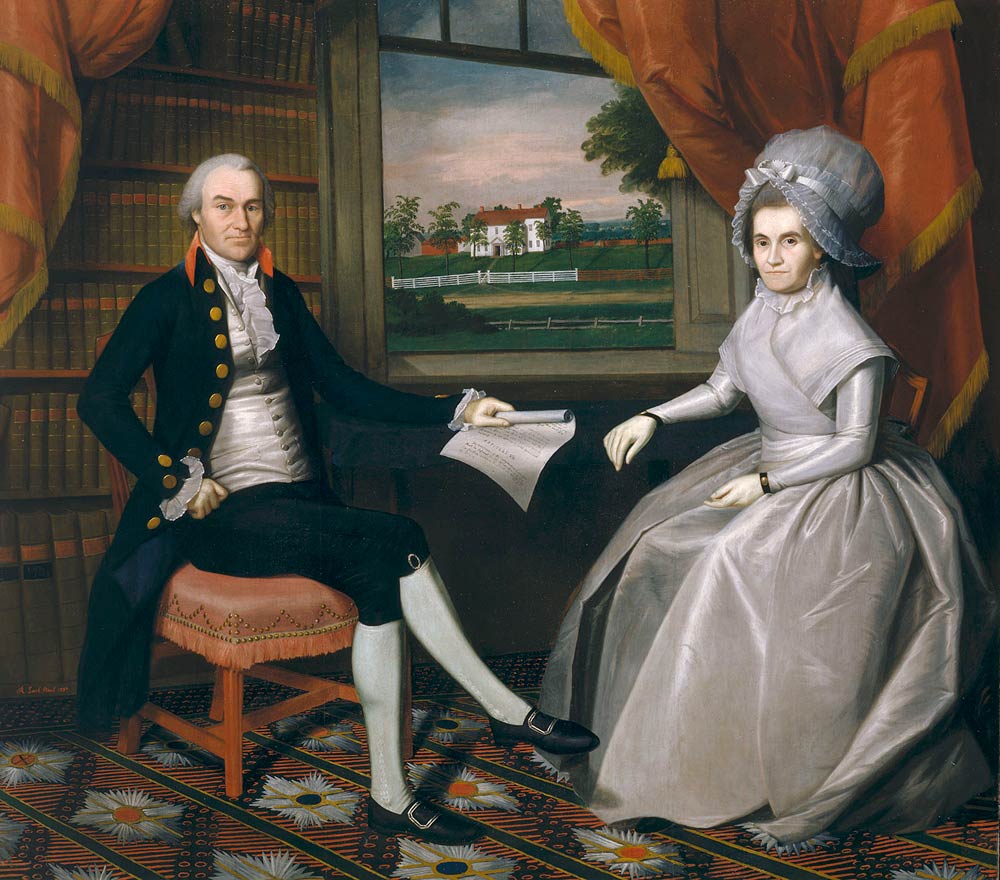
You can probably see some of the differences below.  First, a couple of Americans:
The Ellsworths
 Roger Sherman
Below are some  contemporary British aristocrats:
John Perceval, Earl of Egmont
 Duke John Churchill
Their expressions say it all.  In a fight, I’m putting my money on Ellsworth and Sherman.  Even in this famous painting of Benjamin West (a European) on the death of General Wolfe, one gets the impression that Ellsworth and Sherman would have said something like, “Sir, if you are going to die would you please be quick about it  . . .and stop mugging for the audience!”
Death of General Wolfe Benjamin West
I hope the students will enjoy our look at the war itself beginning next week.

A Leopard Cannot Change His Spots

I originally write this in January 2013, so don’t be too puzzled by the very dated football playoff reference!

********************

It’s playoff time in the NFL, and many talking heads now say that Atlanta quarterback Matt Ryan has “made the leap” by engineering a late game comeback against the Seahawks this past Sunday.  Having won the “big game,” Ryan can now join the club of “clutch” quarterbacks.

But if Matt Bryant had missed the field goal, we would be having a different conversation, one that focused on Ryan’s crucial 4th quarter interception that helped lead to a Seahawks comeback.  I agree with Grantland’s Bill Barnwell.  A lot depends on context.  After the Falcons lost to the 49ers, thanks in part to a Matt Ryan fumble, Barnwell wrote amusing follow-up here.

What is the stuff of leadership?

Any visitor to a library can get stuffed to the gills with theories of leadership, and while I admit to judging these books by their covers, I don’t think I buy any particular “theory” of leadership.

Of course all good leaders demonstrate the same basic characteristics.  They show firmness at the right time, or flexibility at the right time, or the willingness to listen and adapt at the right time, or to maintain the strength of their convictions at the right time, and so on, and so on.  But anyone can write this without any special talent.  Add to that, much leadership theory presupposes that people can fundamentally change who they are, that “type B” leaders can become “type A” leaders whenever the situation arises.  I doubt this happens much.  The same firmness and clarity of vision from Winston Churchill that helped save Europe in W.W. II also led him to be nearly all wrong on the Indian question throughout the 1930’s.

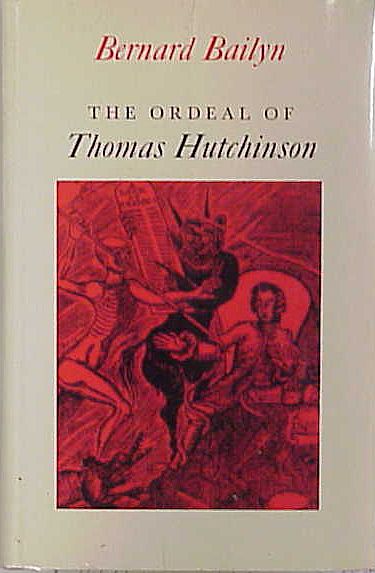
Bernard Bailyn’s book The Ordeal of Thomas Hutchinson demonstrates that people who might be great leaders in certain circumstances are utter failures in others.

Bailyn begins his book by revisiting the worst of the riots over the Stamp Act of 1765.  A variety of British officials received threats and intimidation, but none received the level of concentrated violence as Thomas Hutchinson, the Lt. Governor of Massachussets and also the Supreme Court justice.  Looters ransacked his house methodically for three days straight, taking several thousand dollars in cash and valuables, while causing another few thousand dollars damage to his house.

With this in mind, we would naturally make many assumptions about the man.  He probably gave loud and hearty support to the Stamp Act.   He probably displayed a haughty character.  Maybe he was even not native to the land, but a British import.  Probably he lived ostentatiously and lorded it over his fellow men.

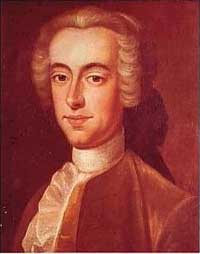
But nearly all of our natural assumptions about him would be wrong.  His portrait reveals a man of some reserve with the pleasant “Smile of Reason” the Enlightenment philosophes had down pat.   His house was nice, but not over the top.  He was born and bred in the colonies, and even wrote what is considered to be the best contemporary history of the Massachusetts  Colony.  He never published it. He commented to a few friends that it had too many flaws.

Thomas Hutchinson

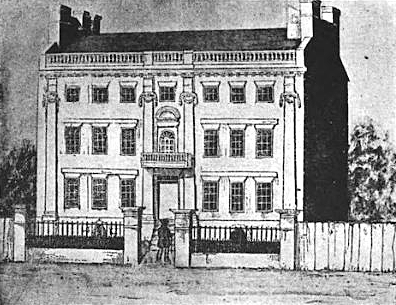
The Hutchinson HouseAdd to that, he opposed the Stamp Act!  As Chief Justice he commented that he thought the Stamp Act bad policy and sure to fail.  He earnestly hoped that the British would see reason and cease their plans for the doomed tax.

But he, more than any other, received the laser-like focus of wrath from the Sons of Liberty.  John Adams, along with James Otis, vilified him in print year after year, and Hutchinson, perhaps totally flummoxed, never seems to have responded in kind.  How did this happen?  Why did such a mild-mannered man as Hutchinson cause so much anger and resentment?

John Adams rarely passed up an opportunity to call Hutchinson a “courtier” — someone of no account who fawned his way to the top of society.  True, the marriages within his family aided his cause, but this form of social climbing was hardly unknown even in the colonies, and certainly known in England.  For what it’s worth, Hutchinson appeared to have a very good marriage, and he grieved long and hard for his wife who died in childbirth.

Others point to the fact that in 1765 Hutchinson held two offices, Lt. Governor and Chief Justice, and thus ran afoul of the emerging doctrine of the separation of powers that would make itself manifest in the Constitution.  But Hutchinson never sought a position on the court.  The governor nominated him, and he initially refused, claiming that he “had not the necessary legal mind” for the job.  He took it only reluctantly after repeated entreaties from the governor himself.

But Bailyn holds that the main cause of Hutchinson’s singular failure lie in his personality.  His love of careful compromise, his lifelong aversion to stirring the pot unnecessarily, made him singularly unsuited to leadership in a revolutionary age.  Indeed, had Hutchinson held power in England, we might very well be reading about how his careful, compromising leadership helped King George avoid war with the colonies.  But in America, that shoe did not fit.

We get an idea of the temper of the times when colonists criticized Hutchinson not for being for the Stamp Act, but for being against it for the wrong reasons.  Where people like Adams and Otis saw deep-seated principle at stake, Hutchinson saw misguided policy, and this attitude led to Hutchinson’s most unfortunate and damaging mistake.  Bostonians drew up  an eloquent and passionate objection to the Stamp Act to send to Parliament, but Hutchinson put on the brakes.  He argued, tinkered and pleaded for a month to change much of the tone and some of the substance of their entreaty, while still sharing their objections to the tax.  In the interval, other colonies gained fame and glory by publishing their own heated objections, making Boston look weak and tepid.  Between their first headstrong and final lukewarm drafts, England settled their minds and began the road to enforcing the Act.

Boston was not amused.  They vented all their considerable anger directly at Hutchinson.  Many of them suspected him (erroneously) of merely stalling for time and not really being against the Act at all.

If the revolution had never happened, who’s to say that the colonies would not in time have developed their essential independence along the lines of Canada? Such a smooth, uneventful and gradual transition would have tickled Hutchinson pink.

What Hutchinson never saw, however, was how his own mindset and personality had been shaped by a revolution 75-100 years prior — the intellectual paradigm shift known as the Enlightenment.   All that calm reasonableness would not have fit within the late 16th century any more than it did in late 18th century North America.

Alas for Thomas Hutchinson, a good and decent man, but one decidedly not of his time — a leopard who could not change his spots.

Edmund Burke on how to Prevent a Revolution

UnknownIt might be a good sign when those one admirers disagree among themselves, but for me it can be painful.  Few have taught me more than G.K. Chesterton, but I also like Edmund Burke.  Had the two co-existed they would not have been friends.  Chesterton believed that Burke’s innate conservatism meant that he disapproved of any change at any price, or that whatever political and social order in existence had divine sanction behind it.  Burke tended towards the stodgy, but I think Chesterton overreacted.  I see Burke as a champion of workable, reasonable policy, an Enlightenment man in a Romantic era.  Perhaps this is what Chesterton, the art school dropout, could not forgive in Burke.  Practicality can be maddening.

Burke’s marshaling of logic expressed in dense Enlightenment style can infuriate, all the more so when he’s right.  His Reflections on the French Revolution is a hard read but deserves its acclaim for its early prediction of all that would go wrong in France.   When I saw his Speeches and Letters on American Affairs for sale cheap, I felt I had to pounce and take a dose of good sense, albeit in protein bar form.

Burke speaks better than he writes, but I still found it rough going.  Despite this, Burke’s patented insight strikes again in England’s dealings with America. Burke saw England kill the golden goose between the years 1765-74 through one bad decision after another.  England never heeded his advice, and two wars resulted.  Burke’s thoughts have universal roots and application, and proceed as follows:

I hear the honorable gentlemen say, ‘I don’t care how we got into our predicament.  I only care now how to get out of it.’  . . . No possible good can come from this attitude towards our situation . . .

Burke calls England back to first principles.  Is the problem English debt, or colonial recalcitrance?  By 1774 the revolution had nearly begun, and England scrambled to make things right.  Burke saw England concerning itself only with dealing with whatever situation lay in front of them.  Constantly reacting, they never reflected.  One can’t solve a problem until you understand the problem, and this England never bothered to do.

In this case, Burke calls England to look in the mirror.  However bad the colonies have acted, we ourselves first damaged the relationship by our own actions.  Their policy adjustments thus amounted to little more than course corrections to avoid icebergs, when you should think more about heading south in the first place.

Besides, some of the things taxed were so trivial, that the loss of the objects themselves and their utter annihilation out of American commerce would have been comparatively as nothing.

Perhaps the English had a right to tax the colonists in some respects.  But Burke rightly calls out the English for foolish and paltry duties on things like playing cards.  Such taxes only aggravate and obscure whatever good purpose you might have.

. . . but whatever it is, [you] gentlemen will force the colonists to take the teas.  You will force them?

Burke admits that the Tea Act had many benign and even generous provisions.  To then use force risked ruining everything.

“Incredible as it many seem, you know that you have deliberately thrown away a large duty [the normal course of trade in tea] for the vain hope of getting one 3/4 less, through every hazard, certain litigation, and possibly through war.”

Had they left well enough alone they would have collected plenty of money.  They reduced duties on tea, but then used force to ensure they would collect it.  Again, Burke argues that it appears that the true purpose of the British is to assert their authority rather than enrich their people and make peace.  This gets to the root of the problem itself — England had its priorities all wrong.

Force over time wastes away.

Burke continues . . .

To repeal by the denial of our right to tax in the preamble would have cut, in the heroic style, the Gordian knot with a sword.

The English piddled around the fringes of the various taxes they imposed, modifying this or that over time.  True, sometimes they lessened the duties instead of increasing them, but this yo-yo act ensured colonial aggravation.  Had they simply denied their right to tax altogether they would solved the problem immediately.  Nor would it have cost them money in the long run.  Burke cites the exponentially increasing British imports pouring into America over the past 50 years.  Forcing certain duties, having the Americans object, followed by the inevitable British penalty of closing ports, has the British run the long way round for nothing, or less than nothing.  Much better to act on principle (which the colonists would respect) and be done with it.

Freedom is to them not only an enjoyment, but a kind of rank and privilege. . . . I do not mean, Sir, to commend the superior morality of this sentiment, which has at least as much pride and virtue in it; but I cannot alter the nature of man.

Burke acknowledges that some colonists talked far too much of liberty, perhaps without any sense of responsibility.  John Wesley certainly thought so.  Slavery proves it.  But Burke realized that England had no ability to change what the colonists believe.  Force would certainly not accomplish this, and likely make it worse.

But England would not back down, because at least on Burke’s reading of the situation, they cared more about asserting power than peace.  Perhaps they cared about peace, but it would have to be on their terms.  The outbreak of war and its result proved how wrong they were, and that sometimes stodgy, methodical wisdom is best after all.

I can’t assert this with blanket accuracy, but it seems to me that whenever nations disconnect from reality by doing one thing not for the purpose of the thing itself, but as a placeholder for something else entirely, the results never pan out.  One thinks of Johnson’s bombing in Vietnam.   No one thought the actual bombing particularly effective, but we assumed it would send a political message to the North.  We know how that worked out.  Burke’s message to live in reality stands the test of time.