Democracies and their Aristocracies

This post has had a few different lives (originally written during the party primaries in 2016) . . .

Our most recent election raises many questions for many people.  One thing appears clear . . . we knew that the Republican party was in trouble before this election.  Otherwise, Trump never would have received the nomination.  The fact that Clinton lost, however, shows the weakness of the Democratic party as well.  The whole party system will likely need a reboot in the coming years.

Below is the first re-posting note . . .

*************

I published this about a year ago (you will note the dated references), but republish it to coincide with our look at Aristotle in our senior level Government class.  The original post is below.

**************************************

Democracies have always had at best an uneasy relationship with aristocracies, for obvious reasons. The very presence of an aristocracy either seems like an obstacle or a reminder of the inadequacy of democracy.  But first and foremost, I suppose, democracies would interest themselves in self-preservation.  In turn it might mean, to paraphrase Aristotle, that democracies should adopt not the political practices that democracies want, but those designed instead to preserve democracies.

I thought of Aristotle’s dictum while reading Jonathan Rauch’s provocatively titled Political Realism: How Hacks, Machines, Big Money, and Back Room Deals can Strengthen American Democracy.   I love the title.  Its (seeming) incongruity demands further examination.  But I admit I initially dismissedpoliticalrealism_990x450 the idea as a farce — until I thought about Donald Trump in the Republican primaries.  Democrats should be careful of cheering Trump on in the almost certain hope that he will fall on his face in due course.  We need good candidates on both sides to spur one another on and stabilize the electorate.  I found myself thinking, “Trump has had his fun and served his purpose.  Why hasn’t someone taken care of this?”  Then I realized that what in fact I wanted was a smoke-filled back room where “decisions” got made about these sorts of things.
No one suggests that such a solution resembles democracy.  But Rauch argues that these practices in fact preserve middle-ground, the key to a stable democracy. We fret about the increased polarization of the country and the lack of compromise. Look no further, Rauch argues, then to the decline of the power of parties — in our day particularly, the decline of the Republican party.  He contends that political machines in fact serve two key purposes:

  • They traffic in interests not ideas.  Ideas have no limits, no boundaries.  The “system” of politics is more easily quantified, thus more easily measured and controlled.
  • The candidates of a ‘machine’ stand accountable to a conglomeration of interests.  Ideological candidates have much less direct accountability.  This lack of accountability makes ideological candidates more free, and thus more oppositional.  As Rauch writes, “Show me a political system without machine-politics, and I’ll show you confusion, fragmentation, and a drift towards ungovernable extremism.”  Moderation, he argues comes not from moderates, but from machines that by design moderate everyone’s extremism.

Machine politics reminds us of Tammany Hall and other kinds of organizations filled with what even its ardent defenders might call “honest graft.”  Rauch argues that politics always involves making a lot of sausage.  But he argues that political machines also accomplished a great deal.  Tammany Hall dramatically boosted voter turnout and passed a great deal of progressive legislation.  Lyndon Johnson made who knows how many deals to pass the Civil Rights Act.  Progressives, Libertarians, and Tea-Partiers, Rauch argues, get so caught up in the purity of the idea, the purity of the process, that nothing ever gets done.  For him they are the modern-day lotus eaters.

But however good sausages taste, watching them get made never sits well.  Machine politics face the hurdles of ideologues. The modern media microscope surely offers no help either.  I can see Americans get fed up with polarization and return to a more centrist mindset.  I can’t see the media going away or turning a blind eye any time soon to back-room deals.  This poses the biggest challenge to a return to the bygone days of political machines.

Rauch makes an eloquent plea for his idea.  He effectively demonstrates the moderating effect of machines.  I wish he had talked more about the inevitable nature of ideology in democracies, or the inevitable nature of ideology in human experience.  For Rauch, ideology is almost a four-letter word. He recognizes its power, but not its place.  So, ok, machines can moderate ideologies.  But I wonder if Rauch the pragmatic realist is asking us to accept the fantasy that (to reference Thucydides) interest will trump honor and/or fear.

Also we need more than a modern comparison to evaluate it. We need greater perspective outside of our own sphere. Basically what he asks for is a democracy managed by a semi-official oligarchy.  In many ways we had this in  post-Napoleonic Europe in the 19th century.  How does this period stack up?

Some features of this era:

  • A significant increase in democracy through expanded voting rights, and in some places, limitations on the ‘elite’ legislative bodies (like the House of Lords in England).
  • Relative peace — at least internally in Europe.  Wars happened but they tended to be limited in scope and duration.
  • An aristocracy that had less power than the previous century but still lots of influence.  What’s more — this aristocracy had more mobility than perhaps at any other time in history.  Traveling around Europe formed an integral part of the growing up experience for many aristocratic youth.  Thus, the aristocracy formed a real “boys club” throughout central and western Europe (most of the monarchies also had some familial relationship to one another as well).
  • As an extension of this, lots and lots of international conferences to settle disputes and award prizes to the participants.

Of course no era is perfect.  Some would point out that the “relative peace” I mention came at the expense of significant overseas expansion. I argue elsewhere that such expansion created domestic internal issues.  Others might say that the catastrophe of W.W. I emerged from the ultimate failure of this system. We should consider their record in context, however. The system they established must have the backdrop of the chaos of the highly ideological French Revolution and the resultant Napoleonic Wars that killed millions.

We will see whether or not this next election shows the need for the return of political machines.  If Hilary Clinton runs against Jeb Bush for the presidency, we might even argue that such machines never left.  But another question that Rauch fails to ask is, can they return to prominence?  It may be more than a matter of political will.  The decline of political machines has its roots beyond politics.  For example, after itunes, Youtube, etc., record companies exist, but not in the same way.  The power they had in the 1990’s to release greatest hits albums of their artists but put one new song on the album to try and make die-hard fans buy entire albums to get that one song — may never return (not that I’m bitter or anything).  We can observe this de-centralization most everywhere in our culture.  And surely this de-centralization comes at a price, but also gives some benefits?  Rauch sees no real benefits to political de-centralization and cannot weigh the merits of both.

But this is still a good book.  It makes one think.  Fundamentally, it asks us to consider whether or not democracies, left to themselves, will preserve themselves from their own folly.

11th Grade: The Dilemmas of Reconstruction

Greetings,
This week the students worked on their Reconstruction projects.  I wanted to give them a chance to approach an era from a different perspective than the usual classroom.  They had to present their own plan for organizing Reconstruction as if they lived at that time.  A couple of “big picture” issues they need to keep in mind. . .
  • Winning the peace is just as important as winning the war — indeed winning the peace is not only  part of the war effort, it forms the very reason for the war itself.
  • How various elements of reconstruction, the economic, cultural, political, military, etc. should all work together.  Ideally students should see this seemingly disparate elements as part of a coherent whole, moving together towards a single purpose.
  • Part of the goal of Reconstruction deals with why conflict began in the first place.  If “Reconstruction” will prevent another war, it has to deal with the root causes of the conflict to be successful.  Seeing the Civil War arising largely out of economic and cultural differences, as opposed to purely political differences, would produce different goals for the post-war process.  If one saw the main problem rooted in the social position of African-Americans, Reconstruction would look different still.

I gave students a series of maps to help guide them through this process.  For example, if students want to focus on the social aspects of Reconstruction they may need to know the population density for African-Americans:

And the population density of the U.S. as a whole . . .
Economic issues would certainly involve railroads. . .
And you may want to concentrate your efforts most effected by the Civil War itself. . .
And so on.  The students had to face many questions and dilemmas.
Was Reconstruction a success or failure?  Ultimately it depends on your point of view, and what one might want Reconstruction to accomplish.  On the one hand, civil war  never again threatened the country, and the lives of African Americans did improve, at least to a relative degree.  The 13th-15th Amendments helped preserve legal rights especially for African Americans.   On the other hand, ‘Jim Crow’ laws arose in the South, which kept most African-Americans as second class citizens.  Many issues from the Civil War would not be fully worked out until the Civil Rights era of the 1960’s.  Some enduring bitterness remained in parts of the South that have still yet to be fully healed.  We will revisit these issues later this year.

10th Grade: The Dutch Have Their 15 Minutes

Greetings,

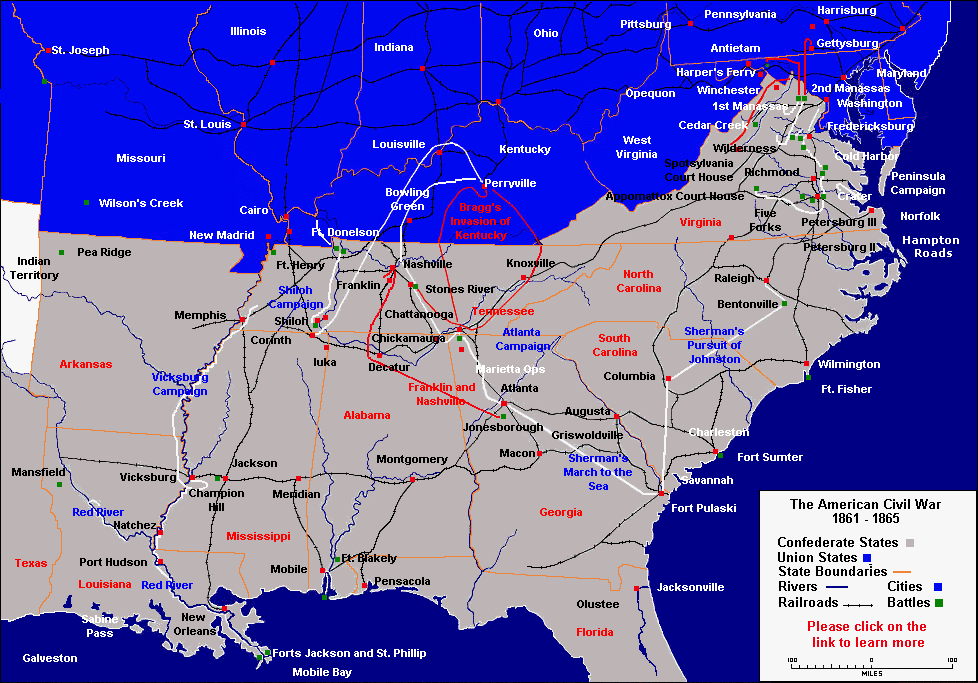
This week we looked at the golden age of Dutch culture from around 1630-75, and how that related to the painting of Rembrandt.  I can think of three instances where a naval based culture defeats a large empire, and then subsequently experienced a ‘golden age.’

1. Athens defeats Persia ca. 480 BC, which leads to Periclean Athens (Aeschylus, Euripides, etc.)
2. England defeats Spain in 1588, which leads to Elizabethan England (Shakespeare, Philip Sydney, etc.)
3. The Dutch defeat Spain ca. 1600, which brings about the Dutch Republic (Rembrandt)

I don’t know if this is coincidence or not.  Can anyone think of other examples?  We discussed before what needs to happen to create a ‘golden age’ in a culture, but I don’t know if having a solid navy needs to be part of that. Might we suggest that navies give people a broader perspective of the world, which allows for broader minds to create culture?  Or, do navies lead to trade, which brings economic prosperity, which also seems to be an ingredient?   I am not sure.

The Dutch defeat of Spain had military and economic causes.  The Spanish had seemingly inexhaustible silver mines in the new world, but the Dutch had something new and more powerful: a stock market.  Initially all of us might take the silver mine over the stock market, but why did the stock market beat the silver mine?  We discussed this in class, with the caveat that I am not an economist:

  • A silver mine would make one feel rich, but what does one do with the wealth?  If everyone wins the lottery, no one in fact would win, because inflation would skyrocket as prices would inevitably rise.  Loads of silver are in the end a wasting asset.  In fact, prices rose some 400%  in Spain over a period of a century.
  • Besides this, how the money is used makes a difference.  If it is used in a consumptive way, no new wealth is created.  If you buy a series of fancy dinners, well and good, but the money is in your belly.  If money was invested or used to create, it could create ‘new’ money, like a perpetual motion machine.
  • Of course, having money create new wealth requires a society where innovation is possible, a society that allows for creativity and risk.  When studying the Spanish Armada we saw how Spain lagged behind other European nations by maintaining a traditional social structure.
  • Currency can be anything that has value.  If you buy $10 worth of stock, the certificate = $10.  But if the value of the company goes up, the value of what you own does as well.  That $10 certificate can become $30 over time. You just made $20 — new wealth appears almost by magic.  But this new wealth would ideally, at least, be tied toward actual production which would benefit society.  So, ideally again, the value is not simply ‘on paper’ but has some tie to reality.  Stock market bubbles burst when value becomes artificial, supported merely by belief or false delusion, and we discussed the first stock market boom/bust with the tulip craze.

The Dutch also invent the idea of the corporation.  Though today many view the corporation as  the epitome of entities estranged from “the people,”  their original invention had a lot to do with the broad Republic created by the Dutch.  The corporation not only allowed resources to be maximized and risks minimized, it allowed for the ordinary Joe to have a shot at wealth and status.  No longer would money be in the hands of the aristocracy, or those granted a royal monopoly.  It is a bit ironic to see what has happened to the image of corporations recently, but perhaps some of it is just.  Perhaps corporations have grown so large as to become essentially faceless and detached from a human and understandable context.  This, I think, is the root of some of modern unease some feel towards corporations today, but in the beginning the corporations was the ‘underdog,’ the People vs. the Established Powers.  Still, I long for the day when a corporation is not the bad guy in a recently released movie.

On a related note, we had a good discussion about the morality of stock markets, and whether or not it is just for someone from the market.  Should someone profit without work?  Or is investing in company a kind of ‘work’ that benefits society?  I’m happy to say that the students did very well with these heady concepts.

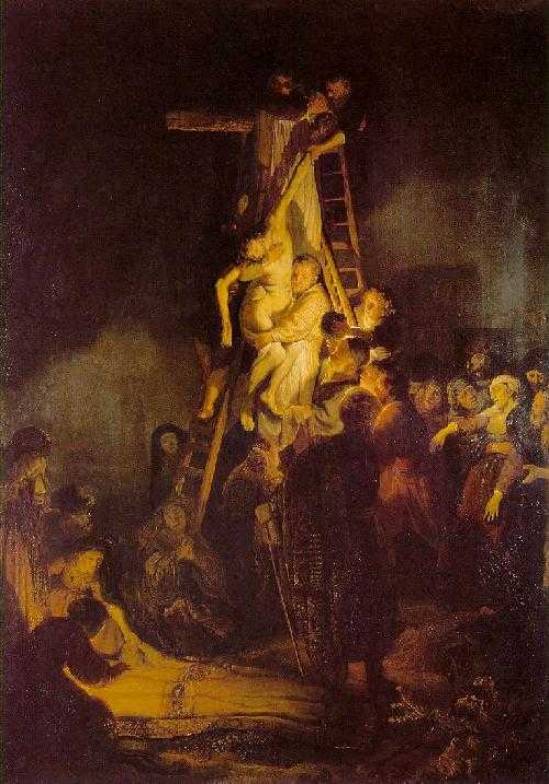
A few weeks ago we  looked at the  art of Rembrandt, the great Dutch master, and compared him to Carravaggio, contemporaries of each other.  The Reformation emphasis of the sanctity of the everyday, of humanity itself, shines through in Rembrandt’s work.  His portraits get inside people’s skin, bringing dignity and meaning to each individual.

Rembrandt painted many religious works, and his up and down life may have helped him not pull any punches with himself.  In this famous work, many believe that Rembrandt puts himself in the work (bottom right), associating himself with those that killed Christ.

Though Carravaggio was a Catholic, his emphasis on everyday people amidst the drama of salvation shows the influence of the Reformation (and perhaps a resurgence of the Medieval mindset against the Renaissance) as well.  He excelled in painting sinners.  In my favorite work of his, “The Calling of St. Matthew,” all of his genius gets poured to Matthew’s surprised, yet hopeful eyes.

Carravaggio’s possessed a wild and unruly streak, one that led to him killing a man in a duel in a dispute over a woman.  In perhaps his most dramatic work (and one of his last), he uses his own head as the model for Goliath.

How can one choose between two great masters?  Yet the differences in their work reveal differences in their personalities and their respective cultures, something I wanted the students to consider.

Blessings,

Dave Mathwin

12th Grade: The Presence of Law is Half the Problem

Greetings,

This week we wrapped up our discussion of Plato’s political philosophy, at least for the moment.  This week we spent some time with Plato’s dialog The Statesman.  Many take the position that Plato’s Republic represents his best-case, unrealistic dream-world, and his subsequent dialogs (such as The Statesman) represent a more realistic approach.  I think this too simplistic, but clearly in The Statesman Plato wrestles with the fact that a) Rulers are not divine, and b) people are not sheep who will easily obey.

The problem gets compounded for Plato when he considers the nature and purpose of law.  States cannot exist without law, and yet Plato believes that the presence of law at all reveals a fundamental weakness in the state itself.  This sounds confusing, but if we consider our relationships with our spouses and friends, they are not governed by law.  We don’t have stipulations such as, “You must call me every day from work or you will face ‘x’ consequence.  Law in fact would kill the relationship.  The bonds between us have to be more organic and natural for the relationship to function well.

The same holds true for the state itself.  The presence of law presupposes problems in our relationships with one another.  If a state relies on law to hold itself together, the bonds will be merely external and therefore weak.  Plato knows that “philosopher kings” who know all and get obeyed by all is an impossibility.  He knows that a law-bound state will lack the internal harmony* required for success.  How to proceed?

Plato believes that the problem will have a partial solution if our leaders are “statesman,” and not “politicians” in the standard sense of the word.  Politicians attempt to curry favor with the people, or blow with the prevailing winds in a pavlovian manner, without regard for wisdom.  Politics then, can be a matter of mere technique.  Statesmanship, on the other hand, is an art form.  Statesman don’t rule via law, they find a way to knit people together without law.  We can approach Plato’s idea here if we think back on our greatest Presidents, who seem to embody something “American” for all people.  We don’t call them successful presidents for the great laws they passed, but for how the embody us and motivate us.  Law can do neither of these things.

Plato uses the analogy of weaving to describe the statesman’s art.  I include an excerpt from the dialog below if you have the interest.  Weaving shows up in many ancient texts, and seems to represent more than just skill with cloth (something I discuss in this post).  Plato kept on exploring, and he entitled one of his last dialogs The Laws, which may be an indication that he abandoned his dream late in life.  We need not see this necessarily.  Perhaps Plato wanted to tackle the problem of good governance from many different angles, and even in the laws he focuses on the importance of the soul.  We shall look at The Laws later in the year.

*A harmonious state requires harmonious souls within the state, hence Plato’s frequent references to music and the need for the state to control music within it.

Plato’s “The Statesman” — The Art of Weaving

STRANGER:

Then you and I will not be far wrong in trying to see the nature of example in general in a small and particular instance; afterwards from lesser things we intend to pass to the royal class, which is the highest form of the same nature, and endeavour to discover by rules of art what the management of cities is; and then the dream will become a reality to us.

YOUNG SOCRATES:

Very true.

STRANGER:

Then, once more, let us resume the previous argument, and as there were innumerable rivals of the royal race who claim to have the care of states, let us part them all off, and leave him alone; and, as I was saying, a model or example of this process has first to be framed.

YOUNG SOCRATES:

Exactly.

STRANGER:

What model is there which is small, and yet has any analogy with the political occupation? Suppose, Socrates, that if we have no other example at hand, we choose weaving, or, more precisely, weaving of wool—this will be quite enough, without taking the whole of weaving, to illustrate our meaning?

YOUNG SOCRATES:

Certainly.

STRANGER:

Why should we not apply to weaving the same processes of division and subdivision which we have already applied to other classes; going once more as rapidly as we can through all the steps until we come to that which is needed for our purpose?

YOUNG SOCRATES:

How do you mean?

STRANGER:

I shall reply by actually performing the process.

YOUNG SOCRATES:

Very good.

STRANGER:

All things which we make or acquire are either creative or preventive; of the preventive class are antidotes, divine and human, and also defences; and defences are either military weapons or protections; and protections are veils, and also shields against heat and cold, and shields against heat and cold are shelters and coverings; and coverings are blankets and garments; and garments are some of them in one piece, and others of them are made in several parts; and of these latter some are stitched, others are fastened and not stitched; and of the not stitched, some are made of the sinews of plants, and some of hair; and of these, again, some are cemented with water and earth, and others are fastened together by themselves. And these last defences and coverings which are fastened together by themselves are called clothes, and the art which superintends them we may call, from the nature of the operation, the art of clothing, just as before the art of the Statesman was derived from the State; and may we not say that the art of weaving, at least that largest portion of it which was concerned with the making of clothes, differs only in name from this art of clothing, in the same way that, in the previous case, the royal science differed from the political?

YOUNG SOCRATES:

Most true.

STRANGER: In the next place, let us make the reflection, that the art of weaving clothes, which an incompetent person might fancy to have been sufficiently described, has been separated off from several others which are of the same family, but not from the co-operative arts.

YOUNG SOCRATES:

And which are the kindred arts?

STRANGER:

I see that I have not taken you with me. So I think that we had better go backwards, starting from the end. We just now parted off from the weaving of clothes, the making of blankets, which differ from each other in that one is put under and the other is put around: and these are what I termed kindred arts.

YOUNG SOCRATES:

I understand.

STRANGER: And we have subtracted the manufacture of all articles made of flax and cords, and all that we just now metaphorically termed the sinews of plants, and we have also separated off the process of felting and the putting together of materials by stitching and sewing, of which the most important part is the cobbler’s art.  Then we separated off the currier’s art, which prepared coverings in entire pieces, and the art of sheltering, and subtracted the various arts of making water-tight which are employed in building, and in general in carpentering, and in other crafts, and all such arts as furnish impediments to thieving and acts of violence, and are concerned with making the lids of boxes and the fixing of doors, being divisions of the art of joining; and we also cut off the manufacture of arms, which is a section of the great and manifold art of making defences; and we originally began by parting off the whole of the magic art which is concerned with antidotes, and have left, as would appear, the very art of which we were in search, the art of protection against winter cold, which fabricates woollen defences, and has the name of weaving.

YOUNG SOCRATES:

Very true.

STRANGER:

Yes, my boy, but that is not all; for the first process to which the material is subjected is the opposite of weaving.

YOUNG SOCRATES:

How so?

STRANGER:

Weaving is a sort of uniting?

YOUNG SOCRATES:

Yes.

STRANGER:

But the first process is a separation of the clotted and matted fibres?

YOUNG SOCRATES:

What do you mean?

STRANGER:

I mean the work of the carder’s art; for we cannot say that carding is weaving, or that the carder is a weaver.  Again, if a person were to say that the art of making the warp and the woof was the art of weaving, he would say what was paradoxical and false.

YOUNG SOCRATES:

To be sure.

STRANGER:

Shall we say that the whole art of the fuller or of the mender has nothing to do with the care and treatment of clothes, or are we to regard all these as arts of weaving?

YOUNG SOCRATES:

Certainly not.

STRANGER:

And yet surely all these arts will maintain that they are concerned with the treatment and production of clothes; they will dispute the exclusive prerogative of weaving, and though assigning a larger sphere to that, will still reserve a considerable field for themselves.

YOUNG SOCRATES:

Very true.

STRANGER:

Besides these, there are the arts which make tools and instruments of weaving, and which will claim at least to be co-operative causes in every work of the weaver.

YOUNG SOCRATES:

Most true.

STRANGER:

Well, then, suppose that we define weaving, or rather that part of it which has been selected by us, to be the greatest and noblest of arts which are concerned with woollen garments—shall we be right?

Mr. Kipling’s Army

Some years ago I read A Perfect Mess, a delightful book that sought to demonstrate the blessings of individuality in business and life.  The book centers on the basic idea that creating uniformity in how people work, process, and store information, though it looks efficient, will in fact harm the bottom line for 2 main reasons:

  • Acquiring the time and means to store information takes more time and money than we might think, and
  • It forces everyone into a mold few people (except the fussy bureaucrat) work well within.

The authors cited the real-life example of two newsstands on the same New York street.  One store had all the modern accoutrements, such as computer reordering systems, a large selection, beautiful decor, and a helpful staff.  The other was a father-son operation that had less of everything.  But only the father-son store stayed in business.  All that selection, decor, staff, and computer systems came with a steep price tag.  Somehow the poorly-lit, somewhat ramshackle father-son operation worked just fine.

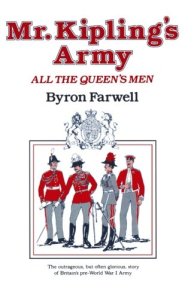
I thought of A Perfect Mess reading the similarly entertaining Mr. Kipling’s Army by the pre-eminent military historian of the Victorian era, Byron Farwell.  Certain things about the British army of this period seem almost impossible to believe.

For one, no one commanded the army.  By this, I don’t mean that no one person commanded the army, I mean that no agreement existed as to whether or not the Crown or Parliament commanded the army.  No “Joint Chiefs of Staff” existed.  Different people commanded different sections of the army, but at root the army had no unity of command.

The practice of purchasing army commissions continued long into the 19th century, which allowed anyone with enough cash and enough desire to immediately assume the rank of Lt. Colonel.  True, some disagreed with this practice. But it had numerous supporters, among them, the Duke of Wellington, who argued that the purchase of commissions gave the upper echelon of officers a direct stake in the well-being of the army/country.

Furthermore, various physical handicaps had no bearing on one’s ability to serve.  Some generals could not hear.  Some could not walk.  Some could not even see, being legally blind.  No one seemed to mind.

The army never grew even close to the size of armies in other European countries such as Prussia and France.  But this same “pint-sized” army was also spread out further over the globe than the military of any other country at that time.

Despite all this, none can doubt that the British army of this period did more with less than anyone else.  Quite simply, they were an enormously effective force, and between 1815-1914, more effective than anyone else.*

Farrwell offers no direct answers to this seeming paradox, but he packs the book with so many choice nuggets that one can begin to answer the question for themselves.  A key feature of the British army in this period would surely be regimental pride and identity, though not, as we might expect, army pride and identity.

The numerous regiments had their own uniforms, customs, mascots . . . a unending list of distinctives.  Sometimes these distinctives included actual violent rivalries with other regiments, but no matter.  If the British had one sacred guiding principle in this era it amounted to this: Do not mess with regimental traditions.  They tolerated almost anything not to violate this sacrosanct dictum, including actual criminal behavior by some soldiers, i.e., “Smashed shop windows at Blenheim Square?  And today is the third Saturday of March?  Pay no mind, that’s just the boys of the 10th Essex.”

The British may have gone too far with their one sacred principle, but they chose well.  Various testimonials abound at how the accretion of tradition and custom built a very strong sense of unity and identity within each fighting line.  The Romans (another effective army!) did something similar for much of its history, grouping soldiers as much as they could by village.  You fought next to those you lived with.  Almost every officer hated getting pulled from regimental ranks into a staff job.  Parting with the regiment meant parting with family.

Armies get their modus operandi, hence their effectiveness, from the societies that create them.  When a natural meshing occurs between army and society, the armies will have much more power because they will have more confidence, consciously or not.  Military action has a greater chance of meshing with society at large, which again adds to the effectiveness of military action.

The British did this brilliantly, whether they realized it or not.  The 19th century in England saw a curious blend of aristocracy and democracy.  The power of the monarch and the House of Lords all underwent a steady transformation towards more democracy, but a strong aristocratic flavor remained.**  Even the “defensive” dress (as brilliantly put by Lord Clark in his Civilization series) of the middle and upper-middle class showed an aristocratic motive to distinguish themselves from the masses.  Chesterton’s early 20th century work  The Club of Queer Trades delightfully pays homage to the British mania for clubs at the turn of the 20th century.

The British saw to it that each regiment was its own club, its own mini-aristocracy with its own traditions, dress, and way of life.  Anyone in a regiment would immediately become part of a mini-society that would give them a holistic identity apart from the rest of society.  As even our modern political scene teaches us, people will fight hard to maintain their sense of identity.

All of this should make us ponder our current situation.  I remember reading an article some time ago that mentioned that over the last 10 years the military has seen a huge spike in those hoping to become snipers.  Maybe this is the result of video games, but maybe not.  Military movies for decades focused on the heroism of the average Joe.  Now our movies and many of our military operations focus on our special forces, a kind of aristocracy within the military at-large.  And yet, our country may be moving in a more populist direction.  If so, this would put some tension between our military and our society which in theory could damage its effectiveness.

Or, possibly what we think is populism is in fact an extension of a kind of hyper identity awareness.  We do see a rise in the role of personal identity with issues surrounding sexuality and gender, and perhaps race as well.  If this is correct, then our military and society may be moving in a more feudal/aristocratic direction, not in the sense of having a defined upper class by birth, but by the segmenting of “Society” into multiple different smaller societies and interest groups.

Or perhaps its instead some weird combination of things, as may often be the case with American history.

Dave

*For now we will leave aside the moral aspects of their military adventures.

**Barbara Tuchman discusses this aspect of English life at this time vividly in The Proud Tower.


Aristocratic Age

Spit and Polish v. Drill

Link to sp. forces


El Campesino

The book jacket to El Campesino: Life and and Death in Soviet Russia boasts that, “this is not another memoir of a tortured intellectual wrestling with his conscience.  This book is in every sense a tense narrative of action, played out against the world’s most important struggle.”

Enough obsessive Russians!  “I was elected to lead, not to read!”

This blurb is accurate, however.  The main character, Valentin Gonzalez, “El Campesino” (the Peasant), is indeed a man of action and not reflection.  His narrative tells the story of his struggle in the Spanish Civil War, which makes him a hero of the Communist Party.  Feted by the Soviets, they whisk him away to Russia for specialized training.  He quickly grew disillusioned with the El CampesinoSoviet system.  His fiery personality led to numerous conflicts with party officials, which led to his imprisonment.  Gonzalez’s relentless forward-looking energy helps him escape not once but twice from prison camps, and eventually to freedom–the stuff of legend.

Such a triumph would indeed never happen with a more introspective “intellectual wrestling with his conscience.”  Gonzalez’s accomplishments come with a host of morally questionable actions he takes, but true to his nature, he hardly blinks an eye.  Gonzalez tells us that in the gulags the political prisoners often die within six months, while the ordinary criminals find ways to survive.

He decided to survive.

Of course one can’t help but root for him.  In many respects we certainly should root for him–for one, we obviously have to root against the Soviets.  Some introspection, some torturing of his conscience, however, might have helped him do more than merely survive.

One incident fairly early in the book jumped out at me that illumined the dark caverns of the Soviet system, and humanity besides.

Upon their arrival in Moscow Gonzalez and other “Heroes of the Revolution” received royal treatment.  Each of them had a “maid” assigned to them.  These maids came young, pretty, perfumed, and quite willing to do anything at all.  In fact the girls sought to sleep with them.  This, they knew, would be part of their weekly evaluations.

Possibly one of these “heroes” might have traditional ideas about sexual behavior and marriage (Gonzalez did not).  But such a man would face a terrible dilemma.  If he did not sleep with her, she might receive poor evaluations and perhaps even a punishment.  He would feel sympathy and wants to protect her.  So he sleeps with her.  But the maids sleep with the men primarily to put them off their guard so that they might reveal “anti-Soviet” thoughts.  They received big rewards for successfully extracting useful information for the NKVD.

The Soviets certainly recognized our need for fellowship and intimacy, but they exploited this not only to turn people against each other, but to turn someone against their very selves.  This result seems almost inevitable given the circumstances.

The life of Father George Calciu, however, shows us a different path.

Father George lived in Romania and came of age just prior to the communist takeover after World War II.  They arrested him in 1948 not so much for any specific crime, but mainly because he was one of the younger, educated set that the communists needed to make their own.  The old did not matter so much.  Romania’s traditional culture and deep roots in the Orthodox faith could die out with them.

Father George and others like him went to an Orwellian style prison designed to break them psychologically more than physically.  Their captors sought via a variety of techniques to separate them from the past and themselves straight out of 1984.  Father George confessed that such methods worked.  He said things to his interrogators he regretted.  After some months he found that he could not remember much about his childhood.  He could not remember how to pray.

Father George CalciuThen two things happened.  First, he realized that he did remember one prayer–“Lord Jesus Christ, Son of God, have mercy upon me, a sinner.”  This helped him remember himself and led to his remembering the the Lord’s Prayer and a few others.  Second, the interrogation process culminated when they successfully recruited prisoners to help them torture other prisoners.  Father George had said things he regretted, but this he would not do.  He felt terribly alone, for if he had agreed to this, he would have found at least some form of fellowship, some kind of sense of team with the other guards.

But then a curious thing happened.  The jailers lumped all the resistant prisoners together, perhaps not wanting them to infect their own converts.  Here Father George found a new community centered around their mutual faith in Christ and a commitment to human dignity.

Now, he knew himself again.

Some years after his release he felt called to deliver a series of Lenten sermons to Romania’s youth and a similar pattern emerged.  The seminary where he taught knew these messages might provoke trouble with the authorities.  They refused to support him, and once again Father George found himself alone.  But he went forward anyway, and to his utter shock, thousands and thousands of students came to hear him each week.  His “Seven Homilies to the Youth” had an international distribution.  He faced a second term in prison.  But now he was an internationally known dissident, and this gave him a small measure of protection.  In both instances, Father George refused to give in to the communist inspired ideals of community.

I admire the courage and audacity of Valentin Gonzalez.  But Father George Calciu showed us a better way.


A Sin Against the Gift of Self

I had a startling realization over this past Christmas that I might be getting old.

My son received an album by The Who as a present and I ended up reacquainting myself with their music as we listened to it together in the car.  Hearing again especially some of their earlier music, all the fuss “eggheads” made in the 1960’s about rock music destroying the youth, and ultimately destroying our civilization, made total sense.

How could this be happening to me?  It could possibly have something to do with the minivan in the driveway . . .

My reaction came not so much from their penchant to destroy their instruments (which I always just found pointless and hardly scary or “revolutionary”) but from the lyrics, rhythm, etc.  Everything seemed to be about angst, alienation, anger, emotional distress, “I’m better than you,” and so on.  Again — some of this changed as they matured as people and musicians in the 1970’s.

“Kid’s these days!”

But if one reflects on popular music in general we see that The Who (who at least were interesting and talented) probably were not nearly as “dangerous” as some other bands/pop stars.  So much even of the best pop music (even early Beatles) aims for the lowest denominator of teenage emotional distress.*  So much of it seems so small, petty, narrow, trapping us inside ourselves.  When we consider that the goal of the Christian life is “contentment in all things” through union with God and our fellow man, we see how obviously such music works directly against that.

In her recent interview with Tyler Cowen the always engaging Camille Paglia talked of how she finds the culture of today small and largely pointless.  In contrast, the culture she grew up in celebrated the large and grand.  The Ten Commandments has the huge statue of Pharaoh move across the screen, or the vast expanse of the desert in Lawerence of Arabia.  Today the internet opens up a whole world and yet we sit fixated on tiny screens.

Perhaps there is a connection between the two.

In the Church’s patristic era a variety of monks described a spiritual state they called “acedia.”  Through a series of unfortunate twists and turns the sin of acedia would come to thought of as mere laziness.  But originally, it meant something deeper and more profound than this.  Abbot Jean Charles Nault seeks to recover its original meaning and its relevance for today, in his book The Noonday Devil.  He attempts to explain the meaning of acedia with roots in apathy, boredom, and indifference.  The middle section, where he discusses the work of Thomas Aquinas, got a bit tedious for me at least (which is a shame because St. Thomas is not tedious).  Despite this, one sees clearly that Abbot Jean has written a useful and timely work.

Abbott Nault begins by tracing the development of the idea of acedia, first recognized, or at least, written about, by the early desert monastics.  Anyone familiar with the writings of such fathers know they possessed profound spiritual and psychological insights.  We can see this when they called acedia the “noon-day devil.”  In the middle of the day in the desert the sun comes to its height and the heat–and the torpor of the day– reach their peak.  Bodies and minds alike become wet noodles.  But more than this, with the sun at its height we see no shadows and are not conscious of time passing.  Without shadow and the passing of time, we lose a sense of mystery.  Without mystery, we grow disenchanted with the world.  Soon enough, we grow not just disenchanted with the world, but our very selves.  In due time, disenchantment leads to disgust even with our very existence.

Hence, Abbot Nault brilliant summation that acedia is a “sin against the gift of the self.”

Since the first to discuss acedia were desert monastics the original applications had to do with desert monastic life.  Acedia took a variety of forms:

  • Temptation to leave one’s cell/calling — variety is the spice of life, so we say.  For the monastics no monk needed anything that was not already in his cell.  The temptation to seek variety led to a dissipation of spiritual energy.  A love of variety only masks a disgust with creation itself.
  • Too much concern for one’s physical health–this seems hardly akin to “disgust with oneself” or creation.  But if we look closer . . . hypochondriacs are navel gazers.  They  misplace their vision and will not look at the stars.  This obsession leads down the path of disenchantment, first  with creation, and then with the self.  Some recommend frequent meditations on death as a special cure for this.  Take care of your body all you like, but death will take you all the same.  In addition, meditation on death will mean meditation on a mystery, and the possibility of re-echantment with the self, creation and ultimately, with God.  In fact, meditation on the brute fact of one’s death was a frequently prescribed remedy for acedia.
  • Neglect in observing the rule–often the temptation is to ‘minimize’ the rule and make things easier.  Sometimes others sought to go beyond the rule to great extremes.  Both paths seek one’s own way in the spiritual struggle, however, and this leads to isolation from community.  Both paths fail the discipline of “staying in your lane” and contentment with what has been given.
  • Aversion to manual labor–this seems more like what we would expect to hear
  • Desire for “worldly pursuits”–service, activity, and so on.  Surely these are good things!  And they are, but “remain in your cell.”  Stay in your lane.

The monks gave various cures for acedia such as exercise, combining work and prayer, and so on.** But none of the remedies allowed the monk to avoid his true calling, and hence, his true self.  “Have the discipline and the desire to become truly human.”

The devil has craft.  He masks acedia in various ways, one of them being the desire for self-preservation.  We feel that our routines suffocate us.  We need fresh air, a change of pace–surely God created such variety for a reason!  But this desire to embrace the so-called fulness of ourselves is false.  In reality we seek to escape ourselves.  This subtle deception makes itself evident when we switch from an “open” approach to life rooted in love to a “closed” approach rooted in obligation.  No lover seeks to perform the minimum to show his intention to his beloved.  But most of us get out of the dentist office as soon as possible.  We take a “closed” approach to our disciplines when we see them as taking instead of giving life.  We erect walls and a moat around our identities.  This so-called self preservation actually shrivels and dissipates us.  We avoid the self by scattering it to the four winds. Without true self-knowledge we will end up dealing with God only when we “have to.”

Many years ago I met very briefly a bishop not terribly unlike some of these desert monastics in terms of his habits.  He was old, thin, and spoke in a quiet though melodious voice.  Yet he easily seemed to me the most “solid” person in the room.  The weight of his personality struck me with great force.  Here, I thought, is a real person, whose discipline of heart and will have made him an infinitely stronger man than myself.^  I recall thinking, “If for some reason he tells me to jump, I will certainly ask, ‘how high?'”

One can easily see how acedia would have a field day in our modern world.  Good evidence exists that the multiplicity of choice in fact makes us less free. We have a hard time avoiding distraction, but the real problem is that we do not want to avoid it.  Many of us crave distraction to keep us away from ourselves, and most of us carry an easy means of distraction in our pockets.  To return to Paglia’s observation, a world of small screens will lead to small minds and a great dullness.

Despite the appalling landscape of our own hearts, I see some ground to build upon.  The Church still understands that monogamous marriage leads to great fulfillment and a true understanding of love of God.  Many often say that they did not really know their spouse until marriage.  So too, many of us did not really know ourselves until practicing marriage either.  We understand here the value of “staying in your lane.”

But progress in our culture on this issue may involve a different understanding of human experience and our place in the world.  We should remember the “middle way” of the desert fathers.  “If you are hungry, eat.  If you are tired, sleep.  But . . . do not leave your cell.”

— Dave


*This was not the case as much with groups that came out a more weighty blues tradition, like the Chuck Berry, Led Zeppelin, and especially, . . . most especially, Jimi Hendrix.

**In a whole other section Nault describes that a frequent remedy for acedia involved lamenting and weeping over one’s sins.  A trivial person, just like a trivial culture, will not be able to take anything seriously.  A true sense of personal sin will give you the  humility to “stay in your lane.”

^The desert fathers have a reputation for extreme severity that the many quotes in the book do not support.  Obviously their monastic life included more asceticism than exists in the world, but all in all, they strove for the “middle way.”


“It Absolutely Will not Stop. Ever.”

I know very little about the history and culture of India, but I feel comfortable saying that they have been around for a long time and possess a very deep sense of cultural identity and tradition.

But in the 20th century, India started to embrace certain key components of western democracy, and introduced new political and cultural strands into their way of being.  I think India bears watching.  They can serve as a petri dish for an experiment.  When democracy interacts with a tradition, who wins?  Can a reasonable peace and balance exist between them?  Or, must one destroy the other?*

For the sake of this post we will not assume that tradition is bad and democracy good, or vice-versa.  Both can be good or bad depending.

I thought of this as I came across an article about hotels in India.  As a traditional society, India has more “conservative” views on marriage and sexual morality.  But democracy seeks to empower individual choices.  Free-market capitalism looks for niches–ways to empower and monetize these choices.  Unmarried couples in India apparently have a hard time getting “privacy.”

Enter StayUncle. The New Delhi-based startup has tied up with hotels where unmarried couples can rent rooms for a duration as short as 8-10 hours. The idea is to help them with affordable rooms, without feeling uncomfortable or unsafe.

“There is no law in India that prohibits (unmarried) couples from renting a room,” Sanchit Sethi, founder of the year-old startup, told Quartz in a phone interview. “As long as you have a government identity card, you should be given a room. We don’t live in the 1950s anymore. What we are trying to do is change the mindset of hoteliers.”

“Couples need a room.  Not a judgment.”

As the article came from a western newspaper, naturally no assumption existed that perhaps India’s discouragement of unmarried couples having hotel rooms has any validity.  They want something–an opportunity to live as they choose–and so naturally we should find some way to empower (and monetize) those choices.  “We don’t live in the 1950’s anymore.”*

What we want now is all that matters.

I thought of Empire of Liberty, where author Gordon Wood points out that almost immediately after the Revolution many of our founders watched aghast as “the people” began eroding many traditions.  One can argue that the Constitution represents a (mostly failed) attempt to put the brakes on the rapid pace of change.

I imagine that, given another couple generations of modern democratic practice in India, most of their traditions don’t stand a chance.  There is something thrilling, horrifying, and inexorable about the march of democratic ideals through traditional societies.  The Terminator reference from poor, doomed, Kyle Reese has its place here.

In the U.S. we have already legally embraced gay-marriage.  Now we moved onto tackling other “traditional” ways of thinking in the form of trans-gender issues, as predicted by both opponents and proponents of gay marriage.  Both democracy and tradition have their good and bad applications.  But I have serious doubts that we can redefine ourselves, our experience, and our place in the world at will and continue to find meaning.

Perhaps the root of the problem comes from the Enlightenment, or the Scientific Revolution, or the printing press/Reformation, or platonic gnosticism, or somewhere else. Whatever the root, a fixation on purely abstract principles or ideas will lead to an abandonment of meaning and rationality in the end.  In his A Philosophy of Inequality Nicholas Berdyaev makes this point quite well.  Absolute equality as a pure idea makes sense, he admits, much like a parallel lines continuing to infinity.  But such equality remains a fiction, a fantasy.  When we try and apply it reality we get the disasters of Revolutionary France, Stalinist Russia, or Mao’s Cultural Revolution.

We see the link between inequality (not servile inequality, but meaningful, purposeful difference) and meaning right in Genesis 1. God creates an intelligible, good world, and does so through distinction and duality, i.e. night and day, sea and dry land, man and woman.  Making sense of our world requires dividing it, in a certain sense.  To see meaning, to see God, we must see distinctions in creation.

The U.S. crossed the bridge of normalizing sexual relationships outside of marriage decades ago.  Again, now we have moved on to gender issues.  We long ago stopped defining gender by certain expected patterns or code of behavior. Now we do not even wish to define it biologically.  If we say now that gender can be defined purely based on one’s own personal, abstract feelings and thoughts, we will enter uncharted waters.  We risk losing the ability to say that anything means anything at all.

With no map to guide us, we should prepare for getting lost.

Dave

*China is conducting a similar experiment.  They attempt to maintain traditional Chinese values, technocratic top-down party political control, and a free market.  On the one hand they have yet to embrace democracy politically, so we might assume a slower pace of change.  But on the other, their economy is more modern and powerful than India’s, so this change might happen faster.

**The 1950’s reference gives this quote a distinctly American feel, as that era is considered the last gasp of traditional morality for U.S.  I don’t know if the same could be said for India or not.

Many on the left decry the “cultural imperialism” of the west, and they have some good points to make.  But have they considered that the non-traditional morality that those on the “academic left” tend to support is also a form of cultural imperialism?

11th Grade: Defending the Indefensible

Greetings,

This week we tried to understand why England and other nations allowed Germany under Hitler to increase its power, in repeated violations of the Versailles treaty.  Hindsight is always 20/20, and of course we know that lack of action spelled disaster for millions around the world.  But we need to avoid finger-wagging, and we need to shun the assumption that if we had only been there in the 1930’s, we would have done the right thing.  If we do not attempt to understand the past, we cannot learn from it.

We note first that the Versailles treaty that ended World War I was unpopular in England almost from the very beginning. Many perceived that it came down too hard on Germany.  As parents, perhaps you too have known the position of being too harsh at first with your kids, and then facing the dilemma of either a) Stick to an unjust course and not back down, or b) Change your initial pronouncement and back down.  Neither option satisfies, but especially if option ‘a’ would also mean hard work at keeping several countries on the same page and equally contributing, it’s easy to see why England went with option ‘b.’  They did so despite the protestations of France, who usually wanted to be harder on Germany than the British, which puts France’s 1940 collapse in a slightly different light.  Ironically, we celebrate (rightly) England’s resistance to the Nazi’s in the early 1940’s and mock France for surrendering.  But in the 1930’s, France in general wanted to be much tougher on Germany than England, but could never get English backing to prevent Germany’s rise to power.

Secondly, for a century prior to World War I England’s basic foreign policy goal meant establishing a continental balance of power.  After the Congress of Vienna in 1815, their basic theory stated that the presence of weak nations induced the stronger ones to fight over them.  Hence, a weak Germany might tempt both France and the Soviet Union towards war over German territory.

So many English statesman actually wanted a stronger Germany to balance out eastern and western Europe.  England drew upon quite recent history for this, as the Austria and Russia’s mutual interest in the Balkans (see map) plunged the world into World War I.

If we look at the map of Europe in 1933, we see British fears that central Europe could be a second Balkans, keeping in mind that the Soviet Union has seized the ‘slashed’ territory.

We also should not forget the situation in Asia in the 1930’s.  Traditionally we date the beginning of World War II in 1939, but Japan began an aggressive foreign policy in 1931 with their invasion of Manchuria.  While Japan did not directly threaten anything Britain held, they began to edge closer to their crucial outposts in Singapore and Hong Kong.  From Hong Kong, India stood just around the corner.  British policy had to take into account the possibility of enemies in the Pacific as well as the continent, and they got almost no help from the U.S. in dealing with the Japanese in the 1930’s.  One gets a sense of this if you look at the British empire ca. 1930.

Japan’s stark rise is almost as dramatic as Germany’s.  They had a rich cultural heritage but almost no natural resources with which to construct a modern military.  Japan looks like an aggressor in 1941, and in many ways they certainly were.  But we must rewind 100 years to the treaty imposed by Admiral Perry in 1858 upon them that forced open their borders.  While one can argue that forcing Japan to open up to western trade benefitted them in some ways, it was done on our terms and not theirs.

The allies made the mistake of humiliating Germany in the wake of W.W. I, and both England and the U.S. made the same mistake with Japan.  The humiliation continued in 1922 when England and the U.S. imposed upon  Japan a treaty that forced the Japanese to have a smaller navy than either England or the U.S.  Many in Japan felt that the west would only tolerate Japan remaining in an “inferior” position.  Japan could have acquiesced to this inferior status, and accepted what geography gave them, or they could try and change it.  The 1922 treaty proved that western powers were not going to let them do it in a peaceful way.  If they wanted more power, they were going to have to take the raw materials of others, which they began to try and do in 1931 by invading Manchuria.  One could argue that England was their in how to craft an empire.

The Allies were the good guys in W.W. II, but it is unfortunately a relative term, and we must be careful not to be smug about it.  In some ways we created the monsters that tried to destroy us.  The only real image of “great nations” they had in 1930’s were European ones who got there via imperialistic colonialism.  With China and Manchuria, I’m sure they thought they were doing what it took to be a “great nation.”

Finally, the economic situation needs our consideration.  Prior to World War I, Germany and England traded more with each other than anyone else.  Like other nations, the Depression hit England hard.  A stronger Germany would mean a stronger German middle class, and a stronger middle class meant better markets for English manufactured goods.  Many economists today believe, that a rising Chinese middle class will benefit our economy.  Ford, I believe, sells more cars in China than they do in the U.S., for example.   We have seen recently in our own time how “the economy” can dominate our own nation’s psyche.  I posed this dilemma to students. . .

Suppose you are a Senator whose state has a technology company that employs thousands of people, one that does  hundreds of millions of dollars in business with China.  Into your office comes someone from your state, who argues that because of human rights abuses and persecution of Christians in China, you should push for severe trade restrictions to try and get China to change their behavior.  Would you agree with her?

In class nearly every student said something like. . .

  • We cannot afford to lose business with China and put thousands of people out of work.
  • China’s human rights abuses is an internal matter for China, and while unfortunate and regrettable, we really can do little to change it.

Does this not sound similar, perhaps, to how nations reacted to Nazi persecution of Jews, ca. 1935?

niall-ferguson-the-war-of-the-world

Much of what I said above I found in Niall Feguson’s book The War of the World, and especially from his chapter “Defending the Indefensible.”  In fact Ferguson makes the claim that appeasement did not cause W.W. II.  Rather, a war which had already began in the Pacific led to appeasement in Europe.  Interestingly, though England tragically miscalculated in regards to Germany, they thought that Japan posed a more imminent danger than Germany was in one sense correct.  Japan’s attack of China predated Germany’s attack on Poland by a couple of years.

Neither Ferguson or I mean to exonerate England of course, but hopefully the students had a better understanding of why events transpired as they did.

Many thanks,

Dave Mathwin

Music Covers and “Renaissances”

One of the ways I think you know you may have hit upon a good theory is if it applies to a variety of areas of life.  If a historical theory holds water, it will do so by revealing something about the human experience in general, not just particular time periods.  Toynbee really impressed me with his theory of how civilizations interact across time, and this article got me thinking about how Toynbee’s theory of “Renaissances”  might apply with artists who cover other people’s songs.

As Toynbee elucidated, not all renaissances are created equal, with some giving life, and others taking it.  Music fans know that not all music covers have the same impact.  Some stink while others succeed.  But why?  Can we apply any general principles to our investigation related to our study of civilizations?  What makes for good or bad cover songs?

One of Toynbee’s theories is that interaction between two living civilization will bear more creative fruit than interactions between live civlizations and the ghosts of dead ones.  We only need to imagine the possibilities inherent in an active conversation between two people, and passively receiving a recording from the past to see the difference.  We can call a ‘living’ band one that is active at the time one of their songs is covered, and a ‘dead’ one as a band/artist no longer active.

First let’s examine some successful covers and see if they fit into the theory.Here are two great originals. . .

Toynbee claimed that one reason why interactions between the living can have more vitality is that the copying civilization (or in our case, artist) are by definition freed from the burden of rote homage.  They can’t merely repeat what the other existing band could easily do better, so they change it and put something of themselves into it.

Below Hendrix and Aretha Franklin cover Dylan and Redding.  These cover versions are deservedly better known, and superior to the originals:

Interestingly, Franklin patterns her version of ‘Respect’ right along Redding’s lines, but the switch of narrator from man to woman and slower tempo adds to the song’s swagger and gives it more life. Perhaps her gender difference with Redding allowed her to confidently assert herself rather than just mimic him.  With Hendrix, he takes Dylan’s song and gives the lyrics the weight, mystery, and energy they deserve.

Along the same lines, Joe Cocker had success interacting with the Beatles on his classic cover of “With a Little Help from My Friends,” at Woodstock, while the Beatles were technically still a living ‘civilization.’

Part of the reason for Cocker’s success is that he feels no need to emulate the Beatles, and is smart enough to know he cannot try and copy what the Beatles could do much better.

But not all would be so insightful.

Here is the Beatles’ “Come Together.”

A few years after they broke up and became a ‘dead civilization’ Aerosmith produced this monstrosity (and if anyone thinks that Ringo didn’t really have any chops, just compare his “light on his feet” performance with the elephant stomps of Joey Kramer):

Here Aerosmith, bringing back the ghost of the recently ‘dead’ Beatles, falls into a common trap.  They feel the need to pay homage, and lose any sense of creative space, producing the lifeless result we might expect under such conditions.  Lest you think Aerosmith an isolated example, let’s do another.

First, the classic original. . .

And now, Sheryl Crow’s regrettable cover of the then recently ‘dead’ Guns N’ Roses:

The problem is not that either Aerosmith or Crow lacks talent.  The problem is their proximity to the ‘dead’ source material creates the additional psychological burden.

Another principle for Toynbee is that of geographical distance.  Closer geographical proximity usually means closer cultural affinity, and less overall freedom.  We saw how in 15th century Europe southern Italy acted with less freedom to the classical revival than northern Europe in the post I linked above.  The Greeks and Romans were the southern Italians’ next door neighbors, but not so to those in the north.  The same can hold true in genres of music.  We see that when Aerosmith, a rock band, covers another rock band (the Beatles) the process of mimesis is often mechanical.  Hendrix and Dylan occupied different genres, as did Joe Cocker and the Beatles.  Franklin pulled off the very unusual feat of occupying similar territory as the artist she covered successfully, but as we’ve seen, the fact that Redding was still a ‘living civilization’ freed her at least from mere mimicry.

Jazz artists over time have often covered standards from popular music, but by the 1980”s-90’s this process grew stale.  Some jazz groups have started to revive the practice of using popular music as source material, but freed from attachment to the ‘Great American Songbook,’ they can choose from a whole new catalog.  Here is a ‘standard’ from my youth:

And here is The Bad Plus, completely reinterpreting it:

The ‘geographical’ difference of genre gives The Bad Plus much more freedom to create something new.

If you, like me, are willing to call Toynbee’s theory a success, are there others areas of life where we can apply his principles?

Many thanks,

Dave

And finally, a cover so awful and so bizarre I am shockingly at a loss for words to begin to categorize it.  Laugh, cry, or go running headlong screaming into the night — I can’t decide!  I dare anyone to actually listen to the whole thing. . .

11th Grade: Trusting our Leaders

Greetings,

We began the week by looking at the election of Franklin Delano Roosevelt in 1932.  His presidency would do much to shape the future of American politics for many reasons.

Fairly or not, the quarterback gets most of the praise or blame for wins or losses, and the same holds true for the president and the economy.  On paper, Hoover had everything going for him as America faced the onset of the Great Depression.  He had experience administering relief work after World War I.  He had broad bipartisan support for many of his policies.  But personality wise, he could not be “relatable” to the public.  Increasingly Americans felt alienated from him, and turned their wrath and desperation his way.

Hoover did not remain aloof from suffering.  He pushed a variety of aid packages through Congress, though they had little success in stemming the tide.  None of this mattered.  What the people required of their president had changed.  Advances in movie and radio technology made the president more accessible, and as such, he needed to be more relatable.

Early in the week we asked the question: “What makes a president more trustworthy?  His ‘credentials’ or his life experience?”  I gave the class two choices of candidate:

  1. An ivy league graduate with a Ph.D in political science, candidate 1 also speaks fluent Chinese and Arabic.  He is personal friends with the U.N. Secretary General and the World Bank.  At every level he graduated with honors and his Ph.D thesis became a best-selling book.  But he grew up with a ‘silver-spoon’ in his mouth, has driven BMW’s his whole life, is personally quite wealthy, etc.  He never had a blue collar job or submitted a resume. He is unmarried with no children.
  2. Candidate 2 is no dummy, but never distinguished himself at school.   He is not wealthy, and grew up lower class and worked his way through college through a variety of odd-jobs.  He married his high school sweetheart and has three children.
Who do you trust more?
Most of the class said they would vote for #1, but others disagreed.  For the latter group, trust had more to do with identifying with that person rather than with their credentials.
In the last presidential race, for example, we saw how the question of being relatable plagued Mitt Romney, who has impressive ‘on-paper’ credentials.  Even when he tries to be a regular guy, it doesn’t come off quite right.
With Hoover one also can’t help but sense a certain stiffness:
Not so with FDR, as even a minute or two of this clip reveals:
We saw also how the Great Depression changed other things. . .
  • One of the subtle shifts that happened in the 1930’s was our attitude towards government itself.  It is probably generally true that previous generations thought of government as removed from the people, even if it was not opposed to them — a kind of necessary but awkward appendage.  Now, government was seen as a helpful and natural tool of the people’s interests and needs.  To be fair to Roosevelt, this idea was not merely his invention.  One can see its roots in the populism of Andrew Jackson.  The extension of voting rights to minorities and women meant that our representatives could more legitimately reflect the population as a whole.  Both of these approaches to government have their roots in the Christian tradition, with St. Augustine tending to see government negatively, and St. Thomas Aquinas, among others, seeing it more positively.
  • We looked at a few specific government programs of the time and asked the question, “Why is it that some government programs stick  around past their original purpose?”  While many New Deal programs did stop during World War II or shortly thereafter, some, like the Tennessee Valley Authority, have lasted until today.  While I don’t want to neglect the fact that many people probably agree that certain programs, like the SEC and FDIC, have had lasting value, I think it more interesting to consider the previous question.  I presented two options to the students:
1. Programs stick around because governments, like people, like power. Individuals like power as much as government does, but government has a much greater capacity to hold onto it because of their monopoly of force and concentration of resources.
OR
2. Does the answer have more to do with our particular system of government, that is, federalism?  If we take the TVA as an example, we  see that a few people (and a few congressmen) benefit a great deal from the program.  When the cost is spread out over a whole, it becomes relatively small, so it is unlikely to bother most of us very much.  A few people are very motivated to keep it, and the vast bulk are not motivated enough to contest it.  Besides, our own congressmen may do similar things for our region that others do for Tennessee.  As a country in general, we accept that deal.
The question of entitlement programs, for example, is political as well as financial.   With the population aging, the current power of the AARP, for example, is unlikely to get smaller.  We can also see different meanings or applications of the concept of equality at work.  On the one hand, government inaction on any particular issue can reinforce the idea of equality.  Doing nothing means not favoring anyone, and letting people work deal with their issues with no hindrance from government.  This has the advantage of consistency and simplicity.  We discussed, on the other hand, the fact that some situations are starkly unequal, with the situation not likely to be any different without decisive and concerted action from government.  What benefits, and what costs, do we want to absorb as a society?
Last week we went back to wrap up some issues from the 1920’s, specifically, the tremendous social impact due to the changing role of women.  We first looked at how the general mood and pace of the times, as well as the changing roles between the sexes, might influence dancing.  We had fun looking at this. . .
But the changes had a broader impact on how women interacting in society in general.
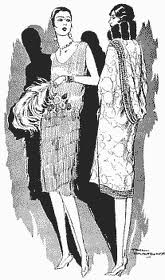
As women gained equality with men in the right to vote, we saw how women’s fashion changed.  They were ‘liberated’ and their dress reflected it:  
But interestingly, some took the idea of equality with men even further, and they began to dress like men, cut their hair short like men, and so on . . .
images-2
images-1
It seems to me that there would be something tragic if women felt that to gain equality with men they had to emulate men, and thereby lose something of their identity as women.
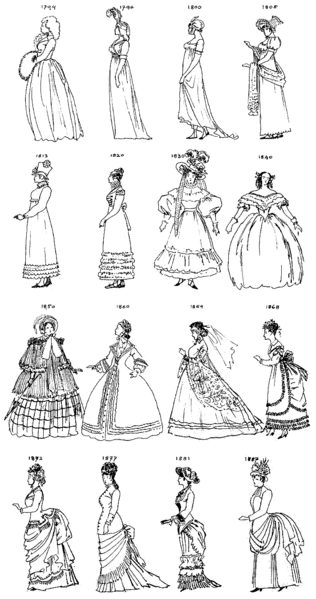
I wanted the students to compare the feminine ideal of the 1920’s with the Victorian era, which we looked at a few months ago.  My gut is that neither era represents a Biblical ideal.  Looking at the mountain of material on Victorian dresses (ca. 1850-1900) makes me think that they obscured true femininity just as the 1920’s did (take a look at the ones from 1850 — 3rd row on left), as to my mind there is something unquestionably ridiculous in how Victorians viewed women as incurably fragile.
A Century of Fashion
Most students asserted that if they had to choose, they would choose the 20’s ideal over the Victorian, arguing that women had more respect in that period.   This did not surprise me, as there is something distinctly modern and familiar with the 1920’s.   Some students last year astutely pointed out that there are two kinds of respect.  In the 1920’s women unquestionably had more political and social freedoms.  No one should underestimate the importance of this.  But they may have lost some of the respect that came with being a woman specifically.  With this exchange, something of the ideal of chivalry, of deference to women, would inevitably be lost.
Ideally, as God made both men and women in His image, for humanity to best reflect that image we should want men to be men and women to be women in the truest possible sense.  What that means exactly will certainly be debated, but the students agreed that neither the 1920’s or the Victorians had it right.
Many thanks,
Dave M

“Securing the Blessings of Empire to our Posterity”

Years ago G.K. Chesterton wrote,

[The problem] I mean is [modern] man’s inability to state his opponent’s view, and often his inability even to state his own.  . . . There is everywhere the habit of assuming certain things, in the sense of not even imagining the opposite things.  For instance, as history is taught, nearly everyone always assumes that it was the right side that won in all important past conflicts. . . . Say to him that we should now be better off if Charles Edward and the Jacobites had captured London instead of falling back from Derby, and he will laugh. . . . Yet nothing can be a more sober or solid fact that that, when the issue was still undecided, wise and thoughtful men were to be found on both sides.  . . . I could give many other examples of what I mean by this imaginative bondage.  It is to be found in the strange superstition of making sacred figures out of certain historical characters, who must not be moved from their symbolic attitudes. . . . To a simple rationalist, these prejudices are a little hard to understand.

Our Constitution has proved itself an enduring and effective document.  Some have an admiration for it that verges on veneration, which can obscure the fact that the success of the Constitution was hardly foreordained.  The election of 1800, and of course the Civil War, pushed its limitations to the brink.  We forget too that many reasonable and intelligent men had strong objections to the Constitution.  Some of these objections proved chimerical, but some had remarkable prescience.

I referenced George Mason’s strenuous objections in another post, but to quickly recap, Mason believed that the South should have required a super-majority to pass all trade legislation.  Mason believed that economic differences would eventually tear the North and South apart, and requiring this provision would ensure more unity.  Unfortunately the south kept slavery in exchange for a trade legislation passing like any other law.  Sure enough, states like South Carolina and Georgia cited unfair trade legislation as reason for secession in 1860.

Most expected some form of strengthening of the national government to come out of the convention in Philadelphia.  Many objected, however, not so much because the federal government would be stronger, but because the states would cease to have any importance in the new scheme.  Defenders of the Constitution rushed to quell such fears.  Obviously the states would continue to have their contributions to make, and so on.  Once again, those that objected to the Constitution had it right.  Today states play no vital role in shaping policy or the identity of the country and merely serve as a kind of organizing mechanism for national politics.

The reasons for why some objectors saw the future diminution of states fascinates me the most, however.  Many jumped on the first three words, “We the people,” and saw a totally new basis for governance.   In making the amorphous “people” the basis for authority in the country, some argued that the United States would transform eventually into a kind of democratic empire-state.  It may sound odd for modern sensibilities to equate “the people” with empire.  But the founders thought in the context of Rome’s history.  Rome’s emperors sought to bypass the aristocracy and the Senate and appealed directly to the “people.”*  Tacitus criticizes many emperors not because of their abuses to the people, but perhaps largely because of their abuses to the senatorial class.  If the preamble had said, “We the states,” it would have indicated that ultimately the senate would take the lead in shaping the tenor of American political life.  “We the people,” would shift the focus to the presidency, which meant that the founder’s stated goal of a federated republic would inevitably get superceded by the people/nation.  This shift from states to the “people” also greatly magnified the role of the Supreme Court far beyond the intent of the founders, as some recent and controversial decisions have overridden state laws.

Indeed, something like this happened over the course of the 20th century, and we see it accelerating recently.  Bill Clinton felt our pain and played saxophone on the Arsenio Hall show.  As candidates, Bush and Gore both appeared on Oprah Winfrey.  While in office President Bush worked hard to maintain a “regular guy” image.  President Obama went on Marc Maron’s podcast and Jerry Seinfeld’s Comedians in Cars Getting Coffee, using more sophisticated forms of direct appeal to “the people.” If Trump is our next president, he will remind me of some of the practical, irascibly likable, yet for the most part dangerously erratic Roman general-emperors.**  Such direct appeals to “the people” from the president I’m sure would have horrified Washington, Madison, and even Thomas Jefferson.

But they would not have surprised some of the Anti-Federalists.

Because the anti-federalists were right about their objections does not mean that we were wrong to ratify the Constitution.  I still believe that despite its flaws it probably represented the realistic “best we could do” under the circumstances.  But the objections of the so-called “Anti-Federalists” shine great light on where we are now as a nation.


Dave


*Caligula was certainly a nut, but the story of him making his horse a senator (if true) may have actually been a calculated swipe at the Senate itself and not necessarily evidence of his insanity.

**Thinking about comparisons for Trump . . . he may not quite fit any one particular emperor.  One colleague offered Marius as a mirror image.  Marius was wealthy, a “new man,” who infuriated the Roman aristocracy, who proved powerless to stop him through normal political means (it took a bloody civil war instead).  Another offered Emperor Theodosius I.  Though not a “general-emperor,” he was gruff and impulsive.  He did terrible things on foolish whims (the massacre in Thessalonica), but proved capable of repentance and subsequent bold and important decisions (as to whether or not Trump can prove capable of repentance . . . we’ll have to wait and see).

His American President counterpart has to be Andrew Jackson.  He was not a founder or the son of a founding father.  He lacked a “European” education.  He introduced the idea of campaigning for office, to the horror of the political elite of the time.  His time on the frontier made him a rough, blunt character.  He made a variety of controversial decisions that definitely divided people — i.e. closing the national bank, South Carolina’s attempts at state nullification, and some horrifying decisions like the Cherokee’s and the “Trail of Tears.”

Historical opinion on Jackson is as varied as his acts in office.  But, however one views him, the U.S. survived a Jackson presidency and we just might survive a Trump presidency.

His likely opponent, Hillary Clinton, lacks the personality to connect with and directly appeal to the people that would put her in unusual company among modern presidents, like George Bush Sr., and perhaps, Nixon?


12th Grade: Making it up as You Go

Greetings,

This week we wrapped up our look at Madison’s notes on the Constitutional Convention.  We touched on many subjects, but centered on one particular issue that illumines both the glory and the problems of the heritage of that august assembly.

As the constitution neared completion, the delegates debated how the document would be received by the public.  What would make the Constitution the law of the land?  Should the states ratify it through their state legislatures, or should a general, national plebisite of the “people” make the decision?

The issue seems mundane, but at its root lay certain key ideas and problems.

If the states ratified the Constitution, it might seem that the states had superiority over the federal government the document created.  Charlemagne, for example objected to being crowned “Holy Roman Emperor” by Pope Leo III (he would crown his son and successor before the Church had a chance), much in the same way that Napoleon refused to allow Pope Pius VII to lay the imperial crown on his head.  He who crowns the king has authority over the king.  If the states gave the Constitution authority, they implicitly would hold supreme power.

The problem with this approach was that the delegates wanted to create a document that significantly increased the power of the federal government relative to the states.  A handful of delegates at the convention wanted to get rid of states altogether.

Another option involved a national ballot referendum and a direct appeal to the people. Bypassing the state legislatures would help emphasize the new power base of the national government.  It would exist not on the foundation of the states, but on the people/”nation” at large.*  So far, so good.  But most of the delegates gravely distrusted the wisdom of “the people,” and feared putting so much power in the hands of those they felt could be easily manipulated.^  So they had to flip a coin, basically, between Scylla and Charybdis.

As the delegates debated an even deeper issue arose.  Why were they in Philadelphia in the first place?  On whose authority?  “If we exist under the authority of the Articles of Confederation,” they might have thought, “then we must give ratifying authority to the states.  But if we exist under the Articles, then we must abide by the key principle of the Articles and not make any new changes without the unanimous consent of all the states.”  But with the decisions they already had made unanimous consent had been rare.  Besides, some states did not have any delegates at the Convention at all. Clearly then, they could not be proceeding under the Articles of Confederation or they would have to rework almost everything.

“But if we are not here under the authority of the Articles,” then who or what gives us the authority to make any decisions?  Will the new government get formed under our own assumed authority, or the authority of ‘the people?’ Are we just making this up as we go?”  I do wonder if the delegates felt themselves at the edge of a great precipice, or on the threshold of a dark and mysterious house, with little idea of what might come next.

One debate surrounding the American Revolution is the question as to whether or not the founders were “radicals” or “conservatives.”  Some scholars (like Edmund Burke) see the Americans as conservatives trying to preserve traditional ideas of government.  In this view it was the English, not the Americans, who were the real “radicals.”  As much as I hate to disagree with Burke, I think the vast bulk of the evidence suggests that the founders were the radicals (historians like Bernard Bailyn and Christopher Ferrara agree) and changed the very basis of modern governance.

Back in ancient times kings derived their authority from the gods.  Though the Greeks may have departed from this briefly in the golden age of their democracy, their philosophers rooted all legitimate authority in notions of Truth/God (Plato), or the Natural Law (Aristotle).  The Romans had a republic, yes, but their political offices often had religious overtones and the early Romans at least did everything with reference to the gods.  In Christendom, kings clearly believed they derived their authority ultimately from God, and that the state should reflect in some ways God’s kingdom and His governance on Earth.

The founders made no such assertions.  They formed a government rooted in Locke’s theory of the “consent of the governed” forming the basis of all legitimate power.  This gave the founders a great deal of freedom to improvise, but also created difficult dilemmas.  How should the “consent of the governed” be measured?  What if what the governed consent to changes over time? Without a clear and fixed point of reference, notions of authority, legitimacy, and morality inevitably would shift over time.

The founders should receive praise, I think, for creating a thoughtful system of government that did well in preventing abuses of power (relatively speaking) and allowed for a healthy tension of unity and diversity within the country. But even some of those present in Philadelphia in 1787 had a premonition that had little claim to authority beyond their own ideas.  Some made reference to history with their political ideas, others to experience.  But very few sought to root their thoughts in any authority beyond that.  The ripples effects of this certainly linger with us today.  What gives the Constitution authority is that we agree it has authority — we consent to its authority.  But as that authority has its roots in day-to-day consent, so too the meaning of our consent will change over time.  Hence, we decide Constitutional question by majority vote.  We may lament this, but the Constitution itself has little more to offer us.

Blessings,

Dave

*Patrick Henry objected to the Constitution because he recognized this shift of power in the first three words, “We the people . . . ”  He recognized the diminished role states would play in the new government.

^Reading Madison’s notes, students were routinely surprised to see the attitude of most delegates towards “the people.”  A great question to ask might be, “How democratic is the Constitution really?”

Alexander Nevsky and Humphrey Bogart

Whenever I teach about ancient Egypt that civilization always impresses me with its “weight.”  I mean that the Egyptians expressed an utter confidence in the meaning and purpose of their civilization.  We see evidence for this in a variety of places, but I draw attention to the “Tale of Sinuhe,” one of the more beloved early Egyptian folktales.  The story recounts some impressive adventures of Sinuhe abroad, but the climax of the story is not found there.  Sinuhe triumphs when he returns home, when he receives the favor of the king, and (strange to our ears, no doubt) when the king grants him a lavish tomb.  The story concludes,

There was constructed for me a pyramid-tomb of stone in the midst of other pyramids.  The draftsmen designed it, the chief sculptors carved in it, and the royal overseers made it all their concern.  Its necessary materials were made from all precious things one desires in a tomb shaft.  Priests for death were given to me.  Gardens were made for me just as is done for the highest servants.  My likeness was overlaid with gold.  His majesty himself made it.  There is no other man for whom the like has been done.  So I was under the favor of the King’s presence until the day of death had come.

All Sinuhe ever needed was in front of him the whole time, a Hallmark card ending if there ever was one.

Of course the Exodus dramatically and deservedly shook this confidence,* and at times the “weight”and “presence” of Egypt would no doubt feel oppressive and claustrophobic  (as it does for me with the Great Pyramid of Giza), but, nevertheless, they had a marvelous run.

Recently reading a collection of tales from medieval Russia, I had a reaction not unlike the one I have with Egypt.  Russia is different than America — obviously.  But how so?  A quick look at literary luminaries reveals much.  The Adventures of Huckleberry Finn undoubtedly deserves its high praise, but then one reads The Brothers Karamazov (roughly contemporary works) and discovers something entirely different.  Twain bounces here and there and constructs a fanciful lark (for the most part) out of the idea of rebellion against society.  Though he is thoroughly American, there remains something of the delightful English politeness about him, making his points in circuitous fashion.  Dostoevsky writes from a much more solid, earthy foundation.  The “earthiness” of his foundation gives it all the more spiritual impact.  He writes not of ideas at all — except to criticize them and the very concept of “ideas.”  Instead he comes from a place of absolute confidence in a particular reality.  In his stories the rebels are the bad guys, who try and introduce discontent into the Russian soul.

Just as we have no particular historical roots as a nation, so our folktales take on a whimsical character and have no particular roots in history (i.e., Paul Bunyan, Johnny Appleseed, etc.).  Even when Twain makes his best points, they take the form of jokes.  Dostoevsky . . . not so much.**  So Russian folktales usually seem to have much more direct historical roots and could rarely be described as “whimsical.”

In the tale told of about the Polish king Stephen Bathory’s siege of the Russian town of Pskov (ca. late 16th century) we see all of these characteristics.  It speaks of “Holy Russia” without a trace of irony.  When the “pagan” king’s army advances past some of the outer defenses, the story turns:

. . . in the Cathedral of the Life-Giving Trinity the clergy incessantly prayed with tears and moaning for deliverance. . . . [they] began to weep with loud voices, extending their arms to the most holy icon.  The noble ladies fell to the ground and beat their breasts and prayed to God and the most Pure Virgin; they fell on the floor, beating the ground with their heads.  All over town women and children who remained home fervently cried and prayed before holy icons, asking for the help of all saints and begging God for the forgiveness of their sins . . .

After an extended poem on the power of God the tide turns, and the people rally.  But they need to stem a breach in the defensive wall.

. . . [the Russian commanders] ordered that the icons be brought to the breach made by the Poles.  Once the holy icon of the Holy Virgin of Vladimir had protected Moscow at the time of Tamerlane.  Now another was brought because of Stephen Bathory . . . and this time the miracle happened in the glorious city of Pskov,  . . . for divine protection invisibly appeared over the breach in the wall.   . . .  All the commanders, warriors, and monks cried out in unison, “O friends, let us die this day at the hands of the Lithuanians for the sake of Christ’s faith and for our Orthodox tsar, Ivan of all the Russias!

In his marvelous, Everyday Saints, Archimandrite Tikhon of the Pskov Caves Monastery related a story about a particular bishop caught in an unfortunate position amidst a large crowd.  Uncertainty reigned in Moscow in a public square during the collapse of communism in the early 1990’s.  Some soldiers came over to shield the bishop from the crowd and began to take him into their vehicles for protection.  Many in the crowd, however, thought the soldiers were imprisoning the bishop.  The Archimandrite relates that several people rushed out towards the bishop, saying, “It is happening again [i.e., the Communists imprisoning church officials]!  This shall not be!  Come brothers, let us help this good priest.  Let us die for him!”  Soldiers dissuaded them from hurling themselves on their bayonets only by careful explanation of their purpose.

A particular sense of reality is evident, and an absolute confidence.

Our heroes play different roles.  Even the golden age of Hollywood, when America supposedly bursted with confidence, gave us heroes like Humphrey Bogart — a man “in the know,” and somewhat detached.  We love the reluctant hero.^  Russians remember instead princes like Alexander Nevsky, who when attacked by the Swedes, supposedly went immediately to church, where

remembering the song from the Psalter, he said: “O Lord, judge those who offended me.  Smite those who set themselves against me, and come to my aid with arms and shields.”

Before his death, Alexander took the most strict of monastic vows, the “schema.”

Alexander’s reaction today could only be mocked by the west, just as Putin’s physicality — be it swimming in icy lakes or wrestling tigers, or whatever — becomes late-night fodder.  But Putin, consciously or not, sincerely or not, very likely taps into something deep within the Russian soul and Russian history — the fearless leader of absolute confidence with not a trace of detached irony.^^

Those who do not like President Obama sometimes don’t see that his appeal has little to do with his policies.  Rather, he embodies a certain idea of American hip culture.  He tells deprecating jokes with wry humor, a wink, and a nod.  He appears on Marc Maron’s podcast and Comedians in Cars Getting Coffee with Jerry Seinfeld. So too we in the west, I think, fail to understand Putin’s popularity.  Perhaps he channels Alexander Nevsky, not Humphrey Bogart.^^^

Dave


*I favor a late Exodus date, and so see Ramses II as the beginning of the end, and not an “Indian Summer” after the decline had already begun in earnest.

**Of course Dostoevsky can sometimes be very funny.  I laughed aloud at various points in The Brothers Karamazov, and The Gambler. But Twain was known as a humorist, and while the idea of Dostoevsky as a one man show is funny, the show itself . . . would not be.

^Might Tom Cruise’s Ethan Hunt of the Mission Impossible movies serve as an exception?  He has none of the smirks of a James Bond.  Hunt “believes” — believes in what?  Who knows?  Who cares?   We don’t watch the movies out of love for the Ethan Hunt character, but for the stunts, scenario’s, etc.

^^The Archimandrite Tikhon has been involved with some controversy and mystery due to his “relationship” with Putin.  An excellent interview with him is here — recommended.  The interviewer represents a typical western perspective and the Archimandrite shows that he is not a modern-westerner.  We should realize that a) Putin may have a sincere religious faith, and b) St. Petersburg will not orient Russia in the way that Peter the Great or other westerners might wish.

^^^Russia has experienced a dramatic rise in religious affiliation since the communist collapse, but not a corresponding rise in regular church attendance, at least according to one Pew Research study.  I don’t mean to suggest that Putin faithfully believes and practices like Prince Alexander.  If left utterly detached from the Faith, Russia’s earthiness will become frighteningly barbaric. As many have noted — Russia is a land of great sinners and great saints.


12th Grade: Constitutions for Dummies, by Dummies

Greetings,

Several weeks ago the Government class discussed the basics of Plato and Aristotle’s philosophy.  One goal I had in this was for students to understand . . .

  • How fundamental ideas about the nature of reality, and the nature of God, help form one’s ideas about government.
  • How one’s view of the nature of humanity (is mankind a body & soul? What is the relationship between our body and soul?) impact how one governs.
  • What relationship should context & history have in a given situation?

I shared an example from my own life that illustrates some of these issues.  Many years ago I lived in a townhouse community run by an HOA.  The development placed about 5 trashcans every 1/4 mile or so.  When people walked their dogs (and we had a high population density of dogs) we commonly deposited the refuse in the trashcans.  But during warmer weather, more people walked their dogs, and the additional heat made the trashcans, well, stink.  This was unfortunate.  Was it a “problem?”

The HOA came up with a rule: No more deposited dog waste in trashcans.  This, they hoped, would solve the problem.

One can view their solution in two basic ways, from a Platonist and Aristotelian perspectives.

The Platonist would argue. . .

  •  The law is a good one because it seeks to better the condition of all.  The neighborhood would become a nicer neighborhood.
  • The people would be encouraged to accept more direct personal responsibility for their pets — taking the refuse to their own trashcans would help them be more responsible overall.

The Aristotelian might respond. . .

  • The law is foolish because people will likely not obey it.  They will either continue to deposit the refuse in the trashcans, or worse, simply not pick it up at all.
  • The law cannot be enforced.  The HOA has no mechanism to police the area.  Thus, people’s disobedience will only encourage a more hostile attitude towards the HOA than they may already have.  In other words, a good law can only be called “good” if people actually obey it, no matter how good in theory the law might be.

I hope students enjoyed this unit.  I then wanted to have the students see how some of these ideas applied in the making of our own government.  To that end we spent the last few days reading Madison’s diary of the constitutional convention debates. We see that different people had different perspectives, different notions of what “liberty” meant and how to achieve it.  They wrestled with the big ideas, referencing key political texts, but also worried how those ideas would apply in the current political climate.  Some of there more lengthy debates seem immediately relevant today, others quite arcane.The decisions they reached sometimes came from unanimity, but more often came through compromise and disagreement.  And despite their brilliance, they failed dreadfully in not foreseeing a popular presidency, and what this meant for the Vice-Presidency.

I had a few main goals with this particular unit:

  • I wanted students to see that political agreements required a great deal of compromise.  I don’t mean to use compromise as a word of praise or derision.  Some compromises achieve great things, others, like the compromises made on slavery, condemn the future to deal with an issue that has had time to fester.
  • I wanted students to consider whether or not the many compromises they made had roots in their agreement on fundamental principles, or whether America was built on band-aids to the deep divisions between Americans at that time (and now).  If they agreed on fundamental principles, what were they?  If they had no agreement on such principles, why not?
  • What did the Constitution do particularly well?  In what areas did it fail?
  • Many of the men at the original Constitutional convention had years of experience in law and government, and an education that rooted them to the classical world.  And yet at times the decisions made seemed based more on arbitrary circumstance than profound guiding principles.  Should this worry us, or is this the way of the world?  Or perhaps it’s a gift, a reminder that we are all in need of God, that none of us, however intelligent, will ever have all the answers or the stamina to decide them fairly?


Thanks again,

Dave