Seeing what you Mean

This was originally written in 2018 . . . .

*****************************

It seems that we occupy a strange place in our national life.  We have more political divisions even though we have much less actual discretionary spending in the federal budget than in the past.  President’s Trump and Obama function/ed largely as symbols for their supporters and detractors.  Many do not care much to look at their particular actions, rather, an action becomes bad or good because of who did it.  We have a hard time seeing past the ad hominem.

But this should not surprise us.  Perhaps it is our very lack of flexibility in the budget that heightens the symbolic role of the president.  I suspect also that especially since the end of the Cold War, and probably since Vietnam, America has searched for a new identity, and forming an identity requires strong symbols.  And, while I think that we would struggle in our political life currently in any case because of this, as (bad) luck would have it, our last two presidents have been near opposites in terms of their personalities and style.  Some argue that Obama was the far more “rational” president, but even if that were true, Obama’s supporters had a strong emotional, gut-level attachment to him, akin to Trump’s current supporters.  In any case, we will miss what is really happening if we focus only on the policies, or the outward appearance of things (though to be sure, we could use some dispassionate focus on what presidents are actually doing in addition to their symbolic perception).

What is a president, exactly?

Childish interpretations of kingship in earlier eras tend to argue along the lines of, “Kings dressed up in all their finery because they were greedy, cruel, and didn’t care about the people.”  Much better interpretations see monarchs as an extension of the people themselves in some way.  The people would not want them to dress in a dowdy fashion, for that would reflect poorly on them too.  So, for example, many Frenchman took great pride in the fact that Louis XIV could eat 2-3x more than a normal man with no apparent ill effects.  But I have struggled with even some of these more sympathetic approaches.  I still feel that they leave something out.

Alice Hunt’s The Drama of Coronation brings out many nuances and subtleties of English coronation rites.  She demonstrates a great ability to let the texts breathe and speak for themselves.  Her analysis strikes me as fair and careful, and her comments attempt to illumine what for 21st-century moderns is a great mystery.  She traces the coronations of five English monarchs in attempt to answer the question:

What is a king (or queen), exactly?

We will miss the mark widely if we think only in terms of having an executive function in government.  One problem that faces historians with this question is that we have very few records of medieval coronation rites.  This in itself gives us a clue that coronation ceremonies had a primarily religious function.  In the older Byzantine rite, we see that the public, and even catechumens, had to leave the service during the canon of the mass.  In the western rite of St. Gregory the Great, the confession of sin has communicants proclaim, “I will not speak of thy mysteries to thine enemies.”  Hunt suggests that at least beginning with Pepin the Short, coronations took place in a sacramental and liturgical sphere, which would have meant “private” in at least some ways.

But we have many records or eyewitnesses of England’s 16th-century coronations.  The crowning of Henry VIII would not have been unusual, but each subsequent coronation had its own unique elements that perhaps called for a more public justification, aside from the turbulent historical circumstances:

  • Anne Boleyn was crowned.  The fact that a new queen would be publicly crowned while the king still reigned was entirely novel.
  • The coronations of Mary and Elizabeth as “queens regnant” had not happened before
  • Edward VI coronation involved that of a boy king amidst stark religious changes

As mentioned, Hunt handles the sources marvelously.  My only quibble is one that I have with many (it seems) English historians, which involves their failure to raise their eyes above the various perspectives and declare something definite.  I am all for intellectual humility, but sometimes it takes more humility to take a risk of being wrong than to say nothing at all.

The first issue Hunt tackles involves historians who try and argue for something along the lines of “exploitation of ceremonies” to achieve power.  She cites some historians of the Wars of the Roses that accuse the Yorkist faction of attempting just this to achieve power.  Hunt dismisses this perspective quickly.  Along with David Kertzer and others, she argues that ceremonies don’t exploit as much as they create legitimate rule.  This may sound silly to some modern ears if they think only of ancient robes and mitres.  But if we imagine a disputed presidential election in the U.S., and one candidate had the Chief Justice of the Supreme Court administer the oath of office, we would not say that he “exploited ceremony.”  Rather, the ceremony–at least in part–made him president.  He could not be president without the ceremony, nor would we say the ceremony meant nothing more than empty ritual.

Henry VIII gives us a good place to begin as the last great coronation before the Reformation.  Here we reside in the realm, so we imagine, of absolute divine right before the advent of more popular Reformation polities.  But just as the Roman emperors opposed themselves to the aristocratic senate and ruled in the name of the people, so too did Henry and other European kings.  Kingship had an element of “popularity” about it, in the strict sense of the Latin meaning of “populares.”  Hunt quotes from the Liber Regalis:

Here followers a device for the manner and order of Coronation of the most excellent and Christian prince Henry VIII, rightful and undoubted inheritor of the Crown of England and of France with all appurtenances, which is only by the whole assed and consent of every of the three estates of his realm.

Henry’s legitimacy is real, rooted not just in Heaven but on Earth.  Thus, the “physicality” of his rule has a reflection in his person, and required the physical objects of rulers past, especially the chalice of St. Edward, among other things.  These various objects had a hierarchy of value, and who carried them and where people processed gave rather than reflected status.  Contra the modern assumption of the homogenization of space and time, the king stood somewhere between heaven and earth.  Heaven of course was not earth, but the two met in various times and places in the medieval view.  Church buildings themselves were a touchstone, and the designs of the buildings manifested this.*  Clergy were consecrated, set apart, so they could receive the ultimate intersection between heaven and earth–the holy eucharist.  The City of God was not the City of Man, but they sought to model earthly order on heavenly order, or reality itself.  Thus, officiating clergy elevated the king at a certain point in the coronation, just as they would elevate the bread and wine.  The ceremony made the connection of “consecration” immediately obvious to all.

Many assume that Henry’s Reformation might make such “catholic” ceremonies obsolete, but in fact Henry seems to have gone “all out” in Anne’s coronation ceremony.  To start, he held a separate coronation service for her, which may have had no precedent.  Second, the ceremony took place on Whitsunday (Pentecost), the second most holy day in the church calendar.  Third, Henry absented himself from being seen directly during the ceremony itself, which gave him more “god-like” status, the unseen yet present “earthly god” bidding Anne receive the crown.  Finally, Henry wanted for Anne to wear Katherine’s crown during the ceremony. Yet here even Henry met a roadblock he could not overcome, as the man in charge of the crown would not give it up.  The ambassador of Venice relates,

Accordingly, the king wrathfully sent to the one who has charge  of the queen’s [i.e. Katherine] crown, Master Sadocho by name, a great man in that island, requiring the crown for the coronation.  Master Sadocho replied he could not give it up because of the oath he had taken to the said queen, that he would guard that crown faithfully. The king then went to see him and expressed his desire.  At this, Master Sadocho, who is a man of ripe age, took off his cap and flung it to the ground without saying a word.  When the king saw this he asked what moved him to do such a thing as this, to which Master Sadocho replied that rather than give him the crown he would suffer his head to lie where his cap did.  . . . As he is a  great personage who also has a son also of great worth and numerous followers, the king took no further steps, but had another crown made for the coronation of the new queen, who has been pregnant for five months.

Obviously, symbols had real meaning for those outside of the king and clergy.

In all these things Henry to me seems to overreach, realizing the precarious nature of his enterprise.  He had founded a new church, divorced/annulled his marriage with Katherine, and married someone already pregnant.  He gave Anne all the symbolism he could.  Prayers said during the coronation directly assumed that the child Anne carried was a boy.  Alas for Anne, perhaps the connection between symbolism and reality could only go so far.

The real shift took place with Edward VI.  Here we had a combination of 1) No Henry to go all out to get his way, 2) More evangelical reformers in charge in the Church of England, 3) A boy king who had no real say in what went on.  The crucial distinction came when Bishop Cranmer stated that, “the oil [for consecration], if added, is but a ceremony,” and not strictly necessary.  Nothing really happens at the coronation that could not happen elsewhere.  Heredity, the system, and his oath made Edward king, and nothing more.  Certainly the ceremony had to have the Church presiding–or so it seemed obvious at the time–but the Church no longer had to “do” anything important.

One might argue that this shifted politics wholly into the realm of the secular, and so made kingship defendant on the right exercise of power.  This made kings potentially just as politically vulnerable as any president, but in a more precarious position, as Charles I and Louis XVI discovered.

As a culture, we clearly crave symbolic archetypes more than in the past.  We see this in the consistent popularity of super-hero movies, and the somewhat polarizing popularity of Jordan Peterson.  We see it in recent political commentary, as a handful of mostly normal people believed that Obama was the anti-Christ in 2008, or that Bush and Trump were/are Nazis. We see it in our woeful neglect of Congress–perhaps there are just too many of them to affix any meaningful archetypes.  It may be that we are forced into this symbolic realm by the incomprehensibility of our laws. However we got here, this unsettling political moment gives our culture some interesting opportunities to understand our symbols and to recover an older view of reality.

Today we tend to assume that if something is a symbol it is not really real, but only a signifier for the real.  Hence, we know what a male sign for the bathroom means, even though of course no one in the bathroom looks like the symbol.  Symbol and reality live in different worlds, in different planes of meaning.  But the older meaning of “symbol” meant the bringing together of reality to create “real” meaning.  St. Maximos the Confessor writes,

…for he who starting from the spiritual world sees appear the visible world or else who sees appear symbolically the contour of spiritual things freeing themselves from visible things… that one does not consider anything of what is visible as impure, because he does not find any irreconcilable contradiction with the ideas of things.

To quote Jonathan Pageau, “a symbol is a meeting place of two worlds, the meeting of the will of God with His creation.”  Pageau goes on to say that the most real things are that way because precisely because they are symbols.  Reality “really happens” when heaven and earth unite, when they “symbol together.”^

I can’t say for sure if this older view of reality will help us understand exactly what a president is, but I think it will help.  The more self-aware we can be of what we are doing, the more hope we have.   Then, maybe we can go back to the lemonade on the porch days of debating the finer points of Social Security reform.

Dave

*Pageau talks mostly of church designs in the eastern Roman empire, though his point applies in the west, though with different applications.

**I am indebted to Pageau’s article here: https://www.orthodoxartsjournal.org/the-recovery-of-symbolism/

^This is exactly what St. Luke tells us the Virgin Mary did in Lk. 2:19 when she “gathered” or (as the Greek states) “symballoussa” all of what had happened to her.


“I See Satan Fall like Lightning”

This was originally published in 2014, then again in 2015 after Girard’s death.  I post it again in light of some discussions this past week in government class.

And now, the post . . .

**************************************

I’ve said before that for the most part, I can’t stand the modern British historian, or at least, a certain kind of British historian. This is the type that Toynbee rebelled against and patiently denounced for years.  This model calls for exacting discipline to attempt to focus only on the “what” and never the “why.”  They see their jobs as using a microscope to discover the most amount of facts possible, but never think to lift up their heads. Leave that to the metaphysicians.  Historians should tell you what happened and keep their noses clean of any other venture.

This approach has flaws from top to bottom.  First of all, it’s dreadfully boring, and second, it’s a lie. We simply can’t avoid metaphysics — we will always worship and point to something, though they seek to drive ourselves and others away from such a fate.

The Abbot Suger of the Abbey St. Denis once declared, “The English are destined by moral and natural law to be subjected to the French, and not contrariwise.”  Leave it to the French to say crazy things!  And with historians anyway, I agree.  French historians to the rescue!   They have their share of great ones, from Einhard to Tocqueville, Fernand Braudel, Marc Bloch,  Regine Pernoud, and so on.  Historians should not forget that they too are made in the image of God, and that history has no meaning or purpose without us seeking to “sub-create” and give meaning and purpose to the world around us.*

Rene Girard fits into this mold with his great I See Satan Fall like Lightning, a brief, but dense and thought provoking book that challenges how we read the gospels, mythology, and all of human history.  A magnificent premise, and he delivers (mostly) — all in 200 pages.

To understand Girard’s argument, we first need to understand two main lines of thought regarding civilization.  The first and overwhelmingly dominant view sees civilization as a great blessing in human affairs. Civilization allows for creativity and cooperation.  It fosters a rule of law that prevents a cycle of violence from overwhelming all.  Civilizations give the stability that, paradoxically, gives us space and time to challenge existing ideas and move forward.

The distinct minority believes that civilization can do no better than aspire to a lesser evil than barbarism.  It at times descends below barbarism because it enacts great cruelties under the comforting cloak of “civilization.” At least the abject barbarian harbors no such illusions.  The very organizing principle of civilization concentrates the worst human impulses to impose their will on others and count themselves innocent in the process.  Before we dismiss this uncomfortable thought, we should note that in Genesis 4 the “arts of civilization” are attributed to Cain and his lineage, with violence as the hallmark of their work.  God confuses language at the Tower of Babel because collectivized human potential is simply too dangerous.  In his The City of God Augustine seems at least sympathetic to this view, as his memorable anecdote regarding Alexander the Great makes clear:

Justice being taken away, then, what are kingdoms but great robberies? For what are robberies themselves, but little kingdoms? The band itself is made up of men; it is ruled by the authority of a prince, it is knit together by the pact of the confederacy; the booty is divided by the law agreed on. If, by the admittance of abandoned men, this evil increases to such a degree that it holds places, fixes abodes, takes possession of cities, and subdues peoples, it assumes the more plainly the name of a kingdom, because the reality is now manifestly conferred on it, not by the removal of covetousness, but by the addition of impunity. Indeed, that was an apt and true reply which was given to Alexander the Great by a pirate who had been seized. For when that king had asked the man what he meant by keeping hostile possession of the sea, he answered with bold pride, What you mean by seizing the whole earth; but because I do it with a petty ship, I am called a robber, while you who does it with a great fleet are styled emperor.

I used to associate this negative view of civilization exclusively with French post-modernists like Foucoult (not that I’ve actually read them 🙂 and therefore dismissed it.  But, there it is, in Genesis 4, in St. Augustine, and likely other places I’m not aware of.  So, when Girard asks us to accept this view, he does so with connection to the Biblical tradition and some aspects of historical theology (Girard accepts the necessity of government and order of some kind but never fleshes out just how he wants it to function).

With this groundwork we can proceed to his argument.

Scripture tells us that Satan is “the Prince of this world,” but in what sense is this case, and how does he maintain his power?  Where he wields influence, he sows discord internally in the hearts and minds of individuals and in society in general.  Hence, the more influence he has, the more dissension, and thus, two things might happen:

  • He risks losing control of his kingdom, as no kingdom can withstand such division for very long.
  • The chaos might incline people to seek something beyond this world for comfort, which might mean that people meet God.

How to maintain control in such a situation?  Girard believes that mythology and Scripture both point to the same answer: Satan rules via a ritual murder rooted in what he calls “mimetic desire.”  The war of “all against all” fostered by Satanic selfishness must be stopped or he risks losing all.  Mimetic desire heightens and gets transformed into the war of “all against one.”  The people’s twin desires for violence and harmony merge in an unjust sacrifice.  This restores order because we have find the enemy collectively, and find that the enemy is not us — it’s he, or she, or possibly they — but never “us.”  Satan’s triumph consists of

  • His control restored
  • His control rooted in violence
  • A moral blindness on our parts
  • A reaffirmation of our faith in the ruling authorities to bring about order

“Mimetic desire” has a simple meaning: we seek to imitate the desires of others, and by doing so take them into ourselves, into the community.  Girard speaks at some length about the 10th commandment which prohibits coveting. While this prohibition is not unique to the Old Testament, it places greater emphasis on the problem of desire than other cultures. Desire in itself is good, but Satan, the “ape of God” gives us his desires, desires for power, for more.  Once these desires spread they turn into a contagion, or a plague that infects people everywhere (Girard believes that many ancient stories that talk of a “plague” may not refer to something strictly biological).  Once begun, resistance is nearly futile.

To understand this we might think of two armies opposing one another.  Neither wants to fight, but both fear that the other might want to fight, so both show up armed.  Once the first shot is fired, be it accidental or otherwise, all “must” participate. All will fire their weapons, and you would not necessarily blame a soldier for doing so.  It just “happened,” and with no one to blame, there can be no justice — another victory for Satan.

He references Peter’s denial of Jesus just before his trial.  Often our interpretations focus on the psychological aspects of Peter’s personality — his impulsiveness, and so on.  Girard won’t let us off the hook so easily.  Such psychological interpretations distance ourselves too comfortably.  In reality, Peter fell prey to the desires of the crowd in ways that ensnare most everyone.  Peter is everyman, in this case, and perhaps its more telling that he extracts himself from that situation.

Pilate too succumbs, in a way typical of politicians everywhere.  Pilate needs order — his cannot afford that Justice be his primary concern.  To maintain order he has no other choice but to give in.  Girard would argue, I think, that this is nothing less than the bargain all rulers must make from time to time.  Politics, then, get revealed as more than a “dirty business,” but one with indelible roots in the City of Man.

Many ancient stories show forth the nature of mimetic violence, but the Cross itself stands as the example par excellence. The people in general have no hostility to Jesus, but once they become aware that the religious authorities are divided, and the Romans start to weigh in, the plague of mimetic desire settles in.  They turn on Jesus, and believe that His death will solve their problems.  It looks like a repeat of other events and another victory for Satan.  But this victim not only possessed legal innocence, He actually had true and complete innocence.  Now Satan’s methodology gets fully exposed, for “truly this was the Son of God.”  His resurrection and ascension vindicate Jesus and establishes His lordship and His reign over a kingdom of innocent victims.**  This “exposure” has its hints in the Old Testament at least in the Book of Job.  His troubles must be deserved in some way, so say Job’s friends.  If he follows his wife’s advice to “curse God and die,” he will bring peace to the community by vindicating their perception of the world.  He resists, and God vindicates him in the end.

Girard argues that Jesus does not give commands so much as introduce a new principle, that of imitation.  He counters our mimetic desires not by squashing them, but by redirection.  Jesus asks that we imitate Him, as He imitates the Father.  The epistles carry this forward.  Paul tells us to imitate him, as he imitates Christ, who imitates the Father.  Well, Jesus did give commands, but his commands about love in John, at least, invoke this pattern of imitation.  “A new commandment I give to you, that you love one another, even as I have loved you, that you also love one another” (John 13:34).  What makes this commandment new is not the injunction to love each other, but perhaps the principle on which it is based.

So far I buy Girard entirely.  His link of mimetic desire with the crucifixion, and his analysis of the nature and extent of Satan’s influence I find profound.  He started to lose me a bit when talking about how so many myths follow this pattern of mass confusion, scapegoat, death, and then, deification of the victim — or barring deification of the person killed, then of the process itself.  I.e., because it restored order, it must be from God/the gods.  I could think of a few myths, but I’m not sure how many follow this pattern (though I have a weak knowledge of mythology and could easily simply be ignorant).

When speaking of the founding of certain civilizations, however, he seems once again right on target.  In Egypt and Babylon the violence occurs between the gods.  Girard suggests that some stories may have actually occurred, and then the victims like Osiris and Tiamat became gods.  But in Rome at least, the violence takes place between the twins Romulus and Remus, an instructive case study for Girard’s thesis.  The twins set out to found a kingdom but cannot agree on which spot the gods blessed.  But the brothers cannot co-exist peacefully.  Their rivalry heightens until Romulus kills Remus and assumes kingship of Rome.  Livy, at least, passes no judgment on any party.  This is the way it “had to be.” No state could have two heads at the helm–one had to be sacrificed for order to commence. The Aeneid also has a similar perspective on the founding of Aeneas’ line. Violence just “happened.”  Such was the founding of Rome, and in later stories Romulus is deified as a personification of the Roman people.  Not that everything about Rome would be evil, but the foundational principle of “sacred violence” to establish civic order has no business with the gospel.

This story is instructive for Girard, but not entirely.  The deification of the aggressor fits squarely within Girard’s framework. But what of those that deify or exalt the victim?  Many myths fall into this category, Persephone, Psyche, Hercules, and so on.  These myths seem to prepare the way for Christ, who fulfills the stories in the flesh made real before our eyes.  Girard sees mythology in general rooted entirely in “City of Man,” but I cannot share this view.

At the end of it all, however, we have a great and thought-provoking book.  We should have more like them even if it means more French influence in our lives.  Below is a brief interview excerpt with him.

Dave

POPE BENDICT IS RIGHT: CHRISTIANITY IS SUPERIOR

Rene Girard, a prominent Roman Catholic conservative and author of the seminal book “Violence and the Sacred,” is an emeritus professor of anthropology at Stanford University. His more recent books include “Things Hidden Since the Foundation of the World” and “I See Satan Fall Like Lightning.” This interview was conducted by Global Viewpoint editor Nathan Gardels earlier this year. It is particularly relevant in shining some light on the controversial comments by Pope Benedict on violence and Islam in Germany last week.

By Rene Girard

Global Viewpoint: When Pope Benedict (then Cardinal Ratzinger) said a few years ago that Christianity was a superior religion, he caused controversy. In 1990, in the encyclical “Redemptoris Missio,” Pope John Paul II said the same thing.

It should not be surprising that believers would affirm their faith as the true one. Perhaps it is a mark of the very relativist dominance Pope Benedict condemns that this is somehow controversial?

Girard: Why would you be a Christian if you didn’t believe in Christ? Paradoxically, we have become so ethnocentric in our relativism that we feel it is only OK for others — not us — to think their religion is superior! We are the only ones with no centrism.

GV: Is Christianity superior to other religions?

Girard: Yes. All of my work has been an effort to show that Christianity is superior and not just another mythology. In mythology, a furious mob mobilizes against scapegoats held responsible for some huge crisis. The sacrifice of the guilty victim through collective violence ends the crisis and founds a new order ordained by the divine. Violence and scapegoating are always present in the mythological definition of the divine itself.

It is true that the structure of the Gospels is similar to that of mythology, in which a crisis is resolved through a single victim who unites everybody against him, thus reconciling the community. As the Greeks thought, the shock of death of the victim brings about a catharsis that reconciles. It extinguishes the appetite for violence. For the Greeks, the tragic death of the hero enabled ordinary people to go back to their peaceful lives.

However, in this case, the victim is innocent and the victimizers are guilty. Collective violence against the scapegoat as a sacred, founding act is revealed as a lie. Christ redeems the victimizers through enduring his suffering, imploring God to “forgive them for they know not what they do.” He refuses to plead to God to avenge his victimhood with reciprocal violence. Rather, he turns the other cheek.

The victory of the Cross is a victory of love against the scapegoating cycle of violence. It punctures the idea that hatred is a sacred duty.

The Gospels do everything that the (Old Testament) Bible had done before, rehabilitating a victimized prophet, a wrongly accused victim. But they also universalize this rehabilitation. They show that, since the foundation of the world, the victims of all Passion-like murders have been victims of the same mob contagion as Jesus. The Gospels make this revelation complete because they give to the biblical denunciation of idolatry a concrete demonstration of how false gods and their violent cultural systems are generated.

This is the truth missing from mythology, the truth that subverts the violent system of this world. This revelation of collective violence as a lie is the earmark of Christianity. This is what is unique about Christianity. And this uniqueness is true.

*Ok, I overstated the case.  The British have many great historians, Henry of Huntington, Toynbee, and recently Niall Ferguson (British Isles), and countless others who all attempt to have the humility stick out their neck, say something intelligible, and make people think.

**In an intriguing aside, Girard points out that Christianity helped establish concern for victims for the first time in history, a great victory for Justice and the human heart.  But Satan has learned to pervert this as well.  Now our “victimization” culture has left off concern for justice, and instead has become a quest for power over others.  I.e., “because ‘x’ happened to me, now you must do ‘y.'”  We see this happen in the ancient world also, perhaps most notably with Julius Caesar’s murder and its relationship to the founding of the Roman Empire with Octavian/Augustus.  Girard writes,

The Antichrist boasts of bringing to human beings the peace and tolerance Christianity promised but failed to deliver.  Actually, what the radicalization of contemporary victomology produces is a return to all sorts of pagan practices: abortion, euthanasia, sexual undifferentiation, Roman circus games without the victims, etc.

Historical Philosophy in Renaissance France

Like many of you I have spent some time wondering where we are as a civilization and how we got here.

It might seem like a book about French historians of the 16th century might have very little to do with this question.  But bear with me!–George Huppert’s book The Idea of Perfect History: Historical Erudition and Historical Philosophy in Renaissance France might indeed have something to do with where we find ourselves.

Though perhaps getting there via this informative but slightly dry tome may require more patience from readers than usual!

Huppert makes that point that the writing of history changed dramatically during the period he examines, but to understand this we need to briefly glimpse the history of “History,” for the study of history as we know it came into being comparatively recently.

In the ancient world various kings had their escapades recorded for posterity.  A text of the Egyptian pharaoh Thutmose III, for example, has him slaying 1000 lions with a single arrow and other such things.  We can wonder, did Thutmose expect others to believe him?  Did he believe it himself?  More likely, he had no wish to record exactly what happened but inhabited another way of thinking and another form of writing.  Herodotus records a combination of personal observations, investigations, and poetic constructions.  He saw no need to differentiate.  Apparently, he didn’t think it mattered.  He saw no need to concern himself exclusively with what “actually happened.”  Even Thucydides–who had a much more scientific bent and witnessed many of the events he records–surely invents certain speeches to craft an artful narrative.

The medieval period formed the immediate context for many of Huppert’s subjects.  Many wrote first-hand accounts of kings or crusades during this period.  What they knew and saw they described.  But when going beyond this, they no problem filling in gaps with some educated guesswork, and like the ancients, saw no need to be clear about the difference.  Others went further.  In his History of the Kings of Britain Geoffrey of Monmouth includes a lengthy section on King Arthur.  Here Geoffrey is on at least semi-historical footing.  King Arthur, or someone like him, may have existed.  But Geoffrey includes a section detailing Arthur’s denunciation by the senate of Rome, and his combat against a rag-tag army which included “Kings from the Orient,” which certainly never happened.  Moreover, Geoffrey and his readers must have known this never happened.

We also see in many medieval histories the desire to connect one’s own particular history with a grander narrative.  One can do this with myth directly, but others did this “mythically.”  Vergil has the origins of Rome come from Troy, and Geoffrey has the English, in turn, come from Rome/Troy.  French historians have the Franks come from Troy as well.*  Again, the desire to connect poetically/narratively with the grand story of civilization trumps that of what “actually happened.”  They did this quite self-consciously.

Nicole Gilles’ Annals of France (ca. 1525) gives us a late example of this.  He begins with Creation itself and then recounts some aspects of Biblical history.  He moves quickly to the history of France’s kings, but here he includes many legends and miracles.  The giants he describes, as well as the kings, have an ancestry. It just so happens in the Annals that the Franks were founded by a man named Francio, . . . also from Troy. Even the giant Feragut, slain by Roland, descends from Goliath.  Perhaps Roland and Francio did not exist, but certainly Charlemagne did.  But he has Charlemagne do things that few would really think actually happened, such as undertake a crusade to Jerusalem.  His book was a wild success, which surely frustrated many of the France’s emerging humanist scholars.  Those scholars might have taken solace had they known that the Annals were the last of its kind.

We see the shift evidenced by the comments of two humanist scholars in the mid 16th century.  Claude Fauchet wrote that medieval historians had, “failed in the chief responsibility of the historian, that is, to tell the truth.” And Lancelot Popeliniere declared that “no man of honor ever practiced [history in France], since the profession had always been in the hands of clerics,” whose limitations and biases prevented them from giving an objective appraisal of events.

These statements contain within them a revolution of thought, but they both beg questions: What does it mean for a historian to tell the truth?  And who is objective?

Their passion for “what really happened” involved the following:

  • Making history a science that concerned itself with the affairs of men, not so much the intervention of God, which cannot be measured or predicted.
  • Broadening the scope of history beyond national or religious concerns, and focusing on the history of all, and
  • Getting the best texts, and staying faithful to the best texts, would get us to the truth.  Truth comes from texts, not so much from tradition.

The astute observer no doubt notices a strong correlation between this last goal and the emerging Protestant Reformation.  Indeed, some of this new breed of historians had much sympathy with the French Protestants, and we can say more on this later.  But regardless of religious affiliation, all three goals also added up to a rejection of the idea that history involved a kind of devolution, a falling away from grace.  Rather, for these French humanists, just as we could improve the study of history and cleanse from the muck of the errors of the past, so too could our whole society move forward and progress.**

Huppert details the writing of several French historians of the 16th century who followed these axioms.  The details here ran a bit dry for me, but the overall effect was the same.  When one combines the work of these scholars in the 16th century with the Scientific Revolution of the 17th century, the work of history changed dramatically, and we should evaluate the fallout for good or ill.

The passion for precision and the value of the text have done a great deal to improve history in a variety of ways that seem axiomatic to mention.  We have more access to more information, we have more texts in translation, and almost certainly, a better idea for “what really happened,” than previously.  The late Renaissance humanists foreshadowed the Enlightenment, which gave us a variety of other secondary blessings, especially related to advancements in science that comes with breaking things down into component parts.

But we have lost a great deal in the exchange, and the exchange may not have worth it.

First, I stress that while we have a “better idea” for what really happened in the past, we still don’t really know.  We still have to guess and be comfortable with guessing.  Having more texts will not solve the problem of interpreting the texts.  But all this says is that the French humanists had a bit too much optimism, hardly a dreadful fault.  But this optimism has had certain consequences.

Their methods assert that we can get outside traditions and into a place of pure perspective and rationality.  We know that we cannot do this.  Their reliance on texts exacerbates this.  A text, divorced from tradition, can have an almost infinite amount of interpretations.  Note how the reliance on “sola Scriptura” has doomed Protestants into constant splintering and thousands of factions, each claiming to base their ideas on the “text” of the Bible.  In the end, different traditions of interpretation do in fact form, with Reformed Study Bibles, Scofield Reference Bibles, and so on.

We must also deal with Geoffrey of Monmouth and Nicole Gilles and ask if they write history. We may say that the discipline of History involves many things, but we must first ask what it involves primarily.  Is it primarily an art or science?  If we had to choose would we rather have eyewitness testimonies to tell us what happened in Guernica, or Picasso’s painting?

If we side with Picasso we will begin to understand medieval historians.

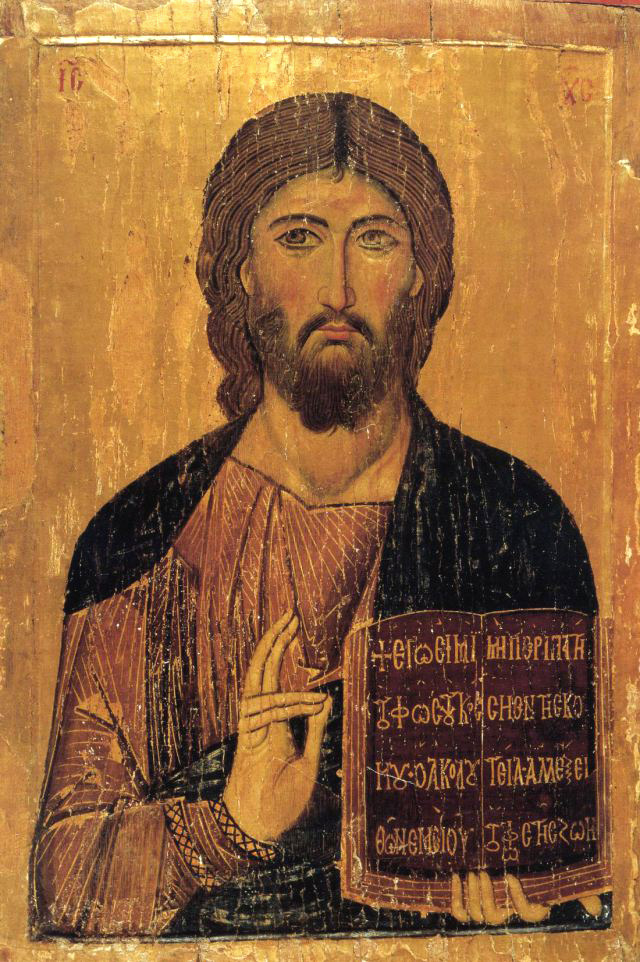
For History to have any real significance, it must have meaning.  Meaning requires interpretation, and interpretation requires poetry, something beyond mere facts.  We might surmise that in having Arthur deal with Rome, Geoffrey sought to display his view of Arthur as the inheritor of the mantle of Christendom after the fall of Rome–the literary equivalent to an interpretative painting of him, or perhaps an “icon” of Arthur (a great example of how truth can be communicated in image can be found here). The same could be said of Gilles’ “depiction” of Charlemagne.

We do not critique paintings by saying things such as, “He didn’t look exactly like that, so that’s not painting.”  But humanistic rationalism treated the text as having more truth than the image.  This is why they treated medieval historians unfairly.  They failed to see how truth claims could be communicated in the text artistically (and entertainingly as well, as anyone who has read Geoffrey of Monmouth can attest).^  I have no problem calling Geoffrey and Gilles historians, albeit historians of a different type.  They told the “truth,” (if their interpretations were accurate), but in a different way.  They had their biases, but so do you and I.

One can point to many reasons why we experience our current political situation.  Some of them do indeed have a connection to the historians of Renaissance France.  The founders (not the early colonists) drank deeply from the same Enlightenment-oriented spirit of our aforementioned historians.  They too focused heavily on texts, and indeed, we base our life together not on shared traditions, but the texts of the Declaration and Constitution, and this has certain consequences.

The postmoderns rightly tell us that texts can have an almost uncountable number of interpretations.  The search for the “absolute” interpretation of the text will get us nowhere.  So, both those who drive pickups with big American flags, and those who drink latte’s and protest the national anthem can claim to live out what it means to be an American (i.e., “protest is the most American thing one can do,” and so on).  On the one hand, Trump takes an ax to many traditions of how a president should act.  But on the other hand, he “connects with the common man,” and isn’t America all about the common man and freedom from tradition?

Hence, we see our dilemma.

But postmoderns fail us because not every interpretation has the same validity.  We have to have a way of distinguishing and separating the good from the bad.  With only texts and no traditions at our disposal, however, we will have a hard time reigning in the various interpretations.  Other ways of seeing and apprehending the “truths” of history can provide checks, balances, and possibly, a return to sanity.  In his introduction to Fr. Maximos Constas’ The Art of Seeing Bishop Maxim asks

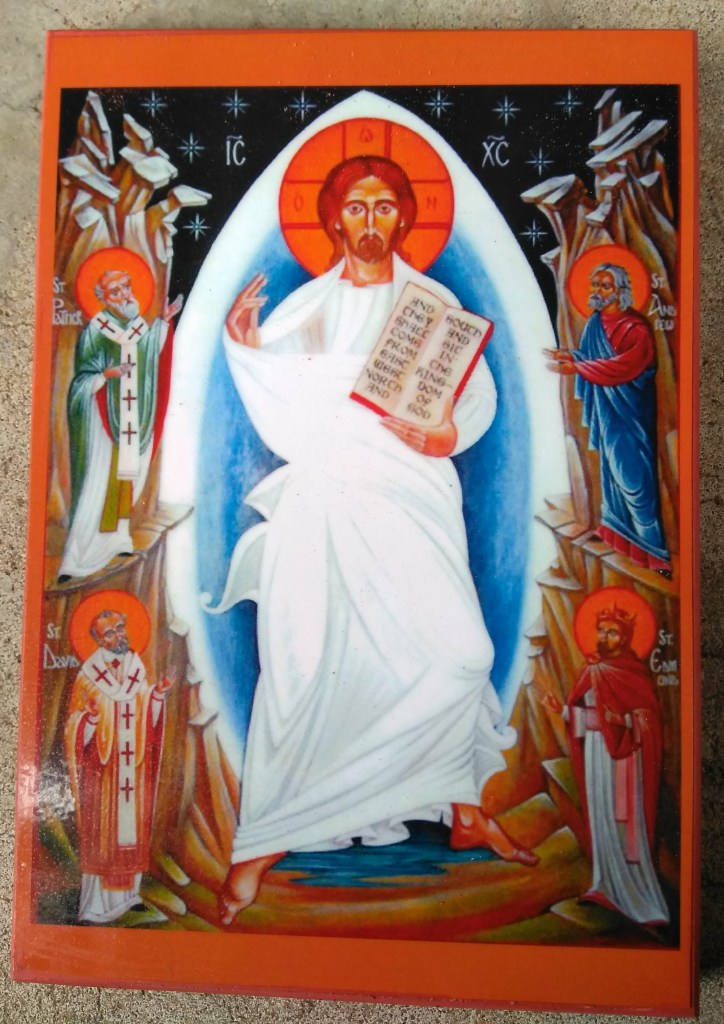
For example, if you have a photograph of Christ and an icon painting of Christ, which is more truthful?  Certainly, if you have a naturalistic approach, you would say, “the photograph.”  But if you say [the icon] you point to unconventional and eschatological truth.  . . . .Therefore, there is truth in art that does not correspond to the mind of reality.

Dave

*I find it interesting that everyone wanted to come from Troy and not Greece.  Troy lost.  Many say that the Europeans wanted to come from Troy to connect themselves with Rome.  I can’t deny this might have something to do with it, but I think it goes beyond that.  Hector, for example, became a Christian name, while Odysseus and Achilles did not.  I’m sure there is more here to explore.

**The idea that history means speaking of such devolution is hardly the property of medievals alone.  Most every ancient society had myths of golden ages in the past we should attempt to emulate, whether these ages be mythical, quasi-mythical, or presented as historical (as perhaps Livy does in his work).  What looks benign to us in the French scholars really represented a radical shift from the past.

I consider the idea of devolution in history here.

^I think this attitude towards texts and the reduction of the idea of truth to “what actually happened” contributed greatly to the Galileo controversy and the subsequent tension between science and religion. In my limited reading of the situation, no such tension existed before this time.


Renaissance and Reformation, Act 2 (?)

I published this originally in 2016 a few weeks after Trump’s election.  In re-reading it, I would change very little of my original thoughts.  I am still not sure of what to make of Trump’s presidency and what it might mean for our future, and I still am not sure what criteria to use to evaluate his presidency.

Without further comment, the original post . . .

**************************

Like many I awoke Wednesday, November 9 to a big surprise.  Like many I wonder in what sense business as usual (more or less) will be the order of the day as Trump begins to actually govern, or whether or not we will see a significant pivot in our national life.  Time will tell (full disclosure, I supported neither candidate and hoped for a 3rd party revolution that never materialized).

I confess there is much I fail to understand about the election.  I have no strong opinions as to why Trump won.   I will attempt to focus on a broader historical perspective and will not deal with issues specific to the campaign, whatever their importance might have been.  I will not seek to take sides so much as to explain.

Consider what follows speculative . . .

Like many I search for historical parallels to our situation.  Many months ago I suggested Andrew Jackson, or perhaps Rome’s Marius, as a historical counterpart to Trump.  A few months ago Tyler Cowen suggested that, based on a book he had read, our world might resemble that of the Reformation.  I filed that away and thought little of it–until November 9.  All six of Cowen’s observations have merit, but two immediately jumped out at me:

1. Many of the structures in places are perceived as failing, even though in absolute terms they are not obviously doing worse than previous times.

2. There is a rise in nationalist sentiment and a semi-cosmopolitan ethic is starting to lose influence.

In his Civilisation series Kenneth Clark displayed an obvious affection for Erasmus of Rotterdam (1466-1536).  Who can blame him?  Erasmus had a great intellect and a good sense of humor, especially about himself.  Erasmus had no particular attachments anywhere and so he cultivated friends all over Europe.  He represented what some might see as the apotheosis of the medieval vision–a cosmopolitan, universal man of Christendom.

Such status did not prevent Erasmus from engaging in polemical criticism.  From what I hear, his Praise of Folly (I have not read it) mercilessly lambasts much of society at that time, in and out of the Church.  And yet, Clark points out that Erasmus could not accept challenges to authority from the common man.  In a personal letter he wrote with horror at the fact that hardly anyone in a town he visited doffed their caps to him–to him–a respectable pillar of Society.  We can almost hear him say, “I’m the one who gets to criticize society.  Not you!  You don’t know what you’re doing, whereas I (obviously) do!”*

Erasmus could criticize aspects of society but would never think of criticizing Society itself and the conventions that held it together.  He lived in an urbane, intelligent, tolerant world of reason, progress, proportion, and the like.  But the temper of times overwhelmed him.  Europe’s darling in 1511 found himself playing the role of “Mr. Irrelevant” soon after the Reformation began in 1517.

Even Clarke, I think, sees the problem with Erasmus.  No one doubted his character, but they questioned his conviction. Erasmus wore too much on his sleeve and not enough (at least to observers) in his heart.  His glib dance throughout Europe made many wonder what he actually believed.

Many assume the that the medieval period practiced more than its fair share of intolerance.  Scholar and historian Regine Pernoud points out, however, that the latter Renaissance had many more persecutions of heretics and witches than any period in the Middle Ages.  She offers no direct reasons for this, but we can speculate.  By 1200 A.D. Europe had attained a significant measure of stability, but not yet a great deal of movement.  The elite of society had “real” jobs and connections to the common man.  The “people” did not live as well as the aristocracy, but they lived with the elite in the same communities and moved in the same circles.  The sea had yet to tempt medieval society, which limited physical mobility and perhaps added to the stability.

By the mid 13th century Thomas Aquinas begins to dabble in the powers of reason and Aristotle.  The Black Plague disrupted the settled social arrangements (among other things).  The 15th century saw plenty of change with the beginnings of exploration and the printing press.  The papal court practiced pagan Greek city-state thinking more so than the service of God.  Now too, elites like Erasmus moved in entirely different circles than “the people.”  With the revival of classical culture came the revival of classical pagan religion, and the rise of occult practices.  It adds up to too much change too quickly.  The Reformation happened not just because of Luther, but in part because Europe had several different people rise up simultaneously willing to challenge an out of touch status quo many no longer cared anything for.  Rightly or wrongly, many felt that elite Renaissance culture had gone too far.**  As Pernoud points out, the reaction against this outwardly benign march of “progress” began before the Reformation in the late Renaissance.

In another post, again from a few months ago, Cowen suggests the possibility that too much immigration may result in a backlash against immigration (we should note that Cowen favors increased immigration as a matter of ideology, but might be pragmatic as a matter of policy–I don’t know). If the pace of change moves too fast, people react against it even if the change itself benefits them overall (most data shows the increased benefits of increased immigration). Rapid change often creates psychological problems of dislocation.

Others with different ideological perspectives seem to agree with him.  Slavoj Zizek argues (warning to those who follow the link: Zizek uses profanity rather “liberally” in places:) that on European immigration issue, allowing for more democracy would significantly restrict immigration policies in multiple countries.  Right now more inclusive policies must come from the state and not from the people.^  Ezra Klein had an interesting exchange with Tyler Cowen recently where they discussed the subject of diversity.

COWEN: …Now Putman, let me ask you about Putnam, and how Putnam relates to Donald Trump. As you know, Robert Putnam at Harvard, he has some work showing that when ethnic diversity goes up that there’s less trust, less cooperation, less social capital.

If you think of yourself in the role of an editor, so you have an American society, diversity has gone up, and a lot of people have reacted to this I would say rather badly — and I think you would agree with me they’ve reacted rather badly — but there’s still a way in which the issue could be framed that while diversity is actually a problem, we can’t handle diversity.

Putnam almost says as such, and do you think there’s currently a language in the media where you have readers who are themselves diverse, where it’s possible not to just be blaming the bigots, but to actually present the positive view, “Look, people are imperfect. A society can only handle so much diversity, and we need to learn this.” What’s your take on that?

KLEIN: I strongly agree. We do not have a language for demographic anxiety that is not a language that is about racism. And we need one. I really believe this, and I believe it’s been a problem, particularly this year. It is clear, the evidence is clear. Donald Trump is not about “economic anxiety.”

Might Trump have a doppelgänger of sorts (not religiously, not even close!) in Martin Luther?  In Luther, we see, among other things, someone with an authoritarian nationalist streak, one who could not stand the polite pagan-infused niceness of elite Europe, one who had no trouble calling fire and brimstone down upon a variety of people, and one who dabbled in opportunism from time to time.

One possible explanation for Trump might lie in the reaction against some of the sweeping changes that have come into the consciousness of America, such as

  • The “trigger warning” and “snowflake” phenomena across many college campuses
  • The Supreme Court case legalizing homosexual marriage across the land (overturning a variety of state laws in the process).
  • The extreme pressure directed against those who refuse to cater, provide flowers, etc. for homosexual weddings
  • The debate over transgender bathrooms, the reaction against the NC law, etc.

None of these changes directly effect the well-being of very many at all, but they do impact how one sees the their place in the world.  Without considering who is right or wrong in these actions, might the western cosmopolitan set across the U.S. and Europe have flown too close to the sun too quickly?

I listen to classical music on a very low level, when I actually listen to it. I can usually tell if it’s Beethoven, Bach, or Mozart, but that’s about it.   One day I decided to get cultured and tried to listen to a Mahler symphony.  My reaction?

In Absolutely on Music, Japanese author Haruki Murakami recorded a series of interviews with the famous conductor Seiji Ozawa.  In one interview Murakami asks,

Just listening to the third movement of [Mahler’s] First Symphony, it seems clear to me that his music is filled with many different elements, all given more or less equal value, used without logical connection, and sometimes in conflict with one another: traditional German music, Jewish music, Bohemian folk songs, musical caricatures, comic subcultural elements, serious philosophical propositions, Christian dogma, Asian worldview–a huge variety of stuff, no single one at the center of things . . . .  Isn’t there something particularly universal or cosmopolitan about Mahler’s music?

To my admittedly very limited experience of attempting to listen to Mahler, Murakami could have just as easily asked, “Isn’t there something meaningless and incomprehensible about Mahler’s music?  After 1/2 hour of attempting to “elevate” my cultural understanding, I would have begged someone to play me a Sousa march to at least bring my brain back into focus.

Cowen’s final thought on how this world might resemble that of the Reformation . . .

The world may nonetheless end up much better off, but the ride to get there will be rocky indeed.

Dave

*A possible parallel to this exists today.  A variety of high-profile fashion designers have said that they will not provide gowns for Melania Trump.  Bruce Springsteen canceled a concert in North Carolina over his objections to their transgender laws.  The great jazz pianist Ethan Iverson called for a boycott of Steinway pianos because the owner of Steinway supported Trump in some vague fashion (in 2012 Iverson urged a boycott of a particular jazz musician for his support of Romney.  Were Iverson a politician, this would be extremely dangerous territory, i.e., punishing someone not for their actions but for their particular beliefs). All of them were perfectly within their rights to do so.  Many applauded them putting moral convictions over profit or convenience.

Can progressives not extend the same rights to those who wish not to cater homosexual weddings?  It appears that some do not wish to extend the same right of protest.  Stephanie Slade at Reason magazine wrote,

The problem is not that Theallet was willing to dress Michelle Obama and isn’t willing to dress Melania Trump (which is, like it or not, a form of discrimination). The problem is just how many people don’t seem to think that same freedom should be extended to bakery owners, photographers, and other wedding vendors who object to same-sex marriage on religious grounds.

As Theallet put it, “we consider our voice an expression of our artistic and philosophical ideals.” I suspect Barronelle Stutzman, the white-haired grandmother who owns Arlene’s Flowers, feels the same way about her craft. But instead of assuming a live-and-let-live attitude on the matter, Washington state has systematically worked to destroy Stutzman’s business unless she agrees to take part in a celebration to which she is morally opposed.

**Whatever authoritarian streak the Middle Ages might have had, the Renaissance had it too, but it came not from the people, but from the elite makers of taste.  In many cathedrals the colorful stained glass (made by a variety of local artisans) got smashed out and replaced with clear glass to better fit wth their ideas of classical purity and decorum.

Pernoud argued with some force that the culture of the Middle Ages was “populist,” which the culture of the Renaissance was “elitist.”

^We can see the Brexit vote as a symptom of this same phenomena.  Europe’s pundits all seemingly declared that Britain would vote to stay in the European Union.  Part of me wonders whether or not the vote to leave had more to do with “sticking it to the cosmopolitan man” (which certainly includes most pundits) than any particular economic or social issue.

9th/10th Grade: The Reformation Roller Coaster

Greetings,

This week we looked at how the Reformation began to spread beyond Luther and his theology.  We looked at a couple of key ideas and themes:

1. Erasmus was a notable scholar.  He wrote many powerful critiques of the Catholic hierarchy.  He believed in going “back to the sources,” and translated the New Testament into Greek.  He initially admired Luther, but felt that a) Luther went too far, and b) Breaking with the Church would cause more harm than good.  Erasmus’ life should make us consider whether or not the cost of the Reformation outweighed its benefits.

2. Mainstream reformers like Luther, Calvin, and Zwingli believed that while the Church needed reform, society as it stood should be preserved.  Others of a more radical bent believed that both Church and society needed drastic overhauls.  They borrowed heavily from Luther’s “priesthood of all believers” theology and established their own views of faith, revelation, and the culture around them.  They went much further than Luther ever intended.  The logic of their ideas ran something like. . .

  • All believers have equal access to God, and have an equal chance of understanding His Word
  • Therefore, we have no need of any kind of hierarchical leadership in the Church
  • Those with the Spirit of God have more wisdom than those who do not.  Therefore, we have no real need of local governments.
  • To achieve real holiness of life, and real holiness in society, the godly must separate themselves from the ungodly.

Luther and others were aghast when they saw how others interpreted their ideas.  When Luther wrote pamphlets urging the nobility to crush the radicals without mercy, some felt that Luther had become a ‘Protestant Pope.’

Our look at the ‘Radical Reformation’ forced us to consider the Church’s relationship to society.  Calvin’s followers wanted to blend civic and religious duties almost until there was no distinction.  In other words, Church and Society in their view should blend seamlessly together.  Radical Reformers wanted the kept entirely separate.  I hope the students understood that our ideas of how the Church should function impact how we think Christians should interact with society.

Of course, Luther never envisioned that he was starting “The Reformation.”  He believed that the Church needed reformed, and that under his guidance, the Church had more or less done so.  In his mind, after the reforms he helped initiate, it was time to stop “The Reformation.”  But Luther had unwittingly opened the floodgates.  The genie was out of the lamp, roaming free across Europe.

We discussed that while Protestantism solved many problems, it created others:

1. There are thousands and thousands of Protestant denominations worldwide.  What did this mean for society in the 16th century?  What does this mean for us today? Is this a problem?  If so, can Protestantism solve it, or is it part of its very nature?

2. In the 16th century, Catholics persecuted Protestants (and vice versa), but Protestants also persecuted each other, largely over disagreements over what is ‘essential’ to the faith.  How do we know what an essential of the faith is?  Can Protestants reach unity on this question today?  Why could they not do so in the 16th century?  As we discussed in class, few disagree about what Scripture says.  We disagree about what it means.  Why did the social, political, and religious climate of this time lead to so much violence?

The peasant revolts, the political shifts, and the multitude of opinions that emerged from this period should make us ask — “What was the Reformation exactly?”  For our first formal discussion of the year we got different perspectives on this question.  Whatever our answer, we must see that the Reformation involved much more than a change of church doctrine.  In fact, the Reformation shows us that changes in the Church will get reflected in society at large.

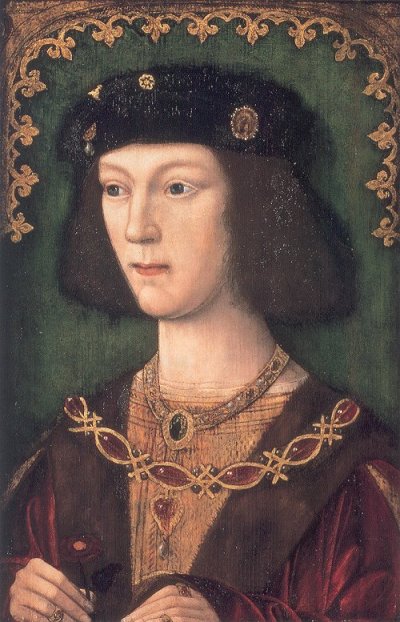
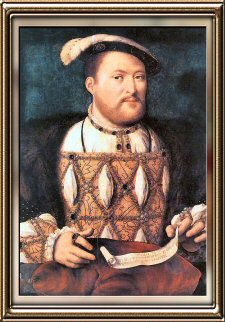
We continued to examine the Reformation in England, and its consequences for the rest of Europe. On Thursday we looked at Henry VIII early life and reign.  I include here four pictures of him at various points in his life.   No matter the period — I don’t trust those eyes!

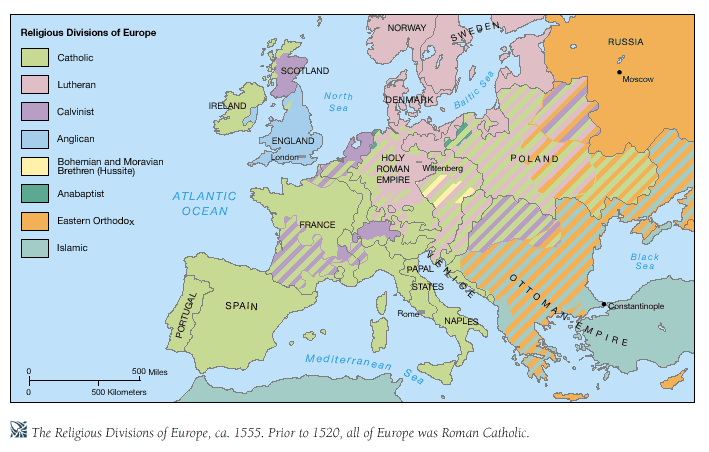
Last Thursday I had the students look at a variety of maps in an effort to look at the Reformation from a purely geographical perspective.  In other words, did geography do anything to shape the course of the Reformation? Are there any patterns for us to observe?  The maps are here, which include the topography that the students had to match up with the religious divisions.

European Topography:

Some of them noted how mountains walled off certain religious groups.  Some theorized that different countries of like religious beliefs usually were close enough to be trading partners.  Religious groups in more rugged terrain (Spanish Catholics, French and Scottish Protestants) tended to have a bit more militancy to them than others did.  The possible link with rugged terrain and more intense religious expression may go beyond Europe.  Most of radical Islam, for example, does not come from Indonesia (the most populous Moslem country) but from the deserts of the Mid-East.  Looking at events from different angles hopefully can give us a more full complete picture of an era.

Many thanks,

Dave Mathwin

9th/10th Grade: Looking back from the Reformation

Greetings to all,

This will be the first of what should be weekly updates about what we are doing in class.  My goal is to have these updates to you no later than Sunday afternoon, so if you do not receive one by Monday, do let me know.  My purpose is to let you have a glimpse of the classroom so you can keep abreast of what we are learning and discussing.  I hope you will join in the conversation with us as we move through the year.

We spent part of the first week reviewing and setting the context for the Reformation.  For the new students, this meant entering a story somewhere in the middle, which can always be difficult.  For some of the returning students, summer has understandably flushed some of their brains.  Any student who feels shaky on the medieval and Renaissance period may want to look here and here, or perhaps other places in the “9th Grade” category in the archives here at astickinthemud.

As I mentioned at orientation, this class primarily involves understanding what it means to transition from the pre-modern to the modern world.  We tend to use “modern” as a synonym for “good,” and indeed, students may feel that the changes from 1500-1850 represent a substantial improvement for mankind.  However, others may just as legitimately feel that we lost a great deal of our Christian heritage as a result of this transition.  Understanding both sides of this debate is one of the key goals of this class, regardless of where students stand on this transition.

The transition can be best understood I think in the following ways:

  • The pre-modern world believed that time and space had a meaning of its own apart from our own actions, whereas the modern world, in the words of scholar Charles Taylor, believes in the homogeneity of time and space.

For example, some churches today have spaces that they use for basketball on one day, picnics on another day, and worship on Sundays.  The meaning of the space depends on the meaning the people give it.  The space has no “meaning” in itself.

The pre-modern world believed in sacred time (Lent, Paschaltide, Advent, etc.) and sacred space.  No one would every think of playing basketball inside Chartes Cathedral.  The space has a meaning apart from us, inherent in the nature of the space itself.

  • The modern world puts a lot more emphasis on the individual than the pre-modern world, which had a more communal and historically oriented approach to meaning.

For example, many in the modern world feel comfortable with the idea than anyone can interpret the scriptures, which empowers the laity to read for themselves.  On the flip side, however, the modern world has a harder time deciding which interpretation is correct.  The pre-modern world had little concept of the individual and derived meaning and understanding from the past more so than the present.

No Church historian, whether Protestant or Catholic, believes that things in the Church in 1500 A.D. were fine.  Many wanted reform in the Church and believed it was desperately needed.   Among scholars and contemporaries, disagreements come in the following areas:

1. When did the problems in the Church begin?  Some say that it began with the popes of the 15th century.  Some say it began with the Great Schism of 1378.  Some argue that it can be traced to the Avignon Papacy, or to the papal decree ‘Unam Sanctum.’  Some go as far back as the Investiture Controversy of 1077.  Some reformers would want to go back further still, and argued that the problems began with Constantine in the 4th century A.D. How people answered this question influenced what they believe was the root problem the church faced.

2. What  indeed was the root problem the Church faced?  Was it a question of the ethics of the Church hierarchy? Was the issue mainly theological?  Or was it the Church’s long involvement with politics?  Or perhaps, all three?  Each choice represented a new fork in the road, one that would involve different choices and divergent paths.  For example, if you believed the Church’s problems to be recent, you likely would focus on the Church’s moral lapses.  The further back one found the so-called “root” of the problem, the more theological and institutional the criticisms, the more radical the operation required to correct the abuses.

Another issue was not only how far reform should go, but, cut free from Church hierarchy, what criteria should they use to make theological decisions?  What authority should tradition be granted?  Is it just “What the Bible means to me?”  If it is more than that, what is it?  Reformers at the time did not always agree on this question, and the results of their disagreement would do much to shape events throughout Europe.

Despite its fairly innocuous beginning when Martin Luther nailed the 95 Theses to the church door in Wittenburg, the Reformation would snowball into a revolution.  Martin Luther had all of the necessary qualities that revolutionaries need.  He possessed great courage and great belief in his convictions.  He had charisma and keen intelligence.  The same qualities that make for good revolutionaries, however, do not make for good diplomats.  This type needs patience, flexibility, and the ability to see many points of view.  Historically speaking, very, very few have been good at both.*  This too will have a significant impact on Protestantism in particular, and the history of Europe in general.  Below I include some quotes from Martin Luther (and others) that illustrate Luther’s keen insights, sense of humor, temper, and stubbornness.

Next week we will see how the Reformation spreads throughout northern Europe, and the different guises reform takes.  If we believe that religion forms the heart of any civilization, the religious upheaval in Europe in 16th century will have significant ripple effects into all areas of life.  We shall examine some of these things next week.

Many thanks,

Dave Mathwin

*The only two I can think of are Nelson Mandela and George Washington.  Can anyone else think of others?

Reformation Quotes:

I think his [95 Theses] will please all, except a few regarding Purgatory who make their money thereby.  I perceive that the monarchy of the Roman high priest is the plague of Christendom, yet I hardly know if it is expedient to touch this open sore. — Erasmus in 1518

Most blessed Father, I offer myself prostrate at the feet of your Holiness, with all that I am and have. . . .I will acknowledge your voice as the voice of Christ, residing and speaking in you.  — Martin Luther to Pope Leo, 1518

Dearest brother in Christ, your epistle, showing the keeness of your mind and breathing a Christian spirit, was most pleasant to me.  Christ gave you his spirit, for His glory and the world’s good. [My advice] is that quiet argument may do more than wholesale condemnation.  Keep cool.  Do not get angry. — Erasmus 1519, in a letter to Luther

Luther’s books are everywhere and in every language.  No one would believe the influence he now has on men. — Erasmus, 1521

Unless I am convicted by the testimony of Sacred Scripture or by evident reason . . . I cannot and I will not recant anything, for to go against my conscience is neither right nor safe.  God help me. — Martin Luther at the Diet of Worms, 1521

If we strike thieves with the gallows, robbers with the sword, heretics with fire, why do we not much more attack these masters of perdition, these cardinals, these popes, and this sink of Roman Sodom . . . and wash our hands in their blood? —  Martin Luther, 1520

It would be better if every bishop were murdered, every foundation of every cloister rooted out, then one soul destroyed, let alone that all souls should be lost due to their trumpery and idolatry. – Martin Luther, 1521

Begone, unclean swine!  Touch not the altars with your desecrated hands!  The cup is full.  See ye not that the breath of liberty is stirring?  – John Hutten, German priest speaking to the Roman bishops

The common man is learning to think, and contempt of princes is gathering among the multitude.  Men will not suffer your tyranny much longer. — Luther to the German princes

You lords, let down your stubborness and oppression, and give the poor air to breathe.  The peasants, for their part, should let themselves be instructed, and [withdraw some of their demands]. – Luther to German Nobility

Forward!  Forward while the fire is hot!  Let your swords be ever warm with blood. . . . The godless have no right to live except as they are permitted to do so by the elect.  – Thomas Munster, to his peasant army, 1524

In my former book, I did not venture to judge the peasants, since they had offered to be set right and instructed, [but they did not listen].  Any man against whom sedition can be proved is outside the law of God, so that the first who can slay him does right and well.  Therefore let everyone who can smite, slay, and stab.  There is nothing more devilish than a rebel. – Luther, ‘Against the Robbing and Murderous Horde Of Peasants.’ – 1525

He who will not hear God’s Word when it is spoken with kindness must hear the headsman when he comes with his axe. . . . Of mercy I will give no heed but to God’s will in His word.  If He will have wrath and not mercy, what are you to do with mercy?  Did not Saul sin by showing mercy upon Malek? — Luther, ‘An Open Letter concerning the Hard Book Against the Peasants.

Why should we pity men more than God does? – Philip Melancthon on the destruction of the Anabaptists

Anyone who is aware of [Anabaptist] teaching and preaching must give names to the magistrate, in order that the offender may be taken and punished.  Those aware of such breeches of this order and do not give information, shall be punished by loss of life or property. – Edict of Saxony, 1528

Quotes from Luther on Various Topics:

All the articles of our Christian faith are in the presence of reason sheerly impossible, absurd and false.  Reason is the greatest enemy faith has.  She is the Devil’s greatest whore.

The Bible teaches us to feel, hope, grasp, and comprehend faith, hope, and charity far otherwise than mere human reason can.

The human will is a beast of burden.  If God mounts it, it goes where He wills, and if Satan, it goes where he wills.  Nor can it choose the rider.

Christianity is nothing but a continual exercise in feeling that though you sin, you have no sin.  It is enough to know that the Lamb bears the sins of the world, whether we commit a thousand fornications a day or as many murders.

Man is as unfree as a block of wood, a lump of clay, a pillar of salt.

I do not admit that my doctrine can be judged by anyone.  He who does not receive my doctrine cannot be saved.

Seek out the society of your boon companions, drink, play talk bawdy, amuse yourself.  One must sometimes commit a great sin out of hate for the Devil, so as not to give you the chance to feel scrupulous over mere nothings.

Sin powerfully.  God can only forgive a hearty sinner.

I eat like a Bohemian and drink like a German.  Thanks be to God.

I seek and accept joy where I can find it.  We now know, thank God, that we can be happy with a good conscience.

Our loving God wills that we eat, drink, and be merry.

Dances are instituted that courtesy may contracted between young men and girls.  I myself would attend them sometimes, but the youth would whirl less giddily if I did.

I would not give up my humble musical gift for anything, however great.  Next to theology, there is no art that can be compared to music, for it alone, after theology, gives us rest and joy of heart.

Christians need not altogether shun plays because there is sometimes coarseness and adulteries therein; for such reasons they would have to give up the Bible too.

If God can forgive me for having crucified Him . . . He can also bear with me for occasionally taking a good drink to honor Him.

My enemies examine all that I do.  If I break wind in Wittenberg they smell it in Rome.

Punish if you must, but let the sugar plum go with the rod.

Take women from their housewifery and they are good for nothing.  But there she can do more with the children with one finger than a man with two fists.

My Lord Katie (his pet name for his wife Katharine).

I wish you peace and grace in Christ, and send you my infirm love.  Dear Katie, I was weak on the road to Eisleben, but that was my own fault. . . . now, thank God I am so well that I am sore tempted by fair women and care not how gallant I am.  God bless you.

I never work better than when I am inspired by anger.

Luther the Anti-Semite?

 I would not have the Gospel defended by violence or murder.  Since belief and unbelief is a matter of everyone’s conscience . . . the secular power should be content to attend to its own affairs and constrain no one by force.

Since our fools, the popes, bishops, sophists and monks, those donkeys have dealt poorly with the Jews.  Indeed, had I been a Jew and seen such idiots, I would rather be a hog than a Christian.  I would advise everybody to deal kindly with the Jews.

And let whosoever can throw brimstone and pitch upon [the Jews]; if one could hurl hellfire so much the better. . . .And this must be done, so that our Lord will see that we are indeed Christians.  Let them be driven like mad dogs out of the land.

Opinions of Luther

Luther is the ‘Morning Star’ of Wittenberg. – Mutantius, contemporary of Luther

Luther has all the fury of a maniac. – Mutantius, spoken about a year after the previous comment

If we judge greatness by influence – which is the least subjective test we can use – we may rank Luther with Copernicus, Voltaire, and Darwin as the most powerful personalities in the modern world. – Will Durant

The Stripping of the Altars

A friend of mine and I sometimes argue about A.I. He contends that it is literally impossible for the Singularity to happen. I agree with Jonathan Pageau, who stated that whether or not the Singularity “actually” happens won’t matter if people believe that it has happened. Our perception of reality trumps “reality” all the time, and then calls that reality into being. If you believe that you have an imaginary friend you act on that belief and shape your life around it. Those choices count much more than the fact that Billy the Rabbit has no actual physical existence.*

Perception obviously shapes historical analysis as well and can easily trump “facts on the ground.”

Sean McMeekin has written The Russian Revolution: A New History that challenges the version of events that I (and many others) learned in high school. Because of newly declassified documents available, McMeekin has solid footing for his conclusions. Textbooks told us that,

  • Russia was hopelessly backward and corrupt
  • The people were starving
  • The army wouldn’t fight in WW I, but the Czar made them anyway
  • That the people rose up spontaneously with the Bolsheviks, etc.

Naturally, the Left in Europe and America eagerly accepted this narrative–it was a narrative they very much wanted to be true.

We now know that

  • Bolsheviks paid the modern equivalent of hundreds of dollars per person per protest, which came direct from German financing
  • The Red Army in the Civil War (1918-1919) had lots of help from Sweden, it was not a purely popular movement
  • The Russian army in WW I actually fought well most of the time and had high morale until the Provisional Government made catastrophic errors after Czar Nicholas abdicated
  • Czarist Russia actually had a milder justice/police system than most any other comparable westernized country.

McMeekin points out perfectly well that a) Communism is bad, and b) Communists lied and manipulated to get into power, and then promptly dreadfully abused said power. But what this doesn’t tell us is why Lenin and Trotsky won and could maintain power, if they didn’t necessarily represent the people.

Eamon Duffy’s The Stripping of the Altars: Traditional Religion in England, 1400-1580 attempts something similar. The standard narrative of the English Reformation generally assumes, that, yes–Henry VIII was a bit of wild boar, but Catholicism had reached a decrepit state and the laity, on the whole, wanted change. In some ways, then, the Reformation proved a blessing in disguise for Catholicism, as it spurred on their own revival. Duffy’s extensive research seeks to change our perception of the Catholic church in England leading up to the momentous decade of the 1530’s. Duffy combines copious research with an intimate and engaged style. One can see why this book won awards for historical writing in England. Duffy avoids any direct comments on the theological controversies that surround the book, but stays engaged as a writer through the ebb and flow of events he describes.

Duffy uses a few different lenses to make his points. Many assume that the laity must not have understood services in Latin (however much Latin was known in AD 1000, it was the language of scholars and clergy by the mid-15th century), and therefore disengaged themselves from liturgical life. With multiple types of sources, one in fact sees almost the opposite. Participation in church life on Sundays and other important feasts formed a crucial part of the lives of nearly everyone. Many laity gave gifts to churches not just of money, but of items for liturgical use. Indeed, in the English church at least, the clergy had responsibility for the adornment of the altar, but the laity for the nave of the church. Different sources indicate that the laity saw this not as imposition or burden imposed from the clergy, but as a privilege and a chance to take responsibility for the “their” church. We do not see a distant, “authoritarian” clergy in England in the century leading up to Henry VIII. We instead see partnership between clerical authority and the people.

Ah, but perhaps the laity blindly followed along to a service and a faith of which they had no understanding? Certain treatises or plays from the time do make a boorish cleric or layman the butt of fun for his lack of knowledge. Duffy cites a few examples of such things, but urges us not to make too much of such texts. We should not assume that such characters reflected standard fare. Such literary characters had comic effect precisely because they defied typical expectations. No one laughs at a man walking down the stairs, but if he tumbled down, that would be different.

Another standard narrative has the printing press prepping the ground for the Reformation by giving voices to those outside the theological and cultural mainstream. Once people read such material, they jumped on board with change. Again, Duffy pulls the reins. Indeed many printers had a good business selling books . . . with Catholic theological primers and prayer books topping the list. The “Book of Hours” (a compendium of prayers for different times of day based on the prayers recited by monastics) topped lists, selling thousands of copies and going through several editions for decades. More surprisingly, most of these books were written in Latin, not English. The people bought them either in spite of, or perhaps even because of, this fact.

Duffy speculates at length what this might mean. He points out that having the books themselves served as a mark of devotion. The books contained many pious illustrations as well. But good evidence exists that people knew the content and meaning of at least some of the psalms and prayers through repeption, participation in church life, and so on. In the post-printing press world we assume reading the only path to knowledge, but it ain’t necessarily so.

Having started the freight train of revisionist thought, Duffy (who keeps his own religious opinions unstated throughout the book) keeps going . . .

Many Reformation scholars assume that restriction of lay participation in religious life created a great need that reformers could exploit. Thus, the Reformation succeeds not so much through doctrinal change but by giving the laity new roles and responsibilities in their worship. Perhaps a grain of truth exists in this, but overall Duffy disagrees, citing numerous examples of popular devotions and practices that if anything, the laity foisted on the clergy. From Duffy’s perspective a healthy lay input of practice and devotion existed across England during Henry’s reign, which combined easily with the universal liturgical worship.

Ok, but surely the Catholicism of the time with all of its “smells and bells” must have emphasized a remote, distant, God, one we can access only through Mary and the saints, and so on. Wrong again. Duffy devotes significant space to the place of saints in late medieval religion, prevalent as it was. But this devotion to saints took nothing away from their sense of closeness to Christ. Both in formal liturgical worship and prayer, and in popular religious expressions (often in the form of “mystery plays”) the consistent emphasis came down on the side of Jesus as our brother, sharing in our humanity and sufferings, and so forth.

Duffy adds little new to our understanding of Henry VIII. We suspect that Henry broke from Catholicism for political reasons overwhelmingly, and Duffy’s research backs this view. Henry concerned himself exclusively with stability. He wanted to keep people quiet and so keep “traditional” religion. His problem lay in that to break with Rome, divorce Katherine, and marry Anne, he needed the support of religious leaders who wanted much more than to simply replace Henry with the Pope. Henry occupied an island by himself. Most wanted to stay Catholic. Others wanted more evangelical Protestantism. No one besides Henry’s wanted his solution–he fell “in between two stools.” And so, while he constantly had to reign in more zealous Protestants who stirred up trouble by changing too much too fast, he could not get rid of them and have his various marriages legitimated.

Some Catholics resisted openly, but I think that–whether Henry consciously intended this or no (I think not)–Henry’s regular reigning in of people like Cranmer and Cromwell gave Catholics hope that he would return to Catholicism. They might legitimately think that time favored them. Perhaps Henry’s ministers caused all the problems, and he might dismiss them any day now. In other words, “rocking the boat” might easily appear against their interests. In actuality, this movement of two steps forward, one step back, brought them further away from shore over time. This can explain the relative lack of resistance to Henry’s changes.

Edward VI reigned but a few years, though certainly all in a Protestant direction. Then, a truly Catholic Queen Mary followed, and it looked as if the temporizing strategy of most Catholics during Henry’s reign might pay off. As Duffy indicates, a truly fair picture of Mary Tudor’s (“Bloody Mary”) reign has yet to emerge.** Duffy shows that Mary tried temporizing to a degree herself. She did not immediately try and revert to the full Catholic liturgical rites, but instead first pushed things back to the state of things during her father’s reign. Again, Catholics could see things moving their way. But Mary’s short reign threw things decisively in favor of Protestantism, as Elizabeth came next.

Duffy shows us convincingly that the movement towards Protestantism never had majority support until Elizabeth’s reign. So we then must wonder why the English Reformation happened at all. A few theories exist:

  • Catholicism had grown corrupt, the laity desiring change, but kept in the dark by dumb, corrupt, obscurantist clerics. If one only wants to accept half of what Duffy claims, this view makes no sense of the actual evidence.
  • The people wanted more things that were distinctively English, as a form of rebellion against the cosmopolitan elitism of the late Renaissance. Thus, the English Reformation had more to do with native/national feeling than religious belief. But this won’t fly either–Duffy points out countless examples of English Catholic churches “localizing” certain practices and celebrations of saints–often ahead of the church hierarchy. Their practice of Catholicism had distinctive English elements. Besides, while the liturgy continued in Latin, numerous other religious works existed in English approved by the Church.
  • Catholicism remained strong, but societal elites, from the gentry on up, had grown distant from popular piety through the distribution of private prayer books and private family chapels. The English Reformation worked because Henry VIII appealed to the aristocrats of little piety with gifts of land, and to other sincerely religious elites who disdained the “vulgar” and distinctly physical practices of English Catholicism ca. 1500.

I have strong sympathy with this view, but Duffy disagrees with it for a few important reasons:

  • Many aristocrats made it a point to furnish churches with liturgical decorations and stayed involved with church life
  • Many aristocrats made a point to continue to fund the printing and distribution of Catholic materials.
  • Many aristocrats became central pillars of Catholic resistance, especially during the reigns of Elizabeth and James I.

At least we can say that the English Reformation, while supported by some aristocracy, did not primarily involve class divisions.

Duffy never offers a direct answer to the question of how exactly the marginalization of Catholicism happended, but he leaves some bread crumbs for us to follow. Part of the success of Protestantism involved time. The slow, steady move away from religious practice of 1530 sometimes changed course, but the overall direction favored Protestant innovations or simplifications. By the 1580’s only a minority of closet Catholics and the very old would remember “the way things were.” From a Catholic perspective, Protestants eventually cooked the frog in the pot.

Another subtle attack made deep inroads, one that piggy-backed with prevailing Renaissance humanist methodology. Catholics believe/d that holy water actually contains spiritual power and grace from God. It is not only or even primarily a mental reminder of one’s baptism. Holy images actually serve as a way to enter into the real presence of the saints, not just as a mental reminder that they once existed and led holy lives. Because Henry wanted to change and also not change things, many of his lieutenants attacked not the images themselves, or the use of holy water in itself, but their meaning and interpretation. For Henry’s reformers, such things served only to remind us of this or that. Their continued use provided continuity, but this new interpretation laid the foundations for their eventual removal. As the saying goes, if to appreciate the music you have to listen to the notes they are not playing, well, you can do that at home. To change the reason or the meaning of the action will effectively change the thing itself.^ The proof lies with the pudding . . . what Anglican church today uses holy water, incense, or venerates images as part of their worship?

I say that this piggy-backed on humanist methods because with the Reformation one saw a contemporaneous change in other areas. Renaissance humanists wanted things clean and tidy. They removed multi-colored stained glass in many cathedrals and replaced it with clear panes. They significantly curtailed the so-called “mystery plays” done by the laity, so prevalent in medieval times. Previous historians wrote with an eye towards myth and meaning, but starting around 1500 historians switched towards embracing exacting accuracy, and “fact.” The general trend for these scholars involved moving away from a “messy” physical/spiritual interaction towards the clean, unfettered world of the mind. Henry’s use of this trend put him squarely on the crest of the wave of deconstructing meaning that has only started to reverse itself within the last four or five years.

Duffy’s justly praised work leaves us with some uncomfortable questions.

Though this is a minor point, those committed to a view of “temporizing” with change have to face up to the fact that this strategy failed miserably for Catholics. Maybe it would have worked had a few things been different, but we know that temporizing failed. I have a natural sympathy with the dictum of Don Fabrizio Cabrera in The Leopard who states that, “we must change so that things stay the same.” Maybe sometimes this would work. But just as obviously, sometimes it fails, and one needs to hold the line at all costs. We should acknowledge that our preference for either prudent compromise or steely resolve comes from temperament, and examples of the prudence of both approaches litter the pages of history. Hopefully we can cultivate wisdom to know when we need one or the other. In the case of the English Reformation, even if Henry kept everything the same minus the Pope, well–it turns out you can’t have Catholicism without the Pope.

More substantively, The Stripping of the Altars may challenge one’s view of history, as it has mine. I would say that up until about 7-8 years ago, I leaned heavily on the side of history proceeding mainly from the bottom up. That is, I saw things happening because for better or worse, “the people,” or “the culture” brought it into being. Unless someone decisively challenges Duffy, this emphatically was not the case with the English Reformation. Rather, a few people close to power at the top managed within a generation to end centuries of belief and practice. This picture fits with emerging work on the Russian Revolution, and possibly the American Revolution as well. It fits with the aftermath of the Obergefell decision has had on our culture. It fits too with how people have responded to COVID, and how quickly the world fell in line. History may very well proceed from the top-down even in our more democratic age. For as much as Catholics here and there found bold or wily ways to resist change in pockets, they lacked cohesive national leadership.

Perhaps one should lean towards compromise most of the time. But, regardless of one’s convictions, every man, culture, and faith needs a solid center that will not budge when it encounters the world.

DM

*For example, if we make a progressive algorithm and feed it to a computer, and tell the computer to make decisions based on the algorithm–or–if we made decisions based on the computer algorithim–who has agency and volition in this scenario? I say that in the above scenario we act as is the computer has volition, for we follow its commands. This matters much more than the technical origins of the algorithm.

**If we look at strictly the numbers, Elizabeth persecuted Catholics far more than Mary did Protestants, though of course she reigned for a much longer time. As a further aside, the image we have of Mary owes much to John Foxe’s Foxe’s Christian Martyrs, an indication of how a particular image/book at the right time can sway centuries of opinion.

^I.e., if you change the meaning of marriage from a sacramental union showing forth salvation to something instituted primarily for human happiness, you end up with marriage subordinated to human happiness–and there are plenty of ways to be happy as a couple without marriage.

Bull Logic, Bear Result

I recently heard an interesting interview with author Paul Kingsnorth. Some years ago Kingsnorth was a prominent advocate for the environment.. He ceased his activism, though has kept most of his beliefs about the environmental and sociological issues western civilization faces. Kingsnorth also recently converted to Orthodox Christianity, which–while not the same as moving to Texas and becoming a Baptist–still puts him at odds with aspects of many environmental movements (for a few at least, Christianity is the cause of our environmental degradation with its teaching about man’s dominion over creation).

Again–Kingsnorth agrees that many problems exist. But he has come to believe that

  • Some of the solutions many advocate are in fact part of the problem. Technological advances will not save us–be those advances in carbon reduction, green energy, etc. To look to “Science” and “Progress” for help is to look to what got us in this mess in the first place. For example, electric cars are no doubt better for the environment than gasoline engines, but one still has to do a lot mining to get the materials for the batteries of those cars.
  • Activism spends too much time telling people what to do (which naturally provokes resistance) and not enough showing them how to do it.

More importantly, he added that

  • People may want to change, but our choices actually have very little “choice” in them. The whole concept of the “market” has helped create many of our environmental problems. But–all of our “stories” we tell ourselves involve the market. We market ourselves, and our causes, on social media and elsewhere. We seek to maximize ourselves just as we seek to get the best deal on a mattress.
  • So, in the end–change seems impossible within current framework.*

Kingsnorth has now dedicated himself to trying to create a different framework for himself and others through rediscovering old stories and crafting new ones, something he has done with his novels, The Wake, Beast, and Alexandria. Of course, I hope I have represented his views fairly–I encourage you to listen to him yourself.

Hearing Kingsnorth made me curious to try and explore the question of the market, and this led me to Harvey Cox’s The Market as God. I tend toward conservatism (whatever that means), so I thought it important to check out a more liberal voice on the question. A few aspects of Cox’s analysis raised my ire. He critiques aspects of the Christian tradition, which I’m fine with as far as it goes. Certain aspects of Christian tradition should come in for critique.** But heaven forbid that Cox put other religions under the same lens. For many on the left, what is “other” always stands superior to what is one’s own. But Cox showed nuance and thoughtfulness in other areas that helped me read on (such as his correct refusal to name Adam Smith as the patron of self-interest and unbridled capitalism). He picks some low-hanging fruit, but also explores deeper questions about where we find ourselves.

Most analyses of capitalism focus too much on surface questions, i.e., how much utility does the market have for society? Cox moves through this territory quickly. First, people will inevitably create markets. And, markets obviously accomplish many functions that benefit society. Cox acknowledges the persuasive power of arguments within the Christian tradition on behalf of the Market. Michael Novak, a conservative Catholic, argues that

  • God made man in His image, which gives mankind the capacity to create things of value
  • Societies should be constructed so that this God-given aspect of man can flourish
  • Thus, whatever impedes this creative faculty in man, be it burdensome regulation, crony capitalism, and so forth, should be removed.

Novak understands the problems of unbridled capitalism combined with a competitive spirit. He also traces the effects of markets on those in poverty. Increasing opportunities for all means increasing them for the poor. Novak need not say that capitalism works perfectly to rightly argue that, while it likely will increase economic inequality, it will also raise the standard of living for all. Capitalism will not raise everyone out of poverty, but it will raise some, which is always better than none. Critics of capitalism have to acknowledge the benefits it brings.

But what I like about Cox’s book is that he is not concerned to argue about the relative pro’s and con’s of capitalism. This debate has gone on ad nauseam in many other places. He wonders not what good the Market brings (it obviously brings many benefits) but what kind of a person a Market society creates.

To start, if the Market served as a deity it would need holy days, or “feasts.” And so we have Black Friday, Prime Day, the Christmas buying season, and so on. A religion needs precepts, articles of faith. Cox mentions the idea of “trickle-down” theories, and given his background, could have leaned on this hard. But I give him credit that he went deeper to foundational ideas, not just politically divisive ones on the surface. Cox sees that every religion needs a topography, a uniform landscape where people can enter at any place. A Baptist should be able to walk into more or less any Baptist church and feel comfortable to an extent at least. The Market seeks efficiency and maximizes opportunity. For Cox, Market “faith” means much more than trickle-down theories. The Market teaches us fundamentally that we must choose, but within a set of defined parameters. Cox writes,

The Market calls not just for a monochrome outer topography. It needs an internal predictability as well. It needs people open to conversion. The Market mentality within us must match the Market that surrounds us or else the vital connection will misfire. . . . because profit derives from the mass production of countless blouses, cars, and wristwatches, a certain uniformity of taste must be generated. The problem is that human beings are not the same . . . So the Market God needs to transform people what what they once were into people prepared to receive and act on its message. . . . They have to be reconfigured to want the same thing, with manageable variations in packaging, color, and flavor.

Perhaps this explains why the Market tends to take over territory that in its inception at least, had nothing to do with Market incentives. One immediately thinks of the Super Bowl, which many now watch for the commercials. The game itself is practically secondary for many viewers. Cox briefly traces the path of Mother’s Day, Valentine’s Day, and of course, even Christmas itself, and how the Market inexorably wormed its way into how we “observe” such days. President’s Day, Memorial Day, and so on, have at least been partially transformed simply into long weekends with inevitable sales and opportunities to buy. This presence of the Market, akin to “omnipresence,” shows the deep power of Market ideology.

In light of this, liberals and progressives might face temptation to chortle on the moral high ground. But hold the phone . . . progressives gladly support the idea of corporations and organizations supporting their causes. In fact, I would argue that liberals/progressives do a much better job branding and yes, “marketing” their ideas to the culture. How else did they win the culture wars? Those on the left believe firmly that their choices define them. Their bodies are buyers in the domain of sexuality much more than conservatives. They would cry “foul” just as much as a free-market capitalist if government or culture at large restricted their freedom of choice, their freedom to “create” themselves in the market of ideas, and causes.

This is Kingsnorth’s insight. Nearly all of our discourse on the right and the left takes place within the framework of choice, opportunity and allowing us to maximize our ability to choose.

Cox holds back from saying that the Market rules all, but admits it comes close. He floats the possibility that faith in the Market god may have peaked around 2015-16. He cites data showing that Black Friday shopping has declined in recent years. This he attributes not to people shopping less, but to stores following the lead of market rationale of providing more opportunities to shoppers, thus the new trend of stores opening on Thanksgiving evening. The logic here works, of course–the Market loves more opportunities and openings–but that same logic also works against itself. Cox cites interviews with Black Friday pre-dawn shoppers. Many told reporters that they were not there for the deals so much as the spectacle, or the ritual, of Black Friday. If they got a cheap tv, great, but they came for the Black Friday experience. Without that experience, why come?

Cox wrote his book before peak Amazon and advent of Prime Day, which, following the logic of the Market, has expanded into multiple days. Nothing testifies to the Market in all its glory like Amazon. One can buy almost anything from almost anywhere, all without “wasting time” driving too and from different stories (full disclosure–I bought The Market as God used on Amazon for the amazing low price of $3.49, I think). But the problem is the same as the ones retailers face with Black Friday. The Market seeks to expand choice and possibility. Amazon, the current apotheosis of Market ideology, has followed this creed better than anyone else. But spread the butter too thin and you won’t notice it at all. Amazon has no embodied communal rituals, and religions cannot survive without them.

In the medieval period most markets existed within the vicinity of the great cathedrals. Some see in this a co-opting of religion, or an unholy partnership between religion and the market. Some foolish folk even go so far as to see profit as the driving force behind the building of cathedrals themselves. Cox pleasantly surprised me by seeing it differently. The point of the medievals locating markets near churches only partially had anything to do with the fact that churches existed in the center of towns. Rather, markets only really work when they know their place in a proper hierarchy, which is under the shadow of the Cross.

DM

*Kingsnorth has no issue with markets per se, but their omnipotence. I would not say that Kingsnorth is a pessimist outright, yet it seems that the main thrust of his recent writing focuses on preparing us for death, and hopefully, new life afterwards. No civilization lasts forever, and most succumb to their own internal logic reaching the end of the line. For example . . . most emissions and environmental problems come from China, and perhaps India. How can we stop this? Europe, Russia, and the U.S. went through the same process of industrialization and urban centralization in the late 19th-early 20th century. Doesn’t “fairness” indicate that they should get their turn as well? If not–would we fight a war to stop them? Aside from the monumental human cost, war would involve much more destruction to the environment than the current situation. We are stuck. If we stop, we will lose to China and others, and if we continue, we will all lose together. At least, this is one possible outcome.

**Cox has read Max Weber much more closely than I, and, unwittingly or no, he indirectly confirms some of Weber’s key ideas. It is eerily remarkable how many ‘founding fathers’ of the Market came from some kind of Calvinistic background. A connection must exist that I have yet to fully grasp.

The Year 0

I have never been much for math but the concept of the ‘0’ has always intrigued me, perhaps because of its philosophical nature. How can one count or measure something that by definition has nothing to count or measure? The ancient Greeks, obsessed as they were with perfection, never came to terms with it. The Romans–ever practical by nature–used numbers for recording, bartering, etc. only, so they seemed to have no need for it, or never thought of it. Or perhaps, they feared and consciously avoided the 0, dimly perceiving its immense metaphysical weight.

In ancient cultures, from India, Egypt, China, and Meso-America, the ‘0’ had a differing but overall overlapping meaning. A ‘zero’ is the “space between” what we can measure. A zero dwells where reason cannot. As a practical example, the Roman Ptolemy apparently used a ‘0’ to measure the time of solar eclipses, when it was day, but not day, as one might interpret it. In China, a 0 functioned in writing as a “full stop.” One hits the reset button with the 0. More poetically, we might say that in calendars, a 0 functions as a beginning outside of time. The 0 creates time, or certainly at least, the meaning of time. Something has stopped, something else will begin, a new demarcation.

Over the last several years, we have seen the rise of BCE (Before Common Era) and CE (Common Era) to mark our passage through time. This shift has happened without anyone in particular decreeing it so, an interesting fact in itself. I came across a description of this change here from a reputable encyclopedic website, where they make two basic claims:

  • That the change from BC/AD to BCE/CE has “nothing to do with removing Christ from the calendar and everything to do with historical accuracy, and
  • That calendars should be concerned only with scientific accuracy.

Regarding the second point, Robert Cargill writes,

According to the Gospel of Matthew, Jesus was born during the reign of Herod the Great. According to multiple ancient sources, Herod died in 4 BCE. If the Gospel of Matthew is historically accurate, this would mean that Jesus of Nazareth was born on or before 4 BCE—meaning Jesus was born 4 BC (4 years Before Christ)! If we add to these 4 years the fact that Herod the Great did not die immediately after the birth of Jesus, but, according to Matthew, ordered the death of all children two years of age and younger in an attempt to kill Jesus, we can add an additional two years to the birth of Jesus, making his birth approximately 6 BCE. If we also add the missing year zero, it is most likely that, according to the Gospel of Matthew, Jesus was born around 7 BCE!A

Thus, the BC/AD system is fundamentally flawed in that it misrepresents the birth of Jesus by approximately 7 years. This means that Jesus’ ministry did not begin around the year 30, but instead around the year 23. Likewise, Pentecost and the origin of the Christian Church should not be dated to “33 AD,” but to about 26 CE.

An even greater problem still exists with the BC/AD system: the year of Jesus’ birth differs depending on which Gospel one reads. While the Gospel of Matthew states in chapter 2:1 that Jesus was born during the reign of Herod the Great, the Gospel of Luke states in chapter 2:1-2 that Jesus was born during the first census of the rule of Quirinius, governor of Syria. According to ancient sources, the date of this census is about 6 CE. Thus, the Bible is internally inconsistent regarding the year of Jesus’ birth. (2)

The article explains that the phrase “Common Era” (instead of A.D.) should not be viewed as a bow to political correctness, for scholars in the 17th-19th century used the term when communicating with non-Christians. The article notes that,

Non-Christian scholars, especially, embraced the new designations because they could now communicate more easily with the Christian community. Jewish and Islamic, Hindu and Buddhist, scholars could retain their calendar but refer to events using the Gregorian Calendar as BCE and CE without compromising their own beliefs about the divinity of Jesus of Nazareth. Since the BCE/CE designations corresponded to the Christian BC/AD, Christians could correspond back just as clearly. Throughout the 18th and 19th century, “common era” was used frequently with a respectful nod to Christianity in phrases such as “the common era of Christ” or “the common era of the Incarnation” until, by the late 20th century, it again reverted to simply “common era”.

All in all, the article’s author Josh Mark tells everyone to calm down. The Gregorian calendar is not really accurate, and the new designations make communication easier across cultures.

But I disagree. This change, now adopted across western-speak, portends a great deal. To make this case we first need to understand something of the nature of time itself.

As to the question, “What is time?” many things could be said. In his book The Ethics of Time John Pateleimon Manoussakis makes the observation that time should be primarily thought of as “movement.” We might assume this an obvious given, but some ancient philosophers thought movement essentially impossible. Zeno’s paradox suggests the impossibility of movement. Parmenides concurs, writing that Being

is simple, immovable, and without end. Nor was it ever, nor will it ever be; for now it is, all at once, one and continuous . . .

Heraclitus seems to promote movement, but his concept of flux remains so completely continuous, that we can truly said to go nowhere at all because we lack a solid reference point from which to measure. Without this, we cannot truly know if we have moved at all.

Anaxagoras broke this mold by claiming that Parmenides reached his conclusion by the movement of thinking, the movement of the “nous,” I.e., the “soul” or “heart” of a man (the word has various translations). This movement of our inmost being need not take us away from, but rather towards our perfection. To the question, “How does something become what is best for it?” Anaxagoras answered, “By being moved.” Plato tells us that Socrates joined in with Anaxagoras’ approach, and Manoussakis summarizes Socrates’ thoughts thusly:

If then one wishes to know the cause of each thing, why it comes to be or perishes or exists, one had to find what was the best way for it, the best way for it to be, or to be acted upon, or to act.

St. Maximus the Confessor, likely quite familiar with Greek philosophy, saw as one of its problematic manifestations this fundamental disbelief in movement through the idea of “eternal return.” Anaxagoras and Socrates broke free from its clutches to an extent, but lacked a definitive goal. For St. Maximus,

rest is not simply the cessation of motion, but its intensification, so with the human will whose willful self-surrender to God’s will finds its fulfillment, a fulfillment that will never know any satiety.

The Ethics of Time, p. 90

We can heartily agree with Anaxagoras, Plato/Socrates, and St. Maximus, but only if we know where we begin and where we should go. We can only discern “movement” with a fixed point of reference. With this in mind we can tackle the two main claims above.

Sure, the move to ‘BCE’ has some precedent, but it also obviously means to alter the Christian reference point. I have no love for the French revolutionaries, but at least they perfectly understood the meaning of time. When they wanted to change society, they changed the calendar, declaring the French Revolution itself as their ‘0’. To say that some in the 17th century used the term “Common Era” fails to answer the question. The question should be–what is meant by the change? Anyone who knows anything about the history of the west knows that a movement away from a strictly Christian conception of the world began in the 17th century. Scientists like Kepler wished to set aside a Christian way of speaking so that they could engage in where their treasure truly lay–scientific research and discovery.

Secondly, no calendar can have scientific accuracy as its main concern. Every philosopher and mathematician of repute acknowledges that the ‘0’ of any system has to lay outside the system itself. Every pre-modern dating system puts their ‘0’ outside of time, or at least on the margins of time and eternity. But one cannot use the tools of the system to measure outside of the system. Every calendar, then, is at root a religious enterprise, and not strictly scientific.

So too the switch to BCE/CE involves religion more than science.

We have yet to receive an explanation as to what this new reference point means by “common” (as in “Common Era”). I can think of two possibilities:

  • It is the first salvo of a move to reorient time in another direction. Obviously, “Common” is without meaning but we will replace “Common” with what we really mean when we have got rid of Christian conceptions of time. Or,
  • The meaning of time is that it really has no meaning. There is no real past for us to be concerned about–i.e., many made arguments in favor of gay marriage by simply stating, “Hey, it’s 2015.” In other words, “We live now and this is what we want to do, so . . . your objection is . . . ?”

This second view basically assumes that what matters is getting along and not thinking about such things like a ‘0’ or the meaning of time. Best to live our lives, watch what we want on Netflix, and buy what we want on Amazon.

All well and good . . . people have fought and killed each other over the concept of ‘0’ and the meaning of time, and people with the 2nd view are not likely to do this.

But we can’t live this way for long. We have to have a point of reference.

On a podcast that serves as the impetus for this post, the host and his guest made the observation that in many non-western countries, very few people know their birthdays. This perplexes many Americans–they can’t quite conceive of such a world. They obviously have the technical capacity to know this information, but it has no importance for them. When asked, “When were you born?” they get the quizzical response, “When my mother gave birth to me.” Their concept of themselves and their place in the world has no need of such precise information.

The fact that we have a hard time imagining our world without this information (think of how often we use our birthday as a means of identifying ourselves to companies, etc.) means that we may have found our own personal ‘0’ for our lives. Perhaps this explains why no one has put up much fuss over how we perceive the past. Our shared sense of things need not matter if we surmise the world began with us.*

Dave

*Evidence that birthday party celebrations may be what we truly have in common:

The Marriage of Handwriting and Architecture

It did not take me long to get miffed by Steven Greenblatt’s The Swerve.  Almost right away  he commits two cardinal sins in my book when discussing the Medieval period.
  • He brings up all the worst aspects of the Medieval period without any of its virtues, and
  • He asserts that the discovery of Lucretius’s On the Nature of Things is one of the main causes for the “swerve” from the Medieval to the Modern world.  He does not assert this absolutely, but hedging all on one manuscript still seemed too reductionistic to me.

But Greenblat’s charm and narrative style kept me going.  In the end, I didn’t read the whole thing and skimmed some sections, but one thing in particular struck me forcefully — how handwriting can be a reflection of the personality of a society.

‘Gothic’ script dominated the ‘Gothic’ era, and it can be contrasted with the Carolingian script revived by many Renaissance scribes:

Petrarch complained that Gothic script, “had been designed for something other than reading,” and he was not whining, but speaking the truth.

Gothic Script

The height and cramped fashion of letters makes it difficult to read, and may subconsciously have been designed to be “seen and not heard.”  When we remember that very few could read, and that books were meant to educate visually just as much as textually, the Gothic “font” makes more sense.

Gothic Manuscript

Here are examples of the Carolingian script fashionable during the Renaissance:

Perhaps pro-Renaissance scholars do not exaggerate the real shift that took place as far as education is concerned.  Perhaps this shift in handwriting style helped pave the way for the printing press itself.

If the “font’s” a society uses reflect something of its larger worldview, we would expect to see this expressed in other aspects of their culture.  Gothic architecture mirrors gothic script in uncanny script in uncanny ways, with the “bunched up” nature of its space.

Flying Buttresses

True, the high ceilings of these cathedrals did give a sense of space, but it was space that meant to overpower you, a weight and bulk of a different kind.  The stained glass windows again reveal the same thing as the buttresses — the “cramming” full of space with color.

In the Renaissance we see something else entirely, a more “human” scale in architecture, and a greater sense of space.

The Pazzi Chapel

Michelangelo, the Medici Chapel

So apparently, handwriting can be an expression of a culture’s personality just as architecture can, which should not have surprised me.

When I realized that the Renaissance basically just revived Carolingian script, this gave new significance to the Carolingian Renaissance itself under Charlemagne six centuries earlier.  Those that invented the style and not merely copied it should get greater credit.  Some scholars dismiss the “Carolingian Renaissance,” as small potatoes, but the script they used showed an interest in reading, which sheds new light on the work of Nottker and Einhard.  So, what about architecture under Charlemagne — will it show that same sense of space?  Naturally we must consider Aachen Cathedral, the central building of Charlemagne’s realm:

Aachen Cathedral, Exterior

Aachener_dom_oktagon

Well, it appears that we have a mixed verdict.  It is part Gothic, part Byzantine, and part something all its own.  Will I allow this to overthrow my theory of seeing links between handwriting and architecture? Perish the thought!  I can always say that Charlemagne’s time had so much going on that they had no time to be particularly self-aware of these choices, in contrast to both the Gothic and Renaissance periods.

Does America’s utter lack of defining architectural identity have anything to do with our confusion about teaching handwriting?

Blessings,

Dave

11th Grade: “The bombs in Vietnam explode at Home”

Greetings,

This week we continued our look at the Vietnam War, but also focused on the Civil Rights movement.

Vietnam has many controversial aspects, including the way we fought the war.  I think our massive bombing campaigns attracted Johnson for political reasons.  He campaigned in ’64 on a “I don’t want to want to get too involved in Vietnam,” platform and won easily. Bombing allowed us to do something while committing relatively few men and risking relatively few lives compared to other options.  At the same time, our bombing could send the message to the North that we meant business.

But our military actions have a meaning to them that extends far beyond their direct military impact.  Bombing proved disastrous in a number of ways:

  • Bombing, while low-risk, comes with great expense.  As Martin Luther King said, “The bombs in Vietnam explode at home.  They destroy the chance for us to create a decent America.”
  • In jungle terrain, bombing had little to no effect on enemy movements or their ability to fight
  • Bombing makes us look like a bully.  Here we are, the most advanced society on earth, dropping explosives from a safe distance upon a peasant society.  Human nature loves an underdog, and perhaps Americans especially loves them.  Our tactics made the North Vietnamese look like the team a neutral observer would root for (we need to think in similar ways about our use of drones today — how are drone strikes interpreted by the global population?)
  • Finally, one could argue that bombing sent a message not of the strength of our resolve, but of our lack of it.  We know that Johnson wished desperately that the war in Vietnam would “go away.”  Bombing brought little domestic fall-out initially, because it would mean relatively few casualties for us. Ho Chi Minh could easily have interpreted bombing as Johnson’s way of trying to avoid the hard questions Vietnam brought.  It appears that they did just that.

We lost the battle for public opinion in the war by around 1967.

General Westmoreland’s tactics of “Search and Destroy” proved strategically ineffective in the long run.  We like to think of our armed forces as tool for good.  We understand that that might mean violence, but most of don’t want to think of our military primarily being used to kill others.  Westmoreland did not focus on protection, but on “body counts.”  How many of the enemy did we kill?  This does not have the same ring, as “How many innocent lives did we protect?” though obviously that could involve killing the enemy.

The North Vietnamese certainly committed atrocities — more of them than we did and with greater scope.  They usually treated civilians much worse than us, sometimes intentionally using them as human shields.  Their atrocities did  not get equal media attention.  But I suspect that even if such atrocities had been well-reported, it may not have made much difference.  We expected others, the “them,” to be the bad guys.  Nothing in our national psyche or identity prepared us not to like what we saw in the mirror.  One sees this self-delusion in those that said, “The only thing that can defeat America is America,” which asserts that we can attain omnipotence if only we will it.

De Tocqueville and many others have commented that when democratic armies have the support of the population they become very difficult to stop.  Democratic armies naturally seek to draw strength from the people.  But when they cannot do this, their effectiveness gets diminished.  This is something that democratic societies must bear in mind in a way that dictatorships, for example, do not.  In Vietnam, I believe that most historians would agree that we did not fashion a “way of war” that lent itself to gaining the support of the people.  The North Vietnamese realized our predicament long before we did.  Le Duan Thoc, a North Vietnamese strategist, commented fairly early in the war,

[We can win no matter what the United States does.]  They will fight far from home and will be regarded as an old style colonial invader, in a climate to which they are not accustomed, against indigenous forces backed by China and the Soviets.  If they invade the North they will face 17 million of us, and potentially hundreds of millions from China.   If they use nuclear weapons the Soviets will retaliate.  The more they risk, the more they alienate the international community and erode support domestically – the more too they are vulnerable to a crisis in other parts of the world.   The enemy is in a weak position.

Some argue that, in fact, we could never have won in Vietnam.  Eventually we would go home, and they would remain.  Others counter with the argument that, had we fought in a way that focused on security for the South rather than killing the enemy, we could have won over public opinion and given the South Vietnamese government a chance to work.  We in fact began to try this strategy in 1969 when General Abrams replaced Westmoreland, but by then America had given up the fight in our hearts and minds.  Of course, some believe we could have won if we had fought differently, either with more bombing in Cambodia and Laos, or with a different style of fighting (perhaps fewer men and more covert operations).

We also looked this week at how the Civil Rights movement transformed over time.  The enormous moral force of those that demonstrated for equal treatment overwhelmed opposition.  Television brought the issue to the forefront of American homes across the country, much as the Fugitive Slave Law of 1850 moved the slavery question from the abstract to the real for many Americans.  The movement peaked in 1965 with the Voting Rights Act.

But then something happened.  Violence erupted in many cities across America over the next two years, beginning with the Watts riots in Los Angeles.  Student protests spiked sharply.  The fringe “Hippy” movement went into the mainstream.  How did this happen?  At the moment when it seemed that America had become more of the kind of country it was supposed to be, why did so many subsequently turn to violence?

This paradoxical question will occupy us next week.  What I suggest for now is that King’s words above may not have  been merely metaphorical.

Many thanks,

Dave

Standardization is Decline, Easy as ABC

A few years ago I wrote another post under this same theme about restaurant regulation in the EU, based off a particular quote from Arnold Toynbee, which reads,

In a previous part of this study we have seen that in the process of growth the several growing civilizations become differentiated from one another.  We shall now find that, conversely, the qualitative effect of the standardization process is decline.

This idea that “standardization is decline” is exactly the sort of pithy phrase that drew the ire of many of Toynbee’s critics.  In his work Toynbee attempted to create universal general laws of history based on his premise of the uniformity of human nature.  Toynbee’s writing could sometimes degenerate into ideas that seem so general as to be almost meaningless.*  On the subject of standardization, we easily see that surely not every instance of standardization brings decline and limits freedom.  Standard traffic laws, for example, make driving much easier and much safer.  Toynbee’s critics have a point.

But some of Toynbee’s critics seem afraid to say anything without caveating it a million different ways, and this too is another form of saying nothing at all.  Toynbee’s assertion about standardization is of course is not true in every respect, but is it generally true?

I like historians like Toynbee who try and say things, and no one I’ve come across tries to “say things” like Ivan Illich.  Toynbee threw down a magnificent challenge to the prevailing view of history (in his day) that more machines, more territory, more democracy, more everything meant progress for civilization.

But he did not know Ivan Illich, who allows almost no assumption of the modern world to go unexamined.  Toynbee poked at some of our pretty important cows.  Illich often aims for the most sacred.  In Medical Nemesis he challenges the assumption that people today are healthier than they were in the pre-industrial era.  In ABC, he (with co-author Barry Sanders) attacks the idea that universal literacy brings unquestioned benefits to civilization.  In fact, he argues the quest for rote literacy will end with meaninglessness and possibly, tyranny.

Illich begins the book by referencing a quote of the historian Herodotus, who wrote 1000 years after the death of Polycrates. He commented that the tyrant of Samos,

was the first to set out to control the sea, apart from Minos of Knossos and others who might have done so as well.  Certainly Polycrates was the first of those whom we call the human race.

Illich comments that,

Herodotus did not deny the existence of Minos, but for him Minos was not a human being in the literal sense.  . . . [Herodotus] believed in gods and myths, but excluded him from the domain of events that could be described historically.  He did not see it as his job to decipher a core of objective historical fact.  He cheerfully [placed] historical truth alongside different kinds of truth.

This may seem an odd place to begin a book about language.

Later Greek and Roman historians attempted to explain the minotaur and Minos not as myth but as exaggerated historical reality.  So, the sacrifice to the minotaur must really have been a sacrifice of perhaps money or troops to some cruel despot.  Herodotus will have none of this, and neither will Illich.  Those that seek to explain away myths attempt a kind of standardization of truth.  This standardization inevitably involves a reduction, a narrowing, of the meaning of truth, language, and human experience.  I think this explains why he begins with this quote from Herodotus.

Historians misread prehistory when they assume, Illich contends, that language is spoken in a wordless world.  Of course words can exist without exactly defined meanings that last beyond the context in which they were spoken.  But many often assume that this means we have barbarism because without an established language, we cannot have “education” in the sense that we mean it.  Speech remains different from language.  Lest we think that Illich is nuts, we should consider the impact of early forms of standardization:

  • In ancient Egypt, scribes with a unified written language could keep records, and could thus hold people accountable to pay taxes, work on the pyramids, etc.
  • In ancient China, too, the power of scribes over language gave them enormous power within the halls of power.
  • Illich argues that medieval oaths used to be distinctly personal.  Those that swore would clasp their shoulder, their hands, their thigh, and so on.  Towards the end of the Middle Ages, with the rise of Roman, classical concepts of law came the fact that one’s signature stood as the seal of an oath.  By “clear” we should think, opaque, or lacking substance because it lacks context.  This impersonality can give way to tyranny.
  • Henry II attempt at reforming English law (and thus, it would inevitably seem, unifying language as well) was done to increase his power by making it easier to govern and control the population.  Does not much of modern law do the same thing?
  • Isidore of Seville once wrote (ca. 1180) that letters “indicate figures speaking with sounds,” and admitted that until a herald spoke the words, they had no authority, because they had no meaning.  The modern age allows those in power to multiply their authority merely through the distribution of lifeless pieces of paper.
  • One of the first advocates for a universal language and literacy, Elio Nebrija, made his argument just after Columbus set sail.  He bases his argument on hopes of creating a “unified and sovereign body of such shape and inner cohesion that centuries would not serve to undo it.”  He frankly admits that the diversity of tongues presents a real problem for the crown.

Regarding Nebrija, Illich makes the thunderous point that he sought a universal language not to increase people’s reading but to limit it.  “They waste their time on fancy novels and stories full of lies,” he writes to the king.  A universal tongue promulgated from on high would put a stop to that.

We might be surprised to note that Queen Isabella (who does not always get good treatment in the history books) rejected Nebrija’s proposal, believing that, “every subject of her many kingdoms was so made by nature that he would reach dominion over his own tongue on his own.”  Royal power, by the design of the cosmos, should not reach into local speech.  Leave grammar to the scribes.

We live in a world of disembodied texts.  The text can be analyzed, pored over, dissected in such a way as to kill it.  As the texts lack a body, the text remains dead and inert.

But just as we assume that meaning comes when a text is analyzed rather than heard, so too we have created the idea of the self merely to analyze the self.  Ancient people, up through the medieval period, do not possess a “self” in the modern sense.  We see this in their literature.  No stratified layers exist in an Odysseus, Aeneas, or Roland.  No “self” exists apart from their actions.  So too in the modern era the self lacks meaning unless the self is examined.  So we turn ourselves inside out just as turn over the texts that transmit meaning.   But who is more alive, Roland, Aeneas, and Alexander Nevsky, or the man on the psychologists couch?

We might think, maybe the drive for universal literacy back then meant squelching freedom but now surely it is a path to freedom.  After all, we tout education as the pathway to independence, options in life, and so on.  Illich will not let us off the hook.  Education according to whom?  Universal literacy, again, can only be achieved through universal language.  And universal language implies a standardized education.  So to prove we are educated we need the right piece of paper, paper only the government can grant.**

Back to square one again.

So the passion for universal literacy ends in the death of meaning, and the death of the self.  In his final chapter Illich examines the newspeak of 1984 and sees it as the logical conclusion of universal literacy.  Words will mean what the standard-bearers of words say they mean, and this in turn will define the nature of truth and experience itself.

ABC is a short book and easy to read.  But in another way, reading Illich can be very demanding.  He asks you not just to rethink everything, but to actually give up most everything you thought you knew.  Agree or not, this makes him an important writer for our standardized and bureaucratic age.


Dave

*Obviously this post is not about Toynbee, but as much as I admire him and as much as I have learned from him, Toynbee’s latent and terribly damaging gnosticism (which comes from his failure to understand the Incarnation and the Resurrection) did at times lead him into a kind of a airy vagueness that greatly limits his persuasive power.

**I suppose to get Illich’s full argument on this score we would need to read his Deschooling Society.

12th Grade History/Civics: “To be, or not to be. . .”

Greetings,

This week we continued with the Cold War in earnest and took a look at a few key issues and events:

England and America could see the Cold War coming as W.W. II ended.  The unfortunate Eastern European nations of Poland, Hungary, Rumania, and Bulgaria exchanged one conqueror for another.  Soviet dictatorship may not have been as bad as Nazi occupation, but that is hardly saying much.

Atomic weapons quickly became prominent, although not necessarily because we wanted it that way.  Free societies maintain themselves traditionally through a volunteer military, except in emergencies.  With the war over hundreds of thousands of soldiers looked forward to returning home and resuming normal civilian life.

But the Soviets did not disband their army.  They kept it active and occupied much of Eastern Europe.  How could we respond?  We could either:

  • Keep the draft going and maintain our military at W.W. II levels, which might also mean continuing the war-time command economy.

Or

  • Use atomic weapons as a kind of equalizer against the sheer volume of Soviet troops.

The latter option appealed to us for many reasons, but of course created other problems.  If the Soviets eventually got “the bomb,” how then do we maintain our advantage?  Do we make more atomic weapons?  Or do we make them more powerful?  The arms race was on, and one consequence of this was the proliferation of weapons able not to just win wars but wipe out civilization as we know it.

Another problem with nuclear weapons revolves around what exact purpose they serve.  Are they weapons?  This seems obvious on its face.  Of course they are weapons.  But can something be a weapon if you would never actually use it?  No — then it’s just a very expensive and very dangerous showpiece.  But could nuclear weapons actually be used?  For once used, Pandora’s box opens.  Could a nuclear war have a winner?

So, did nuclear weapons in reality function much like status symbols, reflecting the image of power rather than actually having power?  But then again, if everyone thinks they are just status symbols, they pose no threat.  And clearly, these weapons posed a huge threat.  We could not contemplate the consequences of using them, and we felt that we needed to have them ready to use at a moment’s notice. These were some of the terrible dilemmas the Cold War gave us.  The confusion between image and reality bore itself out in this Civil Defense video many elementary school children saw in the early 1950’s:

The idea that we may not have known exactly what we had on our hands gets reinforced from the Castle Bravo disaster in 1954.

At its core, the Cold War presented us with the dilemma of how to win a war without actually fighting the other side.  How could you win a boxing match if neither opponent could touch each other?  Much of our strategy revolved around the following premesis:

  • Communism can only survive as a parasite.  It cannot internally sustain itself, so the only way it can live is by feeding off of others.  Thus, it is imperative to deny them access to new territory, for each new piece of territory will artificially extend their life-span.
  • Since fighting the Soviet Union directly would have exceedingly dire consequences, we have took for non-traditional, or “asymmetrical” ways to fight.  Economic advantage, and our political image, among other things, would play key roles in this conflict.

The Korean War often gets ignored, sandwiched between World War II and Vietnam.  I myself usually breeze over it, but every so often the conflict makes itself very relevant.  The issues involved deal with many of problems discussed above.  Commentators could argue that we

  • Won the war, because after the invasion of the North we pushed the North out of South Korea.
  • Lost the war, because we failed to destroy North Korean forces, largely due to the intervention of China, and got pushed back out of North Korea
  • Tied, because the status quo was restored, but nothing more.

While we could not go through the entirety of the history of the war, the impact of our involvement would have large, though subtle ripple effects in our own society.

  • The Korean War was unquestionably a war, yet the Senate never declared war.  Obviously this was not the first time that we had used troops and not declared war formally, but the scale of the conflict and commitment exceeded previous undeclared wars.
  • After the Korean War we began to maintain a continuously large standing army, a break from the past.
  • The war also raised questions about executive power and the role of Congress.  As foreign policy came to dominate, the power of presidency inevitably increased, but for the most part, these questions have no resolution as of now.

A brief aside, every political commentator of which I am aware from the classical era down to the early modern age (Aristotle, our own founders, etc.) argued that a large standing army posed a dire threat to liberty.  That is, no militarized state could maintain political freedom indefinitely.  Whether they were wrong, or our exception proves the rule, or perhaps our political system has indeed suffered because of this is a point of great debate.

Many of these questions came to a head in October 1962 in the Cuban Missile Crisis, where under a cloak of deceit, the Soviets started building missile silos to house nuclear warheads capable of reaching at least 1/3 of the U.S. mainland.  We could either . . .

  • Ignore the problem.  Perhaps it would not be worth it to get them out, or perhaps we did not have the political will to stop them from installing them.  As parents we sometimes ignore things that we would rather not deal with at the moment.  We then file the incident away to be used later if we need to.
  • Acknowledge the presence of the silos/missiles, but do nothing about it, which would make us look terribly weak.
  • Insist that the missiles not be installed and prepare to take action to prevent it.  Easy to say, but hard to do, because it begs the question of how far we would go.  Would it be worth W.W. III to prevent it?  Would it be worth a global nuclear holocaust?  Maybe we would not actually launch nukes, but do we then bluff and claim we would?  Would that escalate or diffuse the crisis?

Records indicate that initially most favored an air strike against the silos.  Most agreed that we had a good chance of eliminating the silos via bombing, with minimal casualties.  But it would involve a military attack on one of Russia’s allies, and we could not be sure how they would respond.  Would they then take West Berlin?  What would we do then?

Perhaps these questions led Kennedy to decide on a naval quarantine which would prevent the installation of the missiles, and also give the two sides time to talk.  It forced the Soviets to back down or be the first to take aggressive action.

But none of this attempts to see the crisis from the Soviet perspective.  If the U.S. had concerns about missiles 90 miles from our shores, what about the fact that we had missiles 90 miles from the Soviet Union in Turkey?  What about the Bay of Pigs?  One could easily argue that the missiles in Cuba served peace, if you believed that strategic parity gave the best guarantee of avoiding conflict.

In the end the Soviets agreed to remove the missiles if we pledged never to invade Cuba and removed ours from Turkey, which we agreed to do, albeit secretly.  Many felt that we had won, and many praise Kennedy for his handling of the crisis.

But as time passed, we learned more about just how close we came to disaster.  In the documentary The Fog of War, Defense Secretary Robert McNamara discussed his meetings with Castro in 1992 below.

If these revelations are true, the air-strike we nearly decided upon would have led to disaster.  When one understands the possibilities inherent when human fallibility combines with enormous destructive power, we can only thank God that nuclear war did not happen in 1962.

Next week we move on to Vietnam.

Blessings,

Dave

Breathe In, Breathe Out

I have very fond feelings for Will Durant. His multi-volume series The Story of Civilization was an absolute lifeline for me in my early years of teaching, and reading those volumes propelled me to some wonderful primary sources. His insights were not as profound as those of his contemporary AJ Toynbee, but he wrote with a more whimsical touch.

In Durant’s The Lessons of History (co-authored by his wife Ariel) he includes an essay on the question of whether or not progress is real. In grand Thomistic fashion Durant begins by proposing a negative answer. Philosophy will never eclipse Plato, literature will not move beyond Shakespeare. Science heals but also has created new forms of death and accelerated our means to destroy each other.

But Durant then pivots, and affirms that we have progressed–not in happiness (we will always find ways to be unhappy)–but in command over the environment. Famine and other natural disasters no longer decimate millions each year, and Durant asks,

“Are we ready to scuttle the science that has so diminished superstition, obscurantism, and religious intolerance, or the technology that has spread food, home ownership, comfort, education, and leisure beyond any precedent?”

He continues and admires the expansion of education, stating that

“If education is the transmission of civilization, we are unquestionably progressing … our finest contemporary achievement is our unprecedented expenditure of wealth and toil in the provision of higher education for all … we have raised the average level of knowledge beyond any age in history.”

It is a fine argument, and as always, wonderfully written.

In 1845 Thomas Macaulay wrote eloquently in favor of the Progress narrative:

It is now the fashion to place the golden age of England in times when noblemen were destitute of comforts the want of which would be intolerable to a modern footman, when farmers and shopkeepers breakfasted on loaves the very sight of which would raise a riot in a modern workhouse, when to have a clean shirt once a week was a privilege reserved for the higher class of gentry, when men died faster in the purest country air than they now die in the most pestilential lanes of our towns, and when men died faster in the lanes of our towns than they now die on the coast of Guiana.

We too shall, in our turn, be outstripped, and in our turn be envied. It may well be, in the twentieth century, that the peasant of Dorsetshire may think himself miserably paid with twenty shillings a week; that the carpenter at Greenwich may receive ten shillings a day; that labouring men may be as little used to dine without meat as they now are to eat rye bread; that sanitary police and medical discoveries may have added several more years to the average length of human life; that numerous comforts and luxuries which are now unknown, or confined to a few, may be within the reach of every diligent and thrifty working man

But even Macaulay, amidst his rhapsody, at least gives a quick nod to the counter argument:

And yet it may then be the mode to assert that the increase of wealth and the progress of science have benefited the few at the expense of the many, and to talk of the reign of Queen Victoria as the time when England was truly merry England, when all classes were bound together by brotherly sympathy, when the rich did not grind the faces of the poor, and when the poor did not envy the splendour of the rich.

Most ancient historians claim that things have gotten worse, that we progress from golden ages, to silver, to bronze and iron, a descent from heaven to earth. A middle position exists that I want to explore, one that questions the main arguments of the progress and decline narratives–though obviously certain kinds of progress and decline happen–and instead focus on the idea that “there is nothing new under the sun,” and be guided by St. Gregory of Nyssa’s treatise, On the Making of Man.*

Consider what follows speculative . . .

Humanity may progress in certain ways, and decline in others, but will always be limited by the circumstances of his creation. We are meant both to reflect God to world and to mediate the world to God. As such we have elements both of movement and stability in our nature. St. Gregory writes,

It may be, by a providential dispensation, so that the property of nature which constitutes its immutability and immobility might not, when viewed in any created object, cause the creature to be accounted as God; for that which may happen to move or change would cease to admit the conception of the Godhead.

Hence the earth is stable without being immutable, while the heavens, on the contrary, as it has no mutability, so has not stability either, that the Divine power, by weaving change in the stable nature and motion with that which is not subject to change, might by the interchange of attributes, at once join them both closely to each other, and make them alien from the conception of Deity.

That is, God makes us in such a way so that we can neither have the presumption to be God, but also see that we are more than the beasts. We have this duality within us, meant to exist in harmony.

St. Gregory makes many such connections between the rhythms and operations of nature and our own flourishing as human beings made by God. He comments that many creatures are larger, stronger, and faster than us, yet we have dominion over them–a seeming puzzle. He answers this disarmingly by stating that if we were to be the largest, fastest, and strongest of the creatures we would surely look rather funny–misshapen and unbalanced, “wild looking.” But as he stresses our dominion over creation, he does so again by establishing our connection with it.

. . . moreover, he would have neglected his rule over the other creatures if he had no need of the co-operation of his subjects.

St. Gregory establishes (so it seems to me) an irrevocable connection between God, man, and nature, writing elsewhere that,

The creation of man is related as coming last, as of one who took up into himself every single form of life, both that of plants and that which is seen in brutes.

So, although we are all always in a state of flux, we have stable elements, just as creation itself is both stable and fluid. We never step into the same river twice, and yet it is still the same river. And while some may see hints of evolutionary ideas in St. Gregory’s above comment, I think that he would say that creation reflects man more so than man reflects creation.

Given this, we can ask in regards to the question of progress–can creation “progress?” Certainly dirty water can become clean, but we might call this a “return” more than an “advance.”

We should think similarly in terms of human progress.

What I mean is that what we often call progress may be simply a reflection of how we breathe. We inhale, that is:

  • We draw things into ourselves
  • We concentrate our being, we focus, or in other words,
  • We centralize our being

And we exhale, meaning

  • We disperse things from our being
  • We separate the good and bad, the proper and improper
  • We get looser physically and mentally, we de-centralize**

We shouldn’t call inhalation or exhalation progress, but we often do. So, for example, many heralded the changes we made in the area of national intelligence in the wake of 9/11. We centralized our intelligence gathering–we inhaled. Surely this was correct? But in the wake of our intelligence failure after Pearl Harbor we determined that we needed to exhale and de-centralize intelligence agencies so we could have multiple views to consider. Both seemed like exactly the right thing to do given their respective contexts, and maybe both were correct actions to take, but neither can be termed “progress,” though it may feel like it at the time. What we might instead be doing is returning to a proper balance, or recalibrating temporarily.

Of course we usually want avoid dramatic inhalation and exhalation, which we only do as humans exerting ourselves or trying to de-escalate an emotional situation. We cannot continue for long in such a state.

We can take the state of education, so lauded by Durant, among others. Democratic education “inhales” a great deal by taking in everyone it can. But this has led to a kind of hyper-concentration in education, which can only lead to more centralization and standardization. So, naturally we see the rise of importance in standardized tests, which have the effect of getting teachers to “teach to the test.” In what sense has education truly improved in the last 100 years? What we can say for sure is that it has done some things at the expense of others.

Democracies possibly overvalue the “fluid” elements of our created selves, and trust in the free flow of people, goods, and information. The New York Times recently announced, for example, that it would “open up” its process of how it endorses presidential candidates and make it more transparent. Surely transparency means progress in any democracy? But as Alex Tabbarok pointed out, this will likely make all of the candidates far less candid than they might have otherwise been when talking with the Times. Certain stances they might have explained as a kind of horse-trading off the record they would never reveal in a more public forum. When the scale tips too far in the “fluid” direction, the natural reaction brings us to excessive solidity. “Progress,” so called, seems impossible in either direction, and that by design. The structure of creation, our bodies, etc. makes utopias impossible.

Perhaps the most striking form of progress surely is the application of science to food production and the eradication of disease. We live healthier and longer than in the past. Infant mortality has decreased dramatically. Unquestionably, the argument goes, this is progress that all can champion without qualification.

This certainly strongly challenges my argument–and most every argument has its limits. Still, perhaps these significant improvements do have a hidden cost of separation from the very creation that nurtures us and with whom our identity is inextricably linked. Here, I will admit, however, that it is hard to argue against progress of this kind.

Maybe . . . certain kinds of progress are possible.

But I think the larger point still remains, one that we do well to consider as we head towards another election cycle. Some may feel that Trump has lurched us too far in one direction, so that the solution is go hard in the opposite direction. This will exhaust us quickly. Rather, as St. Gregory taught us, we need to be a nation that takes calm and measured breaths.

Dave

*I should state at the outset that I do not find St. Gregory an easy read, and I make no certain claim to interpreting him correctly, though hopefully I have at least applied his words in the right spirit.

**This process of gathering in and pushing out is reflected in almost every icon of Christ, as He blesses with His right hand (drawing in) and separates with his left (in the form of a scroll, the Book of Life, which makes distinctions between people, etc.), further testimony to this pattern at the very Head of Humanity itself.

In the Byzantine icon below, the blessing/”drawing in” motif is more explicit, as His right hand almost seems to draw one towards Him:

A more modern icon, “Christ of the Isles” (Celtic style), that abides by the traditional pattern . . .

11th/12th Grade: Ending the War Justly(?)

Greetings,

This week we wrapped up World War II by focusing on two key issues: our use of the atomic bomb, and the Nuremberg Trials.

We discussed before how war in general can have a terrible kind of osmosis for the combatants.  So in W.W. I the Germans first used chemical warfare and all cried foul, but soon the Allies followed suit.  All were outraged when the Germans bombed London, but as the war went on the British and Americans killed far more civilians with their bombings than the Axis powers.  Herman Goering called the conflict, “the great racial war,” and Americans as well as the British adopted some similar attitudes to their enemies as the Axis powers did to us.  This proved especially towards our Japanese opponents.  This picture, for example, of a young woman admiring the skull of a dead Japanese soldier her boyfriend sent her, appeared prominently in Life Magazine.  

A few issues regarding the bombings need discussed:

1. Is it the primary job of the commanding officer primarily to abide by a a Christian ethic of human life even if it puts his troops at relative disadvantage, or do we want him to instead seek to have his men accomplish their mission with as few casualties as possible?  What about the President?  It is worth noting that Air Force General Curtis LeMay, who led many of the bombing runs that killed hundreds of thousands of Japanese, thought that he would be tried as a war criminal should the Allies lose the war.

The divide here may be seen this way. . .

  • On the one hand, you have the view that “war is hell,” and exists essentially outside normal ethical standards.  Killing someone, for example, is never the “kind” thing to do.  The main goal, therefore, is to end war as soon as possible, and then resume “normal” life.
  • On the other, you have the view that war is not primarily about victory, but about our sanctification as individuals and as a nation.  If fighting “morally” means we suffer, so be it.  Just as individuals should never do wrong to benefit themselves, so nations should not either.

Granted, this divide may be altogether too simplistic. but it touches on another issue.  What are nations?  When a nations acts should it be held to the same standards as individuals, or are nations in fact artificial, impersonal creations that therefore are not subject to the same standards as individuals?

These questions have no easy answers.

2. Should the ethics of war depend in part on the nature of conflict itself? For example, conflicts in the past involved armies of aristocratic warriors, and rarely involved the general population.  In the 20th century however, war between whole nations became the standard.  If nations fight, can the whole nation, civilian or otherwise, become the target?  I hope the students will consider some difficult questions.  Is there a difference between bombing cities from the sky, and going from house to house shooting those inside?  Can you target areas if civilians are likely to be unintended collateral damage?

Our decision to use the atomic bomb had many factors involved:

  • We wanted to avoid a mainland invasion of Japan, which would likely have cost us at least 100,000 casualties, with some estimates being much higher.
  • We wanted to end the war before the Soviets could get involved and take Japan for themselves.
  • While we could have bombed Hiroshima conventionally with a comparable destructive impact, the atomic weapon had much greater potential for psychologically impacting them.

Our use of the two atomic weapons, “Fat Man,” and “Little Boy” did have the desired effect.  Japan did surrender without us needing to invade.  But nearly all Japanese that died in these attacks were civilians.  For the first time in my teaching career, almost all of the students thought that the decision to use the bomb could not be justified.

Germany’s surrender left us with a variety of post-war dilemmas.  The magnitude of the evil perpetrated in the Holocaust numbs the mind.  Never before in history had such a thing happened on such a scale.

But what should we do with Nazi leaders that surrendered?  Should they be released into civilian life again, as if nothing happened?  Or should they be shot out of hand?  Neither option seems to satisfy.  Putting them on trial had many advantages to it.  We would give them legal counsel.  They would have a fair chance to prove their innocence or at least mitigate their guilt.  This was the “civilized” option.

But that too posed problems.  What right did we have to put Germans on trial?  They were not American citizens and had broken no American laws.  To what kind of law can we hold them accountable?  We can argue for international law, but the Germans had withdrawn from international agreements and oversight before the war began.  Thus, they were not accountable directly to international laws they never pledged to obey.  What legal procedures should even govern the trial?

Furthermore, how could the trials be fair if all the judges were Allies?  Should the Germans have the right to a trial of their peers?  But would that eliminate the possibility of guilty verdicts?  Could the trials be fair if the Soviets participated in the prosecutions?  But how could we exclude them, considering that the Soviet Union suffered far, far more casualties than the U.S. and England combined?

The trials raise many perplexing legal questions, but also difficult moral ones.  How far should the “I was just following orders defense,” be allowed to go?  How far down the chain of command should we prosecute?

Eichmann served in the S.S. and played a role in the Holocaust.  He ended up escaping from Germany, and was captured by Israeli’s 15 years after the end of the war and put on trial.  Many remarked on how ordinary a man Eichmann was.  Hannah Arendt’s famous phrase “the banality of evil” fit him perfectly.

Many thanks,

Dave