Historians tend towards the romantic, which means they can develop an undue fascination with decay. The best historians add to this a grand sweeping view of all things and thus see (with good reason) the vicissitudes of time and the sin to which all men are drawn. Historians hopefully are not cranks or kill-joys–rather they at least believe themselves saying, “I’ve seen this movie before . . . . ”
Exceptions exist of course, but Polybius, while writing of the glorious successes of the Republic saw the wheel of time moving that same Republic inexorably towards decline. Oswald Spengler also shared the basic assumption that civilizations, like every living thing, had its inevitable death built into their DNA. Plato too saw forms of government moving in a definite cycle, and Machiavelli–though departing from Plato as much as he could philosophically–shared this basic assumption. He hoped that practical wisdom could elongate the good parts of the cycle and shorten the bad ones, but sought nothing beyond that. Toynbee, being more influenced by Christianity than any of the aforementioned greats, saw more hope but still admitted that every civilization he studied had declined and disappeared.
All of these historians (others could be mentioned, such as Thucydides, and though Herodotus may have been the most hopeful, he did not write about the Peloponnesian War) dealt with civilizational decline but not with the concept of time itself. Some might say that historians should not bother about “Time” and let it stand as the purview of either science or theology. Well, history involves a degree of science, and no one can write about mankind without at least subconsciously thinking about God.
Enter Olivier Clement, and his dense, difficult, but still fascinating Transfiguring Time: Understanding Time in Light of the Orthodox Tradition. I cannot claim to have understood him thoroughly, but I hope to have gleaned the most important aspects of his work.
History shows us that civilizations had two main ways of conceiving of time, either as cyclical or linear. The cyclical view dominated most pre-Christian civilizations. Clement writes that
For primitive society, authentic time is the dawning moment of creation. At that moment . . . heaven was still very close to earth. . . . This first blessedness disappeared as a result of a fall, a cataclysm that separated heaven and earth . . . Thereafter he was isolated from the divine and from the cosmos.
The whole effort of fallen man was therefore to seek an end of this fallen state in order once again to be in paradise.
One sees this in the mythologies of most civilizations I am aware of. For the Greeks, Egyptians, Meso-Americans, etc. history begins with the gods ruling on earth in some capacity, a golden age of harmony and justice.
As the gods fled, all people had left to them was mimicry. By participating in the “cycles” initiated by the gods they could perhaps glean something. So we marry because heaven and earth were once married. We farm because of the motif of life from death, death from life we see played out in agriculture. Night becomes day, and day becomes night. Clement writes,
One important symbol (and ritual), the dance, sums up this conception of time. According to a very ancient tantric expression, the cosmos is the “game of god,” the divine dance. Primitive cyclical time is nothing less than the rhythm of this dance, ever tighter cycle in which the dancer is drawn in and assimilated.
Clement acknowledges that much truth exists in this conception of time, but emphasizes that it is fruitless in the end and thus, hopeless, a “hellish” repetition.* “Time is always experienced as degradation” as we move further out from the original marriage of heaven and earth. As we move further out, our connection lessens, hence the origin of ecstatic religious manifestations as an attempt to escape the cycle of reality and return to innocence. The Dionysian cult, for example, was universally acknowledged as “new” by the Greeks in the 5th century. Toynbee mentions that in the aftermath of Hannibal’s invasion, the more disciplined Romans found themselves “plagued” with an onslaught of much more emotional religious expressions. The old gods could no longer meet the new needs
This severing of man from meaning makes time itself meaningless. Eventually not even the regularity of the cycles can entice. One sees this clearly in the Viking epic Egil’s Saga. The prose sparkles, and the poetry is even better. But in the end we have feast, feud, violence, victory–rinse and repeat. So too in other cultures. Clement cites the famous story of Narada from the Sayings of Sri Ramikrishna which illustrate this well:
Narada, the model of piety, gained the favor of Vishnu by his fervent devotion and asceticism. Narada demanded of Vishnu that he reveal to him the secret of his “maya.” Vishnu replied with an ambiguous smile, “Will you go over yonder to fetch me a little water?” “Certainly, master,” he replied, and began to walk to a distant village. Vishnu waited in the cool shade of a rock for him to return.
Narada knocked at the first door he came to, eager to complete the errand. A very beautiful young woman opened the door and the saintly man experienced something entirely new in his life. He was spellbound by her eyes, which resembled those of Vishnu. He stood transfixed, forgetting why he had come. The young woman welcomed him in a friendly and straightforward way. Her voice was like that of a gold cord passed around the neck of a stranger.
He entered the house as if in a dream. The occupants of the house greeted him respectfully. He was greeted with honor, treated as a long lost friend. After some time he asked the father of the house for permission to marry his daughter who greeted him at the door. This is what everyone had been waiting for. He became a member of the household, sharing its burdens and joys.
Twelve years passed. He had three children and when his father-in-law died he became head of the family. In the 12th year the rainy season was especially violent. The rivers swelled and floods came down from the mountains and the village was swamped with water. During the night the waters swept away houses and cattle. Everyone fled.
Holding his wife with one hand and two of his children with the other, with the third perched on his shoulders, Narada left with great haste. He staggered along, battered by torrents of water. Suddenly he stumbled, and the child on his shoulders fell and plunged into the flood. With a cry of despair Narada let go of his two other children and flailed away to try and reach the littlest one, but he was too late. At this moment, the raging water swept away his wife and two other children.
He lost his own footing, and the flood took him away, dashing his head against a rock. He lost consciousness. We he awoke he could see only a vast plain of muddy water, and he wept for his loss. He heard a familiar voice, “My child, where is the water you said you would fetch me. I have been waiting for almost ½ an hour.”
Narada turned and saw only desert scorched by the mid-day sun. Vishnu sat beside him and smiled with cruel tenderness, “Do you now understand the secret of my maya?”
Commenting on this story, Clement cites two Hindu scholars, who write that,
The nature of each existing thing is its own instantaneity, created from an incalculable number of destructions of stasis.
and
Because the transformation from existence non-existence is instantaneous, there is no movement.
Thus, for Hindus as well as Greeks, eternity is seen in opposition to time, with immobility being the means of entering into eternity, which is again, in opposition to all that is transitory on earth.**
Viewed against other pre-Christian societies, Israel of the Old Testament looks quite different in their view of time and space. Some comment on the “crudeness” of the anthropomorphic language in the Old Testament about God, but this language, “demonstrates that eternity is oriented towards time, and that eternity marches with time towards encounter and fulfillment.” Clement uses the word “courtship” to describe this relationship, which I find most apt. One might then say that the Old Testament culminates in the Virgin Mary bearing the union of Heaven and Earth in the person of Christ. Time takes on a linear dimension and events take on definite meaning. True–time is part of creation and thus partakes of the curse of the fall–it marches us towards death and non-being. Existence gets mechanized. But this also means time will be redeemed, and this process of redemption begins not at the future “Day of the Lord,” but in the Incarnation itself, and in the everyday “now.”
The Christian worldview has elements of the cyclical time of many pre-Christian civilizations. Many medieval calendars, for example were often expressed in a circular, not linear, manner.
The Church is both eschatological and paradisal–a paradise regained–though importantly, a paradise regained that will be greater than that which was lost. Levitical liturgical life prescribed yearly festivals that mirrored the seasons of the year. In some ways, the world is a “game of God,” as St. Maximos the Confessor states.^ The liturgy recapitulates not our vain longings for a return as in pagan cultures, but the real interaction of time and eternity at the heart of existence.
In the Old Testament, time had meaning in part because it moved to a definite fulfillment with the coming of the Messiah. With the Messiah rejected, the Jewish people lost their connection with the eternal purpose of time. Now time as a straight line simply ends in death, and proclaims the reign of death just as strongly as the vain repetitive cycles of the most ancient cultures.
If I understood Clement rightly, he argues that the Christian sense of time preserves the best of both Jewish and pagan time–the cyclical and the linear–while introducing an entirely new element. The liturgical cycles give us continual entrance into a defined pattern life as we move in a distinctly forward direction towards the Day of the Lord. But these cycles don’t just recall the past or proclaim the future, but bring about an intersection of eternal and temporal. Liturgical prayers often speak of the “today” of the historical event celebrated. And if time is part of creation, then the “line” of history too will be redeemed and circumscribed by eternity.
As to the implications on blog about history and culture, well, here I have less confidence than in my attempts to understand Clement. But if I may venture forth . . . it does seem that an undue amount of political commentators have fallen prey to the romantic idea of cyclical and irretrievable decay. Right after Trump was elected, for example, a new edition of Plutarch’s lives detailing the end of the Roman Republic got published. Some now on the right feel a leftist totalitarianism on the rise. But Clement would tell us that is at precisely these times that we must remember: time no longer bears us unceasingly towards decay. If we so choose, we can live in a world infused with the paradise of eternity.
Dave
*Clement mentions that many ancient societies buried their dead in the fetal position as an indication that the cycle of life/death was to repeat ad infinitum. Many Native American tribes did this, as did the Egyptians, apparently. As far as I know, Christians have never buried their dead in a like position, testifying to a different theology of time and redemption.
Egyptian Mummy
Cremation practiced at times by the Greeks and others also testifies in some ways to the futility of the cycle–we began as nothing and return to nothing.
**Clement notes some similarity between this concept of “immobility” and Orthodox ascesis. Many monastic fathers speak of “stillness of heart” and “remaining in your cell.” Again, Clement acknowledges the complexity of the topic and the need to emphasize that sometimes the differences are not of “kind” but of degree & orientation.
^The idea being not something arbitrary but something playful and in flux, compared to the stability of the heavenly realms.
In western Canadian native culture, they tell a story about the South Wind and a skate. The South Wind’s volatility caused many problems for the people, making it impossible for them to fish and gather shellfish on the shore. They decide to fight the winds to make them behave. Some people and fish embark on an expedition to tame the wind, and have success. The South Wind agrees only to blow from time to time at certain periods, so that people can get on with their lives.
In his Myth and Meaning: Cracking the Code of Culture Claude Levi-Strauss sees more here than a nice story. He focused on the presence of the skate, which like a flounder, presents itself as a “normal” fish but is actually quite thin. When lying on the bottom, the skate presents an easy target, but a simple twist of its body will suddenly make it a much more difficult target. The skate, then, presents a kind of binary, a yes/no option to the world. He writes,
If the South Wind blows every day of the year, then life is impossible for mankind. But if it blows only one day out of two–‘yes’ one day and ‘no’ the other–then a compromise becomes possible between the needs of mankind and the conditions of the natural world. Levi-Strauss comments,
Thus, from a logical point of view, there is an affinity between an animal like the skate and the kind of problem the myth is trying to solve. The story is not true from a strictly scientific point of view be we can only understand this property of the myth at a time when computers have come to exist and provided us with an understanding of binary operations which had already been put to use in a very different way with concrete objects or beings by mythical thought. So there is no divorce between mythology and science.
As moderns we love to parse and divide, and so many theories exist about the functions of myths (I am guessing that ancient/traditional society have no such theories). Bronislaw Malinowski championed the “Functionalist” school–myths describe how we make life work regarding our basic human needs and drives. Claude Levy-Bruhl took an entirely different approach, arguing that the key difference between “primitive” and modern people came down to “emotional” and “mystic” representations from the former vs. scientific for the latter.
Strauss had a different approach, one I think closer to the truth. Traditional or “primitive” man had the ability to think in a disinterested, scientific way, but went about it differently than moderns. Strauss argued that we need to see more science in the past, and more myth in the present. True, the “scientific mind,” as described by Descartes, seeks “to divide the difficulty into as many parts as necessary in order to solve it.” But in the end, we must find coherence in order to manifest the order of the cosmos. As Strauss argued, if humanity the world over seeks order and meaning, it must be because order and meaning exist in the world.
The link between scientific and mythological thinking shows up sometimes in suprising places.
In his The Occult Sciences in the Renaissance Wayne Shumaker gives an interesting perspective on the Renaissance–one not in keeping with our natural expectations. He agrees with historian Paul Kocher–both note that the best attacks on Astrology during the Renaissance–Elizabethan era came almost entirely from ecclesiastics, including Pope Sixtus V, Pope Urban VIII, William Fulke, John Calvin, William Perkins, John Chamber, and George Carleton. Kocher continues,
And who, on the other side, spoke up for astrology? To the bewilderment of the modern analyst, chiefly the foremost scientific men of the age . . . an almost solid front of physicians, astronomers, and other natural philosophers, renowned for their achievements.
Kocher, Science and Religion in the Elizabethan Era, p. 267
Our typical assumptions about the Renaissance need reviewed, and Shumaker writes with great clarity and precision to facilitate this.
The argument for astrology in the Renaissance came from medieval roots, to be sure. To understand the medieval approach we have to reorient our assumptions about the nature of space, the relationship between the physical and the spiritual, and the concept of identity.
Space
Moderns see emptiness, a void, with objects moving that only occasionally and remotely have an interactive relationship based on mass.
Ancient and medieval people saw a universe crammed with life, be it the gods, angels, intelligences, etc. All these beings have a continuous relationship with one another.
Physical and the Spiritual
Moderns tend to separate the two. We have symbols, but what is really real is matter, what we see, observe, measure, etc. Spiritual realities exist, perhaps, but the two worlds do not mix
Ancients and medievals saw the two as constantly intermingling and influencing one another. This has ultimate expression in the mass, where heaven and earth meet in the transformation of the eucharistic elements into the Body and Blood of Christ, and the ripple effects flow from that.
Moderns acknowledge that physical things like weather impact our moods and can alter events. Ancients and medievals extended that sphere of influence into the heavens. Many in the Renaissance took in one step further. Shumaker writes that,
the Renaissance defense of astrology rested very heavily on the alleged power of “rays” to exert influence by means of light and heat. The rays of the sun operate upon us sensibly, and those of the moon, which was known to influence the tides, could be concentrated sufficiently by a concave mirror to produce warmth. Is it credible that rays from other cosmic bodies can affect us?
Identity
Moderns focus a great deal on the idea of the “true self,”* which must be liberated from the constraints of every influence to act freely and shine brightly. We eschew accepting that outside entities or forces should have any role in forming our concept of the self.
Ancient-medieval people readily understood that family, place, the gods/God all formed core aspects of our identity that no one really questioned or fought back against.
Astrology (as distinct from astronomy) must at first glance seem very distant from the modern mindset. And yet, modern science and astrology had a partnership for a time. They went their separate ways as a couple might divorce, not because they had a natural enmity. We can begin to understand this connection if we look at one of the horoscopes prepared for King Henry VIII of England, which relied on very precise observations. Its original rendering looked like this:
Which in modern observational terms would translate to something like this:
One translation of the horoscope reads,
This horoscope, in which there could be no greater good or any greater evil–because Venus is in the 9th house with Aldebaran and the Tail an in sextile with Mercury–shows a change in the laws which will not be revoked but will remain settled. Also the moon, in the 7th house and in quartile with the sun, while Saturn is in trine aspect with Venus, places as has been described, and Mars is in trine with the lord of the 7th house, Jupiter, announces divorce and much trouble with wives, to the point that one will be capitally punished. Saturn is in opposition with Mercury, since Mercury . . .
Some excerpts from the horoscope of Cicero, the famous Roman, composed in 1547:
The ornament of eloquence and mouth of the Romans has in his horoscope (i.e., the first house) the heart of a Lion, and with it, the sun, the Tail (the descending node of the moon), Mercury, Venus, and Mars: by these his fluency and high authority were determined. Almost the same things are reported of Petrarch . . .
And again, a horoscope of Emperor Charles V:
Charles V, born February 25, at 4:34 am . . . A peculiarity is the noting of stellar magnitudes within named constellations. In Book I of the Supplementum Almanach, Cardan discussed the names and powers of some 46 stars. Here he finds significance in their magnitudes . . . . Jupiter is with the third star in the water of Aquarius, a star of the fourth magnitude, and the nature of Saturn, with very little of that of Jupiter. . . . The sun is with a star in the back of Perseus, of the 2nd magnitude, and of the nature of Mars and Mercury . . .
We see in these examples language of precise measurements of time and space, with very little overt religious language or mysticism. The key to proper astrology involved knowing the precise date and time of birth, and coordinating that with known star charts and planetary movements. Observation, notation, comparison to other known data–all of this fits snugly within a scientific frame. As Shumaker notes, “We can set aside our doubts and accept [Renaissance] astrology as meeting all the requirements of a true science.”
Renaissance astrologists shared certain characteristics with their medieval forebears. Michael Ward’s Planet Narnia ingeniously attempts to demonstrate that each of the Narnia books has as its subtext the influence of a particular planet in the medieval cosmos. Lewis, as a Medieval-Renaissance scholar, certainly knew much about how medievals thought, thought part of Ward’s argument involves accepting that Lewis employed a certain strategy.
But whether Lewis attempted this with full intentionality or not I think beside the point. The Narnian stories show forth the medieval attitude to the cosmos, and the contrast shows how Renaissance astrology represented a decisive shift. Ward’s insights show us the Moon’s presence in The Silver Chair, or Saturn’s presence in The Last Battle, but one can read the story, understand and enjoy it without awareness of this fact. For the medievals, the planets had a role to play in events, based on some of the principles explained above, but the influence was subtle, “atmospheric,” with human agency, choice, and responsibility holding center stage.
Astrology met the characteristics of a “true science,” but that adds nothing to the truth claims of astrology. In fact, we can say that such claims are false not only because of the various attacks against it rooted in proper theological thinking, but because astrology as a science involves the same kind of precision completely removed from human experience that we see in conspiracy theories. In the documentary Room 237, director Rodney Ascher explores the variety of conspiracy theories associated with Stanley Kubrick’s movie The Shining, a horror movie based on a book by Stephen King. The movie seems like a departure from the grand projects Kubrick usually attempted (such as 2001, and Barry Lyndon made before, and Full Metal Jacket made after), that a variety of people assume that Kubrick must have put a deeper, more mysterious meaning into The Shining.
A variety of people come forward in the film to propose that The Shining is actually about
American imperialism, especially related to the subjugation of Native Americans
How Kubrick helped NASA fake the moon landings
The Nazi Holocaust and the need to let go of grief
As Chuck Klosterman pointed out in a review, the movie exercises a spell of sorts–one can get drawn into the world of the various theorists interviewed. The main problem with all of these theories, however, is that they rely on a method of watching the movie completely inaccessible to anyone when the film was released, including Kubrick himself. The “proof” offered by the various theorists relies on stopping and enlarging certain precise frames of the movie, or running the film backwards and forwards simultaneously, or digital reproductions. Indeed, such theories likely never would have materialized had DVD’s never been invented. Sure, we can analyze movies and look for subtexts, but we will not find their meaning by breaking it down into its smallest component parts.
The scientific Renaissance astrologists relied on the same technique as the conspiracy theorists. If one looks very precisely at a few certain facts, i.e., the fact that ‘X’ was “born at 4:34 AM and not 5:12 AM, then we note that the position of ‘Y’ and ‘Z’ star had a position relative to ‘A’ planet” and so on, and. so on. They forget that none of these methods of measurement or observation were accessible for the vast majority of human history, or relevant to anyone who gives birth to and raises a child.
Science relies on deconstruction, certainly a useful and important skill. I am no more “anti-science” than any of the ancient critics of astrology. But we come to Meaning through Love, which involves “symboling” things together. Myth can nest Science within it, in the best sense of the meaning of “myth.” When science goes too far it resembles “myth” in the worst sense of the meaning of the word. Descartes had it wrong–dividing the difficulty into many parts will often pull us farther away from the solutions we seek.
Dave
*Note the theologically liberal search for the “historical” Jesus that can somehow be sifted from the gospel texts.
This difficult era of the crusades raises many questions for us:
1. Did the Crusades attempt to stem the tide of Moslem aggression, or did they in fact cause more Moslem unity and a resurgence of Moslem power?
Some see the Crusades as a legitimate attempt to strike against Moslem expansionism. Others argue that the Crusades forced the Moslems to unite once again. Having been invaded by the West, they determined to renew their attacks against them. Do the Crusades bear any blame for the eventual collapse of Constantinople in 1453?
2. What role should faith and reason play in everyday affairs?
The Third Crusade is a good example of this problem. Richard I fought his way to Jerusalem, but went home in part because he believed he could not hold the city even if he took it. Therefore, it was pointless to risk his live and the lives of his men for nothing. Some criticized his actions, saying something to the effect of, “You must step forward in faith, and watch God bless you. This is what faith is all about! You cannot think of this in practical terms. That is not thinking with faith. Put a foot into the Jordan, and then watch it part.”
We see this same question also running through the idea of the tragic Children’s Crusades, though here the Church strongly opposed Europe’s youth to no avail.* How should the balance between ‘faith’ and ‘reason’ guide our daily lives? How should we answer the argument of many young people who participated in the ‘Children’s Crusades,’ which ran something like this:
God has called his people to crusade for Jerusalem. We believed so in 1097. Has God changed? He is the same, yesterday, today, forever. Therefore, His call is the same. We must still vie for the Holy Land.
But how shall we go? Let us not trust in princes, horses, or chariots (i.e. Ps. 20), let us know that our trust is in God, by marching out in true faith. We see in Scripture that Moses led the Israelites to the Red Sea and it parted. Joshua marched around the city, and it fell. Guided by God’s word, we shall emulate their example. God shall make a way for us to take Jerusalem, and do so in a way so that all glory goes to him.
Many argue that the problem with the Crusades was a lack of organization, supplies, or reinforcements. This only betrays worldly thinking. Would more supplies have made the Crusaders less greedy in 1204? Would it have made them less violent inside Jerusalem’s walls in 1099? No, the problem has been our lack of faith and obedience.
Jesus pointed out the strength and purity of the faith of children. Therefore, who better than the Church’s youth to undertake this venture?
We know that the Children’s Crusades ended in utter disaster.* But what would you say in response to their argument? How can you disprove them? What is faith’s relationship to reason?
3. The west attempted at least seven times at retaking Jerusalem. What should this tell us about them?
That they were foolishly stubborn?
That they were intensely dedicated and willing to make great sacrifices for achieving their goal?
That they were a people of faith willing to trust in spite of adversity?
That they were foolish, naive, and used ‘faith’ as a cover for their prejudice and desire for gain?
In the end, the Crusades would have many unintended consequences. The West was exposed to Greek literature and philosophy for the first time. St. Thomas Aquinas, the Renaissance, and Exploration may all have been by-products of this, among other things. The Crusades also raise many questions about using violence as means to bring about the Kingdom of God that are still with us. If we agree with the Crusades, should we also agree with the bombing of abortion clinics?
Next week we will return to our look at Medieval Feudal society, and I hope that the students will be confronted with good questions.
Dave Mathwin
*I should note that scholars debate when these crusades took place, and whether or not there was one crusade or two. A few even doubt whether or not they were children at all, as some believe they may have been a mass of landless unemployed. My rendering in class will be the traditional story.
A recent local article mentioned that one Fairfax County School (Herndon HS) will cease allowing students to use their phones in class. Anyone familiar with reality knows that listening to one’s phone in class, or texting, or scrolling through Instagram, will hinder the learning process. Of course, the rule has loopholes that some will exploit. Perhaps more embarrassing for our civilization than the actual presence of phones in class–teachers may give students a 5 minute “phone break” during instruction if necessary. Most interesting to me from a cultural perspective, however, was the stated rationale for the policy: the phones need removed, for they may distract from other students learning. I applaud the school’s principal move to ban phones. The rationale for the decision, however, will not allow any real progress in education.
When we cannot state the obvious–i.e., students with phones out distract themselves far more than others–we have discovered a sacred cow of our times. But this fits in with other aspects of our culture. So strong runs our belief even in the power of a 15 year-old to define their lives ad nauseam, that parents, teachers, our society, will not attempt to define reality for them. We will not tell them that phones hurt themselves, for we likely would have no response for, “It might hurt others, but not me,” and no idea what kind of general embodiment we should ask for from our children.
If this reads so far like a cranky reactionary, well, that can be me at times. But I have far to go to reach the crankiness of Rene Guenon. He appreciated essentially nothing of modern life. But we should not dismiss him. The Crisis of the Modern World shows real prescience (he wrote this in 1927). His symbolic framing of the topics he examines make his work intuitive to understand and important for our times.
First, what failed to impress me about the book:
Guenon has some brilliant insights in his critique of the modern west, but he ascribes nothing good at all to the West and finds salvation only in the East. I understand taking a big swing for effect, but in this case, the book made me want to think of ways to defend the west. His overreach has the opposite effect on me.
I cannot tell quite where Guenon stands religiously, which I think important in a work like this. On the one hand, he has much to praise about Hinduism. On the other, we know he converted to Islam a bit after writing this work. He also argued that the West’s only hope lay in the faint possibility of revival of true Catholicism. Perhaps he dabbled in the idea of Perennialism, which seems to run counter to his main point of commitment to a tradition. Or–perhaps Guenon at the time of this writing lacked internal clarity himself, and if so it shows a bit in this book.
Now, on to the good stuff. . .
Guenon begins by critiquing the modern west’s view of linear progress. We see time functioning as a line, and our technological and political progress demonstrating that this line moves upwards. We no longer have the same attachment to the idea of inevitable progress as 100 years ago, but we still measure progress in material terms, i.e., how the economy functions, what new technology we invent, etc. But the core of our problem lies here. How we measure time and progress put us in continuously impossible situations that we cannot comprehend, due to the angle of our vision, akin to someone who scratches their irritation and wonders why it still itches.
Ancient and traditional societies put their focus on retaining meaning within their culture, not in increasing power or wealth. Our focus on power over our environment has led us “down the mountain” towards disunity of mind and society in general. The ancient world also tended to see time as cyclical, which Guenon thinks key to his thesis about time. I disagree, but it influences his view of how our culture has moved from “higher” to “lower” things. He writes,
It will doubtless be asked why cyclic development must proceed in this manner, in a downward direction, from higher to lower, a course that will at once be perceived as a complete antithesis to progress as the moderns understand it. The reason is . . . it implies a gradual increasing of distance fro the principle from which it proceeds; starting from the highest point, it tends downward, and as with heavy bodies, the speed of its motion increases continuously until finally it reaches a point at which it is stopped. This fall could be described as “progressive materialization.”
The project of the western world for the last 500 years or so has generally involved deconstruction of the world through a focus on gaining power over our environment. Rather than a circle, I prefer the image of a mountain to explain this process, something that I will not rehash in full here (I have written about this in other posts linked above). Of course mountains have a prominent role in almost every traditional culture, including ancient Israel (Mt. Sinai, Mt. Zion, etc.). The top of the mountain allows one a unity of vision, though it entails a necessary blending of various particularities. Descending down the mountain comes naturally. It’s easier than going up. This downward movement also gives you increased ability to see particular things with greater distinction and contrast to other things around it. But to accomplish this, one must sacrifice a unity of perspective. The methods western society employs lead us to chaos and disunity, which will manifest itself in our souls and our societies.
For example, we can take the idea prevalent in modern parlance that trade will unify countries and draw them together. The more trade, the more unity. Guenon argues that, in fact, increased trade between peoples will likely lead to more conflict, not less. Perhaps we see the pattern. Trade in goods means focusing on materiality, and focusing on matter means dividing reality–and we divide to conquer. Guenon wrote just shortly after the horror of W.W. I. But in the years leading up to that conflict, Germany and England were primary trading partners.
Thirty years ago many argued that the U.S. should increase trade with China to cement good relations between us, which would help China improve its record on human rights. In fact, what has happened is just as Guenon would predict–China and the U.S. like each other less, and trade in material goods has only served to increase China’s power. A more immediate example–Europe’s use of Russian oil and gas has done nothing to make them like each other more. Perhaps trade may make disparate cultures a bit more alike, but history shows that we tend to fight more with those who look a bit skewed to us, rather than those who are completely different. For example, lots of historians pour vitriol on the Middle Ages, which has similarities and differences to the modern world, but no one “hates” ancient Egypt, which maintains a proper, non-threatening distance from us. In any case, when we act against the pattern of reality, we suffer for it.
The political schisms the western world experiences now have their origin in our souls. Many marvel at why, despite unprecedented material opportunities and prosperity, we see such a spike in suicide, escapist drugs, depression, and other mental illnesses. Guenon sees an obvious connection. A focus on “materiality” inevitably means a focus on particularity, which means division. Two years ago many believed that the presence of COVID might at least have the silver lining effect of bringing us together and helping heal our political divisions. Of course, our intense focus on the particularity of tiny molecules and the various means of treating said molecules have driven us even farther apart, which again Guenon could have predicted.*
But because Guenon has a primarily cyclical view of reality, a degree of hope exists, for this is not the first time civilization has experienced this descent into “progressive materialization.” In the history of the world, he sees in the 6th century B.C. a period when unity descended into division. He writes,
In the sixth century [B.C.] changes took place for one reason or another amongst almost all peoples . . . for example, in China, where doctrine previously established as a unified whole divided clearly into two distinct parts: Taoism, reserved for the elite and comprising pure metaphysics . . ., and Confuscianism, . . . whose domain was that of practical and social applications. In India . . . this period saw the rise of Buddhism, that is to say, a revolt against the traditional spirit . . . Moving westward we see that for the Jews this was the time of the Babylonian captivity and perhaps one of the most astonishing of all these happenings is that a short period of 70 years should have sufficed for the Jews to forget even their alphabet . . .
. . . for Rome it was the beginning of the ‘historical’ period, which followed on the ‘legendary’ period of the kings. [In Greece also], the 6th century was the start of so-called ‘classical’ civilization, which alone is entitled–according to the moderns–to be considered ‘historical.’**
This moment in Greece inaugurated the discipline of philosophy, so dear to the western intellectual tradition. What began more or less in innocence devolved into an exaltation of the rational, and hence, the analytical side of man over and above all things.
The tendencies that found expression among the Greeks had to be pushed to the extreme . . . before we could arrive at “rationalism,” a specifically modern attitude that consists in not merely ignoring, but expressly denying, everything of a supra-rational order.
Christianity arose via the collapse of western civilization in the 5th century A.D., and reasserted more traditional ways of knowing. We can see this in how history got written, with the examples of Ammianus Marcellinus, writing at the time of Rome’s decline. His precise factual accuracy has high value in today’s world. But even Gibbon found him unreadably dull and shortsighted, commenting that, “The coarse and undistinguishing pencil of Ammianus has delineated his bloody figures with tedious and disgusting accuracy.” We can compare him with the author/s? of the roughly contemporaneous Alexander Romance, which had universal appeal, with eventual versions written in Greek, Latin, Syriac, Armenian, and Ethiopian, to name a few. Many dismiss the work as “fantastical” (it has Alexander encountering mythical beasts such as centaurs) but it had broad appeal for a reason. The work seeks to interpret the life of Alexander, and thus communicate meaning, not facts. Traditional cultures understand this difference in ways that elude us, making much of the “legendary” histories written in the past unintelligible to us.
With medieval culture Guenon believes that we see the turn of history’s wheel back towards the apex of the cycle. They focused on wisdom through inhabiting meaning over analysis. But the wheel keeps turning, which brings us to the Renaissance. For Guenon, moderns get it backwards. The “Middle Ages” was not merely a bridge between “civilization” (which the term “Middle Ages” implies), but a time of actual civilization in between decayed epochs. As for the Renaissance,
As we have said . . . . the Renaissance was in reality not a rebirth but the death of many things; on the pretext of being a return to Greco-Latin civilization, it merely took over the outward part of it, since this was the only part that could be expressed clearly in written texts; and in any case, this incomplete restoration was bound to have very artificial character, as it meant a re-establishment of forms whose real life had gone out of them centuries before. . . . Henceforth there was only ‘profane’ philosophy and ‘profane’ science, in other words, the negation of true intellectuality, the limitation of knowledge to its lowest order, namely the empirical and analytical study of facts divorced from principles, a dispersion of an indefinite multitude of insignificant details . . .^
All of this ends with the ‘Individual’ as the only form of reality left that we recognize, hence the problem one encounters in a public school when you want to ban cellphones. Our individuality has generated the chaos of defining one’s own reality through social media, or through simple assertions of will, as Neo lamely articulated in the third Matrix installment. Some try and plug the holes in the ship by earnestly urging us to focus on the “facts.” Alas, like those that focus on trade, or “the science,” to bring us together fail to see that the “facts” can never accomplish that task. Focusing on meaning by examining things outside of their context separates things from other things, and so it will divide selves from other selves.^^.
The distortions of the modern have created a reality that Guenon calls “monstrous.” A “monster,” by definition, is something that exists internally and externally out of proper proportion. We may think that we have traded unity for diversity, and since both have their place, we will at least have one even if we lack the other. Guenon disagrees, “since unity is the principle out of which all multiplicity arises.” So–we will be left only with a naked assertion of will whereby we seek to subsume all things into ourselves. This brings the flood, and a restarting of the cycle.
As powerfully as Guenon writes, I push back in one particular. Guenon, influenced by his possible religious Perennialism, hovers perhaps a bit too far above the mountaintop. He seemingly fails to see that the reality he wants to inhabit has irregularities. The orbiting of the planets, like our own bodies, lack perfect symmetry. Parts of reality are “weird,” and we occasionally see creatures and situations that defy categories. Exceptions to rules exist. Where Guenon is right, however, is that those exceptions don’t destroy the form, but merely give it room to breathe.
Dave
*Many social conservatives like myself who want to rein in society’s affirmation of school-children wanting gender reassignment surgery put the focus on biology–“there are only two genders,” and so on. I have seen Ben Shapiro, for example, consistently go to this well. But focusing on “the science” perpetuates confusion, for the same reasons discussed above. A focus on deconstructing physical matter will never answer this question, because one can always find exceptions when looking to deconstruct. Those that push back against him are wrong in their conclusion but at least partially right in their method. “Why should I submit to matter?” they seem to be saying. “Shouldn’t the lower serve the higher?”
**Curiously, Guenon fails to note that at around exactly the same time in Greece and in Rome, we see a movement towards more democracy. I would not call the Roman Republic ‘democratic,’ but certainly it was more democratic than their previous era. I find it curious that he passes on a chance to point out another move away from unity towards diversity/particularity.
^Guenon later writes that philosophy, following this form, has grown obsessed with abstractions and “problems,” and multiplying difficulties rather than expounding “wisdom.”
^^COVID did indeed present us with an opportunity, but one that we missed. Rather than exclusively focusing on how to combat the disease, and whether or not this or that measure helped prevent it and by how much, we should have focused on how to preserve meaning and coherence amidst the disease. Instead, we were basically told to stay at home and watch Netflix.
In his famous work, On War, the Prussian Carl von Clausewitz commented,
War is an area of uncertainty; three quarters of the things on which all action in War is based are lying in a fog of uncertainty to a greater or lesser extent. The first thing (needed) here is a fine, piercing mind, to feel out the truth with the measure of its judgment.
This truth makes itself felt in many areas, with the Crusades certainly among them.
This week we began to look at the Crusades. The Crusades would be one of the defining events of medieval civilization and they raise many questions.
Why did they go on the Crusades?
We understand some of the parallels from the Crusades to today, with religiously motivated conflict once again making a return to history. But every a cursory look at the Crusades repels most modern observers. Their reasons and motivations seem entirely foreign to us. When we examine Crusading literature, for example, we cannot help but be struck at the importance they placed not on “holy war” against Moslems, or “breaking Moslem power,” (very general, broad reasons), but specifically the recovery of Jerusalem, and more specifically still, the recovery of the Church of the Holy Sepulchre, where Christ may have been buried and raised from the dead. Many miracles were recorded at the site in the Middle Ages, which we moderns may or may not believe. But there can be little doubt that nearly all medievals believed God was present in a special way at this church.
Many may have a hard time relating to this today. We tend not to think of some places as more special than another. For early medievals, however, Jerusalem was part of their spiritual inheritance. Not having access to it might be the equivalent of not being able to have access to the Bible for some Protestants.
One need not read Scripture every day to be a Christian. But if someone or some power decided that Christians could no longer have access to Scripture, that would be a problem. If we see Scripture the way medieval Christians viewed Jerusalem, we would see that the Bible is part of God’s gift to the Church. God need not ‘prove’ His love by giving us this, but He gave us His word as a gift, for our benefit. It is part of His inheritance for us. Should we seek to recover our inheritance? Would we be justified in using violence to do so?
As for the medieval view of Jerusalem, I tried to explain it to student using the idea of experience and inheritance. Suppose for a moment that there is a special place associated with your childhood and your family. Take, for example, your grandfather’s house that had a place you enjoyed. In my case it would be the stream in his backyard. I had many great times there building forts, shooting bb guns, playing elaborate games of tag. Now suppose that upon his death he left the property to me in his will from now until doomsday. Let’s suppose that circumstances prevent me from staying on the property, and I get word that someone else occupies the property and dumps toxic waste into the stream. If I didn’t care, what it would say about how I view my grandfather, or my inheritance?
Of course, even if my analogy accurately describes the west’s view of Jerusalem, it still begs a variety of questions. In what sense was Jerusalem the ‘inheritance’ of Christians? Is it only history that makes it special, or are certain places (such as the Holy Sepulchre) really a literal “fount of blessing” for the Christian faithful? If it were, what would be best way to regain it? What methods would be justified? Should they even attempt to do so, or ‘turn the other cheek?’
So why did people go?
Some went out of a general sense of holy duty.
Some, and perhaps many, went in a sense of a pilgrimage, in response to the call for soldiers to exercise penance (indeed, I think we have understand the idea of penance to understand the Crusades).
Some went out of a sense of adventure.
Some went out of response to the stories of Moslem persecution of Christians. Historians argue that the stories medieval Christians heard contain some exaggeration, and that may be true. Exaggeration or not, the stories were believed, and we should keep in mind that some of the stories of Christian persecution were undoubtedly true.
Some argue that some went in the hopes of adding land to their existing estates. I admit this possibility in isolated cases, but find it unlikely for the majority. If their main concern was to add wealth, they would have stayed home and managed their estates. The Church, for example, enacted several provisions against molesting the property of crusaders. Their long absence surely would have opened their property up to danger in their absence.
Some may have seen it as a way to break the political and military power of the Moslem empire in half, and perhaps hasten its decline.
While the motives of the Crusaders may have varied, there are a few that I believe do not fit the period. Some say that the Crusades were motivated by anti-Moslem bigotry. This may have been true in isolated cases, but the purpose of the Crusades cannot have been to ‘kill Moslems.’ Plenty of Moslems, for example, resided in Spain and were much closer than Jerusalem. Also, the Crusaders occasionally made alliances with Moslems on their way to Jerusalem, which they would not have done if their avowed purpose was to kill as many as possible. Also, while some may have wanted to add to their territory, the Crusade in itself was enormously expensive. Nobles who left paid their own way, as well as their attendants, along with being absent from their estate, which also would have reduced their income.
The Crusades had numerous causes, and sifting out the most important is very difficult.
One indirect cause surely was the rise of Moslem power from 630-750 A.D. From modest beginnings in Arabia, they quickly grabbed the near entirety of the mid-east, along with North Africa and Spain.
But the Crusades do not begin until the late 11th century, so the growth of Islam cannot be the main proximate cause. Some suggest that around 1050 AD a new breed of tough warrior Moslems called Seljuks caused great alarm in the west.
Moslems had also taken territory from the Byzantine empire, composed largely of Orthodox Christians. Their appeal to the west for help opened the door not only to political reconciliation, but also reconciling of eastern and western churches, a tempting prospect.
The rise of the power of the state also contributed. Before mid 11th century, the state generally was weak vis a vis the hold of Church on society. With the overall stability of the civilization by 1050 came the rise of more powerful monarchs who could control more and more the lives of the warrior caste. Pope Gregory VII, for example, raised his own army of “holy warriors” to combat the rising power and threat of Henry IV. Since fighting and violence is not in itself wrong, the Church sought to “Christianize” or refine it in the lives of Europe’s warrior caste.
All this of course, does not answer the question of whether or not the Crusades were a good idea, from either a purely military or Biblical perspective. Even today the Crusades raise important questions:
Can violence be used in the name of Christ to achieve ‘holy’ ends? If we think in Augustinian terms, can violence be part of the ‘City of God?’ Or, can the ‘City of God’ borrow from the ‘City of Man’ without being tarnished? Can one kill others for God and His Church? If so, how does this fit within the Christian ethic of loving our neighbors? If not, is being a soldier wrong for a Christian? Nearly the whole history of the Church would say ‘no’ to this question. If a soldier cannot kill ‘for God,’ then for whom should he kill? How can we know whether or not one truly fights for God?
In what sense should the Crusade be thought of in practical terms, and in what sense should the idea of a ‘leap of faith’ enter the picture?
Why did the Crusades not result in the reunion of East and West, as many hoped? What impact did they have on the future of East/West relations?
All in all, the Crusades raise important and profound questions for us today. At certain times the Crusades have been romanticized. Today for some the Crusades are the ultimate example of religious bigotry. Of course, the Mideast has its own remembrance of the Crusades which we do well to consider.
We will delve more into these questions next week.
I have written before surrounding the confusion in medieval studies. Some Christians see too much tolerance of Roman or other cultural practices. Other historians, often heavily influenced by the Enlightenment, see narrowness and bigotry. We think in binaries, and want one side or the other to be the truth. But in another way of thinking, both or neither could be correct. And finally, maybe one side is right or wrong, and both and neither sides are correct . . . all at once?
I thought of these questions reading excerpts from The Heliand, which means “Savior” in the old Saxon tongue. The book paraphrases the four gospels, or perhaps reformulates Tatian’s existing paraphrase of the four gospels. Much debate exists as to the author’s identity and background, but it seems obvious that he wrote this work as an aspect of missionary efforts to the Saxon people. The work likely predates Beowulf, or perhaps existed contemporaneously with it.
Anglo-Saxon society at that time highly valued
Heroic deeds and striving, action over contemplation
Loyalty
Rank and the proper posture towards rank
In his retelling the author makes some interesting changes of emphasis and detail, both in what he adds and detracts. A few examples readily show this.
There were many whose hearts told them that they should begin to tell the secret runes, the word of God, the famous feats that the powerful Christ accomplished in words and in deeds among men. There were many of the wise who wanted to praise the teaching of Christ, the Holy Word of God, and wanted to write a bright-shining book with their own hands. . . . Among all these, however, there were only four who had the power of God and help from heaven, the Holy Spirit, the strength from Christ to do it. No one else among the heroic sons of men was to attempt it, since these four had been picked by the power of God. They lifted up their voices to chant God’s spell. Nothing can ever glorify our ruler, our dear Chieftain, so well!
In this prologue excerpt, the author recasts the gospel in epic language and themes. Some specifics stand out here. The “secret runes” catches our eye–the Saxons loved puzzles, riddles, and the mysteries of runes. The author uses this motif to position the gospel as a kind of mystery unraveled, in language that would make a lot of sense to them.
The Saxons also oved gold, shiny things, etc.–gold made up much of their conception of the good life. Calling the gospel book “bright-shining” calls this to mind.
At that time the Christian God granted to the Roman people the greatest kingdom. He strengthened the heart of their army so that they conquered every nation. Those helmet lovers from hill-fort Rome had won an empire. In Jerusalem, Herod was chosen king over the Jewish people. Caesar placed him there–it was only thanks to Caesar, that the descendants of Israel, those fighting men renowned for their toughness, had to obey him.
. . . There came a decree from Fort Rome, from the great Octavian who had power over the world, governing the people and commanders from every land. It said that anyone living outside their territory must return–all warrior heroes should go back to their assemblies, to the clan of which he was a member, to the hill-fort that was his home.
The good Joseph went also with his household, just as God, ruling rightly, willed it. Bethlehem was the assembly-place for both of them, for Joseph the hero and for Mary the good, the holy girl. This was the place where in olden days that great and noble King David stood for as long as he reigned, enthroned on High, the Earl of the Hebrews. Joseph and Mary both belonged to this lineage. They were of good family line, of David’s own clan.
The text takes pains to emphasize that the Jews were “renowned for their toughness”–the Saxons admired fighting men. Joseph also gets portrayed as a hero–though he has no military accomplishments we know of. The author does not invent any, of course, and one certainly could call Joseph a hero of the faith. Finally, the humility of Joseph, Mary, and their situation do not get the same treatment as the nobility of their lineage, the connections to David, again of importance to the Saxon audience.
I have heard it told that the shining workings of fate and the power of God told Mary that on this journey a son would be born to her, the strongest child, the most powerful of kings, the Great One came to mankind–just as foretold by many visions in days before.
Wise men had said that the Protector would come in a humble way, by His own power, to visit this kingdom of earth. His mother, that most beautiful woman, wrapped Him in clothes and precious jewels, and then with her two hands that child, in a fodder-crib, even though he was the Chieftain of men and had the power of God. There His mother sat watching over him. And there was no doubt in the mind of that holy maid.
The text adds the element of “jewels” in Christ’s birth, knowing of the love the Saxons had for such things and their cultural associations with royalty. The text also omits the “no room at the inn,” part of the story. The translator of the text, Father G. Ronald Murphy, speculated in a footnote that the lack of hospitality for anyone, let alone royalty, would have dumbfounded the Anglo-Saxons. With this detail included, Murphy speculated, the Saxons might think the story a fable and doubt its authenticity.
. . . What had happened became known to many over this wide world. The guards heard it. As horse-servants, they were outside, they were men on sentry duty, watching the horses and the beasts of the field. They saw the darkness split in two in the sky, and the light of God came shining through the clouds. Those men felt fear in their hearts.
Here those that see the star in the sky are not shepherds, but stable hands, groomers of horses. Murphy notes that the Saxons would have known about sheep and shepherds, so the alteration needs another explanation besides cultural ignorance. He surmises that Saxon nobility had no interaction with shepherds, and so would not have trusted them. But stable hands took care of valuable horses, and were trusted members of households. Thus, the witness of such men would have credibility in their eyes.
Thus I have heard it told that John praised his Lord Christ’s teaching to every good man of the people, telling them that they could win the greatest of good things, blessed eternal life, the kingdom of heaven. The Good Chieftain Himself went out into the wild country. The Chieftain of earls was there a long time. He had no companions, and this was as He chose it to be.
He wanted to let powerful creatures test Him, even Satan, who is always doing evil. He understood Satan’s feelings and angry ill-will, and how he misled the couple, Adam and Eve, with lies into disloyalty, so that the souls of men should go to Hel after their departure.
. . . The Guardian of the Land, the Chieftain, fasted for forty days, eating no meat. For that entire time, the evil creatures did not approach Him, the evil-minded nidhudig, nor speak to Him face to face.
Again the author makes some interesting choices. We note that the author has to explain why Christ went out by himself–a king without companions for an Anglo-Saxon makes no sense–unless it involves some heroic striving. Here the text indicates that Christ chose this for Himself lest there be no confusion. The “nidhudig” in Saxon mythology was a demonic snake that fed on the souls of the unrighteous, always doing battle with the eagle that perched upon the tree of life. Here the author makes a connection–the enemy of Christ is the same enemy you have always known. Of course the story continues, and the author continued to make adjustments in content and tone throughout.*
As Charles Taylor noted in his A Secular Age, a distinctive feature of the modern world involves the homogenization of space and time. Most see all time as the same, all space as the same. Thus, we impose meaning on time and place, and not vice-versa. But for pre-moderns and traditional thinkers, certain spaces and times had special qualities because of what happened there, or an act of God, the gods, and so forth. They also saw the world laid out in a structured, hierarchical way, with each part of the world having a different meaning inherent in it. I have called this structure (borrowing directly from Jonathan Pageau–and his insights about church design are also reflected below) the Core, the Fringe, and Chaos, and discussed this in a different post. Here I hope to elaborate on this structure and connect it to St. Maximus the Confessor’s thoughts on the connections between God, the Church, and the World.
In his Ecclesiastical Mystagogy. St. Maximos writes,
It is in this way that the holy Church of God will be shown to be working for us the same effects as God, in the same way as the image reflects its archetype. For numerous and of almost infinite number are the men, women, and children who are distinct from one another and vastly different by birth and appearance, by nationality and language, by customs and age, by opinions and skills, by manners and habits, by pursuits and studies, and still again by reputation, fortune, characteristics, and connections: All are born into the Church and through it are reborn and recreated in the Spirit. To all in equal measure it gives and bestows one divine form and designation, to be Christ’s and to carry his name. In accordance with faith it gives to all a single, simple, whole, and indivisible condition which does not allow us to bring to mind the existence of the myriads of differences among them, even if they do exist, through the universal relationship and union of all things with it. It is through it that absolutely no one at all is in himself separated from the community since everyone converges with all the rest and joins together with them by the one, simple, and indivisible grace and power of faith. For all, it is said, had but one heart and one mind. Thus to be and to appear as one body formed of different members is really worthy of Christ himself, our true head, in whom says the divine Apostle, there is neither male nor female, neither Jew nor Greek, neither circumcision nor uncircumcision, neither foreigner nor Scythian, neither slave nor freeman, but Christ is everything in all of you. It is he who encloses in himself all beings by the unique, simple, and infinitely wise power of his goodness. As the centre of straight lines that radiate from him he does not allow by his unique, simple, and single cause and power that the principles of beings become disjoined at the periphery but rather he circumscribes their extension in a circle and brings back to himself the distinctive elements of beings which he himself brought into existence. The purpose of this is so that the creations and products of the one God be in no way strangers and enemies to one another by having no reason or centre for which they might show each other any friendly or peaceful sentiment or identity, and not run the risk of having their being separated from God to dissolve into nonbeing.
On a second level of contemplation he used to speak of God’s holy Church as a figure and image of the entire world composed of visible and invisible essences because like it, it contains both unity and diversity.
For while it is one house in its construction it admits of a certain diversity in the disposition of its plan by being divided into an area exclusively assigned to priests and ministers, which we call a sanctuary, and one accessible to all the faithful, which we call a nave. Still, it is one in its basic reality without being divided into its parts by reason of the differences between them, but rather by their relationship to the unity it frees these parts from the difference arising from their names. İt shows to each other that they are both the same thing, and reveals that one is to the other in turn what each one is for itself. Thus, the nave is the sanctuary in potency by being consecrated by the relationship of the sacrament toward its end, and in turn the sanctuary is the nave in act by possessing the principle of its own sacrament, which remains one and the same in its two parts. In this way the entire world of beings produced by God in creation is divided into a spiritual world filled with intelligible and incorporeal essences and into this sensible and bodily world which is ingeniously woven together of many forms and natures. This is like another sort of Church not of human construction which is wisely revealed in this church which is humanly made, and it has for its sanctuary the higher world assigned to the powers above, and for its nave the lower world which is reserved to those who share the life of sense.
Moreover, he used to say that God’s holy church in itself is a symbol of the sensible world as such, since it possesses the divine sanctuary as heaven and the beauty of the nave as earth. Likewise the world is a church since it possesses heaven corresponding to a sanctuary, and for a nave it has the adornment of the earth.
And again from another point of view he used to say that holy Church is like a man because for the soul it has the sanctuary, for mind it has the divine altar, and for body it has the nave. It is thus the image and likeness of man who is created in the image and likeness of God. By means of the nave, representing the body, it proposes moral wisdom, while by means of the sanctuary, representing the soul, it spiritually interprets natural contemplation, and by means of the mind of the divine altar it manifests mystical theology. Conversely, man is a mystical church, because through the nave which is his body he brightens by virtue the ascetic force of the soul by the observance of the commandments in moral wisdom.
St. Maximos pulls this from the structure of creation revealed in the Scriptures. We can see the concept of the “fringe” in the seventh day of creation, and in leaving the fields with the edges unharvested. We can see the core & fringe motif in how the Israelites marched through the desert, with the tabernacle at the core/center with the priests, with Joseph’s tribe towards the center leading west, Judah close to the center facing east (from which direction the Savior comes), with Benjamin, the last born on the edge, but near his “brother” tribes, and so on.**
I tremble to interpret St. Maximos, but we can break down his thoughts in the following way:
God’s creation exhibits unity and distinction, just as God Himself, who is 1 God in 3 Persons
The distinctions in God have a reflection in the Church, which has its, Spirit, Soul, and Body.
The design of mankind also exhibits this three-fold distinction.
The Spirit, Soul, and Body have a unity, but are not strictly equal. And, they have different functions.
Medievals understood this and reflected it in the design of their churches. Winchester Cathedral has the tripartite structure with the altar/sanctuary as the innermost region of the heart, the choir as the soul, and the nave as the body. The “core,” that is, the altar, resides in the eastern wing of the cathedral, from whence Christ shall come again (Is. 41, Rev. 7, etc.).
I have heard different explanations for the exact meaning of gargoyles, but everyone agrees and everywhere attests that they belong on the outside of churches, the exterior, representing the dangerous fringe of the world, or possibly the demonic chaos that lies beyond the pale. Whichever interpretation we prefer, the church models the structure of our lives and creation itself.^
We can consider missionary work in the light of the structure Scripture, the Church, and St. Maximos has laid out for us.
The fringe, or edge of our beings, just as the edge of societies, involves transitions from one world to another. A fluidity exists here not present at the core of societies.^^ When we make these transitions, for example, to another culture, we usually ease into them. We buy a phrase book, we get maps, maybe a tour guide–we look for ways to make the entry as seamless as possible. When we experience wrenching or abrupt transitions, such as throwing off the covers on a cold winter morning, we usually react poorly.
Navigating religious change has many more pitfalls than getting out of bed in the morning (some might disagree), and traditionally missionaries look for whatever they see within the culture that they can use to grease the skids towards Christianity. But one cannot use anything and everything in a society–some things need left behind. Conversely, one need not start with the Core messages and doctrines of faith per se. One might want to arrive there by a circuitous route. The key in choosing what to omit or emphasize should have the goal of leading one from the Fringe to the Core. If the emphasis one gives obscures or changes the Core, you have likely put a stumbling block in their path, and will have problems later on. Navigating this requires a great deal of wisdom, something that my very few and brief forays into different cultural environments shows that I lack.
From this vantage point we can think about the omissions and emphases of the author. Regardless of where one stands with The Heliand, clearly the author understands Saxon culture and has an appreciation for it. We should not doubt his intentions, but the results . . . we can evaluate them based on how well these transitional spaces (of which The Heliand is a part) help prepare us for the “core.” When the Saxons heard the Gospel read and preached in Church, would they see it as a fulfillment of what they heard, or something alien, a bait and switch of sorts that might inspire confusion and even anger? We know that the Saxons converted to Christianity over a 50 year period, give or take, in the 6th and 7th centuries AD, though we cannot know the role this text played. Perhaps we can suggest, along with Thomas Aquinas that, “Grace does not destroy nature, but perfects it.”
Dave
*Perhaps the most famous incident of re-packaging the message in the text is Peter’s cutting off the ear of Malchus when Christ is arrested. The Heliand includes this episode, but it plays up the valiant, courageous nature of Peter protecting his King, as any vassal should. The text has Christ heal Malchus’ ear, but Christ’s “put your sword away” line is not included.
**Placing Benjamin farthest to the west, traditionally viewed as a direction oriented towards death and chaos, may also have something to do with the Benjamites being left-handed–confronting the strange with the strange, perhaps. Joseph, as the “good” son who save Israel, gets a double blessing on his two sons. But Christ comes from Judah, so Judah takes the lead in the eastern wing of the cross.
^Pope Francis’ failed to understand this key difference at his Amazonian Synod in 2019. Is there a place for finding some common ground between the pagan world and Christianity? Apologists at least since Justin Martyr in the 2nd century AD have thought so. Paul quoted from pagan authors in his sermon in Athens. But . . . neither of them would ever have thought of placing something that resides on the transitional fringe right on the altar–at the core.
^^This is why rivers are often boundaries between one place and another, and why saints associated with rivers, such as St. Christopher, have a fluidity to them.
David Gordon White’s Myths of the Dog-Man examines how cultures interact with the concept of the “other” in three major civilizational traditions: Christendom, India, and China. White has a number of keen insights and makes impressive connections across cultures. But a key aspect of his work bothered me greatly, and so first, a rant.
Before warming up, I acknowledge that the job of the academic involves risk. They should not just affirm the immediate cultural norms in a rote manner. The scholar who functions as they ought will always walk a tight-rope, which can feel lonely. Like anyone, they search for community, but perhaps have a harder time of it because of their partial cultural distance from many of those around them.
Perhaps that is why many academics feel their job involves the opposite–that of praising the “other” while critiquing one’s own culture. That, at least, puts them on the other side of the suspended rope. We can see this as a personal attempt to connect with something. Having started by crafting a respectful, and perhaps even appropriate, distance with one’s surrounding culture, perhaps even unconsciously, the academic seeks something new to connect with.
But at least the narrow-minded idiot disdained by the academic has built a thing that people can live in, however narrowly they live. The academic always in love with the “other” can offer critique of their home base aplenty, for sure. But could they navigate a monster-truck rally?*
White seems to treat the “other” in his work as an inherent moral good, which is extremely flat thinking. The “other” we encounter could be bad or good. It would depend. I elaborated at length about this dynamic, found in Christ and patterned throughout the world, in this post here, so I will not elaborate at length now. White seemingly has no cognizance that navigating the other brings great peril to one’s soul and one’s civilization. Union with the “foreign other” brought down Solomon, the wisest of kings, and his failure brought down Israel. Abraham made his servant swear to find a wife for Isaac only among his own people, and God showed him Rebecca by the well. It took Wisdom Himself to navigate to “marry” the “other” at another well with success many centuries later (John 4).
Of course the Old Testament takes care to avoid the sclerosis that possibly infected ancient Egypt and China. The Israelites were to take care to “leave” a day at the end of the week, to leave their garments and their fields with a fringe (Lev. 23:22), so that the edges of society could come right to your door. And of course, we see Ruth, and especially Rahab, who prefigures Photine.**. What White fails to see is that the “foreign” does not just change the core. The foreign “other” also must change–the change goes both ways.
So yes, I–perhaps unjustly–detected some know-it-all smarminess from White, who looks a fool for telling us that a quarter has a picture of an eagle on one side.
But I still absolutely liked this book. White teaches us a great deal about the symbolic role of the “other.”
First, regarding the title of this post, apologies and thanks to the wondrous Dav Pilkey, whose books about a half-man, half-dog crime fighter had great truck in the Mathwin household some years ago Pilkey’s books usually have at their core boring, stuffy, adult authority figures. His heroes come from the fringe to bring justice and order. Pilkey may not be pleased to hear it, but this pattern fits many biblical heroes, such as Ehud (left-handed), Samson, and the like. His use specifically of a “dog-man” certainly qualifies as a “symbolism happens” moment.^
For as White shows, different cultures across time and space have viewed the dog as an outsider, and “unclean.” At the same time, dogs guard boundaries, and they help protect the center. This paradox, this interplay between good and bad, outside and inside, shows in our experience in a number of ways:
Dogs form the boundary between the human and the animal world. No other pet does this in quite the same way. Think of how having a dog will lead you to interact more with nature when you take them for walks, and how the dog will protect you from nature. Think too of how dogs, much more than cats, for example, function as a social lubricant between humans who might otherwise stand awkwardly beside each other.
The Romans conceived of the “Lares,” the ancestral divinities who wandered borders protecting home and hearth, as dogs or men clad in the skins of dogs.
Two Lares flank a dog
Lares as Dog-Men
While we do not see the dog motif here directly with the Lares above, note how they guard against the snakes below
Note how many many military veterans suffering from trauma work with dogs to help integrate them back into “normal” human society.
Think of Cerebus, who guarded the passage of death, or Anubis in Egyptian civilization. Here again, dogs stand in the gap. For the Egyptians, Anubis had close association to the “Dog-Star,” Sirius. The rise of Sirius heralded the “dog-days” of summer, the terrible heat linked with death. But–the rise of Sirius also meant the Nile would soon flood, bringing life back to Egypt. Once again, we see the dog associated with boundary and transition, the bringer of death and life.
In the Alexander Romance, of which versions exist across multiple different cultures, Alexander meets the “Cynocephalae,” men with heads of dogs, at the edge of his travels in the east.
In Hindu tradition, there is the example of the great sage Visimitra. He shows up in story about “how to rule when time has arrived at a low-point, when all things have become slave-like.” In the story, a terrible drought has beset the land at the end of the Treta age for 12 years. Visimitra, known for his strict purity and asceticism, goes into the forest and eats the hind leg of a dog, over and against strong objections from those around him, for the dog was most unclean, “the vilest of all game.” After he eats, Indra sends rain and the earth revives. “Thus one who is expert and high-souled, and a knower of solutions,” the story concludes, ” . . . ought to maintain a firm conviction of dharma and adharma in this world.”
Chinese culture generally closed itself off from the outside, yet they too have stories involving dog-men. But in an indirect way (no dog-men directly in the story) the following Taoist acecdote I find most illustrative:
The Emperor of the South was called Shu. The Emperor of the North was called Hu. And the Emperor of the center was called Hun-tun. Shu and Hu at times came together and in Hun-tun’s territory. Hun-Tun treated them very generously. Shu and Hu discussed how they could emulate Hun-tun’s virtue, saying: “Men all have seven openings in order to see, hear, eat, and breathe. He alone has none. Let’s try boring him some.” Each day, they bored one hole, and on the seventh day, Hun-Tun died.
White notes that the Taoists saw the greatest good in optimal potential, i.e., uncut stone, uncut cloth, etc., with the Tao preceding the regimentation of creation itself. This parable then, spoke against the Confucian school, the “meddling busybodies” who wanted all things ordered, classified, managed, and understood. One has to leave some room for the fringe.
For sure, White spends plenty of time looking at the The Apocalypse of Pseudo-Methodius, a medieval text that emphasizes the role of the Church in keeping out the “other” from infecting the world. “Methodius” may have borrowed from stories about Alexander the Great building a wall to keep out the barbarians. Again, if we turn to the paradigm outlined above, we can say that the emphasis on the dangerous aspects of the other absolutely has its place. Another example of this emphasis comes from the Estonian Kynocephalae Daemon, similar in theme to the Apocalypse noted above:
The Dog Snouts live at the edge of the world, where the earth ends and heaven begins. They must stand guard at this edge, so that no one may enter heaven there. . . . They dwell behind a great mountain. The mountain forms a border between the land of men and that of the Dog Snouts. By general consensus, a company of Russian soldiers stands guard here, lest the Dog Snouts come over the mountain. Were they to come, they would tear every man limb from limb. They have great strength so that none can resist.
The Dog Snouts threaten the world with destruction. One need not fear, however, so long as the troops stand guard. Those soldiers refuse to be trifled with, and victory always stands with them.
In some regions it is believed that each town contributes a portion of the guard of this mountain, because all share in the burden of not wanting the end of the world. Even so, one time the Dog Snouts did break through into the world of men. They came to lay waste our land, but a violent hailstorm drove them back across the mountain, which we guard now more strongly than ever.
Though this idea of the other bringing destruction certainly has its role in the Christian tradition, a variety of Christian saints have strong associations with dogs. The birth of St. Dominic, founder of the Dominican order, took place after his mother dreamt she carried a dog with a torch in its mouth in her womb. His feast day in the west also took place in summer’s “dog days,” observed in the first week of August. Compostello in Spain still is one of the most traveled of Christian pilgrimages, and has very early roots. This has significance, for the Compostello site resides right at the western edge of medieval Christendom, the place where the sun sets, towards the land of the dead. One tradition states that on July 25, the rise of the Sirius star, St. James of Compostello opened the gates of heaven to the souls of the dead.
But the story of St. Christopher the Cynocephalae has pride of place. Different versions of the story exist, with some overlap. The first, from an Ethiopian text called “The Acts of the Apostles Andrew and Bartholomew . . .
Then did our Lord Jesus Christ appear unto Andrew and Bartholomew and say, “Now depart into the desert, and I will be with you; and be not afraid, for I will send unto you a man whose face is like unto a dog, and you shall take him into the city.”
And the apostles went forth with sorrow, for the people of the city had not believed. They walked for a time and came to rest and fell asleep. When they slept, the Angel of God lifted them up and brought them to the City of Cannibals. Now there came from that city a man looking for another man to eat. And the Angel of God said unto him, “O thou man whose face is that of a dog, behold–you shall find two men sitting under a rock, and when you arrive there, let no evil thing happen to them through you, for they are servants of God.
And the dog-man trembled and asked the Angel, “Who art Thou? I know neither thee nor thy God, but tell me of whom you speak.”
[Here follows a long discourse of the angel to the man about God, the gospel, etc.]
Then the man said, “I wish to see some sign so that I may believe in all His miraculous powers.” Then at the same hour fire came down from heaven and surrounded that man with the face of a dog, and he was unable to withdraw himself. He cried out, “O God whom I know not, have compassion upon me and I will believe.” The angel answered and said, “You must go with the Apostles every place they go, and follow all of their commands.”
“O my Lord, I am not like other men, and I have no knowledge of their speech. And if I be hungry, where will I find men to eat? I should certainly then fall upon them and devour them.” The angel replied, “God will give unto thee the nature of the children of men, and will restrain thy nature.” The angel stretched out his hands and brought the dog man out of the fire and cried out to him in the name of the Father, and the Son, and the Holy Ghost. Then the dog-faced man became as gentle as a lamb.
The dog-faced man rose up and went to find the Apostles. Now–his appearance was terrible. He stood 4 cubits in height, with teeth like that of a wild boar, and the nails of his hands were like great hooks, and his hair came down over his arms to resemble the mane of a lion. When he came upon the Apostles, they became as dead men through fear of this man. Then he laid hold upon them and said, “Be not afraid, O my spiritual fathers,” and God took the fear from Andrew and Bartholomew.
Then Andew said, “May God bless thee, my son. But tell me thy name.” “My name is Hasum [meaning ‘Abominable’ in Parthian]. And Andrew said, “You speak rightly, for a name is oneself. But here is a hidden mystery, for from now on, your name shall be ‘Christian.’” Then they journeyed back to the city.
Now Satan had gone ahead of them into the city. Andrew prayed as they approached, “Let all the city gates open quickly.” And as Andrew spoke, the gates of the city fell down, and the Apostles and ‘Christian’ (he who had the face of a dog) entered.
Then the Governor commanded the town to bring hungry and savage beasts to attack the men. Then the man with the dog-face prayed, “O Lord Christ, who did take my former nature away from me, restore it now and strengthen me with thy power, so they may know there is no other God but thee.”
And then he became as he had been, and grew quickly in wrath and might. He looked at all in great fury, and slew all of the beasts set against them, and tore out their bowels and ate their flesh. When the men of the city saw this, they feared exceedingly, and set upon the men and each. More than 700 of them died. And God sent a fire to surround the city, and none of them could escape. Then the people cried, “We believe that there is no other God but your God, and no other savior other than Christ the Lord. Have compassion upon us!” And so the Apostles prayed to God for them . . .
And the Apostles came unto the dog-man, and prayed that his bestial nature would flee from him, and that the nature of the children of men would be restored, and Christian became as gentle as a lamb once more. When the people and the governor saw this, they took olive branches in their hand and bowed before the Apostles, who told them of the grace of God.
The western version of the story . . .
Christopher was of the lineage of the Canaanites, and he was of a right great stature, and had a terrible and fearful cheer and countenance, and he was twelve cubits of length.
And as it is read in some histories that, when he served and dwelled with the king of Canaan, it came in his mind that he would seek the greatest prince that was in the world, and him would he serve and obey. And so far he went that he came to a right great king, of whom the renown generally was that he was the greatest of the world. And when the king saw him, he received him into his service, and made him to dwell in his court.
Upon a time a minstrel sang tofore him a song in which he named the devil, and the king, who was a Christian man, when he heard him name the devil, made anon the sign of the cross in his visage. And when Christopher saw that, he had great marvel at what sign it was, and wherefore the king made it, and he demanded of him. And because the king would not say, he said: If thou tell me not, I shall no longer dwell with thee.
And then the king told to him, saying: Alway when I hear the devil named, I fear that he should have power over me, and I garnish me with this sign that I have protection from him.
Then Christopher said to him: Can the devil hurt you? Then is the devil more mighty and greater than you. I am then deceived of my hope and purpose, for I had supposed I had found the most mighty and the most greatest Lord of the world, but I commend thee to the Devil, for I will go seek him to be my Lord, and I his servant.
And then [Christopher] departed from this king, and hastened him to seek the devil. And as he went by a great desert, he saw a great company of knights, of which a knight cruel and horrible came to him and demanded where he was going. Christopher answered him and said: I go seek the devil for to be my master. And he said: I am he that thou seekest. And then Christopher was glad, and took him for his master and Lord.
And as they went together by a common way, they found there a cross, erect and standing.
When the devil saw the cross he fled, and brought Christopher about by a sharp turn. And after, when they were past the cross, he brought him to the highway that they had left. And when Christopher saw that, he marvelled, and demanded why he feared that sign. And the devil would not tell him. So Christopher started to take his leave.
So the devil told him: There was a man called Christ which was hanged on the cross, and when I see his sign I flee from it.
Christopher said: Then he is greater, and more mightier than thou, when thou art afraid of his sign, and I see that I have chosen you in vain, when I have not found the greatest Lord of the world. And I will serve thee no longer, go thy way then, for I will go seek Christ.
And when he had long sought and demanded where he should find Christ, at last he came into a great desert, to an hermit that dwelt there, and this hermit preached to him of Jesu Christ and informed him in the faith diligently, and said to him: This king whom thou desirest to serve, requireth the service that you fast often.
And Christopher said to him: Require of me some other thing, and I shall do it, for how can I fast? I know nothing of this. And the hermit said: Thou must then wake and make many prayers. And Christopher said to him: What are prayers? I can do no such thing. And then the hermit said to him: Knowest thou such a river, in which many be perished and lost? Christopher said he knew it well.
Then said the hermit, “Because you are strong and tall, reside by that river, and take them on your shoulders to the other side. Do this and I pray our Lord will show Himself to you.” Christopher agreed and went to the river.
Christopher took a staff to help him traverse the river, and he stayed there many days. One night he heard a voice in his sleep. He awoke and went out, but he found no man. And when he was again in his house, he heard the same voice and he ran out and found nobody. The third time he was called and came thither, and found a child beside the river, who asked Christopher to bear him across the river.
And then Christopher put the child on his shoulders, and took his staff, and entered into the river. And the water of the river arose and swelled more and more: and the child was heavy as lead, and as he went farther the water increased and grew more, and the child got heavier, so that Christopher struggled mightily and thought himself and the child lost. Finally he made it to the other side and dropped to the ground. “Child, what is this, seeing that I almost died in carrying someone so little.”
And the child answered: Christopher, you have not only borne all the world upon thee, but also borne Him that created and made all the world, upon your shoulders. I am Jesus Christ the King, whom you serve at this river. And because you know that I say the truth, set your staff in the earth by thy house, and tomorrow it shall bear flowers and fruit, and then he vanished from his eyes. And then Christopher set his staff in the earth, and when he arose on the morn, he found his staff bearing flowers, leaves and dates.
And then Christopher went into the city of Lycia, and understood not their language. Then he prayed our Lord that he might understand them, and so he did. And as he was in this prayer, the judges supposed that he had been a fool, and left him there. And then when Christopher understood the language, he covered his face and went to the place where they martyred Christian men, and comforted them in our Lord.
And then the judges smote him in the face, and Christopher said to them: If I were not Christian I should avenge mine injury. Christopher pitched his rod in the earth, and prayed to our Lord that to convert the people it might bear flowers and fruit, and it did so. And then he converted eight thousand men.
And then the king sent two knights to fetch him to the king. They found him praying. The king sent many more, and they set them down to pray with him. And when Christopher arose, he said to them: What do you seek?
And when they saw him in the visage they said to him: The king hath sent us, that we should lead thee bound unto him. And Christopher said to them: If I would, you should not lead me to him bound. And they said to him: If you put it that way, we’ll say that we could not find you.
It shall not be so, but I shall go with you.
And then he converted them in the faith, and commanded them that they should bind his hands behind his back, and lead him so bound to the king. And when the king saw him he fell down off the seat, and his servants lifted him up and revived him. And then the king inquired his name and his country; and Christopher said to him: Before I was baptized I was named Reprobus, and after, I am Christopher; before baptism, a Canaanite, now, a Christian man.
The king said: You have the foolish name of Christ crucified. He could not help himself–he cannot help you. So, cursed Canaanite, why not sacrifice to our gods? Christopher said: Thou art rightfully called Dagnus, for thou art the death of the world, and fellow of the devil, and thy gods be made with the hands of men.
And the king said to him: You nourished among wild beasts, your words are wild language, unknown to men. If you now sacrifice to the gods I shall give to you great gifts and great honors. If not, I shall destroy you by great torments. Christopher refused. The king killed the knights with him, and threw Christopher in prison.
And after this he sent into the prison to St. Christopher two fair women, of whom one was named Nicæa and that other Aquilina. The king promised them many great gifts if they could draw Christopher to sin with them.
And when Christopher saw that, he set him down in prayer, and when he was constrained by them that embraced him to move, he arose and said: What do you seek?And they were afraid of his cheer and clearness of his face, said: Holy saint of God, have pity on us so that we may believe in God.
And when the king heard that, he commanded that they should be let out and brought to him. “You women are deceived, but I swear to you by my gods that, if you do no sacrifice to my gods, you shall perish by an evil death.” they said to him: “We will sacrifice. Command that people come to the temple to witness.”And when this was done they entered in to the temple, and took their girdles, and put them about the necks of their gods, and drew them to the earth, and brake them all in pieces, and said to them that were there: “Go and call the doctors to heal your gods!”
And then, by the commandment of the king, Aquilina was hanged, and a right great and heavy stone was hanged at her feet, so that her body broke severely. And when she was dead, and passed to our Lord, her sister Nicæa was cast into a great fire, but she issued out without harm all whole, and then he made to smite off her head, and so suffered death.
After this Christopher was brought to the king, and the king commanded that he should be beaten with rods of iron, and that there should be set upon his head a cross of iron red hot and burning, and then after, he sat Christopher on a stool of iron, and set fire under it, and cast therein pitch. But Christopher took no harm.
And when the king saw that, he commanded that he should be bound to a strong stake, and that forty archers pierce him with arrows. But try as they would, the arrows always missed. Then by the commandment of the king he was led to be beheaded, and then, there made he his death. His head was smitten off, and so suffered martyrdom.
Now the king had suffered a wound in his eye. And the king then took a little of Christopher’s blood and laid it on his eye, and said: “In the name of God and of Christopher!” and he was healed. Then the king believed in God, and gave commandment that if any person blamed God or St. Christopher, he should be slain with the sword.
Many icons of St. Christopher depict him with a dog’s head:
For many years, St. Christopher’s feast day occurred on July 25, which coincided with the rise of the Sirius star, so important to the ancient Egyptians.
My favorite St. Christopher icon comes from the East and shows him with St. Stephen the proto-martyr. The image reveals something crucial that White misses. Yes, Church acknowledges the importance of the other, that Christ reaches the outer-limits, and even that the beast in us can be used against evil if tamed and transformed. But it also shows St. Christopher on the left, and St. Stephen on the right, the place of honor, vis a vis the unseen Christ. Furthermore, it also shows that how what lies outside pays honor to the inside. Christopher shows deference to Stephen here. The fringe has legitimacy, but contra White, the center, not the fringe, gets pride of place. An addiction to the “other,” so common in so many today, will serve no one, and does no honor to the greatest hero of the Dog-Men. That’s not how St. Christopher would want it.
Your physique was overwhelming and your face horrifying. You willingly suffered trauma from your own people. Men and women tried to arouse consuming fires of passion in you, but instead they followed you to your martyrdom. You are our strong protector, o great martyr Christopher!
Prayer for the feast day of St. Christopher
Dave
*Perhaps this is unfair. I would have a hard time with this as well.
**St. Photine is the name of given by Catholics and Orthodox to the woman in John 4.
^I suppose I should say that it would be a mistake for the reader to get caught up in whether or not people with actual dog’s heads really ever had a physically observable existence. To ask the question in itself means that one fails to perceive in the manner of traditional cultures. Whether or not such creatures had a “physically observable existence” was not the point for them–it should not be for us. Rather, we can begin by thinking of the meaning of Dog-Men–they are bestial, they have lost something crucial of their humanity, they have become unclean and must be made whole once more.
I find it intriguing that American culture seems to value dogs more highly than almost any other culture. Why might this be–many theories no doubt exist. I am convinced, however, that a large part of the answer involves the fact that America itself lies at the “edge,” the farthest reaches of Western civilization. In a traditional concept of the world, America, the un-tapped “pure potential” functioned as the ultimate symbolic fringe. No surprise, then, that we would associate ourselves with the animal traditionally relegated to the fringe.
On the Symbolic World website Cormac Jones recently published an article of immense depth on the concept of the “Chiasmus,” the cross or “Chi” literary structure found in many older texts. The concept gets its name from the Greek letter “Chi” which is written in the form of an “X.” Jones makes many startling observations about the biblical texts, noting that chiastic structure runs rampant throughout the Bible. He gives numerous examples, among them, this one from Matthew 7:4-5
Or here in Matthew 13
As Jones points out, the word “parable” has geometric implications–the parabolic arc bends up or down and then returns on its former path, so it makes sense that a parable would do likewise. We must not assume it mere coincidence that Jesus’ used the parable as His primary method of teaching. As St. Nikolai Velimirović noted,
The whole world is one long parable, made up of innumerable parables. This world and all that is in it is as ephemeral as a tale that is told. But the spiritual kernel that is hidden within the layers of every parable is enduring and does not decay. Those who nourish only their eyes and ears by these parables remain spiritually hungry, for the spirit is nourished by the kernel of these parables, and they are not capable of penetrating to this kernel. An unspiritual, sensual man feeds on the green leaves of many parables, and remains always hungry and restless from this hunger. A spiritual man seeks the kernel of these manifold parables and, feeding on it, becomes satisfied and filled with peace. All things that exist are parables, for they are all, like green leaves or layers, wrapped round the hidden kernel. All that happens is the stuff of parable, for it is the clothing for the spiritual content, kernel, and nourishment.
Placed in this world, man is as though encompassed by a sea of God’s wisdom expressed in parables. But he who looks on this wisdom only with his eyes sees nothing but the vesture in which this wisdom is clothed; he looks, and sees the vesture of nature, but does not see its spirit and kernel; he listens, and hears nature, but he hears only empty voices, not understanding their meaning. The eye is not given to see nature’s kernel, nor the ear given to hear its meaning. Spirit finds spirit; meaning looks to meaning; understanding meets understanding; love senses love.
All spiritual truth is from the other world — the spiritual, heavenly world — and it can be perceived and grasped only with spiritual sight, hearing, and understanding. But these spiritual truths are set forth in this world under the form of things and incidents. Many have lost the sight, hearing, and understanding of spiritual truths. Many only see the form, and only listen to the outward voice, and understand only the outward content, form, and nature of things and incidents. This is bodily sight, bodily hearing, and bodily understanding. The Lord Jesus knew men’s blindness and therefore, as a most wise Teacher, led men from bodily subjects to spiritual, and from physical facts to spiritual. He therefore spoke to them in parables — in a form that was able to be grasped by their sight, hearing, and understanding.
Jones continues to point out the chiastic structure not just of certain biblical passages, but whole books of the Bible (you can find such outlines and commentary on his website), and why the chiastic structure is ideally five-fold, rooted in St. Maximus’ concept of being, well-being, and eternal being:
. . . that there are three modes, inasmuch as the total principle of the whole coming into being of rational substances is seen to have mode of being, of well-being, and eternal-being; and that of being is first given to beings by essence; that of well-being is granted to them second, by their power to choose, inasmuch as they are self-moved; and that of eternal-being is lavished on them third, by grace. And the first contains potential, the second activity, and the third, rest from activity
St. Maximus the Confessor, Ambigum 65
He gives a quick outline of this as
He then goes on to argue that chiasm ideally functions in a five fold manner, writing,
So when the B in the A-B-A’ itself expands to a-b-a’ you end up with something fivefold, something expressible as A-B-C-B’-A’. You could acknowledge this basic form as the result of the threefold chiastic minimum combined with the most basic fractal understanding, or you could see in the expansion from three to five the wedding between man and God — between God’s agency and man’s agency. That’s the cosmic story. It can be expressed in simplest terms thus:
More specifically:
Which also has expression as a parabola [i.e., a “parable,”] or cosmic mountain:
I will spare the reader an entire recapitulation of his excellent article, but it is this space in the middle, the center of the ‘X,’ that allows the “division” between the A and B elements of chiasms to have resolution.
Coincidentally, the number 5 has a long history of importance within the Christian tradition. This may have its origin in the symbolic role of the hand itself as what orients, directs, and confers power and blessing. The Church developed this further with the five wounds of Christ, the five joys of Mary, and other emblems around the number five.
Sympathy stands as one mark of the best historians, and that quality shines out in Ernst Kantorowicz’s classic The King’s Two Bodies, which examines medieval political theology. He begins his study by looking at Edmund Plowden’s Reports, which date from the 16th century. The issue involved whether or not King Edward VI could dispense with property he held privately, though he was legally underage to do so? Plowden writes,
By the Common Law no Act which the King does as King shall be defeated by his Nonage [i.e., being underage]. For the King has in him two Bodies, a body natural and a Body politic. His Body natural, if it be considered in itself, is a Body mortal, subject to all infirmities that come by Nature or Accident . . . . But his Body politic is a Body that cannot be seen or handled, consisting of Policy and Government, and constituted for the direction of the People and the management of the Public weal. This body is utterly void of infancy, and of old age, and other natural defects which the Body natural is subject to. For this cause, what the king does in his Body politic cannot be frustrated by any disability in his natural Body.
Therefore, when the two Bodies are become as one Body, to which no Body is equal, this double Body, whereof the Body politic is greater, cannot hold in jointure with any single one.
Yet, despite the unity of the two Bodies, his capacity to take in the Body natural is not confounded by the Body politic, but remains still.
Notwithstanding that these two Bodies are at one Time conjoined together, yet the Capacity of of the one does not confound the other, but they remain distinct Capacities.
Ergo, the Body natural and the Body politic are not distinct, but united as one Body.
Another earlier commentator known only as the “Norman Anonymous” wrote in a similar vein,
We thus have to recognize in the king a twin person, one descended from nature, the other from grace . . One through which, through nature, he shares with other men: another through which . . . he excels all others. Concerning one, he was by nature, an individual man: concerning his other personality, he was, by grace, a Christus.
To the modern eye, raised on Occam’s Razor, this sounds at best convoluted, and perhaps even ridiculous–“byzantine” in its overwrought complexity. But Kantorowicz rightly points out that, while medievals viewed there theories as complex, they had an internal logic to them. Medievals took seriously the strange mystical nature of leadership, and applied their theology directly to difficulty political questions. Some may note the connection above with Trinitarian and Christological doctrines developed in the early church. Christianity is neither monistic or polytheistic–we have one God in three Persons. But more particularly, the theory of two bodies for the king has roots in the Council of Chalcedon (AD 451), which affirmed that:
We, then, following the holy Fathers, all with one consent, teach people to confess one and the same Son, our Lord Jesus Christ, the same perfect in Godhead and also perfect in manhood; truly God and truly man, of a reasonable [rational] soul and body; consubstantial [co-essential] with the Father according to the Godhead, and consubstantial with us according to the Manhood; in all things like unto us, without sin; begotten before all ages of the Father according to the Godhead, and in these latter days, for us and for our salvation, born of the Virgin Mary, the Mother of God, according to the Manhood; one and the same Christ, Son, Lord, only begotten, to be acknowledged in two natures, inconfusedly, unchangeably, indivisibly, inseparably; (ἐν δύο φύσεσιν ἀσυγχύτως, ἀτρέπτως, ἀδιαιρέτως, ἀχωρίστως – in duabus naturis inconfuse, immutabiliter, indivise, inseparabiliter) the distinction of natures being by no means taken away by the union, but rather the property of each nature being preserved, and concurring in one Person (prosopon) and one Subsistence (hypostasis), not parted or divided into two persons, but one and the same Son, and only begotten God (μονογενῆ Θεόν), the Word, the Lord Jesus Christ; as the prophets from the beginning [have declared] concerning Him, and the Lord Jesus Christ Himself has taught us, and the Creed of the holy Fathers has handed down to us.
In other words, Christ is one person, with two natures, and these two natures exist in concert with each other. The king reigns as an icon of Christ, and this means that he must show forth not just his power but his humility as well. Kantorowicz points out that for the first several centuries, Christian kingship had strong liturgical connections, especially related to Christ’s offering of Himself not just on the cross but continually in the eucharist, as Gregory of Bergamo explained,
One is the body which is the sacrament, another the body of which it is the sacrament . . . . One body of Christ which is he himself, and another body of which he is the head.
Kantorowicz asserts that problems with monarchy in the 17th century developed perhaps only when western civilization abandoned this theological tension. He quotes from the Puritans who remarked regarding Charles I along the lines of, “We fight the king to save the King,” as indicative of straying near the Monophysite heresy. Monophysites denied the Chalcedonian symbol, arguing that Christ essentially had only one divine nature, reducing his humanity to an outer shell. With this theological shift de-emphasizing Christ’s incarnation, the use of Christ as a model for kingship went out of fashion. Instead, Kantorowicz argues, God, or perhaps God the Father, became the image of earthly kingship. With the liturgical connection of descent, sacrifice, ascent then lost, the legal powers of kingship increased, and kingship became more absolute. This so-called growth of the power of the king actually foreshadowed its demise. Monarchy grew severed from its proper source, and came ripe for a fall.
The King’s Two Bodies has a great deal of thought provoking detail, tracing the development of the “two bodies” idea thoroughly. I thought Kantorowicz missed something in his analysis, however, something akin to the missing center of the chiasm when it has only an oppositional structure. Something must hold it together beyond merely the distinction between the two bodies, just as Christ is one person with two natures. Kantorowicz describes some of the historical mechanics of monarchy admirably but misses some of the real point of the main question: Why has monarchy been the historical, traditional “go-to” form of government?
This question Jean Hani gets at more directly in Sacred Royalty: From the Pharaoh to the Most Christian King. Hani understands that the modern man has no real understanding of monarchy. Some might even favor monarchy, but see it only as a convenient way to concentrate power, such as Adolphe Thiers, who commented in 1871 that, “the monarchy is at root a republic, a republic with a hereditary president.” Others perhaps might wish to say more, and allow that kingship has roots in nature, or in fatherhood. The philosophy Denis Diderot notes, however, that “nature gives no one the right to rule others,” and that the power of paternity recedes as the children grow up. Diderot’s implication, of course, was that France, and the world, had reached such an age.
Hani concedes that any genuine idea of monarchy must have roots beyond efficiency, practicality, and hereditary. It must be, “a paternity raised to the second power, sacred by nature, but whose sacredness is conferred by means of rites”–that is, by what is above.
Any full unpacking of Hani’s work exceeds my capacity here. What I found most illuminating, however, is that Hani discovers the secret to kingship through the mystery of chiasm, though he never sought to attempt any such thing (as far as I know).
First, Hani notes that mankind, in Jewish, Christian, Chinese, and other religious traditions, occupies a central place in the cosmos, one that lies at the midpoint between heaven and earth. “True Man,” he states, “is a synthesis of the Universe,” an idea echoed in St. Maximos, among others. As one Chinese sage put it,
The square pertains to Earth, and the circle pertains to Heaven. Heaven is a circle, and Earth is a square.
Zhou Bi Suan
As the Taoist Change-Tzu stated,
The emperor concentrates on non-action, which is the Way of Heaven . . . . The ancient rulers abstained from acting on their own, allowing Heaven to govern through them . . . . At the summit of the Universe, the Principle unites Heaven and Earth, which transmits its influence to all beings, and which, entering the world of men, becomes good government.
But this “heaven” must touch earth to receive body and enactment in the world. Hani includes several pictures of the layout of ancient cities which symbolically represent this in their circular design, first with ancient Mansura:
and with the Viking fortress of Trelleborg:
and Firuzabad:
and Darabgerd:
This “squaring the circle” motif (with the earth upon which the city rests being the “square”) brings Heaven to Earth, in a sense. Even the Assyrians, depicting something as prosaic as a military camp, understood this.
What surrounded the king had this same pattern, such as the chariots of China and yes, also Assyria (not noted as a civilization that always appreciated the finer things):
The key element here is the square bottom and circular top–Earth connecting with Heaven:
For China, at least, Hani shows how this all comes together even in their language, writing,
But the most profound symbolism of the imperial residence was the central edifice, the Ming-tang, or “Temple of Light . . . this building had a square base and a round roof; the same structure governed the chariot of the emperor . . . . Thus, dress, chariot, and palace, by their fundamental structure, analogous to the character “wang,” expressed the nature of the sovereign as incarnating the function of “True Man,” or “Transcendent Man,” fixed in the “Invariable Middle” (symbolized by the central cross of the character “wang”) and ultimately identified with the Axis of the World.
Here is the Chinese character for “king.”*
This brings us back to the five-fold chiasm.
Cormac Jones writes,
Have you ever considered it odd that Man, . . . is not given his own day on which to be made? He rather shares the sixth day with all the beasts of the field and creeping things of the earth. . . . what this grouping seems to suggest is that–not only are humans of like essence with the animals according to their bodies, symmetrical to the [angels] according to their spirits–but also the featured creation of the sixth day is specifically the five senses, which men and animals share alike. First you have all material creation made in a symbolic five days, then you have the five senses which circumscribe them by their powers of perception made on the sixth day.
And St. Maximos writes,
Manifold is the relation between intellects and what they perceive and between the senses and what they experience. . . . So it is in two parts divided between these things, and it draws these things through their own parts into itself in unity.
Here we have our window through which to understand kingship, at least in the ancient and medieval world. We as humans must square the circle in some place, and since, (as St. Maximos and others have stated) man is a macrocosmos, it must come to a point not in some place, but first in the Man by nature, and then in a man through grace. Other cultures intuited many important aspects of this truth, as we see above. Christianity’s crucial, seminal contribution is to put this power of Heaven and Earth on a cross, to fix our five fold nature into both sorrow and joy. It is one of the paradoxes of the Faith that the way Up involves going down.
Dave
*The Chinese Lo Shu number square, rooted in the origin myth of 9 rivers, 9 mountains, and the 9 provinces of China looks like
and not coincidentally, has the number 5 in the middle as the midpoint of 9, as what holds together the four cardinal directions. This surely has something to do with the designation of China as the “Middle Kingdom.”
Few reigns have had more significance than that of Charlemagne. When he assumed the throne of the Franks in 768 the “dark ages” had run of things on the European continent. Little settled political order existed, and the world of most villagers narrowed to their immediate sphere. Travel and mobility came with far too much unpredictability.
Upon his death in 814, Europe had begun its transformation into what we might recognize as civilization. Not only had a discernible political order emerged, but the “Carolingian Renaissance” started to bring back the rudiments of culture and learning. The geography of Europe changed, as these “before” (ca. AD 700) and “after” (AD 814) maps of Europe indicate. . .
. . . but the change involved much more than geography alone. With Charlemagne came the return of building with stone. We discussed in class about the significance of building with stone, and what it reveals about a time period that introduces it:
Building with stone requires a higher degree of specialized skill than either mud-brick or wood, showing advancement.
Building with stone is more costly, showing economic improvement
Stone is more time-consuming, but also more durable. No one would build with stone who thought about moving anytime soon.
The use of stone in the 9th century AD shows more than mere political stability, it shows a return of confidence, what historian Kenneth Clark argues is one of the unseen foundations of any civilization. Clark may or may not have been a Christian, but he recognized the key truth that civilization rests ultimately on psychological/spiritual factors, rather than mere “physical” factors like good laws and good economies. He is one of the few historians I’ve come across who gives the lion’s share of credit to the Church for recovering civilization after Rome’s fall.
Last week the students go their first introduction to Clark, one of my favorite historians. This site’s title is in fact an homage to Clark. I realize that students may not go ga-ga over a mildly stuffy British lord with bad teeth, but Clark has much to teach us. He possessed a discerning eye and a careful mind, one that could read a great deal from the creative works left by the past. Here is the first few minutes of the first episode, though I recommend just about everything he did. . .
Charlemagne’s times raised difficult questions for the Church then, and by proxy for the Church today. The Church has an interest in good government and good order for society. All in all, the Church would prefer a government friendly to its interests. But all government rests in the end, on owning the monopoly on violence in a particular geography. This is inevitable in any age. The Church then, and the Church today, has hard choices about what to support and what to protest. The state does not bear the sword for nothing, as St. Paul stated in Romans. But the state has its own interests apart from the Kingdom that the Church should critique. In this intricate dance, it’s easy to miss a few steps.
Charlemagne’s constant wars mean we can find much to dislike about him. After his death his kingdom got divided amongst his sons, and with this political division came instability and the return of violence, and this raises two possibilities:
However much we might deplore Charlemagne’s violence we might be forced to see it as necessary for the “reboot” of civilization to have one strong-man impose his singular vision. While this vision may have been less than perfect, it stood superior to anything before it.
Or, we can say that the breakup of his kingdom after his death comes as a byproduct of the violence of his reign. Charlemagne taught his successors that violence was the pathway to getting what you wanted.
Civilization took a few backward steps after Charlemagne, but the seeds planted during his reign bore fruit later. This is why I personally can’t fully accept argument #2 above. Charlemagne had an eye to something other than just violence. Take for example the development of the elegant “Carolingian” script during his time, which shows a different side of the man. First, the script that preceded it, the “Merovingian” style . . .
And now the Carolingian . . .
One can perhaps see Charlemagne’s practical, decisive, hand in the handwriting that bears his namesake. I think it an improvement over the Merovingian — it’s more accessible to the common man. But Carolingian script is not strictly a “military” in nature, it shows a softer side of Charlemagne — it has a decided elegance about it.
While handwriting styles shouldn’t always be taken as decisive evidence, I think it telling in this instance. The undercurrent of some semblance of Christian civilization had taken root, though the prevailing winds might blow in various directions.
After the break we will look at the Norman Conquest and the subsequent formation of an identity called “Europe.”
A good education should expose people to “otherness,” but our current discourse gives far too narrow a definition of “otherness.” We tend to focus on ethnicity or gender differences, and not necessarily other ways of perceiving the world. I believe the best form of “otherness” comes through exposure to other worldviews, other ways of thinking, and this can come in the most unlikely of places.
Many generally assume that we share much in common with medieval Europeans, and perhaps this accounts for our striking reaction when we find profound differences. We can judge them quite harshly when they do not match our expectations. But if we started from a different mindset we might see them more clearly as fundamentally different from us. This, in turn, would help us actually learn more from them.
No scholarly consensus exists that I am aware of on the identity of St. Dionysius the Areopagite, except that he was not the Dionysius encountered by St. Paul in Athens. Perhaps “St. Dionysius” wrote in the tradition developed by this same Dionysius. Whoever he was, his writings had enormous influence over the medieval world, as C.S. Lewis points out in his great work The Discarded Image. In one section he writes,
In my opinion a hierarchy is a sacred order, a state of understanding, and an activity approximating, as closely as possible to the divine . . . The goal of hierarchy, then, is to enable beings to be as like unto God as possible and to be at one with Him. Hierarchy causes its members to be images of God in all respects, to be clear and spotless mirrors of reflecting the glow of primordial light and indeed of God Himself. It ensures that when its members have received this full and divine splendor they can then pass on this light generously and in accordance with God’s will to those members further down the scale.
We might expect St. Dionysius to praise hierarchy as a form of divine order on earth, and indeed he does just this. What might surprise us, however, is how he uses the term “generous” in regards to hierarchy, and how communally oriented his hierarchical vision is.
Author Andrew Louth comments on this passage that,
What St. Denys means, is that hierarchy is a radiant display that reaches out from God throughout the whole created order and draws it back into union with Him. Whereas hierarchies to modern ears evoke separation, exclusion, [and perhaps exploitation], for St. Denys it connotes inclusion and union.
How far back in time should our concept of “western civilization” go? Lots of possible answers exist, but most would probably include the Middle Ages. Yet, St. Dionysius had a significant impact on the life and culture of the medievals, and in this passage he entirely runs against the grain of one of our major assumptions today regarding hierarchies. For St. Dionysius, it seems that hierarchies include rather than exclude because it ensures that everyone has a place, and that everyone has responsibility for someone else. The coherence of the world inhabited by St. Dionysius also allowed for everyone to know their place and, in theory, navigate it successfully.
St. Dionysius’ passage calls to mind an observation by Tocqueville, who warned at the potential downsides of democratic individualism. In a a guest post on the U.S. Intellectual History blog Jordan Heykoop commented that,
Americans are lonely. “Americanization”–understood by European intellectuals and political leaders in the twentieth century as an export of American products and values, an investment strategy to control the economies of other countries, an attempt to educate foreigners in the superiority of American institutions, or a process of modernization, all in the name of the free market–was in some sense an export of glorified loneliness.
A democratic and capitalist spirit cultivated this loneliness in America. Alexis de Tocqueville observed that aristocracy made “of all citizens a long chain that went up from the peasant to the king. Democracy, on the other hand, “breaks the chain and sets each link apart” as it constantly draws each individual “back towards himself alone and threatens finally to confine him wholly to the solitude of his own heart.” People in a democratic era are no longer bound through loyalty and obligation, values which are far-reaching and stable, but through common interest, which is malleable and subjective. Individuals gather to negotiate and calculate their interests, then disband. This sense of equality breaks social and communal links and leaves the individual looking inward for identity, place, and meaning.[
For Max Weber, a Protestant society, free from the structure and liturgy of the Catholic [or Orthodox] Church, cultivated a deep inner loneliness in which individuals worked desperately to discern signs of God’s favor. This discipline and sense of calling in a worldly vocation created the foundation for a capitalist spirit–the conditions under which a free market economy could thrive. America is the paragon of these processes. Late capitalism had become a “monstrous cosmos,” a world where the values of hard work and the sense of inner loneliness remained entrenched, but was completely unhinged from any religious foundation or teleological connection.
Even supposing that you agree with Haykoop, we cannot snap our fingers, import the distant past, and make everyone feel comfortable again.* We are a democracy and cannot invent or import a hierarchy wholesale from nothing.
Perhaps the greatest expounder of St. Dionysius’ ideas was St. Maximus the Confessor. The back cover of Andrew Louth’s book on St. Maximus encourages us with the statement that St. Maximus is the theologian for a world in crisis. Indeed, St. Maximus shows us how practical theology can be.
Monistic religions leave no room to breathe, no room for distinctions, and thus create tyrannies. For example, though officially an atheistic state, the “party” represented a monistic tyranny in Soviet Russia. By definition, the “Party” was always correct, and all outside it cannot belong to the body politic. Such outsiders needed dealt with. Polytheistic religions might give more freedom in theory, but lack any point of unity. So these societies tend to succumb to (in Toynbee’s phrase) “the idolization of the parochial community.” Wars of all against all arise, like the Peloponnesian War in Greece at the end of the 5th century B.C.
By the 7th century A.D., the Church had worked out the doctrine of the Trinity (more or less), but had yet to fully develop the doctrine of Christ and the relationship between His deity and humanity. One key issue involved whether or not Christ had one divine will, or two wills in one person, a human and divine will. Maximus asserted that Christ had to have a human will to be fully human. In addition, it is the submission of Christ’s human will to His divine will that makes a pathway for us to become more like Christ and thereby “participate in the divine nature.”
Perhaps St. Maximus is best known for his development of the cosmic nature of redemption, and Christ’s fulfillment of various patterns within redemptive history.As one example of this, we can examine the Christ’s entering into the pattern of the right and left hand, and simultaneously affirming and transforming that pattern.
The idea of a “righteous” right hand and sinister “left-hand” go far back into history–at least the to Egyptians–but other ancient cultures used it as well. Even so-called “rational” cultures like the Greeks used such categories frequently. Indeed, while many today will mock such as ideas as superstitious, unless we want to fully embrace chronological snobbery, we must assume a universal truth to this pattern and category even if we fail to understand it.
Christ used such imagery when speaking of the last judgment in Matthew 25, and icons of this event depict this consistently.
Perhaps the most famous icon of Christ is the “Pantocrater” image, with Christ blessing all with his right hand, and holding the Scriptures (which also represents separation, categorization, and therefore some sense of judgment), with his left.
But we should hold back if we assume that Christ categorizes His creation merely terms of right and left imagery. Two of the greatest saints of the Church are of course Mary His Mother and St. John the Baptist. Mary bears God within her womb, and spent her formative years in the temple in Jersusalem–right at the very center of God’s presence. John the Baptist, on other hand (a phrase that indicates that we too still use something of the right/left imagery) wears odd clothing, eats odd food, and resides in the wilderness outside the city, in the realm of chaos. So, the Church depicts Mary on the right of Christ, and St. John on the left to indicate a hierarchical difference between them
Yet obviously the “left-handedness” of St. John does nothing to diminish his status per se in the kingdom. Christ calls him “the greatest among men.”
We see the same treatment of the two great apostles of the Church, Saints Peter and Paul. St. Paul comes later, he’s younger, and he actively persecuted the church. He comes as one “unnaturally born,” to use his own words. St. Peter was one of the original twelve, the “rock,” a witness to the resurrection, and the preacher at Pentecost. Peter will therefore be shown on the right of Christ, Paul on the left.
Yet we remember too Peter also denied Christ, and Paul rebuked him for embracing the teaching of the Judaizers in the book of Galatians. The right hand has its faults just as the left hand. The hierarchy can be both affirmed and transcended at the same time.
We need a St. Maximus’ today, or at least we need to heed his wisdom. On the right of the political spectrum we have those that affirm the values of order and unity at the “center.” They are wary of the fringe’s of society, and this can make for rigid authoritarianism. The far left exalts the fringe above the center, idealizing the exception rather than the rule.** But if the falcon’s widening gyre leaves no center at all, we will have chaos. Or rather, we will have a hierarchy, but one that will invert basic reality and create a purposeless and powerless structure, with the “oppression olympics” and the race not towards strength, purpose, and so on, but towards impotent victimhood as one example of this.
Christ shows us that submission of the human to the divine does not debase the human, but exalts it. Rather than set the right hand against the left He affirms both without denying the place of either. In fact, for the right and left to work properly, they need each other. His hierarchy includes rather than excludes. This, our only viable political path forward, gives witness to deep theological truths. Of course, St. Maximus suffered for these truths and for this way of life,^ and perhaps we may need to as well.
St. Peter on the right (of Christ that is, imagining Him at the center), St. Paul on the left
*The medieval period had its share of rebellions, violence, etc. I am not trying to glorify the past so much as point out the difference in how they saw their place in the world, and to attempt to put a finger on our current malaise.
**We should ask the question whether or not we have a genuine “right hand” in America. The left is socially liberal but wants more government control over the market. The right tends towards more social conservatism but wants the market to operate without restrictions to maximize efficiency, not seeing how the market easily disrupts traditional communities and economies (for example, when Wal-Mart comes to a small town, say goodbye to Main Street). In the end, libertarians embrace both “left-handed” sides of things.
As Patrick Deneen has commented, we have solid anti-authoritarian safeguards built into our national DNA, but it appears that we lack an antidote for excessive individualism. Of course, both sides have elements of the excessive fringe and the excessive center embedded within them. For the right, the excessive center manifests itself in dangerous forms of nationalism, but their fringe enters with its exaltation of individual rights. The left praises every form of fringe behavior as liberation from group consensus, but their “center” manifestation that all must adhere to proper speech guidelines, for example (note the various numbers of people banned from Twitter, for example, who do not conform to proper speech as defined by the socially powerful).
What we witness now, in fact, is what happens when we lose sight of Christ, the Son of Man, and the Son of God.
^As an old man the theological and political tide turned against St. Maximus, and he had his tongue and right hand cut off. He died without seeing any earthly vindication of his theological vision.
David F. Noble’s The Religion of Technology starts with an intriguing premise. Many, he argues, assume that religion and technology have a long standing enmity with each other. This narrative, bolstered by the urban legend of the church’s opposition to Columbus, and a misunderstanding of what happened with Galileo, runs deep in our cultural mindset. The triumph of Enlightenment thinking for some seals the deal in religion’s ultimate defeat by the march of progress and reason. Noble’s book sets out to show the opposite, that the creation of technology has always stemmed from a religious impulse, and that many of the world’s great technological pioneers created with a distinctly religious aim in mind.
Noble makes a few interesting claims. On the one hand, he points out that the church sponsored, or helped create certain technologies, such as the heavy plow in the Frankish empire, and a variety of other things. He also attempts to show such sponsorship meant a departure from established Orthodoxy, assuming that such ‘orthodoxy’ stood against technical development, and then traces this religious impulse down to the modern day. I can appreciate any attempt to help understand and heal the divide between religion and science, and Noble’s work accomplishes this to a slight degree. His problems stem from his lack of understanding of the meaning of technology, and the Scriptural tradition related to the topic. He misses crucial nuance and context.*
For starters, how anti-technology can Christian orthodoxy be if
The Old Testament has a variety of sections in which craftsmen are praised, especially those who build the temple.
Adam was told to tend and develop the garden. One might suppose that he would do so with more than just his hands.
Jesus was the (earthly) son of a carpenter
But Noble rightly points out ambiguity in the text and tradition, for we also see
That Cain’s line was the first to develop technology
That the early chapters of Genesis show that those that develop technology use it first for bad ends
That cities get a bad rap in OT at least, with Cain, Babel, Sodom, Egypt, and the like.
Noble makes no attempt to resolve these seeming contradictions and place technology in its proper context.
First we need to understand the meaning of mankind in creation, and why Cain developed tools and cities.
One can read Genesis 1 in a variety of ways. I think it best read as, at its core, an explication of the meaning of creation. Mankind comes last, but throughout the process of creation we see continual duality, first cosmically between light and dark, and then later between sea and dry land, fishes and birds, plants and animals, and so on. This dualities get closer together until we get the creation of man and woman. Mankind has the role of mediating between heaven and earth, of being the center point of the ladder of meaning that travels between what lies above and below.
The picture deepens when we see the Garden in Genesis residing on a mountain. The idea of a mountain bursting with life–this kind of paradox permeates the Christian faith, a paradox that we need to understand to interpret technologies role correctly. When Adam and Eve leave the garden, they descend down the mountain, a descent away from heaven toward earth, from meaning to fact. This “fall” downwards also gives one more earthly power, which makes sense as a kind of parody of heavenly wisdom.
In the Old Testament, as well as in other mythic traditions, the problem with technology comes not with the thing itself, but mankind receiving or grasping it before the proper time. We see this in the myth of Prometheus, for example. In the Garden, the tree of the knowledge of good and evil was declared “good” along with the rest of creation. To help destroy man the snake tempts them to take it before the proper time.** Cain’s subsequent wandering takes him down under the mountain, in fact. He begins to look not up to heaven but under the earth. He and his descendants build cities, tools, and even musical instruments. All of this has its roots in death–even the earliest instruments came from the horns or skins of dead animals. Naturally, actual physical death comes right on the heels of these technologies (Gen. 4:23-24).
Alienated from God, mankind no longer can properly unite heaven and earth. Many have speculated on the proper interpretation of Genesis 6:1-4. The early church saw these verses as the Book of Enoch interprets them. Fallen angels have, likely through demonic possession of some sort, join with women and their offspring become the Nephilim, a race of giants. Others see it in simpler terms, with the godly line of Seth intermarrying with the ungodly line of Cain. I prefer the former option, but either way, we see again the same problem, that of improper mixing, and mankind failing to properly mediate between heaven and earth. Once again, this results in violence and the flood. The flood represents chaos and a return to a formless void, but it only mirror the chaos already introduced by mankind who fell to the temptations of technology.
Science participates in the same pattern of uniting heaven and earth as other areas of life. No contradiction should exist between science and religion. Scientists take an idea, a hypothesis, and try and coherently unite that idea (what is ‘above’) to observable phenomena (what is ‘below’). One might argue that the power Science grants has a kinship with the power of words properly structured in a great speech. But, science seems to operate on a different scale. We many not initially see that the increase of power granted by technology serves in turn to make us more vulnerable. This shows itself in any number of ways in our experience. For example, if in traveling from New York to California we
walked, it would take us a long time, but the worst that could happen more or less is that we would sprain our ankle, or
ran, we could go a bit faster, but in falling, with the extra momentum, we could do more damage to our legs and feet, or
drove, we would get there faster still, but if something went wrong with the car we could get badly hurt in an accident, or
flew in a plane, we would go fastest of all, but if even a small thing goes wrong with the craft, death would be the likely outcome.
This quick sketch no doubt leaves many unanswered questions, but hopefully this shows that reticence the Church expresses about technology has nothing to do with fear of change, or control, but in something far deeper and more important. However, the biblical narrative develops another parallel track regarding the use of technology that begins just as the detrimental effects of the Fall take root. With Adam and Eve now naked and ashamed, God makes them a “garment of skin,” a covering, that allows them to encounter the world and each other. Such garments come from the death of animals, and we can see them as the first “technology.” This technology allows mankind to interact with the world. The garments come from death and are a concession to death, but serve a good purpose.
This turning of death into life also forms part of the pattern of creation, for “Christ was slain from the foundation of the world.” For, while the OT shows us the problem of cities within the patterns, the NT shows us that even the idea of the city becomes part of the glorification of all things (Rev. 20-21). We see hints of this in the OT as well, with the construction of the Tabernacle, which can be seen as a “covering,” a means for us to encounter God, since seeing Him directly would destroy us. The Temple later serves something of the the same purpose, but interestingly, many of the materials and craftsmen for the Temple came from foreign nations. such as Tyre and Lebanon, which allows to see two things simultaneously:
A foreshadowing of the gathering in of all nations to under the coming Messiah, of God reconciling all things to Himself in Christ, and
That these coverings come from Outside, they are not quite part of the “core” of kingdom culture, that the Temple is “tainted” in some way.
Noble makes the great point that our technological impulse is essentially religious. Done rightly, it can manifest our calling to unite Heaven and Earth properly. But a wrong application leads toward a potentially demonic path, where our worst impulses to make ourselves into one of the old gods. Noble fails to see this pattern and so he cannot coherently organize his thoughts to make a point beyond mere observations of particulars. To say that technological development cuts against “religious orthodoxy” is too strong a claim. To say that Church tradition has usually expressed a wariness with new inventions puts us nearer the truth. We need such caution on today’s rapidly expanding digital technology to give us a chance to navigate it rightly, and give us the best chance avoiding violence and destabilization.
In War and Civilization, a short work compiling Arnold Toynbee’s thoughts on the relationship between war and society, Arnold Toynbee quotes from a prominent biologist that,
One seductive and ultimately fatal path [of Evolution] has been the development of protective armor. An organism can protect itself by concealment, by swiftness in flight, by counter-attack, by uniting for counter-attack by others of his species and also by encasing itself within bony plates and spines. The last course was adopted by ganoid fishes of the Devonian with their shining armor. Some of the great lizards of the later Mesozoic were elaborately encased. Always the experiment of armor failed. Creatures adopting it tended to become unwieldy. They had to move relatively slowly. Hence they were forced to live on vegetative matter compared to living on more “profitable” animal food. The repeated failure of armor shows that, even a somewhat low evolutionary level, mind triumphed over mere matter. It is this sort of triumph which has been supremely exemplified in Man.
Toynbee used this analogy of armor as a reference point to the David and Goliath story. David’s rejection of armor gave him more than a potential tactical advantage over Goliath. We can see David refusing armor as a putting off of the Garments of Skin, as a return to something like the Garden. Jesus cursing the fig tree accomplishes much the same thing, which we can see as Christ reversing the fall–fig leaves formed the first covering for man (Gen. 3:7). And, when Jesus tells us that “the Son of Man has no place to lay his head,” He refers directly to the humility of His poverty. But he also hearkens back to the fact that He has no covering, that He shed his garments, so to speak.
With his commitment to seeing history through a spiritual lens, Toynbee arrived, perhaps unwittingly, had some of these same hesitations regarding power–another “covering” akin to the Garments in Genesis. He writes about the Roman Empire:
In the downward course of a civilization there is truth in the saying of the philosopher Heraclitus: “War is the father of all things.” The sinister concentration of the resources of a civilization upon the business of fratricidal warfare may generate a military prowess that will place their neighbors at their mercy, may create a military technique that may grant them a far reaching technical mastery over the merely “Material World.”
Since it is common to reckon success primarily by power and wealth, the opening chapters in the decline of a civilization will be hailed as times of blessing and growth, and this misconception can persist even for centuries. Sooner or later, however, disillusionment is bound to follow, for a society that is hopelessly divided against itself is almost certain to try and double down on military might, for that is what seemed to work initially.
For example, we see the money-power and man-power won for Greek society by Alexander the Great, and these same vast resources used to intensify the civil wars between Alexander’s successors. This same power swept into Roman hands through the meteoric rise in Rome’s land and wealth ca. 241-146 B.C. was just as quickly spent in the various civil wars that wracked Rome before the rise of Augustus and the Pax Romana. For Spain, the treasure gained in the new world and the free labor of the essentially enslaved native populations was the food for their wars in Europe during the late 16th and early 17th centuries–the same wars that brought them into second-rate power status in Europe.
Thus the increasing command over the environment gained is apt to bestow upon a society a disintegration that puts a greater driving power into the suicidally demented society’s chosen work of self-destruction; and that story turns out to be a simple illustration of the theme that, “The wages of sin is death” (Rom. 6:23). And again, the empires of industrialized Europe in the late 19th century gained the material resources to nearly destroy European civilization in our great Western civil war of 1914-18.
War and Civilization centers around Toynbee’s examination of Assyrian civilization. Assyria stands as the poster child of how a quick, massive expansion of power actually can bring about a swift ruin and complete dissipation of that power. Such near instant bursts of physical growth bring with them commensurate problems, hence Toynbee’s chapter entitled, “The Burden of Nineveh.” With this in mind, we have a possible lens through which we can know whether or not we choose our garments well or poorly. We can begin by realizing that whatever coverings we put on will not actually solve our psychological, spiritual, or physical longings, though they can deceive us not thinking so. Sometimes these coverings hinder and obscure the best parts of us. But at times they are a necessary expedient to cope with challenges we face. Different people, and different civilizations might need to choose differently depending on circumstance. We should walk these paths with caution. The only way to avoid the deception of our garments of skin is to wear them with humility.
Dave
*Noble annoyed me early on by quoting with approval Max Weber’s idea that Christianity revived Roman polytheism. I can appreciate that Christianity is not strictly monistic as is Islam and perhaps Judaism, but Noble should know better. I suppose he left it in for supposed shock value, since it adds nothing to his thesis.
**We can see this same element in human sexuality. It is good, created by God. Only when we are properly prepared, in the right context (marriage between a man and a woman) can this “power” be wielded in a good and proper manner.
I have written on a few occasions that those who write history books can fall into one of two errors:
Over-emphasizing the differences between things, which means that nothing can be compared to anything with any confidence, and
Over-emphasizing the similarities between things, which these days means that everyone is either Hitler or Stalin.
The best historians combine factual mastery with poetic gifts. They see rhyme and rhythm, but they never force it, letting the “occasional” square pegs stand aside from the round holes when appropriate.*
The first error (the “differences” error) is more useful. If you over-emphasize particular facts at the expense of synthesis, you have hopefully uncovered many useful pieces of information. But these kinds of historians are in my view not really historians, but researchers. They have definite skills, but play too close to the vest. Without extending themselves and taking a risk, they limit their impact.
The second error involves more chutzpah and dash, and so I tend to be more forgiving to those who synthesize too much. Toynbee, one of my great heroes, conflated Greek and Roman civilizations to such a degree that he claimed that Rome began its decline in 431 B.C., the year the Peloponnesian War started in Greece. Such an assertion perhaps has some grandeur in its theatricality. But no one could claim that this whopper arose from intellectual laziness on his part.
Other times, however, errors of the second kind can only arise from a combination of laziness and willful blindness. These types of errors of the “Over-emphasizing similarities” school are more dangerous than the “differences” school. When you aim higher, you fall farther.
One “similarities” error that has lingered on in the scholarship of late antiquity, and subsequently in the public consciousness, involves the interplay between Christianity post-Constantine and the older paganism. Sir Geoffrey Elton–a knight no less!–expresses this basic idea concisely, writing,
. . . religions organized in powerful churches and in command of the field persecute as a matter of course and tend to regard toleration as a sign of weakness or even wickedness towards whatever deity they worship. Among the religious, toleration is demanded by the persecuted who need it if they are to be triumphant, when, all too often, they then persecute in their turn. . . . To say this is not cynicism but sobriety of judgment.
Ugh–one can just imagine Sir Geoffrey Elton saying this with some British smugness. Intolerable, I say! It just won’t do!
So, Elton, followed by Peter Garnsey, and Francois Paschoud on the French side–and a host of others–mash everything up and declare that basically no difference existed between the intolerance of Rome towards Christians, and intolerance of Christians towards Roman pagans.
But even a brief look at this assertion shows its utter fatuity.
How did Rome persecute Christians? Over a span of 250 years (though not continuous over that period, but sporadic in its intensity) Rome imprisoned, tortured and killed thousands and thousands of Christians. Many died in a gruesome manner, as even Roman sources hostile to Christians attest. By the late empire, feeding Christians to lions in the arena was old hat. Even mild, tolerant, and “good” emperors like Trajan admitted that, yes, if push came to shove, Pliny should arrest and even execute Christians.
How did Christians persecute pagan Romans once in “command of the field?” They closed and sometimes destroyed temples. They refused to give state funding for pagan rites. They closed the Academy of Athens. Some sporadic–and important to note–non-state sponsored violence probably happened in some instances. One can cite the era of Theodosius I, from AD 379-395, where
hands and feet . . . were broken; their faces and genitals smashed . . .
But this violence was not directed at people but at the statues of gods and goddesses. However “purposeful” and “vindictive” (as one historian terms it) such actions may have been, it is not quite the same thing as watching people eaten alive for entertainment.**
Enter historian Peter Brown to set the record partially aright. Alas, I have only slight exposure to Brown, an acknowledged master of late Roman antiquity. My first impressions peg him tending towards the “differences” error, but this might suit him well to clean up the typical sludge created by Elton et. al. on this issue. He entitled chapter 1 of his work Authority and the Sacred: Aspects of the Christianization of the Roman World, “Christianization: Narratives and Processes,” which can only elicit one response:
But chapter two deals with the question of religious toleration in a much more promising manner.
Brown points out a few helpful counterpoints to Elton and his crew.
Most every ruler’s first priority involves money, which comes mostly through taxation. Any ruler of moderate ability understands the tricky nature of taxation, and how it relies upon a network of trust and compliance that is not easily enforced. Brown comments,
It is easy to assume that a tax system . . . so successful, indicated the indomitable will of the emperors to control the souls of their subjects as surely as they had come to control their wealth. In fact, the exact opposite may be the case. In most areas, the system of negotiated consensus was usually stretched to its limits by the task of exacting taxes. It had little energy left to give ‘bite’ to intolerant policies in matters of religion. It is no surprise that many sources indicate a clear relation between taxation and toleration. Faced by demands of Porphyry of Gaza for permission to destroy the temples of the city, supposedly in 400, the emperor Arcadius is presented as having said: ‘I know the city is full of idols, but it shows “devotio” in paying taxes and contributes much to the treasury. If we suddenly terrorize these people, they will run away, and we lose considerable revenues.”
Brown also stresses that late imperial Rome even in the Christian era involved shared power among elites. And these elites had strong common bonds between them that crossed religious lines. Brown writes again,
As far as the formation of the new governing class of the post-Constantinian empire was concerned, the fourth century was very definitely not a century overshadowed by [religious conflict]. Nothing could have been more distressing to the Roman upper-classes than the suggestion that ‘Pagan’ and ‘Christian’ were overriding designations in their style of life and choice of friends and allies. . . . Rather . . . studied ambiguity and strong loyalty to common symbolic forms . . . prevailed at this time.
Pagan and Jewish religious leaders, Brown notes, received not just toleration, but sometimes even support from the empire.
It would be wrong to imply, as Menachem Stern has done, that [Libanius and the rabbi Hillel] . . . found themselves drawn together “under the yoke of Christian emperors.” They were drawn together by common enjoyment of an imperial system that conferred high status on them both. . . . Both enjoyed high honorary rank, conferred by imperial codicilli–those precious purple letters of personal esteem signed by Theodosius in his own hand.
Theodosius, it bears mentioning, is often thought of as one of the great “intolerant” emperors.
So far, well and good. Brown, with his eye for detail and his great reluctance to generalize, gives an admirable riposte to the traditional academic narrative. But something still needs addressed. Brown blocks effectively, but asserts little beyond, “It wasn’t as clear cut as many think,” he seems to say. But everything is complicated. The historian should at least offer a way to make the complicated intelligible.
Alas, the elephant is still in the room, in the form of two important questions for scholars like Elton and Garnsey–questions that Brown fails to ask:
The first: toleration may be a good thing, but what are its limits? One can praise the virtue of getting along despite differences. Everyone knows this already, however. It’s not a hard thing to say. The hard thing means saying when the differences have become so great that co-existence no longer works, when the house divided cannot stand.
Drawing this line ultimately comes down to values, and values come from religious beliefs. My second question to Elton, etc. would be, “What is your religion? You seem to be neither pagan, nor Christian–and that’s fine. But what or who is your God/god? And what does He/She/It not like? What do you not tolerate? Surely He/She/It can’t like everything.
Brown avoids such questions, and that’s too bad. He has my respect, and a historian of his heft should apply his knowledge to this problem. As for our own situation in our own time, such questions have unfortunately become more than just theoretical. I believe that the media accentuates the differences between Americans for profit. Also, professional tweeters are more divided than average Americans. But a breaking point lies out there somewhere for all of us. We must acknowledge this, and at the same time, hope that we never find it.
Dave
*This observation might seem quite obvious, and so it is. But it is rooted in the profound truth of the nature of the Trinity–unity and diversity at the root of all being.
**I admit this is not the whole truth of all of Christian history. There were times and places where it got worse than this in the next 1000 years. But though it did at times get worse than what I describe above, it never equaled what Rome did.
In Ezra Klein’s podcast with Rod Dreher, the subject of media and culture was front and center. They conversed at length with each person making important points, and I commend them both. Klein brought up what is a fairly standard critique of conservative Christians, that is (in sum), “Why so much focus on gay and transgender issues when there are many poor and suffering people in the world? Surely the Bible says at least as much about the poor as it does about sexuality?”
Dreher had a fine response, and no doubt the format might have limited his remarks. But I think Klein, and possibly Dreher to a lesser extent, fail to take into account the strong symbolic role sexuality has played in most every culture, and the role of the body as one of the primary means of communication.
Dreher linked to a post of Scott Alexander at Slate Star Codex who speculates that the Pride/LGBT etc. movement may become the new civil religion in America. Alexander–who I believe writes as a supporter of his proposed theory, comments,
Am I saying that gay pride has replaced the American civil religion?
Maybe not just because it had a cool parade. But put it in the context of everything else going on, and it seems plausible. “Social justice is a religion” is hardly a novel take. A thousand tradcon articles make the same case. But a lot of them use an impoverished definition of religion, something like “false belief that stupid people hold on faith, turning them into hateful fanatics” – which is a weird mistake for tradcons to make.
There’s another aspect of religion. The one that inspired the Guatemala Easter parade. The group-building aspect. The one that answers the questions inherent in any group more tightly bound than atomic individuals acting in their self-interest:
What is our group? We’re the people who believe in pride and equality and diversity and love always winning.
Why is our group better than other groups? Because those other groups are bigots who are motivated by hate.
What gives our social system legitimacy? Because all those beautiful people in fancy cars, Governor Gavin Newsom and Mayor London Breed and all the rest, are fighting for equality and trying to dismantle racism.
Again, based on Smith’s book discussed below, if it happens it should not surprise us, given the strong symbolic role that body has in our existence.
In the letters of the Roman magistrate Pliny to the emperor Trajan, Pliny asks him about the official policy towards Christians. Christians have been brought before him, and he has condemned them to execution, but such matters are not trivial, and he wanted to make sure he followed the letter and spirit of the law.
Trajan wrote back and declared that, yes, if Christians appear before him, who will not recant, then such people should be executed. Trajan agreed with Pliny that Christians generally had nothing else against them other than that they professed the Christian faith, so, no need to seek them out. But Pliny should continue to follow the law. Christians continued to face death for being Christians.
But Trajan never addressed Pliny’s second question, which was (in sum), “Why, if Christians are generally good citizens who do not disturb the peace, do we need to punish them in the first place?” Many rank Trajan as one of Rome’s best emperors, but Rome loved practicality and viewed the Greeks as sissified for all of their reflective philosophizing. My guess–Trajan probably regarded the question with slight derision and, being a nice guy, politely ignored it. The law is law, end of story.
Steven D. Smith begins his insightful work Pagans and Christians in the City: Culture Wars from the Tiber to the Potomac with this historical nugget, for he wants to attempt to answer Pliny’s unanswered question of “why?” Christian luminaries such as Tertullian, Athenagoras, and St. Augustine all pointed out the utter folly and injustice of Rome’s actions. In persecuting Christians, they argued, Rome removed its best citizens. Without discounting the truth of Rome’s cruelty, Smith considers if the Romans may actually been right in their instinct (without articulating it coherently) that Christianity truly posed a threat to their way of life. Gibbon, Pelikan, and many others point out that the Church did triumph over Rome, and that the Church, while able to reside peacefully within Rome, truly meant to end Rome’s way of life.
Recently we have witnessed a variety of almost entirely symbolic prosecutions and attacks of bakers, florists, and pizza joints who do not join in with the prevailing sexual orthodoxy. In a series of articles, Libertarian UVA Law professor Douglas Laycock bemoans the attitudes of those on the left. Plenty of options exist for gay couples for all marriage-related services. Why ferret out those who do nothing to stop you but simply disagree with your choices? Such people do nothing to impinge the freedom of homosexuals. In the same vein, why do conservatives attempt to stop people from engaging in sexual practices they object to, but have no impact on the lives of those who object? Both sides strive for the same symbolic but essentially “meaningless” victory, and it ruins our political discourse.
Laycock sounds quite reasonable, but Smith points out that these “victories” for which different sides strive have a great deal of symbolic value attached to them. Though symbols may not fit into a strictly rational worldview, Smith concludes that, “we live by symbols” and can derive meaning only from symbols.* Furthermore, religious belief always demands communal expression, and symbols shape and embody that expression. From this point, Smith’s book explores what the modern culture wars are all about through the lens of Christianity’s first conflict with imperial Rome.
Many today will likely admire the Romans for their tolerance, and wonder why Christians could not accommodate themselves to Rome. Rome, after all, found a way to accommodate a great many different religions into their empire. But no society can tolerate everything. And we, too, have “zero-tolerance” policies for what we truly deem important, such as drugs or sexual harassment, and so on. With the example of offering incense to the emperor, which many Christians refused to do, we can invent the following conversation:
Roman: You Christians are impossible. We let you hold your bizarre religious gatherings–albeit outside the city–but we let you hold them. We let you believe whatever you want to believe. We give you the benefits of the greatest empire the world has ever known, and you enjoy those benefits. We do so much for you, and we ask but very little, that you acknowledge the blessings of the authority under which you live. If you live among us we must know that you will follow our laws, and this is how you pledge yourself to that. You are disobedient. You are uncharitable–you take from us and give nothing back. And so . . . we cannot trust you, and how could we do so, after giving so much and receiving back so little?
Christian: We should be grateful for all that Rome does for us, and indeed, we pray for those in authority during every liturgy. In our sojourn here on Earth we can partake of much the world has to offer, and justice demands that we give honor where it is rightly due. But your policy asks us to accommodate our monotheism to your polytheism. You suppose that sacrifices to the emperor are a small accommodation, but you ask us to abandon monotheism and accept polytheism. You ask us to change our religious beliefs, which is surely the most significant accommodation you could possibly ask.
Striking parallels exist between imperial Rome and our own day, and the conflicts engendered between Christians and pagans. One such area involved creation and the natural world. For the Romans, the gods infused the world around them with their presence, and every city had its sacred sites. Christians rejected this direct immanence by emphasizing the transcendent nature of God that had little to no overlap with pagan belief.
But the complexity of Christianity greatly mitigated these differences regarding creation. While God is transcendent, He is also imminent. Many scriptural passages talk of creation praising God, and God calls humanity to steward creation. Christians too had/have their sacred sites involving saints, relics, pilgrimages, and the like. So too today, while many viewed as “anti-science” come from certain segments of the evangelical community, Christians and “pagans” find much common ground with moderate environmentalists, though will eventually part ways over certain particulars.
A much more significant divide came with sexuality, where the Roman approach to sexual ethics looks strikingly modern (what follows applied almost entirely to men in the ancient world, not women):
Sexual behavior was entirely natural, and few restrictions should be placed upon it.
Sex was “healthy,” and self-denial in regard to sex was considered mildly dangerous and “anti-human.”
Sex brings us closer to the divine, for all the stories of the gods (goddesses, not as much) have them cavorting with various women.
Use of the male sexual organ had a halo of sacredness surrounding it, but how one used it had very few restrictions. One could “sleep with” slaves, prostitutes, or even other men or boys, provided that one was never the “female” in such a relationship.
I am not the person and this is not the format to give a full treatment of the traditional Christian view of sexuality. But in brief:
The Fathers of the church quickly realized the Scriptural hints about the sacred nature of sexual behavior, and its connections to our life in God. But . . . sex serves at most as a pointer to a more fuller, transcendent reality that will be present only when the Kingdom of God is fully present. It is not an end in itself.
Many Christians believed in the sanctity of sexuality in some way, but the sanctity of sex is the reason for the various restrictions Christians placed on sexual behavior. To protect its meaning and purpose, sex needs strong fences, such as limiting it within marriage between a man and woman
Living fully as human beings meant taming and restricting our “appetites,” for the ability to do separates us from the beasts. So, while the Romans thought that the more or less indiscriminate indulgence in sex made us more human, Christians believed it made us sub-human–just as over indulgence in eating would do the same, i.e., a dogs will eat anything put before them, as much as they are given.
How deep these differences really go, Smith asserts, comes down not to logic and private self-interest, but the more nebulous (but simultaneously more real) world of symbol. Symbols cannot be fully explained, but have to be experienced–one knows it when we live it. I lament the effect the culture wars have had on eroding our social fabric and institutions. But though Smith never quite explicitly states it (that I found), he strongly hints that such wars will inevitably be fought. For our culture to have cohesion it must have meaning, and this meaning can only come from a common communal understanding. Symbols work only in this way.
Clearly, for us today as the Romans then, sexual behavior occupies a crucial space within our culture. We may not believe sex to have the sacredness that it did for the Romans, at least in an overtly conscious sense. We likely relate sex in America to our deep beliefs about personal expression and the self. What unifies modern and ancients on both sides, Smith suggests, is the divide between the transcendent and the imminent.
For example, Smith states, no one really questions the motto, “In God we Trust” on our money, but “one nation, under God,” in the Pledge of Allegiance has received significant constitutional scrutiny. Smith finds the difference in the word “under,” which assumes a transcendent deity in ways that “In God we Trust” does not (this “God” need not be above us but exclusively “among us” for us to define and control).
If Smith is right about this in particular, so much the better, for it gives us clarity in a confusing debate. But his other assertion holds more weight. Our disagreements about sex** may very well be an unconscious proxy for our ideas about meaning and community. Perhaps Smith doesn’t excuse the culture wars, but suggests they will continue. It also suggests that our diseased political culture has not caused this divide. Rather, we might flip our normal way of discussing the culture wars on its head. Perhaps our divergent ideas about sexuality (dating back at least to Roe v. Wade and the Sexual Revolution) have fractured our idea of meaning and community, and this fracture manifests itself in various ways.^
Our founders put priority on minimizing centralized power. They knew that humans can get contentious, but sought to make lemonade out of lemons. Our propensity to conflict would create different interest groups, but in the end they would all cancel each other out, preserving liberty. Thus, the Constitution was not meant to create a tight-knit political community, but essentially sought to prevent its formation.Obviously, this experiment has worked on a number of levels. But now that most churches and other community defining organizations have declined in numbers and importance, we have lost our ability to determine meaning in any kind of public sphere. Tocqueville warned us that this might happen if our more private and local communal connections eroded. And so, here we are, seeking meaning from the only viable institutions most of us have any familiarity with–the federal government. This may be what distinguishes our current cultural problems from those we previously experienced, and why we invest so much emotional and moral weight into our politics.^^
Following Smith’s largely unspoken line of thought brings us to a sober realization. Our seemingly silly fights might actually have great importance. If we can focus on the real issue at hand, perhaps we could make progress in solving them.
Dave
*This comment may seem confusing or silly if you think of symbols as images only. If we take the older meaning of symbol and apply the term to ways of understanding beyond the literal and physical, it makes more sense. Parents of teens will surely have encountered this before. Your child asks for “reasons” and “explanations” for your various edicts, but you can’t always provide to the degree they wish. No amount of explanation suffices, for you want them how to live “into” a world, one that can’t be entirely shown them from the outside.
**This includes abortion as well. Some hard cases exist on the fringe of the issue, but at its root is the issue of human autonomy and sexual freedom. I believe it likely that most of the debate about “when life begins” for the pro-choice side is a smokescreen for the right to create a “safe space” for us to adopt a more pagan attitude towards sexual behavior.
^The rapid changes in accepted sexual morality recently may be extra evidence for Smith’s claim. He points out that Seinfeld may have been a turning point. Most every character led sexual lives that would not have fit into any previous sitcom. But to balance this, the show did not promote the main characters as morally serious in any way. From there, we had Friends, and then The Office which were still comedies but the moral seriousness of the characters increased as their sexual ethics remained much the same as in Seinfeld.
^^Perhaps the one place where people can find some semblance of community and belonging is college campuses, and perhaps this is why many students and professors have sought to make their campus into a kind of temple and dramatically infuse it with doctrinaire ideologies, sacred spaces, and taboo speech. Like Ross Douthat, I deplore a great deal about the campus protests, but I understand the impulse. While I admire efforts from a quite ideologically diverse group of people like Joe Rogan, Dave Rubin, Camille Paglia, and Candace Owens to further free-speech and open debate, we need to realize that such things in themselves will not save us.
I very much appreciate Peter Thiel’s contributions to public discourse. I likely lean away from his overall optimism about technology–I wish we could think of a way to grow economically without needing to radically altering the labor market and our sense of things with the latest invention every few years. That said, those who can combine business acumen, incisive cultural commentary, and theological insight deserve a listen.
The subject of Constantine came up in his recent interview on the Meeting of Mindspodcast with Jerry Bowyer. Thiel alluded to the problems of governance in accordance with truth and goodness. Politics is inevitably icky, and linking Christianity with such ickiness has always proved problematic. Thiel made the intriguing comment that given the chaotic nature of the times, perhaps Constantine had it right in postponing his baptism and official conversion until near his death.
I had never thought this way before about Constantine, and while I wished Thiel had continued his thoughts on this point, the fact that he left it at that leaves me room to speculate with abandon.
To understand politics, and to try and have some sympathy with Constantine’s decision, we need to see the difference between Authority and Power. Hopefully both have a strong relation to each other. But in strange times, they tend to move further apart.
“Authority” contains the core, and the origin, of a particular action. The core must be solid, and stable. For Authority to work, it has to embody this reality. Authority gives legitimacy, or impetus, or perhaps even permission, to Power.
“Power” applies Authority, and so must have more fluidity and movement. It is this movement which gives Power, well, its power. This motion will have an effect, however, regardless of its association to Authority. That is why we hope that Power will always stay connected to legitimate Authority.
Some examples of this Authority-Power dynamic at work . . .
An army waits to go right or left. The general, back at HQ, gives the order. The corporals and privates eventually start to move and they begin the attack. The general has authority, but has no power by himself. What can one man do? But, the general actuates Power, and gives Power its purpose. The army starts to move. Authority (hopefully) tames and directs Power.
In chess the King/Authority moves little, and hence has little Power. Power belongs to the Queen, and so she has the most freedom of movement. But everything depends on the existence of the King/Authority.
People often stated about Queen Elizabeth that she had no real power. Very true. But she was beloved nearly the world over because we instinctively realized that she embodied Authority to near perfection. Her bearing, countenance, and behavior all spoke of Authority. It was crucial, in fact, that she rarely sought to have Power–this allowed her to maintain Authority.
We see these patterns on Earth because it is the foundation of all things in the life of the Trinity. God the Father does not “move.”** He is, in a way, the Origin. God the Son moves more, but His movement is somewhat “restricted” to going down and then up again in a specific place. It is the Holy Spirit, the “power of God,” which “blows where it wishes” (John 3:8) going to a fro throughout the Earth.
When Authority and Power have no clear connection, then things get a little weird, and actually have to get a little weird, to set the times right again. Think of King Saul pursuing David. God’s anointed king (Saul) betrayed his calling, making authority in the realm more or less of no effect. Note, for example, the story of Jonathan and the honey, or the fact that Saul cannot catch David. David must then resort to weirdness to come to a place where things get right again, even to the extent of
Feigning insanity to ingratiate himself with the Philistines, and
Leading a portion of the Philistine army
Centuries later, with the Romans occupying Palestine and the Jewish religious leaders failing the people, no true Authority existed among the people of God. It took a man dressed in camel skins who ate bugs to bring hope and point to the one who “taught with authority” (Lk. 4:32).
Many legends and folklore point to this same dynamic. When King Richard languished in prison and King John took the throne, the only honest men were the thieves in the forest with Robin Hood. When we remember that the forest for medievals meant a dark, dangerous, unpredictable place, this dynamic looks even stranger. Once King Richard returned, the merry band disbanded.
Understanding this relationship gives us a good lens to understand controversial political actions. For example, some criticize Lincoln for the Emancipation Proclamation, usually on two fronts:
Lincoln had no Constitutional authority to issue the edict, and
The edict actually accomplished nothing, serving as a mere empty symbol
Though I am no Lincoln expert, I suspect that he thought that Authority (i.e., the Constitution) had fled the scene by 1860. The Constitution already suffered mightily “de facto” by the very fact of the secession of several states. The Constitution was designed to bind the states together. More importantly, “Authority” failed to solve slavery, our most pressing moral, cultural, and political problem. Not only could operating under the Constitution not solve the slavery problem, slavery got much worse from 1788-1860.
This meant that Lincoln might have to lean into the weird, and use Power to knock Authority back into place. The Emancipation Proclamation was weird, no question. One can argue that it actually freed no slaves at all. But if one looks at a bit of a slant, we see that it set in motion events that led to Authority set back in place with the 13th Amendment banning slavery. Lincoln rightly intuited that the U.S. could not exist on any other basis, because otherwise the Constitution could not serve the role of Authority for the nation.
All of this brings us to Constantine.
Constantine remains an ambiguous and problematic figure for many westerners for a few different reasons.
Some see him as corrupting the church by linking it with the state
Some see him as using the church to further his own power
Some see him as a hypocrite, using Christianity as a cover to accomplish certain political ends.
Of course, Christians at the time saw him much differently.
He ended Diocletian’s persecution of Christians
He commissioned the building of numerous churches, including the Church of Holy Sepulcher in Jerusalem
He restored property taken by Diocletian to Christians/Churches
He used the Church as the main arm of charity for the state
He made Sunday, the “Lord’s Day,” a holy day with no work mandated, allowing space for everyone to attend church
He exempted clergy from civic duties, significantly contributing to the church’s freedom
Perhaps most importantly, by “neutering” pagan religion and removing the foundation of the state from pagan sacrifices, he made it possible to found civilizations on an entirely new basis.
But for sure, many of his other actions raise eyebrows, such as the possible execution of his son, his turning on Licinius, Crispus, and the like. And then, if he was such a Christian, why postpone baptism until the end of his life?
Certainly, Constantine presents us with many conundrums. But we might get more clarity if we think of him as exercising Power in an attempt to create a new Authority. His behavior will look odd and wrong looking straight on, but if we look from angle, we might see different things.
Rome experienced an almost absurd amount of political instability in the 3rd century AD, as the following list shows:
Septimius 193–211
Caracalla 211–217
Geta 211–212
Macrinus 217–218 A.D.
Diadumenianus 218 A.D.
Elagabalus 218–222 A.D.
Alexander Severus 222-235
The Soldier Emperors
Maximinus I 235–238
Gordian 238 A.D.
Balbinus and 238
Pupienus (in Italy)238
Gordian III 238–244 A.D.
Philip the Arab 244–249 A.D.
Trajan Decius 249–251 A.D.
Trebonianus Gallus
(with Volusian) 251–253 A.D.
Aemilianus 253 A.D.
Gallienus 253–268
with Valerian 253–260 A.D.
Gallic Empire (West)
following the death of Valerian
Postumus 260–269 A.D.
Laelian 268 A.D.
Marius 268 A.D.
Victorinus 268–270 A.D.
Domitianus 271 A.D.
Tetricus I and II 270–274 A.D.
Palmyrene Empire
Odenathus c. 250–267 A.D.
Vaballathus
(with Zenobia) 267–272 A.D.
The Soldier Emperors(continued)
Claudius II Gothicus 268–270 A.D.
Quintillus 270 A.D.
Aurelian 270–275 A.D.
Tacitus 275–276 A.D.
Florianus 276 A.D.
Probus 276–282 A.D.
Carus 282–283 A.D.
Carinus 283–284 A.D.
Numerianus 283–284 A.D.
Obviously, any reality of Authority had flown the coop in Rome, and only Power remained. After winning the battle at Milvan Bridge, Constantine entered Rome as someone not yet a Christian, but sympathetic to Christianity, where Christianity remained a distinct minority faith. The life of any Roman general at this time meant dancing on the edge of a knife. Those too ambitious too soon would likely get noticed in a bad way by those in power. But armies wanted their generals ambitious. The success of the general inevitably meant good things for them. Generals–and Emperors as well–not ambitious enough might have their army turn on them and kill them.
In interpreting Constantine, we must take into account that he tried simultaneously to a) End a century of civil wars, and b) Not just re-establish an old Authority but install a new one. His situation was more precarious, and more weird, than that of Lincoln. In this light, establishing New Rome (what would later be Constantinople) went far beyond politics or military policy. In New Rome he could lay the foundation of a new Authority, from whence could flow a moderated, tamed Power. Those who simultaneously blame him for hypocrisy and for postponing his baptism should look again. In delaying joining the Church officially, Constantine perhaps tried to avoid the very things he gets blamed for. Maybe what he did had to be done. To do them as a formal, official, Christian would have sullied the Church.
Neither Lincoln or Constantine stand without blemish.^ But neither of them had the chance to play entirely fair. Still, both used Power rightly. The proof lies with the Authority they established.
Dave
*These next few paragraphs have a deep debt to Jonathan Pageau’s thoughts found here.
**I lack the knowledge to know if Thomas Aquinas meant something like this Authority/Power distinction in his “Unmoved Mover” argument for the existence of God. If so, I find that argument more convincing.
This week we continued with Rome’s decline and saw the rise of Constantine, and with it a significant change in the history of the west.
The 3rd century AD was a bad one for Rome. General after general assumed power, with no real progress or change to show for it. In 284 Emperor Diocletian took control, and one might surmise, here for the first time in a while was a sane man. He realized that:
1. Rome was too big to control himself. He divided up the empire into administrative regions and delegated much of his power, which was quite unusual for a Roman emperor.
2. Rome’s problems went far beyond the military. They had a ‘spiritual’ or ‘moral’ problem at heart. Diocletian sought to revive Roman values, tradition, and religion.
Diocletian was a man of insight in this regard, but his solution begs the following questions:
1. Can you ‘go home again’? Can you use force to create things like patriotism, or belief in general, for that matter?
2. Was Christianity a threat to Rome? In one sense the answer is of course, ‘no.’ In general Christians were good citizens who could have breathed new spiritual life into Rome. But in another sense, Diocletian shows his insight by recognizing that Christians were indeed a threat to Rome’s values of strength, pride, and power. Christianity baffled Rome by preaching weakness and humility. His persecution of Christians was Rome’s last and most intense. It’s failure only helped contribute to the ‘triumph’ of the Church.
I mentioned in class that I feel bad for Diocletian. Far from being mad with power, he actually sought to divest himself of power to make Rome more secure. He saw the various political and economic problems Rome faced and realized that their real problems lie deeper — in culture and morality. He had some keen insights, but came to disastrous conclusions from those insights.
We see some of this transition in the busts made of Diocletian. Here, early in his life, he reflects the typical Greek image so prevalent among his predecessors:
But later in life, he abandoned that for a much more Roman look, consistent with his goal of revitalizing Rome:
Still, Diocletian’s persecution of Christians only continued Rome’s blindness. They failed to see their own selves as the problem. Typically, they projected their problems onto others. As many historians have noted, Rome’s own decadence, decline, and violence helped create a spiritual vacuum that Christianity filled.
Not surprisingly, Diocletian’s passion for re-ordering Rome through direct control spilled over into his desire to control Rome’s economy and manage prices throughout the empire. Price-controls in any circumstance almost always have negative effects. Price-controls across an expanse as vast and diverse as the Roman empire would without question bring disaster.
With the rise of Constantine, some new questions emerge:
1. Would Constantine’s support of the Church be good for society? Would it be good for the Church? If we arrive at different answers for those questions, should we favor the Church or society?
2. Constantine claimed to be a Christian, but as emperor he had many official duties related to the old Roman religion. Can a leader have ‘two bodies,’ one public and the other private? If he represents more than just himself, might he have duties that put him in conflict with his private convictions? What should leaders do in these situations? Does Constantine’s dual roles put his ‘conversion’ into doubt?
On another note. . .
Next week I want to show the students another kind of archeological evidence. Roman fort design changed over the centuries, and these changes tell a story.
In the second century AD, their forts looked like this:
The relatively little effort put towards defense shows the openness and confidence of not just the army itself, but the army’s sense of security in occupied territory. Rome may very well have expected a good relationship in its provinces.
But we see things change in the next century:
Now they placed much more emphasis on defense, and the trend continues in the 4th century, where Rome not only focused on defense, but made sure to build forts on the high ground:
The nature of Rome’s army, and the nature of its relationship to the world outside Rome, had changed dramatically.






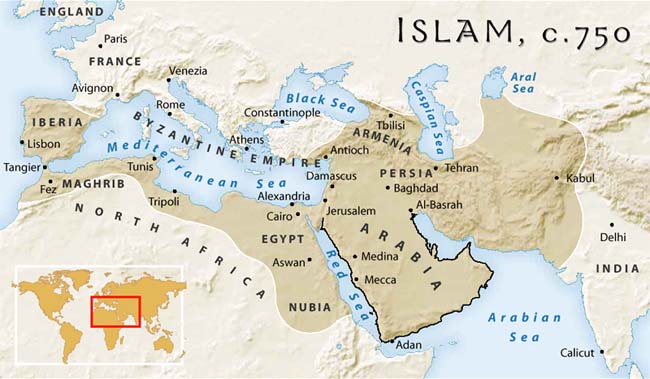


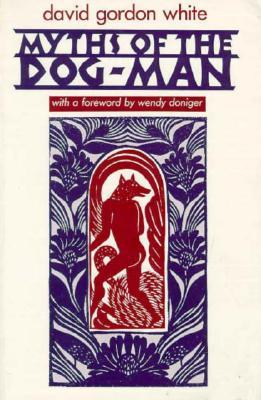
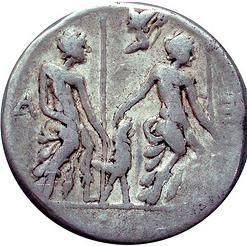
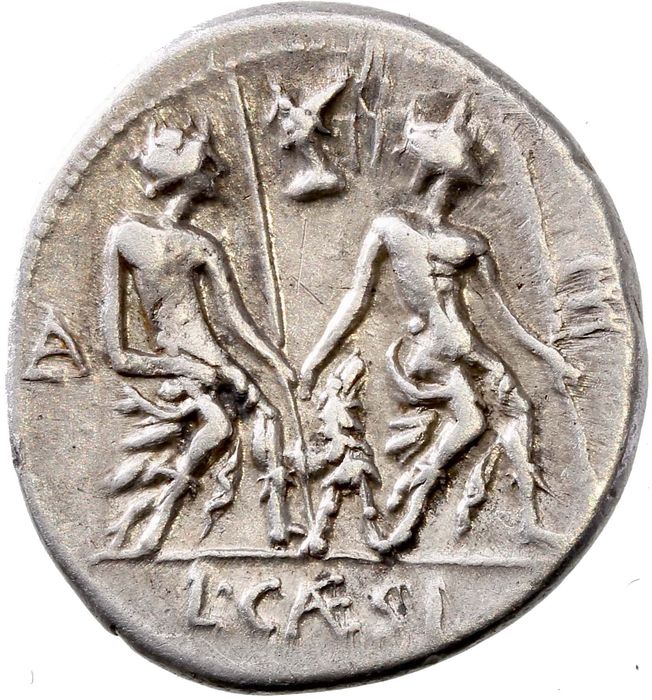

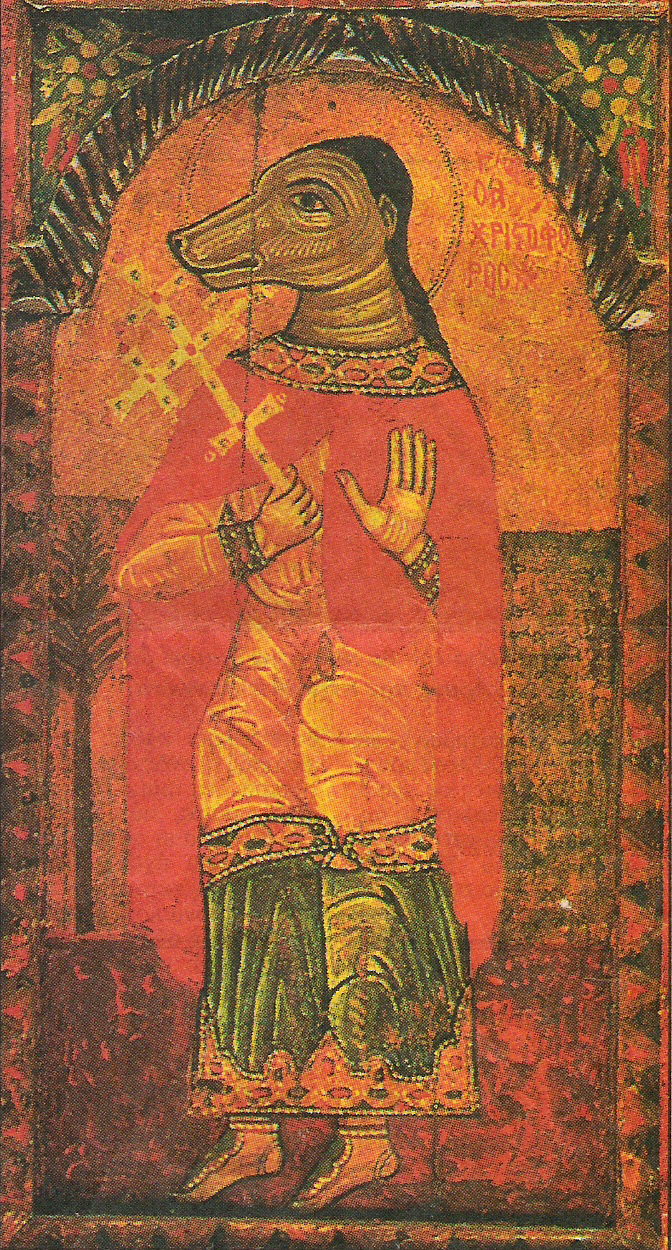


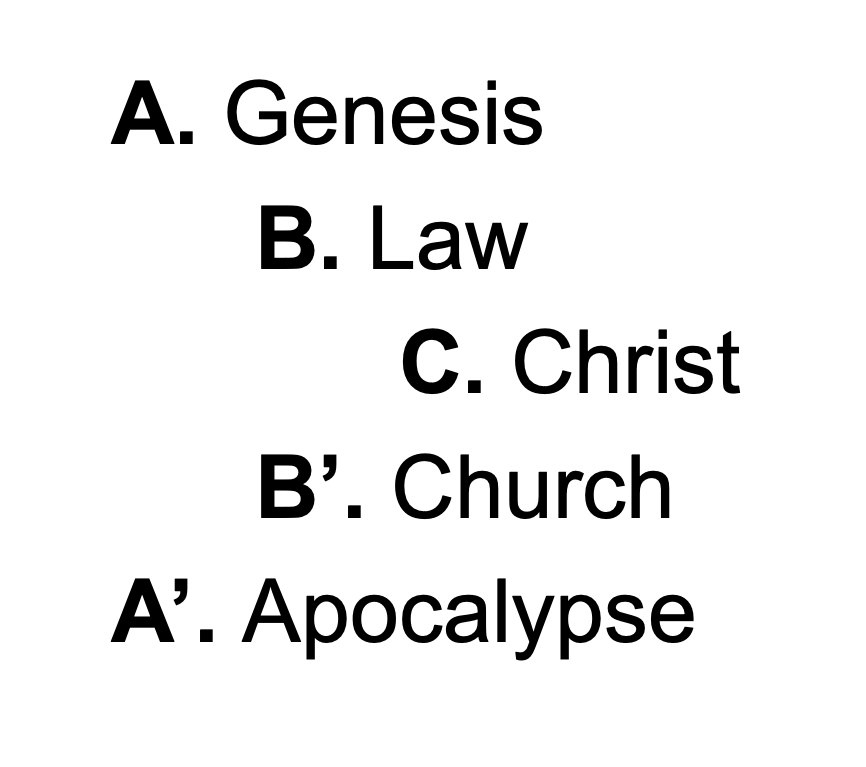
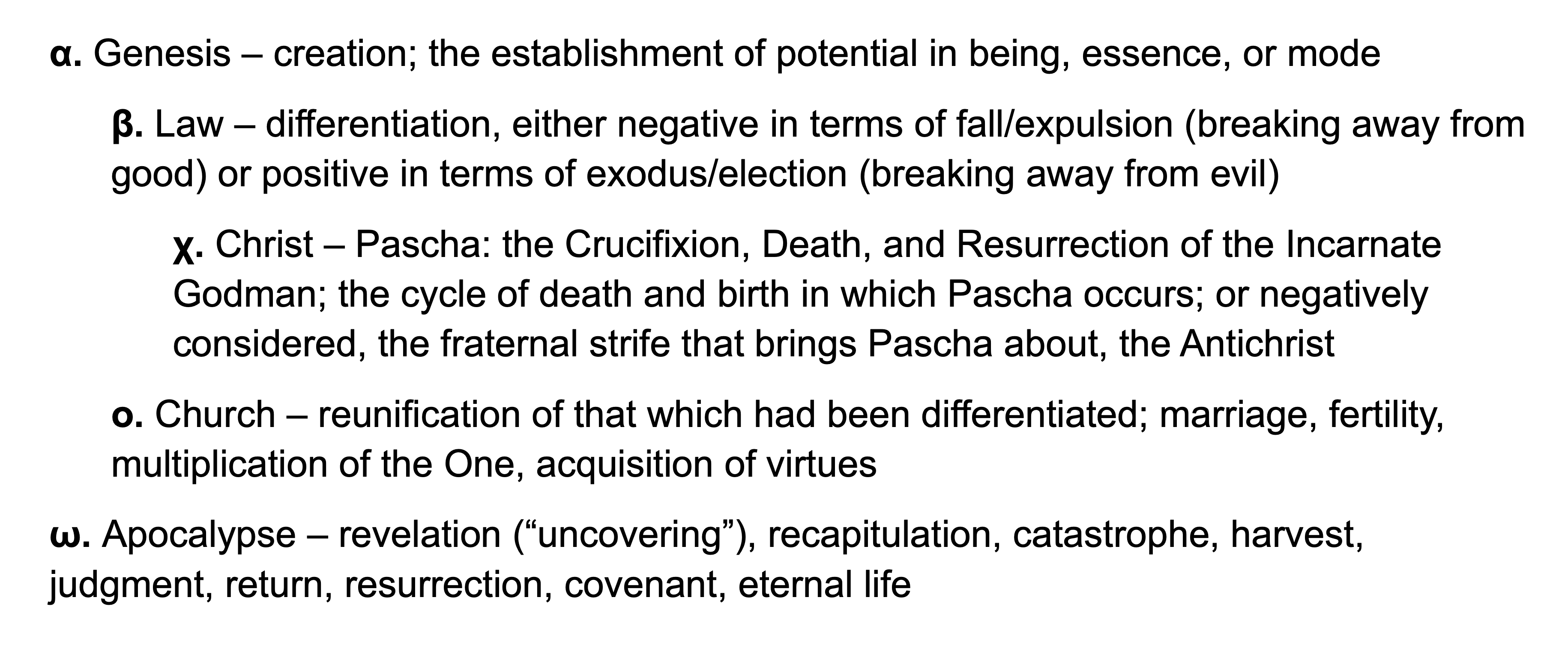




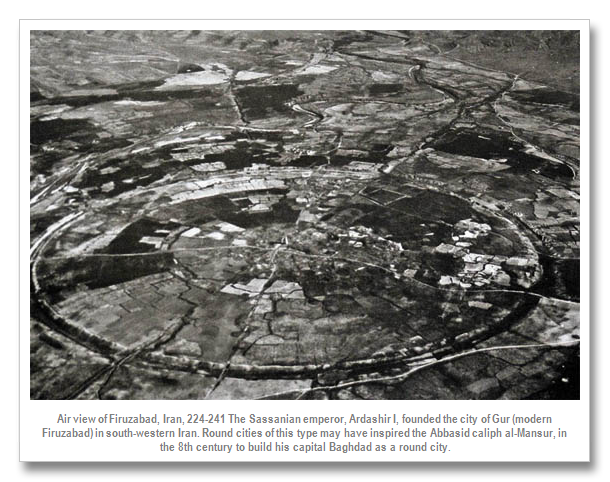




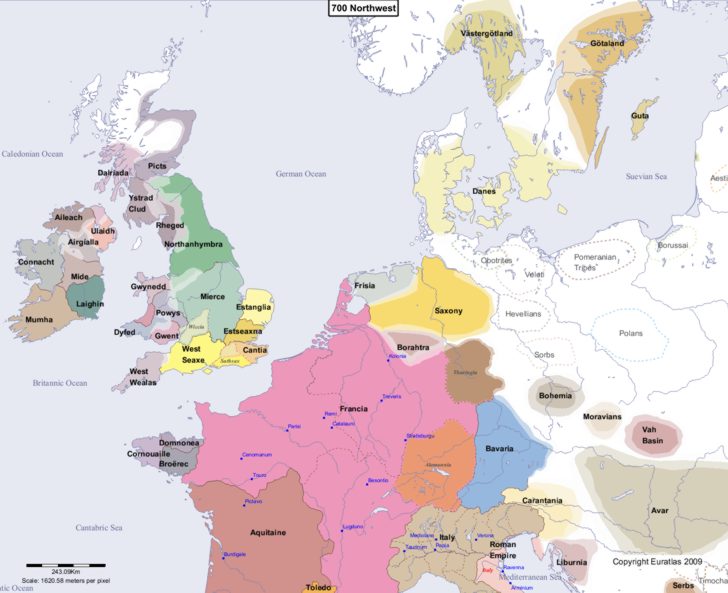
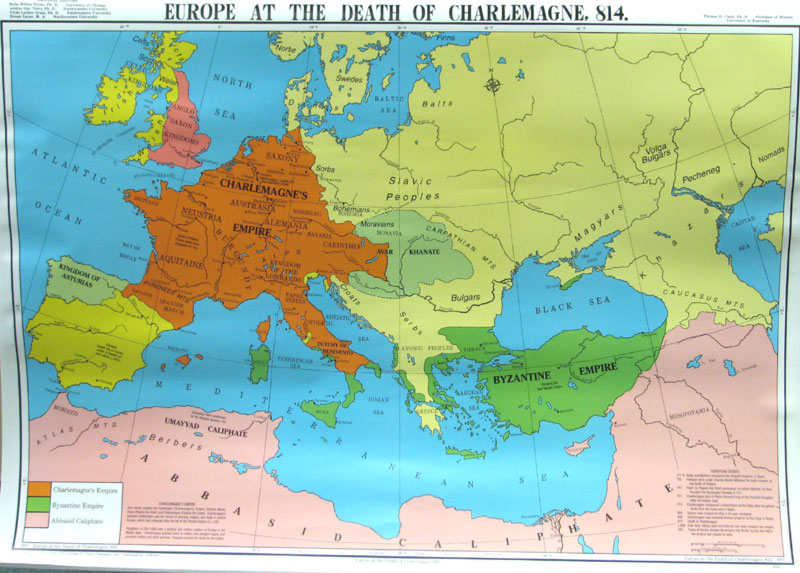
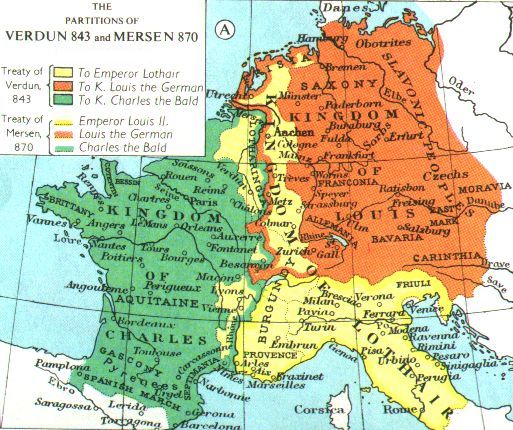


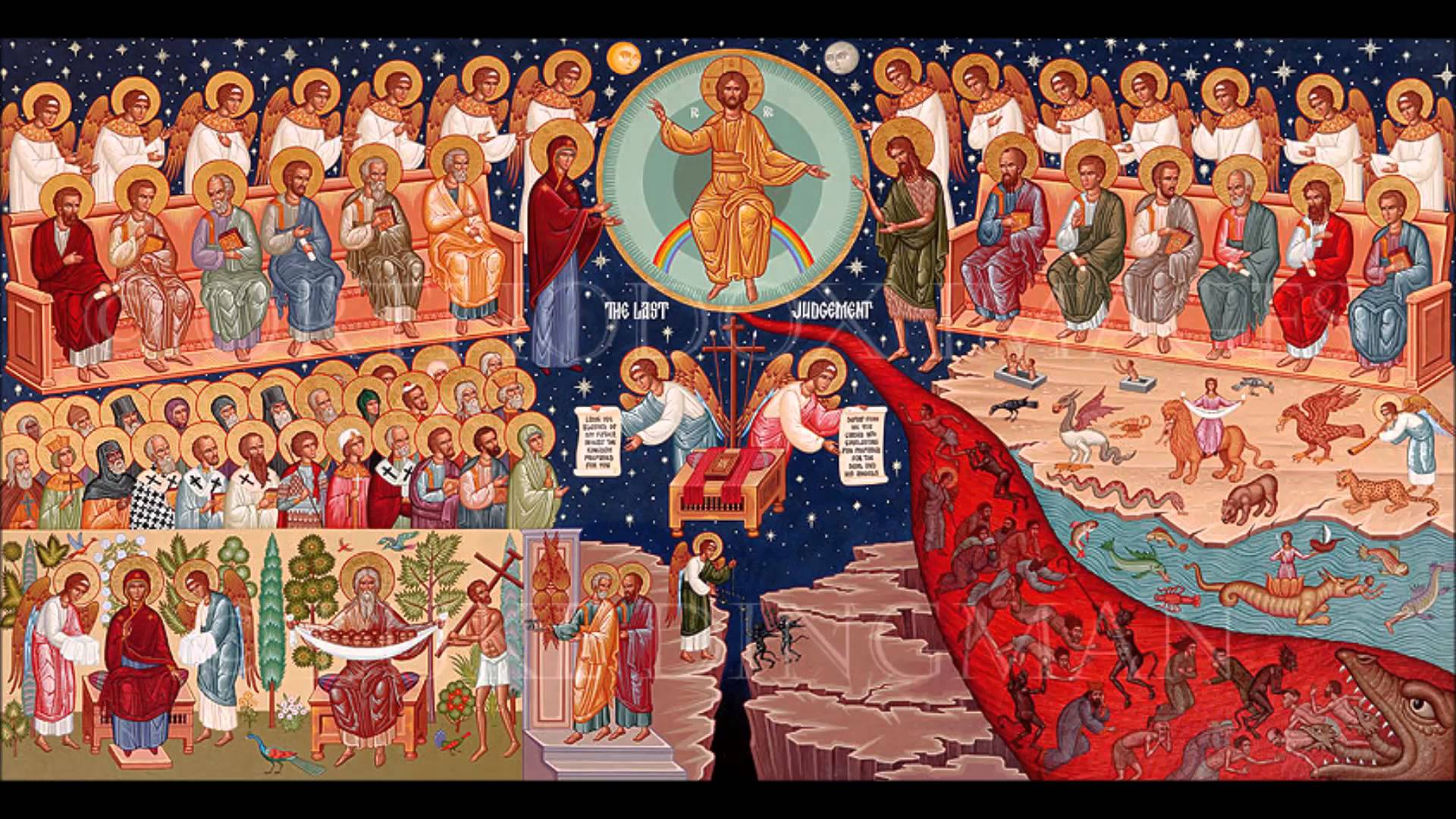



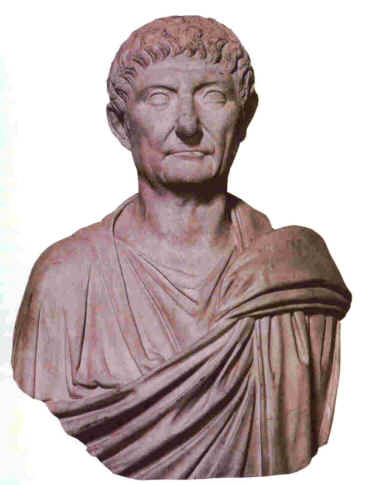
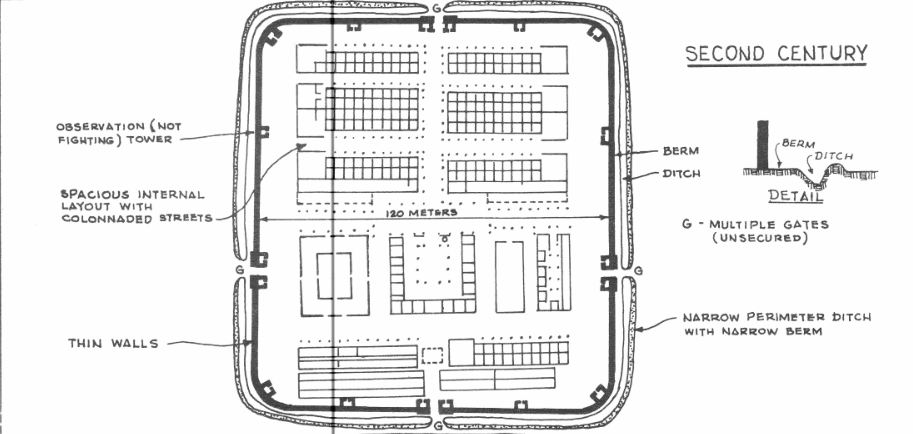
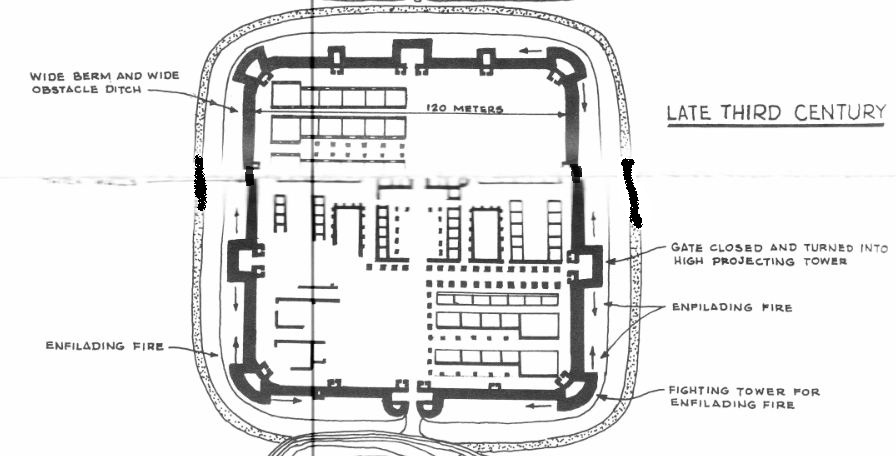
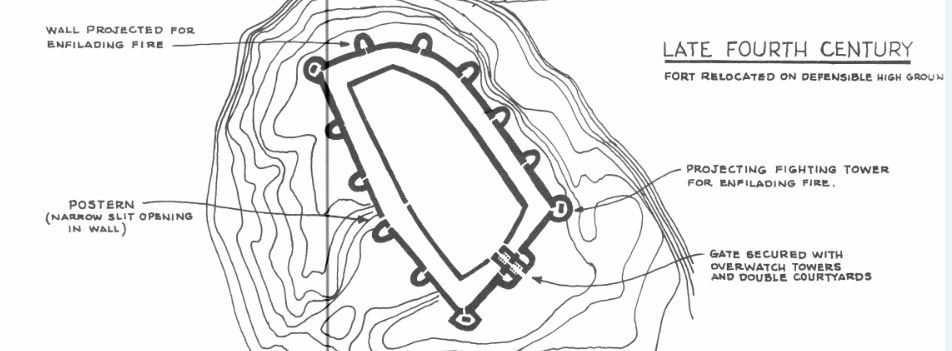
 A Stick in the Mud