12th Grade: Aristotle and the Modern Political Landscape

Greetings,

This week we examined the philosophy of Aristotle, specifically his theory of truth and how it related to his ideas about government.

Creation

Aristotle saw the created order not as a negative (like Plato), but as a friend or guide to truth.  Truth Aristotleresided here among us, not “up there” among the gods.  For Aristotle, God/the gods may or may not exist, but whether they did or not they had nothing to teach us.  As far as Zeus and Apollo are concerned, the power and immortality of the Greek gods make it so they never pay for any of their decisions.  They stand immune from consequences, and hence, immune to gathering wisdom.  If God existed, Aristotle thought he stood too far removed from human life to be of much use to us.  We experience truth in the created order, not by looking beyond the stars.*
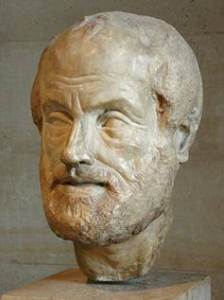
This does not make Aristotle a moral relativist, at least in the meaning that we normally give the word.  However much truth depended on context, what worked could be said to be fundamentally true.  If someone, for example, argued that his heroin addiction benefitted him, because it, “transfers me to a different spiritual plane,” where, “I see myself and the world in radically new way,” Aristotle would respond by saying:

  • You cannot be a heroin addict and function in creation
  • Who you are cannot be separated from your physical body.  Thus, you will not learn anything about yourself by seeking to destroy yourself.

Aristotle did not deny that mankind had a soul, but he thought that the physical and spiritual aspects of who we are cannot be separated, which made his view of creation and the body much more Christian than Plato’s.

balloon-glassI like to think of Aristotle’s view of truth like one of those air-blown figurines.  Some things always remain constants, i.e. human nature and creation.  But, the application of those constants might change depending on the circumstances.  The figure may flap around but always remain rooted to the ground.  A law, for example, can only be considered a good law if it will actually work in the applied context.

Aristotle had a profound influence on the philosophy and theology of St. Thomas Aquinas, who gives a striking example of this principle.  Suppose you were made king of a country that thought murder was a good thing, and had practiced murder for centuries prior to your arrival.  One might think that your first order of business would be to make murder illegal.  Indeed, murder is obviously wrong, but Aristotle would argue that such an action would be foolish, and would not help make your people more virtuous.  Why?

  • The people would not obey this law, and would find it ridiculous.  This would lead to them flaunting the law, adding to their sin.
  • The people would also lose respect for you as king, and refuse to follow your authority.

If you wanted to make the people more virtuous, they must have respect for law in order to change.  This change will come about slowly.  People, like battleships, can’t be turned so quickly.  We discussed in class how Aristotle would face such a situation, and got some interesting responses from the students.  Maybe start, some suggested, by arming everyone to make murder more risky.  Or maybe make a law restricting murder to certain days.  In any event, virtue comes by the practice of it, not from a mere intellectual recognition of what virtue might be.  Abstracting a law from its context is not the way to judge it.  Rather, a law can only be judged properly when we see its application, its result.

Plato spilled a lot of ink thinking about how to form a government without making it too much of a government in the standard sense.  Plato sought for a society knitted together not by law but a community of harmonious souls.  Aristotle seems to have not given such a prospect much thought, as it probably seemed to him pointlessly unrealistic.  He had no doubt that the best form of government would be the absolute rule of one good man.  But just as easily, the rule of one bad individual would create a disaster.  The rule of a ‘few good men’ via an oligarchy of birth can minimize the possibility of autocracy and provide the state with wisdom.  But this oligarchy can easily degenerate into rule by an elitist and wealthy cabal.  Democracy provides more stability, but less brilliance.  It has the advantage of building on the broadest foundation, but can descend into mob rule.  The government that might work best for a given area would depend on what they valued most, and what their current political context might be.

The differences between Plato and Aristotle are not merely academic.  Few of us might always agree with either one, but our leanings to one side or the other will influence our decisions.  Generally those on either the far left or right might have more in common with Plato.  The goal is to move people to the absolute standard of the founders vision (Tea Party?), or create a better society on Earth regardless of the messy context of law and custom (Liberal Progressives?).  Centrists and moderates tend to be more comfortable with moving slowly, tweaking things with the times around the edges, and being ‘realistic.’

We can relate this idea to our views about democracy.  Supposing that one believes that democracy is the best form of government (and that is a big ‘suppose’). Should the U.S. attempt to spread democracy abroad?  Of course this involves some speculation, but we might consider that. . .

Plato

Plato would answer ‘yes,’ if he believed that democracy was the ideal form of government (he did not in actuality). Though not all have an immediate cultural context for democracy, he would argue that democracy appeals to all humanity on a ‘spiritual’ level.  Just as most of us can guess that that Caribbean vacation would be nice even if we’ve only experienced a cold and crowded New Jersey beach, so too things like equality, control of your destiny, participation, and rights, have an immediate gut level connection with us.  We should spread it because it would take root in people’s hearts, even if it might take a bit longer in some places than others to come to fruition.

Aristotle

Likely Aristotle would answer ‘no,’ or at least ‘no’ most of the time.  He would have wanted to see certain key structures in place before even considering spreading democracy, like a strong middle class, an educated populace, a stable economy, and a general trust across class, race, and religion.  Without these things democracy would have no place to take root, like a bird trying to make a nest in the air.

If I had to make a personal wild guess, Aristotle might think that democracy in Iraq has about 33-50% chance of succeeding.  In Afghanistan, with its mountainous terrain, strong tribal affinities, little education, and divided population, I’m guessing his estimation of success would be much lower.

Plato would counter that since true knowledge is ‘remembering,’ the truth is bound to take root once they have a chance to truly experience democracy.  Democracy would not be a narrowly western system in this view, but truly universal, applicable regardless of context.  Again, this is mostly speculation, but hopefully profitable nonetheless.

Many thanks,

Dave Mathwin

*The Incarnation provides the bridge between Aristotle and Plato’s ideas.  It fits within neither one of their philosophies, but their systems stand in sore need of a proper unity between the eternal and the temporal.
12th Grade: The Peace Democracies Pursue

Greetings to all,

Welcome!  I hope the year will be a blessed one for you and your family.  Senior year can be at turns stressful and special all at once.  My prayer is that you will look back on the vista of your achievement have reason for thankful hearts come June.

As I mentioned in orientation, this class discusses the idea and practice of democracy.  This means we will look at different events and thinkers across time and space.  It means also that we need to hit the “reset” button and re-examine our beliefs with the aid of the great philosophers and events from the past.

We began the year rethinking our approach to civilizations in general, just as we did way back in 8th grade.  We discussed what a civilization is and is not, and how democracies fit within that framework. But I also wanted to consider whether or not we should view civilization as good thing in itself, or if civilization is in fact the core problem of our existence.  Here we have two basic approaches:

  • Civilization is good because it provides a framework for fruitful human interaction.  Civilization as we know it would have existed even without the Fall — note that there was “law” in the Garden.
  • Civilization may have some redeeming characteristics, but overall it is the symbol of the “City of Man” and serves to concentrate the human impulse to exploit one another.  Note how in Genesis 4 the arts of civilization get developed by Cain’s lineage.

You can read more about this theory in the post reviewing I Saw Satan Fall like Lightning.

We also discussed what the concept of democracies mean.  We might understand that democracies, like dogs, can take different forms.  But what is it about democracies that we would intrinsically recognize across different forms?  What is the central core of democracies?  How do we recognize that boxers, poodles, and labradors are all dogs?

We can start out our thinking on this question by considering what the “natural core community” is of a particular form of government.  In monarchies the family serves as this core.  The king comes from a “royal family.”  The successor to the king is the king’s oldest son, and so on.  In oligarchies one could argue that the clan, or an extended group of families, forms the central core.  When one builds from a proper foundation, good results can follow, but if not, we can expect significant problems.  For example, imagine a literature teacher who thought that “it’s all about the kids.”  With this approach, the teacher would not care whether or not they read Homer, Shakespeare, or the latest teen romance so long as “the kids were engaged.”  In fact, in literature class it should be “all about the literature,” and the students’ engagement with it.  Without this foundation, no “literature class” would exist.

What about democracies?

Truthfully, they have no central building block.  Democracies build on the foundation of “all men are created equal.”  Each individual is a core unto himself.  The giant mass of people (“We the people of the United States . . .”) also could be the core, for democracies at least in theory do not discriminate. Not only do democracies have no ethnic divisions or class divisions, they also have no geographical boundaries.  Democracies preach human rights, not English rights, or German rights.  The spirit of democracies roves to and fro, in contrast to the more tradition oriented forms of government.

This reality gives democracies enormous potential dynamism.  It is no coincidence that democratic peoples both now and in history have been the most powerful countries in existence when they thrive.  They build invincible citizen armies, and can even produce superior culture (think of Periclean Athens, or the law of Rome’s Republic, or Whitman and Twain, etc.)

But this floating and amorphous core gives rise to potentially massive and dangerous contradictions when individuals don’t receive equal treatment.  Our own civil war comes easily to mind, or the tumultuous 1960’s which had its roots in the unequal treatment of blacks.  Today we see the same logic used surrounding the marriage issue for homosexuals.  Christians have solid Scriptural and historical reasons for opposing it, but do democracies?  If the majority of people approve or disapprove of something, should that be enough to make it so?  As one student last year noted, democracies find their reference point in the here and now.

These potential stress points also inform a democracy’s foreign policy.  We see that in regards to Syria. When flagrant human rights abuses take place and the world knows about it, the boundary-less, human-conscious democracies must take notice (I realize that there is some dispute as to exactly what is happening in Syria).  Of course, we should realize that democracies will process information differently than other forms of government.  The internet age fits very well with the international field of vision democracies can’t help but fall into.

I assigned the students a small portion of Augustine’s magisterial The City of God which we will discuss on Wednesday.  Augustine discusses how each person ultimately seeks eternal peace with God.  On earth, we seek shadows of this peace in various ways.  He wisely points out that even we make war to bring about a peace more suitable to us.  By the nature of our creation in God’s world we naturally seek harmony with our surroundings, though often in false ways.  I want the students to consider what kinds of political and social equilibrium democracies pursue, and what the consequences for that will be.

Many thanks,

Dave

Lawyers, Guns, and Money

In his excellent work on the French Revolution, Citizens, Simon Schama makes many connections between the path of revolution and Romantic philosophy.  They came to associate monarchy with secrecy–secret plans, secret councils, and the like.  Romanticism preached openness to all things, to nature, to oneself, and so on.  Real, authentic, people had nothing to hide.   It made sense then, that real, authentic government had nothing to hide either.

The French paranoia over secrecy, Schama argues, drove much of the violence in the Revolution.  Even simple misunderstandings could be evidence of “plots,” for no true Frenchman would have anything to hide.  For example, Robespierre’s lieutenant Armand St. Just wrote some unpublished ideas for laws that would have taken his ideas of an open society to an absurd degree.  He urged that,

Every man twenty-one years of age shall publicly state in the temples who are his friends. This declaration shall be renewed each year during the month Ventose. If a man deserts his friend, he is bound to explain his motives before the people in the temples; if he refuses, he shall be banished. Friends shall not put their contracts into writing, nor shall they oppose one another at law. If a man commits a crime, his friends shall be banished. Friends shall dig the grave of a deceased friend and prepare for the obsequies, and with the children of the deceased they shall scatter flowers on the grave. He who says that he does not believe in friendship, or who has no friends, shall be banned of ingratitude shall be banished.

But all this wide-eyed optimism did not prevent the Revolution from eventually being run by the Committee of Public Safety, which met in secret.  It did not prevent informers roaming about looking for counter-revolutionaries.

With the best of intentions comes a tremendous and inevitable tension.  We expect monarchies to have secrets.  Monarchs, by definition, are not quite like normal people anyway.  They decide things apart from the people.  Democracies have different standards, which sometimes makes for more difficult choices and an unsolvable tension.

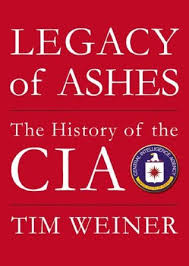
Tim Weiner’s Legacy of Ashes: The History of the CIA is in some respects a marvelous book.  He writes well and so the pages turn easily.   Weiner’s pours gobs of research into his account.  He has more than 100 pages of footnotes.  Many of his citations come not from other books about the CIA, but from the agents themselves and especially from the CIA’s own de-classified documents.  Weiner works for the NY Times in his day-job reporting on national security issues, so he knows the territory for this book quite well.

Unfortunately for me Weiner rarely delves into analysis and synthesis of his material.  Maybe he wants a “just the facts” reporters perspective.  That’s his strength, and if he added analysis the book might get unwieldy in size.  Fair enough, but in the end the failure to plumb the depths of certain questions make this book incomplete in my eyes.

Weiter hammers away at the CIA, citing failure after failure, blown operation after blown operation.  Their charter called for them to provide political leadership with crucial information that could inform decisions but they whiffed on almost every major crisis.  Their most significant “successes,” such as organizing regime change in Iran in the 1950’s, backfired terribly a generation later.  We had very little success recruiting agents within the Soviet Union and often relied on the intel of our allies.  Internal reviews often pointed out the CIA’s shortcomings, but these reports almost always got buried and nothing changed.

Supposing that Weiner’s basic appraisal is true (which is up for debate), I would have liked more from Weiner on why the CIA failed as it did, but he offers only hints.

Time might have something to do with it.  We are still a young country, with a very young intelligence service.  The British, the Russians, and so on have all done  this for much longer than us and would likely do a better job than us for that reason alone.

I wondered if the level of internal criticism from their own reviews is at least a partial function of personality.  Many intelligence analysts might tend toward pessimism and obsession over detail.  Maybe they would naturally be too hard on themselves.  I stress the word “maybe.”  I glanced through Victor Cherkashin’s Spy Handler: Memoir of  a KGB Officer for a different look and he confirmed some of what Weiner wrote, especially regarding our very poor handling of some of our agents behind the curtain.  Cherkashin handled and helped recruit both Aldrich Ames and Robert Hanssen.  He confirms some of what Weiner wrote about the Ames disaster (Hanssen was from the FBI). But he also mentioned some worthy adversaries and tough problems posed by the CIA for the KGB.  His perspective gives the CIA more credit than Weiner.

In one brief aside Weiner mentions that while, yes, the CIA proved almost inept at gathering intelligence, they did an excellent job of using money to buy influence, and they created some really cool gadgets that would be the envy of the international intelligence community.   I am reminded of John le Carre’s quote that one sees the character of a country most particularly in its intelligence service.*  The shoe definitely fits in this case.  We specialize in gadgets and money.

But that doesn’t mean an intelligence failure per se, it could mean a different kind of success.  For example, Weiner seems critical of the development of the U-2 spy plane.  We would not have needed to develop such a plane if we had better human intelligence on the ground.  Eisenhower worried that the plane might get shot down, and so on. True, but the plane gathered important information, some better, some worse, than an agent on the ground would have obtained.  When Gary Powers was shot down it did cause problems, but having an agent captured would also cause problems, albeit of a different type.  We made the U-2 because of our lack of human intelligence, but that doesn’t mean to me that the U-2 symbolizes failure, or is in itself a failure.

A review of Legacy of Ashes by the CIA’s historian, who makes this same point (among many other criticisms), is here.

But it’s in another aside that Weiner gets at the real root issue.  Democracies, he mentions, simply aren’t very good at secrecy, and we’re not good at it mainly because it goes against all of our democratic instincts.  Like the French Romantics, concealment means that we must be up to no good.  And if we commit ourselves to democracy then we need an informed public.  How an informed public, let alone informed public officials, and a clandestine agency should mix we have yet to figure out.  Weiner offers no solutions.  I can’t blame him, as I have none myself.  I do wish, however, that he paid some mind to this tension present in every democracy.

Part of our desire for openness gives the press more freedom in the U.S. than anywhere else.  We have no equivalent, for example, to England’s Official Secrets Act, which allows the British government to shut down almost any story they deem a threat to national security.  The U.S. cannot do this thanks to the first amendment.  Of course sometimes the government lies and the press exposes it.  But sometimes the press gets it wrong and messes up the government.  Weiner cites one such instance during Ford’s presidency.  Ford had orchestrated a dual arms deal to both Egypt and Israel via CIA backchannels.  He wanted to avoid seeming too pro-Israeli, but didn’t want Israel to know about the sales to Egypt.  However we judge it, he had the intention of setting up the U.S. as an international broker between the two countries.  But the press caught wind of the arms sale to Israel and published stories on it, but they had no information on Egypt.  Ford couldn’t say, “Well we sold stuff to Egypt too–we’re trying our best!” for that would expose the operation.

Of course as a reporter Weiner benefits from this access and freedom.  I wish he would have explored this tension. I’m not suggesting that it’s too bad that we have the first amendment, but it’s not an unqualified good. Among other things, it makes life harder for our intelligence services.  Weiner fails to take this into account in his evaluation.

In his Revisionist History podcast renowned author Malcolm Gladwell takes a second look at stories that he feels got neglected by the flow of time.  In his “Damascus Road” episode he looks at an instance involving the press and a CIA asset.  A man named Carlos the Jackal was everybody’s most wanted list.  No one could come close to catching him.  Out of the blue a man volunteered his help to the CIA.  He wanted no money, rather, he sought to try and make amends for the terrorist activities of his past, some of which had killed Americans.  He gave us information that allowed for his capture.

Under the Clinton administration the Justice Department ordered an “asset scrub” as part of the overhaul of the CIA.  How to draw a line between who stays and who goes?  It seemed simple enough to say that anyone who had previously killed Americans needed let go as an asset.

The CIA complied for the most part, but this particular asset was simply too valuable.  He remained on the books.

Eventually, however, a reporter found out about this non-compliance from a variety of sources.  He wrote the story but met with a CIA agent before publishing it.  The CIA representative got the reporter to remove some the crucial details, but not all.  He pleaded with the reporter . . . the details he left in would expose this asset and seal his fate.  The story was published, and the asset was killed shortly thereafter.

You probably guessed that the reporter in question was Tim Weiner.

Weiner argued that if anyone should be blamed for the man’s death, it was the CIA.  They broke the law (a dumb law, but the law nonetheless) and his job as a reporter is to at times expose the misdeeds of government.  He had credible sources within the CIA itself for the story.  He might further argue that he had no reason to fundamentally trust the CIA with its claims, so often did they mislead and misdirect.

I can’t see it that way.  Had Weiner not published the article, or even watered it down more, our asset would not have been exposed.  He played a role in his death.  When asked how those at the NY Times reacted to this turn of events, he said that for the most part it was business as usual.  You move on to the next story.

That argument aside, I find it ironic that Weiner should so stringently criticize the CIA for not developing foreign assets when he himself had a direct hand in exposing one of their best.

Moving on to a different argument . . . I say that “Lawyers, Guns, and Money” is far and away Warren Zevon’s best song.  The song’s unreliable narrator makes this one so enjoyable and so funny.  Those familiar with the lyrics know that the protagonist always goes home with a waitress, and surprise, it doesn’t always work out.  He goes “gambling in Havanna” and–shockingly–finds himself in hot water, then calls upon dear old dad (not for the first time, it seems) to bail him out.  Yet, he remains “an innocent bystander,” who “somehow got stuck.”

Ok, the connection to all I’ve written here is weak.  Mainly, I thought the song made a great title for this post.  It’s a book about the CIA, after all.  I do not suggest that Weiner resembles Zevon’s most famous character.  But Weiner criticizes the CIA constantly throughout his work for losing track of ends and means, for never looking squarely in the mirror, for dissimulation and failure.  However true, Weiner suffers from something similar.  Legacy of Ashes paints with too narrow a brush.

Weiner’s characters almost all suffer from myopia.  Weiner might suffer from it as well.  There is no particular shame in this.  It is a human problem, and not the sole property of spies.

Dave

*Le Carre is a perfect example of the principle I speculate about in the above paragraph.  He is the former spy for the west who now is enormously critical of spying.  His cold war novels expressed an ambivalence about the two major sides, while his post-cold war work exclusively criticizes the West in general, and the U.S. in particular.  People naturally assume that this makes his portrayals more realistic, but I’m confident that’s not necessarily so.


Tolkien the Anarchist

It is easy to confuse anarchism with nihilism.

The nihilist cares for nothing but destruction itself.  He derives strength ironically (and illogically) from the “meaning” of no meaning at all.  Owlman makes this perfectly clear, giving perhaps the clearest nihilistic statement in modern times.

The anarchist has a different approach.  His desire to destroy comes with reasonably good motives and a limited scope.  He really seeks not to destroy and create  better way of life.  One senses this in the music of Rage Against the Machine.  They have passion and plenty of excessive, destructive anger, but they plead for something real.  G.K. Chesteron’s brilliant The Man Who was Thursday touches on this as well, with the character of Sunday (slight spoiler alert) serving as the chief destroyer and chief unifier of the characters in the tale.

So it should not scare us too badly that a professor from Yale comes out in favor of anarchism.

James C. Scott’s book Two Cheers for Anarchism has a bark worse than its bite.  He believes that the state has some function to play, though never quite describes how.  He reveals himself as a strong critic of the industrial capitalistic modern world, much like Ivan Illich.  His critiques hit on something amiss about our predicament.  I wish he said more about about solutions.  In fairness, the road out of our situation is long and narrow.

How might one sympathize with a self-described anarchist?  We must first gain historical perspective and realize that the modern world looks very different from almost every other historical era.  The ordering of our lives occasioned especially by the industrial revolution make our lives much more regimented not by nature, but by our own creations, than any other time.

To work against this Scott urges us to abandon all centralized and regimented government solutions.  A simple example illustrates his point.  The Dutch tried an experiment with a notoriously dangerous and congested intersection.  They could have spent tens of millions and took several months to make an overpass.  The more obvious solution called for breaking up the intersection with more traffic lights and more centralized control.

Instead they opted for a traffic circle, with glorious results.  Accidents sharply declined and so did congestion. Traffic circles call for drivers to pay attention and make judgments, but Scott argues this is precisely why they work.  Governments need to get in the habit of giving over more initiative to the people and divesting themselves of institutional means of control, even with something as simple as traffic lights.  Plenty of other examples illustrate the same point, including

  • The superiority of the ‘randomness’ of nature to regimented/”scientific” planting of trees and gardens
  • The failures of housing projects vs. the concept of “neighborhoods.”
  • The unseen bonuses of shopping in neighborhoods as opposed to the ‘big box’ stores,

and so on.  His basic argument comes down to the concept of “small is beautiful.”

But he goes beyond this.  The “anarchist” part of the book involves his encouragement to small-scale kinds of disobedience to perverse means of establishing control.  He cites the recent example of French cab drivers suddenly finding themselves targeted for offenses of a particular traffic law.  They smelled not safety but money-making for the state as the motive.  So they banded together and decided that they would rigidly obey all the various traffic regulations.  Of course, traffic ground to a halt throughout French cities, the point being that

  • The practice of the people truly define what the law is, such as with speed limits, and
  • The state has stuffed the people full of useless and menacing regulations.  To enforce them all is impossible, to enforce most others would be arbitrary.

Scott laments when the natural actions and interests of the common man get co-opted by organizations.  Whatever their initial intentions, the imposed structure of unions, protest organizations, and the like, can never match the organic actions of the common man.  He admits that at times that state plays a useful function in giving an imprimatur, or proper force behind collective action, such as in the Civil Rights Movement.  But in general, a step towards centralization moves one closer to lifeless banality.

I also give Scott a lot of credit for recognizing that large-scale revolutionary action will make things worse.*  Every modern revolution created a more oppressive state than what it replaced:

  • After the American Revolution, British loyalists got a far worse treatment than any revolutionary against George III ever did before 1775.
  • The French Revolution made things far worse than the worst of the old regime
  • The Bolshevik revolution made Russia far worse than under the czars
  • Mao
  • Etc., etc.

We fix things, then in the steady and simple way of rejecting top-down government centralization, and looking for small ways in everyday life to assert the independence of organic communities and organic action.

So far so good, but while I realize the book merely wants to serve as an introduction, one issue in particular bothered me.

Scott states that, essentially, no possibility of a just society even existed until the political invention of modern democracy.  Ok . . . but . . . all of the worst examples of modern totalitarianism occurred in the name of the people.  It seems like democracy can, like nuclear power, give tremendous benefits but also cause tremendous damage.  Scott admits this from a structural standpoint, i.e., universal citizenship gives way to universal conscription, but misses something on the political side.

Scott also attaches himself too strongly to democracy itself, with the English Civil War as a case in point.  One can make a reasonable case that Charles I abused his power.  I think it much harder to justify his execution, done in the name of the law, in the name of the people, after a trial of dubious legality.  I know of no historian who argues that the Protectorate under Cromwell gave people more freedoms than Charles I.  In time, England begged Charles’ son to come back and rule as Charles II, and he returned to huge acclaim.  Again, it seems that the “Restoration” era under Charles II provided more tolerance and more room for localism than Cromwell and his more democratically minded Puritans.

The vision Scott argues for reminded me of G.K. Chesterton and Hillaire Belloc with “distributism.”  Scott decisively breaks with left-leaning academics who despise the “petty bourgeoise,” and instead looks for just the sort of limited land-ownership and localism that this class provides.  But the closest parallel to this kind of organization has historically only come from

  • Frontier societies, whose time may be sweet but is inevitably limited, as it waits for the rest of society to catch up
  • Societies on geographical fringes, like the eskimos, aborigines, jungle tribes, desert nomads, etc.
  • The Middle Ages

Maybe modern democracy is the cause, not the solution to the problems Scott decries.  Marx himself, I believe, believed that capitalism served the purpose of destroying local traditions, a necessary step towards worldwide revolution.  Maybe we need not blame democracy for all of the problems of the industrialized state.  But at the very least, sometimes non-democratic governments do a better job of preserving localism and traditions.

I wish Scott had tackled this.

Scott also may need to choose.  Does he prefer organic localism, or individual rights, democracy, etc.  The two do not always mix, so which does he prefer?  As an anarchist Scott blames the system.  But with democracies people generally get to create the system they want. If a democracy goes bad, then, blame the people, and not the system.  We get what we deserve.

Scott will strike many as decidedly modern, but if you poke around writers and thinkers with a bent towards bygone eras we get some surprises.  The great J.R.R. Tolkien railed against the modern world with his life and work to no avail.   Yet in a letter to his son he wrote,

My political opinions lean more and more to Anarchy (philosophically understood, meaning the abolition of control not whiskered men with bombs)—or to ‘unconstitutional’ Monarchy. I would arrest anybody who uses the word State (in any sense other than the inanimate real of England and its inhabitants, a thing that has neither power, rights nor mind); and after a chance of recantation, execute them if they remained obstinate! If we could go back to personal names, it would do a lot of good. Government is an abstract noun meaning the art and process of governing and it should be an offence to write it with a capital G or so to refer to people . . . .

He continued on the nature of ruling that,

Not one in a million is fit for it, and least of all those who seek the opportunity. At least it is done only to a small group of men who know who their master is. The mediaevals were only too right in taking nolo episcopari as the best reason a man could give to others for making him a bishop. Grant me a king whose chief interest in life is stamps, railways, or race-horses; and who has the power to sack his Vizier (or whatever you dare call him) if he does not like the cut of his trousers. And so on down the line. But, of course, the fatal weakness of all that—after all only the fatal weakness of all good natural things in a bad corrupt unnatural world—is that it works and has only worked when all the world is messing along in the same good old inefficient human way . . . .

David Bentley Hart quotes from this letter in a recent article in First Things, and Hart himself seems to get the gist of Tolkien’s meaning when he writes,

The ideal king would be rather like the king in chess: the most useless piece on the board, which occupies its square simply to prevent any other piece from doing so, but which is somehow still the whole game. There is something positively sacramental about its strategic impotence. And there is something blessedly gallant about giving one’s wholehearted allegiance to some poor inbred ditherer whose chief passions are Dresden china and the history of fly-fishing, but who nonetheless, quite ex opere operato, is also the bearer of the dignity of the nation, the anointed embodiment of the genius gentis—a kind of totem or, better, mascot.

Scott has done a great service with his book.  If he writes again I would love for his critique of modernism to go a bit a deeper.  Lets see what he can write if he broadens his vision.

Dave

*He never gets into why this is, however, and the question is worth pondering.  Why do popular revolutions create more totalitarianism than the governments they replace?

Be Like the Fox

This post was originally written in 2017, and you will note the reference to Trump as president below . .  .

****************

If you wanted to be an English aristocrat in the Victorian age (or perhaps most any age) one needed to hunt foxes.  For years this perplexed me.  Sure, foxes eat chickens sometimes and maybe cause a bit of mischief, but they posed no real threat to anyone.  They did not seem like noble quarry.  But then I realized that foxes were not hunted because of the damage they did to farms (like you would hunt wolves or wild hogs), or the danger they posed to the hunters (like lions or bears), but because they were so clever at avoiding traps.  To hunt a clever beast, one had to display their own cunning.

Machiavelli has always beguiled his admirers and detractors alike.  Reading him can feel like a bracing tonic, but then he leaves you cold with his “Machiavellian” calculations.  He seems both clear and contradictory.  We may wonder if we can read him as anything more than a guilty pleasure.

We need not look further than his “It is Better to be Feared rather than Loved” chapter from The Prince.  In his typically realistic/pessimistic way, he says that the love of the people will never be constant, whereas fear will keep them bound to the ruler.  This seems to fit within Machiavelli’s general framework, but we should recall that as an avid student of history, Machiavelli would surely know that fear never works beyond the short-term.  The most successful rulers throughout history may not have people “love” them in the sense in which we use the word, but they did establish relationships and a series of mutual benefits for the ruler and ruled.

Erica Benner makes the bold suggestion that not only is Machiavelli giving bad advice in this notorious chapter, he knows he is giving bad advice.  In fact, he wants his audience (the D’ Medici’s who ended Florence’s Republic) to take this advice and make themselves odious to the people.  He hopes, in fact, that the Republic he loves might be restored through the stupidity of those that read him.*

Ordinarily I would suspect some show-off chicanery with this analysis, but Be Like the Fox surprised me with its even-handed and careful approach that remains accessible to someone like me.  She begins by suggesting that we should not view Machiavelli primarily through the lens of The Prince, but rather through the body of his other work, and especially, his life as a diplomat.  The book weaves biography and analysis gracefully.  Diplomats, especially Renaissance diplomats, often had to speak elliptically and carefully.  The message lay not so much in what was said but in how it was said.  Perhaps Machiavelli’s writings evidence some of this same character.

At his best, Machiavelli bring us back to questions of purpose in political action.  Benner includes an example from Machiavelli’s own life to illustrate this.  Early in his marriage Niccolo had a brief affair with his cousin Bernardo’s female servant and got her pregnant.  She admitted to Bernardo that Niccolo was the father.  From his diaries, we know that Bernardo considered carefully what to do.

Privately he approached Niccolo and mentioned the pregnancy and, in neutral tones, the accusation. “What will happen to the Machiavelli name,” Niccolo, “when word of this gets out?”  Niccolo sympathized with the poor girl and his cousin.  He blamed himself . . . because, he said, a friend of his had seduced the poor girl while he and his wife were away from the house.  Niccolo offered to try and track him down.  Of course, after a few days he reported that the “man” was a scoundrel and would never fess up.  But . . . since he recognized that the fault in the end lay with him, he agreed to provide for a large dowry for the girl so she could get married . . . quietly.  After all, no one wanted a scandal to tarnish the Machiavelli name.

If the cousin’s goal was to bring Machiavelli to repentance, this method may have hindered that cause.  If he desired a quiet solution to the outward problem itself, this worked. Would a direct attack on Niccolo bring about a quickening of his conscience, or merely a stubborn defense that would leave him (Bernardo) holding the bag for his pregnant serving girl?  Benner tells this story early in the book to illustrate the point of much of Machiavelli’s writing.

Benner supports her analysis of The Prince especially through the life of Cesare Borgia, whom many suspect Machiavelli admires on their first reading.  As the son of Rodrigo Borgia, a.k.a., Pope Alexander VI, Cesare had enormous advantages.  “Fortune loves and impetuous youth,” Machiavelli writes.  Cesare had a string of great victories throughout Italy based in part on his charisma, luck, and a talent for acquisition via dubious means.  Yet Machiavelli consistently notes that,

  • People who use deception to great effect always assume that everyone else will be honest.
  • People who thrive on conquest often have a hard time building a stable network of alliances, and making and keeping friends.
  • People who have the smile of Fortune rarely realize that Fortune has a fickle streak.  One must do the work of real relationships to create a truly stable state.

In other words, The Prince has much more implied criticism of Cesare Borgia than praise,

Benner illustrates this with other events in Machiavelli’s life.  We assume that Machiavelli just cared about results and not about methods, but Benner argues this would make nonsense of many of his experiences and other writings.  When Pope Sixtus IV (seemingly) supported the failed assassination attempt of Lorenzo and Guillamo d’ Medici, it left Florence in a vulnerable position despite the fact that Lorenzo survived.  Lorenzo’s ruthless revenge not just against the assassins themselves, but the entire Pazzi family from whence they came (which included a few clergy) gave the Pope ammunition to take control of Florence regardless of the failed plot.

Lorenzo scrambled and tried to isolate the pope by getting Naples to break free from their alliance with the Pope.  He thought he scored a major coup for Florence and saved the city.  But then . . .

  • The Pope was still furious because of the treachery of Naples
  • Venice, as an side player in this whole affair, got angry that no one included them in the conversations and joined the Pope against Florence.
  • Meanwhile, Naples had only signed a non-aggression pact with Florence, which meant that they offered no military assistance, leaving Florence in exactly the same position as before.

Slipshod diplomacy made for now diplomacy at all.  Thus, Machiavelli concludes that, “One must things by their methods, and not merely by their results alone,” a conclusion that may surprise us.**

In his fun From Barbarians to Bureaucrats Lawerence Fairley makes the point that companies go through  many of the same life-cycles as civilizations, and uses A.J. Toynbee’s analysis to aid him.  One stage belongs to the “Barbarian.”  Fairley writes that one may be a “barbarian” leader if,

  • You love competition, and the ‘thrill of victory.’  You cannot shrug off losing.
  • You are action-oriented.  You don’t care so much for ideas or systems, but results.
  • You like being in charge and like making decisions
  • You may not have come up with the vision, but want badly to see it through and have definite plans for doing so.
  • You don’t have tons of patience for those who seem to be standing in the way of your mission.
  • You see the ‘struggle’ in absolute terms of us/them, good/evil, etc.

Certainly Cesare Borgia fits this bill, as I think, does our current president.  Fairley points out that we can have good and bad “barbarian” leadership, with each style obviously having its strengths and weaknesses.  Cesare Borgia’s problems came directly after the fighting stopped, as did Alexander the Great’s, as perhaps did Donald Trump’s?  With Cesare, Machiavelli seemed to indirectly counsel that the worst thing one could do with a barbarian was prolong the fighting, which plays directly to his strengths.  The true barbarian, however, will never handle peace well.  Let Cesare stumble over his own feet.  Let Fortune abandon him.  Perhaps Machiavelli would counsel Trump’s political opponents to lay low and let Trump defeat himself.^

In hindsight, of course, some of Machiavelli’s advice looks less and less “Machiavellian.”  In  Debriefing the President, John Nixon writes of his experiences at the CIA and especially about his time spent with Saddam Husssein.  In the midst of his criticism of Clinton, Bush the Younger, Obama, and George Tenet, he reveals changes in his opinion.  He admits that he thought the best intel the U.S. possessed pointed to a stockpile of W.M.D’s, and so initially supported the war.  But he concludes that Iraq and the Mideast would be much better off today with Saddam in power.

Well, obviously.  But Nixon makes this claim more interesting with Saddam’s own words and history, much of which he missed himself as an intelligence analyst leading up to the war.  Saddam’s greatest threat was not the U.S., he argues, but Sunni-based Islamic terror, because he relied on the Sunni’s for nearly all his power in Iraq.  Thus, Saddam would have opposed Al-Queada and especially ISIS, as mortal threats to his regime.  Perhaps the fighting would have happened regardless, but Saddam may have appeared vulnerable enough for more open fighting, which would have played right into the U.S.’s tactical and technological advantages.

Maybe so, though this is much easier to say in 2017 than it was in 2003.  Still, I surmise that Benner would concur with Nixon that the best policies come from taking a lesson from the fox, who lives not by paying attention to ideology, but by finding the best way to avoid traps.^^

DM

*Other aspects of The Prince suggest something similar.  He discusses in one chapter that there are two kinds of kingdoms. One type is easy to conquer because they are divided, but this same type of kingdom is all the more difficult to hold precisely because of its divisions.  Was this a word of warning for his D’ Medici enemies who had taken advantage of Florence’s internal divisions?

**Machiavelli argues that Florence survived only because of the serendipity of Turkish activity right at this moment.  The Italian city-states agreed on little besides the fact that Turkey was their greatest enemy.

^This is the conventional view.  But it may be that Trump is actually doing a good job fulfilling his basic promises, as the irrepressible and always enjoyable Camille Paglia points out in her interview here.

^Here I speculate on Benner’s and Nixon’s position, and do not necessarily mean to give my own.  Machiavelli’s work forces one to answer many questions about Christianity’s relationship to politics–but I haven’t come up with an answer yet!

The Imaginarium of Dr. Grotius

“Part of the problem with religion is that it can just be an aestheticization of life,” a young Orthodox priest from Yonkers said. “It’s still late-modern capitalism working its insidious tentacles. We need a vocabulary to get outside of that.”

This quote comes from a profile in The New Yorker on Rod Dreher (author of the much reviewed The Benedict Option).  Dreher admits that one of the problems of his book is that the terms and categories we have for the debate have already been set.  We still have all the values of “late-modern capitalism” attached to our religious thinking.  We may debate what color to paint the living room but rarely consider how the design of the house, or its foundation, may influence us.

The same holds true in every society.  The ancients regarded the Romans as a very religious people, but religious in what sense, exactly?  “Real” religious belief often lies deep beneath its outward manifestation.  In his Discourses on Livy, Machiavelli includes some revealing anecdotes:

Auguries were not only, as we have shown above, a main foundation of the old religion of the Gentiles, but were also the cause of the prosperity of the Roman commonwealth. Accordingly, the Romans gave more heed to these than to any other of their observances; resorting to them in their consular comitia; in undertaking new enterprises; in calling out their armies; in going into battle; and, in short, in every business of importance, whether civil or military. Nor would they ever set forth on any warlike expedition, until they had satisfied their soldiers that the gods had promised them victory.

Among other means of declaring the auguries, they had in their armies a class of soothsayers, named by them pullarii, whom, when they desired to give battle, they would ask to take the auspices, which they did by observing the behaviour of fowls. If the fowls pecked, the engagement was begun with a favourable omen. If they refused, battle was declined. Nevertheless, when it was plain on the face of it that a certain course had to be taken, they take it at all hazards, even though the auspices were adverse; contriving, however, to manage matters so adroitly as not to appear to throw any slight on religion; as was done by the consul Papirius in the great battle he fought with the Samnites wherein that nation was finally broken and overthrown. For Papirius being encamped over against the Samnites, and perceiving that he fought, victory was certain, and consequently being eager to engage, desired the omens to be taken. The fowls refused to peck; but the chief soothsayer observing the eagerness of the soldiers to fight and the confidence felt both by them and by their captain, not to deprive the army of such an opportunity of glory, reported to the consul that the auspices were favourable. Whereupon Papirius began to array his army for battle.

But some among the soothsayers having divulged to certain of the soldiers that the fowls had not pecked, this was told to Spurius Papirius, the nephew of the consul, who reporting it to his uncle, the latter straightway bade him mind his own business, for that so far as he himself and the army were concerned, the auspices were fair; and if the soothsayer had lied, the consequences were on his head. And that the event might accord with the prognostics, he commanded his officers to place the soothsayers in front of the battle. It so chanced that as they advanced against the enemy, the chief soothsayer was killed by a spear thrown by a Roman soldier; which, the consul hearing of, said, “All goes well, and as the Gods would have it, for by the death of this liar the army is purged of blame and absolved from whatever displeasure these may have conceived against it.” And contriving, in this way to make his designs tally with the auspices, he joined battle, without the army knowing that the ordinances of religion had in any degree been disregarded.

But an opposite course was taken by Appius Pulcher, in Sicily, in the first Carthaginian war. For desiring to join battle, he bade the soothsayers take the auspices, and on their announcing that the fowls refused to feed, he answered, “Let us see, then, whether they will drink,” and, so saying, caused them to be thrown into the sea. After which he fought and was defeated. For this he was condemned at Rome, while Papirius was honoured; not so much because the one had gained while the other had lost a battle, as because in their treatment of the auspices the one had behaved discreetly, the other with rashness. And, in truth, the sole object of this system of taking the auspices was to insure the army joining battle with that confidence of success which constantly leads to victory; a device followed not by the Romans only, but by foreign nations as well; of which I shall give an example in the following Chapter.

It seems that “success,” or possibly, “Rome,” is what the Romans really fundamentally worshipped.  Maybe it’s more complicated than that, but clearly, strict fidelity to the auguries or deviation from them was not their central concern.

Modern Social Imaginaries, by Charles Taylor, tackles some of these issues.  His title reminds one of Benedict’s Anderson’s groundbreaking Imagined Communities, and Taylor acknowledges this in his introduction.  Anderson laid bare how the concept of nation, which we take for granted as solid reality, had its roots in a kind of social mental experiment.  Villages and towns have a concrete reality.  We know the people and our direct interaction with them forms the glue of our communities.  But nations are more abstract, as no natural reason often exists for why borders should be in one place and not another.  Creating a nation requires imagination, a mythology, a mental construct, to hold the national “community” together.  This goes far beyond social theories or ideas.

Taylor builds on this idea and seeks to examine the key underpinnings of modern western civilization, to show us the nose on our face.  He writes,

This essay seeks to shed light on both the original and contemporary issues about modernity by defining the self-understandings that have been constitutive of it. Western modernity in this view is inseparable from a certain kind of social imaginary, and the differences among today’s multiple modernities are understood in terms of the divergent social imaginaries involved. This approach is not the same as one that might focus on the ideas as against the institutions of modernity. The social imaginary is not a set of ideas; rather it is what enables, through making sense of, the practices of a society.

Taylor argues that our primary imaginary has us envision society as a means for exchanging goods and services for the mutual benefit of individuals.  This leads in turn to the development of market economies and notions of rights.  But at root, we build upon the idea of the individual.  I think Taylor might agree with Allan Bloom, who commented that the real America religion is our quest for the authentic self, and we let neither tradition, or even nature, stand in the way of our search.

Our modern imaginaries form a stark contrast to pre-modern societies, which tended to be ordered in one of two ways:

  • By a “law of the people” that has existed from time immemorial*, or
  • By a hierarchy in society that mirrors nature.  Disorders in nature have their mirror in the individual, or perhaps we might conceive it the other way round–disorders in our souls and bodies have their response in nature.**

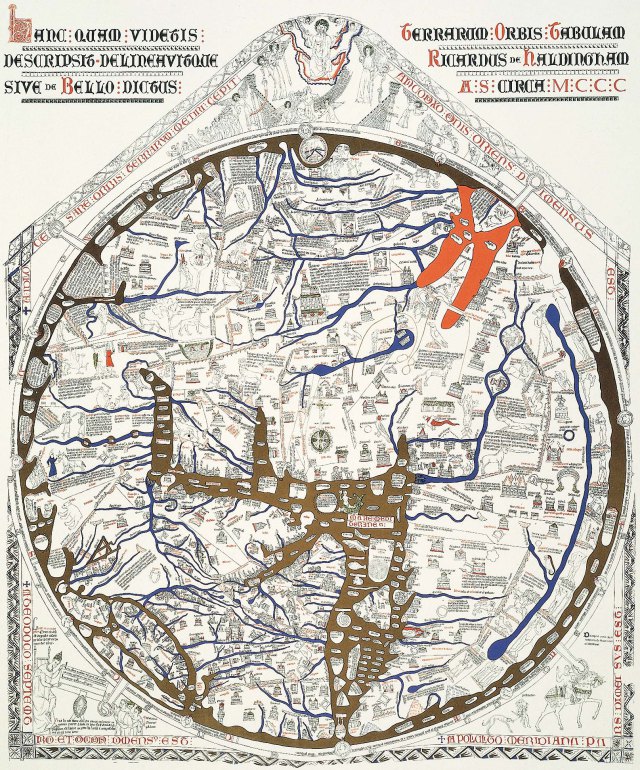
The “telos” of pre-modern societies involved living into something that existed before you.  They have an “end” beyond the society itself.  These frameworks exist not as a direct prescription but more so a guide to understanding reality.  Hence the “Mappa Mundi” (ca. 1300) tries not to accurately depict the physical world, but rather help one understand their place in the grand scheme of things.  It “maps” your life by telling you that you will die and face judgment, that Jerusalem is the center of the Earth, and so on.

The medievals obviously knew that the world did not actually look like this, but for them that was hardly the point.

The wars of religion in the 16th century lead to new ways of imagining the world. The Dutch philosopher Hugo Grotius gets credit in the eyes of most for orienting society in a new direction.  Though he wrote voluminously on many subjects, we can tie his thought together on the ideas of the individual and consent.  So, for example, the sea should be free for all, so that each individual nation may carve out their own destiny upon it.  Taylor argues that Grotius made such a case not as a radical, but a conservative.  He wanted to preserve the existing order and felt that ideas of freedom and consent were the best way to do this.

Obviously he was wrong.  But this, says Taylor, is often the way of things.  An acorn contains a whole oak, though no one would ever guess.  Our own revolution worked this way.  Within even just a few years, our founders lost control of the direction of things, and some see the Constitution as their attempt to salvage what they could before things got too far out of hand.

Our new imaginings put us on entirely different course.  In ye olden days order is self-realizing.  When evil happens time will go out of joint, for example, as in Hamlet.  Though many may flaunt established cosmic order, in time the cosmos has its way with you.  Order will come back again.  The modern imagining has no such apparatus.  It is entirely contingent, for we start with individuals and not what lies beyond them.

John Locke built on Grotius and went far beyond him.  For centuries, Christians saw sin as the result of death.  That is, our fear of death, whether subconscious or no, leads us to selfish acts of self-preservation.  This takes innocuous forms (I will have the last cookie), and more sinister, but the root is the same–our fear of self-dissolution. But Locke saw blessings in our desire for self-preservation–he saw it as part of our God-given nature.  We begin then, as individuals with a good desire of self-enhancement.  This means we meet on an amoral plane of complementarity, not an established hierarchy.  And from there, many other dominoes begin to fall.

Though Locke and others of his day had a secular foundation to their thought, some of the old way of understanding remained.  We still needed discipline to form our unformed selves.  But the balance of power shifted.  Before, nature came intact as a witness to us.  Locke believed, however, that just our labor shapes ourselves, so too our labor shapes nature.  Nature is ours form–it is our duty to form it–rather than nature forming us.  Now we see the oak embedded in Locke’s acorn–we believe that we are already formed.  As comedian Jon Stewart noted, whatever we do these days we deem special because we did it.^  Those of us who wish to challenge LGBT “agenda,” for example, don’t have the language or framework to do so effectively.  These days, our geodes must be acknowledged!

As we enter into adolescence we become more aware of the world, but our biggest problem at that age usually involves not being able to think of any world besides our own.  History helps with this, and Taylor forces us to ask, “What is normal, after all?”

In The Benedict Option Dreher asserts that Christians have lost the culture wars, and that we need to strategically withdraw.  Taylor’s book brings to mind the adage of Sun Tzu, that perhaps the battle was over before it began.  Modern imaginings are inherently secular.  Christians could never “win” a war fought entirely on their opponents terms.  But Taylor also gets us to rethink what is normal.  Dreher himself admits that he lives much like anyone else, and has yet to actually take his own advice.  He visited, however, a quasi-monastic community that lives out some of his vision.  Dreher commented,

It makes me think, Who are the abnormal ones here? These people, who live in such close rhythm with their own lives and the life of the church, or people like me, who live like I do?” He paused. “It was a sign to me of what could be.”

Dave

*Taylor rightly points out that this idea is not inherently conservative.  Those that rebelled against Charles I did so in the name of their ancient rights and privileges, and perhaps the same could be said about the Magna Carta.

**As one commentator put it, “My students start discussing Petrarch tomorrow in class, and it is easy to misread him as asserting that man is a microcosm of the universe, when in fact it is the universe that is a microcosm of man (or better put, a microcosm of Man).”

^Stewart continued . . . (I paraphrase), “You have to understand.  I grew up as a Jewish kid in New Jersey.  The one thing I heard more than anything else growing up was, “Jonny, get this through your head . . . you’re not special.”

The Inherited Conglomerate

In his collection of folklore from Ireland W.B.Yeats quoted the Irish proverb that, Those who travel much have little faith.”  He mentioned this with seeming ambivalence, which reflects something of Yeats himself.  He certainly had many markings of the worldly man, yet he wrote the magnificent poem “The Second Coming,” with the immortal line that tells of the centre no longer holding, the widening gyre of the falcon.

I have traveled very little, but this very small amount of travel has confirmed its enormous educational benefits.  One sees new things from new perspectives “in the flesh.”  Certainly one should always wish to grow, learn, and so on, but the proverb holds at least a kernel of truth: those who travel without a secure base may find themselves more “enlightened,” but also more confused then before.  These new perspectives can completely undo one’s world.  Whether this disruption be good or bad . . . it is unquestionably a disruption.

The great Gilbert Murray made his mark in the early 20th century as one of the great scholars of classical antiquity.  For many he modeled the calm, rational confidence of pre-W.W. I Europe and the blessings of “free inquiry.  His analysis of the history of Greek religion confirmed his rationalism.  Greece turned to irrationalism, he argued, and therefore decline, only when they lost their “nerve,” their sense of themselves.

But one particular comment of his caused his followers some consternation.  He admitted that every civilization has an “inherited conglomerate” of thoughts and ideas that should not be questioned, even though they cannot be “proven” in the usual sense of the word.   When society starts to try and dissect this inherited tradition, when they lose confidence in the conglomerate, they lose a common language and purpose and begin to fracture. He defended, for example, the teaching of Christianity in Britain’s state schools because

the religious–and what is more–the ethical emotions of the English people are rooted in the Christian writings, especially the Gospels, some of the epistles, and books like the Imitation and Pilgrim’s Progress.  The situation must be accepted.

It was that “must” that particularly bothered people.  What did he truly believe?  was rationality in itself a religion?*

Murray saw the emancipatory movements of the 19th century and often supported them.  But, he remained apparently torn about this in his later years, for he saw that the collapse of traditional Europe after W.W. I did not lead to more freedom as expected, but much less freedom for millions due to the rise of totalitarianism in Italy, Germany, and Russia.

In a podcast with Ezra Klein, he and Tyler Cowen exchanged thoughts on the emerging “rationality community.”

Ezra Klein

What are your thoughts on the rationality community?

Tyler Cowen

Well, tell me a little more what you mean. You mean Eliezer Yudkowsky?

Ezra Klein

Yeah, I mean Less Wrong, Slate Star Codex, Julia Galef, Robin Hanson. Sometimes Bryan Caplan is grouped in here. The community of people who are frontloading ideas like signaling, cognitive biases, etc.

Tyler Cowen

Well, I enjoy all those sources, and I read them. That’s obviously a kind of endorsement. But I would approve of them much more if they called themselves the irrationality community. Because it is just another kind of religion. A different set of ethoses. And there’s nothing wrong with that, but the notion that this is, like, the true, objective vantage point I find highly objectionable. And that pops up in some of those people more than others. But I think it needs to be realized it’s an extremely culturally specific way of viewing the world, and that’s one of the main things travel can teach you.

All of this came to mind as I read E.R. Dodds’ provocative classic, The Greeks and the Irrational.  We assume, he argues, two main things about the Greeks:

  • Their main contribution to the western world was their spirit of free, rational inquiry, and
  • It was this spirit of free inquiry that led to the greatness of their civilization

Dodds pushes us to see the Greeks on their own terms.  They had, perhaps more than other civilizations, a “rational” tradition, but even this rationalism sometimes came cloaked in religious guise.**

For example, the Pythagoreans developed a variety of useful and progressive ideas about math.  But their obsession with ratio/rationalism clearly had strong religious overtones, which shows when they (supposedly) drowned the “heretic” Hipassus for discovering irrational numbers.  The foundation of their mathematical advances had strong irrational overtones.  Socrates, whom many assume to be an arch-rationalist, declared in the Phaedrus that, “Our greatest blessings come to us in the form of madness.”  The whole of Greek literary and dramatic culture arose out of Dionysian worship.  Xenophon, Aristotle, and even Cicero accepted the idea that dreams could have spiritual import. The list could continue.

But as in the case of all civilizations, eventually elites, followed by others, began dismantling the irrational foundations.

Though fragments of Greece’s “inherited conglomerate” survived past the 4th century B.C., by the 3rd century little if anything survived.  At that point, Dodds argues that Greece experienced a time when society was more “open” than at any other point.  Dodds writes,

A completely “open” society would be, as I understand the term, a society whose modes of behavior were entirely determined by rational choice between possible alternatives and whose adaptations were all conscious and deliberate–all “rational.”

This sounds like the dream of many a modern man, but of course, no one could argue that Greek civilization had any large degree of health at this point.  Very few, if any, of Greece’s storehouse of cultural contributions came from this era, and this era paved the way for their final takeover by Rome ca. 146 B.C.  Once you ditch the conglomerate, you might have little less than sand on which to build.  You simply have too many decisions to make and no way to make them coherently as a group.

It seems to me that today we have two groups that argue strong for a rational, open society.

On the conservative side we have those who believe in entirely unfettered markets and expanding choice.  The best society is one where everyone can choose for themselves how to maximize their welfare.  Empowered by education and multiplicity of options, the conglomerate of free choices will create a happy society.  This group favors globalization, open borders, and so on.

On the more liberal side we have those who emphasize the power of choice in more personal, intimate ways, especially in terms of gender and sexual identity, family makeup, birth control (which includes abortion), and so on.

These two sides overlap at points.  They often sit across the political aisle from each other, but they have much more in common than what divides them, for they share a common foundation of devotion to the idea of an open society described by Dodds.

Other groups still believe in some way in the inherited conglomerate.  You have the more conservative, middle-America, white picket fence group that adheres to small town values, and you have more liberal leaning who might balk at small town values a bit, but still desire a “decent America.”  The more conservative side sees culture and community holding things together, the more liberal look to government with greater frequency to manage outcomes.  Yet both sides fear markets and morality running wild and free–and both have more faith in America’s “conglomerate” than either of the aforementioned groups.  Both could be described as irrational, for there is nothing objectively verifiable about “America.”  Their commitment lies on a gut-level, formed by a variety of experiences, emotions, and so on.

This looks like a clash between the rational and the irrational, but Dodds’ book helps illumine this divide.  The irrational have an unprovable gut-level attachment to something called “America.”  But the rational have something akin to religious commitments as well.  Those devoted to the market and to personal identity need to believe that the expansion of choice ad infinitum is always a good thing.  Neither party may believe much in “America,” or they may reduce America to the mere idea of choice.  Their faith lies elsewhere, and they take on the missional mindset of some of the world’s universal religions.

Our political divides often mask religious divides.  As Cowen argued, even the rational have irrational commitments.

Dave

*Murray’s daughter asserted that he came back to the Catholicism of his youth in the last weeks of his life, though other family members dispute this.

**By “irrational” Dodds does not mean “wrong,” or “foolish” but unprovable, or a mysterious a priori, or “psychic,” i.e., related to the soul.

Catch-22

Every year at the beginning of Government class I ask the question, “If 80% of the people voted to put the entire tax burden only on people with red hair, would this be ‘democratic?'”

I am always surprised and a bit dismayed at how many answer ‘yes.’

Of course our discussion then moves toward defining “democracy,” which, for as much we use the word, proves more difficult than we might expect.

“Democracy” is a “good” word, and “empire’ is one of those words you cannot say on TV.  But empires had many things that proponents of democracy value, such as religious tolerance and ethnic mixing.

So how, exactly, should we define “democracy?”

Democracy in the modern era grew out of Enlightenment universalism.  Jefferson said that, “all men are created equal,” and France produced the “Declaration of the Rights of Man.”  Spengler may have been a nut, but he might have been on to something when he commented that “the rights of Englishman,” made a lot more sense to him than, “the rights of man.”  The ancient Greeks, for example, considered by many as the progenitors of democracy, knew nothing of “universal rights.”

This universality gave early democratic movements  their enormous power and enabled them to move speedily through Europe.  But this is not the whole story, for coupled with this universality came the rise of nationalism.

How do we reconcile these different forces?  The French had a hard time of it, rallying to defense of the “patrie” against Austria and Prussia and then expanding under Napoleon both to spread their universal ideals and rule others in the name of France.  The recent presidential election showed this tension.  It has been with us for a while.

On the one hand, democracy thrives on the idea of self-determination.  Democracy grants people the right to determine our lives because we share common interests, cultures, goals, etc.  Modern democratic movements have their genesis in rebelling against rulers who do not share our culture our goals, those that do not speak for us.

On the other hand . . . democracy believes in equality for individuals as well as groups, and this equality, applied in a heterogeneous culture, must in turn limit some aspects of self-determination for the state to hold together.

This has led some to speculate that increased diversity can contribute to more autocracy.

Germany’s Jeroen Zandberg (a proponent of democracy) put it this way:

Of course nationalism can also be used to exclude and eliminate others, but this is rare. These rare occasions are however often used to discredit nationalism. An elite who doesn’t have the best interest of the people at heart, but which does want all the benefits of a high social position often tries to promote patriotism instead, and at the same time downgrades nationalism. Patriotism is simply to owe allegiance to the state even if that state is not legitimized by the people. The state is in that perspective merely an organisation like any other. If that were true it would be like asking soldiers to die for the telephone company. Without identification and an emotional bond between people and state we would have no alternative then to live under a police state. If we don’t want a police state then we need some degree of nationalism.

If you have multiple cultures present in the same location who each have different rules on how to order the world then there needs to be another ethical system to mediate between them. For example, Muslims have Sharia law which describes how a good Islamic society should be organised. These laws are not accepted by non-Muslims for if they would accept them they would be Muslim as well. In a truly multicultural society the Sharia law would govern the lives of Muslims and each of the other cultures would have their own laws as well.

Now Germany, as with other European nations, has a culture based on Christianity and the Enlightenment, which values ideas like freedom, equality and self-determination. If you implement multiculturalism then the values of the Enlightenment are degraded to the level of only being appropriate to the ethnic German population. You would get a Germany where each (ethnic) community has its own rules. Of course such a system could never work in a modern society because people are not isolated in small communities.

Multiculturalism can however also be used to invalidate all of the cultures present, because if all cultures are equal, which multiculturalism implicitly states, than none may rule over the other. This means that, in the case of Germany, the mere presence of another culture is already reason enough to replace German culture with something else. This ‘new’ culture is by definition anti-democratic, because it is one of a small elite who appoints itself as mediator between the various cultural groups. In this way an elite rules over a set of distinct peoples. In that sense multiculturalism is a leap backward in time when there were large empires ruled by a small nobility and people’s positions in society were fixed by birth. Characteristics of such empires are that they are fiercely anti-democratic, oppressive and unable to compete economically in a globalised world.

As much as we might wish, we cannot work out either ideas of liberty and equality in a vacuum.  Something somewhere has to give.

It appears that those who lean towards the multi-ethnic, tolerant, and globalized side of democracy must tolerate some degree of nationalism for the support structure of multi-ethnic tolerant societies to exist.  The balance will be hard to find.

On what side should the Church fall?  Here we must take great care to avoid identifying too much with either camp.  The first half of the 20th century gave us the disasters of nationalism, and more recently, we see the problems created by multiculturalism.  All the more reason for the Church to create its own culture . . .

Dave


The Tyranny in “Freedom”

In his classic work Orthodoxy, G.K. Chesterton uses a masterful analogy.  In discussing the relationship between authority and adventure, he writes,

Christianity is the only frame which has preserved the pleasure of Paganism. We might fancy some children playing on the flat grassy top of some tall island in the sea. So long as there was a wall round the cliff’s edge they could fling themselves into every frantic game and make the place the noisiest of nurseries. But the walls were knocked down, leaving the naked peril of the precipice. They did not fall over; but when their friends returned to them they were all huddled in terror in the centre of the island; and their song had ceased.

As good Americans we tend to believe that absolute freedom and tyranny lie at opposite poles.  We are mistaken. Instead, they have a tendency to bend around and shake hands.  Plato recognized this long ago in his Republic. After discussing various forms of government in Book VII and how the good in each gets perverted, he turns his attention to democracies:

The ruin of oligarchy, [said Socrates] is the ruin of democracy; the same disease magnified and intensified by liberty overmasters democracy — the truth being that the excess of anything often causes a reaction in the opposite direction; and this is the case in vegetable and animal life, but above all in forms of government . . .

The excess of liberty, whether in States or individuals, seems only to pass into excess of slavery.   . . . And so tyranny naturally arises out of democracy, and the most aggravated form of tyranny and slavery out of the most extreme form of liberty.

Socrates continues in the discussion to say that democracies create “a new kind of drone.”

I thought about both Plato and Chesterton when listening to a reaction from one commentator on the Supreme Court’s decision on homosexual marriage.  He agreed with the decision not for legal or moral reasons (which I would disagree with but at least understand in part), but because, “thankfully, the Court recognizes that we live in the 21st century.”  That is, the Court should essentially approve of whatever we happen to be doing at any given time.*  This may look like freedom, but in fact enslaves us to a particular moment without any benefit of perspective. Maybe we must come to terms with the fact that this is what democracy means now.  Perhaps it has always been so and we failed to recognize it.  In any case, this method leaves ourselves only to the walls inside our own heads.

This is why “great” revolutions often end up making things much worse than the regimes they overthrew.  Of course no one intends this at the outset or even recognizes the possibility, partly because revolutionaries perceive a truth, or part of the truth, with crystal clarity.  This truth will give them the motivation they need for revolution.  But because this truth is only part of the whole Truth, it leads to a frozen dogmatism.  The fences melt away in our rush to embrace freedom, and all end up huddling at the center whether they wish it or not.

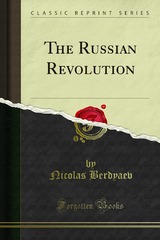
One of the great virtues of Nicolas Berdyaev’s The Russian Revolution is his keen vision that sees past the political aspects of Communism and into its spiritual core.  Of course the Soviet state adopted atheism as its official policy, but Berdyaev puts the roots of communist origins within the deep and ardent tradition of Russian spirituality.

Anyone who has read 19th century Russian literature recognizes the depths of profound insight and feeling those masters tapped.  Their intensity of feeling led them to examine the nature of suffering perhaps as no other epoch has.  The first modern globalization movement allowed more sensitive souls more exposure to more suffering.  Some, like Dostoevsky, took suffering and had it transformed by the cross.  But others failed to do so, and developed what we might call a “naked” hatred of suffering.  As one early Bolshevik proclaimed, “Suffering has no right to exist.”  Everyone must be happy.

This rejection of the meaning of suffering cannot bring one closer to our fellow men, because of course we do suffer and always will.  To reject suffering sets one up to reject the experience of mankind, and then, mankind itself.  Suffering without the Cross gives way to tyranny.

The early revolutionaries had within them a deep asceticism.  All things not geared fully towards improving the material lot of the people must be expunged.  Beauty itself became a debauched and corrupting luxury.  Everyone must do without so that nothing ever gets wasted, either in the mind or on the ledger sheet.  Such asceticism, without grace, again leads to tyranny. But let us not miss the fact that this tyranny has its roots in a certain idea of freedom.  Communists wished the people to be free from suffering, free from worry about the future, free from the competitive aspects of capitalist societies.  Now we know that such freedom leads to a drabness and narrowing of life.

Soviet Architecture

Berdyaev wrote in 1931 and he had a keen insight for the westerners to whom he wrote.  Westerners at that time and now, fundamentally are skeptics, and they assumed that the Soviets shared this basic outlook.  Not so.  The communist has deep (though misplaced) faith, and the people understand and embrace this faith.  The state could not hold together for any other reason.  This faith flies in the face of “evidence” against it.  Most communists rejected the physics of the early 20th century, for example, because Einstein and others smacked of mysticism, and we must exorcise all mysticism so that the people will have true happiness.  In the end pure rationalism becomes entirely irrational and ridiculous.  Still they press on.  Our failure to recognize this faith led us to combat it by all the wrong means.  One thinks of Nixon trying to impress Khruschev by showing him better refrigerators.  It showed our misunderstanding and our bankruptcy.  Was this all we had to offer?  If Khruschev was not impressed, we should be surprised.

The first part of Berdyaev’s book focuses on the spiritual failures of the revolutionaries themselves, but then he adroitly and appropriately turns the tables.  How did such a movement come about?  If the revolutionaries showed great spiritual hunger, we must consider the fact that churches in their locales could not feed them.  The rise of communism comes from the failure not just of capitalism to produce a just society, but from the Church to live out its calling.  He writes,

Christianity has not put its truth into full living practice.  It has found its realization either in conventional formula or in theocracies which deliberately ignore freedom (which is the fundamental condition of any genuine realization), or it has practiced a system of duality, as in modern history, when its power has weakened.  And therefore Communism has made its appearance as a punishment and a reminder, as a perversion of some genuine truth.

As I and others lament the recent high court decision on the validity of homosexual marriage we do well to follow Berdyaev’s example and point our fingers in the right place.  For what we see before us comes fundamentally from the Church’s failure to explain the true nature of marriage not as an emotional bond between two people, but as an image of salvation itself, the marriage of Heaven and Earth.  In Eastern churches, the bride and groom process around the congregation during the service wearing crowns.  These crowns represent crowns of the martyrs.  Marriage, like monasticism, is a kind of martyrdom, a death out of which new life emerges. What we see before us should serve as a “punishment and a reminder” of what we should have proclaiming and living out all along.

Dave

*One sees this in many places in our culture.  Take, for example, the rise of graphic novels.  Rather than be comfortable with the strengths and weaknesses of the medium, we hear ardent insistence that “graphic novels are just like books.”  In my limited experience it seems obligatory for authors of young-adult fiction to include a mean teacher in the story who fails to allow a student to hand in a book-report on a graphic novel.  The theme is the same —  whatever we happen to be doing must be affirmed by all.

Democracies and their Aristocracies

This post has had a few different lives (originally written during the party primaries in 2016) . . .

Our most recent election raises many questions for many people.  One thing appears clear . . . we knew that the Republican party was in trouble before this election.  Otherwise, Trump never would have received the nomination.  The fact that Clinton lost, however, shows the weakness of the Democratic party as well.  The whole party system will likely need a reboot in the coming years.

Below is the first re-posting note . . .

*************

I published this about a year ago (you will note the dated references), but republish it to coincide with our look at Aristotle in our senior level Government class.  The original post is below.

**************************************

Democracies have always had at best an uneasy relationship with aristocracies, for obvious reasons. The very presence of an aristocracy either seems like an obstacle or a reminder of the inadequacy of democracy.  But first and foremost, I suppose, democracies would interest themselves in self-preservation.  In turn it might mean, to paraphrase Aristotle, that democracies should adopt not the political practices that democracies want, but those designed instead to preserve democracies.

I thought of Aristotle’s dictum while reading Jonathan Rauch’s provocatively titled Political Realism: How Hacks, Machines, Big Money, and Back Room Deals can Strengthen American Democracy.   I love the title.  Its (seeming) incongruity demands further examination.  But I admit I initially dismissedpoliticalrealism_990x450 the idea as a farce — until I thought about Donald Trump in the Republican primaries.  Democrats should be careful of cheering Trump on in the almost certain hope that he will fall on his face in due course.  We need good candidates on both sides to spur one another on and stabilize the electorate.  I found myself thinking, “Trump has had his fun and served his purpose.  Why hasn’t someone taken care of this?”  Then I realized that what in fact I wanted was a smoke-filled back room where “decisions” got made about these sorts of things.

No one suggests that such a solution resembles democracy.  But Rauch argues that these practices in fact preserve middle-ground, the key to a stable democracy. We fret about the increased polarization of the country and the lack of compromise. Look no further, Rauch argues, then to the decline of the power of parties — in our day particularly, the decline of the Republican party.  He contends that political machines in fact serve two key purposes:

  • They traffic in interests not ideas.  Ideas have no limits, no boundaries.  The “system” of politics is more easily quantified, thus more easily measured and controlled.
  • The candidates of a ‘machine’ stand accountable to a conglomeration of interests.  Ideological candidates have much less direct accountability.  This lack of accountability makes ideological candidates more free, and thus more oppositional.  As Rauch writes, “Show me a political system without machine-politics, and I’ll show you confusion, fragmentation, and a drift towards ungovernable extremism.”  Moderation, he argues comes not from moderates, but from machines that by design moderate everyone’s extremism.

Machine politics reminds us of Tammany Hall and other kinds of organizations filled with what even its ardent defenders might call “honest graft.”  Rauch argues that politics always involves making a lot of sausage.  But he argues that political machines also accomplished a great deal.  Tammany Hall dramatically boosted voter turnout and passed a great deal of progressive legislation.  Lyndon Johnson made who knows how many deals to pass the Civil Rights Act.  Progressives, Libertarians, and Tea-Partiers, Rauch argues, get so caught up in the purity of the idea, the purity of the process, that nothing ever gets done.  For him they are the modern-day lotus eaters.

But however good sausages taste, watching them get made never sits well.  Machine politics face the hurdles of ideologues. The modern media microscope surely offers no help either.  I can see Americans get fed up with polarization and return to a more centrist mindset.  I can’t see the media going away or turning a blind eye any time soon to back-room deals.  This poses the biggest challenge to a return to the bygone days of political machines.

Rauch makes an eloquent plea for his idea.  He effectively demonstrates the moderating effect of machines.  I wish he had talked more about the inevitable nature of ideology in democracies, or the inevitable nature of ideology in human experience.  For Rauch, ideology is almost a four-letter word. He recognizes its power, but not its place.  So, ok, machines can moderate ideologies.  But I wonder if Rauch the pragmatic realist is asking us to accept the fantasy that (to reference Thucydides) interest will trump honor and/or fear.

Also we need more than a modern comparison to evaluate it. We need greater perspective outside of our own sphere. Basically what he asks for is a democracy managed by a semi-official oligarchy.  In many ways we had this in  post-Napoleonic Europe in the 19th century.  How does this period stack up?

Some features of this era:

  • A significant increase in democracy through expanded voting rights, and in some places, limitations on the ‘elite’ legislative bodies (like the House of Lords in England).
  • Relative peace — at least internally in Europe.  Wars happened but they tended to be limited in scope and duration.
  • An aristocracy that had less power than the previous century but still lots of influence.  What’s more — this aristocracy had more mobility than perhaps at any other time in history.  Traveling around Europe formed an integral part of the growing up experience for many aristocratic youth.  Thus, the aristocracy formed a real “boys club” throughout central and western Europe (most of the monarchies also had some familial relationship to one another as well).
  • As an extension of this, lots and lots of international conferences to settle disputes and award prizes to the participants.

Of course no era is perfect.  Some would point out that the “relative peace” I mention came at the expense of significant overseas expansion. I argue elsewhere that such expansion created domestic internal issues.  Others might say that the catastrophe of W.W. I emerged from the ultimate failure of this system. We should consider their record in context, however. The system they established must have the backdrop of the chaos of the highly ideological French Revolution and the resultant Napoleonic Wars that killed millions.

We will see whether or not this next election shows the need for the return of political machines.  If Hilary Clinton runs against Jeb Bush for the presidency, we might even argue that such machines never left.  But another question that Rauch fails to ask is, can they return to prominence?  It may be more than a matter of political will.  The decline of political machines has its roots beyond politics.  For example, after itunes, Youtube, etc., record companies exist, but not in the same way.  The power they had in the 1990’s to release greatest hits albums of their artists but put one new song on the album to try and make die-hard fans buy entire albums to get that one song — may never return (not that I’m bitter or anything).  We can observe this de-centralization most everywhere in our culture.  And surely this de-centralization comes at a price, but also gives some benefits?  Rauch sees no real benefits to political de-centralization and cannot weigh the merits of both.

But this is still a good book.  It makes one think.  Fundamentally, it asks us to consider whether or not democracies, left to themselves, will preserve themselves from their own folly.

12th Grade: The Presence of Law is Half the Problem

Greetings,

This week we wrapped up our discussion of Plato’s political philosophy, at least for the moment.  This week we spent some time with Plato’s dialog The Statesman.  Many take the position that Plato’s Republic represents his best-case, unrealistic dream-world, and his subsequent dialogs (such as The Statesman) represent a more realistic approach.  I think this too simplistic, but clearly in The Statesman Plato wrestles with the fact that a) Rulers are not divine, and b) people are not sheep who will easily obey.

The problem gets compounded for Plato when he considers the nature and purpose of law.  States cannot exist without law, and yet Plato believes that the presence of law at all reveals a fundamental weakness in the state itself.  This sounds confusing, but if we consider our relationships with our spouses and friends, they are not governed by law.  We don’t have stipulations such as, “You must call me every day from work or you will face ‘x’ consequence.  Law in fact would kill the relationship.  The bonds between us have to be more organic and natural for the relationship to function well.

The same holds true for the state itself.  The presence of law presupposes problems in our relationships with one another.  If a state relies on law to hold itself together, the bonds will be merely external and therefore weak.  Plato knows that “philosopher kings” who know all and get obeyed by all is an impossibility.  He knows that a law-bound state will lack the internal harmony* required for success.  How to proceed?

Plato believes that the problem will have a partial solution if our leaders are “statesman,” and not “politicians” in the standard sense of the word.  Politicians attempt to curry favor with the people, or blow with the prevailing winds in a pavlovian manner, without regard for wisdom.  Politics then, can be a matter of mere technique.  Statesmanship, on the other hand, is an art form.  Statesman don’t rule via law, they find a way to knit people together without law.  We can approach Plato’s idea here if we think back on our greatest Presidents, who seem to embody something “American” for all people.  We don’t call them successful presidents for the great laws they passed, but for how the embody us and motivate us.  Law can do neither of these things.

Plato uses the analogy of weaving to describe the statesman’s art.  I include an excerpt from the dialog below if you have the interest.  Weaving shows up in many ancient texts, and seems to represent more than just skill with cloth (something I discuss in this post).  Plato kept on exploring, and he entitled one of his last dialogs The Laws, which may be an indication that he abandoned his dream late in life.  We need not see this necessarily.  Perhaps Plato wanted to tackle the problem of good governance from many different angles, and even in the laws he focuses on the importance of the soul.  We shall look at The Laws later in the year.

*A harmonious state requires harmonious souls within the state, hence Plato’s frequent references to music and the need for the state to control music within it.

Plato’s “The Statesman” — The Art of Weaving

STRANGER:

Then you and I will not be far wrong in trying to see the nature of example in general in a small and particular instance; afterwards from lesser things we intend to pass to the royal class, which is the highest form of the same nature, and endeavour to discover by rules of art what the management of cities is; and then the dream will become a reality to us.

YOUNG SOCRATES:

Very true.

STRANGER:

Then, once more, let us resume the previous argument, and as there were innumerable rivals of the royal race who claim to have the care of states, let us part them all off, and leave him alone; and, as I was saying, a model or example of this process has first to be framed.

YOUNG SOCRATES:

Exactly.

STRANGER:

What model is there which is small, and yet has any analogy with the political occupation? Suppose, Socrates, that if we have no other example at hand, we choose weaving, or, more precisely, weaving of wool—this will be quite enough, without taking the whole of weaving, to illustrate our meaning?

YOUNG SOCRATES:

Certainly.

STRANGER:

Why should we not apply to weaving the same processes of division and subdivision which we have already applied to other classes; going once more as rapidly as we can through all the steps until we come to that which is needed for our purpose?

YOUNG SOCRATES:

How do you mean?

STRANGER:

I shall reply by actually performing the process.

YOUNG SOCRATES:

Very good.

STRANGER:

All things which we make or acquire are either creative or preventive; of the preventive class are antidotes, divine and human, and also defences; and defences are either military weapons or protections; and protections are veils, and also shields against heat and cold, and shields against heat and cold are shelters and coverings; and coverings are blankets and garments; and garments are some of them in one piece, and others of them are made in several parts; and of these latter some are stitched, others are fastened and not stitched; and of the not stitched, some are made of the sinews of plants, and some of hair; and of these, again, some are cemented with water and earth, and others are fastened together by themselves. And these last defences and coverings which are fastened together by themselves are called clothes, and the art which superintends them we may call, from the nature of the operation, the art of clothing, just as before the art of the Statesman was derived from the State; and may we not say that the art of weaving, at least that largest portion of it which was concerned with the making of clothes, differs only in name from this art of clothing, in the same way that, in the previous case, the royal science differed from the political?

YOUNG SOCRATES:

Most true.

STRANGER: In the next place, let us make the reflection, that the art of weaving clothes, which an incompetent person might fancy to have been sufficiently described, has been separated off from several others which are of the same family, but not from the co-operative arts.

YOUNG SOCRATES:

And which are the kindred arts?

STRANGER:

I see that I have not taken you with me. So I think that we had better go backwards, starting from the end. We just now parted off from the weaving of clothes, the making of blankets, which differ from each other in that one is put under and the other is put around: and these are what I termed kindred arts.

YOUNG SOCRATES:

I understand.

STRANGER: And we have subtracted the manufacture of all articles made of flax and cords, and all that we just now metaphorically termed the sinews of plants, and we have also separated off the process of felting and the putting together of materials by stitching and sewing, of which the most important part is the cobbler’s art.  Then we separated off the currier’s art, which prepared coverings in entire pieces, and the art of sheltering, and subtracted the various arts of making water-tight which are employed in building, and in general in carpentering, and in other crafts, and all such arts as furnish impediments to thieving and acts of violence, and are concerned with making the lids of boxes and the fixing of doors, being divisions of the art of joining; and we also cut off the manufacture of arms, which is a section of the great and manifold art of making defences; and we originally began by parting off the whole of the magic art which is concerned with antidotes, and have left, as would appear, the very art of which we were in search, the art of protection against winter cold, which fabricates woollen defences, and has the name of weaving.

YOUNG SOCRATES:

Very true.

STRANGER:

Yes, my boy, but that is not all; for the first process to which the material is subjected is the opposite of weaving.

YOUNG SOCRATES:

How so?

STRANGER:

Weaving is a sort of uniting?

YOUNG SOCRATES:

Yes.

STRANGER:

But the first process is a separation of the clotted and matted fibres?

YOUNG SOCRATES:

What do you mean?

STRANGER:

I mean the work of the carder’s art; for we cannot say that carding is weaving, or that the carder is a weaver.  Again, if a person were to say that the art of making the warp and the woof was the art of weaving, he would say what was paradoxical and false.

YOUNG SOCRATES:

To be sure.

STRANGER:

Shall we say that the whole art of the fuller or of the mender has nothing to do with the care and treatment of clothes, or are we to regard all these as arts of weaving?

YOUNG SOCRATES:

Certainly not.

STRANGER:

And yet surely all these arts will maintain that they are concerned with the treatment and production of clothes; they will dispute the exclusive prerogative of weaving, and though assigning a larger sphere to that, will still reserve a considerable field for themselves.

YOUNG SOCRATES:

Very true.

STRANGER:

Besides these, there are the arts which make tools and instruments of weaving, and which will claim at least to be co-operative causes in every work of the weaver.

YOUNG SOCRATES:

Most true.

STRANGER:

Well, then, suppose that we define weaving, or rather that part of it which has been selected by us, to be the greatest and noblest of arts which are concerned with woollen garments—shall we be right?

El Campesino

The book jacket to El Campesino: Life and and Death in Soviet Russia boasts that, “this is not another memoir of a tortured intellectual wrestling with his conscience.  This book is in every sense a tense narrative of action, played out against the world’s most important struggle.”

Enough obsessive Russians!  “I was elected to lead, not to read!”

This blurb is accurate, however.  The main character, Valentin Gonzalez, “El Campesino” (the Peasant), is indeed a man of action and not reflection.  His narrative tells the story of his struggle in the Spanish Civil War, which makes him a hero of the Communist Party.  Feted by the Soviets, they whisk him away to Russia for specialized training.  He quickly grew disillusioned with the El CampesinoSoviet system.  His fiery personality led to numerous conflicts with party officials, which led to his imprisonment.  Gonzalez’s relentless forward-looking energy helps him escape not once but twice from prison camps, and eventually to freedom–the stuff of legend.

Such a triumph would indeed never happen with a more introspective “intellectual wrestling with his conscience.”  Gonzalez’s accomplishments come with a host of morally questionable actions he takes, but true to his nature, he hardly blinks an eye.  Gonzalez tells us that in the gulags the political prisoners often die within six months, while the ordinary criminals find ways to survive.

He decided to survive.

Of course one can’t help but root for him.  In many respects we certainly should root for him–for one, we obviously have to root against the Soviets.  Some introspection, some torturing of his conscience, however, might have helped him do more than merely survive.

One incident fairly early in the book jumped out at me that illumined the dark caverns of the Soviet system, and humanity besides.

Upon their arrival in Moscow Gonzalez and other “Heroes of the Revolution” received royal treatment.  Each of them had a “maid” assigned to them.  These maids came young, pretty, perfumed, and quite willing to do anything at all.  In fact the girls sought to sleep with them.  This, they knew, would be part of their weekly evaluations.

Possibly one of these “heroes” might have traditional ideas about sexual behavior and marriage (Gonzalez did not).  But such a man would face a terrible dilemma.  If he did not sleep with her, she might receive poor evaluations and perhaps even a punishment.  He would feel sympathy and wants to protect her.  So he sleeps with her.  But the maids sleep with the men primarily to put them off their guard so that they might reveal “anti-Soviet” thoughts.  They received big rewards for successfully extracting useful information for the NKVD.

The Soviets certainly recognized our need for fellowship and intimacy, but they exploited this not only to turn people against each other, but to turn someone against their very selves.  This result seems almost inevitable given the circumstances.

The life of Father George Calciu, however, shows us a different path.

Father George lived in Romania and came of age just prior to the communist takeover after World War II.  They arrested him in 1948 not so much for any specific crime, but mainly because he was one of the younger, educated set that the communists needed to make their own.  The old did not matter so much.  Romania’s traditional culture and deep roots in the Orthodox faith could die out with them.

Father George and others like him went to an Orwellian style prison designed to break them psychologically more than physically.  Their captors sought via a variety of techniques to separate them from the past and themselves straight out of 1984.  Father George confessed that such methods worked.  He said things to his interrogators he regretted.  After some months he found that he could not remember much about his childhood.  He could not remember how to pray.

Father George CalciuThen two things happened.  First, he realized that he did remember one prayer–“Lord Jesus Christ, Son of God, have mercy upon me, a sinner.”  This helped him remember himself and led to his remembering the the Lord’s Prayer and a few others.  Second, the interrogation process culminated when they successfully recruited prisoners to help them torture other prisoners.  Father George had said things he regretted, but this he would not do.  He felt terribly alone, for if he had agreed to this, he would have found at least some form of fellowship, some kind of sense of team with the other guards.

But then a curious thing happened.  The jailers lumped all the resistant prisoners together, perhaps not wanting them to infect their own converts.  Here Father George found a new community centered around their mutual faith in Christ and a commitment to human dignity.

Now, he knew himself again.

Some years after his release he felt called to deliver a series of Lenten sermons to Romania’s youth and a similar pattern emerged.  The seminary where he taught knew these messages might provoke trouble with the authorities.  They refused to support him, and once again Father George found himself alone.  But he went forward anyway, and to his utter shock, thousands and thousands of students came to hear him each week.  His “Seven Homilies to the Youth” had an international distribution.  He faced a second term in prison.  But now he was an internationally known dissident, and this gave him a small measure of protection.  In both instances, Father George refused to give in to the communist inspired ideals of community.

I admire the courage and audacity of Valentin Gonzalez.  But Father George Calciu showed us a better way.


A Sin Against the Gift of Self

I had a startling realization over this past Christmas that I might be getting old.

My son received an album by The Who as a present and I ended up reacquainting myself with their music as we listened to it together in the car.  Hearing again especially some of their earlier music, all the fuss “eggheads” made in the 1960’s about rock music destroying the youth, and ultimately destroying our civilization, made total sense.

How could this be happening to me?  It could possibly have something to do with the minivan in the driveway . . .

My reaction came not so much from their penchant to destroy their instruments (which I always just found pointless and hardly scary or “revolutionary”) but from the lyrics, rhythm, etc.  Everything seemed to be about angst, alienation, anger, emotional distress, “I’m better than you,” and so on.  Again — some of this changed as they matured as people and musicians in the 1970’s.

“Kid’s these days!”

But if one reflects on popular music in general we see that The Who (who at least were interesting and talented) probably were not nearly as “dangerous” as some other bands/pop stars.  So much even of the best pop music (even early Beatles) aims for the lowest denominator of teenage emotional distress.*  So much of it seems so small, petty, narrow, trapping us inside ourselves.  When we consider that the goal of the Christian life is “contentment in all things” through union with God and our fellow man, we see how obviously such music works directly against that.

In her recent interview with Tyler Cowen the always engaging Camille Paglia talked of how she finds the culture of today small and largely pointless.  In contrast, the culture she grew up in celebrated the large and grand.  The Ten Commandments has the huge statue of Pharaoh move across the screen, or the vast expanse of the desert in Lawerence of Arabia.  Today the internet opens up a whole world and yet we sit fixated on tiny screens.

Perhaps there is a connection between the two.

In the Church’s patristic era a variety of monks described a spiritual state they called “acedia.”  Through a series of unfortunate twists and turns the sin of acedia would come to thought of as mere laziness.  But originally, it meant something deeper and more profound than this.  Abbot Jean Charles Nault seeks to recover its original meaning and its relevance for today, in his book The Noonday Devil.  He attempts to explain the meaning of acedia with roots in apathy, boredom, and indifference.  The middle section, where he discusses the work of Thomas Aquinas, got a bit tedious for me at least (which is a shame because St. Thomas is not tedious).  Despite this, one sees clearly that Abbot Jean has written a useful and timely work.

Abbott Nault begins by tracing the development of the idea of acedia, first recognized, or at least, written about, by the early desert monastics.  Anyone familiar with the writings of such fathers know they possessed profound spiritual and psychological insights.  We can see this when they called acedia the “noon-day devil.”  In the middle of the day in the desert the sun comes to its height and the heat–and the torpor of the day– reach their peak.  Bodies and minds alike become wet noodles.  But more than this, with the sun at its height we see no shadows and are not conscious of time passing.  Without shadow and the passing of time, we lose a sense of mystery.  Without mystery, we grow disenchanted with the world.  Soon enough, we grow not just disenchanted with the world, but our very selves.  In due time, disenchantment leads to disgust even with our very existence.

Hence, Abbot Nault brilliant summation that acedia is a “sin against the gift of the self.”

Since the first to discuss acedia were desert monastics the original applications had to do with desert monastic life.  Acedia took a variety of forms:

  • Temptation to leave one’s cell/calling — variety is the spice of life, so we say.  For the monastics no monk needed anything that was not already in his cell.  The temptation to seek variety led to a dissipation of spiritual energy.  A love of variety only masks a disgust with creation itself.
  • Too much concern for one’s physical health–this seems hardly akin to “disgust with oneself” or creation.  But if we look closer . . . hypochondriacs are navel gazers.  They  misplace their vision and will not look at the stars.  This obsession leads down the path of disenchantment, first  with creation, and then with the self.  Some recommend frequent meditations on death as a special cure for this.  Take care of your body all you like, but death will take you all the same.  In addition, meditation on death will mean meditation on a mystery, and the possibility of re-echantment with the self, creation and ultimately, with God.  In fact, meditation on the brute fact of one’s death was a frequently prescribed remedy for acedia.
  • Neglect in observing the rule–often the temptation is to ‘minimize’ the rule and make things easier.  Sometimes others sought to go beyond the rule to great extremes.  Both paths seek one’s own way in the spiritual struggle, however, and this leads to isolation from community.  Both paths fail the discipline of “staying in your lane” and contentment with what has been given.
  • Aversion to manual labor–this seems more like what we would expect to hear
  • Desire for “worldly pursuits”–service, activity, and so on.  Surely these are good things!  And they are, but “remain in your cell.”  Stay in your lane.

The monks gave various cures for acedia such as exercise, combining work and prayer, and so on.** But none of the remedies allowed the monk to avoid his true calling, and hence, his true self.  “Have the discipline and the desire to become truly human.”

The devil has craft.  He masks acedia in various ways, one of them being the desire for self-preservation.  We feel that our routines suffocate us.  We need fresh air, a change of pace–surely God created such variety for a reason!  But this desire to embrace the so-called fulness of ourselves is false.  In reality we seek to escape ourselves.  This subtle deception makes itself evident when we switch from an “open” approach to life rooted in love to a “closed” approach rooted in obligation.  No lover seeks to perform the minimum to show his intention to his beloved.  But most of us get out of the dentist office as soon as possible.  We take a “closed” approach to our disciplines when we see them as taking instead of giving life.  We erect walls and a moat around our identities.  This so-called self preservation actually shrivels and dissipates us.  We avoid the self by scattering it to the four winds. Without true self-knowledge we will end up dealing with God only when we “have to.”

Many years ago I met very briefly a bishop not terribly unlike some of these desert monastics in terms of his habits.  He was old, thin, and spoke in a quiet though melodious voice.  Yet he easily seemed to me the most “solid” person in the room.  The weight of his personality struck me with great force.  Here, I thought, is a real person, whose discipline of heart and will have made him an infinitely stronger man than myself.^  I recall thinking, “If for some reason he tells me to jump, I will certainly ask, ‘how high?'”

One can easily see how acedia would have a field day in our modern world.  Good evidence exists that the multiplicity of choice in fact makes us less free. We have a hard time avoiding distraction, but the real problem is that we do not want to avoid it.  Many of us crave distraction to keep us away from ourselves, and most of us carry an easy means of distraction in our pockets.  To return to Paglia’s observation, a world of small screens will lead to small minds and a great dullness.

Despite the appalling landscape of our own hearts, I see some ground to build upon.  The Church still understands that monogamous marriage leads to great fulfillment and a true understanding of love of God.  Many often say that they did not really know their spouse until marriage.  So too, many of us did not really know ourselves until practicing marriage either.  We understand here the value of “staying in your lane.”

But progress in our culture on this issue may involve a different understanding of human experience and our place in the world.  We should remember the “middle way” of the desert fathers.  “If you are hungry, eat.  If you are tired, sleep.  But . . . do not leave your cell.”

— Dave


*This was not the case as much with groups that came out a more weighty blues tradition, like the Chuck Berry, Led Zeppelin, and especially, . . . most especially, Jimi Hendrix.

**In a whole other section Nault describes that a frequent remedy for acedia involved lamenting and weeping over one’s sins.  A trivial person, just like a trivial culture, will not be able to take anything seriously.  A true sense of personal sin will give you the  humility to “stay in your lane.”

^The desert fathers have a reputation for extreme severity that the many quotes in the book do not support.  Obviously their monastic life included more asceticism than exists in the world, but all in all, they strove for the “middle way.”


“It Absolutely Will not Stop. Ever.”

I know very little about the history and culture of India, but I feel comfortable saying that they have been around for a long time and possess a very deep sense of cultural identity and tradition.

But in the 20th century, India started to embrace certain key components of western democracy, and introduced new political and cultural strands into their way of being.  I think India bears watching.  They can serve as a petri dish for an experiment.  When democracy interacts with a tradition, who wins?  Can a reasonable peace and balance exist between them?  Or, must one destroy the other?*

For the sake of this post we will not assume that tradition is bad and democracy good, or vice-versa.  Both can be good or bad depending.

I thought of this as I came across an article about hotels in India.  As a traditional society, India has more “conservative” views on marriage and sexual morality.  But democracy seeks to empower individual choices.  Free-market capitalism looks for niches–ways to empower and monetize these choices.  Unmarried couples in India apparently have a hard time getting “privacy.”

Enter StayUncle. The New Delhi-based startup has tied up with hotels where unmarried couples can rent rooms for a duration as short as 8-10 hours. The idea is to help them with affordable rooms, without feeling uncomfortable or unsafe.

“There is no law in India that prohibits (unmarried) couples from renting a room,” Sanchit Sethi, founder of the year-old startup, told Quartz in a phone interview. “As long as you have a government identity card, you should be given a room. We don’t live in the 1950s anymore. What we are trying to do is change the mindset of hoteliers.”

“Couples need a room.  Not a judgment.”

As the article came from a western newspaper, naturally no assumption existed that perhaps India’s discouragement of unmarried couples having hotel rooms has any validity.  They want something–an opportunity to live as they choose–and so naturally we should find some way to empower (and monetize) those choices.  “We don’t live in the 1950’s anymore.”*

What we want now is all that matters.

I thought of Empire of Liberty, where author Gordon Wood points out that almost immediately after the Revolution many of our founders watched aghast as “the people” began eroding many traditions.  One can argue that the Constitution represents a (mostly failed) attempt to put the brakes on the rapid pace of change.

I imagine that, given another couple generations of modern democratic practice in India, most of their traditions don’t stand a chance.  There is something thrilling, horrifying, and inexorable about the march of democratic ideals through traditional societies.  The Terminator reference from poor, doomed, Kyle Reese has its place here.

In the U.S. we have already legally embraced gay-marriage.  Now we moved onto tackling other “traditional” ways of thinking in the form of trans-gender issues, as predicted by both opponents and proponents of gay marriage.  Both democracy and tradition have their good and bad applications.  But I have serious doubts that we can redefine ourselves, our experience, and our place in the world at will and continue to find meaning.

Perhaps the root of the problem comes from the Enlightenment, or the Scientific Revolution, or the printing press/Reformation, or platonic gnosticism, or somewhere else. Whatever the root, a fixation on purely abstract principles or ideas will lead to an abandonment of meaning and rationality in the end.  In his A Philosophy of Inequality Nicholas Berdyaev makes this point quite well.  Absolute equality as a pure idea makes sense, he admits, much like a parallel lines continuing to infinity.  But such equality remains a fiction, a fantasy.  When we try and apply it reality we get the disasters of Revolutionary France, Stalinist Russia, or Mao’s Cultural Revolution.

We see the link between inequality (not servile inequality, but meaningful, purposeful difference) and meaning right in Genesis 1. God creates an intelligible, good world, and does so through distinction and duality, i.e. night and day, sea and dry land, man and woman.  Making sense of our world requires dividing it, in a certain sense.  To see meaning, to see God, we must see distinctions in creation.

The U.S. crossed the bridge of normalizing sexual relationships outside of marriage decades ago.  Again, now we have moved on to gender issues.  We long ago stopped defining gender by certain expected patterns or code of behavior. Now we do not even wish to define it biologically.  If we say now that gender can be defined purely based on one’s own personal, abstract feelings and thoughts, we will enter uncharted waters.  We risk losing the ability to say that anything means anything at all.

With no map to guide us, we should prepare for getting lost.

Dave

*China is conducting a similar experiment.  They attempt to maintain traditional Chinese values, technocratic top-down party political control, and a free market.  On the one hand they have yet to embrace democracy politically, so we might assume a slower pace of change.  But on the other, their economy is more modern and powerful than India’s, so this change might happen faster.

**The 1950’s reference gives this quote a distinctly American feel, as that era is considered the last gasp of traditional morality for U.S.  I don’t know if the same could be said for India or not.

Many on the left decry the “cultural imperialism” of the west, and they have some good points to make.  But have they considered that the non-traditional morality that those on the “academic left” tend to support is also a form of cultural imperialism?

“Securing the Blessings of Empire to our Posterity”

Years ago G.K. Chesterton wrote,

[The problem] I mean is [modern] man’s inability to state his opponent’s view, and often his inability even to state his own.  . . . There is everywhere the habit of assuming certain things, in the sense of not even imagining the opposite things.  For instance, as history is taught, nearly everyone always assumes that it was the right side that won in all important past conflicts. . . . Say to him that we should now be better off if Charles Edward and the Jacobites had captured London instead of falling back from Derby, and he will laugh. . . . Yet nothing can be a more sober or solid fact that that, when the issue was still undecided, wise and thoughtful men were to be found on both sides.  . . . I could give many other examples of what I mean by this imaginative bondage.  It is to be found in the strange superstition of making sacred figures out of certain historical characters, who must not be moved from their symbolic attitudes. . . . To a simple rationalist, these prejudices are a little hard to understand.

Our Constitution has proved itself an enduring and effective document.  Some have an admiration for it that verges on veneration, which can obscure the fact that the success of the Constitution was hardly foreordained.  The election of 1800, and of course the Civil War, pushed its limitations to the brink.  We forget too that many reasonable and intelligent men had strong objections to the Constitution.  Some of these objections proved chimerical, but some had remarkable prescience.

I referenced George Mason’s strenuous objections in another post, but to quickly recap, Mason believed that the South should have required a super-majority to pass all trade legislation.  Mason believed that economic differences would eventually tear the North and South apart, and requiring this provision would ensure more unity.  Unfortunately the south kept slavery in exchange for a trade legislation passing like any other law.  Sure enough, states like South Carolina and Georgia cited unfair trade legislation as reason for secession in 1860.

Most expected some form of strengthening of the national government to come out of the convention in Philadelphia.  Many objected, however, not so much because the federal government would be stronger, but because the states would cease to have any importance in the new scheme.  Defenders of the Constitution rushed to quell such fears.  Obviously the states would continue to have their contributions to make, and so on.  Once again, those that objected to the Constitution had it right.  Today states play no vital role in shaping policy or the identity of the country and merely serve as a kind of organizing mechanism for national politics.

The reasons for why some objectors saw the future diminution of states fascinates me the most, however.  Many jumped on the first three words, “We the people,” and saw a totally new basis for governance.   In making the amorphous “people” the basis for authority in the country, some argued that the United States would transform eventually into a kind of democratic empire-state.  It may sound odd for modern sensibilities to equate “the people” with empire.  But the founders thought in the context of Rome’s history.  Rome’s emperors sought to bypass the aristocracy and the Senate and appealed directly to the “people.”*  Tacitus criticizes many emperors not because of their abuses to the people, but perhaps largely because of their abuses to the senatorial class.  If the preamble had said, “We the states,” it would have indicated that ultimately the senate would take the lead in shaping the tenor of American political life.  “We the people,” would shift the focus to the presidency, which meant that the founder’s stated goal of a federated republic would inevitably get superceded by the people/nation.  This shift from states to the “people” also greatly magnified the role of the Supreme Court far beyond the intent of the founders, as some recent and controversial decisions have overridden state laws.

Indeed, something like this happened over the course of the 20th century, and we see it accelerating recently.  Bill Clinton felt our pain and played saxophone on the Arsenio Hall show.  As candidates, Bush and Gore both appeared on Oprah Winfrey.  While in office President Bush worked hard to maintain a “regular guy” image.  President Obama went on Marc Maron’s podcast and Jerry Seinfeld’s Comedians in Cars Getting Coffee, using more sophisticated forms of direct appeal to “the people.” If Trump is our next president, he will remind me of some of the practical, irascibly likable, yet for the most part dangerously erratic Roman general-emperors.**  Such direct appeals to “the people” from the president I’m sure would have horrified Washington, Madison, and even Thomas Jefferson.

But they would not have surprised some of the Anti-Federalists.

Because the anti-federalists were right about their objections does not mean that we were wrong to ratify the Constitution.  I still believe that despite its flaws it probably represented the realistic “best we could do” under the circumstances.  But the objections of the so-called “Anti-Federalists” shine great light on where we are now as a nation.


Dave


*Caligula was certainly a nut, but the story of him making his horse a senator (if true) may have actually been a calculated swipe at the Senate itself and not necessarily evidence of his insanity.

**Thinking about comparisons for Trump . . . he may not quite fit any one particular emperor.  One colleague offered Marius as a mirror image.  Marius was wealthy, a “new man,” who infuriated the Roman aristocracy, who proved powerless to stop him through normal political means (it took a bloody civil war instead).  Another offered Emperor Theodosius I.  Though not a “general-emperor,” he was gruff and impulsive.  He did terrible things on foolish whims (the massacre in Thessalonica), but proved capable of repentance and subsequent bold and important decisions (as to whether or not Trump can prove capable of repentance . . . we’ll have to wait and see).

His American President counterpart has to be Andrew Jackson.  He was not a founder or the son of a founding father.  He lacked a “European” education.  He introduced the idea of campaigning for office, to the horror of the political elite of the time.  His time on the frontier made him a rough, blunt character.  He made a variety of controversial decisions that definitely divided people — i.e. closing the national bank, South Carolina’s attempts at state nullification, and some horrifying decisions like the Cherokee’s and the “Trail of Tears.”

Historical opinion on Jackson is as varied as his acts in office.  But, however one views him, the U.S. survived a Jackson presidency and we just might survive a Trump presidency.

His likely opponent, Hillary Clinton, lacks the personality to connect with and directly appeal to the people that would put her in unusual company among modern presidents, like George Bush Sr., and perhaps, Nixon?