Standardization is Decline, Easy as ABC

A few years ago I wrote another post under this same theme about restaurant regulation in the EU, based off a particular quote from Arnold Toynbee, which reads,

In a previous part of this study we have seen that in the process of growth the several growing civilizations become differentiated from one another.  We shall now find that, conversely, the qualitative effect of the standardization process is decline.

This idea that “standardization is decline” is exactly the sort of pithy phrase that drew the ire of many of Toynbee’s critics.  In his work Toynbee attempted to create universal general laws of history based on his premise of the uniformity of human nature.  Toynbee’s writing could sometimes degenerate into ideas that seem so general as to be almost meaningless.*  On the subject of standardization, we easily see that surely not every instance of standardization brings decline and limits freedom.  Standard traffic laws, for example, make driving much easier and much safer.  Toynbee’s critics have a point.

But some of Toynbee’s critics seem afraid to say anything without caveating it a million different ways, and this too is another form of saying nothing at all.  Toynbee’s assertion about standardization is of course is not true in every respect, but is it generally true?

I like historians like Toynbee who try and say things, and no one I’ve come across tries to “say things” like Ivan Illich.  Toynbee threw down a magnificent challenge to the prevailing view of history (in his day) that more machines, more territory, more democracy, more everything meant progress for civilization.

But he did not know Ivan Illich, who allows almost no assumption of the modern world to go unexamined.  Toynbee poked at some of our pretty important cows.  Illich often aims for the most sacred.  In Medical Nemesis he challenges the assumption that people today are healthier than they were in the pre-industrial era.  In ABC, he (with co-author Barry Sanders) attacks the idea that universal literacy brings unquestioned benefits to civilization.  In fact, he argues the quest for rote literacy will end with meaninglessness and possibly, tyranny.

Illich begins the book by referencing a quote of the historian Herodotus, who wrote 1000 years after the death of Polycrates. He commented that the tyrant of Samos,

was the first to set out to control the sea, apart from Minos of Knossos and others who might have done so as well.  Certainly Polycrates was the first of those whom we call the human race.

Illich comments that,

Herodotus did not deny the existence of Minos, but for him Minos was not a human being in the literal sense.  . . . [Herodotus] believed in gods and myths, but excluded him from the domain of events that could be described historically.  He did not see it as his job to decipher a core of objective historical fact.  He cheerfully [placed] historical truth alongside different kinds of truth.

This may seem an odd place to begin a book about language.

Later Greek and Roman historians attempted to explain the minotaur and Minos not as myth but as exaggerated historical reality.  So, the sacrifice to the minotaur must really have been a sacrifice of perhaps money or troops to some cruel despot.  Herodotus will have none of this, and neither will Illich.  Those that seek to explain away myths attempt a kind of standardization of truth.  This standardization inevitably involves a reduction, a narrowing, of the meaning of truth, language, and human experience.  I think this explains why he begins with this quote from Herodotus.

Historians misread prehistory when they assume, Illich contends, that language is spoken in a wordless world.  Of course words can exist without exactly defined meanings that last beyond the context in which they were spoken.  But many often assume that this means we have barbarism because without an established language, we cannot have “education” in the sense that we mean it.  Speech remains different from language.  Lest we think that Illich is nuts, we should consider the impact of early forms of standardization:

  • In ancient Egypt, scribes with a unified written language could keep records, and could thus hold people accountable to pay taxes, work on the pyramids, etc.
  • In ancient China, too, the power of scribes over language gave them enormous power within the halls of power.
  • Illich argues that medieval oaths used to be distinctly personal.  Those that swore would clasp their shoulder, their hands, their thigh, and so on.  Towards the end of the Middle Ages, with the rise of Roman, classical concepts of law came the fact that one’s signature stood as the seal of an oath.  By “clear” we should think, opaque, or lacking substance because it lacks context.  This impersonality can give way to tyranny.
  • Henry II attempt at reforming English law (and thus, it would inevitably seem, unifying language as well) was done to increase his power by making it easier to govern and control the population.  Does not much of modern law do the same thing?
  • Isidore of Seville once wrote (ca. 1180) that letters “indicate figures speaking with sounds,” and admitted that until a herald spoke the words, they had no authority, because they had no meaning.  The modern age allows those in power to multiply their authority merely through the distribution of lifeless pieces of paper.
  • One of the first advocates for a universal language and literacy, Elio Nebrija, made his argument just after Columbus set sail.  He bases his argument on hopes of creating a “unified and sovereign body of such shape and inner cohesion that centuries would not serve to undo it.”  He frankly admits that the diversity of tongues presents a real problem for the crown.

Regarding Nebrija, Illich makes the thunderous point that he sought a universal language not to increase people’s reading but to limit it.  “They waste their time on fancy novels and stories full of lies,” he writes to the king.  A universal tongue promulgated from on high would put a stop to that.

We might be surprised to note that Queen Isabella (who does not always get good treatment in the history books) rejected Nebrija’s proposal, believing that, “every subject of her many kingdoms was so made by nature that he would reach dominion over his own tongue on his own.”  Royal power, by the design of the cosmos, should not reach into local speech.  Leave grammar to the scribes.

We live in a world of disembodied texts.  The text can be analyzed, pored over, dissected in such a way as to kill it.  As the texts lack a body, the text remains dead and inert.

But just as we assume that meaning comes when a text is analyzed rather than heard, so too we have created the idea of the self merely to analyze the self.  Ancient people, up through the medieval period, do not possess a “self” in the modern sense.  We see this in their literature.  No stratified layers exist in an Odysseus, Aeneas, or Roland.  No “self” exists apart from their actions.  So too in the modern era the self lacks meaning unless the self is examined.  So we turn ourselves inside out just as turn over the texts that transmit meaning.   But who is more alive, Roland, Aeneas, and Alexander Nevsky, or the man on the psychologists couch?

We might think, maybe the drive for universal literacy back then meant squelching freedom but now surely it is a path to freedom.  After all, we tout education as the pathway to independence, options in life, and so on.  Illich will not let us off the hook.  Education according to whom?  Universal literacy, again, can only be achieved through universal language.  And universal language implies a standardized education.  So to prove we are educated we need the right piece of paper, paper only the government can grant.**

Back to square one again.

So the passion for universal literacy ends in the death of meaning, and the death of the self.  In his final chapter Illich examines the newspeak of 1984 and sees it as the logical conclusion of universal literacy.  Words will mean what the standard-bearers of words say they mean, and this in turn will define the nature of truth and experience itself.

ABC is a short book and easy to read.  But in another way, reading Illich can be very demanding.  He asks you not just to rethink everything, but to actually give up most everything you thought you knew.  Agree or not, this makes him an important writer for our standardized and bureaucratic age.


Dave

*Obviously this post is not about Toynbee, but as much as I admire him and as much as I have learned from him, Toynbee’s latent and terribly damaging gnosticism (which comes from his failure to understand the Incarnation and the Resurrection) did at times lead him into a kind of a airy vagueness that greatly limits his persuasive power.

**I suppose to get Illich’s full argument on this score we would need to read his Deschooling Society.
Breathe In, Breathe Out

I have very fond feelings for Will Durant. His multi-volume series The Story of Civilization was an absolute lifeline for me in my early years of teaching, and reading those volumes propelled me to some wonderful primary sources. His insights were not as profound as those of his contemporary AJ Toynbee, but he wrote with a more whimsical touch.

In Durant’s The Lessons of History (co-authored by his wife Ariel) he includes an essay on the question of whether or not progress is real. In grand Thomistic fashion Durant begins by proposing a negative answer. Philosophy will never eclipse Plato, literature will not move beyond Shakespeare. Science heals but also has created new forms of death and accelerated our means to destroy each other.

But Durant then pivots, and affirms that we have progressed–not in happiness (we will always find ways to be unhappy)–but in command over the environment. Famine and other natural disasters no longer decimate millions each year, and Durant asks,

“Are we ready to scuttle the science that has so diminished superstition, obscurantism, and religious intolerance, or the technology that has spread food, home ownership, comfort, education, and leisure beyond any precedent?”

He continues and admires the expansion of education, stating that

“If education is the transmission of civilization, we are unquestionably progressing … our finest contemporary achievement is our unprecedented expenditure of wealth and toil in the provision of higher education for all … we have raised the average level of knowledge beyond any age in history.”

It is a fine argument, and as always, wonderfully written.

In 1845 Thomas Macaulay wrote eloquently in favor of the Progress narrative:

It is now the fashion to place the golden age of England in times when noblemen were destitute of comforts the want of which would be intolerable to a modern footman, when farmers and shopkeepers breakfasted on loaves the very sight of which would raise a riot in a modern workhouse, when to have a clean shirt once a week was a privilege reserved for the higher class of gentry, when men died faster in the purest country air than they now die in the most pestilential lanes of our towns, and when men died faster in the lanes of our towns than they now die on the coast of Guiana.

We too shall, in our turn, be outstripped, and in our turn be envied. It may well be, in the twentieth century, that the peasant of Dorsetshire may think himself miserably paid with twenty shillings a week; that the carpenter at Greenwich may receive ten shillings a day; that labouring men may be as little used to dine without meat as they now are to eat rye bread; that sanitary police and medical discoveries may have added several more years to the average length of human life; that numerous comforts and luxuries which are now unknown, or confined to a few, may be within the reach of every diligent and thrifty working man

But even Macaulay, amidst his rhapsody, at least gives a quick nod to the counter argument:

And yet it may then be the mode to assert that the increase of wealth and the progress of science have benefited the few at the expense of the many, and to talk of the reign of Queen Victoria as the time when England was truly merry England, when all classes were bound together by brotherly sympathy, when the rich did not grind the faces of the poor, and when the poor did not envy the splendour of the rich.

Most ancient historians claim that things have gotten worse, that we progress from golden ages, to silver, to bronze and iron, a descent from heaven to earth. A middle position exists that I want to explore, one that questions the main arguments of the progress and decline narratives–though obviously certain kinds of progress and decline happen–and instead focus on the idea that “there is nothing new under the sun,” and be guided by St. Gregory of Nyssa’s treatise, On the Making of Man.*

Consider what follows speculative . . .

Humanity may progress in certain ways, and decline in others, but will always be limited by the circumstances of his creation. We are meant both to reflect God to world and to mediate the world to God. As such we have elements both of movement and stability in our nature. St. Gregory writes,

It may be, by a providential dispensation, so that the property of nature which constitutes its immutability and immobility might not, when viewed in any created object, cause the creature to be accounted as God; for that which may happen to move or change would cease to admit the conception of the Godhead.

Hence the earth is stable without being immutable, while the heavens, on the contrary, as it has no mutability, so has not stability either, that the Divine power, by weaving change in the stable nature and motion with that which is not subject to change, might by the interchange of attributes, at once join them both closely to each other, and make them alien from the conception of Deity.

That is, God makes us in such a way so that we can neither have the presumption to be God, but also see that we are more than the beasts. We have this duality within us, meant to exist in harmony.

St. Gregory makes many such connections between the rhythms and operations of nature and our own flourishing as human beings made by God. He comments that many creatures are larger, stronger, and faster than us, yet we have dominion over them–a seeming puzzle. He answers this disarmingly by stating that if we were to be the largest, fastest, and strongest of the creatures we would surely look rather funny–misshapen and unbalanced, “wild looking.” But as he stresses our dominion over creation, he does so again by establishing our connection with it.

. . . moreover, he would have neglected his rule over the other creatures if he had no need of the co-operation of his subjects.

St. Gregory establishes (so it seems to me) an irrevocable connection between God, man, and nature, writing elsewhere that,

The creation of man is related as coming last, as of one who took up into himself every single form of life, both that of plants and that which is seen in brutes.

So, although we are all always in a state of flux, we have stable elements, just as creation itself is both stable and fluid. We never step into the same river twice, and yet it is still the same river. And while some may see hints of evolutionary ideas in St. Gregory’s above comment, I think that he would say that creation reflects man more so than man reflects creation.

Given this, we can ask in regards to the question of progress–can creation “progress?” Certainly dirty water can become clean, but we might call this a “return” more than an “advance.”

We should think similarly in terms of human progress.

What I mean is that what we often call progress may be simply a reflection of how we breathe. We inhale, that is:

  • We draw things into ourselves
  • We concentrate our being, we focus, or in other words,
  • We centralize our being

And we exhale, meaning

  • We disperse things from our being
  • We separate the good and bad, the proper and improper
  • We get looser physically and mentally, we de-centralize**

We shouldn’t call inhalation or exhalation progress, but we often do. So, for example, many heralded the changes we made in the area of national intelligence in the wake of 9/11. We centralized our intelligence gathering–we inhaled. Surely this was correct? But in the wake of our intelligence failure after Pearl Harbor we determined that we needed to exhale and de-centralize intelligence agencies so we could have multiple views to consider. Both seemed like exactly the right thing to do given their respective contexts, and maybe both were correct actions to take, but neither can be termed “progress,” though it may feel like it at the time. What we might instead be doing is returning to a proper balance, or recalibrating temporarily.

Of course we usually want avoid dramatic inhalation and exhalation, which we only do as humans exerting ourselves or trying to de-escalate an emotional situation. We cannot continue for long in such a state.

We can take the state of education, so lauded by Durant, among others. Democratic education “inhales” a great deal by taking in everyone it can. But this has led to a kind of hyper-concentration in education, which can only lead to more centralization and standardization. So, naturally we see the rise of importance in standardized tests, which have the effect of getting teachers to “teach to the test.” In what sense has education truly improved in the last 100 years? What we can say for sure is that it has done some things at the expense of others.

Democracies possibly overvalue the “fluid” elements of our created selves, and trust in the free flow of people, goods, and information. The New York Times recently announced, for example, that it would “open up” its process of how it endorses presidential candidates and make it more transparent. Surely transparency means progress in any democracy? But as Alex Tabbarok pointed out, this will likely make all of the candidates far less candid than they might have otherwise been when talking with the Times. Certain stances they might have explained as a kind of horse-trading off the record they would never reveal in a more public forum. When the scale tips too far in the “fluid” direction, the natural reaction brings us to excessive solidity. “Progress,” so called, seems impossible in either direction, and that by design. The structure of creation, our bodies, etc. makes utopias impossible.

Perhaps the most striking form of progress surely is the application of science to food production and the eradication of disease. We live healthier and longer than in the past. Infant mortality has decreased dramatically. Unquestionably, the argument goes, this is progress that all can champion without qualification.

This certainly strongly challenges my argument–and most every argument has its limits. Still, perhaps these significant improvements do have a hidden cost of separation from the very creation that nurtures us and with whom our identity is inextricably linked. Here, I will admit, however, that it is hard to argue against progress of this kind.

Maybe . . . certain kinds of progress are possible.

But I think the larger point still remains, one that we do well to consider as we head towards another election cycle. Some may feel that Trump has lurched us too far in one direction, so that the solution is go hard in the opposite direction. This will exhaust us quickly. Rather, as St. Gregory taught us, we need to be a nation that takes calm and measured breaths.

Dave

*I should state at the outset that I do not find St. Gregory an easy read, and I make no certain claim to interpreting him correctly, though hopefully I have at least applied his words in the right spirit.

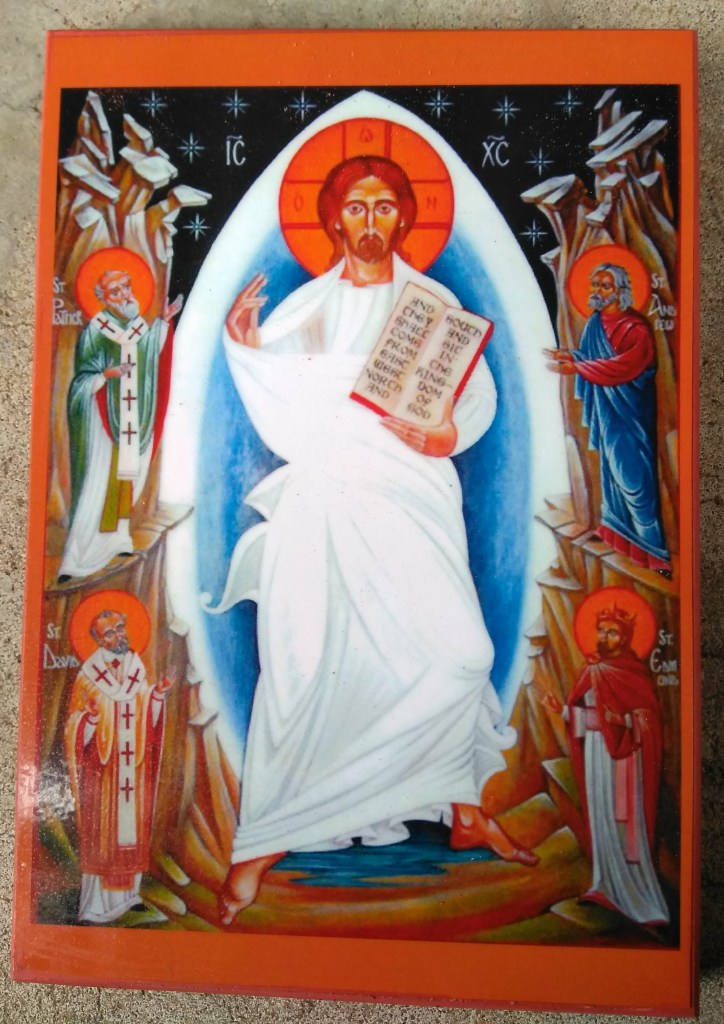
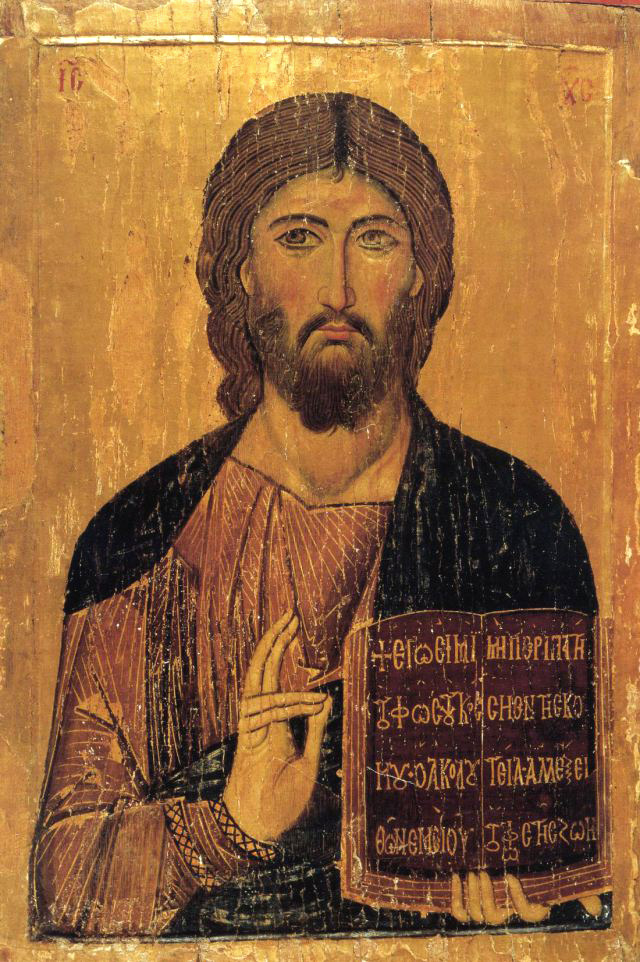
**This process of gathering in and pushing out is reflected in almost every icon of Christ, as He blesses with His right hand (drawing in) and separates with his left (in the form of a scroll, the Book of Life, which makes distinctions between people, etc.), further testimony to this pattern at the very Head of Humanity itself.

In the Byzantine icon below, the blessing/”drawing in” motif is more explicit, as His right hand almost seems to draw one towards Him:

A more modern icon, “Christ of the Isles” (Celtic style), that abides by the traditional pattern . . .

Imagined Communities

Today there is much talk surrounding the idea of the lack of communal identification in America.  We have red states, and blue states, and we bowl alone.  Our kids don’t go outside to play with other neighborhood kids.  We have much to lament.

On the other hand, this social/cultural shift (for our purposes here we’ll assume it’s true) has given us some distance from the whole concept of a “nation.”  Paul Graham has a marvelous post entitled “The Re-fragmentation” in which he discusses the darker side of everyone huddled together around the center.  One could argue that the prime era of nationalism produced an eerie cultural conformity on a scale perhaps not seen since ancient times.

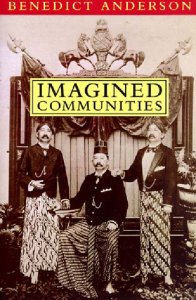
It is this spirit that Benedict Anderson writes Imagined Communities.  The book attempts to tackle how it is that communities71hPv-gXglL called “nations” formed.  At times I thought he drifted into a bit of esotericism, but I found other insights of his incisive and quite helpful.  The first of these insights is in the title itself.  Nations require imagination.  We can understand that those within an immediate geographic proximity could be a community.  We can surmise that those of like-minded belief could find a way to become a community.  But how might I be connected with someone in Oregon with whom I may not share either belief, geography, experience, or culture?  It requires a certain leap of the imagination.

Anderson cites two texts from the fathers of Filipino nationalism to demonstrate how this idea of a national community could be formed.  The first is from Jose Rizal:

Towards the end of October, Don Santiago de los Santos, popularly known as Capitan Tiago, was giving a dinner party.  Although, contrary to his usual practice, he announced it only that afternoon, it was already the subject of every conversation in Binondo, in other quarters of the city, and even in the city of Intramuros.  In those days Capitan Tiago had the reputation of a lavish host.  It was known that his house, like his country, closed his doors to nothing — except to commerce or any new or daring idea.

So the news coursed like an electric shock through the community of parasites, spongers, and gatecrashers, whom God, in His infinite goodness, created, and so tenderly multiplies in Manila.  Some hunted polish for their boots, others looked for collar buttons and cravats.  But one and all were occupied with the problem of how to greet their host with the familiarity required to create the appearance of long-standing friendship, or if need be, to excuse themselves for not having arrived earlier .
The dinner was being given on a house on Anloague Street.  Since we cannot recall the street number, we shall describe it such a way that it may be recognized — that is, if earthquakes have not yet destroyed it.  We do not believe that its owner will have had it torn down, since such work is usually left to God or Nature, which besides, holds many contracts with our Government.  

The second from Marko Kartikromo

It was 7 o’clock Saturday evening; young people in Semarang never at home Saturday night.  On this night, however, no one was about.  Because the heavy day-long rain had made the roads wet and very slippery, all had stayed at home.  

For the workers in shops and offices Saturday morning was a time of anticipation–anticipating their leisure and the fun of walking around the city in the evening, but on this night they were to be disappointed–because of the lethargy created by the bad weather.  The main roads usually crammed with all sorts of traffic, the footpaths usually teeming with people, all were deserted.  Now and then the crack of horse cab’s whip could be heard spurring a horse on its way.

Samerang was deserted.  The light from the gas lamps shone on the shining asphalt road.

A young man was seated on a long rattan lounge reading a newspaper.  He was totally engrossed.  His occasional anger and smiles showed his deep interest in the stories.  He turned the pages of the newspaper, thinking that he might find something to make him feel less miserable.  Suddenly he came upon an article entitled:

PROSPERITY

A destitute vagrant became ill on the side of the road and died of exposure

The report moved the young man.  He could just conjure up the the suffering of the poor soul as he lay dying on the side of the road.  One moment he felt an explosive anger well-up inside.  Another moment he felt pity, and yet again he felt anger at the social system which made some men poor and others rich.

If we contrast these texts with two other famous opening passages (The Iliad, and Pride and Prejudice) we may begin to see why the above texts could be described as “nationalistic.”

Sing, O goddess, the anger of Achilles son of Peleus, that brought countless ills upon the Achaeans. Many a brave soul did it send hurrying down to Hades, and many a hero did it yield a prey to dogs and vultures, for so were the counsels of Jove fulfilled from the day on which the son of Atreus, king of men, and great Achilles, first fell out with one another.

And which of the gods was it that set them on to quarrel? It was the son of Jove and Leto; for he was angry with the king and sent a pestilence upon the host to plague the people, because the son of Atreus had dishonoured Chryses his priest. Now Chryses had come to the ships of the Achaeans to free his daughter, and had brought with him a great ransom: moreover he bore in his hand the sceptre of Apollo wreathed with a suppliant’s wreath and he besought the Achaeans, but most of all the two sons of Atreus, who were their chiefs.

“Sons of Atreus,” he cried, “and all other Achaeans, may the gods who dwell in Olympus grant you to sack the city of Priam, and to reach your homes in safety; but free my daughter, and accept a ransom for her, in reverence to Apollo, son of Jove.”

On this the rest of the Achaeans with one voice were for respecting the priest and taking the ransom that he offered; but not so Agamemnon, who spoke fiercely to him and sent him roughly away. “Old man,” said he, “let me not find you tarrying about our ships, nor yet coming hereafter. Your sceptre of the god and your wreath shall profit you nothing. I will not free her. She shall grow old in my house at Argos far from her own home, busying herself with her loom and visiting my couch; so go, and do not provoke me or it shall be the worse for you.”

The old man feared him and obeyed. Not a word he spoke, but went by the shore of the sounding sea and prayed apart to King Apollo whom lovely Leto had borne. “Hear me,” he cried, “O god of the silver bow, that protects Chryse and holy Cilla and rulest Tenedos with thy might, hear me oh thou of Sminthe. If I have ever decked your temple with garlands, or burned your thigh-bones in fat of bulls or goats, grant my prayer, and let your arrows avenge these my tears upon the Danaans.”

Thus did he pray, and Apollo heard his prayer. He came down furious from the summits of Olympus, with his bow and his quiver upon his shoulder, and the arrows rattled on his back with the rage that trembled within him. He sat himself down away from the ships with a face as dark as night, and his silver bow rang death as he shot his arrow in the midst of them. First he smote their mules and their hounds, but presently he aimed his shafts at the people themselves, and all day long the pyres of the dead were burning.

******

It is a truth universally acknowledged, that a single man in possession of a good fortune, must be in want of a wife.

However little known the feelings or views of such a man may be on his first entering a neighbourhood, this truth is so well fixed in the minds of the surrounding families, that he is considered the rightful property of some one or other of their daughters.

“My dear Mr. Bennet,” said his lady to him one day, “have you heard that Netherfield Park is let at last?”

Mr. Bennet replied that he had not.

“But it is,” returned she; “for Mrs. Long has just been here, and she told me all about it.”

Mr. Bennet made no answer.

“Do you not want to know who has taken it?” cried his wife impatiently.

You want to tell me, and I have no objection to hearing it.”

This was invitation enough.

“Why, my dear, you must know, Mrs. Long says that Netherfield is taken by a young man of large fortune from the north of England; that he came down on Monday in a chaise and four to see the place, and was so much delighted with it, that he agreed with Mr. Morris immediately; that he is to take possession before Michaelmas, and some of his servants are to be in the house by the end of next week.”

If we consider the idea that nations are primarily imagined communities we can examine the texts.

The first two texts . . .

  • Conjure up a sense of belonging to a particular place.  The reader may not know the locations described in experience but can imagine being there.
  • Establish a connection between the large groups of people in the story, despite the fact that these people do not know each other — note that in the second text the man feels a connection to the vagrant though they had never met.
  • Presuppose an almost jocular familiarity with the the concept of a “nation.”

But neither The Illiad or Pride and Prejudice do any of these things.  The reader gets dropped into a world that is not theirs, and neither author shows much concern to make it so.  The reader observes the story, but does not participate in the story.  If we consider Austen one of the primary literary voices of her day, we can surmise that the transition to considering “nations” as communities is quite recent.  C.S. Lewis commented that the world of Austen and Homer had much more in common with each other, despite their 2500 year separation, than his world and Austen’s, despite the mere 150 year time difference.^

Too many causes exist for this momentous shift to consider them here.  Anderson focuses on a couple, however, worth considering.

As mentioned above, one can have a sense of community based on physical proximity.  Anderson’s brilliance is to focus on the idea of “imagination” creating this sense of community.  We must always realize, then, in the essential unreality of nationhood, a subject to which we will return.  But Anderson also shows the concrete foundation for the myth of nationality.

Ideologically the idea of equality had to arise before the idea of nationality had a chance.  But the idea of equality needed fertile soil, and Anderson names “print-capitalism” as one primary ingredient.  With the Enlightenment came the idea of rational standardization of measurement (of distance, time, weight, etc.) and language.

The printed book, kept a permanent form, capable of infinite reproduction, temporally and spatially.  It was no longer subject to the ‘unconsciously modernizing’ habits of monastic scribes.  Thus, while 12th century French differed markedly from that written by Villon in the 15th, the rate of change slowed markedly by the in the 16th.  ‘By the end of the 17th century languages in Europe had generally assumed their modern forms.’

Capitalism too played its part.  “In the Middle Ages,” commented Umberto Eco, “one did not ‘make money.’  You either had money or you didn’t.”  Today we hear a great deal about the inequalities of capitalism.  But capitalism helped produced a society in which the vast majority of people can share in common experiences though common consumption.*  The mass production made possible by political unification helped create mass consumption, and so one hand washes the other.  Capitalism and print media together created the newspaper, which formed the ‘daily liturgy’ of the national community.

So to what extent can we say that “nations” have value?  One student of mine refused to take the bait and argued bluntly (but effectively) that “they seem to be doing pretty well so far.”  Ross Douthat writes,

The nation-state is real, and (thus far) irreplaceable. Yes, the world of nations is full of arbitrary borders, invented traditions, and convenient mythologies layered atop histories of plunder and pillage. And yes, not every government or polity constitutes a nation (see Iraq, or Belgium, or half of Africa). But as guarantors of public order and personal liberty, as sources of meaning and memory and solidarity, as engines of common purpose in the service of the common good, successful nation-states offer something that few of the transnational institutions or organizations bestriding our globalized world have been able to supply. (The arguable exception of Roman Catholicism is, I fear, only arguable these days.) So amid trends that tend to weaken, balkanize or dissolve nation-states, it should not be assumed that a glorious alternative awaits us if we hurry that dissolution to its end.

I agree that the effectiveness of nations vis a vis other forms of organization is at least arguable.**  I agree with Douthat that the premature burial of  “nations” before their time, with nothing ready to replace it, would be silly at best.  But . . . Anderson’s work reminds us that we live in purely imagined communities.  They exist not in reality, but for expediency, a product of contingent historical circumstances.

The question remains — will their imaginary existence, like that of the zero, prove so valuable that they will last far into the future?  We can see the challenge posed to them already by the internet, globalization, and political polarization.  We shall see how strong our imaginations can be in the next generation or two.

Dave

*I do not suggest that defining ourselves through consumption is a good thing in itself, merely that consumerism has had this particular impact.

**In brief, we might say that the birth of nations was bloody (ca. 1800-1871), with the next generation settling into a relative peace.  But the first half of the 20th century was catastrophically destructive, with a moderately peaceful era to follow.  For whatever it’s worth, the possibly waning age of “nations” — ca. 1970’s – present, has been a period of steadily decreasing world violence.

^M.I. Finley makes an interesting connection between the two eras in his classic, The World of Odysseus.  Finley looks at Achilles’ comment in Hades and draws an unexpected conclusion.  Achilles seems to state that he would rather be a “thes” on earth than king in Hades.  Most translations assume that “thes” means “slave,” but Finley argues that the best translation would mean something like, “unattached free small landholder.”  This, and not slavery, was the worst fate Achilles could imagine.

This reminds me of a part in the Gwyenth Paltrow Emma movie where Emma disdains the independent farmer.  “He has no society, no information.”  We get another confirmation of the role capitalism and the concept of “equality” played in the creation of nations.

The Family and Civilization

Recently in Government class we briefly discussed Francis Fukuyama’s famous/infamous The End of History and the Last Man, a book often cited but perhaps much less read these days.

I have not read it myself.

Some years ago a student asked in class, “Might monarchy return to western civilization?” Even 30 years ago such a question would be absurd.  But, Plato, Machiavelli, and other thinkers tacitly assume a cycle of governments that repeat themselves over time.  Fukuyama, as best as I understand, challenges this assumption by stating that democracy has proven itself and will now always remain in the conversation.  It will always be “in play” in the world and some type of democracy would become the dominant form of government from here on out.  The cycle of “History” has ended.  Now all that we have left are “events.”

When we discussed this question in class I remained skeptical about monarchy’s return.  But a colleague pointed out that of course it could happen.  The cycle of monarchy, oligarchy, democracy, monarchy (in all but name) played out in Rome.  Rome began as a monarchy, but expanded as a Republic.  If the Republic stood against anything, it was monarchy.  Yet, while monarchs did not return to Rome, Emperors made an appearance for nearly 500 years, a revision to monarchy in all but name.  Furthermore, after Rome’s fall monarchies reappeared even in areas formerly controlled by Rome.

Perhaps, then, monarchies could return even to the West, given several generations.  We tend to believe that history progresses or declines, more or less in a continuous line.  Maybe we should give more credence to a more cyclically influenced theory of events.

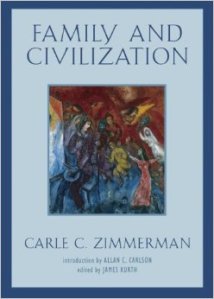
I thought of this conversation reading Carle Zimmerman’s Family and Civilization.  He wrote just after W.W. II and foresaw our modern family crisis.  But because he roots his observations in historical observation over many centuries, the book has a timeless quality.  Fundamentally, Zimmerman argues that we should abandon linear evolutionary concepts of the family, not just because he may not agree with evolutionary scientific theory, but primarily because the history of western civilization shows a circle rather than a straight line.

Zimmerman identifies three different basic family models throughout history:

  • The ‘Trustee Family’ resembles something akin to our idea of Scottish clans. Trustee families are so called because each family member acts as a mere caretaker of the bloodline, property, customs, and traditions of the extended family.  Powerful families are a law unto themselves–a kind of miniature state–and stand in active solidarity with other family members in terms of rewards and punishments.
  • The “Domestic Family” has more of a nuclear composition and mentality.  The father heads the family, but women can own property outright.  The domestic family shares corporate blame for minor offenses, but the trend leans toward individual responsibility.  Neither the clan nor the state makes a domestic family or governs it, but the Church (or other religious affiliation).
  • The “Atomistic Family” describes our own age.  In the absence of the state, the Trustee Family assumes significant control over “horizontal” relationships.  The Domestic Family has a sacramental sacredness ordered primarily though religion.  The Atomistic Family is based on the idea of functionality and convenience.  It’s horizontal nature extends only to individual members.  It has no horizontal sacred dimension.  Personal choice determines the shape of individual families.

Few disagree with Zimmerman’s descriptions, but most modern sociologists assume an evolutionary line of change that will eventually dissolve the family as we know it.  Zimmerman shows that each type existed before in Greece and Rome, and that after Rome’s fall, the cycle began again.  He traces all three models this way:

Trustee Family Era’s

  • Homeric Greece–ca. 800 B.C.
  • Early Roman tribal era–12 Tables of Law (ca. 450 B.C.)
  • The post-Roman barbarian Age (ca. 500 A.D.-12th Century)

Domestic Family Era’s

  • 8th-5th century Greece, from Hesiod-Pericles
  • 12 Tables of Roman Law–Dissolution of the Republic
  • 13th Century-18th Century (Aquinas-Enlightenment)

Atomistic Era’s

  • Sophists-End of classical Greece ca. 150 B.C.
  • Augustus-Barbarian Age of Europe
  • Enlightenment Rationalism-Present Day

The main part of the book concerns itself with showing the family transitions from the fall of Rome until today.

The church stood against much of accepted family mores in Rome’s decline.  From an early point the Church declared marriage a sacrament, and worked against the atomistic view of marriage and family in late Rome.  This makes sense.  After Rome’s fall, we they had two polar opposite views of the family to contend with, as the atomistic model lingered alongside of the trustee model brought by barbarian tribes.

The church found itself stuck between a rock and a hard place.  They abhorred the individualism of the atomistic Roman family, but the trustee model led to uncontrolled violence and lack of individual moral responsibility.  Caught between these two, the Church leaned towards working with the trustee model.  Part of this may have had to do with the fact that the collapse of the Roman state made the trustee model almost inevitable.  It also shows, I think, that the values of the early Church do not match our own.  Needing to choose, they preferred unchecked violence to rampant individualism.*

However, the Church quickly worked to transform ideas of the family in small but concrete ways.  They allowed for marriages even in the absence of familial consent.  They insisted that, as marriage was a sacrament, the Church and not the family made a marriage.  Under most barbarian trusteeships, the groom had to provide a financial gift to his father-in-law, as he “took” someone from his family.  The Church transformed this practice into the groom giving a gift of property/cash to his wife.  The practice of writing wills also allowed for a widow to inherit property independent of her husband’s family.

All of these things helped bring about the Domestic Family, though the slow and steady rise of the state also aided in this as well.

Zimmerman sees the Domestic model as the ideal.  Marriage has a sacramental purpose and reality, but the family is not absolute, as many Scriptures attest.  Because the Church creates a new family, the family has a degree of independence from the state.  Civilizations were healthier with these kinds of families.  Greece experienced its explosion of cultural and political growth largely under the Domestic Family.  In Rome the Republic never had healthier days than during the prevalence of the Domestic Family.  In Europe we see the 12th century golden age that experienced innovations in architecture, philosophy, music, etc. etc.

Several things happened over two centuries that eroded the domestic family.

  • Erasmus (Zimmerman calls him a “sophistic playboy”) and other Renaissance humanists began to enamored with classical culture and its attendant individualism.
  • Building on this, the Reformation 1) Removed marriage as a sacrament, giving the Church less power over marriage and giving more to the state, and 2) Marriage had a higher place than celibacy, which lessened marriage’s spiritually symbolic purpose and paved the way for the “contract view of marriage.**
  • Social contract theory put the emphasis of marriage on fulfilling mutual needs of each “party,” and opened the door to different kinds of marriages–all legitimate in theory provided only that both parties freely consented.

Many in the west today see the rise of the atomistic model concomitant with the rise of political and social freedom.  This view has some merit.  The Reformation and Enlightenment democracies broke down nearly all traditions, which led to a focus on the individual.  The individual rights we enjoy likely would not have come without a breakdown in the “Domestic Family.”

But Zimmerman has an apt word of caution–society cannot exist without some method of organization and accountability.  The family has long served as the repository for moral training, education, preparation for life, and so on.  If the family can no longer perform these functions, the state will have to step in, making the state itself our de-facto family.  This happened in Rome.  When social order decayed, the state had to take up the mantle, and they proved in their laws and actions much more stern than the typical pater-familias.  The history of the west, at least, shows us no more than three mechanisms of control: the clan, religion, and the state.  We must choose.  But the state, due to the variable nature of law, and with no particular method or goal, has shown itself the most unpredictable of the three.

We should not assume that the family has disappeared.  It may have gone underground for now but remains the key element of society.  It will return.^  Zimmermann is not a historical determinist or a pessimist.  In his reflections on the history of the family Zimmermann believes that had a few things happened here and there at the top of each society, the history of the family could have gone much differently and better.  He believes that societal elites have been largely responsible for inculcating anti-family policies into society.  If they can be converted we might turn the tide.

I wish it would be so simple.  Today it seems that much of the flow of modern life in its labor, technology, habits, etc. exert great pressure on the family.  Our recent election suggests that our cultural elites have less influence than ever before.  Then again, I believe in the witness of history, and believe that no one period of time is so starkly different from another.  This era then, might have more in common with Imperial Rome than otherwise.  That might sound like bad news, but from the perspective of the family, it isn’t.  It would mean that turning the heads of a few elites could dramatically improve our situation.  This would be vastly easier than a total societal breakdown that occurred during the last major family crisis.

Dave

*We see this in other areas as well.  The medievals viewed Saturn (which makes melancholy isolationists) as the Infortuna Major, while Mars, (which brought war–but war at least brings some groups together) as the Infortuna Minor.

**In an interesting aside, Zimmerman points out how the influence of the primacy of the text over tradition in the Reformation helped aid this transition.  Nothing in the history of the Church supported this shift to de-sacralize marriage, but a) Reformers had a hard time finding a text in the NT saying exactly that marriage was a sacrament (although Ephesians 5 certainly fits)–what text is supposed to say exactly that anything is a sacrament?  The undue influence of the bare text quickly gave Protestant denominations doctrinal confusion with the Trinity, the Incarnation, and other areas–and b) They found a couple of OT texts that they used to support this lessened view of marriage.

However, Zimmerman also argues that most of the Reformers were strongly traditional pro-family in many other ways.  It was not so much the Protestant preacher in the pulpit that eroded the family, but instead the humanist scholars who influenced the Reformation.  The influence of the Reformation on the family, then, is mixed.

^Zimmerman sees the rise of divorce, homosexuality, youth crime, etc. as the symptom of family breakdown, not its cause.

A National Man of Mystery

Anyone who knows anything about the first half of the 20th century knows that the concept of “nation” has a lot to answer for. We have such familiarity with it that we need not rehash the sins of “nationality” here. Slightly less obvious might be the impact, or pendulum swing we experienced in the second half of the 20th century towards the individual related to the state, or the community. This manifested itself in a variety of ways:

  • The proliferation of international bodies like the EU, G-8, World Bank, IMF, etc.
  • Expansion of global markets, facilitated by the internet and the removal of boundaries on communication and information
  • Significant expansion of media technologies that allow us to radically personalize our world everywhere we go, like Facebook, iTunes, Netflix, etc.
  • Removal of barriers to self-expression, encapsulated in the hey-day of free speech in the 1960’s, and now, with the end of traditional beliefs and social norms about gender and sexuality.*

But, if the pendulum swung too far in one direction from 1900-1960, many think that it has gone too far in the other direction (i.e., Bowling Alone, Why Liberalism Failed, etc.). Some form of such swings might be inevitable from a historical perspective, and might even be healthy when mild, as it might prevent stagnation. But dramatic swings destabilize societies and make it harder to get our bearings. At such times, terrible mistakes can occur.

Over the past 5-10 years we have witnessed the reemergence of national populism. In America, the phenomena manifested itself with Trump’s election, but almost every democracy in the western world has dealt with this, both in old and established democracies (Brexit, Marie le Pen), and relatively new ones (Poland, Hungary, etc.). Some see in national populism the dreaded extreme pendulum swing, but authors Roger Eatwell and Matthew Goodwin disagree. In their book National Populism: The Revolt Against Liberal Democracy, they seek not to praise or bury the phenomena, but to understand its reasons for being and the nuances of the movement. Some critics of the book see it as a sympathetic defense of right-leaning populism, a Marc Antony style bait and switch. Instead, I view the book as a careful delineation of the nuances of the movement. Above all, we must resist the urge to cast the label “Fascist,” to all or even most manifestations of national populism. Yes, the authors believe that certain populist leaders have dangerous leanings, but others simply seek to stand against real/perceived excesses of progressive ideology. We must exercise caution in our examination.

The authors first remind readers that populist movements have always existed within democratic governments. Greece had so much direct participation that it scared off our own founders. Rome’s Republic often existed in uneasy tension with more populist strains. More recently, America has seen populist presidents like Andrew Jackson, and to some extent, Teddy Roosevelt, in addition to various populist governors like Huey Long. Some may dislike all of these leaders on balance, but even if one did, democracy survived, and the country stayed far away from “fascism” or even overt nationalism. Of course, we could arguethat, given the horrors of how national populism operated in Germany from 1933-45, we should avoid even minute drops of it.

Eatwell and Goodwin think that this both unfair and unrealistic. They distinguish between fascism and populism in a variety of ways. Fascist regimes have a strong racial ideology, they often wish to expand territorially, and they often have apocalyptic goals. But even if the similarities were more acute, we simply cannot avoid populism if we wish to remain democratic–we cannot ignore the “voice of the people” in a democracy.

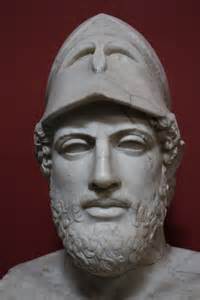
I have sympathy for Eatwell and Goodwin’s presentation of their ideas, though I have written before that I think that democratic societies need “elites.” The question comes to, “What kind of elites?” It seems too easy to say that we need elites with connections to the “common man,” “on the ground,” but so it goes. The “elite” culture of Periclean Athens was a very public culture, accessible to the people (recall the free theater performances of plays). Their leaders often competed with one another as to who served in office, who led armies, and so on. Roman elites were likewise quite civically minded, and for much of the Republic’s history patricians did not greatly exceed the wealth of the plebs–and when this gap widened tremendously after the 3rd Punic War so began the breakdown of the Republic (one factor among many, to be sure). Medieval elites lived in castles, but defended the realm, and were obliged to host a variety of festivals and parties for their tenants. They socially mixed frequently with peasants. Our own founding fathers took great risks and served in the army. Some of them had farms or worked as ordinary town lawyers, again, with strong connections to the “common man.”

Perhaps the chicken of the Republican right in the 1990’s, starting perhaps with Newt Gingrich and Rush Limbaugh, pushed the left farther from the center. Or perhaps the egg of the radical progressive ideologies about immigration, abortion, sexuality, etc. have made it hard to maintain something of a traditional conservatism. Or possibly grander historical forces play upon us, or maybe still, we are now experiencing something cyclical akin to the changing of seasons. Whatever the cause, we now have elites at universities, in Hollywood, in Silicon Valley, and in certain segments of the media (a short list that I know does not apply equally everyehere) that drive the agenda of much of the left throughout the democratic world, and I think this is the main cause for the rise of populism.

For example . . .

  • We “know” that “Empire” is a bad word
  • “Nation” is increasingly becoming a bad word in certain circles
  • In the U.S. at least, we don’t want to give much autonomy to states or local communities to decide things, to have any variance on issues that divide us like abortion, gender, sexuality, immigration, etc.

So, all that certain segments of the political spectrum will leave us with is a stateless individualism with no unifying theme, culture, or nod to tradition. Very few can live in such a way or have ever lived in such a way. Older, more personal and familial conceptions of political realities, such as the “realms” of medieval kings, will not return any time soon.

So it appears that, unless we want civil wars across the western world**, we are stuck with the political entity of nations.

I concede, with Benedict Anderson, that there is something mysterious and imaginary about nations, but they undeniably exist, and people want some sense of identity within them. For that to happen, they need to take their bearings and locate themselves within the culture. The ancients often equated the formless and boundless ocean with chaos. We moderns usually associate the sea with freedom, and this might hint at the differences in how we interpret the meaning of our communities then and now. Nations may have less of a concrete reality than a particular individual, but for people to be truly human we need connections with others. These connections can only come with the presence of trust and familiarity. Dramatic change in law, demographics, and ideology make this hard to come by.

One reviewer rightly pointed out that whereas Eatwell and Goodwin take pains to point out the complexity and nuances of populist movements, populist movements themselves reject complexity–the problems we face have self-evident solutions. Maybe so, but I think that, as academic “elites,” Eatwell and Goodwin do one good turn towards rectifying the gap between elites and the common man. They have at least written a serious book about the “average Joe.”

For those who fear this movement on the right and the left, I would suggest them giving us something for us to feel tangible pride in as a nation. The right too often resorts to our expanded freedom to consume, but this comes from the nameless, faceless market–a stark contrast to what “going to market” meant in bygone eras. Many on the left constantly undermine our cultural inheritance and see the past and present as nothing but evil. They would offer instead foolish fantasies of a future that will always reside outside of our grasp. Neither approach will help us build a reasonable national identity and pride, and so neither approach will prevent the global rise of national populism.

Dave

*Free speech today is under attack on campus’ especially, which is ironic considering the modern free speech movement had its birth at the university. Perhaps this means that free speech is at its most vibrant when a) People wish to challenge the existing order, and b) The existing order is at least partially out of alignment with the rest of the culture, and thus ripe for a “fall” of sorts. Free speech in those contexts might just look like “saying what everyone is thinking (or at least the “right” “everyone”). Today there are plenty of people who fit into the first category, but perhaps the prevailing orthodoxy is not yet ready to fall, backed as it is not just by cultural elites but also most businesses. In the 60’s, the main forms of national culture sided with those challenging the existing moral and political order.

Also, free speech can never be an absolute value even in the context of academic freedom. For example, one might imagine a hypothetical Professor Smith, who advocates with extended argument an absurd defense of Jim Crow laws. Whether public or private, no college should allow his continued employment. The problems today are that 1) Such standards are very unevenly applied, with very slippery standards used to decide what is racist and what is not, and 2) Standards get formed very quickly that alienate, at minimum, very large numbers of people with different opinions that until quite recently were quite acceptable–one recalls President Obama’s support for traditional marriage in 2008, and 3) One can get “mobbed” for things far less than careful, systematically expressed thoughts.

**I dread the possibility, but could the U.S. separate into “Red” and “Blue” nations peacefully? One thinks of the famous dictum from the Chinese epic, The Romance of the Three Kingdoms, which states, “The empire, long divided, must unite; long united, must divide.” Maybe, possibly, we should not view the political union of the states as an absolutely fixed good. New York and Texas could easily go their separate ways, but what about the swing states, like Ohio and Florida? Like Kansas in 1854, one can imagine the frightful spectacle of their destiny decided by a few thousand votes one way or the other.

The lack of geographic contiguity would make the prospect difficult even with no violence, and so we would have the problem of 4-5 separate nations, new constitutions, etc. While nodding to the hypothetical possibly, we should do all we can to avoid it.

Meandering Thoughts on Equality

For the past several years now we have seen a fair amount of thought on the idea of economic inequality. Some see it as a serious problem, others perhaps as a temporary byproduct of the switch from a production economy to one rooted in service.  I suppose a very few might celebrate the possibilities free market economies in the fact of inequality.

I had a chance to think about this a bit recently, and attempt to bring some historical perspective.

It is hard to imagine this issue being resolved more successfully than the Athenians under Solon, ca. 590-570 B.C.  There were the aristocrats and the commoners, with law and wealth heavily sided in favor of the aristocratic class (the ‘Code of Draco’).  Debt spiraled out of control, society was coming apart.

Enter Solon.  He was given full powers to resolve this crisis. He did not need to curry votes or constituents. He was not an aristocrat, but he was rich.  He could appeal to both sides and be trusted by both sides.  He believed that Athens needed its rich citizens, as we might expect.  More crucially, he knew how to motivate reform by appealing to the aristocratic ‘need’ for glory, or arete.  One can’t just dismiss this, as it was part of the Greek mindset for centuries.

He made paying high taxes a sign of arete. You could pay your high taxes not in terms of a fixed percentage, but in terms of

  • Pay for this religious festival, and we’ll say loud and long that you paid for it
  • Build a trireme and pay the crew, but you get to command the ship
  • Build this bridge and we’ll name it after you
  • Etc.  You get the idea.

By some accounts aristocrats paid a percentage 12x higher than the poor, but they got ‘arete’ for those taxes, and they had a direct hand in how they were spent.  

He did other things, like expanding the merchant fleet and encouraging trade, which put a lot of people to work.  This sounds easy but must have been politically difficult, given the role of farming in almost every ancient civilization.

He canceled all debts, but he refused to redistribute property.  

In the end

  • Athens had a stronger middle class
  • Athens had relative social stability
  • Many believe that this helped lead to the cultural/political explosion in their ‘golden age’ a century later.  They  create modern science, literature, democracy, etc.)

Alas, many things about Solon are not replicable for us.  For one thing, change did not come from a democratic process.  He was a ‘tyrant’ (a technical description and not a bad word).  C.S. Lewis commented a few times that to get good results for democracies often you have to achieve them in non-democratic ways.  We are locked into our one democratic tradition, and have not nearly the flexibility the Athenians had.

I love his taxes idea, but we just too big and bureaucratic to copy it.  Could we do something like it–give the rich the privilege of naming how they contribute if they willingly contribute more, and giving them public recognition for this (i.e. naming a bridge after them, getting their name on a fighter jet’s wings, I don’t know)?

The idea of a ‘bridge-builder’ politician we can do, and have done successfully before.  But we lack the civic-mindedness of the Athenians.  For better or worse we are more individualistic.  The ancient world would find our attitude towards the state unfathomable.  

Unfathomable, yes, but their conception of rule, society, etc. was far more personal, far more uniform, and far more religious than ours.  Ancient Persia could be an exception.  The Roman Republic could also serve as an exception.  They did integration and pluralism quite well until they ventured beyond Italy and the Alps and into the Mediterranean.  It proved too much for them to swallow. Most Italians had similar cultures.  But in North Africa, Spain, etc., . . . they were different, and no one wanted to try integrating them into the Republic, and no one thought of not ruling over them in some way.  This is another factor, I’m sure, in the collapse of the Republic.  It may be that societies with higher ethnic diversity have a harder time with equality.  If so, this makes America’s relative equality all the more impressive.*

The trade-offs are huge.  You can get more civic buy-in, in theory, in America, but you would probably have to sacrifice some sense of personal rights, and you would definitely have to ditch pluralism and relatively open immigration.  The first is highly unlikely, the second probably impossible.  Even if we could do those things, it is debatable that we should.

Anyway, we can’t dismiss the rugged individualism out of our national DNA, nor should we want to. Solon could not dismiss arete.  But . . . he found a way to work with it.  

Can we create low-skilled jobs from the digital revolution and keep them in America?  If we did so, would it make things worse for workers in Asia?  Would we want the flag-waving and possible economic confrontations that would come from a more nationalistic America?  Would the world be safer?  I don’t know the answers to these questions.

We are such a big nation (like almost every other one) that our problems become abstract and impersonal.  In Athens more or less everyone knew everyone in some way.  Dealing with inequality has much more meaning when we have a personal connection to the problem.

Rome faced a similar problem ca. 150 B.C. that Athens faced in 600 B.C.  They never found a way out, and the Republic collapsed.  All agree this period has many complexities, and historians hotly debate why the collapse happened, but I think most agree that

  • Both sides used violence to settle issues
  • Both sides tended to view politics as a zero-sum game, very much an ‘us vs. them.’  They destroyed each other with a century of intermittent civil war.

The French Revolution, the Russian Revolution, the revolutions in China, SE Asia, Cuba, and even arguably the American Revolution created far worse tyrannies than those they replaced (this is a stretch in the U.S.– the British weren’t tyrants, and neither were the victors, but the victors did exile many loyalists, slavery expanded, Indians fared far worse than under the British, etc.).  The Roman civil wars over the political questions of the day gave them the emperors.  

We need a political genius of sorts, who can find a synthesis between liberty and equality, between civic responsibility and rugged individualism. He/she would need to be trusted by the common man in Iowa and in Silicon Valley.  He/she would have to, perhaps, give huge tax breaks to corporations who did not outsource jobs–a pro-nationalist low taxes weird hybrid.  If we find him (and I don’t see him/her around), he would not have nearly the power Solon had, at least by the letter of the law.  

None of these mostly unoriginal thoughts get to the unspoken root issue.  Why is inequality a problem in the first place?  By “problem” I don’t mean whether or not inequality exists, but whether or not people perceive it as an issue worthy of much attention.

We might think that inequality is problem in every society but, not so.  For example, monastics renounce property and have all things in common.  We say that communism has never worked, but it works in monastic societies, though of course on a small scale and with everyone present strongly and voluntarily committed to that idea.

Other societies experience inequality, but seem not to think much of it. Neither Homer, Plato, Augustine, Chaucer, Shakespeare, or Austen ever made it a burning issue.  But we do see the issue move right to the front of political thinking just after Austen in the mid-19th century.**  We see it in Marx as well as Dickens, and thereafter inequality could be a rallying cry for political revolution.

Surely the Industrial Revolution has something to do with this, for it created a society where, having mastered the elements of nature, one could quickly have great material success.  The first two generations of factory workers at least likely lived at lower standard of living than previously.  Vast gaps between classes opened up.

Vast gaps existed in ancient Egypt as well between the pharaoh and the peasants, for example, but these gaps made sense to their society historically and theologically.  In a society where “all men are created equal” inequality hits with much greater force.

Marx thought that in the first 50 years or so of Industrialism some of these “non-sensical” gaps would certainly destroy the capitalistic state.  Marx had many things wrong.  But on this, I can’t blame him for his guess.  Why did the capitalist state survive?  Marx, the great materialist, had ironically underestimated our materialism as a society.  Its reasonable to assume that the social gaps created by the industrial revolution, coupled with our ideology of equality, would end the industrial-capitalist society.

The “cause” of the problem of inequality perhaps lies in solving this riddle.  It seems that the poor want what the rich have. Both rich and poor want the same thing, and the values of western society tell them they should have the same thing.  I don’t mean to say that inequality is not a problem or no such problem of economic injustice exists, or that the poor should rest content with the rich as mortal gods on earth.  I am not advocating a revival of ancient Egypt.  I merely point out that our society as a whole has surrendered to the materialist impulse which makes easing the problem that much harder.

Of course this parallels the rise of the issue in the mid-19th century just as social Darwinism, textual biblical criticism, and other de-mythologizers of life gained pride of place.  All that we left ourselves had to do with the here and now, i.e. applied science to increase our standard of living, and our various abstractions to make these things real.

All this to say, dealing with crippling inequality in society will involve a spiritual solution.  The monastics show us that it is possible.

Dave

*If this is true, we are faced with choosing between the competing goods of liberty and equality.  Would we prefer economic peace between our citizens or freedom of movement for all?

**Others I’m sure would disagree, but I don’t see the French Revolution being driven primarily by inequality.

A Pattern Language

Many years ago I witnessed a debate between the Christian William Lane Craig, an atheist, and a Buddhist. Naturally I “rooted” for Craig, but also hoped for an interesting discussion. The atheist cut a poor figure. Craig possesses an enormous intellect and made quick and brutal work of the scientific materialist. In so doing, however, he neglected the Buddhist, who had a much more interesting argument, Though I disagreed with the Buddhist, I wished Craig had stopped shooting fish in the barrel and paid more attention to him. The Buddhist basically argued that values certainly exist in the world, contra the strict materialist. But he thought Christians too interested in the explanation for the values in the world–why not simply live in light of them? Craig never dealt with this enigmatic assertion.

Everyone should read Christopher Alexander’s A Pattern Language, or at least glance through it as I did. 🙂 On its surface the book is about architecture, and he provides much directly for the professional builder. What makes the book remarkable, however, is how easily Alexander connects architecture to everyday life, and orients it not around outsized auteur individual creation, but making spaces for people to live communally and “normally.” To do so, one must tap into the “patterns” in everyday living. Though I know very, very little about Asian religious philosophy, I sensed something of the Buddhist or Taoist in Alexander. He felt no need to justify these patterns or explain their meaning. As far as I could tell he called mainly upon the intuition of our experience in presenting his ideas. Many have written about the increasing privatization of our culture, and no doubt this reflects itself in the buildings we create. Alexander injects a comforting warmth into our sterile sense of the meaning of a building, something quite needed given the state of modern architecture.

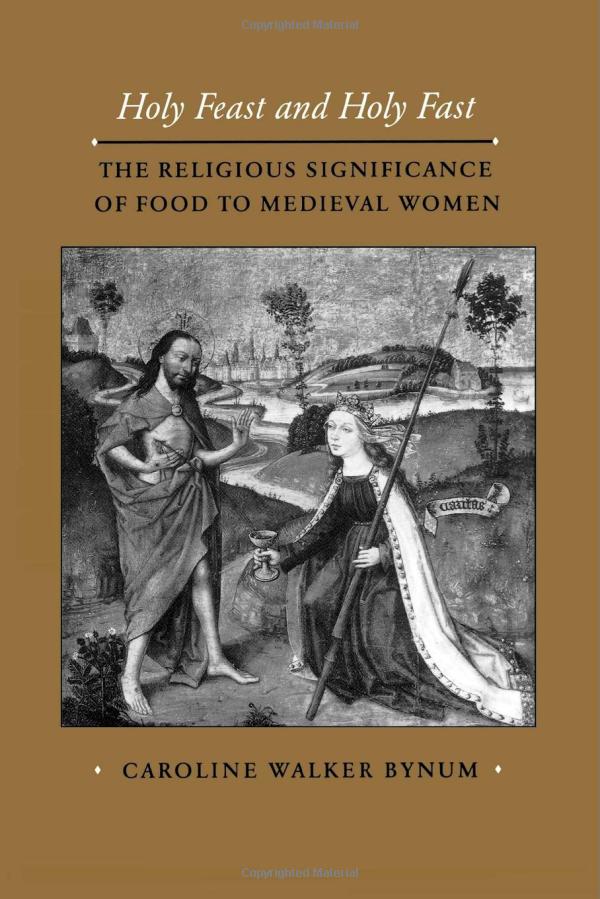
I agree that values present themselves in the world as real entities. I disagree that the origin of these values is a red herring–I think that it matters very much. But I agree again that the experience of such values matters much more than debating or discussing them. To understand the reality of symbols we have to enact them, to incarnate them, in our daily lives. The argument over when we started living in our modern linear, factual. and personalized way has a different contenders–some say the Reformation, the Scientific Revolution, the Enlightenment, or the Industrial Revolution. Caroline Walker Bynum’s Holy Feast and Holy Fast: The Religious Significance of Food for Medieval Women work hints that this process began in the late Middle Ages-early Renaissance, though answering this question was not the intent of her work.

Bynum won me over immediately in her introduction. She makes it clear that we have to understand medievals on their own terms. She quotes John Tauler of the 14th century, who writes,

St. Bernard compared this Sacrament [the eucharist] with the human processes of eating when he used the similes of chewing, swallowing, assimilation, and digestion. To some this will seem crude, but let such refined persons be aware of pride, which comes from the devil; a humble spirit will not take offense at simple things.

The words form an introduction to the subject of her book, and indeed–unlike Henry Charles Lea–Bynum knows that to understand medieval ideas of food (or almost anything) means understanding the eucharist first and foremost. The words also bracket ones whole approach to any part of the past–humility usually triumphs over judgment.*

The humble everyday nature of food is a great place to start understanding the nature of things.

The remarkable Alexander Schemmen began his classic For the Life of the World with these words:

“Man is what he eats.”  With this statement the German materialistic philosopher Feurbach thought he had put to an end all “idealistic” speculations about human nature.  In fact, he was expressing, without knowing it, the most religious idea of man.  For long before the same definition of man was given in Genesis.  The biblical story of creation man is presented, first of all, as a hungry being, and the whole world as his food.  . . . Man must eat in order to live; he must take into the world his body and transform into himself.  He is indeed that which he eats, and the whole world is presented as one banquet table for man.  It is the image of life at its creation and at its fulfillment at the end of time . . . “that you eat and drink at my table in my Kingdom” (Lk. 22:30).

We remember too, that just as, “the whole world is one banquet table” so too, the first sin involved breaking the fast. How and when we eat matters as to how we understand the world.**

Individually, food involves taking the life of something else and making it part of ones own life. Even a stalk of wheat or an apple must be plucked from its source of life and ‘die’ so that we may live. So eating mirrors Christ’s life, death, and resurrection. I talked in a recent post about adopting a theopomorphic view of our experience with the concept of bodies, and we should understanding eating as part of our joining our life to Christ’s life. He offered himself as food for us (John 6:56).

In addition, eating joins us to creation’s pattern. The earth receives water and bears fruit. The earth receives death and decay–think compost or manure–and turns it into life. The church in the early west established “ember” days of fasting to mirror changes in seasons, and the longest fasts of the church year (Advent and Lent) occur during times of year when the ground lies essentially inactive.

Establishing this pattern, Bynum then leads into understanding medieval women and their relationship to food. Creation has always been associated with the feminine, i.e., “Mother Earth.” We know too the trope of the mother who “sacrifices herself,” who will eat less, eat last, or . . . not eat at all. She “dies” so that she can provide.

Bynum frames the context of medieval female religious experience through this lens. Bynum looks at the fasting and eucharistic devotion of certain medieval women, including a long discourse on the whether or not such women suffered from anorexia that is tedious in a scholarly way, but fair and sympathetic nonetheless.

But this intense personal piety as it related to food has a problematic endgame. Connecting fasting and feasting to the patterns in creation meant that communities could experience it together in the same way, with the same meaning. The physicality of things makes itself obvious to all, from the saint, to the scholar, to the ploughman. By separating the practice from “normal” rhythms, the experience became intensely personal, and less communal. This is not to say absolutely that no variance can exist in a community, and the late medievals never normalized the experience of these unusual women. But a decisive shift happened. Fasting meant no longer primarily a communal experience linked with the pattern of the life of Christ and creation, but a vehicle for personal, and possibly idiosyncratic, devotion.

From here dominos start to fall. Without the connection to creation, the common language of food might disappear. In time, one could fast from Netflix or shopping instead of certain foods. Maybe such things have their place for individuals, but the reduction of fasting to individual experience and individual authority robs us of meaning and identity (something Mary Douglas pointed out in her excellent work).

This same radical personalization and consequent loss of meaning have done similar work in the realm of sexuality. In ye olden days marriages happened not primarily because people were “in love,” but rather as a vehicle whereby people could participate in what it means to be human and the drama of salvation. If we think of our humanity and the humanity of Christ as one–before the foundation of the world–we see this clearly especially as it relates to women who get married:

  • The woman is led to the altar by her father
  • She “dies” at the altar–Miss Jane Smith is no more
  • She is “reborn”–meet Mrs. Jane Johnson
  • After marriage comes the “fruit” of the marriage, say hello to little baby Jack Johnson

The meaning of sexuality comes from this mirroring of Christ’s life, death, resurrection and ascension. And here we see why we need “Heaven,” and “Earth,” man, and woman, for our sexuality to make any sense at all. We have divorced this aspect of our being from all such patterns, and made it purely personal inside the chaotic variability of our minds. It appears the end of this rope has come, when some experts tell us that not only is the created order not a model for sexuality, but our very bodies should be discarded to achieve our purely personal goals.

Many today focus on our political confusion, and we should lament this. But these political issues have far deeper roots which we cannot see. Not only do we not see a pattern, we don’t expect to see a pattern. We won’t be able to solve these problems until we start looking.

Dave

*Another aspect of her writing that I appreciated . . . She delineated in the introduction chapters geared more towards layman like myself, and those written more with the professional scholar in mind. I personally have no taste for the hemming and hawing of scholar-speak, but I understand it has its place. It was kind of her to let me know what to avoid and where to focus my attention.

**This may seem a crazy assertion, but if we think of our lived experience we begin to understand. Let’s take drinking alcohol as an example. We instinctively recognize that someone who drinks scotch at 10 am has a problem, but if they did so at 10 pm, no problem. But why? What is the difference between drinking in the morning or at night?

Life is full of “inhaling” and “exhaling.” At night we begin to “exhale,” we reach the “fringe” of our being for the day. As we move through the “fringe” of the day we begin to approach the “chaos” of the unconscious. It intuitively makes sense, then, for us to match drinking something that relaxes us, that moves us toward the “fringe” of our being, at night rather than during the day. If we move towards the “fringe” in the morning when we should be “inhaling”–focusing and getting active–we create personal and societal dissonance. Our distinctions are not arbitrary.

Likewise, we understand that drinking socially is better than drinking alone. A person who drinks too much socially we might perceive as having a minor problem. A person who drinks too much alone we perceive as being in grave danger. But why? The pattern tells us, and again, we understand not so much logically but in our lived experience. Social groups exist for people to blend and mix together. Alcohol can bring us to the fringe of our being, we can “extend” the self in some respects through alcohol. Hence, “Can I buy you a drink?” can be a means of introduction in ways that, “Can I buy you some carrots?” would not. Someone who drank too much alone would extend themselves and connect with no one–it would be an intentionally fruitless action, in which we rightly recognize despair and nihilism.

“. . . And in the End”

My dad has a large record collection, and growing up I heard a lot of different music. One of my earliest memories involves me asking him to, “Put the Apple record on,” by which I meant, “Put on Abbey Road by the Beatles, side two, “The End.” There I would hear the vastly underrated (by the general public) Ringo Starr play his one and only drum solo. I grabbed Tinker Toys, made two mallets, and attempted to play along with the music on the sofa.

Years later when I started playing the drums myself, I sometimes tried to replicate the sound Starr got out of his kit on that album, with no success. Reading And in the End: The Last Days of the Beatles, I discovered the secret–a new way of mic’ing the drums was employed, but the real trick may have been his switch to calfskin drum heads on his tom-toms. Ringo loved the new sound and feel, and credited the heads for giving him some newfound excitement on the kit. With the drum heads sounding so good, it inspired him to integrate his toms more than he had on previous albums–the result can be heard especially on “Come Together,” and “Something,” to say nothing of his famous aforementioned solo.

This little nugget may not be of much interest to anyone but myself, but And in the End gives everyone lots to chew on about the decline and final fall of the Beatles. I have skimmed through biographies of Lennon and McCartney and seen a few documentaries about them, which prepped me for this book. Author Ken McNab gives little background information, which suited me just fine. For anyone with an interest in The Beatles and a passing familiarity with their dynamics, this book will do nicely in filling out some unexplored corners of Beatles lore.

Most of us know about Lennon and McCartney’s personality feuds, the presence of Yoko Ono, and Harrison’s rise in prominence. And in the End mentions this but knows that we have heard about it before. Instead McNab spends a lot of time talking about the business side of The Beatles and how that, perhaps even more than personality differences, contributed heavily to their demise as a group.

The Beatles faced in formidable challenges to their cohesion in 1969:

  • John married Yoko, and Paul married Linda. Again, we are aware of the challenges Yoko brought to the table. Many have well documented the unnerving effects of her awkward presence during rehearsals. But McNab puts a different focus on Paul’s marriage to Linda Eastman as a major contributor to the widening John-Paul divide. Eastman came from New York high society money. Paul’s marriage, then, confirmed and deepened every suspicion John had about Paul–his social striving, his “bourgeoise” aspirations, etc.
  • At the same time, George Harrison began to assert himself much more aggressively in the group. John and Paul had previously worked out truces and trades in sharing the spotlight and wrote “together” at least officially. Now they would have share even more than they had before at a time of much higher tension.
  • At the same time, the “Apple” company they founded floundered badly, obviously bleeding cash. Their image and their pocketbooks would take a big wallop.
  • At the same time, The Beatles attempted to rework their financial arrangements, with John, George, and Ringo favoring one company, and Paul favoring another company–which happened to be run by his new brother-in-law (this did not go over well with the other three. John especially tore into the fact that the Eastman’s had changed their name from Epstein to Eastman, a sign of “inauthenticity”).
  • At the same time, Lennon–who had smoked plenty of weed and experimented with psychedelics in the past, now began a much more problematic heroin habit.

In other words, to paraphrase Fletch in his visit to Dr. Dolan, the Beatles may have been dying for years, but the end was very sudden.

A few bands have lasted more than a few decades, and fewer still have stayed productive during their span instead of merely rehashing older hits on tour. So on the one hand, the demise of The Beatles should not surprise anyone. But McNab’s treatment of the band’s final year made me realize that the main failure of the Beatles involved their failure to “institutionalize” themselves in some respect–a failure to scale up their issues to a point where the issues were “solved” by the institution known as “The Beatles.”

I can think of only two other bands that managed to last long and stay reasonably productive: Kiss and Rush (who actually toured together in 1975). In the case of Rush, they perhaps solved their problem by always having two guys write the songs and one guy write the lyrics. Harmony could be maintained as long as they stuck with this formula, and they did so right until the end. This very stark division of labor will be exceedingly rare in any collaborative group.

The more typical path is that of KISS, who had two strong frontmen with strong personalities. Paul Stanley and Gene Simmons certainly feuded over the years. But the outfits–Starman, Catman, Spaceman, etc.–gave them an identity outside themselves. This allowed them to replace particular musicians when needed (such as Peter Criss, Ace Frehly) while still maintaining their individual identity. They could do a solo album or a solo project as “Paul Stanley”–who is not KISS, then put on the makeup and become KISS again.

Not having Rush’s division of labor, the Beatles needed something of the KISS formula to work, but they could not create it in time. Given the challenges they faced along with their particular personalities, this was not likely to happen, but perhaps the possibility existed.

As I finished the book it appeared that Trump will not have a second term, and this spurred some reflection on the purpose of institutions, and their role in our culture at the moment.

In the Democratic primaries many lamented that anti-establishment figures like Tulsi Gabbard and Andrew Yang got the freeze-out from mainstream media and the party establishment. In the end, the Democratic base chose the most “establishment” figure possible in Biden. On the one hand, Trump vs. Biden at first glance appears to boil down to “Anti-Establishment v. Establishment. That is short-sighted view of the situation–just as seeing the Beatles conflict as purely Lennon v. McCartney–Anti-Establishment v. Establishment–also interprets a lot of the signal as noise.

First we can see Trump akin to John Lennon. Both despised or could not work within institutions. Both always had/have the most gravity in the room. Those freed from an institutional ‘gloss’ or ‘crust’ can shine forth with a particularly concentrated vitality. Lennon would at times impress everyone with his clarity and intelligence, and at other times embarrass everyone with his rash anger and insane narcissism. His partnership with McCartney worked so well because he needed someone to ground him, someone to “land” his ideas, which Paul did with some of John’s best songs*

The Trump-Lennon connection is easy . . . making McCartney into Biden stretches things a bit. Well–it works in some ways. Lennon always hated the “grandma” tunes that McCartney loved, the sweetly melodic semi-vaudeville stuff that Paul dipped into now and then. Paul always believed that the Beatles had to be a “band,” which meant recording and then touring. “Back to basics,” and so on. So we can see the election of Biden as a vindication of our institutions, and at least the perception of “normalcy.”

Certainly Trump is “anti-establishment”–but particularly in his personal behavior. He cared nothing for the niceties, decorum, and customs of acting “presidential.” Some of his political agenda, however, had roots in old Pat Buchanan Republicanism. He had broad support for his judicial nominees and support for pro-life policies, all of which would fit within the Reagan heyday.

Biden on the one hand is quintessential “Establishment,” having served in the Senate for who knows how long. He is nothing if not boring in his personal behavior–which at times can be a strength. He will uphold presidential cultural and political norms.

But he also brings with him a long trail of supporters who also wish to dismantle certain aspects of the Establishment and its norms. It wasn’t too long ago that we heard chants of “Defund the Police.” Biden’s supporters have already created an “enemies list” of Trump staffers and “enablers” that may be used to exclude them from various aspects of public life. No such acts have ever been perpetrated so openly before, at least that I am aware of.** We shall see to what degree Biden takes the Democratic party into more anti-institutional waters. Note that some Democratic supporters have called for the abolition of the Electoral College, a dismantling of certain powers of the Senate, and so on. To alter the Constitution is to dismantle the American institution.

But just as Biden may have a slightly jaded take on institutions, so perhaps did McCartney.

As mentioned above, the problems faced by The Beatles were legion–too much to handle all at once. But–had it boiled down to Lennon’s ‘anti-establishment’ and Paul’s ‘establishment’ they could have compromised here and there, just as they did with their songwriting. In reality, they represented two different mixes of both ‘establishment’ and ‘anti-establishment,’ the combinations of which could not compromise.

John as “Anti-Establishment” (this is rather obvious)

  • The drugs, the weird behavior, founding “Bagism,” the marriage to an avant-garde artist who would lay down inside a bag and scream during performances
  • Etc.

Paul as “Anti-Establishment”

  • Paul was a rock star who did not fit a conventional rock star mold. He was much more fruitfully experimental than John
  • Paul utilized orchestras, audio experimenting, etc.
  • He did the India thing just as the others did

John as “Establishment”

  • The counter-culture is admittedly not the Culture, but the counterculture had enormous power in the late 60’s and John was at the crest of that wave.
  • John wanted to be seen as a rock star who played rock music, and who at times loathed Paul’s “sissified” experimentation.

Paul as “Establishment”

  • He marries into wealthy NYC society
  • He appeals to a much broader cross section of the population than John. He is “the cute one”–certainly much “safer” than John.

A big part of the problem for the Beatles lay here–two different blends of establishment/anti-establishment that allowed both to call the other “squares” on the one hand and feel good personally about stretching boundaries on the other. This dynamic makes compromise a lot harder, because you see the other side as lacking everything while you already “have it all.” When at their best, for example, Paul saw that he needed John to get him to take more risks, and John saw that he needed Paul to “ground him” and give his ideas shape. But as they both grew, Paul found a way to experiment without John, and John found a “grounding” in the counter-culture. Then–they perceived no need for each other.

The right and the left in the U.S. have good and bad things about them and always have. When both sides can even just occasionally see how they need each other, our democracy will be healthy. But now that both sides have both Anti-Institutional and Institutional impulses within them, they will feel this need for each other much less. This, perhaps more than any particular policy change, may be our most significant political challenge.

Dave

*If anyone argues that “Imagine” or “Instant Karma” is as good as “In My Life,” or even “Come Together,” they are just being plain silly or purely ideological. Neither Lennon or McCartney ever topped solo what they did with each other.

**Trump said dangerous things like, “Lock her up,” but never acted on anything. Again–he had a hard time acting on his various statements (look at how little he accomplished when Republicans controlled House and Senate from 2016-18) which we can be thankful for in part.

The ideological left, on the other hand, is much more connected to institutions in media, academia, and increasingly, in the corporate world as well. We shall see whether or not this threat of a “list” becomes reality.

Liberty and Coercion

Almost every political philosopher I am aware of from Aristotle down through Montesquieu believed that a democracy/republic had to be small in size.  Self-government required, among other things:

  • A population where people know each other enough to trust each other to some degree.
  • A population where people can have enough land to support themselves, but a geography that does not allow any one particular faction to have too much land, thus gaining too much of an advantage over their fellows.
  • A relatively culturally homogeneous population that shares core values

The American experiment is unique in many ways, one of which being that Jefferson and Madison attempted to turn this reasoning on its head.  They argued that

  • Democracies/Republics floundered because of too much population concentration, not too little.
  • These population concentrations gave way to passions and factionalism that could easily destroy liberty by trampling on the minority (cf. Madison’s brilliant Federalist #10).
  • Hence, what Democracies/Republics need is not a small geography, but a large one.  People need to spread out so that 1) All will be sure to have land, and 2) No one particular faction could concentrate its power enough to override the rights of minorities (hence, Jefferson’s impetus for his semi-Constitutional Louisiana Purchase).

Maybe necessity helped them invent these ideas, maybe it sprung direct out of their heads.  Either way, with this reasoning Madison and Jefferson show their genius, confidence, and perhaps, their arrogance.  I have wondered if one might not view the whole of American history through the lens of this question: Were Jefferson and Madison right or wrong?*

I expected Gary Gerstle’s Liberty and Coercion to take on the grand question of the thorny question of the interaction between liberty and power, and how sometimes “liberty” for oneself means power over others.  Instead, he narrowed his focus and proceeded in a methodical way to show how over time the “police power” of the federal government grew.  Gerstle disappointed me by never exploring the relationship of our founding ideals to this question.  But at times his narrower focus allows him to make some incisive observations.

For example . .  .

Many presidents and perhaps many Americans had a desire to act in some measure of good faith with Native Americans, but things never went right.  Some might explain this via a grand clash of civilizations.  Gerstle looks instead at the inherent dilemmas posed by our philosophic commitments.  Our commitment to self-government limited the scope of federal government.  No one, whether a Federalist, Anti-Federalist, Democratic/Republican or the like, believed that a large professional army went well with liberty.  But with no money and no political will to even create agencies to establish firm borders and grant land titles, let alone enforce such borders militarily, various presidents found themselves giving in to the settlers “squatters rights.”  We wanted to prevent the national government from having too much power to coerce, but without this power, settlers had the liberty and the power to coerce others.

Time and time again, our sheer size made the relationship between governmental power and self-government difficult.

A similar line of reasoning happened with non-WASP immigrants, be they Catholics from Ireland/southern Europe or Asians settling in the west.  They did not have the same rights as others, but how could they?  For communal self-government relied on shared religious and cultural beliefs and habits.  If these immigrants did have these same values, they could possibly participate in the democracy.  Gerstle shared Teddy Roosevelt’s fury and frustration with the treatment of Japanese migrants in the U.S. just as he was negotiating sensitive deals with Japan.  But he had no ability to force local governments to do as he wished.

Here Gerstle misses an opportunity to connect our dilemmas with our founding ideology.  American colonization began with the idea of transplanting certain distinct communities intact.  But by the later 18th century Enlightenment ideas led to the bold “All men are created equal” mindset of the Declaration.  Simultaneously, America had no real justification to exclude anyone from its shores, but neither could they practice local, autonomous, self-government if they did.

The history of political philosophy has its revenge–or at least makes itself known.

Of course slavery is the preeminent manifestation of this dilemma.  On the one hand, I think most of the founders knew that slavery ran against their moral principles as a nation.  But their political principle of limiting the power of national government meant granting a lot of autonomy to the states.  The clash of these two propositions embedded the possibility of civil war into the fabric of our origins.

Gerstle cites one illuminating aspect of this problem that I had not heard of before.  After Nat Turner’s rebellion many abolitionist presses mailed anti-slavery publications “free of charge” to the South.  This infuriated President Jackson, who believed that such publications only sought to stir up more trouble.  He asked for Congress to ban their mailing.

But southerner John C. Calhoun recognized that such a ban would not serve southern interests.  They would gain in the short term but give away one of their core principles–the right of states to decide such questions.  He advocated against the ban.  But many states arrived at a solution by instructing local postal workers to simply not deliver this mail.  This at best awkward compromise could only last so long, however much it tried to resolve federal and state issues.**

States were seen early on as the means by which well-ordered communities could be established.  Thus, they had broad ranging police power.  The constitution reflects this by enumerating the powers of the federal government and giving everything else to the states.  Today the power of states is much weaker relative to even just a few generations ago.

This changed in stages.

The Industrial Revolution may have done more damage to the vision of the founders than any president or political party.  It broke down local rural life and lumped most people together in the cities as one amorphous mass.  Such conditions created a national state. Without any direct power to act, the government outsourced, deputizing local civic groups to undertake tasks related to civil order.

Whatever the successes such organizations had, they were destined for embarrassing failures.  They discriminated against blacks and immigrants.  They imprisoned without fair trials, and so on, all in the name of the Justice Department.  They needed stopped, but the only way to do so involved finding a way to increase the power of the national government.

Over time the national government used various legal strategies mostly related to the 14th amendment and the commerce clause to achieve their aims.  Perhaps the Industrial Revolution destroyed the possibility of self-government that our constitution depends on.  Rather than create a new constitution, we sought to stretch certain enumerated powers far beyond their original purpose.  Much hay has been made of the commerce clause, for example, which many conservatives lament.  However, our military and national defense (an issue dear to many conservatives) has also assumed a shape utterly unrecognizable to anyone who lived before W.W. II.  The size and cost of our military has in turn stretched the power of the presidency far beyond the vision of the constitution.  Gerstle cites many examples of how our military ballooned in size and then rapidly decreased when conflicts ceased.  Of course we can cite the strategic dilemmas faced by the U.S. after W.W. II as a justification for maintaining a large military.  In a very real sense, W.W. II did not end until 1989.

Strategic considerations aside, we should speculate if any other forces influenced this shift.

Eighteenth-century theorists drew upon the “citizen-soldiers” of times past.  Greece and Rome both provided examples of this.  On the one hand, we cannot have a militarized state, which would jeopardize our liberty.  On the other hand, we need national defense.  A nation of property owners motivated by legitimate self-interest would certainly rally to defend their land, their communities, if need be.  The first 175 years (give or take) of our history demonstrated this.  Right up through the end of W.W. I we demonstrated the ability to dramatically expand and contract the size of our military.

Perhaps our strategic situation changed so dramatically in 1945 that it necessitated the rise of a “military-industrial complex.” Or perhaps it was we ourselves that changed.  Gerstle does not speculate.

Embedded in this question is the relationship between liberty and order.  We have always recognized the need for someone to have the final say, and the need for people to “pursue happiness” in the way they see fit.  This has always meant tolerating things one may disagree with.  Should we ban pornography or not?  Do we grant the freedom of some to own slaves?  Do we grant the freedom of some to oppose same-sex marriages?  Who gets to decide?

Gerstle’s book rather prosaically shows how this power to decide has transferred over time from the states to the federal government.  This happened mainly under Democratic leadership.  But conservatives also played a role at crucial times with their traditional issues of national defense/military.  By “prosaically” I don’t mean that it was easy or unconvincing.  He has extensive research and uses a methodical style that makes him quite convincing.  But he leaves us with some unexplored questions and neglects to swing for the fences.

He makes clear the fact that ideas of liberty and coercion have always existed.  All we have done over time is basically transferred the power of coercion from the state to the national government.  As to whether representative government can exist in the post-industrial era, as to whether or not Jefferson was right or wrong, these grand questions go largely untouched.  I for one can’t help but admire the brilliance and confident boldness of Jefferson’s vision–though I think I disagree.  I wish Gerstle had done a bit more to inspire me one way or another, and done a bit more to help answer the perplexing question of the nature of America’s idea of liberty.

Dave

*Another possible historical lens would be the “wheel of fortune”–the idea that every civilization (and every ruler?) will experience a kind of boom/bust cycle.  The medievals would argue, I think, that this cycle was meant to teach us about redemption.  This lens would argue that some choices could delay the progress of the cycle perhaps even for a long time, but that “nothing lasts forever” and that some kind of decline remains inevitable.

Again, this idea had a historically long run, from the ancients down through Machiavelli at least.  Our founders, many of them heirs to the Enlightenment, would not have accepted this idea.

**The same held true for the Fugitive Slave Act.  Most pro-slavery advocates rejoiced at the new provisions of the law, but others saw that to achieve this they abandoned a key principle of keeping the federal government away from the slavery issue.

Without question slavery is a terrible moral evil.  We must realize that the issue had other dimensions to understand the colonial and ante-bellum period.  We may deplore the actions of another country or culture.  When should we use force to change them?  By what authority?

The Emperor Might Need New Clothes

Some years ago my students and I came across a remarkable passage in Madison’s notes on the Constitutional Convention.  The delegates debated some issue about term limits or representation, when one of the lesser known men commented that, in effect, “this constitution will last us about 75 years, after which we will have to make a new one.”*

This comment passed apparently without much notice or fuss at the Convention in Philadelphia.  Perhaps it was a generally assumed idea, or perhaps they simply had enough trouble in the moment to worry about arguing whether or not their document would last past their grandchildren.

This shocked everyone in class because we think of America like any other country, a more or less solid oak in the earth.  Of course, we have also been brought up with political rhetoric from both parties that venerates the constitution (though perhaps different parts of it).   Because Americans share little besides some form of faith in the Constitution, if that shakes, we all fall down.

Because American history has many unique aspects, I find getting an interpretive handle on our past very difficult.  I have taught American History for about 15 years and have only some educated and less than educated guesses.  Clearly, however, politically and culturally we are currently shifting in some direction or another at the moment.  How should we make sense of it?

One of the more remarkable periods of positive dynamic change occurred in Greece between the years ca. 800-500 B.C.  We know about the Bronze Age, but sometime after the Trojan War Greece descended into a dark age about which we know very little.  Perhaps Homer was the beginning of the rebirth.  Early on in his The Economic and Social Growth of Early Greece: 800-500 B.C. Chester Starr makes an interesting point.  Definite ideas or concepts like “equality” or “rights” did not guide the Greeks ca. 800 B.C.  Rather, the concept of eunomia, or “traditional right” formed the basis of Greek social and political interaction.  Sometimes they invoked eunomia against abuse of power by tyrants or aristocrats, at other times aristocrats invoked it rightly against the “mob.”  This flexibility surely gave them good ground on which to innovate.

This stands in contrast to our history.  We founded America on ideas, whether because we thought that the best way to go, or because we had no other choice.  We often agreed on the results we wanted, but rarely on the “why” of that result.  Even early colonial America had a great deal of cultural diversity, at least by 17th century measurements.  We have never really had a shared culture to build upon, except perhaps for a vague sense of Protestantism.

Starr goes to demonstrate that the creation of the much admired political unit of the city-state had at least part of its origins in the desire of the aristocracy to concentrate its power.  Later, asPericles of Athens we know, democracy arose in many Greek city-states, a tribute to the aforementioned flexibility.  But many Greek democracies still had their aristocratic imprint.  The outstanding reformer Pericles made Athens more democratic while definitely living and fashioning himself as an aristocrat, and not as a “man of the people.” His bust makes this clear.

All good things come to end, and the Greek system had played itself out by the time of Alexander, who had little trouble putting it to rest.  Still, all in all, a good run by any measure, one too that makes sense in some clearly defined stages.

In light of Greek history and our own, I offer some some highly speculative thoughts . . .

Theory 1

Since early colonization America has gone through several iterations:

  • Colonial America – 1600-1756
  • Revolutionary America – 1756-1828
  • Jacksonian America – 1828-1860
  • Progressive America – 1860-1929
  • New Deal America – 1929-1965
  • Global Power America – 1965-2001
  • ???

Obviously some of these dates can be disputed and overlap.  Basically, Theory 1 asserts that because America has been rooted in ideas and not culture/tradition, we subject ourselves to significant shifts every 2-3 generations (the first phase doesn’t really count, as we had no concept of an American “nation” until the mid 1700’s).  We can reinterpret our common language on the fly and create “new Americas” every so often–though of course each era has some connections to past eras.  This ability has its strengths and weaknesses.

This theory, if true, may comfort us now because the the shifting ground beneath our feet will settle again as it has for previous generations.  We’ve done this before, we can do it again.

Theory 2 . . .

proposes more unity for the majority of American history.  Yes, some cultural and political shifts happened over time.  But we consistently maintained faith in the democratic process, and in our reason for being.  Even in the Civil War, the Confederacy broke away not out of a rejection of the American ideal, but out of a belief that they represented the true America.  We had “confidence,” that crucial element of any civilization, even in the midst of our most profound domestic crisis.

But something significant happened in 1965.**  In this year we passed the Voting Rights Act, which could be viewed as the apotheosis of what America was supposed to be.  In this year also we dramatically increased our involvement in Vietnam, again, in some ways I think, out of a belief that this was what we were “supposed” to do.  We increased our troop presence initially at least with the general backing of Congress and the population at large.

However, almost immediately after we passed the Voting Rights Act the riots in America’s cities began.  Rioting continued sporadically in many major cities for the next few years.  Perhaps this was pure coincidence, but I think not, though I would not claim to really understand the reasons for the violence.  But I think that part of the reason might be an intuition that we had “done all we could do,” but that it wasn’t enough.  The supreme confidence we had in our democratic way of life taught us that things would always improve, but now we knew better.  Shortly after our troop surge in Vietnam waves of self-doubt began surging through the country.

The two phenomena are likely connected, though I’m not sure how.

Along with this, the counter-culture “hippie” movement went mainstream into popular culture and eventually most of academia.  Western icons like the Beatles went to India to learn see the world in a non-western way.  We lost confidence in our own culture, and we have not regained it.    We had never agreed fully on the why we did what we did, but we had agreed on what we did.  After this era we could no longer claim this for ourselves, and this makes the modern shift much different than others in our history.  The lack of political flexibility may have hastened the at least seeming collapse of the principles that guided us.  Some of the “vomiting up” of our past in some areas of our culture seems willfully self-induced.^

Recently The Guardian ran a great article about Tory MP Rory Stewart.  Stewart got a great education and attempted on two occasions to serve in difficult postings in Iraq and Afghanistan.  His comments say much about the state of the western world:

Ten years ago he would have listed 10 things Afghanistan needed to build a new state: rule of law, financial administration, civil administration and so on. “And, then you would say, well, how do you do that? Well, I’d say, by a mapping of internal and external stakeholders, definition of critical tasks – all this jargon talk. And I’ve only now just begun to realise these words are nonsense words. I mean, they have no content at all. We should be ashamed to even use them.”

They are nothing more, Stewart now acknowledges, than tautologies. “They pretend to be a plan, but they’re actually just a description of an absence. Saying ‘What we need is security, and what we need to do is eliminate corruption’ is just another way of saying: ‘It’s really dangerous and corrupt.’ None of that actually tells you how it’s done.”

And later,

In some sense I’m a romantic. I like the idea of organic history and tradition. But I think Britain is such a different place now, and changing so quickly, that I’m coming slowly, painfully, to accept that we need to start again.

I emphasize that these comments come not from a reactionary revisionist Liberal, but a member of England’s conservative party.

If we agree that we need to “start again,” in some way, will we agree on where to start from, and where we wish to go?

Dave

For anyone interested in further thoughts on America’s political culture, check out The Grumpy Old Man podcast with Audrey and Emily here.

*My apologies, I have looked back and forth for this comment and cannot find it again to save my life.

**A possible counter-date might be the end of W.W. II.  As Arnold Toynbee regretfully admitted, democracies are not well-equipped to handle something like nuclear weapons, though, so far no horrifying apocalypse.

^Trump gets rightly accused for excessive negativity, but why does no one focus on the obvious negativity from the Left?  Here is Clive Crook, via Marginal Revolution . . . 

Trump’s critics complain about his relentless invoking of crisis — despite agreeing with him that the system is collapsing. Conservatives keep telling us that the American project is in mortal danger, that liberty itself is at stake. Liberals keep telling us that global capitalism is wrecking everything that’s decent in society, that the U.S. is institutionally racist, and America’s traditional values are so much hypocrisy. I think back to the rapturous reception accorded by the left in 2014 to Thomas Piketty’s “Capital,” which argued, you may recall, that capitalism is an engine of injustice, headed for self-destruction; progressives everywhere nodded wisely in agreement. Here’s what puzzles many of them today: Why does Trump have to be so negative?

12th Grade: Israel, Palestine, and Solutions Beyond Governments

Greetings,

This week and last we looked at Israeli democracy, and tried to understand the dilemma they face regarding Palestinian statehood.  I hope we gained sympathy for both sides of this question.  Through this lens I wanted the students to understand one of the Catch-22’s that many democratic states face.

Democracies appeal to us largely because of their high ideals and goals, not just for the state itself, but for the individual.  But human nature almost guarantees that we will not attain these goals, and so democratic states are much more prone to hypocrisy and blind spots than authoritarian dictatorships, for example.  This should not make us abandon democracy.   As Chesterton and others have said, if you aim at nothing you’re sure to hit it.  But I do hope it will give us greater understanding of democracy’s Achilles heel.  The “processes” of democracy, like voting, representation, etc. have no real meaning unless they have roots in specific values.  If values make a democracy, then one must lead with those values.

The idea of a Jewish state predated World War II to the 1890’s.  The western world in general experienced an intensification of nationalism and heightened awareness of ethnic identity, which bore such horrific fruit in the 20th century.  Many Jews, having been scattered throughout Europe for centuries, began to resettle in Palestine, which the Ottomans then administered.  By the 1920’s Jewish settlement in Palestine looked something like this (darker areas indicate Jewish presence), though I should add that almost every map related to the Israel/Palestine question is polemical and controversial in one way or another.

After World War I, the British administered the area, but could no longer do so after World War II.  At that point England wanted to jettison nearly all of its colonial empire, and so they handed the question of Palestine over to the United Nations.  After the Holocaust the world had to answer the question as to whether or not there should be a specific Jewish state, and if so, where it should be.

Although people debated various sites, including Madagascar, they eventually settled on Palestine, which made sense in relation to Jewish history and the recent Zionist movement. No place would be without controversy, but choosing Palestine came with problems.  During World War I many Arabs fought with the British against the Turks, and the British in turn pledged to grant Arabs independence.  Instead they reneged on the deal and added Palestine to its colonial holdings.

Actions have consequences, even if sometimes those consequences take years to make themselves known.

From the Israeli’s perspective, owning a small sliver of land that did not even include Jerusalem, was the least the world could do.  Europe had persecuted the Jews on and off since the Crusades.  The latent, on again off again anti-Semitism that simmered for centuries metastasized into a horrifically clinical attempt to wipe them out entirely with the Nazi domination of Europe.  The world had shown that the Jews must have a safe haven, and giving them back a small part of their ancestral land made  political and ethical sense.

The Palestinians saw it differently and many continue to do so.

While the Palestinians were not the Jews number one fan, the Holocaust happened in Europe. It was not their doing, either directly or indirectly.  If the Jews need a homeland, and Europeans need to give them one to assuage their consciences, fine.  How about taking some European territory?  How about part of Germany?

Instead, what the Palestinians feel happened is what they felt always happens with the West. The Palestinians felt stomped on by one colonial power or another for centuries, and now it looked like deja vu  all over again.  This time, the guise took the form of the United Nations, but the result is the same:  someone took our land without our consent.  Rest assured, the Palestinians did not vote at the U.N. to cede part of Palestine for a Jewish state.  Thus, the very existence of the Jewish state is another form of colonial imperialism in Palestinian eyes.  The Jews invaded, in a sense, under U.S. and European flags.  In their mind Israel has no legitimacy because they are no better than other colonial occupiers.  When some critics of Israel, be they Palestinian or not, talk of Israel as a state founded on thievery, they have these associations in mind.

Most argue that the wars fought between Israel and her neighbors in 1948, 1967, and 1973 were started by Israel’s Moslem neighbors (though some might dispute ’67, where Israel launched the first physical attacks).  Not so, say the Arabs.  Israel started them all simply by being there.

Time has not favored the Palestinian cause, as the map below indicates:

Upon its creation, Israel had to make some crucial choices about its future.  It chose a Parliamentary style democracy, which did not surprise many.  But what to do with Palestinians living within their territory?  In 1948, Palestinians formed a distinct minority within Israel, but they were protected and given citizenship.  A British parliamentary style usually has less federation and more majority rule.  But that was ok, because Jews had the clear majority.  Still, it stood as a statement that Israel need not be for Jews only, and in the wake of the Holocaust, this was a powerful statement.

But what to do with Palestinians in the territory Israel acquired in 1948 and 1967?  Should they be citizens too?

This dilemma pierced the heart of the whole purpose for Israel’s existence.  They no longer could be both a Jewish ethnic state and a fully functioning democracy.  In other words, they could either

  • Give every Palestinian full citizenship rights, and risk that Jews would no longer be the majority in Israel.
  • Give them no rights and treat them as an occupied people
  • Give them some rights and not others, but this middle ground would probably not make legal or moral sense, something akin to the 3/5 Compromise in the Constitution, which made slaves count as 3/5 of a person.  How can one be 3/5 of a person?

In other words, Israel could be an ethnic state or a full fledged democracy.  The two could no longer go together.  They would have to give up something.  I have enormous sympathy for Israel here.  The whole purpose of Israel was to create a refuge for Jews and create a state run by Jews. To attain peace they would need to give up something of their identity.  For a generation that saw and survived the Holocaust, this would have been a near supernatural act, and it is not my place to judge.  Palestinian Christians have the only solution, but tragically, some of Israel’s policies, at times supported by the West, and at times supported by some Christian denominations, have deeply eroded and marginalized the Palestinian Christian community.

The middle course Israel chose gave Palestinians in newly acquired land some economic opportunities but not political representation.  Such mixed messages are usually deadly for democracies, and in time those contradictions often assert themselves with a vengeance.  One only needs to think of what happened when our own country sent blaring mixed messages for the first 80-90 years of our existence. In essence, the Palestinians got invited to the party, but then got told to eat with the servants in the basement.

Eventually, security concerns led Israel to build a wall between themselves and certain occupied areas.  But this seems all wrong.  We are familiar with walls — the Berlin Wall, the Iron Curtain, and so on.  Democracies are not supposed to do this.  But Israel felt that they could not be secure without it.   Some supporters of the wall might argue that it sends a signal, like the Emperor Hadrian’s wall in the north of England, of an end point to expansion in the occupied territories.  In other words, it should comfort the Palestinians. But this is not how Palestinians, or the world-wide community, has interpreted the wall.   Some have called it “the most religious place on Earth.”  The images are powerful:

I think Israel’s history comes with many lessons for democracies, including the need for consistency, and the need to lead with cultural values over strict security concerns.  Ultimately, however, we see the need for something greater than what governments can give.

Many thanks,

Dave M

12th Grade: Wag the Dog

Greetings,

Last week we looked at Athens’ disaster in Sicily and the subsequent and extensive fallout.

Why did Athens lose in Sicily?

Part of Thucydides’ brilliance lies in that he does not merely look at battles and personalities, but finds ways to link events to a grand narrative.  Athens had many strengths, and one could argue that their passion for excellence helped produce democracy.  But I think that something began to go wrong just prior to the Peloponnesian War with the completion of the Parthenon, one of the great architectural achievements in history.  Ostensibly the building stands as a temple to Athena, the patron goddess of the city.  But a closer look at the carvings on the Parthenon reveal not scenes of gods and goddesses but of events in their own history.  Athens had in fact, made a temple to themselves, and showed that the true god they worshipped was their own community.

What kind of impact would this idolatry have, and what does it have to do with democracy?  Part of answering this question has to do with what we say the essence of democracy is.  If we say that the mere act of voting, of having a voice, is the meaning of democracy, than a naval-gazing, self-worshipping state will not be far behind.  For in this situation the process counts, and not the result.  If democracy (or any other form of government) serves a higher ideal than it has a built in check upon itself.  With no higher ideal than whatever decision we arrive at must by definition be good, because we thought of it.  This kind of attitude, present in ancient Athens, leads to disaster eventually.  If we travel with our heads down we’ll eventually walk off a cliff.  G.K. Chesterton has a great quote about self-worship in his book Orthodoxy,

That Jones shall worship the god within turns out ultimately to mean that Jones shall worship Jones.  Let Jones worship the sun, the moon, anything rather than the “Inner Light.”  Let Jones worship cats or crocodiles, but not the god within.  Christianity came into the world firstly in order to assert with violence that a man had not only to look inwards, but outwards. . . . The only fun of being a Christian was that a man was not left alone with the Inner-Light, but definitely recognized an outer light, fair as the sun, clear as the moon, terrible as an army with banners.

The problems with Athens’ expedition to Sicily can be traced to their democracy.  Alcibiades wanted the expedition, Nicias opposed it.  Both had wealth, political and military experience, each had their own political power base at home.  They also could not stand each other.  Their personal and political rivalry spilled over into the formation of Athens’ war policy in Sicily.  For example, Nicias’ purely personal political moves against Alcibiades ended up having a dramatic effect on the composition of the numbers and kind of military forces Athens used against Sicily, and perhaps even the goal of the mission.  One wonders if they realized this.  With their heads down, I think not.  In my opinion, they thought that

  • We voted, just as always
  • We picked experienced people
  • We followed the procedures and processes to arrive at a decision

Therefore, everything is fine!

Democracy has to involve more than mere voting, more than mere process.  The Athenians apparently did not see that in voting for the expedition they had approved a massive invasion of another democratic country not directly involved in the war they had been fighting.  The man who ultimately led them (Nicias) argued against any expedition at all.  Self-worship exacted its price in the thousands of dead outside Syracuse.  In his An Historian’s Approach to Religion AJ Toynbee wrote,

The strength of the devotion that parochial-community-worship thus evokes holds its devotees in bondage to it even when it is carrying them to self-destruction; and so the warfare between contending parochial states tends to grow more intense and more devastating in a crescendo movement. Respect for one’s neighbours’ gods and consideration for these alien gods’ human proteges are wasting assets. All parochial-community-worship ends in a worship of Moloch, and this ‘horrid king’ exacts more cruel sacrifices than the Golden Calf. War to the death between parochial states has been the immediate external cause of the breakdowns and disintegrations of almost all, if not all, the civilizations that have committed suicide up to date.

Athens’ failure in Sicily brought about the collapse of their democratic regime.  Their god had failed to provide for their basic needs, and needed replaced.

The oligarchs that replaced the democracy fared no better, ruling wantonly based on the pent-up sense that now is was “their turn.”  We sometimes see this when one party, shut out of Congress for a time, suddenly gains control.  This “my-turn” attitude usually leads to over-reaching and miscalculation.  The Newt Gingrich led government shut down in the mid-90’s comes to mind.

Democracy came back, but the instability engendered by these power struggles weighed like a mill-stone around the Athenians necks.  They had no anchor beyond their immediate needs.  We saw Athens 1) Win the Battle of Arginusae, then 2) Put the victorious generals to death for impiety, and finally 3) Put the lawyer who prosecuted the generals to death (we never should have listened to him!) all within the span of  several days.  Process trumped justice.  The tail wagged the dog.

Authenticity, Man

Having flamed out on Charles Taylor’s A Secular Age, I was happy to find a more bite-sized chunk of his thought in The Ethics of Authenticity. I admit to approaching the book, like others of a traditional bent, leaning against the very idea of authenticity. “Get over yourself, already.” The search for meaning within the self can never go anywhere and remains something of an illusion. What, after all is there to really “experience?”

The whole concept of “authenticity,” born out of the 1960’s (or so I thought), has given rise to a whole host of modern problems. All of the issues with sex and gender have their roots here, as does a great deal of spiritual innovation with the church, along with the Trump presidency. Many inclined to read this book of Taylor’s might hope for a thorough denunciation from the venerable professor.

Of course, boring conservatives such as myself may not have always been such. We may remember the days of our youth when it seemed we had to break free from our surroundings to see what we were made of. Taylor taps into this, and so, while he criticizes much of what the “Authenticity” stands for, and finds it ultimately self-defeating, he reminds us that a kernel of something like the truth remains within this–in my view– unpleasant husk. Taylor writes,

The picture I am offering is rather than of an ideal that has been degraded . . . So what we need is neither root-and-branch condemnation nor uncritical praise; and not a carefully balanced tradeoff. What we need is a work of retrieval . . .

Taylor demonstrates that of what we term “authenticity” has its roots in Christianity. In the ancient world nearly every person received their identity by what lay wholly outside their control, be it birth, race, family, etc. The triumph of Christianity meant believing that an entirely other world lay outside of our normal lives, the Kingdom of God, in which there existed “neither Jew nor Gentile, neither slave nor free . . . (Gal. 3:28).” The book of Revelation tells us that God “will also give that person a white stone, with a new name written on it, known only to the one who receives it (Rev. 2:17). St. Augustine’s magnum opus told us that the City of God lies nestled, in some ways, within the City of Man, to be discovered by anyone willing to walk through the wardrobe.

18th century Romantic thinkers, primarily Jean-Jacques Rousseau, picked up this dormant thread, albeit thin sprinting with it in ways that St. Augustine would abhor. I find the 18th century an absolute disaster for the Church, but still, Taylor calls me to at least a degree of balance. There was something quite ridiculous and artificial about the French aristocracy, for example, ca. 1770, accurately portrayed (I think) in this clip from John Adams

Perhaps St. Augustine did see “the road to God as passing through a reflexive awareness of ourselves” (p. 27). Many have pointed out how psychologically oriented was Martin Luther’s view of salvation. John Calvin began his Institutes by asking his readers to heed the Socratic dictum to “know thyself,” for knowledge of God and ourselves have an inextricable link. But Taylor sees Rousseau as the main originator of the modern view of authenticity. For Rousseau, “Our moral salvation comes from recovering authentic moral contact with ourselves,” and, “Self determining freedom demands that I break free from external impositions and decide for myself alone” (p. 27).

Well . . . ok. I don’t like the concept of authenticity but perhaps the difference lies in the “time of day.” What I mean is, bacon and eggs smells wonderful on the skillet when you’re hungry before breakfast, but that same smell hits one very differently with a full belly after lunch. The early Romantic movement, just as with the early Enlightenment, had good points to make. Rousseau championed, among other things, mothers actually breast-feeding their own children–something dramatically out of fashion for his time. Connecting with “nature” and the “self” I suppose could lead to more morally responsible living. You cannot blame your birth or other circumstances for who you are. But let it linger too long and you get the ridiculous movie Titanic, riddled through with romantic and “authentic” ideology–the smell of bacon and eggs at 10 am after you have already eaten. Still, Taylor asks the reader to see the premise of the morning before jumping straight to the twilight.

As for today, Taylor points out a variety of ways in which the “authenticity” narrative has gone astray.

Rousseau and his followers helped fuel democratic movements at home and abroad, but having created democracies in part through the dignifying the self, these same democracies would make a mockery of the original golden thread. Liberated from tradition, democratic man seemed to attain authenticity not via stern moral struggle against tradition, but as a birthright. If we are all authentic, then are all special, and thus, we all need recognized and regarded by others.

Taylor’s insights show us why those, for example, like Kaitlyn Jenner can be granted moral weight. The Authenticity narrative tells us that such people have attained a status of “real” humans because of their “courage” to make war even on biology itself–the final frontier–in order to achieve their version of true personhood. And, while I believe that those who alter their sex (if such a thing is truly possible) make terrible and tragic decisions, Taylor hints at why those that make these decisions often find them so empowering. Seeking a “genuine” connection with the self is the modern version of a transcendent experience. We grant large amounts of authority to those that have them, like the mystics of old.

Taylor also points out the endgame in store for “authenticity” lay implicit in its origins. If the self is to be the guide, and self-actualization has the ultimate authority, then we have a contradiction. The self can never be absolute, certainly not over others. Telling someone about your “experience” is nearly as bad as telling someone about the dream you had last night. In the end, we require an outside reference.

Alas, logical contradictions will likely not derail the Authenticity movement. But it is possible that time may take of this in ways that logic cannot.

I mentioned above the analogy of the smell of bacon before and after breakfast, and the analogy holds true in other aspects of life. In his War and Civilization compilation Toynbee admits the allure of the “morning” of a military outlook when reading the Iliad. Homer’s battle scenes have a dramatically bracing effect. Then, fast-forward to 19th century, where Prussian militarists like Helmuth von Moltke give one an entirely different impression of essentially the same thing that Homer described:

Perpetual Peace is a dream–and not even a beautiful dream–and War is an integral part of God’s ordering of the Universe. In War, Man’s noblest virtues come into play: courage and renunciation, fidelity to duty and a readiness to sacrifice that does not stop short of offering up Life itself. Without War the World would be swamped in materialism

Toynbee comments that, “there is a note of passion, of anxiety, and of rancor,” here that takes far away from the Greek poets. Moltke continues, perhaps even aware that he sails too close to the wind;

It is when an institution no longer appears necessary that fantastic reasons are sought or invented for satisfying the instinctive prejudice in its favor, which its long persistence has created.

If the modern Liberal order was created in part on the back of Authenticity, then surely we might say that those who still champion the idea copy Moltke and indeed invent “fantastic reasons” for the path they take. Perhaps Authenticity has run its course and can go into hibernation. We will wake it up when the scales have tipped too far in the other direction.

Dave

Time vs. Space Redux

Whether the conversations be thoughtful or awkward, Thanksgiving seems to be a time to think about the times we live in with our families. About a month ago I tried to think about our culture in deeper terms than merely red state vs. blue state, taxes, immigration, and so on. I think what’s plaguing us runs deeper (I base what follows on my previous post on this topic, which is here), though what follows should be seen as a thought experiment more so than anything definitive.

In that previous post I suggested that what might be “proper” tension between Time and Space could vary depending on the culture. So Egypt leaned heavily toward Space, Babylon towards Time, but both civilizations could be considered “great” in different ways. I have only scratched their respective surfaces, but if one reads their mythology and folklore I think we see that they both had some awareness of this necessary tension. My point previously was that we lack even this basic awareness and need to recast our thinking in order to understand our culture more fully.

The problem is not that we contain contradictions within ourselves. We overpraise consistency in most cases. We need the fluidity of Time and the stability of Space in some measure–a society built 100% on either reality would be both an absurdity and an impossibility. One can be 2-1 in favor of space, or 3-2 in favor of time. I think that our issue is, rather, that our different political sides embrace 100% of both without even realizing it. Our political choices then, border on the non-sensical and thus can only go into more subconscious symbolic realms.*

On the Left Time/Fluidity Scale:

  • Open borders–which makes the capital and labor maximally fluid
  • LGBT agendas (which often involve the erosion of the “fixed” state of nature and biology)
  • Maximal “Equality” for men/women (which includes strong pro-choice stances–“safe, legal, and rare” won’t cut it any more), which flatten out distinctions and traditions.

On the Right Time/Fluidity Scale:

  • Free market and free trade (few forces are more destabilizing to tradition, be it good or bad, then the free market, so though I apologize that I can only think of one example for the right, it is a really big one:).

On the Left Space/Stability Scale:

  • Higher minimum wage laws, which restricts the flow of free labor, along with a penchant for corporate regulation.
  • Safe spaces and tight restrictions on what can be said so that the “communal identity” might be preserved

On the Right Space/Stability Scale:

  • Build a wall, protect our borders
  • I don’t see a strident nationalism in the U.S. as a huge problem, but if it came it would certainly come from the right

Again, it is one thing to hold positions in some kind of balance, it is another to hold them maximally in different areas without even being aware of the contradictions.

Once we see that our differences run into mutually contradictory realms, we naturally look for who or what to blame for our predicament. Some say the iPhone, the internet, the 2008 stock market crash, identity politics, the War in Iraq, Newt Gingrich, and so on. But I think we have to go further back. If there is any consolation for us, I don’t think millennials, Get-X’ers, or Boomers started all this.

Perhaps we can begin with the Enlightenment. The Enlightenment valued (at least at the beginning) common things for common people. That era valued self-control of body and emotions. So far they lean heavily on the side of Stability/Space. But at the same time they gave strong preference to syllogistic reason, the province of the mind and the elite. Jefferson, Rousseau and others also propounded the most universal ideas (which have no boundaries) in the modern era–“all men are created equal,” and “the rights of man,” from the French Revolution, and so on. It is no wonder that the French Revolution swung so wildly so quickly.

Then we have the Romantic era. On the one hand, they praised emotion which put them heavily on the side of Time/Fluidity. But at the same time the Romantic movement gave birth to the modern recovery of folklore, fairy tales, and a kind of ethno-nationalism seen in Wagner, among others, all of which strongly favor Space/Stability.

The dramatic tension in the Romantic movement has a touchstone example in England’s empire. They spread throughout the globe (Time) but also sought to bring England’s culture (Space) everywhere they went. Such tension might very well produce something of a “schism in the soul” that Toynbee often wrote about.

In W.W. II both of the major Axis powers (Germany and Japan) sought to mimic the British in far, far more hideous ways.

  • Both Germany and Japan were strong ethno-nationalist states, yet both sought a significant increase of their territorial reach.
  • Both had strongly hierarchical views of authority (Space), but their military strategies strongly favored continual motion and speed (observe how Hitler took the traditional swastika image and pivoted it to give the impression of continuous forward motion. The problem being, of course, is that the swastika shape cannot “move.” It could not spin or roll forward. Thus, the inherent contradictions of Nazism were present right within its foremost symbol).
  • I believe that both countries perhaps subconsciously pursued impossible objectives that could only end in cataclysmic defeat–the kind of destruction that can come only with a violent clash of two opposing forces (I write a bit about this here).

In our own land we have struggled with the same dichotomies. Our blended form of government gets somewhat near a political balance of Time & Space. But in truth, we have no truly conservative tradition outside of democracy to call upon, which can lead to excess fluidity of the liberal democratic tradition. We have a strong sense of land (stability) being tied to liberty (fluidity) inherited from Aristotle, Locke, et al. but showed an outsized and continuous desire for more and more land–a quasi schizophrenia between Time and Space. Every political theorist on democracy thought that for it to work it needed contained in a small space–“stability” to balance out the “fluidity” of liberty. We said “no thanks” to that and immediately upon getting our independence, we began rapidly expanding our territory, believing that perhaps everyone else was wrong about this political calculus.

Possibly this can give us some perspective on the current Time/Space war in our culture. If it feels like it is accelerating, it may be because we are entering another election cycle, or perhaps it is the pace of life which our ubiquitous “time-saving” technologies push us towards. But I think too that both political parties contribute to this by jumping into the mosh-pit.

On the ACLU Twitter homepage their banner reads, “Fight for the Country We Want to Live In.” I don’t wish to pick on the ACLU per se–my point likely could have been made with other organizations, though I do fear that they too are becoming overly politicized. The country we “want” to live in? The country I want to live in is an impossible pipe-dream of my own personal fancies.** No one should want me to fight for the country I want to live in. The country I need involves something much more politically feasible–a balance between Time and Space, and left and right. That perhaps, is worth a fight.

Dave

A postscript from the recent British election which may show us how to reduce the tension between Time and Space:

He has done what no other conservative leader in the West has done: He has co-opted and thereby neutered the far right. The reactionary Brexit Party has all but collapsed since Boris took over. Anti-immigration fervor has calmed. The Tories have also moved back to the economic and social center under Johnson’s leadership. And there is a strategy to this. What Cummings and Johnson believe is that the E.U., far from being an engine for liberal progress, has, through its overreach and hubris, actually become a major cause of the rise of the far right across the Continent. By forcing many very different countries into one increasingly powerful Eurocratic rubric, the E.U. has spawned a nationalist reaction. From Germany and France to Hungary and Poland, the hardest right is gaining. Getting out of the E.U. is, Johnson and Cummings argue, a way to counter and disarm this nationalism and to transform it into a more benign patriotism. Only the Johnson Tories have grasped this, and the Johnson strategy is one every other major democracy should examine.

*By this I mean that we will make our political choices more from our gut and less from our head. This will likely give an advantage to Trump, who seems quite comfortable governing from his gut impulses.

**Growing up I swore that if I ever became King of the U.S.A., I would first and foremost make it illegal for bands to release a “Greatest Hits” album with one new song on it–something routinely done in the 80’s and 90’s. The internet has fortunately solved this for me, but in so doing it did take away what was to be a major plank in my policy platform.

If Civilization is Worth Doing, it’s Worth Doing Badly

Historian Arnold Toynbee takes the long view–the very long view, on the fall of Rome.  We think of Rome as a grand empire, but Toynbee reminds us both in his book Hellenism, and in Hannibal’s Legacy, that Rome originally organized itself very much like other Greek city-states.  The early Roman Republic was essentially a polis.  As they grew in size, the political dynamics changed until little to nothing remained of its more democratic past.  But if we think of Rome as a “Republic” first and foremost, we should place the decline of Rome somewhere in the transition between the 3rd-2nd cenutry B.C. at the absolute latest.*

Toynbee takes this approach because he sees civilizations operating in a spiritual sense.  He focuses on the beliefs, the internal coherence, the relationships between different groups in society, and so on.  He has long sections in volumes five and six of his multi-volume A Study of History on the “schism in the soul” present in declining civilizations, which might strike one with a more materialist bent as rather absurd.

Niall Ferguson takes a different approach, and I believe that I see common themes in his books, Civilization, Colossus, and Empire.  Ferguson sees civilization running on various physical platforms, such as the quality of roads, a good sewer system, and a good way of gathering and using tax revenue.**  He eschewed the idea of slow, steady decline–or at least one that we could observe in any meaningful way.  For him, the system works until suddenly it doesn’t, and no one can really predict when it will stop working. This explains why no one saw the collapse of the Soviet Union coming, or various stock-market crashes.  The collapses, when they come, will therefore come out of the blue suddenly.

Joseph Tainter’s The Collapse of Complex Socieities is a short, dense, book about a difficult subject. Tainter does a good job with his argument, which I admit even I though I disagree with some of his basic premises.

His argument boils down to a few key points:

  • Major civilizations tend to experience an early period of rapid growth through the ‘low hanging fruit’ of available territory, resources, etc.
  • This growth inevitably leads to specialization, stratification, and complexity which initially serves growth–though this “low-hanging fruit” won’t last forever.
  • The civilization plateau’s and the structure established to help it grow becomes an inextricable  part of society just at the moment that it is no longer really needed.
  • When the ‘low hanging fruit’ disappears, further expansion (be it territorial, trade-oriented) becomes less and less profitable, and eventually starts to work against the civilization.
  • Finally, the complex structure gets too unwieldy, a ball and chain, as the state has to spend more and more to get less and less. But now we depend on the structure.   It has become too big to fail, but like a house of cards, easy to knock over.

Tainter supports his theory well from civilizations across time, and uses very obvious info, like territory, and some other more unusual information, like crop yields, colonial administrations, and so on. No doubt there are many lessons for economists here.

But, while his book is valuable, it has big holes.

In his quest for absolute objectivity, he rejects all value-judgment theories of collapse. If you can’t measure it, it’s not useful. We can never be sure exactly a civilization really believes, and even if we could, it is not an objective field of study, so has nothing to contribute to the study of collapse. After a brief summary of  the work of people like Gibbon, Toynbee, Spengler, and others he dismisses them with a wave of his hand. But as C.S. Lewis once pointed out, very few people are actually German economists. Any study of history must involve people, which will involve more than graphs on paper.

This over-emphasizing of economics shows up in what is actually a thought-provoking idea. What happens after collapse, he argues, may actually be beneficial to society, because it removes a great deal of inefficiency that the old system labored under. Collapse, might be the cleansing forest fires of history, events to almost welcome.

This sounds good on paper, but no actual human being who lived through collapses would have agreed with him. Imagine living in Western Europe ca. 550 AD and thinking, “Boy, I sure am glad for the fall of Rome. Of course, our ramshackle village could be overrun, destroyed, and our people pillaged who knows when by some Goth, Ostrogoth, Visigoth, Vandal, Hun, or some other kind of Goth I have forgotten about. But I’ll take that any day over the economic inefficiency of the late Roman Empire.”

To augment Chesterton’s oft-quoted phrase (If a thing is worth doing, it’s worth doing badly,” “If civilization is worth doing, it’s worth doing badly.”

Dave


*I love and admire Toynbee for many reasons.  But in some places he puts the decline of Rome at 431 B.C. (!), the same year as the outbreak of the Pelopponesian War in Greece.  He does this mostly because he sees much more similarity than difference between Greece and Rome.  One can make that argument, and he does so decently in his Recollections, but to carry it so far as to say that Rome began declining when Athens hit the wall goes way too far.

**In some ways the difference between Toynbee and Ferguson boils down, as (almost) always, to the differences between Plato and Aristotle.  Both are great–I prefer Toynbee and Plato.

Epilogue

I almost always find Toynbee stimulating, and I include some of his collected thoughts on the fall of Rome . . .

It is indeed, one of the tragic ironies that the idealists that arise within the ruling class should tread the same path of social migration as the wastrels.  The Graachi worked far greater havoc through a nobility [in the late Republic] to which someone like Commodus could never aspire. Commodus did far less damage by his own social truancy [i.e., pretending to be Hercules, fighting in the arena, etc.], by engaging in a vulgarity that represents a spiritual malaise, to which the Graachi would never fall.  

By their ‘downward migration’ towards the plebs, the Graachi incurred the wrath of their fellows, who punished them severely for abandoning their class privilege.  Commodus is uneventfully swallowed by the slough in which he delighted to wallow, whereas the Graachi released a kind of demonic energy into the masses of Rome.

*********

Seneca writes ca. A.D. 60 concerning the social function of the Emperor in one of his treatises. . .


“He is the bond that holds the Commonwealth together, he is the breath of life is breathed by his subjects, who in themselves would be nothing but a burden and a prey if they were left to their own devices through the removal of a presence which is the soul of the Empire.


Their king is safe?  One mind informs them all;

Lost?  They break faith straightway.

*********

If this calamity, written about by Vergil in his Georgics (IV, 212-13), which he imagines overtaking the bees, would overtake us, the people would be safe so long as it does not snap the reins, or–if they refuse to be bridled again.  Should this happen–then the texture of this mighty empire would be rent and its present tidiness would fly apart into a hundred shreds. Rome will cease to rule the moment they cease to render obedience.”

A foretaste of the fulfillment of the prophecy that Seneca made to the Emperor Nero was inflicted on the Roman world in A.D. 68-69 as an immediate result of Nero’s tyranny; but the first time round this calamity acted as a stimulus, for after the chaos Rome got Vespasian as emperor and relative calm.  Though Domitian (d. A.D. 96) tried his utmost to revive the chaos by claiming deity for himself, the tide was turned by a series of beneficial philosopher emperors who succeeded one another from Nerva (A.D. 96) through Marcus Aurelius (d. A.D. 180).

It was only after Marcus that the new “time of troubles” set in, and even then foolishness of Commodus managed to right itself after the civil wars of Severus, who repeated Vespasian’s work, though with a rougher and less skilled hand.  It was only after the death of Alexander Severus (A.D. 235) that the storm broke with shattering and uncontrollable violence.

*********

And finally, some of his thoughts on the drawn out length of Roman decline:

In the downward course of a civilization there is truth in the saying of the philosopher Heraclitus: “War is the father of all things.”  The sinister concentration of the resources of a civilization upon the business of fratricidal warfare may generate a military prowess that will place their neighbors at their mercy, may create a military technique that may grant them a far reaching technical mastery over the merely “Material World.”   

Since it is common to reckon success primarily by power and wealth, the opening chapters in the decline of a civilization will be hailed as times of blessing and growth, and this misconception can persist even for centuries.  Sooner or later, however, disillusionment is bound to follow, for a society that is hopelessly divided against itself is almost certain to try and double down on military might, for that is what seemed to work initially.

For example, we see the money-power and man-power won for Greek society by Alexander the Great, and these same vast resources used to intensify the civil wars between Alexander’s successors.  This same power swept into Roman hands through the meteoric rise in Rome’s land and wealth ca. 241-146 B.C. was just as quickly spent in the various civil wars that wracked Rome before the rise of Augustus and the Pax Romana.  For Spain, the treasure gained in the new world and the free labor of the essentially enslaved native populations was the food for their wars in Europe during the late 16th and early 17th centuries–the same wars that brought them into second-rate power status in Europe.

Thus the increasing command over the environment gained is apt to bestow upon a society a disintegration that puts a greater driving power into the suicidally demented society’s chosen work of self-destruction; and that story turns out to be a simple illustration of the theme that, “The wages of sin is death” (Rom. 6:23).  And again, the empires of industrialized Europe in the late 19th century gained the material resources to nearly destroy European civilization in our great Western civil war of 1914-18.

[Toynbee goes on to argue at length that Augustan synthesis bought Rome time, and brought Rome increased prosperity, nevertheless, it was an “Indian Summer” that lasted about 175 years that did nothing to fix Rome’s basic issues or  prevent the coming winter.]