11th Grade: The Dilemmas of Reconstruction

Greetings,
This week the students worked on their Reconstruction projects.  I wanted to give them a chance to approach an era from a different perspective than the usual classroom.  They had to present their own plan for organizing Reconstruction as if they lived at that time.  A couple of “big picture” issues they need to keep in mind. . .
  • Winning the peace is just as important as winning the war — indeed winning the peace is not only  part of the war effort, it forms the very reason for the war itself.
  • How various elements of reconstruction, the economic, cultural, political, military, etc. should all work together.  Ideally students should see this seemingly disparate elements as part of a coherent whole, moving together towards a single purpose.
  • Part of the goal of Reconstruction deals with why conflict began in the first place.  If “Reconstruction” will prevent another war, it has to deal with the root causes of the conflict to be successful.  Seeing the Civil War arising largely out of economic and cultural differences, as opposed to purely political differences, would produce different goals for the post-war process.  If one saw the main problem rooted in the social position of African-Americans, Reconstruction would look different still.

I gave students a series of maps to help guide them through this process.  For example, if students want to focus on the social aspects of Reconstruction they may need to know the population density for African-Americans:

And the population density of the U.S. as a whole . . .
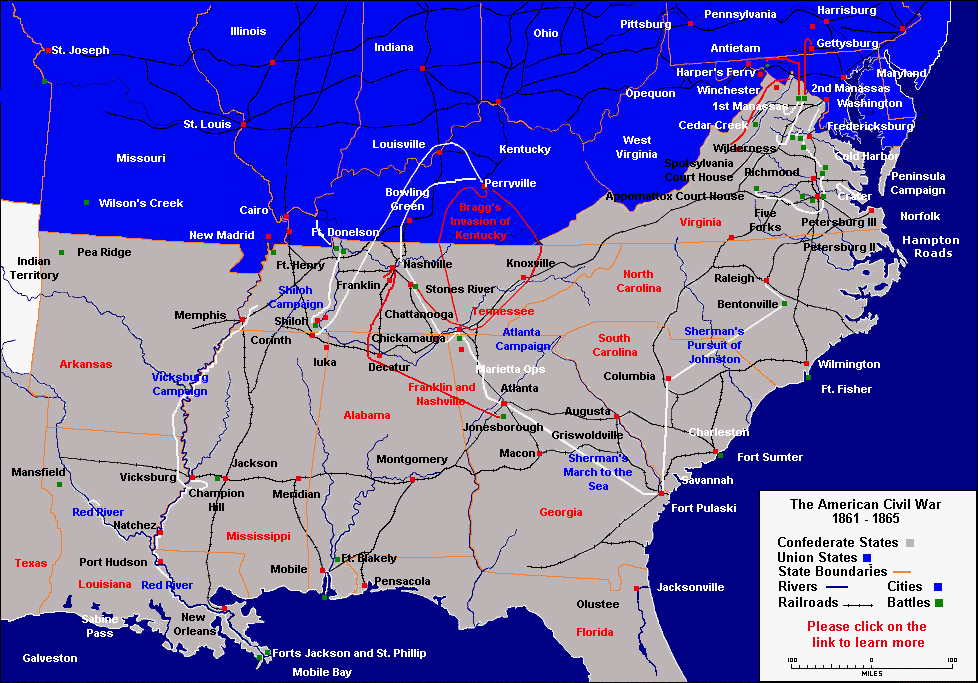
Economic issues would certainly involve railroads. . .
And you may want to concentrate your efforts most effected by the Civil War itself. . .
And so on.  The students had to face many questions and dilemmas.
Was Reconstruction a success or failure?  Ultimately it depends on your point of view, and what one might want Reconstruction to accomplish.  On the one hand, civil war  never again threatened the country, and the lives of African Americans did improve, at least to a relative degree.  The 13th-15th Amendments helped preserve legal rights especially for African Americans.   On the other hand, ‘Jim Crow’ laws arose in the South, which kept most African-Americans as second class citizens.  Many issues from the Civil War would not be fully worked out until the Civil Rights era of the 1960’s.  Some enduring bitterness remained in parts of the South that have still yet to be fully healed.  We will revisit these issues later this year.

Mr. Kipling’s Army

Some years ago I read A Perfect Mess, a delightful book that sought to demonstrate the blessings of individuality in business and life.  The book centers on the basic idea that creating uniformity in how people work, process, and store information, though it looks efficient, will in fact harm the bottom line for 2 main reasons:

  • Acquiring the time and means to store information takes more time and money than we might think, and
  • It forces everyone into a mold few people (except the fussy bureaucrat) work well within.

The authors cited the real-life example of two newsstands on the same New York street.  One store had all the modern accoutrements, such as computer reordering systems, a large selection, beautiful decor, and a helpful staff.  The other was a father-son operation that had less of everything.  But only the father-son store stayed in business.  All that selection, decor, staff, and computer systems came with a steep price tag.  Somehow the poorly-lit, somewhat ramshackle father-son operation worked just fine.

I thought of A Perfect Mess reading the similarly entertaining Mr. Kipling’s Army by the pre-eminent military historian of the Victorian era, Byron Farwell.  Certain things about the British army of this period seem almost impossible to believe.

For one, no one commanded the army.  By this, I don’t mean that no one person commanded the army, I mean that no agreement existed as to whether or not the Crown or Parliament commanded the army.  No “Joint Chiefs of Staff” existed.  Different people commanded different sections of the army, but at root the army had no unity of command.

The practice of purchasing army commissions continued long into the 19th century, which allowed anyone with enough cash and enough desire to immediately assume the rank of Lt. Colonel.  True, some disagreed with this practice. But it had numerous supporters, among them, the Duke of Wellington, who argued that the purchase of commissions gave the upper echelon of officers a direct stake in the well-being of the army/country.

Furthermore, various physical handicaps had no bearing on one’s ability to serve.  Some generals could not hear.  Some could not walk.  Some could not even see, being legally blind.  No one seemed to mind.

The army never grew even close to the size of armies in other European countries such as Prussia and France.  But this same “pint-sized” army was also spread out further over the globe than the military of any other country at that time.

Despite all this, none can doubt that the British army of this period did more with less than anyone else.  Quite simply, they were an enormously effective force, and between 1815-1914, more effective than anyone else.*

Farrwell offers no direct answers to this seeming paradox, but he packs the book with so many choice nuggets that one can begin to answer the question for themselves.  A key feature of the British army in this period would surely be regimental pride and identity, though not, as we might expect, army pride and identity.

The numerous regiments had their own uniforms, customs, mascots . . . a unending list of distinctives.  Sometimes these distinctives included actual violent rivalries with other regiments, but no matter.  If the British had one sacred guiding principle in this era it amounted to this: Do not mess with regimental traditions.  They tolerated almost anything not to violate this sacrosanct dictum, including actual criminal behavior by some soldiers, i.e., “Smashed shop windows at Blenheim Square?  And today is the third Saturday of March?  Pay no mind, that’s just the boys of the 10th Essex.”

The British may have gone too far with their one sacred principle, but they chose well.  Various testimonials abound at how the accretion of tradition and custom built a very strong sense of unity and identity within each fighting line.  The Romans (another effective army!) did something similar for much of its history, grouping soldiers as much as they could by village.  You fought next to those you lived with.  Almost every officer hated getting pulled from regimental ranks into a staff job.  Parting with the regiment meant parting with family.

Armies get their modus operandi, hence their effectiveness, from the societies that create them.  When a natural meshing occurs between army and society, the armies will have much more power because they will have more confidence, consciously or not.  Military action has a greater chance of meshing with society at large, which again adds to the effectiveness of military action.

The British did this brilliantly, whether they realized it or not.  The 19th century in England saw a curious blend of aristocracy and democracy.  The power of the monarch and the House of Lords all underwent a steady transformation towards more democracy, but a strong aristocratic flavor remained.**  Even the “defensive” dress (as brilliantly put by Lord Clark in his Civilization series) of the middle and upper-middle class showed an aristocratic motive to distinguish themselves from the masses.  Chesterton’s early 20th century work  The Club of Queer Trades delightfully pays homage to the British mania for clubs at the turn of the 20th century.

The British saw to it that each regiment was its own club, its own mini-aristocracy with its own traditions, dress, and way of life.  Anyone in a regiment would immediately become part of a mini-society that would give them a holistic identity apart from the rest of society.  As even our modern political scene teaches us, people will fight hard to maintain their sense of identity.

All of this should make us ponder our current situation.  I remember reading an article some time ago that mentioned that over the last 10 years the military has seen a huge spike in those hoping to become snipers.  Maybe this is the result of video games, but maybe not.  Military movies for decades focused on the heroism of the average Joe.  Now our movies and many of our military operations focus on our special forces, a kind of aristocracy within the military at-large.  And yet, our country may be moving in a more populist direction.  If so, this would put some tension between our military and our society which in theory could damage its effectiveness.

Or, possibly what we think is populism is in fact an extension of a kind of hyper identity awareness.  We do see a rise in the role of personal identity with issues surrounding sexuality and gender, and perhaps race as well.  If this is correct, then our military and society may be moving in a more feudal/aristocratic direction, not in the sense of having a defined upper class by birth, but by the segmenting of “Society” into multiple different smaller societies and interest groups.

Or perhaps its instead some weird combination of things, as may often be the case with American history.

Dave

*For now we will leave aside the moral aspects of their military adventures.

**Barbara Tuchman discusses this aspect of English life at this time vividly in The Proud Tower.


Aristocratic Age

Spit and Polish v. Drill

Link to sp. forces


El Campesino

The book jacket to El Campesino: Life and and Death in Soviet Russia boasts that, “this is not another memoir of a tortured intellectual wrestling with his conscience.  This book is in every sense a tense narrative of action, played out against the world’s most important struggle.”

Enough obsessive Russians!  “I was elected to lead, not to read!”

This blurb is accurate, however.  The main character, Valentin Gonzalez, “El Campesino” (the Peasant), is indeed a man of action and not reflection.  His narrative tells the story of his struggle in the Spanish Civil War, which makes him a hero of the Communist Party.  Feted by the Soviets, they whisk him away to Russia for specialized training.  He quickly grew disillusioned with the El CampesinoSoviet system.  His fiery personality led to numerous conflicts with party officials, which led to his imprisonment.  Gonzalez’s relentless forward-looking energy helps him escape not once but twice from prison camps, and eventually to freedom–the stuff of legend.

Such a triumph would indeed never happen with a more introspective “intellectual wrestling with his conscience.”  Gonzalez’s accomplishments come with a host of morally questionable actions he takes, but true to his nature, he hardly blinks an eye.  Gonzalez tells us that in the gulags the political prisoners often die within six months, while the ordinary criminals find ways to survive.

He decided to survive.

Of course one can’t help but root for him.  In many respects we certainly should root for him–for one, we obviously have to root against the Soviets.  Some introspection, some torturing of his conscience, however, might have helped him do more than merely survive.

One incident fairly early in the book jumped out at me that illumined the dark caverns of the Soviet system, and humanity besides.

Upon their arrival in Moscow Gonzalez and other “Heroes of the Revolution” received royal treatment.  Each of them had a “maid” assigned to them.  These maids came young, pretty, perfumed, and quite willing to do anything at all.  In fact the girls sought to sleep with them.  This, they knew, would be part of their weekly evaluations.

Possibly one of these “heroes” might have traditional ideas about sexual behavior and marriage (Gonzalez did not).  But such a man would face a terrible dilemma.  If he did not sleep with her, she might receive poor evaluations and perhaps even a punishment.  He would feel sympathy and wants to protect her.  So he sleeps with her.  But the maids sleep with the men primarily to put them off their guard so that they might reveal “anti-Soviet” thoughts.  They received big rewards for successfully extracting useful information for the NKVD.

The Soviets certainly recognized our need for fellowship and intimacy, but they exploited this not only to turn people against each other, but to turn someone against their very selves.  This result seems almost inevitable given the circumstances.

The life of Father George Calciu, however, shows us a different path.

Father George lived in Romania and came of age just prior to the communist takeover after World War II.  They arrested him in 1948 not so much for any specific crime, but mainly because he was one of the younger, educated set that the communists needed to make their own.  The old did not matter so much.  Romania’s traditional culture and deep roots in the Orthodox faith could die out with them.

Father George and others like him went to an Orwellian style prison designed to break them psychologically more than physically.  Their captors sought via a variety of techniques to separate them from the past and themselves straight out of 1984.  Father George confessed that such methods worked.  He said things to his interrogators he regretted.  After some months he found that he could not remember much about his childhood.  He could not remember how to pray.

Father George CalciuThen two things happened.  First, he realized that he did remember one prayer–“Lord Jesus Christ, Son of God, have mercy upon me, a sinner.”  This helped him remember himself and led to his remembering the the Lord’s Prayer and a few others.  Second, the interrogation process culminated when they successfully recruited prisoners to help them torture other prisoners.  Father George had said things he regretted, but this he would not do.  He felt terribly alone, for if he had agreed to this, he would have found at least some form of fellowship, some kind of sense of team with the other guards.

But then a curious thing happened.  The jailers lumped all the resistant prisoners together, perhaps not wanting them to infect their own converts.  Here Father George found a new community centered around their mutual faith in Christ and a commitment to human dignity.

Now, he knew himself again.

Some years after his release he felt called to deliver a series of Lenten sermons to Romania’s youth and a similar pattern emerged.  The seminary where he taught knew these messages might provoke trouble with the authorities.  They refused to support him, and once again Father George found himself alone.  But he went forward anyway, and to his utter shock, thousands and thousands of students came to hear him each week.  His “Seven Homilies to the Youth” had an international distribution.  He faced a second term in prison.  But now he was an internationally known dissident, and this gave him a small measure of protection.  In both instances, Father George refused to give in to the communist inspired ideals of community.

I admire the courage and audacity of Valentin Gonzalez.  But Father George Calciu showed us a better way.


11th Grade: Defending the Indefensible

Greetings,

This week we tried to understand why England and other nations allowed Germany under Hitler to increase its power, in repeated violations of the Versailles treaty.  Hindsight is always 20/20, and of course we know that lack of action spelled disaster for millions around the world.  But we need to avoid finger-wagging, and we need to shun the assumption that if we had only been there in the 1930’s, we would have done the right thing.  If we do not attempt to understand the past, we cannot learn from it.

We note first that the Versailles treaty that ended World War I was unpopular in England almost from the very beginning. Many perceived that it came down too hard on Germany.  As parents, perhaps you too have known the position of being too harsh at first with your kids, and then facing the dilemma of either a) Stick to an unjust course and not back down, or b) Change your initial pronouncement and back down.  Neither option satisfies, but especially if option ‘a’ would also mean hard work at keeping several countries on the same page and equally contributing, it’s easy to see why England went with option ‘b.’  They did so despite the protestations of France, who usually wanted to be harder on Germany than the British, which puts France’s 1940 collapse in a slightly different light.  Ironically, we celebrate (rightly) England’s resistance to the Nazi’s in the early 1940’s and mock France for surrendering.  But in the 1930’s, France in general wanted to be much tougher on Germany than England, but could never get English backing to prevent Germany’s rise to power.

Secondly, for a century prior to World War I England’s basic foreign policy goal meant establishing a continental balance of power.  After the Congress of Vienna in 1815, their basic theory stated that the presence of weak nations induced the stronger ones to fight over them.  Hence, a weak Germany might tempt both France and the Soviet Union towards war over German territory.

So many English statesman actually wanted a stronger Germany to balance out eastern and western Europe.  England drew upon quite recent history for this, as the Austria and Russia’s mutual interest in the Balkans (see map) plunged the world into World War I.

If we look at the map of Europe in 1933, we see British fears that central Europe could be a second Balkans, keeping in mind that the Soviet Union has seized the ‘slashed’ territory.

We also should not forget the situation in Asia in the 1930’s.  Traditionally we date the beginning of World War II in 1939, but Japan began an aggressive foreign policy in 1931 with their invasion of Manchuria.  While Japan did not directly threaten anything Britain held, they began to edge closer to their crucial outposts in Singapore and Hong Kong.  From Hong Kong, India stood just around the corner.  British policy had to take into account the possibility of enemies in the Pacific as well as the continent, and they got almost no help from the U.S. in dealing with the Japanese in the 1930’s.  One gets a sense of this if you look at the British empire ca. 1930.

Japan’s stark rise is almost as dramatic as Germany’s.  They had a rich cultural heritage but almost no natural resources with which to construct a modern military.  Japan looks like an aggressor in 1941, and in many ways they certainly were.  But we must rewind 100 years to the treaty imposed by Admiral Perry in 1858 upon them that forced open their borders.  While one can argue that forcing Japan to open up to western trade benefitted them in some ways, it was done on our terms and not theirs.

The allies made the mistake of humiliating Germany in the wake of W.W. I, and both England and the U.S. made the same mistake with Japan.  The humiliation continued in 1922 when England and the U.S. imposed upon  Japan a treaty that forced the Japanese to have a smaller navy than either England or the U.S.  Many in Japan felt that the west would only tolerate Japan remaining in an “inferior” position.  Japan could have acquiesced to this inferior status, and accepted what geography gave them, or they could try and change it.  The 1922 treaty proved that western powers were not going to let them do it in a peaceful way.  If they wanted more power, they were going to have to take the raw materials of others, which they began to try and do in 1931 by invading Manchuria.  One could argue that England was their in how to craft an empire.

The Allies were the good guys in W.W. II, but it is unfortunately a relative term, and we must be careful not to be smug about it.  In some ways we created the monsters that tried to destroy us.  The only real image of “great nations” they had in 1930’s were European ones who got there via imperialistic colonialism.  With China and Manchuria, I’m sure they thought they were doing what it took to be a “great nation.”

Finally, the economic situation needs our consideration.  Prior to World War I, Germany and England traded more with each other than anyone else.  Like other nations, the Depression hit England hard.  A stronger Germany would mean a stronger German middle class, and a stronger middle class meant better markets for English manufactured goods.  Many economists today believe, that a rising Chinese middle class will benefit our economy.  Ford, I believe, sells more cars in China than they do in the U.S., for example.   We have seen recently in our own time how “the economy” can dominate our own nation’s psyche.  I posed this dilemma to students. . .

Suppose you are a Senator whose state has a technology company that employs thousands of people, one that does  hundreds of millions of dollars in business with China.  Into your office comes someone from your state, who argues that because of human rights abuses and persecution of Christians in China, you should push for severe trade restrictions to try and get China to change their behavior.  Would you agree with her?

In class nearly every student said something like. . .

  • We cannot afford to lose business with China and put thousands of people out of work.
  • China’s human rights abuses is an internal matter for China, and while unfortunate and regrettable, we really can do little to change it.

Does this not sound similar, perhaps, to how nations reacted to Nazi persecution of Jews, ca. 1935?

niall-ferguson-the-war-of-the-world

Much of what I said above I found in Niall Feguson’s book The War of the World, and especially from his chapter “Defending the Indefensible.”  In fact Ferguson makes the claim that appeasement did not cause W.W. II.  Rather, a war which had already began in the Pacific led to appeasement in Europe.  Interestingly, though England tragically miscalculated in regards to Germany, they thought that Japan posed a more imminent danger than Germany was in one sense correct.  Japan’s attack of China predated Germany’s attack on Poland by a couple of years.

Neither Ferguson or I mean to exonerate England of course, but hopefully the students had a better understanding of why events transpired as they did.

Many thanks,

Dave Mathwin

Music Covers and “Renaissances”

One of the ways I think you know you may have hit upon a good theory is if it applies to a variety of areas of life.  If a historical theory holds water, it will do so by revealing something about the human experience in general, not just particular time periods.  Toynbee really impressed me with his theory of how civilizations interact across time, and this article got me thinking about how Toynbee’s theory of “Renaissances”  might apply with artists who cover other people’s songs.

As Toynbee elucidated, not all renaissances are created equal, with some giving life, and others taking it.  Music fans know that not all music covers have the same impact.  Some stink while others succeed.  But why?  Can we apply any general principles to our investigation related to our study of civilizations?  What makes for good or bad cover songs?

One of Toynbee’s theories is that interaction between two living civilization will bear more creative fruit than interactions between live civlizations and the ghosts of dead ones.  We only need to imagine the possibilities inherent in an active conversation between two people, and passively receiving a recording from the past to see the difference.  We can call a ‘living’ band one that is active at the time one of their songs is covered, and a ‘dead’ one as a band/artist no longer active.

First let’s examine some successful covers and see if they fit into the theory.Here are two great originals. . .

Toynbee claimed that one reason why interactions between the living can have more vitality is that the copying civilization (or in our case, artist) are by definition freed from the burden of rote homage.  They can’t merely repeat what the other existing band could easily do better, so they change it and put something of themselves into it.

Below Hendrix and Aretha Franklin cover Dylan and Redding.  These cover versions are deservedly better known, and superior to the originals:

Interestingly, Franklin patterns her version of ‘Respect’ right along Redding’s lines, but the switch of narrator from man to woman and slower tempo adds to the song’s swagger and gives it more life. Perhaps her gender difference with Redding allowed her to confidently assert herself rather than just mimic him.  With Hendrix, he takes Dylan’s song and gives the lyrics the weight, mystery, and energy they deserve.

Along the same lines, Joe Cocker had success interacting with the Beatles on his classic cover of “With a Little Help from My Friends,” at Woodstock, while the Beatles were technically still a living ‘civilization.’

Part of the reason for Cocker’s success is that he feels no need to emulate the Beatles, and is smart enough to know he cannot try and copy what the Beatles could do much better.

But not all would be so insightful.

Here is the Beatles’ “Come Together.”

A few years after they broke up and became a ‘dead civilization’ Aerosmith produced this monstrosity (and if anyone thinks that Ringo didn’t really have any chops, just compare his “light on his feet” performance with the elephant stomps of Joey Kramer):

Here Aerosmith, bringing back the ghost of the recently ‘dead’ Beatles, falls into a common trap.  They feel the need to pay homage, and lose any sense of creative space, producing the lifeless result we might expect under such conditions.  Lest you think Aerosmith an isolated example, let’s do another.

First, the classic original. . .

And now, Sheryl Crow’s regrettable cover of the then recently ‘dead’ Guns N’ Roses:

The problem is not that either Aerosmith or Crow lacks talent.  The problem is their proximity to the ‘dead’ source material creates the additional psychological burden.

Another principle for Toynbee is that of geographical distance.  Closer geographical proximity usually means closer cultural affinity, and less overall freedom.  We saw how in 15th century Europe southern Italy acted with less freedom to the classical revival than northern Europe in the post I linked above.  The Greeks and Romans were the southern Italians’ next door neighbors, but not so to those in the north.  The same can hold true in genres of music.  We see that when Aerosmith, a rock band, covers another rock band (the Beatles) the process of mimesis is often mechanical.  Hendrix and Dylan occupied different genres, as did Joe Cocker and the Beatles.  Franklin pulled off the very unusual feat of occupying similar territory as the artist she covered successfully, but as we’ve seen, the fact that Redding was still a ‘living civilization’ freed her at least from mere mimicry.

Jazz artists over time have often covered standards from popular music, but by the 1980”s-90’s this process grew stale.  Some jazz groups have started to revive the practice of using popular music as source material, but freed from attachment to the ‘Great American Songbook,’ they can choose from a whole new catalog.  Here is a ‘standard’ from my youth:

And here is The Bad Plus, completely reinterpreting it:

The ‘geographical’ difference of genre gives The Bad Plus much more freedom to create something new.

If you, like me, are willing to call Toynbee’s theory a success, are there others areas of life where we can apply his principles?

Many thanks,

Dave

And finally, a cover so awful and so bizarre I am shockingly at a loss for words to begin to categorize it.  Laugh, cry, or go running headlong screaming into the night — I can’t decide!  I dare anyone to actually listen to the whole thing. . .

11th Grade: Trusting our Leaders

Greetings,

We began the week by looking at the election of Franklin Delano Roosevelt in 1932.  His presidency would do much to shape the future of American politics for many reasons.

Fairly or not, the quarterback gets most of the praise or blame for wins or losses, and the same holds true for the president and the economy.  On paper, Hoover had everything going for him as America faced the onset of the Great Depression.  He had experience administering relief work after World War I.  He had broad bipartisan support for many of his policies.  But personality wise, he could not be “relatable” to the public.  Increasingly Americans felt alienated from him, and turned their wrath and desperation his way.

Hoover did not remain aloof from suffering.  He pushed a variety of aid packages through Congress, though they had little success in stemming the tide.  None of this mattered.  What the people required of their president had changed.  Advances in movie and radio technology made the president more accessible, and as such, he needed to be more relatable.

Early in the week we asked the question: “What makes a president more trustworthy?  His ‘credentials’ or his life experience?”  I gave the class two choices of candidate:

  1. An ivy league graduate with a Ph.D in political science, candidate 1 also speaks fluent Chinese and Arabic.  He is personal friends with the U.N. Secretary General and the World Bank.  At every level he graduated with honors and his Ph.D thesis became a best-selling book.  But he grew up with a ‘silver-spoon’ in his mouth, has driven BMW’s his whole life, is personally quite wealthy, etc.  He never had a blue collar job or submitted a resume. He is unmarried with no children.
  2. Candidate 2 is no dummy, but never distinguished himself at school.   He is not wealthy, and grew up lower class and worked his way through college through a variety of odd-jobs.  He married his high school sweetheart and has three children.
Who do you trust more?
Most of the class said they would vote for #1, but others disagreed.  For the latter group, trust had more to do with identifying with that person rather than with their credentials.
In the last presidential race, for example, we saw how the question of being relatable plagued Mitt Romney, who has impressive ‘on-paper’ credentials.  Even when he tries to be a regular guy, it doesn’t come off quite right.
With Hoover one also can’t help but sense a certain stiffness:
Not so with FDR, as even a minute or two of this clip reveals:
We saw also how the Great Depression changed other things. . .
  • One of the subtle shifts that happened in the 1930’s was our attitude towards government itself.  It is probably generally true that previous generations thought of government as removed from the people, even if it was not opposed to them — a kind of necessary but awkward appendage.  Now, government was seen as a helpful and natural tool of the people’s interests and needs.  To be fair to Roosevelt, this idea was not merely his invention.  One can see its roots in the populism of Andrew Jackson.  The extension of voting rights to minorities and women meant that our representatives could more legitimately reflect the population as a whole.  Both of these approaches to government have their roots in the Christian tradition, with St. Augustine tending to see government negatively, and St. Thomas Aquinas, among others, seeing it more positively.
  • We looked at a few specific government programs of the time and asked the question, “Why is it that some government programs stick  around past their original purpose?”  While many New Deal programs did stop during World War II or shortly thereafter, some, like the Tennessee Valley Authority, have lasted until today.  While I don’t want to neglect the fact that many people probably agree that certain programs, like the SEC and FDIC, have had lasting value, I think it more interesting to consider the previous question.  I presented two options to the students:
1. Programs stick around because governments, like people, like power. Individuals like power as much as government does, but government has a much greater capacity to hold onto it because of their monopoly of force and concentration of resources.
OR
2. Does the answer have more to do with our particular system of government, that is, federalism?  If we take the TVA as an example, we  see that a few people (and a few congressmen) benefit a great deal from the program.  When the cost is spread out over a whole, it becomes relatively small, so it is unlikely to bother most of us very much.  A few people are very motivated to keep it, and the vast bulk are not motivated enough to contest it.  Besides, our own congressmen may do similar things for our region that others do for Tennessee.  As a country in general, we accept that deal.
The question of entitlement programs, for example, is political as well as financial.   With the population aging, the current power of the AARP, for example, is unlikely to get smaller.  We can also see different meanings or applications of the concept of equality at work.  On the one hand, government inaction on any particular issue can reinforce the idea of equality.  Doing nothing means not favoring anyone, and letting people work deal with their issues with no hindrance from government.  This has the advantage of consistency and simplicity.  We discussed, on the other hand, the fact that some situations are starkly unequal, with the situation not likely to be any different without decisive and concerted action from government.  What benefits, and what costs, do we want to absorb as a society?
Last week we went back to wrap up some issues from the 1920’s, specifically, the tremendous social impact due to the changing role of women.  We first looked at how the general mood and pace of the times, as well as the changing roles between the sexes, might influence dancing.  We had fun looking at this. . .
But the changes had a broader impact on how women interacting in society in general.
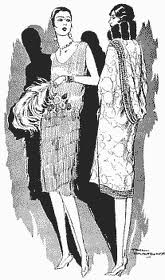
As women gained equality with men in the right to vote, we saw how women’s fashion changed.  They were ‘liberated’ and their dress reflected it:  
But interestingly, some took the idea of equality with men even further, and they began to dress like men, cut their hair short like men, and so on . . .
images-2
images-1
It seems to me that there would be something tragic if women felt that to gain equality with men they had to emulate men, and thereby lose something of their identity as women.
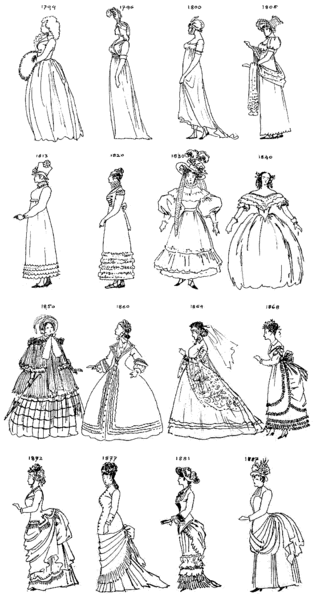
I wanted the students to compare the feminine ideal of the 1920’s with the Victorian era, which we looked at a few months ago.  My gut is that neither era represents a Biblical ideal.  Looking at the mountain of material on Victorian dresses (ca. 1850-1900) makes me think that they obscured true femininity just as the 1920’s did (take a look at the ones from 1850 — 3rd row on left), as to my mind there is something unquestionably ridiculous in how Victorians viewed women as incurably fragile.
A Century of Fashion
Most students asserted that if they had to choose, they would choose the 20’s ideal over the Victorian, arguing that women had more respect in that period.   This did not surprise me, as there is something distinctly modern and familiar with the 1920’s.   Some students last year astutely pointed out that there are two kinds of respect.  In the 1920’s women unquestionably had more political and social freedoms.  No one should underestimate the importance of this.  But they may have lost some of the respect that came with being a woman specifically.  With this exchange, something of the ideal of chivalry, of deference to women, would inevitably be lost.
Ideally, as God made both men and women in His image, for humanity to best reflect that image we should want men to be men and women to be women in the truest possible sense.  What that means exactly will certainly be debated, but the students agreed that neither the 1920’s or the Victorians had it right.
Many thanks,
Dave M

“Securing the Blessings of Empire to our Posterity”

Years ago G.K. Chesterton wrote,

[The problem] I mean is [modern] man’s inability to state his opponent’s view, and often his inability even to state his own.  . . . There is everywhere the habit of assuming certain things, in the sense of not even imagining the opposite things.  For instance, as history is taught, nearly everyone always assumes that it was the right side that won in all important past conflicts. . . . Say to him that we should now be better off if Charles Edward and the Jacobites had captured London instead of falling back from Derby, and he will laugh. . . . Yet nothing can be a more sober or solid fact that that, when the issue was still undecided, wise and thoughtful men were to be found on both sides.  . . . I could give many other examples of what I mean by this imaginative bondage.  It is to be found in the strange superstition of making sacred figures out of certain historical characters, who must not be moved from their symbolic attitudes. . . . To a simple rationalist, these prejudices are a little hard to understand.

Our Constitution has proved itself an enduring and effective document.  Some have an admiration for it that verges on veneration, which can obscure the fact that the success of the Constitution was hardly foreordained.  The election of 1800, and of course the Civil War, pushed its limitations to the brink.  We forget too that many reasonable and intelligent men had strong objections to the Constitution.  Some of these objections proved chimerical, but some had remarkable prescience.

I referenced George Mason’s strenuous objections in another post, but to quickly recap, Mason believed that the South should have required a super-majority to pass all trade legislation.  Mason believed that economic differences would eventually tear the North and South apart, and requiring this provision would ensure more unity.  Unfortunately the south kept slavery in exchange for a trade legislation passing like any other law.  Sure enough, states like South Carolina and Georgia cited unfair trade legislation as reason for secession in 1860.

Most expected some form of strengthening of the national government to come out of the convention in Philadelphia.  Many objected, however, not so much because the federal government would be stronger, but because the states would cease to have any importance in the new scheme.  Defenders of the Constitution rushed to quell such fears.  Obviously the states would continue to have their contributions to make, and so on.  Once again, those that objected to the Constitution had it right.  Today states play no vital role in shaping policy or the identity of the country and merely serve as a kind of organizing mechanism for national politics.

The reasons for why some objectors saw the future diminution of states fascinates me the most, however.  Many jumped on the first three words, “We the people,” and saw a totally new basis for governance.   In making the amorphous “people” the basis for authority in the country, some argued that the United States would transform eventually into a kind of democratic empire-state.  It may sound odd for modern sensibilities to equate “the people” with empire.  But the founders thought in the context of Rome’s history.  Rome’s emperors sought to bypass the aristocracy and the Senate and appealed directly to the “people.”*  Tacitus criticizes many emperors not because of their abuses to the people, but perhaps largely because of their abuses to the senatorial class.  If the preamble had said, “We the states,” it would have indicated that ultimately the senate would take the lead in shaping the tenor of American political life.  “We the people,” would shift the focus to the presidency, which meant that the founder’s stated goal of a federated republic would inevitably get superceded by the people/nation.  This shift from states to the “people” also greatly magnified the role of the Supreme Court far beyond the intent of the founders, as some recent and controversial decisions have overridden state laws.

Indeed, something like this happened over the course of the 20th century, and we see it accelerating recently.  Bill Clinton felt our pain and played saxophone on the Arsenio Hall show.  As candidates, Bush and Gore both appeared on Oprah Winfrey.  While in office President Bush worked hard to maintain a “regular guy” image.  President Obama went on Marc Maron’s podcast and Jerry Seinfeld’s Comedians in Cars Getting Coffee, using more sophisticated forms of direct appeal to “the people.” If Trump is our next president, he will remind me of some of the practical, irascibly likable, yet for the most part dangerously erratic Roman general-emperors.**  Such direct appeals to “the people” from the president I’m sure would have horrified Washington, Madison, and even Thomas Jefferson.

But they would not have surprised some of the Anti-Federalists.

Because the anti-federalists were right about their objections does not mean that we were wrong to ratify the Constitution.  I still believe that despite its flaws it probably represented the realistic “best we could do” under the circumstances.  But the objections of the so-called “Anti-Federalists” shine great light on where we are now as a nation.


Dave


*Caligula was certainly a nut, but the story of him making his horse a senator (if true) may have actually been a calculated swipe at the Senate itself and not necessarily evidence of his insanity.

**Thinking about comparisons for Trump . . . he may not quite fit any one particular emperor.  One colleague offered Marius as a mirror image.  Marius was wealthy, a “new man,” who infuriated the Roman aristocracy, who proved powerless to stop him through normal political means (it took a bloody civil war instead).  Another offered Emperor Theodosius I.  Though not a “general-emperor,” he was gruff and impulsive.  He did terrible things on foolish whims (the massacre in Thessalonica), but proved capable of repentance and subsequent bold and important decisions (as to whether or not Trump can prove capable of repentance . . . we’ll have to wait and see).

His American President counterpart has to be Andrew Jackson.  He was not a founder or the son of a founding father.  He lacked a “European” education.  He introduced the idea of campaigning for office, to the horror of the political elite of the time.  His time on the frontier made him a rough, blunt character.  He made a variety of controversial decisions that definitely divided people — i.e. closing the national bank, South Carolina’s attempts at state nullification, and some horrifying decisions like the Cherokee’s and the “Trail of Tears.”

Historical opinion on Jackson is as varied as his acts in office.  But, however one views him, the U.S. survived a Jackson presidency and we just might survive a Trump presidency.

His likely opponent, Hillary Clinton, lacks the personality to connect with and directly appeal to the people that would put her in unusual company among modern presidents, like George Bush Sr., and perhaps, Nixon?


Death by Abstraction

“A theology without practice is the theology of demons.”  So said St. Maximos the Confessor.  Abstractions have never held any weight within Christianity.  The devil believes, and it makes no difference.  The Incarnation explodes the possibility of the efficacy of “abstraction.”  God became a particular man at a particular time in a particular place.*

We see this theological truth spill out into other areas.  Beware, for example, of vague descriptions of “Human Rights.”  Without application in a particular context, such “rights” have no meaning.  Hence France’s “Declaration of the Rights of Man” declared in 1789 gave absolutely no protection to anyone during the Reign of Terror in 1793.  The Committee of Pubic Safety interpreted such rights as they pleased to do what they wished.  Beware the man with grand visions of glory who cares nothing for the actual human cost.  On such foundations were the great tyrannies of the 20th century built.

A great deal of debate exists as to the question, “What is America?”  Different answers have been given to this question, but we don’t often stop to question why we have so much debate about our identity.  I think the root of this problem lies in the commonly accepted idea (whether it is true or false) that America has its origin in certain ideas about liberty, freedom, and so on, not in any particular experience in history.  In a few other posts on this blog I muse on this question (see here and here if you have not wearied of me quite yet:).

Some historians argue that America took a decided turn with the victory of the North in the Civil War.  Proponents of this do not necessarily assert that the South was “good” and the North “bad,” though some may argue this.  Some in this school of thought, like Clark Carlton from Tennessee Tech, don’t even put the focus on the good of one side vs. the other, or on state’s rights and federal power, but rather on culture and the idea of what America actually is or should be.

Carlton argues that the two sides in the Civil War represented two different ideas about America.  The North, dominated by a New England ethos, believed that America had its roots in certain ideas that should have application everywhere for all men.  The South, rooted in a very different migratory pattern (discussed brilliantly by David Hackett Fischer in Albion’s Seed, by far the best book I’ve read on colonial America), saw America as a place to transplant a certain kind of Anglo-Celtic way of life.

I lack the wherewithal to discuss the merits of this theory, except to say that it has enough plausibility to deserve consideration.  For the moment let’s assume its core proposition and explore its possible merits.  For the theory to hold water, we would need to trace the development of abstract ideas throughout the history of New England and see its pernicious effects.**  Of course this means that we find that they did in believe such abstractions.

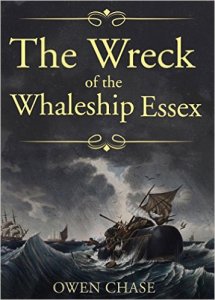
Recently I read the The Wreck of the Whaleship Essex by Owen Chase, written in 1821.  The book tells of the shocking attack and sinking of their ship by a sperm whale, the inspiration for 51-cWJypx5L._SX355_BO1,204,203,200_Melville’s Moby Dick.  Most American whaling crews hailed from the New England area, as did the Essex.  The account held my interest all the way through.  For our purposes here, I couldn’t help notice, however, how the author spoke about God.  I don’t believe he ever used the word “God,” referring instead to “Providence,” or “the benefits of the Creator,” or something like that.  Certainly they never made any reference to Jesus Himself.  Such language left me cold.  Whether or not the author and his crew believed in Christ I cannot say, but this impersonal and ultimately abstract language is certainly not a Christian way to speak about God.  It seems to exactly mirror the Transcendentalists like Emerson, who of course hailed from New England.^

As their journey in the lifeboats continued, their supplies of food obviously dwindled.  At first when crewmen died they buried them at sea decently.  But after several weeks they grew more desperate, and fell to eating parts of the deceased crew’s body before burial.  They did so even though they still had small amounts of bread left, so they had other options.  One of the lifeboats even eventually drew lots to see who would be shot, so his flesh could be consumed.  A man named Owen Coffin drew the short straw and apparently submitted to his fate willingly.

So all in all eight crewmen survived, but at what cost?  I do not judge them too harshly.  They endured severe trials and privations.  After several weeks I’m sure they had nothing left physically, mentally, and emotionally.  I have never endured anything remotely akin to their ordeal.  Yet in the writing of the account itself I expected some remorse, some second-guessing of their practices, especially given the time proximity of their rescue to their cannibalism.  In hindsight, such horrors probably were not even necessary for their strict survival.  But Mr. Chase has no such reflections.

I can’t help but wonder if their cold and distant manner of speaking about God might contribute to their cold, impersonal view of each others lives and bodies.  This surprised me because earlier in the book he wrote touching passages about the attachment of the crew to each other.  After the ship sunk the crew found themselves in three separate lifeboats.  Chase talks movingly of losing sight of their fellow ships at night and their frantic efforts to find each other lest they be separated.  But in the end, I suppose, their abstract notions of life won out.

But this crew did not invent such a way of speaking.  These abstractions must have had their roots somewhere.  We might start with the New England Puritans.  Initially, it seems that the Puritans were anything but abstract in their views.  They practiced a very particular way of life and belief.  But a second look tells otherwise.  I have no wish to “pile on” the Puritans, who get a lot of bad press, much of it undeserved.  I admire certain things about them.  But their strong Calvinism does lead one to a kind of abstraction regarding God.  God’s abstract “will” often asserts itself to the fore in Puritan theology, pushing more personal characteristics such as love, mercy, etc. to the periphery.  Their conception of the “will” of God swallowed up all individual personality.  So I think we can say that abstraction had its roots in the foundation of New England society.^^

The American Revolution had many of its roots in New England, and there again we can say that they had an attachment to abstractions.  They began by charging the British with violating their rights as British citizens in 1765, but ended by conceiving of Lady Liberty (a goddess?), and human rights that should apply to all men everywhere.

This abstract seed has grown many branches, some good and some bad.  The root issue seems to be the idea that once a certain group of people latch onto a particular incarnated meaning of “liberty,” they seek to apply to all everywhere.  So we have the New England abolitionists on the one hand, and LGBT rights on the other.  Both have very different seeming applications, but both might have the same root.+

In the end I’m not sure “abstraction” was a distinctly New England problem.  Carlton sees the Civil War as a turning point for American ideals of abstract liberty, and here I disagree.  Perhaps New England held to such “abstractions” more than others, but by 1800 at least these ideals had spread most everywhere.  Where I agree with him fully, however, is that latching onto abstract propositions to guide us has resulted in many theological and civil problems.

As we end the Christmas season, may the truth of the Incarnation lead us in a different direction.

Dave


*Hence the importance of the prologue of St. Luke’s gospel, the historical books of the Old Testament, and various other portions of Scripture.

**I don’t mean to leave aside the possible pernicious effects of Anglo-Celtic culture.  For his part I don’t believe Carlton means to glorify this culture.  Rather, he seems to assert that the culture was uniquely their culture, and thus they (and not anyone else) had ownership of its strengths and sins, slavery obviously among them.  Their moral life remains their responsibility and not those of other states/countries, or the Federal government.  Perhaps he might continue to argue that taking it out of their hands in a way absolved them of ownership and responsibility — creating a pernicious distance between themselves and their political and cultural lives.  Did this then lead to actually more mistreatment of blacks?  It seems hard to argue this, as slavery ended because of the Civil War.  But . . . perhaps this “distance” gave them more subconscious permission to continue subjugating blacks as an act of defiance?  This would be a pretty radical idea, one that we could not test and can therefore only speculate.  But it does seem a bit of a stretch to me.  Still, I am only speculating as to his argument.

^Such manner of speaking about God is not only confined to New England, however.  Washington, Jefferson, and other southerners spoke in a similar  way.  This may cast doubt on Carlton’s thesis.

^^We can find other examples, I think.  The Puritans did not really grow a local culture, but rather “imported” and imposed a large measure of it from the Old Testament — or at least their interpretation of it.  We might argue that Puritan culture was the byproduct of abstract theological ideas.

+On the issue of slavery Carlton argues that the New England abolitionists accomplished nothing in part because of their abstractions.  They had no roots in the culture they critiqued.  They merely espoused vague notions of liberty.  He wanted southern abolitionists (such societies did exist, at least in the upper South) to solve the issue — alas, they did not.  But neither, I suppose, did northern abolitionists.  They both failed alike to avert Civil War. As to why America could not solve this issue legislatively, as England did, I’m not sure.

Retreat to Move Forward

I confess to having a strong antipathy to smart phones.  I know that they have their good uses.  But I am bewildered as I see people bring them out at various times and places.  I wonder what has become of us.

Now, I also realize a large amount of hypocrisy on my part.  I should also ask what has become of me.  I don’t have a smartphone . . . but I love my iPod, and I check my email too much.  In my mind, if technology had stopped advancing after Apple came out with its 160 GB iPod classic, I would be content.  But even if I am right that our prolific use of smartphones do us harm, what can be done?  After all, retreating from them seems impossible, and time marches on.  To stop advancing technologically would condemn us to economic stagnation.  To actually prevent technology from further advancing would probably require a government more powerful than would be good for us.

So it appears that we’re stuck.

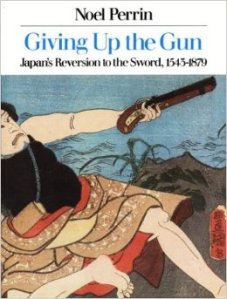
But, maybe not.  The premise of Noel Perrin’s Giving up the Gun: Japan’s Reversion to the Sword, 1543-1879 is that a people can halt a certain kind of technology without radically changing their society.  While certain particular features of Japanese society allowed for this, Perrin states rightly that this example disproves certain well-entrenched ideas about technology and progress, among them:

  • That one must “keep up with the Jones'” to have a successful society
  • That technological progress comes as a whole and not in parts.  In other words, many falsely assume that to halt “progress” in one area will prevent advances in other areas.
  • That halting progress will put a society irrevocably behind other societies.  Instead, when Japan did decide to adopt modern weapons in the late 19th century, they very quickly caught up to others and soon posed a significant military threat.

So first we can examine why Japan could nearly eliminate guns from their society, and then secondarily, we can consider its possible application for us.

I initially assumed that Japan’s restrictive trade practices limited their contact with firearms from the start.  Not so — in fact they made significant use of firearms well into the 1560’s, and European traders remarked quite favorably on their quality.  We might also assume that Japan had a low-level of technology in general, but again — not the case.  To quote Perrin,

Japan had already reached a high level of technology.  Her copper and steel were probably better, and certainly cheaper, than any produced in Europe.  Despite enormous shipping costs, the Dutch found it profitable to send Japanese copper 10,000 miles from Amsterdam.

. . . In iron and steel Japan could undersell England, the recognized leader of European producers.  [Japan also] led the world in paper products.  For 200 years they were the leading manufacturer of weapons.  These were top quality weapons, too, especially the swords.  It is designed to cut through tempered steel, and it can . . .

In a country often experiencing some kind of conflict at some point, they well understood the value of rifles.  But by the end of the 16th century Japan decided against all forms of military mechanization so successfully that they generally disappeared for 250 years.

Of course others in Europe saw the problems with firearms.  Martin Luther said that, “Cannon and firearms are cruel and damnable machines.  I believe them to be the direct invention of the Devil.”  But Germany went on to become the pre-eminent arms manufacturer.  Many French aristocrats inveighed vociferously against the impersonal nature of such weapons, as well as the fact that their introduction would broaden war beyond the aristocracy.  But they too followed the general trend.

Certain factors within Japan made it more likely that they would have success while Europeans failed.  Being an island did not hurt.  Their demographics also played a role.  In France, for example, the warrior aristocracy represented about .1-.2% of the population.  In Japan that number reached close to 10%, which gave them that much more influence.   Japanese swords also had such a high quality that the difference in effectiveness between a sword and a 16th century gun was less than in Europe.

But Perrin argues that the main factor lies in the role of the sword in Japan.  In Europe some swords had religious and symbolic significance, i.e. King Arthur’s “Excalibur,” or Roland’s “Durendal.”  But in Japan, the sword almost literally represented the soul of warrior for every samurai.  Swords were an extension of the self.  Making them obsolete would in effect, make themselves obsolete.  They would have no purpose as they would have no identity.

Perrin relates an interesting story along these lines.  One group of samurai besieged the castle of another warrior.  Eventually it became obvious that the besiegers would win, whereby the besieged asked for a conference.  He explained to his attackers that he had several swords inside that he wished to preserve from destruction.  Would the attackers agree to receive the swords and preserve them?  And so, the defenders, with solemn ceremony, transferred the swords to the attacking army and then retreated back into the castle.  After which, the attackers set fire to the estate and all those inside perished.

Many aristocratic warriors in Europe and Japan detested firearms because it made combat itself impersonal and unredeemable.   We see many examples of dialog during combat in the Arthurian tales, but it seems the Japanese took this to another level.  Perrin gives us one such example, as Warrior ‘X’ tried to behead Warrior ‘Y’ unsuccessfully, who was wounded and exhausted.

Y: Are you fluttered, sir?  You see you have no success.  Look, I wear a nagowa (an iron neck collar).  Remove it, and you can cut off my head.

X: (Bows to “Y”) Thank you sir!  You die an honorable death.  You have my admiration!

One could even argue that Japanese warriors sought not so much victory, but an honorable death.  Firearms dramatically increased the chance that you would die without an honorable end, without a chance to “fly the flag” at the last moment — however much it increased your chances of victory.

Early Japanese firearm manuals acknowledged this and more.  To fire guns well, such manuals stated, one even had to put the body in “demeaning,” inelegant postures.  For the Japanese, the gun represented not just another weapon, but another view of humanity.

Firearms returned late in the 19th century.  Ironically, Admiral Perry told them that if they wanted to keep others like him away, they would need more modern weapons.  Japan then turned on a dime and within a generation had a respectable military force.  Within two generations they posed a grave threat to the most modern of militaries and nearly conquered all of Asia.  The absence of mechanized weapons for three centuries put them at no real disadvantage once they determined to catch up.

One of the oldest tropes in the history of History is historians wishing for bygone days of yore.  But I think our worries about technology go far beyond nostalgia.  Advancement is now so rapid that we have no time to contemplate or evaluate the role of technology in our lives.  We have to ability to develop “social antibodies” to the problems with technology.  As such, we have within the last 10 years become utterly dependent and quite possibly addicted to the internet.  Paul Graham, the innovator behind Reddit, Dropbox, and a variety of other programs, writes,

. . . And unless the rate at which social antibodies evolve can increase to match the accelerating rate at which technological progress throws off new addictions, we’ll be increasingly unable to rely on customs to protect us. Unless we want to be canaries in the coal mine of each new addiction—the people whose sad example becomes a lesson to future generations—we’ll have to figure out for ourselves what to avoid and how. It will actually become a reasonable strategy (or a more reasonable strategy) to suspect everything new.

In fact, even that won’t be enough. We’ll have to worry not just about new things, but also about existing things becoming more addictive. That’s what bit me. I’ve avoided most addictions, but the Internet got me because it became addictive while I was using it.

Do we have any hope of emulating the Japanese and pausing our technological growth?

A few other random examples of at least halting technology exist (such as Elizabeth I preventing indoor plumbing), but I can’t think of another example of a society moving “forwards,”* then “backwards” with the adoption of certain technologies.  Japan’s insular geographic position helped them, as did their demographics, governance, and culture — and I find these last two most significant.

Americans rarely acknowledge the fact that aristocracies come with some benefits, or at least, alternative possibilities.  Japan’s warrior elite had the political and social status to make the ban stick.  Add to that the pull of a unique and deeply distinctive Japanese culture, one that perhaps approximated that of ancient Egypt in its power to unify a large mass of people in a particular way of life (another geographically insulated civilization).

We have no geographic isolation.  Nor does our culture have anything close to Japan’s gravitational pull, i.e. — our capital exports little more than bureaucracy to the rest of the country.  And finally, our democratic system has something close to a zero-percent chance of desiring, or certainly enforcing, such a return to earlier ways.  Self-denial simply has very little place in democratic cultures.

Now I think it’s time for me to check my email . . .

Dave


Matt Zoller of RogerEbert.com writes,

We’ve become a one-handed species. We keep one hand in reserve for taking out a wallet, digging in a purse, swiping a Metrocard, helping up a person who’s fallen on the sidewalk, whatever. The other hand is for Making Sure We Got This.

I know, I know. This has been going on for a few years. It’s not a news flash; it’s who we are as a species. I’m Grandpa Abe Simpson yammering about onion belts. I should climb onto the ice floe and shove off. Or say, “Oh yeah, things change, technology changes, it’s no big deal” and quit complaining.

But I think it deserves ongoing consideration and argument, because it’s everywhere.

Is it merely different from, but in no way inferior to, older forms of participation, as people who are addicted to doing it tend to claim when they read pieces like this one? I have no idea. Only a cognitive researcher could say with any authority. But it’s a major and visible change. It’s species-wide.

And I’ve personally not heard any convincing arguments against the idea that it means we have become, in some basic way, detached from our own existence; that life itself is becoming a supplier of material for Instagram, Flicker, Twitter, YouTube, Facebook and the like, rather than a thing that happens to us, and that we absorb with our bodies and minds, not with our phones.

*I think it would be a nearly impossible to construct a good argument that mechanized weaponry represented an advance for civilization.


Men Behaving Badly

Byron Farwell’s The Great Anglo-Boer War offers an intriguing glimpse into the waning days of Victorian England, deals with some difficult moral dilemmas, and entertains with good writing and good stories.  When one combines the myopia of Victorian Brits and the self-righteousness of the Dutch Boers, it can lead, if nothing else, to entertaining reading.  The whole episode reminded me of the failed Rob Schieder TV show Men Behaving Badly.   I saw exactly 0 episodes of this show, but I do remember the promo, which had Schieder’s character standing by a sink full of dirty dishes.  He narrated,

What does a guy do when all of his dishes are dirty?  Well, the way I see it, he could a) Buy more dishes, b) Rent another apartment, or c) Find suitable dish-like replacement from your natural surroundings (holds up a frisbee).

My guess is that was about as good as the show got.

Who is one to root for in this conflict?

On the surface, you have an imperial nation at the high-water mark of its power, fighting in land not their own against a group of rag-tag farmers who only wish to be left alone.  Our underdog instinct wants to kick in, but then we remember the Dutch Boers woeful mistreatment of the indigenous local African population and back off on any potential support.  So perhaps we can root for the Brits?  After all, “Empire” is not, or should not be, a dirty word in and of itself. Sometimes empire-states can serve the common good.  And one can make a legitimate argument that England’s empire on balance did more good than harm, where no such argument exists for say, the French or Germans.

But then you see their reasons for their fight against the Dutch, and you throw up your hands.  The British and the Dutch had their separate spheres of influence in South Africa, and managed to tolerate each other.  But then miners found gold in the Dutch portion and a variety of treasure-seeking Brits came to seek their fortunes.  The Dutch understandably did not embrace their presence.  Almost exclusively they farmed and cared nothing for mining.  They had a narrow, pious view of how life should be led that did not mesh well with the more rambunctious materialistic miners.  Some kind of conflict between them would be inevitable.

The British couldn’t face the idea of their citizens not getting the royal treatment.  Without citizenship, the miners naturally could not vote, and the Dutch passed a law aimed squarely at the miners making the residency requirement for voting 14 years.  The British were outraged, and some minor scuffles ensued, followed by negotiations.  The Dutch agreed to lower the residency requirement to seven years, two shy of the five years the British wanted.

It took someone like Foreign Secretary Alfred Milner to make this difference into a war.  A brilliant scholar, perhaps his German ancestry led him to develop an outsized passion for all things British, especially the Empire.  Was it his mixed ethnic background that subconsciously put so much racial language into his speech?  He once stated,

I believe in the British race.  I believe that the British race is the greatest governing race that the world has ever seen, and I believe there are no limits to its future.  It is the British race which built the Empire, and the undivided British race which can alone uphold it. . . Deeper, stronger, more primordial than material ties is the bond of common blood, a common language, a common history and traditions.”

His Credo, published posthumously, somehow unfortunately only added to his popularity. . .

I am a Nationalist and not a cosmopolitan …. I am a British (indeed primarily an English) Nationalist. If I am also an Imperialist, it is because the destiny of the English race, owing to its insular position and long supremacy at sea, has been to strike roots in different parts of the world. I am an Imperialist and not a Little Englander because I am a British Race Patriot … The British State must follow the race, must comprehend it, wherever it settles in appreciable numbers as an independent community. If the swarms constantly being thrown off by the parent hive are lost to the State, the State is irreparably weakened. We cannot afford to part with so much of our best blood. We have already parted with much of it, to form the millions of another separate but fortunately friendly State. We cannot suffer a repetition of the process.

As an aside we can see that the Nazi’s did not invent all of their horrible language about “race,” and “blood.”

To our point, with this attitude Milner could make a mountain out of a molehill.  His extreme sense of British dignity could be quite easily tweaked.  When some in England felt that with the concession of the Boers war could be avoided Milner stated, “No no no.  If enforced rigidly their government would be able to exclude anyone they deemed undesirable.”  As Farwell noted, why Milner thought that the sovereign Dutch state could not exclude people they deemed undesirable implied that the Dutch had no sovereignty where England was concerned.

Milner’s counterpart Joseph Chamberlain also saw these minor disputes in absolute terms.  He argued for war as well, stating,

We are going to war in defense of principles, the principle upon which this Empire has been founded, and upon which it alone can exist.  The first principle is this–if we are to maintain our existence as a great power in South Africa, we are bound to show that we are both willing and able to protect British subjects everywhere when they are made to suffer injustice and oppression.  The second is that in the interests of the British Empire, Great Britain must remain the paramount Power in South Africa.  [The Dutch] are menacing the peace of the world.

That last sentence is almost breathtaking in its foolishness.  How could a small group of Dutch farmers who denied British citizens the vote in Dutch elections and taxed them 5% on their profits menace the peace of the world?  Not unless the British see their own peace as the world’s peace, or their own inability to get their way everywhere as tantamount to a rupture of “world peace.”

I could not bring myself to root for the British.  Even British opponents of the war, like Major General William Butler, show this same insufferable posture.  Butler forecasted many troubles the British faced in the war, and afterwords commented, “I was able to judge of a possible war between us and the Boers with a power of forecast of a quite exceptional character.”

The war progressed in the way we might expect.  The rugged South African terrain gave the Dutch farmers plenty of hiding space, and British arrogance and unfamiliarity with their surroundings made for a few massacres.  The Dutch were better shots and had better rifles.  But then, British persistence kicked in.  They poured in more money, more troops, and even had an upswing in Victorian enthusiasm, and eventually wore the Boers down.  They took pages out of Sherman’s book by burning crops and farms (they targeted more broadly than Sherman did) and starving troops in the field.  They anticipated the Nazi’s not only in racial language, but also in the use of concentration camps.

But the peace settlement showed that England had only won battles, and in fact, lost the war.  They could not stay in South Africa, and eventually the Dutch gained their complete independence.  As for “upholding British prestige,” the Germans did not think much of it and thus crashed through Belgium in 1914.  So England lost what it both indirectly and directly fought for within a few years of the war’s conclusion.

What lessons can we deduce from this conflict?

1. The expansiveness of late-stage empires

The end of the Victorian era saw a huge expansion of the the Empire.  As the reign waned, they had to loosen their belts.  The same happened, albeit with less success, under Louis XIV in France, and with Augustus’ bid to get into Germany at the end of his life.

I have no good explanation for this.  My only stab might be that when we get older, we don’t really change, but our characteristics come into sharper focus, be they good or bad.  The same might hold for civilizations at the end of epoch. Expansive minded rulers might take a while to find their sea legs, but then once they/the civilization have made their characters, their expansive nature could accentuate itself more and more as time went on.

2. The Persistence of the Armies of Empire

The British troops showed remarkable tenacity and a passion for glory, much like the Roman army in its heyday.  Mounting British casualties early on did nothing to abate this.  I think we can say that rather than the expansiveness creating the armies, the armies provide the possibility of it in the first place.

3. Empires in their late stages make mountains of molehills

Pericles did this with the Megaran Decree, and Victoria did it in South Africa.  To some extent, Napoleon did this with Russia.  When empire-states do this, they always justify their extreme action under the aegis of defending their reputation throughout the world.  For them, their action proves their vitality, but in reality, it may only prove that they have grown old, cranky, inflexible, and overly touchy.

4. The futility of force alone

On certain extreme political ends, some might say that, “violence never solves anything.”  This is quite obviously untrue.  But violence alone, apart from any other political or moral power, will rarely solve problems, especially for the aggressor far from home.  The British experience in India should have taught them this lesson, for they established themselves there with very little force, and rarely had to use it to stay.

Milner wanted to make South Africa something of a second India, but their brutal tactics could never win over the local population.  The Dutch never wanted to be British the way some Indians did.  Even many Indians that eventually fought for independence used their British educations to do so.

I like the ‘Redux’ version of Apocalypse Now, and I think this scene sums up in some ways the position of the Dutch and the British.

Like sand falling though our fingers, South Africa slipped away despite their military victory.

The “Great Man” Theory of History

The book “Blood and Iron Origin of the German Empire As Revealed by the Character of Its Founder, Bismarck,” by John Hubert Greusel is not so much a biography of Bismarck as it is a pean to an idea, an homage to a theory of History.

Historiography has its fashions just like other disciplines.  In the late 19th century the “History is Made by Great Men” theory gained prominence among a certain set.

To best of my knowledge, the theory runs something like this:

  • Existence, political or otherwise, is about struggle for survival and little else.
  • Civilizations have moral codes to help check our naturally competitive instincts, and these serve a good purpose — most of the time.  But times arise that call for a transcending of such codes.  We don’t like to admit it to ourselves, but the vast majority of us lack the strength of will and purpose needed to accomplish what needs done.  Society craves champions.
  • “Great Men” arise to meet such a challenge.   Such men have vast intellects and plentiful energy.  They can mold the minds of men and make Lady Fortune their mistress.  Their grand vision naturally requires sacrifice, but they sacrifice themselves most of all to their ideals.  They sacrifice the prevailing mores of the time to this ideal as well.  Their “greatness of soul” excuse all their crimes and vices, some of which are only mere convention anyway.
  • Such “Great Men” are beloved by some, hated and reviled by most others.  Inevitably, “lesser” men gang up on them and bring them down, but the “Great Men” manage to have the last laugh.  They gain immortality by their deeds and the impact they leave behind.

Colonel Jessup believed in this theory. . . (warning: language)

Historians typically use a few different people to expound this philosophy.  Julius Caesar fits the bill, as does Napoleon, who said, “The world begged me to govern it.”  Some write about Alexander the Great this way, a man with a vision of the brotherhood of man, only to face betrayal from his own army.  Hannibal gets this treatment too, as his own government first would not give him reinforcements and then after the war betrayed him to of all people, the Romans.  At least Hannibal, unlike Napoleon, Caesar, and Alexander, got a noble death by his own hands.  He remained “unconquered.”

Bismarck most definitely could be written about this way, and that is how Greusel treats him.

Fashions change of course, and historiography changed.  By the mid-20th century historians had stopped focusing on the great men and swung the pendulum to examine culture, environment, and the everyday (think Fernand Braudel).  Interestingly, the “Great Man” approach coincided with the advent of Nietzche’s philosophy of the “over-man” and the heyday of imperialism. Historians’ focus switched as empires collapsed and the civil rights movement began.

First, a word about Greusel specifically.

His writing has an endearing quality, because he cannot contain himself.  He gets carried away with his subject, with both Bismarck and the Idea.  Each page has multiple exclamation points to accompany the exalted language.  A typical paragraph might look like . . .

And here is Bismarck, striding over the plain of Sedan.  Look at his steps, like a Colossus!  His face — o his face! — triumphant in his glory.  But look close.  Is that a tear in his eye?  A tear for the slain, the cost of victory?  Weep, o weep Bismarck, if you must, but not here, not now. Watch him suppress his anguish, for what is the cost?  This is Germany’s hour!  Watch Bismarck complete the triumph.  For he will drink champagne — yes champagne! — right in Versailles where Louis XIV looked with eagle eye over his foppish band.  Bismarck guzzles the liquid, as he guzzles glory!  For here we have a man who loves and hates like no other!

Entertaining in doses, but not entirely informative.

Greusel does not entirely gloss over Bismarck’s faults, but he keeps returning to the idea that, “You need Bismarck on that wall, you want Bismarck on that wall!”  Germany needed united, after all, and it took a force of nature to overrule a pathetic Parliament and outmoded provincial princes.  Thus Bismarck fulfilled, “the secret yearning of the Teutonic Heart,” (his words, not mine) and the immensity of the task meant that immense deeds needed done, and lesser men must give way to The Deed.

I’ll give Greusel credit for this: he does not hide his thoughts in flowery prose.  He has no qualms with making his views obvious, such as his intolerance for weakness or the “pettiness” of democracies.  His heroes are the Great Men, who serve the god Will, embodied in the German national consciousness.

I have profound antipathy for the “Great Men” theory of History for many reasons, but we must first understand its appeal.  We admire strength because we do need it at times.  Part of us can’t help but agree with Colonel Jessup.  Certain times call for clarity of vision and courage to make difficult decisions when all others see a foggy grey landscape.  The question is, what kind of strength do we need?

With that in mind, problems with the theory abound:

  • The theory absolves one of responsibility.  Bismarck’s individuality gets merged into something resembling Fate.  For all of Greusel’s croonings about how Bismarck was a “man” his treatment of him abstracts Bismarck to the point where he no longer is an individual, but a Type.  As a colleague of mine rightly pointed out, a great gulf exists between the Great Men and Biographical approach to History.  The biographical approach values their subjects as men/women, rather than seeing them through the lens of imagined archetypes.
  • This absolving of responsibility allows the characters of this treatment (Napoleon, Alexander, etc.) to indulge via proxy in childish shifting of blame.  “It’s not my fault!  He did it!”  Again, not particularly manly.
  • The theory has no appreciation for anything like moral strength, or the power in humility.  The growth of the Church within the Roman Empire, or the Civil Rights movement stand as clear examples of the power of humility.  Selfishness and pride get pride of place with “Great Men.”
  • Great Men adherents tend to think that force is always the correct solution.  Napoleon may have been right that Europe needed unity, and that every war between European nations had the character of a civil war.  But his conquests provoked far more war than existed previously.  Bismarck wanted to Germany to unite, and I suppose that Germany had a right to unity if they mutually desired it.  But Bismarck did not want unity through a democratic process.  He wanted to create Germany through the forge of blood and iron.  Only in that way could he serve his god.
  • The theory predicates itself on the unremitting “struggle of life.”  But if History means looking at actual people in time, we should ask if “struggle” defines human existence.  Obviously struggle is part of life, but it also seems like most of the time people watch tv, hang out with friends, read books, visit relatives, etc.
  • Not so much on the theory but on Greusel specifically — why exactly did Germany need united, and why did it need to get that unification at the expense of a patient democratic process?  Greusel never addresses this question directly.

Historian Herbert Butterfield commented,

It is easy to make plans of quasi-political salvation of the world. . . .  And when such plans go wrong, it is easy to find a culprit–easy for the idealist to bring out from under his sleeve that doctrine of human sinfulness which would have been much better to face squarely and fairly in the first instance.  At a later stage in the argument the disillusioned idealist trounces the people who opposed him, brings human wickedness into the question as a deux ex machina.  . . . And now he discovers human wickedness with a vengeance, for on this system the sinners are fewer in number, and thus must be diabolically wicked to make up for it.  Nothing more completely locks humanity in some of its bewildering predicaments and dilemmas than to range history as a fight between the righteous and the wicked, rather than seeing initially that human nature–including oneself–is imperfect generally.

Greusel wrote in 1915, when Germany looked like it might “fulfill its destiny on the world stage.”  The sad irony of this book is that Germany’s worship of force led them to near annihilation over the next 30 years.  Beware of calling forces to your aid you call you cannot control.  Their gods Will and Force turned out to be demons.  St. Augustine commented in The City of God, referring to the Romans folly of adopting the gods that could not save Troy,

For who does not see, when he thinks of it, what assumption it is that they could not be vanquished under vanquished defenders, and that they only perished because they had lost their guardian gods, when, indeed, the only cause of their perishing was they chose for themselves protectors condemned to perish.

Finally Greusel’s abstraction of Bismarck has him overlook aspects of the man that don’t fit his theory.  I’m no great fan of Bismarck, but after 1871 he showed a measure of restraint in foreign policy.   He thought imperialistic ventures foolish and self-defeating, for example.  Germany only embarked on extensive colonialism as he lost power in the government.  Was this a “conversion experience” that Greusel overlooked, or is Bismarck just more complicated that he lets on?  I suspect the latter.

Therefore the book, while entertaining in parts, may reveal more about Greusel than Bismarck himself.  

The Social State

As the American History class reads through some excerpts from De Tocqueville, questions about the nature of equality have arisen consistently, especially in regards to the recent Supreme Court decision on marriage.  The students (and to a somewhat lesser extent, myself) seem plowed over by the speed of how things have changed.  In 2004, some argued that the issue of homosexual marriage helped mobilize conservatives to defeat John Kerry.  Ten years later many acted as if the high Court’s decision was an inevitable byproduct of the times.  The shift came swift and sure, and in some ways out of nowhere.

What happened, and why?

One could advance many reasons and theories.  An extended treatment of the topic would involve an in depth look at theological and cultural shifts, and so forth.  Pierre Manent’s De Tocqueville and the Nature of Democracy helped me see one piece of the puzzle in stark clarity.  In discussing De Tocqueville’s general political theory, he writes,

Tocqueville draws distinctions between three types of regimes: those where power is external to society (absolute monarchies), those where it is both internal and external to society (aristocracies, who reside outside the people, but reside there due to custom and tradition, thus from within the culture), and finally, the United States, where the society “acts by itself on itself,” because “there is no power except that which emanates from within.”  He paints the picture of regime where the social bond is immediately political.

Aha!  Here we have it, as he asserts that democratic governments have no guidance from “the state,” rather, it comes from everyone, or no one in particular.  This is why we don’t always see these changes coming.

Manent continues to enumerate two main characteristics of such regimes.

  • Invisibility — De Tocqueville writes, “In America the laws are seen, their daily execution is perceived, everything is in movement around you, but the motor is discovered nowhere.”
  • Omnipresence — This invisible power is present and active.  “In the New England states, the legislative power extends to more objects than are among us.” “In the United States, government centralization is at a high point.  It would be easy to prove that national power there is more concentrated than it has been in any of the ancient monarchies of Europe.”  De Tocqueville referred, of course, to the 1830’s — not today.

This means that, among other things, we cannot blame the courts, the media, Hollywood, or any other particular entity in society.  If we don’t like something we have only two choices: blame everyone, or no one at all.

Tocqueville thought in the 1830’s that this power still mainly operated through legislative bodies and elections.  Today, I can’t think of a strong legislative body in any particular state, let alone Congress itself.  Change now, even more so than Tocqueville’s day, comes from the mist of the air.  It concentrates quickly and becomes universal.  “The social bond is immediately political.”  One can debate whether or not the Supreme Court’s decision truly reflected the “average American.”  But we cannot deny that the “spirit of the age” gave the Court’s decision that feeling of inevitability.  We didn’t see it coming because American politics truly operate from the people, not even from our elected officials — hence the enormous power  of this force.  We can elect new leaders.  Even kings die eventually.  The people will always remain.  Our institutions. then, even our guaranteed rights, should not be seen as natural byproducts of democratic government, but foreign agents sent to sabotage this unseen motor.  Tocqueville believed that the insertion of the Bill of Rights checked democratic feeling, and proved the wisdom of the founders.*  In general, he predicted that the massive power of the people would run through every possible crack in the Constitution and widen it immeasurably.  One only has to see how we have used the commerce clause** for good and ill as yet another exhibit of Tocqueville’s keen perception.

As we might imagine, this “motor” must derive its primary source of energy from a passion for equality, not liberty.  Tocqueville pointed out often that at some point these two governing principles become mutually exclusive and cancel each other out.  “Liberty” might produce more individual works of great genius, but equality will give us “immediate pleasures” and a more equitable foundation for democracy.  He predicted that equality would rise in prominence as the years went by and he predicted accurately.

We might think that the idea of “marriage equality” shows that we have reached the apotheosis of this democratic idea, but if we look at the culture at large I have my doubts.  Movies like “Elysium” and “Snowpiercer,” tv shows like “Mr. Robot,” broader trends like the “Occupy” movement — all show that we may not be done with “Equality” just yet.  This in turn made me think about a comment A.J. Toynbee made about a link between capitalism and communism.  He writes in Volume Five of his A Study of History,

However that may be, the modern Western World seems to have broken virgin soil in extending the empire of Necessity into the economic field — which is indeed a sphere of social life that has been overlooked or ignored by almost all the minds that have directed the thoughts of other societies.  The classic exposition of Economic Determinism is of course Karl Marx; but in the western world of today the number of souls who testify by their acts to a conviction that Economic Necessity is Queen of All is vastly greater than the number of professing Marxists, and would be found to include a phalanx of arch-capitalists who would repudiate with horror any suggestion that were fundamentally at one, in the faith by which they lived, with the execrable prophet of communism.

Many of us grew up with Democracy and Communism as bitter enemies.  But Tocqueville and Manent have made me wonder, if in communism we simply have democracy’s final and untenable form.

Dave


*Though the Bill of Rights was not in the original Constitution, we can agree with Tocqueville if we interpret “founders” more broadly.

**Article 1, Section 8, Clause 3 of the U.S. Constitution, which gives Congress the power “to regulate commerce with foreign nations, and among the several states, and with the Indian tribes.”  We have used the commerce clause as the basis for labor laws, farm subsidies, gun control, etc., etc. in ways I’m sure the framers of the Constitution never imagined.

11th Grade: Power and Markets in the Progressive Era

Greetings,
The week before break we wrapped up our look at Teddy Roosevelt and the Progressive Era.

How did he begin the ‘modern’ presidency?

1. America’s rising power (I think China today is in the position America was 100-120 years ago) meant that they had a role on the world stage.  Foreign policy is the purview of the executive, not the legislative branch.  Inevitably then, the power of the presidency increased as our power relative to the rest of the world increased.

2. A united America would now think of themselves as ‘Americans’ instead of ‘Virginians,’ for example.  In a sense, all the people elect the president, at least in a way that ‘the people’ do not elect senators from Maine.  The formation of a nation would again, put focus inevitably on the presidency.  Along with this, the ‘nationalization’ of industry would lead to a more national focus for media outlets.  National news and national figures would take precedence over local ones.

 There are many across the political spectrum who believe that presidential power needs to be curtailed and is out of line with the founders vision for a dominant legislature.  Truly, there have been very few weak presidents since Roosevelt’s time in office. But those who want to curb executive power need to realize that presidential power takes place in a broad political, economic, and social context.  To add to these factors, Roosevelt had an expansive view of executive power.  For him, if the Constitution did not forbid it, he could do it.  Roosevelt also believed in the government not so much as a threat to people, but as an extension of them.  Government was the people’s steward, the sword point of the arm of the ‘people.’  This attitude led to a couple of groundbreaking actions taken:
  • Roosevelt believed in the establishment of national parks.  Part of this was personal, as Roosevelt’s experience in the west transformed him.  But part of it stemmed from his belief that the land did not belong to individuals, so much as to the nation at large.  Land then, could be used only as it referred to the public at large (he did of course believe in private ownership as well).  Having land set aside for the public fit right in with this vision. . .
  • As did his vision of corporate power and regulation.   The economics of the Industrial Revolution concentrated enormous resources in the hands of a few.  Are economic monopolies consistent with an American view of liberty?  Well, that depends.  If you see liberty as freedom from outside constraint, then there could be nothing inherently wrong with monopolies, provided they were honestly obtained.  But Roosevelt saw monopolies as a threat to liberty.  Monopolies limited the people’s ability to chose, and opened up the possibility that they could be exploited.  Besides, monopolies eliminated competition.  As the students are reading for homework, Roosevelt believed that only a ‘Strenuous Life’ could make us great.  Monopolies could lead to laziness, and in the end, national decline.

These issues raise important questions of constitutional interpretation.  Does the Constitution proscribe a certain attitude towards federal power?  What is the truest meaning of ‘liberty?’  How should we balance individual liberty with the rights of others?  I enjoyed our discussions on these questions, and we related them to the recent controversies surrounding the new body scans at airports.

This also led to a broader discussion of capitalism itself.  Many ‘classical’ economists look with fondness back to the pre-Roosevelt era as the heyday of a more pure capitalism.  This provided an opportunity to consider capitalism itself.   I wanted to place special focus.  I wanted us to consider the following:
1. Does capitalism share common ancestry with Darwinism?  Both rose to prominence at about the same time.  Both stress that it is through competition that we progress.  Both shed few tears over those whom competition eliminates.  Both, curiously enough, have a certain fatalism to them in their purest form, one of class strife, the other of the invisible hand of the market.  Fatalism, no matter the form it takes, is usually a sign of exhaustion or boredom, whether in the individual or the civilization.  C.S. Lewis argued in ‘Mere Christianity’ that a fully Christian economic system would resemble socialism or communism in some key ways (see his ‘Social Morality’ chapter in that book if you are curious).  Taking a different rout. a Christian defense of certain key free market principles can be found here.
Others would counter that while the free market of the Industrial Revolution had its problems and inequalities, surely the end result proved beneficial?  The western world saw unprecedented economic growth and the rise of a truly broad based middle class that is still the foundation of modern democracies.  When all was said and done, standards of living increased, and more people had access to more goods than ever before.
But that still begs the question: Does the free market promote Darwinism?  Or,  as Milton Friedman has argued, is it one of the best indirect promoters of personal freedom?  Or is it, as Philip Bobbitt and Guido Calabresi argued in their book ‘Tragic Choices,’ a method whereby society sometimes avoids hard decisions and puts them in the hands of ‘the market?’
2. If there are links between Darwinism and capitalism, what does that do to our interpretation of capitalism?  Do we affirm it in full, believing that Darwin may have latched onto a truth about existence?  Or does the market need regulated, or ‘softened’ to inject more community oriented values?
3. What might the doctrine of the Trinity have to do with this question?  With God we have community (1 God) and individuality (3 Persons) cohering in their fullness simultaneously.  We, however, are finite, and so we cannot experience both individuality and community in their fullness simultaneously.  Being made in the image of God, we desire and need both.  Might much of our political debates, both then and now, be helpfully viewed through this prism?  How should a society’s economic structure reflect both individual and community values?  Where should the emphasis lie?
Finally, towards the end of the week we looked at some aspects of Progressive Era culture.  Each society has its values and cannot help but give expression to those values, consciously or otherwise.  Here is an image of the city of Chicago ca. 1900
The plan of the city bears all the hallmarks of the Progressive Era.  The design is effecient, ‘scientific,’ and rational.  The design allows the city to be easily navigable to outsiders, reflecting the increasing sense of national over local identity.  Other cities would follow Chicago in their design, and thus cities could be like chain restaurants, more or less the same wherever one went.  Here is an image of St. Louis from about the same time:
Naturally this efficiency of design helped the flow of goods to and from other cities.  The links between cities and regions of the country grew easier to forge and thus became stronger.  To get a sense of the difference and meaning behind the change, here is an image of Philadelphia ca. 1750:
Granted, it’s not as if Philadelphia had no order to it, but the sense of standardization is less.
Blessings,
Dave

Liberty: The God that Failed

My wife and I both love Garrison’s Keillor’s Lake Wobegon Days for its humor and insight into small-town life.  It often resides near our bedside table, so it is with great frustration that I cannot find a particular passage that immediately resonated with me years ago.  Keillor writes about the vapid predictability of his elementary school history lessons about George Washington (and his best friend Abraham Lincoln) and fantasizes about shaking things up just to relieve the boredom.  “I imagined,” Keillor writes (but here I am working from memory and not quoting directly), “fighting for the British, and calling Washington a traitor. Yes, a traitor!  There I would be, scouting the woods, finding the rebels, taking potshots at the great general.  Firing on the Father of our Country?  Why not — yes!.”

It was in this spirit that I initially approached Christopher Ferrara’s Liberty: The God that Failed.  Ah ha!  Here is something different, clearly written from a very defined point of view in a polemical spirit.  Liberty, that treasured American possession, will get exposed as a nothing, or less than nothing!  It sounded like great fun regardless of whether or not it persuaded me.
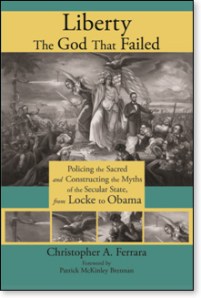
But something more meaningful also encouraged me to read this, for the author pledged to critique both the modern liberal and conservative/libertarian approaches to liberty.  The problems with modern America lie not so much with Republicans or Democrats, or any particular president, or era in our history, but instead within our very DNA as a Nation — Garrison Keillor’s daydream made real.

Before delving into the book’s arguments, I can say that it lives up to its promise.  He writes crisply, and the arguments roll like a freight train.  At 650 pages it’s a surprisingly quick read.  He has a voluminous bibliography.  But Ferrara tries to shoot everything and demolish every sacred cow, and thus sets the bar perhaps a bit too high for himself.  In the first half of the book I recognized many reputable sources from authors like Gordon Wood, Bernard Bailyn, and Joseph Ellis.  By the book’s end he repeats himself, and his discipline seems to crack (I noticed a couple “.com” footnotes later in the work, inappropriate for a book of this weight).  Still, though perhaps about 200 pages too long, Ferrara gives the reader much to ponder.

The book begins with brief summary of the heritage of Greek philosophy after the Peloponnesian War (431-404 B.C.). After the idolatrous parochial worship of their own political communities (see Appendix below) that started that devastating conflict, Plato and Aristotle saw that the state needed a foundation beyond itself.  Neither of them conceived of the state in Christian terms, but both saw that when the state merely served as a mirror for the populace, disaster resulted.  The state should aid in the living of the good life, which is the life of virtue.  The state should have no other legitimate purpose.  In other words, do we want the state to enable injustice and destroyed lives?  In the wake of Rome’s fall, medieval Europe picked up on this idea, and struck a new course.  They would have agreed with Jacques Maritain, who wrote in the mid 20th century that,

We must affirm as a truth . . . the Church’s supremacy . . . over all terrestrial powers.  On the pain of radical [earthly] disorder, she must guide the people towards the last end of human life, which is also that of states.

Without rendering justice to God, we cannot practice justice to others.

Of course the medievals did nothing new in this regard.  Every civilization that has ever existed before the Enlightenment linked the public recognition and worship of God/gods and politics.  Certainly most of the Reformers thought likewise, as Calvin’s Geneva or Puritan New England attest, among other examples.  Only since the Enlightenment has western man tried the novel experiment of severing themselves from looking at anything but themselves to guide their politics.

Ferrara continues with a brief defense of Christendom itself, which we can pass over quickly.  He notes that contrary to received myths with Enlightenment origins that continue to this day, Christendom had

  • Great cultural achievements (Gothic cathedrals, Sistine Chapel, etc.) that can only come with true artistic freedom
  • Economic freedom
  • Limited government, and therefore
  • Limited wars and violence

Ferrara recognizes wisely that defending Christendom stands outside the scope of his thesis, so he moves on from this quickly — perhaps it could have been left out, for it raises many unanswered questions.

By chapter four, he begins to lower the boom.

John Locke had a enormous influence over the founders.  Locke himself may have been either a deist or a Christian, but that, for Ferrara is beside the point (Thomas Hobbes also gets attention, but Locke had far more influence over our founders).  Locke’s “blank slate” metaphysics undermined much of the foundation for mankind knowing eternal ideas “in a state of nature,” contra Romans 1.  Since man has no shared foundation in the eternal, mankind must root government in the consent of the governed.  This is such a truism for us that we hardly give it a passing thought, but this means that “every man has the executive power of the law of nature (Locke, “Two Treatises on Government).”  Locke later states that “Virtue and vice are names pretended” based on the conventions of the day, and all this follows naturally on Locke’s view of the world.  All this forms Locke’s view of sovereignty as essentially a tautology referencing nothing but “the consent of the governed” to determine its will.

Certain places in colonial America based their societies on something like an idea of a Civitas Dei, i.e. the New England Puritans.  But with Locke the emphasis had changed, and America the nation, founded on Locke’s principles could never be a “Christian nation” and doomed itself to moral chaos.  Though other thinkers besides Locke had their role to play, most, like Montesquieu and Bayle drank deeply from Enlightenment thought.  Thus, the myth of an essentially conservative American Revolution designed to protect an already existing social order has no foundation.  The founders were revolutionaries in every sense of the word, and radically reoriented the basis of their society (I like Edmund Burke and his view of the problems between England and America, which Ferrara challenges.  This needs further consideration for me).  Ample citations show that men like Madison, Adams, Jefferson, and Washington saw themselves in this way.

The main problem with the American Revolution as Ferrara sees it, is not the concept of liberty in itself, but how our founders defined the concept.  Borrowing from Locke and others, liberty got defined either as . . .

  • A mere “freedom from” constraint from others, where, to quote Locke, “individual consent is the only proper basis for all man’s organizations, civil or ecclesiastical,” and,
  • The freedom for a people to define one’s own community, one’s own laws.  But the only possible basis for this under Enlightenment thought is “the consent of the governed,” or — “the opinion of most people.”

The end result of this ideology would make “Liberty” into a form of Power, the power to rule others, make laws, on the fly, with no reference to any eternal truth.  This proposition forms Ferrara’s central thesis.

Did the American Revolution play out this way?  At the crucial point of our history, did we turn towards a Civitas Dei or make Liberty our God, and thus make it a demon?

The book goes into some detail to show that many Founders had membership as Masons, and that Masons, by “faith,” were dedicated to deism.  The book references early modern and medieval constitutions that had explicit foundations in Christian belief and practice.  The Enlightenment changed this to “Great Architect of the Universe,” or other such vague references to a distant God.  This means that the so called “moderate Enlightenment” actually brought radical change to how our founders saw the world.  Again, ample evidence exists of this, i.e. Madison’s quote in “Federalist 14” that “our revolution has no parallel in the annals of human history.”  Gordon Wood also comments that the revolution, “fundamentally altered the character of human society.”  So the Revolution happened not to preserve an existing order, but create a new one.

We see the revolutionaries, just before and after the Revolution itself, impose their will to change society.  The Boston Tea Party is a good example.  Rather than let the “market”/people decide whether or not to buy the tea, the Sons of Liberty destroyed it (which happened after they failed to persuade the populace not to buy it, at least in Ferrara’s interpretation).  Liberty meant power over others, and it the revolutionary view of Liberty had pagan roots.  Ferrara perhaps goes a bit too far here, but does cite numerous examples of totems such as the Liberty Tree and Liberty Pole, and the resurrection of the Roman goddess Libertas, “invoked far more often than the Judeo-Christian god.”  This may seem too much for some, but Ferrara cites several 18th century sources, including the widely read and hugely popular Thomas Paine, to show that Liberty became a worshipped idol, and like all paganism, a source of power and manipulation.

The Sons of Liberty used this power to control the press during the Revolution, and tax and sometimes even arrest Tories for their support of England.  Jefferson, famed for his defense of freedom, made loyalty oaths compulsory while serving as Governor of Virginia.  Americans love to believe in the benign nature of their revolution compared to France, but our revolution produced 24 political exiles per thousand, while at the height of the Jacobin terror, France only had 5 refugees per thousand.^   Ferrara cites Murray Rothbard, a great admirer of the Revolution, who writes, “The revolutionaries moved to suppress crucial liberties of their opposition–an ironic but not surprising illustration of the conflict between Liberty and Power.”  “Jefferson,” Ferrara writes, “venerated as an icon by so many libertarians, was really just another statist.”  Maybe Rothbard is wrong.  Maybe no conflict really exists between American “Liberty” and power.

Liberty as Power continued after the revolution, where in Shay’s Rebellion the offenders had no right of habeus corpus.  Many were hung, and we see the “statist” power of Liberty on the rise.  By contrast George III never so much as arrested any revolutionary before the war.  Big government began right after the war’s conclusion with increased taxes and an army of public servants.  Could personal rights exist apart from the declared sovereign power of the people?

Deism, Ferrara argues, forms the natural religion of state grounded in Liberty.  It allows for God to create, and then nicely removes Him to the sidelines. So we have the Treaty of Tripoli (1797) unanimously approved by the Senate, which included Article XI:

As the Government of the United States of America is not, in any sense, founded on the Christian religion; as it has in itself no character of enmity against the laws, religion, or tranquility of [Moslems] . . . it is declared by the parties, that no pretext arising from religious opinions shall ever produce an interruption of the harmony existing between the two countries.

As John Adams later wrote, “[our government] was contrived merely by the use of reason and the senses.”

Ferrara continues on. . .

Liberty as Power had perfect expression in chattel slavery.  Many slave owners, in fact, explicitly defined liberty in terms of slavery.  They used the, “you can’t tell me what to do,” defense, but also went further and claimed that their personal exercise of liberty required slavery, i.e. more slavery = more freedom/more ability for me to live as I like. We rightly cringe at this today, but in fact the founders had no logic within their framework to contradict them, and slavery not only remained, but expanded.  Ferrara wants us to harbor no illusions — America from the American Revolution onwards was in no way a Christian country.  Nowhere does the Constitution recognize God as such, nowhere is any particular religious belief required.  We openly allowed for the oppression of blacks, and violated all laws and treaties to oppress the Indians as well under the same logic that allowed for slavery.  In other words, we had no law but the law of self, the idolatry of the self, or the consent based parochial community.  “We said it, it must be true.”

By this point the reader may grow faint, but not Ferrara.  Looking for a good guy in the Civil War?  Don’t bother.  Southern romantic myths about “genteel society,” whatever truth lay in them, rest on the foundation of slavery.  He exposes Southern myths about their so-called recovery of limited government.  The Southern constitution replicated the North’s almost exactly.  It formally recognized no Christian God (and if they had it would have been blasphemous anyway).  What about the North?  Nope — Lincoln expanded his power in ways George III never dreamed of, such as the draft, suspension of habeus corpus, and the like.  The North had the greater amount of power, so they won, and we in turn went to worship at Nebuchadnezzar’s statue.

Ferrara continues on, but I can’t.  Suffice to say, the growth of liberty as a means of power over our fellow man continues as his theme. His writing grows more scattershot, his sources get weaker.  But he does close on a fascinating and revealing note by examining Justice Kennedy’s “heart of liberty” section from his majority opinion in “Planned Parenthood v. Casey,” which overturned Pennsylvania’s abortion laws.  Kennedy wrote,

At the heart of liberty is the right to define one’s own concept of existence, of meaning, of the universe, and of the mystery of human life.  Beliefs about these matters could not define the attributes of personhood were they formed under compulsion of the state.

Many “conservatives” cried “foul” to Kennedy’s ruling, yet it bears remarkable resemblance Locke’s reasoning in his enormously influential Essay Concerning Human Understanding.  In his dissent, the “conservative” Justice Scalia argued that the decisions on these questions belonged to the state legislatures, to persuasion and the counting of votes — not judges.  Though seemingly on opposite sides, both Scalia and Kennedy drank from the same Enlightenment source, which is the essence of American political conservatism.  For both, it is consent, be it from an individual or group, that determines justice. Thus, no real barrier exists to things like pornography, abortion, homosexual marriage, and the like, provided the votes are there.  America’s very DNA means that we float along with whatever wind comes about by “consent.”  Our Constitution, far from constructing a limited government,** created a structure that would allow for this very thing.  Why would it not?  We should expect the Constitution to reflect Locke’s (and Montesquieu’s, and Bayle’s) views because our founders believed him.  Capitalism in this environment would only contribute to the growth of power, both in terms of big corporations, and in enabling whatever immoral choices we wish to make.

Well, what shall we say about Ferrara’s thesis?

I am a fan of some of John Le Carre’s earlier spy fiction, especially Tinker, Tailor, Soldier, Spy.   I remember reading a review of the book from an actual spy.  He praised it, but cautioned against anyone thinking that “this is what the world of spies really looks like.”  If as much backbiting and infighting existed as Le Carre depicts, no spy program would ever have any success.  

Part of me feels this way about this book.  America surely has had some success and done some good, right?  And the good we have done must have some good roots?  Must we burn every single thing down?*

I think Ferrara would counter that yes, we have done good at times, but that good is only the result of our consent based society sometimes aligning itself with eternal truth.  When we do so, however, we get “lucky,” and should not assume “that’s America.” This may be a fair riposte.  I will reserve final judgment for now.  But all in all, I found him persuasive on the inheritance of Western-based consent societies, especially when we remember the Napoleonic Wars, the Civil War, W.W I, II, and the fact that Nazi Germany, Maoist China, and Soviet Russia were essentially western rooted societies that acted for “the people.”

Part of the validity of his thesis can never have the requisite proof.  What would have become of medieval kingdoms and principalities with modern technology?  Would their wars have been as bloody?  Would certain kings have abused their power like a Stalin even with the more direct presence of Christianity?

We can guess, but never know.  The book also avoids certain key questions.  Would a Christian Commonwealth that Ferrara hopes for allow for freedom of speech, press, etc.?  If yes, what would be dimensions of those freedoms, and if no, would the cure be worse than the disease?  Or is “free speech” yet another idol of Liberty?  He never considers such things.  To be fair, I already stated that the book is too long, and his purpose in writing was to critique American foundations, not put up something definite in its place.  Still, we must face these questions to fully understand the implications of his thesis.

Some may object that even if Ferrara’s is correct, his point has no relevance.  Returning to the Civitas Dei will absolutely never happen now.  Yes — but  this doesn’t mean we should seek to understand exactly what we’re dealing with.  We should call spades spades.

While his ideas may lack immediate political relevance, they have great relevance for education.  So much of how we teach American history assumes significant possible divergence for various “hinge points” in our history with the War of 1812, Civil War, or with this president or that.  Ferrara tells us that many of the choices we think significant are only different shades of the same color.  The real path, the real decisions, got made in the 1760’s.  It’s almost as if we need to tell the story twice to do justice to both Ferrara’s ideas and the traditional approach.

This book should also speak to the Church.  Again, assuming he’s correct, the Church will not influence American politics directly without playing the “power” game.  If our system operates not by virtue but by votes, we may have to appeal to principles we really don’t believe in to accomplish our will.  Ferrara certainly does not believe we have any genuine Christian roots to which we can direct an appeal.

But the greatest value in Ferrara’s exciting, intriguing, but probably too ambitious work lies in how he gets us to rethink the concept of Liberty.  “Individual liberty is individual power.”  So said John Quincy Adams.   Isaiah Berlin gave the classic dilemma of negative (freedom from constraint) or positive liberty (freedom towards an end).  It appears that in the modern framework, negative liberty becomes an idol to self, positive liberty extended creates totalitarianism.  Ferrara splits the horns of the dilemma by reformulating the concept.  Liberty should mean freedom to do as we ought, not as we want, and without this understanding, our nation will float rudderless.

^We should consider, however, that in the “height of the Jacobin Terror” Robespierre’s government seemed much more concerned with executions than forcible exile.  Thus, while the American Revolution had its political compulsion, they preferred exile to execution.

*Perhaps ironically, part of Ferrara’s (a staunch Catholic classicist) work coincides nicely with Howard Zinn’s “radical” and “leftist” interpretation of American history.   Zinn is cited at least once, and probably more, in the footnotes.  In the review above I never delve into Ferrara’s critique of “Liberty” based capitalism, which he argues fosters immorality and at times, oppression and exploitation.  On the “oppression/exploitation” (one that admittedly Ferrara hardly develops) point we see another connection with Zinn.

**Ferrara briefly looks at the 10th Amendment, on which many proponents of limited government pin their hopes.  Ferrara argues that the 10th Amendment is a mere sop and has no actual teeth, not in practice, but in reality.  Those that designed the Amendment had no real belief in limited government in the first place.

Appendix: A.J. Toynbee, “The Idolization of the Parochial Community”

Unhappily, Polytheism begins to produce new and pernicious social effects when its domain is extended from the realm of Nature-worship to a province of the realm of Man-worship in which the object of worship is parochial collective human power. Local worships of deified parochial communities inevitably drive their respective devotees into war with one another. Whereas Demeter our common Mother Earth is the same goddess in Attica and in Laconia, the Athene Polias of Athens and the Athana Chalcioecus of Sparta, who are the respective deifications of these two parochial communities, are bound to be rival goddesses in spite of their bearing the same name. The worship of Nature tends to unite the members of different communities because it is not self-centred; it is the worship of a power in whose presence all human beings have the identical experience of being made aware of their own human weakness. On the other hand the worship of parochial communities tends to set their respective members at variance because this religion is an expression of self-centredness; because self-centredness is the source of all strife; and because the collective ego is a more dangerous object of worship than the individual ego is.

The collective ego is more dangerous because it is more powerful, more demonic, and less patently unworthy of devotion. The collective ego combines the puny individual power of each of its devotees into the collective power of Leviathan. This collective power is at the mercy of subconscious passions because it escapes the control of the Intellect and Will that put some restraint on the individual ego. And bad behaviour that would be condemned unhesitatingly by the conscience in an individual culprit is apt to be condoned when it is perpetrated by Leviathan, under the illusion that the first person is absolved from self-centredness by being transposed from the singular number into the plural. This is, however, just the opposite of the truth; for, when an individual projects his self-centredness on to a community, he is able, with less sense of sin, to carry his egotism to greater lengths of enormity. ‘Patriotism is the last refuge of a scoundrel’;5 and the callousness of committees testifies still more eloquently than the fury of mobs that, in collective action, the ego is capable of descending to depths to which it does not fall when it is acting on its individual responsibility.

The warfare to which parochial-community-worship leads is apt to rankle, sooner or later, into war to the death; and this self-inflicted doom is insidious, because the ultimately fatal effects of this religion are slow to reveal themselves and do not become unmistakably clear till the mischief has become mortally grave.

In its first phase the warfare between deified parochial states is usually waged in a temperate spirit and is confined within moderate limits. In this first phase the worshippers of each parochial god recognize in some degree that each neighbour parochial god is the legitimate sovereign in his own territory. Each local god will be deemed to have both the right and the power to punish alien human trespassers on his domain who commit a grievous wrong against him by committing it against his people; and this consideration counsels caution and restraint in waging war on foreign soil. It tends to prevent war from becoming total. The bashful invader will refrain, not only from desecrating the enemy’s temples, but from poisoning his wells and from cutting down his fruit trees. The Romans, when they had made up their minds to go to all lengths in warring down an enemy community, used to take the preliminary precautions of inviting the enemy gods to evacuate the doomed city and of tempting them to change sides by offering them, in exchange, honourable places in the Roman pantheon. When a local community has been exterminated or deported in defiance of the local divinity and without regard to his sovereign prerogatives, the outraged parochial god may bring the usurpers of his domain and scorners of his majesty to heel by making the place too hot to hold them except on his terms. The colonists planted by the Assyrian Government on territory that had been cleared of its previous human occupants by the deportation of the Children of Israel soon found, to their cost, that Israel’s undeported god Yahweh had lost none of his local potency; and they had no peace till they took to worshipping this very present local god instead of the gods that they had brought with them from their homelands.

Thus the conduct of war between parochial states is kept within bounds, at the start, by a common belief in the equality of sovereign parochial gods, each within his own domain. But this belief is apt to break down, and, with it, the restraint that is imposed by it. They break down because the self-worship of a parochial community is essentially incompatible with the moderation commended in such maxims as ‘Live and let live’ and ‘Do as you would be done by’. Every form of Man-worship is a religious expression of self-centredness, and is consequently infected with the intellectual mistake and the moral sin of treating a part of the Universe as if it were the whole—of trying to wrest the Universe round into centering on something in it that is not and ought not to be anything more than a subordinate part of it. Since self-centeredness is innate in every living creature, it wins allegiance for any religion that ministers to it. It also inhibits any living creature that fails to break away from it from loving its neighbor as itself, and a total failure to achieve this arduous moral feat has a disastrous effect on social relations.

A further reason why it is difficult to keep the warfare between parochial states at a low psychological temperature is because parochial-community-worship wins devotion not only by ministering disastrously to self-centredness. It wins it also by giving a beneficent stimulus to Man’s nobler activities in the first chapter of the story. In the histories of most civilizations in their first chapters, parochial states have done more to enrich their members’ lives by fostering the arts than they have done to impoverish them by taking a toll of blood and treasure. For example, the rise of the Athenian city-state made life richer for its citizens by creating the Attic drama out of a primitive fertility-ritual before life was made intolerable for them by a series of ever more devastating wars between Athens and her rivals. The earlier Athens that had been ‘the education of Hellas’ won and held the allegiance of Athenian men and women, over whom she had cast her spell, for the benefit of the later Athens that was ‘a tyrant power’; and, though these two arrogant phrases were coined to describe Athens’ effect on the lives of the citizens of other Hellenic city-states, they describe her effect on the lives of her own citizens no less aptly. This is the tragic theme of Thucydides’ history of the Great Atheno-Peloponnesian War, and there have been many other performances of the same tragedy that have not found their Thucydides.

The strength of the devotion that parochial-community-worship thus evokes holds its devotees in bondage to it even when it is carrying them to self-destruction; and so the warfare between contending parochial states tends to grow more intense and more devastating in a crescendo movement. Respect for one’s neighbours’ gods and consideration for these alien gods’ human proteges are wasting assets. All parochial-community-worship ends in a worship of Moloch, and this ‘horrid king’ exacts more cruel sacrifices than the Golden Calf. War to the death between parochial states has been the immediate external cause of the breakdowns and disintegrations of almost all, if not all, the civilizations that have committed suicide up to date. The decline and fall of the First Mayan Civilization is perhaps the only doubtful case.

The devotion to the worship of Moloch is apt to persist until it is too late to save the life of the civilization that is being destroyed by it. It does break down at last, but not until a stage of social disintegration has been reached at which the blood-tax exacted by the waging of ever more intensive, ferocious, and devastating warfare has come palpably to outweigh any cultural and spiritual benefits that the contending parochial states may once have conferred on their citizens. . .


Liberty and Regulation

DownloadedFileIt’s easy to see why John Kenneth Galbraith’s The Great Crash has a high place in the pantheon of mainstream economics books.  His narrative moves crisply, and he does not get bogged down in the details.  The economic information he shares must not be too difficult, for I have very little knowledge of economics and only failed to understand some of the book.

However, while the narrative moves along well, Galbraith sacrifices much to achieve this.  He admits that the reasons for the Crash and the resulting depression are legion and difficult to know precisely, but he backs off any kind of in-depth treatment.  At times he throws out lines about the need for regulation that I assume he agrees with, but he never develops this idea or the rationale for government regulation.  I finished the book feeling like he had no interest in resolving or even tackling the main question his book raises.

The main question, I think, is this:

  • Is liberty an absolute concept and therefore an absolute good?  If so, any restrictions placed upon it done (if done at all) would be done only for emergencies, and then only temporarily.
  • Or, is liberty in the end a relative concept, one that has meaning only within a given context.  If so, societies should feel free to tinker with it, restricting it here and there, to achieve optimal balance.  For example, inoculations make us healthier by giving us a small dose of disease.

Perhaps Galbraith avoids the question out of modesty, or out of fear of ruffling feathers.  In his book The Servile DownloadedFile-1State, Hillaire Belloc (who loved ruffling feathers and had no modesty) jumps right in.  Liberty, he argues, like our appetites, must be kept in check if we are to have freedom in the end.  Just as alcoholics lose their right to drink, so too abusers of liberty will be left with none of it.  Like any admirer of medieval times, Belloc argues for a careful, measured approach, one that in the end values stability over wide-ranging opportunity.

He traces the development of capitalism not from the Industrial Revolution but from Henry VIII dissolution of the monasteries, allying his government with the wealthy class by distributing the land among them.  What looked to be a bold move to secure his own power, Henry in fact only made his power subservient to the elite.  This is not freedom for the state or freedom for the individual.  

But he goes a bit further.  Since full-boar capitalism produces instability in the end, the people will reject it, and swing the other way to a “servile-economy.”  In this new economy they will have guarantees but much less freedom than before.  They will in fact, be made to work as the government becomes more and more allied with businesses — a form of slavery.  Belloc did not foresee the welfare-state, where it could become actually cheaper for some not to work at all, but this too would be a form of slavery for Belloc.

I believe that a free people should attempt to use government to help achieved legitimate societal ends, and in that way I have at least some sympathy with Galbraith and Belloc.  The problem is, what should we regulate and how much? The article below from Matt Yglesias (thanks to a link from Marginal Revolution) exposes some of the problems when talking about regulation.  Do we have the kind of society, and the kind of political environment we need, to successfully and appropriately regulate ourselves?  We shall see.

I did a piece about how annoying the paperwork for getting even the simplest small-business license is, which prompted a lot of weird reactions from conservative readers, like “Obama lapdog Matt Yglesias has epiphany: Gee, it’s hard to start a small business in D.C.!” and various comments about how I’m reaping what I sow, and now I should understand why lots of people vote Republican.

This is something I think I actually understand very well. I voted for Republican Patrick Mara the last time he was on the ballot for a D.C. Council at-large seat, and I’ll probably vote for him again. I voted for Mitt Romney for governor in 2002. I would have voted for Michael Bloomberg in the 2005 or 2009 New York City mayoral races, and in general I think the conservative critique of municipal government in the United States has a lot of merit. Republicans might be interested in why someone like me—someone who sympathizes with many of their economic policy views—still hesitates to vote for their candidates for national office. One reason is that I tend to think conservatives place much too little emphasis on the rights and interests of religious and ethnic minority groups, gay people, and the like. Another reason is that conservatives have much too much affection for state-sponsored violence. In terms of economic policy, Republicans tend to deride the hugely successful practice of taking money from the rich and giving it to the poor. But even on the regulatory front, there are real shortcomings to the Republican approach.


The way I would put this is that the American economy is simultaneously overregulated and underregulated. It is much too difficult to get business and occupational licenses; there are excessive restrictions on the wholesaling and retailing of alcoholic beverages; exclusionary zoning codes cripple the economy; and I’m sure there are more problems than I’m even aware of.


At the same time, it continues to be the case that even if you ignore climate change, there are huge problematic environmental externalities involved in the energy production and industrial sectors of the economy. And you shouldn’t ignore climate change! We are much too lax about what firms are allowed to dump into the air. On the financial side, too, it’s become clear that there are really big problems with bank supervision. The existence of bad rent-seeking rules around who’s allowed to cut hair is not a good justification for the absence of rules around banks’ ability to issue no-doc liar’s loans. The fact that it’s too much of a pain in the ass to get a building permit is not a good justification for making it easier to poison children’s brains with mercury. Now obviously all these rules are incredibly annoying. I am really glad, personally, that I don’t need to take any time or effort to comply with the Environmental Protection Agency’s new mercury emissions rules. But at the same time, it ought to be a pain in the ass to put extra mercury into the air. We don’t want too much mercury! We don’t want too much bank leverage!

Business licensing is different. “This city has too many restaurants to choose from” is not a real public policy problem—it’s only a problem for incumbent restaurateurs who don’t want to face competition. But in other fields of endeavor—telecommunications, say—the absence of regulations can lead to an uncompetitive outcome. Partisan politics is pretty simple, since there are only two parties to choose from. But the underlying structure of reality is quite complicated, and it’s worth your time to try to understand the issues.