Democracies and their Special Forces

Originally posted in 2015 . . . .

*********************************************

Field Marshal Viscount Slim memoir Defeat into Victory: Battling Japan in Burma and India is generally regarded as one the finest, if not the finest military memoir.  Having read it (and not having read many others) I won’t dispute the claim.  I often have a hard time with books written by ex-officers, who I find usually bog down in details.  I also, to be fair, have a hard time with spatial relations and without solid maps right in front of me I often get lost.

Slim’s writing bears some marks of what usually gives me trouble with books like this.  What distinguishes this book is his sense of style and humor.  He shares many anecdotes that paint himself a bit poorly.  He shares honest introspection about his actions without getting too much inside his own head.  When he asserts opinions of people he likes or dislikes he admits that others have different opinions.  Finally, he seemed interested in the campaign as a whole, more so than his role in it.

One of his slightly controversial opinions involved Orde Wingate.  Wingate was just the sort of commander that would appeal to Churchill.  Like Churchill he loved the knight-errant approach to war, and so the Chindits, or special forces, of the Burma campaign, gave Wingate a chance to sally forth boldly behind enemy lines.  The direct military effectiveness of his operations seemed limited, though even Slim admits that he boosted morale through the exploits of his men in the aftermath of a complete defeat inflicted by Japan.

Slim’s concluding comments interested me most about this aspect of the Burma campaign.  He thought that England’s reliance on special forces, and the mythology surrounding special forces, did not serve an overall good purpose.  He mentions the variety of special forces the British used (i.e. mountain divisions, amphibious divisions, long-range penetration divisions, and so on).  He acknowledged that some showed great examples of courage but writes,

Yet I came firmly to the conclusion that such [special forces] . . . were wasteful.  They did not give, militarily, a worth-while return the resources in men, material, and time they absorbed.

To begin with, they were usually formed by attracting the best men from the normal units by better conditions, promises of excitement, and not a little propaganda.   . . . The result of these methods was to undoubtedly to lower the quality of the rest of the army, not only by drawing off the cream from it, but by encouraging the idea that certain of the normal operations of war were so difficult that only specially equipped elite corp could undertake them.  Anything, whatever short-cuts to victory it may promise, which thus weakens the army spirit is dangerous.

. . . The level of initiative, training, and weapon skill required in a commando is admirable; what is not admirable is that it should be confined to a few small units.  Any well-trained infantry battalion should be able to do what any commando can do . . .   This cult of special forces is as sensible as to form a Royal Corp of Tree Climbers and say that no soldier who does not wear its green hat with a bunch of oak leaves stuck in it should be allowed to climb a tree.

Slim retracts a wee bit of this statement when he acknowledges that certain special units devoted to intelligence and sabotage, which fall outside the duties of standard training for  a soldier, but reiterates his main point when he stresses that the multiplication of special forces in Burma made unified command difficult to attain.

Our current war on terrorism presents many political and military challenges.  We have responded in part by significantly increasing the prominence of our special forces, both in budgets, deployments, and perhaps also in a surrounding “mythos” about them.  Like Slim, I am grateful for their courage and dedication.  Perhaps unlike him, I am not willing to apply his thoughts wholesale to our current situation just yet.  We face different sorts of military challenges now as opposed to W.W. II.  But we should not assume that we can do whatever we like militarily without it  having consequences on our values and political practices.   We should at least ask whether or not the increase of special forces may distance the military from the general public, or whether or not the military will be for “the common man” in the near future.

Special Forces demand, among other things, a great deal more secrecy, something else Slim abhorred.  Along with drones, they can be used with less public notice and oversight.  Democracies do not thrive with a populace disconnected from its government.  Is there a parallel between the increase of special forces use and the recent NSA scandals?  In other words, a military disconnected from a general democratic population may work (even unconsciously) to undermine the political application of democratic values.

Other wars have brought about shifts in our country’s values, sometimes for the better.  Maybe this current war will lead us into a better place as well.  Whatever the case, we cannot escape some kind of social and political change if we continue to fight in almost exclusively in a clandestine manner, and these changes will likely alter how we practice democracy at home.

Carnival Time

One of my favorite of ESPN’s 30 for 30 documentaries is “The Guru of Go,” about Loyola Marymount University’s run-and-gun style of basketball.  Those who follow college basketball today know that scores routinely end up in the 60’s, but LMU routinely scored in the 90’s and had many games of over 100 points or more.  Their command over their own style of play “forced” other teams to try and keep up.  But . . . even when teams could stick with Loyola Marymount  in the short-term, the fact that they got caught up in the fast pace meant that they played on enemy territory.  Inevitably, the pace would wear down opponents and Loyola would shoot ahead, leaving the other guys wheezing on the bench.

Most every Christian in the west of an orthodox (small “o”) bent acknowledges that the so-called culture war is over and has been for some time.  We lost.  This might surprise someone transported from, say, the 1980’s when it appeared that “victory” was at hand, with the ascendancy of the moral majority and political conservatism firmly entrenched.  Now looking back we see that marshaling coalitions and votes for laws and Supreme Court justices only meant playing on enemy territory.  Rather, the “City of God” cannot arise using the tools of the “City of Man.”  Like Loyola’s opponents, we got enticed into playing a game ill suited to us–a secular game on secular turf.

Charles Taylor’s A Secular Age will likely prove too deep and dense for me to glean much from.  He writes in a conversational style but with deep concepts and many variations of thought.  One needs a great deal of focus to follow him.  But I felt, perhaps rashly, that the whole of his thesis made sense when he discussed . . .

medieval carnivals.

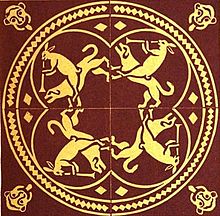
Medieval carnivals took some different forms in different times and places.  Some days merely involved eating and drinking too much, such as “Fat Tuesday.”  Some had more complexity/absurdity, such as the “Lord of Misrule,” which happened around Christmastide.  In this space of time a sub-deacon or even a peasant might get appointed as chief of festivities, which obviously involved eating and drinking, among other things.   Other such similar days had dukes serve as peasants and peasants occupy manorial houses, and so on.  So in the carnival emblem to the side, all of creation seems reversed, as the hare triumphantly rides the hunting hound.

Most commentators point out that such festivals allowed people to let off steam, especially necessary in a structured and hierarchical society such as medieval Europe.  Even some contemporary clerics acknowledge this role for the carnival.  But this forms only the baseline for understanding the role of the carnival.  The emblem of the hare and hounds attest to something grander at work.

Those committed to Christianity know that it provides a means to understand all of experience, not just life after death.  Much of our Christian life involves holding things in tension.  So we believe that God is one God in three persons, neither favoring the unity or the plurality, but going “straight ahead.”  Jesus is fully God and fully man, “without confusion,” as stated by the Council of Chalcedon.  The Church hymns the Virgin Mary as the “unwedded bride.”  For the Mother of God both terms truly apply, without confusion.  Scripture is the Word of God, written by particular men at particular times, and so on it goes.  Christians rightly recognized the Incarnation as the focal point of human experience, for in the coming of Christ creation gets remade and reborn, as John attests in his Gospel by obviously referencing Genesis 1.  After the Incarnation we live in a new world, but in many ways outwardly it exactly resembles the old world.

In the world B.C.*, people saw childlessness as a curse.  Of course children are a blessing in a physical, natural sense, but at a deeper level we were meant to perpetuate the continuing natural order as a means of bringing about the coming of Messiah.  No children meant no participation in redemption.

In the kingdom to come, however, we will neither marry nor be given in marriage.  Thus, we honor monastics.  At the baseline, we honor them for their sacrifice.  But their vows of poverty and chastity mean that they do not live in ordinary time. Their lives transcend the ordinary needs of the world with its buying, selling, and saving, and also reflects the reality of the new creation wrought by Christ. They live partially in eternal time, which contains all time.  They “neither marry, or are given in marriage,” and of course in the heavenly kingdom no one needs money.**  Monastics may or may not live exemplary lives, but the fact of their “station in life” puts them closer to eternal time than laity and even priests, who must concern themselves with affairs in the world.

In his essay Leisure, the Basis of Culture, Josef Pieper makes that case that the only way to escape the cycle of work is to receive breaks in time from without.  Even vacations, he points out, cannot be “leisure” if we view them strictly as breaks from work.  Modern views of labor probably originated with Marx and his followers, and certainly we should sympathize with the “proletariat,” if we wish to use the term.  But as Pieper wryly remarks, “Proletarianism cannot obviously be overcome by making everyone proletarian.”

Ordinary time may be strictly linear, but not “eternal time.”  Eternal time contains all moments.  We the laity, despite our ordinary and natural station, can still at times participate in eternal time.  Taking the crucifixion as an example, Taylor writes,

Meanwhile the Church, in its liturgical year, remembers and re-enacts what happened . . . [at Christ’s crucifixion].  Which is why this year’s Good Friday can be closer to the Crucifixion than last year’s mid-summer’s day.  And the Crucifixion itself, since Christ’s passion here participates in God’s eternity, is closer to all times than they in secular terms are to each other.

Put in other terms, on this view tracts of secular time were not homogenous and interchangeable.  They were [differentiated] by their placing in relation to higher time.

Medieval carnivals did not participate in sacred time, but they did recognize the duality.  By breaking down the natural order of ordinary time, they testified to the reality of sacred eternity, where a completely new order will forever take hold of the cosmos.  Thus, the breaking down of the order gives it new life, the secular/ordinary order gets reborn freshly after each carnival.  It makes perfect sense that the “Lord of Misrule” would “reign” during Christmastide, for this time on calendar celebrated the breaking in of the eternal into temporal via the Incarnation.  “How can the guests of the bridegroom fast while He is with them (Mk. 2:19)?”

Carnivals did not protest against the prevailing order so much as re-affirm it.  Recognizing its temporary and inferior status was the only way it could be reaffirmed, the only way order could perpetuate.

We remember Henry VIII for his many marriages, but it makes perfect sense that an absolutist like Henry would also abolish the days of misrule at Christmastide.  This too accompanies his seizure of monastic lands.  The monastic vocation and the carnival testify to this tension in time, and to the transitory nature of the state.  No statist like Henry likes such things.  Worlds other than those they made frighten and confuse them.

We see too that whatever its intentions, by abolishing liturgies and the church calendar, the Reformation paved the way for secularization.  Bit by bit Protestant denominations moved away from the “sacred time” of the church calendar year. Taylor cites Walter Benjamin’s description of “homogenous and empty time” as the mark of modern consciousness.  “On this view,” Taylor writes, “time [has no meaning in itself] but is like a container, indifferent to what fills it.  Without “eternal liturgics,” and without a sense of time as a gift to mold and shape us, all that is left is for us to fill time with meaning.  And so we have, and created the secular state thereby.

This secular victory is quite empty, however. The homogenization of time makes everything sterile.  Nothing can have real meaning.  Without fasting, our materialistic civilization cannot even feast.  With the homogenization of time comes the homogenization of space–including space for worship.  With no delineation of either time and space, it’s no wonder that, to riff on Milton Friedman, “we’re all secular now.”

We see this view of the homogeneity and plasticity of time permeate our society. Take Fridays for example.  Back in ye olden days Fridays for everyone involved fasting of some kind, for each Friday participated in some way in the Crucifixion–not just in memory, but in reality.  After abandoning the dual sense of time described above we instead oriented time around our work/school week.  Now Friday has taken on the opposite role in our secular liturgy as a day of release, fun, and celebration.  Imagine a family trying to establish something of the older sense of Fridays, and the enormous accompanying societal/liturgical pressure to go out and have fun with friends from work or school facing them square in the face.

“Resistance is futile.”

Of course, this same story has been played out in so many other areas. Without Advent we get Black Friday.  Without Paschaltide we get “Spring Breakers.”

In a recent conversation with Hank Hannegraaf Rod Drehrer recounted his meeting with a group of evangelical pastors near the election.  While Drehrer understood why one might vote for Trump “in sorrow,” as an alternative to Clinton, he admitted an utter incredulity in seeing some pastors positively enthused about Trump.  The response from another evangelical who shared his lament was, “You have to understand, they have no Plan B.  Politics is the only way they can conceive of changing the world.”^

The statism of Henry VIII–and others– has born disastrous fruit.

Many on the more secular left might lament Trump’s election and see it as proof that the “war has yet to be won,” or something like that.  They can relax and break out the cigars.  The war was won long ago, the rest has been mopping-up operations here and there.

I find it hard to tell if Taylor laments or merely describes the shift towards secularism.  He does state that at most all those who hope for a return can do is indulge in nostalgia.  I agree that the tide ran out long ago, but I have more hope.  A proper and effective response will first recognize that turning the battleship will take generations of small faithfulness in our lives and homes.  We should begin with a developing a new sense of time.

Dave

Written (originally in 2018) on the Feast of the Chains of St. Peter, and the Commemoration of St. Paul the Apostle

*The attempt to replace B.C./A.D. with BCE/CE may only be meant as a sop to political correctness or inclusivity.  No doubt people mean well.  But still, the switch is at root an attempt to remake our understanding of time.  Though I lament this shift, it is in many ways long overdue, as we no longer order our lives around the impact of the Incarnation.  It took the French just four years of Revolution to switch their calendar.  It will take us much longer, because we have nothing to replace it with.  We lack the bold audacity of the French, which is a good thing, considering that tens of thousands died in the French Revolution and millions died in the Napoleonic wars.

**Visitors to the monasteries on Mount Athos notice that two different clocks are used in many of the monasteries.  One, the familiar ordinary/secular time, the other clocks measure the now nearly extinct “Byzantine” time (Byzantine clock seen bel0w) to reflect this dual reality.

^So too the French Revolutionaries, which explains the failure of their festivals.  They sought to ape medieval carnivals, but key differences persisted:

  • They were attempting to construct a new order, not deconstruct an existing order.
  • Thus, their festivals had a much more didactic emphasis than medieval carnivals, which
  • Made them much more boring.

A Prohibiting Question

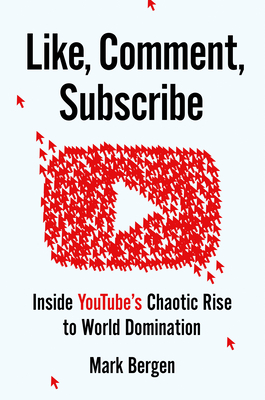
If it did nothing else, Mark Bergen’s Like, Comment, Subscribe: Inside YouTube’s Chaotic Rise to World Domination gave me a great deal of sympathy for those that tried to run this unusual company. Everyone in the early years of the web believed that the power the internet granted for anyone to say anything would work overwhelmingly for good. Much of YouTube’s history can get boiled down to dealing with the continual disproval of this hope. For every click on a silly, weird, enlightening or endearing video, another of icky sexual, violent, racist content, would crop up somewhere else. Keeping up with problematic videos quickly proved impossible. Deciding what should stay and what should go sometimes came down to blunt metrics, other times to personal judgments by a few harried staff. Neither approach could solve the problem–the problem has no solution. The internet disrupts everything. To quote Yeats, with the internet the center no longer holds. When that happens, movement away from the center takes one up, down, and every which way possible–certainly not always up! And yet, despite its missteps and issues, no one can conceive of YouTube somehow failing. Very quickly it became part of the American experience.

Many have attempted to define the essence of America. My personal stab involves the concept of “movement.” I suppose that means that I basically agree with Frederick Jackson Turner’s thesis. From the moment Europeans arrived on the continent, they began expanding their reach at a rapid pace. After the French-Indian War, England made a treaty with France that guaranteed English settlers everything east of the Appalachians. Not good enough. The Americans wanted more, and almost immediately violated the treaty terms, which resulted in Pontiac’s War of 1764. The English surely felt angry and confused. We had perhaps 10x as much land as England, and somehow this was not enough? Can’t we settle down for five minutes?

Of course we rapidly set ourselves on.a course of acquiring more land, by fair means or foul. We can understand this phenomena in part through our associations of land with liberty, which comes partly through John Locke, and partly through various other streams. But more deeply, our national predilection for movement comes naturally vis a vis our geographical symbolism. Sure, the world is round, but for Europeans at least America represented the end of the world, the edge of the world. Naturally we lived into this mental model. On the edge, things get blurry and more fluid in a literal sense (rivers or bodies of water often form boundaries of different places), and culturally and spiritually as well. America has always existed on that fluid margin.

It should not surprise us, therefore, that America has created technologies that compress time and eroded space, such as the telegraph (which admittedly had various people in different places working simultaneously with Samuel Morse), the car, the airplane, the internet, and so on. All of these technologies have had the overall impact of adding fluidity and movement to our world.

Prohibition has always perplexed me. Ken Burns’ documentary series succeeded admirably in looking at the small details of how the movement came about and collapsed. But whatever explanations we offer, from a distance Prohibition must strike us as historically bizarre. Alcohol has played a significant role* in every civilization ever that I am aware of, and we somehow believed that we could and should turn off that spigot.

Initially at least, it should also strike us as strange that an era that that moved so fluidly and loosely in a progressive direction, with

  • The beginning of cars going mainstream
  • Women getting the right to vote
  • Women starting to look and act more like men (hair and clothing styles changed)
  • General economic growth and prosperity
  • The advent of radio

should on a dime attempt a very ambitious “tighten” in an area more or less destined to fail. What follows is my attempt to understand this seeming paradox.

We tend to believe that

  • Liberals like to ‘liberalize’ and keep things moving in a fluid direction, and
  • Conservatives like to tighten things and prevent change.

So, the political left favors “time,” and the right “space.”

But in reality, both sides have aspects of their opposite. Progressives tend towards fluidity and the consequent “mixing” of gender identities, sexual identities, and the like. They disdain borders in culture and politics, preferring a global outlook. But they want much more stability on questions of speech, they seek to protect and create “safe spaces” for those they believe disadvantaged. They also prefer equality, which wants everyone together in one place, and want the market contained to prevent inequalities.

For their part, conservatives want to contain traditional ideas of family, sexuality, and the like. They value the defined space of country and flag. But they also want the market flowing freely. And–they value liberty over equality, which separates people and allows for distinctions in accolades, money, and the like.

One could see this as a kind of schizophrenia for both sides, a manner of confusion that could exist on the geo-spatial margin. I think that explains American politics partially. No question–America is weird, and likely always will be. Our political disagreements then, involve not “Tight v. Loose” but where to tighten, and where to loosen.

Though American politics is weird, I also think that fundamentally each person–and each civilization–must create some kind of balance between stability and change, because it forms the pattern of existence. Life requires it. Too much fluidity and mixing brings the flood and chaos–we perish from drowning. Too much rigidity puts us in the petrified forest, where we perish from dehydration. So we need to craft if not an actual balance between these two aspects, at least some kind of working relationship. One of our problems in the modern era is that traditional societies had this relationship worked out in theory, but mostly in practice. You see this in times in liturgical calendars for fasting, feasting, carnivals, and so on. Today, we subconsciously understand the need for stability and fluidity but have no clear idea of how to have both properly, and no guides in our culture to inform us. So, we flail about blindly instead.

I think something similar happened with Prohibition. For the above mentioned reasons, American society in 1920 felt itself on the edge of a precipice of sorts, ready to engage in a great deal of fluid movement socially, culturally, and economically. I fit most aspects of a conservative and so favor stability, but I do not subscribe to Fluidity=Bad, Stability=Good. Obviously both are good or bad depending on context. So, I do not mean to say here that the changes in the 1920’s were bad per se, but that their scale contributed to our need to tighten somewhere else. The dramatic and foolish nature of the tightening that occurred over Prohibition, I propose, was a subconscious reaction to a dramatic acceleration of fluidity. So perhaps either

  • Because we lacked a coherent means of knowing how and where to tighten a particular area of society, we landed on alcohol more or less randomly, or
  • The unprecedented loosening would require an unprecedented tightening, with alcohol then as the somewhat natural choice.

I find the latter more persuasive, though either one helps us answer the mystery of Prohibition.

Dave

*I understand the argument that a) Americans drank more than other civilizations had at any time previously, and b) Drank maybe too much harder stuff than wine, mead, beer, etc. Perhaps Prohibition might have had a better chance of success if they had focused on liquors instead of everything, but I doubt it.

The Jazz Age

Some no doubt find themselves enormously annoyed at the rise of flat earth ideas. I find flat earth theories fascinating, though in no way do I profess belief in a scientifically measurable flat earth. The Earth is round. But, I confess, I would find it hilariously fun if indeed the Earth was physically flat, probably because I am not a scientist.

I find the recent appearance of these ideas intriguing not because I find them convincing, but because of what it says about our cultural moment. In other words, the “physical” part of what flat-earthers say might amount to nothing. The fact that they say it, and that many seem to agree, surely evidences a general weakening of the center in our culture–a signal amidst the noise. We no longer trust even the most basic of assumed narratives.

Traditional authorities and traditional ways of creating meaning in our culture no longer work. Many loaded criticism onto the CDC for how they handled COVID. I have no great love for the CDC, but one could view them not as the main character in a tragedy, but almost as a minor player in a much larger narrative. This breakdown of trust in the central narrative has happened in other areas as well, in elections, in the media in general, and so on.

But, while I have a large amount of trust that we live on a round earth, we all know that experientially we live on a flat earth most of the time. We do not experience the rotation of the earth–we see the sun move. Our senses are not lying to us. Here the bare facts of the Earth’s rotation matters much less than our experienced reality. Our experience shapes reality more so than the other way round.

On his Marginal Revolution blog Tyler Cowen posted an amusing link to every problem laid at the feet of jazz in the 1920’s and 30’s. If one takes the time to peruse, we see jazz blamed for

  • Warts
  • Small family sizes
  • Indigestion
  • Difficulties in college athletics

and so on. The natural reaction for us moderns typically involves a bemused smile at the obtuseness of panicky fools in the past. Perhaps we imagine that we ourselves would never react in such a way. The key here for historians at least, involves seeing if any signals exist amidst this mishmash of chatter.*

Most every western culture experienced profound shifts after W.W. I. One can argue that such changes had their roots in developments decades earlier, in the Industrial Revolution, or centuries earlier with the Scientific Revolution and the Enlightenment. One can go back further if you want. Making connections like this has its place, but we also need to separate, to delineate, as well as join together. Acknowledging the myriad of forces that drive change, we should ask if Jazz in the 20’s and 30’s stands out in any particular way.

Many have remarked how W.W. I destroyed the last vestiges of aristocracy in Europe, both physically and culturally/spiritually. This brought about more democracy politically, but perhaps more importantly, also culturally. Now the “bottom,” or “low” culture would have more prominence. I do not use these terms in a derogatory way. High and Low culture both have their place–the question involves what place, exactly. Perhaps one could argue that

  • Beethoven (maybe Mozart?) helped start this downward movement by using emotional themes and motifs heavily starting in the middle of his career. This has significance because of the place of emotions in the structure of the body, which reflects in certain respects the structure of the cosmos. Appealing to the emotions meant appealing to our bellies, what lays “lower” in our being.
  • With Franz Liszt, we see a mixture of high and low culture (‘high’ skill with ‘low’ folk motifs) with a ‘low’ reaction to him (ladies swoon and scream–he’s a rock star).
  • At the turn of the century Mahler (whose music I neither like nor understand, so take this with salt) completes the destruction of the classical forms, paving the way for something else. Maybe Stravinsky’s Rite of Spring worked in a similar way upon the world.

The visual arts mirror this trend in music, starting with Turner as early impressionism, down to Monet, Van Gogh, and then finally Duchamp’s Nude Descending a Staircase

Joseph Mallord William Turner (British, London 1775–1851 London) The Lake of Zug, 1843 British, Watercolor over graphite; 11 3/4 x 18
Nude Descending a Staircase

This progression towards less fixed form and more loose, popular expression up until W.W I certainly took place, but the dam had not burst, so to speak, however many cracks any perceptive observer might have noted at the time.

But with the breakout of jazz and swing. suddenly popular, “low” culture became the dominant culture, flipping things from a top-down/old-to-young to the reverse. Now the young grabbed the throne, and culture obligingly followed. The manic way people took to this new form should indicate that something was not quite right. Clearly, something happened in how we viewed the world, something throttled us, in a sense, and made us into something new.

Marshal McLuhan has the fascinating idea that the switch to electricity primarily drove this change, which began in earnest just before W.W. I. His complex argument can get boiled down to his belief that

  • The culture of ‘printing press’ man would lend itself to a filtered experience of the world. We gained the ability to separate our experiences in a detached way. For example, any selection from Bach’s Well Tempered Clavier has emotional content, but that comes later in the listening experience and not right away.
  • The electric age would thrust western man back in time, to a more tribal mode of culture, where sensory experience integrates and brings everything “all at once.”
  • Whichever culture we prefer, this sort of culture will not facilitate the “cool” detachment needed in a linear print culture. We would now run “hot,” experiencing culture When listening to, for example, James Brown, the impact is immediate, and does not lend itself to analysis as does Bach.

Again, whether one regards this shift as good, bad, or indifferent, it represents a massive psychic shift in perception, which would lead to a new way of life.

I do not suggest that we should adopt McCluhan’s thoughts whole hog. Exploring religious factors would also yield interesting results. But culture stands right next to religion, and I find his lens a good one. The music of jazz, appearing right at the advent of radio and electricity, fits into this shift. The experience of early swing music at least has an immediacy, and totality of effect.

The linked post from Marginal Revolution about the impacts of jazz show lack of thought, some stabs in the dark, and some panic. But those early worry-warts had an intuitive insight–they knew that something big was afoot that would alter everything.

In its modern incarnation, democracy arose from the pinnacle of the print age in the late 18th century. Our political practice, and our rights, such as freedom of speech, require a certain amount of practiced detachment. This posture now runs in short supply in certain aspects of our culture, and we may soon experience a seismic shift akin to what took place in the 20’s and 30’s. So, when we poke fun at the past and assume our own superiority, we should pause. Our modern world might resemble chickens without their heads soon enough. If the bare facts don’t tell that story, our experience might. Historians should look in both places.

Dave

*None of what follows should be seen as disparaging to jazz. It is one of my favorite musical genres. I regard Count Basie (more than Louie Armstrong or Miles Davis, though obviously they are all magnificent), as one of the great emblems of American culture of the 20th century. No one managed such a distinctive, punchy, groove for longer. Miles Davis had more intellectual inventiveness, and John Coltrane played with more rich emotion. Neither of them have nearly as much fun as Count Basie. Likewise, Basie could never be considered the best piano player, and maybe not even a “great” piano player (though I would say so, but admittedly in a certain sense of the term). But he was always the most fun, as this little moment at the 4:05 mark attests.

Slant Deeds to Straight Times

I very much appreciate Peter Thiel’s contributions to public discourse. I likely lean away from his overall optimism about technology–I wish we could think of a way to grow economically without needing to radically altering the labor market and our sense of things with the latest invention every few years. That said, those who can combine business acumen, incisive cultural commentary, and theological insight deserve a listen.

The subject of Constantine came up in his recent interview on the Meeting of Minds podcast with Jerry Bowyer. Thiel alluded to the problems of governance in accordance with truth and goodness. Politics is inevitably icky, and linking Christianity with such ickiness has always proved problematic. Thiel made the intriguing comment that given the chaotic nature of the times, perhaps Constantine had it right in postponing his baptism and official conversion until near his death.

I had never thought this way before about Constantine, and while I wished Thiel had continued his thoughts on this point, the fact that he left it at that leaves me room to speculate with abandon.

To understand politics, and to try and have some sympathy with Constantine’s decision, we need to see the difference between Authority and Power. Hopefully both have a strong relation to each other. But in strange times, they tend to move further apart.

“Authority” contains the core, and the origin, of a particular action. The core must be solid, and stable. For Authority to work, it has to embody this reality. Authority gives legitimacy, or impetus, or perhaps even permission, to Power.

“Power” applies Authority, and so must have more fluidity and movement. It is this movement which gives Power, well, its power. This motion will have an effect, however, regardless of its association to Authority. That is why we hope that Power will always stay connected to legitimate Authority.

Some examples of this Authority-Power dynamic at work . . .

  • An army waits to go right or left. The general, back at HQ, gives the order. The corporals and privates eventually start to move and they begin the attack. The general has authority, but has no power by himself. What can one man do? But, the general actuates Power, and gives Power its purpose. The army starts to move. Authority (hopefully) tames and directs Power.
  • In chess the King/Authority moves little, and hence has little Power. Power belongs to the Queen, and so she has the most freedom of movement. But everything depends on the existence of the King/Authority.
  • People often stated about Queen Elizabeth that she had no real power. Very true. But she was beloved nearly the world over because we instinctively realized that she embodied Authority to near perfection. Her bearing, countenance, and behavior all spoke of Authority. It was crucial, in fact, that she rarely sought to have Power–this allowed her to maintain Authority.
  • We see these patterns on Earth because it is the foundation of all things in the life of the Trinity. God the Father does not “move.”** He is, in a way, the Origin. God the Son moves more, but His movement is somewhat “restricted” to going down and then up again in a specific place. It is the Holy Spirit, the “power of God,” which “blows where it wishes” (John 3:8) going to a fro throughout the Earth.

When Authority and Power have no clear connection, then things get a little weird, and actually have to get a little weird, to set the times right again. Think of King Saul pursuing David. God’s anointed king (Saul) betrayed his calling, making authority in the realm more or less of no effect. Note, for example, the story of Jonathan and the honey, or the fact that Saul cannot catch David. David must then resort to weirdness to come to a place where things get right again, even to the extent of

  • Feigning insanity to ingratiate himself with the Philistines, and
  • Leading a portion of the Philistine army

Centuries later, with the Romans occupying Palestine and the Jewish religious leaders failing the people, no true Authority existed among the people of God. It took a man dressed in camel skins who ate bugs to bring hope and point to the one who “taught with authority” (Lk. 4:32).

Many legends and folklore point to this same dynamic. When King Richard languished in prison and King John took the throne, the only honest men were the thieves in the forest with Robin Hood. When we remember that the forest for medievals meant a dark, dangerous, unpredictable place, this dynamic looks even stranger. Once King Richard returned, the merry band disbanded.

Understanding this relationship gives us a good lens to understand controversial political actions. For example, some criticize Lincoln for the Emancipation Proclamation, usually on two fronts:

  • Lincoln had no Constitutional authority to issue the edict, and
  • The edict actually accomplished nothing, serving as a mere empty symbol

Though I am no Lincoln expert, I suspect that he thought that Authority (i.e., the Constitution) had fled the scene by 1860. The Constitution already suffered mightily “de facto” by the very fact of the secession of several states. The Constitution was designed to bind the states together. More importantly, “Authority” failed to solve slavery, our most pressing moral, cultural, and political problem. Not only could operating under the Constitution not solve the slavery problem, slavery got much worse from 1788-1860.

This meant that Lincoln might have to lean into the weird, and use Power to knock Authority back into place. The Emancipation Proclamation was weird, no question. One can argue that it actually freed no slaves at all. But if one looks at a bit of a slant, we see that it set in motion events that led to Authority set back in place with the 13th Amendment banning slavery. Lincoln rightly intuited that the U.S. could not exist on any other basis, because otherwise the Constitution could not serve the role of Authority for the nation.

All of this brings us to Constantine.

Constantine remains an ambiguous and problematic figure for many westerners for a few different reasons.

  • Some see him as corrupting the church by linking it with the state
  • Some see him as using the church to further his own power
  • Some see him as a hypocrite, using Christianity as a cover to accomplish certain political ends.

Of course, Christians at the time saw him much differently.

  • He ended Diocletian’s persecution of Christians
  • He commissioned the building of numerous churches, including the Church of Holy Sepulcher in Jerusalem
  • He restored property taken by Diocletian to Christians/Churches
  • He used the Church as the main arm of charity for the state
  • He made Sunday, the “Lord’s Day,” a holy day with no work mandated, allowing space for everyone to attend church
  • He exempted clergy from civic duties, significantly contributing to the church’s freedom
  • Perhaps most importantly, by “neutering” pagan religion and removing the foundation of the state from pagan sacrifices, he made it possible to found civilizations on an entirely new basis.

But for sure, many of his other actions raise eyebrows, such as the possible execution of his son, his turning on Licinius, Crispus, and the like. And then, if he was such a Christian, why postpone baptism until the end of his life?

Certainly, Constantine presents us with many conundrums. But we might get more clarity if we think of him as exercising Power in an attempt to create a new Authority. His behavior will look odd and wrong looking straight on, but if we look from angle, we might see different things.

Rome experienced an almost absurd amount of political instability in the 3rd century AD, as the following list shows:

  • Septimius 193–211 
  • Caracalla 211–217 
  • Geta 211–212
  • Macrinus 217–218 A.D.
  • Diadumenianus 218 A.D.
  • Elagabalus 218–222 A.D.
  • Alexander Severus 222-235

The Soldier Emperors

  • Maximinus I 235–238 
  • Gordian 238 A.D.
  • Balbinus and 238
  • Pupienus (in Italy) 238
  • Gordian III 238–244 A.D.
  • Philip the Arab 244–249 A.D.
  • Trajan Decius 249–251 A.D.
  • Trebonianus Gallus 
  • (with Volusian) 251–253 A.D.
  • Aemilianus 253 A.D.
  • Gallienus 253–268 
  • with Valerian 253–260 A.D.

Gallic Empire (West)

following the death of Valerian

  • Postumus 260–269 A.D.
  • Laelian 268 A.D.
  • Marius 268 A.D.
  • Victorinus 268–270 A.D.
  • Domitianus 271 A.D.
  • Tetricus I and II 270–274 A.D.

Palmyrene Empire

  • Odenathus c. 250–267 A.D.
  • Vaballathus 
  • (with Zenobia) 267–272 A.D.

The Soldier Emperors (continued)

  • Claudius II Gothicus 268–270 A.D.
  • Quintillus 270 A.D.
  • Aurelian 270–275 A.D.
  • Tacitus 275–276 A.D.
  • Florianus 276 A.D.
  • Probus 276–282 A.D.
  • Carus 282–283 A.D.
  • Carinus 283–284 A.D.
  • Numerianus 283–284 A.D.

Obviously, any reality of Authority had flown the coop in Rome, and only Power remained. After winning the battle at Milvan Bridge, Constantine entered Rome as someone not yet a Christian, but sympathetic to Christianity, where Christianity remained a distinct minority faith. The life of any Roman general at this time meant dancing on the edge of a knife. Those too ambitious too soon would likely get noticed in a bad way by those in power. But armies wanted their generals ambitious. The success of the general inevitably meant good things for them. Generals–and Emperors as well–not ambitious enough might have their army turn on them and kill them.

In interpreting Constantine, we must take into account that he tried simultaneously to a) End a century of civil wars, and b) Not just re-establish an old Authority but install a new one. His situation was more precarious, and more weird, than that of Lincoln. In this light, establishing New Rome (what would later be Constantinople) went far beyond politics or military policy. In New Rome he could lay the foundation of a new Authority, from whence could flow a moderated, tamed Power. Those who simultaneously blame him for hypocrisy and for postponing his baptism should look again. In delaying joining the Church officially, Constantine perhaps tried to avoid the very things he gets blamed for. Maybe what he did had to be done. To do them as a formal, official, Christian would have sullied the Church.

Neither Lincoln or Constantine stand without blemish.^ But neither of them had the chance to play entirely fair. Still, both used Power rightly. The proof lies with the Authority they established.

Dave

*These next few paragraphs have a deep debt to Jonathan Pageau’s thoughts found here.

**I lack the knowledge to know if Thomas Aquinas meant something like this Authority/Power distinction in his “Unmoved Mover” argument for the existence of God. If so, I find that argument more convincing.

Fantasy Island

You will notice the dated references from 2019 to the Covington kids caught on film at pro-life protest. I repost this in conjunction with the start of our American History class.

***************

I did not grow up watching a lot of TV, as my parents were (thankfully) on the stricter side of things in that regard. Yet, like most everyone else, I watched what I could when they were not around. Almost anything would do when these opportunities struck, and I distinctly remember even watching a few scattered episodes of Fantasy Island. Some of you will remember this show, in which Ricardo Montalban presided over an island resort of sorts, where people would come for vacations. But inevitably, guests would have some kind of unreal and usually traumatic experience, whereby certain unknown issues in their lives would attain resolution. The guests would leave happy, Montalban smiling benignly as they left.

Again, I watched this show even though I never particularly enjoyed it (it was on tv, and that was enough). What’s more, I could never grasp its basic premise or understand what was happening. Were the experiences of the guests real or not? They seemed unreal, but then if unreal, why did people feel so satisfied at the end? How could the island produce just what was needed for each guest (The Lost series, after an intriguing start, definitely borrowed way too much from Fantasy Island in its later seasons)? I remember no explanation, just that, “it had all worked out” somehow in a package that always seemed too neat and tidy

Again, the aggravations I had with the show didn’t prevent me from watching. In my defense, how can one look away from Ricardo Montalblan (still the best Star Trek villain to date)?

Much has been said about the dust-up over the brief video clips from the Pro-Life March involving the “clash” between Catholic high-school students and other protestors. I will say little here, except that

  • I was glad to see some who made ridiculous and ill-founded statements retract their comments when new, extended video evidence came to light. I wish I saw far more laments that thousands of people rushed to extreme judgment of a 17-year-old after seeing 1 minute of video–in other words, the very exercise of commenting on Twitter “in the moment” is desperately fraught with peril. It wasn’t just that people got it wrong, but that no one should have commented in the first place.*
  • I basically agree with David Brooks, who argued that 1) this scary and tribal rush to judgment happens on both sides** (this time the left was at fault) , and 2) the problem we have is also a byproduct a new technology (phones and social media) that we must understand more fully and use more wisely.

But as much as I appreciated Brooks’ wisdom, I think he misses something deeper and more fundamental. No one questions the impact of smart phones on how we interact with each other and the world. We should remember, however, that inventions do not simply randomly drop from the sky. They emerge within specific cultural contexts. While the phone was certainly not fated to arise in America, it makes perfect sense that it did. Apple marketed its products with the letter “i” in front, itunes, the ipod, the iMac, and of course, the iphone. Apple wanted one to think of these tools as a way to radically personalize our worlds, which fits within our cultural and political notions of individualism. It’s no surprise that their products made them billions of dollars. They did not create the need for radical personalization of our lives, they tapped into what already existed and helped us expand the horizons of our collective felt need.

I agree that we need to work as a society to understand the technologies we create, but that is just another way of saying we need to understand ourselves.

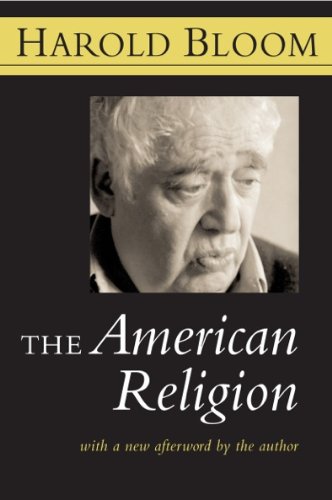
Harold Bloom’s The American Religion attempts to do just this. He argues that, as diverse as we are religiously, every culture must have some unifying belief, even if this belief remains below the level of consciousness. Bloom states that America is in fact a gnostic nation and not a Christian one, and he defines gnosticism as:

  • A belief that the physical world is essentially evil, and the “spiritual” is good.
  • That all people have a “divine spark” within them covered over by experience, culture, history, and materiality (the “all people” part of this is our particular democratization of what was an elitist religion in the ancient world).
  • We must find a way to liberate our true selves, this “divine spark,” from its constraints. Culture, tradition, history, etc. often stand as enemies in this effort.

Bloom postulates that this faith lies underneath other professed faiths, be they agnostic, Baptist, Jewish, or Mormon. It has invaded and colonized our institutional religions and our overall mindset. He finds it particular present in Southern Baptists of his era, but today he would likely look to the various mega-churches, which operate on the idea that Sundays should be friendly, relatable, accessible, and above all, not “boring.” Ralph Waldo Emerson no doubt helped found our particular version of gnostic faith, writing in 1838 that,

Jesus Christ belonged to the true race of prophets. He saw with open eye the mystery of the soul. Drawn by its severe harmony, ravished with its beauty, he lived in it . . . . Alone in history he estimated the greatness of man. One man was true to what is in you and me. . . . He spoke of miracles, for he felt that man’s life was a miracle, and all that man doth, and he knew that this miracle shines as the character ascends.

1838 Divinity School Address

So too William James wrote that

Religion, as I ask you take it, shall mean for us the feelings, acts, and experiences of individual men in their solitude, so far as they stand in relation to whatever they may consider the divine. . . . as I have already said, the immediate personal experiences the immediate personal experiences will amply fill our time, and we shall hardly consider theology or ecclesiasticism at all.

“The Variety of Religious Experience, 1902

We could easily sandwich Walt Whitman’s Song of Myself in between these two thinkers for the trifecta of the prophets of non-contextualized, disembodied, American hyper-individualism. This kind of individualism has as its mission liberation from other groups other entities that would seek to mold, shape, and define. And, as we look at the crumbling of institutional churches, our lack of respect for governmental instiutions, the crisis at many universities, etc. we must declare that the individualism of Emerson and Whitman has triumphed almost completely.^

I can think of few things more compatible with this faith than combining Twitter and iphones. We can both memorialize our lives (which are of course special and worthy of documentation) and express our inmost thoughts to the world at any time. Conventions of privacy, or politeness, you say? Sorry, the god of individualism is a jealous god and will brook no rivals for his throne. Do we contradict oursevles and treat others as we would rather not be treated? Well, we are large, to paraphrase Whitman, and contain multitudes. We believe firmly that our souls should have the right to break free at all times.

Thus, if Bloom is correct, if we want to avoid such miscarriages of justice in the future, we may need to do much more than get a better understanding of technology. Brooks is wrong. No quick and mysterious sitcom-like fix is in sight. We need a new religion to avoid such disasters in the future. Our nation, relatively isolated as it is, is still not an island. And, double alas, Ricardo Montalblan is not here to save us.

Dave

*I know that we need journalism, public records of public events, etc., but I will go one step farther. I don’t know why anyone was filming the students in the first place. I know this happens all the time, but it seems to me that you should go to a protest march to protest, not film others protesting. If you want to counter-protest, do so, but don’t go to film others counter-protesting. I agree with Jonathan Pageau, who argued that our incessant desire to mediate our experience through screens fits into the kind of gnosticism Bloom describes. The screen inevitably creates an abstraction, a disconnect between ourselves and reality. He writes,

It is only in the 17th century that men framed their vision with metal and glass, projecting their mind out into an artificially augmented space. Men always had artificial spaces, painting, sculpture, maps, but the telescope and microscope are self-effacing artifices, they attempt to replace the eye, to convince us that they are not artificial but are more real than the eye. It is not only the physical gesture of looking at the world through a machine that demonstrates the radical change, though this is symbolic enough, but it is the very fact that people would do that and come to the conclusion that what they saw through these machines was truer than how they experienced the world without them.

from his “Most of the Time the World is Flat,” a post for the Orthodox Arts Journal

**I am basically conservative and run mostly in conservative circles. So, while I feel that it is mostly the left that mobs people for now for breathing too loudly through their nose, I should say that the right engages in it as well. I remember some years ago glumly sitting through a presentation where a commentator dissected and destroyed the whole personality of Bill Clinton based on 6 seconds of a video clip played in slow-motion.

^Patrick Deneen has related that when he taught at Princeton, an important study came out that on the Amish that showed that more than 90% of all those who experience “rumspringa” (when as later teens they leave the community to experience the world) return back to their communities. Deneen was taken aback by how much this bothered his colleagues, who could not conceive of living a life bound by tradition and communal standards. For many of our elite Princteton dons, such a life could only be termed as oppression, and some went so far as to suggest that they should be liberated from this oppression.

This, I’m sure, backs up Bloom’s thesis all the more.

Growth Measures

This post is from 2016 originally, and you will note some dated references.  I repost it in conjunction with discussions this week in our Government class.

The original post follows . . .

****************

In his account of the Athenian debate over their proposed expedition to Sicily during the Peloponnesian War, Thucydides has Alicibiades close with a famous analogy on the fate of states and nations that remain inert.

And as for security, whether for remaining there, in case of any success, or for returning, our fleet will provide us with it; for by sea we shall be superior to all the Siceliots put together. And let not the non-interfering policy which Nicias recommends in his speeches, nor his setting the young against the old, divert you from your purpose; but acting in your usual order, just as our fathers, by consulting young with old, raised the state to its present height, do ye now too, in the same manner, endeavor to advance it; being convinced that youth and old age can do nothing without each other; but that the period of levity, and of mid-age, and of extreme preciseness, will have most power when joined together; and that the state, if it remain quiet, will be worn out on itself, like anything else, and its skill in everything grow dull; while by entering into contest it will continually gain fresh experience, and will find self-defense habitual to it, not in word, but rather in deed. My decided opinion then is, that I think a state of no inactive character would most quickly be ruined by a change to inactivity; and that those men live most securely, who regulate their affairs in accordance with their existing habits and institutions, even though they may be of an inferior character, with the least variation.

The Athenian adventure into Sicily ended in disaster, but the idea that states and people must essentially “keep swimming or die” entered into our consciousness.  Progress must involve motion, the conquering of challenges.  So J.S. Huxley comments that,

Life can never be about equilibrium.  Given the well established facts that change . . . multiplies in an expanding geometric ratio, then change in the status quo is inevitable.  A status quo may exist for a time, but with one organism bumping against another means a rearrangement of them all.   

And J.R. Smuts adds,

A peculiar feature about the change in equilibrium in a physico-chemical structure is that it is never such as to produce a perfect new equilibrium; the new is merely approximate, just as the old was.  We may say the change was from too little to too much.

The instance of a super-saturated solution is a case in point, where the crystallization lags behind the conditions which bring it about.  When the change comes it swings beyond the necessities of the case.  Again there is the condition of instability which has to be righted by a swing back in due course.  Thence arises the character of natural change.  Complete equilibrium is never attained and would be fatal if attained, because it would mean stagnation, atrophy, and death.

Once let a large, favorable variation take place . . . others must keep up or perish.  So it comes to pass that history moves in successive phases of momentary equilibrium, with extended periods of “conflict” and readjustment, each one a higher plane of independence than the one before, and each giving place to the other.

So it seems nearly an axiom (at least for post-Enlightenment western societies) that change=growth, growth=progress, progress= something good (?).

But Thucydides had no love for Alicibades, and whether or not he reports fairly, clearly the scope of his narrative means to show the disastrous nature of Alcibiades’ logic.  Earlier in the war his hero Pericles urged the Athenians to accept war with Sparta, but only if they resolved firmly not to add any new territory to their empire.

But Pericles may not have been entirely consistent.  In his famous “Funeral Oration” he celebrated the dynamic, maritime nature of Athenian life in his famous funeral oration.

If we turn to our military policy, there also we differ from our antagonists. We throw open our city to the world, and never by alien acts exclude foreigners from any opportunity of learning or observing, although the eyes of an enemy may occasionally profit by our liberality; trusting less in system and policy than to the native spirit of our citizens; while in education, where our rivals from their very cradles by a painful discipline seek after manliness, at Athens we live exactly as we please, and yet are just as ready to encounter every legitimate danger. In proof of this it may be noticed that the Lacedaemonians do not invade our country alone, but bring with them all their confederates; while we Athenians advance unsupported into the territory of a neighbour, and fighting upon a foreign soil usually vanquish with ease men who are defending their homes. Our united force was never yet encountered by any enemy, because we have at once to attend to our marine and to dispatch our citizens by land upon a hundred different services; so that, wherever they engage with some such fraction of our strength, a success against a detachment is magnified into a victory over the nation, and a defeat into a reverse suffered at the hands of our entire people. And yet if with habits not of labour but of ease, and courage not of art but of nature, we are still willing to encounter danger, we have the double advantage of escaping the experience of hardships in anticipation and of facing them in the hour of need as fearlessly as those who are never free from them.

“In short, I say that as a city we are the school of Hellas, while I doubt if the world can produce a man who, where he has only himself to depend upon, is equal to so many emergencies, and graced by so happy a versatility, as the Athenian. And that this is no mere boast thrown out for the occasion, but plain matter of fact, the power of the state acquired by these habits proves.

Pericles’ words have resonated strongly with western societies for at least the last two centuries.  Democracies have long wanted to be thought of as progressive, diverse, open to new experiences and new people, etc.  But this vision had its critics, most notably Plato, who wrote in his Laws,

Athenian Stranger. And now, what will this city be? I do not mean to ask what is or will hereafter be the name of the place; that may be determined by the accident of locality or of the original settlement-a river or fountain, or some local deity may give the sanction of a name to the newly-founded city; but I do want to know what the situation is, whether maritime or inland.

Cleinias. I should imagine, Stranger, that the city of which we are speaking is about eighty stadia distant from the sea.

Ath: If the city were to be built at the seaside and were going to be well supplied with harbors but ill-supplied with the necessities of life from the soil, then it would have needed mighty saviors and divinely inspired legislators to escape the moral confusion and moral corruption that are the inevitable penalty of such environments.

For the sea is an insidious neighbor which makes itself agreeable to the daily interaction [between good soil and good harbors], but is salt and bitter inasmuch as it fills the country with tradesmen’s business, and the souls of the country with deceit, and the body politic with distrust–each seeking advantage over his fellow man and neighboring states.

These social evils are to some extent counteracted if the soil produces something of everything; and, if it is a rough and highland country . . . it will not be able to do so.  If it could not, it would produce a large export surplus and would attract to itself the equivalent import of gold and silver currency–and that is the greatest moral disaster that can overtake a country.

[As for sea power], it would have profited the Athenians to lose seventy times seven children a year to the tyrant Minos [referring here to the ancient legend of the Minotaur] before turning themselves in defense to a sea power instead of heavy infantry, and so lose the  power of standing fast, acquiring instead the habit of perpetually jumping ashore and then running back to their ships at a run hardly after landing.

This method of warfare erases any sense of shame at being too cowardly to risk one’s life by standing one’s ground and receiving the enemy’s attack.  It suggests facile and “plausible” excuses for taking to one’s heels–never of course in disorder but always “according to plan.”

There is nothing so demoralizing for infantry as their allied fleet riding at anchor in their rear.  Why, even lions, if they took to tactics of that sort, would run away from deer.

Cle: Yet all the same, sir–well, what about the Battle of Salamis?  That, after all, was a naval battle, in which the Athenians beat the barbarians, and it is our belief that this victory was the salvation of Greece.

Ath: I know that is the general view . . . But in [my] belief, it was the land battles of Marathon and Platea that were the day-spring of the salvation of Greece and its crowning mercy.

Arnold Toynbee took up the question of how civilizations grow in volume 3 of his A Study of History.  He first considers civilizations in an “arrested” state.  The nomads and the Eskimos perform near heroic feats of adaptation to survive in their environment.  However, the environment requires too much adaptation, leaving those in them stuck at a particular point in its development.  Ultimately the social organization can never transcend their environment.*

Toynbee has a lot in common with Spengler, but ultimately rejects Spengler’s “biological life span” template for civilizations.  Toynbee believes that civilization transcends individuals so in theory, civilizations can extend themselves ad-infinitum if they play their cards right.  So to find the clue Toynbee uses scientific analogies about crystallization and so forth.  Civilizations have to keep moving to avoid stagnation.  But what kind of movement?  Toynbee is too smart to focus on mere territorial enlargement.  Measuring growth by technological advancement also fails as rubric for many reasons, one of them being the question, “Which is more impressive, the ‘invention’ and original mastery of fire, or the steam engine?”

Ultimately knows that spiritual/psychological growth should occupy pride of place along with other factors.  But how to measure this?  How would it manifest itself?  This is not so easy, as Toynbee knows (though credit him for trying).

Recently I wrote about the “noon-day” devil of acedia.  Essentially acedia involves the temptation to distraction out of a sense of listlessness and no purpose.  The key to fighting this temptation involved drilling down into the recesses of the self, and ultimately to train oneself not to bored with the things of God.  So one monk tells his confessor, “Father, I have been troubled by acedia, but praise be, the temptation vanishes whenever I go visit Abba Paul.” “On the contrary,” his confessor replies, “you have entirely given into the temptation and will soon be in its power.”

Hence the dictum–“stay in your cell.”

St. John Cassian writes,

When this besieges the unhappy mind, it begets aversion from the place, boredom with one’s cell, and scorn and contempt for one’s brethren, whether they be dwelling with one or some way off, as careless and unspiritually minded persons. Also, towards any work that may be done within the enclosure of our own lair, we become listless and inert. It will not suffer us to stay in our cell, or to attend to our reading: we lament that in all this while, living in the same spot, we have made no progress, we sigh and complain that bereft of sympathetic fellowship we have no spiritual fruit; and bewail ourselves as empty of all spiritual profit, abiding vacant and useless in this place; and we that could guide others and be of value to multitudes have edified no man, enriched no man with our precept and example. We praise other and far distant monasteries, describing them as more helpful to one’s progress, more congenial to one’s soul’s health. We paint the fellowship of the brethren there, its suavity, its richness in spiritual conversation, contrasting it with the harshness of all that is at hand, where not only is there no edification to be had from any of the brethren who dwell here, but where one cannot even procure one’s victuals without enormous toil. Finally we conclude that there is not health for us so long as we stay in this place, short of abandoning the cell wherein to tarry further will be only to perish with it, and betaking ourselves elsewhere as quickly as possible.

Towards eleven o’clock or midday it induces such lassitude of body and craving for food, as one might feel after the exhaustion of a long journey and hard toil, or the postponing of a meal throughout a two or three days fast. Finally one gazes anxiously here and there, and sighs that no brother of any description is to be seen approaching: one is for ever in and out of one’s cell, gazing at the sun as though it were tarrying to its setting: one’s mind is in an irrational confusion, like the earth befogged in a mist, one is slothful and vacant in every spiritual activity, and no remedy, it seems, can be found for this state of siege than a visit from some brother, or the solace of sleep. Finally our malady suggests that in common courtesy one should salute the brethren, and visit the sick, near or far. It dictates such offices of duty and piety as to seek out this relative or that, and make haste to visit them; or there is that religious and devout lady, destitute of any support from her family, whom it is a pious act to visit now and then and supply in holy wise with necessary comforts, neglected and despised as she is by her own relations: far better to bestow one’s pious labour upon these than sit without benefit or profit in one’s cell. . . .

The wisdom and achievement (both spiritual and social) of the desert fathers has few historical parallels.  This points us in a new and more profitable direction than standard measures of growth, such as the health of the economy or advancement in technology.

Certainly, for example, the western world has achieved tremendous technological leaps over the past 150 years, but we should not necessarily call this “growth.”  These technological advances have largely served to help us to the things democratic nations tend to do, such as move and consume, except now we can do this more quickly.  I don’t mean this to sound harsh or cynical.  Democracies tend to be forward looking and anti-tradition.  This has its place.  Democracies seek to empower choice, and this has its most obvious reflection in choosing where we go and what we buy.  Technology has changed nothing in the spiritual and social plane for us.  We remain on the go, we remain distracted, with the facilities for spinning our wheels vastly improved over time.

De Tocqueville, as usual, predicted something like this, writing

The first thing which strikes a traveler in the United States is the innumerable multitude of those who seek to emerge from their original condition; and the second is the rarity of lofty ambition to be observed in the universally ambitious stir of society.  No Americans are devoid of a yearning desire to rise; but hardly any appear to entertain hopes of a great magnitude, or to pursue lofty aims.  All constantly to acquire property, power, and reputation; few contemplate these things on a great scale.

Without this great ambition (if he is correct) we will tend to spin our wheels in the same direction.  Again–we should not call this growth automatically.**

We assume that the desert monks had no social impact.  Sure, we assume, they helped their own souls, or perhaps those of their brotherhood, but not society at large.  But a careful reading of the biographies of such fathers shows the opposite.  People came to them all the time for healing and advice.  Many stories exist of their charity to others.  Some lived as solitary hermits, but many others lived in monasteries close to towns where a fair amount of interaction between them took place.

Perhaps the secret of real growth lies here.  No tree can bear fruit if constantly uprooted.

Dave

*This can be contrasted to civilizations that seem “petrified” or “frozen,” such as a certain time period of ancient Egypt.  Nothing about their physical circumstances forces a frozen civilization to stay at a particular level of development, but they choose to do so for a variety of reasons.

**I realize that what follows puts me squarely within the company of other grumpy old men.  But I’ll take the plunge . . . .  The fact that The Force Awakens was so popular reveals this very fact about our culture.  The movie had nothing original about it, with no memorable dialogue, acting, or even memorable scenes.  With its casting it was calculated precisely to hit squarely within the middle of our cultural mindset.  People praised it for “being the movie fans wanted to see.” It hit all its marks, giving us all the old characters plus an even bigger Death Star.  But this is precisely the reason why the movie failed to challenge or move us in any way.

To plunge even further . . . one might almost say that an “acedic” listlessness pervades the whole movie.  What happened to the Republic?  Nobody knows, nobody cares–it’s not important.  What is the “First Order” and what do they want?  How did they get here?  Nobody knows, nobody cares.  In A New Hope Alderann is destroyed cruelly but for a “reason.”  Now whole systems are destroyed for no apparent reason.  Obi-Wan’s death had some meaning or purpose within the Star Wars universe, but not Han’s death–it just happened.  Han himself as a character appears stuck in an endless loop of meaningless activity.  The heroine receives Jedi powers and can fly the spaceships with no context, no training, again for no apparent reason.  Why?  Nobody knows, nobody cares.  What is important is that we saw what we desired.  The movie fulfilled our list of demands.

“We have a great king, who loves ham.”

Originally written a few years ago, reposted based on recent material in class . . .

***************

I recently came across an interesting article about a man who commands fees of $4000 for slicing a leg of ham.

If one reads the article, the startling headline begins to make a bit of sense.  Many consider Florencio Sanchez the pre-eminent international voice for Iberian ham, a traditional Spanish cuisine/delicacy.  Apparently Iberian ham means to Spain what barbecue might mean for Texan.  The pig must be raised in a certain way, cut in a certain way, and so on.  Clearly as well, Sanchez styles himself as an “artiste.”  For Iberian ham to truly be Iberian ham it must be presented in a certain way, with certain instruments that . . .  only he may ever touch. Among other things, Sanchez believes that no true slicer of ham would ever speak English.

One comment in the video below particularly stuck with me, however:

Sanchez clearly takes the most pride in having cut ham for the King of Spain, which should not surprise us.  But he added that, “We have a great king, who loves ham.”

It seemed to me that he could have almost said, “We have a great king because he loves ham.”

Of course, Sanchez has honed and practices a very traditional skill, and monarchy is a traditional form of government that relies on tradition to succeed.  And if the king appreciates Sanchez’s life’s work, we should not blame Sanchez if he feels flattered and even vindicated.  But with this comment, I think Sanchez has an insight into political leadership, and why many in the west–not just in the U.S.– feel less confidence about our democracies at the moment.

A successful monarch need not necessarily have the right policies.  He/she will generally be loved if their actions in some measure reflect well on their country.  So Richard I, the “Lionhearted,” can be revered in English memory although he actually spent very little time in England.  Saint Louis IX lost on two crusades and emptied the treasury in payments to Moslems for his own ransom, but his noble character and sanctity earned him the love of France.  Louis XIV had an enormous appetite (apparently due to his abnormally huge stomach), eating multiple courses for dinner, making a huge show of it in the process, and Frenchmen took pride in that.  “Look what our king can do!”   So too, “Our king loves ham.”  He acts in ways that embody something of Spain, just as Richard did for England.  Such kings overshadow more “successful” monarchs like Henry II, if we think of success in modern terms.*

Our founders recognized the need for this on some level.  I think they wanted the president to always be George Washington–that is–someone above reproach who used his powers sparingly but with forbearance and wisdom, someone who had no political skin in the game. They utterly failed to anticipate the almost immediate rise of the presidency as a popular/populist office and the impact that would have on our democracy.

Bernard Bailyn, Gordon Wood, and others point out the radical nature of the American Revolution and its clean break with tradition and the past.  This bold move helped make the Revolution successful and gave it its influence worldwide.  But, this recent election might make us wish that we had a king, “who loves ham,” or in our case, perhaps cheeseburgers.

Dave

*Before we think that, “Hey, I’ll gladly love ham if you make me king of Spain,” kingship has some very tricky elements.  By the end of his reign the people hated Louis XIV.  Louis might say, “Sure, I lost two big wars, but after all, so did St. Louis IX!  And . . . I can still eat more than most mortal men, right?”

But it wouldn’t have helped him.

People cheered Louis XVI at the opening of the Estates General in 1789.  They executed him a few years later. Kingship works when a quasi-mystical, perhaps sacred connection exists between him and his people–when he rightly acts as the “pater-familias.”

Wikipedia tells us that Felipe VI of Spain has the favor of the Spanish people, and that many want him to intervene a bit more to reconcile party differences.  He seems to have popularity and good-will at the moment. But if Wikipedia accurately reports, he will need great caution, because some of his popularity seems rooted in his abandonment of certain long-standing traditions, such as the practice of elected officials taking their oaths of office upon a Bible or crucifix.

A king’s power rests in large measure upon tradition, and he tampers with that as his peril.  Many assume France’s Louis XVI was reactionary and inflexible.  In fact, as Simon Schama points out in his Citizens, Louis attempted many progressive reforms.  Some of the Enlightenment philosophes initially praised him as just the sort of king France needed (Louis probably did not want their praise, but still . . . ).  Events show that this stance almost certainly hurt rather than helped.

The Etiquette of Battle

A friend of mine has a friend who teaches in a classics department at a university.  On different campuses different kinds of progressive ideologies have more sway, and at this particular school the administration required the classics professor to document how he would help his students encounter “the other” in the time periods he studied.

This in itself is a worthy goal, for getting outside of the prejudices and perspectives of one’s own time is one of history’s great benefits.  Like C.S. Lewis said about great literature, history can get one outside of oneself, and ultimately can prepare us for worship.

My friend’s friend made the argument that in studying the Greeks and Romans one studies “the other.”  We need nothing else.  Many aspects of their society make them very weird indeed to our current sensibilities.  Anyone from ancient Greece or Rome would feel completely out of place in the modern world.

Alas that his argument held no sway with the administration.*

But we need not go back thousands of years to get at “the other.”  Even certain aspects of European culture from just a few centuries ago would suffice.  We inherited a great deal from the Enlightenment era, but even so, we could not imagine settling disagreements as they did.

I have dealt with the subject of dueling before, but wish to speculate on the connections between dueling, warfare, and ceremony.

Many unwritten rules governed duels, but eventually a man named Crow Ryan (perhaps a pseudonym?) codified them into the “Code Duello.”  No need to review all 26 stipulations, but a few examples will help illustrate for us how they thought.  First, the hierarchy of insults:

I. The first offence requires the first apology, though the retort may have been more offensive than the insult. Example: A tells B he is impertinent, etc. B retorts that he lies; yet A must make the first apology, because he gave the first offence, and (after one fire) B may explain away the retort by subsequent apology.

II. But if the parties would rather fight on, then, after two shots each (but in no case before), B may explain first and A apologize afterwards.

N.B. The above rules apply to all cases of offences in retort not of a stronger class than the example.

And

V. As a blow is strictly prohibited under any circumstances among gentlemen, no verbal apology can be received for such an insult. The alternatives, therefore, are: The offender handing a cane to the injured party to be used on his back, at the same time begging pardon, firing until one or both are disabled; or exchanging three shots and then begging pardon without the proffer of the cane.

N.B. If swords are used, the parties engage until one is well blooded, disabled, or disarmed, or until, after receiving a wound and blood being drawn, the aggressor begs pardon.

VI. If A gives B the lie and B retorts by a blow (being the two greatest offences), no reconciliation can take place till after two discharges each or a severe hit, after which B may beg A’s pardon for the blow, and then A may explain simply for the lie, because a blow is never allowable, and the offence of the lie, therefore, merges in it. (See preceding rule.)

It seems obvious to me (someone correct me if I’m wrong) that the code prohibited “blows” because any Joe Six-Pack can use their fists.  Fists then, would offer no opportunity to distinguish oneself as a gentleman.  In addition, fists lack the deadly power of pistols or sabres.  If we’re going to fight, let’s really fight and not play around as children. To use your fists on someone communicates to them that they are not “worth your sword.”  The contest wouldn’t count because it would lack any real gravitas.

But I think that fists lacked the proper ceremony that helped legitimize dueling.  The rituals of the duel gave the duel the power to confer status on the participants.  We see an example of this ceremony from a scene in Barry Lyndon:

This short scene captures much:

  • The setting for the duel serves the immediate purpose of being away from the law or other bystanders.  But it also is a “genteel” spot that elevates the occasion.
  • The seconds do their duty and attempt a reconciliation before the event.
  • Once the apology was refused, they must fight.  Though Captain Quinn looks as if he had second thoughts, he cannot back down now.
  • Captain Quinn’s second accepts the results and even encourages the other to get away so as to avoid the police.**

The word for duel comes from the Latin “duo” and “bellum,”–a “two-person war,” shortened to “duel.”  It should not surprise us that at the height of dueling, war itself had some of the same rituals.

Another scene from Barry Lyndon shows the ritual nature of battle to some extent.  Neither side employs any strategy.  They declare themselves plainly and come at each other simply and openly.

The first 1:30 of this next clip show the ritual nature of battle well:

In his magnificent The Centurions, Jean Larteguy has the character of Jacques Glatigny, who hails from an established French military family, muse on how things have changed during the French disaster at Dien Bien Phu:

Glatigny’s reaction [he has just been captured near Dien Bien Phu] was that of a regular officer; he could not believe that this “officer” squatting over him and smoking foul tobacco was, like him, a battalion commander with the same rank and responsibilities as his own.  

Glatigny thought that his “opposite number” looked much like a peasant.  His face was neither cruel nor intelligent but rather sly, patient, and attentive.

So this was one of the officers of the 308th Division, the best unit the Vietminh had; it was this peasant from the fields that had beaten him, Glatigny, the descendant of one of the great military dynasties of the West, for whom was was a profession.  He looked at the Vietminh captain with some confusion.  They had fought against each other on equal terms. Their heavy mortars were just as effective as French artillery, and the French air force had not been able to operate over the battlefield.  They had fought hand-to-hand and the position had changed several times throughout the battle, but there remained neither respect, hatred, or even anything resembling interest on his inscrutable face.

The days when the victorious side presented arms to the vanquished garrison that had fought bravely were over.  There was no room left for military chivalry.  In the deadly world of Communism the vanquished was a culprit and reduced to the position of a man condemned by law.  

Up to 1945 the principles of the old world still held.  Second Lt. Glatigny was then in command of a platoon outside Karlruhe.  He had taken a German major prisoner and brought him back to his squadron commander, of the same social class as himself.  The commander had established his HQ in a forester’s cottage.  They saluted and then introduced themselves.  The captured major, after all, had fought gallantly himself and came from a vaunted division of the Wehrmacht.  

The German and the Frenchman, completely at ease with one another, discussed where they might have fought against each other since 1939.  To them it was of little consequence that one was the victor and one the loser, provided that they had observed the rules and fought bravely.  They respected each other and became fast friends.  The major drove the captured German to the prison in his personal Jeep and before departing, shook hands.

Democracies tend to eschew ceremony as elitist, and this has some truth to it.  Ceremonies need presiding, and those that know how to conduct them must have some kind of training not available to all.    But without ceremony we will have a hard time finding meaning in our military endeavors–or in general, for that matter.  This perhaps sheds light on the current problem of the “War on Terror.”  What are we doing, where are we doing it, how are we fighting, and to what end?

But one can have the opposite reaction.  Many students who view the videos above see the actions of the army and the duelists as essentially meaningless.  Two of the clips above come from Stanley Kubrick’s highly praised Barry Lyndon, and one might interpret the movie as an indictment of the meaningless nature of Lyndon’s life in pursuit of aristocratic status.

Maybe, maybe.  But if we eschew one form of ceremony, we will need to replace it with something else, as nature abhors a vacuum.

Dave

*For the administration in question, the “other” had to be defined ethnically.  The Greeks and Romans were “white.”  This tendency of some progressives to label people primarily or almost exclusively by their gender and ethnicity is quite unfortunate and even dangerous, but that is another post.

**Those who have seen the movie know that this is not quite the whole story . . .

Time vs. Space

This post was originally written in 2019 . . . .

*******************************

In an essay he wrote a few years ago called “The Four America’s” conservative columnist David Brooks pointed to the need for a new unifying narrative for America. What he called the “Exodus” paradigm held from our founding as a nation until recently. We told ourselves that America was essentially replaying the story of the Israelites, who fled religious oppression in Egypt, and came to the promised land to be a light unto the nations. Americans too fled oppression in the old world and came to a new one, establishing a special and unique nation that could broadcast freedom to the rest of the world. We existed to inspire others to follow in our footsteps.

Obviously this national myth no longer holds the imagination of our culture. In some ways we can lament the loss of this sense of mission and purpose, but I also think that the story never quite fit to begin with. Granted, every myth compresses and synthesizes, but our treatment of Native Americans and slavery stand as massive exceptions that the myth simply cannot hold within it. Our relative ignorance of these “anomalies” in our story* for centuries then naturally led people to focus almost exclusively upon the “exception” to the story, and so the pendulum swung entirely in the other direction. I am no friend of the modern progressive left, but reluctantly, I understand why they exist. We will have to endure them at least a little longer, it seems, perhaps as penance for our sins.

In addition, the Exodus story works wonderfully for a pioneer people, but less well for a major superpower. And, finally, even a cursory look suggests the possibility that the Enlightenment had just as much, if not more, influence on our founding than Christianity.

Brooks then suggests four other off-shoots from this myth, though admits that neither of them work even as well as the Exodus narrative.

  • The Libertarian myth sees us as “a land of free individuals responsible for our own fate.” It celebrates choice and the free market. It borrows from the freedom element of the Exodus story, but economic choice isn’t as powerful as religious choice. And–simply focusing on personal choice and responsibility cannot sufficiently unify us.
  • The “Globalized America” narrative celebrates a sliver of the “America as beacon for the world” from the Exodus story, as well as the dismantling of old hierarchies celebrated by our founders. But this story fails to provide an America distinctive enough to give us an identity.
  • “Multicultural America” borrows from the “Exodus” story with its narrative of oppression and the idea of a melting pot nation. But in always focusing on the exceptions and purely personal identity, no common core can be built to rally around.
  • The “America First” story gives us a common core and reinforces American distinctives, unlike the above three options. It has a brashness that can be bracing, especially compared to the other options. But it leaves out the inclusive aspect of the American story. It can tend to produce a “patriotism for the sake of patriotism” whirlpool. It gives America no transcendent reason to exist beyond its mere existence.

I agree with Brooks that neither of these four approaches are even as good as our discarded “Exodus” story. I agree that we need another narrative, but am not sure how we’re going to get one in our polarized culture. But as to what polarizes us a country–we don’t agree on this either. This is not only America’s problem–most everywhere else at least in the developed world seems to have the “first world problem” of no unifying narrative.** But we do not look deep enough for the cause of this rift, and blame different sides for the wrong reasons.

Though democracies have done much to alter traditions, they cannot change the basic ways in which the world works and the ways we perceive the world, at least on a subconscious level. Ancient creation stories agree in many ways, perhaps most fundamentally in that they conceived of creation as a harmony of contrasting forces. “Salvation” in a Christian sense is about the marriage of Heaven and Earth, and of course, the Incarnation is Christ the God-Man uniting Heaven and Earth in one Person. I do not intend this post to be an explicit argument for the truth of the Christian story, but I do believe it contains the most coherent and best “version” of all the ancient cosmologies. Biblical cosmology overlaps with many other ancient cosmologies, and this only serves as a point in its favor. Acknowledging these huge questions, from here on I will proceed by discussing ancient cosmologies in general.

The modern age measures time in what I would consider to be rather an insane way:

The second (abbreviation, s or sec) is the Standard International ( SI ) unit of time. One second is the time that elapses during 9,192,631,770 (9.192631770 x 10 9 ) cycles of the radiation produced by the transition between two levels of the cesium 133 atom . . .

This has advantages, as it allows to universalize and quantify precisely, but it happens completely outside of our experience, and thus, time can have little real meaning for us. The way we parse out units of time remains essentially arbitrary. For the ancient world, time had a manifest reality because it brought observable change. Day turns to night, and then night turns to day. Seasons change, and death and new life come with these changes. Thus the ancients conceived time as something moving, fluid, in flux–like water, but also solid and experientially verifiable.

Space gives us stability. Time allows us to become, but we need to “be” something to “become” anything (apologies to Brad Goodman). Time needs space to act upon. The relationship between time and space can only work well when we have a strong concept of the unity of heaven and earth. Possibly, we could have an acceptable range of this relationship. Some parents are more strict and some more permissive, but as long as one avoids the red line on either side, families can be stable and healthy.

For example, ancient Egypt leaned heavily on the side of space. They lived within a narrow strip of land, with the “chaos” of desert and death right next to them. Even their greatest architectural achievements mainly had the psychological effect of weights pressing on the ground. The Nile flooding formed in integral part of Egyptian life, but they put all their energy into controlling the Nile flood. Theirs was a “masculine” civilization all in all, and some historians criticize them for being too rigid and not sufficiently adaptable to change.

Babylon favored the fluidity of time (too much so, I would say, but we’ll let it pass for now–they had a long and storied history, after all). The Euphrates bisected their city, and they sought not to control the river–they had no great need to do so anyway–but to utilize it for their benefit. One of their main deities, Ishtar, was goddess of love, war, marriage, and prostitution, and sometimes was pictured with a beard. Aristocratic males were known to cross-dress and temple prostitution was the norm. Babylon was the quintessential cosmopolitan city–home of every philosophy and religious idea in existence in their known world. Theirs was a “feminine” civilization, in the sense that they had little devotion to the concept of a stable, unified form.

We can debate the merits of both civilizations, but should acknowledge that although they had different answers as to the balance between time and space, both at least were conscious of the realities of both. Our problem is twofold: 1) We lack even basic awareness of these concepts on a metaphysical level, and 2) We have abandoned the “marriage” of Heaven and Earth (a mirror also for “Time, and “Space” respectively) in Christ, and so have lost any hope of holding them in tension. With both freed from each other, Time makes war on Space, and vice-versa.^

Some argue that Time reigns supreme. In favor of the victory of Time, we see the rapid expansion of “time saving” technologies. Cars and planes compress space, but nothing compresses space quite like the internet. We erode boundaries of privacy, and we live in a “hot-take” world of moving information. Very few media outlets can afford patient reflection. Time’s triumph–thinking in terms of the “fluid” aspect of time–seems most evident in our culture’s support for people changing genders.

But, not so fast . . . “Space” does not take this lying down. If Democrats propose open borders, Trump will build a wall. In countries such as Poland and Hungary we see a resurgence of a strong nationalistic mindset. As we do more to celebrate exceptions and fluidity in the west, at the same time we have more absolute boundaries enforced by the culture as to what we can and cannot say. College students demand rigid “safe spaces” on the one hand while simultaneously affirming the legitimacy of every possible identity–a perfect incarnation of the intense stalemate between time and space. And–every spot on earth is mapped out, which means that space has complete definition. No country would possibly consider negotiating space with another country to resolve a dispute. Lest our modern avoidance of this seem perfectly natural, it stands in sharp contrast to politics before perhaps 1789, where king’s would routinely trade provinces here and there as diplomatic chips.

So today we have both “Time” and “Space” making a strong play for dominance, and just like the whole family suffers when dad and mom fight, so too we suffer in the midst of this contest. But children have little hope of solving their parent’s problems. We have more control of ours. We need the King to return to end the vicious squabbling of princes. When the dust settles, then we may see clearly enough to tell ourselves the story we all need to hear.

Dave

*I suppose there are those that would not call slavery and our treatment of Native Americans as anomalies to the story. Israel did have slaves–and some might draw a parallel to our treatment of Native Americans with what Israel did at Jericho. I disagree with this interpretation, but I want to acknowledge its existence.

**I know some do not want a unifying narrative because they fear the unity that this provides, and the concentration of power it gives. We saw the destructive potential of this in the early 20th century. But you can shove this basic human need under the carpet for only so long, and the longer we wait, the more chances for a destructive “pendulum swing” identity to emerge.

^Those familiar with Jonathan Pageau’s Symbolic World podcast will note my debt in what follows to episode 62, along with Matthew Pageau’s The Language of Creation.

Comparing civilizations on the Time/Space axis can be fun and illuminating. Clearly America, along with Babylon, heavily leans in the direction of “Time.” We have pioneered many so-called “time saving” technologies. The great Tyler Cowen proclaimed that our decline in physical mobility is a worrisome problem. We love our cars, and some argue that we lost our mojo as a civilization the moment the frontier closed. Bob Dylan mythologized the rolling stone, and who can possibly forget Journey telling us that the wheel in the sky keeps on turning, and that he doesn’t know where he’ll be tomorrow?

We have countless writers and other aspects of our culture that celebrate movement, the open road, etc. I can think only of Wendell Berry as perhaps our only cultural contributor of note who writes in celebration of Space.

The Logic of a Lack of Conviction

This post was originally written in 2018 . . .

****************************

One of Arnold Toynbee’s missions involved reacting against the Enlightenment-inspired Whig historian that saw progress as inevitable and assured.  For this school the advance of science and the decline of religion–the influence of priests or the Church over the state–served as ‘Exhibit A’ of this march towards continual progress.  Toynbee developed an overall pattern of history that worked against this notion.  In his critique he warned against the pollyanna idea of equating the decline of religious belief with improvements in civilization.  Rather, he cautioned, failure to believe in the God of the “higher religions” would not lead to a pleasant garden of pure reason, but rather encourage attachment to the “darker gods” of tribalism and paganism.

On Marginal Revolution Tyler Cowen linked to an article by Shadi Hamid, in which he wrote that,

In polarized times, political competition comes to resemble tribal warfare. Everyone is under pressure to close ranks and boost morale. Lacking an animating vision beyond expert-led incrementalism, center-left politicians and pundits have few options to rally the Democratic base other than by attacking adversaries and heightening partisan divides. The other option—laying out an alternative that differs from what Hillary Clinton or even President Obama offered—requires ideological conviction.

That would explain why Rep. Adam Schiff —previously “known as a milquetoast moderate,” according to the New Yorker—has emerged as one of the most outspoken figures in the Russian collusion investigation. Before being appointed to succeed Mrs. Clinton in the Senate, Kirsten Gillibrand was an upstate New York representative who belonged to the Blue Dog Coalition. Her 2013 New Yorker profile was titled “Strong Vanilla”—and she now boasts the upper chamber’s most anti- Trump voting record.

Cowen added that,

When people don’t believe in so much with conviction, the logic of the crowd will sometimes dominate, because actual belief is no longer such a constraining force.  This is one reason why a totally secular “Enlightenment” society is not in every way to be welcomed . . .

Hamid comments later in the article that, “Lack of real belief,” and lack of genuine religious communities, is often more of a problem behind terrorism than is “excessively fanatical belief.”

Both President Obama and President Trump inspired strong reactions from their political opposition.  Republicans seemed for the most part to simply oppose whatever policy Obama supported, and Democrats now seem to be following suit.  However effectively this rallies their political base, it leads to a steep decline in democratic practice, a rise of tribal mentalities, and a resurgence of the “darker gods” mentioned by Toynbee.  In 2018 we can easily see that neither religion, nor social institutions, nor even a common social class unites us now.  Toynbee wrote in his An Historian’s Approach to Religion that,

The erosion of the west’s traditional institutions and common outlook . . . has been progressive.  The unity of the clergy in western Christendom was broken by the Reformation.  The unity of the Western “Republic of Letters” as it had existed down to the generation of Erasmus and St. Thomas More, was broken when Latin was ousted by the local vernaculars, and it was re-established only very imperfectly when Latin was partially replaced by French in the 17th century.  The unity of the West European aristocracy–a polygot social circle knit together by intermarriage–was broken by the French Revolution, by the smothering of the aristocracy in Britain in the 19th century in the embrace of the prolific middle class, and by the rise of the United States, where the West European aristocracy had never taken root.

He penned those words in 1956, and we  might follow this up by adding that post-modernism has contributed further to this erosion.  We no longer have a common belief in progress, and even our faith in democracy itself has declined.

Machiavelli wrote during a time of political upheaval in Italy, and understood the temptation to lash out and “fight fire with fire.”  But in his Discourses on Livy he advocated a different course in a chapter he titled “Temporize with Evil.”

In connection with this league against Rome we have first to note, that when a mischief which springs up either in or against a republic, and whether occasioned by internal or external causes, has grown to such proportions that it begins to fill the whole community with alarm, it is a far safer course to temporize with it than to attempt to quell it by violence. For commonly those who make this attempt only add fuel to the flame, and hasten the impending ruin. Such disorders arise in a republic more often from internal causes than external, either through some citizen being suffered to acquire undue influence, or from the corruption of some institution of that republic, which had once been the life and sinew of its freedom; and from this corruption being allowed to gain such head that the attempt to check it is more dangerous than to let it be. And it is all the harder to recognize these disorders in their beginning, because it seems natural to men to look with favour on the beginnings of things. Favour of this sort, more than by anything else, is attracted by those actions which seem to have in them a quality of greatness, or which are performed by the young. For when in a republic some young man is seen to come forward endowed with rare excellence, the eyes of all the citizens are at once turned upon him, and all, without distinction, concur to do him honour; so that if he have one spark of ambition, the advantages which he has from nature, together with those he takes from this favourable disposition of men’s minds, raise him to such a pitch of power, that when the citizens at last see their mistake it is almost impossible for them to correct it; and when they do what they can to oppose his influence the only result is to extend it. Of this I might cite numerous examples, but shall content myself with one relating to our own city.

Cosimo de’ Medici, to whom the house of the Medici in Florence owes the origin of its fortunes, acquired so great a name from the favour wherewith his own prudence and the blindness of others invested him, that coming to be held in awe by the government, his fellow-citizens deemed it dangerous to offend him, but still more dangerous to let him alone. Nicolò da Uzzano, his cotemporary, who was accounted well versed in all civil affairs, but who had made a first mistake in not discerning the dangers which might grow from the rising influence of Cosimo, would never while he lived, permit a second mistake to be made in attempting to crush him; judging that such an attempt would be the ruin of the State, as in truth it proved after his death. For some who survived him, disregarding his counsels, combined against Cosimo and banished him from Florence. And so it came about that the partisans of Cosimo, angry at the wrong done him, soon afterwards recalled him and made him prince of the republic, a dignity he never would have reached but for this open opposition. The very same thing happened in Rome in the case of Cæsar. For his services having gained him the good-will of Pompey and other citizens, their favour was presently turned to fear, as Cicero testifies where he says that “it was late that Pompey began to fear Cæsar.” This fear led men to think of remedies, and the remedies to which they resorted accelerated the destruction of the republic.

His advice is sound, but it requires conviction to heed.  We can’t “temporize” unless we know equally well what we want to happen as well as what we wish to prevent.

Chaos Theory

In the wake of 9/11 Patrick Deneen wrote an essay entitled “Patriotic Vision: At Home in a World made Strange,” in which he lamented the dichotomy he saw in public opinion. On the one hand, you had an entirely uncritical belief among many of the righteousness of the United States. Politicians needed to wear a small flag on their jacket lapels, (couldn’t happen now), and waved through sweeping legislation (the “Patriot Act”) that dramatically increased the surveillance powers of the government. On the other . . . you had many in academia, perhaps especially among our elite institutions, that could barely contain their smugness with pronouncements that America had gotten what it deserved for its overbearing foreign policy. Deneen published this essay in early 2002, and this split would only grow in the run-up to the Iraq War. Remember “America Fries?”

Two seems to be a natural number for democracies to fall into, and perhaps somewhat natural in general for any society. We have night and day, sun and moon, major and minor keys, and so on. But “two” has always been something of a dangerous number, symbolically speaking. The either/or paths “2” creates bring inevitable division among extremes. Still, if we think of myths and creation accounts as, among other things, poetic interpretations of the world, we note that “2,” while obviously prevalent in creation, does not have the final say.

Between day and night, and night and day, lies twilight and dawn, the grey area linking them both. We have Adam and Eve, but they are supposed to “be fruitful and multiply,” i.e., not stay just the two of them. We have six days of creation and the seventh day–a breathing space of sorts within the normal cycle of the week. In Revelation the angel tells the Apostle John to measure the inner court of the temple of God, but to leave the outer court unmeasured (Rev. 11:1-2), i.e., we need to loosen our intellectual hold on at least parts of reality. St. John’s gives us grand cosmic visions, but the Old Testament has this need for an unmeasured, in-between space, displayed even in the most prosaic of ways. The Israelites had to leave the fringe of their fields unharvested, and to leave the edges of their garments loose (Duet. 24, Num. 15).

It is on this fringe, the in-between spaces, where fruitful interaction and new creation can happen.

Certainly Deneen’s essay has resonance with us today. But he did not seek merely to lament the situation that existed in 2002, nor do I seek only to bemoan the world today. Rather, Deneen pointed to the classical world for a possible solution to the dilemma of “2”–the Greek vocation of the “theorist.”

One form of education seeks to construct by rote a particular view of the world. In regard to our own history some proclaim that the founders were all wise and good men–and only wise and good–our wars are always just, etc. Without cultivating any possibility of error, no repentance can happen and growth a forlorn hope. Such infants can never eat meat. As Aristotle noted, the perfect citizen would rarely be a good man. He could never grow into virtue.

The other education aims only at deconstruction–our founders were all misogynists, slave owners, etc. Of course this deconstruction supposes the need to construct something else in its place. Nothing can exist based on a universal negative. But often, having despised their birthright, deconstructionists have no idea what or where to build, and can feed only on dreams, or worse–themselves, and thereby “starve for feeding”(Coriolanus, Act 4.2). We need another approach.

Enter “one who sees,” which is a translation from the Greek word “theorist.” Certain elected officials within most classical Greek city-states had the title of “theoroi.” To quote Deneen,

To “theorize” was to take part in a sacred journey to visit the “other,” to “see” events such as religious or athletic festivals, and to return to their home city to give an account . . . the theorist would then attempt to comprehend, assess, compare, and then, in the idiom of his own city, explain what he had seen. The encounter would inevitably raise questions about the customs and practices of the theorists own city. . . . Might their be a best way of organizing the city that is not our way?

. . . The activity of “seeing” other ways of foreign life comprised half of the theorist’s duty. The other half . . . was the “giving an account” of what the theorist had seen. A “theorist” would betray his office if he were, so to speak, “go native” while abroad. . . . Even if a theorist were persuaded that that foreign practices were superior to those of his own city, the primacy of the theorist’s allegiance to his own city demanded careful and prudent explanation . . .

The “theorist” then, was not chosen only for his ability to “see” and apprehend with sensitivity the new and unusual but equally for the abiding customs of his own way of life. . . . it was by means of deep familiarity and love for that cultural inheritance that the theorist was able to move fellow citizens to renewed devotion to those practices . . . or to subtle questioning of dubious customs . . .

Conserving America: Essays on Present Discontents, pp. 18-20

It is through this lens that Deneen suggests we should see Socrates. He self-consciously went on a “sacred journey” of philosophy and saw himself as a “gadfly” to Athens, but also someone who would never consider disobedience to the laws of his city.*

Deneen examines Rene Descartes as possibly the first example of a modern “theorist.” As a French Catholic fighting other Catholics in the brutal 30 Years War, Descartes had a unique opportunity for serious soul-searching. As Deneen points out, however, he operated purely with his mind and imagination, and not with his heart. He “begins with radical suspicion of all that preceded him in act or thought, and especially all that is the result of the common endeavors of a community or people” (23). Descartes prefers to think by himself in a foreign land, but cares not even for the foreign locale. Time and place matter not to him. “A thinker like Descartes would be content to think anywhere on earth” (24). Descartes loved to sit in bed and think–all well and good. But what person, or place, or custom, did he love?

The abstract method Descartes employed led him to question everything . . . except himself (“I think, therefore, I am”). The mind, powered by egotism and unfettered from the body, became a weapon to remake nations and nature itself for civilizations that followed his wake. But to be free from one’s time and place is also to be estranged from it. We tend to lash out at strangers, even if the stranger is our very selves.

Those younger than me may groan–but nevertheless–a line runs straight from Descartes’ abstractions to the internet and social media, or, the “cloud.” The internet has perfected the art of taking you away from where you reside and placing you nowhere in particular. I suppose with very simple and direct messages, social media works well, i.e., “Look, my son graduated from high school,” or, “I love my new haircut.” But anything involving complexity requires context, and context requires “full body” communication–not just the mind. Misunderstandings become almost the norm if we ignore this, which brings chaos. Our connections to one another disappear. To compensate for the interpersonal gap (which we perhaps feel but may not be fully aware of), we use manipulation as a method to bridge the chasm. Christians are guilty of this just as others are, i.e., “Jesus is the Light of the World–If you love God you will share with all your Friends!” Marshall McLuhan was right–the medium often dictates the message.

In difficult times we face two temptations. One is to bury our vision into the dark and tangled soil. There we meet the demons of blood and earth. The early 20th century saw this nightmare made real. The other involves a flight into escapist utopian fantasy with our heads in the sky. Devils lay there as well (i.e. the “prince of the powers of the air”–Eph. 2:2**). Both soil and clouds exist for a reason, however. Both have their place. We need to see what lies below and above at the same time, with Christ in the center, holding all things together.

*We can note that in The Republic he places his ideal, or perhaps, imaginary, city outside of Athens (I tend to think of The Republic as a thought experiment and not a description of Plato’s “real” beliefs–others disagree). Deneen also notes that the great Athenian dramatists played the role of “theorists,” and they, like Plato, often set their events outside of Athens.

**Perhaps we should think of Paul’s words in a strictly spatial manner, but I am fairly sure that we should interpret his words metaphorically (the two are not mutually exclusive–both meanings are in play). That is, the “air” shifts to and fro–it has no boundaries, no direction–its shiftiness resembles the snake, who speaks with a forked tongue, etc.

Renaissance and Reformation, Act 2 (?)

I published this originally in 2016 a few weeks after Trump’s election.  In re-reading it, I would change very little of my original thoughts.  I am still not sure of what to make of Trump’s presidency and what it might mean for our future, and I still am not sure what criteria to use to evaluate his presidency.

Without further comment, the original post . . .

**************************

Like many I awoke Wednesday, November 9 to a big surprise.  Like many I wonder in what sense business as usual (more or less) will be the order of the day as Trump begins to actually govern, or whether or not we will see a significant pivot in our national life.  Time will tell (full disclosure, I supported neither candidate and hoped for a 3rd party revolution that never materialized).

I confess there is much I fail to understand about the election.  I have no strong opinions as to why Trump won.   I will attempt to focus on a broader historical perspective and will not deal with issues specific to the campaign, whatever their importance might have been.  I will not seek to take sides so much as to explain.

Consider what follows speculative . . .

Like many I search for historical parallels to our situation.  Many months ago I suggested Andrew Jackson, or perhaps Rome’s Marius, as a historical counterpart to Trump.  A few months ago Tyler Cowen suggested that, based on a book he had read, our world might resemble that of the Reformation.  I filed that away and thought little of it–until November 9.  All six of Cowen’s observations have merit, but two immediately jumped out at me:

1. Many of the structures in places are perceived as failing, even though in absolute terms they are not obviously doing worse than previous times.

2. There is a rise in nationalist sentiment and a semi-cosmopolitan ethic is starting to lose influence.

In his Civilisation series Kenneth Clark displayed an obvious affection for Erasmus of Rotterdam (1466-1536).  Who can blame him?  Erasmus had a great intellect and a good sense of humor, especially about himself.  Erasmus had no particular attachments anywhere and so he cultivated friends all over Europe.  He represented what some might see as the apotheosis of the medieval vision–a cosmopolitan, universal man of Christendom.

Such status did not prevent Erasmus from engaging in polemical criticism.  From what I hear, his Praise of Folly (I have not read it) mercilessly lambasts much of society at that time, in and out of the Church.  And yet, Clark points out that Erasmus could not accept challenges to authority from the common man.  In a personal letter he wrote with horror at the fact that hardly anyone in a town he visited doffed their caps to him–to him–a respectable pillar of Society.  We can almost hear him say, “I’m the one who gets to criticize society.  Not you!  You don’t know what you’re doing, whereas I (obviously) do!”*

Erasmus could criticize aspects of society but would never think of criticizing Society itself and the conventions that held it together.  He lived in an urbane, intelligent, tolerant world of reason, progress, proportion, and the like.  But the temper of times overwhelmed him.  Europe’s darling in 1511 found himself playing the role of “Mr. Irrelevant” soon after the Reformation began in 1517.

Even Clarke, I think, sees the problem with Erasmus.  No one doubted his character, but they questioned his conviction. Erasmus wore too much on his sleeve and not enough (at least to observers) in his heart.  His glib dance throughout Europe made many wonder what he actually believed.

Many assume the that the medieval period practiced more than its fair share of intolerance.  Scholar and historian Regine Pernoud points out, however, that the latter Renaissance had many more persecutions of heretics and witches than any period in the Middle Ages.  She offers no direct reasons for this, but we can speculate.  By 1200 A.D. Europe had attained a significant measure of stability, but not yet a great deal of movement.  The elite of society had “real” jobs and connections to the common man.  The “people” did not live as well as the aristocracy, but they lived with the elite in the same communities and moved in the same circles.  The sea had yet to tempt medieval society, which limited physical mobility and perhaps added to the stability.

By the mid 13th century Thomas Aquinas begins to dabble in the powers of reason and Aristotle.  The Black Plague disrupted the settled social arrangements (among other things).  The 15th century saw plenty of change with the beginnings of exploration and the printing press.  The papal court practiced pagan Greek city-state thinking more so than the service of God.  Now too, elites like Erasmus moved in entirely different circles than “the people.”  With the revival of classical culture came the revival of classical pagan religion, and the rise of occult practices.  It adds up to too much change too quickly.  The Reformation happened not just because of Luther, but in part because Europe had several different people rise up simultaneously willing to challenge an out of touch status quo many no longer cared anything for.  Rightly or wrongly, many felt that elite Renaissance culture had gone too far.**  As Pernoud points out, the reaction against this outwardly benign march of “progress” began before the Reformation in the late Renaissance.

In another post, again from a few months ago, Cowen suggests the possibility that too much immigration may result in a backlash against immigration (we should note that Cowen favors increased immigration as a matter of ideology, but might be pragmatic as a matter of policy–I don’t know). If the pace of change moves too fast, people react against it even if the change itself benefits them overall (most data shows the increased benefits of increased immigration). Rapid change often creates psychological problems of dislocation.

Others with different ideological perspectives seem to agree with him.  Slavoj Zizek argues (warning to those who follow the link: Zizek uses profanity rather “liberally” in places:) that on European immigration issue, allowing for more democracy would significantly restrict immigration policies in multiple countries.  Right now more inclusive policies must come from the state and not from the people.^  Ezra Klein had an interesting exchange with Tyler Cowen recently where they discussed the subject of diversity.

COWEN: …Now Putman, let me ask you about Putnam, and how Putnam relates to Donald Trump. As you know, Robert Putnam at Harvard, he has some work showing that when ethnic diversity goes up that there’s less trust, less cooperation, less social capital.

If you think of yourself in the role of an editor, so you have an American society, diversity has gone up, and a lot of people have reacted to this I would say rather badly — and I think you would agree with me they’ve reacted rather badly — but there’s still a way in which the issue could be framed that while diversity is actually a problem, we can’t handle diversity.

Putnam almost says as such, and do you think there’s currently a language in the media where you have readers who are themselves diverse, where it’s possible not to just be blaming the bigots, but to actually present the positive view, “Look, people are imperfect. A society can only handle so much diversity, and we need to learn this.” What’s your take on that?

KLEIN: I strongly agree. We do not have a language for demographic anxiety that is not a language that is about racism. And we need one. I really believe this, and I believe it’s been a problem, particularly this year. It is clear, the evidence is clear. Donald Trump is not about “economic anxiety.”

Might Trump have a doppelgänger of sorts (not religiously, not even close!) in Martin Luther?  In Luther, we see, among other things, someone with an authoritarian nationalist streak, one who could not stand the polite pagan-infused niceness of elite Europe, one who had no trouble calling fire and brimstone down upon a variety of people, and one who dabbled in opportunism from time to time.

One possible explanation for Trump might lie in the reaction against some of the sweeping changes that have come into the consciousness of America, such as

  • The “trigger warning” and “snowflake” phenomena across many college campuses
  • The Supreme Court case legalizing homosexual marriage across the land (overturning a variety of state laws in the process).
  • The extreme pressure directed against those who refuse to cater, provide flowers, etc. for homosexual weddings
  • The debate over transgender bathrooms, the reaction against the NC law, etc.

None of these changes directly effect the well-being of very many at all, but they do impact how one sees the their place in the world.  Without considering who is right or wrong in these actions, might the western cosmopolitan set across the U.S. and Europe have flown too close to the sun too quickly?

I listen to classical music on a very low level, when I actually listen to it. I can usually tell if it’s Beethoven, Bach, or Mozart, but that’s about it.   One day I decided to get cultured and tried to listen to a Mahler symphony.  My reaction?

In Absolutely on Music, Japanese author Haruki Murakami recorded a series of interviews with the famous conductor Seiji Ozawa.  In one interview Murakami asks,

Just listening to the third movement of [Mahler’s] First Symphony, it seems clear to me that his music is filled with many different elements, all given more or less equal value, used without logical connection, and sometimes in conflict with one another: traditional German music, Jewish music, Bohemian folk songs, musical caricatures, comic subcultural elements, serious philosophical propositions, Christian dogma, Asian worldview–a huge variety of stuff, no single one at the center of things . . . .  Isn’t there something particularly universal or cosmopolitan about Mahler’s music?

To my admittedly very limited experience of attempting to listen to Mahler, Murakami could have just as easily asked, “Isn’t there something meaningless and incomprehensible about Mahler’s music?  After 1/2 hour of attempting to “elevate” my cultural understanding, I would have begged someone to play me a Sousa march to at least bring my brain back into focus.

Cowen’s final thought on how this world might resemble that of the Reformation . . .

The world may nonetheless end up much better off, but the ride to get there will be rocky indeed.

Dave

*A possible parallel to this exists today.  A variety of high-profile fashion designers have said that they will not provide gowns for Melania Trump.  Bruce Springsteen canceled a concert in North Carolina over his objections to their transgender laws.  The great jazz pianist Ethan Iverson called for a boycott of Steinway pianos because the owner of Steinway supported Trump in some vague fashion (in 2012 Iverson urged a boycott of a particular jazz musician for his support of Romney.  Were Iverson a politician, this would be extremely dangerous territory, i.e., punishing someone not for their actions but for their particular beliefs). All of them were perfectly within their rights to do so.  Many applauded them putting moral convictions over profit or convenience.

Can progressives not extend the same rights to those who wish not to cater homosexual weddings?  It appears that some do not wish to extend the same right of protest.  Stephanie Slade at Reason magazine wrote,

The problem is not that Theallet was willing to dress Michelle Obama and isn’t willing to dress Melania Trump (which is, like it or not, a form of discrimination). The problem is just how many people don’t seem to think that same freedom should be extended to bakery owners, photographers, and other wedding vendors who object to same-sex marriage on religious grounds.

As Theallet put it, “we consider our voice an expression of our artistic and philosophical ideals.” I suspect Barronelle Stutzman, the white-haired grandmother who owns Arlene’s Flowers, feels the same way about her craft. But instead of assuming a live-and-let-live attitude on the matter, Washington state has systematically worked to destroy Stutzman’s business unless she agrees to take part in a celebration to which she is morally opposed.

**Whatever authoritarian streak the Middle Ages might have had, the Renaissance had it too, but it came not from the people, but from the elite makers of taste.  In many cathedrals the colorful stained glass (made by a variety of local artisans) got smashed out and replaced with clear glass to better fit wth their ideas of classical purity and decorum.

Pernoud argued with some force that the culture of the Middle Ages was “populist,” which the culture of the Renaissance was “elitist.”

^We can see the Brexit vote as a symptom of this same phenomena.  Europe’s pundits all seemingly declared that Britain would vote to stay in the European Union.  Part of me wonders whether or not the vote to leave had more to do with “sticking it to the cosmopolitan man” (which certainly includes most pundits) than any particular economic or social issue.

The Year 0

I have never been much for math but the concept of the ‘0’ has always intrigued me, perhaps because of its philosophical nature. How can one count or measure something that by definition has nothing to count or measure? The ancient Greeks, obsessed as they were with perfection, never came to terms with it. The Romans–ever practical by nature–used numbers for recording, bartering, etc. only, so they seemed to have no need for it, or never thought of it. Or perhaps, they feared and consciously avoided the 0, dimly perceiving its immense metaphysical weight.

In ancient cultures, from India, Egypt, China, and Meso-America, the ‘0’ had a differing but overall overlapping meaning. A ‘zero’ is the “space between” what we can measure. A zero dwells where reason cannot. As a practical example, the Roman Ptolemy apparently used a ‘0’ to measure the time of solar eclipses, when it was day, but not day, as one might interpret it. In China, a 0 functioned in writing as a “full stop.” One hits the reset button with the 0. More poetically, we might say that in calendars, a 0 functions as a beginning outside of time. The 0 creates time, or certainly at least, the meaning of time. Something has stopped, something else will begin, a new demarcation.

Over the last several years, we have seen the rise of BCE (Before Common Era) and CE (Common Era) to mark our passage through time. This shift has happened without anyone in particular decreeing it so, an interesting fact in itself. I came across a description of this change here from a reputable encyclopedic website, where they make two basic claims:

  • That the change from BC/AD to BCE/CE has “nothing to do with removing Christ from the calendar and everything to do with historical accuracy, and
  • That calendars should be concerned only with scientific accuracy.

Regarding the second point, Robert Cargill writes,

According to the Gospel of Matthew, Jesus was born during the reign of Herod the Great. According to multiple ancient sources, Herod died in 4 BCE. If the Gospel of Matthew is historically accurate, this would mean that Jesus of Nazareth was born on or before 4 BCE—meaning Jesus was born 4 BC (4 years Before Christ)! If we add to these 4 years the fact that Herod the Great did not die immediately after the birth of Jesus, but, according to Matthew, ordered the death of all children two years of age and younger in an attempt to kill Jesus, we can add an additional two years to the birth of Jesus, making his birth approximately 6 BCE. If we also add the missing year zero, it is most likely that, according to the Gospel of Matthew, Jesus was born around 7 BCE!A

Thus, the BC/AD system is fundamentally flawed in that it misrepresents the birth of Jesus by approximately 7 years. This means that Jesus’ ministry did not begin around the year 30, but instead around the year 23. Likewise, Pentecost and the origin of the Christian Church should not be dated to “33 AD,” but to about 26 CE.

An even greater problem still exists with the BC/AD system: the year of Jesus’ birth differs depending on which Gospel one reads. While the Gospel of Matthew states in chapter 2:1 that Jesus was born during the reign of Herod the Great, the Gospel of Luke states in chapter 2:1-2 that Jesus was born during the first census of the rule of Quirinius, governor of Syria. According to ancient sources, the date of this census is about 6 CE. Thus, the Bible is internally inconsistent regarding the year of Jesus’ birth. (2)

The article explains that the phrase “Common Era” (instead of A.D.) should not be viewed as a bow to political correctness, for scholars in the 17th-19th century used the term when communicating with non-Christians. The article notes that,

Non-Christian scholars, especially, embraced the new designations because they could now communicate more easily with the Christian community. Jewish and Islamic, Hindu and Buddhist, scholars could retain their calendar but refer to events using the Gregorian Calendar as BCE and CE without compromising their own beliefs about the divinity of Jesus of Nazareth. Since the BCE/CE designations corresponded to the Christian BC/AD, Christians could correspond back just as clearly. Throughout the 18th and 19th century, “common era” was used frequently with a respectful nod to Christianity in phrases such as “the common era of Christ” or “the common era of the Incarnation” until, by the late 20th century, it again reverted to simply “common era”.

All in all, the article’s author Josh Mark tells everyone to calm down. The Gregorian calendar is not really accurate, and the new designations make communication easier across cultures.

But I disagree. This change, now adopted across western-speak, portends a great deal. To make this case we first need to understand something of the nature of time itself.

As to the question, “What is time?” many things could be said. In his book The Ethics of Time John Pateleimon Manoussakis makes the observation that time should be primarily thought of as “movement.” We might assume this an obvious given, but some ancient philosophers thought movement essentially impossible. Zeno’s paradox suggests the impossibility of movement. Parmenides concurs, writing that Being

is simple, immovable, and without end. Nor was it ever, nor will it ever be; for now it is, all at once, one and continuous . . .

Heraclitus seems to promote movement, but his concept of flux remains so completely continuous, that we can truly said to go nowhere at all because we lack a solid reference point from which to measure. Without this, we cannot truly know if we have moved at all.

Anaxagoras broke this mold by claiming that Parmenides reached his conclusion by the movement of thinking, the movement of the “nous,” I.e., the “soul” or “heart” of a man (the word has various translations). This movement of our inmost being need not take us away from, but rather towards our perfection. To the question, “How does something become what is best for it?” Anaxagoras answered, “By being moved.” Plato tells us that Socrates joined in with Anaxagoras’ approach, and Manoussakis summarizes Socrates’ thoughts thusly:

If then one wishes to know the cause of each thing, why it comes to be or perishes or exists, one had to find what was the best way for it, the best way for it to be, or to be acted upon, or to act.

St. Maximus the Confessor, likely quite familiar with Greek philosophy, saw as one of its problematic manifestations this fundamental disbelief in movement through the idea of “eternal return.” Anaxagoras and Socrates broke free from its clutches to an extent, but lacked a definitive goal. For St. Maximus,

rest is not simply the cessation of motion, but its intensification, so with the human will whose willful self-surrender to God’s will finds its fulfillment, a fulfillment that will never know any satiety.

The Ethics of Time, p. 90

We can heartily agree with Anaxagoras, Plato/Socrates, and St. Maximus, but only if we know where we begin and where we should go. We can only discern “movement” with a fixed point of reference. With this in mind we can tackle the two main claims above.

Sure, the move to ‘BCE’ has some precedent, but it also obviously means to alter the Christian reference point. I have no love for the French revolutionaries, but at least they perfectly understood the meaning of time. When they wanted to change society, they changed the calendar, declaring the French Revolution itself as their ‘0’. To say that some in the 17th century used the term “Common Era” fails to answer the question. The question should be–what is meant by the change? Anyone who knows anything about the history of the west knows that a movement away from a strictly Christian conception of the world began in the 17th century. Scientists like Kepler wished to set aside a Christian way of speaking so that they could engage in where their treasure truly lay–scientific research and discovery.

Secondly, no calendar can have scientific accuracy as its main concern. Every philosopher and mathematician of repute acknowledges that the ‘0’ of any system has to lay outside the system itself. Every pre-modern dating system puts their ‘0’ outside of time, or at least on the margins of time and eternity. But one cannot use the tools of the system to measure outside of the system. Every calendar, then, is at root a religious enterprise, and not strictly scientific.

So too the switch to BCE/CE involves religion more than science.

We have yet to receive an explanation as to what this new reference point means by “common” (as in “Common Era”). I can think of two possibilities:

  • It is the first salvo of a move to reorient time in another direction. Obviously, “Common” is without meaning but we will replace “Common” with what we really mean when we have got rid of Christian conceptions of time. Or,
  • The meaning of time is that it really has no meaning. There is no real past for us to be concerned about–i.e., many made arguments in favor of gay marriage by simply stating, “Hey, it’s 2015.” In other words, “We live now and this is what we want to do, so . . . your objection is . . . ?”

This second view basically assumes that what matters is getting along and not thinking about such things like a ‘0’ or the meaning of time. Best to live our lives, watch what we want on Netflix, and buy what we want on Amazon.

All well and good . . . people have fought and killed each other over the concept of ‘0’ and the meaning of time, and people with the 2nd view are not likely to do this.

But we can’t live this way for long. We have to have a point of reference.

On a podcast that serves as the impetus for this post, the host and his guest made the observation that in many non-western countries, very few people know their birthdays. This perplexes many Americans–they can’t quite conceive of such a world. They obviously have the technical capacity to know this information, but it has no importance for them. When asked, “When were you born?” they get the quizzical response, “When my mother gave birth to me.” Their concept of themselves and their place in the world has no need of such precise information.

The fact that we have a hard time imagining our world without this information (think of how often we use our birthday as a means of identifying ourselves to companies, etc.) means that we may have found our own personal ‘0’ for our lives. Perhaps this explains why no one has put up much fuss over how we perceive the past. Our shared sense of things need not matter if we surmise the world began with us.*

Dave

*Evidence that birthday party celebrations may be what we truly have in common:

The Marriage of Handwriting and Architecture

It did not take me long to get miffed by Steven Greenblatt’s The Swerve.  Almost right away  he commits two cardinal sins in my book when discussing the Medieval period.
  • He brings up all the worst aspects of the Medieval period without any of its virtues, and
  • He asserts that the discovery of Lucretius’s On the Nature of Things is one of the main causes for the “swerve” from the Medieval to the Modern world.  He does not assert this absolutely, but hedging all on one manuscript still seemed too reductionistic to me.

But Greenblat’s charm and narrative style kept me going.  In the end, I didn’t read the whole thing and skimmed some sections, but one thing in particular struck me forcefully — how handwriting can be a reflection of the personality of a society.

‘Gothic’ script dominated the ‘Gothic’ era, and it can be contrasted with the Carolingian script revived by many Renaissance scribes:

Petrarch complained that Gothic script, “had been designed for something other than reading,” and he was not whining, but speaking the truth.

Gothic Script

The height and cramped fashion of letters makes it difficult to read, and may subconsciously have been designed to be “seen and not heard.”  When we remember that very few could read, and that books were meant to educate visually just as much as textually, the Gothic “font” makes more sense.

Gothic Manuscript

Here are examples of the Carolingian script fashionable during the Renaissance:

Perhaps pro-Renaissance scholars do not exaggerate the real shift that took place as far as education is concerned.  Perhaps this shift in handwriting style helped pave the way for the printing press itself.

If the “font’s” a society uses reflect something of its larger worldview, we would expect to see this expressed in other aspects of their culture.  Gothic architecture mirrors gothic script in uncanny script in uncanny ways, with the “bunched up” nature of its space.

Flying Buttresses

True, the high ceilings of these cathedrals did give a sense of space, but it was space that meant to overpower you, a weight and bulk of a different kind.  The stained glass windows again reveal the same thing as the buttresses — the “cramming” full of space with color.

In the Renaissance we see something else entirely, a more “human” scale in architecture, and a greater sense of space.

The Pazzi Chapel

Michelangelo, the Medici Chapel

So apparently, handwriting can be an expression of a culture’s personality just as architecture can, which should not have surprised me.

When I realized that the Renaissance basically just revived Carolingian script, this gave new significance to the Carolingian Renaissance itself under Charlemagne six centuries earlier.  Those that invented the style and not merely copied it should get greater credit.  Some scholars dismiss the “Carolingian Renaissance,” as small potatoes, but the script they used showed an interest in reading, which sheds new light on the work of Nottker and Einhard.  So, what about architecture under Charlemagne — will it show that same sense of space?  Naturally we must consider Aachen Cathedral, the central building of Charlemagne’s realm:

Aachen Cathedral, Exterior

Aachener_dom_oktagon

Well, it appears that we have a mixed verdict.  It is part Gothic, part Byzantine, and part something all its own.  Will I allow this to overthrow my theory of seeing links between handwriting and architecture? Perish the thought!  I can always say that Charlemagne’s time had so much going on that they had no time to be particularly self-aware of these choices, in contrast to both the Gothic and Renaissance periods.

Does America’s utter lack of defining architectural identity have anything to do with our confusion about teaching handwriting?

Blessings,

Dave