This week in Civics we explored the 1990’s, not so much in the specific events, but the cultural trends that shaped that decade.
Having lived through the 90’s as a young man, I remember them as good times. I enjoyed much of what the culture offered, such as grunge music and the chance to wear untucked flannel shirts. And yet, the 90’s pose a curious problem. Having definitively won the Cold War, we should have been happy and celebratory as a nation. And yet, the 80’s, a time of uncertainty and the fear of nuclear war, appear as the decade of optimism. In the 1990’s, we appear wracked by self-doubt, angst, and a loss of confidence. The popular image of the time is that of the disaffected slacker.
Logic dictates this should not have been the case. After all, throughout most of the 90’s we had
- Economic Growth
- Former Enemies in Europe becoming fast friends (i.e., Poland, Romania, etc.)
- New, exciting technologies such as the internet (the legacy of the internet is debatable, at the time everyone thought it would be great).
- A more peaceful world
- The expansion of trade and the modern advent of globalization (today the legacy of this is hotly debated, at the time it seemed a slam-dunk to most).
And yet, it was during this time that our culture began to fragment in weird and unexpected ways. I have some theories as to why this might have happened, but first, let us note the sharp difference between the late 80’s and the early 90’s.
In terms of fashion, the 80’s were defined by bright colors, and bold choices. Things were bright and big.


Whatever one might think of such choices, they certainly come from a place of confidence (perhaps too much of it :).
In the early 90’s things shift dramatically to a look now known as “heroin chic.”

We are used to the issue of confusion between male and female and the blurring of lines between them. This has it roots in the 90’s as well, as these fashion shoots indicate:
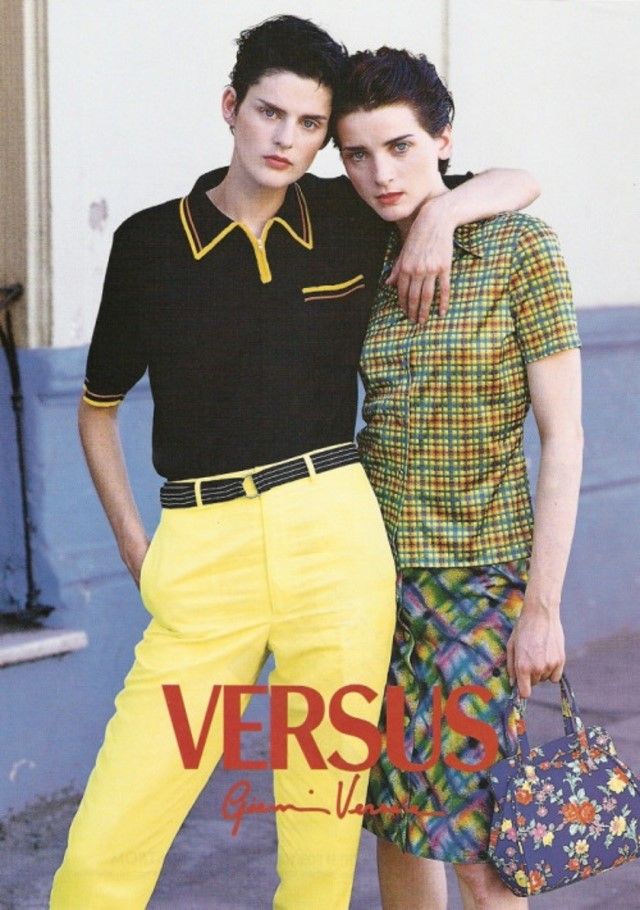
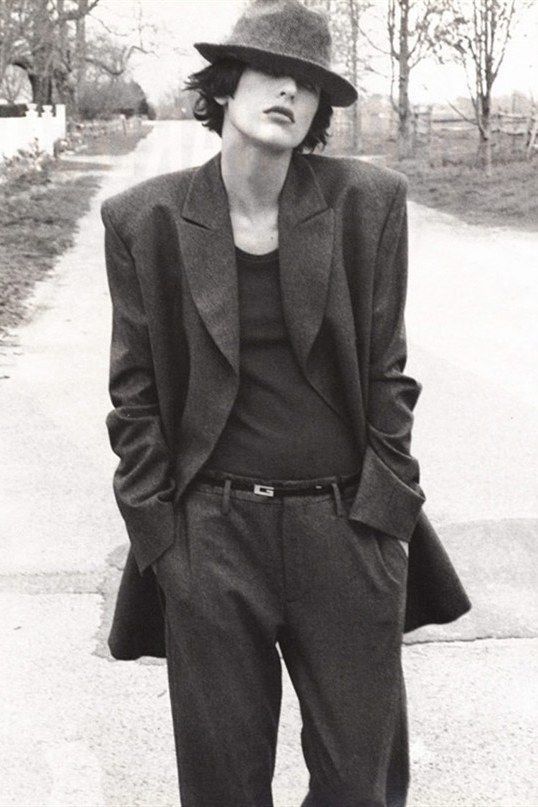
A theme in 90’s fashion is the empahsis is not on the accentuation of the human form, but its dimunition (perhaps especially for women). Now that it is the 90’s, we are not supposed to have colors, or happiness. We are supposed to feel bad about things. But exactly what we are to feel bad about . . . we’re not sure.
Any perusal through the popular music of the 1980’s reveals an era loaded with upbeat songs with big, bright production values. Even the “bad boys” generally were not angry or sad, but celebrating partying, doing bad things, etc.–think Van Halen and AC/DC. These bands were agressive in their sound, but optimistic in their tone, i.e., it was time to have a good time.
Coincidentally or no, almost exactly as the Soviet Union completed its collapse, Nirvana released its album Nevermind (which already hints at Gen X disengagement) and its most popular song, “Smells like Teen Spirit.” Some of it’s lyrics read
Load up on guns, bring your friends
It’s fun to lose and to pretend
She’s over-bored, and self-assured
Oh no, I know a dirty word
Hello, hello, hello, how low?
Hello, hello, hello, how low?
Hello, hello, hello, how low?
Hello, hello, hello
With the lights out, it’s less dangerous
Here we are now, entertain us
I feel stupid and contagious
Here we are now, entertain us.
This song, and others by Nirvana, ask us to engage with apathy, disillusionment, chaos, without really pinpointing the problem, exactly. Other famous grunge bands such as Pearl Jam, Alice in Chains, and Soundgarden would follow suit. They sang about emptiness, apocalypse, and other such topics (think of Soundgarden’s Black Hole Sun” or Stone Temple Pilot’s “Trippin’ on a Hole in a Paper Heart”). Like the fashion of the early 90’s there seemed to be a desire to destroy what was generically considered “human,” at least in the 1980’s. We no longer believed in what we were, or who we were.
True, by the mid-late 90’s, these cultural trends would shift again somewhat. Grunge and the fashion style of “heroin chic” would fall out of fashion. But the stage was set for significant transition in other modes of life. The old norms that guided society were starting to fade away. Thirty years later, we are still looking for new norms to hold us together.
We are getting used to political polarization, and many of us reading this have essentially grown up with it. I did not. The 1980’s still experienced a reasonable amount of cooperation and consensus building. That changed with the election of 1992, when the winning candidate, Bill Clinton, failed to get a majority of the popular vote in a three person race. In his candidacy, Clinton broke with typical norms governing how politicians should act, appearing on the Arsenio Hall show and playing saxophone along with the house band. Republicans followed suit, and were early in the political talk-radio space, which had more aggressive and angry messaging. The center was losing its grip, but we did not see this at the time.
Again, all of this should be strike us a curious. Most cultures experience something of a golden age in the aftermath of significant military victory, such as Athens after the Persian Wars, or England after the defeat of the Spanish Armada, or the Dutch after their own defeat of Spain. This did not happen with us. We should have been confident and exuberant. But this pattern did not materialize for us as it had in the past.
Perhaps not coincidentally, the advent of the 1990’s saw the publishing of what would become a very influential book in China, Wang Huning’s America against America. Huning had visited America for several months in the late 1980’s and wrote about his observations. Huning went on to serve as a top advisor to three Chinese premiers and still holds a top position in the government today. Many see Huning’s book as having a strong impact on the development of China and their view on the United States.
Huning saw culture, tradition, and shared values all eroding in America. This is a fairly common critique of democracies in general, and so nothing particularly new. Huning had good things to say about America that many other foreign observers might share. There are a few observations he made, however, that seem prescient and influential over the next three decades.
- The title of the book is taken from the Chinese term yíhuò [疑惑] meaning “puzzle” or “doubt.” America had effectively turned itself into a yíhuò [疑惑] which has made Americans equally puzzled by their own system. For Huning, America was trapped in a puzzle. It was in a battle against itself.
- As one online commentator notes, “One of his observations in particular would be very influential for China’s new path forward: the power of technology. The use of electronic payments like the credit card shocked him, as did the emergence of computers. But he also understood that this technological process would eventually remake the very people it was supposed to serve. Sometimes it is not the people who master technology, but the technology that masters the people. If you want to overwhelm the Americans, you must do one thing: surpass them in science and technology.”
- Huning saw most Americans as fundamentally disconnected from each other, and wrote that, “Lonliness is a major burden on the political system.” If true, perhaps grunge music was not such an anomaly at all, but a logical consequence of this unconscious feeling.
One can certainly argue that Huning took some of his observations too far. His fear of social fracturing, combined with his adoration of technology, has led to institutions like China’s dystopian social credit system. But his observations in themselves may have merit.
The legacy of the 1990’s is complicated, but it is where the seeds were planted for many of our modern problems.
Dave
 A Stick in the Mud