The Red Pants of France

Barbara Tuchmann’s The Guns of August discusses the controversies, dilemmas, and human drama in the days leading up to World War I. She puts a special focus on the war plans developed by France and Germany in the years leading up to the war. The two plans reflect much about the two nations. Germany’s Schliefflin Plan

  • Relied heavily on rail transport with precision timetables
  • Relied heavily on heavy artillery and all of the other goodies of industrialization
  • Involved violating Belgian neutrality, but no matter–the winner would determine the post-war narrative, and they had to go through Belgium to make their plan work.

France’s Plan 17 relied

  • Heavily on initiative in the field for individual commanders, with the emphasis on attack
  • Much more than Germany on the human element, “men win wars, not machines,” and so on–what the French called “elan.”
  • They eschewed heavy artillery, feeling that it would slow their men down and give them a dependent mindset.

Both sides had perfect awareness of the other’s plans, and both thought the strategic situation favored their own side. The French, with their army in red pants, hearkened back to an older time. Some called for the uniforms to be replaced with a more drab color less visible on the spectrum. The French general staff refused absolutely. The red pants embodied the spirit and will of the army, a refusal to bend to the industrial spirit of the age.

Alas, German organization, artillery, and precision destroyed the French army in first weeks of the war, inflicting at least 250,000 casualties. France had to adjust, and while they managed to stave off disaster at the Battle of the Marne, the dash and the human initiative would fade away just like the red pants. They too brought out heavy guns and “succumbed” to the Germany way.

As events unfolded, both sides ended up digging into the ground for what became known as Trench Warfare, which characterized the fighting in the western front right through 1918. Historians usually offer a variety of explanations for this unusual development–neither previous or future wars would ever use trenches so completely.

  • Some focus on the significant imbalance between defense and offense that existed between the western powers. Heavy weaponry for the most part had little mobility at this time, which limited offensive capability and gave an enormous advantage to the defensive.
  • Some focus on the narrow geography between the German and French borders, which meant an extreme concentration of men and machines. More space on the Eastern Front, for example, meant some more mobility and much less trench digging.

These explanations have merit but I think miss the larger picture.

The triumph of the metric system presaged military developments in World War I. The old systems of measurements had its roots in human experience and proportion, i.e., the “foot.” or the “stone” (about 14 pounds), which would be local and based on the weight of an actual stone in a particular town or region. The new system greatly maximized standardization, minimizing locality, and made it easier to count, measure, multiply, and so on. In other words, the new system granted one more power.* The Industrial Revolution continued this standardization, which naturally granted increased power to produce goods on a mass scale

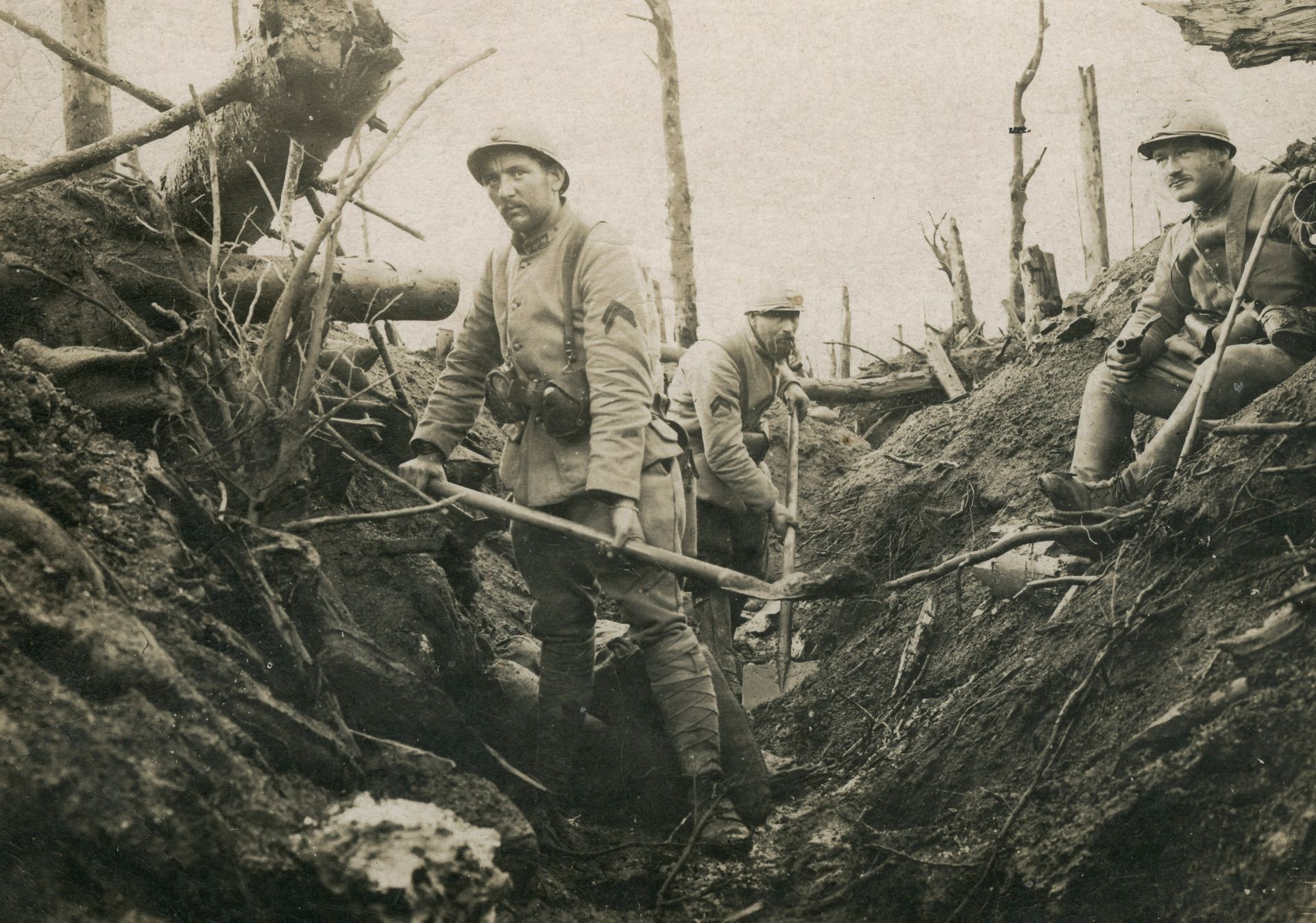
But all of this power came from literally digging into the earth to obtain the necessary raw materials for the engines of industry and war. As industrialization reached its peak manifestation, the soldiers too dug into the earth. Perhaps the eastern theater of war saw less trench warfare because it had less industrialization. It seems a curious symmetry exists between the birth of the modern war machine and trench warfare, and we should endeavor to explain it. In other words, the creation of industrialization (digging into the earth), and its apotheosis (trench warfare) mirror each other (in the picture of the soldiers above, change the uniforms and the men could look exactly like miners). For Europe, World War I ended the belief in the inevitable progress of mankind, represented by science/industrialization and democracy. One can easily argue that science and democracy (in the form of mass media, mass mobilization, and mass production) made the war much more deadly than any previous conflict.

We can begin by noting the symmetry between birth and death. Interestingly, many ancient cultures buried people in the fetal position, linking birth and death in a circle, which I discussed here.

Perhaps this should not surprise us, as birth and death have something of a symbiosis.

We see a similar symmetry in rock music. I grew up partially in the Grunge Era. I took great delight in the transition from 80’s pop to Nirvana and Soundgarden. But anyone who reflects for a moment should see something odd going on with music in the 1990’s. In his excellent book on that decade, Chuck Klosterman made two keen observations:

  • The grunge attitude and aesthetic brought about the end of rock and roll. The whole foundation of rock music involved stardom, mass appeal, etc. Grunge artists had massive success while deriding, mocking, and hating that success, a kind of matter-anti-matter collision. In this sense, Kurt Cobain’s tragic suicide** can be seen as a harbinger, a death-knell for the genre as a whole. In many ways, the power that comes with stardom brings not life, but a kind of death, just as the power granted by industrialization ushered in an era of millions of deaths in war.
  • What was with the litany of songs with large portions of lyrics devoted either to nonsense, mere sounds, or garbled unintelligibility?

We’ll get to that list momentarily. We saw something similar at the birth of rock and roll in the late 50’s-early 60’s, in the form of a variety of songs with nonsense/unintelligible lyrics that made their way into the American psyche.

All of these songs share the exuberance that characterizes the birth of an era. The nonsense, the invented sounds, reminds one of little kids discovering their mouths for the first time.

In the 90’s you have Klosterman’s list of songs with nonsensical and unintelligible lyrics. But this time, the tenor, and atmosphere of the songs embrace not the excitement of new life but chaos, meaninglessness, and death.

  • Of course, Nirvana’s “Smells Like Teen Spirit,” with Weird Al parodying the song’s unintelligibility.
  • Blur’s “Beetlebum,” and “Song 2.” “Song 2” has a something of exuberance in it, but the video clearly shows it is the excitement of destruction, not creation. No coincidence then, that Paul Veerhoven used this song to promote his movie Starship Troopers, which parodied the meaninglessness of fascistic violence.
  • Trio’s “Da Da Da.” Volkswagen used the song expertly to hint at the banality of life for young men. Leave it to the Germans, I suppose.
  • Basement Jaxx’s “Bingo Bango.” Yes, the song has an upbeat mood to it, but the video hints at disorienting chaos.
  • “Mmmmm Mmmmmm Mmmmmm” by the Crash Test Dummies. The song has beauty, but it is the beauty of an elegy. The group’s other hit, “Coffee Spoons and Afternoons” talks about receding hairlines, hospitals, drinking coffee in the afternoon wearing pajamas–not exactly the stuff of birth.
  • At first glance, Hanson’s “Mmmmbop” may seem to have the stuff of “life” embedded within, but after listening for about 90 seconds, thoughts of anger, hatred, and despair flood one’s being. The song is hypnotically annoying/infuriating.

The end of rock music mirrored its beginning, but the mirror has cracks.

Historians date the birth of the modern state at different points. One can trace the beginnings in the later Renaissance, and things look more clear at the Peace of Westphalia in 1648. But to see the state as we know it, with its bureaucracy, centralization, uniformity of law, and military organization, we have to look at Napoleon. We have a fascination with Napoleon for good reason–undoubtedly he embodied something romantic, something of promise, in his early years.

But 100 years later, that civilization, while having much more power at its disposal, actually approaches its death–a variety of historians (Niall Ferguson, Oswald Spengler) see World War I as the end of the west. Certainly at least, Europe–the core of western civilization– has never recovered from that conflict. Western civilization’s power and identity had its start with going into the earth in hope that its raw materials would give us power to establish Kant’s dream of perpetual peace. It ended differently.

Dave

*A variety of people have pointed out this connection between counting, numbering, and power. This may be why King David suffered such a strong rebuke when he took a census in Israel. He tried to count “excessively,” i.e., he tried to consolidate power inappropriately at the end of his reign.

**In an interview with Vulture magazine, Klosterman commented,

What is so profound about Nirvana is that the relationship ended up becoming real. The song “I Hate Myself and Want to Die.” The idea that a person who writes that song also does commit suicide — that is so on the nose. People would say things like, “If that guy hates fame so much, why doesn’t he just stop?” We did not fully believe that Kurt Cobain was actually unhappy. And then when he killed himself, it made that music suddenly weirdly true.

He was presenting ideas in a culture where irony was the central understanding of all messages, and he seems to have had no ironic distance at all. It actually was incredibly sad and depressing to him that people he didn’t like loved his music. It legitimately bothered him that, say, homophobes liked his music. It bothered him in a way that for other artists, it would’ve been seen almost as branding.

8th Grade Civics: The Paradox of the 1990’s

This week in Civics we explored the 1990’s, not so much in the specific events, but the cultural trends that shaped that decade.

Having lived through the 90’s as a young man, I remember them as good times. I enjoyed much of what the culture offered, such as grunge music and the chance to wear untucked flannel shirts. And yet, the 90’s pose a curious problem. Having definitively won the Cold War, we should have been happy and celebratory as a nation. And yet, the 80’s, a time of uncertainty and the fear of nuclear war, appear as the decade of optimism. In the 1990’s, we appear wracked by self-doubt, angst, and a loss of confidence. The popular image of the time is that of the disaffected slacker.

Logic dictates this should not have been the case. After all, throughout most of the 90’s we had

  • Economic Growth
  • Former Enemies in Europe becoming fast friends (i.e., Poland, Romania, etc.)
  • New, exciting technologies such as the internet (the legacy of the internet is debatable, at the time everyone thought it would be great).
  • A more peaceful world
  • The expansion of trade and the modern advent of globalization (today the legacy of this is hotly debated, at the time it seemed a slam-dunk to most).

And yet, it was during this time that our culture began to fragment in weird and unexpected ways. I have some theories as to why this might have happened, but first, let us note the sharp difference between the late 80’s and the early 90’s.

In terms of fashion, the 80’s were defined by bright colors, and bold choices. Things were bright and big.

Whatever one might think of such choices, they certainly come from a place of confidence (perhaps too much of it :).

In the early 90’s things shift dramatically to a look now known as “heroin chic.”

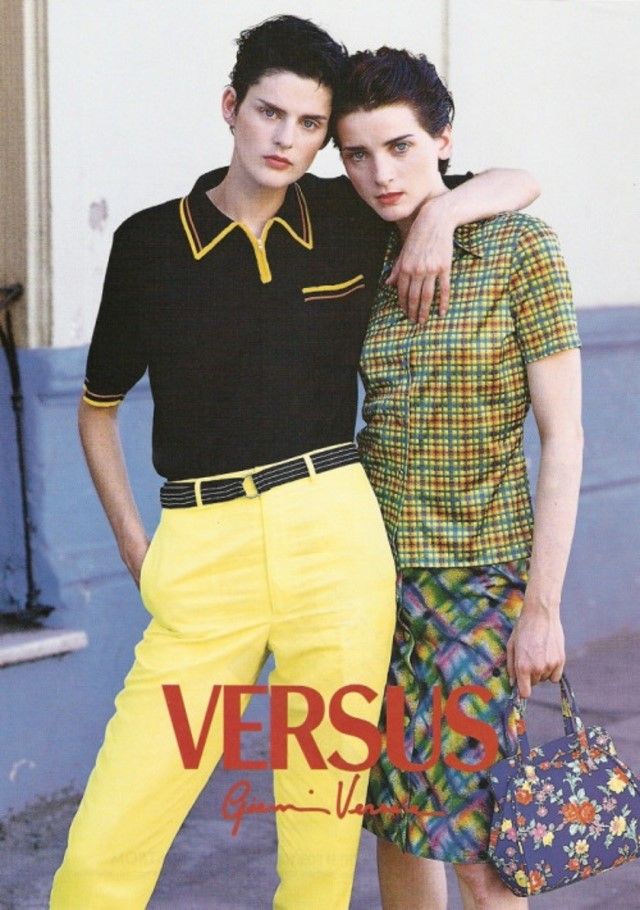
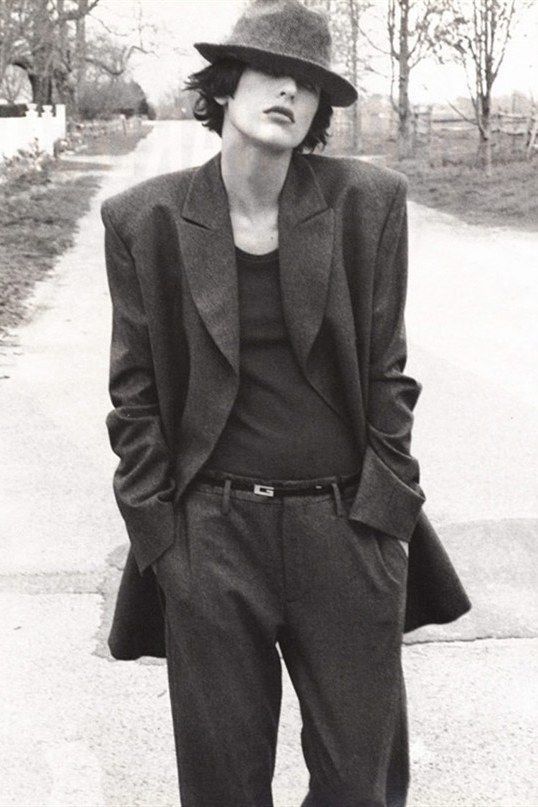
We are used to the issue of confusion between male and female and the blurring of lines between them. This has it roots in the 90’s as well, as these fashion shoots indicate:

A theme in 90’s fashion is the empahsis is not on the accentuation of the human form, but its dimunition (perhaps especially for women). Now that it is the 90’s, we are not supposed to have colors, or happiness. We are supposed to feel bad about things. But exactly what we are to feel bad about . . . we’re not sure.

Any perusal through the popular music of the 1980’s reveals an era loaded with upbeat songs with big, bright production values. Even the “bad boys” generally were not angry or sad, but celebrating partying, doing bad things, etc.–think Van Halen and AC/DC. These bands were agressive in their sound, but optimistic in their tone, i.e., it was time to have a good time.

Coincidentally or no, almost exactly as the Soviet Union completed its collapse, Nirvana released its album Nevermind (which already hints at Gen X disengagement) and its most popular song, “Smells like Teen Spirit.” Some of it’s lyrics read

Load up on guns, bring your friends

It’s fun to lose and to pretend

She’s over-bored, and self-assured

Oh no, I know a dirty word

Hello, hello, hello, how low?

Hello, hello, hello, how low?

Hello, hello, hello, how low?

Hello, hello, hello

With the lights out, it’s less dangerous

Here we are now, entertain us

I feel stupid and contagious

Here we are now, entertain us.

This song, and others by Nirvana, ask us to engage with apathy, disillusionment, chaos, without really pinpointing the problem, exactly. Other famous grunge bands such as Pearl Jam, Alice in Chains, and Soundgarden would follow suit. They sang about emptiness, apocalypse, and other such topics (think of Soundgarden’s Black Hole Sun” or Stone Temple Pilot’s “Trippin’ on a Hole in a Paper Heart”). Like the fashion of the early 90’s there seemed to be a desire to destroy what was generically considered “human,” at least in the 1980’s. We no longer believed in what we were, or who we were.

True, by the mid-late 90’s, these cultural trends would shift again somewhat. Grunge and the fashion style of “heroin chic” would fall out of fashion. But the stage was set for significant transition in other modes of life. The old norms that guided society were starting to fade away. Thirty years later, we are still looking for new norms to hold us together.

We are getting used to political polarization, and many of us reading this have essentially grown up with it. I did not. The 1980’s still experienced a reasonable amount of cooperation and consensus building. That changed with the election of 1992, when the winning candidate, Bill Clinton, failed to get a majority of the popular vote in a three person race. In his candidacy, Clinton broke with typical norms governing how politicians should act, appearing on the Arsenio Hall show and playing saxophone along with the house band. Republicans followed suit, and were early in the political talk-radio space, which had more aggressive and angry messaging. The center was losing its grip, but we did not see this at the time.

Again, all of this should be strike us a curious. Most cultures experience something of a golden age in the aftermath of significant military victory, such as Athens after the Persian Wars, or England after the defeat of the Spanish Armada, or the Dutch after their own defeat of Spain. This did not happen with us. We should have been confident and exuberant. But this pattern did not materialize for us as it had in the past.

Perhaps not coincidentally, the advent of the 1990’s saw the publishing of what would become a very influential book in China, Wang Huning’s America against America. Huning had visited America for several months in the late 1980’s and wrote about his observations. Huning went on to serve as a top advisor to three Chinese premiers and still holds a top position in the government today. Many see Huning’s book as having a strong impact on the development of China and their view on the United States.

Huning saw culture, tradition, and shared values all eroding in America. This is a fairly common critique of democracies in general, and so nothing particularly new. Huning had good things to say about America that many other foreign observers might share. There are a few observations he made, however, that seem prescient and influential over the next three decades.

  • The title of the book is taken from the Chinese term yíhuò [疑惑] meaning “puzzle” or “doubt.” America had effectively turned itself into a yíhuò [疑惑] which has made Americans equally puzzled by their own system. For Huning, America was trapped in a puzzle. It was in a battle  against itself.
  • As one online commentator notes, “One of his observations in particular would be very influential for China’s new path forward: the power of technology. The use of electronic payments like the credit card shocked him, as did the emergence of computers. But he also understood that this technological process would eventually remake the very people it was supposed to serve. Sometimes it is not the people who master technology, but the technology that masters the people. If you want to overwhelm the Americans, you must do one thing: surpass them in science and technology.”
  • Huning saw most Americans as fundamentally disconnected from each other, and wrote that, “Lonliness is a major burden on the political system.” If true, perhaps grunge music was not such an anomaly at all, but a logical consequence of this unconscious feeling.

One can certainly argue that Huning took some of his observations too far. His fear of social fracturing, combined with his adoration of technology, has led to institutions like China’s dystopian social credit system. But his observations in themselves may have merit.

The legacy of the 1990’s is complicated, but it is where the seeds were planted for many of our modern problems.

Dave

8th Grade Literature: Hide from Yourself

This week we continued with Act II of Macbeth and saw the development of the themes introduced in Act I.

In our last post we saw how the witches introduced this theme of confusion into the play, both in where they resided, and how they spoke. Now we see their evil spread to Macbeth and Lady Macbeth.

Different versions of Mabeth productions show the witches in different ways. My favorite is the recent Coen brothers film of Macbeth. They only have one witch, and in the play there were three. But the way this witch speaks to herself is like speaking to others. Are the other witches there that we cannot see, or is she driven to schizophrenia by her evil?* I am guessing the latter. The way she unnaturally unfolds her body mirrors this division within her soul (the flapping of her arms also introduces the idea of the witch as a crow or raven, an important element in the play we will touch on next week).

Towards the end of Act I, Lady Macbeth challenges Macbeth to murder Duncan. To do this she calls his manhood into question, a curious tactic considering that we know Macbeth to be the major hero in the battle. One might guess that this tactic would not work, but Macbeth has already let the witches’ prophesies into his heart and mind. He is already confused, and his confusion will grow over time.

To get Macbeth to betray Duncan, Lady Macbeth also calls the nature of manhood into question. The traditional view is that one key factor that separates man from beast is the fact that man can think, reason, and deny himself. A hungry dog would not pass up a meal, but it is possible, for example, for a man to fast for a higher purpose. Lady Macbeth flips this on its head, telling Macbeth that he is wrong for letting “I dare not,” wait upon, “I would.” For Lady Macbeth, what makes a man is that he never denies himself what he wants. When Macbeth expresses second thoughts, Lady Macbeth calls him a “beast,” yet it is a man that can second guess himself, and not a beast.

Can one exist in such an upside down world?

Even before Macbeth actually kills Duncan, he begins to have a hard time with reality. We see this start with his vision of bloody dagger. He is not sure if it is a “dagger of the mind” or real.

After he murders Duncan, Macbeth utters the famous line that he has “murdered sleep.” For the rest of the play, sleep will elude Macbeth, and we can see this is as a physical manifestation of his evil deed. Sleep is restorative, taking our tattered body and mind and making it whole again. Macbeth has torn the kingdom asunder so it is right that he is denied wholeness. In a broader sense, Macbeth’s murder has severed him from nature, as he murdered his “natural lord.” The idea of a “natural lord,” may seem odd to us, but it was a common idea in medieval Europe. For those in Shakespeare’s time, one is born into a particular condition, and one generally stayed in that condition. This was no hardship but a comfort (at least in theory for most). One knew one’s place in the cosmos. King’s had their position not because they were great but “by the grace of God.” The order of things just simply “was.” The eldest son ruled, not because he was the best son, but because that was the nature of things. No one earned their place. Your place was a gift.

Honoring King Duncan and obeying him was the right thing to do, of course. But it was also the “natural” thing to do, just as it is natural for the sun to rise in the morning and set at night. One should strive to conform oneself to the order of nature.

Macbeth’s murder of Duncan (a guest in his own home) unravels the kingdom and also the fabric of creation itself. He has robbed himself of his own place in the world, and now neither God, his fellow man, or even creation itself will give him comfort. He has nothing left, and now he cannot even comfort or reason with himself. Macbeth states that, “To know my deed ’twere best not know myself.”

Macbeth’s schizophrenia aptly matches that of the witches he encountered in Act I. His descent will continue.

Dave

*One reason why I like this artistic choice is that the witch (maybe) talking to herself, seeing things, etc. mirrors what happens to Macbeth. He thinks he sees a dagger and a ghost, and maybe he does, and maybe not. The mirroring of the witches and Macbeth is certainly hinted at in the text of the play, and I think it quite clever to show this visually.