Oligarchies, Expansion, and a “Time of Troubles”

I posted this originally back in 2012.  While I could have added some new thoughts to the post I wrote directly on Eric Voegelin’s Science Politics, and Gnosticism (found here), I thought it better to include in this post as a sub-set on the idea of territorial expansion.

It may very well be that to read Eric Voegelin is to be confused.  I have had my struggles with his book Order and History: The Ecumenic Age.  But, remembering that he made a special study of gnostic ideas and philosophy, I found his thoughts on the origins of Gnosticism and its relation to territorial expansion very intriguing.

Gnosticism has many permutations, but at its core it propounds an opposition of matter and spirit, the soul and the body, and so on.  Some biblical scholars believe that the Apostle John may be attempting to counter Gnosticism in his epistles. Those who have read St. Augustine’s Confessions know that he involved himself in the gnostic ideas of Manicheism before converting to Christianity.  But gnosticism as a general philosophy pre-dates the coming of Christ by many centuries. Voegelin writes on its origins,

The genetic context to which I refer is the interaction between expansion of empire and differentiation of consciousness.  In pragmatic history, Gnosticism arises from six centuries of imperial expansion and civilizational destruction (p. 21).

Thus, we may assume that gnostic ideas had their roots in the first great ecumenic empire of the Persians, and this fits with the Zoroastrianism and its adoption by Darius I as the semi-official religion of his court.

As to the “why” behind the link between expansion and Gnosticism, I am less able to penetrate Voegelin’s thoughts.  But I believe that we can surmise the following:

  • Significant expansion destroys our sense of proportion.  If the empire is everywhere, it is nowhere.
  • Lacking perspective, we lack attachment to place.  Without attachment to place, we lose our attachment to creation itself.  As an old Irish proverb states (I’m not quoting exactly), “Those who travel much lose their faith.”
  • The power that comes with empire inflates one’s sense of self and distances us from others.  As Chesterton stated, one should pray in valleys, not mountaintops.

Related to the original post below, the disconnect from creation might form the spiritual basis of the problems faced by expansion.

Having recently glanced over The Goebbels Diaries I wondered —  did Hitler’s refusal to allow Rommel to withdraw at El Alamein, and his “fight to the last bullet” order to Von Paulus at Stalingrad arise not from hope of victory but desire for the extinguishing of matter?  As Germany’s territory increased, Hitler seemed more focused on a “refining” cataclysm for creation than in actual victory.  Once separated from creation, we come to hate it, with death as the (perceived) only escape.

And now, the original post . . .

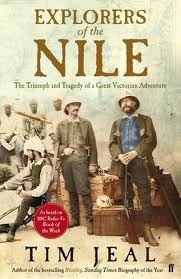
Reading Explorers of the Nile spurred on a thought experiment.

While I have not been overly compelled by the story, there have been several interesting tidbits.  Regardless of one’s feelings toward the Victorian age in general, or the Brits in particular, one can’t help but admire the sheer will and energy of the second great wave of western exploration (the first being in the 15th-early 16th centuries via the Atlantic).  Many hundreds of men risked everything for the sheer thrill of discovery, and yes, for the glory of it as well.  In the early phases from ca. 1840-1860’s, most of this exploration seemed to me to have a generally innocent tinge to it.  The more acquisitive imperialism came later.
This energy and striving for glory reminded me of late Republic Rome, and the quote from Sallust in The Jurgurthine War, which reads,

I have often heard that Quintus Maximus Publius Scipio, and other distinguished men of our country were accustomed to declare that, whenever they looked on the masks of their ancestors, their hearts were set aflame in the pursuit of virtue [i.e. worthy deeds].  Of course they did not mean that the wax or the effigy had any power over them, but it is the memory of great achievements that kindles a flame in the breasts of eminent men that cannot be extinguished until their own excellence has come to rival the reputation and glory of their forefathers.

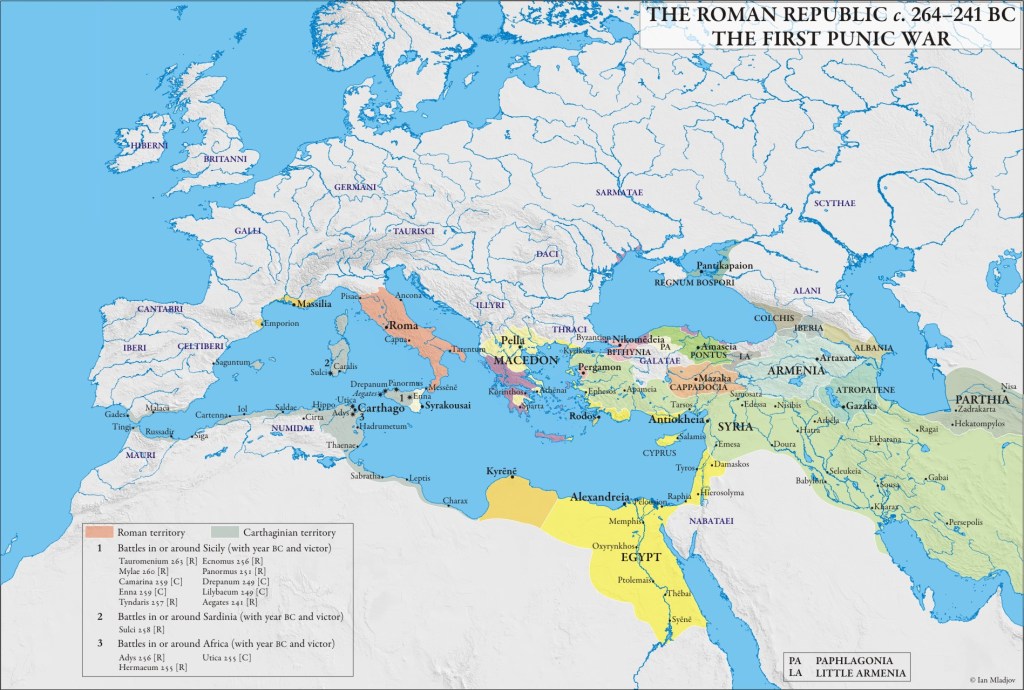
It struck me that it was during the later phase of the Republic that Rome grew the most in size.  If we look at a map of the Mediterranean at the beginning of the first Punic War in 264 B.C. . . .

Mediterranean, 264 BC

we see that Rome, though decent in size, does not dominate.  They have their sphere, along with Carthage, Egypt, Macedon, etc.

If we fast-forward 100 years we get a different picture, and as the map below indicates, Rome continues to grow almost geometrically down to the death of Caesar in 44 B.C.

Roman Growth Timeline

While Rome had a Republic at this time, I agree with Toynbee that while the government had democratic elements, it was for all intents and purposes an oligarchy.  The aristocratic senate dominated policy, however much voting by the masses took place.

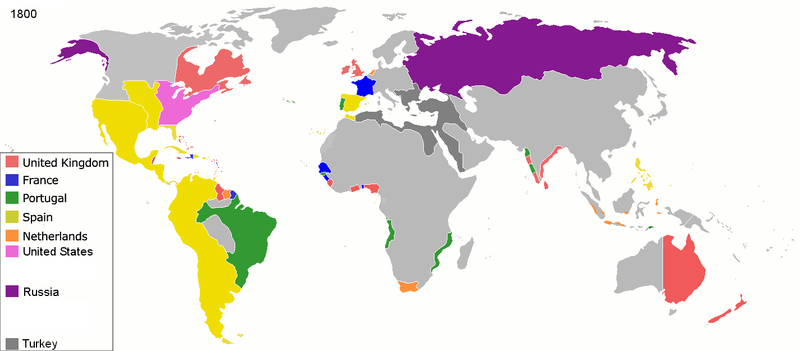
Is there a connection then, between oligarchic democracies and expansion?  As time marched on from Charles I, England did by fits and starts become more democratic.  But 19th century England surely was not democracy in our sense of the word, and instead like the Republic showed strong oligarchic tinges.  As a monarchy, England’s overseas holdings were modest compared with the rest of the world, ca. 1800. . .

Colonisation, 1800

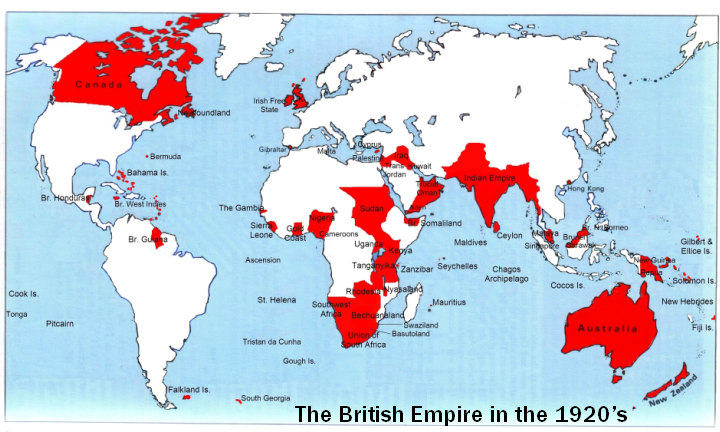
But a century later, after more democracy (while still having an oligarchy) and we see a different scene:

British Empire, 1920

As in late Republic in Rome, we have a near doubling in size.  Of course, something similar could be said of the other major European powers during the same time, many of them become more democratic after 1848, though again, like England, not fully so until after W.W. I.

Two examples do not really suffice to prove the connection.  But three will!

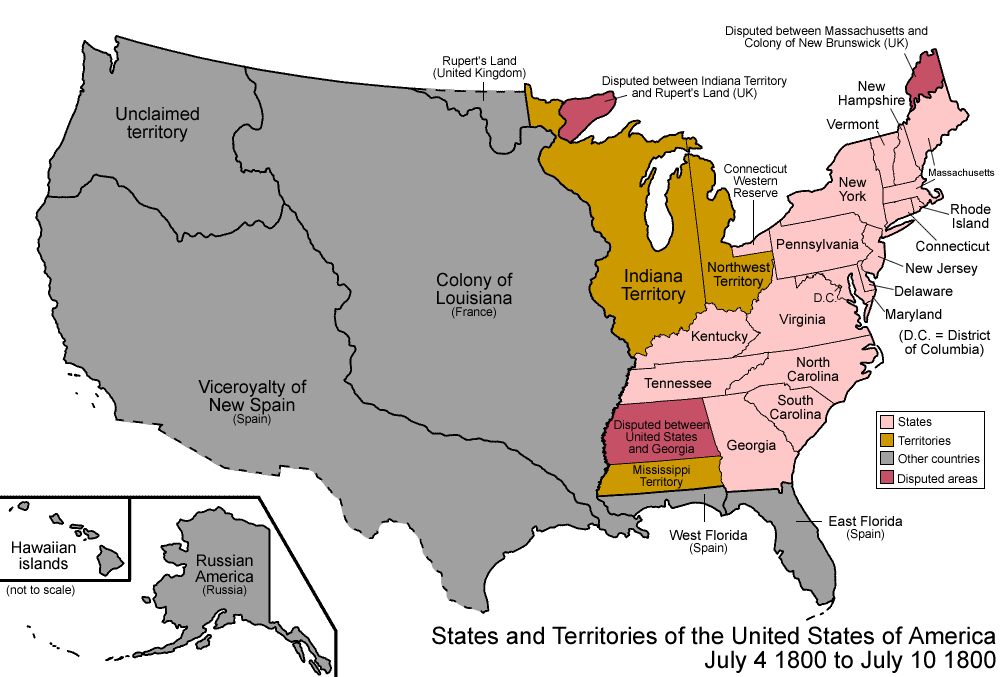
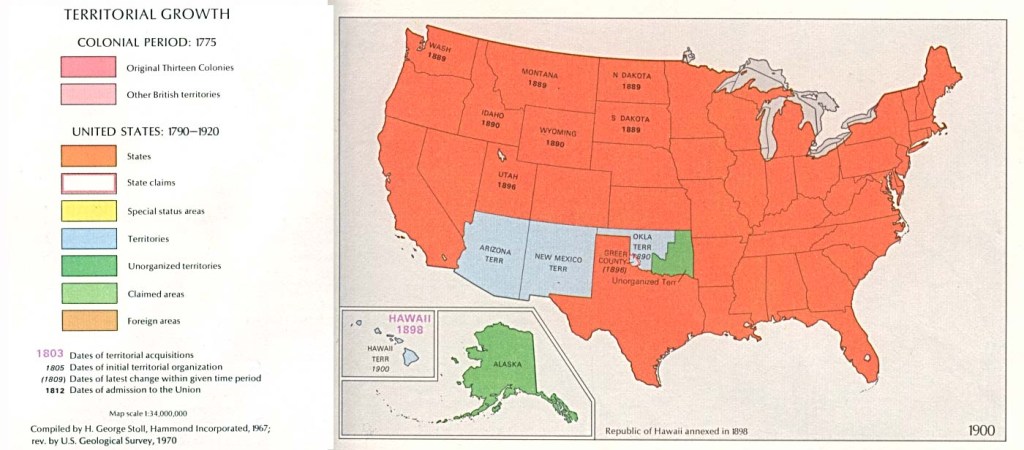
America gets accused of being an imperial power, but I think the charge false in our current, strongly democratic time.  It might have had more merit in the more oligarchic 19th century, however.

America, 1800:

America, 1800

America, 1900:

When America became more democratic in the 20th century, our expansion rapidly slowed.  Now, to be fair, we acquired Louisiana “fairly” from France by buying it, and Alaska fair and square from Russia.  But the same cannot be said for the Philippines, or the vast territory taken from Indians, including territory in Louisiana.  Both Abraham Lincoln and Ulysses S. Grant thought that our war with Mexico in 1846 to be manifestly unjust.

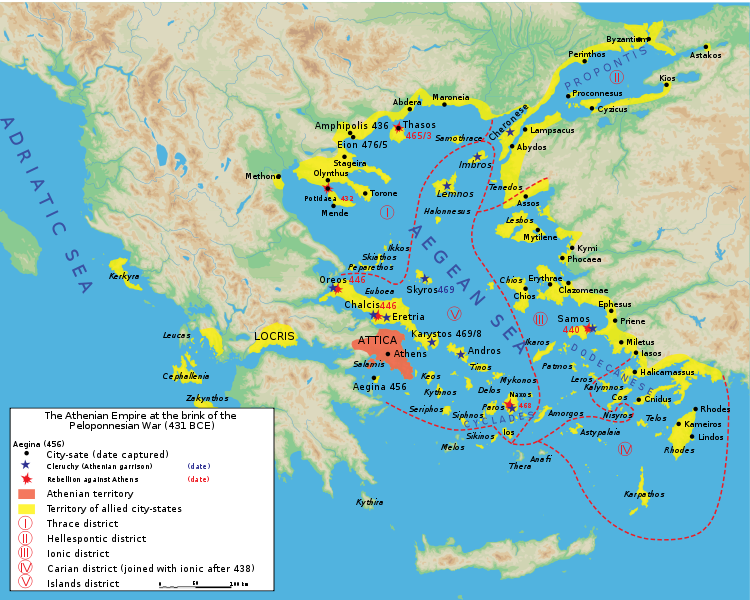
If we believe Thucydides, and call Athenian democracy in its golden age really a Pericles-led oligarchy of the best (a claim, to be fair, disputed by the great classicist Donald Kagan), we again see this principle of growth.  In 490 B.C. Athens stood as one city-state among many.  Not so 50 years later. . .

Map, Athenian Empire 431 B.C.

As to why oligarchic democracies have such expansionistic tendencies, I cannot say.  Perhaps it can be the subject of another post filled with wild theories.  But it does seem clear that this period of expansion leads to a “Time of Troubles,” for all parties involved.

For England and the rest of Europe, expansion gave way to the two World Wars.  America had its Civil War, caused largely by the exacerbation of the slavery issue.  The inflaming of the slavery question in its turn had its roots in the Mexican-American war in 1846.  Athens and the Greek world faced the Peloponnesian War (431-404 B.C.).  Though the proximate causes and results of these conflicts differ, they each have an age of expansion to precede it.

Any thoughts from anyone else, with more examples, or a connection between oligarchic democracies and expansion, are heartily welcome.

Blessings,

Dave

8th Grade Civics: Regime Change

Greetings all,

Before Christmas break we wrapped up our unit on the Cold War, and right at the end of that era we initiated a military operation to remove a leader from a Latin America country. In 1989 we invaded Panama to depose the de facto leader, Manuel Noriega. He eventually surrendered and was convicted at his trial in the United States. Purely from the perspective of a history teacher, our actions in Venezuela occurred at just the right time. We discussed in class some similarities and differences bewteen the two events, and brought in Machiavelli’s perspective to aid our discussion.

We struck at Noriega for a variety of reasons that can likely be condensed to

  • Drugs
  • Safeguarding the democratic process in Panama
  • Protecting the viability of the Panama Canal

Operation Just Cause was controversial then and now, with questions abounding about its legality according to international law and the constitutional powers of the presidency. Depending on which source one uses, casualties ranged from 500 to 1000 people, But in terms of results, most everyone agrees that the United States achieved its political goals in the operation. In time Panama became a stable, democratic state friendly to US interests. At the time, the people of Panama overwhelmingly supported the operation, and Panama’s subsequent political history bears this out.

Time will tell regarding the ultimate success of our extraction of President Maduro. Will he be convicted? Will Venezuela transform politcally? Will the US garner support in the region or not? Such questions will need a few years before we have the answer. But we can look to history and its observers to aid our speculation amidst our confusing political moment.

In class we looked at two chapters of Machiavelli’s The Prince to inform our discussion.

Machiavelli examines how one ruler can take effective control of another land and govern it either personally or via proxy. As usual, Machiavelli avoids the moral question of whether or not one should or should not do so, and concentrates on the conditions for success should one wish to undertake the action.

He identifies two paths to success:

  • Control the territory through occupation. This requires patience and a lot of money. But if one has the resources (both financial and in terms of political and military will) this will usually give one success.
  • Destroy the territory and scatter its inhabitants. This is simpler and much more effecient than the above option. However, many will consider these actions cruel and your reputation as a ruler will be sullied for posterity.

Machiavelli frankly admits that because of this, few rulers should consider seeking to control other lands. Most lack the stomach for it. Most, he argues, unable to “rip off the band-aid” will attempt to be “nice,” or take short-cuts, and their efforts will ultimately fail. It would have been much better if they never attempted anything in the first place.

Various political scientists have tried to tease out the principles behind Machiavelli’s to apply them to modern actions. For example, if one wants to occupy an entire geographic region one must indeed scatter the inhabitants of the entire region. But what if the “territory” you wish to occupy is merely the seat of power itself? In that case, when one “scatters the inhabitants” you can confine yourself to those with political power rather than the whole of the population. Here is one clue as to why Panama might have worked, for we entirely dismantled Panama’s governing elite and rendered it’s military ineffective. In Afghanistan, we certainly did not sufficiently “scatter” or destroy the Taliban, and they were able to return to power.

Time will reveal whether or not our actions in Venezeula will turn out for good or ill. Machiavelli would likely argue that taking out only Maduro would qualify as a half-measure that will likely make things more difficult for us in the long run. We shall see.

Perhaps Machiavelli’s most infamous section of The Prince comes in chapter 17, where he writes,

Coming now to the other qualities mentioned above, I say that every prince ought to desire to be considered clement and not cruel. Nevertheless he ought to take care not to misuse this clemency. Cesare Borgia was considered cruel; notwithstanding, his cruelty reconciled the Romagna, unified it, and restored it to peace and loyalty. And if this be rightly considered, he will be seen to have been much more merciful than the Florentine people, who, to avoid a reputation for cruelty, permitted Pistoia to be destroyed. Therefore a prince, so long as he keeps his subjects united and loyal, ought not to mind the reproach of cruelty; because with a few examples he will be more merciful than those who, through too much mercy, allow disorders to arise, from which follow murders or robberies; for these are wont to injure the whole people, whilst those executions which originate with a prince offend the individual only.

Nevertheless he ought to be slow to believe and to act, nor should he himself show fear, but proceed in a temperate manner with prudence and humanity, so that too much confidence may not make him incautious and too much distrust render him intolerable.

A question arises out of this, namely: Is it better to be loved than feared or better to be feared than loved? Well, one would like to be both; but it’s difficult for one person to be both feared and loved, and when a choice has to be made it is safer to be feared. The reason for this is a fact about men in general: they are ungrateful, fickle, deceptive, cowardly and greedy. As long as you are doing them good, they are entirely yours: they’ll offer you their blood, their property, their lives, and their children—as long as there is no immediate prospect of their having to make good on these offerings; but when that changes, they’ll turn against you. And a prince who relies on their promises and doesn’t take other precautions is ruined.

What is Machiavelli advocating?

First, we can note that when Machiavelli uses the word “love” he does not have the Christian definition of the word in mind. From the context, it seems that he means something akin to infatuation. We have seen how certain people rise to prominence only to experience a fall a few months later (Elon Musk comes to mind as a recent example), and given the context, I think this is what he means. Having people be infatuated with those in power does give leaders a brief moment when they could hypothetically receive a lot of support and accomplish a great deal. But like the wind, such infatuation comes and goes.

Fear also does not last forever, but it does last longer than “love” as Machiavelli defines it. By “fear” Machiavelli means (I think) the obedience and stability inspired via wanting to avoid punishment. It is stability, I think, that is Machiavelli’s key concern. For example, Machiavelli understands that leaders can be immoral, but if their immorality affects the lives of the public, such as raising taxes and pocketing the money yourself, you will not last in power long. The people will not take kindly to the disruption you brought into their lives. On the other hand, if a ruler had a mistress and destroyed his marriage, that wouldn’t be a good thing, but it would not directly impact the lives of the people. In such cases, the public will usually either forgive or look past your misdeeds.

Here is a positive spin on Machavelli’s trade-off:

Many parents, for example, do not want to be seen as the “bad guy.” In addition, the amount of decisions parents make in a day can be wearisome, and it is hard to always know what is right. Thus, some parents will often hedge about certain decisions. “Dad, can I do ‘x’?” The dad has doubts about ‘x,’ but also (like any parent), likes to say “yes” to his son. He is ultimately not sure about ‘x’ and wants to think about it.

So, dad hedges, and says, “Maybe you can do ‘x,’ under certain parameters for a certain length of time. Let me think about it.” The dad hopes that he shows that the child that he is reasonable and open. But often these kinds of actions produced confusion and unhappiness in the child.

The dad who simply says, “No,” and adds, “and you know better than to even ask,” seems cruel at first glance. The child may be momentarily upset, but will get over it soon. Above all, the child knows where he stands, and experiences no confusion. In the end, this child is probably happier in the long run.

Alas, I (and perhaps others who read this as well) have often tried the hedge described above and found experience to be a hard, but fair, teacher.

8th Grade Literature: Medea at a Crossroads

As we move into Book Three of the Argonautica we get introduced to Medea, which sets up the central dramatic problem of the epic.

Greek literature followed Greek religion and delved into the nature of human choice, Fate, and the gods. Actions between men and the gods are often countered and then countermanned again. The gods push and pull against each other and mankind mirrors their actions. The line between what humans can control and what they must submit to from the gods is always blurry, and so it is in our story.

Jason was set on a quest by his uncle to retrieve the Golden Fleece, an ancient gift representing kingly power. Jason claims the throne belongs to him, so it is somewhat natural that he should need some emblem of royal dignity to accompany him. He was set on this quest to fail, however, as his uncle intended. The owner of the fleece, Aeetes, will never relinquish it. Jason has so far shown he lacks the brawn to overpower anyone. He has shown cunning and diplomacy in spurts, but that will not be enough to defeat Aetes in his own backyard.

At this point, Hera, backed by Athena, enters the story. She is a fan of Jason, as Jason one time did Hera a good turn when she was disguised as an old woman. More to the point, she hates Jason’s uncle Peleus, who regularly ignored her altars. She wants Jason to have the fleece, and decides to use Aeetes’ daughter Medea to help him get it. Medea is shot by Eros/Cupid, and falls irrevocably in love with Jason. This is tragic largely because Medea will be torn between her “love” for Jason and for her duty to her family and city. For her, helping Jason would be akin to treason. If she gains Jason, she will lose everything else.

Her choice of Medea is not random. Medea is a priestess of Hecate, and Hecate was the goddess of witchcraft, liminal borders, and magic.

Hecate was also the goddess of crossroads, which is reflected in the three directional statue of Hecate above. And this is appropriate as well, for Medea’s decision whether or not to help Jason will put her life on an irrevocable path. She will risk everything for Jason, but Jason may not be worth that risk.

The Argonautica is more slippery than previous Greek epics. The Iliad is rife with tragedy but has a tragic granduer. The Odyssey gives us a flawed hero but also justice and catharsis at its conclusion. The Odyssey also gives us a wise and virtuous heroine in Penelope.

Here in the Argonautica we have neither a bold hero or a virtuous heroine. Medea is sympathetic, but she is no Penelope. In many ways the story wants to see her action as selfish, though today many would not view it so. We are much more individualistic than the ancient Greeks. Medea’s actions cut her off from everyone and everything–except Jason. If Jason cannot successfully integrate her into his world, she will have no world at all. The Greeks thought that acting virtuously required a social context. For Aristotle, to be without a defined community made it impossible to realize one’s full humanity. Medea’s choices put her in danger of essentially becoming a non-person.

The postscript for Jason and Medea is a bitter one. Medea flees with Jason, and Jason agrees to marry her out of sympathy, gratitude, and in part, to keep her safe. But from the start their relationship was off balance. Medea was much more drawn to Jason than Jason to Medea, and Medea had to give up a great deal more than Jason.

Still, Jason had to give up something as well. He was the son of a king, and to marry a king’s daughter would certainly not be beneath him. But, he married Medea without her family’s consent (her father wanted Jason dead) and so his marriage would likely bring conflict to his own land even if he made it back safely. To marry without the family blessing of either side put their relationship at risk from the word ‘go.’

There is an interesting vignette in Medea’s story not in The Argonautica but in other versions of the story. On their way home, Medea has an encounter with Queen Arete, who can be compared to Penelope in terms of virtue and the best of feminine wisdom. Medea asks Arete for advice, and Arete tells her to leave her history of magic, spells, and sorcery behind, especially when it comes to her relationship with Jason. In the end, Medea will not follow this advice. In a classic instance of particularly Greek irony, her use of magic to keep Jason attached to her only ends up driving her away. Jason and Medea eventually have children (the number varies according to the source), but in the end, Jason divorces Medea. To make sure that Jason will have no heirs and no legacy, Medea murders his new bride and her own children as well.

The original readers knew all of this lore, and all of adds extra weight to Medea’s choice to help Jason and his crew escape. Medea chose wrongly, but the tragedy of Greek literature is that choosing rightly still would have meant the deaths of Jason and his crew at the hands of Aetes, and the failure of his quest. If the quest failed, well, we have no story. Hera and Jason sacrifice Medea for their own ends, and Medea destroys her family (and even later murders her brother) to achieve her own ends as well.

Earlier this week we had fun discussing what elements a good relationship needs, such as family support, mutual attraction, similar backgrounds, and so forth. The class did not always agree about where to rank these elements in their order of importance, but it became obvious that Jason and Medea had very little to build on and much working against them. In their favor, we can note their mutual attraction for one another, and the fact that both came from royal families. Against them, we can list:

  • Neither had the blessing of their families
  • Their “relationship” was formed very quickly in a very intense situation
  • Jason owed far more to Medea than Medea owed to Jason.
  • Conversely, after her betrayal Medea depended entirely on Jason for her protection and status. She uses this at times to guilt Jason into marrying her.
  • They had very different experiences growing up
  • Medea’s service to Hecate made Jason suspicious of her, while at the same time, her powers were needed at crucial moments to save Jason and the crew.
  • They forced enormous stress from the very start of their attraction for one another.

It is easy to see that Jason and Medea had little chance for a successful future together.

In the end, everyone may or may not be playing everyone else, and this quest does not give us the catharsis that we hope for. This is what makes The Argonautica a late-civilization epic, and why we can compare Jason’s character to the context of Machiavelli’s The Prince, which we are also reading this year.

Dave