8th Grade Civics: Machiavelli, Watergate, and Getting Good at Being Bad(?)

Greetings Everyone,

This week we continued our look at Machiavelli, and paired up chapter 8 of The Prince with the presidency of Richard Nixon.

Nixon is best known for the Watergate scandal that led to his resignation during his second term in 1974. This is a fair verdict of history. However, we do well to remember that Nixon had a variety of foreign policy successes during his tenure, such as

  • Initiating a policy of detente, and the SALT treaties signed with the Soviet Union which contributed to easing the nuclear arms race.
  • Assisting in peace negotiations between Israeal and other Arab nations duirng the Yom Kippur War of 1973.
  • His historic overture to China and our opening of diplomatic relations. While we may wonder today at the ultimate legacy of our shift in China policy over the last 50 years, at the time it was a revolutionary move that likely helped hasten the end of the Cold War.

Domestically, Nixon had several initiatives that may surprise some who know him only through the prism of Watergate:

  • He started several new government agencies, such as the EPA, OSHA, and the National Oceanic and Atmospheric Administration
  • He took the US economy off of the gold standard
  • He reshaped financial policy by creating the Office of Management and Budget*
  • He passed the Clean Water Act

Some of these policies were popular, some not, but we cannot question that for a time he was an effective political leader and easily won reelection in 1972. But the Watergate scandal, and Nixon’s actions during the scandal, unraveled everything very quickly, and we should consider why this was the case. For that, we turned to Machiavelli’s insights about rulers who exercise “villainy.”

Machiavelli begins chapter eight of The Prince discussing two infamous rulers, and begins with Agathocles of Sicily, writing,

The son of a potter, he led a life of the utmost wickedness through all the stages of his fortune. Nevertheless, his wickedness was accompanied by such vigor of mind and body, that having joined the miltia, he rose through its grades to become praetor of Syracuse. . . . He [then] called together the people and Senate of the city, having imparted his design to fight Hamilcar the Carthaginian, . . . at a given signal had the senators and all the rich men of the city murdered, [eliminating all who could oppose him]. . . . And although he was twice beaten by Carthage and ultimately beseiged, he was able not only to defend the city, . . . but also [expand its territory into Africa] and [eventually] brought the Carthiginians to terms. In the end, he maintained his position as prince by many courageous and perilous expedients.

It cannot be called virtue to kill one’s fellow citizens, betray one’s friends, be without faith or pity, and without religion, by which methods one may indeed gain an empire but not glory.

Machiavelli goes on to cite the example of someone contemporary to his own day, who used many of the same methods as Agathocles. Later in the chapter, he continues,

Some may wonder how it came about that Agathocles, and others like him, could, after infinite treachery and crueltry, live secure for many years in their country without being conspired against by their subjects; although many others have, through their cruelty, been unable to maintain their position in times of peace, to say nothing of the uncertain times of war.

Machiavelli then answers his query, writing,

I believe this arises from the cruelties being used well or badly. “Well” used may be called those (if it is permissable to use the word of evil) which are committed once for the need of securing oneself, and which afterwards are not persisted in, but which are exchanged for methods as useful to the citizens as possible. Cruelties ill used are those which , although at first few, increase rather than diminish with time. Those who follow the former method may remedy in some measure their condition with God and man, as did Agathocles. As to the others, it is impossible for them to maintain themselves. . . . a conqueror must arrange to have all his cruelties come at once, so as not to have to resort to them every day . . .

We can first note that almost no political leader follows his advice, and indeed, in a democratic system, following his advice (supposing that one should do so, a different question entirely) becomes almost impossible. To get elected, one must promise good things, and certainly not state that one will begin their term by doing various evil deeds. To get elected, one must at least give the appearance of either a) healing the harms done by the previous leader, or b) prevent the harms that the challenger will introduce should they be elected.

The elected leader usually then enjoys a honeymoon period, an era of good feelings, where people assume the best and enjoy the change. Then, later, when the leader makes missteps, they are judged harshly for them. Among other things, these missteps go against the grain of their earlier cultivated image.

For presidents that serve two terms, the second term usually brings crisis and controversy. Truman’s second term had the Korean War, Johnson’s second term had violence in cities and the escalation in Vietnam. Nixon had Watergate, and Reagan the Iran-Contra scandal. Clinton had the Monica Lewinsky scandal and impeachment. Bush had to face increasing difficulties and costs in Iraq, as well as the financial crash of ’08. The good feelings engendered by Obama in his first term disappeared during his second. There appears little escape from this pattern.

Perhaps one problem modern political leaders have is that they have little chance to exercise physical courage in any direct way. This limits their chances to win the favor of the people and renew their mandate, so to speak. Agathocles, for example, didn’t just take political risks that paid off, he regularly risked his own life.

Crtics of Machiavelli assert that he encouraged rulers to do evil things, or at least, gave them a pathway for doing so. This is possible, but I think we have to think more deeply about his words. Machiavelli does not say one can be a great ruler by doing evil, but q successful one. There is a difference. If one regards politics as an inevitably dirty business, then one needs to be aware of how to use the dirt. The divide, I think comes between those who think the dirt cannot be avoided, and those who think that it can. Machiavelli would tell us that the problem with modern leadership is not the dirt on their hands, but that they tell us that their hands are clean.

Dave

*I would suggest that the “throughline” for understanding both his foreign policy successes, his domestic policy initiatives, and the Watergate scandal is that of control. Nixon was not process oriented but idea oriented. He was suspicious of collaboration and had a hard time trusting others. He believed he was the one who best control events and outcomes. So, taking the economy off the gold standard gave the Fed more control over the economy, his budget reorganization put more power into the executive branch, and perhaps he created other federal agencies to extend executive power even in areas traditionally not managed by government. As for Watergate, rather than come clean at first and accept minor damage, he believed he could control the messaging and prevent problematic fallout. His miscalculation on this (in addition to his actual obstruction of justice) led to his demise.

A Culture of Victory, a Culture of Collapse

The evaluations of the historically minded often move like a pendulum.  I see this throughout my own life. Initially, like everyone, I thought Napoleon a great genius.  But then you think again . . . after all, he lost.  And what about what happened in Egypt, to say nothing of Russia?  And what of all those armies he beat from 1799-1809–nothing more than decrepit, out-dated Enlightenment entities destined for the trash-heap anyway.

After a while, however, I thought again and gave credit where due.  Sure, his armies were the perfect foil for the Austrians and Prussians, but he helped create the French army that formed that perfect foil.  Like any great leader he imprinted himself all over his army.  And we say that the armies he faced were bound for trash-heap only with the benefit of hindsight.  Napoleon put them there, after all.

But . . . he lost.

Writing about The Civil War comes with similar pitfalls.  As the states began to come together in the Progressive Era (ca. 1880-1920) we looked for unity and healing from our past, and we lionized Lee as a romantically doomed warrior, who nevertheless, performed heroic feats.  Lee’s generalship for that era stood second to none.  Beginning in the 1960’s historians swung the narrative.  They focused on Lee’s irascible temper, his huge losses, his weak opponents, his strategic failures at Antietam, Gettysburg, and so on.

Joseph Glatthar’s excellent General Lee’s Army brings balance back to this narrative.  He studies the army of Northern Virginia in depth and concludes51tuzkutcjl that of course, Lee was a great commander.  He helped forge a great army with a great record in the field.  He deserves much of the credit he receives.

But . . . he lost, and we do well to remember this. Lee’s ultimate defeat may well have had something to do with Lee, and the army he commanded.

Glathaar shows us how the strengths and weaknesses of Lee and his army come from the same place by looking at culture, demographics, the life of the common solider, and those directly under Lee’s command.

We do have to take into account Lee’s frequent opponent, the Union’s Army of the Potomac.  From a pure match-up standpoint, it would have been interesting to have Lee, Longstreet, and Jackson oppose Grant, Sherman, and Thomas for the duration of the conflict.  As it happened Lee only faced Grant towards the end of the war, and then Grant had to work with the Army of the Potomac, where he inherited a completely different, and vastly inferior, operational and command culture than what he worked with out west.

In  A Savage War, the authors point out that the Army of the Potomac inherited a disproportionate number of soldiers recently graduated from West Point.  A West Point education tended at that time to over-emphasize math, engineering, and organization (something that U.S. Grant lamented in his memoirs).  Such skills have their place, but should not have pride of place in officer training.  Those that drank from the firehose of this approach would inevitably give way to excessive caution. Meticulous organization takes a lot of time.  In addition, once you have built something so “pure” and pretty, one might not wish to do anything that might get it dirty. This helps explain why McClellan (tops in his class at West Point) could think himself a great general even though he couldn’t actually win a battle.  He was excellent in doing what his education, at least in the narrow sense, trained him to do.

The plodding, rigidly organized Army of the Potomac gave Lee and his men a perfect target given their particular strengths.

Glaathar points out that the men in Lee’s army fully believed in their cause and came with the strongest of motivations.  Ante-bellum southern society had the duel influences of the aristocratic planter and the Appalachian border-settlers.  Both of these cultures emphasized honor and courage.  Both of these cultures preached a vision of manliness that gave way to no one.  Letters home from top officers on down the ranks show a constant desire for combat and to prove themselves.

Lee both understood and embodied this himself.  Many other accounts of his generalship focus on his ability to psychologically assess his opposite number on the Union side and devise the proper approach accordingly.  Glaathar adds to this, showing how Lee knew how to use his men expertly.  They proved superlative in the counter-attack, and could march quickly and fight hard back-to-back.  We see this at Bull Run, in Jackson’s Shenandoah campaign, and at Chancellorsville, as at other times.

But both the aristocratic planter and border settler culture had its weaknesses, and these too had a significant impact on the war.

Organization:

Appalachian border culture emphasized freedom of initiative and eschewed “systems” like tight and itchy collars.  Lack of formal structure gives one great freedom.  But an army of tens of thousands needs tight organization to act as a unit.  Without this organization, large scale offensives could never be undertaken.

Discipline:

Many in the south seceded because they did not want to be told what to do by anyone they did not like or respect.  They tended to run hot and cold alternatively.  Sure enough, Lee had a hard time enforcing discipline.  We hear a lot about Union armies looting in the South, but Lee’s army at times looted the Virginia countryside for supplies, stole from the bodies of dead Union soldiers,** and had a hard time maintaining equipment.  Many went AWOL unexpectedly not necessarily out of cowardice but because “they felt like it.”

Honor and Ego:

The aristocratic nature of the army came through in the upper echelon of the officers.  The bickered for position and rank.  At times they disobeyed directly if they felt insulted.   Some at times seemed to prefer maintaining their honor to winning a battle.

All of these weaknesses would make coordinated action over a large distance difficult.  Perhaps this is why Lee spread out his armies in his invasion of the north in 1863.  It gave each commander more independence. But . . . when the time came for coordinated action, invariably Lee’s forces could not pull it off.

Shelby Foote wrote that, “Gettysburg was the price the South paid for having Lee command their army.”  I’m guessing that he meant at least that no one is perfect.  But I surmise that he meant more.  The weaknesses of Lee’s army, and of much of southern culture, outed themselves at that battle.   There the Confederacy fought a weaker opponent, but in ways that favored Union’s strengths.  The good ground and interior lines of the Union forces at Gettysburg played right into the laps of the North’s slower, plodding, yet more bull-headed nature.^

Lee’s 1863 invasion may have been a mistake, but he intuited correctly that the South could not win a long and protracted war.  He emphasized the Confederacy’s logistical shortcomings, but the army had cultural shortcomings as well.  Perhaps Lee had read and recalled Tocqueville’s thoughts on aristocratic and democratic societies at war.  Tocqueville comments that,

In aristocracies the military profession, being a privileged career, is held in honor even in time of peace. Men of great talents, great attainments, and great ambition embrace it; the army is in all respects on a level with the nation, and frequently above it.

We have seen, on the contrary, that among a democratic people the choicer minds of the nation are gradually drawn away from the military profession, to seek by other paths distinction, power, and especially wealth. After a long peace, and in democratic times the periods of peace are long, the army is always inferior to the country itself. In this state it is called into active service, and until war has altered it, there is danger for the country as well as for the army.

It may be remarked with surprise that in a democratic army after a long peace all the soldiers are mere boys, and all the superior officers in declining years, so that the former are wanting in experience, the latter in vigor. This is a leading cause of defeat, for the first condition of successful generalship is youth. I should not have ventured to say so if the greatest captain of modern times had not made the observation.

A long war produces upon a democratic army the same effects that a revolution produces upon a people; it breaks through regulations and allows extraordinary men to rise above the common level. Those officers whose bodies and minds have grown old in peace are removed or superannuated, or they die. In their stead a host of young men is pressing on, whose frames are already hardened, whose desires are extended and inflamed by active service. They are bent on advancement at all hazards, and perpetual advancement; they are followed by others with the same passions and desires, and after these are others, yet unlimited by aught but the size of the army. The principle of equality opens the door of ambition to all, and death provides chances for ambition. Death is constantly thinning the ranks, making vacancies, closing and opening the career of arms.

. . . An aristocratic nation that in a contest with a democratic people does not succeed in ruining the latter at the outset of the war always runs a great risk of being conquered by it.

Dave

*Interesting parallels exist between Lee and Napoleon’s armies.  Both faced stiff, rigidly organized opponents.  Both emphasized movement, speed, and capitalized on the energy and spirit of their men.  Both had great success early, but both also suffered significant setbacks as their respective wars dragged on. Each faced manpower issues, but also, their opponents got better over time and neither Napoleon or Lee made the necessary adjustments based on the improvement in their opponents.

In fairness to the Army of the Potomac, the soldiers displayed extreme courage at Fredericksburg, and were stalwart in the defense at Gettysburg.

**Many southerners decry the actions of Sherman.  Glaathar demonstrates that Lee’s army did many of the same things, albeit on a smaller, less organized scale, as Sherman’s army.  And . . . they did this not just in Pennsylvania but in Virginia as well.

^Fredericksburg might serve as a good example of these qualities, with a negative outcome.

8th Grade Civics: Machiavelli Explains Vietnam

This week we continued our look at the Vietnam war. The fall of South Vietnam has many causes, but given our limited time with this period, we need to try and find the “core” of why our policies and military intervention failed to prevent North Vietnam from absorbing South Vietnam.

Machiavelli’s speciality involves viewing different events through a few key principles, one of them involving how states get created and how people come to rule them.

He writes,

Those who solely by good fortune become princes from being private citizens have little trouble in rising, but much in keeping atop; they have not any difficulties on the way up, because they fly, but they have many when they reach the summit. Such are those to whom some state is given either for money or by the favour of him who bestows it; as happened to many in Greece, in the cities of Ionia and of the Hellespont, where princes were made by Darius, in order that they might hold the cities both for his security and his glory; as also were those emperors who, by the corruption of the soldiers, from being citizens came to empire. Such stand simply upon the goodwill and the fortune of him who has elevated them — two most inconstant and unstable things. Neither have they the knowledge requisite for the position; because, unless they are men of great worth and ability, it is not reasonable to expect that they should know how to command, having always lived in a private condition; besides, they cannot hold it because they have not forces which they can keep friendly and faithful.

States that rise unexpectedly, then, like all other things in nature which are born and grow rapidly, cannot have their foundations and relations with other states fixed in such a way that the first storm will not overthrow them; unless, as is said, those who unexpectedly become princes are men of so much ability that they know they have to be prepared at once to hold that which fortune has thrown into their laps, and that those foundations, which others have laid before they became princes, they must lay afterwards. 

Machiavelli goes on to cite examples of men who gain power through nepotism, such as Cesare Borgia, who demonstrated enormous energy and creative drive. Borgia had the respect of some, and the fear of most. He had many successes. And yet, as Machiavelli notes, even a man of such ability as Borgia had his power eroded almost the moment his father died. If Cesare Borgia failed, we can count on almost everyone failing in some way in such a position.

We will understand Machiavelli better if we understand his terminology, especially the word “Fortune.” For example, a person might get into Harvard not because of their achievements but because of a large contribution from their parents. A king might place his favorite in charge of a conquered province, regardless of his connection to the people there or his experience. All this would be an example of Fortune at work.

Very few places in Machiavelli’s day made political decisions via elections, so his advice may seem outdated. But if by “princes” we take “rulers” more generally that will help us understand his words more clearly.

When looking at South Vietnam, we should first realize that in many ways, the state was created by “Fortune” artificially. True, the Vietnamese people had existed for centuries, and Vietnam as a region had existed for centuries. But after the French lost control of what was then called Indochina in 1954, Vietnam was partitioned into North and South Vietnam by treaty. The US had a heavy hand in making sure this happened, and we had good reasons for doing so. We wanted to stop the spread of communism, for one (the North was basically communist controlled) and we wanted to preserve the long southern coastline for shipping, trade, and other security reasons. But South Vietnam was essentially created by “Fortune” and its president, Ngo Diem, was in power at least partly due to our influence.

Machiavelli would have said that the fall of South Vietnam 1975 had a lot to do with the circumstances of its founding in 1954. It would have taken extraordinary leadership to overcome the inherent problems involved in its somewhat artificial creation. Unfortunately, President Diem displayed some of the worst characteristics of leaders created by Fortune.

To be fair to Diem, he was an intelligent man and a staunch anti-communist. He likely also held sincere Christian beliefs. He had a real desire to see South Vietnam succeed. He showed courage in the war for independence from the French, for in eschewing both communism and colonialism, he made himself vulnerable to reprisals from both parties. He wanted a democratic Vietnam, and had well thought out ideas of how to map democracy onto Vietnamese culture and history.

Having said this, many leaders created by Fortune can forget that they did not truly earn their position. This can lead them to overconfidence, which in turn leads them to isolate themselves from the populace.* Diem made several missteps, among them

  • He was a Catholic in a largely Buddhist part of Vietnam. Historians debate the nature of his treatment of Buddhists as democratic equals, but his policies towards them failed to connect. Eventually, he ended up cracking down on the civil liberties of Buddhists.
  • He held elections, but almost certainly rigged them in his favor, or at least, significantly exaggerated the extent of his winning margins.
  • He practiced nepotism, giving family members key governmental posts. If these family members had great ability, this could have mitigated the political cost of nepotism. As it was, his family members were corrupt and unstable. One of his brothers, for example, was a professed admirer of Hitler.

When the US finally decided to withdraw its support of Diem in 1963, a successful coup attempt happened almost immediately. But one coup can lead to another, and South Vietnam never again had a stable government. After hearing about the coup Ho Chi Minh, the leader of North Vietnam, reportedly stated that, “I can hardly believe the Americans would be so stupid.” The North Vietnamese government wrote that,

The consequences of the 1 November coup d’état will be contrary to the calculations of the US imperialists … Diệm was one of the strongest individuals resisting the people and Communism. Everything that could be done in an attempt to crush the revolution was carried out by Diệm. Diệm was one of the most competent lackeys of the US imperialists. Among the anti-Communists in South Vietnam or exiled in other countries, no one has sufficient political assets and abilities to cause others to obey. Therefore, the lackey administration cannot be stabilized. The coup d’état on 1 November 1963 will not be the last.

Indeed, this unfortunately proved prescient. South Vietnam experienced many other changes in leadership over the next several years, and no regime ever had anything like stability. In such an environment, American military efforts were akin to pouring water into a sieve. South Vietnam crumbled as the US inevitably withdrew its support, and US culture crumbled as well, with the domestic and foreign scene mirroring each other in some ways.

Dave

*The story of South Vietnam partially foreshadows what happened in Afghanistan in 2001-2020. Our invasion helped install Hamid Karzai in power, and he began his term in office with significant international acclaim and support. Based on my very limited knowledge it seems to me he was a better leader than Diem, and smarter about how he tried to unite different factions. Karzai was intelligent and courageous. In time, however, his relationship with the U.S. soured, and he was accused of corruption from different facets of the Afghan and international community. Afghanistan could not maintain the momentum of the early 2000’s, and in time the Taliban returned. This quasi-democratic interregnum lasted about 20 years, roughly the same amount of time South Vietnam existed.

8th Grade Literature: Mobilis in Mobili

We continued with 20,000 Leagues Under the Sea this week and got our first introduction to Captain Nemo.

I hope that the students in the class will not only understand the events of the stories we read, but also understand the meaning of events within the story. That is, the students will hopefully learn to see how literature can entertain them but also challenge them to potentially think and see the world differently. This means learning how to read, in the sense of learning how to discern authorial intent within the text.

So, for example, the characters of Professor Arronax, Ned Land, anmd Conseil assert that the crew of the Nautilus are “pirates” multiple times after entering the vessel. Clearly, Verne means to ask the question as to whether or not Nemo should be considered among likes of Blackbeard. The story may reject this notion, but Verne introduces it to us for a reason. He wants us to entertain the possibility.

No one questions that Captain Nemo is the most important and enigmatic character of the story. The fact that Nemo has lived on in our cultural parlance, and that his character has been adopted into other stories, shows that Verne hit the mark with his creation. Before the characters formally meet Nemo, they are introduced to his motto, another clue to its importance in unlocking the meaning of the story. Around the ship the characters see the letter “N” surrounded by the words

Mobilis in Mobili

The phrase can be translated literally as “Moving in a Moving Thing,” but is better captured more colloquially as “moving within motion,” or some also suggest, “changing within change.”

Verne could be described as a writer of popular fiction, but there is a lot to unpack in this phrase as it relates to the story.

Not coincidentally, the phrase is associated with a submarine and a crew that never touches land. They are always within water, which is continuously fluid and changing its shape. So, from a metaphysical point of view, the Nautilus and her crew must always “change within change,” but this continuous flux becomes in itself a new stasis. Land represents stability, and without land, they will need to continuously adapt. This continuous adaptation still produces recognizable patterns.

This lends insight into Nemo’s later assertion that he is bound by no law other than his own. Without the stability of land, there can be no fixed law of conduct. Yet, this continuos change does produce something resembling stability within Nemo’s personality. His law resembles that of civilization, but it still stands slightly askew, and hopefully the students will see this.

The fact that Nemo’s super submarine is called the Nautilus also reveals much. The word choice has several levels of meaning:

  • In Greek, the word nautilus means simply, “sailor.”
  • The nautilus is a sea creature within a shell. It is the sole living creature whose bony structure is in fact a shell. The submarine becomes the skin of the crew, an extension of themselves.
  • Metaphorically, the grooves of the shell spiral downward continuously, a foreshadowing of the end of the book, as well as a metaphor for Nemo’s life. Under the sea, enclosed in the sub, there would be no natural way to measure the passage of time. Without the ability to mark time, one will be in danger of not being able to discern meaning from experience.

The Nautilus offers a kind of luxury and temporary interest for the scholar, Professor Arronax. But for the more normal Ned Land, the sub is nothing more than a prison. Here again Verne wants us to consider not only if meaning requires time, but also if meaning requires stability. Is the world Nemo built enough to sustain him psychologically and morally, or will it leave Nemo only to the whims of his moods?

We will continue to explore these questions as we get into the meat of the story in the following weeks.

Dave

“The Civil War as a Theological Crisis”

The Enlightenment historian Edward Gibbon pointed out with some ridicule that in the Arian controversy, Christianity got into a kerfuffle over the smallest letter in the Greek alphabet — the iota.  At the Council of Nicea Arians wanted the word “homoiousios,” meaning “similar substance” inserted into the creed concerning the nature of Christ.  They were comfortable thinking of Jesus in divine terms, but not as an equal to the Father in His essence.  Led by Athanasius, the orthodox contingent objected, insisting on the word “homoousious,” meaning “same substance.”

For Gibbon and other Enlightenment oriented thinkers, this all seemed too much.  Such minutiae, such trifling, would upset things so unnecessarily.  Given that Gibbon liked nothing better than a well-oiled worldly machine, he saw the controversy as so many wrenches in the works.  Of course Gibbon missed the point entirely.  The difference between viewing Christ as fully God as opposed to merely “God-like” changes one’s conception of the entire universe, creation, and history itself.  When it comes to our theological understanding, what we worship will have dramatic consequences.

I’ve always believed that understanding religious belief formed the key to understanding any event in history, be it great or small.  Often this is more easily seen in the ancient world, where religion showed on the sleeves much more so than today. But men are men, and as a man thinks, so he is (Prov. 23:7).   Mark Noll  points out the religious roots and the religious mistakes of both North and South in his excellent The Civil War as a Theological Crisis.  Noll’s analysis gets to the heart of the real differences between North and South, and shows how these religious differences formed the roots of the political disagreements that led to war.  Both sides professed belief in the authority of the Bible, and both sides reached different conclusions.  That’s obvious to anyone, but Noll’s approach shows these different interpretations came from the same source American/Enlightenment source, and that makes this brief work a real treasure.

By 1850 America experienced a deep political crisis, but astute observers of the day saw that the roots went deeper. A Protestant ethos merged nicely with Democratic principles in America quite easily.  The individual should be able to read, reason, and think for himself.  Both Protestantism and Democratic government rest on the idea that truth always has a “plain” and obvious character.  It could be argued that an agreed upon “atmosphere” of sorts existed between Protestant denominations despite their differences (Noll takes this for granted and does not argue the point).  But in 1844 both Methodist and Baptist churches (the largest in the U.S. at that time) experienced deep schisms.  A broken Church will lead to a broken nation, and leaders from the North and South predicted this. Henry Clay opined that, “this sundering of religious ties . . . I consider the greatest source of danger to our country. In 1850 John Calhoun of South Carolina warned that if the great Protestant denominations finally broke, “nothing would be left to hold the States together except force.”*  Noll writes,

If we keep in mind that it was never only a matter of interpreting individual biblical texts, but always a question of putting actively to use the authoritative Book on which the national culture of the United States had been built, then we are in a position to understand why in 1860 battles over the Bible were so important, why divergent views of providence cut so deeply, and . . . why the Civil War illuminated much about the general character of religion in America.

First, the South.

Southern arguments in defense of slavery had the advantage of simplicity and (the apparent) strict fidelity to the Biblical text.  They pointed out that . . .

  • God allowed Israel to have slavery
  • Abraham and other luminaries owned slaves
  • Jesus never condemned the institution of slavery
  • Nowhere in the epistles is slavery ever condemned.  In fact, slaves are repeatedly told to obey their masters.  Paul, after finding Onesimus, an escaped slave, has him return to Philemon.

Thus, to argue (as abolitionists often did) that anyone who practiced slavery could have nothing to do with Biblical Christianity flies in the face of the entire and obvious biblical teaching on slavery.  The case was open and shut.

Northern arguments also strove for stark clarity and simplicity.

The most common arguments usually had the following characteristics:

  • Slavery had inextricable links to tyranny and moral abuses that the ethic of the Gospel strenuously opposed
  • Slavery contradicted principles of justice, love, and mercy found throughout the Bible
  • Slavery went against the general spirit of the “brotherhood of mankind” propounded by certain texts, like Galatians 3:28.

In other words, anti-slavery arguments inevitably used first principles but tended to avoid textual rigor and so failed to deal head-on with what pro-slavery advocates said.  Furthermore, many anti-slavery arguments wedded themselves to “natural reason,” “self-evident truths,” and “republican practices” and at times relied on these ideas more than Scripture itself.  Thus, as Noll comments, “The primary reason the biblical defense of slavery remained so strong was that biblical attacks on slavery were so weak.”  Again, Noll doesn’t dispute that slavery was wrong.  His point is one rarely made, that Northern arguments against slavery had some of the same flaws as pro-slavery arguments.  Thus, the two ships were likely to pass in the night.

Much better arguments against American slavery existed from some Protestants, and interestingly, some Catholics as well. Such arguments pointed out that . . .

  • Using Israel as an example for American slavery made the mistake of conflating Israel with America, a mistake Americans had been making for generations.
  • If the South could used ancient Israel for support, they should be informed by their practices.  For one, slaves had rights in Israel, and they did not in the South.  For another, Mosaic law prescribed years of Jubilee every 7th year and again at the 50th year in which all slaves were freed and all debts canceled.  The South never practiced this.  And again, slavery in Israel was not racial, perpetual, or hereditary. The South condemned themselves by asking to be judged by the law.
  • Certain biblical principles of justice, mercy, and love certainly applied to arguments against slavery.  But these more careful Protestant and Catholic voices applied them differently than most abolitionists.  For starters, they kept such principles clear of democratic ideology — on which Scripture remains silent at least directly (and pro-slavery arguments pointed this out).  The goal for the Christian, according to these arguments, was not so much to live in light of specific texts, but in light of the flow of history itself.  If God’s Kingdom is not just coming but is already here in Christ, we have to live in light of the “now” reality of God’s Kingdom. In God’s Kingdom we will not/do not enslave one another.  Evidence exists for this not just in Scripture, but in the early history of the Church.  Christians worked to liberate slaves and medieval civilization stood as the first major civilization in history to essentially eliminate slavery.  It got reintroduced only in the Renaissance, when pagan, Roman concepts of property and ownership tragically got transported back into Europe’s bloodstream.
  • The Roman example of slavery also condemned southerners, at least to an extent.   For one, Roman slavery lacked the racial character of Southern slavery.  In one of the best chapters in the book, Noll pulls from numerous sources that show that the real problem for the South was not slavery but race.

So whatever one might say about slavery in a general vacuum, no good arguments existed for slavery as practiced by the ante-bellum South.

Unfortunately such arguments never made it into the mainstream of American cultural life.  As to why, we might assume something along the lines of a “short attention span,” but this fits modern times more readily.  In fact, audiences flocked to hear discourses and debates of all kinds in the mid 19th century. Lincoln and Douglas in 1858 spoke for many hours at a time to packed audiences.  One debate on slavery lasted for multiple hours over multiple days to an audience of several hundred.  Rather, the reason lies in the common roots shared by mainstream arguments about slavery on both sides.

The mainstream arguments for and against slavery before the Civil War had the following characteristics:

  • They involve no more than a 1-2 step reasoning process
  • They insist on the “plain” character of truth.  Neither side could be described as anti-intellectual, but arguers for both sides seemed to show an exasperation with the need to develop arguments at all.  The truth was so obvious!
  • Anti-slavery arguments relied on “simple” principle, pro-slavery arguments on isolated small texts.  Both arguments only functioned along one track, one line of thought.

Whichever side won the argument (i.e., the war), the future for having the Church influence culture looked bleak.  The Enlightenment had done its dirty work.

Subconsciously perhaps, we reject oversimplifications because reality and our experience have more complexity and mystery than the Enlightenment can fathom.  Rejecting this truth condemned us to search aimlessly for generations hence to fill the void with politics, “The American Dream,” sex, and the like.**  Obviously western theologians could and did make nuanced and complex arguments, but western culture as a whole failed to notice or heed them.

As a buttress to his observations about slavery arguments, Noll includes a section on the idea of God’s providence as debated before and after the war.  True to form, both sides found obvious answers to the results of the conflict.  For the Southerners, even their defeat showed the rightness of their cause, for “God disciplines those He loves” — i.e. — “We are experiencing discipline, showing God’s love for us, showing the rightness of our cause.  For it is often true that the godly rarely prosper in this world.”  For the North, their arguments had a simpler character, though no doubt the South would have made them had they won the war.  “We won.  God was and is on our side.   Therefore we were/are right.”  Lincoln understood better, and pushed back on this simple approach.  We may always know that God has events in His hand, he agreed, but the particular application of His providence often remains a mystery to us.  Not even someone of Lincoln’s stature could get others to embrace this more nuanced view.

Noll’s work has great value for his illumination of the state of religion in 19th century America.  What makes it even more intriguing is how he reveals what may be the central problem of American political and educational life.  Our problem really resides not in short attention spans, not in one political party or the other, not the sexual revolution, or other such movement. Rather, Americans need to grapple with how our democratic ideology meshes with the nature of truth itself.

Dave

*Noll includes some interesting statistics showing the decline of religion and growth of government.  This should not surprise us, as Calhoun (not someone I’d like to agree with very often) foretold.

  • In 1860 about 4.7 million people voted in the presidential election, but in that same year between 3-4 times that many regularly attended church  on Sundays.  In 2004, about 115 million went to the polls, which equaled the number of regular church attendees in 1860 (Noll should take into account, however, the fact that women and many minorities did not vote in 1860).
  • In 1860 the number of Methodist clergy alone equaled the number of postal workers.  Today the ratio of postal workers to Methodist clergy approximates 9-1.
  • Before mobilization in 1860 the number of active duty military was about 1/2 the number of clergy in the country.  In the early 21st century, before mobilization for the war in Iraq, the ratio of military to clergy was about 3-1.
  • In 1860 the total income of the churches and religious organizations nearly equaled the federal budget.  Today the ratio of federal income to annual religion-related giving is about 25-1.
  • In 1860 about 400 institutions of higher-learning existed, with nearly all of them run by religious groups.
  • In 1860 there were 35 churches for each bank.  Today there are four churches for each bank.

**In an interesting digression, Noll points out that warfare and dramatic social change have often produced great works of lasting theological depth.  One thinks immediately of Augustine’s The City of God, but numerous other examples exist (St. Bernard during the Crusades, and St. Francis experienced a dramatic shift after fighting in a small war.  In the modern era, Bonhoeffer comes most clearly to mind).  By that model, the Civil War should have, but failed, to produce any significant theological insight, and this reveals a thin theology throughout North and South at that time.

Perhaps not surprisingly, the great storytellers of the 20th century, MacDonald, Lewis, Tolkien, Flannery O’Connor, Walker Percy — all came from liturgical and historical traditions.  Lewis and Tolkien both fought in W.W. I, and O’Connor and Percy both suffered from lifelong illnesses.

8th Grade Literature: Jiro Dreams of Sushi

Greetings all,

This week we mostly took a break from 20,000 Leagues Under the Sea as students finished their rough drafts of their Song of Roland essays. In the syllabus I handed out at Orientation, I mentioned that we would be seeing two movies this year that fit with the themes of our particular unit. Both Old Man and the Sea and The Song of Roland have similar characters and ask some of the same questions. Both Roland and Santiago

  • See their life almost wholly through their job/vocation (knight and fisherman)
  • Dedicate themselves to their task with great courage, risking their life for their “calling.”
  • Avoid “thinking too much”–analysis leads to paralysis for both men. For both men, the truth of their lives comes in their actions.
  • Achieve greatness, but they could also both be accused of having too narrow a focus. They have to sacrifice a great deal to become who they are.

Our movie for this unit is Jiro Dreams of Sushi, a documentary about the man many believe to be the greatest sushi chef in the world. His restaurant is small, nestled in the midst of a metro train stop. But foreign dignataries have come to dine at his establishment, and there is a now such a long wait list for diners that one must call long in advance to get a seat.

The movie has a great to reccomend it. It immerses one into the world of sushi and the personality of Jiro. While obviously no documentary can explore every area of anyone’s life, one gets the sense that the film captures the essence of Jiro the man. One can admire a great deal about Jiro:

  • He has worked with sushi since he was a little boy. He has no real formal training and everything he knows he gleaned from his own experience.
  • He could have easily grown rich through various means involving franchising, promotionals, etc. but he keeps a low profile. Sure, he is reasonably well off as an individual, but one immediately senses that it is not money, but the craft that drives him.
  • He has a wholehearted dedication to perfection in his craft. Only a small percentage of what he and his staff make actually gets served.
  • Critics say the key to his success is the simplicity and purity of his dedication. He serves sushi, and only sushi. There is no music, fancy lights, or even conversation in his restaurant. Nothing is there to distract from the food.

Jiro is probably more evocative of Santiago instead of Roland, but as you can see, he shares similarities with both of them. Both Hemingway and the author of The Song of Roland have a great fondness for their main characters. But their admiration for Santiago and Roland, respectively, is not uncritical. Great literature knows how to ask questions of itself. Jiro Dreams of Sushi also has great admiration for its subject. But it would not be such an influential documentary film if the movie only involved hero worship.

A closer viewing of the film reveals the costs of Jiro’s life and achievements. Like Santiago, he seems a bit of a loner. The movie shows him visiting with friends and family, but this seems added on merely as an attempt to show him as “well rounded.” Jiro does not get that gleam in his eye from visiting family. Like Roland, his dedication to his own sense of calling leaves little room for other voices. As one restaurant critic says, no truly great chef is interested in collaboration. One senses that perhaps he should have retired some time ago and let his son take over, but this seems an impossibility for him.

My hope is that the students will notice some of these shadows around Jiro’s bright sun, and that this might help him understand what we have read so far this year.

8th Grade Civics: Aristotle helps explain Vietnam

In Book V of his Politics Aristotle writes that

Constitutions are preserved when their destroyers are at a distance, and sometimes also because they are near, for the fear of them makes the government keep in hand the constitution. 

Wherefore the ruler who has a care of the constitution should invent terrors, and bring distant dangers near, in order that the citizens may be on their guard, and, like sentinels in a night watch, never relax their attention. He should endeavor too by help of the laws to control the contentions and quarrels of the notables, and to prevent those who have not hitherto taken part in them from catching the spirit of contention. 

Some of this may seem jarring to us, as Aristotle is usually so calm and reasonable! Still, we should try and understand him.

First, by “constitution” Aristotle means something much more than the laws or political processes of a particular state. He refers more broadly how a particular order is “constituted,” in all its parts, i.e., its decision making, laws, culture, economics. One can think of their own familes as a kind of “constitution.” Parents make some “laws” that are explicit (perhaps, “no phones at the dinner table”), and there are some things that your family just “does not do.” You have ways of making decisions as a family that might vary, but would vary in a predictable fashion.

Let us suppose that mom and dad have a family meeting and declare together that “We are going to the beach this summer for vacation. You accept this as final even if perhaps you preferred to go elsewhere. You can now prepare to enjoy the beach as best you can. But what if dad says “beach” but mom says, “cabin in the mountains.” Their division would spark division amongst the children. Everyone would see the possibilities, and everyone would have an opinion. The uncertainty breeds division.

But division over where to go on vacation is relatively harmless. Imagine a different scenario with more at stake. Someone new moves into the neighborhood. He does live next door, but he is on your street several houses down. Some say that the new neighbor is a nicy guy, even if he is quirky and a bit mysterious. No one seems exactly sure what he does for work, of if he has a family. But he seems a bit lonely, so its important to reach out. Others say that he is a bad guy, mysterious for all the wrong reasons. He is someone to be avoided. But no one can say anything definitively.

Now imagine if your parents lacked clarity on how they viewed him. Sometimes they see him as a potential threat, sometimes they see him as a someone they should reach out to. They send mixed messages. They cannot decide. The kids too would be confused, and likely divided themselves. All kinds of theories would emerge in favor of every kind of approach.

This is the problem Aristotle alludes to. A threat far away is no problem. We have clarity on the situtation, and can relax. A threat close by also unites us, and again, it is the clarity that unites. A possible threat maybe in gray zone, maybe not, will pose a problem for the constituted order, even if they never actually attack. Their mere presence in the miasma of the in-between will breed internal division and disunion. Most “constitutions,” after all, are eroded from within rather than without.

It is the lack of clarity that divides internally.

In our own nation’s history we can think of some recent examples. Before we entered WW II, for example, the nation was seriously divided over whether or not we should involve ourselves in wars so far away, whether in Africa or Asia. Yes, the Nazi’s were bad, but how much did their “badness” impact us? After Pearl Harbor, we no longer had any doubts about the threat they posed, and we enetered the war entirely united.

This principle played itself out in our own living memory. After 9/11 as a nation we had clarity about our invasion of Afghanistan. We were attacked, and our attackers were there. We had our “Pearl Harbor” moment regarding Islamic terrorism. We invaded Afghanistan under a banner of national unity.

A few years later, we invaded Iraq with much less national unity and much less clarity. Was Iraq a threat? Well, maybe. Perhaps they had weapons of mass destruction, and perhaps Saddam Hussein would actively try to help those who wanted to harm us, but maybe not. We had no national agreement, but invaded anyway. The war lasted longer than we thought, cost more than we thought, and likely contributed to the financial collapse of 2008. One can argue that politically and culturally, we have not recovered from the fallout of these events.

Should we have invaded either country? The question is certainly important, but we can understand Aristotle’s point even better if we eliminate what we “should have” done from the equation. After all, the invasion done under the banner of unity did not have ultimate success (the Taliban is back in power), and the one conducted under national strife seems to have had some positive lasting effects (the constitution we helped install in 2005 still holds in Iraq). The question Aristotle wants us to consider is which conflict proved worse for our own constituted order, and here we have an obvious answer.

When we look at the Vietnam War, we again have a conflict almost guaranteed to cause internal division and threaten our constitution. We can see the violence and massive cultural changes in terms of family breakdown, the sexual revolution, drug culture, etc. as a byproduct of our involvement in a war in which we lacked clarity on the nature of the threat.

One the one hand, protecting South Vietnam could be seen as vital to our interests for many reasons:

  • We had pledged to defend the country from communist agression. Whether or not we should have done this, once declared, we had to back up our words if we wanted our words honored in other places throughout the world.
  • We had an interest in stopping the spread of communism, which was/is an evil ideology that wrecks great harm wherever it goes.
  • South Vietnam’s coastal geographic position made it a key strategic point of all of Southeast Asia.

But the fall of South Vietnam could be seen as not a threat to us for equally valid reasons:

  • Chinese and Soviet communism did pose a threat to us. But Vietnamese communism was more nationalistic, and thus, no real threat to the United States
  • Furthermore, Vietnam had a history of conflict with China. It would be in our interest not to fight them but to court them as an ally against China.
  • The perceived moral imbalance of a wealthy industrialized power attacking a poor peasant nation would never hold politically in the US, a country that mythologizes the underdog.

At the risk of oversimplifying a complex period in our history, our lack of clarity over a threat in the grey area led us into a labryinth that could only lead to the altering of our constittuted order.

10th/11th Grade: Who Owns the Past?

Greetings,

This week we brought some of the  events leading up to the Civil War to a close, and examined a few different issues.  Studying the Civil War usually brings strong political passions to the fore, and this class has been no exception.  I wanted to try and cut to core of what divided the country, and reduce the argument to its essentials.

The past formed a key battleground between the North and South.  Both sides claimed sonship from what it meant to be an “American,” and both had different ideas on the meaning of liberty.

The South claimed to be the “heirs of the American Revolution” because

  • Our founders feared strong central authority, and set up a government designed to give primacy to the states.  Lincoln’s Republican administration would (in their view) upset this balance by restricting slavery and inserting themselves into their private lives.  The federal government had no right to arbitrate moral questions like slavery for the states.  For them to do so amounted to tyranny.  “Don’t tread on me,” might have been their motto.
  • The founders had a vision that was primarily political in nature.  They spent a great deal of time discussing the structure of government, and much less on its purpose.  If the structure of government changed, what it meant to be an American changed.

The North countered with

  • The founders vision obviously had political overtones, but primarily had a moral character.  The phrase, “All men are created equal, and endowed by their Creator with certain inalienable rights,” gives birth to our nation.  The founders did not fully follow through on that vision.  Therefore, a political system that seeks the perpetuation and extension of slavery can have nothing to do with what our country should be about.
  • The American Revolution did not fully finish until we found a stable government in the Constitution.  The Constitution, ratified by all southern states, sought to form “a more perfect union,” and increased the power of the federal government.
  • While many founders owned slaves, most of them believed (erroneously) that slavery would die out on its own.  The Northwest Ordinance of 1789 banned slavery in the newly created mid-western states, showing that the Federal Government did have jurisdiction over slavery in new territories, and showing that even slave states understood that slavery would not expand into new territory.

These differences have their resonance in many hot-button issues of the day.  Should the federal government make you wear a helmet on a motorcycle?  Should the federal government have the right to ban gay marriage or abortion?  What role do we want to give them in our private lives?  How much power should they have to stop evil?

Classical theorists on government like Aristotle drew rationale for the state based on the family, so an analogy of the family might help us.  We can imagine the parents as the originators of the family and those most interested in preserving family unity and harmony between siblings (i.e., the federal government).  We can put states in the role of grown children.  Some children seem to be leading wayward lives.  But what control should parents still have?  They might urge a child to stop doing ‘x’ behavior, but what if the child did not listen?  What power should the parents have?  Should they have access to a means of force to compel their 30 year old children to come to a family reunion or face punishment?  What kind of punishments can a parent of a 30 year-old mete out anyway?

Obviously the analogy breaks down at points.  But for the federal government to assert that slave-owning states must not own slaves sounded to southern states, “You do not have the ability to govern yourselves.  You are not equal to us, who have that ability.  You are lesser, and therefore we can dictate to you.”

Those against slavery might have used a different analogy.  Perhaps here the children are teens, not independent adults.  Independent adults are akin to separate nations with their own families, but the U.S. is still a family of 50 states.  Parents grant their teens a certain measure of independence.  But parents would grant their teen so much freedom that the integrity of the family unit gets jeopardized.

In the excerpts from Democracy in America that we discussed this week, De Tocqueville talked about how the ideals of liberty and equality ultimately compete against each other.  We cannot have equal amounts of liberty and equality, so we must choose where the balance lies.  Different people would give different priorities to either liberty or equality.

Scholars have debated for years the cause of the war.  Some say that war was about slavery, others say that slavery had nothing to do with it, and instead the war centered on the rights of the states.  I prefer to split the horns of the dilemma.  In 1861 the issue boiled down to Union v. Secession, but slavery formed the vast majority of the subtext related to this question.  It lurked underneath most every significant political debate from at least 1846 on, and in some ways, dominated discussions decades before that going back to the Missouri Compromise of 1820.  Economic issues did play a part, but they too had a lot to do with slavery.  The map below shows the concentration of slaves in the various states.  The darker the color, the higher the concentration.

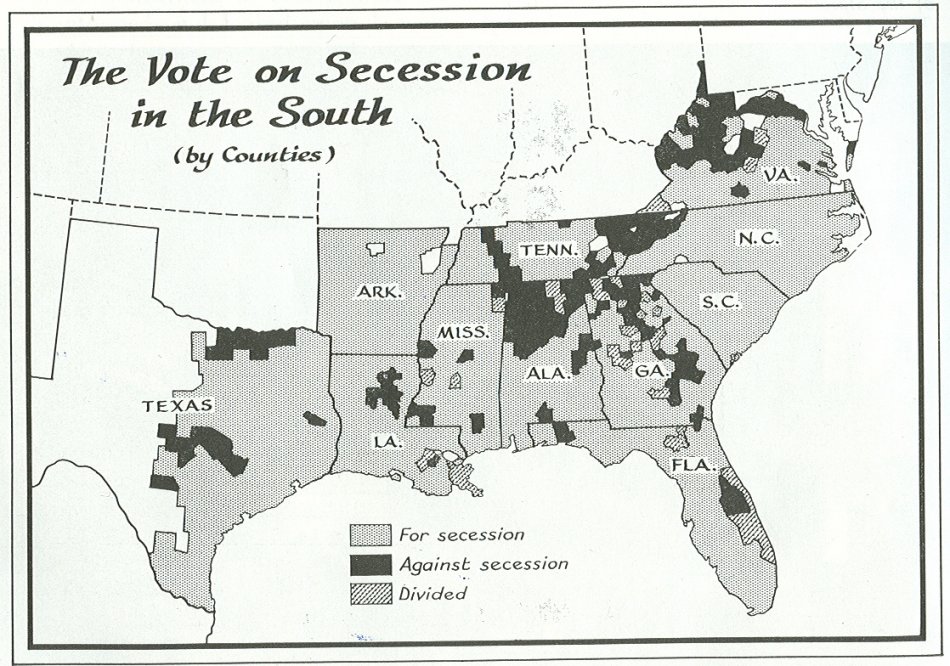
We see how slavery concentrated near water, or in low lying tidewater areas (i.e. Southeastern VA and MD).  This in turn led to the predominance of labor intensive cash crops like cotton or tobacco.  Below is a map of how various southern counties voted on the secession question.  Obviously, not all wanted secession.  The South was not monolithic.  But there is a striking link between the counties who voted for secession and the presence of slavery.  Clearly, the moral question of slavery and the political issue of slavery went hand-in-hand in 1860-61.

Slavery was a national issue in the Declaration of Independence, Constitution, in 1820, 1848, 1850, 1854, 1856, and 1859. It was the main topic of discussion in the Lincoln/Douglas debates of 1858. Why did the various compromises on the issue fail?  In fact, could they be said to have made things worse? As time went by and slavery became more prevalent, their attitude went from ‘necessary evil’ to ‘positive good.’  What can explain this shift?

I think we can say the following:
  • Industrialization in England and the north gobbled up cotton produced in the deep south and helped solidify the power of large plantation farms.  The North implicated themselves to a degree in this and did not mind getting cheap cotton from the South.
  • I don’t think we should miss the psychological/moral component.  Shakespeare’s line of “Methinks he doth protest too much,” applies here.  Those of you have (or remember having) smaller children know that when you say, “It’s time for bed,” and they immediately whine and shout, “I’m not tired! I’m not tired!” are in fact showing how tired they really are.

This hardening of their views on slavery covered over many contradictions.  Masters supposedly civilized their slaves, but they constantly feared slave insurrections.  Masters claimed to “enlighten” their slaves but often actually educating them was forbidden by law.

As I mentioned earlier a “North=Good, South=Bad” paradigm will not help us understand the period or the war itself.  Many northerners differed little in their view of blacks from the South.  Had the North treated blacks better, some of the evils of slavery might have been exposed sooner.  Of course, there were those in the south who respected blacks and treated them with dignity.  But it is still true to say that the North had an anti-slavery bent even if many had ambiguous feelings about abolishing it.  And it is still true to say that many in the South wanted not only to preserve, but extend an institution that broke up families and and allowed masters to use other humans as they saw fit.

These differences over slavery also had links to broader cultural differences rooted in the typical differences between urban and rural societies.  Generally speaking. . .

Urban areas

  • View change as a positive
  • Believe that we “should not stand still”
  • Look more to the future than the past

and Rural areas

  • Seek to avoid change whenever possible
  • Like to be guided by tradition
  • Look more to past than the future

These different values form different priorities, and this may also help explain the conflict.

The Frontier Garden City

I am no fan of the “Woke” but a few years ago Ross Douthat wrote a piece entitled “A Crisis our Universities Deserve,” which showed me that at the core of this movement lay something admirable. At some point in the 20th century, college lost its emphasis on ennobling the soul, the great virtues, ideas, etc., and became a means to make more money in life. Certainly in the early 90’s, most of the encouragement from society to go to college came in this form. Students today rightly rebel from this, want more from their education than this, and more from life in general. Many “woke” students seek something moral, something transcendent. Douthat commends them for this, at least.

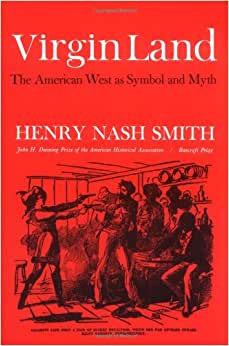
My public school education left me with the impression that the arc of American History bent towards the good, but of course we had x,y,z, and 1, 2,3, things wrong with us. The list of wrong things had grown since my dad’s day, but still stopped just short of overthrowing the basic arc. Subsequent generations have had the scales tipped. Manifest Destiny, the idea that History/God/Fate/Benign Providence wanted/needed America to span the continent, stood very near the core of our things wrong with us, and seemingly impossible to redeem in any way. After reading Henry Nash Smith’s Virgin Land: The American West as Symbol and Myth I had the realization that the Woke and the various champions of Manifest Destiny have a great deal in common, including a highly idealistic goals and a bent towards rebellion against the status quo.

This comparison may surprise some, but makes at least temperamental sense to me. My first reaction to the Woke and Manifest Destiny comes from the gut: “Ick . . . it’s just too much work, too much angst and yearning, too much of everything. Enough, already.” I feel Jerry Seinfeld should have a bit on this–he would agree with me, I’m sure. But one needs more of a foundation to denigrate these two major epochs of our country’s past and present, and one has to admire the energy and drive in both movements.

Smith shows that Manifest Destiny had no direct racial motivations. When race entered into the discussion from some, it usually involved spreading “free labor” across the continent to help limit and eventually squeeze out slavery. Manifest Destiny’s sharpest critics in fact often came from pro-slavery camps, who poured cold water on all of the messianic expectations of free labor across the continent. I found it curious as well that the native Indians got little mention. It strikes me not that they were discounted, but rather not counted from the start. Maybe promoters of expansion automatically assumed that the natives would go along with it. More likely, thoughts of overland Asian trade routes, the fusion of independence, wealth, and power, the sweep of empires throughout time–left no room to see particular people such as the natives. Certainly one could critique the impact of the idea on native peoples, but harming them seems absent from the original intent.

At its core, then Manifest Destiny

  • Believed firmly in America’s unique role in world history
  • Allied with many of the progressive causes of the day–causes that today would certainly look progressive–grants of free government things (not $, but land), the belief that the hand of government should engineer certain social and political ends.
  • Believed strongly in unity–national unity, but also a more expansive international unity, for which the United States could hold the standard. Walt Whitman wrote in his A Passage to India that

The people [are] to become brothers and sisters,

Their races, neighbors, to marry and be given in marriage,

The oceans to be cross’d, the distant brought near,

The lands welded together.

Whitman being Whitman, he waxes rhapsodically about how Man and Nature shall once again fuse together under the “true Son of God”–not sure whom this was supposed to be. We conclude, then, that Manifest Destiny involved not just our national greatness, but

  • A grand union of all humanity, abolishing all national differences and dismantling the hierarchies of the old, worn out traditional world.

All of these are strongly progressive causes.

The progressive Woke have their virtues, but their virtues lean so far in one direction that they have to overcompensate, consciously or no, towards the other pole. So while they talk of abolishing all forms of difference in some grand human unity on the one hand, with the other they proclaim a certain kind of radical individuality. We see this in their insistence that anyone can do anything they like with their body, sexuality, etc. On the one hand, the Woke can be fiercely anti-authoritarian and anti-institutional, but on the other, as Patrick Deneen has pointed out, they need Government writ-large to protect them from local, more traditionally minded majorities. And, while the Woke encourage a general sort of mixing, they have a hard time mixing in a fruitful manner, i.e., with relationships, marriages, and families.

With the heroes of expansion west, real or fictional, we see the same motifs. Civilization requires cooperation, but Cooper’s Leatherstocking, Whitman’s rhapsodies, and the real Daniel Boone can never settle and build. The unbounded horizon calls more strongly to them than any particular place. They decide things for themselves on the fly. Their freedom from the shackles of civilization gives them a newfound moral clarity and moral authority, for they are freed from all bigotry of place. They see with universal eyes. In his novel Old Hicks the then-famous Charles W. Webber (a product of Princeton), declares of the Texas Ranger that,

With them the primitive virtues of a heroic manhood are all-sufficient, and they care nothing for reverences, forms, and duties, as civilization has them, but respect each others rights and recognize the awful presence of a benign God in the grandeur of the mountain, forest, plain, valley, and river. . . . Such men do not look to society except with disgust . . .

Interestingly, as part of the plot, Webber has the head mountain man romantically pursue the wife of the villain, and marry her despite she actually being the wife of the evil Count. The “Laws of Nature” here easily become the Laws of God, which trumps the laws of man. Similar arguments today justify ditching traditional sexual ethics. For example, those that transition, or “come out,” are granted a carte blanche in their decisions regardless of its impact on those around them, for their very distance from society with these decisions grants them supposed insight and authority.

Webber wrote fictional characters, but life imitated art in some respects with the foremost advocates for the frontier. Francis Parkman, another ivy-league grad (Harvard) traveled west in the summer of 1842 following his sophomore year. In his journal Parkman showed disdain for most of the actual people he met, especially the livestock farmer, a foreshadowing of sorts of the frayed relationship between coastal elites and flyover country. After passing beyond civilization further into the forest, Smith notes that “[Parkman’s] tone changes completely.” The independent woodsman garners immense respect: “He is a remarkably intelligent fellow . . . resolute and independent as the wind.” Smith writes,

Parkman’s antithetical attitudes towards farmers and the hunters of the wilderness illustrate the fact that . . . two distinct “West’s” existed in the minds of many [advocates of the frontier from the east]. The agricultural west was tedious. Its inhabitants belonged to a despised social class. The Wild West was by contrast an exhilarating region of adventure in the open air. Its heroes . . . were in reality not members of society at all, but noble anarchs owning no master, free denizens of a limitless wilderness.

Advocates for Manifest Destiny could, like the Woke, see civilization in sweeping terms, and they could see the heroic individual. They both have a harder time with groups in between these categories, the basic societal building blocks of villages, farms, towns, etc.

A competing mythos, that of the west as paradisal garden, also informed America’s westward push. This motif had more to say for it, as it usually involved families, but still had its rose-colored glasses. Timothy Flint wrote against attitudes like Parkman’s, and gloried in farm life, writing in 1827:

Thousands of independent and happy yeoman reside [in the west], with their numerous, healthy, and happy families about them, with the ample abundance that fills their granaries, with their young orchards, whose branches must be propped to sustain the weight of their fruit, beside their beautiful rivers and beech woods, in which the squirrels skip, the deer browse, and the sweet red-bird sings, and with the prospect of settling their children on any of the dozens of farms that surround them.

James Lanman echoed such ideas in the 1830’s . . .

If, as has been remarked by distinguished statesman, cities are the sores of the political body where the bad matter of the state concentrates what healthful attitudes of mind and body are afforded by agricultural enterprise. The exhilarating atmosphere of rural life, the invigorating exercise afforded by its various occupations, the pure water, the necessities supplied for daily existence, leading to early and virtuous marriages, all point to this pursuit as best adapted to the comfort of the individual man.

I do not like to agree with the anti Free-soil crowd (often, though not always, secessionists and pro-slavery) on much of anything, but the “Messenger” was on to something in 1856, when it opined that

Farming is hardly a pleasant occupation, and the idea that it is comes from dreamers and poets. The actual, manual operations of farming are irksome and repulsive to the great mass of mankind.

Alas, reality set in for the devotees of the garden myth shortly after the Civil War. Smith writes,

The yawning gap between agrarian theory and post-war reality . . . comes out in the farmer’s crusades of the last 25 years of the 19th century. The western farmer had been told that he was not a peasant but a peer of the realm; that his contribution to society was basic, and all others peripheral or parasitic, in comparison cities were sores on the body politic. . . . He had been told that he was compensated for any austerity in his mode of life by receiving shelter from the temptations of luxury and vice, and against the ups and downs of the market. His outstanding characteristic was his independence of character and condition.

But after the Civil War Republican policy obviously favored the city against the country, the merchant against the farmer. And the western farmer found that instead of being independent, he was at the mercy not only of the Chicago and New York and Liverpool grain pits, but also of the railways and steamships lines that he must rely on to get his crop to market

I have read most of the volumes of Toynbee’s unabridged A Study of History. I think him a great master and I owe him a great debt, but I found the central theme of Volume III, which describes the growth of civilizations after their infancies, so annoying I stopped reading about halfway through some years ago. I have yet to pick it up again. Toynbee rightly reacted against material measures of progress. A civilization surely must be able to advance in more ways that territory and GDP. Toynbee developed a different approach, which meant a good start. But he ended with what he called “etherealization.” The idea seems to run along the lines of

  • A civilization develops an idea or technique that works for them, but that idea/process, has a limited growth potential because it is anchored to its locality
  • The civilization then extracts the core of the idea, removing it from its trappings, thus making it more transferrable across space.
  • This allows for more sharing of ideas, etc. which aids growth. The process is essentially cooperative and other oriented.

He takes, as an example, the alphabet as an etherealization of language, as opposed to ideograms. Alphabets transfer across cultures relatively easily, but China’s writing, among other things, will not allow for this, keeping them isolated.

Toynbee often nods via anecdote and analysis to “the old ways are best.” He wasn’t always consistent in his ideas, but this is not a fault. He usually explored possibilities as opposed to asserting things absolutely. But etherealization shows Toynbee’s weakness for too much generality, too much “Platonism” (but only in the worst sense of that word). Lifting something too far off the ground tends to make it dangerous and destabilizing to society, like a steroid. Supporters of Woke politics, and mid-19th century supporters of Manifest Destiny, have this same problem. What masks itself as “progress” in fact only abstracts what in embodied form might actually be good, though less dramatic, ideas.

American history mashes together so many competing concepts. Sometimes this results in great creative tension. We get into trouble when succumb to the lure of the unbounded everything America has always foolishly promised.

We should note that the Old Testament takes a dim view of cities. Cain builds the first one, from which evil and violence come, and then you have Sodom, the cities built by Hebrew slaves for Pharaoh, Babylon, Ninevah, and the like. But the end of the New Testament shows the final restoration taking place with a garden within a city–even cities get redeemed in God’s providence over history. So, the frontier, the farm, the city–every civilization that actually functions needs all three.

Dave

Inventing Vietnam

Like most Americans, I root against the New England Patriots.  It is nothing personal, but Americans root for the underdog, and the Patriots have been so successful they are never the underdog.  And yet, I can’t help but admire the brilliance of Bill Belichek.

He confirmed my admiration during a particular playoff game against the Steelers many years. ago.  The Patriots held a slim lead early in the game but the Steelers had a built a nice drive.  They resided just out of field goal range and faced a 4th and 1 somewhere around the Patriots 40 yard line.  The Steelers decided to go for it, and their home crowd cheered.

At this time the Steelers built their identity around a “smash-mouth” style of play and relied heavily on running back Jerome Bettis.  Everyone knew the Steelers would want to run the ball.  The Patriots of course also knew this.  They stacked the line of scrimmage and their defense sold out on the run.  I don’t recall if they had any safeties behind the line of scrimmage.  Their defensive formation triple-dog-dared Pittsburgh to pass.

I remember yelling at the TV for Pittsburgh to call a timeout.  They were obviously going to run, but if they had just flared out a tight-end it could have gone for a touchdown.  But Pittsburgh went ahead and ran the ball anyway.  And of course New England, having every single player right at the line of scrimmage, stopped it easily.  After taking over on downs Brady promptly completed a long pass for a touchdown and broke the will of the Steelers.

Game over.  In the first quarter.

I thought to myself, “How did Belichek know Pittsburgh would run?”  Of course he didn’t really know, but his defense said to me that he knew.  What Belichek, knew, I think, is that under stress, we revert to our comfort foods.  We can’t help it.  In a regular season game, with stress levels lower, maybe Pittsburgh calls a different play.  But in the playoffs?  He knew they would stress-eat the Ritz crackers and run Jerome Bettis over left-tackle even when a voice inside them probably told them to eat carrot sticks instead.  They couldn’t help it.

Civilizations contain a vast aggregate of personalities, but have a undeniable personality and predelictions all their own.  When we picture someone wearing a t-shirt and blue jeans, of course it fails to cover everything about America, but it covers enough.

Toynbee believed that western civilization reveals itself in its passion for mechanics.  He wrote,

The Hellenic civilization displays a manifest tendency towards a predominantly aesthetic rubric for orienting and defining itself.   The Hellenic tendency to view life as a whole distinctively in such terms that the ancient Greek adjective “kalos,” which denotes what is aesthetically beautiful, is used in addition to describe what is morally good.  In other words, Greek concepts of beauty and morality . . . were indistinguishable.

When we come to our own western civilization we find no difficulty discovering our own bent or bias.  It is, of course, a penchant towards machinery: a concentration of interest and effort upon applying discoveries of Natural Science to material purposes through the creation of social-clockwork devices, i.e. steam engines, motor cars, but also social engines like representative governments and military mobilizations.

We sometimes talk as if this appetite for mechanics was a quite recent occurrence in western civilization  . . . But this is precisely how westerners were viewed by the courts in Japan and China [in the early 1800’s, just prior to the Industrial Revolution]–as “barbarians” redeemed partially by our manifest and outsized technical ability.   The Byzantine princess Anna Comnena had the same impression of the first crusaders in 1099 A.D.  She called  their  crossbow a “devilish construction” that, while ingenious in its mechanics, fitted perfectly the barbarians who wielded it . . .

I thought of Toynbee’s analysis reading James Carter’s Inventing Vietnam.  A lot about this book revealed little about the Vietnam War that I had not read elsewhere.  I thought Carter missed some important opportunities to illumine the conflict.  But his basic thesis, that America essentially tried to invent, i.e. “call int0 existence” a country that did not really exist makes sense.  South Vietnam had no real governance, no real culture, no real identity at all, apart from some lines on paper at the U.N.

Carter demonstrates that we tried to create South Vietnam in the only way we knew how.  We went to our comfort food . . . lots and lots of mechanical stuff.

Everyone recognized fairly early on that South Vietnam occupied a precarious position in Southeast Asia.  President Diem failed to inspire confidence.  The North had nearly all the best political leadership.  The major battles of the war against France, and thus, the major political infrastructure to handle the war, happened in the North.  Even in the late 1950’s we realized the South Vietnam could collapse not so much because of the actions of North Vietnam but under its own weight.  Castles cannot built on air.*

But for many reasons, some well-intentioned and justifiable, and some not, we felt that we had to try.**  We sought to modernize their economy, and give thousands of South Vietnamese jobs through our massive construction projects.  We could maybe, just maybe “fast-track” their way towards gaining some kind of statehood.  If nothing else, in attempting this we stayed on familiar territory.  We knew how to provide material goods and benefits.

While Carter’s book disappointed me overall, he proves his main point.  Our efforts to “create” South Vietnam massively undermined our stated goals.

  • The massive surge in U.S. dollars in South Vietnam destabilized their economy
  • South Vietnam’s economy and infrastructure could not absorb the massive inflow of goods, which created a black-market economy almost immediately.  This “shadow economy” further eroded governmental authority.
  • Most significantly, construction projects facilitated the expansion of our war effort.  The expansion of the war effort led to more bombing in South Vietnam, and more troop activity.  The more war South Vietnam experienced, the more disruption they faced, the less chance the South Vietnamese government had of establishing themselves.

Each of these problems served to ensure that the South Vietnamese government had no control over its own destiny.  Many in the State Department and military realized this, but could do little else but press on.  We couldn’t help ourselves.  This is what we knew how to do.  We can reasonably assume that if we had defeated the North Vietnamese militarily, the overall strategic situation would have changed hardly at all since the 1954 Geneva Accords which divided Vietnam in the first place.  South Vietnam would not have been an independent country.

When our war in Afghanistan seemingly went well in late 2001, Secretary of Defense Donald Rumsfeld was a media darling.  His “transformation” doctrine of war, which emphasized smaller troop levels and increased use of technology, seemed to work.  But by 2006 Iraq was a mess, and by 2009 the situation in Afghanistan had significantly eroded.  In truth, much of the Rumsfeld doctrine hardly broke new ground.  It appealed directly to our comfort food of believing in, and relying upon, bigger and better stuff to solve our problems.  Some tech oriented environmentalists tap into this again with their pledge that new green technologies will solve economic and environmental problems.  If we looked closer we would see that our weaknesses, and of course also our strengths, have deeper roots than this.

Dave

*Marine General Victor Krulak commented in 1966 that, “Despite all our assertions to the contrary, the South Vietnamese are not–and have never been–a nation.

For a postscript below, Raymond Fitts’ article entitled, The Uses and Abuses of Technology in War

“The American effort in Vietnam was the best that modern military science could offer. The array of sophisticated weapons used against the enemy boggles the mind. Combat units applied massive firepower using the most advanced scientific methods. Military and civilian managers employed the most advanced techniques of management science to support combat units in the field. The result was an almost unbroken series of American victories that somehow became irrelevant to the war. In the end, the best that military science could offer was not good enough . . .”1

How is it that such a paradox developed? How could a world Super Power lose a war to a third or forth rate military power? The answer has many parts. One part of the answer must lie in the difference between military science and military art. The more technology a country has developed, the more it seems to depend on military science in stead of military art. Another part is in the make up of the combatants and their outlook toward warfare.

Despite the many analyses of the Vietnam war produced by the military, none has adequately considered the fundamental question of how the U.S. could so completely dominate the battlefield and yet lose the war. Senior military officers have published books and memoirs about Vietnam. They have all nearly ignored the insurgent portions of the war and devoted themselves to the conventional side of the conflict. The most celebrated analysis of the war made by a military officer was produced by Col. Harry G. Summers, Jr. His basic treatment of the entire war was as it ended, i.e., in a conventional invasion of South Vietnam by North Vietnam. He ignored the guerrilla tactics and insurgent strategies of the war. All these personal accounts of the war seem to be best summarized by the adage “If they has just turned us loose in 1965, the war would have been over quickly.”2 It is clear that had the war been nothing more than a conventional one, the US should have been more successful than it was.

A clue to understanding the Vietnam paradox lies in the term “military science.” No one can doubt the importance of military science to the success of military operations in today’s world. The firepower provided by today’s weapons dominates the modern battlefield. The procurement of those same systems is a complex science in itself. However, successful military operations are a combination of the application of military science and military art.3

As the term implies, military science is a systematic body of knowledge about the conduct of military affairs. It deals with issues that can be quantified with a considerable degree of precision. It generally deals with what one can or cannot do in military operations–the technical aspects of developing and employing military forces.

Military art is the systematic study and creative planing and conduct of military affairs.4 It involves strategy (including tactics), political-military affairs, leadership, and morale. In short, it deals with the inexact side of military operations. It is concerned with what military forces should or should not do and why. It is learned through a study of history.

Successful military campaigns are the result of some sort of balance between the two. The balance may, in fact, depend on the status of the opposing forces–their equality. Reasonable equality may not exist between opposing forces. The weaker side must then depend on superior military art to achieve victory.

The North Vietnamese and Viet Cong were forced to depend on the use of military art because of the overwhelming resources and superior technology of the U.S. The Communist confused the Americans with a package of political, psychological, economic and military warfare.

There is a considerable body of literature that suggests that the warfare of the future, especially with the end of the Cold War, will be on the low-intensity end of the conflict spectrum. If indeed such is the case, then the U.S. will need to rethink how it uses its technology to fight at this end of the spectrum. But to understand what constitutes the low-intensity conflict some definitions are necessary. Applications of technology in this environment will be explored to evaluate the effects of the use of technology.

Definitions

Low-Intensity Conflict

The American military establishment considers low-intensity conflict to be manifested in four different ways: (1) counterterrorism (assuming there is a terrorist to counter); (2) peace keeping: (3) peacetime contingencies (quick sharp, peacetime military actions like the air raid on Libya in 1986); and (4) insurgency/counterinsurgency. The inclusion of some of these terms in the definition of low-intensity conflict is debatable. Terrorism can be considered a tactic that can be used in any type of warfare. Peace keeping missions are meant to prevent the outbreak of a conflict. The essential difference between war-fighting and peace-keeping missions is that one makes the maximum use of force while the latter is committed to the minimum use of force. Direct action missions tend to be high in intensity but short in duration, a situation that is particularly unsuited for the term “low-intensity conflict.” We are thus left with insurgency and counterinsurgency claiming any legitimacy to the title “low-intensity” conflict.6 A low-intensity conflict includes not only the unconventional aspects of warfare but also economic, political and psychological warfare.

There is an important aspect about low-intensity conflict that needs emphasis. The level of intensity is a relative thing. For the soldier in the trenches, combat is always intense–he’s the one getting shot at. For the United States, Vietnam was not a highly intense conflict because it did not require the full resources of the country. For the North Vietnamese, the war was a high intensity conflict because it involved all the nation’s resources. The level of intensity is usually associated with the probability of occurrence of a certain level of conflict. Terrorism is at one end of the spectrum and is highly probable while all-out nuclear war is at the other end and is least likely.

Partisan vs. Insurgent Warfare

The difference between partisan warfare and an insurgency is what the guerrilla is trying to do to the government. The partisan is merely interested in throwing out a conquering power. The partisan may need help from an outside source. An example might the East Europeans trying to expel the Germans during World War II. An insurgent is trying to overthrow an existing government by any means. Insurgencies are the more insidious of the two in as much as it has no definite beginning; its origins are not military, they are political, economic, and psychological. The insurgency is self-sustaining; and does not need outside support. An insurgency sneaks up on the existing government slowly and quietly.

Successful insurgencies have a number of elements in common. Four characteristics are particularly important for the American military: the protracted nature of the war; the central role of the insurgent political infrastructure; the secondary role of the insurgent military; and the use of guerrilla tactics in military operations.7 An insurgency represents the total integration of political and military factors with the political factors always in complete domination.

Conditions are ripe for insurgencies in many parts of the Third World. They all have several things in common: the stark contrasts between incredible poverty for the vast majority of the population and the extreme wealth for the ruling elite; a small to non-existent middle class that can be a stabilizing influence and a conduit for the upwardly mobile; these same areas often times sit astride important trade routes or trade-route chokepoints; they might contain important deposits of raw material vital to the industrialized world.8 The insurgencies of the twentieth century have been scattered all over the world and have been the result, for the most part, of real or imagined inequities in political and economic power coupled with the perception of minimal opportunity for reform, either political or economic. When taken together, the unique aspects of insurgent warfare suggests that such struggles are different from conventional warfare.

The most important aspect of an insurgency is time. Both the French and the Americans found that their enemies used time as a weapon against them. The Vietminh and later the Vietcong purposely made the struggle longer waiting for the Americans and French to get tired of the endless blood letting and look for a way out of the conflict.

The rebels also need time to build up their political support and military strength relative to the government they are trying to overthrow. Time works for the insurgent in another way: every day the rebellion exists is another day that discredits the government and its ability to govern and control its own destiny. The defeat of the insurgent military threat is only an adjunct to buying time for the government to implement reforms and for those reforms to work..

Guerrilla Warfare

Guerrilla warfare is the classic ploy of the weaker against the stronger. The conventional European military operations are planned to obtain a quick victory while guerrilla warfare tactics are geared for the long haul. The guerrilla attempts to avoid a decisive defeat at the hands of the stronger enemy. They operate in small groups to avoid presenting tempting targets for government forces that usually have vastly superior firepower for its use.9

In fact, a guerrilla wins by not losing, while the government loses by not winning. In short, there is no room for the status quo. Each side must discredit the other by some means whether it be political, economic, psychological, or military. Generally, it is s combination of all these elements. The military aspects usually are fought to make space for the other aspects to work on the minds and pocket books of the population.

The American Way of War

There are several deep-seated reasons for the condition of the American armed forces: military men are still highly regarded in Europe but not much here; the European tradition of martial exploits is missing in America; a technological bias to create weapons that can kill from a distance; and a failure to create a well-motivated, well trained military force.10 Most Americans have not had to come to grips with the central role that military forces play in international settings Americans have not had to confront war as a political act.

Its long span of oceanic-based isolation has led the Americans to think of war as an aberration, a failure of political policy Americans see warfare as a great crusade to over-come a well defined enemy who was definitely evil. Simplistic approaches to political military problems are also indications that Americans have not been forced to deal with the role of force. Despite obstacles, Americans have expected to achieve their goals; the spirit of “can-do” has been a permanent part of their collective psyche.11

The Civil War was the first American conflict observed by professional European soldiers. The British, French and Greater Prussian General Staff sent representatives to observe both sides at war. The observers noted, with some distain, the American penchant for standing off at some distance from each other and throw enormous amounts of lead at each other, often times for hours on end. This method has become ineluctably part of the American way of war.

This proclivity to conserve lives has been all the more difficult because of a distinction in the military tradition: the population has always distrusted a large standing army, it has thus developed a strong militia to fight its wars. American armies have had to learn to fight by fighting. The U.S. has been willing to compensate for what it lacked in preparation by spending its national wealth. America’s war industry has overwhelmed its enemies with weaponry.12

The U.S. military has concentrated on the sciences of developing, deploying, and employing America’s overwhelming resources since the Civil War. The military has, as a result, not had to be very clever in the military arts because it could overwhelm its opponents in a sea of men, weapons, firepower, and logistics.13 This ability has lead to a 20th Century American trend in American thinking: modern American strategists and tacticians have sought to substitute fire and steel for American blood.14 General James Van Fleet, then commander of the Korean based 8th Army in 1952, is a good example of this mode of thinking. He was determined to use his artillery as a substitute for U.S. infantrymen.

The basic aim of the U.S. military, it seems, in peacetime is to buy hardware rather than use it. The main aim of each service is to get from Congress as much money as it wants. The peacetime emphasis has moved from fighting skills to procurement and the management of technology. The best way to a promotion is through running a successful procurement program in the Pentagon. Leadership in the field is a secondary consideration. What the American military has developed is a distorted sense of priorities and a general lack of seriousness about warfare. It has fallen into a push-button mentality that has a developed a passion for hardware to the neglect of strategy, tactics, and the intangibles of warfare.15 We have done a marvelous job of preparing for the next war only to find that we cannot afford to fight it.

In spite of all this high-technology, it has never been the decisive factor in any American war. The struggle to use technology and to deal with the enemies technology has been much more important.16 Using history as a guide, the American record with military aviation technology has been mixed at best. In World War I, the U.S. flew European designed and, for the most part, built aircraft. World War II showed the Japanese Zero was better than any U.S. front line aircraft at the beginning of the war and the MiG-15 was a superior surprise during the Korean conflict.17

The French Experience

France was the last of the European imperial powers to resist, by force, the loss of its colonies following World War II. The wave of independence following the war swept over all of the former European colonies. The wave gave the colonies a moral advantage that made the war in Indochina increasingly unpopular in France.

The French experience in Indo-china finally ended with the signing of a treaty between the Viet Minh and the French. The treaty divided the country into two halves: one half went to the Vietnamese communists, the other went to what became the Republic of Vietnam. The political turmoil over the next decade brought the U. S. into a war that the French could not win. The final disaster for the French was at a small town in northwestern Vietnam called Dien Bien Phu. Hot on the heels of Vietnam was another colony of France: Algeria. It seems that the French didn’t learn enough from Vietnam because they went through the same traumatic experiences in Northern Africa that they had in Asia. The two places were very different, but the guerrilla war fought by France in both countries contained the same French military responses to the insurgents.

Vietnam18

The French experience in Vietnam lasted eight long years. The Viet Minh experienced tactical defeats with huge losses when faced with the terrible destructive power of the French firepower. The Viet Minh accepted their losses and learned from their mistakes. Over time, they succeeded in dominating Indochina except for a few French “safe areas” around Hanoi and its immediate vicinity.

The only real advantage the French had was their mastery of and ability to conduct European-style machine warfare. They believed to the very end that the enemy could be crushed and Indochina subdued by concentrated firepower. Early on, they also learned that artillery and airpower had little effect on an elusive enemy that avoided a fight. What the French wanted was a large-scale battle of attrition that would grind the Viet Minh into the ground under a final massive avalanche of bombs and artillery fire. The strategy has two fatal flaws: (1) the French were frustrated by their inability to find and fix an enemy in an inhospitable environment; and (2) the French assumed that they alone possessed the ability to apply firepower in a battle of attrition.

Giap keep the pressure on the French by infiltrating soldiers into the Delta lowlands around Hanoi thus tying down French units. He initiated local attacks against the French units creating havoc in the colonial heartland. Giap also conceded to the French their superior firepower and willing spent lives to accomplish two things: first, to maintain his offensive and secondly to buy time to build a firepower base that could challenge the French in open warfare. To accomplish such things, surprise and secrecy were essential.

The Viet Minh learned from experience that under no circumstances should a column be caught in the open to be devastated by French firepower. They traveled by night in small groups to lessen the probability of being detected. They stayed in areas firmly under their control. Limited attacks outside of their protective base areas were planned carefully and by moving to and from the objective area without delay. If they were caught in the open, the men would scatter and hide before the French were able to adjust in and mass artillery fire on the position. The elusiveness of their tactics in combination with the difficult terrain greatly reduced the killing power of French firepower.

The Viet Minh also learned something about the application of airpower. Initially, it frightened the green, inexperienced insurgents and forced them to break off attacks. The French could rarely afford to send more than single aircraft to turn back attacks. The Viet Minh learned quickly that airpower employed in small doses possessed little destructive power. They also effectively dissipated French firepower by using a “hugging” tactic that began with a concentrated recoilless rifle, mortar, and machine gun attack on a fire base with the express intent of knocking out the defender’s radio–the sole means of calling for friendly fire. They then moved the entire force within the barbed wire outside the fort. Fortress and firepower proved to be no match for cunning, patience, courage and a willingness to sacrifice lives to achieve an objective.

Close air support became more effective as time went on. The pilots got to know their assigned areas of responsibility. They could bomb and strafe with particular destructiveness because they did not need to worry about the location of their own soldiers.

The French lost the first round of the war when they lost effective control over most of the territory and population in North Vietnam. The lesson to be learned here was that no amount of firepower or fortification can be effective against an insurgent without first obtaining the support of the people who inhabit the country.

The most effective innovation in firepower control was the use of light observation aircraft, specifically the Morane, to control supporting fires in support of an infantry unit in heavy contact. Such control often meant the difference between victory and defeat for the supported unit. The pilot had to be able to put the fire at very close ranges to the friendly forces.

The American observers present were not particularly impressed with the French airsupport system. It had airplanes dashing about from one fire fight to another in small groups (often only a few planes at a time). It was not their idea of a concentrated air campaign because it seemed so disorganized and without purpose. The close air support provided by the French air force, however, was sufficient as long as the enemy restricted himself to low-level hit-and-run tactics.

Both sides were learning from the battles. Giap learned that his forces were too lightly equipped to slug it out with the French and their overwhelming firepower. He therefore resorted to guerrilla warfare tactics using irregular forces against enemy strength and main forces against French weaknesses. He committed his forces only when there was a high probability of success.

On the positive side, Giap learned that the ability to stand up of French firepower increased with experience. A few well hidden machine guns made the effectiveness of French air attacks decrease appreciably. Giap did not have to match French firepower gun for gun to reduce its effect.

Giap also realized his own impatience with his early attempts at open warfare. He then decided that he would fight on his own terms. He sought to draw the French away from their bases thereby weakening the French ability to project and supply large fire-power intensive forces. He then attacked when the right combination of circumstances (weather, lines of communication, terrain) and available forces reduced or eliminated the French firepower advantage.

For the French, their victories convinced several commanders that the war could be won by fighting a decisive set-piece battle of attrition. They therefore sought to lure the Viet Minh into attacking well-prepared positions thus letting the enemy bleed to death in the face of French firepower. In doing so, however, the French made two critical mistakes. The first was to assume that their firepower was more effective than it really was. It was indeed effective early on, but as the enemy became better able to avoid it and developed their own firepower base more and more ordnance was needed to achieve significant results. Their second mistake was in not realizing that unless the attacker has an overwhelming advantage in firepower, causalities were likely to be about the same on both sides.

The French infantry effectiveness began to decline as a result of an accumulation of all of these factors. The French soldiers, because they were often green or shaken, needed more and more concentrations of firepower to keep them effective. The guerrilla retains the strategic initiative because he can determine the level of the conflict whenever the enemy’s firepower proves to be too destructive.

The French left and the Americans began to replace them only to have to learn the same lessons the French had, but without the benefit of consulting the French.

Algeria

The Indochina war was hardly over when fresh trouble broke out in Algeria, France’s colony in Northern Africa. Trouble had been brewing there for some time, just as it had in Tunisia and Morocco. France had settled both of the latter problems by granting them independence. But Algeria was part of metropolitan France and would always be French.

Extensive European land ownership and a local Moslem elite that controlled the economic and financial structure while the bulk of the population went hungry and landless made Algeria look a lot like Vietnam. The French never ruled comfortably and force lay just below the governmental facade.19 Algeria was not France: 90 percent of the wealth was in the hands of 10 percent of the population, nearly a million people were unemployed while nearly two million were underemployed.

Both sides in the rebellion understood much about the other. The French refused to realize the strength of nationalist feelings while the rebels did not recognize the obstinacy of the Europeans or the French military against them.20

French military forces numbered about 50,000 when the rebellion started on the 1st of November, 1954. By May of the following year there were 100,000 French soldiers in Algeria. The military commanders were not worried about “bandits” who would yield rather quickly to the superior power of the French army; they thought nothing of sending mechanized columns to subdue them. Apparently the lessons of Vietnam had not yet sunk in because any Vietnam veteran could have told them that mechanized columns sent anywhere did little more that provide convenient targets for guerrillas.

The French aggravated their situation with the measures taken by the police; numerous arrests for nearly arbitrary reasons and the brutal treatment of the detainees just fed the fire. Further French counter tactics remained the rebels best friend. The build up was still under way and the military commanders did not have the forces to carry out the traditional pacification tactics. The Army was in a particularly dangerous frame of mind after the losses in 1940 and Indochina left it with a monstrous inferiority complex.21 The French guerrilla warfare doctrine applied to Algeria was doomed from the start because the French had ignored the aspirations of the population –in Mao’s doctrine the very first lesson. In spite of their revolutionary doctrine, and the results in Vietnam, the French army continued to rely on the traditional techniques of fighting the Algerian war.

Despite their inept military activities, the French did have some advantages: approximately 400,000 soldiers in Algeria; the factious nature of the rebellion; and the lack of rebellion’s internal cohesion played a disruptive role amongst the rebels.22

The Battle of Algiers occurred after the 10th Parachute Division took over counterterrorism duties. The division was not kind in its tactics. The battle that followed was an outgrowth of their brutality that left many dead behind. Controlled genocide as policy seemed to work though. The rebel infrastructure in Algiers was destroyed and the French efforts in the countryside seemed to be working. The battle in Algiers sent more moslems into the arms of the rebels.

But the French off-set their gains with their garrison concept that took the bulk of their forces. The concept left the countryside to the guerrilla (a failing seen in Indochina). Several other factors degraded the effects of French tactics: the use of inexperienced conscript soldiers, an inadequate force for the mission (again a notion left over from Indochina), guerrilla reinforcements coming in from neighboring sanctuaries, rebel determination to throw them out, French barbarism, and finally the overall extent of the destruction of the country.23 The French barbarism even reached into neighboring Tunisia when an air force colonel ordered a Tunisian village bombed on the pretext that machine guns fired at French aircraft–some three miles away in Algerian skies.24

The French attempted to seal off the Tunisian border with a fortified barrier that was 40 meters wide and just over 250 kilometers long. The Morice Line used an electrified fence as its core. It was surveyed by radar and human patrols, covered by searchlights and artillery in places, and had its approaches mined. It still had its disadvantages: it was expensive to build, it required thousands of soldiers to patrol, it was a far as 50 miles from the border in some places and it could be outflanked.25

French tactics eventually became more effective and more mobile with the use of helicopters. But by this time President Charles de Gaulle realized that the French could fight in Algeria for a hundred years without resolving the issues that brought on the conflict in the first place. He finally put an end to the madness by granting Algeria its long awaited and much desired independence. Algeria wasn’t out of the woods yet, but at least it could set its own course.

The American Experience

Americans have had a love affair with technology since the inception of the country. It helped to develop a new continent from coast to coast through the train and the telegraph. Technology made up for the lack of people in developing a new country. That very love affair carried into the way Americans fought their wars. They took it with them to all of their wars since the Civil War. In a recent example it contributed mightly to their undoing.

Gadgets in Vietnam

The Vietnam experience was a bewildering disaster for the U.S. military. The battlefield effort gave the U.S. military an almost unbroken string of victories. On the one occasion, Tet Offensive of 1968, that the enemy stood and fought the American forces in a conventional style, the enemy was so badly beaten that it could not launch another major offensive for four years.26 The U.S. still did not win the war. Apparent military success could not be translated into political success in the larger war. The United States is so dominated by its technologies and its wealth that it has lost touch with people. The United States believes it can spread democracy and maneuver politics by technology and money only. This may well be a fatal error in the life of our nation.27 The loss of China to the communists and the French loss in Indochina made for rather unpleasant news in the U.S. about a new type of warfare coming onto the world scene. Insurgency was a type of warfare that was wholly unknown and unanticipated in America. This isn’t too surprising because the Americans lacked a number of overpowering attitudes that were, and are still common in the Third World: the depth of belief that comes from desperation, a tradition of humiliation that begets hatred; the immediacy of wide spread starvation in the face of corrupt plenty; the zeal of the patriot in the face of foreign invaders and finally a basic lack of interest in war.28

In tune with their propensity to use gadgets, the Americans invented “think tanks” to think up new devices and ways to use them; the think tank was supposed to devise new policies that would allow the U.S. military to fight an insurgency war. The think tank was a development that followed the end of World War II when the Department of Defense didn’t want of lose all of the scientific talent it had accumulated during the war. Insurgency provided the think tank’s biggest challenge after the Korean war.

So we sent our soldiers to Vietnam unprepared for what they were to face. They were so unprepared, that even the soldiers responsible for intelligence gathering could not speak Vietnamese. They had to hire Vietnamese to translate for them. The translators were as ill-prepared for their task as the American intelligence specialists were; some could only barely speak English at all let alone translate Vietnamese into intelligible English. Given such a starting point, it was hardly unlikely that the wrong story got told, especially with the Oriental propensity to tell a Westerner what he wants to hear.

The toughest technical problem was to just find and identify the enemy. The VC and the NVA did not, as a rule, fight in regiments and divisions. The lengths to which the U.S. gadgeteers went to solve this problem are truly awesome.

The U.S. tried bedbugs to sniff out people.29 The bed bug is supposed to be able to smell human food from a long distance. It then moves around making some small noises. The noises were what the gadgeteers tried to use to operate a meter showing the proximity to people. The think tanks devised a machine to be carried by one soldier and operated by four or five bed bugs. The sniffing tube was pointed at a suspected ambush site thus providing a sign to the soldier that somebody was hidden there. The machine failed combat test.

A “people sniffer”, using a chemical-physical apparatus, did have some successful field tests. The machine was supposed to be able to detect body odor of concealed guerrillas from 200 yards away.

Small infantry units had a small personnel radar that could detect moving human beings and alert defenders in the dark of impending attack. The attacks happened anyway.

The starlight scope turned out to be a useful gadget. It allowed a soldier to see in the dark by concentrating the light of the stars. Aircraft were even using them.

Sound was also used as an indicator in several gadgets: one gadget detected the sound of clothing rubbing against clothing; sensors were used on the Ho Chi Minh trail to detect the sound of trucks and other vehicles. Seismic detectors were used to detect the trembling of the ground as heavy trucks and tanks drove by. Infrared detectors were developed for use to find heat sources beneath the jungle canopy. Special photographic films were developed to detect the dead vegetation used as camouflage.

American gadgeteers seldom reckoned with the propaganda effects of the usage of their gadgets. The bed-bug episode drew a wave of negative editorial comments in the Vietnamese press.

Then their was Operation Ranch Hand. The operation was designed to defoliate the jungle hide-outs of the VC and NVA. It was eventually used to destroy the rice crop. The trick back-fired in a big way because of the special status of rice in the Oriental mind: to waste it is a cardinal sin. Westerners killing whole fields not only deprived the owner of the rice but handed the Viet Cong a propaganda coup of the first magnitude. The destruction of the rice fields drove more peasants into the hands of the waiting VC. The VC then used it as the basis of a charge of germ warfare to exterminate the Vietnamese people.30

The Americans tried tear gas to disable people. The U.S. news men got a hold of the idea about “non-lethal” gas warfare in South Vietnam. The story drew instant and hostile reactions. Napalm also drew adverse reactions from the American public. Despite its military value, it provided a propaganda coup for its detractors.

The M-16 rifle that the infantry used in Vietnam generated a lot of controversy. There was its propensity to jam blamed on the users not keeping it clean while Marines died because of the defects. There was a controversy over the ammunition used–the contracts for its manufacture were suspect. And again the user did the dying.

Other gadgets included such things as the M-26 and M-79 grenade launchers, Claymore mines, airborne miniguns and the AC-47 that used them, Aluminum dust that was sprayed on trails so that radar could follow them, navigation systems for aircraft, Snake-eye bombs, CBU [Cluster Bomb Unit] that generated propaganda for the enemy because unexploded bomblets killed and maimed civilians that stumbled upon them, the Bullpup missile, special jungle clothing, a computer (IBM 1430) to help the intelligence specialists gather and sort data, and finally, of all things, lie detectors.31

The Army tried to use its old technology to provide target information. It brought in the AN/PQ-4 counter-mortar radar. The radar tracked an incoming mortar shell and back plotted its trajectory. A skilled operator could plot the mortar position to about 50 meters. Unfortunately, it was too old and easy to fool. It had a very narrow sector scan and the operator eventually got tired of looking at the screen. The enemy put his mortars where the radar wasn’t looking and fired when the operators were least likely to be alert.

The AN/TPS-25 ground surveillance radar was more modern and could detect a moving vehicle up to six miles away. It was meant for use in a conventional European war and couldn’t pick up small groups of men at a walking pace.32

Ground sensors were used as an aid in the search for targets. But for them to be effective, they had to be precisely located. Most of the sensors were dropped from slow-flying airplanes thus making them hard to locate accurately.

The enemy learned, in time, to counter the sensors in some fashion when he could not avoid them altogether. The sensor system was only effective when used in conjunction with other methods such as patrols, radars, scout dogs, and aerial sightings. Yet the system was all that provided the precision target information with the consistency necessary for effective target engagement by indirect fire.

There were some technological success stories. The AC-47 with its mini-guns proved to be great operational success. A few dedicated individuals managed to develop a system appropriate to the war being fought in Vietnam despite the Air Force’s denigration of the ideal of using an obsolete aircraft for anything (it wasn’t fast enough or the latest in technological innovations). The gunship was used to provide a large volume of firepower in a very small area for infantry engaged in heavy combat, especially at night. Other aircraft used in the gunship role, the AC-130 and AC-119, also saw action. The AC-130 saw action along the Ho Chi Minh trail in Laos.33

Americans have had a plethora of mechanical devices or military hardware in Vietnam. Unfortunately, in this war the relations between human beings and abstract ideas were decisive. Our gadgets were superb but just not enough.

Gadget Driven Tactics

Not long after the siege of Plei Mei (early in the war), in the Central Highlands, General Kinnard commanded the 1st Cavalry Division. He was instructed, by General Westmoreland, to destroy the forces that had attacked Plei Mei. The situation was considered perfect for the Division’s style of air mobile warfare. Kinnard moved his artillery into the battle area by helicopter so that it could support his infantry as soon as they touched the ground. General Kinnard hoped that his scattered units would lead the enemy to believe the units could be defeated in detail. Kinnard planned to use the units not engaged as a reserve to be moved by helicopter to reinforce any units in contact with the enemy. Holding terrain meant little in his style of warfare. The heavy lift helicopter gave isolated units the reassurance that they would and could be supported with an inexhaustible supple of artillery guns and ammunition.34 A road bound relief force could itself become a victim of an well planned ambush. The enemy commander, Colonel Ha, had learned that all he had to do to even the match was to separate the Americans from their firepower.

Another battle that made news was the battle of the Ia Drang. The lesson learned there was that firepower would be the pivotal factor in the tactical battle. The Americans goal was to use his firepower quickly to gain the advantage. (Throughout the war experienced infantry commanders were the loudest proponents of fighting battles with firepower.) The enemy’s objective was to separate the Americans from their firepower or to strike quickly and get away before firepower could shift the odds against them. The Ia Drang battle also taught the Americans that the only way to bring a reluctant enemy to battle was by sending out platoon sized units to search him out. Then the enemy was attacked with standard tactics. Unfortunately additional maneuver forces in the enemy’s rear didn’t mean that the enemy was trapped. In the jungle it was easy for him to disappear thus braking contact at will.

When an enemy base camp was found deep in the jungles and marshes of Vietnam, the conventional wisdom for attacking it was to determine its dimensions, isolate it with a strong cordon and then pound it with firepower. Occasional forays were made into the area to check on the results of the attack by fire, then the fire was repeated. This cycle was repeated as often as desired or needed. The preservation of soldier’s lives was the overriding tactical imperative.

Artillery became the fire support system of choice in Vietnam. It was always available in any weather or at any time of day. The artillery was scattered all over the countryside and concentrated by firing more shells at the enemy. Reinforcements from the Air Force and Army aviation ensured that overwhelming firepower would eventually be achieved. And despite the observer’s opinions of the French methods, the Americans learned to use spotter aircraft just as the French had during their stay in Vietnam.

Close air support from fighter aircraft was, and still is, the best way to deliver overwhelming firepower quickly and precisely against tanks, fortifications, and bunker complexes. Such bunker complexes made up enemy base camps in the deepest parts of the southern swamps and under the jungles of the rest of the country. But the enemy did not always stay at home. Often times, when major offensives were run against such base camps, it was found to be lightly defended or empty altogether. When the enemy did stay at home, a major battle ensued and airpower served its purpose very well.

Airpower in Vietnam followed a phenomenon of recent origin; a trend among Western nations to expect too much from aerial firepower, an expectation that might well be the product of our search for a technical means to win wars without expending lives.35 It took one 105 mm light artillery battery to fire 2000 rounds over a two hour period to equal the effects of a single pass of a flight of F-4s against a target thus making it more desirable for the Infantry to want to see the fighters work for them.

A major problem for fire support efforts was the acquisition of useful intelligence. A guerrilla force had to be found, fixed, targeted, and engaged with a fury of concentrated firepower that was timed to overwhelm it before it could break and run. All major ground forces eventually employed small patrols to destroy the enemy guerrilla with long-range fire power.

North Vietnam’s Giap finally realized the American public did not differentiate between front-line casualties and support troops. He then went after the fire bases used by the artillery. This did two things for him. It reduced the firepower available to the Americans and it caused casualties. Reducing the artillery available was an advantage to him because the Americans rarely moved against the NVA when the engagement was beyond the range of artillery. The less there was of it, the smaller the advantage to the enemy and the smaller the territory he could control. The enemy attacked the fire bases using a “hugging attack” that was launched from within the perimeter wire or from within the garrison itself. These tactics lessened the effectiveness of artillery and air strikes. The growing causality lists sapped morale and national will at home.

Giap tried to use tactics against the Americans that had worked against the French. The Americans fortified their fire bases to withstand the heaviest assaults and succeeded where the French had failed because of their overwhelming firepower.36 But military forces that concentrate on protecting itself forfeits the tactical and strategic initiative to the enemy. As the U.S. forces dug in, they also undermined their own offensive spirit.37

It was common practice to fire artillery at points in the jungle that were supposed to be enemy points of interest: assembly points, way points to elsewhere, temporary base camps of various sized units, and communications nodes. The Army fired and fired and fired with results that are still unknown. This type of fire was known as Harassment and Interdiction fire. Artillery units made very little effort to assess their H & I programs by early morning surveillance or the dispatch of ground patrols to investigate an area recently engaged. Perhaps this failure serves as the greatest indicator of the confidence fire planners placed in the value of H & Is.38

The Russian Experience

The Russians have not been immune from involvement in insurgencies as the counterinsurgent. They spend many years supporting “wars of national liberation” with advisors, equipment, money and weapons to make life difficult for the Western world. They were successful at making life difficult alright, but the results of the insurgencies were mixed.

Afghanistan39

The Soviet love affair with the tank soured quickly with their involvement in Afghanistan. Soviet tactical doctrine directed that tank forces operate as part of a combined arms force with mechanized infantry, artillery, and engineers. Yet in Afghanistan tank units went into combat with out the benefit of mechanized infantry. The tank’s clumsiness in rough terrain makes it vulnerable to ambushes when they have lost the advantage of surprise.

The actual invasion was the easiest part for the Soviet Army. It was, however, an army geared for conventional offensive warfare. Once in Afghanistan, it proved to be a lumbering beast better suited to fighting in the European low lands rather than the rag-tag civilians in the mountains and deserts of Afghanistan. The Soviet 40th Army rolled across the border after an airborne brigade landed at airports to take such places for themselves and to deny them to any resistance. The invasion was swift and surprising. It was planned for winter time when Western countries were preparing for Christmas and New Year’s Day. The weather was bad making guerrilla activity difficult.

Riots broke out in Kandahar. The rioters attacked anything representing either the Soviets or the new government. Soldiers sent in to control the riots couldn’t do so. MiG-17s were sent to strafe buildings and open areas but the Afghan pilots couldn’t attack their own people. The Russians sent in the 66th Motorized Division into Kandahar after the riots. The Soviet air force followed with a fleet of helicopter gunships and attacked positions in the nearby mountains almost immediately.

The Russians had tried initially, to overawe the resistance by a massive display of armor: six divisions in 4500 tanks, T-54s and T-64s, heavy artillery and APCs rolled into Afghanistan after the Airborne takeover of key locations. Afghan units were expected to subdue the rural resistance and keep it to a minimum. Bad planning was obvious from the beginning. Casualties were very high from the start and the population was not overawed. In fact, the resistance became more effective as the winter snows melted.

The Russians discovered that their main battle tank could not fight guerrillas entrenched in high mountain passes because the guns could not be elevated high enough or traversed far enough to fire at the enemy positions. The uneven terrain made it difficult to fire accurately and their engines overheated in the hot, thin air. Inexperience drivers often times snapped the treads trying to negotiate the difficult trails of the country. Some of the early battles were disasters for the round bound Soviet forces.

The Soviets also found it difficult to support their maneuver forces with firepower. Their doctrine was too firmly rooted in meticulous planning and deliberate bombardment by artillery and airpower. Obsessive obedience to a central authority permeated the higher reaches of the command structure. Change in the Soviet army came from the top down as befits a structured, autocratic society. Lower level commanders were driven by strict regulations and tactical “norms” in extreme detail. The result is a rigid method of warfare that leaves little to chance. When things go wrong, commanders excuse failure by showing his fidelity to the planned concept of operations. It is the operational norms that are at fault, that is, the scientific calculations are wrong. The solution was to change the norms.

The rebel leaders learned that they could, very often, attack a Soviet formation and get away without taking any artillery fire at all. This may well have been due to the cumbersome fire support system that was too inflexible to respond. It might well have been due to the reluctance of the ground commander to ask for the support unless it had been planned ahead of time. Not only was the system too “preplanned” oriented, it was also meant to support the main effort and not to save lives.

As in the Indochina wars, firepower played a key role in the protection of Soviet facilities and lines of communication. Mine fields were laid around major installations to such an extent that the Mujahideen did not dare attack the installations. By the summer of 1980 the ubiquitous fire base appeared as the Soviets and reliable Afghan forces sought to extend their influence farther and farther into the countryside.

The Soviets failed to solve the problem of convoy protection. The distances involved were to great for an interlocking, mutually supporting network of position artillery to cover main supply routes. The supplies had to be flown to their destination or sent by heavily protected convoy. Convoys were extremely vulnerable to ambushes without aircraft overhead. The Soviets paid a high price in men and equipment to supply their outposts because the Mujahideen ambushed so many convoys. That left a limited number of fuel and ammunition for the outpost to spend on local combat operations. Too many soldiers were tied up in convoy protection.

The Soviets experimented with various means to add more flexible firepower to their convoys: they tried putting a 4-barreled 23 mm anti-aircraft gun in a truck. They mounted a 30 mm grenade launcher in BTR-60 and some BMP vehicles. They also sent self-propelled guns with their convoys.

Two things became apparent to the Soviet commander: a war that had started out as a war of intervention had become a war of attrition, and a major transformation of Soviet tactical doctrine was necessary if the Army was to prosecute the war with any degree of proficiency. One change was their version of the forward detachment with its own organic firepower. They also decentralized their control of the artillery by splitting it up into less than the usual battery of 18 guns. They also learned that the most important single weapon in a war against a guerrilla was the helicopter–something that could well have been apparent from the French and American experiences. They also learned that to conduct a counter guerrilla campaign they needed to rely on the initiative and self-reliance amongst the junior leaders–the very things a centrally controlled army cannot deal with.

In a war without fronts or a clearly defined enemy, an infantry commander rarely knows what fire support he will need ahead of time. He must find and fix the enemy before he can employ heavy firepower with effect. The Soviets attempts to achieve decisive effect using ground delivered firepower was hampered by an obsolete and inflexible fire support doctrine. They also relearned that soldiers who are dug-in and defending mountainous terrain are nearly impossible to dislodge with indirect firepower.

The Mi-24 Hind was the Soviet version of the attack helicopter. It could carry a wide range of weapons and the pilots could talk directly to the ground commander. It could even carry a squad of infantry into a battle area. The Mujahideen learned to fear the Hind. It was the only weapon in the Soviet repertoire that could thwart effectively a guerrilla operation in the field and cause substantial casualties amongst the rebels. The Hind was the centerpiece of the firepower system in Afghanistan.

Soviet interdiction campaigns do not seem to have been very successful in reducing the fighting strength of the Mujahideen. Such campaigns have little effect against a light, mobile and thinly scattered guerrilla force despite the effects such a campaign might have against a conventional force. The Soviets could not stop movement of supply caravans along the borders or inside the country for the first three years of the war.

Several other reasons might also explain the ineffectiveness of the interdiction campaigns. Soviet munitions proved to be unreliable in the mountains.. The pilots were unable to exercise any initiative at all. They attacked what they were told to attack even if a village, for instance, was uninhabited and the rebels were driving down the road just a few miles away. There were numerous reports of such events. The pilots even flew, nearly right over, past rebel bands in the open without firing a shot at them.

The Soviets employed two basic tactical methods when they ventured into rebel-held territory. The first was to cordon off an area and then search for rebels from the population. The second was to organize “kill zones” (sounds like the Russian counterpart to the American “free-fire zone” of Vietnam) and then attempt to push the rebels into it and overwhelm them with firepower. The Soviets still lacked preparation: they used reserve soldiers who lacked even enough training to take cover from sniper fire; their officers had no maps of their routes; the officers weren’t briefed on the kind of resistance they might encounter; and the units were better versed in the local languages than they were in military tactics.

Despite their overwhelming military strength, the Soviet forces could not conquer Afghanistan. The cities, main roads, and the airbases were taken in a matter of days. Their mechanized army of more than a 100,000 made little progress in reducing insurgent control over the countryside and its control over the cities and the roads was increasingly challenged. They found that shock tactics based on massive air and armored firepower can hurt and scatter the guerrilla groups but not destroy them. The difficult terrain and fighting qualities of the Mujahideen made it evident that pacification would take more forces that the Soviets had deployed.

Road blocks made travel difficult and hazardous. Convoys were necessary with no garantees of their arrival at their destination. The effectiveness of the so-called bandits emphasized the failure of the Soviets to impose control. The Soviets were forced to use terror and destruction in order to crush the opposition. They depended on massive amounts of firepower in conducting search-and-destroy missions and punitive bombing attacks. They used gas and napalm in reprisals against resisting villages. There were many cases of indiscriminate slaughter as a result of bombing, strafing, artillery fire and helicopter attack. Terror weapons brought no advantage because the Soviets had too few soldiers to secure areas decimated by gas or bombing attacks. The population learned to anticipate such attacks thus lessening the effects. But the costs guaranteed nothing but hostility for use of such weapons.

Afghan Mujahideen tactics conformed to the classic requirements of guerrilla warfare. There were small group actions at night in territory remote from centers of power and within a supporting population that inflicted damage on the entrenched authority with vastly greater military resources. The Mujahideen were felt everywhere but lacked the weapons and organization to seriously threaten the Soviet position.

The rebels had a several things going for them in their fight against the Russians. They had the difficult countryside and their expertise with light weapons; their attacks often times took place at night while they hid in the general population when they weren’t actually fighting. They had their own stamina and ability to improvise that worked with their growing ability to organize themselves. Their motivation for the fight was a mixture of fatalism and dedication unique to Islam. They accepted the hardships of defending their way of life and religion.

Such were the conditions upon which they accepted the mission of holy warrior defending what is virtuous and meaningful against the destructive infidel. To die for such a cause was a good thing. The entire population faced massacres, weapons that it could not cope with and the presence of a superpower with a seemingly endless supply of manpower and firepower without letting up its resistance.

When the following spring arrived, the population rallied to fight the Soviets along with refugees who slipped back into the country. They fought with a hodge-podge of weapons that ranged from left-over WWI British Lee Enfields to home made flintlocks. The Soviets brought in seven motorized rifle divisions and the 105th Airborne for a total of 85,000 men. They also introduced five Air Assault brigades. By the end of two years, the Soviet force was at 105,000-110,000 soldiers. By 1985 the total stood at around 115,000 soldiers.

Their failed assault on the Kunar Valley despite overwhelming military superiority (200 MiGs, Su-24s, and helicopter gunships) left serious questions about their ability to contain, let alone destroy, a tightly organized and reasonably equipped resistance front.

The Soviets realized that more soldiers were needed but the Kremlin was unwilling to send them. They needed newer tactics and did manage to develop some that worked. The Russian Special Forces were respected by the Mujahideen for their ability to fight.

In the end, the Russians too left their insurgent war with a bad taste in their military mouths. They had the enemy outmanned and outgunned several times over but could do no better than the French and Americans in Indochina.

Chechnya40

The Russian experience of insurgent warfare wasn’t over just yet. The people of Chechnya wanted and demanded their own independent state. Their demand was the result of the break up of the former communist ruled USSR. Once again the Russians sent in the high technology equipment.

The Chichnians used classic insurgent warfare tactics in their conflict with the Russians. Only this time the rebels had a much better complement of high-technology equipment than the Afghans had. The Chechens made wide use of ambushes and good use of communications and intelligence from covert agents.

When the Russians sent their air force into the fight, the pilots had only a poor understanding of Chechen tactics. Part of those tactics included controlling mobile air defense weapons with radios and celluar phones and constantly changing the weapons systems positions. Because they had no reliable data on the disposition of Chechen weapons, the pilots were forced to operate from maximum possible ranges when using their weapons.

The Russians had learned to use a system developed in Indochina by both the French and Americans. They had learned to use the Forward Air Controller (FAC) to direct the aircraft in their attacks on the rebels. One of the primary Chechen targets for intelligence was the FAC. This mitigated the already disappointing results of the Russian air force.

Against no credible threat, other than a few ZSU-23/4 air defense artillery pieces, the Russian air force was unable to make any major impact on the course of the fighting. The performance of the air force against a lightly armed guerrilla force was less than sterling for several reasons: the rough terrain in which the combat took place; the harsh weather conditions; a general lack of training time for the pilots; old equipment; and finally poor stocks of supplies. One helicopter in ten was lost while one in four was damaged. One Russian Colonel blamed pilot performance on the tactics of retaliatory strikes against an enemy who used hit-and-run tactics constantly. Such tactics took the initiative away from the pilots; such a loss led to belated responses to rebel attacks thus reducing combat capability.

Results and Some Lessons Learned

The results of the intervention of France, the U.S. and the Russians were decidedly one-sided. The super powers of the First World overwhelmed their opponents with technology, equipment, and manpower and still lost the war. In the war of ideas its really true that the pen is mightier than the sword and ideas are harder than bullets and bombs. The wars were settled politically with the major powers leaving the country over which they fought–with the single exception of Checnya. Chechnya was unique in that it was surrounded by Russian territory; the rebels had no where to hide and no one to help them. While they made life difficult for the Russian military they would have a very difficult time obtaining their goals.

A common error in the cases studied here is readily apparent: the intervening power did not consider what it was that the people living in the country wanted for themselves. The major powers seemed to think that they already know what was best for the common people of the country when in fact the politicians had no real idea what was wanted at the grass-roots level.

For the Americans, their political objectives were poorly understood. The military strategy and tactics were designed for a very different sort of war. Morale in the field declined and support for the war disappeared because of the growing casualty list with no end of the war in sight. The problem was that the American version of reality no longer fit the real world.

A nation should never consider intervention in a small war without first considering what firepower and technology can do and what its limitations are. Modern nations have consistently overestimated the worth of their technology and the destructiveness of their firepower. Their expectations were greater than the machines they used could deliver. No matter how good the technology of target selection is, it will never be able to locate an irregular force in dense enough numbers for firepower to have a decisive effect.41

It is also apparent that such a lesson has not been learned. There are senior officers that still think that small detachments will escape detection but that larger, battalion size and bigger, will be found and decimated because when insurgents launch conventional operations they become exposed to crushing defeat.42 Experience dictates otherwise: the Chinese smuggled a quarter of a million men into Korea without anyone being the wiser; in Vietnam, 90 percent of the Viet Cong attacks were made with less than battalion sized units. The NVA moved down the Ho Chi Ming Trail in an uninterrupted, and increasingly large, stream despite the American interdiction campaigns against such traffic. At Dien Bien Phu, the Viet Minh decimated the French while at Khe Sanh it was the NVA and VC that was crushed. A mixed bag of results does not make a golden rule.

The unsuccessful American effort in Vietnam illustrated two important topics: the overwhelming tradition and the U.S. fascination with technology, it was supposed to be more efficient but efficiency does not equal effectiveness; victory on the battlefield does not necessarily mean victory in war.43

At best, modern firepower is an indiscriminate thing especially when used in populated areas. A misplaced artillery round can do more harm than good. It takes a disciplined and limited use of firepower to be effective. The fire controller must know when enough is enough and turn off the rain of destruction when that point has been reached. Firepower must be apportioned to the intensity of the conflict. It cannot compensate for bad strategy.

The American, French and Russians all discovered that there seems to be a relationship between the quality of the maneuver forces and the quantity of firepower necessary to make them effective in combat. In counterinsurgent warfare, massive firepower and large unit operations can be counterproductive. The Americans and Russians should have learned this from their search-and-destroy missions. The lesson seems to be that small units are what are needed for an effective counterinsurgency.

Another lesson all three powers should have learned from their experiences was that there is a premium placed on simple and durable equipment that requires a minimum of maintenance. The equipment must be cheap enough to be affordable by Third World countries or to be given freely by the U.S. Perhaps this is the reason the gunship did so well in Vietnam.

All three countries should have noticed that the insurgent is not without several tactical advantages: knowledge of the terrain: a very short logistical tail; they know the people who provide unlimited intelligence data; to win, the insurgent needs only to survive; the insurgent discovers that napalm is not the atomic bomb; shells do no harm when they are dropped in the wrong place; and many now enjoy having first-rate weaponry.44

In short, there is much to be learned by studying the history of insurgent warfare. Chief among them is that technology is not the answer to everything a country tries to do. In the end it is the human element that will persevere; it is the human element that makes the difference in winning and losing an insurgency. Without recognizing this, technology will be to no avail.
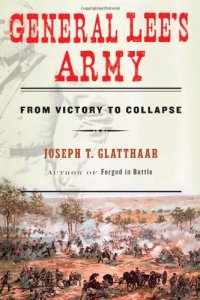
8th Grade Civics: Machiavelli on Having it Both Ways

Alexander the Great’s conquest of Persia provides the backdrop for one of Machiavelli’s more insightful observations about how countries are composed and hold together.

Persia had a vast army and a vast amount of territory. Furthermore, the Persian empire was comprised of different ethnic and tribal groups, as well other assimilated civilizations such as Egypt and Babylon. Yet, with an army of between 40-50,000, within ten years Alexander had destroyed all resistance to his control over most of Asia. Alexander died without having the chance to consolidate any of his gains, and we might then expect that Persia would revolt against the Macedonians and reclaim their freedom. But this failed to materialize. In fact, the Macedonians fought amongst themselves for control of the region, and still Persia did nothing. How could this be?

Machiavelli writes:

Considering the difficulties which men have had to hold to a newly acquired state, some might wonder how, seeing that Alexander the Great became the master of Asia in a few years, and died whilst it was scarcely settled (whence it might appear reasonable that the whole empire would have rebelled), nevertheless his successors maintained themselves, and had to meet no other difficulty than that which arose among themselves from their own ambitions.

I answer that the principalities of which one has record are found to be governed in two different ways; either by a prince, with a body of servants, who assist him to govern the kingdom as ministers by hisfavour and permission; or by a prince and barons, who hold that dignity by antiquity of blood and not by the grace of the prince. Such barons have states and their own subjects, who recognize them as lords and hold them in natural affection. Those states that are governed by a prince and his servants hold their prince in more consideration, because in all the country there is no one who is recognized as superior to him, and if they yield obedience to another they do it as to a minister and official, and they do not bear him any particular affection.

The examples of these two governments in our time are the Turk and the King of France. The entire monarchy of the Turk is governed by one lord, the others are his servants; and, dividing his kingdom into sanjaks, he sends there different administrators, and shifts and changes them as he chooses. But the King of France is placed in the midst of an ancient body of lords, acknowledged by their own subjects, and beloved by them; they have their own prerogatives, nor can the king take these away except at his peril. Therefore, he who considers both of these states will recognize great difficulties in seizing the state of the Turk, but, once it is conquered, great ease in holding it. The causes of the difficulties in seizing the kingdom of the Turk are that the usurper cannot be called in by the princes of the kingdom, nor can he hope to be assisted in his designs by the revolt of those whom the lord has around him. This arises from the reasons given above; for his ministers, being all slaves and bondmen, can only be corrupted with great difficulty, and one can expect little advantage from them when they have been corrupted, as they cannot carry the people with them, for the reasons assigned. Hence, he who attacks the Turk must bear in mind that he will find him united, and he will have to rely more on his own strength than on the revolt of others; but, if once the Turk has been conquered, and routed in the field in such a way that he cannot replace his armies, there is nothing to fear but the family of this prince, and, this being exterminated, there remains no one to fear, the others having no credit with the people; and as the conqueror did not rely on them before his victory, so he ought not to fear them after it.

The contrary happens in kingdoms governed like that of France, because one can easily enter there by gaining over some baron of the kingdom, for one always finds malcontents and such as desire a change. Such men, for the reasons given, can open the way into the state and render the victory easy; but if you wish to hold it afterwards, you meet with infinite difficulties, both from those who have assisted you and from those you have crushed. Nor is it enough for you to have exterminated the family of the prince, because the lords that remain make themselves the heads of fresh movements against you, and as you are unable either to satisfy or exterminate them, that state is lost whenever time brings the opportunity. 

Essentially Machiavelli points out that

  • Some countries are hard to conquer but easy to hold once defeated. They have greater unity from the top-down, but once that unity is shattered, it cannot make itself whole again. We might think of such countries akin to a brick wall. It is very hard to put one’s fist through a wall, but once you break the wall, it cannot reconstitute itself.
  • Some countries are easy to conquer but make it quite difficult to maintain the conquest. Their internal divisions open the door to the invader, but those same internal divisions will guarantee you will have problems in the future. Such countries resemble water. One can easily put one’s fist through water, but the most one can do is move or scatter it. Given the right conditions, that pool of water can easily return.

We can use Machiavelli’s framework to help explain historical events closer to our time.

During WW II, Germany and Japan functioned much like Persia or the Ottoman Empire of Machiavelli’s day (though it is important to remember that Machiavelli’s categories are not moral categories–one can be bad or good and have strong unity). After their military defeat, both Japan and West Germany rebuilt themselves with extraordinary speed. Neither Nazism or military dictatorship made even a pretense of returning to Germay or Japan, respectively. Their (extreme) unity, once shattered, disappeared into the ether, with an entirely new society emerging.

Our experience recently with Afghanistan highlights Machiavelli’s second category. With its many tribes and difficult geography, we were able to quickly defeat the Taliban and establish a new government. However, all we really accomplished was the scattering of water. In time, the Taliban reemerged and regained control. Our experience mirrored that of England in the 19th century, and Russia, both in the 19th and 20th centuries.

I wanted the students to consider whether America resembled more of ancient Persia, or if we are more like medieval France. The students had different arguments for both sides, which was great to see.

For centralized unity defining America, they argued that

  • While a few “weird” states exist (such as Florida and Alaska) for the most part most states function in the same way and have similar cultures.
  • We have unified executive control over the military from top to bottom.
  • We share common political and cultural events, such as elections, political debates, the Super Bowl, etc.
  • We share enough of a common vision of what it means to be an American, such as agreement over our rights as citizens.

For the “water” analogy fitting America, they argued that

  • There are a variety of states, scattered throughout the country, that may have similar poltical systems, but very different cultures (Texas, California, Lousiana, etc.).
  • We have a great deal of political disagreement. While we technically have one president, a strong minority of Americans will not support him.
  • While we agree on our rights, such as the right to vote and free speech, these rights are generally used to divide us and not unite us.

I enjoyed the students’ thoughts on this important question.

It is possible that a country can change its identity. The France Machiavelli mentioned went from the “water” model to the “brick wall” starting in the 17th century under King Louis XIV. By the time of the French Revolution in the late 18th century, what happened in Paris determined everything in France. America may have gone through periods in our history when we functioned in a more centralized or de-centralized manner, and we may change again.

One of Machiavelli’s talents involves letting us know that one can rarely if ever have it both ways. Strong unity, or strong disunity both have their advantages that are somewhat exclusive. We have to own our choices, and understand their consequences.

Enjoy the weekend,

Dave

8th Grade Civics: Aristotle and the Veiling of Authority

This week we continued with Aristotle and examined the idea of how monarchies function and preserve their power. Aristotle was a good Greek, and so in the final analysis he did not view monarchy as the best form of government. However, he acknowledged that monarchies had strengths, and we looked at his advice (which Machiavelli likely would have agreed with) regarding how kings can maintain their power and authority.

He wrote that,

A king will best preserve his throne through moderation. The less he exercises authority, and in the fewest areas of civic life, the greater his power. 

To start, kingship in certain religious contexts is best preserved through mystique, which is ruined by excessive action. The less areas of action, the less his subjects will envy him. The survival of Spartan kingship may be attributed partly to the original division of power between two kings, and partly to the moderation afterwards by Theopompous. He may have strengthened the kingship by divesting himself of some of its powers.

Despotic tyrannies may be preserved in two ways, one of which was proved by Periander of Corinth, who found men of spirit who might oppose him and had them executed. But additional measures are possible, the main being the forbidding of common meals, associations, clubs, and education, or in other words, making every citizen a stranger to his fellow man.

Another line of policy involves getting information about everyone through a network of spies. This entails a secret police, like the female spies employed at Syracuse, or the eavesdroppers sent by the tyrant Hiero to public gatherings.

We can consider both the legitimate and illegitimate use of moderation and “veiling” one’s power.

Aristotle alludes to the mystique of kingship that exists in part because of its overt connections to religion. In pre-modern Christian societies one assumed the throne “by the grace of God.” There was a conscious acknowledment that one did not “earn” the kingship through merit. Being the oldest son of the reigning monarch meant nothing in of itself. In other ancient societies, some kings reputedly had special connections to the gods, and in some places (such as Egypt), kings were demi-gods themselves.

Religion has power both through what it reveals and what it conceals. Recall the times in the gospel when Christ tells people not to tell about His healing miracles (ex: Mt. 16:20), or the fact that He spoke in parables (Mk. 4:12) to obscure meaning.

Veils are meant on one hand to obscure our view, but on they other, they reveal something else. Think, for example, of the robes and regalia of a king. In part such accoutrements are there for symbolic purposes. They also help the ordinary man disappear, and then subsequently reveal “the king.” In crucial moments (such as depicted in the video, when Charles II dissolved Parliament) words are best kept to a necessary minimum.

In a more down to earth manner, most parents know that they cannot comment about everything their kids do. They instinctively know that if they comment on everything they will soon lack the ability to speak about anything to their kids. Especially as your kids get older, you have to pick your spots. When my own kids were teenagers, I remember discovering that my attempts to rationally explain why they could not go “X” party only resulted in prolonged arguing and frustration. After I switched to simply stating “You cannot do ‘X,’ end of story, there was still anger, but less frustration, and it was much less prolonged. Such is the power that comes with veiling authority.

As your status elevates, you should speak less, but conversely, what you say carries greater weight. My paternal grandparents, for example, never told me what to do, except on two occasions, once when I was twelve, once when I was nineteen. In both instances, there was no question my mind about heeding their advice. Speaking to me so rarely meant their words carried great weight. Of course my parents dealt with in a more direct manner on a daily basis, and consequently had to say much to me than my grandparents. Naturally, sometimes I listened to my parents, and sometimes I did not.*

In monarchies no necessary “reason” existed as to why a particular family assumed the throne. No one needed a “reason.” Someone in medieval France or ancient Babylon did not need “convinced,” no defender of the king needed to syllogistically prove why “X” should reign. It was an accepted fact of their existence, akin to the rising and setting of the sun. In democracies, the very fact that we have choice means that person X might not have been president if only a, b, or c had happened. The opposition party immediately tries to minimize the reach of the current president, and begins planning to unseat him in the next election.

Aristotle mentions how monarchy can distort itself into a tyranny through the use of informants and a secret police. Such measures make sense for monarchies, in a way, for they parody the power that comes from the mystery of kingship. A well trained secret police can have great effectiveness because we both fear and revere secrets. Secrets have authority, whatever the end to which they are put.

Democracies value transparency and openness. We naturally distrust those who keep secrets, and voters need informed on the issues. Many see the rise of social media and Youtube as a great boon to our democratic political life. I grew up in an age of curated information. For political news to reach me, it had to pass down through various institutional filters in government and the media. Now we can get so much more information so much more quickly, and have no need of the institutional filters that existed for so long. Politicians can also speak more directly to people anytime they want on any issue.

But politicians, like parents, should not spout off indescriminately. They should in some measure hoard their ammunition and craft something of a mystique.** We can grant that democratic leaders need more visibility to the people they represent. But if everything is worthy of comment, quite soon nothing will matter to anyone. Those in power will find their arsenals either empty or full of duds.

Dave

*This dynamic may explain a common frustration of parents–they tell their kid to do ‘x,’ dozens of times and get no result. Someone adjacent to the family says the same thing and they immediately think it’s a great idea.

**Teachers should do the same. Don’t be the teacher that lets your students know a laundry list of your personal likes, dislikes, voting habits, etc. or students will not see you in the mantle of “teacher,” but just as another regular Joe on Instagram.

8th Grade Literature: Introduction to 20,000 Leagues Under the Sea

Next week we will start our next book for the year, Jules Verne’s 20,000 Leagues Under the Sea. Verne’s stories captivated the people of his time. Many of his books have been made into movies, which is one measure of cultural resonance. His stories had straightforward plots and generally stock characters, which aided their serialization into the popular magazines of the day. So on one level, I hope that the students enjoy the story as an adventure tale.

But like any great author, a particular worldview informs the work, and the story raises interesting questions for us to consider.

The Relationship Between Technology and Freedom

Verne wrote in the mid-late 19th century, a time of enormous technological change, perhaps a shift greater than what we have experienced the last twenty years or so. The Industrial Revolution not only remade the economy, it shifted how we worked and lived as a society. This period saw the spread of democratic ideals throughout Europe and America as well, and the casting off of traditional institutions and ideas. Elites across the western world lost a great deal of status, which culminated in World War I. So one the one hand, the growth of political freedom and technology went hand in hand.

Yet in our day, we see that the relationship between technology and freedom is not so straightforward. Our phones give us immediate access to information everywhere, but they also track us and have a way of fixating our attention. Computers allow us to be more creative and productive at work but this also means that work can follow us anywhere at anytime. Cars allow us to roam with more speed and flexibility than at any previous time in history but they break down frequently and require us to work long hours to maintain them.

This paradox is not confined to our day. For example, most saw the obvious benefits of the Industrial Revolution in the abundance of goods at cheaper prices for a great mass of people. In very real ways, the standard of living went up. To achieve this, millions of people had to work menial, robotically repetitive jobs in factories for 12-14 hours a day.

In Verne’s story, Captain Nemo consciously sought to free himself from the constraints of civilization’s laws and mores, and takes to the sea . . . where he spends his life confined in a metal shell. The Nautilus gives and takes away from Nemo and his crew in equal measure. We shall explore this relationship as we read.

The Relationship Between Man and Society

We often define freedom as the absence of constraints, i.e., no one tells me what to eat for lunch, or what movie to see, or who to vote for. In this respect Nemo and his crew are “free.” But as already noted, this form of freedom comes with a price. Philosophers and theologians outline another view of freedom, one where the constraints put upon us actually aid us in achieving our proper ends as men and women. For example, a train is certainly constrained by the tracks on which it moves. Yet those very constraints help the train be what it what it was created to be. Without tracks, a train cannot fulfill its proper “end,” or (to use Aristotle’s phrase) “telos.” A train sitting in the woods has no freedom to be a train.

So too, our families, communities, and our country certainly put constraints upon us. Children and adults alike resent them at times. We might rather play the video game than do our homework. We might rather finish our movie than clean the kitchen or change the diaper of a crying child. On a societal level, our politicians can annoy and disappoint us, and we may pine for other lands where the grass seems greener. Captain Nemo is the classic “tortured soul” that our culture has trained us to admire. We can certainly appreciate Nemo’s courage, intelligence, and devotion to his crew. But we need to see how Nemo’s separation from civilization has also warped his sensibilities. Our connections to those around us shape who we are, and without them, we are left with the freedom of the void.

Many business leaders, politicians, and the like, reflect that it is “lonely at the top.” I remember my pastor in college confiding to me that most all of his truly good friends were other pastors. They shared a common bond that others cannot quite relate to. So too, a ship’s captain will likely find the highest level of kinship with other captains. But because Nemo has severed ties with the world, he cut himself off from the possibility of that kinship. He has his ship, his books, and his studies, to comfort him.