Healing Hierarchies

A good education should expose people to “otherness,” but our current discourse gives far too narrow a definition of “otherness.” We tend to focus on ethnicity or gender differences, and not necessarily other ways of perceiving the world. I believe the best form of “otherness” comes through exposure to other worldviews, other ways of thinking, and this can come in the most unlikely of places.

Many generally assume that we share much in common with medieval Europeans, and perhaps this accounts for our striking reaction when we find profound differences. We can judge them quite harshly when they do not match our expectations. But if we started from a different mindset we might see them more clearly as fundamentally different from us. This, in turn, would help us actually learn more from them.

No scholarly consensus exists that I am aware of on the identity of St. Dionysius the Areopagite, except that he was not the Dionysius encountered by St. Paul in Athens. Perhaps “St. Dionysius” wrote in the tradition developed by this same Dionysius. Whoever he was, his writings had enormous influence over the medieval world, as C.S. Lewis points out in his great work The Discarded Image. In one section he writes,

In my opinion a hierarchy is a sacred order, a state of understanding, and an activity approximating, as closely as possible to the divine . . .  The goal of hierarchy, then, is to enable beings to be as like unto God as possible and to be at one with Him. Hierarchy causes its members to be images of God in all respects, to be clear and spotless mirrors  of reflecting the glow of primordial light and indeed of God Himself. It ensures that when its members have received this full and divine splendor they can then pass on this light generously and in accordance with God’s will to those members further down the scale.

We might expect St. Dionysius to praise hierarchy as a form of divine order on earth, and indeed he does just this. What might surprise us, however, is how he uses the term “generous” in regards to hierarchy, and how communally oriented his hierarchical vision is.

Author Andrew Louth comments on this passage that,

What St. Denys means, is that hierarchy is a radiant display that reaches out from God throughout the whole created order and draws it back into union with Him.  Whereas hierarchies to modern ears evoke separation, exclusion, [and perhaps exploitation], for St. Denys it connotes inclusion and union.

How far back in time should our concept of “western civilization” go? Lots of possible answers exist, but most would probably include the Middle Ages. Yet, St. Dionysius had a significant impact on the life and culture of the medievals, and in this passage he entirely runs against the grain of one of our major assumptions today regarding hierarchies. For St. Dionysius, it seems that hierarchies include rather than exclude because it ensures that everyone has a place, and that everyone has responsibility for someone else. The coherence of the world inhabited by St. Dionysius also allowed for everyone to know their place and, in theory, navigate it successfully.

St. Dionysius’ passage calls to mind an observation by Tocqueville, who warned at the potential downsides of democratic individualism. In a a guest post on the U.S. Intellectual History blog Jordan Heykoop commented that,

Americans are lonely. “Americanization”–understood by European intellectuals and political leaders in the twentieth century as an export of American products and values, an investment strategy to control the economies of other countries, an attempt to educate foreigners in the superiority of American institutions, or a process of modernization, all in the name of the free market–was in some sense an export of glorified loneliness.

A democratic and capitalist spirit cultivated this loneliness in America. Alexis de Tocqueville observed that aristocracy made “of all citizens a long chain that went up from the peasant to the king. Democracy, on the other hand, “breaks the chain and sets each link apart” as it constantly draws each individual “back towards himself alone and threatens finally to confine him wholly to the solitude of his own heart.” People in a democratic era are no longer bound through loyalty and obligation, values which are far-reaching and stable, but through common interest, which is malleable and subjective. Individuals gather to negotiate and calculate their interests, then disband. This sense of equality breaks social and communal links and leaves the individual looking inward for identity, place, and meaning.[

For Max Weber, a Protestant society, free from the structure and liturgy of the Catholic [or Orthodox] Church, cultivated a deep inner loneliness in which individuals worked desperately to discern signs of God’s favor. This discipline and sense of calling in a worldly vocation created the foundation for a capitalist spirit–the conditions under which a free market economy could thrive. America is the paragon of these processes. Late capitalism had become a “monstrous cosmos,” a world where the values of hard work and the sense of inner loneliness remained entrenched, but was completely unhinged from any religious foundation or teleological connection.

Even supposing that you agree with Haykoop, we cannot snap our fingers, import the distant past, and make everyone feel comfortable again.* We are a democracy and cannot invent or import a hierarchy wholesale from nothing.

Perhaps the greatest expounder of St. Dionysius’ ideas was St. Maximus the Confessor. The back cover of Andrew Louth’s book on St. Maximus encourages us with the statement that St. Maximus is the theologian for a world in crisis. Indeed, St. Maximus shows us how practical theology can be.

Monistic religions leave no room to breathe, no room for distinctions, and thus create tyrannies. For example, though officially an atheistic state, the “party” represented a monistic tyranny in Soviet Russia. By definition, the “Party” was always correct, and all outside it cannot belong to the body politic. Such outsiders needed dealt with. Polytheistic religions might give more freedom in theory, but lack any point of unity. So these societies tend to succumb to (in Toynbee’s phrase) “the idolization of the parochial community.” Wars of all against all arise, like the Peloponnesian War in Greece at the end of the 5th century B.C.

By the 7th century A.D., the Church had worked out the doctrine of the Trinity (more or less), but had yet to fully develop the doctrine of Christ and the relationship between His deity and humanity. One key issue involved whether or not Christ had one divine will, or two wills in one person, a human and divine will. Maximus asserted that Christ had to have a human will to be fully human. In addition, it is the submission of Christ’s human will to His divine will that makes a pathway for us to become more like Christ and thereby “participate in the divine nature.”

Perhaps St. Maximus is best known for his development of the cosmic nature of redemption, and Christ’s fulfillment of various patterns within redemptive history.As one example of this, we can examine the Christ’s entering into the pattern of the right and left hand, and simultaneously affirming and transforming that pattern.

The idea of a “righteous” right hand and sinister “left-hand” go far back into history–at least the to Egyptians–but other ancient cultures used it as well. Even so-called “rational” cultures like the Greeks used such categories frequently. Indeed, while many today will mock such as ideas as superstitious, unless we want to fully embrace chronological snobbery, we must assume a universal truth to this pattern and category even if we fail to understand it.

Christ used such imagery when speaking of the last judgment in Matthew 25, and icons of this event depict this consistently.
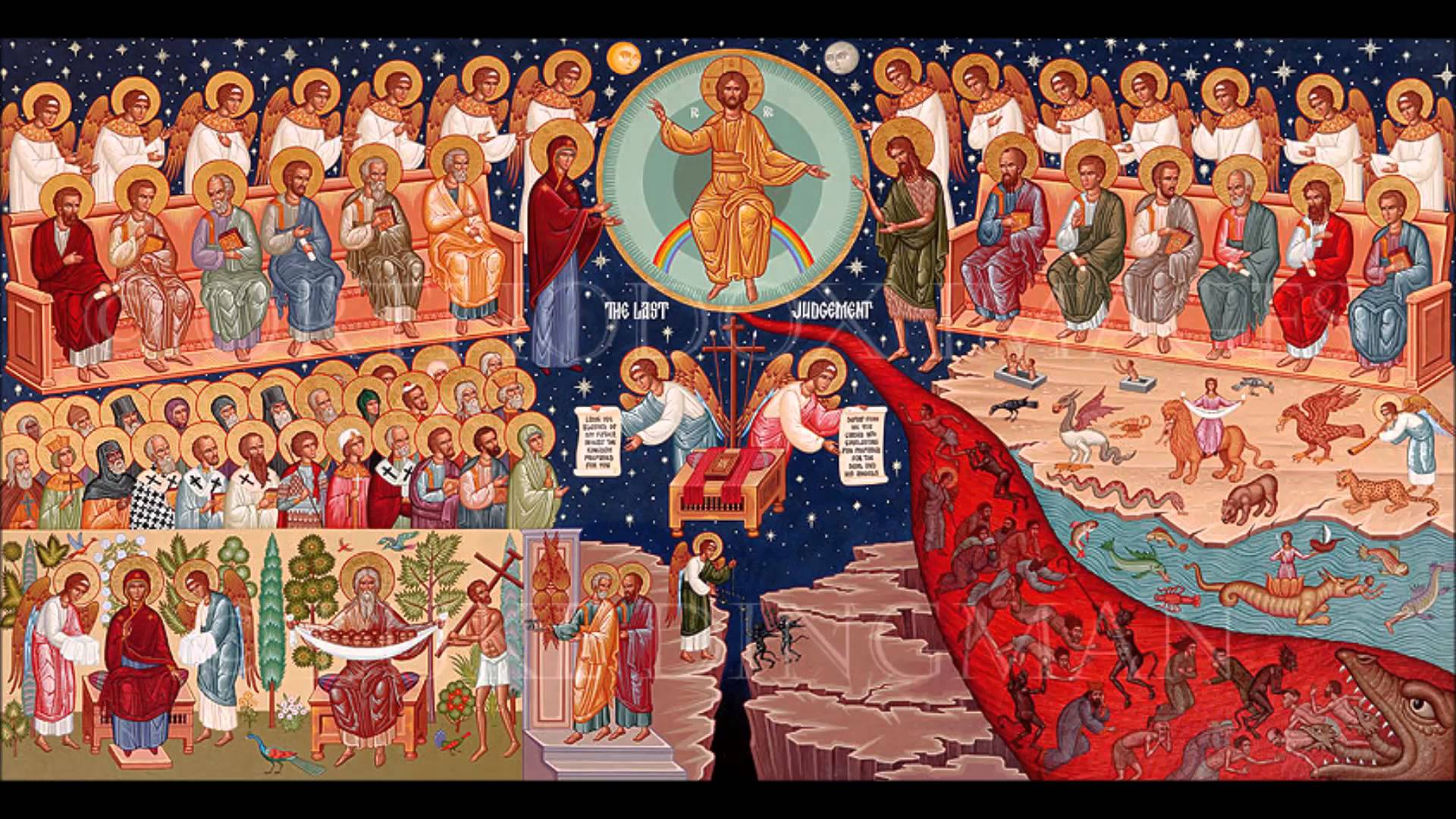
Perhaps the most famous icon of Christ is the “Pantocrater” image, with Christ blessing all with his right hand, and holding the Scriptures (which also represents separation, categorization, and therefore some sense of judgment), with his left.

But we should hold back if we assume that Christ categorizes His creation merely terms of right and left imagery. Two of the greatest saints of the Church are of course Mary His Mother and St. John the Baptist. Mary bears God within her womb, and spent her formative years in the temple in Jersusalem–right at the very center of God’s presence. John the Baptist, on other hand (a phrase that indicates that we too still use something of the right/left imagery) wears odd clothing, eats odd food, and resides in the wilderness outside the city, in the realm of chaos. So, the Church depicts Mary on the right of Christ, and St. John on the left to indicate a hierarchical difference between them

Yet obviously the “left-handedness” of St. John does nothing to diminish his status per se in the kingdom. Christ calls him “the greatest among men.”

We see the same treatment of the two great apostles of the Church, Saints Peter and Paul. St. Paul comes later, he’s younger, and he actively persecuted the church. He comes as one “unnaturally born,” to use his own words. St. Peter was one of the original twelve, the “rock,” a witness to the resurrection, and the preacher at Pentecost. Peter will therefore be shown on the right of Christ, Paul on the left.

Yet we remember too Peter also denied Christ, and Paul rebuked him for embracing the teaching of the Judaizers in the book of Galatians. The right hand has its faults just as the left hand. The hierarchy can be both affirmed and transcended at the same time.

We need a St. Maximus’ today, or at least we need to heed his wisdom. On the right of the political spectrum we have those that affirm the values of order and unity at the “center.” They are wary of the fringe’s of society, and this can make for rigid authoritarianism. The far left exalts the fringe above the center, idealizing the exception rather than the rule.** But if the falcon’s widening gyre leaves no center at all, we will have chaos. Or rather, we will have a hierarchy, but one that will invert basic reality and create a purposeless and powerless structure, with the “oppression olympics” and the race not towards strength, purpose, and so on, but towards impotent victimhood as one example of this.

Christ shows us that submission of the human to the divine does not debase the human, but exalts it. Rather than set the right hand against the left He affirms both without denying the place of either. In fact, for the right and left to work properly, they need each other. His hierarchy includes rather than excludes. This, our only viable political path forward, gives witness to deep theological truths. Of course, St. Maximus suffered for these truths and for this way of life,^ and perhaps we may need to as well.

St. Peter on the right (of Christ that is, imagining Him at the center), St. Paul on the left

*The medieval period had its share of rebellions, violence, etc. I am not trying to glorify the past so much as point out the difference in how they saw their place in the world, and to attempt to put a finger on our current malaise.

**We should ask the question whether or not we have a genuine “right hand” in America. The left is socially liberal but wants more government control over the market. The right tends towards more social conservatism but wants the market to operate without restrictions to maximize efficiency, not seeing how the market easily disrupts traditional communities and economies (for example, when Wal-Mart comes to a small town, say goodbye to Main Street). In the end, libertarians embrace both “left-handed” sides of things.

As Patrick Deneen has commented, we have solid anti-authoritarian safeguards built into our national DNA, but it appears that we lack an antidote for excessive individualism. Of course, both sides have elements of the excessive fringe and the excessive center embedded within them. For the right, the excessive center manifests itself in dangerous forms of nationalism, but their fringe enters with its exaltation of individual rights. The left praises every form of fringe behavior as liberation from group consensus, but their “center” manifestation that all must adhere to proper speech guidelines, for example (note the various numbers of people banned from Twitter, for example, who do not conform to proper speech as defined by the socially powerful).

What we witness now, in fact, is what happens when we lose sight of Christ, the Son of Man, and the Son of God.

^As an old man the theological and political tide turned against St. Maximus, and he had his tongue and right hand cut off. He died without seeing any earthly vindication of his theological vision.


The Burden of Nineveh

David F. Noble’s The Religion of Technology starts with an intriguing premise. Many, he argues, assume that religion and technology have a long standing enmity with each other. This narrative, bolstered by the urban legend of the church’s opposition to Columbus, and a misunderstanding of what happened with Galileo, runs deep in our cultural mindset. The triumph of Enlightenment thinking for some seals the deal in religion’s ultimate defeat by the march of progress and reason. Noble’s book sets out to show the opposite, that the creation of technology has always stemmed from a religious impulse, and that many of the world’s great technological pioneers created with a distinctly religious aim in mind.

Noble makes a few interesting claims. On the one hand, he points out that the church sponsored, or helped create certain technologies, such as the heavy plow in the Frankish empire, and a variety of other things. He also attempts to show such sponsorship meant a departure from established Orthodoxy, assuming that such ‘orthodoxy’ stood against technical development, and then traces this religious impulse down to the modern day. I can appreciate any attempt to help understand and heal the divide between religion and science, and Noble’s work accomplishes this to a slight degree. His problems stem from his lack of understanding of the meaning of technology, and the Scriptural tradition related to the topic. He misses crucial nuance and context.*

For starters, how anti-technology can Christian orthodoxy be if

  • The Old Testament has a variety of sections in which craftsmen are praised, especially those who build the temple.
  • Adam was told to tend and develop the garden. One might suppose that he would do so with more than just his hands.
  • Jesus was the (earthly) son of a carpenter

But Noble rightly points out ambiguity in the text and tradition, for we also see

  • That Cain’s line was the first to develop technology
  • That the early chapters of Genesis show that those that develop technology use it first for bad ends
  • That cities get a bad rap in OT at least, with Cain, Babel, Sodom, Egypt, and the like.

Noble makes no attempt to resolve these seeming contradictions and place technology in its proper context.

First we need to understand the meaning of mankind in creation, and why Cain developed tools and cities.

One can read Genesis 1 in a variety of ways. I think it best read as, at its core, an explication of the meaning of creation. Mankind comes last, but throughout the process of creation we see continual duality, first cosmically between light and dark, and then later between sea and dry land, fishes and birds, plants and animals, and so on. This dualities get closer together until we get the creation of man and woman. Mankind has the role of mediating between heaven and earth, of being the center point of the ladder of meaning that travels between what lies above and below.

The picture deepens when we see the Garden in Genesis residing on a mountain. The idea of a mountain bursting with life–this kind of paradox permeates the Christian faith, a paradox that we need to understand to interpret technologies role correctly. When Adam and Eve leave the garden, they descend down the mountain, a descent away from heaven toward earth, from meaning to fact. This “fall” downwards also gives one more earthly power, which makes sense as a kind of parody of heavenly wisdom.

In the Old Testament, as well as in other mythic traditions, the problem with technology comes not with the thing itself, but mankind receiving or grasping it before the proper time. We see this in the myth of Prometheus, for example. In the Garden, the tree of the knowledge of good and evil was declared “good” along with the rest of creation. To help destroy man the snake tempts them to take it before the proper time.** Cain’s subsequent wandering takes him down under the mountain, in fact. He begins to look not up to heaven but under the earth. He and his descendants build cities, tools, and even musical instruments. All of this has its roots in death–even the earliest instruments came from the horns or skins of dead animals. Naturally, actual physical death comes right on the heels of these technologies (Gen. 4:23-24).

Alienated from God, mankind no longer can properly unite heaven and earth. Many have speculated on the proper interpretation of Genesis 6:1-4. The early church saw these verses as the Book of Enoch interprets them. Fallen angels have, likely through demonic possession of some sort, join with women and their offspring become the Nephilim, a race of giants. Others see it in simpler terms, with the godly line of Seth intermarrying with the ungodly line of Cain. I prefer the former option, but either way, we see again the same problem, that of improper mixing, and mankind failing to properly mediate between heaven and earth. Once again, this results in violence and the flood. The flood represents chaos and a return to a formless void, but it only mirror the chaos already introduced by mankind who fell to the temptations of technology.

Science participates in the same pattern of uniting heaven and earth as other areas of life. No contradiction should exist between science and religion. Scientists take an idea, a hypothesis, and try and coherently unite that idea (what is ‘above’) to observable phenomena (what is ‘below’). One might argue that the power Science grants has a kinship with the power of words properly structured in a great speech. But, science seems to operate on a different scale. We many not initially see that the increase of power granted by technology serves in turn to make us more vulnerable. This shows itself in any number of ways in our experience. For example, if in traveling from New York to California we

  • walked, it would take us a long time, but the worst that could happen more or less is that we would sprain our ankle, or
  • ran, we could go a bit faster, but in falling, with the extra momentum, we could do more damage to our legs and feet, or
  • drove, we would get there faster still, but if something went wrong with the car we could get badly hurt in an accident, or
  • flew in a plane, we would go fastest of all, but if even a small thing goes wrong with the craft, death would be the likely outcome.

This quick sketch no doubt leaves many unanswered questions, but hopefully this shows that reticence the Church expresses about technology has nothing to do with fear of change, or control, but in something far deeper and more important. However, the biblical narrative develops another parallel track regarding the use of technology that begins just as the detrimental effects of the Fall take root. With Adam and Eve now naked and ashamed, God makes them a “garment of skin,” a covering, that allows them to encounter the world and each other. Such garments come from the death of animals, and we can see them as the first “technology.” This technology allows mankind to interact with the world. The garments come from death and are a concession to death, but serve a good purpose.

This turning of death into life also forms part of the pattern of creation, for “Christ was slain from the foundation of the world.” For, while the OT shows us the problem of cities within the patterns, the NT shows us that even the idea of the city becomes part of the glorification of all things (Rev. 20-21). We see hints of this in the OT as well, with the construction of the Tabernacle, which can be seen as a “covering,” a means for us to encounter God, since seeing Him directly would destroy us. The Temple later serves something of the the same purpose, but interestingly, many of the materials and craftsmen for the Temple came from foreign nations. such as Tyre and Lebanon, which allows to see two things simultaneously:

  • A foreshadowing of the gathering in of all nations to under the coming Messiah, of God reconciling all things to Himself in Christ, and
  • That these coverings come from Outside, they are not quite part of the “core” of kingdom culture, that the Temple is “tainted” in some way.

Noble makes the great point that our technological impulse is essentially religious. Done rightly, it can manifest our calling to unite Heaven and Earth properly. But a wrong application leads toward a potentially demonic path, where our worst impulses to make ourselves into one of the old gods. Noble fails to see this pattern and so he cannot coherently organize his thoughts to make a point beyond mere observations of particulars. To say that technological development cuts against “religious orthodoxy” is too strong a claim. To say that Church tradition has usually expressed a wariness with new inventions puts us nearer the truth. We need such caution on today’s rapidly expanding digital technology to give us a chance to navigate it rightly, and give us the best chance avoiding violence and destabilization.

In War and Civilization, a short work compiling Arnold Toynbee’s thoughts on the relationship between war and society, Arnold Toynbee quotes from a prominent biologist that,

One seductive and ultimately fatal path [of Evolution] has been the development of protective armor. An organism can protect itself by concealment, by swiftness in flight, by counter-attack, by uniting for counter-attack by others of his species and also by encasing itself within bony plates and spines. The last course was adopted by ganoid fishes of the Devonian with their shining armor. Some of the great lizards of the later Mesozoic were elaborately encased. Always the experiment of armor failed. Creatures adopting it tended to become unwieldy. They had to move relatively slowly. Hence they were forced to live on vegetative matter compared to living on more “profitable” animal food. The repeated failure of armor shows that, even a somewhat low evolutionary level, mind triumphed over mere matter. It is this sort of triumph which has been supremely exemplified in Man.

Toynbee used this analogy of armor as a reference point to the David and Goliath story. David’s rejection of armor gave him more than a potential tactical advantage over Goliath. We can see David refusing armor as a putting off of the Garments of Skin, as a return to something like the Garden. Jesus cursing the fig tree accomplishes much the same thing, which we can see as Christ reversing the fall–fig leaves formed the first covering for man (Gen. 3:7). And, when Jesus tells us that “the Son of Man has no place to lay his head,” He refers directly to the humility of His poverty. But he also hearkens back to the fact that He has no covering, that He shed his garments, so to speak.

With his commitment to seeing history through a spiritual lens, Toynbee arrived, perhaps unwittingly, had some of these same hesitations regarding power–another “covering” akin to the Garments in Genesis. He writes about the Roman Empire:

In the downward course of a civilization there is truth in the saying of the philosopher Heraclitus: “War is the father of all things.”  The sinister concentration of the resources of a civilization upon the business of fratricidal warfare may generate a military prowess that will place their neighbors at their mercy, may create a military technique that may grant them a far reaching technical mastery over the merely “Material World.”   

Since it is common to reckon success primarily by power and wealth, the opening chapters in the decline of a civilization will be hailed as times of blessing and growth, and this misconception can persist even for centuries.  Sooner or later, however, disillusionment is bound to follow, for a society that is hopelessly divided against itself is almost certain to try and double down on military might, for that is what seemed to work initially. 

For example, we see the money-power and man-power won for Greek society by Alexander the Great, and these same vast resources used to intensify the civil wars between Alexander’s successors.  This same power swept into Roman hands through the meteoric rise in Rome’s land and wealth ca. 241-146 B.C.  was just as quickly spent in the various civil wars that wracked Rome before the rise of Augustus and the Pax Romana.  For Spain, the treasure gained in the new world and the free labor of the essentially enslaved native populations was the food for their wars in Europe during the late 16th and early 17th centuries–the same wars that brought them into second-rate power status in Europe.

Thus the increasing command over the environment gained is apt to bestow upon a society a disintegration that puts a greater driving power into the suicidally demented society’s chosen work of self-destruction; and that story turns out to be a simple illustration of the theme that, “The wages of sin is death” (Rom. 6:23).  And again, the empires of industrialized Europe in the late 19th century gained the material resources to nearly destroy European civilization in our great Western civil war of 1914-18.  

War and Civilization centers around Toynbee’s examination of Assyrian civilization. Assyria stands as the poster child of how a quick, massive expansion of power actually can bring about a swift ruin and complete dissipation of that power. Such near instant bursts of physical growth bring with them commensurate problems, hence Toynbee’s chapter entitled, “The Burden of Nineveh.” With this in mind, we have a possible lens through which we can know whether or not we choose our garments well or poorly. We can begin by realizing that whatever coverings we put on will not actually solve our psychological, spiritual, or physical longings, though they can deceive us not thinking so. Sometimes these coverings hinder and obscure the best parts of us. But at times they are a necessary expedient to cope with challenges we face. Different people, and different civilizations might need to choose differently depending on circumstance. We should walk these paths with caution. The only way to avoid the deception of our garments of skin is to wear them with humility.

Dave

*Noble annoyed me early on by quoting with approval Max Weber’s idea that Christianity revived Roman polytheism. I can appreciate that Christianity is not strictly monistic as is Islam and perhaps Judaism, but Noble should know better. I suppose he left it in for supposed shock value, since it adds nothing to his thesis.

**We can see this same element in human sexuality. It is good, created by God. Only when we are properly prepared, in the right context (marriage between a man and a woman) can this “power” be wielded in a good and proper manner.

The Law of Gus

Ostensibly, this post discusses Michael Oriard’s fine book, Brand NFL, which I enjoyed. This post also serves as a companion piece to another post from about a year ago, “Every Sacrifice Needs a Witness.” I will try not to repeat points I have already made. I mention both of these things because I am starting in what will seem like an unrelated place for a book largely about football marketing and labor relations.

First, there exists a theory about sportscaster Gus Johnson. articulated by Bill Simmons:

I keep mentioning the Law of Gus without ever really defining it, so let’s do it right now. If Gus Johnson is calling an NFL game, the odds quintuple that (A) the lead will change hands in the fourth quarter; (B) someone will complete a long pass in a big moment that will make Gus’ voice hit an octave only dogs can hear; and (C) the game will go into overtime or at least come damned close. It seems impossible that the mere presence of an announcer would alter the course of the game, but . . .

Here are some of Johnson’s greatest moments and phrases . . .

One might perform some kind of statistical analysis of Johnson’s games, and perhaps discover that indeed there are more big moments, more exciting comebacks, than for other announcers. One could come up with any number of plausible materialistic explanations for this, i.e., Johnson is the best announcer, so they put him on the best games. Possibly, one might grant some kind of psychological reason–the players know that Johnson is announcing and that if they make a great play they will attain youtube immortality with the Gus Johnson call in accompaniment.

But . . .maybe there exists some kind of transformation of reality when Gus Johnson announces a game. Perhaps at times he is not merely a sportscaster, but a ringmaster. Otherwise, how could Vermont possibly beat Syracuse? I mean, Vermont?

Secondly, why do so many athletes pray before and during a game? On the one hand, it seems so silly. Surely God cares nothing for a mere game, and surely . . . athletes know this? Yet the behavior persists. Growing up I played baseball in high school, and we prayed the Lord’s Prayer before games, though my coach seemed indifferent to religion. I confess that praying before a baseball game seemed a bit off to me then and now, but football . . . that’s different. Though I never played high school football, I never experienced a combination of more fear and elation than in 10th grade, when catching a pass in a playground game with friends, I juked John–a merciless tackler now embarrassed and enraged–and then had to outrun him for 40 yards. Never again would I run as fast as I did that day, and strange (and sad) as it may seem, I still remember the exact words of praise I received from one friend after that run.

Aside from the “foolishness” of associating prayer with sports, many would object to differentiating between sports and the “appropriateness” of prayer at such events. If prayer “works” with one sport, it should work with another. But I would rank the major sports from Most to Least appropriate to associate with prayer thusly:

  • Football
  • Hockey
  • Basketball
  • Baseball

My explanation . . .

Football involves the highest levels of 1) Danger/”sacrifice” and 2) Communal action. Baseball involves some danger (batters facing a 95 mph fastball, pitchers dodging a comeback line drive), but that danger is limited to just a few people at a particular moment. Baseball might have more danger than basketball, but much less communal action. One could stand out in right field all day and have literally zero impact on the game. In basketball everyone on the court can rebound, pass, etc. and will have to do so at some point. During football games, almost anyone can get injured on almost any play, and, in contrast to baseball (but not hockey or basketball quite as much) everyone on the offense or defense has to move together, i.e., “communal action.”* It is in “communal action” that sports mimic religion, and that added element of danger and drama provide catharsis to players and fans alike. Just as every Sunday, in liturgical worship, worshippers go through the journey of death and resurrection.

As good as Oriard’s book is, it never even broaches subjects like this, and so his analysis comes up a bit thin at times.

Oriard played NFL football for Kansas City, and he combines his personal experience with good writing and insightful analysis in certain parts. I loved his take on the relationship between the changing passing rules and the increasing size of lineman, a nice compliment to Michael Lewis’ The Blind Side. Though he has an obvious bias in his discussions of the labor issues that beset the NFL between 1974-1987, I found it hard to disagree with him, or to dispute his claim that labor peace contributed significantly to the NFL’s rise to prominence in the 1990’s.

At times, however, Oriard wants it both ways. He laments the “paternalism” of the NFL’s in the 1950’s and 60’s with its coaches treating players like a strong, willful, caring, but occasionally crazy father. But when that era ended and players got more power, they also seemed to get into more trouble. Or–more likely, became bigger targets for journalists in the post-Watergate era, trained to always look for what lay behind the curtain. So, when players started to get exposed for taking drugs, did that primarily implicate the league, the player, or the fan who looked the other way so long as the players performed on the field?

Oriard’s method of laying out the issues, is quite familiar to us, and helpful in a way. We have our tradition of two political parties, prosecution and defense, etc. But we have no way to “break through” the common divides over such questions with the lens Oriard gives us. Another example—Oriard professes confusion as to why the public tended to side with the owners in the strikes during the 70’s and 80’s. Most of the time, people side with workers against “the man,” but not when it came to athletes striking. Oriard offers the possibility that the public wanted nothing to do with a dispute between billionaires and millionaires as an explanation. But that would only work if the public blamed each side equally. Besides, players did not really become “millionaires” until the late 1980’s at the earliest. Oriard frames the issues well, but his frame needs enlarged.

That fans tended to side with owners in labor disputes has its true explanation in the fact that elite athletes exist outside normal categories. Obviously they have outsized physical gifts, but I mean something more: their participation in liturgized communal danger “transforms” them into something more than a regular person. They morph into priests of ritualized conflict. We, the fans, acknowledge this, but perhaps only semi-consciously. Players may not be as rich as owners, but we do not watch highlights of owner’s meetings, we do not put owners on the covers of magazines, and we do not dream of being an owner–we dream of being Lebron, Tom Brady, Messi, and so on. Money is nothing compared to one’s ability to break tackles and run for 80 yards. When the chance to participate, however indirectly, in such a transformation gets “taken away,” we naturally focus on those to whom we give glory.** Mary Renault’s imagining of Theseus at Crete with the bull dancers in her The King Must Die give us perhaps a more accurate picture than Oriard. For Renault, the bull-dancers were pampered, feted, praised, glorified . . . and not expected to live long. No one cared about those that owned the bull-dancers one way or another.

As Oriard notes, when people dislike baseball they call it boring, but when they dislike football they find football “inhuman.” Not having the religious lens, again Oriard can’t quite see why this might be, beyond the violence of football. But both criticisms are correct. Baseball between two bad teams in August can personify boredom. The ritualized violence of football indeed both degrades and transcends normal human life. The ancients that went into battle understood this, the Greeks, the Vikings, and so on. This should give us additional perspective on the goal and achievement of medieval chivalry. To go into battle and remain something akin to a normal human being–neither a beast nor a dark god–stands as a tremendous achievement for a civilization. To reject Achilles and Alexander the Great as models for war, you need a strong, real, and powerful replacement.

I thought Oriard spot-on when discussing the narrative of domestic abuse and violence off the field. He showed decisively that players do not commit more crimes than the average person, and are not more violent than the average citizen. But in his discussion of drug-use, Oriard misses the religious side of the question. To share another brief personal example . . . very few fans ever came to our high school baseball games. But one day we played our arch rival. Late in the game, I came up with the bases loaded, down a run. I hit a line-drive over the 3rd baseman’s head, and I as I ran to first, I heard the roar of the crowd. Alas–it went foul by an inch or so–had it been fair at least 2 runs score, maybe we win, and maybe I’m the hero. When it might have gone fair, running down to first, hearing the crowd . . . I experienced something akin to transcendence. As it turned out, a couple of pitches later I grounded into a double-play–inning over. We ended up losing. Anyone who has played organized sports can relate to this experience. What one might feel in front of 50,000 instead of 150 I can only guess. That one might try and artificially recreate that feeling of transformation makes perfect sense, though a losing proposition from the start.

Of course I think religion important and often neglected as a subject, but I don’t praise every religion, any more that I applaud football’s connection to religion. In fact, football’s strong religious associations make it a viable competitor to the “higher” religion of Christianity. In addition to labor peace, football’s rise might also have something to do with the decline of institutional religion in America. Indeed, love it or not, football seems the quintessential sport for a civilization founded at the edge of the world, a place where utopia mingles easily with violence.

Dave

*One can apply this lens to other sports . . . soccer, large amount of communal action, but little danger (despite the writhing of various soccer players), bullfighting and bullriding, with its high levels of danger with almost no communal action related to that danger, and Formula 1, with its high level of danger, and high levels of communal action–but only behind the scenes, and the drivers being the only ones subject to great risk.

**One simple test for the religious nature of the sport and how much it draws in fans to the ritual participation is–do fans storm the field/court? They do so in football, and basketball too. But . . . not baseball.

Tolerating Toleration

I have written on a few occasions that those who write history books can fall into one of two errors:

  • Over-emphasizing the differences between things, which means that nothing can be compared to anything with any confidence, and
  • Over-emphasizing the similarities between things, which these days means that everyone is either Hitler or Stalin.

The best historians combine factual mastery with poetic gifts. They see rhyme and rhythm, but they never force it, letting the “occasional” square pegs stand aside from the round holes when appropriate.*

The first error (the “differences” error) is more useful. If you over-emphasize particular facts at the expense of synthesis, you have hopefully uncovered many useful pieces of information. But these kinds of historians are in my view not really historians, but researchers. They have definite skills, but play too close to the vest. Without extending themselves and taking a risk, they limit their impact.

The second error involves more chutzpah and dash, and so I tend to be more forgiving to those who synthesize too much. Toynbee, one of my great heroes, conflated Greek and Roman civilizations to such a degree that he claimed that Rome began its decline in 431 B.C., the year the Peloponnesian War started in Greece. Such an assertion perhaps has some grandeur in its theatricality. But no one could claim that this whopper arose from intellectual laziness on his part.

Other times, however, errors of the second kind can only arise from a combination of laziness and willful blindness. These types of errors of the “Over-emphasizing similarities” school are more dangerous than the “differences” school. When you aim higher, you fall farther.

One “similarities” error that has lingered on in the scholarship of late antiquity, and subsequently in the public consciousness, involves the interplay between Christianity post-Constantine and the older paganism. Sir Geoffrey Elton–a knight no less!–expresses this basic idea concisely, writing,

. . . religions organized in powerful churches and in command of the field persecute as a matter of course and tend to regard toleration as a sign of weakness or even wickedness towards whatever deity they worship. Among the religious, toleration is demanded by the persecuted who need it if they are to be triumphant, when, all too often, they then persecute in their turn. . . . To say this is not cynicism but sobriety of judgment.

Ugh–one can just imagine Sir Geoffrey Elton saying this with some British smugness. Intolerable, I say! It just won’t do!

So, Elton, followed by Peter Garnsey, and Francois Paschoud on the French side–and a host of others–mash everything up and declare that basically no difference existed between the intolerance of Rome towards Christians, and intolerance of Christians towards Roman pagans.

But even a brief look at this assertion shows its utter fatuity.

How did Rome persecute Christians? Over a span of 250 years (though not continuous over that period, but sporadic in its intensity) Rome imprisoned, tortured and killed thousands and thousands of Christians. Many died in a gruesome manner, as even Roman sources hostile to Christians attest. By the late empire, feeding Christians to lions in the arena was old hat. Even mild, tolerant, and “good” emperors like Trajan admitted that, yes, if push came to shove, Pliny should arrest and even execute Christians.

How did Christians persecute pagan Romans once in “command of the field?” They closed and sometimes destroyed temples. They refused to give state funding for pagan rites. They closed the Academy of Athens. Some sporadic–and important to note–non-state sponsored violence probably happened in some instances. One can cite the era of Theodosius I, from AD 379-395, where

hands and feet . . . were broken; their faces and genitals smashed . . .

But this violence was not directed at people but at the statues of gods and goddesses. However “purposeful” and “vindictive” (as one historian terms it) such actions may have been, it is not quite the same thing as watching people eaten alive for entertainment.**

Enter historian Peter Brown to set the record partially aright. Alas, I have only slight exposure to Brown, an acknowledged master of late Roman antiquity. My first impressions peg him tending towards the “differences” error, but this might suit him well to clean up the typical sludge created by Elton et. al. on this issue. He entitled chapter 1 of his work Authority and the Sacred: Aspects of the Christianization of the Roman World, “Christianization: Narratives and Processes,” which can only elicit one response:

But chapter two deals with the question of religious toleration in a much more promising manner.

Brown points out a few helpful counterpoints to Elton and his crew.

Most every ruler’s first priority involves money, which comes mostly through taxation. Any ruler of moderate ability understands the tricky nature of taxation, and how it relies upon a network of trust and compliance that is not easily enforced. Brown comments,

It is easy to assume that a tax system . . . so successful, indicated the indomitable will of the emperors to control the souls of their subjects as surely as they had come to control their wealth. In fact, the exact opposite may be the case. In most areas, the system of negotiated consensus was usually stretched to its limits by the task of exacting taxes. It had little energy left to give ‘bite’ to intolerant policies in matters of religion. It is no surprise that many sources indicate a clear relation between taxation and toleration. Faced by demands of Porphyry of Gaza for permission to destroy the temples of the city, supposedly in 400, the emperor Arcadius is presented as having said: ‘I know the city is full of idols, but it shows “devotio” in paying taxes and contributes much to the treasury. If we suddenly terrorize these people, they will run away, and we lose considerable revenues.”

Brown also stresses that late imperial Rome even in the Christian era involved shared power among elites. And these elites had strong common bonds between them that crossed religious lines. Brown writes again,

As far as the formation of the new governing class of the post-Constantinian empire was concerned, the fourth century was very definitely not a century overshadowed by [religious conflict]. Nothing could have been more distressing to the Roman upper-classes than the suggestion that ‘Pagan’ and ‘Christian’ were overriding designations in their style of life and choice of friends and allies. . . . Rather . . . studied ambiguity and strong loyalty to common symbolic forms . . . prevailed at this time.

Pagan and Jewish religious leaders, Brown notes, received not just toleration, but sometimes even support from the empire.

It would be wrong to imply, as Menachem Stern has done, that [Libanius and the rabbi Hillel] . . . found themselves drawn together “under the yoke of Christian emperors.” They were drawn together by common enjoyment of an imperial system that conferred high status on them both. . . . Both enjoyed high honorary rank, conferred by imperial codicilli–those precious purple letters of personal esteem signed by Theodosius in his own hand.

Theodosius, it bears mentioning, is often thought of as one of the great “intolerant” emperors.

So far, well and good. Brown, with his eye for detail and his great reluctance to generalize, gives an admirable riposte to the traditional academic narrative. But something still needs addressed. Brown blocks effectively, but asserts little beyond, “It wasn’t as clear cut as many think,” he seems to say. But everything is complicated. The historian should at least offer a way to make the complicated intelligible.

Alas, the elephant is still in the room, in the form of two important questions for scholars like Elton and Garnsey–questions that Brown fails to ask:

The first: toleration may be a good thing, but what are its limits? One can praise the virtue of getting along despite differences. Everyone knows this already, however. It’s not a hard thing to say. The hard thing means saying when the differences have become so great that co-existence no longer works, when the house divided cannot stand.

Drawing this line ultimately comes down to values, and values come from religious beliefs. My second question to Elton, etc. would be, “What is your religion? You seem to be neither pagan, nor Christian–and that’s fine. But what or who is your God/god? And what does He/She/It not like? What do you not tolerate? Surely He/She/It can’t like everything.

Brown avoids such questions, and that’s too bad. He has my respect, and a historian of his heft should apply his knowledge to this problem. As for our own situation in our own time, such questions have unfortunately become more than just theoretical. I believe that the media accentuates the differences between Americans for profit. Also, professional tweeters are more divided than average Americans. But a breaking point lies out there somewhere for all of us. We must acknowledge this, and at the same time, hope that we never find it.

Dave

*This observation might seem quite obvious, and so it is. But it is rooted in the profound truth of the nature of the Trinity–unity and diversity at the root of all being.

**I admit this is not the whole truth of all of Christian history. There were times and places where it got worse than this in the next 1000 years. But though it did at times get worse than what I describe above, it never equaled what Rome did.